必修 1 Unit 2 Travelling Around
Part 1 单元语法讲义--现在进行时表将来
Part 2 读后续写素材积累
Part 3 单元语法+读后续写即时检测
Part 1 单元语法讲义--现在进行时表将来
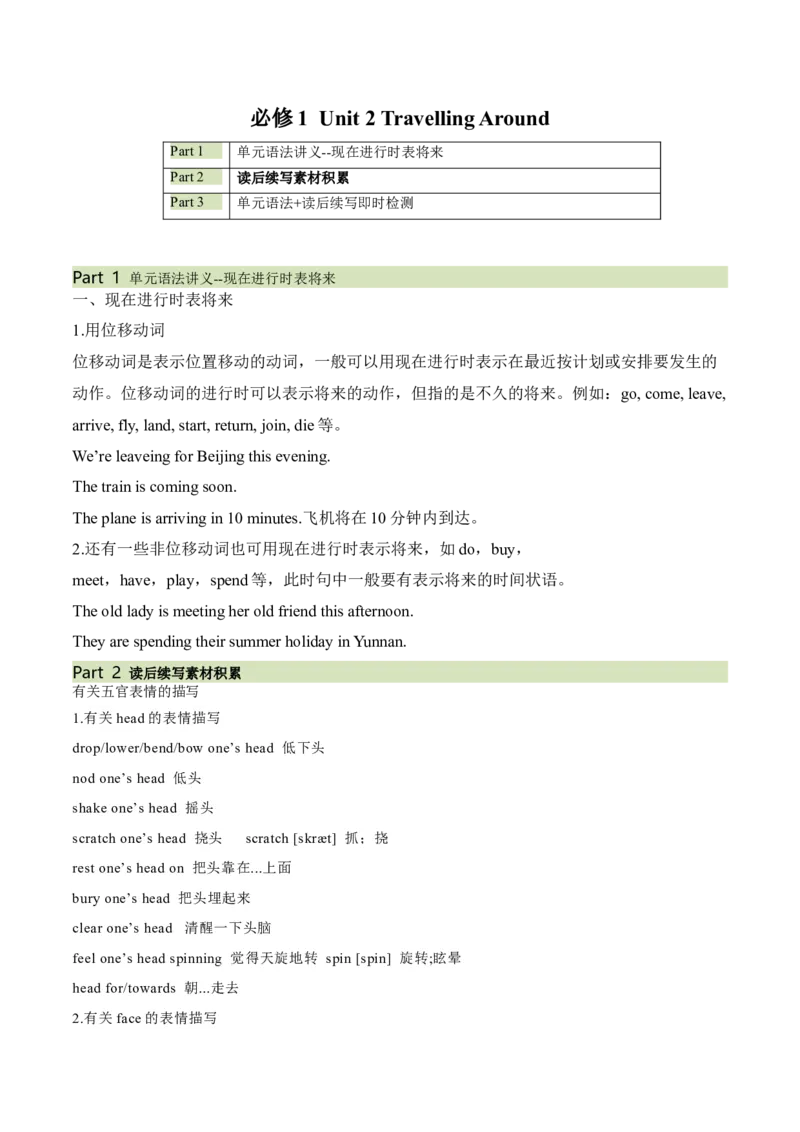
一、现在进行时表将来
1.用位移动词
位移动词是表示位置移动的动词,一般可以用现在进行时表示在最近按计划或安排要发生的
动作。位移动词的进行时可以表示将来的动作,但指的是不久的将来。例如:go, come, leave,
arrive, fly, land, start, return, join, die等。
We’re leaveing for Beijing this evening.
The train is coming soon.
The plane is arriving in 10 minutes.飞机将在10分钟内到达。
2.还有一些非位移动词也可用现在进行时表示将来,如do,buy,
meet,have,play,spend等,此时句中一般要有表示将来的时间状语。
The old lady is meeting her old friend this afternoon.
They are spending their summer holiday in Yunnan.
Part 2 读后续写素材积累
有关五官表情的描写
1.有关head的表情描写
drop/lower/bend/bow one’s head 低下头
nod one’s head 低头
shake one’s head 摇头
scratch one’s head 挠头 scratch [skræt] 抓;挠
rest one’s head on 把头靠在...上面
bury one’s head 把头埋起来
clear one’s head 清醒一下头脑
feel one’s head spinning 觉得天旋地转 spin [spin] 旋转;眩晕
head for/towards 朝...走去
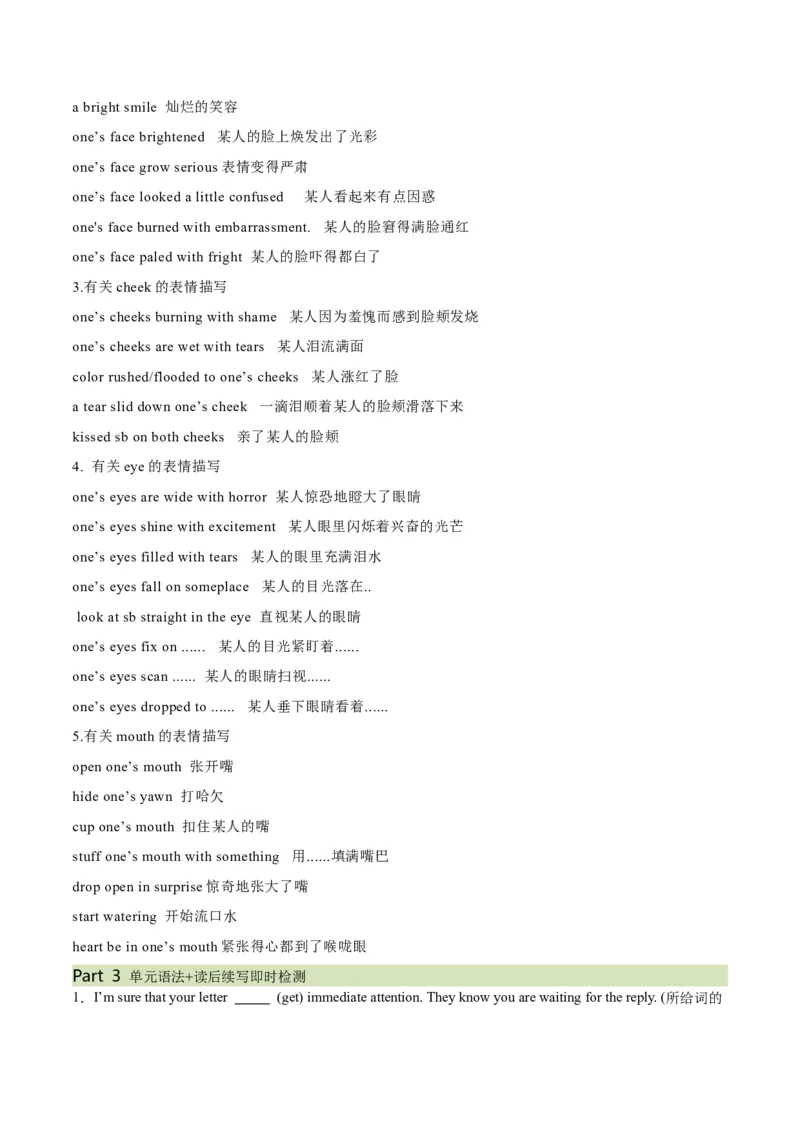
2.有关face的表情描写a bright smile 灿烂的笑容
one’s face brightened 某人的脸上焕发出了光彩
one’s face grow serious表情变得严肃
one’s face looked a little confused 某人看起来有点因惑
one's face burned with embarrassment. 某人的脸窘得满脸通红
one’s face paled with fright 某人的脸吓得都白了
3.有关cheek的表情描写
one’s cheeks burning with shame 某人因为羞愧而感到脸颊发烧
one’s cheeks are wet with tears 某人泪流满面
color rushed/flooded to one’s cheeks 某人涨红了脸
a tear slid down one’s cheek 一滴泪顺着某人的脸颊滑落下来
kissed sb on both cheeks 亲了某人的脸颊
4. 有关eye的表情描写
one’s eyes are wide with horror 某人惊恐地瞪大了眼睛
one’s eyes shine with excitement 某人眼里闪烁着兴奋的光芒
one’s eyes filled with tears 某人的眼里充满泪水
one’s eyes fall on someplace 某人的目光落在..
look at sb straight in the eye 直视某人的眼睛
one’s eyes fix on ...... 某人的目光紧盯着......
one’s eyes scan ...... 某人的眼睛扫视......
one’s eyes dropped to ...... 某人垂下眼睛看着......
5.有关mouth的表情描写
open one’s mouth 张开嘴
hide one’s yawn 打哈欠
cup one’s mouth 扣住某人的嘴
stuff one’s mouth with something 用......填满嘴巴
drop open in surprise惊奇地张大了嘴
start watering 开始流口水
heart be in one’s mouth紧张得心都到了喉咙眼
Part 3 单元语法+读后续写即时检测
1.I’m sure that your letter (get) immediate attention. They know you are waiting for the reply. (所给词的适当形式填空)
2.They (go) fishing if it doesn’t rain this afternoon. (所给词的适当形式填空)
3.The Chinese teacher (grade) the writing assignments tomorrow. (所给词的适当形式填空)
4.Our headmaster said that there (be) a sports meeting next month. (所给词的适当形式填空)
5.Alice said to me that she (stay) in her hometown for two more days. (所给词的适当形式填空)
6.I wasn’t sure whether the postman (deliver) me the package on time.(所给词的适当形式填空)
7.Last Sunday he promised he (come) but he hasn’t arrived until now. (所给词的适当形式填空)
8.—What did your son say in the letter?
—He told me that he (visit) the Disney World the next day. (所给词的适当形式填空)
9.He told me that he (go) to Beijing tomorrow.(所给词的适当形式填空)
10.We were not sure whether they were going (grow) more vegetables. (所给词的适当形式填空)
11.Father said that he (take) me to Beijing the next year. (所给词的适当形式填空)
12.I hoped Tina (come) to my birthday party on time the next Wednesday. (所给词的适当形式填
空)
13.Albert Einstein was born in 1879. As a child, few people guessed that he (be) a famous scientist whose
theories would change the world.
14.From the time I met Alicia, I knew she the next big thing in the technology world. (be) (所给词
的适当形式填空)
15.When the Internet first appeared, few people believed that it (become) popular. (所给词的适当
形式填空)
16.Tom was my leader and he promised that he (help)me if necessary. (所给词的适当形式填空)
17.I didn’t know when she (come), but when she came I would let you know. (所给词的适当形式填
空)
18.The professor told us that he (leave) for Canada for an important meeting the next Friday. (所
给词的适当形式填空)
19.He didn’t know that the experience (change) his whole life in the future. (所给词的适当形式填空)
20.She said that the bus (leave) at seven next morning.(所给词的适当形式填空)
二、读后续写
(2024·黑龙江吉林·模拟预测)
Crab Lessons
My son Geordi was a rather spirited boy. Very little held his attention for long. He spent most of his sparetime thinking up new ways to scare me half to death. Like the time he decided to “surf” on a tiny plastic table that
was meant to hold a few drinks rather than a six-year-old boy. Geordi had just begun learning about the ocean in
school and was surprisingly fascinated by it. We lived in Delaware, so any discussion about the ocean usually
included horseshoe crabs, which crowded our coasts to mate in the late spring.
As part of the lesson, Geordi’s teacher brought horseshoe crab shells (壳) to school for the children to touch
and examine. Hearing that horseshoe crabs had been around for over 300 million years, even before the dinosaurs,
Geordi thought that was officially the coolest thing he had ever heard. He could not stop talking about it for days,
and I decided it was time for us to take a drive to the Delaware Bay.
As we stepped out from the car, strong wind nearly blew my poor forty-five-pound child to the ground.
Being a six-year-old mischievous (调皮的) boy, Geordi saw this as an opportunity to showcase his amazing talents,
which included falling down, getting up, falling down and, yes, getting up again. This, of course, was always
complete with giggles (咯咯笑). The drama came to a sudden stop as Geordi spied the dozens of army-truck-
looking creatures in the sand. The next sound effect was “Wow!” as his body froze and his eyes widened with
wonder.
Geordi ran around excitedly, not knowing which one to check out first. He settled on a horseshoe crab that
was on its back, legs waving wildly in the air, desperate for water. “Mom, look at this one!” he screamed. “He’s
cool!” I pointed out the different body parts of the crab for him, and he listened quietly and absorbed the
information. He said, “I really liked him. I think I will name him Spike because he had all those really cool, spiky
(尖的) things on his back.” Then I picked up the crab, turned it over to its proper position and placed it at the edge
of the water.
注意:
1.续写词数应为150 左右;
2.请按如下格式作答。
Geordi asked what I was doing.
____________________________________________________________________________________________
____________________________________________________________________________________________
____________________________________________________________________________________________
____________________________________________________________________________________________
_____________________________________________________________________________________
Geordi spotted many more horseshoe crabs on their backs.____________________________________________________________________________________________
____________________________________________________________________________________________
____________________________________________________________________________________________
____________________________________________________________________________________________
_____________________________________________________________________________________