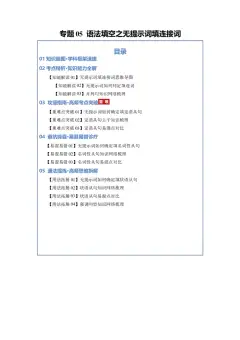
专题 02 语法填空——无提示词的填空
内容导航
命题透视·考情前瞻
01
对标素养,研判高考命题趋势
思维建模·脉络梳理
02
搭建知识框架,构建系统思维
考点精讲·靶向突破
03
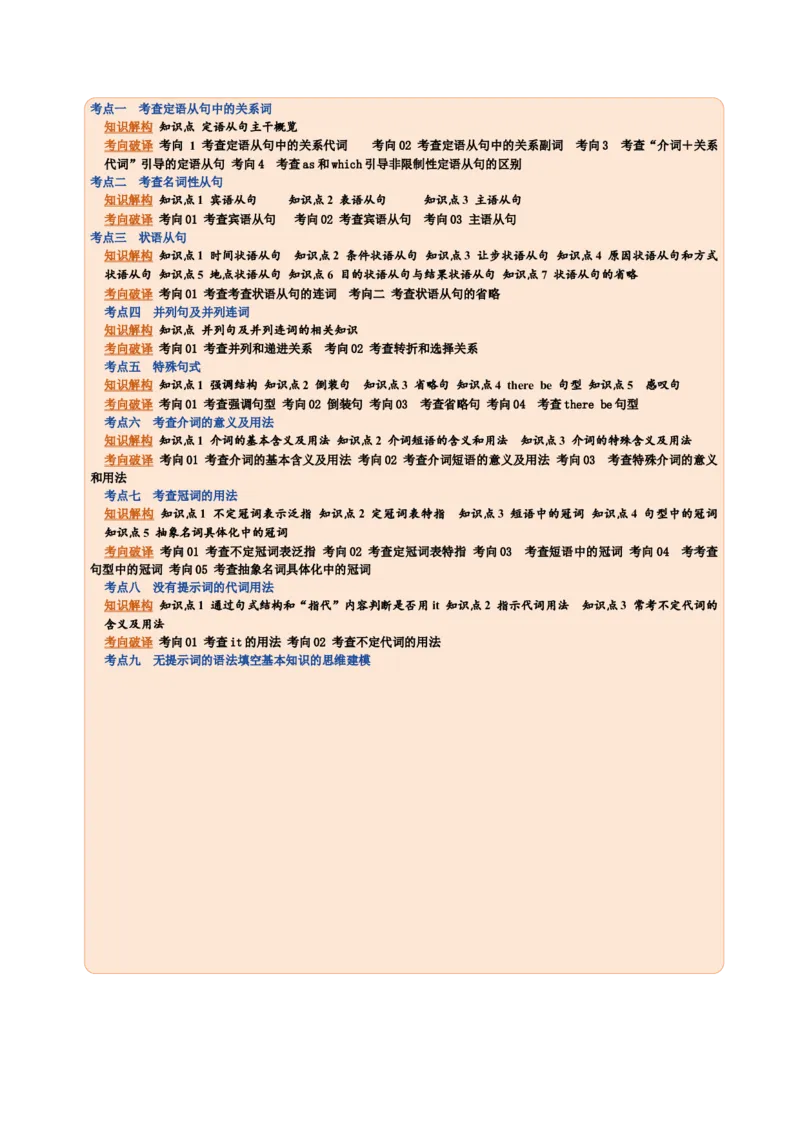
拆解核心考点,归纳解题范式考点一 考查定语从句中的关系词
知识解构 知识点 定语从句主干概览
考向破译 考向 1 考查定语从句中的关系代词 考向02 考查定语从句中的关系副词 考向3 考查“介词+关系
代词”引导的定语从句 考向4 考查as和which引导非限制性定语从句的区别
考点二 考查名词性从句
知识解构 知识点1 宾语从句 知识点2 表语从句 知识点3 主语从句
考向破译 考向01 考查宾语从句 考向02 考查宾语从句 考向03 主语从句
考点三 状语从句
知识解构 知识点1 时间状语从句 知识点2 条件状语从句 知识点3 让步状语从句 知识点4 原因状语从句和方式
状语从句 知识点5 地点状语从句 知识点6 目的状语从句与结果状语从句 知识点7 状语从句的省略
考向破译 考向01 考查考查状语从句的连词 考向二 考查状语从句的省略
考点四 并列句及并列连词
知识解构 知识点 并列句及并列连词的相关知识
考向破译 考向01 考查并列和递进关系 考向02 考查转折和选择关系
考点五 特殊句式
知识解构 知识点1 强调结构 知识点2 倒装句 知识点3 省略句 知识点4 there be 句型 知识点5 感叹句
考向破译 考向01 考查强调句型 考向02 倒装句 考向03 考查省略句 考向04 考查there be句型
考点六 考查介词的意义及用法
知识解构 知识点1 介词的基本含义及用法 知识点2 介词短语的含义和用法 知识点3 介词的特殊含义及用法
考向破译 考向01 考查介词的基本含义及用法 考向02 考查介词短语的意义及用法 考向03 考查特殊介词的意义
和用法
考点七 考查冠词的用法
知识解构 知识点1 不定冠词表示泛指 知识点2 定冠词表特指 知识点3 短语中的冠词 知识点4 句型中的冠词
知识点5 抽象名词具体化中的冠词
考向破译 考向01 考查不定冠词表泛指 考向02 考查定冠词表特指 考向03 考查短语中的冠词 考向04 考考查
句型中的冠词 考向05 考查抽象名词具体化中的冠词
考点八 没有提示词的代词用法
知识解构 知识点1 通过句式结构和“指代”内容判断是否用it 知识点2 指示代词用法 知识点3 常考不定代词的
含义及用法
考向破译 考向01 考查it的用法 考向02 考查不定代词的用法
考点九 无提示词的语法填空基本知识的思维建模04 真题溯源·考向感知
溯源真题逻辑,感知高考考向
命题透视·考情前瞻
——对标素养,研判高考命题趋势
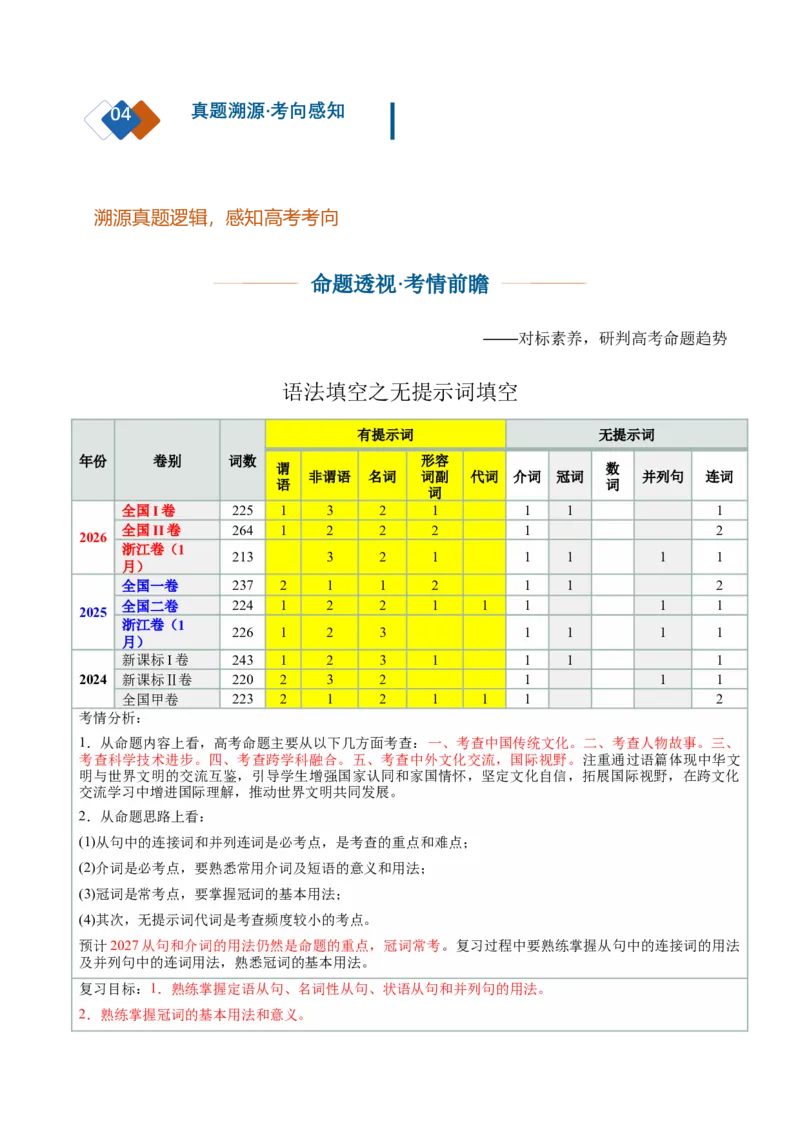
语法填空之无提示词填空
有提示词 无提示词
年份 卷别 词数 形容
谓 数
非谓语 名词 词副 代词 介词 冠词 并列句 连词
语 词
词
全国I卷 225 1 3 2 1 1 1 1
全国II卷 264 1 2 2 2 1 2
2026
浙江卷(1
213 3 2 1 1 1 1 1
月)
全国一卷 237 2 1 1 2 1 1 2
全国二卷 224 1 2 2 1 1 1 1 1
2025
浙江卷(1
226 1 2 3 1 1 1 1
月)
新课标I卷 243 1 2 3 1 1 1 1
2024 新课标Ⅱ卷 220 2 3 2 1 1 1
全国甲卷 223 2 1 2 1 1 1 2
考情分析:
1.从命题内容上看,高考命题主要从以下几方面考查:一、考查中国传统文化。二、考查人物故事。三、
考查科学技术进步。四、考查跨学科融合。五、考查中外文化交流,国际视野。注重通过语篇体现中华文
明与世界文明的交流互鉴,引导学生增强国家认同和家国情怀,坚定文化自信,拓展国际视野,在跨文化
交流学习中增进国际理解,推动世界文明共同发展。
2.从命题思路上看:
(1)从句中的连接词和并列连词是必考点,是考查的重点和难点;
(2)介词是必考点,要熟悉常用介词及短语的意义和用法;
(3)冠词是常考点,要掌握冠词的基本用法;
(4)其次,无提示词代词是考查频度较小的考点。
预计2027从句和介词的用法仍然是命题的重点,冠词常考。复习过程中要熟练掌握从句中的连接词的用法
及并列句中的连词用法,熟悉冠词的基本用法。
复习目标:1.熟练掌握定语从句、名词性从句、状语从句和并列句的用法。
2.熟练掌握冠词的基本用法和意义。3.熟练掌握常用介词及短语的意义和用法;
4.熟练掌握常用连词的意义和用法。
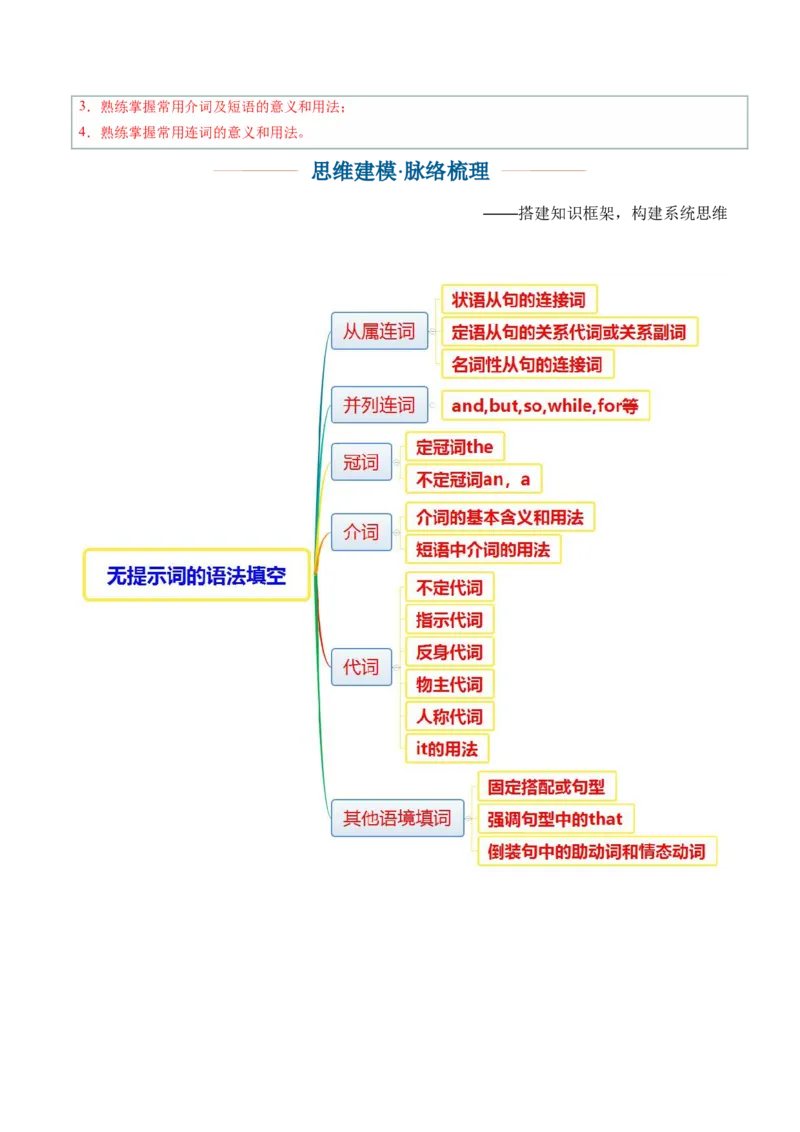
思维建模·脉络梳理
——搭建知识框架,构建系统思维考点精讲·靶向突破
——拆解核心考点,归纳解题范式
考点一 考查从句中的关系词
知●识●解●构
知识点 定语从句
1.确定是定语从句
设空处跟在名词后面,且空后的句子对这个名词进行修饰限定,即表示这个名词的性质、特点等,则
为定语从句。当确定为定语从句后,首先要看看先行词指人、物、时间、地点,还是其他,然后再根据先
行词在句子中所作的成分去判断用何关系词。
2.掌握三步法解题技巧
(1)分清限制性定语从句与非限制性定语从句。
①先行词的后面出现逗号,是非限制性定语从句。
②that不能引导非限制性定语从句。
③which引导非限制性定语从句,可以代表主句的全部或部分内容;代表整个主句时,which意为“这
一点”。
④as引导非限制性定语从句,可置于句中或句首,意为“正如”。其后的谓语动词多是be seen, be
known, be reported, be mentioned, be said, be often the case等。
(2)寻找先行词,判断属性(指人还是指物,表示时间,地点,还是原因)。
①先行词指人:that/who/whom/whose;
②先行词指物:that/which/whose;
③表示时间/地点/原因:when/where/why。
(3)判断定语从句所缺成分,确定关系词。
①缺少主语:that/which/who;
②缺少动词的宾语:that/which/who/whom;
③缺少定语:whose;④缺少时间、地点或原因状语时分别用when、where、why。
1.that与which的区别
(1)只用which不用that的情况:
①当关系代词前面有介词或介词短语时;
②引导非限制性定语从句时。
(2)只用that不用which的情况:
①当先行词是all、everything、nothing、something、few、little、much等不定代词时;
②当先行词被序数词、形容词的最高级或the very、the only、any、the last等修饰时;
③先行词既有人又有物时。
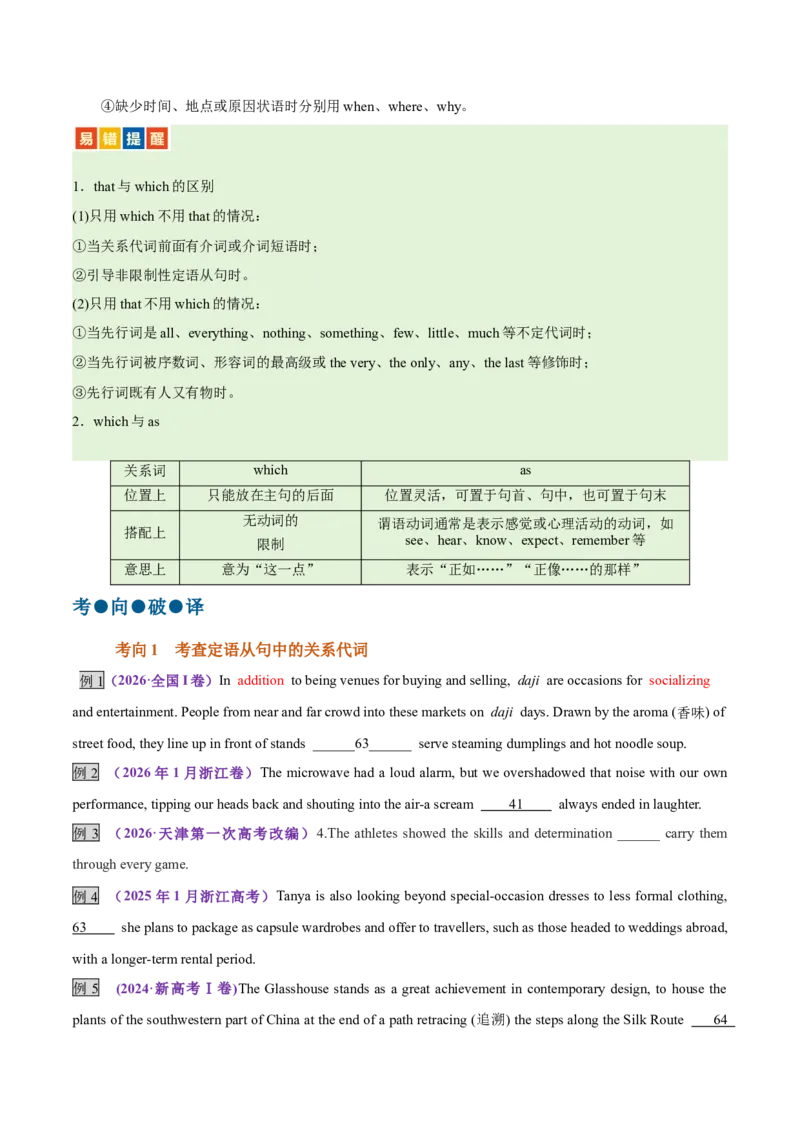
2.which与as
关系词 which as
位置上 只能放在主句的后面 位置灵活,可置于句首、句中,也可置于句末
无动词的 谓语动词通常是表示感觉或心理活动的动词,如
搭配上
限制
see、hear、know、expect、remember等
意思上 意为“这一点” 表示“正如……”“正像……的那样”
考●向●破●译
考向1 考查定语从句中的关系代词
例1(2026·全国I卷)In addition to being venues for buying and selling, daji are occasions for socializing
and entertainment. People from near and far crowd into these markets on daji days. Drawn by the aroma (香味) of
street food, they line up in front of stands ______63______ serve steaming dumplings and hot noodle soup.
例2 (2026年1月浙江卷)The microwave had a loud alarm, but we overshadowed that noise with our own
performance, tipping our heads back and shouting into the air-a scream 41 always ended in laughter.
例 3 (2026·天津第一次高考改编)4.The athletes showed the skills and determination ______ carry them
through every game.
例4 (2025年1月浙江高考)Tanya is also looking beyond special-occasion dresses to less formal clothing,
63 she plans to package as capsule wardrobes and offer to travellers, such as those headed to weddings abroad,
with a longer-term rental period.
例 5 (2024·新高考Ⅰ卷)The Glasshouse stands as a great achievement in contemporary design, to house the
plants of the southwestern part of China at the end of a path retracing (追溯) the steps along the Silk Route 64brought the plants from their native habitat in Asia to come to define much of the richness of gardening in England.
例6 (2023年新高考Ⅰ卷) The GPNP is intended to provide stronger protection for all the species ______ live
within the Giant Panda Range and significantly improve the health of the ecosystem in the area.
来自高考的易错提醒
只用that而不用which的情况
当先行词是all,much,little,few,everything等不定代词或被不定代词修饰时。
There is nothing that we can do now.现在我们什么也做不了。
考向2 考查定语从句中的关系副词
例1(2023全国甲卷)“There was once a town in the heart of America, 64 all life seemed to enjoy
peaceful existence with is surroundings,” her fable begins, borrowing some familiar words from many age-old
fables.
例2(2021天津卷)In the spring, a season ________ we are learning new rhythms of life,many of us find
comfort in the natural world.
例3“You have a full preparation before this event, which is the most important reason you show up here,”
I added with a sincere tone.
例4Scientists are transforming barren sands into productive land in China’s northwest, 36 towns once
moved away from advancing deserts, offering ecological and economic hope to local communities
考向3 考查“介词+关系代词”引导的定语从句
例1(2026·全国II卷)We move on to tai chi positions, of 61 there are forty-two in the style that
Angela teaches. Today, we will only be doing the first nine.
例 2(2021·天津卷 3 月改编) William Hastie once suggested that history informs us of past mistakes from
________ we can learn without repeating them.
例3(2020·江苏卷改编)Many lessons are now available online, from__________students can choose for free.
思维建模 “介词+关系代词”引导的定语从句
1. “介词+关系代词”引导定语从句时,介词的宾语只能用which或whom,且不能省略。
Some experts think reading is the fundamental skill upon/on which school education depends.
一些专家认为阅读是学校教育所依赖的基本技能。
2.“名词/不定代词/数词/形容词比较级或最高级+of+which/whom”引导的定语从句,表示部分与整
体的关系。Many young people,most of whom were well-educated, headed for remote regions to chase their dreams.
很多年轻人都去了偏远地区追求自己的梦想,他们中的大部分都受过良好的教育。
3. 在非限制性定语从句中,whose修饰物时可以换为“the+名词+of which”;修饰人时,可以换为
“the+名词+of whom”。
The newly-built café, the walls of which (=whose walls) are painted light green, is really a peaceful place
for us, especially after hard work.
这家新建成的咖啡馆,墙被刷成了浅绿色,对我们来说,真是一个安静的地方,特别是在辛苦工作后。
考向4 考查as和which引导非限制性定语从句的区别
例1(2024·全国甲卷)Yellowstone was the largest United States national park—2.2 million acres—until Wrangell-
Saint Elias in southern Alaska, 50 became a national monument in 1978, took the honors as a
national park in 1980 with 12.3 million acres.
例2(2023·全国甲卷)Yet, the form of the fable still has values today, Rachel Carson says in “A
Fable for Tomorrow”.
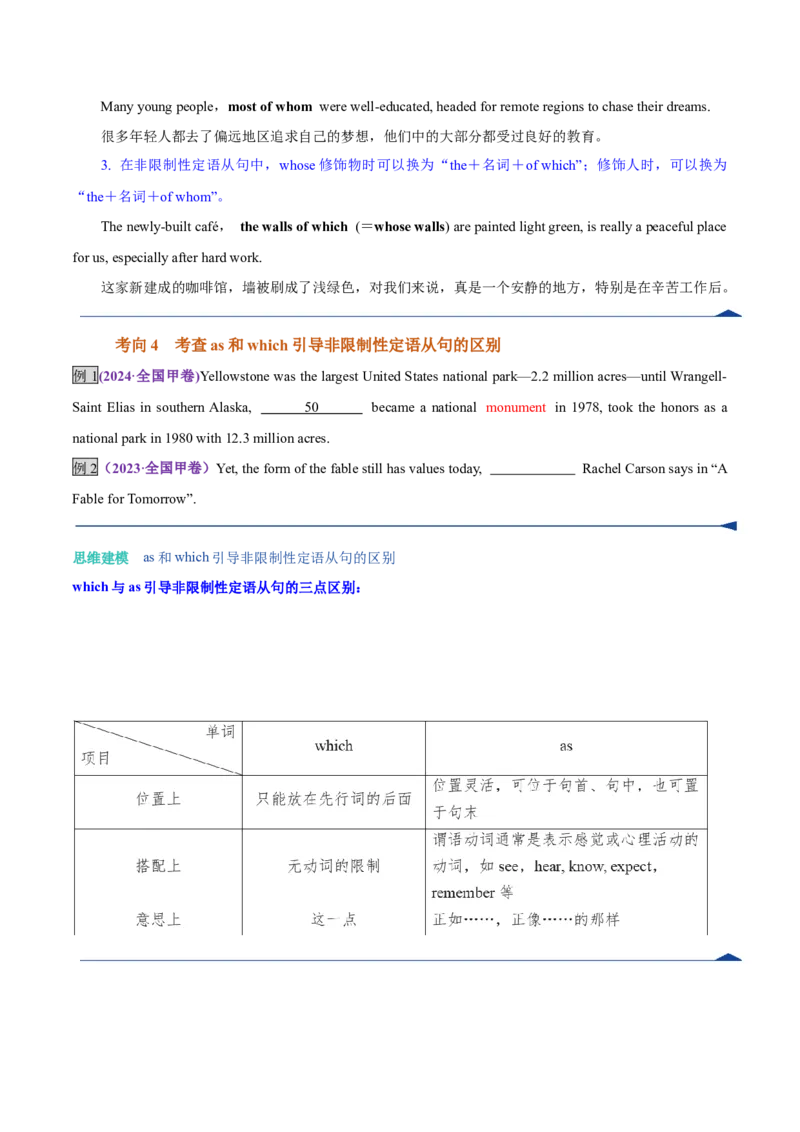
思维建模 as和which引导非限制性定语从句的区别
which与as引导非限制性定语从句的三点区别:考点二 考查名词性从句
知●识●解●构
知识点1宾语从句
1.宾语从句的引导词
引导词 作用
连接词 that, whether, if 只起连接作用,不在从句中作成分
what, who, whom,which,
连接代词 whichever,whatever, 在从句中作主语、宾语、表语或定语
whoever
连接副词 when, where, how, why 在从句中作状语
①I'm writing to tell you that my uncle Li Ming is going to your city for a conference.我写信是想告诉你,
我叔叔李明要去你的城市开会。
②We promise whoever attends the party will have a chance to have a photo taken with the movie star.我们
保证,任何参加这个聚会的人都有机会与那个电影明星合影。
③I don't know whether to set off for Beijing or not.我不知道是否出发去北京。
(1)that引导宾语从句时,常被省去,但下列情况下不能省略:①动词后跟有多个that引导的宾语从句时,
只有第一个that可省略,其余的不可省略;②宾语从句前有插入语时;③that引导的从句位于句首时。
(2)一般情况下介词后只能用wh-类连接词引导宾语从句。介词后的宾语从句,连接词表示“是否”时,只
能用whether,不能用if。
2.形式宾语【高频再现】
宾语一般放在及物动词或介词之后,但是,在下列情况下,须用 it作形式宾语,而将真正的宾语(常为
不定式/从句)后置。
(1)动词find/feel/think/consider/make+it+宾补(形容词或名词)+不定式/从句
(2)动词hate/like/dislike/appreciate/enjoy+it+从句
(3)短语动词see to/depend on/rely on+it+从句
(4)固定搭配take it for granted that/owe it to sb. that+从句
Most of us young men take it for granted that parents do everything for us.我们大部分年轻人认为父母为我们做的一切是理所当然的。
I shall see to it that he is taken good care of when you are absent.当你不在的时候,我负责把他照顾好。
3.宾语从句的时态
一般情况下,宾语从句须与主句的时态保持一致,即主句是一般现在时,从句可根据具体情况选用合
适的时态;主句为过去的某种时态,从句须用相应的过去的某种时态。当从句的内容为真理或客观事实时,
须用一般现在时。
知识点2 表语从句
1.表语从句的引导词
引导词 作用
连接词 that, whether 只起连接作用,不在从句中作成分
what, who, whom, which,
连接代词 whichever, whatever, 在从句中作主语、宾语、表语或定语
whoever
连接副词 when, where, how, why 在从句中作状语
The most important result for the user is that the product does what is intended.
对用户来说最重要的是产品达到了预期的效果。
This is where we usually think it's easier to just give up.
这就是我们通常认为更容易放弃的地方。
if不能引导表语从句;that引导表语从句时不能省略。
2.as if/as though引导表语从句
as if/as though意为“好像,仿佛”,引导的表语从句常跟在系动词(如seem, appear, look, taste, sound,
feel, smell等)之后。若表语从句所述的是非真实的情况,从句用虚拟语气;若所述的是事实或是极可能发
生的情况,从句用陈述语气。
The thick smog covered the whole city. It was as if a great black blanket had been thrown over it.
厚重的烟雾覆盖着整个城市,好像把一个厚厚的黑色的毯子扔到了它的上面。
3.其他常考的表语从句【高频再现】
(1)This/That/It is why+表语从句(表示结果)“这/那就是……的原因”
(2)This/That/It is because+表语从句(表示原因)“这/那是因为……”
(3)The reason why... is that+表语从句“……的原因是……”
知识点3 主语从句1.主语从句的引导词
引导词 作用
连接词 that, whether, if 只起连接作用,不在从句中作成分
what, who, whom,which,
连接代词 在从句中作主语、宾语、表语或定语
whichever,whatever, whoever
连接副词 when, where,how, why 在从句中作状语
When the delayed flight will take off depends much on the weather.
延迟的飞机何时起飞在很大程度上取决于天气。
Where Professor Han was born is known to the public.韩教授出生的地方人人皆知。
What struck me most in the movie was the father's deep love for his son.
影片中最打动我的是父亲对儿子深深的爱。
(1)that引导主语从句时一般不省略。
That they were in truth sisters was clear from the facial similarity between them.从她们的面貌相似度就能清楚地
看出她们是亲姐妹。
(2)whether与if引导主语从句的区别:
主语从句位于主句的谓语动词前,表示“是否”,只能用whether而不能用if引导;若用it作形式主语,
则if与whether可互换。
Whether we can have clean drinking water lies in what effective measures will be taken by the government about
water pollution.
我们能否有干净的饮用水在于政府将采取什么样的有效措施处理水污染问题。
It remains to be seen whether/if this idea can be put into practice.
这一想法能否付诸实施还有待观察。
2.形式主语【高频再现】
it作形式主语的常见句型:
(1)It+be+形容词(necessary/likely/important/certain等)+that从句
(2)It+be+名词(短语)(a pity/a shame/no wonder等)+that从句
(3)It+be+过去分词(said/told/reported等)+that从句
(4)It+不及物动词(seem, appear, happen, matter等)+that从句
It is uncertain what side effect the medicine will bring about,although about two thousand patients have
taken it.尽管大约两千名患者已经服用了这种药,但是它会带来什么样的副作用还不清楚。
It doesn't matter whether you pay by cash or credit card in this store.在这个商店里你用现金支付还是信
用卡支付都没有关系。
考●向●破●译
考向一 考查宾语从句
例1(2026·天津第一次高考改编)Researcher still wondered ______ the new medicine would be effective on
animals.
例2 (2024·全国甲卷)How did the national park system come about? On a cool, starry night in
mid-September 1870, four men relaxed before a campfire along the Firehole River in 43 is
now northwestern Wyoming.
例 3(2022 年 1 月浙江)Cobb, for her party, started to ask conference organizers who invited her to speak
______ she could do so remotely.
考向二 考查表语从句
例1 (2024年1月浙江高考真题)If most of their customers are happy to buy larger quantities, that’s 59
they’ll promote. But that leaves the solo (单独) customers out of pocket and disappointed.
例2 (2023·新高考Ⅱ卷)This is they need an English trainer.
例3(2021·全国甲卷)One of the ground rules of the swap should be__________everyone must try on the clothes
before they take them.
名词性从句中that与what的区别:
引导名词性从句既可以用that,也可以用what。两者的区别在于that在句中不作成分,what在从句中作主
语、宾语或表语。
考向三 考查主语从句
例1 (2021新课标I卷)_____________is so breathtaking about the experience is the out-of-this-world scenes.
例2(2020·江苏卷)It is not a problem__________we can win the battle; it's just a matter of time.
whether与if引导主语从句的区别:
主语从句位于主句的谓语动词前,表示“是否”,只能用whether而不能用if引导;若用it作形式主语,
则if与whether可互换。
Whether we can have clean drinking water lies in what effective measures will be taken by the government about
water pollution.我们能否有干净的饮用水在于政府将采取什么样的有效措施处理水污染问题。
It remains to be seen whether/if this idea can be put into practice.这一想法能否付诸实施还有待观察。
例3Moreover, the silk texture and colour have both grown inconsistent makes creating the necessary
raw materials and matching the colour difficult. The advanced technology is helping them with the restoration.
what & that在名词性从句中的用法:
that是从属连词,在名词性从句中不充当任何成分,也没有任何意义。而 what是连接代词,在名词性从句
中充当成分,通常充当主语、宾语或表语。
I believe that I will succeed if I study hard.我相信如果我努力学习我会成功的。
考点三 状语从句
知●识●解●构
知识点 1 时间状语从句
1.when引导时间状语从句,意为“正在这时”,表示某件事正在发生或刚刚发生时,突然发生另一
动作。
Tom was about to close the window when his attention was caught by a bird.
汤姆正要关窗户,这时他的注意力被一只鸟吸引住了。
when还可表原因,意为“既然”。
How can I help them to understand when they won't listen to me?
既然他们不听我说,我怎么帮他们理解?
2.as soon as, immediately, directly, instantly, the moment, the minute, the instant, no sooner...than...,
hardly/scarcely...when...和once(一……就……),这些从属连词引导的从句都表示从句的动作一发生,主句
的动作随即就发生,常译为“一……就……”,从句中用一般时态代替将来时态。
The moment I heard the voice, I knew father was coming.
我一听到那个声音就知道父亲来了。
The boy burst into tears immediately he saw his mother.
那男孩一见到他妈妈便放声大哭。
no sooner... than..., hardly/scarcely....when....的时态搭配:hardly/scarcely后的句子谓语动词应
用过去完成时,而 than 与 when 引导的句子谓语动词应用一般过去时。此外,当把 no sooner和hardly/scarcely提到句首时,应用倒装语序。
He had no sooner finished his speech than the students started cheering.
=No sooner had he finished his speech than the students started cheering.
他刚完成演讲学生们就开始欢呼起来。
3.before
(1)表示“还未……就……;不到……就……;还没来得及……就……”。
The girl had hardly rung the bell before the door was opened suddenly, and her friend rushed out to greet her.
小女孩还没来得及按门铃,门就突然开了,并且她的朋友冲出来问候她。
Please write it down before you forget it.
趁你现在没忘把它记下来。
(2)It will be+一段时间+before...多久之后才……。
It is+一段时间+since... 自从……多久了。
John thinks it won't be long before he is ready for his new job.
约翰认为他不久就会为新工作做好准备了。
知识点 2 条件状语从句
1.通常由if, unless, as(so)long as, in case(that), once等连词引导。
Unless children believe they can succeed, they will never become totally independent.
除非孩子们相信他们能够成功,否则他们将永远无法完全独立。
2.由on condition(that); provided(that); providing (that); supposing(that)等引导的条件状语从句。
You can go swimming on condition that you don't go too far from the river bank.
只有不离河岸太远你才能下去游泳。
知识点 3 让步状语从句
1.让步状语从句可由 although, though, as, while, even if(though), whenever, whether... or..., no matter
who(when, what...)等引导。
Although regular exercise is very important, it's never a good idea to exercise too close to bedtime.
尽管有规律的锻炼是很重要的,但是在临近就寝的时候进行锻炼绝不是一个好主意。
However serious a problem you may have, you should gather your courage to face the challenge.
不论你的问题有多严重,你都应该鼓起勇气,接受挑战。
2.while作“尽管”讲,引导让步状语从句时,往往放在句首。
While the Internet is of great help, I don't think it's a good idea to spend too much time on it.
尽管因特网对我们有很大的帮助,但我认为花太多的时间上网也不是一个好主意。
while也可以用来表对比转折,意为“而,却”。At school, some students are active while some are shy, yet they can be good friends with one another.
在学校,有的学生很活跃而有的很腼腆,但他们能成为好朋友。
知识点 4 原因状语从句与方式状语从句
1.方式状语从句用来表示主句谓语动作发生的方式,常由as“像……一样”,as if (though)“似乎,好
像”等引导。
The house was greatly damaged by the truck. We'd better leave things as they are until the police arrive.
卡车对这座房子造成了严重的损坏。我们最好保持原样直到警察到来。
He acted as if nothing had happened.
他表现得好像什么也没发生。
2.原因状语从句通常由because, since, as, now that, seeing(that), considering that等引导。
Now that you have grown up, you must do it by yourself.
既然你已经长大了,就必须自己做这件事。
Considering that I have told you three times, you must know it.
鉴于我已经告诉你三次,你必须知道它。
知识点 5 地点状语从句
1.通常由连词where和wherever引导,从句可位于主句之前,也可位于主句之后。
The little girl who got lost decided to remain where she was and wait for her mother.
这个迷路的小女孩决定待在原地等她妈妈。
Today, we will begin where we stopped yesterday so that no point will be left out.
今天我们将在昨天停止的地方开始,为的是不漏掉知识点。
2.地点状语从句在句首时常兼有抽象条件意味。
Where there's a will, there's a way.
有志者事竟成。
Where(ver) there's plenty of sun and rain, the fields are green.
哪里阳光雨水充足,哪里的田野就绿油油。
3.where引导的状语从句和定语从句的区别
where引导地点状语从句直接修饰动词,而在定语从句中where作为关系副词要跟在表示地点的先行
词后面。
When solving the problem a second time, you'd better be more careful where you made a mistake.
=When solving the problem a second time, you'd better be more careful in the place where you made a
mistake.
当你第二次解决这个问题的时候,你要在出过差错的地方更加小心。知识点 6 目的状语从句与结果状语从句
1.目的状语从句。
引导目的状语从句的从属连词有so that,in order that, for fear that, in case,lest等。
(1)in order that与so that。
两个连词都意为“以便……;为了……”,引导的状语从句中需用情态动词,in order that比so that正
式,引导的状语从句可置于主句之前或之后,而so that引导的从句只能置于主句之后。
I'll speak slowly so that you can understand me.
我说慢一点以便你能听懂。
In order that we might see the sunrise, we started for the peak early.
为了能看到日出,我们很早就向山顶出发了。
(2)for fear that, in case与lest。
这三个从属连词引导的目的状语从句中谓语动词要用(should+)动词原形,它本身带有否定意义,相当
于so that... not...或in order that... not...。
The boy hid himself behind the tree in case/for fear that his father(should) see him.
男孩躲到树后以防被父亲发现。
Take your raincoat in case/lest it (should) rain.
带着你的雨衣,以防下雨。
2.结果状语从句。
(1)引导结果状语从句的从属连词有:so that, so...that..., such...that...。在非正式语体中,由so...that...和
such...that...引导的句子中that可以省略,注意其结构形式:
Mike is such an honest worker that we all believe him.
=Mike is so honest a worker that we all believe him.
迈克是如此诚实的工人以至于我们都信任他。
It is such fine weather that we all want to go to the park.
天气如此的好,我们都想去公园。
He earned so little money that he couldn't support his family.
他挣钱太少以至于无法养活家人。
(2)当so或such置于句首时,主句要用倒装语序。
So clever a student was he that he was able to work out all the difficult problems.
他是一个如此聪明的学生,以至于他能算出所有的难题。
知识点 7 状语从句的省略
在时间、条件、让步、原因等状语从句中,当从句主语和主句主语一致,或从句主语是 it,且含有动
词be时,可以将从句主语和动词be动词省略。The school rules state that no child shall be allowed out of the school during the day, unless accompanied by
an adult.
学校规则规定:除非有大人的陪伴,否则任何孩子白天都不允许出学校。
The problem, if not carefully dealt with, will cause a lot of damage.
这个问题,如果不小心处理,将会造成重大损失。
The dying man is moving his eyes slowly as if looking for his family.
这个奄奄一息的人慢慢地转动眼睛好像在寻找家人。
考●向●破●译
考向一 考查状语从句的连词
例 1 (2020·全国卷Ⅲ)__________ he asked the villagers on the banks of the river where he could find the
legendary(传奇的) artist, they smiled and pointed down the river.
例2 (北京卷)If you don't understand something, you may research, study, and talk to other people__________you
figure it out.
思维建模 如何确定状语从句
1.确定是状语从句
空处所在的句子作整个句子的状语时,应用状语从句的引导词。
2.状语从句的特殊考点要记牢
(1)连词before的意义及句型
It will be+一段时间+before ...“多久以后才……”;It won't be+一段时间+before ...“用不了多久
就……”。
(2)连词since的意义及句型
It is +一段时间+since引导的时间状语从句=It has been +一段时间+since引导的时间状语从句。
该固定句型意为“自从……以来,已经多长时间了”。
(3)whether ...or ...,疑问词+-ever,引导让步状语从句。
(4)where引导地点状语从句。
1.when, while, as
(1)when, while, as三者都可以用来引导时间状语从句,意为“当……的时候”。
(2)在when和as引导的从句中,谓语动词既可以是延续性动词也可以是终止性动词,而在while引导的从
句中,谓语动词只能是延续性动词。
(3)三者中as引导时间状语从句时,表示主从句动作同时发生或前后紧接着发生,常译为“(正当)……的时候”“随着……”“一边……一边……”等。
2.so ...that ..., such ...that ...
(1)二者都可以引导结果状语从句。so 后中心词为形容词或副词, such后中心词为名词。
(2)若中心词之前有表示数量的many、much、little、few修饰时,只能用so。
例3 (2018·江苏卷)__________you can sleep well, you will lose the ability to focus, plan and stay motivated after
one or two nights.
例4 (湖南卷)__________hard you try, it is difficult to lose weight without cutting down the amount you eat.
首先判断是否用连词,与定语从句要区别开来。连词连接的往往是两个完整的句子,其中
一个用连词连接,是状语从句。如果其中一个句子中缺少成分,那么就是定语从句,不能用引导状语从句
的连词。
考向二 考查状语从句的省略
例1 (陕西卷)All the photographs in this book,__________stated, otherwise, date from the 1950s.
例2(全国卷Ⅰ)Film has a much shorter history, especially when__________(compare) to such art forms as music
and painting.
状语从句省略后,只剩下不定式(to do)短语、现在分词(doing)短语和过去分词(done)短语,
表示“将要做的事情”用不定式(to do)短语;表示“主动的动作”用现在分词(doing)短语;表示“被动且
完成的动作”用过去分词(done)短语。
考点四 并列句及并列连词
知●识●解●构
知识点 1 确定填并列连词
无提示词,空前后是两个并列的主谓完整的句子、单词、短语等;而且相并列的成分之间是并列、转
折、选择或因果关系,应填并列连词。
2.两个技巧要熟用
技巧1:关系分析法
分析空前后单词、短语或分句之间的关系,确定用哪个连词。
(1)表示并列或递进关系的有and、both ...and ...、not only ...but (also) ...、neither ...nor ...等。
(2)表示选择关系的有or、either ...or ...、not ...but ...等。
(3)表示转折或对比关系的有but、while等。(4)表示因果关系的有so、for等。
技巧2:句型法
(1)祈使句+and/or+陈述句,如表示顺承用and,表示转折用or。
(2)when作并列连词的常用句型:
Sb be doing sth when ...
Sb be about to do sth when ...
Sb had (just) done sth when ...
Hardly ...when ...
1.并列句与定语从句
防止并列句与定语从句混用:并列句由and、but等并列连词连接,句中已有连接词,这时就不能再用引导
定语从句的关系词了。
①They live in a small house, in front of ___________stands an orange tree.
②They live in a small house, and in front of ___________ stands an orange tree.
【解析】两句的区别是连词and,句①逗号后为非限制性定语从句,空处为引导词,表示物,故填 which;
句②中and连接两个并列分句,空处指代前面分句中的a small house,故填it。
③The old man has three sons, none of ___________ is a doctor.
④The old man has three sons, but none of ___________is a doctor.
【解析】两句的区别是连词but,句③逗号后为非限制性定语从句,空处为引导词,表示人,且其前为介
词of,故填whom;句④中but连接两个并列分句,空处指代前面分句中的three sons,故填them。
2.并列句与状语从句
辨清并列句与状语从句:并列句是连词连接两个“互不依存的主谓结构”,两者之间是并列关系;而状语
从句中前后两个句子,一个是主句,一个是从句,从句是用来修饰主句的。
①___________you take the medicine, you will be all right.
②Take this medicine, ___________you will be all right.
【解析】句①空处引导条件状语从句,表示“如果”,故填If;句②中两个并列分句是顺承关系,故填
and。
③ ___________money is necessary for a happy life, it can't buy happiness.
④Money is necessary for a happy life, ___________it can't buy happiness.
【解析】句③空处所在句子是让步状语从句,故填 Although/Though;句④空处前后是转折关系,故填
but。考●向●破●译
考向一 考查并列和递进关系
例1 (2026·全国II卷)Angela, a tai chi instructor with twenty-eight years of experience, says that a successful
hour of tai chi is an hour with no negative thoughts. “Your mind 58 body go together. That’s all that
matters.”
例2(2026年1月浙江卷)She would speed up, the wind blowing our hair back 44 my tiny voice
singing out, “Weeee-eee-eee!”
例3 (2024·新高考II卷)It was very exciting to hear the Chinese language ____45____ see how Tang’s play
was being performed.
考向二 考查转折和选择关系
例1 (2024·1月浙江卷) Either your shopping is then too heavy to carry home 57 you can’t use what
you’ve bought while it’s still fresh.
例2 (2023全国乙卷)It is a distinct visual contrast (反差) that shouldn’t work, 65 somehow these
two very different worlds make a good combination.
考点五 特殊句式
知●识●解●构
知识点1强调结构
1.强调句型。
(1)强调句型的基本结构为:It is/w+被强调的部分+tt/who+句子其他部分。该句型可对句子的主语、
表语、宾语、同位语、状语等进行强调。
(2)强调句型的一般疑问句结构为:Is/Was+it+被强调的部分+that/who+句子其他部分?
He asked what it was that made him so upset.
他询问究竟是什么让他如此难过。
(3)强调句型的特殊疑问句结构为:特殊疑问词+is/was+it+that+句子其他部分?
强调句型亦可用于宾语从句中,但注意语序要用陈述句语序。
It was not until he took off his sunglasses that I realized him.
直到他摘下墨镜我才认出他。
(4)not...until句型的强调句型结构为:It is/was not until...+that+句子其他部分。2.强调谓语动词。
用助动词do,does或did来强调谓语动词,用于一般现在时和一般过去时的肯定的陈述句中,do还可
以用于祈使句。
知识点2 倒装句
1.将含有否定意义的副词或连词置于句首引起的部分倒装结构。这类词(组)有:never, seldom, rarely,
little, few, at no time, by no means, no longer, hardly/scarcely...when..., no sooner...than..., not only...but also..., not
until, nowhere, neither...nor...等。
Never before has she seen anybody who can play tennis as well as Robert.
她以前从没见过打网球和罗伯特一样好的人。
2.only+状语置于句首时,主句要进行部分倒装。
Only after they had discussed the matter for several hours did they reach a decision.
讨论这个问题数小时后他们才做出决定。
3.作状语的介词短语放于句首时引起的句子要全部倒装。有时为了强调将作状语的介词短语放在句
首,而将主语放到句末;或者当句子中主语较长时,为了使句子平衡,常把作状语的介词短语置于句首。
Through the window came in the sweet music.
从窗户里飘出美妙的音乐。
4.so/such...that...结构中的so,such连同它所修饰的成分共同位于句首表示强调时,主句要用部分倒
装。
So frightened was she that she could not say a word.
她如此害怕以至于一句话也说不出来。
Such great progress did he make that he was praised.
他取得了如此大的进步以至于受到了表扬。
5.表示前面所说的情况也适合于后者时,用倒装结构“so/neither/nor+助动词/系动词/情态动词+主
语”(so表示肯定意义,neither/nor表示否定意义)。
6.as引导的让步状语从句要用倒装结构。即as引导的让步状语从句中必须将表语、状语(形容词、副
词、分词)或实义动词提前,构成“形容词/副词/名词/动词/分词+as+主语+谓语的其他部分”的形式。
使用as进行倒装时需要注意的是:
(1)句首是单数可数名词时,名词不能带任何冠词。
Pop star as she is, she still needs to improve.
尽管她已是很受欢迎的歌手,但仍需要提高。
(2)句首是实义动词时,其他助动词则放在主语之后。如果实义动词有宾语和状语,则宾语和状语随实
义动词一起放在主语之前。
Fail as I did, I would never give up.尽管我失败了,但我不放弃。
知识点3省略句
1.复合句中的省略。在用as if, if, though, when, where, while, no matter what, until等引导的从句中,若谓语部分含be动词,
而主语又与主句的主语一致时,从句的主语和谓语中的be动词可以一起省略。
All the photographs in this book, unless stated otherwise, date from the 1950s.
这本书里的相片,除非有说明,否则都是二十世纪五十年代的。
2.动词不定式符号to的省略及不定式的省略。
在主动语态中,感官动词或使役动词后接不定式作补足语时,往往将不定式符号to省略;在同一句话
或同一情景对话中,当同一动作再次出现在后面的不定式位置上时,通常省略该动作而保留不定式符号
to。
3.so/not构成替代省略。
英语中还常常用so/not等来代替省略的肯定内容或否定内容,so/not多跟在I'm afraid/IpI think/II believe
等开头的答句中;条件状语从句中有时也有类似的用法,如:if so/if not等。
It sounds like something is wrong with the car's engine. If so, we'd better take it to the garage immediately.
听起来好像汽车引擎出故障了。如果这样的话,我们最好立即把它送到汽修厂。
知识点4 there be 句型
There be 句型表示“某时间/空间存在/有……”,there本身没有词义,谓语动词be后面的名词/代词是
主语。be可以有不同的时态,可以和情态动词连用。There be结构中的谓语动词be有时可用remain, stand,
lie, go, exist, follow, live, come, occur, happen to be, appear to be, seem to be , used to be等替换。
Once upon a time there lived an old fisherman in a village by the sea.
从前在海边的一个村庄里住着一位老渔夫。
There have been many great changes in our country since then.
从那以后,我国发生了许多巨大的变化。
a.There be句型中的谓语动词be在人称和数上应与其后的主语保持一致。
There is a flower in the bottle.
瓶中有一朵花。
There are five books on the desk.
桌上有五本书。
b.若There be句型中主语为并列结构,be的数和人称遵循就近原则。
There is a boy, a girl and two women in the house.
房子里有一个男孩、一个女孩和两个妇女。
There are ten students and a teacher in the office.
办公室里有十个学生和一个老师。
c. there be结构的非谓语动词形式
There be 结构的非谓语动词形式是there to be 和there being 两种形式。在句中作主语、宾语和状语。
I expect there to be no argument about this.
我希望在这方面不会有任何争论。
I never dreamed of there being any good chance for me.
我从没想过会有什么好机会。There being nothing else to do,we went home. (there be句型的独立主格结构)
由于我们无事可做,我们就回家了。
there be句型的常考句型:
There is no point/sense (in) doing sth.做某事没有意义
There is no doubt that...毫无疑问……
There is no need (for sb.) to do sth.(某人)没有必要做某事
There is (no) difficulty/trouble in doing/ with sth.做某事(没)有困难
There is (no) possibility of (doing) sth./that...(做)某事(没)有可能
知识点5 感叹句
1.what引导的感叹句
what引导的感叹句 示例
What+a/an+(adj.)+单数可数名词+主语+谓
What a good heart you have!你的心肠真好!
语!
What+(adj.)+不可数名词/复数名词+主语+谓 What interesting stories he's told us!
语! 他给我们讲的故事真有趣!
2.how引导的感叹句
how引导的感叹句 示例
How+adj./adv.+主语+谓语! How clever the boy is!这个男孩多么聪明啊!
How clever a boy he is! 他是一个多么聪明的男孩
How+adj.+a/an+单词名词+主语+谓语!
啊!
How+主语+谓语! How time flies! 光阴似箭!
考●向●破●译
考向一 考查强调句型
例1 It was not until he failed the exam for the third time he realized the importance of consistent
effort.
1.针对not…until…句型进行强调,要把not一并提前,构成“It is/was not until+被强调部分+that+其他成
分。”
2.注意用于强调句型就不能把Not until….倒装句式混用。
例2It is that we spare no effort to constantly explore the vast ocean enables us to discover its
countless unknown wonders.思维建模 识别强调句的变型
1.当强调句型的特殊疑问句作宾语从句时,其句式为:主语+谓语+特殊疑问词+it is/was +that+其他。
2.注意宾语从句要用陈述句语序。
例3IIt was in the park I went for a walk yesterday I discovered the wallet.
1.有些句子特别复杂,把强调句型和定语从句融合在一起,其句式为:It is/was+被强调部分+定语从句
+that/who+其他。
2.解题时注意断句,把定语从句视为一个整体单位来理解。
例4It is the nature of delicacy makes Thangkas prefer dry places to prevent the quality of the silk from
being affected by wetness.
考向二 考查倒装句
例1 The highlight is perhaps the central courtyard, inside which (situate) the largest pavilion in the
garden designed for scholarly study.
例2 He also believes that when more people know about animals can nature be better protected,
for which he will continue to show the beautiful wildlife to the world with his camera.
1.only修饰副词、介词短语或状语从句放在句首时,句子(主句)采用部分倒装语序。
2.only修饰状语从句时,注意主句部分倒装,从句不倒装。
例3 Not until he left home he begin to realize how much he loved his parents.
1.Not until…句型位于句首,句子采用倒装语序。注意until从句不倒装。
2.not/never/hardly….until…构成否定句式,主句谓语动词用瞬时性动词。
3.后接名词短语时,until用作介词;后接从句时,until用作连词。
例4 Never before (do) she realize how important it is to master a foreign language until she worked in
the international company.
例5 Not only traditional paper-cutting been recognized as intangible cultural heritage, but it has also
inspired modern design worldwide.
考向三 考查省略句
例1With the support of multimedia technology, Li brings this historical figure to life, creating a visual feast thatenhances the drama while (honor) the core traditions of Peking Opera.
例2 Once (use) for books and tea packs, mulberry paper has a smooth touch and a long life, which
keeps words safe across time.
思维建模 状语从句的省略
状语从句省略后,只剩下不定式(to do)短语、现在分词(doing)短语和过去分词(done)短语,表示“将要
做的事情”用不定式(to do)短语;表示“主动的动作”用现在分词(doing)短语;表示“被动且完成的动
作”用过去分词(done)短语。
例3This cultural treasure has evolved over generations, maintaining its essential character while
(adapt) to contemporary contexts.
考向四 考查there be句型
例1 There (be) neither gas nor electricity at home, we had to go to the nearest restaurant to have
lunch.
例2 We expect there (be) a lot of discussions about the problem.
例3 What a pity, my new computer doesn’t work. must be something wrong with it.
考点六 考查介词的意义及用法
知●识●解●构
知识点1 介词的基本含义及用法
介词的基本含义总结
(1)in表示情况、状态,意为“处在……中”;表示手段、形式、方式,意为“以,用”;表示服饰,
意为“穿着,戴着”;表示范围、领域,意为“在……方面”。
(2)with 表示状态,意为“带有,具有”;表示手段、方法,意为“以,用”;表示关系,意为
“和……在一起”;表示伴随,意为“随着”;表示原因,意为“因为,由于”。
(3)by用于被动语态,意为“被,由”;表示方式,意为“用,靠,凭借”;表示乘用交通工具,意为
“乘坐,驾驶”。
(4)for表示方向,意为“往,向”;表示对象、用途等,意为“为,给”;表示时间、距离、数量等,
意为“计,达”;表示原因,意为“因为,由于”。
(5)through表示位置,意为“穿过”;表示时间,意为“在整个期间,自始至终”;表示手段、媒介,意为“以,凭借”。
(6)as介词的用法:①如同,像;②作为,当作
忽略介词的核心意义(语境中介词的基本用法)
仔细分析句子结构,句子的逻辑意思即可推知常用介词的基础含义。
具体步骤如下:
第一步:观察设空处为无提示词,根据句法确定为介词。
第二步:理清句子成分,合理翻译句意,推知介词的核心意义。
第三步:根据介词的基础用法即可填写答案。
知识点2 介词短语的含义和用法
常考的介词短语
①at+名词
at a loss不知所措at dinner在吃晚餐at peace处于和平状态at dawn在黎明at war在战争中at work在工作
②其他高频介词短语
against time 争分夺秒at the sight of 一看到……at the age of在……岁时in the face of 面对;面临in
addition (to)另外;除了in case of 万一in charge of负责;主管in favour of赞成;支持in need of 需要in
no time立刻in a hurry匆忙in preparation for为……作准备in return for作为回报of help/use 有帮助的/有用
的of importance重要的on behalf of代表
③by+名词
by accident偶然地by chance偶然地by force用暴力by hand手工地by mistake错误地by the month按月算
④beyond+名词
beyond comparison无与伦比beyond control失控beyond description难以描述beyond doubt毋庸置疑beyond
expression 难以表达beyond (one's) reach够不到
⑤in+名词
in bed在床上;卧床in danger处于危险中in debt负债in difficulty 处于困难中in high spirits情绪高昂in need
处于困难中in order 整齐;井然有序in surprise 吃惊地in trouble 在困难中in use使用中
⑥on+名词
on a trip在旅行on business出差on display/show在展出on duty在值班on holiday/vacation在度假on sale在出
售on strike在罢工on the way在途中
⑦out of+名词
out of balance失去平衡out of control失去控制out of danger 脱离危险out of date过期out of order出故障out
of work失业⑧under+名词
under consideration在考虑中under construction在建造中under control在控制之下under discussion在讨论中
under pressure在压力下under repair在修理中under treatment在治疗中
忽略设空处前后词的搭配(固定短语错用)
观察设空处前后,如果考查固定短语中的介词,设空前一两个词中会出现相关动词。如是形容词短语中的
介词,则仍需在设空前寻找线索。其后也会出现固定搭配中的若干词语。故瞻前顾后需谨慎。
具体步骤如下:
第一步:观察设空处为无提示词,根据句法功能判断为介词。
第二步:根据空格处前后有无出现含有介词的固定搭配,仔细鉴别句意。
第三步:推敲得出结论。
知识点3 介词的特殊含义及用法
介词的特殊含义
1.with的用法
① [表让步]尽管,虽然
With all his money, he is unhappy. 尽管他有钱,他并不快乐。
With all his efforts, he lost the match. 虽然尽了全力,他还是输了那场比赛。
②[表伴随或附带情况]与…同时
Michelle had fallen asleep with her head against his shoulder.米歇尔睡着了,头靠在他的肩上。
I slept with the window open. 我开着窗户睡觉。
Don’t speak with your mouth full. 不要满嘴巴食物说话。
③伴着(声音或手势);带着(表情)
With a sigh, she leant back and closed her eyes.她叹了口气,身体向后倚靠,闭上了眼睛。
The front door closed with a crash behind him.前门在他身后砰的一声关上了。
2.against
①紧靠;倚
The teacher’s desk is against the wall. 老师的办公桌靠墙放着。
He stood leaning against the tree. 他站着斜靠在墙上。
②迎着;逆着
You should fly your kite against the wind. 你应该迎着风放风筝。
We are sailing against the wind.(with the wind表示“顺风”) 我们的船正在逆风行驶。③映衬;相映;对照【高频再现】
The red flag looks very bright against the blue sky. 红旗在蓝天的衬托下显得十分鲜艳。
The little red house looks so beautiful against the green woods. 那座红色的小屋在翠绿的森林衬托下显得很美。
3.by
①到…为止;不迟于
They had finished the work by the end of last week. 到上周末他们已完成了工作。
Maybe she has come back by now. 或许到现在为止她已经回来了。
I’ll have arrived by five o’clock this afternoon. 我最迟在今天下午5点前到这里。
【注】by后接表示过去的时间状语时,多与过去完成时连用;后接now时,多与现在完成时连用;后接表
示将来的时间状语时,多与将来完成时或一般将来时连用(尤其谓语是be动词时)。
②凭;靠(后接动名词表示行为的方式或手段)
He makes a living by teaching.他以教书为生。
Lock this door by turning the key twice to the left.锁这扇门要把钥匙向左转两圈。
③表示被抓住身体/衣物的某一部分(by+身体部位名词或衣服名词)
Suddenly she caught him by the ear. 突然间她抓住了他的耳朵。
The policeman took the thief by the hand. 警察抓住了小偷的手。
④表升降、增减的程度(by+数量词)
The number of the students has increased by one-third.学生数量增加了三分之一。
She’s taller than her younger brother by two inches.她比她小弟高两英寸。
4.through
①由于,因为
The thought of someone suffering through a mistake of mine makes me shiver. 想到有人因为我犯的错误而吃苦
头,我就不寒而栗。
②经受;经历
The country has gone through too many wars. 这个国家经历了太多的战争。
She's been through a bad patch recently. 她最近经历了一段困难时期。
5.for
①支持;赞成(反义词:against)
Are you for or against the plan?你是支持还是反对这个计划?
I’m all for the young enjoying themselves. 我完全赞成年轻人多玩玩。
②就…而言;相对…来说(表示相对来说不寻常)
He’s done well for a beginner. 作为新手,他干得很好。He is heavy for a small boy. 作为一个小男孩而言,他的身体算重的了。
The day is cool for July. 在7月里这样的日子算是凉快的了。
③对于;至于;关于
For her, books were as necessary to life as bread.对她来说,书就像面包一样,是生活必需品。
It would be excellent experience for him to travel a little.对他来说,偶尔出去旅游会是很不错的经历。
6.from
①(表示区别、比较)
He is old enough to know right from wrong. 他已长大,能够辨别是非了。
I can’t tell one twin from the other. 我分不出双胞胎中谁是谁。
②(表示原因)因为,由于
He wasn't ill; he stayed in bed from laziness. 他没病,躺在床上是因懒惰之故。
He is trembling from fear. 他吓得发抖
③(表判断、观点)由(…来看),根据(…来判断)
From her looks you would say she was about twenty. 从她的模样看,你会说她约摸20岁。
The expression on his face changed from sympathy to surprise.他脸上的表情从同情变为惊讶。
在解答介词题时,应当重点关注设空处前后内容和句意。如果空格后有名词、代词或动名词,且这些词在
句中不作主语、表语或动词的宾语,那么该空大概率填介词。介词1.考查介词短语的具体意义。2.考查介
词与其前面的动词构成的固定短语的具体含义。
考●向●破●译
考向一 考查介词的基本含义及用法
例1 (2026年1月浙江卷)One of my earliest memories is being held 37 her arms, counting down
the flashing green numbers together. Mum is small, but I remember feeling so high up there.
例2 (2024•新高考Ⅰ卷) The Glasshouse stands 63 a great achievement in contemporary design, to house
the plants of the southwestern part of China at the end of a path retracing (追溯) the steps along the Silk Route
which brought the plants from their native habitat in Asia to come to define much of the richness of gardening in
England.
有些同学看到这个题目后,马上就填了for,他们认为是stand for而且感到熟悉,有语感,但殊不知这是错误的。这里stand意为:突出,与众不同,as意为:作为。总体:作为……很突出。
例3 (2024·全国甲卷)They wondered out loud. This area, with its unique and breathtaking natural beauty, must
be well preserved 47 all people of the nation to enjoy—as a national park.
思维建模 判断介词的用法
例4(2022•全国高考乙卷)May 21st this year marks the first International Tea Day, which was named officially
______ the United Nations on November 27th, 2019.
例 5The loss of interest is understandable, (give) the complicated 27-step process required to create
Dongming grain painting.
注意出处given不是过去分词是介词,其意思是:考虑到。
例6In fact, 44 the continuous development of the market, they are becoming more popular than ever.
考向二 考查介词短语的意义及用法
例1(2026·全国I卷)As a solution, people gathered at specific locations on set days to trade their surplus (剩
余的) items 61 what they needed.
例2(2026·全国II卷)During most of the class, we follow Angela and concentrate on making tiny, isolated (单
独) movements. Then, Angela gets us to try the nine movements on our own. I keep my eyes 63 a
woman to my right and try to copy her movements, but unfortunately I soon lose focus.
例3 (2025年1月·浙江卷)“I think it’s an amazing idea,” says Tanya Perilli, who owns a clothing rental shop.“Customers today look past the fact that something is secondhand and focus instead 58 the fact that they
have something unique to wear and are not overstuffing their own wardrobes (衣柜) or contributing to landfill.”
有些同学看到这个题目后,马上就填了of,他们认为是instead of而且感到熟悉,有语感,但殊不知这是错
误的。一定要看句子的整体,其实这个句子的核心是focus on。
例4 (2024•新高考Ⅱ卷) “Some of the things that Tang was writing about were also Shakespeare’s concerns. I
happen to know that Tang’s play The Peony Pavilion (《牡丹亭》) is similar in some ways ___39___ Romeo and
Juliet.”
思维建模 判断介词的方法
(1)高考对介词的考查主要集中在介词的基本用法及介词与其他词构成的固定短语的用法上。
(2)语法填空题对介词的考查形式为纯空格,即没有提示词,这对学生正确理解句意提出了较高的要求。
(3)名词或动词-ing形式在句中不作主语、表语或动词的宾语时,其前一定填介词。介词可位于名词之前,
如at night、on Sunday等;也可位于形容词之后,如be interested in、be good at等;还可位于不及物动词之
后,如listen to、arrive at、look for等。
例5 Calligraphy is also reach. It is seen on the walls of offices, shops, hotels, and houses everywhere.
例6 The UN Chinese Language Day not only provides a unique platform the world to better understand
China.
例7 Beijing is a city bridging the ancient and the modern. From Buddhist temples to museums, narrow hutong
royal palaces, it is home to more than 3,000 years of glorious history even down to its layout,with the city keeping
its carefully built system of ring roads.
思维建模 判断介词的方法
(1)与动词搭配,如: remind sb of sth“提醒某人某事”;rob sb of sth“抢劫某人某物”。
(2)与名词或代词搭配,如: by accident“偶然”;by oneself “靠自己”。
(3)与形容词搭配,如:be curious about“对……感到好奇”;be proud of “因……而自豪”。
(4)其他搭配,如:not ...until ...“直到……才……”;from ...to ...“从……到……”;between ...and ... “在……
和……之间”。
例 8Its rules are straightforward, requiring minimal physical efforts the form of running, making itaccessible to players of all ages and skill levels.
考向三 考查特殊介词的意义和用法
例1 (2026·天津第一次高考)_________ the widespread of advanced technology, fewer and fewer people use
cash for payment.
例2 (2021浙江卷1月)The study found that between 1985 and 2017, average rural BMI increased ________
2. 1 in women and men.
例3 (2015·浙江·变型练)3. Have you ever heard of the trees that are homes animals both on land and
sea?
A. about B. to C. with D. over
例4 its ancient origins, the Spring Festival remains deeply relevant in modern times. It has evolved to
incorporate contemporary elements, such as digital red envelopes and online greetings, while retaining its core
values.
例5The apples on the tree are the reach of the boy, so he had to ask his brother for help.
考点七 考查冠词的用法
知●识●解●构
知识点1不定冠词表示泛指
1.根据语境判断不定冠词表示泛指:(常考点)
(1)不定冠词与单数名词连用,泛指一类事物或一类事物中的一个。
(2)用于某人或某物的名字前,指与其具有相同特性的人或物。
(3)在序数词前,表示“又一,再一”。
(4)a用在辅音开头的单词前,an用在以元音开头单词前【不见元音不加an,不看字母看发音】
(5)用于表示价格、速度、比率、时间、重量、长度等的单位名词前,表示“每一”,相当于every,
each或per。
(6)表示世界上独一无二的事物的名词前有形容词修饰时,加a或an。
2. 不定冠词a/an分析句子结构,发现空后有单数可数名词,搭配后表示泛指时,应考虑用不定冠词
a/an。
知识点2 定冠词表特指
①用于特指谈话双方都熟悉的人或事物。When I passed the station this morning, I saw an accident.今天早晨经过车站时,我看到了一起交通事故。
②用于复述上文已经提到的人或事物。
I applied for a university in the USA. The university enjoys a good reputation.我申请了一所美国大学,这所大学
享有很好的声誉。
③用于表示世界上独一无二的事物或发明创造的名词前。
The sun is much larger than the earth.太阳比地球大的多。
④用于表示演奏的西洋乐器的名词前。
He started to play the piano at five.他五岁开始学习弹钢琴。
【高频再现】
①用于姓氏的复数前表示“全家人”或“夫妇俩”。
The Smiths are watching TV now.史密斯一家正在看电视。
②用于形容词前表示一类人。
the rich, the poor, the old, the Chinese, the wounded, the injured, the disabled。
③用于序数词或形容词的最高级前面。
The first thing you should do is to think it over and over again.你首先要做的事情是再三考虑一下。
知识点3 短语中的冠词
1.高频短语中的不定冠词
不定冠词用在固定搭配中,如catch a cold、have a fever、all of a sudden、as a matter of fact、as a result、
have a gift for、make a living、have/take a rest、give sb a lift、have a good knowledge of、a handful of 等。
2.高频短语中的定冠词
①定冠词用在固定搭配中,如at the same time、on the contrary、to tell the truth、in the distance、make the
most/best of、in the middle of、on the spot等。
②动词(catch/take/hit等)+sb+介词+the+身体部位。
知识点4 句型中的冠词
常考的固定句型中的冠词
1.主语+be+the size/length/width/height+of+被比较的对象
Our building is twice the height of yours. 我们的大楼是你们的大楼的两倍高。
2.主语+be+the+形容词比较级+of/between...
He is the taller of the two. 他是两人之中较高的那个。
3. 主语+be+the+形容词或副词最高级
Spring is the best season of the year. 春天是一年中最好的季节。
4. one of+the+形容词或副词最高级
The Yellow River is one of the longest rivers in China. 黄河是中国最长的河之一。
5.one... the other ...一个,另一个
知识点5 抽象名词具体化中的冠词①抽象名词具体化,使之具有了“一”的概念。
The house is full of joy.
The little girl is a joy to her parents. (令人高兴的人或物)
Failure is the mother of success.
He is a success. (一个成功的人或物)
He gave me a lot of pleasure.
It is a pleasure to work with you. (一件令人愉快的事情)
She looked up in surprise.
What a great surprise you gave me. (一件令人惊讶的事情)
Knowledge is power.
He has a wide knowledge of animals. (一门…的知识)
He received little education/ a good education. (一种…的教育)
②某些物质名词也可以和不定冠词连用,而变成具体化的名词。例如
I like coffee.
Would you like a coffee? (一杯咖啡)
I has just had lunch.
I has just had a big lunch. (一顿丰盛的午餐)
考●向●破●译
考向一 考查不定冠词表泛指
例1 (2025年1月浙江高考)The price of fashion — economically and environmentally — has led to the rise of
56 new way of dressing, and it’s beginning to take off in Australia, too.
例2 (2022年全国甲卷) 64 friend of his, Wu Fan, volunteered to be his companion during the
trip.
1.深度理解不定冠词表示泛指:泛指就是指抽象的,不具体的信息,也就是对某事物没有详细具体的信息。
【经典例题】(2003·上海春卷)An accident happened at crossroads a few metres away from bank.
A.a…a B./ … a C./ … the D.the…/
【答案】A
【解析】句意:一场事故发生在离一家银行只有几米远的十字路口。两个空都是泛指, 并不是特定的那个
十字路口, 或者那家银行。
【解读】深刻理解此句就解决了不定冠词表泛指的很多问题:An accident happened at a crossroads a fewmetres away from a bank.一场事故发生在离一家银行只有几米远的十字路口。(形象解读:按照这句话提
供的信息,你能找到那个银行吗?能找到那个十字路口吗?本句只让读者知道发生了一次意外事故。这就
是泛指,很多同学不理解抽象和泛指,本题是理解此点的永远的经典)
2.有定语从句修饰的名词不一定是特指,有时是泛指。
【经典例题】(2004·福建卷)It is______ world of wonders,______ world where anything can happen.
A.a;the B.a;a C.the;a D.不填;不填
【答案】B
【解析】考查不定冠词;句意:这是一个充满奇迹的世界,一个任何事情都能发生的世界。a world of一
个……的世界;第二空是同位语, 表示不确定。
【解读】虽然world后有定语从句where anything can happen修饰,但任何事情都能发生的那个世界还没
到来,是将来的一个世界,具有不确定性,是抽象的,是目前看不到的,所以用不定冠词表泛指,用a。
It is a world of wonders, a world where anything can happen.
考向二 考查定冠词表特指
例1(2026·全国I卷)Daji originated from the ancient folk custom of trading goods, which dates back to
58 Han Dynasty.
例2(2026年1月浙江卷)My mum would find fun even when completing the most boring of tasks. I remember
being pushed in a supermarket trolley (手推车) over 43 uneven car park ground like riding a
rollercoaster.
思维建模 判断泛指和特指的方法
注意泛指还是特指
①如果空格后的名词或“形容词+名词”前没有形容词性物主代词、不定代词、名词所有格或指示代
词等限定词时很可能填冠词。
②如果空格及后面的名词在文中第一次出现,可翻译成“一个(本、种等)”,一般填a/an;如果是前文
已经提到过,可翻译成“这/那个,这/那些”,一般填the。
③如果名词后有of短语、不定式、分词或从句等作定语时很可能填the。
考向三 考查短语中的冠词
例1 (2024·新高考Ⅰ卷)Further, the Silk Route Garden around the greenhouse walks visitors through a journey
influenced by the ancient Silk Road, by which silk as well as many plant species came to Britain for 61
first time.
例2 (2023·新高考Ⅰ卷)The meat should be fresh with 6 3 touch of sweetness and the soup hot,clear and delicious.
考向四 考查句型中的冠词
例1 (2024年1月浙江高考真题)Then, when you use one section, 64 other stays fresh.
例2 (2022·新高考Ⅰ卷)The Chinese government recently finalized a plan to set up a Giant Panda National
Park(GPNP). Covering an area about three times 57 size of Yellowstone National Park, the GPNP will be
one of the first national parks in the country.
考向五 考查抽象名词具体化中的冠词
例 (2021新课标I) While you’re in China, Mount Huangshan is 65 must to visit!
1.所有学生都知道must是情态动词,意为:必须。但有些学生不知道其用作名词时,意为:一件必须要做
的事。
2.此处考查抽象名词具体化。
考点八 没有提示词的代词用法
知●识●解●构
知识点1通过句式结构和“指代”内容判断是否用it
①如果指代上文提到的同一个事物,用it;
②如果指代天气、时间、距离或环境情况,用it;
③如果作形式主语或形式宾语,用it;
④某些及物动词或短语后不能直接跟从句,此时需先用it作形式宾语,然后接从句,有此用法的动词(短
语)有like、dislike、hate、appreciate、depend on、rely on、count on、see to等。
知识点2指示代词用法
典型用法 典型示例
it代指上文提到的同一人、同 --Where's your car?--It's in the garage.--你的汽车在哪儿?--在车库里。
一物 Start a new file and put this letter in it. 建立一个新档案,把这封信放进去。
that指代上文提到的不可数名 The population of China is larger than that one. 中国人口比日本多。
词或单数名词 The weather of Beijing is colder than that of Hainan.北京的天气比海南冷。
those特指上文提到的复数名 The houses in Zhengzhou are cheaper than those in Beijing. 郑州的房屋比北
词 京房屋便宜。one 泛指上文提到的可数名 I lost my old camera; this is a new one. 我的旧相机丢了,这是一个新的。
词,前有定语 I'd like an apple. Are you having one, too? 我想买吃苹果,你也要吗?
ones代替泛指的复数名词 Green apples often taste better than red ones. 青苹果往往比红苹果好吃。
the one特指上文提到的单数名 This school is the one we visited last week. 这是我上周参观的那个学校。
词 Our house is the one next to the school. 我家的房子就是学校旁边的那座。
the ones特指上文提到的复数 Don’t buy the expensive apples; buy the cheaper ones.别买那价钱贵的苹果,
名词 买那便宜的。
知识点3 常考不定代词的含义及用法
1. 两者与三者
有些不定代词只用于表示两个人或两个事物,它们是both, either和neither;而有些不定代词则只用
于指三个或三个以上的人或事物,它们是all, any, none和every。在使用时千万不要弄混了。
each既可用于两者,也可用于三者或三者以上,而every只用于三者或三者以上,
所以当用于两者时,只能用each,不能用every。比如要表示“路的每一边”,我们要说成each side of
the road,但不能说成every side of the road,因为“路”只有两个side。但是,如果说“广场的每一边”,
我们就可以说every side of the square,因为“广场”一般都有四个side。
2. 复合不定代词
复合不定代词指的是由some, any, every, no后接thing, one, body等构成的一类代词,它们包
括 something, somebody, someone, anything, anybody, anyone, nothing, nobody, no one, everything,
everybody, everyone 等。它们在句中通常只用作主语、宾语或表语,不能直接用于名词前作定语。
someone不能用于名词man前作定语,况且从意义上看,someone已经表示“某
人”或“有人”,在它后面接man显然是多余的。
注意,复合不定代词虽然不能用作定语,但是它们可以定语的修饰,此时要注意将修饰它们定语放
在它们后面,而不是前面。如:
There’s nothing wrong with the machine. 机器没有毛病。
句中的wrong是修饰nothing的定语,但只能说成nothing wrong,不能说成wrong nothing。
还有一点要注意,就是anyone, everyone 等只能指人,不能指物,且其后一般不接of 短语。若是指
物或后接 of 短语,可用 any one, every one (即分开写)。
3. all, every与each
从意思上看,all表示“所有的”,every表示“每个”,each也表示“每个”,它们都可以用来概
括全体,但是它们的强调重点有所不同:all主要用来整体性地考虑总体,every 是考虑总体中的所有成
员(与all很接近),而each则是逐个逐个地考虑总体。从用法上看,all和each既可以单独使用,也可以后接名词,还可后接of短语;而every 后必须接名
词,既不能单独使用也不能后接 of 短语。如:
从指代数量上看,each可用于指两者或两者以上的“每个”,every只能指三者或三者以上“每
个”,因此指两者时只能用 each。如:
考●向●破●译
考向一 考查it的用法
例1 I hate when she calls me at work — I’m always too busy to carry on a conversation with her.
例2 is a pity that you should miss such a good opportunity to broaden your view. (用适当的词填空)
思维建模 通过句式结构和“指代”,判断是否用it
如果指代上文提到的同一个事物,则用it;如果指代天气、时间、距离或环境情况则用it;如果作形式主
语或形式宾语,则用it;注意一些固定用法:dislike/hate/appreciate/depend on/see to...+it+从句。
例3 To give full play to family gatherings, the Spring Festival lasts for 15 days, ending with the Lantern Festival.
Many people consider a great opportunity to taste traditional cuisine such as dumplings, sticky rice cakes,
and fried meatballs, and share the joy of the festival with their loved ones.
例4Young people today may find difficult to be accustomed to life without the Internet.
例5 I’d appreciate if you could give me some advice on how to adapt to my new surroundings.
考向二 考查不定代词的用法
例1(2026·天津第一次高考改编)3.Grandma always told me ______ who know contentment are the happiest.
例2 (2024年1月浙江卷)Who knows, perhaps some of the more forward-looking (one)
may yet come out with a whole range of “just for you” pack sizes with special offers as well.
思维建模 通过分析指代意义确定替代词
1.指代前面出现过的不可数名词或单数可数名词则用that,若指代复数形式用those;
2. 指代前面出现过的某类事物中的“一个”则用one,若指代复数形式用ones。
例3(2024天津3月卷改编)I really want to go to a place for the summer vacation, ________ especially with
beautiful scenery and unique culture.
例4Sharing your sorrowful feelings with the one you trust can be beneficial to ______ your physical and mental
health.例5It is wise of you to give up your possessions (财产) in the fire because ________ is more important than life.
思维建模 看清句式,理清范围,确定代词
1.两者:二者选其一用either; 二者都不选用neither; 二者都选用both;
2.三者或三者以上:三者或三者以上的任何一个用any; 三者或三者以上都不选用none; 三者或三者以
上都选用all;
3.其他:若表示“(三者或三者以上中的)另外一个”用another;若表示“(两者中的)另一个”用the
other;若表示“其余的,另外的”,在名词前用other; 若不跟名词且指代复数, 用others。
考点九 无提示词的语法填空基本知识的思维建模
思维建模
无提示词的语法填空重难点突破:
✅ 技巧1:先判断从句类型--定连接词
(1)定语从句有先行词,先行词在从句中作成分,因此定语从句是缺成分的句子。
(2)名词性从句:宾语从句前有及物动词;系动词后是表语从句;主语从句充当主语,是一个句子作主
语,其在谓语动词的前面,主语从句在句首时连接词不能省略。
(3)掌握常用状语从句的连接词,状语从句主要靠句子的意思来确定。
✅ 技巧2:利用并列关系--定并列连词
✅ 技巧3:利用句子成分和词性的位置--确定冠词、介词和代词
考●向●破●译
考向 考查无提示词的语法填空
(2027·江苏南京市江宁高级中学一模)
As China becomes a major player on the international stage, many people abroad are curious to see how it
will showcase its rich culture, 1 symbols include dragon-shaped lanterns, Peking Opera, and even
chopsticks. UNESCO’s recognition of Chinese cultural sites also shows this growing international interest. Four
more World Heritage sites have been added 2 the World Heritage List, bringing the total to 27.
From a global perspective, it is 3 (strike) that China has developed its own painting styles for
10,000 years, its own musical instruments for 8,000 years, ceramics (陶瓷) for 5,000 years, 4 poetry for
3,000 years. For thousands of years, China 5 (encounter) challenges from other cultures, and the Chinesepeople have absorbed the best from outside while delicately 6 (transform) foreign elements to suit
Chinese traditions.
“People around the world may be charmed by Chinese culture, but its philosophical roots are still not 7
(wide) known to many people,” said historian Tang Yinbi. At many stages in Chinese history, Confucian ideas
8 (reflect) in the values of rulers and the social order of the time. Famous literary figures, from ancient poets
like Qu Yuan to 20th-century 9 (intellectual) like Lu Xun, consistently expressed deep concern for
society.
These cultural achievements offer a window into a fascinating civilization. They form important spiritual
bonds that unite the Chinese people and help to 10 (deep) their understanding of themselves and give
them greater confidence for the future.
真题溯源·考向感知
——溯源真题逻辑,感知高考考向
单句填空 在空白处填入1个适当的单词或括号内单词的正确形式。
1. (2021·全国甲卷)One of the ground rules of the swap should be__________everyone must try on the clothes
before they take them.
2.(2024 年 1 月浙江高考真题)Of course, shops are not charities — they price goods in the way 58
will make them the most money.
3.(2023年新高考Ⅰ卷) The GPNP is intended to provide stronger protection for all the species ______ live
within the Giant Panda Range and significantly improve the health of the ecosystem in the area.
4.(2020新课标I卷)Because the moon’s body blocks direct radio communication with a probe, China first had
to put a satellite in orbit above the moon in a spot __________ it could send signals to the spacecraft and to Earth.
5.(2024·新高考Ⅱ卷)Chinese cultural elements commemorating (纪念) Tang Xianzu, ___36___ is known as
“the Shakespeare of Asia,” add an international character to Stratford-upon-Avon, William Shakespeare’s
hometown.
6.(2023·全国甲卷)Carson uses a simple, direct style common to fable. In fact, her style and tone (口吻) are
seemingly directed at children. “There was once a town in the heart of America, all life seemed to
enjoy peaceful co-existence with its surroundings,” her fable begins, borrowing some familiar words from many
age-old fables.
7.(2022·全国甲卷)On the 1,100. Kilometer journey, the man Cao Shengkang, ______ lost his eyesight at theage of eight in a car accident, crossed 40 cities and counties in three province.
8.(2020年1月浙江卷)A child born in the US today has ____63_____very realistic chance of living beyond
100 and needs to plan accordingly.
9.(2025·八省联考卷)1.Today, more than 70 countries have included the Chinese language in their education
systems. Chinese plays an increasingly important role in improving communication and cooperation between China
and 44 rest of the world.
10.(2021·全国甲卷) It took us about 3 hours to go all ___48___ way around the Xi'an City Wall.