2026 中考英语语法重难点释疑与巩固
2 / 233
学科网(北京)股份有限公司
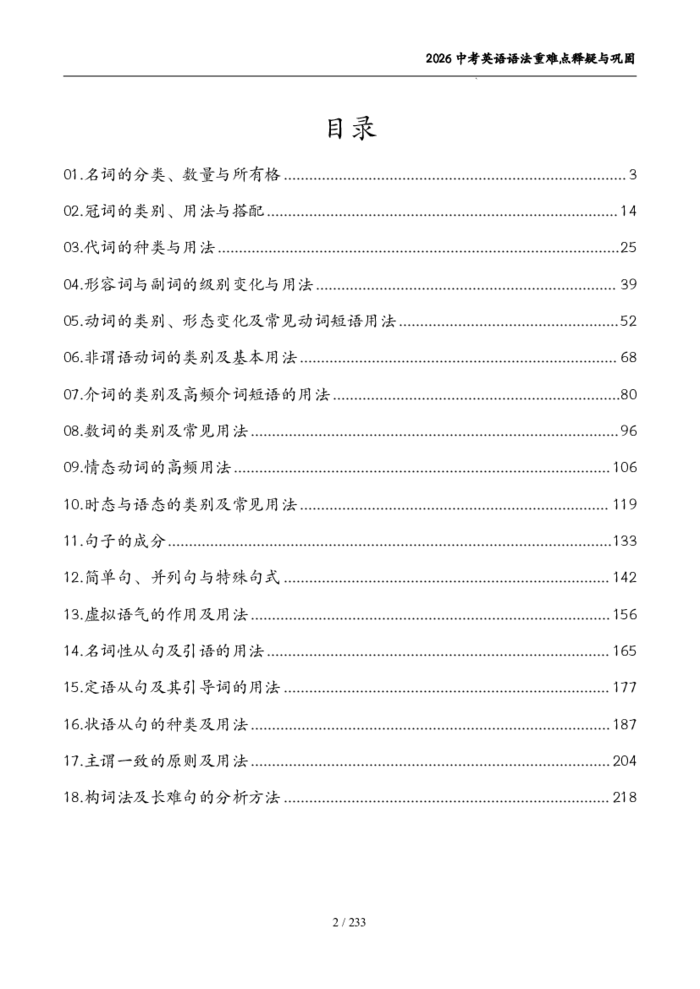
目录
01.名词的分类、数量与所有格................................................................................. 3
02.冠词的类别、用法与搭配................................................................................... 14
03.代词的种类与用法...............................................................................................25
04.形容词与副词的级别变化与用法....................................................................... 39
05.动词的类别、形态变化及常见动词短语用法....................................................52
06.非谓语动词的类别及基本用法........................................................................... 68
07.介词的类别及高频介词短语的用法....................................................................80
08.数词的类别及常见用法.......................................................................................96
09.情态动词的高频用法.........................................................................................106
10.时态与语态的类别及常见用法......................................................................... 119
11.句子的成分.........................................................................................................133
12.简单句、并列句与特殊句式............................................................................. 142
13.虚拟语气的作用及用法..................................................................................... 156
14.名词性从句及引语的用法................................................................................. 165
15.定语从句及其引导词的用法............................................................................. 177
16.状语从句的种类及用法..................................................................................... 187
17.主谓一致的原则及用法..................................................................................... 204
18.构词法及长难句的分析方法............................................................................. 218
2026 中考英语语法重难点释疑与巩固
3 / 233
学科网(北京)股份有限公司
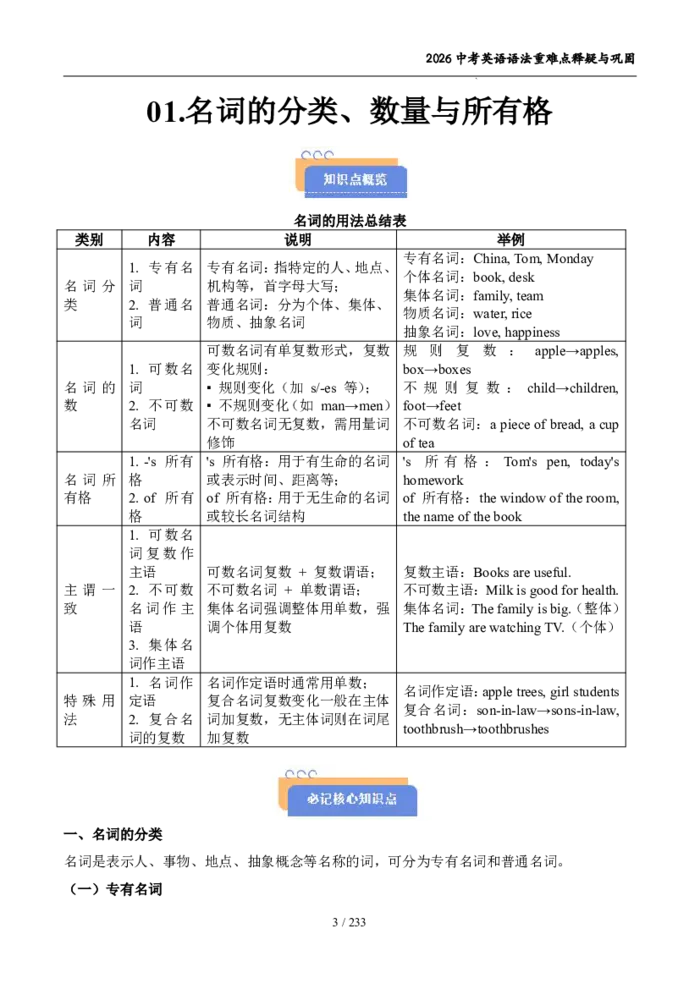
01.名词的分类、数量与所有格
名词的用法总结表
类别
内容
说明
举例
名词分
类
1. 专有名
词
2. 普通名
词
专有名词:指特定的人、地点、
机构等,首字母大写;
普通名词:分为个体、集体、
物质、抽象名词
专有名词:China, Tom, Monday
个体名词:book, desk
集体名词:family, team
物质名词:water, rice
抽象名词:love, happiness
名词的
数
1. 可数名
词
2. 不可数
名词
可数名词有单复数形式,复数
变化规则:
▪规则变化(加s/-es 等);
▪不规则变化(如man→men)
不可数名词无复数,需用量词
修饰
规
则
复
数
:
apple→apples,
box→boxes
不规则复数:child→children,
foot→feet
不可数名词:a piece of bread, a cup
of tea
名词所
有格
1. -'s 所有
格
2. of 所有
格
's 所有格:用于有生命的名词
或表示时间、距离等;
of 所有格:用于无生命的名词
或较长名词结构
's
所有格:Tom's pen, today's
homework
of 所有格:the window of the room,
the name of the book
主谓一
致
1. 可数名
词复数作
主语
2. 不可数
名词作主
语
3. 集体名
词作主语
可数名词复数+ 复数谓语;
不可数名词+ 单数谓语;
集体名词强调整体用单数,强
调个体用复数
复数主语:Books are useful.
不可数主语:Milk is good for health.
集体名词:The family is big.(整体)
The family are watching TV.(个体)
特殊用
法
1. 名词作
定语
2. 复合名
词的复数
名词作定语时通常用单数;
复合名词复数变化一般在主体
词加复数,无主体词则在词尾
加复数
名词作定语:apple trees, girl students
复合名词:son-in-law→sons-in-law,
toothbrush→toothbrushes
一、名词的分类
名词是表示人、事物、地点、抽象概念等名称的词,可分为专有名词和普通名词。
(一)专有名词
2026 中考英语语法重难点释疑与巩固
4 / 233
学科网(北京)股份有限公司
指特定的人、地方、机构、组织等的专有名称,首字母通常大写。例如:
人名:Tom(汤姆)、Mary(玛丽)
地名:Beijing(北京)、New York(纽约)
时间名:Monday(星期一)、Christmas(圣诞节)
机构名:the United Nations(联合国)、Peking University(北京大学)
(二)普通名词
表示一类人或事物或某种抽象概念的名称,可进一步分为个体名词、集体名词、物质名词和抽
象名词。
个体名词:表示单个的人或事物,如:book(书)、student(学生)、apple(苹果)。
集体名词:表示一群人或一些事物的总称,如:family(家庭)、team(团队)、class(班
级)。集体名词作主语时,若强调整体,谓语动词用单数;若强调个体成员,谓语动词用复数。
例如:
My family is a happy one.(我的家庭是一个幸福的家庭。)强调整体,谓语用单数。
The family are watching TV.(全家人在看电视。)强调个体成员,谓语用复数。
物质名词:表示无法分为个体的物质,如:water(水)、rice(米饭)、air(空气)。物质
名词通常为不可数名词。
抽象名词:表示动作、状态、品质、情感等抽象概念,如:love(爱)、health(健康)、friendship
(友谊)。抽象名词一般为不可数名词。
二、名词的数
(一)可数名词
可数名词有单数和复数两种形式。
1.单数形式
表示一个人或事物,前面可加不定冠词a/an(a 用于辅音音素开头的单词前,an 用于
元音音素开头的单词前)。例如:a desk(一张桌子)、an egg(一个鸡蛋)。
2.复数形式
(1)规则变化
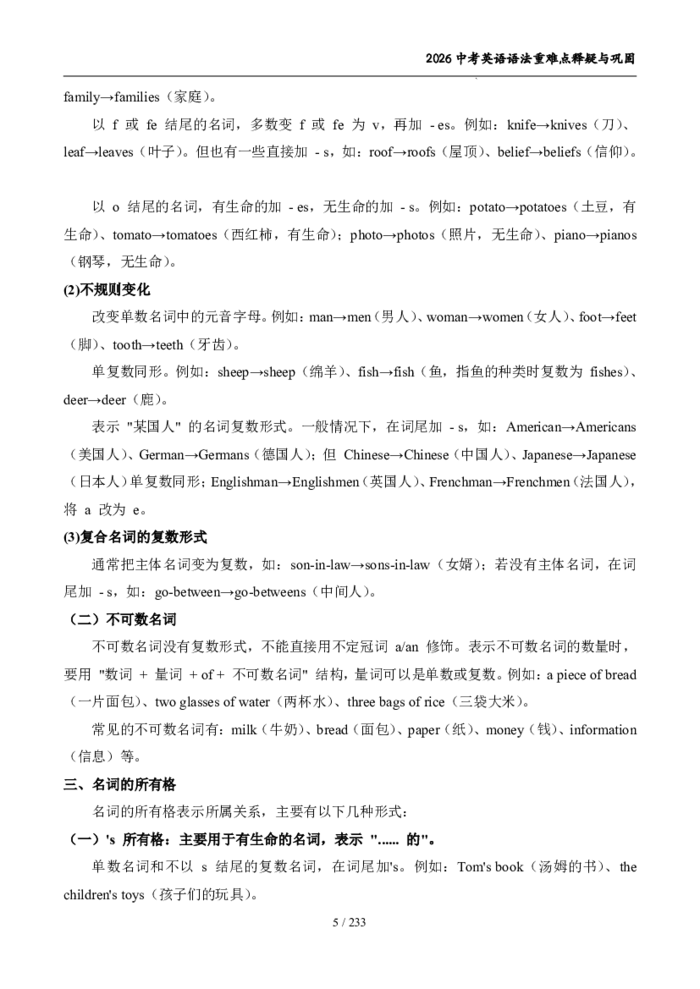
一般情况下,在词尾加- s。例如:book→books(书)、pen→pens(钢笔)。
以s、x、sh、ch 结尾的名词,加- es。例如:bus→buses(公共汽车)、box→boxes(盒
子)、brush→brushes(刷子)、watch→watches(手表)。
以辅音字母+ y 结尾的名词,变y 为i,再加- es。例如:city→cities(城市)、
2026 中考英语语法重难点释疑与巩固
5 / 233
学科网(北京)股份有限公司
family→families(家庭)。
以f 或fe 结尾的名词,多数变f 或fe 为v,再加- es。例如:knife→knives(刀)、
leaf→leaves(叶子)。但也有一些直接加- s,如:roof→roofs(屋顶)、belief→beliefs(信仰)。
以o 结尾的名词,有生命的加- es,无生命的加- s。例如:potato→potatoes(土豆,有
生命)、tomato→tomatoes(西红柿,有生命);photo→photos(照片,无生命)、piano→pianos
(钢琴,无生命)。
(2)不规则变化
改变单数名词中的元音字母。例如:man→men(男人)、woman→women(女人)、foot→feet
(脚)、tooth→teeth(牙齿)。
单复数同形。例如:sheep→sheep(绵羊)、fish→fish(鱼,指鱼的种类时复数为fishes)、
deer→deer(鹿)。
表示"某国人" 的名词复数形式。一般情况下,在词尾加- s,如:American→Americans
(美国人)、German→Germans(德国人);但Chinese→Chinese(中国人)、Japanese→Japanese
(日本人)单复数同形;Englishman→Englishmen(英国人)、Frenchman→Frenchmen(法国人),
将a 改为e。
(3)复合名词的复数形式
通常把主体名词变为复数,如:son-in-law→sons-in-law(女婿);若没有主体名词,在词
尾加- s,如:go-between→go-betweens(中间人)。
(二)不可数名词
不可数名词没有复数形式,不能直接用不定冠词a/an 修饰。表示不可数名词的数量时,
要用"数词+ 量词+ of + 不可数名词" 结构,量词可以是单数或复数。例如:a piece of bread
(一片面包)、two glasses of water(两杯水)、three bags of rice(三袋大米)。
常见的不可数名词有:milk(牛奶)、bread(面包)、paper(纸)、money(钱)、information
(信息)等。
三、名词的所有格
名词的所有格表示所属关系,主要有以下几种形式:
(一)'s 所有格:主要用于有生命的名词,表示"...... 的"。
单数名词和不以s 结尾的复数名词,在词尾加's。例如:Tom's book(汤姆的书)、the
children's toys(孩子们的玩具)。
2026 中考英语语法重难点释疑与巩固
6 / 233
学科网(北京)股份有限公司
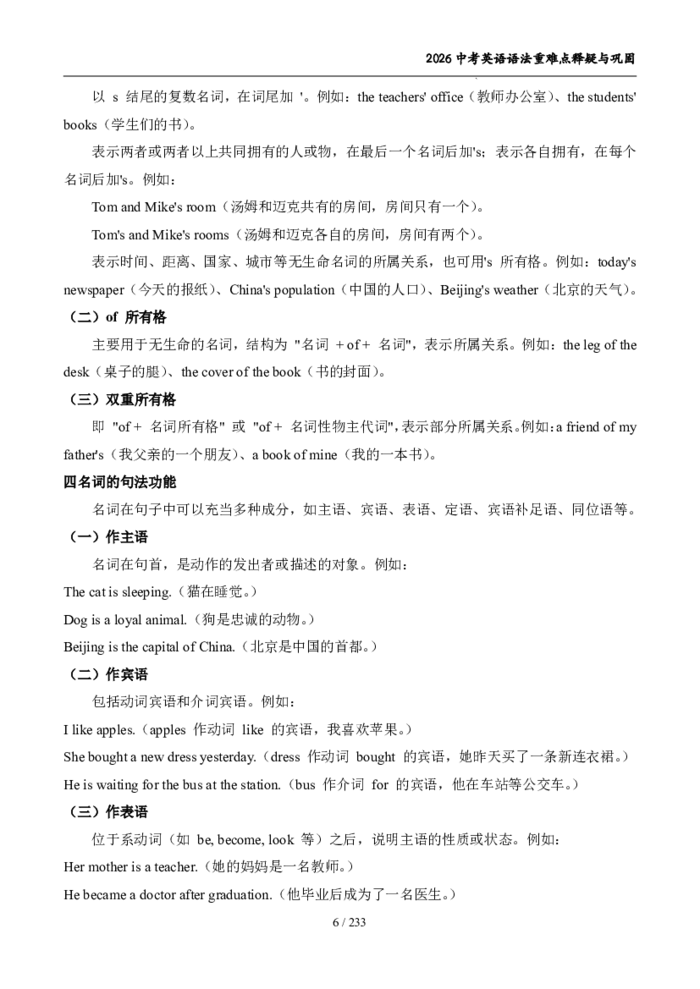
以s 结尾的复数名词,在词尾加'。例如:the teachers' office(教师办公室)、the students'
books(学生们的书)。
表示两者或两者以上共同拥有的人或物,在最后一个名词后加's;表示各自拥有,在每个
名词后加's。例如:
Tom and Mike's room(汤姆和迈克共有的房间,房间只有一个)。
Tom's and Mike's rooms(汤姆和迈克各自的房间,房间有两个)。
表示时间、距离、国家、城市等无生命名词的所属关系,也可用's 所有格。例如:today's
newspaper(今天的报纸)、China's population(中国的人口)、Beijing's weather(北京的天气)。
(二)of 所有格
主要用于无生命的名词,结构为"名词+ of + 名词",表示所属关系。例如:the leg of the
desk(桌子的腿)、the cover of the book(书的封面)。
(三)双重所有格
即"of + 名词所有格" 或"of + 名词性物主代词",表示部分所属关系。例如:a friend of my
father's(我父亲的一个朋友)、a book of mine(我的一本书)。
四名词的句法功能
名词在句子中可以充当多种成分,如主语、宾语、表语、定语、宾语补足语、同位语等。
(一)作主语
名词在句首,是动作的发出者或描述的对象。例如:
The cat is sleeping.(猫在睡觉。)
Dog is a loyal animal.(狗是忠诚的动物。)
Beijing is the capital of China.(北京是中国的首都。)
(二)作宾语
包括动词宾语和介词宾语。例如:
I like apples.(apples 作动词like 的宾语,我喜欢苹果。)
She bought a new dress yesterday.(dress 作动词bought 的宾语,她昨天买了一条新连衣裙。)
He is waiting for the bus at the station.(bus 作介词for 的宾语,他在车站等公交车。)
(三)作表语
位于系动词(如be, become, look 等)之后,说明主语的性质或状态。例如:
Her mother is a teacher.(她的妈妈是一名教师。)
He became a doctor after graduation.(他毕业后成为了一名医生。)
2026 中考英语语法重难点释疑与巩固
7 / 233
学科网(北京)股份有限公司
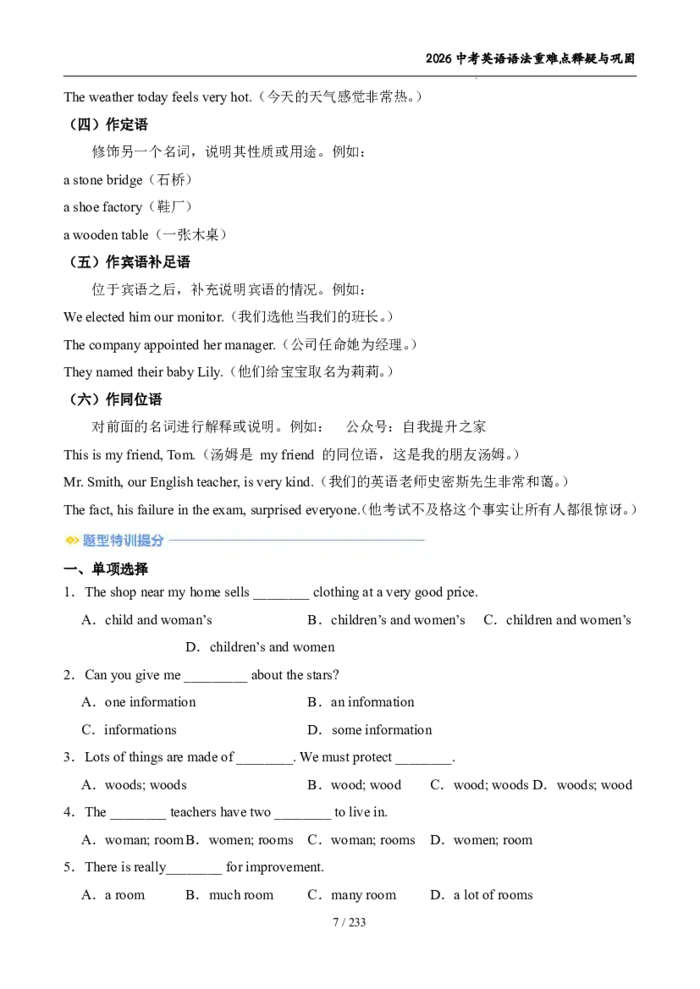
The weather today feels very hot.(今天的天气感觉非常热。)
(四)作定语
修饰另一个名词,说明其性质或用途。例如:
a stone bridge(石桥)
a shoe factory(鞋厂)
a wooden table(一张木桌)
(五)作宾语补足语
位于宾语之后,补充说明宾语的情况。例如:
We elected him our monitor.(我们选他当我们的班长。)
The company appointed her manager.(公司任命她为经理。)
They named their baby Lily.(他们给宝宝取名为莉莉。)
(六)作同位语
对前面的名词进行解释或说明。例如:
公众号:自我提升之家
This is my friend, Tom.(汤姆是my friend 的同位语,这是我的朋友汤姆。)
Mr. Smith, our English teacher, is very kind.(我们的英语老师史密斯先生非常和蔼。)
The fact, his failure in the exam, surprised everyone.(他考试不及格这个事实让所有人都很惊讶。)
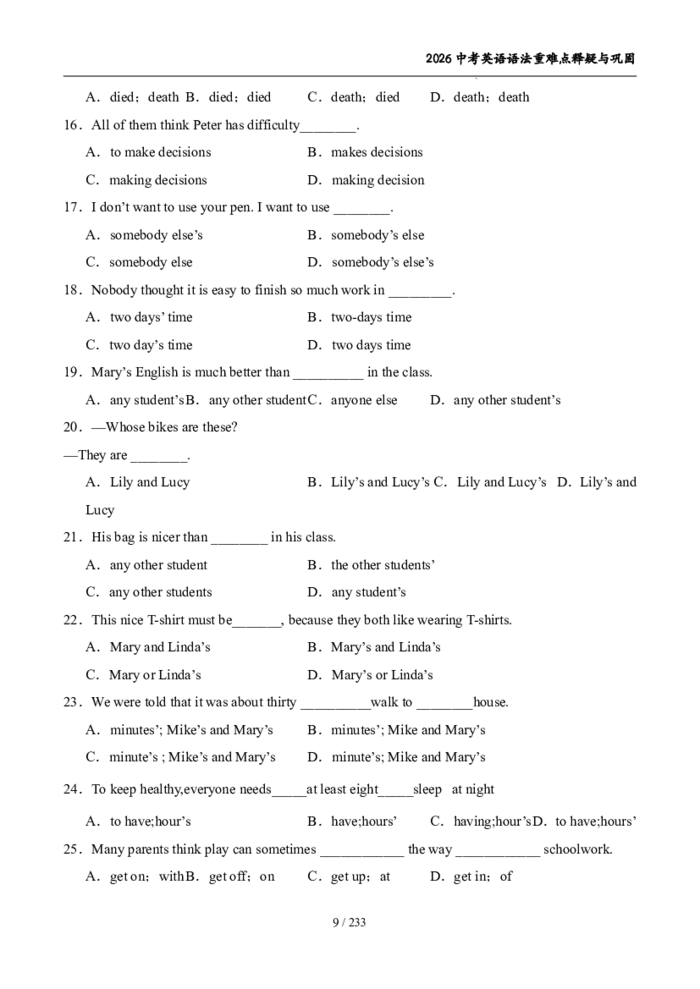
一、单项选择
1.The shop near my home sells ________ clothing at a very good price.
A.child and woman’s
B.children’s and women’s
C.children and women’s
D.children’s and women
2.Can you give me _________ about the stars?
A.one information
B.an information
C.informations
D.some information
3.Lots of things are made of ________. We must protect ________.
A.woods; woods
B.wood; wood
C.wood; woods D.woods; wood
4.The ________ teachers have two ________ to live in.
A.woman; roomB.women; rooms
C.woman; rooms
D.women; room
5.There is really________ for improvement.
A.a room
B.much room
C.many room
D.a lot of rooms
2026 中考英语语法重难点释疑与巩固
8 / 233
学科网(北京)股份有限公司
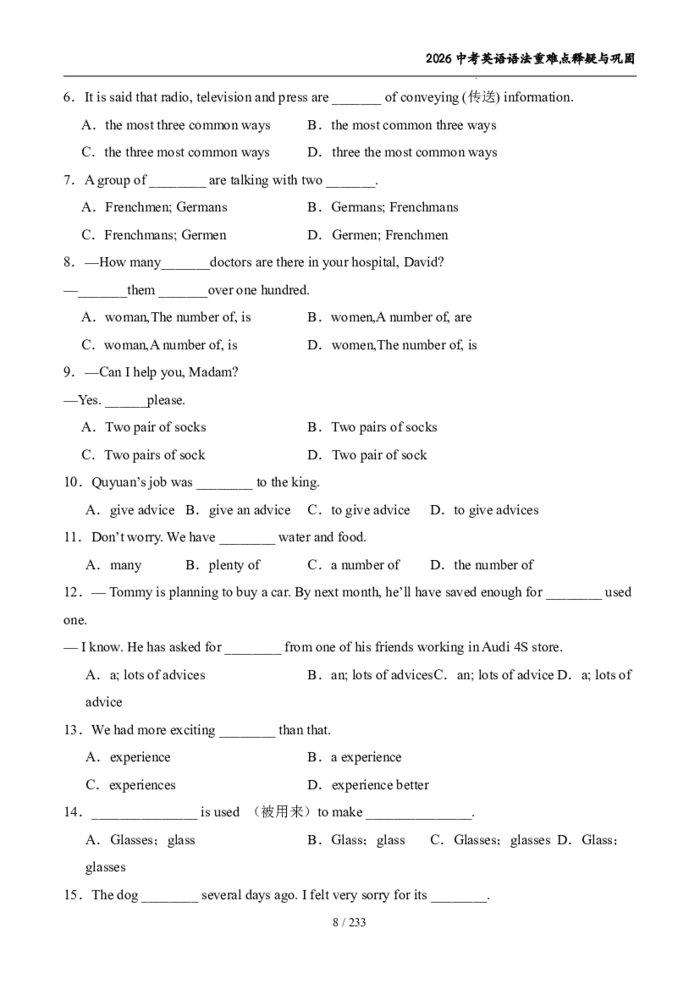
6.It is said that radio, television and press are _______ of conveying (传送) information.
A.the most three common ways
B.the most common three ways
C.the three most common ways
D.three the most common ways
7.A group of ________ are talking with two _______.
A.Frenchmen; Germans
B.Germans; Frenchmans
C.Frenchmans; Germen
D.Germen; Frenchmen
8.—How many_______doctors are there in your hospital, David?
—_______them _______over one hundred.
A.woman,The number of, is
B.women,A number of, are
C.woman,A number of, is
D.women,The number of, is
9.—Can I help you, Madam?
—Yes. ______please.
A.Two pair of socks
B.Two pairs of socks
C.Two pairs of sock
D.Two pair of sock
10.Quyuan’s job was ________ to the king.
A.give advice B.give an advice
C.to give advice
D.to give advices
11.Don’t worry. We have ________ water and food.
A.many
B.plenty of
C.a number of
D.the number of
12.— Tommy is planning to buy a car. By next month, he’ll have saved enough for ________ used
one.
— I know. He has asked for ________ from one of his friends working in Audi 4S store.
A.a; lots of advices
B.an; lots of advicesC.an; lots of advice D.a; lots of
advice
13.We had more exciting ________ than that.
A.experience
B.a experience
C.experiences
D.experience better
14._______________ is used (被用来)to make _______________.
A.Glasses;glass
B.Glass;glass
C.Glasses;glasses D.Glass;
glasses
15.The dog ________ several days ago. I felt very sorry for its ________.
2026 中考英语语法重难点释疑与巩固
9 / 233
学科网(北京)股份有限公司
A.died;death B.died;died
C.death;died
D.death;death
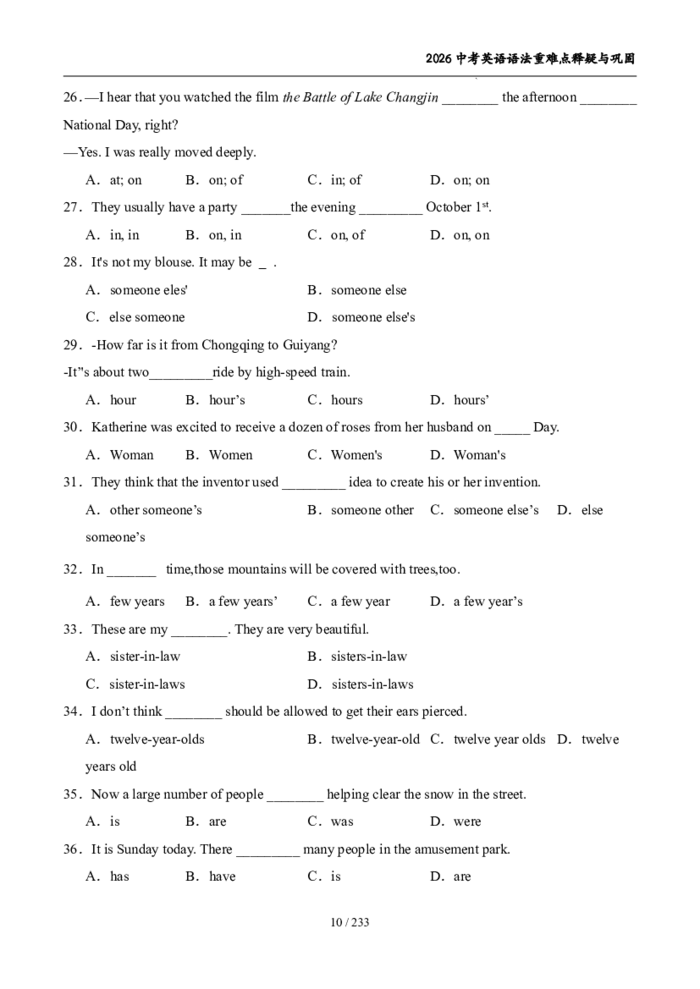
16.All of them think Peter has difficulty________.
A.to make decisions
B.makes decisions
C.making decisions
D.making decision
17.I don’t want to use your pen. I want to use ________.
A.somebody else’s
B.somebody’s else
C.somebody else
D.somebody’s else’s
18.Nobody thought it is easy to finish so much work in _________.
A.two days’ time
B.two-days time
C.two day’s time
D.two days time
19.Mary’s English is much better than __________ in the class.
A.any student’sB.any other studentC.anyone else
D.any other student’s
20.—Whose bikes are these?
—They are ________.
A.Lily and Lucy
B.Lily’s and Lucy’s C.Lily and Lucy’s D.Lily’s and
Lucy
21.His bag is nicer than ________ in his class.
A.any other student
B.the other students’
C.any other students
D.any student’s
22.This nice T-shirt must be_______, because they both like wearing T-shirts.
A.Mary and Linda’s
B.Mary’s and Linda’s
C.Mary or Linda’s
D.Mary’s or Linda’s
23.We were told that it was about thirty __________walk to ________house.
A.minutes’; Mike’s and Mary’s
B.minutes’; Mike and Mary’s
C.minute’s ; Mike’s and Mary’s
D.minute’s; Mike and Mary’s
24.To keep healthy,everyone needs_____at least eight_____sleep at night
A.to have;hour’s
B.have;hours’
C.having;hour’sD.to have;hours’
25.Many parents think play can sometimes ____________ the way ____________ schoolwork.
A.get on;withB.get off;on
C.get up;at
D.get in;of
2026 中考英语语法重难点释疑与巩固
10 / 233
学科网(北京)股份有限公司
26.—I hear that you watched the film the Battle of Lake Changjin ________ the afternoon ________
National Day, right?
—Yes. I was really moved deeply.
A.at; on
B.on; of
C.in; of
D.on; on
27.They usually have a party _______the evening _________ October 1st.
A.in, in
B.on, in
C.on, of
D.on, on
28.It's not my blouse. It may be
.
A.someone eles'
B.someone else
C.else someone
D.someone else's
29.-How far is it from Chongqing to Guiyang?
-It’'s about two_________ride by high-speed train.
A.hour
B.hour’s
C.hours
D.hours’
30.Katherine was excited to receive a dozen of roses from her husband on _____ Day.
A.Woman
B.Women
C.Women's
D.Woman's
31.They think that the inventor used _________ idea to create his or her invention.
A.other someone’s
B.someone other
C.someone else’s
D.else
someone’s
32.In _______ time,those mountains will be covered with trees,too.
A.few years
B.a few years’
C.a few year
D.a few year’s
33.These are my ________. They are very beautiful.
A.sister-in-law
B.sisters-in-law
C.sister-in-laws
D.sisters-in-laws
34.I don’t think ________ should be allowed to get their ears pierced.
A.twelve-year-olds
B.twelve-year-old C.twelve year olds
D.twelve
years old
35.Now a large number of people ________ helping clear the snow in the street.
A.is
B.are
C.was
D.were
36.It is Sunday today. There _________ many people in the amusement park.
A.has
B.have
C.is
D.are
2026 中考英语语法重难点释疑与巩固
11 / 233
学科网(北京)股份有限公司
37.There are many ________ on the farm.
A.horse
B.sheep
C.chicken
D.dog
38.Cattle _____________ on the hillside.
A.grazes
B.is grazing
C.was grazing
D.were grazing
39.—Are all the students in your school from ________?
—No. Only a small number of them ________.
A.Germany; are Germans
B.Germany; are GermenC.German; is Germany
D.Germen; is Germany
40.A Bing is a famous musician in China, and his music always gives people a ______ of sadness.
A.feeling
B.pride
C.admire
D.energy
41.—It will be _________ and our teacher is going to have a football match with us tomorrow.
—Great! Only if there isn’t _________.
A.sunny; rain
B.sunny; rainy
C.sun; rain
D.sun; rainy
42.________ a balanced diet will make a difference to your ________ and your future.
A.Having; healthy
B.Have; healthy
C.Have; health D.Having; health
43.—Nick, how much do you know about ________?
—People usually eat rice dumplings to remember Qu Yuan.
A.Dragon Boat Festival
B.Lantern Festival
C.Mid-Autumn Festival
D.Tomb-Sweeping Festival
44.Sally comes from _____, so she can speak very good _____.
A.French, French
B.France, France
C.France, French
D.French,
France
45.Nelson Mandela was
of South Africa from 1994 to 1999.
A.presidents
B.a president
C.President
D.our president
二、完成句子
46.鲁迅文学奖就是以他的名字命名的。
Lu Xun Literature
is
.
47.故乡在我的心中留下了许多美好的回忆。
The hometown has left many
in my heart.
2026 中考英语语法重难点释疑与巩固
12 / 233
学科网(北京)股份有限公司
48.在中国文化中,红色被认为是好运的象征。公众号:自我提升之家
The red color is considered as
in Chinese culture.
49.讲座非常生动,全部学生都听得很认真。
It was
all the students listened carefully.
50.吐鲁番是世界上最热的地方之一。
Turpan is one of the
around the world.
51.然而,在法国一件不贵的东西,是葡萄酒。
One thing
not expensive,
, is the
.
52.成功和失败不是最终的结果,而是你人生旅途的经历。
Neither success nor failure is a(an)
but both of them are experience of your
life journey.
53.人工智能正成为我们日常生活的重要组成部分。
AI is becoming an important part of our
.
54.在这页的顶端写上你的名字。
Write your name at the
the page.
55.她总是认真地做作业以避免错误。
She always does her homework carefully to
.
56.做最好的打算,做最坏的准备。
Hope for the best, but prepare for
.
57.充足的睡眠可以帮助人们保持头脑清醒。
Enough
can
people keep a clear mind.
58.我一到哈尔滨,就给你发短信。
On arriving in Harbin, I will send you
.
59.快餐虽然方便,但对健康不利。
is convenient but bad for health.
60.李磊喜欢编故事。
Li Lei likes
.
61.我的兄弟们经常骑自行车去上学。
My brothers often
to school.
62.汤姆意识到要想身体健康,就必须多锻炼并保持均衡饮食。
2026 中考英语语法重难点释疑与巩固
13 / 233
学科网(北京)股份有限公司
Tom realized that he needed to do more exercise and
in
order to stay healthy.
63.妈妈昨天给了我零花钱。
My mum gave me some
yesterday.
64.她每天早上都在同一时刻醒来。
She wakes up at the
every morning.
65.毫无疑问,茅台是贵州省最大的品牌。
There is
that Moutai is the biggest brand in Guizhou Province.
66.我们学校2/3 的老师是女老师。
Two thirds of the teachers in our school
.
67.好书如挚友。
A good book is like a
.
68.能与在座的各位交谈是我的荣幸。
It’s
to talk with all of you here.
69.他在回家的路上买了一些邮票。
He bought
on his way home.
70.把一门外语学好要花费挺多时间的。
Learning a foreign language well
.
2026 中考英语语法重难点释疑与巩固
14 / 233
学科网(北京)股份有限公司
02.冠词的类别、用法与搭配
冠词的核心知识点
类型
用法说明
示例
不定冠词
1. 表示泛指的单数可数名词(a+辅音音素,
an+元音音素)
2. 首次提及的人或物
3. 表示职业或身份
4. 固定搭配(如a few, have a cold)
A book(一本书)
An hour(一小时)
She's a doctor.
In a hurry
定冠词
1. 特指双方已知的事物
2. 上文提过的事物
3. 独一无二的事物(the sun)
4. 序数词/最高级前
5. 乐器名称前(play the piano)
6. 地理专有名词(the Yellow River)
The girl in red
The first lesson
The Himalayas
不用冠词
1. 不可数名词表泛指(Water is important)
2. 复数名词表类别(Dogs are loyal)
3. 专有名词(China)
4. 三餐/节假日名称(have breakfast)
Life is hard.
They love music.
On Christmas Day
一、不定冠词(a/an)的用法
(一)基本用法:表示“一(个/ 件/ 本……)” 或“某一类人或事物”
1. a 用于以辅音音素开头的单词前(注意:不是辅音字母)。
例如:
a one-eyed cat(一只独眼猫,one 以辅音音素/w/ 开头)
a uniform(一套校服,uniform 以辅音音素/juː/ 开头)
a European city(一座欧洲城市,European 以辅音音素/jʊ/ 开头)
2. an 用于以元音音素开头的单词前(注意:不是元音字母)
例如:
an elephant(一头大象,elephant 以元音音素/e/ 开头)
an orange(一个橙子,orange 以元音音素/ɒ/ 开头)
2026 中考英语语法重难点释疑与巩固
15 / 233
学科网(北京)股份有限公司
an hour(一小时,hour 中h 不发音,以元音音素/aʊ/ 开头)
(二)特殊用法
1. 表示“同一(类)”,相当于“the same”
例如:
The children are a group in the science project.(孩子们在科学项目中是一个小组。)
These two houses are a style.(这两座房子是同一风格。)
We are a team, and we fight together.(我们是一个团队,并肩作战。)
2. 用于首次提到的人或事物(非特指)
例如:
A stranger knocked on the door just now.(刚才有个陌生人敲门。)
There is a bookstore around the corner.(街角有一家书店。)
She met a famous singer at the concert.(她在音乐会上遇见了一位著名歌手。)
二、定冠词(the)的用法
(一)特指某(些)人或事物
1. 指上文提到过的人或事物
例如:
I lost a key yesterday. The key opens my bedroom door.(我昨天丢了一把钥匙,这把钥匙开
卧室门。)
Lily bought a dress online. The dress is too long for her.(莉莉在网上买了一条连衣裙,这条
裙子对她来说太长了。)
We saw a movie last night. The movie was about space travel.(我们昨晚看了一部电影,这部
电影是关于太空旅行的。)
2. 指说话双方都知道的人或事物
例如:
Don't forget to bring the textbook to class.(别忘了带课本上课。)
Could you pass me the cup on the table?(你能把桌上的杯子递给我吗?)
The teacher is talking to the class about the exam rules.(老师正在向全班同学讲考试规则。)
(二)用于“独一无二” 的事物前
例如:
The earth provides us with everything we need.(地球为我们提供了所需的一切。)
2026 中考英语语法重难点释疑与巩固
16 / 233
学科网(北京)股份有限公司
The moon affects the tides of the ocean.(月亮影响海洋的潮汐。)
The universe is full of mysterious galaxies.(宇宙充满了神秘的星系。)
(三)用于序数词、形容词最高级前
例如:
He was the third to finish the marathon.(他是第三个完成马拉松的人。)
This is the oldest tree in the forest.(这是森林里最古老的树。)
She is the most hardworking student in our class.(她是我们班最勤奋的学生。)
(四)用于乐器、方位、姓氏复数(表示“一家人”)前
例如:
He learned to play the saxophone at the age of 10.(他10 岁开始学吹萨克斯。)
Can you play the drums in the band?(你能在乐队里打鼓吗?)
She plays the flute beautifully.(她长笛吹得很优美。)
The supermarket is in the west of the city.(超市在城市的西部。)
The Browns are going on a summer vacation.(布朗一家要去度暑假。)
I visited the Wus last weekend.(我上周末拜访了吴先生一家。)
三、零冠词(不用冠词)的情况
(一)专有名词、不可数名词表泛指时
例如:
New York is a major city in the United States.(纽约是美国的一座主要城市。)
Saturday is my favorite day of the week.(星期六是我一周中最喜欢的一天。)
Mount Everest is located in the Himalayas.(珠穆朗玛峰位于喜马拉雅山脉。)
Food is essential for survival.(食物是生存的必需品。)
Advice from parents is often valuable.(父母的建议往往很有价值。)
(二)球类运动、三餐、学科前
例如:
They play volleyball on the beach every weekend.(他们每个周末在沙滩上打排球。)
What did you have for lunch today?(你今天午餐吃了什么?)
Biology is the study of living organisms.(生物学是研究生命体的学科。)
(三)固定搭配中
1. 交通工具
2026 中考英语语法重难点释疑与巩固
17 / 233
学科网(北京)股份有限公司
例如:
He goes to work by car every day.(他每天开车上班。)
They traveled to Beijing by train.(他们乘火车去北京。)
2. 季节/ 节日
例如:
In winter, we like to go skiing in the mountains.(冬天,我们喜欢去山里滑雪。)
On National Day, there are many celebrations across the country.(国庆节期间,全国有很多庆
祝活动。)
四、易混点辨析
(一)a/an 的选择:看发音而非字母
错误:a elephant(×)→正确:an elephant(√,elephant 以元音音素/e/ 开头)
错误:an useful tool(×)→正确:a useful tool(√,useful 以辅音音素/j/ 开头)
(二)the 的特指与泛指
泛指:I need to buy a pen for writing.(我需要买一支笔用来写字,任意一支笔)
特指:I need to buy the pen that writes smoothly.(我需要买那支写起来流畅的笔,特定的笔)
(三)零冠词与the 的区别
零冠词表泛指:Cats are popular pets around the world.(猫是全世界受欢迎的宠物,泛指所
有猫)
the 表特指:The cats in the animal shelter need our care.(动物收容所里的猫需要我们的照
顾,特指收容所的猫)
一、单项选择
1.It’s a pity that many wild animals are now in danger. Please have ________ pity on them since
they are part of our big family.
A./
B.a
C.an
D.the
2.Although Lily is ________ 11-year-old girl, she can play the piano very well.
A.a
B.an
C.the
D./
3.The Colorado River looks like ________ silver stream as it passes through the rocks at ________
bottom of the canyon.
2026 中考英语语法重难点释疑与巩固
18 / 233
学科网(北京)股份有限公司
A.an; the
B.an; 不填
C.a; the
D.a; a
4.—Do you know how to make ________ “red bean paste” for zongzi?
—Yes! You need ________ bag of red beans and some sugar.
A.a; a
B.the; a
C./; a
D./; the
5.We’re going to have ________ picnic in the park ________ this Sunday.
A.a; 不填
B.a; the
C.the; a
D.\; \
6.There is ________ new garden in our school, and ________ flowers in it are beautiful.
A.a; the
B.an; the
C./; /
D.an; /
7.Boys and girls, work hard for ________ months, and you are sure to have ________ exciting
result in the high school entrance examination. Come on!
A.another two; an
B.two more; a
C.more two; an D.two another; a
8.The game of go (围棋) is ________ model of traditional Chinese art and has become popular
________ young people.
A.the; among
B.a; with
C.a; in
D.the; of
9.—This is ________ boy I’ve told you about several times.
—He is really ________ energetic student.
A.a; a
B.the; an
C.the; the
D.a; the
10.There is ________ orange on the table. ________ orange is red.
A.an, An
B.the, The
C.an, The
D.the, A
11.As long as everyone plays ________ part in protecting the Earth, it will become more and more
beautiful.
A.the
B.an
C./
D.a
12.—What do you think of ________ film Ne Zha 2?
—Well, I have never seen a more amazing one. It’s worth watching ________ second time.
A.the; the
B.the; a
C.a; the
D.a; a
13.—What do you think of the film Ne Zha Ⅱ?
—Well, I have never seen ________ more amazing one. It’s worth watching ________ second time.
A.the; the
B.a; a
C.a; the
D.a; /
14.—What do you think of ________ film Nezha Ⅱ?
—It is so wonderful that I want to see it ________ third time.
2026 中考英语语法重难点释疑与巩固
19 / 233
学科网(北京)股份有限公司
A.a; the
B.a; a
C.the; the
D.the; a
15.—How do you like ________ film Ne Zha 2 (《哪吒2》)?
—It is so wonderful that I want to see it for ________ second time.
A.a, the
B.a, a
C.the, the
D.the, a
16.Yesterday we went on ________ trip to Hainan. ________ trip is exciting.
A.a, The
B.a, A
C.the, A
D.the, The
17.Jenny always takes _______ active part in the classroom discussion.
A.a
B.an
C.the
D./
18.—It seems that your daughter shows ________ interest in playing ________ chess.
—Exactly. Her teacher says she has ________ gift for music.
A.a; the; a
B.an; /; a
C./; the; /
D.an; the; the
19.—What’s wrong, Danny?
—I feel very cold. Maybe I have ________ high fever.
A.an
B.a
C.the
D./
20.After dinner, I usually take my pet dog for ________ walk in the park.
A.a
B.an
C.the
D./
21.—Bob, what’s ________ matter with you?
—I have ________ bad toothache.
A.a; the
B.the; a
C./; /
D./; the
22.Don’t push, children. Get off the bus one at ________ time.
A.the
B.one
C.a
D.an
23.—Tommy, what’s ________ matter with you?
—I have ________ stomachache.
A.a; the
B.the; a
C./; the
D.the; /
24.I have heard of_______ Michael Jackson, but not_______ famous one.
A./, a
B.a, the
C./; the
D.the; a
25.To achieve ______ state of flow, there must be ______ balance between the challenge of the task
and your skill level.
A.a; /
B./; a
C./; /
D.a; a
2026 中考英语语法重难点释疑与巩固
20 / 233
学科网(北京)股份有限公司
26.To achieve ________ great success, there must be ________ balance between the challenge of
the task and your skill level.
A.a;/
B./;a
C./;/
D.a;a
27.He promised it ________ success, but at last, we couldn’t get ________ good result.
A.the; the
B.a; a
C.a; /
D.the; a
28.—Have you got _________ Bing Dwendwen, Lisa?
—Not yet. It is _________ pity that I can’t find one in any toy shop.
A.a; /
B.the; /
C.a; a
D.the; a
29.—Don’t you think Huawei company is ________ success?
—Yes, I do. Huawei smartphones are popular among ________ public in China.
A.the; a
B.a; the
C.a; a
D./; a
30.The visitors here are greatly impressed by the fact that ___________ people from all walks of life
(各行各业) are working hard for _______ new Jiangsu.
A./; a
B./; the
C.the; a
D.the; the
31.—Could you please tell me something about Yang Liping?
—Sure. She is one of ________ most famous dancers in China.
A.a
B.an
C.the
D./
32.—What’s ________ population of Wu Xi?
—Do you want to know about it? Sorry, I don’t know.
A.a
B.an
C.the
D.that
33.That is _______ useful book, isn’t it?
A.a
B.an
C.the
D./
34.The documentary Protecting the Yangtze River highlights ________ importance of ecological
conservation.
A.a
B.an
C.the
D./
35.Grandpa keeps a pet parrot. ________ parrot is very cute.
A.A
B.An
C.The
D./
36.—Who is ________ girl with long brown hair?
—She is my cousin Holly.
2026 中考英语语法重难点释疑与巩固
21 / 233
学科网(北京)股份有限公司
A.a
B.an
C.the
D./
37.I learned to play __________ guitar when I was ten years old.
A.a
B.an
C.the
D./
38.Since tasting the excitement of ________ big city life, she never wants to live in ________
country again.
A.the, the
B./, /
C.the, /
D./, the
39.Nobody at the party could recognize ________ man in a blue jacket except me.
A.a
B.an
C.the
D./
40.All Grade 7 students are busy preparing for their English exam at ________ moment.
A.a
B.an
C.the
D./
41.Jerry is eating _______ ice cream in _______ sun.
A.an; the
B.an; /
C.a; the
D.a; a
42.Everyone should play ________ part in saving ________ earth.
A.a; an
B.a; the
C.the; /
D.the; an
43.People did not only pass silk along ________ Silk Road.
A.a
B.an
C.the
D./
44.Tuesday being ________ windy, cold day in Beijing, Mr White toured ________ Forbidden City
in Beijing, wearing ________ blue shirt with no tie and a casual leather packet.
A.a; the; the
B.a; /; a
C./; /; a
D.a; the; a
45.Bob likes playing _______ basketball, but he doesn’t like _______ piano.
A.the; an
B./; an
C./; the
D.the; a
46.My sister likes music, and she can play ________ piano very well.
A.a
B.an
C.the
D./
47.—________ Smiths are used to living in Shanghai now.
—We hope more and more foreign friends live ________ better life in China.
A./; a
B./; the
C.The; a
D.The; the
48.________ Smiths used to be poor, but they live ________ better life now.
A./; a
B./; the
C.The; a
D.The; the
49.—When was ________ umbrella invented?
—It was invented in 18th century, I think.
2026 中考英语语法重难点释疑与巩固
22 / 233
学科网(北京)股份有限公司
A.a
B.an
C.the
D./
50.—When was ________ umbrella invented?
—It is said that it was invented in ________11th century B.C.in China.
A.a; an
B.an; an
C.a; the
D.the; the
51.Tom volunteered to help ________ blind last summer. What ________ amazing experience he
had!
A.the; an
B.an; an
C.the; a
D.a; an
52.We Chinese have the tradition of respecting ________ old.
A./
B.an
C.a
D.the
53.Vienna is ________ old city in ________ centre of Europe.
A.a; /
B.an; the
C.an; /
D.a; the
54.We’d better not throw things away for ________ time being. They’ll be useful later.
A.a
B.an
C.the
D./
55.It is said that people born in ________ Year of ________ Sheep are gentle.
A.the; the
B./; /
C./; the
D.the; /
56.Tom is ________ university student. He is Jack’s ________ best friend in his class.
A.an; the
B.an; /
C.a; the
D.a; /
57.Many tourists are still in ________ habit of writing silly things in ________ public places.
A.the; the
B.a; the
C.the; /
D./; the
58.On ________ Children’s Day, Jack received a prize for being ________ honest boy.
A.a; the
B./; the
C./; an
D.the; a
59.Mary was ________ university student of ________ physics when she won first prize in the
national the contest.
A.a; the
B.an; the
C.an; /
D.a; /
60.I like playing ________ chess but my brother likes playing the piano.
A./
B.a
C.an
D.the
61.Tim is studying in ________ university in ________ Beijing and he wants to be ________
astronaut in the future.
A.an; the; an
B.a; the; an
C.a; /; an
D.an; /; a
62.It’s ________ exciting news. We all feel very happy.
2026 中考英语语法重难点释疑与巩固
23 / 233
学科网(北京)股份有限公司
A.a
B.an
C.the
D./
63.—How long does it take us to go to Shanghai from Urumqi?
—It takes us half ________ hour by ________ car.
A.a; a
B.an; /
C.a; the
D.an; the
64.—How long does it take us to go to your hometown from here?
—It takes us ________ hour to go to my home town by ________ train.
A.an; a
B.an; /
C.an; the
D.a; the
65.—What did the doctor say?
—He said that I had ________ bad cold and had to stay in ________ bed for two days.
A.a; /
B.a; the
C.the; /
D.the; the
二、完成句子
66.阅读在英语学习中起着重要的作用。
Reading
important
learning English.
67.你应该打起精神去完成这项艰巨的任务。
You should gather yourself up to finish
.
68.一月份是一年中的第一个月。
January is
month of
.
69.我感谢我的老师们。他们教我如何成为一个更好的人。
I’m thankful to my teachers. They teach me how to
.
70.长大后他想成为一名科学家。
He wants to
scientist when he grows up.
71.嘟嘟是一条相当友好的狗。
Dudu is
friendly dog.
72.我是家里独生子。
I am
child of my family.
73.大象是泰国人生活和文化的一个重要部分。然而现在它们正处于危险之中。
Elephants are
part of Thai life and culture.
, they are
now.
74.在我们学校附近有一家新花店。
new flower shop near our school.
2026 中考英语语法重难点释疑与巩固
24 / 233
学科网(北京)股份有限公司
75.她是如此好的一位老师以至于所有的学生都喜欢她。
She is
good teacher
all the students like her.
76.我有一块橡皮和一块蓝色的手表。
I have
and a blue watch.
77.健康的饮食能帮助人们长寿。
can help people live longer.
78.这个小女孩穿着红色的连衣裙。
This girl wears
.
79.我爷爷有一个大农场。
My grandpa has
.
80.伦敦是英国的首都。
London is
of the U.K.
2026 中考英语语法重难点释疑与巩固
25 / 233
学科网(北京)股份有限公司
03.代词的种类与用法
代词的用法
类型
用法
例句
注意事项
人称代
词
表示人或事物的称呼,分
为主格(作主语)和宾格
(作宾语/ 表语)。
主格:She is a teacher.
宾格:Let me help you.
主格在句首作主语,宾格在动词
或介词后作宾语。
并列使用时顺序通常为:第二人
称→第三人称→第一人称(如
you and me)。
物主代
词
表示所属关系,分为形容
词性物主代词(后接名词)
和名词性物主代词(独立
使用)。
形容词性:This
is my book.
名词性:The book
is mine.
名词性物主代词= 形容词性物
主代词+ 名词。
不可与冠词(a/an/the)或指示
代词(this/that)连用。
反身代
词
表示动作返回主语自身,
译为“自己”,常见结构:
by oneself(独自)、enjoy
oneself(玩得开心)。
She
taught herself English.
They
enjoyed themselves at
the party.
主语和宾语为同一人/ 物时使
用,注意与主语在人称和数上一
致
(
如
I→myself
,
we→ourselves)。
指示代
词
指代人或事物,包括this
(近指单数)、that(远指
单数)、these(近指复数)、
those(远指复数)。
This is my pen.
Those are their cars.
指代上文提到的事物时,单数用
that ,复数用
those(如The
weather here is better than that in
Beijing)。
不定代
词
不明确指代特定对象,常
见词:some/any(一些)、
both/either/neither(两者)、
all/none(三者及以上)、
many/much(许多)等。
Some
students
like
math.
Neither of the answers
is correct.
some 多用于肯定句,any 用于
否定/ 疑问句;
both 表示“两者都”,neither 表
示“两者都不”,either 表示“两
者中的任意一个”。
相互代
词
表示相互关系,包括each
other(两者之间)和one
another(三者及以上)。
They
help
each
other with homework.
The classmates should
care for one another.
可加-’s 构成所有格(如each
other’s books)。
疑问代
词
用于构成特殊疑问句,包
括who(问人,主格)、
whom(问人,宾格)、what
(问事物)、which(问特
定范围的人/ 物)、whose
(问所属关系)。
Who is singing?
What do you want to
eat?
Whose bag is this?
whom 在口语中可用who 代
替(如
Who/Whom did you
meet?);
which 可接名词限定范围(如
Which book do you like?)。
关系代
词
引导定语从句,指代先行
词并在从句中充当成分,
The man who is talking
is my teacher.
who 在从句中作主语,whom
作宾语;
2026 中考英语语法重难点释疑与巩固
26 / 233
学科网(北京)股份有限公司
包括who/whom(指人)、
which(指物)、that(指人
或物)、whose(指所属关
系)。
This is the book that I
bought yesterday.
that 不能用于非限制性定语从
句(如逗号后),且介词后不用
that(如with which)。
一、人称代词
指代人或事物的代词,分主格(作主语)和宾格(作宾语/ 表语),需根据在句中的成分
选择形式。公众号:自我提升之家
(一)主格(I, you, he, she, it, we, they)
【用法】在句中作主语,置于动词前。例如:
She often helps her classmates with math.(她经常帮助同学学数学。)
[解析]she 作主语,指代前文提到的女性。
It is important to protect the environment.(保护环境很重要。)
[解析]it 作形式主语,真正主语是不定式短语to protect the environment。
They will visit the Science Museum next week.(他们下周将参观科学博物馆。)
[解析]they 作主语,指代“他们” 这一复数概念。
(二)宾格(me, you, him, her, it, us, them)
【用法】在句中作动词或介词的宾语,或用于表语位置。例如:
Could you please pass me the dictionary?(你能把字典递给我吗?)
[解析]me 作动词pass 的宾语,位于动词后。
The teacher asked them to finish the homework on time.(老师让他们按时完成作业。)
[解析]them 作动词asked 的宾语,指代“他们”。
Let us discuss the problem together.(我们一起讨论这个问题吧。)
[解析]us 作动词let 的宾语,let us 可缩写为let's。
二、物主代词
表示所属关系,分形容词性物主代词(后接名词)和名词性物主代词(独立使用,相当于
“形容词性物主代词+ 名词”)。
(一)形容词性物主代词(my, your, his, her, its, our, their)
【用法】相当于形容词,后接名词作定语。例如:
2026 中考英语语法重难点释疑与巩固
27 / 233
学科网(北京)股份有限公司
My father is a doctor, and your father is a teacher.(我父亲是医生,你父亲是教师。)
[解析]my/your 修饰father,明确所属关系。
The cat is hungry. Please give its food to it.(猫饿了,请给它食物。)
[解析]its 修饰food,注意its(它的)与it's(它是)的区别。
Their school has a large library with thousands of books.(他们的学校有一个藏书数千册的大图书
馆。)
[解析]their 修饰school,表明“他们的” 学校。
(二)名词性物主代词(mine, yours, his, hers, its, ours, theirs)
【用法】独立使用,后不接名词,相当于“形容词性物主代词+ 名词”。
—Is this pencil yours? —No, mine is in the pencil box.(—— 这支铅笔是你的吗?—— 不是,我
的在铅笔盒里。)
[解析]yours=your pencil,mine=my pencil。
The blue jacket is his, and the pink one is hers.(蓝色夹克是他的,粉色的是她的。)
[解析]his=his jacket,hers=her jacket,避免重复。
Our classroom is cleaner than theirs.(我们的教室比他们的干净。)
[解析]theirs=their classroom,用于比较结构。
三、反身代词
表示动作返回到主语本身,译为“自己/ 亲自”,形式为- SELF(单数)/-SELVES(复
数),如myself, yourself, ourselves 等。例如:
Lily taught herself to play the piano at the age of 8.(莉莉8 岁自学弹钢琴。)
[解析]herself 作taught 的宾语,主语Lily 与宾语为同一人。
We should learn to depend on ourselves, not others.(我们应学会依靠自己,而非他人。)
[解析]ourselves 作depend on 的宾语,强调“我们自己”。
Help yourself to some cake, Mary.(玛丽,请随便吃些蛋糕。)
[解析]yourself 用于固定搭配help oneself to,表示“请自便”。
四、指示代词
指代特定的人或事物,包括单数this(这个,近指)、that(那个,远指)和复数these(这
些)、those(那些)。例如:
This is my new mobile phone, and that is my old one.(这是我的新手机,那是我的旧手机。)
[解析]this 指近处的新手机,that 指远处的旧手机。
2026 中考英语语法重难点释疑与巩固
28 / 233
学科网(北京)股份有限公司
These flowers are from the garden, and those are from the market.(这些花来自花园,那些来自市
场。)
[解析]these 指近处的复数花朵,those 指远处的复数花朵。
—What is that in the sky? —It's a bird.(—— 天空中那个是什么?—— 是一只鸟。)
[解析]that 指代远处天空中的物体,回答用it 指代单数事物。
五、相互代词
表示两者或多者之间的相互关系,主要有each other(两者之间)和one another(三者及
以上之间),两者在现代英语中可通用。例如:
The twins often help each other with homework.(这对双胞胎经常互相帮助做作业。)
[解析]each other 用于两者(双胞胎)之间的相互动作。
We should learn from one another and make progress together.(我们应互相学习、共同进步。)[解
析]one another 用于三者及以上(“我们” 至少三人)的相互关系。
The classmates care about each other like family members.(同学们像家人一样互相关心。)
[解析]each other 用于复数主语classmates(多人)之间,强调相互关怀。
六、不定代词
不明确指代特定事物的代词,需根据语境区分词义和用法,常见词包括some, any, both, all,
each, every 等。
(一)some & any(一些)
some 用于肯定句,或表邀请/ 请求的疑问句(希望得到肯定回答)。any 用于否定句、疑
问句或条件句。例如:
I have some interesting stories to share with you.(我有一些有趣的故事想和你分享。)
[解析]肯定句中用some 修饰可数名词stories。
There aren't any apples in the basket.(篮子里没有苹果了。)
[解析]否定句中用any 修饰可数名词apples。
Would you like some milk?(你想喝点牛奶吗?)
[解析]表邀请的疑问句中用some,体现希望对方接受的意愿。
(二)both & all(都)
both 指两者“都”,后接复数名词或of 短语。all 指三者或以上“都”,后接复数名词(表
人/ 物)或不可数名词(表整体)。例如:
Both of my brothers are university students.(我的两个哥哥都是大学生。)
2026 中考英语语法重难点释疑与巩固
29 / 233
学科网(北京)股份有限公司
[解析]both 指“两个哥哥”(两者),后接of 短语。
All the teachers in our school are kind.(我们学校的所有老师都很和蔼。)
[解析]all 指“所有老师”(三者以上),后接复数名词。
She can speak both French and Spanish.(她既会说法语又会说西班牙语。)
[解析]both 连接两个并列宾语,强调“两者都”。
(三)each & every(每个)
each 强调个体,可接of 短语,谓语动词用单数。every 强调整体,后接单数名词,不接of
(除every one of)。例如:公众号:自我提升之家
Each of the students has a dictionary.(每个学生都有一本字典。)
[解析]each of + 复数名词,谓语动词用单数has。
Every child needs love and care.(每个孩子都需要爱与关怀。)
[解析]every 修饰单数名词child,强调整体中的每一个。
The teacher gave each student a prize.(老师给每个学生都发了奖品。)
[解析]each 直接修饰单数名词student,强调个体。
七、疑问代词
用于构成特殊疑问句,包括who(谁,主格)、whom(谁,宾格)、what(什么)、which
(哪一个)、whose(谁的)。例如:
Who is the girl standing under the tree?(站在树下的女孩是谁?)
[解析]who 作主语,提问人(主格)。
What did you buy for your mother's birthday?(你给妈妈买了什么生日礼物?)
[解析]what 作宾语,提问事物。
Which subject do you prefer, English or Chinese?(你更喜欢哪门学科,英语还是语文?)
[解析]which 在限定范围(英语或语文)中提问,后接名词subject。
八、关系代词
引导定语从句,指代先行词并在从句中充当成分,包括who(指人,主格)、whom(指
人,宾格)、which(指物)、that(指人/ 物)、whose(表所属关系,相当于先行词的所有格)。
例如:
The man who is talking to the teacher is my father.(正在和老师谈话的男人是我父亲。)
[解析]who 在从句中作主语,先行词是the man(人)。
The girl whom you met yesterday is my classmate.(你昨天遇见的女孩是我的同学。)
2026 中考英语语法重难点释疑与巩固
30 / 233
学科网(北京)股份有限公司
[解析]whom 在从句中作宾语(you met whom),先行词是the girl(人)。
This is the book that I borrowed from the library.(这是我从图书馆借的书。)
[解析]that 在从句中作宾语(borrowed that),先行词是the book(物)。
The house which they bought last year is very beautiful.(他们去年买的房子很漂亮。)
[解析]which 在从句中作宾语(bought which),先行词是the house(物)。
Do you know the boy whose father is a scientist?(你认识那个父亲是科学家的男孩吗?)
[解析]whose 在从句中作定语(father 属于the boy),先行词是the boy(人)。
The tree whose leaves are red is very rare.(那棵叶子红色的树很稀有。)
[解析]whose 在从句中作定语(leaves 属于the tree),先行词是the tree(物)。
附:易混点辨析
(一)it vs. one vs. that
代词
用法
例句
it
指代上文提到的同一事物(同名
同物)
I have a pen. It is black.
(我有一支笔,它是黑色的。)
one
指代同类事物中的一个(同名异
物,可数名词单数)
I need a pen. Can you lend me one?
(我需要一支笔,你能借我一支
吗?)
that
指代同类事物中的特指对象(常
用于比较结构,可接of 短语)
The weather in Beijing is colder than
that in Guangzhou.(北京的天气比广
州冷。)
(二)few/a few vs. little/a little
搭配
修饰对象
含义
例句
few
可数名词复数
否定(几乎没
有)
There are few eggs left. We need
to buy some.(剩下的鸡蛋很少
了,我们需要买一些。)
a few
可数名词复数
肯定(有一些)
I have a few friends in this city.(我
在这个城市有几个朋友。)
2026 中考英语语法重难点释疑与巩固
31 / 233
学科网(北京)股份有限公司
little
不可数名词
否定(几乎没
有)
Hurry up! There is little time left.
(快点!剩下的时间不多了。)
a little
不可数名词
肯定(有一点)
Add a little sugar to the coffee.(给
咖啡加一点糖。)
一、单项选择
1.—Is this your toy car?
—No, it’s not ________. It belongs to ________, my little brother Toby.
A.my; him
B.your; his
C.my; his
D.mine; him
2.Everyone couldn’t understand ________ because he expressed ________ in a strange way.
A.him; himself B.his; him
C.himself; him
D.him; his
3.You’re not good at English, but you can’t _______.
A.give it to
B.give to it
C.give it up
D.give up it
4.—It’s said that a few foreign English teachers will teach ________ English next term.
—Wow! ________! We can practice our spoken English better then.
A.our; What excited news
B.us; How excited the news is
C.us; What exciting news
D.our; How exciting the news is
5.—Mary, is this ________ sister’s phone?
—No. ________ is pink.
A.yours; His
B.your; Mine
C.your; Hers
D.yours; Hers
6.China is on ________ way to ________ a strong country in science and technology.
A.her; becoming
B.my; become
C.her; become D.my; becoming
7.My brother enjoys singing and ________ favorite subject is music.
A.his
B.my
C.her
D.our
8.—Hi, Jim! Is this your phone or Linging’s?
—It’s mine, not ________.
A.her
B.she
C.hers
D.she’s
9.—Could I use your dictionary, Amy?
2026 中考英语语法重难点释疑与巩固
32 / 233
学科网(北京)股份有限公司
—Sorry, this is Mary’s dictionary. I left ________ at home.
A.my
B.mine
C.her
D.hers
10.Our travel plans are different from ________ . Let’s discuss ________ together.
A.your; theirs B.yours; their
C.yours; them
D.your; them
11.Andy met a friend of ________ on the way to the sports center yesterday.
A.he
B.him
C.himself
D.his
12.My daughter got up and dressed ________ quickly when her alarm clock went off.
A.himself
B.myself
C.yourself
D.herself
13.After the senior high school entrance examination, I decided to travel to Lijiang by ________.
A.me
B.my
C.myself
D.mine
14.No matter what happens, students should learn to stay calm and protect _________.
A.they
B.them
C.themselves
D.their
15.—When we meet a difficult problem, we should try our best to solve it by ________.
—Can’t agree more. It can improve our independence.
A.himself
B.yourselves
C.ourselves
D.itself
16.—Where did you get the toy car?
—From Betty. She made it
.
A.myself
B.herself
C.itself
D.himself
17.—Where’s Tom? I didn’t see him today.
—Oh, he hurt ______ when he rode to school this morning. He went to see the doctor.
A.he
B.him
C.his
D.himself
18.Teacher: Did your father help you with your English homework last night, David?
David: No, he did it all by ________.
A.myself
B.yourself
C.himself
D.herself
19.Mike hurt ________ when he climbed the mountain.
A.he
B.his
C.himself
D.him
20.Don’t push ________ too hard. If you’re tired, rest for a while.
A.you
B.yourself
C.me
D.myself
21.—Which of ________ do you prefer, this pen or that one?
—I like this one. It writes more smoothly.
2026 中考英语语法重难点释疑与巩固
33 / 233
学科网(北京)股份有限公司
A.these
B.that
C.this
D.those ones
22.Look! ________ elephants are drinking water near the river.
A.This
B.That
C.These
D.It
23.Because of the cold weather, the students in Harbin have a longer winter holiday than ________
in Hefei.
A.those
B.ones
C.these
D.that
24.There are more people in this room than ________ in that one.
A.that
B.those
C.people
D./
25.The girl is flying a kite on ________.
A.so a windy day
B.such a windy day
C.such windy day
D.so windy day
26.To my surprise, ________ a little boy can draw ________ many beautiful pictures.
A.so; so
B.so; such
C.such; so
D.such; such
27.The Christmas lights in your house are brighter than ________ in my house.
A.that
B.this
C.those
D.these
28.—What’s that in English?
—________ is a jacket.
A.It
B.It’s
C.This
D.That
29.Students who often ask questions during or after class can gain more knowledge than
_______________ who seldom ask.
A.this
B.that
C.these
D.those
30.Hurry up! There is ________ time left. We must set out now.
A.few
B.little
C.a few
D.a little
31.My daughter has ________ life goals and one of them is to be a volunteer to help the poor
children.
A.a few
B.few
C.a little
D.little
32.We can write on ________ sides of the paper to protect the trees.
A.all
B.neither
C.either
D.both
33.________ of Jim’s classmates like skating. They often play together in winter.
2026 中考英语语法重难点释疑与巩固
34 / 233
学科网(北京)股份有限公司
A.Neither
B.Either
C.All
D.None
34.This kind of milk tastes ________, but there is ________ in the fridge, we need to buy some.
A.good; a little B.well; little
C.good; little
D.good; few
35.—I don’t like these hats. Could you please show me ________ one?
—Sure. We have many new hats.
A.other
B.the other
C.another
D.others
36.The museum has five exhibition halls. Three show ancient art, ______ two display modern
works.
A.other
B.another
C.the other
D.the others
37.The talk show was so boring that ______ students paid attention to it.
A.little
B.a little
C.few
D.a few
38.—May I have a cup of coffee, please?
—Coffee? Sorry, there’s________left. We only have some juice now.
A.nothing
B.something
C.anything
D.none
39.—How is the interview going?
—We’re satisfied with two men coming for the interview and _________ have an excellent
education background and perfect working experience.
A.neither
B.all
C.none
D.both
40.I’ve been expecting to read the books written by Cao Wenxuan, but I haven’t bought ________
so far.
A.it
B.those
C.that
D.one
41.Many hands make light work. ________ will be achieved unless we work together.
A.Nothing
B.Anything
C.Something
D.Everything
42.—Each of you has ________ that you’re good at, and your friends have theirs.
—I agree. We should learn from each other.
A.everything
B.nothing
C.something
D.anything
43.—I’m trying to learn painting, but it’s not easy.
—Don’t give up! Each try teaches you ______, like color mixing. It’ll get better!
A.something
B.everything
C.anything
D.nothing
44.With a strong will, ________ can stop him from completing the running competition.
2026 中考英语语法重难点释疑与巩固
35 / 233
学科网(北京)股份有限公司
A.everything
B.nothing
C.something
D.anything
45.When it comes to teenage problems, ________ seems to have an answer, but finding the right
way is not always easy.
A.someone
B.everyone
C.nobody
D.none
46.There is ________ in today’s newspaper.
A.important something
B.important anything
C.anything important
D.something important
47.________ is better worth my respect than Yuan Longping. He is the pride of China.
A.Someone
B.Anyone
C.Nobody
D.Everybody
48.Jogging is getting popular among young people, for it is good for health and it almost costs
________.
A.anything
B.something
C.nothing
D.everything
49.There is _______ with my computer. I will have my uncle repair it this afternoon.
A.wrong something
B.something wrongC.nothing wrong
D.wrong
nothing
50.— You went to Shanghai last week. I wonder ________ you went there with.
— Oh, some of my pen friends.
A.which
B.whom
C.what
D.whose
51.—________ smart device do you like best, a smart toilet, tap or kitchen?
—A smart kitchen.
A.Whose
B.What
C.Who’s
D.Which
52.You must remember that ________ you do, you should be serious about it.
A.however
B.wherever
C.whichever
D.whatever
53.—With ________ did David go to Shanghai last Sunday?
—His parents.
A.whose
B.whom
C.what
D.which
54.“The notebook has been on the teacher’s desk for two days. ________ is it?” asked the monitor.
A.Who
B.Which
C.What
D.Whose
55.Some trees can join roots together underground and pass food and water to ________.
A.one another B.other
C.the other
D.another
2026 中考英语语法重难点释疑与巩固
36 / 233
学科网(北京)股份有限公司
56.We are in a class like a big family and we should help ________.
A.other
B.each other
C.the other
D.others
57.The two old men often take care of ________.
A.one other
B.the other
C.another
D.each other
58.We are in a class like a big family and we should help ________.
A.others
B.another
C.the other
D.each other
59.Jason and Sean are good friends. They often help _________.
A.another
B.other
C.the other
D.each other
60.They know ________ parents.
A.the other
B.each other
C.one another
D.each other’s
61.—Dad, why is ______ important to have friends?
—Whenever you have difficulties, friends are always there lending you a hand.
A.it
B.this
C.that
D.one
62.Online short video apps like Douyin make ________ more convenient to learn about the world at
home.
A.one
B.this
C.it
D.that
63.It is very kind ________ you to help me, but it is very hard ________ you to finish too much
work in a short time.
A.for; for
B.of; of
C.for; of
D.of; for
64.We all consider ________ of great importance that we should combine theory with practice.
A.that
B.it
C.which
D.this
65.Many students found ________ quite difficult ________ a script based on the texts we learned.
A.it; writing
B.it’s; to write
C.it’s; writing
D.it; to write
二、完成句子
66.人们相信未来科技会改变我们的生活。
It’s
technology can change our lives.
67.对国内外游客来说,体验贵州民族团结大巡游是令人激动的。
It is
tourists from all over the world to experience Guizhou Ethnic Unity
Parade.
68.好多树叶都变黄了,从树上掉了下来。
2026 中考英语语法重难点释疑与巩固
37 / 233
学科网(北京)股份有限公司
leaves turned yellow and fell off (掉落) the tree.
69.例如,我们可以做一些有意义的事情。
, we can do
.
70.教机器人跳舞是一件很困难的事情。
us
teach robots to dance.
71.读书对于每个人都是必需的,阅读不仅仅是一种爱好,更是一种强大能量!
necessary for everyone to read books. Reading is not just a hobby, it’s also a
superpower!
72.在美国,一些人见面时相互拥抱。
In the US, some people hug
when they meet.
73.老师给了我一个在班上展示才华的机会。
The teacher
to show my talent in the class.
74.学生们认为正确地分类垃圾是必须的。
Students all think that
to sort the rubbish correctly.
75.均衡的饮食对我们每个人都很重要。
for all of us to have a balanced diet.
76.他的帐篷里有东西,看起来像是一盏灯。
There’s
his tent: it looks like a light.
77.我能看到一堆火,但这个人没在煮任何东西。
I can see a fire, but the man isn’t
.
78.任何小事情都值得做好,因为即使最小的行为也可能产生很大的影响。
is worth doing well because even the smallest act can make a big difference.
79.李霞每天花费一个小时的时间去制作自备午餐。
Lixia an hour
packed lunch.
80.莫高窟因其独特的美而成为了我最喜欢的地方。
The Mogao Caves are
place for their unique beauty.
81.你和智力有缺陷的人交谈有困难吗?
Do you
to people with intellectual disabilities?
82.这个想法没有问题。
2026 中考英语语法重难点释疑与巩固
38 / 233
学科网(北京)股份有限公司
There is
with this idea.
83.如果你的电脑出故障,记得向那些志愿者寻求帮助。
If
your computer, remember to ask those volunteers for
help.
84.我们需要讨论一些关于我们未来计划的重要事情。
We need to discuss
about our future plans.
85.灯太亮了。请把它们关掉。
The lights are too light. Please
.
2026 中考英语语法重难点释疑与巩固
39 / 233
学科网(北京)股份有限公司
04.形容词与副词的级别变化与用法
类别
用法要点
示例
形容词
修饰名词或代词,表性质、特征、状态,位于名
词前或系动词后(表语)
前置:a beautiful flower
表语:She looks happy.
多个形容词修饰名词时,遵循“限定词→描绘性
→大小/ 形状→新旧→颜色→国籍→材质”
a
lovely
small
old
French
wooden house
形容词短语作后置定语
something important
the people present
副词
修饰动词、形容词、其他副词或整个句子,表程
度、方式、时间、地点等
修饰动词:run quickly
修饰形容词:very good
修饰句子:Luckily, it didn’t rain.
部分副词有两种形式(如hard/hardly),意义不同
hard:努力地,work hard
hardly:几乎不,hardly any time
比较级
两者比较用“比较级+ than”;多音节词前加
more
taller than
more beautiful than
最高级
三者及以上比较用“the + 最高级”;多音节词前
加most
the tallest
the most interesting
特殊用法
形容词、副词前加the 表示一类人或物;倍数表
达:倍数+ 比较级+ than
the rich(富人)
This room is three times larger
than that one.
一、形容词的用法
修饰名词或代词,说明事物或人的性质、特征、状态等,译为“…… 的”。
(一)作定语(修饰名词,前置或后置)
1. 前置定语(多数情况):单个形容词位于名词前
She is a happy girl.(她是个快乐的女孩。)
I bought an expensive dictionary yesterday.(我昨天买了一本昂贵的字典。)
The old man lives in a small village.(这位老人住在一个小村庄里。)
2. 后置定语(特殊情况:修饰不定代词/ 表语形容词):修饰不定代词(something, anything,
nothing 等)时后置。
2026 中考英语语法重难点释疑与巩固
40 / 233
学科网(北京)股份有限公司
There is something wrong with my bike.(我的自行车出问题了。)
Did you find anything interesting in the book?(你在书里发现有趣的内容了吗?)
I have nothing important to say.(我没有重要的事要说。)
(二)作表语(位于系动词后,说明主语性质/ 状态)(系动词包括be, look, feel, sound, taste,
become, get 等)
The music sounds wonderful.(这音乐听起来很棒。)
She looks happy today.(她今天看起来很开心。)
The weather got cold suddenly.(天气突然变冷了。)
(三)作宾语补足语(补充说明宾语的状态):位于宾语后,与宾语构成逻辑上的主谓关系
We keep our classroom clean and tidy.(我们保持教室干净整洁。)
The news made her sad.(这个消息让她难过。)
I found the story very interesting.(我觉得这个故事很有趣。)
(四)特殊用法(形容词化的分词):现在分词(-ing)表“令人…… 的”,过去分词(-ed)
表“感到…… 的”
The movie was moving, and we were all moved.(这部电影很感人,我们都被感动了。
He told us an exciting story, and we felt excited.(他给我们讲了一个激动人心的故事,我们
感到很兴奋。)
The math problem is confusing, so I'm confused.(这道数学题很令人困惑,所以我很迷惑。)
二、副词的用法
修饰动词、形容词、其他副词或句子,表示时间、地点、程度、方式等,译为“…… 地”。
(一)作状语(最主要用法,修饰动词/ 形容词/ 副词/ 句子)
1. 修饰动词(说明动作方式/ 程度)
She sings beautifully.(她唱歌很动听。)
He runs fast in the sports meeting.(他在运动会上跑得很快。)
They worked hard and finished the task on time.(他们努力工作,按时完成了任务。)
2. 修饰形容词/ 副词(说明程度)
The book is very interesting.(这本书非常有趣。)
He is too young to go to school.(他太小了,还不能上学。)
She speaks English quite well.(她英语说得相当好。)
3. 修饰句子(表示态度/ 逻辑关系)
2026 中考英语语法重难点释疑与巩固
41 / 233
学科网(北京)股份有限公司
Luckily, we arrived on time.(幸运的是,我们按时到达了。)
Finally, they won the game.(最后,他们赢得了比赛。)
However, he didn't believe what I said.(然而,他不相信我说的话。)
(二)作表语(位于系动词后,说明主语状态)(常见副词:here, there, in, out, away, back 等)
Is everyone here?(大家都在吗?)
He will be back soon.(他很快就会回来。)
My father is out for a walk.(我父亲出去散步了。)
(三)作定语(少数副词可修饰名词,位于名词后)
(常见副词:here, there, above, below, today,
yesterday 等)
The people here are very friendly.(这里的人非常友好。)
The weather today is much better.(今天的天气好多了。)
Look at the words above.(看上面的单词。)
三、形容词与副词的比较级和最高级
(一)规则变化
类型
构成方法
原级
比较级
最高级
单音节/ 部分
双音节
直
接
加
-er/-est
tall
taller
tallest
以e 结尾
加-r/-st
nice
nicer
nicest
以“辅音+ y”
结尾
变
y 为
i 加
-er/-est
happy
happier
happiest
重读闭音节结
尾
双写尾字母加
-er/-est
hot
hotter
hottest
多音节/ 部分
双音节
前
加
more/most
beautiful
more
beautiful
most beautiful
例句:
单音节:
This building is tall, but that one is taller.(这栋楼很高,但那栋更高。)
Mount Qomolangma is the tallest mountain in the world.(珠穆朗玛峰是世界最高峰。)
2026 中考英语语法重难点释疑与巩固
42 / 233
学科网(北京)股份有限公司
多音节:
Math is difficult, but physics is more difficult.(数学很难,但物理更难。)
English is the most popular subject in our school.(英语是我们学校最受欢迎的科目。)
(二)不规则变化
原级
比较级
最高级
good/well
better
best
bad/badly
worse
worst
far
farther/further
farthest/furthest
little
less
least
many/much
more
most
例句:
Her English is good, but mine is better.(她英语不错,但我的更好。)
This is the best movie I've ever seen.(这是我看过的最好的电影。)
My home is far, but his is farther.(我家很远,但他家更远。)
She lives the farthest from school in our class.(她是我们班住得离学校最远的。)
(三)比较级的常用结构
1.比较级+ than(比…… 更)
Tom is older than his brother.(汤姆比他弟弟大。)
She runs faster than any other student in the class.(她比班上其他任何学生都跑得快。)
2.比较级+ and + 比较级(越来越……)
Our city is becoming more and more beautiful.(我们的城市变得越来越美丽。)
The weather is getting colder and colder.(天气越来越冷了。)
3.the + 比较级,the + 比较级(越……,越……)
The harder you study, the better grades you will get.(你学习越努力,成绩就会越好。)
The more you read, the wiser you will be.(你读的书越多,就会越明智。)
(四)最高级的常用结构
1.the + 最高级+ in/of(在…… 中最……)
She is the tallest in our class.(她是我们班最高的。)
This is the most delicious cake of all.(这是所有蛋糕中最美味的。)
2.one of the + 最高级+ 复数名词(最…… 的…… 之一)
2026 中考英语语法重难点释疑与巩固
43 / 233
学科网(北京)股份有限公司
Beijing is one of the biggest cities in China.(北京是中国最大的城市之一。)
Lu Xun is one of the most famous writers in China.(鲁迅是中国最著名的作家之一。)
四、易混点辨析
(一)形容词vs. 副词同形(拼写相同,词性不同)
单词
形容词(修饰名词)
副词(修饰动词/ 形容词)
fast
a fast car(快车)
run fast(跑得快)
hard
a hard job(困难的工作)
work hard(努力工作)
late
a late bus(晚的公交车)
arrive late(迟到)
例句:
He is a fast runner and can run fast.(他是个跑得快的运动员,能跑得很快。)
It's a hard task, but we must work hard.(这是一项艰巨的任务,但我们必须努力工作。)
(二)以- ly 结尾的形容词vs. 副词
1. 形容词(虽以- ly 结尾,但修饰名词)
如:friendly(友好的), lovely(可爱的), lonely(孤独的), daily(每日的)
例句:
正确:She is a friendly girl and always helps others.(她是个友好的女孩,总是帮助别人。)
错误:She treats others friendly.(×,应改为副词friendly→friendly 是形容词,此处需用副
词,但friendly 无副词形式,需用in a friendly way)
2. 副词(多数由形容词+ ly 构成)
如:quick→quickly, slow→slowly, careful→carefully
例句:He finished the work carefully.(他认真地完成了工作。)
注意:少数副词不加ly,如fast, hard, early(见上文同形词)。
(三)比较级的特殊用法
1.no + 比较级+ than(和…… 一样不……)
He is no taller than me.(他和我一样高(都不高)。)
2.than any other + 单数名词(比较级表示最高级)
Tom is taller than any other boy in the class.(汤姆比班上其他任何男孩都高→即他最高。)
一、单项选择
2026 中考英语语法重难点释疑与巩固
44 / 233
学科网(北京)股份有限公司
1.Betty did badly in the exam. She was not ________ to pay attention to every detail.
A.enough carefully
B.carefully enough
C.enough careful
D.careful enough
2.We’re proud of the great changes in our country. We’re sure she will develop even ________
tomorrow.
A.quickly
B.less quickly
C.more quickly
D.the most quickly
3.People usually plant trees in spring because the weather gets ________.
A.warm
B.warmer
C.warmest
D.more warm
4.—Lisa, is Jade Dragon Snow Mountain the second ________ mountain in Yunnan Province?
—I am not sure. Let’s ask DeepSeek for help.
A.high
B.higher
C.highest
D.the highest
5.The Great Wall is one of ________ wonders of the world. It attracts millions of visitors every year.
A.many
B.more
C.most
D.the most
6.DeepSeek is one of ________ AI apps in the field of smart learning.
A.popular
B.more popular
C.most popular
D.the most popular
7.The children are making ________ . It’s too ________.
A.much too noise; noisy
B.too much noise; noisy
C.much too noise; noisily
D.too much noise; noisily
8.Think ________ and you will find it ________ to work out the Maths problem.
A.careful; easilyB.carefully; easy
C.careful; easy
D.carefully; easily
9.—In my opinion, reading is more important than speaking in English learning.
—I can’t agree with you. I think speaking is ________ reading.
A.more important
B.the most important
C.as important as
D.so important as
10.There is ________ with my laptop. I will have my uncle ________ it this afternoon.
A.something wrong; to fix
B.something wrong; fix
C.wrong something; to fix
D.wrong something, fixing
11.Almost ______ in big cities seems to be busy and tired, so sometimes they need to do ______.
A.nobody; relaxing something
B.nobody; something relaxing
C.everyone; relaxing something
D.everyone; something relaxing
2026 中考英语语法重难点释疑与巩固
45 / 233
学科网(北京)股份有限公司
12.Be quiet, boys and girls! I have ________ about our trip to Dali to tell you.
A.important something
B.something important
C.important anything
D.anything important
13.There is ________ with my bike. Can you help me mend it?
A.nothing wrong
B.anything wrong C.something wrong D.wrong
something
14.The new science book is not as ________ as the old one.
A.interesting
B.interest
C.interested
D.more interesting
15.The traditional festivals of Yunnan’s ethnic minorities (少数民族) are as ________ as colorful
paintings.
A.lively
B.more lively
C.the more lively
D.the most lively
16.The weather in Tianjin is not ________ hot ________ that in Jinan.
A.as; than
B.so; as
C.than; as
D.as; so
17.This math problem is ______ than I expected.
A.more much difficult
B.much more difficult
C.very more difficult
D.quite more difficult
18.Global warming is much ________ than any other problem.
A.important
B.more important C.importantly
D.more importance
19.After reading the story a second time, Mary found it a bit ________.
A.interesting
B.interested
C.more interesting D.more interested
20.—The air pollution is getting ________. What can we do to stop it?
—I think we can ride our bicycles to school more.
A.worse
B.worst
C.better
D.best
21.Tu Youyou is one of ________ medical scientists in the world.
A.famous
B.more famous
C.most famous
D.the most famous
22.China has taken the lead in wind power and is now ________ producer in the world.
A.large
B.larger
C.largest
D.the largest
23.For coffee lovers, there’s nothing ______ than a cup of coffee in the morning.
A.bad
B.worse
C.good
D.better
2026 中考英语语法重难点释疑与巩固
46 / 233
学科网(北京)股份有限公司
24.—What do you think of the art performance during the closing ceremony of the Olympics?
—It couldn’t be ________. The whole world was completely attracted.
A.best
B.better
C.worst
D.worse
25.—________ is more comfortable than staying at home in such bad weather, as it rains cats and
dogs outside.
—You’re the boss. So, would you care for a cup of coffee?
A.Something
B.Everything
C.Anything
D.Nothing
26.Tom is ________ than any other student in his class.
A.tall
B.taller
C.tallest
D.the tallest
27.New York is bigger than _______ in the USA.
A.any city
B.any cities
C.any other city
D.any other cities
28.—Jack runs ________ in our school.
—Sure, he runs faster than ________ boy.
A.the fastest; the other
B.the fastest; any other
C.the faster; the other
D.the faster; any other
29.Chongqing is bigger than ______ in Sichuan Province and it is bigger than ______ in China.
A.any city; any other city
B.any other city; any city
C.any other city; any cities
D.any city; any other cities
30.—Everyone knows Canada is the second largest country in the world.
—That is, it is larger than ________ country in Asia.
A.any
B.any other
C.other
D.another
31.The ________ you practice speaking English, the ________ you will speak.
A.much; well
B.more; better
C.much; better
D.more; well
32.—Can you tell me how to improve my English?
—The more you practice, ________ it becomes
A.the worse
B.the worst
C.the better
D.the best
33.This is ________ movie I’ve ever seen. I almost fell asleep.
A.boring
B.more boring
C.the most boring D.bored
34.Sam’s pet dog is _________ of all in the neighborhood. It brings the newspaper to Sam every
morning.
2026 中考英语语法重难点释疑与巩固
47 / 233
学科网(北京)股份有限公司
A.clever
B.cleverer
C.more cleverly
D.the cleverest
35.Linda does well in all her subjects, she is one of ______ in her class.
A.the cleverest girls
B.the cleverer girl C.the cleverver girls D.cleverest
girl
36.Kangding is one of ________ cities in China.
A.beautiful
B.more beautiful
C.the most beautiful
D.most beautiful
37.The Yellow River is the ________ river in China.
A.second long B.second longest
C.second longer
D.two longest
38.The girl is wearing a ________ dress.
A.long pink silk lovely
B.lovely long pink silk
C.silk long pink lovely
D.pink long lovely silk
39.The museum has a ________ vase.
A.beautiful ancient big white
B.big beautiful ancient white
C.beautiful big ancient white
D.ancient beautiful big white
40.If I’m going ________ for the first time, I’ll go online and google it.
A.somewhere
B.everywhere
C.anywhere
D.nowhere
41.My best friend ________ eats breakfast because he always gets up late.
A.never
B.always
C.often
D.usually
42.Jenny’s daughter learned to ride a bike quickly. At first, she fell down a few times, but now she
________ falls down.
A.always
B.often
C.sometimes
D.seldom
43.We should never waste food ________ throw rubbish ________ in the school canteen.
A.and; anywhere
B.or; everywhere
C.but; somewhere
D.or;
nowhere
44.Tina goes to the movies at least ________ a month. She loves movies very much.
A.twice
B.second
C.two
D.twice time
45.—You look strong and healthy. ________ do you do sports?
—I ________ play basketball after school.
A.How much; often
B.How often; always
C.How often; seldom
2026 中考英语语法重难点释疑与巩固
48 / 233
学科网(北京)股份有限公司
D.How soon; sometimes
46.After working hard on his project for several weeks, Li Ming has ________ improved a lot, and
he has ________ given up when meeting problems.
A.already; never
B.ever; already
C.yet; never
D.ever; yet
47.—What’s the matter with Tony? He didn’t say anything these days.
—I have no idea. He has been behaving ________ for nearly two weeks.
A.hardly
B.loudly
C.correctly
D.strangely
48.They all looked _____ at the teacher when he told them the good news.
A.sadly
B.sad
C.happily
D.happy
49.The gate of our school should be wider. It is________ for two cars to go through.
A.too wide
B.enough wide
C.not too wide
D.not wide enough
50.AI can help people do many things, but ________, it can help improve people’s lives.
A.most importance
B.most important
C.importantly
D.most
importantly
51.To protect the environment, we should reduce waste ________ in our daily lives.
A.high
B.highly
C.proper
D.properly
52.We can’t be ________ while looking after those poor old people.
A.helpless enough
B.helpful enough
C.too helpless
D.too helpful
53.The girl look ________ at her new dress, with a bright smile on her face.
A.friendly
B.lovely
C.excitedly
D.worriedly
54.________ the new policy will bring some changes in the market, but the exact impact ________
more complicated than we originally thought.
A.Maybe; may be
B.May be; maybe C.Maybe; maybe
D.May be;
may be
55.They worked as _________ as before although the weather got cold.
A.harder
B.hard
C.hardly
D.hardest
56.If you can take schoolwork ________ than before, you are sure to learn well.
A.carefully
B.more carefully
C.careful
D.more careful
57.Tom won the first prize in this competition because he worked ________ among us.
2026 中考英语语法重难点释疑与巩固
49 / 233
学科网(北京)股份有限公司
A.hard
B.hardly
C.harder
D.hardest
58.Mike runs the ________ among his classmates in the school playground during the PE class.
A.fast
B.faster
C.most fast
D.fastest
59.English is one of ________ used languages in the world.
A.widely
B.more widely
C.the most widely D.wider
60.Who sings ________, Tom, Jack or Bill?
A.more beautiful
B.more beautifully C.the most beautifully
D.the
most beautiful
61.—I felt so nervous during the show that I must have sounded awful.
—Don’t be silly. You sang ________ of them all!
A.more beautifully
B.less beautifully
C.the most beautifully
D.the least beautifully
62.—Who runs ______ in your class?
—Tom does.
A.fast
B.faster
C.fastest
D.more fast
63.According to Mary’s mother, Mary does ________ in English of all her subjects.
A.good
B.well
C.better
D.best
64.Which season do you like ______?
A.better
B.best
C.most
D.more
65.—Who runs ________, Linda, Mike or you?
—I think I am the fastest runner.
A.faster
B.fastest
C.farther
D.farthest
二、完成句子
66.贝蒂住地离学校最远,所以她每天起地很早。
Betty lives
our school, so she has to get up very early every day.
67.他住的离学校最远,所以他乘地铁。
He lives the
school, so he takes the underground.
68.它有最大的座位,坐着最舒服。
It has the biggest seats and you can sit
.
69.运动会上,李明在一百米比赛中跑得最快。
2026 中考英语语法重难点释疑与巩固
50 / 233
学科网(北京)股份有限公司
Li Ming ran
in the 100-meter race in the sports meeting.
70.你可以在那里买到最便宜的水果。
You can buy fruit
there.
71.Movie City 有着最差的服务,但是我们能在那坐得最舒服。
Movie City has
service, but we can sit
there.
72.你在那里买衣服最便宜。
You can buy clothes
there.
73.在所有的学生当中,迈克住的离学校最远。
Of all the students, Mike lives the
school.
74.在我们办公室里,Kate 工作最细心。
Kate works the
in our office.
75.她是三个中整理床铺最整洁的。
She made the bed
of the three.
76.这真是一次有意义的活动啊!
it is!
77.我相信我们所做的一切会对他们孤独的生活产生真正的影响。
I’m sure that what we did will
to their lonely lives.
78.我的朋友们都觉得对于学生来说能通过这些活动学到更多东西真是幸运。
My friends all think that
for students
more from
the activities.公众号:自我提升之家
79.与乘私家车相比,坐大巴或地铁更加环保。
taking a private car, taking a bus or the subway is
environmentally
.
80.如果你加入我们,你会发现与电影共学共长是让人激动的。
If you join us, you will find that
to learn and grow with films.
81.当我还是小孩子的时候,爸爸经常给我讲有趣的故事。
When I was a little child, my dad often told me
.
82.国家主席习近平在2025 年新年贺词中提到了很多激动人心的瞬间。
President Xi Jinping mentioned many
in his 2025 New Year Message.
2026 中考英语语法重难点释疑与巩固
51 / 233
学科网(北京)股份有限公司
83.青少年应该对自己自信一些。(完成译句)
Teenagers should be
in themselves.
84.亲爱的同学们,在家吃饭比外出吃饭更健康。
Dear students, eating at home is
eating out.
85.随后,我们将在当地饭店品尝一些美味的特色小吃。
Later, we will taste some
at the local restaurant.
2026 中考英语语法重难点释疑与巩固
52 / 233
学科网(北京)股份有限公司
05.动词的类别、形态变化及常见动词短语
用法
类别
用法说明
示例
连系动词
连接主语和表语,表主语状
态、特征,后接形容词、名词
等
be(am/is/are/was/were);
look(看起来):look happy;
become(变得):become a teacher;
feel(感觉):feel tired
实义动词
表示具体动作或状态,分及物
动词(后接宾语)和不及物动
词(需加介词再接宾语)
及物:buy(买):buy a book;
不及物:listen(听):listen to music;
arrive(到达):arrive at/in a place
助动词
协助实义动词构成时态、语
态、疑问或否定句
be(进行时:be doing);
have(完成时:have done);
do(一般现在时/ 过去时疑问句和否定句:
do/does/did + 动词原形)
情态动词
后接动词原形,表能力、请求、
推测等
can(能):can speak English;
must(必须):must finish homework;
should(应该):should help others
动词短语
动词+ 介词:固定搭配,介
词后接宾语
动词+ 副词:代词放中间,
名词可中可后
动词+ 副词+ 介词:整体使
用
动词+ 介词:look for(寻找);care about(关心)
动词+ 副词:put on(穿上):put it on;put the coat
on
动词+ 副词+ 介词:catch up with(赶上);come
up with(想出)
一、动词的类别
(一)实义动词
表示具体动作或状态,可独立作谓语,分为及物动词(需接宾语)和不及物动词(不直接
接宾语)。
1. 及物动词(vt.,后必须接宾语)
动作作用于对象,宾语可为名词、代词或从句。例如:
2026 中考英语语法重难点释疑与巩固
53 / 233
学科网(北京)股份有限公司
She finished her homework before dinner.(她晚餐前完成了作业。)
[解析]finished 为及物动词,homework 作宾语。
I remember his name but forget his face.(我记得他的名字但忘了他的长相。)
[解析]remember 后接名词短语his name 作宾语。
They decided that they would visit the museum.(他们决定去参观博物馆。)
[解析]decided 后接宾语从句。
2. 不及物动词(vi.,不直接接宾语,需加介词接宾语)
动作独立发生,或通过介词引出对象。例如:
The phone rang loudly, but no one answered.(电话大声响着,但没人接。)
[解析]rang 为不及物动词,无需宾语。
He arrived in Beijing yesterday and visited the Great Wall.(他昨天抵达北京并参观了长城。)
[解析]arrived 后接介词in,再接宾语Beijing。
The little girl laughed happily when she saw her mother.(小女孩看到妈妈时开心地笑了。)
[解析]laughed 为不及物动词,happily 为副词修饰动作。
(二)连系动词
连接主语和表语,说明主语性质/ 状态,不能独立作谓语。
1. 状态类(be, keep, stay, remain)
The weather kept warm throughout the winter.(整个冬天天气都很暖和。)
Please stay quiet while others are studying.(别人学习时请保持安静。)
He remained silent when asked about the accident.(被问及事故时他保持沉默。)
2. 感官类(look, feel, sound, taste, smell)
The song sounds familiar—did we hear it before?(这首歌听起来很熟悉—— 我们以前听过
吗?)
The silk dress feels soft and comfortable.(这件丝绸连衣裙摸起来柔软舒适。)
The cake smells delicious; can I have a piece?(蛋糕闻起来真香,我能吃一块吗?)
3. 变化类(become, get, turn, grow, go)
She became a doctor after eight years of study.(经过八年学习,她成为了一名医生。)
The leaves turn yellow when autumn comes.(秋天来临,树叶变黄。)
He grew tired of the boring job and decided to quit.(他厌倦了这份枯燥的工作,决定辞职。)
(三)助动词
2026 中考英语语法重难点释疑与巩固
54 / 233
学科网(北京)股份有限公司
辅助构成时态、语态、疑问句或否定句,本身无实义。(常见助动词:be, do, have, will)
Does she often go to the library on weekends?(她周末常去图书馆吗?)
[解析]does 为助动词,构成一般疑问句。
公众号:自我提升之家
They have been waiting for the bus for 30 minutes.(他们等公交车已经30 分钟了。)
[解析]have 为助动词,与been waiting 构成现在完成进行时。
The project will be completed by the end of this month.(项目将于本月底完成。)
[解析]will 为助动词,构成一般将来时被动语态。
(四)情态动词
表示能力、许可、推测等语气,后接动词原形,无人称变化。
1. 表能力(can, could)
I can swim but my sister can't.(我会游泳,但我妹妹不会。)
Could you help me carry these heavy books?(你能帮我搬这些重书吗?)
2. 表许可(may, might, can)
May I use your dictionary during the exam?(考试时我可以用你的字典吗?)
You can enter the room after the bell rings.(铃响后你可以进入房间。)
3. 表义务/ 建议(must, should)
We must follow the traffic rules to stay safe.(我们必须遵守交通规则以确保安全。)
You should apologize to her for your mistake.(你应该为你的错误向她道歉。)
二、动词的形态变化
(一)时态变化
常见的时态变化如下:
1. 一般现在时(表习惯、真理)
构成:主语三单动词加- s/-es,其他用原形
He watches TV for an hour every night.(他每晚看一小时电视。)
Light travels faster than sound.(光速比声速快。)
They live in a small town near the sea.(他们住在海边的一个小镇。)
2. 现在进行时(表正在进行的动作)
构成:am/is/are + 动词- ing
The students are listening to the teacher carefully.(学生们正在认真听老师讲课。)
Look! The birds are flying back to their nests.(看!鸟儿正飞回巢穴。)
2026 中考英语语法重难点释疑与巩固
55 / 233
学科网(北京)股份有限公司
I am writing a letter to my pen pal.(我正在给笔友写信。)
3. 一般过去时(表过去发生的动作)
构成:规则动词加- ed,不规则动词特殊记忆
She brought a gift for me from Shanghai.(她从上海给我带了一份礼物。)
We went to the park yesterday and had a picnic.(我们昨天去公园野餐了。)
He forgot to turn off the light when he left the room.(他离开房间时忘记关灯了。)
(二)被动语态(主语是动作承受者)
构成:be + 过去分词(时态通过be 动词体现)
时态
被动语态结构
例句
一般现在
时
am/is/are + done
English is spoken worldwide.(英语被全世界使用。)
一般过去
时
was/were + done
The house was built in 1990.(房子建于1990 年。)
一般将来
时
will be + done
The work will be finished tomorrow.(工作明天将被完
成。)
现在完成
时
have/has
been
+
done
The book has been read by many students.(这本书被许
多学生读过。)
含有情态
动词
情态动词+ be +
done
The problem can be solved easily.(问题可以轻松解
决。)
三、常见动词短语的构成
(一)动词+ 介词(介词不可省略,宾语放其后)
例如:
1. look 系列
look at(看)
Please look at the blackboard and take notes.(请看黑板并做笔记。)
look for(寻找)
I'm looking for my keys—have you seen them?(我在找钥匙—— 你看见了吗?)
2026 中考英语语法重难点释疑与巩固
56 / 233
学科网(北京)股份有限公司
look after(照顾)
She had to look after her sick mother at home.(她不得不在家照顾生病的母亲。)
2. listen & wait 系列
listen to(听)
We should listen to the teacher in class.(课堂上我们应听老师讲课。)
wait for(等待)
They are waiting for the rain to stop.(他们在等待雨停。)
(二)动词+ 副词(宾语为名词可放中间/ 后面,代词必须放中间)
例如:
1. put 系列
put on(穿上;上演)
It's cold outside—put on your coat.(外面冷,穿上外套。)
The school will put on a play next week.(学校下周将上演一出戏剧。)
put off(推迟)
They put off the meeting because of the heavy rain.(因大雨他们推迟了会议。)
2. take 系列
take off(脱下;起飞)
He took off his shoes and walked into the room.(他脱下鞋子走进房间。)
The plane took off on time despite the bad weather.(尽管天气不好,飞机仍准时起飞。
take up(开始从事;占据)
She took up painting when she retired.(她退休后开始学画画。)
(三)动词+ 名词+ 介词(名词固定,不可省略)
例如:
1. take care of(照顾)
He has to take care of his younger brother after school.(他放学后得照顾弟弟。)
The nurse takes good care of the patients in the hospital.(护士悉心照料医院里的病人。
2. pay attention to(注意)
Please pay attention to the teacher's instructions.(请注意老师的指示。)
We should pay more attention to environmental protection.(我们应多关注环境保护。)
3. make use of(利用)
2026 中考英语语法重难点释疑与巩固
57 / 233
学科网(北京)股份有限公司
We should make good use of our free time.(我们应充分利用空闲时间。)
(四)动词+ 副词+ 介词(固定搭配,后接宾语)
例如:
1. look forward to(期待,to 为介词,后接动名词)
I am looking forward to seeing you again.(我期待再次见到你。)
They look forward to the summer vacation every year.(他们每年都期待暑假。)
2. catch up with(赶上)
He worked hard to catch up with his classmates.(他努力学习以赶上同学。)
I need to catch up with the latest news in my field.(我需要了解行业最新动态。)
3. get along with(与…… 相处)
She gets along well with all her colleagues.(她和所有同事相处融洽。)
It's important to get along harmoniously with your roommates.(与室友和谐相处很重要。)
(五)易混动词(短语)辨析
短语
含义及用法
例句对比
rise
vs.
raise
rise(vi.)自然上升;
raise(vt.)人为举起、
提高
The sun rises in the east.(太阳从东方升起。)
He raised his hand to ask a question.(他举手提问。)
lie vs. lay
lie(vi.)躺;lay(vt.)
放置、下蛋
She lies on the bed reading.(她躺在床上看书。)The hen lays
an egg every day.(母鸡每天下蛋。)
look for vs.
find
look for(强调动作);
find(强调结果)
I'm looking for my watch, but I can't find it.(我在找手表,但
没找到。)
四、动词过去时、过去分词与现在分词的变化规则
(一)过去式和过去分词的规则变化(均加-ed)
情况
变化规则
例词(原形→过去式→过去分词)
一般情况
直接加-ed
work →worked →worked
2026 中考英语语法重难点释疑与巩固
58 / 233
学科网(北京)股份有限公司
情况
变化规则
例词(原形→过去式→过去分词)
以不发音e 结尾
加-d
live →lived →lived
以“辅音字母+ y” 结尾
变y 为i 加-ed
study →studied →studied
重读闭音节结尾
双写尾字母加-ed
stop →stopped →stopped
以“元音+ y” 结尾
直接加-ed
play →played →played
例句:
She worked in a hospital last year.(她去年在医院工作。)
They have cleaned the classroom.(他们已经打扫了教室。)
He studied English hard and passed the exam.(他努力学英语并通过了考试。)
The baby cried all night.(婴儿哭了一整夜。)
We stopped to rest.(我们停下来休息。)
The dog begged for food.(狗在乞讨食物。)
(二)过去式和过去分词的不规则变化
1.AAA 型(原形、过去式、过去分词同形)
原形
过去
式
过去
分词
例句
cut
cut
cut
He cut his finger yesterday.(他昨天切到了手指。)
put
put
put
She put the book on the table.(她把书放在桌上。)
let
let
let
The teacher let us go home early.(老师让我们早回家。)
set
set
set
They set up a tent.(他们搭起了帐篷。)
2.ABB 型(过去式、过去分词相同)
2026 中考英语语法重难点释疑与巩固
59 / 233
学科网(北京)股份有限公司
原形
过去式
过去分
词
例句
buy
bought
bought
I bought a new dress.(我买了一条新裙子。)
bring
brought
brought
She brought some flowers.(她带来了一些花。)
teach
taught
taught
My father taught me to drive.(我父亲教我开车。)
think
thought
thought
I thought he was right.(我原以为他是对的。)
3.ABC 型(三者均不同)
原形
过去式
过去分
词
例句
go
went
gone
They went to Beijing last year.(他们去年去了北京。)
do
did
done
She did her homework.(她做了作业。)
eat
ate
eaten
I have eaten breakfast.(我已经吃了早餐。)
see
saw
seen
We saw a beautiful bird.(我们看到了一只美丽的鸟。)
4.ABA 型(原形与过去分词同形)
原形
过去式
过去分词
例句
come
came
come
He came to school late.(他上学迟到了。)
become
became
become
She became a doctor.(她成为了一名医生。)
run
ran
run
They ran very fast.(他们跑得很快。)
(三)现在分词的变化规则(加-ing)
2026 中考英语语法重难点释疑与巩固
60 / 233
学科网(北京)股份有限公司
情况
变化规则
例词(原形→现在分词)
一般情况
直接加-ing
work →working
以不发音e 结尾
去e 加-ing
write →writing
以ie 结尾
变ie 为y 加-ing
lie →lying
重读闭音节结尾
双写尾字母加-ing
run →running
以“元音+ e” 结尾
直接加-ing
see →seeing
例句:
They are playing football now.(他们正在踢足球。)
She is reading a book.(她正在看书。)
He is making a cake.(他正在做蛋糕。)
The bird is flying in the sky.(鸟在天空中飞。)
I enjoy swimming in summer.(我喜欢夏天游泳。)
The cat is running after the mouse.(猫在追老鼠。)
一、单项选择
1.Eating too much junk food without exercise may ________ weight, leading to health problems like
tiredness and stress.
A.set off
B.take down
C.put on
D.give away
2.The China-Central Asia Summit (中亚峰会) will serve to ________ markets for China and other
Asian countries.
A.open up
B.put up
C.make up
D.look up
3.—The energy from the sun and the wind costs little and will never ________.
—That’s why we have a lot of wind power generation system.
A.turn down
B.put away
C.run out
D.take off
4.In order to improve health services, we’ll ________ more hospitals in the countryside.
2026 中考英语语法重难点释疑与巩固
61 / 233
学科网(北京)股份有限公司
A.tidy up
B.take up
C.set up
D.give up
5.I’m afraid Li Lei cannot spare a whole day for outing. His time is fully ________ with games.
A.made up
B.taken up
C.set up
D.looked up
6.Nothing is easy in the world and only hard work can ______ success.
A.depend on
B.keep on
C.lead to
D.belong to
7.—I’m really interested in the coming talk show. What do you think?
—It’s a great chance to show your works. You should fight ________ it.
A.against
B.off
C.for
D.with
8.Bob ________ watching short videos every night, so he often feels sleepy in class.
A.puts up
B.takes up
C.gives up
D.stays up
9.Emma is such a good girl that she never ________ her parents.
A.takes care of B.talks back to
C.worries about
D.looks up to
10.To make full use of my free time, I am planning to ________ a new hobby.
A.take up
B.give up
C.turn up
D.look up
11.All the students are required _________ school uniforms on campus.
A.to wear
B.to put on
C.putting on
D.wearing
12.He has trouble _________ the difficult math problem.
A.to solve
B.solving
C.solved
D.with solving
13.Life is a journey with difficulties, but with care and wisdom you can ________ any problem you
face.
A.put out
B.hand out
C.work out
D.break out
14.—Sending E-mails is a very popular way to ________ friends.
—Quite right. I often use it.
A.take pride in B.keep clear of
C.get into the habit of
D.stay in touch with
15.He has to
his excitement when he saw his favorite star on stage.
A.pull down
B.turn down
C.put down
D.keep down
16.When meeting a problem, you’d better try to ________.
A.turn it out
B.take it out
C.work it out
D.put it out
17.I plan to ________ a new hobby this summer holiday, like playing badminton.
A.come out
B.take up
C.think about
D.turn off
2026 中考英语语法重难点释疑与巩固
62 / 233
学科网(北京)股份有限公司
18.—Lisa, if you are _________, please feel free to call me.
—It’s very kind of you.
A.in cold blood
B.turning a blind eye
C.having a ball
D.in hot water
19.Pick up your pen and draw your own invention. Maybe it will be _________ a real product one
day!
A.turned out
B.turned down
C.turned into
D.turned off
20.—Jimmy, can you ________ the table before dinner is ready?
—No problem. I’m coming soon.
A.put out
B.give out
C.take out
D.lay out
21.The new library in our school is _________ with thousands of books. Students like reading there.
A.filled
B.covered
C.compared
D.connected
22.Learning a new language may be difficult at first, but it will _________ to be useful in the future.
A.turn on
B.turn out
C.turn up
D.turn down
23.Do you want to know what kind of butterfly it is? ________ the book and you’ll find the answer
in it.
A.Put off
B.Care for
C.Check out
D.Part with
24.It’s a pity that many wild animals are now in danger. Please have ________ pity on them since
they are part of our big family.
A./
B.a
C.an
D.the
25.Close your eyes and try to imagine a beautiful beach with golden sand.
A.listen carefully
B.draw on paper
C.visit by yourself
D.see in your mind
26.Li Hua always ______ her mother in kindness. They often volunteer at the elderly care center at
weekends.
A.takes after
B.gives off
C.breaks up
D.turns down
27.After the trip, we will return to school by bus.
A.leave a place
B.go back to a place
C.visit a new place
D.stay in the same place
2026 中考英语语法重难点释疑与巩固
63 / 233
学科网(北京)股份有限公司
28.We sincerely hope that no war will ________ and that peace will be long-lasting.
A.break out
B.stay out
C.work out
D.put out
29.—Last night I called you twice but couldn’t ________.
—I was taking a walk with my parents in the park.
A.call up
B.come over
C.get through
D.call back
30.—The new energy cars are becoming popular, but some people are caring about their safety.
—We ________ worry about it with the development of modern technology.
A.mustn’t
B.needn’t
C.can’t
D.shouldn’t
31.Bob promised to come to my home for lunch, but he didn’t
until 2:00 pm.
A.put away
B.show up
C.take off
D.hand out
32.—Sarah, ________ from five to one and I’ll hide.
—OK. Here we go! Five, four, three, two, one ... ready or not, here I come!
A.write down
B.count down
C.warm up
D.heat up
33.—I hope to be a volunteer on weekends.
—You could help to ________ the city parks.
A.cheer up
B.make up
C.take up
D.clean up
34.—Don’t ________ the new word in the dictionary if we meet it in a text. We can guess it.
—Sure. It’s a good way to improve our reading skills.
A.look up
B.turn off
C.give away
D.cut into
35.Life always ________ to be different from our expectations. Staying calm and giving your best
effort is the key.
A.works on
B.carry on
C.turns out
D.runs out
36.— Our school will have a sports meeting next month.
— That sounds fun! I’d like to ________ the running race.
A.put on
B.run after
C.take part in
D.take care of
37.—Mrs. White, can I leave my homework until tomorrow?
—I’m afraid not. Don’t ________ what you can do today till tomorrow.
A.put off
B.get off
C.turn off
D.take off
38.—Wow! You have so many old story books. How will you ________ them?
—I plan to give them to the children in a village school.
2026 中考英语语法重难点释疑与巩固
64 / 233
学科网(北京)股份有限公司
A.deal with
B.look for
C.care about
D.care for
39.The furniture in this room is made ________ a special kind of wood from Guangdong.
A.of
B.from
C.by
D.in
40.I like these photos and they can ________ me ________ the life living in the countryside.
A.think; of
B.let; down
C.remind; of
D.wake; up
41.The old man likes walking in the park, ________ the fresh air every morning.
A.giving away B.taking in
C.cutting out
D.dying down
42.I want to ________ reading as a hobby. It’s a good way to see the world.
A.take up
B.put up
C.make up
D.turn up
43.Since my teammates all fell ill, I had no choice but ______ the report alone.
A.finish
B.to finish
C.finishing
D.finished
44.—Your article ________ good memories for me.
—I’m happy to hear that.
A.brings back B.puts on
C.takes up
D.turns down
45.—Clean-Up Day is only two weeks from now, Jack. What should we do?
—No hurry, Jane. We should ________ a plan first, then follow it.
A.come up with
B.get away from
C.run out of
D.take care of
46.At last, the poor woman ________ that the company couldn’t afford ________ her work.
A.told; paying for
B.was told; paying C.told; to pay
D.was told; to
pay for
47.—I make a mess again! Something will get _________ when I join in.
—Cheer up! Just appreciate yourself from the bottom of yourself.
A.broken
B.closed
C.noticed
D.included
48.—Why didn’t you buy anything yesterday?
—Because all my money had ________.
A.found out
B.run out
C.looked out
D.rushed out
49.The house ________ for the homeless people ________.
A.was built; to live in
B.was built; to live
C.built; to live
D.built, to live in
50.That newly bought sofa is too small for four people to________ and it is also too heavy for them
2026 中考英语语法重难点释疑与巩固
65 / 233
学科网(北京)股份有限公司
to________.
A.sit; lift
B.sit on; lift it
C.sit; lift it
D.sit on; lift
51.— When did she ________ the young cool man? — In 2019.
A.get married with
B.marry
C.marry with
D.marry to
52.We plan to ________ the island during our summer vacation.
A.explore
B.explore in
C.explore at
D.explore for
53.—Would you like to live in a house ________ two floors?
—Of course. I only ________ a flat.
A.has; have
B.with; with
C.with; have
D.has; with
54.The population of China ________ large. More than half of the population ________ farmers.
A.are; are
B.are; is
C.is; are
D.is; be
55.The cake __________ so nice. I want to have another one.
A.smells
B.sounds
C.tastes
D.looks
56.The music in the hall ________ beautiful. It makes me feel relaxed.
A.sounds
B.tastes
C.smells
D.feels
57.The dish ________ delicious. I can’t wait to taste it.
A.looks
B.smells
C.tastes
D.sounds
58.My parents and I ________ going to visit the Shanghai Disneyland this summer holiday.
A.is
B.am
C.are
D.be
59.The strawberry cake in this shop looks nice and __________ better.
A.sounds
B.looks
C.tastes
D.feels
60.The singer’s voice ________ beautiful.
A.sounds
B.hears
C.listens
D.is sounded
61.—What are you cooking, honey? It ________ so good!
—Just some chicken wings. Do you want to try one?
A.tastes
B.smells
C.looks
D.sounds
62.The chairperson warned that we ________ achieve our dreams if we didn’t work hard.
A.will
B.won’t
C.would
D.wouldn’t
63.If it ________ tomorrow, we’ll have a picnic in the park.
2026 中考英语语法重难点释疑与巩固
66 / 233
学科网(北京)股份有限公司
A.isn’t rain
B.doesn’t rain
C.won’t rain
D.isn’t raining
64.We ________ any drink. You’d better buy some fruit and vegetables at the supermarket.
A.needn’t
B.don’t need to
C.don’t need
D.not need
65.Not only his parents but also he ________ been to the Tibet.
A.is
B.are
C.has
D.have
66.Why don’t you ________ to your parents?
A.talk
B.talking
C.talks
D.talked
67.—I tried to make Alice ______ her mind but I found it difficult.
—Well, I saw you ______ that when I went past.
A.change; do
B.to change; doing C.to change; to do D.change; doing
68.My mother made me ________ a lot of cakes last night.
A.eat
B.to eat
C.eating
D.ate
69.At last, my mother made me ________ and I began to laugh.
A.stop crying
B.stopped crying
C.stop to cry
D.stopped to cry
70.The old lady________ the fisherman ask the goldfish for a new house.
A.wanted
B.said
C.made
D.ordered
二、完成句子
71.现在我们都离不开这个智能的AI 助手了!
Now we
this smart AI helper!
72.尽管天气有点热,大家仍然玩得很开心。
the weather was a little hot, all of them still
.
73.很多学生和家长来参加这次活动。
Lots of students and their parents
this activity.
74.托尼正在考虑加入学校篮球队的事儿。
Tony is
joining the basketball team.
75.直到晚上11 点,汤姆才完成这张卡片。
Tom
making the card
11 p.m.
76.2025 年4 月24 日,中国成功发射了神州二十号载人飞船。
On April 24th, 2025, China
launching Shenzhou-20 manned spaceship.
77.今日事,今日毕。
2026 中考英语语法重难点释疑与巩固
67 / 233
学科网(北京)股份有限公司
Never
what you can do today till tomorrow.
78.作为中学生,我们应该花更多时间帮助他人。
As middle school students, we
more time helping others.
79.上周我跟同学们参加了在操场举行的运动会,我们的对手是1 班。
Last week my classmates and I
a basketball match held in the playground. We
played against Class 1.
80.我女儿在很多方面都像我。她和我一样喜欢读书。
My daughter
me in many ways. She loves reading just like I do.
81.如果我们齐心协力,我们的中国梦一定可以实现。
If we
, our Chinese Dream is sure to come true.
82.我期待能在人工智能Deepseek 的帮助下,我的数学考试能取得进步。
I look forward to
in my math exam with the help of AI Deepseek.
83.外面一个人都没有,这座城市当时感觉像一座孤城。(完成译句)
With nobody outside, it
a lonely city at that time.
84.艾丽丝,请将你的书收起来放在书架上。
Alice, please
your books on the shelf.
85.相传宋徽宗因为食冰过度而遭受胃痛之苦。
Folk tales have it that Emperor Huizong
stomach pains after eating too much
ice.
86.气候变化影响我们的星球,所以我们应该现在采取行动。
affects our planet, so we should
now.
87.他看起来像一只猴子。他好滑稽!
He
a monkey.
he is!
88.上周他们成功地通过了考试。
They
the exam last week.
89.每一天都很重要,所以不要把你能做的事情拖到明天。
Every day matters, so never
what you can do till tomorrow.
90.此次活动的目的是为了警告我们独自游泳的危险性。
The
of the activity is
of the danger of swimming alone.
2026 中考英语语法重难点释疑与巩固
68 / 233
学科网(北京)股份有限公司
06.非谓语动词的类别及基本用法
类别
基本形式
基本用法
示例
动词不
定式
to + 动词原形
1. 作主语(常用it
作形式主语)
2. 作宾语
3. 作宾语补足语
4. 作目的状语
It’s important to learn English.
(作主语)
want to do sth.(作宾语)
动名词
动词原形
+
-ing
1. 作主语、宾语
2. 作表语
3. 作定语(表用途)
Reading is my hobby.(作主
语)
enjoy doing sth.(作宾语)
现在分
词
动词原形
+
-ing
1. 作定语(表主动、
进行)
2. 作状语(表时间、
原因、伴随等)
a running boy(作定语)
Laughing loudly, she left the
room.(作伴随状语)
过去分
词
规则动词:动词
原形+ -ed
不规则动词:特
殊形式
1. 作定语(表被动、
完成)
2. 作状语(表被动、
完成)
3. 作宾语补足语
a broken cup(作定语)
Seen from the hill, the city is
beautiful.(作状语)
一、动词不定式(to do)
动词不定式具有名词、形容词和副词的特征,在句中可充当多种成分。
(一)作主语:表示具体的、未来的动作,通常用it 作形式主语,真正的主语是后面的不定
式短语。
To learn a foreign language is important. (学习一门外语很重要。)
2026 中考英语语法重难点释疑与巩固
69 / 233
学科网(北京)股份有限公司
(→It is important to learn a foreign language.)
To finish the work in two days seems difficult. (在两天内完成这项工作似乎很困难。)
(→It seems difficult to finish the work in two days.)
To help others is our happiness. (帮助别人是我们的快乐。)
(→It is our happiness to help others.)
(二)作宾语:跟在及物动词之后,常见的动词有want, hope, decide, plan, afford 等。
I want to visit the Great Wall next week. (我下周想去参观长城。)
She hopes to become a teacher in the future. (她希望将来成为一名教师。)
They decided to take the train to Beijing. (他们决定乘火车去北京。)
(三)作表语:放在系动词(如be, seem, appear 等)之后,说明主语的内容或目的。
My dream is to be a scientist. (我的梦想是成为一名科学家。)
His goal is to pass the exam with good grades. (他的目标是考试取得好成绩。)
The first thing is to find a place to live. (第一件事是找个地方住。)
(四)作定语:放在被修饰的名词或代词之后,表明被修饰词的内容或目的。
I have a lot of homework to do tonight. (今晚我有很多作业要做。)
She is looking for a book to read. (她在找一本可读的书。)
We need a room to hold the meeting. (我们需要一个房间来举行会议。)
(五)作状语:表示目的、结果、原因等。
He got up early to catch the first bus. (他早起是为了赶上第一班公共汽车。)(目的状语)
She was too tired to walk further. (她太累了,走不动了。)(结果状语)
I'm sorry to hear that you are ill. (听到你生病了,我很难过。)(原因状语)
(六)作宾语补足语:放在宾语之后,补充说明宾语的动作或状态,常见的动词有ask, tell, want,
allow, teach 等。
The teacher asked us to finish the exercise on time. (老师让我们按时完成练习。)
My parents want me to study hard. (我的父母希望我努力学习。)
He taught me to play the piano. (他教我弹钢琴。)
二、动名词(doing)
动名词具有名词的性质,在句中可充当主语、宾语、表语、定语等。
(一)作主语:表示抽象的、习惯性的动作。
Reading books is good for us. (读书对我们有好处。)
2026 中考英语语法重难点释疑与巩固
70 / 233
学科网(北京)股份有限公司
Swimming in the river in summer is very enjoyable. (夏天在河里游泳非常愉快。)
Collecting stamps is his hobby. (集邮是他的爱好。)
公众号:自我提升之家
(二)作宾语:跟在及物动词或介词之后,常见的接动名词作宾语的动词有enjoy, finish,
practice, mind, keep 等,介词如in, on, at, about 等后也接动名词。
She enjoys listening to music in her free time. (她在空闲时间喜欢听音乐。)
Have you finished doing your homework? (你完成作业了吗?)
We are good at playing basketball. (我们擅长打篮球。)
(三)作表语:放在系动词之后,说明主语的内容或性质,主语和表语通常可以互换位置
His job is teaching English. (他的工作是教英语。)
(→Teaching English is his job.)
My hobby is dancing. (我的爱好是跳舞。)
(→Dancing is my hobby.)
Her favorite activity is singing. (她最喜欢的活动是唱歌。)
(→Singing is her favorite activity.)
(四)作定语:放在被修饰的名词之前,表示该名词的用途或性质。
There is a swimming pool in our school. (我们学校有一个游泳池。)(游泳池是用来游泳的)
She bought a new reading room. (她买了一个新的阅览室。)(阅览室是用来阅读的)
The sleeping bag is very useful when camping. (露营时睡袋非常有用。)(睡袋是用来睡觉
的)
三、现在分词(doing)
现在分词具有形容词和副词的特征,表示主动或进行的动作,在句中可作表语、定语、状
语、宾语补足语等。
(一)作表语:放在系动词之后,说明主语的性质或特征,主语通常是物。
The movie is very interesting. (这部电影非常有趣。)
The story he told is quite moving. (他讲的故事很感人。)
The news is exciting. (这个消息令人兴奋。)
(二)作定语:放在被修饰的名词之前或之后,放在前面表示被修饰词的性质或正在进行的
动作,放在后面相当于一个定语从句。
The running boy is my brother. (正在跑步的男孩是我的弟弟。)(前置定语)
2026 中考英语语法重难点释疑与巩固
71 / 233
学科网(北京)股份有限公司
The girl standing under the tree is my friend. (站在树下的女孩是我的朋友。)(后置定语,
相当于The girl who is standing under the tree is my friend.)
The book lying on the desk is mine.(躺在书桌上的书是我的。)
(后置定语,相当于The book
which is lying on the desk is mine.)
(三)作状语:表示时间、原因、结果、伴随等,其逻辑主语与句子的主语一致。
While walking in the park, I met an old friend. (在公园散步时,我遇到了一位老朋友。)(时
间状语)
Being ill, he didn't go to school yesterday. (因为生病了,他昨天没去上学。)(原因状语)
The teacher came in, carrying a book in his hand. (老师手里拿着一本书进来了。)(伴随状
语)
(四)作宾语补足语:放在宾语之后,补充说明宾语正在进行的动作,常见的动词有see, watch,
hear, find, keep 等。
I saw him playing basketball on the playground. (我看见他在操场上打篮球。)
We heard her singing in the room. (我们听见她在房间里唱歌。)
The teacher kept the students reading for an hour. (老师让学生们读了一个小时。)
四、过去分词(done)
过去分词具有形容词和副词的特征,表示被动或完成的动作,在句中可作表语、定语、状
语、宾语补足语等。
公众号:自我提升之家
(一)作表语:放在系动词之后,说明主语的状态或感受,主语通常是人。
I am interested in English. (我对英语感兴趣。)
They were surprised at the news. (他们对这个消息感到惊讶。)
She is bored with the boring movie. (她对这部无聊的电影感到厌烦。)
(二)作定语:放在被修饰的名词之前或之后,放在前面表示被动或完成的状态,放在后面
相当于一个定语从句。
The broken window needs to be repaired. (破碎的窗户需要修理。)(前置定语)
The house built last year is very beautiful. (去年建造的房子非常漂亮。)(后置定语,相当
于The house which was built last year is very beautiful.)
The book written by Lu Xun is worth reading. (鲁迅写的这本书值得一读。)(后置定语,相
当于The book which was written by Lu Xun is worth reading.)
(三)作状语:表示时间、原因、条件、让步等,其逻辑主语与句子的主语一致,且主语是
2026 中考英语语法重难点释疑与巩固
72 / 233
学科网(北京)股份有限公司
过去分词动作的承受者。
Seen from the top of the hill, the city looks more beautiful. (从山顶上看,这座城市看起来更
美丽。)(时间状语)
Encouraged by the teacher, he worked harder. (受到老师的鼓励,他更加努力学习。)(原因
状语)
Given more time, we can finish the work better. (如果给更多的时间,我们能把工作完成得
更好。)(条件状语)
(四)作宾语补足语:放在宾语之后,补充说明宾语的状态或动作,宾语是过去分词动作的
承受者,常见的动词有see, watch, hear, find, have, make 等。
I had my bike repaired yesterday. (我昨天把自行车修好了。)
He found his wallet stolen when he got home. (他回家时发现钱包被偷了。)
The teacher made us interested in the subject. (老师让我们对这门学科感兴趣。)
一、单项选择
1.My mother always asks me ________ the habit of making the bed as soon as I get up.
A.develop
B.developing
C.develops
D.to develop
2.The World Earth Day is a day that reminds people ________ the earth.
A.to protect
B.protect
C.protected
D.protecting
3.It’s important ______ breakfast every day.
A.eat
B.eating
C.to eat
D.eats
4.Students are expected ________ Yunnan’s old history and special culture.
A.learn
B.to learn
C.learning
D.learned
5.It will be convenient for you _________ shopping if you move to this neighbourhood, Sir.
A.to go
B.goes
C.went
D.go
6.People use water _________ their clothes and the dishes at home.
A.wash
B.to wash
C.washing
D.washes
7.There are so many beautiful scarves, I don’t know _________ .
A.how to buy
B.what to buy
C.to choose whiech one D.which one to buy
8.I think it is necessary for college students _________ part in some social activities.
A.take
B.taking
C.to take
D.took
2026 中考英语语法重难点释疑与巩固
73 / 233
学科网(北京)股份有限公司
9.We can’t change the plan, so there’s nothing ________ but ________ for the worst.
A.to do; prepareB.doing; preparing C.to do; to prepare D.do; prepare
10.Frank refused ________ on his dreams, no matter how many challenges he would face.
A.giving up
B.give up
C.gave up
D.to give up
11.The classroom was so dirty. We decided ______.
A.clean it up
B.to clean it up
C.clean up it
D.to clean up it
12.My dream is ________ an engineer in 10 years’ time.
A.become
B.to become
C.becomes
D.became
13.The goal of this game is ________ the ball into the net as many times as possible.
A.put
B.putting
C.to put
D.puts
14.His hobby is ________ stamps.
A.collect
B.collects
C.to collect
D.collected
15.Write an email about the best season ________.
A.travel
B.travelling
C.to travel
D.to travelling
16.________ May 24, 1607, 105 Englishmen came to what is now Jamestown. They were the first
Englishmen ________ in America.
A.On; to arrive B.In; arriving
C.On; arriving
D.In; to arrive
17.We live in an information age, so we have more chances ________ ourselves.
A.to improve
B.improve
C.improved
D.improves
18.He was seen __________ the bank just now.
A.enter
B.entered
C.enters
D.to enter
19.Students are encouraged ______ in various sports activities to develop teamwork skills.
A.participate
B.to participate
C.participating
D.participated
20.Our teachers ________ us ________ phones to the school.
A.don’t allow, to bring
B.doesn’t allow, bring
C.not allow, to bring
D.didn’t allow, bring
21.Mobile phones can be used to ________ for information, but I’m not used to ________
information on such a small screen.
A.search; reading
B.searching; reading
C.search; read D.searching;
read
2026 中考英语语法重难点释疑与巩固
74 / 233
学科网(北京)股份有限公司
22.—You must make an effort ________ playing computer games. It’s bad for your eyes.
—You are right. It might be hard for me, but it’s worth ________.
A.to stop; trying
B.to stop; to try
C.stopping; to try
D.stopping;
trying
23.Ms. Li always makes her teaching plans attractive ________ her students.
A.encourage
B.encouraged
C.encouraging
D.to encourage
24.—Why do they hold the activity?
—The purpose (目的) is to ______ for a charity.
A.donate money
B.raising money
C.donating money
D.raise
money
25.My new classmates are all nice. I am happy ________.
A.make friends with them
B.to make friends with them
C.making friends with them
D.to make friends with him
26.We are happy ________ to school after the summer holiday.
A.to back
B.be back
C.to be back
D.back
27.Little Tom is so excited ________his new bike.
A.see
B.to see
C.seeing
D.sees
28.The thinking training courses are ________ difficult for us ________ understand.
A.so; that
B.too; to
C.to; to
D.such; that
29.The workers are too busy __________. They have to keep working till they finish it.
A.having a rest
B.not to have a rest
C.to have a rest
D.they have a rest
30.Life in the US was hard _________.
A.to get used to
B.getting used to
C.to get used to it
D.getting used to it
31.The kind of dog is hard __________ and even harder __________.
A.to find; to be kept
B.finding; keeping
C.to be found; to keep
D.to find; to keep
32.We are due ________ a class party next weekend.
A.have
B.had
2026 中考英语语法重难点释疑与巩固
75 / 233
学科网(北京)股份有限公司
C.to have
D.to having
33.They ________ many happy hours ________ along the beach during the holiday.
A.spent; to walk
B.paid; walk
C.cost; walking D.spent; walking
34.In the early 1610s, William Shakespeare went back to his hometown and kept ________ until he
died.
A.writing
B.to write
C.wrote
D.written
35.You’d better stop ________ about the busy schedule and start to focus on time management.
A.complain
B.to complain
C.complaining
D.being complained
36.The girl is afraid ________ out at night.
A.of going
B.going
C.goes
D.to going
37.In summer, Helen enjoys ________ in the sea in her free time.
A.swim
B.to swim
C.swimming
D.to swimming
38.Pansy considered ________ an article about history on the computer last week.
A.write
B.to write
C.to writing
D.writing
39.The teacher asked the students to avoid ________ too many mistakes in the exam.
A.made
B.to make
C.have made
D.making
40.We often practise ________ English in class.
A.speak
B.speaks
C.speaking
D.spoke
41.My sister enjoys ________ English songs in her free time.
A.sing
B.to sing
C.singing
D.sings
42.—The girl’s beautiful pronunciation caught our ________ in yesterday’s English speech
competition.
—Exactly. Many students couldn’t help ________ for her.
A.condition; to cheer
B.attention; cheering
C.invention; cheering
D.position; to cheer
43.When it’s raining, I don’t feel like ________ outside.
A.go
B.going
C.to go
D.to going
44.It is a rainy day today, but we want to go out instead of ________ at home.
A.stay
B.staying
C.to stay
D.stays
45.After ________ the patient to cooperate with him, the doctor finally managed to ________ him
2026 中考英语语法重难点释疑与巩固
76 / 233
学科网(北京)股份有限公司
of his disease.
A.making; treatB.getting; cure
C.making; cure
D.getting; treat
46.—Do you have any trouble ________ the laptop?
—No, I want to have a try.
A.fixing
B.to fix
C.fix
D.fixes
47.________ the first prize in the national painting competition, Alice felt very proud.
A.Win
B.Winning
C.To win
D.Won
48.The river ______ through Huai’an is called the Grand Canal (大运河).
A.flows
B.flowed
C.flowing
D.to flow
49.—Where’s Mr. Zhang, do you know?
—Well, it’s hard to say. But I saw him ________ a football game just now.
A.watching
B.watched
C.was watching
D.has watched
50.When Mary saw a policeman________, she shouted at him for help.
A.coming
B.comes
C.is coming
D.has come
51.When I opened my eyes, I saw Melissa ________ at the end of my bed.
A.stand
B.standing
C.to stand
D.stood
52.Listen! There is a girl ________ in the classroom.
A.sings
B.is singing
C.singing
D.are singing
53.My computer doesn’t work, so I want to have it ________.
A.repaired
B.repairing
C.to repair
D.repair
54.The book ________ by Mo Yan is very popular.
A.write
B.wrote
C.written
D.writing
55.The book ________ by Han Han is very popular among teenagers.
A.write
B.wrote
C.writing
D.written
56.Kunqu ________ in Jiangsu Province is one of China’s oldest forms of opera and known for its
pleasant singing.
A.create
B.created
C.creating
D.to create
57.This novel ________ by Mo Yan won the Nobel Prize in 2012.
A.write
B.wrote
C.writing
D.written
58.An artificial intelligence chatbot __________ by Deepseek is one of the fastest-growing
2026 中考英语语法重难点释疑与巩固
77 / 233
学科网(北京)股份有限公司
consumer apps in history.
A.decided
B.divided
C.developed
D.discovered
59.—Your hair is too long. You should have it ________.
—OK, I will.
A.cuts
B.to cut
C.cutting
D.cut
60.The Poetic Dance: The Journey of a Legendary Landscape Painting is a dance drama ________
the beautiful piece of art A Thousand Miles of Rivers and Mountains.
A.is based on
B.insisted on
C.based on
D.succeeded in
61.________ start with, I want to tell you an important thing.
A.To
B.Of
C.From
D.About
62.-- Four people were killed in the terrible car accident, a baby __________.
-- I’m very sorry to hear that.
A.added
B.including
C.included
D.adding
63.Our government is trying to provide homeless people ______ special shelter ______ stay.
A.with; to
B.with; for
C.for; to
D.for; with
64.___________ by their deeds, we decide to do everything for the people from now on.
A.Moving
B.To move
C.Moves
D.Moved
65._____with his English, mine is better.
A.Compare
B.Compared
C.Comparing
D.To compare
二、完成句子
66.说实话,我不喜欢这部电影。
, I don’t like this film.
67.说实在的,我已经好久没吃披萨了。
, I haven’t eaten pizza for
.
68.为了发展不同的旅游业,本次巡游展示了贵州旅游取得的新成果。
different tourism, this parade showed Guizhou’s new travel achievements.
69.到达那里之后,我们尽力做我们能做的事情去帮助他们。
After arriving there, we tried our best to do the things
help
them.
70.环卫工人们花了整整两天时间才清理完街道上的树枝。
2026 中考英语语法重难点释疑与巩固
78 / 233
学科网(北京)股份有限公司
the cleaners two days
all the branches from the
streets.
71.她喜欢参观新地方和交朋友。
She likes visiting new places and
.
72.猴子擅长攀爬树木,它们在树上跳来跳去。
Monkeys are good
trees and they jump around in the trees.
73.当你离开家时,请关掉那些灯.
the lights when
home.
74.我发现我弟弟昨天翻看我的东西。
I found my brother
my things yesterday.
75.直到外面嘈杂的声音慢慢减弱,两个小孩才睡着。(完成译句)
With the noise outside
, the two babies could fall asleep
76.她经过时听到她的邻居正在呼救。
She heard her neighbour
help when she passed by.
77.我前面有5 个人在等核酸检测。我是第六个。
There are 5 people
Nucleic Acid Testing in front of me. I am the sixth.
78.他们看到一座用糖果做的大房子。(翻译句子)
They saw a big house
candy.
79.与去年的自己相比,大明更加健壮了。
himself last year, Daming is much stronger.
80.与往年相比,我们收到了更多的照片。
other years, we received many more photos.
81.让我们一起保护森林,不再买用象牙制成的东西。
Let’s save the forests and not buy things
ivory.
82.对我们来说,学好英语很重要。
It’s very
for us
English well.
83.我们和五班打了一场篮球比赛。老师教了我们如何在比赛中保持冷静。
We
Class 5 in a basketball game. Our teacher taught us
calm in the Game.
84.过度依赖AI 会使我们缺乏创造力。
2026 中考英语语法重难点释疑与巩固
79 / 233
学科网(北京)股份有限公司
AI too much makes us short in creativity.
85.I want to know how I should start the meal in America. (转化为简单句)
I want to know how
the meal in America.
2026 中考英语语法重难点释疑与巩固
80 / 233
学科网(北京)股份有限公司
07.介词的类别及高频介词短语的用法
类别
常见介词
用法说明
高频短语示例
时间
介词
at, on, in,
for, since
at:具体时刻;on:具体某
天;in:时间段;for:持续
一段时间;since:时间起
点
at 7:00;on Monday;in summer;
for two hours;since 2020
地点
介词
in, on, at,
under,
over
in:大地点/ 内部;on:
表面/ 具体街道;at:小地
点;under:正下方;over:
正上方
in Beijing;on the desk;at the
station;under the tree;over the
bridge
方向
介词
to,
into,
out
of,
towards
to:到达;into:进入内部;
out of :从…
出来;
towards:朝向
go to school ;jump into the
water;come out of the room;
walk towards the park
方式
介词
by,
with,
in
by:交通工具/ 方式;
with:使用工具;in:使用
语言/ 材料
by bus;write with a pen;speak
in English
原因
介词
for,
because of
for:表目的或原因;because
of:后接名词/ 短语表原
因
thank sb. for sth. ;be late
because of the traffic
其他
介词
about, of,
from,
between
about:关于;of:所属/ 性
质;from:来自;between:
两者之间
talk about;a map of China;be
from;between A and B
高频
短语
固定搭配,需整体记忆
be good at(擅长);be interested
in(对… 感兴趣);take care of
(照顾);look forward to(期待)
2026 中考英语语法重难点释疑与巩固
81 / 233
学科网(北京)股份有限公司
第一部分
常见的介词
一、时间介词
1. at:用于表示时间点、年龄以及一些固定搭配。
I usually get up at 6:30.(我通常6 点30 分起床。)
She started playing the piano at the age of five.(她五岁开始弹钢琴。)
We have lunch at noon.(我们中午吃午饭。)
2. in:用于表示世纪、年、季节、月、上午/ 下午/ 晚上以及一段时间之后。
He was born in 2008.(他出生于2008 年。)
It often rains in summer.(夏天经常下雨。)
They will arrive in two hours.(他们两小时后到达。)
3. on:用于表示具体的某一天、星期几以及某天的上午/ 下午/ 晚上。
My birthday is on May 1st.(我的生日是5 月1 日。)
We have English class on Monday morning.(我们周一上午有英语课。)
She went shopping on a rainy afternoon.(她在一个下雨天的下午去购物了。)
4. for:用于表示一段时间的持续。
He has lived here for ten years.(他在这里住了十年。)
They studied English for three hours yesterday.(他们昨天学了三个小时英语。)
I will stay in Beijing for a week.(我将在北京待一周。)
5. since:用于表示从过去某个时间点开始一直持续到现在。
She has been a teacher since 2010.(她从2010 年起就当老师了。)
We have known each other since we were children.(我们从小就认识。)
He has worked in this company since last year.(他从去年开始就在这家公司工作。)
二、地点介词
1. in:用于表示在较大的范围或空间内。
Beijing is in the north of China.(北京在中国的北部。)
There is a book in the bag.(书包里有一本书。)
She lives in a small town.(她住在一个小镇上。)
2026 中考英语语法重难点释疑与巩固
82 / 233
学科网(北京)股份有限公司
2. on:用于表示在物体的表面以及与物体表面接触。
There is a map on the wall.(墙上有一幅地图。)
The cup is on the table.(杯子在桌子上。)
The picture hangs on the door.(图片挂在门上。)
3. at:用于表示在较小的地点或具体的位置。
He is waiting for you at the bus stop.(他在公交车站等你。)
They met at the school gate.(他们在学校门口见面。)
I will meet him at the restaurant.(我将在餐厅见他。)
4. under:用于表示在物体的正下方。
The cat is under the chair.(猫在椅子下面。)
There is a ball under the bed.(床底下有一个球。)
The umbrella is under the desk.(雨伞在桌子下面。)
5. above:用于表示在物体的上方,但不一定是正上方。
There is a bridge above the river.(河上有一座桥。)
A plane is flying above the city.(一架飞机正在城市上空飞行。)
The temperature will be above zero tomorrow.(明天的温度将在零度以上。)
6. below:用于表示在物体的下方,但不一定是正下方。
The sun sank below the horizon.(太阳落到了地平线以下。)
The temperature is below freezing today.(今天的温度在冰点以下。)
Her score is below average.(她的分数低于平均分。)
7. between:用于表示在两者之间。
The bookstore is between the bank and the hospital.(书店在银行和医院之间。)
She sat between her parents.(她坐在父母中间。)
The competition is between Class One and Class Two.(比赛在一班和二班之间进行。)
8. among:用于表示在三者或三者以上的群体之中。
He is the tallest among the students.(他在学生中是最高的。)
There is a hidden treasure among the rocks.(岩石中间藏着宝藏。)
She found her friend among the crowd.(她在人群中找到了她的朋友。)
三、方式介词
1. by:用于表示乘坐某种交通工具、通过某种方式或手段,还可用于被动语态中引出动作的
2026 中考英语语法重难点释疑与巩固
83 / 233
学科网(北京)股份有限公司
执行者。
I go to school by bike.(我骑自行车去上学。)
He made the model by himself.(他自己制作了这个模型。)
The letter was written by Tom.(这封信是汤姆写的。)
2. with:用于表示使用具体的工具或手段,还可表示伴随的状态。
She writes with a pen.(她用钢笔写字。)
He cut the apple with a knife.(他用刀切苹果。)
The teacher came in with a book in his hand.(老师手里拿着一本书进来了。)
3. in:用于表示使用某种语言、材料或方式。
Can you say it in English?(你能用英语说吗?)
He painted the picture in oil.(他用油画颜料画画。)
They expressed their thanks in different ways.(他们用不同的方式表达了感谢。)
四、原因介词
1. because of:用于表示由于某种原因,后面接名词、代词或动名词。
He was late because of the heavy traffic.(由于交通堵塞,他迟到了。)
She didn't go to school because of illness.(她因为生病没去上学。)
They canceled the game because of the rain.(因为下雨,他们取消了比赛。)
2. due to:用于表示由于某种原因,通常作表语或状语。
The accident was due to his carelessness.(事故是由于他的粗心造成的。)
Due to the bad weather, we had to stay at home.(由于天气不好,我们不得不待在家里。)
The delay is due to the technical problem.(延误是由于技术问题造成的。)
3. thanks to:用于表示多亏、由于,通常带有感激的语气。
Thanks to your help, I finished the work on time.(多亏了你的帮助,我按时完成了工作。)
Thanks to the new technology, our life has become more convenient.(多亏了新技术,我们的
生活变得更加便利。)
Thanks to his hard work, he passed the exam.(多亏了他的努力学习,他通过了考试。)
五、目的介词
1. for:用于表示目的、用途、对象等。
We bought a present for her birthday.(我们为她的生日买了一件礼物。)
This book is for children.(这本书是为孩子们写的。)
2026 中考英语语法重难点释疑与巩固
84 / 233
学科网(北京)股份有限公司
They are training for the sports meeting.(他们正在为运动会进行训练。)
2. to:用于表示目的或方向。
He went to the library to borrow some books.(他去图书馆借一些书。)
She gave the flowers to her mother.(她把花送给了她的妈妈。)
They moved to the city to find a job.(他们搬到城市里去找工作。)
六、其他介词
1. about:用于表示关于、大约。
We are talking about the movie.(我们正在谈论这部电影。)
He is about 30 years old.(他大约30 岁。)
She knows a lot about history.(她对历史了解很多。)
2. like:用于表示像、如同。
He looks like his father.(他看起来像他的父亲。)
The moon is like a silver plate.(月亮像一个银盘子。)
She sings like a bird.(她唱歌像鸟儿一样动听。)
3. without:用于表示没有、不带有。
He left without saying goodbye.(他没说再见就走了。)
We can't live without water.(没有水我们就无法生存。)
She finished the work without any help.(她没有任何帮助就完成了工作。)
4. except:用于表示除…… 之外(不包括在内)。
Everyone is here except Tom.(除了汤姆,大家都到了。)
She likes all fruits except apples.(她喜欢所有的水果,除了苹果。)
They go to school every day except Sunday.(他们除了星期天每天都去上学。)
5. besides:用于表示除…… 之外(还包括在内)。
Besides English, he can speak French.(除了英语,他还会说法语。)
Besides reading books, she likes painting.(除了读书,她还喜欢画画。)
Besides me, there are three other people in the room.(除了我,房间里还有另外三个人。)
第二部分
常用的介词短语
一、时间介词短语
1. at the moment:含义是"此刻、现在",用于现在进行时。
She is reading a book at the moment.(她此刻正在看书。)
2026 中考英语语法重难点释疑与巩固
85 / 233
学科网(北京)股份有限公司
They are playing football at the moment.(他们此刻正在踢足球。)
I'm busy at the moment.(我现在很忙。)
2. in the morning/afternoon/evening:分别表示"在早上/ 下午/ 晚上"。
We have breakfast in the morning.(我们早上吃早饭。)
She usually watches TV in the evening.(她通常晚上看电视。)
They play basketball in the afternoon.(他们下午打篮球。)
3. on weekends:意思是"在周末"。
I often go shopping on weekends.(我经常在周末去购物。)
They visit their grandparents on weekends.(他们在周末去看望祖父母。)
She studies piano on weekends.(她在周末学钢琴。)
4. for a long time:表示"很长时间"。
He has waited for a long time.(他已经等了很长时间。)
They lived here for a long time.(他们在这里住了很长时间。)
I haven't seen her for a long time.(我很长时间没见到她了。)
5. since then:意为"从那时起",常用于现在完成时。
He has worked hard since then.(从那时起他就努力工作。)
She has been happy since then.(从那时起她就很开心。)
They have been friends since then.(从那时起他们就成了朋友。)
二、地点介词短语
1. in front of:表示"在…… 前面(外部)"。
There is a tree in front of the house.(房子前面有一棵树。)
The car is parked in front of the building.(汽车停在大楼前面。)
She is standing in front of the classroom.(她站在教室前面。)
2. behind:表示"在…… 后面"。
The cat is behind the door.(猫在门后面。)
There is a garden behind the house.(房子后面有一个花园。)
The bookstore is behind the park.(书店在公园后面。)
3. next to:表示"在…… 旁边"。
My seat is next to yours.(我的座位在你的旁边。)
The supermarket is next to the bank.(超市在银行旁边。)
2026 中考英语语法重难点释疑与巩固
86 / 233
学科网(北京)股份有限公司
She lives next to the school.(她住在学校旁边。)
4. between...and...:表示"在…… 和…… 之间"。
The library is between the post office and the hospital.(图书馆在邮局和医院之间。)
She sits between Tom and Jack.(她坐在汤姆和杰克之间。)
The town lies between two mountains.(这个小镇位于两座山之间。)
5. on the left/right:表示"在左边/ 右边"。
The shop is on the left.(商店在左边。)
Turn right at the first crossing. The hospital is on the right.(在第一个十字路口向右拐。医院
在右边。)
The bookstore is on the right of the park.(书店在公园的右边。)
三、方式介词短语
1. by bus/car/train/plane:分别表示"乘公共汽车/ 小汽车/ 火车/ 飞机"。
I go to school by bus.(我乘公共汽车去上学。)
They went to Beijing by plane.(他们乘飞机去北京。)
She travels by train.(她乘火车旅行。)
2. on foot:表示"步行"。
He goes to work on foot.(他步行去上班。)
We walked to the park on foot.(我们步行去公园。)
She usually goes shopping on foot.(她通常步行去购物。)
3. in English/Chinese:表示"用英语/ 汉语"。
Can you answer the question in English?(你能用英语回答这个问题吗?)
He wrote the letter in Chinese.(他用汉语写的这封信。)
She speaks in a loud voice.(她大声说话。)
四、原因介词短语
1. because of:表示"由于、因为",后面接名词、代词或动名词。
He was late because of the traffic jam.(由于交通堵塞,他迟到了。)
They canceled the game because of the rain.(因为下雨,他们取消了比赛。)
She didn't go to school because of her illness.(她因为生病没去上学。)
2. thanks to:表示"多亏、由于",通常带有感激的语气。
Thanks to your help, I finished the work on time.(多亏了你的帮助,我按时完成了工作。)
2026 中考英语语法重难点释疑与巩固
87 / 233
学科网(北京)股份有限公司
Thanks to the good weather, we had a great picnic.(多亏了好天气,我们进行了一次很棒的
野餐。)
Thanks to his hard work, he passed the exam.(多亏了他的努力学习,他通过了考试。)
五、目的介词短语
1. for the purpose of:表示"为了…… 目的"。
They started a club for the purpose of helping others.(他们为了帮助别人成立了一个俱乐部。)
He studies hard for the purpose of getting good grades.(他努力学习是为了取得好成绩。)
The organization was set up for the purpose of protecting animals.(这个组织是为了保护动物
而成立的。)
2. in order to:表示"为了……",后面接动词原形。
She gets up early in order to catch the first bus.(她早起是为了赶上第一班公交车。)
They practiced a lot in order to win the competition.(他们为了赢得比赛练习了很多。)
He saved money in order to buy a new bike.(他存钱是为了买一辆新自行车。)
六、其他介词短语
1. instead of:表示"代替、而不是"。
He had noodles instead of rice for lunch.(他午饭吃的面条而不是米饭。)
She went to the park instead of staying at home.(她去了公园而不是待在家里。)
We should exercise instead of sitting all day.(我们应该锻炼而不是整天坐着。)
2. according to:表示"根据、按照"。
According to the weather report, it will rain tomorrow.(根据天气预报,明天会下雨。)
According to the rule, we must wear uniforms at school.(按照规定,我们在学校必须穿校服。)
According to his words, he is very happy.(根据他的话,他非常开心。)
3. as a result:表示"结果"。
He didn't study hard. As a result, he failed the exam.(他学习不努力。结果,他考试不及格。)
She practiced a lot. As a result, she became a good singer.(她练习了很多。结果,她成了一名
优秀的歌手。)
They worked together. As a result, the project was completed on time.(他们一起工作。结果,
项目按时完成了。)
4. in addition:表示"此外、另外"。
She is good at math. In addition, she is interested in science.(她擅长数学。此外,她对科学也
2026 中考英语语法重难点释疑与巩固
88 / 233
学科网(北京)股份有限公司
感兴趣。)
The hotel is very comfortable. In addition, the service is excellent.(这家酒店非常舒适。此外,
服务也很出色。)
He is very kind. In addition, he is very smart.(他非常善良。此外,他也很聪明。)
5. on the one hand...on the other hand...:表示"一方面…… 另一方面……"。
On the one hand, I want to study abroad. On the other hand, I don't want to leave my family.(一
方面,我想出国留学。另一方面,我不想离开我的家人。)
On the one hand, the job is well-paid. On the other hand, it is very tiring.(一方面,这份工作报
酬很高。另一方面,它非常累人。)
On the one hand, we need to save money. On the other hand, we need to enjoy life.(一方面,
我们需要省钱。另一方面,我们需要享受生活。)
一、单项选择
1.My dad usually goes to work at 7:30 ________ the morning.
A.in
B.on
C.at
D.for
2.________ April 26, 2003, Aron was caught in a difficult situation when climbing.
A.At
B.In
C.On
D.From
3.World Volunteer Day is ______ the 5th day of December 5 every year.
A.on
B.in
C.at
D.for
4.—What time do you usually get up on weekdays, Amy?
—I usually get up ________ six o’clock in the morning.
A.on
B.in
C.at
D.between
5.The Sports Day was held ________ the school playground.
A.in
B.on
C.at
D.with
6.This Saturday morning, Lily and Lucy will meet ________ the gate of the Olympic Forest Park
and jog together.
A.in
B.on
C.at
D.to
7.Tim is so kind that he often helps the old walk ________ the busy road safely.
A.about
B.across
C.above
D.against
8.Look at the picture on the right. Where is the cat?
2026 中考英语语法重难点释疑与巩固
89 / 233
学科网(北京)股份有限公司
A.It’s outside the house.
B.It’s near the ball.
C.It’s below the floor.
D.It’s under the table.
9.If someone is ________ your way, wait until he or she moves instead of pushing past.
A.in
B.on
C.by
D.along
10.Mrs Fang lives on the fifth floor and I live on the third floor. I live two floors ________ her.
A.above
B.below
C.under
D.over
11.It is ________ good way to improve your English ________ a lot.
A.the, by speaking
B.the, with speaking
C.a, with speaking
D.a, by speaking
12.—How do we get to Sunshine Shopping Mall?
—________.
A.It’s far
B.It’s large
C.By car
D.In the city centre
13.Before, I would look at it ________ my camera mostly: take a photo, post it, get some likes.
A.in
B.on
C.through
D.across
14.Daniel is a big fan ________ science. He often finds answers his questions________the Internet.
A.to;on
B.of;on
C.to;in
D.of;in
15.I ______ a student. I go to school ______ bus every day.
A.is; by
B.am; on
C.am; by
D.is; on
16.I want to have a cottage ________ a beautiful garden when I am old.
A.there is
B.has
C.have
D.with
17.In Chenghuang Miao area, there is a lake ________ a pavilion in its middle.
A.by
B.for
C.with
D.outside
18.Chinese lanterns look so pretty at night, ________ all the different colours.
A.at
B.on
C.of
D.with
19.It’s time ________ lunch. Let’s go to the dining hall.
A./
B.have
C.for
D.to having
20.Alice’s head teacher praised her ________ making great progress in her subjects this term.
2026 中考英语语法重难点释疑与巩固
90 / 233
学科网(北京)股份有限公司
A.with
B.as
C.by
D.for
21.Do you want to join me ______ lunch?
A.with
B.at
C.for
D.on
22.Michelle Yeoh won ________ Oscar ________ her wonderful act in the new film.
A.a; to
B.an; to
C.a; for
D.an; for
23.Hunters hunt tigers ________ their fur ________ make clothes.
A.to; to
B.for; to
C.to; for
D.for; for
24.—How do you study ________ a test?
—I study ________ working with a group.
A.by; in
B.for; by
C.for; from
D.for; with
25.—What can I do for you?
—I need shoes ________ sports. I have a basketball game next week.
A.on
B.to
C.for
D.with
26.—Last Saturday we didn’t climb the mountain ________ the heavy rain.
—What a pity!
A.because
B.because of
C.in front of
D.before
27.Singer Rodriguez was really well-known _______ his two songs in South Africa, but back in the
US, he actually worked _______ a decoration worker after he had recorded the two songs.
A.as, as
B.in, for
C.for, as
D.with, with
28.Zhang Yi won the Golden Rooster Award ________ Best Actor ________ his role in the film
Cliff Walkers.
A.for; in
B.for; for
C.in; for
D.for; as
29.I know nothing about the accident ________ I read in the newspaper.
A.except what
B.except that
C.besides that
D.besides what
30.—What impress you most in the movie Ne Zha?
—Nobody can tell a person what to do ________ himself.
A.but
B.except
C.while
D.instead
31.The street was completely dark ________ the light from the house at the end of the road.
A.except
B.besides
C.with
D.except for
2026 中考英语语法重难点释疑与巩固
91 / 233
学科网(北京)股份有限公司
32.Everyone in the class signed up for the soccer game ________ Mike, who needed to rest his sore
leg but promised to cheer for the team.
A.except
B.except for
C.besides
D.beyond
33.All of the students went to the Great Wall________ Mary because she had to stay at home and
looked after her sick brother.
A.except
B.with
C.besides
D.beside
34.________ more and more forests destroyed, some animals are facing the danger of dying out.
A.By
B.With
C.As
D.For
35.We found him lying on the ground with his mouth ________ and eyes ________.
A.opened; close
B.open; closed
C.opened; closed
D.open;
close
36.With a computer ________ to the Internet, I can get all the information.
A.connecting
B.connected
C.to have connectedD.to have been connected
37.She came in ________ a smile on her face. Maybe something funny happened ________ her.
A.wears; to
B.with; on
C.wears; on
D.with; to
38.I’m afraid of the dark. So I go to sleep ________ my light on.
A.in
B.with
C.for
D.of
39.—What about fish, Amy?
—Fish sleep with their eyes ________.
A.open
B.opened
C.opening
D.opens
40.With no one
the little boy, he felt bored and lonely.
A.looks after
B.taking care
C.cared for
D.looking after
41.In the situation ________ the company is going broke (破产), the employees are trying their best
to find solutions ________ the crisis.
A.when; to
B.when; of
C.where; of
D.where; to
42.The artist made a piece of woodcarving ___________ the shape of a running horse, with clear
lines that showed its movement.
A.on
B.at
C.in
D.with
43.________ his father, Simon ________ watching football matches on TV.
A.Like; like
B.Likes; like
C.Likes; likes
D.Like; likes
2026 中考英语语法重难点释疑与巩固
92 / 233
学科网(北京)股份有限公司
44.Simon, ________ his friends, ________ playing computer games very much.
A.like; likes
B.like; like
C.likes; like
D.likes; likes
45.The post office is ________ our school. Walk ________ the street and you’ll find it.
A.opposite; across
B.the opposite of; acrossC.opposite; cross
D.the
opposite of; cross
46.Lucy worked very hard. ________, she became the top student in her class.
A.Above all
B.As a result
C.As usual
D.For example
47.—Miss Chen, could you tell me ________ the students in your class?
—Forty-nine.
A.the number of
B.a number of
C.the amount of
D.an amount of
48.I’m sure your son is old enough to make the bed ________ .
A.with his own B.with himself
C.on his own
D.on himself
49.—I’ll take the white blouse and the blue skirt. How much are they ________?
—400 yuan, 170 for the blouse and 230 for the skirt.
A.in common
B.in general
C.in nature
D.in total
50.A balanced diet should include nutrient-rich vegetables and whole grains __________ lean
proteins (瘦蛋白).
A.as good as
B.as far as
C.as well as
D.as long as
51.Frank hurt his leg when playing soccer. ________, he will have to be away from school for
several days.
A.On time
B.At least
C.As a result
D.For example
52.All the students sat ________ in the classroom now, listening to the teacher carefully.
A.in peace
B.in silence
C.in danger
D.in trouble
53.________ one of the people from Yancheng, I’m proud ________ the great changes here.
A.For; to
B.As; of
C.With; for
D.Of; at
54.—Yaming, this cup of tea tastes really delicious!
—No wonder. China’s tea is the most popular drink in the world (after water). But do you know it
was invented ________?
A.in silence
B.for fun
C.without doubt
D.by accident
2026 中考英语语法重难点释疑与巩固
93 / 233
学科网(北京)股份有限公司
55.A friend ________ need is a friend indeed.
A.on
B.at
C.over
D.in
56.When Jeremy met Jasmine________the first time, he gave her a crystal necklace as a present, but
Jasmine didn’t________it.
A./; receive
B./; accept
C.for; accept
D.for; receive
57.—Look at how well John organized the class party. Everything went smoothly!
—He’s really good at planning. He’s _______ the best person for the job.
A.by accident B.on purpose
C.in secret
D.without doubt
58.Many wild animals are ________
, and it’s time for us to try to save them.
A.in order
B.in danger
C.on duty
D.on sale
59.There are many kinds of fruits in the supermarket, ________ apples, bananas and oranges.
A.for example B.such as
C.such like
D.as such
60.—Is it an exciting book?
—Yes, it’s ________ excitements.
A.up to
B.instead of
C.full of
D.at first
61.Alex is late for school. He is running so fast. It looks like that he is ________.
A.in a rush
B.side by side
C.on holiday
D.on time
62.—Congratulations, Lucy! You’re the champion of the English speech.
—Thanks! ________, I didn’t think I could perform so well.
A.To my surprise
B.In that case
C.It depends
D.To be honest
63.________ I know, there are no man-made objects as big as the Great Wall.
A.As soon as
B.As long as
C.As well as
D.As far as
64.—Is your father at home? I need his advice.
—Sorry, he’s ______. You can call him later.
A.in town
B.at work
C.under discussion D.with difficulty
65.It is amazing that ________ AI, the people in our text books are all alive.
A.in the form of
B.with the help of C.with the purpose of
D.in
return for
二、完成句子
66.因为天气不好,我们的航班取消了。
2026 中考英语语法重难点释疑与巩固
94 / 233
学科网(北京)股份有限公司
bad weather, our flight was called off.
67.这个问题超出了我的理解范围。
The question is
.
68.在超市对面将会新建一所学校。
There will be a new school
the supermarket.
69.在困难时期,对我们来说互相帮助很重要。
, it’s important for us to help each other.
70.为了保持健康,我们需要每天锻炼。
keep healthy, we need to exercise every day.
71.人们最好在公众场合保持安静。
People had better keep quiet
.
72.我们应该尊重我们的父母,并以适当的方式与他们交谈。
We should respect our parents and talk with them
.
73.为了帮助有需要的老人,我们决定去探访一家养老院。
help the elderly in need, we decided to visit a nursing home.
74.学会如何与不同年龄的人相处是有益的。
It’s good to learn how to
people
different
.
75.多亏了智能手机,人们获取信息更加方便了。
smartphones, it’s more convenient for people to get information.
76.比方说,左图中的碗和右图中碗的形状不完全一样。
For instance, the bowl in the picture on the left isn’t
shape
the one
on the right.
77.罗斯和西蒙静静地走着,生怕打破了这份宁静。
Rose and Simon walked
, afraid to break the peace.
78.张决定做点什么来帮助社区里的穷人作为回报。
Zhang decided to do something to help
in the
community
.
79.他驾驶着电动汽车以每小时100 公里的速度行驶。
He is driving an electric car
100 kilometers per hour.
80.最后,我仔细思考了这个问题并找到了一个解决办法。
2026 中考英语语法重难点释疑与巩固
95 / 233
学科网(北京)股份有限公司
, I
the problem carefully and found a
solution.
81.我们的校长将亲自为获奖者颁奖。
Our headmaster will present the prizes to the winners
.
82.你需要能够在野外生存,知道如何找到食物和安全的地方休息。
You need to be able to survive
and know
food and a safe place to rest.
83.星期天,我们骑自行车去乡下看望了我的祖父母。
On Sunday, we
and visited my
grandparents
.
84.她从没想像能写一篇1000 多字的作文。但是她做到了。
She never
a composition of
1000 words. But she
did it.
85.她努力练习舞蹈以实现自己的梦想,而且她总是以一种欢快的方式训练。
She practices dancing hard to
, and she always
trains
.
86.他们用皮毛摩擦光滑的石头来发电!
They
by rubbing fur
smooth stone!
87.沿着这条街走,你会看到银行在你的右边。
this street and you’ll see the bank
your right.
88.现在我们可以乘坐高铁快速旅行。
Now we can travel fast
.
89.我们的体育老师经常给我们关于保持健康的建议。
Our PE teacher often gives us suggestions
keep
.
90.东方明珠塔始于1994 年,现在仍然是上海的著名景点。
The Oriental Pearl
1994 and it is still a famous place of interest in Shanghai.
2026 中考英语语法重难点释疑与巩固
96 / 233
学科网(北京)股份有限公司
08.数词的类别及常见用法
类别
定义及形式
常见用法
示例
基数词
表示数量,如
one, two, three
1. 表示数量、年龄、时刻
2. 电话号码、门牌、车牌
号等
3. 构成复合形容词(中间
用连字符,名词用单数)
five books; twenty years
old; at six o'clock
phone
number:
8765-4321
a two-month holiday
序数词
表示顺序,如
first, second, third
1. 表示顺序、日期、楼层
2. 与the 连用,在句中
作定语、主语、宾语或表
语
the first lesson; on May
1st ( 读作
May the
first); the third floor
分数
分子用基数词,分
母用序数词(分子
大于1 时,分母
加s)
表示部分与整体的关系,
在句中作主语、宾语、表
语或定语
one fifth; three fourths
(或three quarters)
小数
以小数点“point”
连接整数和小数
部分
表示具体数值,常见于价
格、长度、重量等计量场
景
3.5 读作
three point
five; 0.25 读作
zero
point two five
倍数
用times 表示,
如once(一倍),
twice(两倍)
表示数量或程度的成倍
增加,常用结构:倍数+
as…as / 倍数+ 比较级
+ than
three times as big as;
twice larger than
概数
用
hundred,
thousand,
million
等表示不确定数
量
1. 与of 连用,词尾加
s,前无具体数字
2. 有具体数字时,词尾不
加s
thousands of people(成
千上万的人)
five
hundred
students
(五百名学生)
2026 中考英语语法重难点释疑与巩固
97 / 233
学科网(北京)股份有限公司
一、基数词
基数词表示数目多少,如one, two, three 等。其常见用法如下:
(一)表示数量:用于修饰可数名词复数,表示具体的数目。
There are five students in the classroom. 教室里有五名学生。
I have two brothers and one sister. 我有两个兄弟和一个姐妹。
She bought ten apples at the market. 她在市场买了十个苹果。
(二)表示年龄:直接用基数词表示年龄,通常与be 动词或其他表示年龄的动词搭配。
He is twelve years old this year. 他今年十二岁。
The little girl is only three. 这个小女孩只有三岁。
My parents are both forty. 我的父母都是四十岁。
(三)表示年份、时刻:表示年份时,用基数词,四位数年份通常分为两组来读。其中,表
示时刻时,有两种读法:直接读数字(整点用"基数词+ o'clock")和借助past(超过)、to
(差)来表示。
The People's Republic of China was founded in 1949. 中华人民共和国成立于1949 年。
I was born in 2005. 我出生于2005 年。
公众号:自我提升之家
The event happened in 2020. 这件事发生在2020 年。
It's seven o'clock in the morning. 现在是早上七点钟。
It's half past six. 现在是六点半。
It's ten to nine. 现在是八点五十(差十分钟到九点)。
(四)表示价格、电话号码等:表示价格时,基数词后可接货币单位。其中,电话号码由一
串基数词组成,通常逐位读出。
The book costs twenty yuan. 这本书花费二十元。
The shirt is thirty - five dollars. 这件衬衫三十五美元。
The ticket price is fifty pounds. 票价是五十英镑。
My phone number is 13812345678. 我的电话号码是13812345678。
Please call 555 - 1234. 请拨打555 - 1234。
The emergency number in China is 110. 中国的紧急号码是110。
2026 中考英语语法重难点释疑与巩固
98 / 233
学科网(北京)股份有限公司
二、序数词
序数词表示顺序先后,如first, second, third 等,其前一般加定冠词the。常见用法如下:
(一)表示顺序:用于表示事物的排列顺序,如楼层、名次、等级等。
She lives on the fifth floor. 她住在五楼。
He got the first prize in the competition. 他在比赛中获得一等奖。
This is the second edition of the book. 这是这本书的第二版。
(二)表示日期中的"日"
:在日期中,"日" 用序数词表示,月份可用缩写或全称。
Today is June 1st, 2025. 今天是2025 年6 月1 日。
Her birthday is on March 12th. 她的生日在3 月12 日。
The meeting will be held on December 25th. 会议将在12 月25 日举行。
(三)表示分数中的分母(分子用基数词,分母用序数词,分子大于1 时,分母用复数)
One-third of the students are boys.三分之一的学生是男生。
Two-fifths of the cake has been eaten.五分之二的蛋糕已经被吃掉了。
三、数词的其他用法
(一)分数的表达:分子用基数词,分母用序数词,分子大于1 时,分母用复数。
One third of the students like playing basketball. 三分之一的学生喜欢打篮球。
Two fifths of the land is covered with trees. 五分之二的土地被树木覆盖。
Three quarters (Three fourths) of the water in the bottle is clean. 瓶子里四分之三的水是干净
的。
(二)小数的表达:小数用基数词,小数点读作point,小数点后的数字依次读出。
The ruler is 1.5 meters long. 这把尺子1.5 米长。
The price of the pen is 2.99 dollars. 这支钢笔的价格是2.99 美元。
The temperature is 36.5 degrees Celsius. 温度是36.5 摄氏度。
(三)百分数的表达:百分数用"基数词+ percent" 表示。
Eighty percent of the teachers in our school are women. 我们学校百分之八十的老师是女性。
Thirty percent of the apples are bad. 百分之三十的苹果坏了。
Ninety - five percent of the students passed the exam. 百分之九十五的学生通过了考试。
2026 中考英语语法重难点释疑与巩固
99 / 233
学科网(北京)股份有限公司
一、单项选择
1.More than four ________ Chinese athletes took part in the Olympic games in 2024. Among them,
Pan Zhanle finished ________ first in the men’s 100-metre freestyle swimming event.
A.hundreds; the B.hundred; the
C.hundred; /
D.hundreds; /
2.—Louis, where are you going this winter holiday?
—Sanya. The weather is fine with temperatures in the ________ .
A.twenties
B.twenty’s
C.twenty
D.twentieth
3.About ________ families chose the island to travel during the summer holiday.
A.hundreds of
B.two hundred
C.two hundreds
D.hundred of
4.“Fifty-five million five hundred and sixty-seven thousand and eighty-five” is ________ .
A.55567085
B.55056785
C.55506785
D.55560785
5.—If a=10, b =3, what’s the answer to the question “3ab”?
—________.
A.Ninety
B.Forty
C.Thirty
D.Sixty
6.Yesterday, our class had a quiz. I answered ________ questions correctly, and ________ one was
about the inventor of the light bulb.
A.eight; three
B.the eighth; the third
C.eight; third
D.eight; the third
7.There are ________ people in my family. We live on the ________ floor in a tall building.
A.fifth; five
B.five; fifth
C.five; five
D.fifth; fifth
8.There are ________ floors in our building, I live on the ________ floor.
A.twelve; twelfth
B.twelve; twelve
C.twelfth; twelfth
D.twelfth;
twelve
9.—Does your uncle have ________ children?
—Yes, Tom is his ________ child.
A.three; three
B.third; three
C.three; third
D.third; third
10.Tom, it is the ________ time in ________ days that you’ve been late for school.
A.two; three
B.second; three
C.two; third
D.second; third
2026 中考英语语法重难点释疑与巩固
100 / 233
学科网(北京)股份有限公司
11.My father served in the army in ________ when he was in ________.
A.1950’s; twenties
B.the 1950s; his twenties
C.the 1950’s; the twenties
D.1950’s; the twenties
12.—How do you say “1: 57” in English?
—It is ________.
A.three past two
B.three past one
C.three to one
D.three to two
13.—When is Ms Gao’s birthday?
—________ birthday is on ________ March.
A.She; 22nd
B.Her; 23rd
C.Your; 21st
D.He; 20th
14.We read the time 6:45 like this ________.
A.a quarter past six
B.a quarter to six
C.a quarter to seven D.a quarter
past seven
15.My brother goes to work at half ________ eight every day.
A.past
B.to
C.at
D.in
16.Our class begins at 7:30, so we must get to school at about ________.
A.half past eight
B.twenty to eight
C.a quarter past seven
D.a
quarter to eight
17.We can read 11:45 as a ________ to twelve.
A.guide
B.quarter
C.tone
D.result
18.My sister is in _________ grade.
A.three
B.third
C.the third
D.the three
19.—Which room shall we live in tonight?
—In ________.
A.the Room 406
B.Room 406
C.the 406 Room
D.406 Room
20.Today I know some students from ________.
A.Class 1, Grade 7
B.Class one, Grade seven
C.the Class 1, Grade 7
D.the Class One, Grade Seven
21.The accident happened in________. He was in ________at that time.
A.the1990s; his twenties
B.the1990s; the twenties
2026 中考英语语法重难点释疑与巩固
101 / 233
学科网(北京)股份有限公司
C.1990s; his twenties
D.1990s; twenties
22.—About ________ of the workers in the factory were born in the ________.
—We all really admire them because all of them ________ the factory for more than 20 years.
A.two-thirds; 1970s; have been in
B.two-thirds; 1970; has joined
C.two-third; 1970; has been at
D.two-third; 1970s; have been a member of
23.The People’s Republic of China was founded ________.
A.in Oct.1, 1949
B.on 1949, Oct.1
C.in 1, Oct.1949
D.on Oct.1,
1949
24.—How do you read the year 2017?
—________.
A.Two zero one seven
B.Twenty seventeenC.Thirty seventeen D.Two zero
seventeen
25.You can read the year 2015 as ________.
A.two thousand and fifteen
B.two thousand and fifty
C.twenty fifty
D.two o and fifteen
26.His grandfather joined the Party in _______and passed away in ______.
A.1960s; his eighty
B.1960; his eighties
C.the 1960s; eighty
D.the 1960s; his eighties
27.—David, how old is your father this year?
—________ . And we just had a special party for his ________ birthday last week.
A.Fortieth; forty
B.Forty; forty
C.Fortieth; fortieth D.Forty;
fortieth
28.—How old is your daughter?
—________. We had a surprise party for her ________ birthday last Sunday.
A.Twentieth; twentieth
B.Twentieth; twenty
C.Twenty; twentieth
D.Twenty; twenty
29.His father is in his________. Today is his________ birthday.
A.forty; fortieth
B.forties; forty
C.forties; fortieth
D.fortieth;
forty
30.17.17 can be read ______.
2026 中考英语语法重难点释疑与巩固
102 / 233
学科网(北京)股份有限公司
A.one seven point one seven
B.seventeen point seventeen
C.seventeen point one seven
D.one seven point seventeen
31.It’s surprising that only ________ of news online ________true.
A.twenty percent, is
B.twenty percents, are
C.twenty percent, are
D.twenty percents, is
32.In this shop, sixty ________ of the watches ________ from other countries.
A.percent; is
B.percent; are
C.percents; is
D.percents; are
33.Sutong Bridge over the Yangtze River is about ________ long.
A.eight thousand metres
B.eight-thousand-metre
C.eight-thousands-metres
D.eight thousands metres
34.It is said that the big fish in the lake is about ________.
A.four meters long
B.four meter long
C.four-meter long
D.four-meters long
35.Her father is ________.
A.1.78 meter tall
B.1.78 meters tall
C.1.78 tall meter
D.1.78 tall
meters
36.The teaching building in our school is about ________.
A.15-metre high
B.15 metres high
C.15-metres-high
D.15 metres’
high
37.People planted a tree here ten years ago. And now the tree is ________.
A.three-meter-tall
B.three-meters-tall C.three meter tall
D.three
meters tall
38.—Oh. Lisa, have you finished your homework yet?
—No, not yet. I think it’ll take me ________ ten minutes.
A.another
B.other
C.others
D.more
39.—Would you like to have ________ piece of cake?
—No, thanks. I’ve had enough.
A.the other
B.the others
C.another
D.other
40.How beautiful Kunming is! The Greens hope to stay here for ________ two days.
A.another
B.other
C.others
D.more
2026 中考英语语法重难点释疑与巩固
103 / 233
学科网(北京)股份有限公司
41.It’s Sunday, I can spend 30 ________ minutes ________.
A.another; in bed
B.more; in bed
C.another; in the bed
D.more;
in beds
42.The young tree is only ________ tall. It needs special care.
A.one and half foot
B.one and a half feet
C.one feet and a half
D.one and half a feet
43.I need ________ to finish my work.
A.two hours and half
B.two and a half hours
C.two hour and a half
D.two and a half hour
44.It takes about ________ to from Nanjing to Jinan by high-speed rail.
A.two hours and a half
B.two hours and half
C.two and a half hour
D.two and half an hour
45.It’s surprising for me to learn that ________ of trees can take in so much CO2.
A.a half and one hectare
B.one and a half hectares
C.one and a half hectare
D.one hectare and half
46.Harbin Ice and Snow World is a symbol of winter tourism. It attracts ______ travelers every year.
A.million of
B.two millions
C.millions of
D.two millions of
47.There are ______ students in the school. They are studying hard for their dreams.
A.three thousands
B.thousand of
C.thousands of D.three
thousands of
48.The famous singer has sold ten ________ records and ________ people like to listen to them
very much.
A.millions; million of
B.million; millions of
C.millions; millions of
D.million; million of
49.—You eat so many candies! Do you know that candies are harmful ________ our teeth?
—Sure! So I brush my teeth ________ a day.
A.to; three timeB.for; three times
C.for; three time
D.to; three times
50.—________ do you exercise?
2026 中考英语语法重难点释疑与巩固
104 / 233
学科网(北京)股份有限公司
—I exercise ________.
A.How often; three time a week
B.How often; three times a week
C.How far; three time a week
D.How long; three times a week
51.—How many times have you been to France?
—________.
A.Once a year B.Only once
C.Twice a year
D.Always
52.I watch interesting cartoons on CCTV 3 ________.
A.two days
B.two every days
C.every two days
D.every two day
53._________ of the land in that district is covered with trees and grass.
A.Two-fifth
B.Two-fifths
C.Second-fifths
D.Two-fives
54.________ of the students in our class are from Nanjing.
A.Three quarters
B.Three fourth
C.Third fourths D.Three fours
55.Deep Seek, an AI company, has shown great potential in its AI large models (人工智能大模型).
It has already secured the ________ place in a global AI competition.
A.one
B.first
C.second
D.two
56.—Would you like another cup of tea, Jenny?
—Thank you anyway. I’ve already had one cup, and I’m drinking the _________ cup.
A.one
B.first
C.two
D.second
57.—It’s already the ________ of June. Let’s plan our summer vacation!
—Good idea! I want to visit Dali.
A.five
B.fifth
C.firstly
D.two
58.—Tomorrow is the ________ of June. We’ll celebrate the Dragon Boat Festival.
—Let’s make zongzi together!
A.thirteenth
B.third
C.thirtieth
D.twelfth
59.The Dragon Boat Festival is on ________ day of ________ month in the Chinese lunar calendar.
A.five; five
B.five; the fifth
C.the fifth; five
D.the fifth; the fifth
60.If a =3 and b=4, what’s the answer to the problem: a+b=?
A.Nine
B.Eight
C.Seven
D.Six
二、完成句子
61.当她还是一个16 岁的学生时,珍就梦想着去非洲研究野生动物。
2026 中考英语语法重难点释疑与巩固
105 / 233
学科网(北京)股份有限公司
When she was a
schoolgirl, Jane
a career studying wild animals in
Africa.
62.他在上周的写作比赛中获得了一等奖。
He won the
in the writing competition last week.
63.杰克住在离南京市中心三十英里远的一个小镇上。
Jack lives in a small town
the
of Nanjing.
64.他说他明年会争取夺得一等奖。
He said he was going to try for the
the next year.
65.每天有上百万的游客来中国旅行。
There are
tourists come to China.
66.成千上万的人花钱去观看这支乐队的演出。
people spend money to watch the band’s performance.
67.我们的学校图书馆有八千本书。
Our school library has
books.
68.那个弹吉他的人刚刚庆祝了他的四十岁生日。
The man playing
just celebrated his
birthday.
69.他每周打三次网球。
He plays tennis
.
70.我五岁的时候开始弹钢琴。
I
the piano when I was 5 years
.
71.她的祖父活到了100 岁。他是多么幸运啊!
Her grandfather lives
. How lucky he is!
72.每天都有数千名游客来这个古镇。
Every day
visitors come to this ancient town.
73.请再给我一天时间。
Please give me
day.
74.在西方国家,周日是一周中的第一天。
In Western countries, Sunday is
day of a week.
75.每年成千上万的游客来参观苏州园林,了解文化。
visitors come to visit Suzhou gardens and learn about culture every year.
2026 中考英语语法重难点释疑与巩固
106 / 233
学科网(北京)股份有限公司
09.情态动词的高频用法
情态动词
高频用法
肯定句示例
否定句/ 疑
问句示例
说明
can/could
1.
表能力
(过去式
could)
2. 表请求或
允许(could
更委婉)
3. 否定句/
疑问句表推
测
I
can
speak
English.
Could you help
me?
Can
he
swim?
He can't be
at home.(否
定推测:不
可能)
could 可用于
虚拟语气,如
If I could fly...
may/migh
t
1. 表请求许
可(比
can
更正式)
2.
表推测
(可能性较
小,might 更
不确定)
May I use your
pen?
It
may
rain
tomorrow.
Might
he
come late?
You may not
enter without
permission.
may/might not
表“可能不”,
否定推测时
用can't(不可
能)更强烈
must
1. 表必要性
或义务(“必
须”)
2. 肯定句中
表推测(“一
定”,可能性
极高)
We
must
wear
masks.
He must be tired.
Must I finish
it now?
Mustn't (禁
止):You
mustn't
smoke here.
must 提问时,
否定回答用
needn't
或
don't have to
(不必)
should
1. 表建议、
义务或责任
(“应该”)
2. 用于纠正
You
should
study harder.
Should
I
call
him?
You
shouldn't
waste time.
常与ought to
(应该)互
换,但ought
to 语气稍弱,
2026 中考英语语法重难点释疑与巩固
107 / 233
学科网(北京)股份有限公司
情态动词
高频用法
肯定句示例
否定句/ 疑
问句示例
说明
或批评
后接to do
need
1. 作情态动
词:用于否定
句
/
疑问
句,表
“需
要”
2. 作实义动
词:need to do
(肯定句)
—
Need
he
come early?
You
needn't
worry.
实义动词用
法:He needs
to buy a book.
(否定/ 疑
问需加助动
词:doesn't
need to)
will/woul
d
1. 表意愿、
请求(would
更委婉)
2. 表习惯性
动作(“ 总
是”)
3. 表过去将
来
I will help you.
Would you like
some tea?
Will it rain
tomorrow?
He wouldn't
listen to me.
would
用于
虚拟语气或
过去习惯,如
He would go
fishing
every
weekend.(过
去常做)
情态动词表示说话人的语气或态度,本身有一定含义,但不能单独作谓语,需与动词原形
搭配使用。
一、表示能力(can/could)
can 表示现在的能力,could 表示过去的能力(或委婉请求)。否定式:can't/cannot(不能)
/couldn't(过去不能)。
1. 表示现在具备的能力
结构:can + 动词原形
She can speak three languages.(她会说三种语言。)
Can you swim?(你会游泳吗?)
We can finish the task before lunch.(我们能在午饭前完成任务。)
2026 中考英语语法重难点释疑与巩固
108 / 233
学科网(北京)股份有限公司
2. 表示过去具备的能力
结构:could + 动词原形
He could ride a bike at the age of five.(他五岁时就会骑自行车。)
They couldn't find the way home yesterday.(他们昨天找不到回家的路。)
When I was young, I could climb trees easily.(我小时候能轻松爬树。)
3. 表示委婉请求(could 比can 更礼貌)
结构:Could you + 动词原形...?
Could you help me carry the box?(你能帮我搬这个箱子吗?)
Could I borrow your pen?(我能借你的钢笔吗?)
Could we leave a bit earlier?(我们能早一点离开吗?)
二、表示许可(can/could/may/might)
can/may 表示现在或将来的许可(may 更正式);
could/might 表示过去的许可或委婉请求(语气更弱)。
1. 表示允许他人做某事
结构:Can/May + 主语+ 动词原形...?
May I use your dictionary?(我可以用你的字典吗?)
Can we go out for a walk after dinner?(晚饭后我们能出去散步吗?)
You may leave now if you finish the work.(如果你完成工作,现在可以离开。)
2. 表示过去的许可(常用于否定)
结构:couldn't/might not + 动词原形
They couldn't enter the room because it was locked.(他们进不了房间,因为门锁了。)
Students might not bring phones to school in the past.(过去学生可能不能带手机到学校。)
He could not stay out late when he was a teenager.(他青少年时不能在外面待到很晚。)
3. 表示礼貌请求(might 比may 更委婉)
结构:Might/Could you + 动词原形...?
Might I ask you a question?(我能问你一个问题吗?)
Could you please tell me the way to the station?(你能告诉我去车站的路吗?)
Might we have a look at your new book?(我们能看看你的新书吗?)
三、表示义务或必须(must/have to)
must 表示主观上的“必须”,否定式mustn't 表示“禁止”;
2026 中考英语语法重难点释疑与巩固
109 / 233
学科网(北京)股份有限公司
have to 表示客观上的“不得不”,否定式don't/doesn't/didn't have to 表示“不必”。
1. 主观上的必须(must)
结构:must + 动词原形
We must study hard for the exam.(我们必须为考试努力学习。)
You mustn't smoke here.(你禁止在这里吸烟。)
Must I finish the work today?(我必须今天完成工作吗?)
2. 客观上的不得不(have to)
结构:have/has to + 动词原形(过去式:had to)
She has to take the bus to school because her bike is broken.(她不得不乘公交上学,因为自行
车坏了。)
They had to cancel the trip due to the bad weather.(由于天气不好,他们不得不取消旅行。)
Do you have to leave so soon?(你必须这么快离开吗?)
3. 表示“不必”(don't have to = needn't)
结构:don't/doesn't/didn't have to + 动词原形
You don't have to come early tomorrow.(你明天不必早来。)
We didn't have to wait for hours; the bus came quickly.(我们不必等几个小时,公交车很快就
来了。)
She needn't worry about the exam; she's well-prepared.(她不必担心考试,准备得很充分。)
四、表示推测(must/may/might/can't)
must(肯定推测,“一定”);may/might(可能性推测,“可能”,might 可能性更低);
can't(否定推测,“不可能”)。
1. 肯定推测(用于肯定句)
结构:must/may/might + 动词原形(对现在的推测)
The light is on; he must be at home.(灯亮着,他一定在家。)
She may come to the party tonight.(她今晚可能来参加派对。)
They might arrive a bit late due to traffic.(他们可能因交通堵塞晚到一会儿。)
2. 否定推测(can't 表示“不可能”,mustn't 不表推测)
结构:can't + 动词原形
That can't be true; he never lies.(那不可能是真的,他从不撒谎。)
The boy can't be Jim; he's much taller.(这个男孩不可能是吉姆,他高多了。)
2026 中考英语语法重难点释疑与巩固
110 / 233
学科网(北京)股份有限公司
It can't rain today; the sky is clear.(今天不可能下雨,天空很晴朗。)
3. 对过去的推测
结构:must/may/might + have + 过去分词(肯定);can't + have + 过去分词(否定)
He must have finished the work yesterday.(他昨天一定完成了工作。)
They might have missed the train.(他们可能没赶上火车。)
She can't have seen me because I wasn't there.(她不可能见过我,因为我当时不在那里。)
五、表示建议或责任(should/ought to)
should 表示“应该”(主观建议);ought to 表示“应该”(客观责任,语气更正式)。
否定式:shouldn't(不应该);oughtn't to(较少用)。
1. 表示建议(should 更常用)
结构:should + 动词原形
You should drink more water every day.(你应该每天多喝水。)
They should arrive at the airport two hours early.(他们应该提前两小时到机场。)
Should I tell her the truth?(我应该告诉她真相吗?)
2. 表示责任或义务(ought to)
结构:ought to + 动词原形
Students ought to respect their teachers.(学生应该尊重老师。)
We ought to protect the environment.(我们应该保护环境。)
Ought he to apologize for his mistake?(他应该为自己的错误道歉吗?)
3. 表示“本应该”(对过去的虚拟)
结构:should have + 过去分词(实际未做)
You should have finished the homework yesterday.(你昨天本应该完成作业的。)
He shouldn't have shouted at his mother.(他本不应该对妈妈大喊大叫。)
We ought to have helped him when he was in trouble.(他遇到困难时我们本应该帮助他。)
六、表示意愿或请求(will/would)
will 表示现在的意愿或请求;would 表示过去的意愿或更委婉的请求。
1. 表示愿意做某事
结构:will/would + 动词原形
I will help you if you need it.(如果你需要,我会帮助你。)
He said he would visit us next week.(他说下周会来看我们。)
2026 中考英语语法重难点释疑与巩固
111 / 233
学科网(北京)股份有限公司
Will you join us for dinner?(你愿意和我们一起吃晚饭吗?)
2. 表示礼貌请求(would 更委婉)
结构:Would you like to...? / Would you mind...?
Would you like a cup of tea?(你想喝杯茶吗?)
Would you please pass me the book?(你能把书递给我吗?)
Would you mind closing the window?(你介意关一下窗户吗?)
3. 表示习惯性动作(would 表过去习惯,will 表现在习惯)
He will often read books before bed.(他经常睡前读书。)
When I was a child, I would go fishing with my father.(小时候,我常和爸爸去钓鱼。)
She will always forget her keys.(她总是忘记带钥匙。)
七、表示必要性(need/dare)
need 表示“需要”,否定式needn't(不必);
dare 表示“敢于”,否定式daren't(不敢),两者多用于否定句或疑问句。
1. 作为情态动词(多用于否定/ 疑问)
结构:need/dare + 动词原形(否定:needn't/daren't)
Need I explain it again?(我需要再解释一遍吗?)
You needn't worry about the result.(你不必担心结果。)
Dare she speak in front of so many people?(她敢在这么多人面前讲话吗?)
2. 作为实义动词(可用于肯定句,后接to do)
结构:need/dare to do(否定:don't/doesn't/didn't need/dare to do)
He needs to buy a new bike.(他需要买一辆新自行车。)
They didn't dare to tell the truth.(他们不敢说出真相。)
She doesn't need to come early.(她不需要早来。)
3. “本不必”(needn't have done)
结构:needn't have + 过去分词(实际做了但没必要)
You needn't have bought so many gifts.(你本不必买这么多礼物的。)
We needn't have rushed; the meeting was delayed.(我们本不必着急,会议推迟了。)
She needn't have apologized; it was my fault.(她本不必道歉,是我的错。)
2026 中考英语语法重难点释疑与巩固
112 / 233
学科网(北京)股份有限公司
一、单项选择
1.—The final examination is coming!
—Yes, our headmaster tells us we ________ be too careful while taking exams.
A.can’t
B.shouldn’t
C.needn’t
D.mustn’t
2.—Can I take this book out of the library?
—Yes, you ________.
A.should
B.must
C.need
D.can
3.Sanya is still hot, so you ________ swim in the sea.
A.must
B.should
C.need
D.can
4.I ____ work out the maths problem within an hour. It’s very difficult for me.
A.can’t
B.mustn’t
C.shouldn’t
D.needn’t
5.—________ you please tell me how to get to the post office?
—Sorry, I’m not sure how to get there.
A.Should
B.Must
C.Need
D.Could
6.At that time people ________ not see the night sky as clearly as we do now.
A.may
B.can
C.must
D.could
7.Sophie ______ read both English and French when she was only five years old.
A.can
B.could
C.may
D.need
8.The door was closed, so no one ______ hear the noise.
A.should
B.could
C.must
D.may
9.—Dad, _________ you give me a ride to town now? If I take the bus, I’ll be late.
—I’m I afraid I _________, Peter. The car is broken.
A.could; can’t
B.could; couldn’t
C.should; shouldn’tD.should; needn’t
10.—Simon, you swim so well. Did you learn to swim when you are a child?
—Oh. The fact is that I ________ swim until I was twenty.
A.needn’t
B.shouldn’t
C.couldn’t
D.mustn’t
11.—Some experts warns that AI __________ become a deadly (致命的) weapon of war in the
future.
—That’s worrying.
2026 中考英语语法重难点释疑与巩固
113 / 233
学科网(北京)股份有限公司
A.can
B.could
C.might
D.must
12.You’d better take an umbrella with you. ________ the weather forecast isn’t that accurate (准确
的), and there ________ a rain tonight.
A.Maybe; may be
B.Maybe; maybe
C.May be; may be
D.May be; maybe
13.—Have you decided where to go for your summer holiday?
—Not yet. We ________ go to Qingdao. It’s a good place for vacation.
A.may
B.should
C.need
D.must
14.—Tommy hasn’t replied to my last letter till now.
—Forget it. He ________ be busy these days.
A.would
B.can
C.may
D.should
15.—________ I come in?
—Sure. Come here and here’s a gift for you.
A.Must
B.May
C.Do
D.Should
16.—This pair of shoes ________ belong to Jack. He likes this kind very much.
—It ________ be his. It’s too large for him.
A.can; can’t
B.may; needn’t
C.must; mustn’t
D.may; can’t
17.—Whose book is this ?
—I’m not sure. It ________ be Mary’s.
A.must
B.can
C.should
D.may
18.—Julia, never throw objects from high-rise buildings. Even a small object ________ hurt people
badly and even cause death.
—Sorry, I won’t do that.
A.need
B.must
C.may
D.should
19.It ________ rain later. I decide to take an umbrella.
A.should
B.should not
C.may
D.may not
20.Since I ________ be late, so don’t wait for me to start the sports meeting ceremony.
A.mustn’t
B.can’t
C.need
D.may
21.—The weather report says there ________ be a big sandstorm tomorrow.
—Then we ________ cancel the outdoor activities and stay indoors.
2026 中考英语语法重难点释疑与巩固
114 / 233
学科网(北京)股份有限公司
A.can; would
B.must; need
C.might; should
D.should; could
22.We ________ have an art festival next week. I heard some teachers talking about it.
A.might
B.need
C.can’t
D.shouldn’t
23.—What a beautiful paper cutting! Who made it?
—I’m not sure. It ________ be Lily because she loves traditional Chinese art.
A.might
B.must
C.can’t
D.shouldn’t
24.All passengers _________ go through the safety check before they take a plane.
A.must
B.can
C.might
D.may
25.His heart disease is so serious that he ________ have an operation as soon as possible.
A.must
B.can
C.could
D.may
26.According to the notice, visitors ______ take photos in this work area.
A.mustn’t
B.needn’t
C.oughtn’t
D.couldn’t
27.You ______ talk loudly in the library. It’s a rule for everyone.
A.must
B.may
C.mustn’t
D.may not
28.—Does the sports watch belong to Mary?
—It ________ be hers. She is the only one who wears the sports watch in our class.
A.can’t
B.might
C.must
D.could
29.—Bao Yinyin, a girl from Nantong, came first in the 100-metre hurdles at the Asian Youth
Athletics Championships.
—What an excellent girl! She ________ work very hard as well in her daily practice.
A.may
B.can
C.could
D.must
30.—Look at that. Whose book is it?
—It ________ be Zhang Ming’s. There are ZM on its cover.
A.can
B.should
C.may
D.must
31.—Can we play ball games here?
—Better not. If you ________, please go to the open space over there.
A.can
B.may
C.must
D.will
32.—Can I go to the concert this Sunday, Mom?
—The final exam is coming. If you ________, please prepare well for the exam on Saturday.
A.need
B.may
C.must
D.should
2026 中考英语语法重难点释疑与巩固
115 / 233
学科网(北京)股份有限公司
33.—________ we go to play basketball on Saturday?
— All right.
A.Must
B.Should
C.Shall
D.Have
34.—What does the sign over there say?
—“No person ________ bring drinks into the student computer room.”
A.will
B.may
C.shall
D.must
35.If you have a stomachache, you ________ eat too much.
A.should
B.shouldn’t
C.need
D.needn’t
36.Life ________ be only about grades and schoolwork. It’s necessary to find a balance between
studying and enjoying oneself.
A.must
B.shouldn’t
C.couldn’t
D.can
37.The boy is only five years old. But he is able to write more than 500 English words.
A.can
B.must
C.shall
D.will
38.—Try this soup. I’m sure you ________ like it.
—Wow! It is delicious.
A.must
B.will
C.shall
D.can
39.—Don’t play the dangerous game.
—Sorry! I ________ do it.
A.won’t
B.don’t
C.can’t
D.mustn’t
40.—________ you like some tea?
—Yes, please.
A.Need
B.May
C.Would
D.Can
41.—________ you like to come to my party?
—Yes, I’d love to.
A.Do
B.Would
C.Are
D.Can
42.Only an arm’s length away, but he still ________ reach the crayfish.
A.shouldn’t
B.mustn’t
C.wouldn’t
D.couldn’t
43.—Must we bring our own lunch for the field trip, Ms. Brown?
2026 中考英语语法重难点释疑与巩固
116 / 233
学科网(北京)股份有限公司
—No, you ________. The school will provide meals.
A.can’t
B.needn’t
C.mustn’t
D.shouldn’t
44.—Jim, we ________ buy Mom presents. We can clean the house from top to bottom.
—Good idea! It’s a special present for Mother’s Day.
A.can’t
B.mustn’t
C.shouldn’t
D.needn’t
45.—It takes me a long time to carry out the experiment and I haven’t finish the report.
—Take your time. You ________ finish it today. It’s fine if we hand it in tomorrow.
A.can’t
B.mustn’t
C.needn’t
D.shouldn’t
46.All the children knew who broke the window, but they________ point out.
A.daren’t
B.daren’t to
C.dare
D.dare to
47.—Can you come to my party on Saturday afternoon?
—I’m sorry, I ________ look after my grandmother. She is ill.
A.can
B.may
C.would
D.have to
48.—Linda, can you go out with me now?
—I am afraid I ________ do the dishes first.
A.can
B.have to
C.could
D.may
49.—Mom, I don’t want to go to school with that uniform (校服).
—But you ________, honey. It’s a rule, you know that.
A.have to
B.can
C.may
D.can’t
50.—Tina, I need your help. I have trouble ________ math.
—Well, you’d better ________ to the teacher very carefully in class.
A.learning; listen
B.learning; to listen C.learn; listen D.learn; to listen
51.He ________ interrupt the speaker during the presentation—It’s extremely rude.
A.won’t
B.had better not
C.needn’t
D.don’t have to
52.—Jim, you’d better __________ outside until the heavy rain stops.
—OK, Mum. I’ll do some reading at home.
A.play
B.not play
C.to play
D.not to play
53.—You’d better ________ out at eight. There may be wild animals.
—No, I won’t.
2026 中考英语语法重难点释疑与巩固
117 / 233
学科网(北京)股份有限公司
A.don’t
B.not go
C.not to go
D.to go
54.—Would the fisherman ________ in saving himself from the genie in the bottle?
—Hopefully.
A.succeed
B.success
C.successful
D.successfully
55.When trouble _________ you, you shouldn’t _________ it all the time.
A.worries; worried about
B.worries about; worry about
C.worries; be worried about
D.worries about; be worried about
56.Listen! The birds ______ sweetly among the flowers. Can you ______ the flowers? Spring is
coming!
A.are singing; smell
B.sing; smelling
C.sang; smell
D.are singing; smells
57.You________do such kind of experiments without the teacher’s permission. It’s dangerous.
A.oughtn’t to
B.might not
C.need to
D.would rather
58.Everyone ________ remember to turn off the lights before leaving the office.
A.ought to
B.may
C.can
D.need
59.“It’s getting late—I really ________ to go home now.” Sally said to Lucy.
A.may
B.should
C.can
D.ought
二、完成句子
60.请问我在哪能找到这本书?
Could you tell me
find the book?
61.我们没查出电脑为什么死机。
We couldn’t
why the computer crashed.
62.我们不应该嘲笑他们的错误。
We shouldn’t
their mistakes.
63.你能倒一下垃圾,再叠一下衣服吗?
Could you
the
and fold the clothes?
64.新鲜的蔬菜对我们有益,能给我们提供丰富和必需的维生素。
Fresh vegetables are good for us and
rich and necessary vitamins for us.
65.我们应该对别人友善。
We should
others.
2026 中考英语语法重难点释疑与巩固
118 / 233
学科网(北京)股份有限公司
66.我们应该更加关注生活中的美好事物。
We should
good things more in our life.
67.你能帮我搬这个重箱子吗?
Can you
with this heavy box?
68.你必须马上穿过森林。
You must
the forest at once.
69.你最好在考试前复习一下你的笔记。
You’d
your notes before the exam.
70.你能倒一下垃圾吗?
please take out the rubbish?
71.为了保护我们的个人信息,我们最好远离诈骗(scam)网站。
To protect our personal information, we had better
scam websites.
72.我们不应该到处扔垃圾以及打断别人谈话。
We shouldn’t
everywhere or
on others.
73.人工智能可以在工作或学习中给你提供帮助。
AI can
in your work or study.
74.我们应该照顾好自己的身体。
We should
of our bodies well.
75.他的话能让我振奋起来。
His words can
.
2026 中考英语语法重难点释疑与巩固
119 / 233
学科网(北京)股份有限公司
10.时态与语态的类别及常见用法
常见类型
构成
常见用法
示例
时
态
一般现在
时
动词原形/
第三人称单
数形式
1. 表客观事实、真
理
2. 表习惯性、经常
性动作
3. 表时间表安排的
将来动作
The
earth
moves
around the sun.
I often read books.
The
train
leaves
at
8:00.
一般过去
时
动词过去式
1. 表过去发生的动
作或状态
2. 描述过去习惯动
作
She went to the park
yesterday.
He
used
to
play
football.
一般将来
时
will/shall +
动词原形
be going to
+
动词原
形
1. 表将来发生的动
作或状态
2. be going to 侧重
计划、打算
They will visit Beijing
next week.
It’s going to rain.
现在进行
时
am/is/are
+
动词- ing
1. 表此刻正在进行
的动作
2. 表近期计划安排
的动作
She is reading a book
now.
We
are
leaving
for
Shanghai tomorrow.
过去进行
时
was/were +
动词- ing
表过去某一时刻或
时间段正在进行的
动作
He was watching TV
at 8 o’clock last night.
现在完成
时
have/has
+
过去分词
1. 表过去发生的动
作对现在的影响
2. 表从过去持续到
I have seen the film.
She
has
lived
here
since 2010.
2026 中考英语语法重难点释疑与巩固
120 / 233
学科网(北京)股份有限公司
常见类型
构成
常见用法
示例
现在的动作或状态
(常与
for/since
连用)
语
态
一般现在
时的被动
语态
am/is/are
+
过去分词
强调动作的承受
者,动作执行者不
重要或未知
The book is written by
Lu Xun.
一般过去
时的被动
语态
was/were +
过去分词
同一般过去时被
动,用于过去动作
的被动情况
The house was built in
2000.
一般将来
时的被动
语态
will/shall be
+
过去分
词
be going to
be + 过去
分词
表将来动作的被动
A new school will be
built next year.
The project is going to
be finished soon.
含情态动
词的被动
语态
情态动词
+ be +
过
去分词
表情态意义下的被
动动作
The
work
must
be
done today.
These books can be
borrowed
from
the
library.
一、时态的种类及用法
(一)一般现在时
【结构】
肯定句:主语+ 动词原形/ 第三人称单数(V 原形/ V-s/es)
否定句:主语+ don't/doesn't + 动词原形
疑问句:Do/Does + 主语+ 动词原形?
1. 表示习惯性、经常性的动作(常与频度副词连用)
2026 中考英语语法重难点释疑与巩固
121 / 233
学科网(北京)股份有限公司
She often reads English in the morning.(她经常早上读英语。)
They don't watch TV on weekdays.(他们工作日不看电视。)
Does your father go to work by bike?(你爸爸骑自行车上班吗?)
2. 表示客观事实或普遍真理
The earth moves around the sun.(地球绕太阳转动。)
Water boils at 100℃.(水在100 摄氏度沸腾。)
Knowledge is power.(知识就是力量。)
3. 表示时间表或计划(如列车时刻表、日程安排)
The train leaves at 8:00 a.m.(火车早上8 点出发。)
School begins at 7:30 every day.(学校每天7:30 开始上课。)
When does the concert start?(音乐会什么时候开始?)
(二)一般过去时
【结构】
肯定句:主语+ 动词过去式(V-ed)
否定句:主语+ didn't + 动词原形
疑问句:Did + 主语+ 动词原形?
1. 表示过去发生的具体动作或状态(常与过去时间状语连用)
I visited the Great Wall last year.(我去年参观了长城。)
They didn't go to the park yesterday.(他们昨天没去公园。)
Did you see the movie last night?(你昨晚看电影了吗?)
2. 表示过去的习惯或经常发生的动作(可与used to 连用)
He used to play basketball after school.(他过去放学后常打篮球。)
She didn't use to like math.(她过去不喜欢数学。)
Did you use to live in the city?(你过去住在城市里吗?)
3. 描述过去的事实或状态(如年龄、地点)
I was born in 2008.(我出生于2008 年。)
They were students in No.1 Middle School three years ago.(三年前他们是一中的学生。)
Where were you yesterday afternoon?(昨天下午你在哪里?)
(三)现在进行时
【结构】
2026 中考英语语法重难点释疑与巩固
122 / 233
学科网(北京)股份有限公司
肯定句:主语+ am/is/are + 现在分词(V-ing)
否定句:主语+ am/is/are + not + V-ing
疑问句:Am/Is/Are + 主语+ V-ing?
1. 表示现在正在进行的动作(常与now, look, listen 等连用)
Look! The students are playing football on the playground.(看!学生们正在操场踢足球。)
I am doing my homework now.(我现在正在做作业。)
Is your mother cooking dinner?(你妈妈在做晚饭吗?)
2. 表示现阶段正在进行的动作(但此刻不一定正在做)
We are preparing for the mid-term exam these days.(这些天我们在准备期中考试。)
She is learning to play the piano this term.(这学期她在学弹钢琴。)
They aren't studying English at the moment; they're in the library.(他们此刻没学英语,在图
书馆。)
3. 表示将来的计划或安排(限于go, come, leave 等瞬间动词)
We are leaving for Beijing tomorrow.(我们明天出发去北京。)
Is she coming to the party tonight?(她今晚来参加派对吗?)
They are going hiking this weekend.(他们这周末去徒步。)
(四)过去进行时
【结构】
肯定句:主语+ was/were + V-ing
否定句:主语+ was/were + not + V-ing
疑问句:Was/Were + 主语+ V-ing?
1. 表示过去某一时刻或时间段正在进行的动作(常与when/while 连用)
When the teacher came in, we were reading English.(老师进来时,我们正在读英语。)
She was watching TV while her brother was doing homework.(她看电视时,弟弟在做作业。)
Were you sleeping at 9:00 last night?(昨晚9 点你在睡觉吗?)
2. 描述过去背景动作(用于引出另一个过去动作)
I was walking in the park when it began to rain.(我正在公园散步,突然开始下雨。)
They were talking loudly when the teacher stopped them.(他们正在大声说话,老师制止了他
们。)
What were you doing this time yesterday?(昨天这个时候你在做什么?)
2026 中考英语语法重难点释疑与巩固
123 / 233
学科网(北京)股份有限公司
3. 表示过去反复发生的动作(与always 等副词连用,带感情色彩)
He was always asking strange questions when he was a child.(他小时候总是问奇怪的问题。)
She was constantly forgetting her keys last week.(上周她老是忘记带钥匙。)
They weren't always arguing; sometimes they got along well.(他们不总是吵架,有时相处得
很好。)
(五)一般将来时
【结构】
will/shall + 动词原形(shall 仅用于第一人称)
be going to + 动词原形(表示计划/ 打算)
1. 表示将来发生的动作或状态(will 更侧重意愿,be going to 侧重计划)
We will visit the science museum next week.(我们下周将参观科学博物馆。)
She is going to take a trip to Shanghai this summer.(她今年夏天打算去上海旅行。)
Will it rain tomorrow?(明天会下雨吗?)
2. 表示客观趋势或必然发生的事(常用will)
People will live longer in the future.(未来人们会更长寿。)
The sun will rise in the east.(太阳将从东方升起。)
He is going to be a doctor when he grows up.(他长大后打算当医生。)
3. 临时决定或预测(用will)
They will probably arrive late because of the traffic.(他们可能因堵车迟到。)
Are you going to attend the meeting?(你打算参加会议吗?)
(六)现在完成时
【结构】
肯定句:主语+ have/has + 过去分词(V-ed)
否定句:主语+ haven't/hasn't + V-ed
疑问句:Have/Has + 主语+ V-ed?
1. 过去动作对现在的影响(常与already, yet, ever, never 连用)
I have already finished my homework.(我已经完成作业了。)
She hasn't read the book yet.(她还没读这本书。)
Have you ever been to Beijing?(你去过北京吗?)
2. 动作从过去持续到现在(常与for/since 连用,动词用延续性动词)
2026 中考英语语法重难点释疑与巩固
124 / 233
学科网(北京)股份有限公司
They have lived in this city for ten years.(他们在这个城市住了十年。)
She has worked here since 2020.(她从2020 年起就在这里工作。)
How long have you studied English?(你学英语多久了?)
3. 表示“曾经做过” 或“从未做过”(强调经历)
My father has visited many countries.(我父亲去过很多国家。)
We haven't seen each other for a long time.(我们很久没见面了。)
Has he ever won a prize?(他曾获过奖吗?)
二、被动语态的用法
【结构】
主语+ be 动词+ 过去分词(+ by 动作执行者)
(一)一般现在时的被动语态
【结构】am/is/are + 过去分词
The classroom is cleaned every day.(教室每天被打扫。)
English is spoken by many people in the world.(世界上许多人说英语。)
Are the books returned to the library?(这些书被还回图书馆了吗?)
(二)一般过去时的被动语态
【结构】was/were + 过去分词
The house was built in 2010.(这房子建于2010 年。)
My bike was stolen yesterday.(我的自行车昨天被偷了。)
Were the trees planted last spring?(这些树是去年春天种的吗?)
(三)一般将来时的被动语态
【结构】will be + 过去分词/be going to be + 过去分词
A new school will be built in our town next year.(我们镇明年将建一所新学校。)
The sports meeting is going to be held next week.(运动会将于下周举行。)
When will the project be completed?(项目何时完成?)
(四)现在完成时的被动语态
【结构】have/has been + 过去分词
The work has been finished by them.(工作已被他们完成。)
Many trees have been planted in the mountains.(山上已种了许多树。)
Has the letter been sent yet?(信已经寄出了吗?)
2026 中考英语语法重难点释疑与巩固
125 / 233
学科网(北京)股份有限公司
(五)被动语态的特殊用法
1. 省略by 短语(不知道或不必提及动作执行者)
The window was broken.(窗户被打破了。)
This book is written for children.(这本书是为儿童写的。)
The problem was solved successfully.(问题被成功解决了。)
2. 感官动词/ 使役动词的被动语态(补语前加to)
He was seen to enter the room.(有人看见他进入房间。)
The boy was made to clean the classroom.(男孩被要求打扫教室。)
She is heard to sing every morning.(每天早上有人听见她唱歌。)
3. 主动表被动的情况(常见于need/want/require + V-ing 或形容词)
The room needs cleaning.(房间需要打扫。= needs to be cleaned)
The book is worth reading.(这本书值得读。)
The question is easy to answer.(这个问题容易回答。)
(六)被动语态注意事项
1.适用范围
只有及物动词(能直接跟宾语的动词)才有被动语态,不及物动词(如happen、arrive、
come、go 等)不能用于被动结构。例如:
正确:The story happened in 1990.(happen 为不及物动词,无被动)
错误:The story was happened in 1990.
2.主动句变被动句步骤
步骤1:将主动句的宾语变为被动句的主语
步骤2:把主动句的谓语动词改为“be 动词+ 过去分词” 的被动结构,be 动词的时态要与
原句保持一致
步骤3:主动句的主语变为by 引导的宾语(若不强调动作执行者,可省略)
例句:
主动句:She eats an apple
被动句:An apple is eaten by her
一、单项选择
1.— Now many flowers ________ on both sides of the roads to welcome the Year of the Snake.
2026 中考英语语法重难点释疑与巩固
126 / 233
学科网(北京)股份有限公司
— How beautiful!
A.placed
B.are placed
C.will be placed
D.will place
2.More and more green buildings ________ in our city in the future.
A.will build
B.will be built
C.are built
D.build
3.—Old clothes ________ to villages in need through our school program every year.
—That’s meaningful!
A.are raised
B.will be raised
C.am raising
D.have raised
4.A talk on Chinese traditional culture ________ in the school hall tomorrow.
A.will be given B.will give
C.is given
D.gives
5.— It’s said that iQIYI Land ________ in Yangzhou since March, 2025.
— Really? It will become a new popular attraction in our hometown.
A.has built
B.were built
C.will be built
D.has been built
6.Since the English corner ______ up last month, we have organize six activities.
A.has been set
B.is set
C.was set
D.will be set
7.As we know, Chinese characters ________ by Cang Jie more than 4,000 years ago.
A.invent
B.invented
C.are invented
D.were invented
8.The science magazine is very popular and it ________ mainly by students now.
A.has read
B.is read
C.reads
D.will be read
9.It’s reported that China’s Shenzhou-20 ________ into space on April 24, 2025.
A.will be sent
B.was sent
C.sends
D.sent
10.Sorry, your car can’t ________ in front of the hotel.
A.put
B.putting
C.be put
D.be putting
11.In the beginning, Baduanjin (八段锦) ________ as a way to improve the physical health of
soldiers.
A.develops
B.developed
C.is developed
D.was developed
12.The next AI show _________ in our school playground next week.
A.holds
B.will hold
C.will be held
D.is held
13.—Can I use your dictionary?
—Sorry, it ________ by Lucy just now. You can borrow it soon.
2026 中考英语语法重难点释疑与巩固
127 / 233
学科网(北京)股份有限公司
A.is being usedB.uses
C.used
D.was used
14.—Do you like swimming, Jack?
—Yes, I do. Swimming regularly ________ my heart healthy and helps me stay energetic, so I make
it a weekly habit.
A.is keeping
B.keeps
C.was keeping
D.kept
15.My sister _________ in the park every morning. She likes the clean air there.
A.is exercising B.exercised
C.exercises
D.exercise
16.People usually ________ the full moon and eat mooncakes on the Mid-Autumn Festival.
A.admire
B.are admiring
C.admired
D.have admired
17.There ________ enough fresh water for us in the future if we don’t save it.
A.won’t have
B.won’t be
C.is
D.is going to have
18.There ________ a big flower show in Nanhu Park next week.
A.is
B.was
C.will be
D.were
19.—Why do you practice dancing every day?
—Our team ________ at the city culture festival. We hope it can be a great hit.
A.performs
B.will perform
C.performed
D.has performed
20.I ________ one of my old friends on Fifth Avenue the other day.
A.meets
B.am meeting
C.will meet
D.met
21.—We have been friends since we ________ in the same neighborhood.
—How time flies!
A.have lived
B.lived
C.live
D.will live
22.She ______ a new bike last week.
A.buy
B.buys
C.bought
D.will buy
23.—Look at the “Stop” sign. Some workers ________ the road.
—Yes. We have to take another road.
A.have repaired
B.were repairing
C.are repairing D.would repair
24.The students ______ an English class now.
A.have
B.has
C.are having
D.were having
25.Look! The man ________ to the radio.
A.is listening
B.listens
C.listened
D.will listen
2026 中考英语语法重难点释疑与巩固
128 / 233
学科网(北京)股份有限公司
26.—What were you doing ________ I called you at about 8 o’clock yesterday?
—I was going over my lessons carefully.
A.after
B.as soon as
C.when
D.as long as
27.—Where is your cousin?
—I’m not sure. He ________ playing the piano in his room when I saw him just now.
A.practices
B.was practicing
C.is practicing
D.will practice
28.When Mr. Smith came into the classroom, we ________ the maths problem.
A.were discussing
B.will discuss
C.have discussed
D.discuss
29.—The musician has created some great works of music ________ he was in high school.
—How talented!
A.because
B.unless
C.since
D.if
30.— Betty, are you ready for the party? Your friends are coming soon.
— Yes, I ______ everything for it.
A.prepare
B.prepared
C.have prepared
D.will prepare
31.Huangmei Opera has gained great popularity in Anhui since it ______ an important part of local
culture.
A.became
B.has become
C.will become
D.is becoming
32.The film ______ for five minutes when I got to the cinema.
A.had begun
B.has been on
C.had been on
D.has begun
33.They ________ lots of food for winter before the heavy snow came.
A.were storing B.store
C.would store
D.had stored
34.—Did you see Mr. Wang yesterday morning?
—No. By the time I got to school, he ________.
A.left
B.has left
C.had left
D.leave
35.—Well done! You won yesterday’s English speech competition!
—I thought I ________ it because I kept making mistakes when preparing for it.
A.lose
B.lost
C.would lose
D.will lose
36.The president announced that he ________ a number of useless staffs.
A.would fire
B.has fired
C.fires
D.will fire
37.The weather forecast reported that it ________ in the afternoon but it didn’t at last.
2026 中考英语语法重难点释疑与巩固
129 / 233
学科网(北京)股份有限公司
A.would rain
B.will rain
C.was raining
D.rained
38.I ____________ my grandmother at three this afternoon.
A.shall be visiting
B.shall have visited
C.shall be visited
D.will visit
39.By the time you arrive in London, we ________ in Europe for two weeks.
A.will stay
B.will have stayed C.have stayed
D.have been staying
40.Sam ________ this book this morning and up to now he ________ eighty pages.
A.has been reading; has read
B.has read; has read
C.has read; has been reading
D.has been reading; has been reading
41.—I hear the Mid-Autumn Festival has a long history in China.
—Yes! Chinese people ________ the festival for centuries.
A.have been celebrating
B.are celebrating
C.celebrated
D.will celebrate
42.I have been ________ English since I was seven.
A.learned
B.learn
C.learning
D.learns
43.If it ________ tomorrow, we will go hiking in the Western Hills.
A.isn’t rain
B.won’t rain
C.doesn’t rain
D.don’t rain
44.Believe in yourself! If you work hard every day, your dream ________ true in the future.
A.comes
B.came
C.will come
D.has come
45.When I got to the classroom this morning, the lecture ________ for 10 minutes.
A.have begun B.had begun
C.have been on
D.had been on
二、完成句子
46.孩子们想知道他们如何能够学到一些有趣的课程。
The children wondered
some interesting courses.
47.看到老照片时,她总会想到她的爷爷奶奶。
She often
her grandparents when she sees old photos.
48.我通常在周末和朋友去购物。
I usually
with friends on weekends.
49.她每天早上练习弹钢琴。
She
the piano every morning.
2026 中考英语语法重难点释疑与巩固
130 / 233
学科网(北京)股份有限公司
50.直到晚上11 点,汤姆才完成这张卡片。
Tom
making the card
11 p.m.
51.2025 年4 月24 日,中国成功发射了神州二十号载人飞船。
On April 24th, 2025, China
in launching Shenzhou-20 manned spacecraft.
52.在将来,DeepSeek 在教育中将起到非常重要的作用。
DeepSeek
an important part in education in the future.
53.在将来,DeepSeek 在教育中将起到非常重要的作用。
DeepSeek
an important part in education in the future.
54.当你取得进步时,我会给你买一份礼物。
you make progress, I
you a present.
55.我想加入这个俱乐部,并且我会遵守俱乐部的规则。
I want to join the club, and I will
of the club.
56.伴随着欢快的歌曲,Gina 将尽情地跳舞。
Along with cheerful songs, Gina
as much as she can.
57.他正在客厅里看电视。
He
TV in the living room.
58.端午节明天就到了。我好期待啊。
The Dragon Boat Festival is coming tomorrow. I’m
to it!
59.重庆正发生着巨大的变化。
Great changes are
in Chongqing.
60.看!他们正在为老人们打扫房间。
Look!They
the rooms for the old people.
61.当音乐响起时,各民族同胞载歌载舞。
When the music started, people in different ethnic groups
and singing.
62.你打电话的时候,我在睡觉。
When you called, I
.
63.在昨天的这个时候, 他正在准备体育考试。
He
for the P. E. exam at this time yesterday.
64.一天,他们正在穿过一片沙漠。
2026 中考英语语法重难点释疑与巩固
131 / 233
学科网(北京)股份有限公司
One day, they were
a desert.
65.老师走进来的时候,他正在张贴通知。
He
up notices when the teacher walked in.
66.这些天我没有收到他的来信。
I haven’t
him these days.
67.社交媒体已成为一种沟通和信息共享的强大工具。
Social media
a powerful tool for communication and information sharing.
68.当我到达车站的时候,火车已经离开了。
I got to the station, the train
.
69.当我意识到他是一个小偷时,他已经离开了。(完成译句)
the time I realized he was a thief, he
already left.
70.我想知道他明天是否来我的派对。
I wondered
to my party tomorrow.
71.中国人庆祝中秋节和吃月饼的习俗已经有几个世纪了。
Chinese people
the Mid-Autumn Festival and enjoying
mooncakes
.
72.关于这种蝴蝶的奇异事实一直吸引着他的注意。
about the butterfly have been
.
73.如果你一口气吹灭蜡烛,梦想会实现。
If you
the candles in one go, the dream will come true.
74.如果你去黄果树瀑布,你将会有一次难忘的经历。
If you come and visit Huangguoshu Waterfall, you
an unforgettable
experience.
75.她一到达我就会打电话给你。
I will call you
she
.
76.上周六,我校举办了一次学校开放日活动。
A School Open Day
last Saturday.
77.露西给了汤姆一些有用的建议,比如说制作一张漂亮的卡片。
Some useful suggestions
to Tom by Lucy, such as making a beautiful card.
2026 中考英语语法重难点释疑与巩固
132 / 233
学科网(北京)股份有限公司
78.我们的老师和同学鼓励我们不要放弃。
We
not to give up by our teachers and classmates.
79.昨日已成历史,明日仍是谜团,而今日是馈赠。这就是为什么它被称为”当下”(礼物)。
——《功夫熊猫》
Yesterday is history, tomorrow is a mystery, but today is a gift. That’s why it
the “present”. —Kung Fu Panda
80.强风吹坏了很多小区住户的窗户。
Many windows in the neighborhood
by the strong wind.
2026 中考英语语法重难点释疑与巩固
133 / 233
学科网(北京)股份有限公司
11.句子的成分
类型
定义及常见用法
示例
主语
句子说明的对象,通常由名词、代
词、动名词、不定式或从句充当
Tom likes music.(名词)
To see is to believe.(不定式)
谓语
说明主语的动作或状态,由动词或
动词短语充当
She runs every morning.(实义动词)
He is a teacher.(系动词)
宾语
动作的承受者,分为直接宾语(物)
和间接宾语(人),由名词、代词等
充当
Give me a book.(me 为间接宾语,book
为直接宾语)
表语
位于系动词后,说明主语的性质、
状态或身份,由名词、形容词等充
当
Her dress is beautiful.(形容词)
My dream is to be a doctor.(不定式)
定语
修饰名词或代词,可由形容词、介
词短语、从句等充当
A tall boy(形容词)
a book on the desk(介词短语)
状语
修饰动词、形容词、副词或整个句
子,表时间、地点、原因等
She works hard.(程度状语)
They left yesterday.(时间状语)
宾语
补足
语
补充说明宾语的状态或动作,由形
容词、动词不定式等充当
We keep the room clean.(形容词)
He asked me to help him.(不定式)
同位
语
一种对句子中某一名词或代词进行
补充说明、解释或限定的语法成分
My friend Tom is a doctor.(Tom 补充说
明friend)
Beijing, the capital of China, is a vibrant
city. (the capital of China 补充说明
Beijing)
2026 中考英语语法重难点释疑与巩固
134 / 233
学科网(北京)股份有限公司
句子成分是组成句子的基本单位,主要包括主语、谓语、宾语、表语、定语、状语、补语
和同位语。
一、主语(Subject)
表示句子描述的主体,是动作的发出者或被说明的对象,通常位于句首。充当词类:名词、
代词、动名词、不定式、从句等。
(一)名词作主语
The teacher is preparing the lesson.(老师在备课。)
Books are our best friends.(书籍是我们最好的朋友。)
My brother plays basketball every weekend.(我哥哥每周周末打篮球。)
(二)代词作主语
She often helps others.(她经常帮助别人。)
This is a beautiful city.(这是一座美丽的城市。)
What you said is right.(你说的对。)(从句作主语)
(三)动名词/ 不定式作主语
Reading aloud is important for learning English.(大声朗读对学英语很重要。)
To see is to believe.(眼见为实。)
Swimming in the river is dangerous.(在河里游泳很危险。)
二、谓语(Predicate)
说明主语的动作或状态,由动词或动词短语充当,分为谓语动词和复合谓语。注意:谓语
必须与主语在人称和数上一致。
(一)简单谓语(动词/ 动词短语)
They study hard every day.(他们每天努力学习。)
The cat caught a mouse last night.(猫昨晚抓了一只老鼠。)
We will visit the museum next week.(我们下周将参观博物馆。)
(二)复合谓语(系动词+ 表语/ 情态动词+ 动词原形)
She looks happy today.(她今天看起来很开心。)(系动词+ 表语)
You must finish the work on time.(你必须按时完成工作。)(情态动词+ 动词原形)
2026 中考英语语法重难点释疑与巩固
135 / 233
学科网(北京)股份有限公司
He has become a doctor.(他成为了一名医生。)(助动词+ 过去分词)
三、宾语(Object)
表示动作的承受者或对象,分为直接宾语(动作直接对象)和间接宾语(动作指向对象)。
充当词类:名词、代词、动名词、不定式、从句等。
(一)直接宾语(指物)
I bought a new dictionary yesterday.(我昨天买了一本新词典。)
She loves reading novels.(她喜欢读小说。)
They decided to visit the Great Wall.(他们决定去参观长城。)
(二)间接宾语+ 直接宾语(双宾语)
My mother gave me a gift.(妈妈给了我一份礼物。)(间接宾语:me,直接宾语:a gift)
The teacher told us an interesting story.(老师给我们讲了一个有趣的故事。)
Can you lend me your pen?(你能把钢笔借给我吗?)
(三)宾语从句
I know that he is honest.(我知道他很诚实。)
She asked why he was late.(她问他为什么迟到。)
Do you believe what he said?(你相信他说的话吗?)
四、表语(Predicative)
位于系动词(如be, look, feel, become)后,说明主语的性质、状态或身份。充当词类:
名词、形容词、介词短语、从句等。
(一)名词/ 代词作表语
Her dream is to be a teacher.(她的梦想是成为一名教师。)
This book is mine.(这本书是我的。)
He remains a student.(他仍是一名学生。)
(二)形容词/ 介词短语作表语
The weather becomes cold.(天气变冷了。)
She is in the classroom.(她在教室里。)
The story sounds interesting.(这个故事听起来很有趣。)
(三)表语从句
The problem is that we have no time.(问题是我们没有时间。)
This is where I lived ten years ago.(这是我十年前住的地方。)
2026 中考英语语法重难点释疑与巩固
136 / 233
学科网(北京)股份有限公司
His advice is what we need.(他的建议正是我们需要的。)
五、定语(Attribute)
修饰名词或代词,说明其性质、特征或所属关系,可前置或后置。充当词类:形容词、介
词短语、从句、分词等。
(一)前置定语(形容词/ 名词/ 代词)
She is a young teacher.(她是一位年轻的老师。)(形容词)
I need a coffee cup.(我需要一个咖啡杯。)(名词)
This is my schoolbag.(这是我的书包。)(物主代词)
(二)后置定语(介词短语/ 从句/ 不定式)
The girl in red is my sister.(穿红衣服的女孩是我妹妹。)(介词短语)
The book that you lent me is interesting.(你借给我的书很有趣。)(定语从句)
I have lots of homework to do.(我有很多作业要做。)(不定式)
(三)分词作定语
The sleeping boy is my brother.(睡觉的男孩是我弟弟。)(现在分词)
The broken window needs to be repaired.(打碎的窗户需要修理。)(过去分词)
The man standing there is our teacher.(站在那里的男人是我们的老师。)(现在分词短语)
六、状语(Adverbial)
修饰动词、形容词、副词或整个句子,表示时间、地点、原因、方式等。充当词类:副词、
介词短语、从句、分词短语等。
(一)时间状语
We will meet tomorrow.(我们明天见面。)(副词)
She was born in 2005.(她出生于2005 年。)(介词短语)
I will call you when I arrive.(我到达后会给你打电话。)(时间状语从句)
(二)地点状语
They are playing in the park.(他们在公园里玩。)(介词短语)
The book is on the desk.(书在书桌上。)(介词短语)
Wherever you go, I will follow.(无论你去哪里,我都会跟随。)(地点状语从句)
(三)方式/ 原因状语
She speaks English fluently.(她英语说得很流利。)(副词)
He was late because he missed the bus.(他迟到了,因为没赶上公交。)(原因状语从句)
2026 中考英语语法重难点释疑与巩固
137 / 233
学科网(北京)股份有限公司
They came in laughing and talking.(他们笑着谈着进来了。)(分词短语)
七、补语(Complement)
补充说明主语或宾语的状态、身份等,分为主语补足语(被动语态中)和宾语补足语。
(一)宾语补足语(说明宾语)
We elected him monitor.(我们选他当班长。)(名词作宾补)
The teacher made us finish the homework.(老师让我们完成作业。)(不定式作宾补)
We found the room clean and tidy.(我们发现房间干净整洁。)(形容词作宾补)
(二)主语补足语(被动语态中,说明主语)
He was elected monitor by us.(他被我们选为班长。)(名词作主语补足语)
The girl was seen to dance in the classroom.(有人看见女孩在教室跳舞。)(不定式作主语补
足语)
The door was left open.(门被留着开着。)(形容词作主语补足语)
八、同位语(Appositive)
对前面的名词或代词作进一步解释,与被解释词在语法上处于同等地位。
(一)名词作同位语
This is my friend, Tom.(这是我的朋友汤姆。)
We students should study hard.(我们学生应该努力学习。)
The city Beijing is the capital of China.(北京这座城市是中国的首都。)
(二)从句作同位语(同位语从句)
I heard the news that he won the competition.(我听到他赢得比赛的消息。)
The fact that she is ill is true.(她生病的事实是真的。)
We have no idea where he went.(我们不知道他去了哪里。)
一、单项选择(请指出划线部分作何种句子成分)
1.Please pass me a box of matches, Alex.
A.真正主语
B.形式主语
C.直接宾语
D.间接宾语
2.Just now Julia explained why she wouldn’t join the music club.
A.主语
B.状语
C.表语
D.定语
3.Summer camp can develop children’s independence.
A.主语
B.谓语
C.宾语
D.状语
2026 中考英语语法重难点释疑与巩固
138 / 233
学科网(北京)股份有限公司
4.Learning some study skills can help students a lot with their studies.
A.主语
B.谓语
C.宾语
D.状语
5.He should talk to his friend so that he can say he’s sorry.
A.表语
B.定语
C.宾语
D.状语
6.When it began to rain, Ben was helping his mom make dinner.
A.定语
B.主语
C.谓语
D.宾语
7.She decided to try out for a volunteer after-school reading program.
A.宾语
B.表语
C.状语
D.定语
8.The fish soup tastes delicious.
A.主语
B.定语
C.宾语
D.表语
9.We can’t run in the hallways.
A.宾语
B.谓语
C.状语
D.宾补
10.We sometimes practise baseball.
A.宾补
B.谓语
C.宾语
D.状语
11.It’s easy to feel sleepy if you don’t eat breakfast.
A.主语
B.谓语
C.宾补
D.宾语
12.We should also order a salad.
A.主语
B.谓语
C.表语
D.宾语
13.She always shows us her photos.
A.定语
B.间接宾语
C.直接宾语
D.状语
14.We must eat healthy food.
A.状语
B.定语
C.主语
D.表语
15.That sounds good.
A.定语
B.状语
C.表语
D.主语
16.He seldom does exercise.
A.主语
B.宾语
C.状语
D.谓语
17.There are many ducks in the river.
A.表语
B.主语
C.宾语
D.状语
18.Mr. Ma is ________ teacher in our school. He can always ________ his classes with imaginative
2026 中考英语语法重难点释疑与巩固
139 / 233
学科网(北京)股份有限公司
stories.
A.the most creative; fill
B.the most creative; full
C.more creative; fill
D.more creative; full
19.Mrs. Black was asleep quickly after a long walk last Saturday.
A.谓语
B.表语
C.定语
D.状语
20.There are more and more cars in the city these years.
A.主语
B.宾语
C.定语
D.谓语
21.Tom thinks dogs are cute animals.
A.表语
B.宾语
C.主语
D.定语
22.I have four classes on Monday morning.
A.宾语
B.表语
C.定语
D.状语
23.People should save the forest.
A.宾语
B.主语
C.状语
D.谓语
24.We can’t talk in class.
A.谓语
B.主语
C.状语
D.表语
25.Which part is the VERB of the following sentence “I received a gift this morning”?
A.“a gift”
B.“I”
C.“received”
D.“this morning”
26.The elephants are in danger.
A.主语
B.状语
C.谓语
D.表语
27.Tom and his wife bought the red car two months ago.
A.宾语
B.状语
C.定语
D.主语
28.My parents give me a lot of pressure about my study.
A.间接宾语
B.直接宾语
C.定语
D.表语
29.It’s hard to imagine how things will go on.
A.谓语
B.表语
C.定语
D.真正主语
30.They didn’t realize the importance of the matter until today.
A.宾语
B.谓语
C.定语
D.表语
31.My elder sister is looking happily at the report card.
A.主语
B.表语
C.定语
D.谓语
32.I finally understand that we need to share the housework to have a clean and comfortable home.
2026 中考英语语法重难点释疑与巩固
140 / 233
学科网(北京)股份有限公司
A.宾语
B.谓语
C.状语
D.宾语补足语
33.I found my sister looking through my things yesterday.
A.宾语
B.谓语
C.状语
D.宾语补足语
34.I think the sound from the forest sounds like a piece of music.
A.宾语
B.主语
C.表语
D.谓语
35.But when his water ran out, he knew that he would have to do something to save his own life.
A.定语
B.主语
C.状语
D.谓语
36.We waited over an hour for the train.
A.宾语
B.表语
C.定语
D.主语
37.But robots will never get bored.
A.谓语
B.状语
C.表语
D.宾语
38.The one with little hair is Lisa.
A.状语
B.定语
C.宾语
D.主语
39.The best way to relax is through exercise.
A.表语
B.主语
C.宾语
D.定语
40.I love swimming very much.
该句中画线部分作________。
A.主语
B.谓语
C.宾语
D.状语
41.There will be more trees and less pollution in the future.
A.宾语
B.定语
C.主语
D.状语
42.Miller’s is the best clothes store in town.
A.定语
B.状语
C.表语
D.宾语
43.I’m more outgoing than my sister.
A.定语
B.宾语
C.表语
D.谓语
44.I bought something for my father.
A.谓语
B.宾语
C.表语
D.状语
45.I hope to be a TV reporter one day.
A.状语
B.宾语
C.定语
D.表语
二、完成句子
46.孩子们,下次不要迟到!
2026 中考英语语法重难点释疑与巩固
141 / 233
学科网(北京)股份有限公司
Kids, don’t be late
!
47.因为雾大,交通运行得比较慢。
The traffic goes
the
.
48.蒂娜穿着那件由丝绸制成的连衣裙去参加了学校的毕业典礼。
Tina wore that dress
silk to attend the school graduation ceremony.
49.许多学生想知道是否还有更好的方法来解这道数学题。
Many students
there is a better way to work out the math problem.
50.她甚至会做美味的蛋糕!
She
delicious cakes!
51.我的朋友们每个周末都打篮球。
My friends play basketball
.
52.树后面的大楼是图书馆。
The big
the tree is the library.
53.她计划周末去图书馆。
She
to the library on the weekend.
54.据我们所知,谷雨时节喝茶可以让人们远离疾病。
, drinking tea during Grain Rain can make
people stay away from illnesses.
55.那个穿粉色衣服的女人正在和她的朋友野餐。
The woman
a picnic with her friend.
56.他们每周见面并且分享他们的想法。
They meet
and
.
57.格林一家正一起度过愉快的时光。
The Greens
.
58.两个小时前他去学校了。
He went to school
.
59.你一定要相信我们能把自己照顾得很好。
You must believe that we can
us very
.
60.后天将有一场精彩的篮球赛。
There will be a wonderful basketball match
.
2026 中考英语语法重难点释疑与巩固
142 / 233
学科网(北京)股份有限公司
12.简单句、并列句与特殊句式
类
别
分类
结构/用法
例句
简
单
句
五种基
本句型
1. 主谓(S+V)
2. 主谓宾(S+V+O)
3.
主
谓
双
宾
(S+V+IO+DO)
4.
主
谓
宾
补
(S+V+O+C)
5.
主系表(S+Link
V+P)
1. She smiled.(主谓)
2. I love English.(主谓宾)
3. He gave me a book.(主谓双
宾)
并
列
句
并列连
词
(and/b
ut/or)
and 表顺承,but 表转
折,or 表选择/ 否则,
连接两个或多个独立
分句
1. Tom likes basketball, and he
plays every day.
2. Hurry up, or you'll be late.
关联连
词
(both..
.and
等)
both...and(两者都)、
either...or(二者其一)、
neither...nor (两者都
不),需注意主谓一致
(就近原则)
1.
Both
my
parents and I are going hiking.
2. Either you or he is wrong.
特
殊
句
式
强调句
It is/was + 被强调部分
+ that/who... ,强调主
语、宾语、状语,去掉
结构后句子仍完整
1. It is my mother who cooks
breakfast.
2. It was in the park that we
met.
倒装句
Only/Not until / 否定词
(never/hardly)开头时
主谓倒装,增强语气
1.
Only
when
you
work
hard can you succeed.
2. Never have I seen such a
beautiful view.
2026 中考英语语法重难点释疑与巩固
143 / 233
学科网(北京)股份有限公司
类
别
分类
结构/用法
例句
感叹句
What + (a/an) + 形容词
+ 名词+ 主谓!
How + 形容词/ 副词
+ 主谓!
1. What a beautiful day it is!
2. How fast he runs!
祈使句
动词原形开头,表命
令、建议,否定句用
Don’t + 动词原形
1. Open the door, please.
2. Don’t forget to bring your
book.
There
be 句型
There be + 主语(遵循
就近原则),表“存在”,
be 动词与最近主语一
致
1. There are three students in
the room.
2.
There
will
be
a
sports
meeting next week.
英语句子按结构可分为简单句、并列句和复合句(特殊句式包含部分独立句型)。
一、简单句
只包含一个主谓结构(可带宾语、表语等)的句子。
(一)五种基本句型
1. 主语+ 谓语(S + V)(谓语为不及物动词,无需宾语)
The sun rises in the east.(太阳从东方升起。)
She laughed loudly.(她大声笑了。)
The birds are singing.(鸟儿在歌唱。)
2. 主语+ 谓语+ 宾语(S + V + O)(谓语为及物动词,需接宾语)
I love English.(我爱英语。)
They bought a new car.(他们买了一辆新车。)
She is reading a book.(她正在读一本书。)
3. 主语+ 谓语+ 双宾语(S + V + IO + DO)(间接宾语+ 直接宾语,IO 指人,DO 指物)
My teacher gave me advice.(老师给了我建议。)公众号:自我提升之家
2026 中考英语语法重难点释疑与巩固
144 / 233
学科网(北京)股份有限公司
He lent me his dictionary.(他把字典借给了我。)
Mother made us a cake.(妈妈给我们做了一个蛋糕。)
4. 主语+ 谓语+ 宾语+ 宾语补足语(S + V + O + OC)(补足语补充说明宾语的状态或身
份)
We elected him monitor.(我们选他当班长。)
The teacher asked us to finish homework.(老师让我们完成作业。)
They found the room clean.(他们发现房间很干净。)
5. 主语+ 系动词+ 表语(S + Link V + P)(表语说明主语性质/ 状态,系动词如be, look,
become 等)
She is a student.(她是一名学生。)
The weather feels cold.(天气感觉很冷。)
His dream became true.(他的梦想实现了。)
二、并列句
由并列连词(and, but, or, so 等)连接两个或多个简单句的句子。
1. 并列关系(联合、顺承)
连词:and(和), not only...but also...(不仅... 而且...), both...and...(两者都)
She likes singing, and he likes dancing.(她喜欢唱歌,他喜欢跳舞。)
Not only you but also I am wrong.(不仅你错了,我也错了。)
Both Tom and Lily are good at math.(汤姆和莉莉都擅长数学。)
2. 转折关系(对比、转折)
连词:but(但是), yet(然而), while(而,表对比)
He is young, but he is wise.(他很年轻,但很聪明。)
She tried hard, yet she failed.(她努力了,但还是失败了。)
I like coffee, while she likes tea.(我喜欢咖啡,而她喜欢茶。)
3. 选择关系(二者选一或可能性)
连词:or(或者;否则), either...or...(要么... 要么...), neither...nor...(既不... 也不...)
Hurry up, or you will be late.(快点,否则你会迟到。)
Either you or he is wrong.(要么你错了,要么他错了。)
Neither she nor I like swimming.(她和我都不喜欢游泳。)
4. 因果关系(原因与结果)
2026 中考英语语法重难点释疑与巩固
145 / 233
学科网(北京)股份有限公司
连词:so(所以), for(因为,置于句中)
It was raining, so we stayed at home.(下雨了,所以我们待在家里。)
He must be ill, for he didn't come to school.(他一定病了,因为他没来上学。)
She worked hard, so she passed the exam.(她努力学习,所以通过了考试。)
▲并列句连接词选择
①逻辑关系连接词
转折关系:but 强调转折的强烈对比,while 侧重平行对比。例如:
He is rich but not happy.(对比反差大)
I like coffee while she prefers tea.(两种喜好平行对比)
因果关系:so 表示直接结果,for 用于补充说明原因(通常位于句中)。例如:
It rained heavily, so we stayed at home.(直接因果)
We stayed at home, for it rained heavily.(补充原因)
②“祈使句+ and/or + 简单句” 结构
and 连接时,祈使句相当于条件状语从句,后句表示积极结果,如Work hard, and you will
succeed(= If you work hard, you will succeed);
or 连接时,祈使句表示警告,后句为消极结果,如Hurry up, or you will miss the bus(= If you
don't hurry up, you will miss the bus)。
三、特殊句式
(一)感叹句
【结构】
What + (a/an) + 形容词+ 名词+ 主语+ 谓语!
How + 形容词/ 副词+ 主语+ 谓语!
1. What 引导的感叹句
What a beautiful flower (it is)!(多美的花啊!)
What interesting books they are!(多有趣的书啊!)
What bad weather (it is)!(多糟糕的天气啊!)
2. How 引导的感叹句
How tall the building is!(这栋楼多高啊!)
How fast he runs!(他跑得多快啊!)
How happy they are!(他们多开心啊!)
2026 中考英语语法重难点释疑与巩固
146 / 233
学科网(北京)股份有限公司
(二)疑问句
1. 一般疑问句(Yes/No Questions)(用yes/no 回答,助动词/ 情态动词/ 系动词提前)
Do you like music?(你喜欢音乐吗?)
Can she speak French?(她会说法语吗?)
Is he your brother?(他是你哥哥吗?)
2. 特殊疑问句(Wh-Questions)(用疑问词提问,回答需具体信息)
What do you want to eat?(你想吃什么?)
Where did you go yesterday?(你昨天去哪里了?)
How does she go to school?(她怎么去上学?)
3. 反意疑问句(Tag Questions)(前半部分陈述,后半部分提问,遵循“前肯后否,前否后肯”)
She is a teacher, isn't she?(她是老师,对吗?)
They didn't finish work, did they?(他们没完成工作,对吗?)
Let's go, shall we?(我们走吧,好吗?)
(三)祈使句
表示命令、请求、建议,主语you 通常省略。
1. 肯定祈使句
Open the door, please.(请开门。)
Let's study together.(我们一起学习吧。)
Be quiet!(安静!)
2. 否定祈使句
Don't touch the machine.(别碰机器。)
Let him not go alone.(别让他一个人去。)
Never give up!(永不放弃!)
(四)倒装句
为强调或语法需要,将谓语部分或全部提前。
1. so/neither 引导的倒装(表示前者情况适用于后者)
I like coffee, so does she.(我喜欢咖啡,她也是。)
He can't swim, neither can I.(他不会游泳,我也不会。)
She is a student, so am I.(她是学生,我也是。)
2. here/there 开头的倒装(表示地点或存在)
2026 中考英语语法重难点释疑与巩固
147 / 233
学科网(北京)股份有限公司
Here comes the bus!(公交车来了!)
There goes the bell.(铃响了。)
Here is a letter for you.(这有一封你的信。)
(五)There be 句型(表示“存在”)
【结构】
There be + 主语+ 地点/ 时间状语(be 动词与主语单复数一致)
1. 一般现在时
There is a book on the desk.(书桌上有一本书。)
There are many students in the classroom.(教室里有很多学生。)
There is some water in the bottle.(瓶子里有一些水。)
2. 一般过去时
There was a park here ten years ago.(十年前这里有个公园。)
There were two birds in the tree.(树上有两只鸟。)
There was no milk in the fridge.(冰箱里没有牛奶。)
3. 一般将来时
There will be a sports meeting next week.(下周将有一场运动会。)
There is going to be a film tonight.(今晚有一场电影。)
There will be more trees in the city.(城市里将会有更多树。)
▲特殊句式易错点
①感叹句中What 与How 的区分
What 修饰名词短语,结构为:
What + a/an + 形容词+ 可数名词单数+ 主语+ 谓语!
(例:What a beautiful flower it is!)
What + 形容词+ 可数名词复数/ 不可数名词+ 主语+ 谓语!
(例:What delicious food!)
How 修饰形容词或副词,结构为:
How + 形容词/ 副词+ 主语+ 谓语!
(例:How fast he runs!)
易错对比:
What a tall building!(修饰名词building)
2026 中考英语语法重难点释疑与巩固
148 / 233
学科网(北京)股份有限公司
How tall the building is!(修饰形容词tall)
②There be 句型的主谓一致
遵循“就近原则”,be 动词的单复数由离它最近的主语决定。例如:
There is a pen and two books on the desk.(离be 动词近的a pen 为单数)
There are two books and a pen on the desk.(离be 动词近的two books 为复数)
当there be 句型中有多个并列主语时,be 动词始终与第一个主语保持一致,如There was
a boy, two girls, and three dogs in the park. (就近的a boy 决定用was)
一、单项选择
1.—May we leave the classroom now?
—No, you ________. You ________ to leave until the bell rings.
A.needn’t; are allowed
B.may not; are allowed
C.must; aren’t allowed
D.can’t; aren’t allowed
2.—Madam, please don’t take photos___________ the paintings.
—Sorry, I___________ the sign here.
A.of; haven’t noticed
B.for; haven’t noticed
C.of; didn’t notice
D.for; didn’t notice
3.—There ________ a sports meeting next week because of the bad weather.
—Oh, I’m sorry to hear that.
A.will have
B.is going to be
C.isn’t going to have
D.won’t be
4.—What are you going to do this weekend?
—I ________ yet.
A.won’t decide
B.haven’t decided
C.have decided
D.didn’t decide
5.—Jenny, would you like to come to the party at my new home tomorrow evening?
—I’d love to, but I ________ free. I ________ to Hong Kong tomorrow.
A.don’t have; am going to fly
B.don’t have; will fly
C.am not; am flying
D.am not; fly
6.—Did you ________ any photos on the farm?
—Yes, I ________.
2026 中考英语语法重难点释疑与巩固
149 / 233
学科网(北京)股份有限公司
A.take, take
B.take, did
C.took, do
D.took, did
7.—Did you ________ fishing last weekend?
—Yes, I did. I ________ fishing with my father.
A.go, went
B.went, go
C.go, goes
D.goes, went
8.—________did you travel to Gansu?
—Last month.
A.When
B.Where
C.What
D.How
9.—________do you watch a movie?
—Once a month.
A.How often
B.How much
C.How soon
D.How long
10.He’d like to have a look at your picture, ________ he?
A.hadn’t
B.didn’t
C.couldn’t
D.wouldn’t
11.The computer is very useful in our life, ________ it?
A.isn’t
B.doesn’t
C.wasn’t
D.hasn’t
12.—There ________ a new film at the end of this month, isn’t there?
—Fantastic! I can’t wait to watch it.
A.will be
B.is going to have C.is going to be
D.will have
13.—Lucy, do you want to join the art club or the chess club?
—________. I like drawing pictures.
A.Yes, I do
B.No, I don’t
C.The art club
D.The chess club
14.—Which city do you prefer, Beijing or Shanghai?
—I prefer ________ because it’s more modern.
A.Shanghai
B.Beijing
C.the city
D.cities
15.__________ the animals food. It’s not good for them.
A.Not feed
B.Don’t feed
C.Feeding
D.Feed
16.Don’t ________ in the river. It’s dangerous.
A.swimming
B.to swim
C.swim
D.swam
17.________a diary, and you will improve your writing skills.
A.Keeping
B.Keep
C.To keep
D.Keeps
2026 中考英语语法重难点释疑与巩固
150 / 233
学科网(北京)股份有限公司
18.Growing up is not easy. ________ calm when you’re facing serious problems in life.
A.Staying
B.To stay
C.Stay
D.Stays
19.Keep away from the tall buildings while the earthquake is happening, ________ you’ll be hard to
avoid the risk.
A.and
B.but
C.or
D.so
20._________ singing more English songs, and you will find it interesting to learn a foreign
language.
A.Try
B.Trying
C.To try
D.Tried
21.______ at others, and you will receive smiles in return.
A.Smiling
B.Smile
C.To smile
D.Smiles
22.Remember to take the umbrella with you, ________ you’ll be wet in the rain.
A.but
B.or
C.because
D.unless
23.Stop throwing rubbish here and there, ________ our environment will be polluted worse.
A.or
B.and
C.so
D.but
24.— ________ amazing news! China’s moon probe Chang’e-6 collected samples (样本) from the
far side of the moon.
—Great! It’s the first time for man to do this in history.
A.How an
B.What an
C.How
D.What
25.—________ exciting football match it was!
—Yeah, though there was no goal finally.
A.What an
B.How
C.What
D.How an
26.—We will learn to do some farm work during the coming summer vacation.
—________ meaningful experience it is! I can’t wait.
A.How
B.What
C.What a
D.What an
27.________ wonderful news! China’s space station, Tiangong, is open for international
cooperation.
A.How
B.What
C.What a
D.What an
28.________ special robots we saw on the Spring Festival Gala (春晚)! They were dancing with
other actors.
A.How
B.What a
C.What an
D.What
2026 中考英语语法重难点释疑与巩固
151 / 233
学科网(北京)股份有限公司
29.—________ beautiful rapeseed flowers in Luoping!
—I think so. They are like a bright yellow sea.
A.How
B.What
C.What a
D.What an
30.—All of my classmates have passed the PE test.
—________ exciting!
A.How
B.What
C.What an
D.How an
31.— ______ lovely the weather in Yunnan is!
—So it is. It’s always warm with bright sunshine and gentle wind all year round.
A.How
B.What
C.What a
D.What an
32.________ fighter plane, j-20, made in China, it flies!
A.How a fast
B.What fast
C.How fast a
D.How fast
33.________ the boy is writing!
A.What quickly
B.How quick
C.How quickly D.What quick
34.The trip that you took with Bob sounds really ______ to me. ______ I wish to go!
A.exciting, What
B.excited, What
C.exciting, How
D.excited,
How
35.—Lucy, we will graduate in a week! We should keep in touch.
—________!
A.How time fly
B.What time fly
C.How time flies
D.What time flies
36.—Let’s go to see the West Lake this summer.
—________ fantastic advice it is! ________ I wish that the holiday can come soon!
A.What a; HowB.How; What
C.How a; What
D.What; How
37.—I haven’t read the book Red Star Over China (《红星照耀中国》).
—________.
A.Neither have I
B.So have I
C.Neither I have
D.So I have
38.—Tom finished his work yesterday.
—________, and ________.
A.So he did; so did I
B.So did he; so I did
C.So he did; so I did
2026 中考英语语法重难点释疑与巩固
152 / 233
学科网(北京)股份有限公司
D.So did he; so did I
39.Sandy and Jenny are like twins. If Sandy doesn’t go to the piano concert tonight, ________
A.so does Jenny
B.neither does Jenny
C.so will JennyD.neither
will Jenny
40.—Look! In this area of the city ________ many tall buildings.
—Yes. I think it’s the CBD of the city.
A.have
B.has
C.are
D.is
41.________ the bus to the centre of the town.
A.Is coming here
B.Comes here
C.Here is coming
D.Here
comes
42.—Where on earth did you go last night?
—I to the movies with my friends.
A.did went
B.do go
C.did go
D.do went
43.—When was it________ you realized she was a famous film star?
—________she took off her dark glasses.
A.when, When B.that, Until
C.When, Until
D.that, Not until
44.It was the third time________she ________History Museum.
A.that; visited B.that; have visited C.which; had visited
D.that; had visited
45.—We really shouldn't use plastic bags any more when shopping.
—________. It's important to protect our environment.
A.So do I
B.With pleasure
C.That's all right
D.So it is
46.—I like to listen to rock music. What about you?
—Me too.
A.So do I
B.So am I
C.Either is OK
D.You decide
47.—I’ll do the washing-up. Jack, would you please do the floors?
—Why ________? Susan is sitting there doing nothing.
A.I
B.me
C.she
D.her
48.All the schools in Nanjing did a lot before the vaccination(疫苗接种). ________, students didn’t
wait for a long time.
A.As a result
B.In fact
C.Otherwise
D.Moreover
2026 中考英语语法重难点释疑与巩固
153 / 233
学科网(北京)股份有限公司
49.— Dale failed the math exam this time.
— How come? ________ I know, he gets high scores in every math exam.
A.As long as
B.As well as
C.As soon as
D.As far as
50.—________ should get the job, Joe or Jeff?
—I think Jeff should get the job.
A.Who do you think
B.Do you think whoC.What do you guess
D.Do
you guess what
51.There _________ an interesting activity in our school playground next Friday afternoon.
A.is going to have
B.have
C.will have D.is going to be
52.—Will there be libraries in the future?
—No, ________. People will use computers.
A.there isn’t
B.it isn’t
C.there won’t
D.it won’t
53.I’ve wanted to read The Little Prince for long, _______ today I finally borrowed the book from
the library.
A.or
B.since
C.and
D.because
54.The world is changing with every second; and China, too, _________ with every second.
A.is changing B.had changed
C.changed
D.will change
55.Elephants are our friends. Hunters should stop killing elephants and ________ their ivory.
A.selling
B.to sell
C.buying
D.to buy
56.—Jenny is only five years old, ________ she can help with a lot of housework at home.
—What a helpful girl she is!
A.because
B.since
C.but
D.if
57.I’d love to go to the theatre tonight, ________ I am too busy.
A.because
B.or
C.but
D.and
58.I don’t like salad, ________ Amy does.
A.and
B.but
C.for
D.so
59.I don’t like vegetables, ________ I like fruit.
A.and
B.so
C.but
D.for
60.—Which club would you like to join, Alan?
—I like music, ________ I’d like to join the music club.
2026 中考英语语法重难点释疑与巩固
154 / 233
学科网(北京)股份有限公司
A.so
B.because
C.or
D.but
61.I went to bed early last night, ______ I feel great today.
A.so
B.or
C.but
D.for
62.Hurry up, ________ you will miss the first bus to your school.
A.so
B.or
C.and
D.but
63.Hold a meeting to have a good talk, ________ we won’t reach an agreement.
A.and
B.but
C.or
D.so
64.Try to relax before the test. _______ to some music or go for an early morning walk.
A.Listen
B.Listening
C.To listen
D.To listsening
65.Mr. Pitt had to cheer up soon, ______ he would lose the game completely.
A.and
B.so
C.but
D.or
二、完成句子
66.They
other birds,
they can swim fast.
它们(企鹅)不能像其他鸟一样飞,但它们可以游得很快。
67.她很严格但是人很好。
She was
very nice.
68.他经常早晨六点半起床,然后在家吃早餐。
He often gets up at 6:30 in the morning,
has breakfast at home.
69.我今年12 岁,我来自北京。
I’m twelve years old
Beijing.
70.我们的滑板很酷,你们也是。
Our skateboards are cool, and
yours.
71.——咱们去看熊猫吧。
——好的。它们就在那边。
—
and see the pandas.
—OK.
they are.
72.说实话,上周我确实太忙了。
, I was really too busy last week.
73.昨天他没看足球赛,我也没看。
He didn’t watch the soccer game yesterday and
I.
2026 中考英语语法重难点释疑与巩固
155 / 233
学科网(北京)股份有限公司
74.——给我一些橙子,可以吗?
——好的,给你。
—Give me some oranges, OK?
—OK.
.
75.他说好的,也就是说,他会来我的派对。
He said yes,
, he will come to my party.
76.虽然一周后任务结束了,但莉莉依然每个月都拜访安娜。她多么善良且乐于助人呀!
Even though the challenge was over after a week, Lily still visited Anna every month.
she was!
77.贵阳的牛肉粉是多么美味呀!
Guiyang beef noodles are!
78.今日事,今日毕。
Never
what you can do today till tomorrow.
79.艾丽丝,请将你的书收起来放在书架上。
Alice, please
your books on the shelf.
80.——你想要什么尺寸的夹克衫?
——一件中码的。
—
of the jacket would you like?
—A
one.
2026 中考英语语法重难点释疑与巩固
156 / 233
学科网(北京)股份有限公司
13.虚拟语气的作用及用法
虚拟条件句
时
间
从句谓语形
式
主句谓语形
式
例句
与
现
在
事
实
相
反
动词过去式
(be
动词
一
般
用
were)
would/could/
might/should
+ 动词原形
If I were you, I would accept his invitation.
(如果我是你,我会接受他的邀请。)
If he had time, he could go with us.(如果他
有时间,他能和我们一起去。)
与
过
去
事
实
相
反
had + 过去
分词
would/could/
might/should
+ have + 过
去分词
If she had studied harder, she would have
passed the exam.(如果她学习更努力些,她
就会通过考试了。)
If they had left earlier, they might have
caught the train.(如果他们早点出发,他们
可能就赶上火车了。)
与
将
来
事
实
相
反
①动词过
去式
②should +
动词原形
③were to +
动词原形
would/could/
might/should
+ 动词原形
If it rained tomorrow, we would stay at home.
(如果明天下雨,我们就会待在家里。)
If he should come tomorrow, I would tell him
the news.(如果他明天来,我会告诉他这个
消息。)公众号:自我提升之家
If it were to snow tomorrow, what would you
do?(如果明天下雪,你会做什么?)
wish 后的宾语从句
2026 中考英语语法重难点释疑与巩固
157 / 233
学科网(北京)股份有限公司
时间
从句谓语形式
例句
与现在事
实相反
动词过去式(be 动词
一般用were)
I wish I were as tall as Yao
Ming.(我希望我能和姚明一
样高。)
与过去事
实相反
had + 过去分词
I wish I had seen the film last
night.(我希望我昨晚看了那
部电影。)
与将来事
实相反
would/could/might
+
动词原形
I wish it would stop raining
tomorrow.(我希望明天雨能
停。)
虚拟语气是一种特殊的动词形式,用于表示假设、愿望、建议、命令等非真实的情况。虽
然虚拟语气不完全等同于情态动词,但常与情态动词(如would/should/could/might)搭配使用。
一、条件句中的虚拟语气(非真实条件句)
(一)与现在事实相反的假设
“If + 主语+ 动词过去式(be 动词用were),主语+ would/should/could/might + 动词原形”,
表示现在不可能发生或与现实相反的情况。
If I were you, I would study harder.(如果我是你,我会更努力学习。)
If she had time, she could go to the party with us.(如果她有时间,她就能和我们一起去派对。)
If there were no air, people would not live.(如果没有空气,人们就无法生存。)
(二)与过去事实相反的假设
“If + 主语+ had + 过去分词,主语+ would/should/could/might + have + 过去分词”,表示
过去本可以发生但实际未发生的情况。
If you had come earlier, you would have met my teacher.(如果你早点来,就会见到我的老师
了。)
2026 中考英语语法重难点释疑与巩固
158 / 233
学科网(北京)股份有限公司
If they had known the truth, they might not have made the mistake.(如果他们知道真相,可能
就不会犯这个错误了。)
If it had not rained yesterday, we could have played basketball.(如果昨天没下雨,我们本可
以打篮球的。)
(三)与将来事实相反或可能性极小的假设
“If + 主语
+ 动词过去式
/were to + 动词原形
/should + 动词原形,主语
+
would/should/could/might + 动词原形”,表示对将来的假设(实现可能性低)。
If it rained tomorrow, we would stay at home.(如果明天下雨,我们就待在家里。)
If he were to come, what should we say?(如果他真的来了,我们该说什么呢?)
If she should fail the exam, she would be sad.(万一她考试不及格,她会难过的。)
二、名词性从句中的虚拟语气
(一)宾语从句中的虚拟语气
1. 表示“建议、命令、要求” 的动词(如suggest, advise, order, demand, require)
结构:主语+ 动词+ that + 主语+ (should) + 动词原形(从句用“should + 动词原形”,
should 可省略)
The teacher suggested that we (should) read English every day.(老师建议我们每天读英语。)
The doctor ordered that she (should) stay in bed for a week.(医生命令她卧床一周。)
They required that the work (should) be finished on time.(他们要求工作按时完成。)
2. wish 后的宾语从句(表示难以实现的愿望)
与现在事实相反:从句用过去式(be 动词用were)
I wish I were a bird. (我希望我是一只鸟。)
She wishes she had a car. (她希望自己有一辆车。)
They wish they lived in a big city. (他们希望住在大城市。)
与过去事实相反:从句用had + 过去分词
I wish I had taken your advice. (我真希望当初听了你的建议。)
He wishes he had not missed the train. (他希望自己没错过火车。)
We wish we had visited the museum earlier. (我们希望早点参观博物馆。)
与将来事实相反:从句用would + 动词原形
I wish you would come tomorrow. (我希望你明天能来。)
She wishes her son would study abroad. (她希望儿子将来能出国学习。)
2026 中考英语语法重难点释疑与巩固
159 / 233
学科网(北京)股份有限公司
They wish it would stop raining soon. (他们希望雨很快能停。)
(二)主语从句中的虚拟语气
“It is + 形容词/ 名词(necessary, important, strange, a pity)+ that + 主语+ (should) + 动
词原形”,表示建议、要求、必要等含义。
It is necessary that we (should) learn a foreign language.(我们有必要学一门外语。)
It is important that he (should) follow the rules.(他遵守规则很重要。)
It is a pity that she (should) miss such a good chance.(很遗憾她错过了这么好的机会。)
三、其他结构中的虚拟语气
(一)as if /as though 引导的从句(表示“好像”,与事实相反)
与现在事实相反:从句用过去式(be 动词用were)
He talks as if he were the boss. (他说话好像他是老板似的。)
She acts as though she knew everything. (她表现得好像什么都知道。)
The boy runs as if he were a rabbit. (这个男孩跑起来像只兔子。)
与过去事实相反:从句用had + 过去分词
They talked as if they had been friends for years.(他们聊天的样子好像是多年的朋友。)
The old man looked at me as though he had seen me before.(老人看着我,好像以前见过我。)
She cried as if her heart had been broken.(她哭得好像心都碎了。)
(二)would rather(宁愿)后的从句
与现在/ 将来相反:从句用过去式
I would rather you stayed at home tonight.(我宁愿你今晚待在家里。)
He would rather she didn’t come tomorrow.(他宁愿她明天不要来。)
We would rather they left early.(我们宁愿他们早点离开。)
与过去相反:从句用had + 过去分词
I would rather you had told me the truth earlier.(我宁愿你早点告诉我真相。)
She would rather he had not done that.(她宁愿他没做那件事。)
They would rather we had not gone there.(他们宁愿我们没去过那里。)
四、虚拟语气的特殊用法
(一)“It’s time (that)...” 结构
结构:It’s time + 主语+ 过去式(表示“该做某事了”,隐含建议)
It’s time that we went to bed. (我们该睡觉了。)
2026 中考英语语法重难点释疑与巩固
160 / 233
学科网(北京)股份有限公司
It’s time that she studied for the exam. (她该复习考试了。)
It’s time that they left for the airport. (他们该出发去机场了。)
(二)含蓄条件句(省略if,用with/without/but for 等表示假设)
结构:without/but for + 名词,主句用would/could/might + 动词原形
Without your help, I would not pass the exam.(没有你的帮助,我就不会通过考试。)
But for the rain, we could have a picnic.(要不是下雨,我们本可以去野餐。)
With more time, she might finish the work.(如果有更多时间,她或许能完成工作。)
一、单项选择
1.Our teacher recommends that we ________ as attentive as possible when we visit the museum.
A.are
B.shall be
C.ought to be
D.be
2.I suggested that my friend ________ his teacher about his plan.
A.talked over
B.should discuss
C.talked to
D.should tell
3.— Come and join us, Ben!
— I’m afraid I can’t. I’m too busy now. If I ________ time, I would certainly go.
A.had
B.will have
C.have had
D.have
4.---What should I do If I had a million dollars?
--- If I ______ you, I would give it to medical research.
A.am
B.was
C.were
D.will be
5.If I went to the moon, I ______ bring something unusual back to the earth.
A.could
B.will
C.would
D.shall
6.If I
you, I
invite him to go to see a movie.
A.am, would
B.were, will
C.were, would
D.was, will
7.What ________ you do if you ______ me?
A.would; were B.will; were
C.would; are
D.will; are
8.If I ______ you, I would represent the class in the school English speech contest.
A.was
B.were
C.am
D.are
9.If I _____ one million dollars, I________ travel around the world with my parents.
2026 中考英语语法重难点释疑与巩固
161 / 233
学科网(北京)股份有限公司
A.have; will
B.had; will
C.had; will
D.had; would
10.-What would you do if you _____ the traffic accident?
-I would ______.
A.see,do my housework first
B.saw;buy some fruit right away
C.see;call at 110 at once
D.saw;call the police right away
11.Had he studied harder, he_______ the exams.
A.must have got through
B.could get through
C.would get through
D.would have got through
12.Jackson suggested we ______ our parents for help if we have trouble.
A.ask
B.asking
C.asked
D.to ask
13.It is natural to forget new words! I suggest you ________ four or five words a day on pieces of
paper and ________ them in your room.
A.write; make B.writing; place
C.write; place
D.writing; making
14.I _______ a big house for my family if I ________ a lot of money.
A.would buy, have
B.would buy, had
C.will buy, had
D.will buy, will have
15.If I you , I’d wear a shirt and tie.
A.are
B.was
C.were
D.is
16.I suggest you __________ four or five words a day on pieces of paper.
A.write
B.to write
C.writing
D.written
17.I suggest that we Chinese people_______Chinese culture with love and joy everywhere we go.
A.spread
B.spreading
C.to spread
D.will spread
18.Mike’s uncle insists ________ in the hotel.
A.staying not
B.not to stay
C.that we would not stay
D.that he not stay
19.—I blamed Mary yesterday.
—I would rather you ________ .
A.didn’t do that
B.hadn’t done that
C.wouldn’t do that
D.shouldn’t have done that
20.The physicists propose that our attention ________the use of special methods of thinking and
2026 中考英语语法重难点释疑与巩固
162 / 233
学科网(北京)股份有限公司
acting.
A.would be directed towards
B.be directed towards
C.is directed towards
D.direct towards
21.—If it hadn’t been raining so hard, I might have been home much earlier.
—It’s too bad you ________ it. Nancy ________ here and she ________ to see you.
A.didn’t make; is; wants
B.won’t make; will be; wants
C.didn’t make; was; wanted
D.won’t make; would be; wanted
22.Look at the trouble I am in! If only I________your advice.
A.followed
B.would follow
C.should follow
D.had followed
23.—I should have been more careful in the exam.
—It is a great pity that you __________.
A.didn’t
B.haven’t
C.were not
D.are not
24.You _______ through that red light, for you _______ an accident.
A.must have driven; should have caused B.could have driven; might have caused
C.couldn’t have driven; should have caused
D.shouldn’t have driven; could have caused
25.You should_______ watched TV. There is so much work to do,
A.not have
B.have not
C.not
D.not having
26.The workers insisted that they
a free lunch every noon and the boss had
to do that.
A.be given
B.being given
C.will be to give
D.were given
27.Sir, you should__________ at the red light.But you didn’t.
A.stop
B.have stopped
C.not have stopped D.stopped
28.I’ m so busy. If I
time, I
travel around.
A.have; would B.have; could
C.had; would
D.had; will
29.--What would you do if you won a million yuan?
-- __________.
A.I shall give it to charities
B.I will buy snacks
C.I won’t put it in the bank
D.I’d give it to medical research
2026 中考英语语法重难点释疑与巩固
163 / 233
学科网(北京)股份有限公司
30.What_____you do if you had a million dollars ?
A.would
B.will
C.did
D.do
31.— Should I buy two more bags of rice?
— Too much, _________.
A.if you insist B.if you ask me
C.you can’t miss it D.don’t mention it
32.The teacher often says that we had better ________ late and we must have at least eight hours of
sleep.
A.not going to bed
B.not to go to bed C.go not to bed
D.not go to
bed
二、完成句子
33.上周日,我们班决定组织一次去敬老院的探访活动。
Last Sunday, our class decided
a visit to the old people’s
home.
34.我建议我们马上处理这个问题。
I suggest that we
it immediately.
35.这个书包一定是Jack 的,因为他最喜欢的颜色是黑色。
This schoolbag
Jack’s because his favorite color is black.
36.一定有东西在拜访我们附近的住户。
There
things
the homes in our neighborhood.
37.你应该警告他要注意危险。
You should have
him
the danger.
38.——来电话了。
——嗯。我想知道会是谁。
—That’s the phone.
—Hmm. I wonder who it
.
39.——我能在这儿吸烟吗?
——对不起,你不能。
—
smoke here?
—
, you can’t.
40.你最好按时到达学校。
2026 中考英语语法重难点释疑与巩固
164 / 233
学科网(北京)股份有限公司
You’d
to school on time.
41.我希望有一天我能进入太空。
I wish I
some day.
42.我希望未来不再有战争。
I wish there would be
wars in the future.
43.我强烈建议我们应该采取行动来关爱贫困儿童。
I strongly suggested that some action
to care for poor children.
44.你应该劝你爸爸戒烟戒酒。
You should advise your father
up smoking and drinking.
45.犯罪嫌疑人坚持说他和盗窃案无关。
The suspect insisted that
the theft.
2026 中考英语语法重难点释疑与巩固
165 / 233
学科网(北京)股份有限公司
14.名词性从句及引语的用法
类
型
定义
常见引导词
语序
时态呼应
注意事项
主
语
从
句
作句子主
语的从
句,通常
位于句首
或用
it
作形式主
语
that,
whether,
who,
what,
which,
when,
where,
how
等
(that
无实
义,不可省略)
陈述
语序
(引
导词
+ 主
语+
谓
语)
主句时态
不影响从
句时态
(根据实
际情况确
定)
1. it 作形式主语:
It is clear that...
2. 避免与强调句
混淆(判断是否去
掉
It is...that 后
句子结构完整)
宾
语
从
句
作及物动
词或介词
宾语的从
句
that(可省略),
whether/if,
who,
whom,
what,
which,
whose,
when,
where,
why,
how 等
陈述
语序
1. 主句为
现在时,
从句时态
不限
2. 主句为
过去时,
从句用相
应过去时
态
3. 客观真
理/ 事实
用一般现
在时
1. whether 与
if
的区别:
---介词后、or not
前只用whether;
---宾语从句为否
定句时常用if
2. 否定转移:I
don’t think he is
right.
3. 直接引语变间
接引语的规则
表
语
从
句
作连系动
词(如be,
seem,
become )
表语的从
句
that,
whether,
who,
what,
which,
when,
where,
how,
why 等(that
不可省略)
陈述
语序
从句时态
与主句保
持一致
(客观真
理除外)
1. 常见结构:The
problem is that...
2. 避免与定语从
句混淆(表语从句
位于系动词后,无
先行词)
2026 中考英语语法重难点释疑与巩固
166 / 233
学科网(北京)股份有限公司
类
型
定义
常见引导词
语序
时态呼应
注意事项
同
位
语
从
句
对名词
(如fact,
news,
idea)进行
解释说明
的从句
that (不可省
略), whether,
how, when 等
陈述
语序
时态根据
实际情况
确定
1. 先行词多为抽
象名词(如plan,
suggestion,
promise)
2. 区别于定语从
句:同位语从句解
释名词内容,定语
从句修饰名词性
质
名词性从句是在句子中起名词作用的从句,包括主语从句、宾语从句、表语从句和同位语
从句。引语分为直接引语和间接引语,主要考查直接引语变间接引语的规则。
一、名词性从句(Nominal Clauses)
(一)主语从句(Subject Clause)
在句中作主语,通常由that/whether/what/when/where/why/how 等引导,可用形式主语it
代替。在分析句子结构时,需特别注意主语从句与其他从句的区分,避免混淆。
1. 直接作主语(常见引导词:that, what, whether)
That 引导主语从句时,本身无实际意义,仅起连接作用,且在从句中不充当任何成分,
但不能省略。
例如:
That he is honest is known to everyone.(他很诚实,这是大家都知道的。)该句中"That he is
honest" 整个从句作为句子主语,表明陈述一个既定事实。
What 引导主语从句时,在从句中充当主语、宾语或表语,意为“所…… 的(事/ 物)”。
例如:
What she said made me happy.(她的话让我开心。)这里"What she said" 中,what 作said
的宾语,指代她所说的内容。
Whether 引导主语从句表示“是否”,不充当从句成分,常用于表达不确定的情况。
2026 中考英语语法重难点释疑与巩固
167 / 233
学科网(北京)股份有限公司
例如:
Whether he will come depends on the weather.(他是否会来取决于天气。)此句强调来与不
来的不确定性。
2. It 作形式主语(避免头重脚轻)
当主语从句较长时,为使句子结构平衡,常用it 作形式主语,将真正的主语从句后置。
常见结构有:
“It + be + 形容词+ that 从句”:It is important that we learn English well.(我们学好英语
很重要。)此类结构中,常见形容词有important, necessary, possible, strange 等,强调从句内容
的性质。
“It + be + 过去分词+ when 从句”:It is unknown when the meeting will start.(会议何时
开始还不知道。)常用过去分词有said, reported, believed, known 等,用于客观陈述信息。
“It + 不及物动词+ that 从句”:It seems that he has lost interest in study.(他似乎对学习
失去了兴趣。)这类不及物动词如seem, happen, appear 等,表达某种情况或现象。
3. 特殊用法
疑问词(when, where, why, how 等)引导主语从句时,既保留疑问含义,又在从句中充当
一定成分,且从句要用陈述语序。
How 在从句中作方式状语,How we can improve our English is a big problem.(我们如何提
高英语是个大问题。)强调提高英语的方式方法。
Where 在从句中作地点状语,Where she put the key is still a mystery.(她把钥匙放哪儿了仍
是个谜。)关注放置钥匙的地点。
Why 在从句中作原因状语,Why he failed the exam surprises us.(他考试不及格的原因让
我们惊讶。)探究考试不及格的原因。
(二)宾语从句(Object Clause)
在句中作宾语,位于及物动词、介词或某些形容词后,需用陈述句语序,注意时态呼应。
宾语从句是英语句子结构中传递间接信息的重要语法工具,通过不同引导词可实现多样化表达,
同时遵循时态逻辑确保语义连贯。
1. 动词后的宾语从句(引导词:that/whether/if/ 疑问词)
that 引导:当从句为陈述句时,常用that 引导,在口语中可省略。
He said that he would visit Beijing next week.(他说下周要去北京。)
(口语化表达可省略that:He said he would visit Beijing next week.)
2026 中考英语语法重难点释疑与巩固
168 / 233
学科网(北京)股份有限公司
whether/if 引导:当从句表达“是否” 含义时,二者均可使用,但在介词后或与or not 连用
时只能用whether。
I wonder whether/if she likes coffee.(我想知道她是否喜欢咖啡。)
正确:I'm not sure whether he will come or not.
错误:I'm not sure if he will come or not.
疑问词引导:当从句为特殊疑问句时,用相应疑问词(what/when/where 等)引导,同时需
将疑问句语序调整为陈述句语序。
Can you tell me where you bought this book?(你能告诉我这本书在哪里买的吗?)
原疑问句:Where did you buy this book? →宾语从句:where you bought this book
2. 介词后的宾语从句(常用疑问词引导)
介词后的宾语从句需清晰表达具体信息,因此多用疑问词引导,且不能省略引导词。
We are talking about how we can solve the problem.(我们在讨论如何解决这个问题。)
She is interested in what he said.(她对他说的话感兴趣。)
I worry about whether he can pass the exam.(“是否” 含义且在介词后,只能用whether)
3. 时态呼应规则
规则解析:主句时态决定从句的时态选择,客观真理除外。
主句为现在时:从句可根据实际情况使用任意时态,用于表达当下不同时间维度的信息。
例如:
He believes that he will win.(他相信自己会赢。)→未来事件
She knows that he is studying.(她知道他正在学习。)→现在进行时
I think that she finished the work.(我认为她完成了工作。)→过去事件
主句为过去时:从句需用相应过去时态(一般过去时、过去进行时、过去完成时等),确
保时间逻辑一致。
例如:
She said that she was reading a book.(她说她在读书。)→过去进行时
He told me that he had seen the movie.(他告诉我他看过这部电影。)→过去完成时
从句为客观真理:即使主句为过去时,从句仍用一般现在时,体现事实恒定性。
例如:
The teacher told us that the earth moves around the sun.(老师告诉我们地球绕太阳转。)
错误:The teacher told us that the earth moved around the sun.(客观真理不受主句时态影响)
2026 中考英语语法重难点释疑与巩固
169 / 233
学科网(北京)股份有限公司
(三)表语从句(Predicative Clause)
位于系动词(如be, look, seem, become)后,说明主语的内容或性质,常用引导词同主语
从句。表语从句在句子中起到「点睛」作用,将主语的核心信息具象化。在使用时需注意,表
语从句中的that 虽无实际意义,但引导陈述句时不可省略;而what、why 等引导词则需根
据语境准确选择,避免语义混淆。
1. 解释主语的内容(引导词:that, what, why 等)
此类表语从句直接揭示主语的具体含义,回答“是什么”“为什么”等核心问题:
that 引导:用于陈述事实或观点,that 仅起连接作用。The problem is that we don't have
enough time.(问题是我们没有足够时间。)此句中that 引导的从句说明“问题”的具体内容。
what 引导:强调主语的具体内容,what 在从句中充当成分(主语、宾语等)。This is what
I want to say.(这就是我想说的。)what 在从句中作say 的宾语,指代说话内容。
why 引导:常用于解释原因,对应上文提到的结果。That's why he was late for school.(那
就是他上学迟到的原因。)从句解释了迟到的根源。
2. 表示推测或判断(引导词:whether, as if 等)
这类表语从句侧重表达不确定性或主观判断:
whether 引导:常用于疑问句转化的表语从句,表达“是否”的疑问。The question is whether
he can finish the work on time.(问题是他能否按时完成工作。)whether 体现对结果的不确定。
as if /as though 引导:用于描述看起来的状态,常与感官系动词(look, seem 等)搭配,
可接虚拟语气。It looks as if it is going to rain.(看起来好像要下雨了。)即使实际未下雨,也通
过as if 描述外在迹象。
that 引导建议、命令等:当主语为advice, suggestion 等词时,表语从句需用「should +
动词原形」的虚拟语气,should 可省略。My advice is that you (should) study harder.(我的建议
是你应该更努力学习。)强调建议的内容和必要性。公众号:自我提升之家
(四)同位语从句(Appositive Clause)
对前面的抽象名词(如fact, news, idea, hope 等)作进一步解释说明,引导词常用
that/whether/ 疑问词,且引导词不可省略。同位语从句与定语从句容易混淆,需注意区分:同
位语从句是对名词内容的具体阐述,而定语从句是对名词进行限定修饰。
1. 跟在抽象名词后(引导词:that 表确定,whether 表疑问)
当引导词为that 时,从句需陈述一个既定事实;当引导词为whether 时,从句需表达
不确定性。
2026 中考英语语法重难点释疑与巩固
170 / 233
学科网(北京)股份有限公司
例句:
The news that our team won the game is true.("that our team won the game" 是对"news" 具
体内容的解释,说明消息的核心事实)
I have no idea whether he will come.("whether he will come" 补充说明"idea" 的内容,表
达不确定性)
They made a plan that they would visit the museum next week.(从句解释"plan" 的具体内容,
属于对未来计划的确定性描述)
若抽象名词后接从句表示“是否”,只能用whether,不可用if。例如:
The question whether he passed the exam puzzles me.(✓)
The question if he passed the exam puzzles me.(×)
2. 疑问词引导的同位语从句
由when, where, how, why, what 等疑问词引导的同位语从句,需与前面的名词在语义上
形成合理对应关系。
例如:
We haven't decided on the problem when we should start.("when" 对应"problem" 中关于时
间的疑问)
I have a question how we can get there on time.("how" 解释"question" 中关于方式的疑问)
The fact why he left is not clear.("why" 补充说明"fact" 中关于原因的疑问)
在实际写作中,同位语从句可与定语从句结合使用,例如:
The news that our school will hold a sports meeting, which makes us excited, spreads quickly.
(前为同位语从句,后为定语从句)
二、引语
(一)直接引语(Direct Speech)
直接引用别人的原话,用引号括起,时态、人称不变。例如:
She said, "I will visit Beijing next week."(她说:“我下周要去北京。”)
He asked, "Do you like coffee?"(他问:“你喜欢咖啡吗?”)
"Where is the library?" the student asked.(学生问:“图书馆在哪里?”)
(二)间接引语(Indirect Speech)
转述别人的话,不用引号,需调整时态、人称、时间状语等,本质是宾语从句。
1. 陈述句变间接引语(引导词:that 可省略)
2026 中考英语语法重难点释疑与巩固
171 / 233
学科网(北京)股份有限公司
直接引语:She said, "I am happy."
间接引语:She said that she was happy.(时态:一般现在时→一般过去时;人称:I→she)
直接引语:He said, "They will come tomorrow."
间接引语:He said that they would come the next day.(时间状语:tomorrow→the next day)
2. 一般疑问句变间接引语(引导词:whether/if)
直接引语:She asked, "Is he a student?"
间接引语:She asked whether/if he was a student.(语序:疑问句→陈述句;时态:一般现
在时→一般过去时)
直接引语:He asked, "Can you swim?"
间接引语:He asked whether/if I could swim.(情态动词:can→could;人称:you→I)
3. 特殊疑问句变间接引语(引导词:疑问词,语序不变)
直接引语:She asked, "Where do you live?"
间接引语:She asked where I lived.(语序:do you live→I lived;时态:一般现在时→一般
过去时)
直接引语:He asked, "What are you doing?"
间接引语:He asked what I was doing.(时态:现在进行时→过去进行时;人称:you→I)
4. 祈使句变间接引语(用tell/ask/order sb. to do sth.)
直接引语:"Open the door," he said.
间接引语:He told me to open the door.
直接引语:"Don't touch the machine," the teacher said.
间接引语:The teacher told us not to touch the machine.
▲间接引语转换规则
直接引语
间接引语
例句(直接→间接)
时间状语
now→then,
today→that
day
"I will do it now." →She
said she would do it then.
地点状语
here→there
"I live here." →He said he
lived there.
2026 中考英语语法重难点释疑与巩固
172 / 233
学科网(北京)股份有限公司
指示代词
this→that, these→those
"These are my books." →
She
said
those
were
her
books.
动词
come→go, bring→take
"I will come here." →He
said he would go there.
一、单项选择
1.—Many young people are encouraged by the stories of role models of the times.
—Yes, and ________ we can learn from these role models can shape our future.
A.who
B.which
C.what
D.whose
2._______ he’ll come or not isn’t important.
A.Why
B.If
C.Whether
D.What
3.________meeting will begin is still unknown.
A.If the
B.That the
C.When the
D.The
4.________ matters most in learning English is enough practice.
A.What
B.Why
C.Where
D.Which
5.—Does she like to have tea or coffee?
—It is unknown ________ she would like to have.
A.how
B.as
C.that
D.which
6.— I’m planning a trip to Harbin this summer vacation. I wonder ______ the best time is to go
there.
— Why not go online to get more information about it?
A.that
B.when
C.why
D.whether
7.— How beautiful your T-shirt is! Could you please tell me ________ you bought it?
— Thanks. I bought it in an online shop.
A.where
B.when
C.why
D.whether
8.The teacher asked us ______ during the AI technology exhibition.
A.what had we learned
B.what we had learned C.how we will learn
D.how will we learn
2026 中考英语语法重难点释疑与巩固
173 / 233
学科网(北京)股份有限公司
9.—Could you please tell me ________?
—Sure. I think being honest is the first step.
A.how I can make more friends
B.what I can do for my friends
C.how can I make more friends
D.what can I do for my friends
10.—Can you tell me ________ you celebrate World Book Day?
—Sure. I usually give some books to a village library.
A.where
B.how
C.what
D.why
11.—Do you know what Tom will do for his father?
—He told me ________ he wanted to buy a present for his father.
A.that
B.where
C.if
D.why
12.—Do you know ________ our Chinese teacher often goes to work on foot?
—Of course. To get more exercise.
A.how
B.where
C.why
D.when
13.We must find out ________ your holiday will begin, so we can book the flight ticket for you.
A.how
B.why
C.when
D.where
14.—Could you tell me _________ I can improve my speaking skills?
—Practice speaking English every day.
A.why
B.when
C.how
D.where
15.As we all know, AI is beginning to change everything. Let’s hug it and see ______ the future
goes.
A.when
B.how
C.what
D.why
16.Mary was nearly killed on the road just now. That’s ________ she is so scared now.
A.that
B.when
C.why
D.how
17.The stars are very far from us. That’s ________ they look so small.
A.what
B.where
C.why
D.how
18.The People’s Park is ___________ I __________ her for the first time.
A.where, meet B.when, met
C.where, met
D.when, meet
19.I had neither a raincoat nor an umbrella. ________ I got wet through.
A.It’s the reason
B.That’s why
C.There’s why D.It’s how
20.—That’s ________ he told me the other day.
2026 中考英语语法重难点释疑与巩固
174 / 233
学科网(北京)股份有限公司
—Thank you for telling me the truth.
A.that
B.which
C.when
D.what
21.By boat is the only way to get around here and that is ________ we arrived.
A.where
B.what
C.why
D.how
22.Actually, girls can be _________ they want to be just like boys, whether it is a pilot, an astronaut
or a general manager.
A.whatever
B.however
C.whenever
D.wherever
23.China is becoming stronger and stronger. It is no longer ________.
A.what it used to be
B.what it was used to be C.what it used to being
D.what it got used to be
24.We all know the truth ________ there is air, water and sunlight, there are living things.
A.in wherever B.that wherever
C.where
D.that
25.She loves the newly born baby so much that her only happiness lies in the fact ________ she can
take care of her child by herself.
A.that
B.what
C.when
D.where
26.Time is running out. But I am sure about the huge possibility ________ we can get the job
finished on time.
A.whether
B.why
C.that
D.how
27.——Could you tell me ?
——Glad to help.
A.if I have been to the Great Wall
B.where did he study
C.how I can get to the post office
D.what’s your name
28.—Chinese is too hard for Tom.
—Really? But I ________ it ________ a problem if he works hard.
A.think; will be
B.think; isn’t
C.don’t think; will be
D.don’t think; won’t be
29.—Look at the boy with green hair. It’s cool.
2026 中考英语语法重难点释疑与巩固
175 / 233
学科网(北京)股份有限公司
—But I don’t think students ________ to color their hair.
A.should be not allowed
B.shouldn’t be allowed C.should be allowed
D.should allow
30.—Could you tell me ________ I can improve my writing skills?
—Reading more is a good way.
A.where
B.what
C.when
D.how
二、完成句子
31.他父亲的话让他认真思考。
made him think carefully.
32.好像没有人喜欢汤姆。
nobody likes Tom.
33.他所需要的是穿上一件快乐的人的衬衫。
is the shirt of a happy person to wear.
34.这个项目帮助孩子获得他们喜欢阅读的东西。
This program has helped children get
to read.
35.为了能出色地表演,这些机器人通过AI 学习如何安全地跳舞。
In order to perform perfectly, these robots learned
dance safely
through AI.
36.李华不知道应该参加哪个社团。
Li Hua doesn’t know
join.
37.当我到达敦煌时,导游向我讲述了它是如何成为一个商业中心的。
When I arrived in Dunhuang, the guide told me
business centre.
38.此外,我们还一起探讨了应该做什么来传承中国汉字文化。
In addition, we also discussed
to pass on the culture of
Chinese characters.
39.家是心所在的地方。
Home is
.
40.那就是为什么许多中国成年人继续与他们的父母生活在一起.
many Chinese adults continue to live with their parents.
41.台风似乎要来了。
2026 中考英语语法重难点释疑与巩固
176 / 233
学科网(北京)股份有限公司
that the typhoon is coming.
42.这里是我们准备天气预报的地方。
we prepare the weather reports.
43.毫无疑问,教育是通往更好未来的关键。
There is
that education is the key to a better future.
44.重要的是,你能从错误中获得经验。
is that you can gain the experience from the mistakes.
45.我们所需要的是更多的睡眠时间。
is more time to sleep.
46.她说的是错的。
was wrong.
47.正如俗语所说:“衣如其人。”
As the
goes, “You are
you wear.”
48.那就是马库斯与朋友们相处的方式。
Marcus gets on with his friends.
49.那是因为不同的国家人们做法不同。
people do different things in different countries.
50.我的朋友想知道他们为什么对科技节这么感兴趣。
My friends wonder
in the science festival so
much.
2026 中考英语语法重难点释疑与巩固
177 / 233
学科网(北京)股份有限公司
15.定语从句及其引导词的用法
类型
定义
引导词
先行词
关系词
在从句
中成分
注意事项
限制性
定语从
句
修饰先
行词,
是句子
不可缺
少的部
分,无
逗号分
隔
关系代词:
who/whom
(人), which
(物), that
(人/ 物),
whose(所属)
关系副词:
where(地点),
when(时间),
why(原因)
名词/
代
词
(人、
物、时
间、地
点等)
主语、宾
语、定
语、状语
1. 关系代词的选择:
- 先行词为不定代词(all, everything
等)或被序数词/ 最高级修饰时,只
用that
- 先行词为人物混合(如人和物)时,
只用that
- 介词后只用which/whom(This is the
room in which he lives.)
2. 关系代词作宾语可省略:
The book (that) I bought is interesting.
3. whose 的用法:表示所属关系,可
修饰人或物(This is the girl whose
mother is a teacher.)
非限制
性定语
从句
补充说
明先行
词,可
省略,
用逗号
分隔,
不能用
that
关系代词:
who/whom
(人), which
(物), whose
(所属)
关系副词:
where/when
(很少考)
名词/
代词/
整个主
句内容
主语、宾
语、定
语、状语
1. which 指代整个主句:
He failed the exam, which made his
parents angry.
2. 不能用that,关系代词不可省略
3. 逗号不可省略,否则可能改变句意
第一部分
限制性与非限制性定语从句
一、限制性定语从句(无逗号,从句是先行词的必要修饰)
特征:从句与先行词关系紧密,充当限定性成分,若去掉会导致句子表意模糊或逻辑缺失。
关系代词that、which、who、whom、whose 均可引导,且当关系代词在从句中作宾语时,可
省略。
用途:紧密修饰先行词,明确所指对象,确保句子信息完整。
2026 中考英语语法重难点释疑与巩固
178 / 233
学科网(北京)股份有限公司
例如:
The book that I borrowed from the library is very interesting.(解析:"that I borrowed from the
library" 限定了"book" 的范围,若去掉,读者无法得知具体是哪本书;语法细节:that 在从
句中作宾语,可替换为which,口语中可省略)
The girl who wears glasses is the best student in our class.(解析:从句明确了"the girl" 的身
份特征;特殊情况:若先行词被序数词、最高级修饰,只能用that,如"The first girl that came
in won the prize.")
The house which we bought last year needs painting.(解析:"which we bought last year" 界定
了房子的归属和时间;注意:当先行词为物且作主语时,只能用which 或that,不能省略)
(二)非限制性定语从句(有逗号,从句是补充说明,不可用that)
特征:从句与主句用逗号分隔,对先行词进行补充说明,即使省略也不影响主句完整性。
关系代词指物用which,指人用who/whom(宾格),且关系代词不可省略。
用途:提供额外信息,增强表达丰富度,通常用于解释、评价或补充背景。
例如:
The Great Wall, which is famous around the world, was built in ancient China.(解析:从句补
充了长城的国际知名度,删除后主句依然成立;注意:which 指代整个主句时,谓语动词用单
数,如"He failed the exam, which made him sad.")
My teacher, who has taught for 20 years, is very kind to us.(解析:从句强调老师的教学经验,
非限定其身份;对比:若写成"The teacher who has taught for 20 years is kind",则暗示有多位
老师,20 年教龄的那位更和蔼)
The car, which my uncle bought last month, is a new model.(解析:从句补充购车时间信息;
特殊用法:非限制性从句可修饰整个主句,如"We won the game, which made everyone excited.")
第二部分
引导词的用法探析
一、关系代词引导的定语从句(先行词在从句中作主语、宾语或定语)
关系代词包括who, whom, whose, which, that,其用法根据先行词的人和物属性及在从句
中的成分区分。
(一)who(先行词指人,从句中作主语,不可省略):代替先行词(人),在从句中充当动作
的发出者
The boy who is drawing over there is my brother.(在那边画画的男孩是我弟弟。先行词the
boy 指人,who 作主语)
2026 中考英语语法重难点释疑与巩固
179 / 233
学科网(北京)股份有限公司
The teacher who teaches us history is very humorous.(教我们历史的老师非常幽默。先行词
the teacher 指人,who 作主语)
Any student who breaks the rules will be punished.(任何违反规则的学生都会受到惩罚。先
行词student 指人,who 作主语)
(二)whom(先行词指人,从句中作宾语,可省略):代替先行词(人),在从句中充当动作
的承受者或介词宾语
The man whom you called just now is my father.(你刚才打电话的男人是我父亲。先行词the
man 指人,whom 作called 的宾语)
The girl whom we met at the park is a famous singer.(我们在公园遇到的女孩是著名歌手。
先行词the girl 指人,whom 作met 的宾语)
The person whom she talked to is our new manager.(她交谈的那个人是我们的新经理。先行
词the person 指人,whom 作to 的宾语)
(三)whose(先行词指人或物,从句中作定语,表所属关系):代替先行词(人/ 物),修饰
从句中的名词,相当于"谁的/ 某物的"
The student whose mother is a nurse is sitting in the front.(母亲是护士的学生坐在前排。先
行词the student 指人,whose 修饰mother)
This is the tree whose leaves turn red in autumn.(这是那棵秋天叶子变红的树。先行词the
tree 指物,whose 修饰leaves)
The book whose cover is blue belongs to my sister.(封面是蓝色的书是我姐姐的。先行词the
book 指物,whose 修饰cover)
(四)which(先行词指物,从句中作主语或宾语,作宾语时可省略):代替先行词(物),在
从句中充当主语或动作的承受者
The bike which is parked at the gate is mine.(停在门口的自行车是我的。先行词the bike 指
物,which 作主语)
The movie which we watched yesterday was very moving.(我们昨天看的电影非常感人。先
行词the movie 指物,which 作watched 的宾语)
The house which they built last month has three bedrooms.(他们上个月建的房子有三间卧室。
先行词the house 指物,which 作built 的宾语)
(五)that(先行词指人或物,从句中作主语或宾语,作宾语时可省略):万能关系代词,可
替代who/whom/which,用于限制性定语从句
2026 中考英语语法重难点释疑与巩固
180 / 233
学科网(北京)股份有限公司
The girl that you saw in the library is my classmate.(你在图书馆看到的女孩是我同学。先行
词the girl 指人,that 作saw 的宾语)
The dog that is running after the cat is very cute.(追着猫跑的狗很可爱。先行词the dog 指
物,that 作主语)
The story that he told us was very interesting.(他给我们讲的故事很有趣。先行词the story
指物,that 作told 的宾语)
二、关系副词引导的定语从句(先行词在从句中作状语)
关系副词包括when, where, why,其用法根据先行词的时间、地点、原因属性区分,相当
于"介词+ 关系代词" 结构:
(一)when(先行词表时间,从句中作时间状语,= 介词+ which):代替先行词(时间名词),
修饰从句中的动作发生时间
I will never forget the day when we visited the museum.(我永远不会忘记我们参观博物馆的
那一天。先行词the day 表时间,when=on which)
The year when he went to college was 2020.(他上大学的年份是2020 年。先行词the year
表时间,when=in which)
Do you remember the time when we first met?(你记得我们第一次见面的时间吗?先行词
the time 表时间,when=at which)
(二)where(先行词表地点,从句中作地点状语,= 介词+ which):代替先行词(地点名
词),修饰从句中的动作发生地点
This is the school where my mother works.(这是我妈妈工作的学校。先行词the school 表
地点,where=in which)
The city where I was born is very beautiful.(我出生的城市非常美丽。先行词the city 表地
点,where=in which)
The park where we had a picnic last week is far from here.(我们上周野餐的公园离这里很远。
先行词the park 表地点,where=in which)
(三)why(先行词表原因,从句中作原因状语,=for which):仅用于先行词为reason 的情
况,解释动作发生的原因
Can you tell me the reason why you are late?(你能告诉我你迟到的原因吗?先行词the
reason 表原因,why=for which)
The reason why he didn't come is that he was ill.(他没来的原因是他生病了。先行词the
2026 中考英语语法重难点释疑与巩固
181 / 233
学科网(北京)股份有限公司
reason 表原因,why=for which)
I don't know the reason why she refused the invitation.(我不知道她拒绝邀请的原因。先行词
the reason 表原因,why=for which)
三、引导词特殊用法
(一)只能用that 的情况
1.先行词为不定代词(all, everything, nothing, something 等)
All that he said is right.(他说的一切都是对的。先行词all 为不定代词,用that)
There is nothing that I can't solve.(没有我解决不了的事。先行词nothing 为不定代词,用
that)
2.先行词被序数词/ 最高级修饰(first, best, tallest 等)
This is the first book that I bought.(这是我买的第一本书。先行词被first 修饰,用that)
She is the tallest girl that I have ever seen.(她是我见过最高的女孩。先行词被最高级tallest
修饰,用that)
3.先行词被the only/the very 等限定(表"唯一/ 正是")
He is the only person that I can rely on.(他是我唯一能依靠的人。先行词被the only 修饰,
用that)
This is the very dictionary that I need.(这正是我需要的词典。先行词被the very 修饰,用
that)
(二)只能用which 的情况(2 种高频考点)
1.引导非限制性定语从句(从句与先行词用逗号隔开,表补充说明)
The house, which is very old, was built in 1950.(这座很旧的房子建于1950 年。非限制性
从句,先行词指物,用which)公众号:自我提升之家
The book, which I borrowed from the library, is lost.(我从图书馆借的书丢了。非限制性从句,
先行词指物,用which)
2.介词提前至关系词前(形成"介词+ which" 结构)
This is the room in which he lives.(这是他住的房间。介词in 提前,先行词指物,用which)
The tool with which he works is very useful.(他工作用的工具非常有用。介词with 提前,
先行词指物,用which)
2026 中考英语语法重难点释疑与巩固
182 / 233
学科网(北京)股份有限公司
一、单项选择
1.—What a pleasant trip to Yangzhou !
—Yes, I will never forget the friends and places of interest ________ I visited here.
A.who
B.what
C.which
D./
2.The train G828 is the first direct high-speed train ________ connects Xi’an and Hong Kong.
A.who
B.when
C.which
D.that
3.Nowadays, AI is one of the most important technologies ________ are widely used in our life.
A.that
B.which
C.who
D.what
4.—Have you met the volunteer ________ is organizing the community book drive?
—Yes! She’s the one ________ idea won the “Best Youth Project” award last year.
A.which; whose B.that; who
C.that; whose
D.who; which
5.Have you ever read the book ________ I bought yesterday?
A.who
B.what
C.that
D.whom
6.Nowadays, AI is one of the most important technologies ________ are widely used to change and
improve people’s lives.
A.that
B.which
C.who
D.what
7.Flammable ice (可燃冰) is a kind of new energy ________ produces less pollution.
A.which
B.what
C.who
D.when
8.Have you found the details of Yangliwei ________ you can use for your report?
A.whom
B.what
C.which
D.who
9.Kua Fu Runs After the Sun is a story ________ shows how much ancient people wanted to know
about the world.
A.which
B.who
C.what
D.whose
10.Sorry, we don’t have the coat ________ you need.
A.what
B.who
C.whom
D.which
11.The panda is a kind of animal ________ can be found only in China.
A.who
B.whose
C.where
D.which
12.—Do you know _________ won the race just now?
—Yes. He is Peter.
A.whose
B.what
C.which
D.who
2026 中考英语语法重难点释疑与巩固
183 / 233
学科网(北京)股份有限公司
13.The boy _________ is flying a kite on the playground is my little brother.
A.which
B.who
C.where
D.whom
14.I will never forget those ________ have helped me along the way.
A.who
B.what
C.which
D.whom
15.The book tells the story of a girl called Mulan ________ joins the army instead of her father.
A.whose
B.who
C.whom
D.which
16.The man ________ I saw in the park yesterday is a famous writer.
A.who
B.whom
C.whose
D.which
17.—Do you like the weekly talk show, The Reader, on CCTV?
—Sure. It’s a great TV program ________ brings the habit of reading back into the public.
A.who
B.which
C.whom
D.what
18.The boy with ________ John is talking is my elder brother.
A.whom
B.who
C.that
D.which
19.—I want a partner to practice roller skating.
—My friend is a person ______ skill is very great.
A.which
B.who
C.whom
D.whose
20.The house ________ windows face south is very bright.
A.when
B.where
C.which
D.whose
21.His parents wouldn't let him marry anyone _______ family was poor.
A.that
B.which
C.whose
D.whom
22.The man with ________ they are talking comes from Nanjing.
A.whom
B.that
C.which
D.what
23.This is the beautiful town in ________ I grew up. I love it very much.
A.what
B.where
C.which
D.that
24.Many young people, most ________ were well-educated, headed for remote regions to chase
their dreams.
A.of which
B.of them
C.of whom
D.of those
25.In the busy street, there were some artists ________ the tourists paid no attention.
A.that
B.who
C.from whom
D.to whom
26.He lived in London for 3 months, during ________ time he learned some English.
2026 中考英语语法重难点释疑与巩固
184 / 233
学科网(北京)股份有限公司
A.this
B.which
C.that
D.same
27.In the dark street, there wasn’t a single person ________ she could turn for help.
A.that
B.who
C.from who
D.to whom
28.Do you know the year ________ the Chinese Communist Party was founded?
A.which
B.that
C.when
D.on which
29.I still remember the day ________ I first came to this school.
A.when
B.where
C.which
D.that
30.—What do you know about the Mid-Autumn Festival?
—It’s a festival _______ people usually eat mooncakes and admire the moon.
A.which
B.when
C.where
D.that
31.Michael will never forget the village ________ he was born.
A.that
B.which
C.what
D.where
32.This is the factory ________ my father once worked.
A.when
B.where
C.which
D.that
33.With snow-covered mountains, lakes and vast grasslands, Shangri-la is a heavenly world
________ people live in harmony with nature.
A.that
B.in that
C.where
D.which
34.The reason ________ he didn’t come to the party is that he was ill.
A.when
B.where
C.why
D.which
35.I wonder the reason ________ you were late for school yesterday.
A.why
B.where
C.when
D.who
36.I don’t know the reason ________ he didn’t agree to go with us.
A.when
B.why
C.which
D.where
37.Kate was at home. Her mother was asking her about the reason ________ she didn’t go to school.
A.why
B.that
C.which
D.for what
38.He thinks that his pet cat, ________ is very cute, can understand his feelings.
A.who
B.which
C.whom
D.whose
39.I have some information about the astronauts, ________ is helpful for your writing.
A.which
B.what
C.who
D.whose
40.The cultural heritage exhibition, ________ features Hui embroidery and bamboo carving,
2026 中考英语语法重难点释疑与巩固
185 / 233
学科网(北京)股份有限公司
attracted thousands of visitors.
A.which
B.who
C.where
D.when
41.________ is often the case, we have worked out the production plan.
A.Which
B.When
C.What
D.As
42.________ we all know, the Earth goes around the Sun.
A.Because
B.Because of
C.As
D.For
43.________ has already been pointed out, grammar is not a set of dead rules.
A.As
B.It
C.That
D.Which
44._______ has already been pointed out, grammar is not a set of dead rules.
A.It
B.That
C.Which
D.As
45.My mother, ________ is a kind woman, always helps others.
A.who
B.whom
C.which
D.that
46.That record had been held by Travis Ludlow, ________ was 18 when he made his flight around
the world last year.
A.what
B.which
C.who
D.why
47.— Do you like the small red car ________ is made in Shiyan?
— Yes, it looks so cool!
A.what
B.when
C.if
D.which
48.I came back to visit the old house, ________ I used to live in my childhood.
A.which
B.that
C./
D.where
49.If you want to improve your study grades. You must know two kinds of education. One is taught
by others, and ________ is more important, ________ he learns by himself.
A.other; that
B.the other; which C.other; which
D.the others; that
50.—Do you know the reason ________ he was late for school yesterday?
—Yes, but I don’t think the reason ________ he told me is acceptable.
A.which; why
B.for which; why
C.why; which
D.why; for which
二、完成句子
51.未来属于那些相信梦想之美的人。
The future belongs to those
in the beauty of their dreams.
2026 中考英语语法重难点释疑与巩固
186 / 233
学科网(北京)股份有限公司
52.在这次活动中,你将欣赏到有着众多经典台词的精彩电影。
You will enjoy wonderful movies
lots of classic lines in the activity.
53.这一节气名为“谷雨”,因雨水帮助谷物生长而闻名。
This solar term is named the Grain Rain because it is famous for rain
the grain
grow.
54.读书万卷不如行万里路。
Man
far knows more.
55.你看到那本封面是蓝色的杂志了吗?
Have you seen the magazine
is blue?
56.阿伦有很多次都差点儿因为事故丧命。
There were
Aron almost lost his life because of accidents.
57.那是我10 年前居住的房子。
That is the house
ten years ago.
58.请告诉我你选择这个数字的原因。
Please tell me
you choose this
.
59.众所周知,中国人发明了火药。
, ancient Chinese invented gunpowder.
60.钟南山是一名伟大的医生,受到全国人民的尊敬。
Zhong Nanshan is a great doctor,
by all the people in China.
2026 中考英语语法重难点释疑与巩固
187 / 233
学科网(北京)股份有限公司
16.状语从句的种类及用法
类型
定义
常见引导
词
时态规则
注意事项
时间
状语
从句
表示动
作发生
的时间
when,
while,
as,
before,
after, until,
since,
as
soon
as,
whenever
1. 主将从现:主
句将来时,从句
用一般现在时
(I’ll call you as
soon as I arrive.)
2. since 从句用
一般过去时,主
句用现在完成时
(He has lived
here since he was
born.)
1. when/while/as 区别:
---when 可接瞬间/ 延续动词,从句动作可
与主句同时或先后发生;
---while 接延续动词,强调“同时进行”
(While she was reading, I cooked.);
---as 强调“伴随”(He sang as he walked.)
2. not...until:直到…… 才(He didn’t sleep
until his mom came back.)
地点
状语
从句
表示动
作发生
的地点
where,
wherever
时态与主句一致
1. where 指具体地点(Stay where you are.)
2. wherever 指“无论哪里”(Wherever you
go, I’ll follow.)
原因
状语
从句
表示动
作发生
的原因
because,
since, as
时态与主句一致
1. because/since/as/for 区别:
---because 语气最强,回答why;
---since “既然”(已知原因),as “由于”(较
委婉)
2. because 不可与so 连用
条件
状语
从句
表示动
作发生
的条件
if,
unless
(=if not),
as long as
主
将
从
现
(
Unless
you
study hard, you
won’t pass.)
1. unless=if not(I won’t go unless he invites
me.=I’ll go if he invites me.)
2. if 引导虚拟语气(中考偶考):
If I were you, I would study harder.(与现在事
实相反)
让步
状语
从句
表
示
“尽管/
虽然”,
主句结
果与从
句相反
though,
although,
even
if/though,
whatever,
whoever,
however
时态与主句一致
1. though/although 不可与but 连用,但可与
yet/still 连用
(Although he is old, yet he works hard.)
2.
whatever/whoever
等
=
no
matter
what/who(Whatever happens, don’t panic.=No
matter what happens...)
目的
状语
从句
表示动
作的目
的
so that, in
order that
从句中常含
can/could/may/m
ight 等情态动词
1. 可转换为不定式结构:
He studies hard so that he can pass. →He
studies hard to pass.
2. 否定结构:in order not to/so as not to(不
2026 中考英语语法重难点释疑与巩固
188 / 233
学科网(北京)股份有限公司
可置于句首)
结果
状语
从句
表示动
作的结
果
so...that,
such...that
时态与主句一致
1. so vs. such:
---so + 形容词/ 副词(so fast);
---such+a/an + 形容词+ 单数名词(such a
tall boy);
---名词前有many/much/few/little 时用so
(so many books)
2. 可与too...to/enough to 转换:
He
is
so
young
that
he
can’t
go
to
school. →He is too young to go to school.
方式
状语
从句
表示动
作的方
式
as,
as
if/though
(似乎)
时态与主句一致
as if/though 可接虚拟语气(与事实相反):
He talks as if he knew everything.(实际不知
道)
比较
状语
从句
表示比
较关系
as...as, not
so/as...as,
than
时态与主句一致
1. as...as 中间用原级(He is as tall as his
father.)
2. 比较级+ than(She runs faster than me.)
状语从句是在复合句中充当状语的从句,可修饰谓语、非谓语动词、句子等,表达时间、
地点、原因、条件、让步、目的、结果、方式、比较等含义。
一、时间状语从句
时间状语从句在英语句子中扮演着“时间坐标” 的角色,通过特定的引导词明确动作发生
的先后顺序或同时性。其引导词主要包括when, while, as, before, after, until/till, since, as soon as
等,核心用途在于精准表示动作发生的时间,清晰回答"何时" 的问题。
(一)when 引导的时间状语从句
when 作为最常用的引导词之一,其引导的从句中动词既可以是延续性动词(表示可持续
一段时间的动作,如read, study),也可以是瞬间性动词(表示短暂、快速完成的动作,如come,
ring);主从句动作既可同时发生,也可先后发生。
主从句动作先后发生:当从句为瞬间性动词时,常表示主句动作在从句动作发生的时间点
上进行。如"I was doing homework when my mother came in." 中,妈妈进来(came in)是瞬间
动作,我写作业(was doing homework)在这一瞬间正在进行。
主从句动作同时发生:当从句为一般现在时表将来时,如"When the bell rings, the students
will go out of the classroom.",表示铃声响起的同时,学生们会做出走出教室的动作。
从句动作先于主句动作:在"She will call you when she arrives in Beijing." 中,到达北京(arrives
2026 中考英语语法重难点释疑与巩固
189 / 233
学科网(北京)股份有限公司
in Beijing)这个动作先完成,之后才会发生打电话(will call)的动作。
(二)while 引导的时间状语从句
while 引导的从句强调主从句动作同时发生,且从句必须使用延续性动词,常与进行时态
搭配,体现“在…… 期间” 的含义。
不同主语同时进行不同动作:"While we were talking, the teacher came in." 表明我们谈话的
过程中,老师进来了,两个动作在时间上有重叠。
同一主语同时进行两个动作:"I listen to music while I am doing housework." 说明我在做家
务的整个持续过程中都在听音乐。
两个主语同时进行同类动作:"While he was reading, his sister was drawing." 强调他读书和
妹妹画画这两个持续动作同时进行,形成对比。
(三)until/till 引导的时间状语从句
until 和till 意思相同,均表示“直到……”。当主句为肯定句时,主句需使用延续性动词,
表示动作持续到从句动作发生为止;当主句为否定句时,常用"not...until" 结构,表示“直
到…… 才”,即主句动作在从句动作发生前一直未发生。
肯定句中延续性动作:"We waited for him until he came back." 说明“等待” 这个动作一直
持续到他回来为止。
否定句中瞬间性动作:"She didn't go to bed until she finished her work." 表示她完成工作之
前一直没睡觉,完成工作后才去睡觉。
表示时间截止点:"The shop stays open till 9 o'clock in the evening." 中,“营业” 这个持续
动作到晚上9 点结束,till 后直接跟时间点。
二、地点状语从句
引导词:where(在…… 地方), wherever(无论哪里)
用途:表示动作发生的地点或范围,回答"何地" 的问题。
在实际应用中,地点状语从句常与主句形成紧密的逻辑关联,帮助读者或听众更清晰地定
位事件发生场景。需要特别注意的是,where 引导的从句可修饰主句中的谓语动词,也可作为
定语修饰先行词;wherever 引导的从句则更强调不受限制的空间范围,常用于表达决心、承
诺或普遍性规律。
(一)where 引导(具体地点)
当where 引导地点状语从句修饰谓语动词时,从句直接说明动作发生的具体位置,从句
前无需先行词。例句:Stay where you are.(待在你现在的位置。)补充说明:该句中where 引
2026 中考英语语法重难点释疑与巩固
190 / 233
学科网(北京)股份有限公司
导的从句修饰谓语动词stay,强调保持静止的具体位置,相当于"in the place where you are"。
特殊用法:当where 从句前有表示地点的先行词时,where 转变为关系副词,引导定语
从句。例句:This is the place where we met for the first time.(这是我们第一次见面的地方。)对
比辨析:此句中the place 为先行词,where 在从句中充当地点状语,相当于"in which",不
可与地点状语从句混淆。
语境应用:where 从句常与表示发现、放置等动作的动词搭配,突出位置关联性。例句:
I found my keys where I left them.(我在放钥匙的地方找到了它们。)替换表达:可改写为"I
found my keys in the place where I left them",但原句更简洁地道。
(二)wherever 引导(泛指任何地点,强调"无论何处")
语气强化:wherever 引导的从句常用于表达自由选择或无限制的空间概念,主句动词多
为移动性动词。例句:You can go wherever you like.(你可以去任何你喜欢的地方。)同义替换:
可替换为"any place that you like",但wherever 更具强调效果。
让步逻辑:在主从复合句中,wherever 可引导让步状语从句,表示无论在何种地点条件
下,主句动作都会发生。例句:Wherever she goes, she takes her little dog with her.(无论她去哪
里,都带着她的小狗。)倒装结构:当强调地点时,可将wherever 从句提前,形成"Wherever...,
主句" 结构。
情感表达:在承诺、誓言等语境中,wherever 常传递坚定决心或忠诚。例句:I will follow
you wherever you go.(无论你去哪里,我都会跟着你。)语法拓展:该句可变形为"Wherever you
may go, I will follow you",may 加强语气,表达可能性。
三、原因状语从句
引导词:because(因为), since(既然), as(由于), for(补充说明原因,不用于句首)
用途:表示动作发生的原因,回答"为什么" 的问题。
在实际应用中,我们需要根据语境和表达需求,合理选择原因状语从句的引导词。同时,
要注意原因状语从句的时态应与主句时态保持一致,遵循“主将从现” 等语法规则。此外,在
写作中,合理运用原因状语从句可以使文章的逻辑更加清晰,论述更加充分。
(一)because 引导(直接原因,语气最强)
because 引导的原因状语从句,通常用来回答以why 开头的特殊疑问句,强调直接且重
要的原因。它所表达的原因往往是说话人认为对方不知道的信息,并且在所有原因状语从句引
导词中,because 的语气最为强烈。
He didn't come to school because he was ill.(他没来上学因为他生病了。)—— 此句中,“生
2026 中考英语语法重难点释疑与巩固
191 / 233
学科网(北京)股份有限公司
病” 是“没来上学” 最直接的原因,若有人问“Why didn't he come to school?”,用because 回
答最为合适。
I like English because it's interesting.(我喜欢英语因为它很有趣。)——“有趣” 是“喜欢英
语” 的直接缘由,用because 突出这一关键因素。
She was late because the traffic was heavy.(她迟到了因为交通拥堵。)—— 交通拥堵是导
致她迟到的直接原因,使用because 强调因果联系。
(二)since 引导(已知原因,"既然",侧重主句内容)
since 引导的原因状语从句,所表达的原因通常是双方都知道的事实,或显而易见的情况。
它的重点不在于强调原因,而是基于这个已知原因,引出主句的内容,更侧重于说明主句行为
的合理性。
Since everyone is here, let's start the meeting.(既然大家都在,我们开始开会吧。)——“大
家都在” 是一个在场众人皆知的情况,基于此提出开会的建议。
Since you are free, you can help me with the housework.(既然你有空,你可以帮我做家务。)
——“你有空” 是双方都清楚的事实,以此为依据提出请求。
Since it's raining, we will stay at home.(既然下雨了,我们就待在家里。)—— 下雨是显而
易见的状况,基于此决定待在家里。
(三)as 引导(明显原因,"由于",语气较弱)
as 引导的原因状语从句,用于说明较为明显、显而易见的原因,其语气比because 弱。
通常,as 引导的从句可以放在主句之前或之后,不影响句子整体意思的表达。
As she was tired, she went to bed early.(由于她累了,她早早就睡了。)——“累了” 是比较
明显的原因,用as 自然地引出早睡的结果。公众号:自我提升之家
As it is getting dark, we must go home now.(由于天快黑了,我们现在必须回家。)—— 天
色渐暗是大家都能感知的情况,用as 引导原因状语从句,衔接主句内容。
As he is a student, he should study hard.(由于他是学生,他应该努力学习。)——“他是学生”
是客观事实,as 引导从句说明基于这一事实,他应该努力学习的原因。
(四)for 引导(补充说明原因,不用于句首)
for 引导的句子不能放在句首,它主要用于对前面的句子进行补充说明,提供一种附加的、
解释性的理由,而不是直接导致主句行为的原因。
It must have rained last night, for the ground is wet.(昨晚一定下雨了,因为地面是湿的。)
——“地面湿” 不是“昨晚下雨” 的直接原因,而是对“昨晚下雨” 这一推测的补充说明。
2026 中考英语语法重难点释疑与巩固
192 / 233
学科网(北京)股份有限公司
He must be at home, for the light in his room is on.(他一定在家,因为他房间的灯亮着。)
——“房间灯亮” 是对“他在家” 这一判断的补充依据,而非直接致使他在家的原因。
四、条件状语从句
引导词:if(如果), unless(除非= if not), as long as(只要), once(一旦)
用途:表示动作发生的条件,回答"在什么条件下" 的问题。
时态规则:遵循"主将从现" 原则,即主句用一般将来时,从句用一般现在时表将来;若
主句是祈使句或含有情态动词,从句同样用一般现在时。
(一)if 引导(肯定条件,"如果")
If it doesn't rain tomorrow, we will go hiking.(如果明天不下雨,我们就去徒步。)解析:从
句"it doesn't rain" 用一般现在时,主句"we will go hiking" 用一般将来时,符合"主将从现"。
You will succeed if you work hard.(如果你努力工作,你就会成功。)注意:if 条件句可前
置或后置,如改为"If you work hard, you will succeed.",需在从句后加逗号。
If you need help, please call me.(如果你需要帮助,请打电话给我。)特殊情况:主句为祈
使句时,从句仍用一般现在时。
(二)unless 引导(否定条件,"除非")
You won't pass the exam unless you study hard.(除非你努力学习,否则你不会通过考试。
(同义转换:可改写为"If you don't study hard, you won't pass the exam.",突出unless 与if not
的等价关系。)
She will not come unless you invite her.(除非你邀请她,否则她不会来。)(易错点:部分同
学易混淆unless 与until,需注意unless 表条件,until 表时间。)
The baby can't sleep unless you sing to her.(除非你给宝宝唱歌,否则她睡不着。)(拓展:
unless 从句中不可用否定形式,如不能说"unless you don't sing"。)
(三)as long as 引导(强调条件的充分性,"只要")
You can borrow the book as long as you return it on time.(只要你按时还书,你就可以借这本
书。)(对比:与if 相比,as long as 更强调条件的充分性和持续性。)
We will be happy as long as we are together.(只要我们在一起,我们就会开心。)(拓展用法:
as long as 可用于句首加强语气,如"As long as we keep trying, we'll make progress.")
As long as you try your best, you will have no regrets.(只要你尽力了,就不会有遗憾。)(口
语化表达:在口语中,as long as 也可简化为long as,如"Long as you're here, I'm fine.")
(四)once 引导(强调条件的一次性和不可逆性,"一旦")
2026 中考英语语法重难点释疑与巩固
193 / 233
学科网(北京)股份有限公司
Once you make a decision, you should stick to it.(一旦你做了决定,就应该坚持下去。)(特
点:once 引导的从句通常暗示条件达成后,后续结果难以改变。)
Once the game starts, no one can enter the field.(一旦比赛开始,任何人都不能进入场地。)
(时态注意:同样遵循"主将从现",如从句用一般现在时,主句可用情态动词或将来时。)
五、让步状语从句
让步状语从句,如同语言中的“矛盾调和者”,即使存在某些阻碍或不利条件,主句所描
述的动作或状态依然会发生。其核心意义类似于中文里“虽然…… 但是……”,但在英语语法
规则中,引导词和连词不能同时使用。
引导词:though/although(虽然), even if/though(即使), whatever(无论什么), wherever
(无论哪里)、whoever(无论谁)、whenever(无论何时)、however(无论怎样)
(一)though/although 引导(不与but 连用)
这组引导词用于表达客观存在的让步关系,在使用时要特别注意,英语中though/although
不能和but 同时出现在一个句子中,因为它们在逻辑功能上是重复的。若想强调转折语气,
可以搭配yet/still 使用。
Though he is young, he knows a lot.(虽然他年轻,但他知道很多。)(补充:此句也可写成
Though he is young, yet he knows a lot. 这里yet 起到加强转折的作用,使句子语气更强烈。)
Although it was raining, they still went out.(尽管在下雨,他们还是出去了。)(拓展:该句
型常用来描述计划不受恶劣环境影响,如Although the traffic was heavy, we still arrived on time.)
She is happy though she has little money.(虽然她没什么钱,但她很快乐。)(深入理解:
这体现了though/although 引导的从句可位于主句前或后,不影响句子核心逻辑,例如She still
achieved success, although she faced many difficulties.)
(二)even if/though 引导("即使",假设让步)
even if 和even though 侧重表达假设性的让步条件,即便某件事情还未发生或可能性较
小,主句的行为依然会进行。两者可互换使用,但even if 更强调假设性,even though 更侧
重让步语气。
Even if it snows, we will go to school.(即使下雪,我们也会去上学。)(解析:此句中“下
雪” 是未确定发生的情况,用even if 突出即使这种假设成真,上学的行动也不会改变。)
He will not give up even though he fails.(即使失败,他也不会放弃。)(对比:可与普通让
步句对比,Though he failed last time, he tried again. 而even though 强调即便未来可能失败,也
不改变决心。)
2026 中考英语语法重难点释疑与巩固
194 / 233
学科网(北京)股份有限公司
Even if you don't like it, you should try it.(即使你不喜欢,你也应该尝试一下。)(应用
场景:常用于劝说、建议场景,如Even though the task is difficult, you should give it a try.)
(三)whatever 引导("无论什么",后接名词或动词)
whatever 引导的让步状语从句,后可直接跟名词或动词,强调无论发生何种情况,主句
的动作或状态都不受影响。类似用法的还有whoever(无论谁)、whenever(无论何时)、wherever
(无论哪里)、however(无论怎样)。
Whatever you say, I will believe you.(无论你说什么,我都会相信你。)(扩展:可替换引导
词,如Whoever tells you the news, don't trust easily.)
She will do whatever her mother tells her.(她会做妈妈让她做的任何事。)(结构分析:
whatever 后接名词短语,类似用法如You can choose whatever book you like.)
Whatever happens, we should stay calm.(无论发生什么,我们都应该保持冷静。)(变形:
用however 改写为However things change, we should stay calm. )
六、目的状语从句
引导词:so that(为了), in order that(为了), so(以便,较口语化)用途:表示动作发
生的目的,从句中常用can/could/may/might 等情态动词。
(一)so that
He gets up early so that he can catch the first bus.(他早起是为了赶上第一班公交车。)
She studies hard so that she may enter a good high school.(她努力学习以便进入一所好高中。)
We should take notes so that we can remember the key points.(我们应该做笔记以便记住重
点。)
(二)in order that
They worked day and night in order that they could finish the task on time.(他们日夜工作为了
按时完成任务。)
I bought a new dictionary in order that I can learn English better.(我买了一本新词典为了更好
地学英语。)
He practices speaking English every day in order that he might pass the exam.(他每天练习说
英语为了通过考试。)
(三)so (从句前可加逗号,口语化)
Come early, so you can see him.(早点来,以便你能见到他。)
Speak loudly, so everyone can hear you.(大声说,以便每个人都能听到。)
2026 中考英语语法重难点释疑与巩固
195 / 233
学科网(北京)股份有限公司
Write clearly, so the teacher can understand you.(写清楚,以便老师能理解你。)
七、结果状语从句
引导词:so...that(如此…… 以至于), such...that(如此…… 以至于)用途:表示动作导
致的结果,注意so 后接形容词/ 副词,such 后接名词。
(一)so + 形容词/ 副词+ that
He was so tired that he fell asleep at once.(他太累了,以至于立刻睡着了。)
She ran so fast that no one could catch up with her.(她跑得太快,没人能追上她。)
The problem is so difficult that we can't solve it.(这个问题太难了,我们解决不了。)
(二)such +(a/an)+形容词+名词+ that
It was such a funny movie that we laughed all the time.(这是一部如此有趣的电影,我们一直
笑。)
He has such good grades that everyone admires him.(他成绩如此好,以至于每个人都羡慕他。)
There was such heavy rain that the roads were flooded.(雨下得如此大,道路都被淹没了。)
(三)so + 形容词+ a/an + 单数名词+ that
She is so kind a girl that everyone likes her.(她是如此善良的女孩,大家都喜欢她。)
It was so interesting a book that I read it twice.(这是一本如此有趣的书,我读了两遍。)
He is so clever a boy that he can solve the problem quickly.(他是个如此聪明的男孩,能很快
解决问题。)
八、方式状语从句
引导词:as(像…… 一样), as if/as though(好像,虚拟语气)用途:表示动作发生的方
式,回答"如何" 的问题。
(一)as ("按照…… 方式")
Do as the teacher tells you.(按照老师说的做。)
She sings as her mother does.(她唱歌像她妈妈一样。)
You should write as carefully as possible.(你应该尽可能认真地写。)
(二)as if/as though ("好像",若与事实相反用虚拟语气)
He talks as if he knew everything.(他说话好像什么都知道。→虚拟,实际不知道)
She acts as though she were a queen.(她表现得好像她是女王。→虚拟,实际不是)
It looks as if it is going to rain.(看起来好像要下雨了。→可能是事实,不用虚拟)
九、比较状语从句
2026 中考英语语法重难点释疑与巩固
196 / 233
学科网(北京)股份有限公司
引导词:as...as(和…… 一样), not as/so...as(不如……), than(比)用途:表示两者的
比较,回答"和…… 相比如何" 的问题。
(一)as...as(肯定比较)
Tom is as tall as his father.(汤姆和他爸爸一样高。)
She runs as fast as a deer.(她跑得像鹿一样快。)
This book is as interesting as that one.(这本书和那本书一样有趣。)
(二)not as/so...as(否定比较)
I am not as/so old as you think.(我不像你想的那么老。)
The problem is not so difficult as I expected.(这个问题不像我预期的那么难。)
He doesn't study as hard as his sister.(他学习不如他妹妹努力。)
(三)than (比较级)
She is taller than her brother.(她比她弟弟高。)
I have more books than you.(我的书比你的多。)
This movie is more exciting than that one.(这部电影比那部更刺激。)
一、单项选择
1.________ I fall ill, my mother always makes warm chicken soup.
A.And
B.When
C.But
D.So
2.We can learn to take turns, share and solve problems ________ we join teams working together.
A.or
B.but
C.when
D.whether
3.—Do you often use emojis (表情符号) ______ sending messages to your friends?
—Yes. They are very funny and can help me express myself very well.
A.until
B.while
C.before
D.after
4.Alice won second prize in the competition. ________ she stood on the stage with flowers in hands,
her eyes were filled with tears.
A.Until
B.After
C.While
D.As
5.Our life will get more modern ________ science and technology develop.
A.as
B.before
C.if
D.though
6.How time flies! It has been ten years since I ________ him in Xuzhou.
A.meet
B.met
C.have met
D.will meet
2026 中考英语语法重难点释疑与巩固
197 / 233
学科网(北京)股份有限公司
7.How time flies! Nearly three years has passed since we ________ each other for the first time.
A.meet
B.met
C.have met
D.will meet
8.—I missed the live-broadcast of the Shenzhou-20 launch.
—What a pity! It may be a long time ________ you get another exciting moment.
A.since
B.after
C.until
D.before
9.Remember to knock on the door ________ you go into the teachers’ office.
A.after
B.before
C.but
D.so
10.Children are taught to give their teeth a good brush ________ they go to bed.
A.if
B.after
C.because
D.before
11.—What do you usually do ________ you finish your homework?
—I usually go out for a walk with my parents or read the books that I like.
A.since
B.after
C.until
D.while
12.I didn’t understand my teacher’s great love ________ I became a teacher myself.
A.if
B.until
C.since
D.because
13.We may fail from time to time, but we can learn from failure, correct our mistakes and try again
________ we achieve our goals.
A.though
B.after
C.while
D.until
14.By the time I locked the door, I realized that I ________ my key at home.
A.had left
B.has left
C.would left
D.leave
15.The meeting had started ________ he arrived there.
A.all the time
B.by the time
C.on time
D.in time
16.—When will you go to see your grandpa?
—I’ll see him ________ I get off the plane. He is waiting for me at the airport.
A.as soon as
B.as long as
C.as far as
D.as easily as
17.—Could you please help me take out the rubbish?
—Sure. I will do it ________ I finish my book report.
A.as soon as
B.even though
C.so that
D.as far as
18.If the government doesn’t close down the factory, a lot of plants near it ________.
A.killed
B.have killed
C.will be killed
D.have been killed
2026 中考英语语法重难点释疑与巩固
198 / 233
学科网(北京)股份有限公司
19.It’s impossible to achieve anything________ you are afraid of difficulties and give up easily.
A.though
B.if
C.unless
D.until
20.________ it is fine tomorrow, we’ll go on a spring field trip.
A.So
B.And
C.If
D.Or
21.—Will Helen come to your birthday party this evening?
—I don’t think she will come ________ she finishes writing her report.
A.because
B.unless
C.when
D.if
22.You won’t fully experience the culture of a foreign country ________ you go there in person.
A.unless
B.because
C.when
D.although
23.________ you join the art club, you can learn to draw beautiful pictures.
A.Once
B.Although
C.But
D.Before
24.________ I decide to do something, I will never give up.
A.Once
B.Though
C.And
D.Before
25.________ you understand this rule, you will have no further difficulty.
A.While
B.Once
C.Though
D.Unless
26.—I think nothing is difficult ______ we try our best to do it.
—You’re quite right.
A.as long as
B.as soon as
C.as well as
D.as far as
27.________ you keep English diaries as a habit, your writing skill will be developed.
A.As long as
B.Even though
C.In order that
D.As soon as
28.In case ________, we’d better ________.
A.of it rains, to play indoors
B.of it rains, to play outdoors
C.it is rainy, play
indoors
D.it rains, play outdoors
29.It was great in the end ________ we had a terrible time at the beginning.
A.if
B.when
C.although
D.unless
30.The tourists were still in high spirits ______ it was rainy in Mount Changbai.
A.because
B.unless
C.until
D.although
31._______ Austen’s novels are about love and marriage, the British writer never married.
A.Since
B.Until
C.Although
D.Unless
32.________ the snow was getting heavier and heavier, the traffic police were still busy working on
2026 中考英语语法重难点释疑与巩固
199 / 233
学科网(北京)股份有限公司
the road.
A.Even though B.As soon as
C.As if
D.As long as
33.Parents are always worried about their children ________ they are old enough.
A.so that
B.even though
C.as long as
D.as soon as
34.—Alipay makes our life easier.
—Yes, we can buy things, ______ we don’t take any money.
A.unless
B.because
C.so that
D.even if
35.________ I win or lose the competition, it’s a good chance (机会) for me to learn something.
A.Whether
B.Unless
C.Until
D.When
36.It’s a tradition for Chinese to get together with their families during the Spring Festival,
________ they’re near or far away from home.
A.if
B.when
C.however
D.whether
37.Smiles are the best language. ________ you meet, you should smile at them.
A.However
B.Whenever
C.Whoever
D.Wherever
38.—What do you like to do when it rains?
—________ it rains, I enjoy watching movies at home.
A.Whenever
B.Whatever
C.Wherever
D.However
39.________ what difficulty I’m going to face, I’ll never step back and give up.
A.Even if
B.No matter
C.According to
D.In order to
40.You must remember ________ you do, you should be serious about it.
A.no matter what
B.no matter how
C.no matter where
D.no matter
who
41.Many students don’t like playing in the playground ________ it is hot.
A.because
B.so
C.and
D.but
42.—Why do you like pandas?
—________ they’re very cute.
A.So
B.Because
C.And
D.But
43.Since_________, we played video games just for a while and then our tablet ran out of battery.
A.there wasn’t any electricity
B.it was very hard to live without electricity
C.electricity was very important
D.we could use electricity safely
2026 中考英语语法重难点释疑与巩固
200 / 233
学科网(北京)股份有限公司
44.—Why didn’t you go to school today?
—I couldn’t go ________ I had an illness.
A.but
B.since
C.although
D.unless
45.Nowadays museums are becoming more popular ________ people want to learn more about
culture and history.
A.until
B.unless
C.as
D.although
46.The word “as” in the sentence “As he likes the sounds of nature, Tan uses them a lot in his music.”
is used to ________.
A.show cause B.show purpose
C.show result
D.show time
47.It rained last night, ________ the ground is wet.
A.or
B.for
C.but
D.though
48.She was able to sell millions of her handmade dolls, ________ they were in good qualities.
A.so
B.or
C.for
D.but
49.________ the typhoon is gone, why not take a walk at the seaside?
A.Although
B.While
C.Unless
D.Now that
50.Although many people view conflict as bad, conflict is sometimes useful ________ it forces
people to test the relative merits of their attitudes and behavior.
A.by which
B.to which
C.in that
D.so that
51.He went to a training centre in his spare time __________ he could do the job well.
A.in order to
B.so as to
C.in order that
D.to do
52.Steve turns off his phone before reading ________ he can focus better on the story later.
A.even if
B.in order that
C.now that
D.as soon as
53.My sister learns a lot about history of Anhui ________ she can become a tour guide in the near
future.
A.if
B.unless
C.though
D.so that
54.Linda raised her voice ________ we could hear her clearly.
A.for
B.so that
C.as
D.because
55.I was ________ tired ________ I went to sleep early yesterday.
A.too; to
B.too; that
C.so; to
D.so; that
56.The movie was ________ interesting ________ I watched it three times.
2026 中考英语语法重难点释疑与巩固
201 / 233
学科网(北京)股份有限公司
A.too; to
B.so; that
C.enough; to
D.such; that
57.Unbelievable! He is ________ boy that he is the first one in this exam.
A.so hard-working
B.such a hard-working
C.such an crazy
D.so a
crazy
58.—What do you think of the movie?
—It’s ________ wonderful movie that I want to see it again.
A.so
B.such
C.so a
D.such a
59.Tom is one of the people who ________ they are now.
A.from
B.like
C.with
D.as
60.______we are able to bring out the best in us, our dream will come true.
A.As long as
B.As far as
C.As little as
D.As much as
61.Bob likes to do the same things _____.
A.as me
B.likes me
C.as I do
D.Both A and C
62.Many teachers go on working ________ they are sick.
A.in order that B.so that
C.as if
D.even though
63.He was so tired that he fell asleep ___he went to bed.
A.as if
B.even though
C.ever since
D.as soon as
64.—How do you like the advertisement of the way to lose weight?
—Don’t fall for it. In the beginning, that may do, but after a while you will end up back ________
you started.
A.how
B.where
C.what
D.when
65.The visitor asked the guide to take his picture ________ stands the famous tower.
A.that
B.where
C.which
D.there
66.— Have you ever taken a flight from Beijing Daxing International Airport?
— No. But I know it is as ________ as 63 Tian’anmen Squares.
A.large
B.larger
C.largest
D.the largest
67.Don’t just believe the advertisement on TV, the medicine is ________ it says.
2026 中考英语语法重难点释疑与巩固
202 / 233
学科网(北京)股份有限公司
A.as good as
B.as well as
C.not as better as
D.not so good as
68.He is a little____________ than you, but he is as____________ as you.
A.thin; healthy B.thinner; healthierC.thinner; healthy D.thin; healthier
69.The________you are, the________ mistakes you’ll make.
A.carefuler; fewer
B.more careful; less C.more carefully; fewer D.more
careful; fewer
70.________ the star goes, there are lots of people waiting to see her.
A.Wherever
B.Whatever
C.Whenever
D.However
二、完成句子
71.他们是如此强壮以至于我们第一回合就输了。
They were
we lost in the first round.
72.不管问题有多难,保罗总能想出一个好办法。
how difficult the problem is, Paul can always come up with a good idea.
73.如果有一辆车开过来,直到真的安全了,你才会过马路。
If a car comes, you
the road until it is really safe.
74.我每天早上起得很早,以便能赶上校车。
I get up early every day
I can catch the school bus.
75.井干方知水珍贵。
We
know the worth of water
the well is dry.
76.只要你努力,梦想会实现的。
you work hard, your dream will come true.
77.琳达一进门我就把这份礼物给她了。
I gave the present to Linda
she
into the room.
78.为了能够生活得更好,我们应该种更多的树。
We should grow more trees
we can live better.
79.尽管电子产品被广泛使用,人们仍然需要纸质书。
electronics are widely used, people still need printed books.
80.不管有多远,我都步行去。
how far it is, I’ll go on foot.
2026 中考英语语法重难点释疑与巩固
203 / 233
学科网(北京)股份有限公司
2026 中考英语语法重难点释疑与巩固
204 / 233
学科网(北京)股份有限公司
17.主谓一致的原则及用法
类型
核心规则
例句
注意事项
语法一
致
主语为单
数,谓语
用单数;
主语为复
数,谓语
用复数
The dog runs fast.
They play football.
1. 不可数名词作主语,谓语用单数
(Water is important.)
2. 复数形式的学科/ 疾病(maths,
physics, news)用单数(The news is
true.)
意义一
致
主语形式
为单数,
但意义为
复数,谓
语用复数
The
family
are
watching TV.
1. 集体名词(family, team, class)强
调整体用单数,强调个体用复数
(The team is strong. vs. The team
are arguing.)
2. 时间/ 金钱/ 距离等复数名词
作整体用单数(Ten dollars is
enough.)
就近原
则
谓语动词
与靠近它
的主语保
持一致
Either you or he is
right.
There is a pen and
two books.
1. 常见结构:either...or, neither...nor,
not only...but also, there be 句型
2. Not only I but also he likes
music. →动词与he 保持一致
谓语动词
与前面的
主语保持
一致
The
teacher,
with
his
students,
is
coming.
1. 常见结构:along with, together
with, as well as, besides, except 等连
接主语时
2. My mother, as well as my sisters,
enjoys shopping. →动词与mother
保持一致
特殊主
语
固定搭配
或短语的
主谓一致
规则
1. each/every + 单
数名词:用单数
2.a
number
of=many:用复数
1. both...and 连接主语用复数(Both
Tom and Jerry are happy.)
2.
one
of
+
复数名词
+
who/that/which 从句:从句谓语用复
2026 中考英语语法重难点释疑与巩固
205 / 233
学科网(北京)股份有限公司
类型
核心规则
例句
注意事项
3. the number of 表
数量,用单数
3. 分数/ 百分比
+ of + 名词:与of
后的名词一致
数(He is one of the boys who play
football.)
3. none of + 复数名词:谓语可用单
数或复数(None of them is/are
wrong.)
主谓一致指主语与谓语动词在人称和数上保持一致,是中考英语的高频核心考点,在单项
选择、完形填空、语法填空等题型中频繁出现,稍有疏忽就可能导致失分。这一语法规则主要
遵循语法一致、意义一致、就近一致三大基本原则:语法一致强调形式上的匹配,即单数主语
搭配单数谓语,复数主语搭配复数谓语;意义一致注重句子表达的实际含义,根据主语所表达
的概念决定谓语形式;就近一致则以靠近谓语动词的主语部分为依据确定谓语单复数。
一、语法一致原则(单数主语搭配单数谓语,复数主语搭配复数谓语)
(一)单数主语+ 单数谓语
主语为单数名词、代词或不可数名词时,谓语用单数。这类规则在中考英语中常通过选择
题、改错题和写作场景考查,考生需注意不可数名词无复数形式,以及复合不定代词作主语的
特殊性。
1.单个名词/ 代词
普通名词:The book is on the desk.(这本书在桌上。主语the book 为单数名词,遵循语
法一致原则)
复合不定代词:Everyone knows the answer.(每个人都知道答案。everyone、someone、nobody
等复合不定代词作主语时,谓语动词用单数,如:Nobody likes being criticized.)
2.不可数名词
物质名词:Water is necessary for life.(水是生命必需的。water、air、rice 等物质名词无复
数形式,谓语用单数)
抽象名词:Advice helps us make better decisions.(建议帮助我们做出更好的决定。advice、
information、knowledge 等抽象名词作主语时,谓语动词用单数,需特别注意advice 不可与
可数名词suggestion 混淆)
2026 中考英语语法重难点释疑与巩固
206 / 233
学科网(北京)股份有限公司
3.动名词/ 不定式作主语
动名词短语:Reading is a good habit.(阅读是个好习惯。单个动名词短语作主语,谓语动
词用单数;若两个并列动名词表不同行为,谓语用复数,如:Reading and writing are important
skills.)
不定式短语:To learn English well requires patience.(学好英语需要耐心。不定式短语作主
语常可转化为It requires patience to learn English well 的形式,it 作形式主语)
(二)复数主语+ 复数谓语
主语为复数名词、代词或多个并列主语时,谓语用复数。中考常结合there be 句型、主
谓倒装句等句式考查,需注意集合名词作主语时的主谓一致性判断。
1.复数名词/ 代词
规则复数名词:The students are playing basketball.(学生们在打篮球。以-s 结尾的规则复
数名词作主语,谓语用复数)
不规则复数名词:They have finished their homework.(他们完成了作业。they 指代复数人
称,children、men 等不规则复数名词同理,如:Children enjoy playing games.)
2.由and 连接的并列主语(表不同事物)
并列人或物:Tom and Lily are twins.(汤姆和莉莉是双胞胎。并列主语为不同个体,谓语
用复数)
并列抽象概念:Books and pens are in my schoolbag.(书和笔在我书包里。若and 连接的
名词前分别有冠词,需视为复数,如:The teacher and the student are discussing the problem.)
3.集体名词表多个个体
强调成员个体:The family are watching TV together.(全家人在一起看电视。family、class、
team 等集体名词,若强调个体行为,谓语用复数)
易混淆用法:The class have different opinions.(全班同学有不同意见。对比The class is large.
(这个班级规模大),后者强调整体概念,谓语用单数)
(三)特殊情况:and 连接的主语表单一概念
当并列主语表示同一人、同一事物或固定搭配时,谓语用单数。此类考点常出现在完形填
空和语法填空中,需结合语境判断名词组合是否构成整体概念。
1.同一人/ 事物
双重身份主语:The singer and dancer is coming to the party.(这位歌手兼舞者要来派对。and
连接的两个名词共用同一冠词,暗示同一人,谓语用单数)公众号:自我提升之家
2026 中考英语语法重难点释疑与巩固
207 / 233
学科网(北京)股份有限公司
固定搭配短语:Bread and butter is his favorite breakfast.(面包配黄油是他最爱的早餐。fish
and chips、meat and potatoes 等食物组合视为整体,谓语用单数)
2.时间、距离、金额等复数主语表整体
时间单位:Ten years is a long time.(十年是很长的时间。复数时间作主语强调整体时长,
谓语用单数;若强调单位个体,如Ten years have passed since we met. 则用复数)
数量概念:Fifty dollars is enough for the book.(50 美元够买这本书。Two kilometers is not a
long distance. 同理,复数距离、重量等单位作主语表总量时,谓语用单数)
二、意义一致原则(主语形式与意义不一致时,按意义确定谓语)
意义一致原则突破了语法形式的限制,强调从主语表达的实际语义出发选择谓语动词的单
复数形式。该原则在中考英语中常通过集体名词、不定代词及带修饰语的主语等考点呈现,需
要考生结合语境灵活判断。
(一)集体名词作主语
集体名词既可以表示作为一个整体的概念(视为单数),也可以强调组成集体的个体成员
(视为复数),谓语动词需相应变化。
1.强调整体(视为单数)
当集体名词作为一个统一的单位或实体时,谓语动词用单数形式。常见集体名词:family,
company, team, government, class, group 等。例如:
The family is a happy one.(此处family 作为一个完整的家庭单元,强调整体性)
The company has 500 employees.(company 被看作一个经营实体,谓语用单数)
2.强调个体(视为复数)
若描述集体中的各个成员的行为或状态,谓语动词用复数形式。例如:
My family are all fond of music.(这里强调家庭中的每个成员都有相同爱好)
The team are celebrating their victory.(着重表现队员们各自的庆祝行为)
易错提醒:集体名词people(人们), police(警察), cattle(牛群)等,因本身表示复数
概念,谓语动词始终用复数。如:The police are searching for the missing child.
(二)不定代词作主语
不定代词指代的内容直接决定谓语动词的单复数形式,需根据语境判断其所指对象。
1.表单数意义(each/every/someone 等)
each/every + 单数名词:Each of the students has a dictionary.(each 强调个体,谓语用单数)
2026 中考英语语法重难点释疑与巩固
208 / 233
学科网(北京)股份有限公司
复合不定代词:Someone is knocking at the door.(anyone, everyone, nobody 等复合不定代
词作主语时,谓语均用单数)
2.表复数意义(both/several/many 等)
both/several/many + 复数名词:Both of my parents are teachers.(both 指代两个个体,谓语
用复数)
a few, many a, a number of 等短语修饰复数名词作主语时,谓语用复数:A number of
students are interested in science.
3.表不可数/ 单复数均可(all/most/some 等)
指代不可数名词:All of the milk is gone.(milk 为不可数名词,谓语用单数)
指代复数名词:All of the students are here.(students 为复数,谓语用复数)
(三)主语后接修饰语
当主语后紧跟with, as well as 等短语时,谓语动词的单复数仅由主语本身决定,修饰成
分不影响主谓一致。
1.with/along with/together with
The teacher, together with her students, is visiting the museum.(主语核心为the teacher,视
为单数)
Tom, along with his friends, plays basketball every day.(真正主语是Tom,谓语用第三人称
单数)
2.as well as/except/besides
My sister, as well as I, likes drawing.(主语重点在my sister,谓语与之一致)
Everyone except Jim has passed the exam.(主语为everyone,不受except 短语影响)
特别注意:使用not only...but also...和either...or...连接主语时,谓语动词遵循就近原则,与
靠近的主语保持一致。如:Not only the students but also the teacher is excited.
三、就近一致原则(谓语与靠近的主语一致)
就近一致原则,又称“邻近原则” 或“就近原则”,指在特定句式或连接词结构中,谓语
动词的单复数形式由离其最近的主语决定。这种语法规则打破了常规的主语与谓语一一对应的
关系,需要学习者重点关注句子结构特征。
(一)there be 句型
be 动词与最近的主语在数上一致,常用于描述“某处存在某人或某物” 的场景。
1.单数主语在前
2026 中考英语语法重难点释疑与巩固
209 / 233
学科网(北京)股份有限公司
在"There be" 句型中,当第一个主语为单数名词或不可数名词时,be 动词用单数形式
"is"。
There is a book and two pens on the desk.(桌上有一本书和两支笔。最近主语a book 为单
数)
There is an apple in the basket.(篮子里有一个苹果。最近主语an apple 为单数)
注意:即使后续出现多个复数主语,be 动词仍以首个主语为准。例如:There is a cup, three
plates and some cutlery on the table.
2.复数主语在前
若句子开头的主语为复数形式,be 动词需用复数形式"are"。
There are two pens and a book on the desk.(桌上有两支笔和一本书。最近主语two pens 为
复数)
There are some students in the classroom.(教室里有一些学生。最近主语students 为复数)
例外情况:当多个主语由and 连接且表示同一概念时,be 动词用单数,如There is bread
and butter on the plate.(面包黄油视为整体)
(二)由or/either...or/neither...nor 连接的主语
谓语动词与靠近的主语在数和人称上保持一致,常用于表达两者间的选择或否定关系。
1.either...or:表示“要么... 要么...”,强调二者择一。谓语动词与第二个主语保持一致。
Either you or he is wrong.(要么你错了,要么他错了。靠近主语he 为单数)
Either the students or the teacher knows the answer.(要么学生们知道答案,要么老师知道。
靠近主语the teacher 为单数)
提示:实际使用时,可通过调整主语顺序避免主谓不一致的歧义,如将复数主语置于靠近
谓语位置。
2.neither...nor:表示“两者都不”,否定并列的两个主语。谓语动词同样遵循就近原则。
Neither the parents nor the child likes the movie.(父母和孩子都不喜欢这部电影。靠近主语
the child 为单数)
Neither I nor they are going to the party.(我和他们都不去派对。靠近主语they 为复数)
特殊情况:当neither 单独作主语时,谓语动词用单数,如Neither of them is here.
3.not only...but also:意为“不仅... 而且...”,强调后者。谓语动词与but also 后的主语保持
一致。
Not only the teacher but also the students are interested in the game.(不仅老师,学生们也对
2026 中考英语语法重难点释疑与巩固
210 / 233
学科网(北京)股份有限公司
游戏感兴趣。靠近主语the students 为复数)
Not only Tom but also his sister has visited Beijing.(不仅汤姆,他姐姐也去过北京。靠近主
语his sister 为单数)
补充说明:当not only 位于句首时,前半句需部分倒装,如Not only does he speak English,
but also he writes well.
一、单项选择
1.— What would you like, tea ________ coffee?
— Either is OK. But I prefer coffee ________ milk.
A.to;with
B.or;with
C.to;to
D.to;than
2.—Either you or he ________ going to plant trees this Sunday in the village.
—Yes. It’s a great idea to protect the local environment.
A.are
B.is
C.were
D.be
3.—I don’t know what to wear in the party next weekend.
—You can wear ________ the white dress ________ the yellow skirt.
A.either; or
B.from; to
C.both; and
D.between; and
4.You can choose ________ the black pen or the red one—both are good.
A.as well
B.too
C.either
D.also
5.______ Jenny ______Ann is going to the supermarket with you because one of them must help
with the party preparation.
A.Neither; nor
B.Either; or
C.Not only; but alsoD.Both; and
6.Neither Jim nor I ________ our promises easily. So our classmates like to be friends with us.
A.break
B.breaks
C.was breaking
D.broke
7.Neither Jim nor Tom ________ France before, but they know the country very well.
A.has gone to
B.has been to
C.have gone to
D.have been to
8.Just remember ______ success ______ failure is your final result. They are just parts of your life.
A.both; and
B.not only; but alsoC.either; or
D.neither; nor
9.—I hear ________ your father ________ your mother likes watching Beijing Opera.
—Right, just as many old people do in Beijing.
A.both, and
B.either, or
C.neither, nor
D.not only, but also
2026 中考英语语法重难点释疑与巩固
211 / 233
学科网(北京)股份有限公司
10.Not only Tom but also his parents ________ to Beijing.
A.have been
B.has been
C.have gone
D.has gone
11.—After watching “To the Wonder” on TV, I can’t wait to go to Altay for a look on my own.
—Why not join the study tour in the coming summer holiday? There ________ different routes (线
路) for school students to choose to travel in Xinjiang.
A.is going to be
B.are going to have
C.will be
D.will have
12.There ________ some big trees behind this house years ago.
A.are
B.is
C.were
D.was
13.There ________ some beef and many tomatoes in the kitchen.
A.is
B.are
C.has
D.have
14.—Is there a library in your city?
—________. I often read books there.
A.Yes, it is
B.No, it isn’t
C.Yes, there is
D.No, there isn’t
15.Here ________ some good news about our school.
A.is
B.are
C.have
D.has
16.—Jack, here ______ two nice photos of my family.
—Wow! It’s great.
A.is
B.are
C.am
D.be
17.Here
a pair of
on the sofa.
A.is; shoe
B.are; shorts
C.is; trousers
D.are; shoes
18.—I called you but you didn’t answer me.
—Oh, sorry. I, together with friends, ________ the film Formed Police Unit at the cinema.
A.has watched B.have watched
C.was watching
D.were watching
19.—________ Amy with her sister ________ the Statue of Liberty in the USA?
—Yes, only once.
A.Have; been in
B.Have; been to
C.Has; been in D.Has; been to
20.Jack, with his friends, ________ watch a new film at the cinema tomorrow.
A.is going to
B.are going to
C.goes to
D.go to
2026 中考英语语法重难点释疑与巩固
212 / 233
学科网(北京)股份有限公司
21.—Tom, as well as his friends, ________ interested in robotics.
—They often build models together.
A.is
B.are
C.was
D.were
22.—History as well as PE________ more and more important in middle school.
—We should pay more attention to them.
A.are becoming
B.are getting
C.is becoming D.is getting
23.A teacher’s job is to teach students knowledge __________ help improve their study habits.
A.also
B.as well
C.while
D.as well as
24.Frank isn’t very friendly to others. As a result, all my classmates except him ________ Christmas
presents from one another.
A.have got
B.has got
C.gets
D.were getting
25.Nothing but grass and trees ________ the hill and it looks alive with nature.
A.cover
B.covers
C.are covering
D.will cover
26.Everyone except Tom and Mike
London before.
A.has gone to
B.have been to
C.have gone to
D.has been to
27.Everyone except Tom and Mike ________ London before.
A.has gone to
B.have been to
C.has been to
D.have gone to
28.Dragon Boat racing has been a much-loved sport all over the world, ______the US cities such as
New York and Boston.
A.include
B.includes
C.included
D.including
29.
Mr. Hunt
his friends is going to visit the museum.
A.Not only; but also
B./; rather than
C.Both; and
D.Neither; nor
30.He rather than I _____ going to clean the room.
A.is
B.am
C.will
D.was
31.Every means ________, but none proved ________.
A.have tried; a success
B.have been tried; successfully
C.has tried; to be
successful
D.has been tried; successful
32.—________ 300 pounds enough for Lisa ________ a new bike?
2026 中考英语语法重难点释疑与巩固
213 / 233
学科网(北京)股份有限公司
—Yes, quite enough.
A.Are; to buy
B.Is; to buy
C.Are; buy
D.Is; buy
33.I plan to travel to Beijing next month, and I think 3,000 yuan ________ enough.
A.was
B.are
C.is
D.were
34.—Bob, hurry up! We only have 15 minutes.
—Oh, Dad, 15 minutes ________ enough for us.
A.is
B.have
C.were
D.was
35.Three years ________ a short time. So we have to value the time we work together.
A.is
B.are
C.has
D.have
36.— Dad, I’ve listened to music for only forty minutes. Listening to music is good for us.
— Forty minutes ______ enough. Now you must do your homework.
A.was
B.is
C.are
D.were
37.The police ________ looking for the lost child everywhere.
A.is
B.are
C.was
D.be
38.The Greens ________ in a big city.
A.lives
B.live
C.living
D.to live
39.—Do you like your community?
—Yes. Life here is easy and people around ________ friendly.
A.am
B.is
C.are
D.be
40.Jenny’s family _______ flying kites in the park now.
A.am
B.is
C.be
D.\
41.The number of teachers in our school ________ 400 and sixty percent of them ________ women
teachers.
A.is; is
B.is; are
C.are; is
D.are; are
42.—Do you think the rich ________ always happy?
—I don’t know.
A.are
B.is
C.be
D.was
43.The old ________ the cold more than the young.
A.feels
B.feel
C.is feeling
D.are feeling
44.The poor ________ getting fewer and fewer in our country these years under the leadership of
2026 中考英语语法重难点释疑与巩固
214 / 233
学科网(北京)股份有限公司
President Xi.
A.is
B.are
C.was
D.were
45.There ______ a lot of fish in the pond.
A.is
B.are
C.have
D.has
46.Here ________ some flowers for you.
A.be
B.is
C.are
D.am
47.The fish ______ for some time. You’d better cook them at once.
A.have been dead
B.has died
C.have died
D.has been dead
48.Look! Some sheep ________ grass near the lake.
A.eat
B.is eating
C.are eating
D.eats
49.The number of dog parks in the United States ________ by 40 percent in the past 5 years.
A.has increased
B.have increased
C.is increasing D.are increasing
50.The number of blue whales on the Earth __________ recently. Something must be done to save
them.
A.drops
B.has dropped
C.have dropped
D.dropped
51.—________ this pair of jeans blue?
—Yes, I like blue. The jeans ________ very nice for me.
A.Is; is
B.Are; are
C.Is; are
D.Are; is
52.—How much ________ this pair of trousers cost?
—Thirty yuan.
A.do
B.is
C.are
D.does
53.She and her classmates often ______ the old books to the school library. It makes them happy.
A.give away
B.gives away
C.gave away
D.giving away
54.On the left of the playground ___________ the new library and the reading rooms. There
___________ a number of useful books for us to read.
A.is; is
B.is; are
C.are; is
D.are; are
55.Tom and his parents _______ to America. They _______ back in two weeks.
A.have gone; will come
B.has gone; will come
C.have been; have come
D.have been; come
56.Having good manners ________ necessary when you visit a foreign country.
2026 中考英语语法重难点释疑与巩固
215 / 233
学科网(北京)股份有限公司
A.are
B.is
C.were
D.was
57.Doing sports ________ us energy and makes us ________ strong.
A.give, to feel B.gives, feel
C.give, feel
D.gives, to feel
58.—How nice these flowers are!
—So they are! That lady ______ care of them whenever she has time.
A.took
B.is taking
C.will take
D.takes
59.—Why were you absent from the basketball training yesterday?
—Because there ________ an important examination.
A.are
B.were
C.is
D.was
60.Because of the special situation last year, about _________ of the students in our school _______
having classes on the Internet at home.
A.two thirds; are
B.two third; is
C.two thirds; was
D.two thirds; were
61.—What do you think of the environment here?
—Wonderful! ________ of the land ________ covered with trees and grass.
A.Two fifths, are
B.Two fifth, is
C.Two fifths, is D.Second five,
are
62.About three quarters of the population ________ Chinese in Singapore.
A.is
B.are
C.be
D.were
63.The environment here is better now because ________ of the land ________ covered with plants.
A.three fourth; is
B.three fourths; is C.three fourths; are D.three
fourth; are
64.The two dogs are fighting ________ the bone. Each of them ________ the only bone.
A.with; wants B.for; wants
C.with; want
D.for; want
65.When the teacher arrived at the classroom, the children ________ quietly. It made the teacher
surprised and happy.
A.was reading B.is reading
C.are reading
D.were reading
二、完成句子
66.这儿附近有一座图书馆和两家书店。
a library and two bookstores near here.
2026 中考英语语法重难点释疑与巩固
216 / 233
学科网(北京)股份有限公司
67.梵净山有许多珍贵的野生动物。
many precious wild animals in Fanjing Mountain.
68.必要时我才会勇敢,勇敢并不意味着你要到处闯祸。——《狮子王》
I’m only brave when I have to be. Being brave
you go looking for trouble.
—The Lion King
69.我姐姐不仅会跳舞,还会弹钢琴。
My elder sister can
dance but also play the piano.
70.她总是乐于帮助他人,所以她和同学们相处得很好。
She is always willing to help others, so she
with her classmates.
71.无论大小困难都不会使这些年轻人放弃他们的想法。
small
big difficulties will cause these young people to give up their ideas.
72.贵州位于中国的西南部,这里有许多风景名胜和特色民族文化。
Guizhou is located in the southwest of China.
plenty of places of interest and
unique ethnic culture.
73.——下周日在社区中心有一场“援助之手”会议吗?
——有的。
—
a “helping hands” meeting
next Sunday?
—Yes, there is.
74.我们班的学生人数是25。
students in our class is 25.
75.电影《哪吒之魔童闹海》非常值得一看。
The movie Ne Zha 2
.
76.这个机器人不仅会唱歌还会写歌。
This robot can not only sing
write songs.
77.“一带一路”源于中国,但它属于整个世界。
“The Belt and Road” is from China but
the whole world.
78.李雷和他的同学们此刻正在愉快地打篮球。
Li Lei
his classmates is playing basketball happily at the moment.
79.——50 块钱够买个披萨吗?——当然不够。
2026 中考英语语法重难点释疑与巩固
217 / 233
学科网(北京)股份有限公司
—
50 yuan enough
a pizza?
— Of course not.
80.我的家人对于我来说很重要。
My family
me.
2026 中考英语语法重难点释疑与巩固
218 / 233
学科网(北京)股份有限公司
18.构词法及长难句的分析方法
构词法规律
类
型
定义
常见方法
注意事项
派
生
法
通过
添加
前缀
或后
缀构
成新
词
前缀:
否定前缀:un-(happy→unhappy), in-
(
correct→incorrect
)
,
dis-
(like→dislike)
时间
/
空间前缀:pre-
(
school→preschool
)
,
post-
(graduate→postgraduate ),
re-
(write→rewrite)
后缀:
名词后缀:-er/or(teach→teacher),
-tion/ation(educate→education), -ment
(develop→development)
形容词后缀:-ful(care→careful), -less
(
care→careless
)
,
-able
(drink→drinkable)
副词后缀:-ly(quick→quickly)
1. 注意拼写变化:
以辅音+ y 结尾,去y
加
-
ily
(happy→happily)
动词双写最后一个辅音
字母(run→runner)
2. 否定前缀的选择:un
- 多接形容词(unfair),
in - 多接以字母b/m/p
开头的词(impossible)
合
成
法
将两
个或
多个
单词
组合
成一
个新
词
名词+ 名词:bookstore, football
形容词
+
名词:blackboard,
greenhouse
动词+ 副词:breakfast, outcome
副词+ 动词:overcome, input
1. 合成词的词性:
通常保留最后一个词的
词性(blackboard 是名
词)
2. 注意连字符的使用:
部分合成词需用连字符
(如:two-year-old)
转
化
法
单词
不改
变形
式,词
名词→动词:book(书→预订), hand
(手→传递)
动词→名词:walk(走→散步), look
(看→表情)
1. 读音可能变化:
名词record(/ˈrekɔːd/)
→
动
词
record
(/rɪˈkɔːd/)
2026 中考英语语法重难点释疑与巩固
219 / 233
学科网(北京)股份有限公司
类
型
定义
常见方法
注意事项
性发
生变
化
形容词→动词:warm(温暖的→使温
暖), cool(凉爽的→使凉爽)
2. 语境决定词性:
He gave me a book.(名
词)vs. I want to book a
ticket.(动词)
缩
略
法
通过
缩写
或省
略构
成新
词
截
短
法
:
telephone→phone,
photograph→photo
首字母缩略词:WTO(World Trade
Organization), DIY(Do It Yourself)
拼
缀
法
:
smoke+fog→smog,
breakfast+lunch→brunch
1. 发音规则:首字母缩
略词按字母读(WTO
读作/ˈdʌbljuː tiː əʊ/);
拼缀词按新单词发音
(smog 读作/smɒɡ/)
2. 书写形式:缩略词一
般大写(NASA),拼缀
词小写(blog)
长难句知识要点
类
型
结构特
点
常见错误点
应对策略
例句
复
合
句
包含主
句
+
从
句
(名词
性/ 定
语/ 状
语
从
句)
1. 从句引导
词误用(如宾
语从句用疑
问语序)
2. 时态不一
致(如状语从
句未用“主
将从现”)
1. 先找主句主谓
宾,再划从句(用
括号标注引导词)
2. 牢记宾语从句
“陈述句语序”
3. 定语从句先找
先行词,再判断关
系词在从句中的
成分
I don’t know who he is.
(宾语从句)
The man who is standing
there is my teacher.(定
语从句)
并
列
句
由并列
连
词
(and/b
ut/or/so
等)连
接两个
简单句
1. 连词误用
(如转折用
and)
2. 逗号误用
(缺少连词)
1. 识别并列连
词,判断逻辑关系
(并列/ 转折/
选择/ 因果)
2. 避免“逗号粘
连”(两句间必须
有连词)
She likes music, and he
enjoys painting.
Hurry up, or you’ll be
late.
2026 中考英语语法重难点释疑与巩固
220 / 233
学科网(北京)股份有限公司
类
型
结构特
点
常见错误点
应对策略
例句
含
非
谓
语
动
词
的
句
子
包含不
定式(to
do)、动
名
词
(doing
)、分词
(done/
doing)
作状语
/ 定语
1. 非谓语动
词与逻辑主
语不一致(如
主动/ 被动
混淆)
2. 固定搭配
错误(如
forget
to
do/doing)
1. 确定非谓语动
词的逻辑主语(通
常为主句主语)
2. 牢记固定搭配
(如enjoy doing,
want to do)
3. 分词作状语
时,主动用- ing,
被动用- ed
To pass the exam, we
must study hard.(不定式
作目的状语)
The boy standing by the
window is my brother.
(现在分词作定语)
强
调
句
结构:It
is/was +
被强调
部分+
that/wh
o + 剩
余部分
误判强调句
结构(如漏掉
that/who)
1. 去掉It is/was
和that/who 后,
句子仍完整
2.
强调人用
who/that,强调物
用that
It was yesterday that I
met him.
It is he who helped me.
倒
装
句
主谓顺
序颠倒
(
如
here/the
re
开
头,或
否定词
前置)
主谓数不一
致(如Here
comes they)
1. 完全倒装:
Here/There +
谓
语+ 主语(主语
为名词时倒装,代
词不倒装)
2. 部分倒装:否
定
词
(never/hardly)+
助动词+ 主语+
动词
Here comes the bus.
Never have I seen such a
beautiful view.
含
插
入
语
的
句
子
句子中
插入独
立成分
(如
I
think, in
my
opinion
误将插入语
当作主语或
谓语
1. 用逗号隔开插
入语,先忽略不
看,直接分析主句
结构
2. 常见插入语:I
believe, as far as I
know
This book, I think, is
very useful.
The
problem,
in
my
view, is easy to solve.
2026 中考英语语法重难点释疑与巩固
221 / 233
学科网(北京)股份有限公司
类
型
结构特
点
常见错误点
应对策略
例句
)
第一部分
构词法规律
构词法是英语词汇拓展的核心方法,通过词形变化、组合或转化构成新词。在中考英语中,
派生法(加前缀/ 后缀)、合成法、转化法是考查的三大重点类型。派生法通过添加前缀或后
缀改变词义和词性,如"happy" 加上后缀"-ness" 变为名词"happiness";合成法则是将两个
或多个单词组合成新单词,像"book" 和"store" 合成"bookstore";转化法指单词在不改变词
形的情况下,实现词性转变,例如"water" 从名词"水" 转化为动词"浇水" 。掌握这些构词
法规律,不仅能帮助同学们快速理解生词含义,更能在考试中精准应对词汇类题目。
一、派生法(通过前缀/ 后缀构词)
(一)前缀构词法(改变词义,不改变词性)
加在词根前,构成意义相反或相关的新词,常见前缀有否定、时间、程度等类别。
1. 否定前缀(un-/im-/dis-)
un-(不/ 非):加在形容词/ 副词前
happy →unhappy(不开心的)She felt unhappy because she failed the exam.
lucky →unlucky(不幸的)It was unlucky that he missed the bus.
able →unable(不能的)He is unable to solve the problem alone.
im-/in-(不/ 无,后接b/m/p 开头单词用im-)
possible →impossible(不可能的)It's impossible to finish the work in one day.
patient →impatient(不耐烦的)Don't be impatient; wait for a moment.
correct →incorrect(不正确的)Your answer is incorrect; try again.
dis-(否定/ 相反)
like →dislike(不喜欢)She dislikes eating spicy food.
agree →disagree(不同意)I disagree with your opinion on this matter.
appear →disappear(消失)The bird disappeared into the sky quickly.
2026 中考英语语法重难点释疑与巩固
222 / 233
学科网(北京)股份有限公司
2. 其他功能前缀(时间/ 程度/ 反义)
re-(重新/ 再)
write →rewrite(重写)Please rewrite this sentence to make it clearer.
build →rebuild(重建)They plan to rebuild the old house next year.
use →reuse(重复使用)We should reuse plastic bags to protect the environment.
(二)后缀构词法(改变词性,词义与词根相关)
加在词根后,将单词转化为名词、形容词、动词等,是词性转换的核心方法。
1. 名词后缀(-er/-or/-tion)
-er/-or(表执行者)
teach →teacher(教师)My teacher helps me a lot with my English.
act →actor(演员)The actor played the role of a hero in the movie.
visit →visitor(参观者)There are many visitors in the museum today.
-tion/-sion(表动作/ 状态,动词变名词)
invent →invention(发明)The invention of the computer changed our lives.
discuss →discussion(讨论)We had a long discussion about the plan.
decide →decision(决定)It's difficult to make a decision sometimes.
2. 形容词后缀(-ful/-less/-able)
-ful(充满... 的)
care →careful(仔细的)Be careful when you cross the street.
beauty →beautiful(美丽的)The garden is beautiful with many flowers.
meaning →meaningful(有意义的)We had a meaningful experience during the volunteer work.
-less(无/ 不)
use →useless(无用的)This old book is useless, but I still keep it.
care →careless(粗心的)He made a careless mistake in the exam.
hope →hopeless(无望的)It seems hopeless to find the lost key now.
二、合成法(通过组合两个独立单词构词,词性多为名词/ 形容词)
(一)合成名词(名词+ 名词/ 动词+ 名词等)
将两个名词或动词+ 名词组合,形成新的名词,词义为两者的结合。
1. 名词+ 名词
schoolbag(书包)= school + bagI bought a new schoolbag for my brother.
2026 中考英语语法重难点释疑与巩固
223 / 233
学科网(北京)股份有限公司
basketball(篮球)= basket + ballThey often play basketball after school.
bookshelf(书架)= book + shelfThere are many books on the bookshelf.
2. 动词+ 名词
swimming pool(游泳池)= swimming + poolWe go to the swimming pool every weekend.
running shoes(跑鞋)= running + shoesI need to buy a pair of running shoes for the sports meeting.
washing machine(洗衣机)= washing + machineMy mother uses the washing machine to clean
clothes.
(二)合成形容词(形容词+ 名词/ 副词+ 动词等)
组合后修饰名词,常用连字符连接,中考高频考点为复合形容词作定语。
1. 形容词+ 名词+ ed
kind-hearted(善良的)= kind + heart + edThe kind-hearted man helped the old woman cross the
road.
cold-blooded(冷血的)= cold + blood + edThe cold-blooded animal prefers living in warm places.
warm-hearted(热心的)= warm + heart + edOur warm-hearted neighbor often helps us with chores.
2. 数词+ 名词(+ed)
three-year-old(三岁的)= three + year + oldThe three-year-old girl can sing many songs.
ten-minute walk(十分钟步行路程)= ten + minute + walkIt's a ten-minute walk from my home to
the school.
one-eyed(独眼的)= one + eye + edThere is a story about a one-eyed giant in the book.
三、转化法(不改变词形,词性发生转变,多为名词与动词互转)
(一)名词转化为动词(词义相关或引申)
名词直接用作动词,表示“用该名词进行某种动作”。
hand(手→传递)Please hand me the dictionary on the desk.
water(水→浇水)Don't forget to water the flowers every day.
name(名字→命名)They named their baby after a famous scientist.
(二)动词转化为名词(表动作或结果)
动词直接用作名词,常与动词搭配构成短语。
look(看→样子/ 表情)She gave me a strange look when I asked the question.
walk(走→散步)Let's go for a walk after dinner to keep healthy.
visit(参观→访问)We had a pleasant visit to the art museum last week.
2026 中考英语语法重难点释疑与巩固
224 / 233
学科网(北京)股份有限公司
第二部分
复杂长难句解析
复杂长难句是由多个从句、并列结构、非谓语动词或特殊句式构成的句子,是中考英语阅
读理解和写作的核心难点。掌握其结构需拆解“主句核心”与“修饰/ 补充成分”的逻辑关
系。
一、复合句嵌套(多个从句层层修饰)
(一)宾语从句+ 定语从句
主句包含宾语从句,宾语从句中某一名词再被定语从句修饰,传递多层限定信息。
例句
I know that the boy who sits in front of me is good at math.(宾语从句中,the boy 被定语从
句who sits in front of me 修饰)
She told me that the book which I borrowed yesterday was very interesting.(宾语从句中,the
book 被定语从句which I borrowed yesterday 修饰)
We believe that the girl whose father is a teacher will win the competition.(宾语从句中,the girl
被定语从句whose father is a teacher 修饰)
(二)状语从句+ 定语从句
状语从句(表时间/ 条件/ 让步)与主句中的名词被定语从句修饰,丰富句子的背景和
细节。
例句
When I visited the museum last week, I saw a painting that was created 300 years ago.(时间状
语从句When I visited the museum last week,定语从句that was created 300 years ago 修饰
painting)
If you meet a person who is always kind, you should learn from him.(条件状语从句If you
meet a person, 定语从句who is always kind 修饰person)
Although she lives in a city where everything is convenient, she misses her hometown.(让步状
语从句Although she lives in a city,定语从句where everything is convenient 修饰city)
(三)定语从句+ 状语从句
定语从句修饰先行词,同时从句内部包含状语从句,形成“修饰+ 逻辑”的双重结构。
例句
The teacher who taught us last year said that if we work hard, we will succeed.(定语从句who
taught us last year 修饰teacher,宾语从句that if we work hard, we will succeed 包含条件状语从
2026 中考英语语法重难点释疑与巩固
225 / 233
学科网(北京)股份有限公司
句if we work hard)
The book which I bought because it was cheap is actually very useful.(定语从句which I
bought 修饰book,定语从句内部的原因状语从句because it was cheap)
The girl whom you saw when you entered the room is my cousin.(定语从句whom you saw 修
饰girl,定语从句内部的时间状语从句when you entered the room)
二、并列复合句+ 复杂修饰
(一)并列连词连接多个主句,含非谓语动词
通过and/or/but 连接两个主句,其中至少一个主句包含非谓语动词短语作定语/ 状语。
例句
Tom played basketball for two hours, got tired, and decided to have a rest.[并列主句1:Tom
played basketball for two hours,并列主句2:(Tom) got tired(省略主语,与前句一致),并列
主句3:(Tom) decided to have a rest(含不定式作宾语)]
She wanted to buy a gift for her mother, went to the store, and chose a beautiful scarf.[ 并列主
句1:She wanted to buy a gift for her mother(含不定式作宾语);并列主句2:She went to the store;
并列主句3:She chose a beautiful scarf]
I invited him to the party, but he refused, saying that he had too much homework.[并列主句1:
I invited him to the party;并列主句2:he refused(表转折,用but 连接);伴随状语saying that
he had too much homework(含宾语从句)]
(二)关联连词(both...and/either...or)连接复杂成分
通过关联连词连接两个并列的从句或短语,需注意主谓一致和成分对称。
例句:
Both the teacher who is strict and the students who work hard are respected.[ both...and 连接两
个并列主语:主语1:the teacher who is strict(含定语从句);主语2:the students who work hard
(含定语从句)]
Either you should finish the work today or I will find someone else.[either...or 连接两个并列
主句:主句1:you should finish the work today; 主句2:I will find someone else(表选择,二
者其一)]
Neither
the
movie
that
we
watched
nor
the
book
that
he
recommended
is
interesting.[neither...nor 连接两个并列主语:主语1:the movie that we watched(含定语从句);
主语2:the book that he recommended(含定语从句; 谓语:is interesting(单数,就近原则,
2026 中考英语语法重难点释疑与巩固
226 / 233
学科网(北京)股份有限公司
靠近主语2 为单数)]
(三)并列句中嵌套状语从句
并列主句之间包含状语从句,表达更复杂的逻辑关系(如时间、条件、因果)。
例句
He wanted to go hiking, but it rained heavily, so he stayed at home.[并列主句1:He wanted to
go hiking;并列连词but 表转折,连接主句2:it rained heavily;结果状语从句so he stayed at
home(用so 连接结果)]
She can speak English fluently, and she often helps others when they have problems.[并列主句
1:She can speak English fluently;并列连词and 表顺承,连接主句2:she often helps other;时间
状语从句when they have problems 修饰主句2(当别人有问题时)]
You can choose to study at home, or you can go to the library if you need a quiet place.[并列主
句1:You can choose to study at home;并列连词or 表选择,连接主句2:you can go to the library;
条件状语从句if you need a quiet place 修饰主句2(如果你需要安静的地方)]
三、特殊结构长难句
(一)强调句(It is/was + 被强调部分+ that/who...)
强调句子的某一成分(主语、宾语、状语),去掉It is/was...that 后句子仍完整。
例句:
It is my mother who/that cooks breakfast for me every day.[强调主语my mother,原句:My
mother cooks breakfast for me every day.]
It was in the park that we met for the first time.[强调地点状语in the park,原句:We met for the
first time in the park.]
It is because he studies hard that he gets good grades.[强调原因状语从句because he studies hard,
原句:He gets good grades because he studies hard.]
(二)倒装句(Only/Not until 等开头,主谓倒装)
通过倒装强调状语,使句子结构紧凑,增强语气。
例句:
Only when you work hard can you achieve your dream.[Only + 时间状语从句when you
work hard 开头,主句主谓倒装(can you achieve)]
Not until she came back did I finish my homework.[Not until + 时间状语从句she came back
开头,主句主谓倒装(did I finish)]
2026 中考英语语法重难点释疑与巩固
227 / 233
学科网(北京)股份有限公司
Never have I seen such a beautiful painting before.[否定词Never 开头,主谓倒装(have I
seen),原句:I have never seen such a beautiful painting before.]
(三)非谓语动词+ 从句(不定式/ 分词作状语,含逻辑主语)
非谓语动词(to do/doing/done)与从句结合,表达主动/ 被动关系或时间顺序。
例句:
To pass the exam, you need to study the grammar rules that are important.[不定式短语To pass
the exam 作目的状语;主句you need to study the grammar rules↳
定语从句that are important
修饰rules(重要的语法规则)]
Feeling tired, she went to bed early, which made her feel better the next day.[现在分词短语
Feeling tired 作原因状语(主动关系);主句she went to bed early↳
非限制性定语从句which
made her feel better 修饰前句(结果)]
Built in 2000, the bridge that connects the two towns is still strong.[过去分词短语Built in
2000 作定语(被动,表完成);主句the bridge is still strong↳
定语从句that connects the two
towns 修饰bridge(连接两个城镇的桥)]
▲长难句破解步骤
找连接词:识别that/which/when 等从句引导词,或and/but/or 等并列连词,划分主句与
从句。
划主干成分:先找主句的主语+ 谓语+ 宾语,再分析从句在主句中的成分(宾语/ 定
语/ 状语)。
逐层拆解:从外到内,先处理外层主句,再分析内层从句的修饰关系,遇到非谓语动词时
判断其逻辑主语和语态。
一、单项选择
1.After living in the countryside for ten years, the ________ writer finished a book on how to live a
long and healthy life.
A.86-year old
B.86-year-old
C.86 years’old
D.86-years-old
2.The word “________” is formed the same way as “impatient”.
A.incorrect
B.patiently
C.humorous
D.pancake
3.We can put the prefix “un-” before ________ to give it the opposite(相反的) meaning.
A.certain
B.active
C.correct
D.possible
2026 中考英语语法重难点释疑与巩固
228 / 233
学科网(北京)股份有限公司
4.An adult panda _________ 100-150 kilograms. That is to say, its _________ is 100-150
kilograms.
A.weight; weight
B.weighs; weighs
C.weight; weigh
D.weighs;
weight
5.Mr. Black is an ________ in the army, not an ________ in the government. You can not easily find
him in his________.
A.official; officer; office
B.officer; office; official
C.official; official; official
D.officer; official; office
6.We have to learn ________ technology from other countries.
A.advance
B.advancing
C.advantage
D.advanced
7.The child looked at me ________.
A.stranger
B.strangely
C.strange
D.strangeness
8.Canada is mainly an ________ country.
A.English-speaking
B.speak-English
C.spoken-English
D.English-spoken
9.—I’d like to help kids with their homework.
—You ________ volunteer in an ________ study program.
A.could, after-school
B.could; after school
C.must; after school
D.must; after-school
10.They want to build a _________ bridge over the river.
A.2-kilometers-long
B.2 kilometers-long C.2-kilometer-long
D.2-kilometer long
11.I want to ________ another two ________.
A.book; books B.books; book
C.book; book
D.books; books
12.It is five years since we began to enjoy a ________ spring holiday each year.
A.ten--day
B.ten day
C.ten day's
D.ten days
13.There are many models of places of ________ from all over the world in the World Park.
A.interest
B.interesting
C.interested
D.more interesting
14.— What ______ you, dad?
—I was ______ that the dog could do so many useful things for the disabled.
2026 中考英语语法重难点释疑与巩固
229 / 233
学科网(北京)股份有限公司
A.surprised; surprised
B.surprising; surprising
C.surprised; surprising
D.surprising; surprise
15.Even where parents no longer live together, they each continue to be________ for their children.
A.responsible
B.responsibility
C.responsibly
D.response
16.My idol was Kobe Bryant. He was good at playing basketball and he was a member of ______.
A.CCTV
B.BBC
C.NBA
D.UFO
17.—Is the library _______ now?
—No, it usually _______ at 9 a.m.
A.opens; opens B.open; open
C.open; opens
D.opens; open
18.This book is very boring. I often want to _________ whenever trying to read.
A.sleeps
B.sleeping
C.be sleepy
D.slept
19.—What are you going to do after the exam?
—We'll have a________ holiday.
A.three week's B.three-weeks
C.three weeks
D.three-week
20.To my ________, the twin sisters went to Peking University at the same time last year.
A.surprise
B.surprised
C.surprising
D.surprises
21.---I want to be ______.What should I do?
---First, you must keep ______every day.
A.health;happy B.unhealthy;happily
C.healthy;happy
D.health;happily
22.- We’re lost in the mountains. It’s ______ for us to find the way.
- Don’t give up. Let’s keep trying.
A.hopefully
B.hope
C.hopeless
D.hopeful
23.Jim is ill in hospital. Now he is _______ in bed and talking to his doctor.
A.lie
B.lies
C.lying
D.lay
24.She spoke________ to the frightened child.
A.gently
B.gentle
C.gentleman
D.gentlely
25.Half- time is a ______ for players______.
A.ten minutes period ; to rest
B.ten-minutes period ; rest
2026 中考英语语法重难点释疑与巩固
230 / 233
学科网(北京)股份有限公司
C.ten-minute period ; to rest
D.ten-minute-period ; to rest
26.Andrew's honesty and wisdom will surely make him a ________ businessman.
A.succeed
B.success
C.successful
D.successfully
27.On snowy days, a driver must drive as ________ as possible.
A.care
B.careful
C.careless
D.carefully
28.Let's discuss whether it is ________ to talk on the phone while driving.
A.safe
B.save
C.safety
D.safely
29.The old lady has been __________ for two weeks and her __________ made her son lose
himself.
A.died;dead B.died;death
C.dead;death
D.dead;die
30.The shop _________with old people on weekends,but children _________in the interesting
places.
A.crowds;crowded
B.crowded;crowds
C.crowded;crowd D.is
crowded;crowd
31.The movie was not a bit interesting. I almost fell
.
A.sleep
B.asleep
C.sleepy
D.sleeping
32.Mary ____________ the hat very much, because it's ____________ a cat.
A.like;like
B.like; likes
C.likes;like
D.likes; likes
33.To tell the ________, I don't agree with you.
A.true
B.truly
C.truth
D.truely
34.We are ___________ to hear that we will have a three-day off.
A.please
B.pleased
C.pleasure
D.pleasant
35.—There' s a lot of _____on the road.
—Yes. It was _____last night.
A.snow; snow
B.snow; snowy
C.snowy; snowy
D.snowy; snow
36.He was ________ boy. But _______ he had a kind grandmother.
A.an unlucky; luckily
B.a lucky; luckily
C.an unlucky; unluckily
D.a lucky, unluckily
2026 中考英语语法重难点释疑与巩固
231 / 233
学科网(北京)股份有限公司
37.These vegetables are good for the healthy ______ of children.
A.develop
B.developing
C.development
D.developed
38.Doing housework helps to develop our ______ .
A.independence
B.independent
C.dependence
D.dependent
39.I’m glad to get your ________ to spend vacation with you .
A.invite
B.invitation
C.invites
D.inviting
40.He got up ___________ yesterday morning.
A.lately
B.late
C.latest
D.latter
41.He is a good
, so he is good at .
A.runner;run
B.run;runner
C.run;running
D.runner;
running
42.The man can make a __________ a horse. It __________ amazing.
A.sound like; sounds
B.sound like; listens
C.sound; sounds like
D.sound; sounds
43.Kangkang won the first place in the ______ in the school sports meet last week.
A.boy’s 100-meter race
B.boys’ 100-meter race
C.boy’s 100-meters race
D.boys’ 100-meters race
44.His failure made his father think him a ___________ boy.
A.disappoint
B.disappointed
C.disappointing
D.disappointment
45.The man is one of the best ______. He is _____ tasty dishes at the moment.
A.cooks, cooks
B.cooks, cooking
C.cookers, cooking
D.cooking, cooking
二、单词拼写
46.The weather here is
, with sudden storms and temperature drops. (change)
47.Tony’s
(happy) because his Chinese is not good.
48.This math problem is very easy. Everyone can solve it
(easy).
49.Both of my brothers are
(write). Their new books came out last month.
50.Gina likes music and she wants to be a
(sing).
51.There will be nothing
(possible) if you try your best to do it.
2026 中考英语语法重难点释疑与巩固
232 / 233
学科网(北京)股份有限公司
52.Of the four seasons in Chongqing, spring is the most
(usual) one, because people are
wearing all kinds of clothes. For example, you can see sweaters and T-shirt s at the same time.
53.It is
(polite) to speak when you are eating things.
54.It is
(mean) for us to be a volunteer.
55.They are having a
(discuss) about the party.
56.These
(listen) were very excited when they heard the good news.
57.
(recent), there have been more tourists in different places of interest in Wuxi.
58.His mother is a nurse and his father is a
(manage).
59.—Air
(pollute) is a serious problem for people in modern society.
—It’s necessary for us to drive less.
60.She thinks a good friend must know her
(true).
61.Most
(west) people like eating fast food.
62.How those people deeply influenced by wars wish to live
(peace)!
63.My father keeps diaries to remember his
(day) life.
64.It was
(sun) yesterday, but there is much rain today.
65.You can find those
(climb) names on the home page of our club.
66.A lot of
(art) perform plays, concerts and operas there.
67.I know he is
(aware) of his mistake because he still acts in the same old way.
68.No one was willing to help the old man and he felt
(help).
69.When you make a
(decide), you must be careful.
70.Your
(suggest) is of great value and is really worth taking. Thank you so much!
2026 中考英语语法重难点释疑与巩固
233 / 233
学科网(北京)股份有限公司