Appendices
*   Literature Corner   P66    *   Words and Expressions   P70
Reading   P70
Listening and Viewing   P80
*   Grammar Terms   P82
*   Glossary   P83
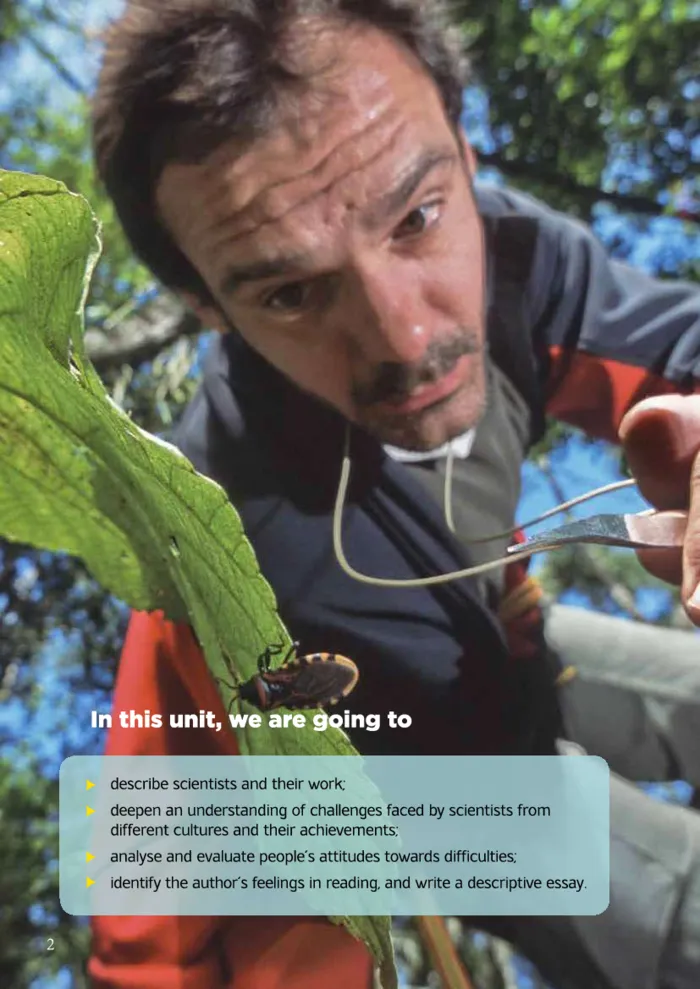
Look at the picture on the left and answer the
questions.
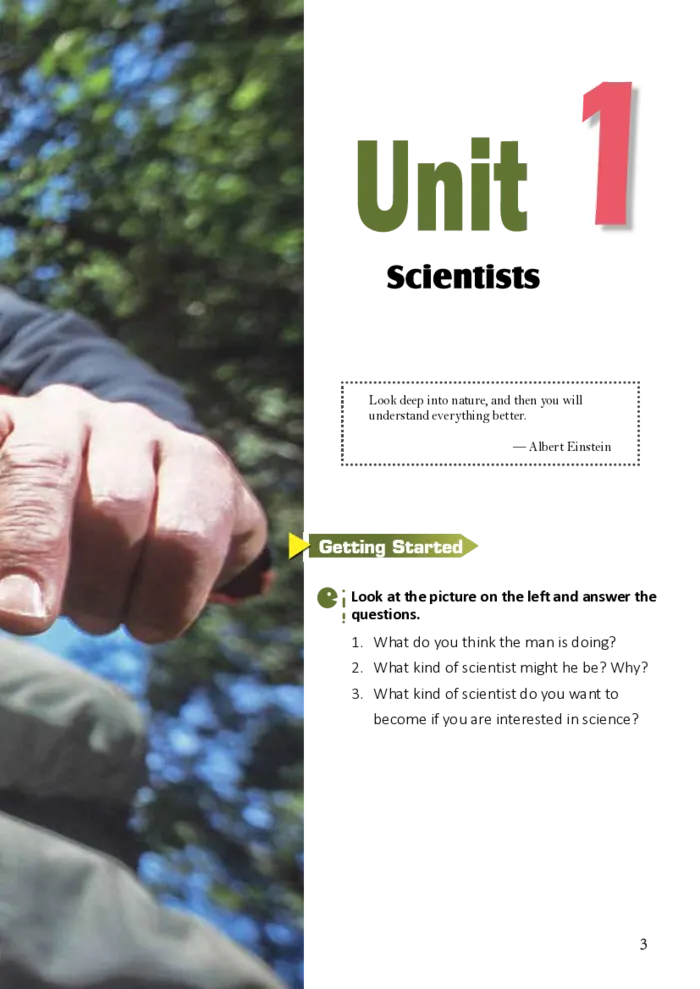
1. What do you think the man is doing?
2. What kind of scientist might he be? Why?
3. What kind of scientist do you want to


become if you are interested in science?
Look deep into nature, and then you will
understand everything better.

                                      — Albert Einstein
Today, more than 40 million seeds
from nearly 1,000 different kinds of
plants have been collected from the
Qinghai-Tibet Plateau. We owe this to
Zhong Yang, a professor of biology at
Fudan University and Xizang University,
who saw the value of studying plants.
Zhong spent a lot of time and
effort building a collection of seeds
bank preserves plant seeds and may
have medical or agricultural value in
the future. Storing seeds also protects
biodiversity — the balanced variety of
plant and animal life in the world.
More than 80 percent of the
seeds that Zhong collected are from
the Qinghai-Tibet Plateau — a large
elevated plain that is also known as
the “roof of the world.” The plateau
plants and is therefore an important
resource. However, it is highly
challenging for people to collect seeds
from the plateau. One has to deal with
varying climates and environments
sea level. In fact, a third of the seeds
collected on the plateau were found
at a height of 4,000 metres above sea
level! On top of that, the seed bank
requires that at least 5,000 seeds of
each plant be collected so they can be
preserved for more than 100 years.
Some seeds are easy to collect
UNIT 1
while others are more difficult. One
seed that is hard to collect is from a
special species of peach. In order to get
5,000 seeds, Zhong and his students
started eating the peaches, lots of the
peaches. “Since there is no suitable
we have to eat the peaches, which taste
awful. But this is the safest way to get
the seeds,” Zhong said.
Every year, Zhong and his students
walked at least 10,000 kilometres to
collect seeds. They sometimes fell ill
to save time, Zhong and his students
ate only one meal a day while travelling
to the mountains. Despite all these
hardships, they persisted.
Zhong spent countless hours
deeply devoted to this work, he also
I have realised that Xizang needs an
educator more than a biologist,” Zhong
at Xizang University, Zhong helped
to develop programmes of study in
biology and other sciences.
Zhong first started his work in
Xizang in 2001 and worked on his
car accident in 2017. Zhong was aware
that his research had touched only the
more to do.
“I have never regretted being a
scientist,” Zhong once said. “Imagine
what you do today will benefit many
people, even after you die. Everything
Personal Touch
Do you find Zhong Yang’s story impressive? Why?
Scientists
I. Fill in the blanks according to the text.
II. Answer the questions.
III.  Fill in the blanks with evidence from the text to support the statement about
Zhong Yang. An example is given.
IV. What other qualities do you think Zhong Yang had as a scientist and educator?
Support your opinion with evidence from the text.
1. Why is it important to build seed banks?
2. What challenges did Zhong Yang and his team face when collecting seeds in Xizang?
3. What did Zhong do as an educator in Xizang?
4. Why did Zhong never regret choosing his career?
Comprehension
Zhong Yang's major
contribution as a scientist
More than 40 million seeds from nearly 1,000 different
kinds of plants have been collected from the
(1) _______________.
Zhong never regretted (4) _______________.
Zhong spent a lot of time and effort (2) _______________.
Zhong  was also devoted to (3)  _______________
at Xizang University.
Zhong's work in Xizang
Zhong's attitude towards
science
Statement:
Zhong was very hard-working and tough.
Evidence:
 He had to deal with varying climates and environments depending on an area’s
position above sea level.
 __________________________________________________________________
 __________________________________________________________________
…
UNIT 1
Vocabulary Focus
Today, more than 40 million seeds have been collected from the Qinghai-Tibet
Plateau. We 1 ______________ this to Zhong Yang, a professor of 2 ______________.
Zhong arrived in Xizang in 2001 to collect seeds for scientific purposes. His work provided
medical or agricultural value in the future. It can also protect biodiversity — the balanced
3 _____________ of plants and animals.
Zhong and his students spent a lot of time and effort collecting seeds from the
Qinghai-Tibet Plateau — a large elevated 4 _______________ that is also known as the
“roof of the world.” The work was highly 5 _______________ for Zhong and his team.
They had to deal with 6 ______________ climates and environments there. Some
7 _____________ grow at high altitudes and Zhong and his students had to walk a long
way to collect them. They sometimes 8 ________________ because of plant allergies.
Despite all these difficulties, they continued their work.
While Zhong 9 _____________ collecting seeds in Xizang, he also spent a lot of time
improving education there. He worked as a biology professor at Xizang University and
helped to develop programmes of study in biology and other sciences.
Zhong never regretted being a scientist. He believed a scientist’s work could
10 _____________ all mankind.
I.  Key Vocabulary
Match the words or expressions with their definitions. Then fill in each blank with
one of the words or expressions in its appropriate form to complete the passage.
 (1) plain
a. the small hard part produced by a plant, from


which a new plant can  grow
 (2) (be) devoted to
b. the study of the life and structure of plants and


animals
 (3) challenging
c. to do good to
 (5) biology
e.  marked by differences
 (6) seed
f.  suddenly become ill


or sth
 (10) owe
j.  different kinds of sth
Scientists
I. Compare and tell the difference in the uses of the underlined parts in each pair of
sentences.
Grammar in Use
-ing/-ed forms 4 — used as predicatives
Science plays a major role in society. Because of science, human understanding of
the past, present, and future is continually changing. For example, decades ago the idea
of 1 _____________ on the moon would have seemed impossible. Today it is a mark of
2 _____________. Events once regarded as material for 3 _____________, such as landing
on Mars, now seem possible.
Science and technology can be found in nearly all aspects of everyday life. For example,
if electricity had never been discovered, telephones, lights, and televisions would not exist.
4 _____________. Because
of 5 _____________, information can be processed in seconds.

6 _____________ and large companies. But now computers can be found in many homes,
schools, stores and libraries. Computers are
also used in many places. They are used as
7 _____________ in schools, to monitor heating
systems at home and to guide satellites and space
research. In the future, computers may even have
microprocessors produced in 8 _____________.
1. a. He spends a lot of time with animals every day. Studying animals is his job.

b. He spends a lot of time with animals every day. His job is studying animals.
2.  a. The upcoming field trip got him worried.
   b. He seemed worried about the upcoming field trip.
3.  a. Zhong Yang was devoted to scientific work.
   b. Zhong Yang was a devoted scientist.
4.  a. It was frightening for him to carry out that dangerous experiment.
   b. He felt frightened to carry out that dangerous experiment.
II. Topic-Related Expressions
Fill in the blanks with the expressions given in the box to complete the passage.
Note that there are two more options than you need.
UNIT 1
III.  Complete the passage using the -ing or -ed forms of the given verbs.
II. Complete the dialogues with the -ing or -ed forms of the words given in brackets.
Grammar Highlights
The -ing and -ed forms of a verb can be used as
predicatives that provide specific information about the
subjects of the sentences. They usually come after linking
verbs: be, seem, get, look, become, appear, etc.  For
example:
• His job is studying animals.
• The findings seemed amazing.
• All these mysteries remain unsolved.

The first living things to travel in space were not human beings. They were animals. It
sounds 1 _____________, doesn’t it?
In 1952, the United States sent two monkeys named Patricia and Mike into space.
Scientists wanted to see what would happen when the spaceship reached a height of
survived! The scientists were 2 _____________ to find out that living things could
survive the trip into space. Patricia and Mike landed safely and went to live at a park in
Washington, D.C.
3 _____________ as the first living thing to travel
around the Earth in a spaceship. She was sent into space in 1957. Her job was
4 _____________ inside the spaceship and 5 _____________ scientists monitor her heart
rate, breathing, and blood pressure during the trip. In this way, the scientists were able to
learn about the effects of space travel on living things.
animals, scientists learned that humans could survive space travel.
travel
let
excite
  surprise
know
Scientists
I. Answer the questions.
II. Listen and choose the best answer.
This passage mainly introduces Stephen Hawking’s ______________.
B. sufferings and great achievements
C. attitudes towards science
D. best-selling books
What do you know about Stephen Hawking? What is he famous for?
What do you think is the relationship between suffering and success? Give your
reasons.
IV. Discuss the question.
Stephen Hawking (Radio programme)
III. Listen again and fill in each blank with what you hear.
1 _________ he would only live a few years. But
he proved them wrong by surviving for more than 50 years more and 2 _________
his scientific work.
The disease eventually put him in a wheelchair and took away his 3 _________ to
speak. For many years, Hawking 4
In his 2013 book, My Brief History, Hawking wrote about first learning of the
5
the time, I thought my life was over and that I would never realise the potential I felt
I had.” “But now, 50 years later, I can be quietly 6 _________ with my life,” he wrote.
Do You Know These Female Scientists? (TV programme)
I. Answer the question.
Have you heard of any famous female scientists? Name a few.
1. one of the most important people in the
development of modern computer software
2. one of the major contributors to the discovery of
3. a researcher on animal behaviour, especially
different areas
which is now widely used to treat malaria
II. Watch the video clip about some female scientists and match the scientists with
the descriptions.
B. Tu Youyou
C. Jane Goodall
D. Grace Hopper
E. Rosalind Franklin
UNIT 1
1. Where did Marie Curie do most of her work?
2. What does Jane Goodall’s work show us?
Do you think scientific progress is always a good thing? Why or why not?
III. Watch the video clip again and answer the questions.
IV.  Work in groups to discuss the questions.
Recommending stories of scientists
Your school is going to hold a science festival. Your class is supposed to recommend
a list of stories about scientists. Talk with a partner and decide which stories to
recommend.
Asking for recommendations
What do you recommend?
Would you mind sharing your comments
on ...?
What is your favourite ...?
Could you please make a recommendation
about what to ...?
Giving recommendations
Why don’t you ...?
I highly recommend ...
You should ... when you have spare time.
I really think you’ll like it.
You will find it interesting.
Step 1    Make a list of famous scientists and collect stories about them.
Step 4    Each pair recommends  stories of scientists to the class and explains why.
Step 2    Work in pairs. Share with your partner the basic information (main characters,
plots, writers, etc.) of the stories and make comments on them.
Step 3    Discuss which stories to recommend to the class. During the discussion, you may
give reasons for your recommendation.

EXAMPLE


difficulties in life. I really think you should read it. Which story do you


recommend?

Culture Link
Nobel Prize Fast Facts
•
•
physics, chemistry, physiology or medicine, literature, peace and economic
•
Scientists
 Physical chemist Rosalind
Franklin discovered through an X-ray
was a double helix
1. This discovery is
considered one of the most important
course of her career, Franklin had an
undying passion for science. Her work
eventually became the basis of many
 Rosalind Elsie Franklin was born
She came from an educated Jewish
facts and reasons to stories and
make-believe. She knew she wanted to
Franklin graduated from university
despite her father’s disapproval of
young age of 26, Franklin had already
published five papers on the physical
structure of coal and carbon. Nothing
even though science was considered
a “man’s world.” During World War
II, Franklin continued to cycle to work
Germany.
 In 1945, Franklin earned her
doctorate in physical chemistry from
worked in Paris. There, she mastered
a special X-ray technique called X-ray
crystallography2, which eventually
became an important part of her
research.
Franklin returned to England
i n 1 9 5 1 t o w o r k a s a n X- ray
crystallography expert at King’s
her efforts often went unnoticed.
Women in the field of science were
not eat lunch in the same room with
project, Franklin worked alone. She
Franklin’s skills in X-ray crystallography,
coupled with her “extreme clarity
and perfection,” had resulted in the
famous image — photograph 51.
But Franklin was very careful and
wanted more evidence. Without her
knowledge, Maurice Wilkins and two
other male scientists, James Watson
and Francis Crick, got hold of her
data. Soon after, Watson and Crick
on Franklin’s photograph.
Franklin eventually left King’s
College in 1953 and began her most
UNIT 1
famous work on viruses. Sadly,
in 1956, Franklin found that she
had cancer, but she continued to
work until her death in 1958. Four
years later, in 1962, the three male
scientists who took advantage of
credit even though she had provided
the crucial information that allowed
Watson and Crick to make their
breakthrough. If she were alive,
would Franklin have been recognised
for her work, alongside her fellow
I. Answer the questions.
1. What difficulties did Rosalind Franklin face?
3. How does the author feel about the difficulties Franklin faced as a female
scientist? Find evidence from the text to support your answer.
One of Franklin’s biggest problems
was gender inequality — the unfair
women were treated. But she never
lost heart. She took up every challenge
head-on so that she could do what
she loved — and that was to be a
II. Fill in the table with key information about Rosalind Franklin’s life and career.
Notes
1. double helix (see the picture above)
method used to see the three-
dimensional structure of crystals.
Comprehension Plus
Reading Strategy
1958
1920
1941
1945
1956
1958
1951–1953
Time
Event(s)
Scientists
I. Reflect on what you have learned about Zhong Yang, Stephen Hawking and Rosalind
Franklin in this unit. Fill in the table with the difficulties they faced, how they dealt
with these difficulties and their qualities as scientists.
• brain power (intelligence/talent)
• curiosity
• creativity
• communication skills in writing and speaking
• courage in the face of hardship or prejudice
II. What other qualities do you think are important for scientists? Give your reasons.
The following qualities are given as examples.
Zhong Yang
Stephen Hawking
Rosalind Franklin
What difficulties
they faced
How they dealt with
the difficulties
What qualities they
had as scientists
UNIT 1
The science society in your school is celebrating its 4th
anniversary next month. You are asked to write about a
personal experience of exploring science. It could be a
scientific lecture you attended, an experiment you did
in school or at home, a visit to a science and technology
museum, a science game you played with friends, etc.
Here is a piece of descriptive writing about an
unforgettable experience. Note the detailed descriptions
used in this writing.
Our class visited a science fair last week. I was so excited
that I couldn’t sleep the night before! This experience still
remains fresh in my mind.
We arrived at the science fair in the morning. The place
was overcrowded with students from different schools. I
saw handmade models of motor cars, trains, ships, aircraft,
X-ray machines, etc. What interested me most was a model
of a human body powered by electricity. The workings  of
the heart, lungs and other organs of the body were displayed
vividly before my eyes.
“That’s so cool!” I said excitedly.
The inventor glowed with pride. “I’m always fascinated
by how our body works. Our biology and physics classes
have really helped a lot!”
“That’s amazing! I hope I can come here with my model
train next year.”
We left the fair with a feeling of joy and wonder. I will
definitely visit the science fair again!
Sensory
details
Dialogues
Scientists
Guided Writing
Step 1    Think of an experience you want to write about.
Step 2    List the details you want to describe in the table.
Step 3    Write a piece of descriptive writing in 100–120 words using the details suggested
above.
The main purpose of descriptive writing is to describe a person, place or thing in
such a way that a picture is formed in the reader’s mind. The success of descriptive
writing lies in the details. There are two major ways to make detailed descriptions
— using dialogues and using five senses (sight, hearing, taste, touch and smell).
1. “Justin,” Mum shouted, “get in the room now!”

“Just a moment. I’ll be right there,” said Justin. (using dialogues)
senses — sight)
3. She smelled of wet cigarettes and bacon. (using the five senses — smell)
4. The mother hugged the boy, breathing her hot breath onto his neck. (using the
five senses — touch)
5. Mr Jenkins was awakened by a sharp noise of a bat hitting a ball. (using the five
senses — hearing)
6. He could feel the taste of blood in his throat. (using the five senses — taste)
Sensory details
Sight
Smell
Touch
Hearing
Taste
Dialogues
Other important
details
UNIT 1
1. Title of the booklet
2. Name of the scientist
3. A picture of the scientist
4. Years living (examples: 1901–1959; 1973–?)
5. Birthplace
6. Three important facts about the scientist
7. A quote from the scientist
8. A paragraph introducing his/her contributions
(Note: one page for each scientist)
Key information to be included:
Work in groups to create a full-colour booklet of a certain group of Chinese
scientists. You may choose one of the following groups of scientists:
biologists, physicists, chemists, ecologists, geologists, psychologists, etc.
Look at the expected learning outcomes of this unit. Tick the items you think you
have done well.
Write a reflective note on what you think you need to improve. You may include
some or all of the following points:
What you still find difficult
Your plan to solve the problem(s)
Possible cause(s) of the problem(s)
Learning resources that you could use
  A. Understanding sufferings and great achievements of scientists
  B. Talking about the life and work of some famous scientists
  C. Creating a full-colour booklet of a group of scientists
  D. Analysing and evaluating scientists’ attitudes towards difficulties
  E. Identifying the author’s feelings in reading
  F. Writing a descriptive essay about my personal experience of exploring science
Scientists
Below are some benefits of learning a new
language. Based on your experience of
learning English, which of them do you find
to be true? Explain why.
1. improving your memory
2. improving your concentration
3. building your willpower
4. improving your learning ability
The limits of my language mean the limits of
my world.

   — Ludwig Wittgenstein
There are about 7,000 languages spoken around the
world — and they all have different sounds, words and
structures. But do they shape the way we think? Lera
Boroditsky suggests an answer.
About 7,000 languages are
spoken around the world. And all the
languages differ from one another
in all kinds of ways. That begs this
ancient question: does the language
we speak shape the way we think?
Charlemagne, Holy Roman emperor,
said, “To have a second language is
to have a second soul.” –– a strong
statement that suggests that language
affects reality. On the other hand,
Shakespeare’s Juliet says, “What’s
in a name? A rose by any other
name would smell as sweet.” –– this
suggests that language does not
shape reality. Whether language
shapes reality has been debatable for
thousands of years.
Here are some of my favourite
examples. I’ll start with one from an
Aboriginal community in Australia,
the earliest people who lived in the
country. The Kuuk Thaayorre people
don’t use words like “left” and “right.”
Instead, they use: north, south,
east, and west. Thus, they would say
something like, “Oh, there’s an ant on
your southwest leg.” Or, “Move your
cup to the north-northeast a little bit.”
In fact, people who speak languages
like this are more aware of where they
are in the world.
Languages differ in how they
express colours. Some languages
have lots of words for colours, while
UNIT 2
some have only a couple of words ––
“light” and “dark.” For example, in
English, there is a word for blue, but
in Russian, there isn’t just one word.
Instead, Russian speakers have to tell
the difference between light blue,
“goluboy,” and dark blue, “siniy.” When
we test people’s ability to recognise
the differences between these colours,
we find that Russian speakers are
faster.
Languages also differ in how they
describe accidents. In English, it’s
fine to say, “He broke the vase.” In
a language like Spanish, you might
be more likely to say, “The vase
broke,” or, “The vase broke itself.” If
it is an accident, you wouldn’t say
that “someone” did it. So, people
who speak different languages will
pay attention to different things,
depending on what their language
usually requires them to do.
I’ve given you a few examples of
how language can significantly shape
the way we think. Language can have
big effects, as we saw with space.
Language can also have really early
effects, as we saw in the case of colour.
They have an impact on our simple,
basic decisions. And finally, we saw
how language can shape things
that have personal significance for
us — ideas like blame and pun-
ishment.
There is such a beautiful variety
of language and it reveals just how
brilliant and flexible the human mind
is. I want to leave you with this final
thought. I’ve told you about how
speakers of different languages think
differently. But, it’s not about how
people elsewhere think. It’s about
how you think. And that gives you
the opportunity to ask, “Why do I
think the way that I do?”
Note
This text was selected and adapted from a
talk given by Lera Boroditsky in 2017.
Personal Touch
How long have you been learning English? Has learning and using
English changed the way you see the world?
Language and Mind
I. Answer the questions.
II. Complete the table by writing down corresponding examples of the claims.
III. The speaker used two quotes in support of the opposing statements regarding
the relationship between language and mind. Read the quotes below and put
them into the corresponding category. Add a quote to support the statement
you agree with.
1. What is the speaker’s point of view regarding the relationship between the
language(s) we speak and the way we think? Do you agree?
2.  According to a study by the speaker (Boroditsky 2010), Chinese speakers use more
up-down terms (e.g. shang ge yue, xia yi zhou) to talk about time than English
speakers, who often use left-right terms (e.g. the following week). Could you think of
such expressions in English or Chinese?
3. Do you think our way of thinking also influences the language(s) we use? Why or
why not?
Comprehension
Claim
Example
Language can influence the way we think
about space.
Language can influence the way we
express colours.
Language can influence the way we
describe accidents.
Statement 1:
Language shapes the way we think.
Statement 2:
Language doesn’t shape the way we think.
A
B
A. To have a second language is to have a second soul.  — Charlemagne
B. What’s in a name? A rose by any other name would smell as sweet.
— William Shakespeare
C. Knowledge of languages is the doorway to wisdom.
D. Words are the clothes thoughts wear.
E. The ability to think for one’s self depends upon one’s mastery of the language.
F. One more quote: ________________________________________.
UNIT 2
Vocabulary Focus
you? It could have been just one sentence — one single sentence
1 _________ for a moment, or maybe even
a lifetime. There is more to our language than strict grammar,
words, spelling and 2 _________. There is a real power to it. Our
language creates a 3
The words we speak to other people and the thoughts we hear in
our minds add up and create our personal stories. Those stories
eventually create and 4 _________ our 5 _________. This is the
power of language. If you spend some time focusing on the
6 _________,
you will see how a language 7 _________ in the realities it
creates. You may also 8 _________ the power of language if you
such a failure” with “I do want to feel secure and successful.”
You will have similar findings if you pay attention to examples
9 _________. They all show how language can 10 _________ shape
the way we think.
I. Key Vocabulary
 Fill in the blanks with the appropriate forms of the given words to complete the
passage. Note that there are two more options than you need.
II. Topic-Related Expressions
Fill in the blanks with the appropriate forms of the given expressions to complete
the sentences. Note that there are two more options than you need.
1. How a language groups various things and concepts will guide an individual’s
______________, including categorisation, memory, reasoning and decision-making.
2. Scientists have found that unborn babies are able to ______________ between two
languages. The babies they observed were able to distinguish between English and
Japanese even a month before they were born.
pattern(s) of thought
language contact strong statement
mental activity
recognise
structure
reality
soul
elsewhere
impact
Language and Mind
I. Study the sentences and underline the subordinate clauses. What functions do they
have in the sentences?

Grammar in Use
Subject clauses and predicative clauses
3. The ______________ is the most complex object on Earth. It is the source of all
thought and behaviour.
4. There is an interdependence between the input and the output in ______________
acquisition.
5. As with the Anglo-Saxon and Norman settlers of centuries past, the languages spoken
by today’s ethnic communities have begun to ______________ the everyday spoken
English of other communities.
6. ______________ often leads to language change.
7. There is a common belief that Eskimos have ______________ for snow. Repeating
this idea over and over does not turn it into a fact.
8. The ancient Greeks believed that the structure of language mirrored ______________.
1. It is accepted that our language and thought are both influenced by culture.
2. What the researchers have found is how brilliant and flexible the human mind is.
3. Whether language shapes the way we think has been a question for centuries.
4. A common belief is that any language can be learned with enough practice.
5. How language learning can benefit young learners has attracted a lot of researchers’
interest recently.
What has been argued for thousands of years is whether or not people speaking different
languages think differently.
subject
predicative
EXAMPLE
UNIT 2
II. Read the passage and answer the questions by using subject or predicative clauses.
Grammar Highlights
One of the oldest questions in the study of language involves how it influences
our thought. According to a highly debatable response from Benjamin Whorf, a
student of the famous linguist Edward Sapir, “Language not only influences thought,
but it determines thought as well.” The Sapir-Whorf hypothesis, at least in its
strongest form, has been rejected by many psychologists. After all, it’s not difficult to
come up with examples of thought that does not involve language. But a weaker form
of the hypothesis has yet to be challenged: the idea that the language we speak does
to a certain extent affect our thought.
1. What is one of the oldest questions in the study of language?

One of the oldest questions in the study of language is _______________________.
2. What is suggested in the Sapir-Whorf hypothesis?

It is suggested _______________________________________________________.
3. What has been proved by examples according to the passage?

It has been proved ___________________________________________________.
4. What has yet to be challenged?

___________________________________ has yet to be challenged.
III. Answer the questions with information from the passage above, using subject or
predicative clauses.
1. What is the stronger form of the Sapir-Whorf hypothesis?
2. What is the weaker form of the Sapir-Whorf hypothesis?
3. What can be used as evidence to reject the stronger form?
The underlined clauses in the example in Exercise I act as the
subject and the predicative respectively. Since they serve the same
function as nouns, they are called noun clauses.
A noun clause normally begins with words such as that, how,
whether, what, whatever, when, which, whichever, who, whoever,
whom, whomever and why.
Language and Mind
II. Listen and answer.
I. Answer the questions.
1. About how many languages
were spoken in Australia?
2. About how many languages
are still spoken today in
Australia?
3. When did Europeans arrive
in Australia?
4. How many languages are
considered “alive” and in
daily use in Australia?
Do you know there are endangered languages in Australia?
Why should we save them?
I. Watch the video in silent mode for 32 seconds and try to answer the questions.
 1. What is the possible relationship between the two boys?
 2. What were they busy doing?
II. Watch the entire video and answer the questions.

Did the boys both succeed in what they were doing? Why?
Saving Critically Endangered Languages in Australia (Radio programme)
Why Should Students Learn Foreign Languages? (Mini-lecture)
III. Listen again and complete the diagram.
Language is a central part of the (1) _________
of Australia’s Aboriginal communities.
Language helps them understand their
(2) _________, history and (3) _________.
Language also gives them
a strong (4) _________.
III. Watch again and complete the table.
Both of them like
playing basketball.
They have similar
(1) ______________.
John
Matt
During his free time, John involved himself in
(2) ______________ while he also managed to
learn (3) ______________ of his choice.
Matt is as (4) ______________, but he wasted
most of his time doing nothing, just
(5) ______________.
Culture Link
Languages Are Disappearing
You probably know that much of the world’s environment
is under threat, but you might not know that languages
are disappearing alongside plants and animals. There are
around 7,000 living languages in the world, but UNESCO
predicts more than half will have disappeared by the end
of the century. If a language dies out, much knowledge
goes with it. There are plenty of linguists who are studying
and trying to save the world’s dying languages.
UNIT 2
 1. enhancing a global mindset
 2. getting high scores in exams
 3. developing the ability to appreciate other cultures
 4. improving thinking and life skills
 5. being employed by the best organisations
 6. getting into a good college
 7. studying in the best universities abroad
IV. Pick out the items that are the benefits of learning a foreign language based on
what you have watched.
Giving a presentation on the possible effects of learning a foreign language
Work in groups. Give a presentation on the possible effects of learning a foreign
language on the human mind.
Before the 1960s, speaking two languages was considered a factor that slowed a
child’s brain development by forcing them to spend too much energy distinguishing
between languages. A new study did show that reaction times and errors increased
for some students who speak two languages in cross-language tests. However, the
study also showed that the effort and attention needed to switch between languages
caused more activity in, and possibly strengthened, a part of the brain that plays a
large role in decision-making, problem-solving, switching between tasks and focusing.
So, while speaking two languages may not always make you smarter, it does make
your brain healthier, more complex and actively engaged.
During a presentation, the speaker should guide the audience so they can easily follow
the argument as the speaker moves from one idea to the next. Speakers do this by using
expressions to clearly signal what idea will come next. These expressions are called
transitions. Apart from the underlined parts in the passage below, you can also use the
following expressions:
• Now that I’ve told you about … I’m going to explain …
• I’d like to move on to …
• Let me turn to …
Signalling a transition
Speaking Strategy
Step 1    Brainstorm and list the possible advantages and disadvantages of learning a foreign
language.
Step 2    Give a presentation based on your discussion. Make sure the audience can easily
follow your argument. You may use the underlined parts in the passage below.
Language and Mind
Learning a new language can
feel like doing magic. Suddenly, a
whole other world opens up and you
discover a completely new side of
life. Of course, learning a language
doesn’t happen through magic, but
rather through study. But the effect
this studying has on our brain is
nothing short of magical. Here are
some highlights about how the brain
changes during language learning.
It sounds like something a child
may ask: does learning new things
make my brain grow bigger? It turns
out that this is what language learning
does to the brain. Researchers from
Lund University in Sweden studied a
group of students who went through
a demanding language learning
programme. For a control group, the
researchers selected students who
were studying medicine and science.
Both groups were given MRI (magnetic
resonance imaging) scans at
the beginning of their studies,
and again after three months.
The researchers discovered
that brain structure changed
only in the language learning
group. The results suggest
that language learning is
a promising way to keep the brain
in shape and offers more enhanced
cognitive benefits than other forms
of study.
Many of us dream of being able to
focus better and, according to a study
published in the journal Brain and
Language, learning a new language
could help make that dream come
true. Using a language comprehension
task, researchers from Northwestern
University tested individuals who
speak one or two languages. The
task involved listening to a word and
then selecting the corresponding
image from a group of four. It sounds
simple, but the trick was that each
group had a distracting word added to
it, which is a word that sounds similar
to the target word. For example,
“candy” versus “candle.” Individuals
who speak two languages were better
at filtering out the distracting words.
UNIT 2
The results revealed that people who
only speak one language had to work
harder to complete the task.
Just like exercising your body,
providing your brain with a workout
has considerable health benefits.
Several studies have shown a link
between being bilingual and delaying
the beginning of Alzheimer’s disease
by an average of four years. The
reason for this delay, the researchers
believe, is that learning a language
challenges our grey cells, which helps
prevent them from becoming worse
as we age.
Ready to give your brain a
workout?
Complete the cause and effect tree diagram using options from the box below
based on the text you have read. Read more about language and mind. Write
down one more effect and discuss it in groups.
Damaging brain cells
Tuning out distractions
Delaying Alzheimer’s disease
Effect 3:
__________________
One more effect:
___________________
Effect 1:
______________
Effect 2:
 ______________
Developing the brain
Processing more information
Cause:
Learning a new language
Comprehension Plus
Language and Mind
Analysing cause-effect
relationships
I. The following is a PPT slide of a talk about the benefits of learning a new language.
It shows several possible effects of language learning. Find evidence for these effects
based on what you have learned in this unit.
• developing better relationships with others
• deepening one's understanding of other cultures
• forming a global perspective
Learning a new language may:
• change the way one perceives the world;
• enhance one's global mindset;
• change one's brain structure with better cognitive

performance;
• help one tune out distractions;
• enable one to fulfill complex tasks;
• delay the aging of one's brain.
II. Learning a foreign language not only strengthens one's mind, but also leads to many
other benefits. Discuss how language learning gives rise to the following benefits by
analysing the cause-effect relationships.
UNIT 2
Chen Kai has been learning English for eight years. He
can read books in English and do very well in tests. Last
summer, he watched a French film and was attracted by
the French language and culture. This made him eager to
learn French. However, no French course was offered at his
school. Chen was disappointed and wondered why English
was the only foreign language taught at his school.
Later, he came across a short essay in a local magazine.
Is English the Only Foreign Language Worth Learning?
Nowadays English is used in almost all fields of
international communication: business, politics, science,
culture, etc. For this reason one may think that English is
the only foreign language worth learning to feel confident
in society. But is that really so? I strongly believe that high
school students in today’s globalised world should have
the opportunity to learn languages other than English.
Every language is worth learning because it is a key that
unlocks a world for us. It doesn’t matter if it’s French,
German, Spanish, Japanese, Korean, Hebrew or any other
language. Learning other foreign languages greatly increases
the number of people on the globe with whom you can
communicate. In conclusion, I would recommend that
my friends learn as many foreign languages as possible.
The languages we have learned and are learning are our
treasure — the treasure that cannot be taken from us.
counterclaim
claim
Language and Mind
Chen decides to write a letter to his headmaster to persuade him to offer a French
course at school. Can you help him?
Dear __________,
_______________________________________________
_______________________________________________
_______________________________________________
_______________________________________________
_______________________________________________
_______________________________________________

Guided Writing
claim and counterclaim
A claim is a statement that something is true or is a fact, although other people might
not believe it.
A counterclaim is a statement that someone makes in response to a different
statement made by someone else.
Argumentative writing
  Step 1    Work in groups. Discuss whether there should be an additional foreign language
course for high school students. Write down opinions of each group member.
  Step 2    Choose the strongest claim and counterclaim from your notes.
  Step 3    Write a persuasive letter to the headmaster in 100–120 words. Use claim(s) and
counterclaim(s).
UNIT 2
Nowadays, many Chinese dialects are spoken by a much smaller population
than decades ago. In different places in China, efforts are being made to protect
disappearing dialects. Collect information on this topic.
Case
Place
Measures
Sample case
Shanghai
1. In addition to Putonghua, the Shanghai dialect is also used in
announcements on buses in Shanghai.
2. Some radio and television programmes are launched in the Shanghai
dialect.
3. Research into the Shanghai dialect is carried out by linguists.
Your case
Your group’s case
Collecting information about dialect protection in China
  Step 1    Search the Internet for articles reporting on dialect protection in China. Download
one article and note down the main idea(s).
  Step 2    Summarise the article in no more than three sentences.
  Step 3    Discuss the articles in groups. Decide on the best example and report it to the
class. Present your notes in a table, as shown below.

Look at the expected learning outcomes of this unit. Tick the items you think you
have done well.
Write a reflective note on what you think you need to improve. You may include
some or all of the following points:
What you still find difficult
Your plan to solve the problem(s)
Possible cause(s) of the problem(s)
Learning resources that you could use
  A. Understanding and discussing the impact of the language we speak on the
way we think
  B. Talking about the benefits of learning foreign languages
  C.  Collecting information about dialect protection in China
  D. Analysing cause-effect relationships between language learning and its
possible effects
  E. Giving a presentation on the possible effects of language learning using transitions
  F.  Writing an argumentative essay containing claim(s) and counterclaim(s)
Language and Mind
Read the poem and answer the questions.
What does “Charity gives you happiness
beyond compare” mean? Do you agree?
Give your reasons.
When one is good to others, they will be
good to him too.

                                            — Guan Zhong
Charity
You are looking at a website and
an advertisement jumps out, asking
for donations to people in need of
warm clothes. You pay for a few items
at a drugstore and the clerk asks if
you’d like to donate school supplies to
less fortunate children. You receive an
to do the ALS Ice Bucket Challenge
1.
Opportunities to give money to
people who need help are every-
where. But which situations prompt
you to reach for your wallet? Does it
depend on your mood? Your excess
cash that month? Does it depend on
who’s watching?
Accordi ng to a new stu dy,
published in the Journal of Consumer
Research, a major factor that may
determine whether or not we
donate is where we stand on two
moral traits: empathy and a sense of
justice. Although both are positive
characteristics, they often appear to
to keep a balance can be tricky and,
depending on the situation, we often
lean more towards one over the other.
For example, if you believe that
a homeless man has caused his own
misfortune and you are pretty sure
he could have made better choices
Why do people usually give to charity? Read
UNIT 3
Personal Touch
If you meet homeless people, will you give money to them? Why or
why not?
than he did, then you will probably
lean towards not giving any money. On
the other hand, if you can relate to the
pain that would cause him to slip into
the hopeless situation — whether or
not you actually had the same terrible
experiences as he did — then you
would probably lean towards empathic
giving, even if he did play a role in his
own problem.
For the study, researchers asked
people to donate to charities in which
as those who cannot keep a job due to
alcohol use). Results showed that some
participants considered it immoral to
give a donation to people who were
Furthermore, the participants who
felt this way and also felt themselves to
be highly moral were even less likely to
donate money. In other words, if they
felt that they almost always make moral
choices, then they seemed to feel less
empathic towards the sufferers and
were less likely to donate.
Although there are several factors
we take into account before donating
to a charity, the research confirms
the immense power of empathy. It’s
empathy that connects us to one
another and prompts us to reach out.
suffering can help us relate to another
person’s unique form of suffering,
In fact, when researchers asked the
participants to recall their own past
immoral behaviours, then they seemed
able to empathise more with those who
were suffering. As a result, they were
more likely to donate.
Note
involving the dumping of a bucket of ice
and water over a person’s head to promote
awareness of the disease “amyotrophic lateral
research.
Charity
According to a study,
______ and _______ are two
major factors.
_____________ are also
important factors.
Comprehension
I. Fill in the blanks with information from the text. Add further factors that may
influence the decision whether to donate.
II. Judge whether the following statements are true or false. Write T for “true” and
F for “false” and then find evidence from the text to support your judgement.
____ 1. Empathy is the major factor that determines whether or not we donate.
 ____________________________________________________________
____ 2. Many people manage to keep a balance between empathy and a sense of

justice while donating to some sufferers.
 ____________________________________________________________
____ 3. People are less likely to donate to a homeless man if they think he could

have made better choices.
 ____________________________________________________________
____ 4. Some participants thought donating to people who were responsible for

their own situation was immoral.
 ____________________________________________________________
____ 5. Most participants in the study chose to donate out of empathy.
 ____________________________________________________________
If people lean more towards _______,
they will be more likely to donate.
If people lean more towards _______,
they will be less likely to donate.
If people _____________________
____________________________,
they will be more likely to donate.
If people _____________________
____________________________,
they will be less likely to donate.
What determines whether or not you donate to a homeless person?
Information from the text
Your opinion
UNIT 3
Vocabulary Focus
Have you ever hesitated to give money to those who need help? According to
a new study, whether you are willing to give money may 1 _________ by two moral
traits: empathy and a sense of 2
3 _________ may let you make
completely different decisions. For example, you will be more likely to give money
to a homeless person if you 4 __________ to the pain that has caused him or her
to 5 __________ into the hopeless situation. However, if you think that he or she should be
6 _________ for his or her own misfortune, you may not regard it as 7 _________ to make
a donation to him or her.
Of course, the study 8 _________ that empathy has immense power among all
When we 9 _________ our own past wrong behaviours, we seem to be more able to
10 _________ with the sufferers and more likely to donate. And thus empathy is
important to connect us to one another.
I. Key Vocabulary
 Fill in the blanks with the appropriate forms of the given words to complete the
passage. Note that there are two more options than you need.
II. Topic-Related Expressions
1. Find appropriate verbs to fill in the blanks.
______ a cardboard sign
______ moral choices
moral
relate
determine
alcohol
recall
slip
Charity
I. Scan the text in Reading A and pick out the sentences in which the -ing forms function
as a subject and an object to fill in the blanks.
Grammar in Use
-ing forms — used as subjects and objects
1. -ing form used as a subject: ______________________________________________

____________________________________________________________________
2. -ing form used as an object: ______________________________________________

____________________________________________________________________
2. Complete the passage with the appropriate forms of the expressions in Exercise 1.
One evening during last Christmas season, I went to a store to buy some gifts
for my children. After checking out I noticed a small girl standing outside the
window, 1 _________ with the word “Hungry.” She looked almost the same age
as my daughter Katie. 2 _________, I was eager to 3 _________ her. I went to her
and asked what she wanted Santa to bring her.
“I don’t want Santa to bring me anything,” she answered. I was shocked by her
words and continued to ask why.
“I just want him to bring Mama something nice. We have no money and
Mama often cries worrying about things.”
Struck by the idea of such a small child, I 4 _________ immediately and
5 _________ my wallet and took out a $50 note. I gave the money to her and told
her to get Mama something nice.
I watched the girl running to her mama with the money and then walked away
6 _________ to
others, but I still felt happy on that special Christmas evening. And I hoped that
would be a special Christmas for the girl and her mama.
UNIT 3
II. Note down what you infer from each of the dialogues by completing the
sentence on the right with an appropriate -ing form.
Grammar Highlights

Like infinitives, -ing forms can function like nouns and be used as subjects or
objects of verbs. They can also be used as objects of prepositions.
1. Some verbs are normally followed by -ing forms as objects, such as admit,
avoid, consider, deny, enjoy, finish, mind, quit and suggest. For example:

 Could you come to my office after you finish cleaning the classroom?

 He suggested participating in the charity sale at the school.
2. Some verbs, like forget, regret, remember, try and stop, can be
followed by either -ing forms or infinitives, but they have
different meanings. For example:

  Jennifer always takes her own bag with her and has stopped

using plastic bags in supermarkets.

  Having worked for two hours, Johnny stopped to drink a cup

of coffee.

Dialogue
What can you infer from
the dialogue?
1
Erik: Do you think it’s a good idea to hold a
charity sale this weekend?
Alice: Yes, it is.
_____________ is a good idea
for Erik.
2
Monica: There’s a mountain village where
some of the parents can’t afford school
supplies for their children. How can we help
them?
Phil: We could raise some money for them.
Phil suggests _____________
________________________
________________________.
3
Jim: You’ve been doing volunteer work in the
nursing home, haven’t you?
Ellen: Yes, I have. I’m happy to help the elderly.
Ellen enjoys ______________
________________________.
4
Irene: Did you go to the charity party last
month?
Mike: Yes, I did, and I donated fifty dollars.
Mike remembers __________
_________________________.
5
Cathy: Do you mind if we add a “Donate Now”
button to your web page?
Jerry: Not at all. I love helping with charity
events.
Jerry doesn't mind _________
_________________________.
6
Ann: Have you signed up for the charity
marathon next week?
Charlie: Yes, I have. I’ve been training for it for
a month. I can’t wait!
Charlie is looking forward to
________________________
________________________.
Charity
I. Answer the question.
  What is a non-profit organisation? Give examples.
I. Answer the questions.
 1. Did you know about charity as a kid?
 2. How did you learn about charity for the first time?
II. Listen and choose.

What is the report mainly about?
A. Volunteering activities aimed at helping teenagers.
B. Charitable activities started by teenagers.
C. Foundations that help those who have trouble affording tuition fees.
D. Non-profit organisations helping homeless people.
III. Listen again and fill in the blanks.
Non-profit Organisations Founded by Teenagers (Report)
Teaching Kids About Charity (TV programme)
this by speaking in simple terms that the kids 1 _________, letting them be part of the
2 _________ process, asking them who they would like to 3 _________ and how they
could 4 _________, and of course, making it 5 _________.
II. Watch the video clip and fill in each blank with one word to complete the summary.
Name:
Jonas
Organisation: (1) ____________
Motivation:  Jonas was inspired by his experience of seeing not only
(2) ________ but also (3) ________ in need.
Service:
(4) ____________ young people to make a difference through
their volunteer commitment of providing (5) ____________
youth and their families with basic necessities.
Name:
Annie
Organisation: (6) ____________
Motivation:  She discovered there were many kids in (7) ____________
situations who had to leave their homes with very few of their
own (8) ____________.
Service:
Creating and (9) ____________ fabric care bags filled with
(10) __________ and comforting items for needy children from
babies to 18-year-olds.
UNIT 3
1. Why is it difficult to teach kids about charity?
2. How does the mother understand charity?
3. Why did the mother get the whole community together?
4. What is important when teaching children to become good citizens?
III. Watch the video clip again and answer the questions.
Suggesting a creative charity event for your school
Imagine your school is holding a charity event next weekend, and the school office
has asked for creative ideas about suitable charity events. Follow the steps below to
prepare a proposal.
can describe them in a detailed and ordered way by making clear:
what your ideas are;
why you came up with them;
what benefits they offer;
...
Expanding on your ideas
Speaking Strategy
Step 4    Report your ideas to the school office after summing up the details about the three
charity events.
Summing up the ideas
I’d like to summarise my group’s ideas on ...
Some Creative Charity Events
• Dublin hosts a Women’s Mini
Marathon annually as a charity
event and men often dress as
women to join in the race.
• France is the first country in the
world to ban supermarkets from
throwing away unsold food,
forcing them instead to donate it
to charities.
• In 2011, a dog from Maryland
ran a half marathon and raised
$13,000 for charity.
Culture Link
Step 1    Brainstorm with your classmates and make a list of some creative charity events.

e.g. Bring our used books to school and give them to those who need them.
Step 2    Vote for the three most creative charity events.
Step 3    Expand on your ideas by giving detailed
information about these three creative ideas
based on the discussion with your classmates.
Refer to the speaking strategy and make clear
why these three charity events are creative,
what the details for organising these events
are, how these events can benefit others and
so on.

EXAMPLE
I think donating used books is a good idea.
Everyone must have some books that they
don’t need any more. We can bring those
books to school and give them to those who
need them. Or we can sell these second-hand
books to raise money for those who need help.
Charity
Every fast-food employee knows
that the drive-through window is the
worst position. A fierce wind spits
in your face as you sit at the frost-
covered glass. You press the headset
closer to your ear and repeat the
order perfectly only to be greeted
I glared at my supervisor every time
she handed me the headset. I loved
my job. But I hated that drive-through
window.
noon when everything changed.
Every once in a while, the sub-zero
temperatures of northern Alberta seal
a vehicle’s windows shut. Drivers don’t
exactly enjoy having to stand outside
in the cold and screaming their orders
into a speaker box, when they had
expected to drive through on their
heated leather seats. In such cases,
most customers tend to take out their
annoyance on the employees.
“I’ll get the next car’s order as
well,” she said as she came up to the
window to pay. She stood outside,
gathering snowflakes on her hair and
freezing, her bright smile lit up her
“You can’t take their drinks,” I said,
confused and tired. My breath turned
into a thick fog around my face.
turning red with cold. “No, but I’ll buy
them,” she said. “Pay it forward and all
that.”
Completely shocked, I charged
her as requested, and when the
next customer arrived at the
window I explained what had just
happened. I watched as his facial
expression changed like a succession
of photographs on a slideshow —
first disturbed to be out in the cold,
then surprised at the random act of
kindness and finally, delighted by his
luck.
“I suppose I’ll pay for the next
order then,” he replied, nodding and
him. He handed over the cash and
received his pre-paid drink.
the entire rush hour. Customers
arrived annoyed and stressed, only to
leave humbled and calm. No one had
any idea how many drinks they would
have to purchase. Some customers
spent much more than they had
expected, while others ended up
receiving their order for less than half
the price.
Five cars passed, and then ten,
then twenty. No one refused to pay.
Customers stood at my window
emptying a handful of change to buy
UNIT 3
coffee for a complete stranger. Cars
rounded the bend as they drove off,
honking and waving their gratitude,
knowing that they would be unlikely
to see each other again.
Every fast-food employee knows
that the drive-through window is the
constant ice, the roar of engines hurts
your ears and your words are lost in
the roaring wind. But it only takes one
customer, one person, to change the
moment, one smile, to warm up even
the coldest days.
I.  Fill in the blanks to trace the emotional changes that the characters experienced.
1. Why did the narrator think the woman was different?
2. What does the narrator mean by saying “a succession of photographs on a slideshow”?
3. What made the woman and the other customers pay for the next car’s order?
4. How might the narrator feel differently about working at the drive-through
5. How do you understand “It only takes one moment, one smile, to warm up even
the coldest days”?
II. Answer the questions.
As a fast-food employee, I used to
window.
random act of kindness.
practice of paying it forward.
A fierce wind spat in my face as I sat at the
drive-through window.
I repeated the order perfectly only to be
Most customers tended to take out their
“You can’t take their drinks,” I said to the lady,
As they were driving off, customers honked and
with cold.
I explained to the next customer what had just
Comprehension Plus
Charity
I. Charity benefits not only the receivers but also the givers. Think of some charity
events or acts of kindness in this unit and list their positive effects in the table.
II. Develop the table by adding further examples of charity events or acts of kindness
not mentioned in this unit, and list their positive effects.
III. Refer to the table and think about who finds more happiness through charity, the
giver or the receiver. Then write down what you think.
Charity Event
or Act of Kindness
Positive Effects
Receiver
Giver
Donating school supplies
Getting prepared for school
life and having more interest
in learning
Feeling fulfilled after helping
pupils get new school
supplies
Paying for the next order
at a drive-through window
The receiver is happier because __________________
___________________________________________
___________________________________________
___________________________________________
___________________________________________
OR
The giver is happier because _____________________
___________________________________________
___________________________________________
___________________________________________
___________________________________________
___________________________________________
Evaluating from different
perspectives
UNIT 3
The following is a notice from your school’s Newspaper Club.
Write the story as requested by the Newspaper Club. Refer to the
following tips on writing a narrative and follow the instructions on
the next page.
Do you have any experience of helping others by doing charity work
or some other good deeds? Whether your story is big or small, we
are willing to hear it.
Please write your story in 100–120 words and send it to
touchingstory@club.com.
CALL FOR STORIES
Narrative writing
Writing a narrative or story is telling true or imaginary events or a connected sequence of events.
A narrative usually includes elements such as setting
the story, etc.), plot
emotions or lessons that the writer wants to share with
beginning, body
(rising action, climax, falling action) and end. Not all narratives contain all these elements. Some
elements like emotions or lessons may be optional in a narrative.
Beginning:
I hated working at the drive-through window,
especially on freezing days when most
customers got annoyed while queuing for
their orders and treated me rudely.
Falling action:
entire rush hour. Customers honked
and waved their gratitude when driving
off.
End:
warmed up by the random
acts of kindness.
Rising action:
A woman wearing a bright smile offered
to get the next car’s order. I misunderstood
her at first. It turned out that she wanted
to pay for the next order. When the next
customer arrived, I explained what had
happened and witnessed the change in his
facial expressions.
Climax:
decided to pay for the next order.
Charity
Guided Writing
_____________________________________________________________________
_____________________________________________________________________
_____________________________________________________________________
_____________________________________________________________________
_____________________________________________________________________
_____________________________________________________________________
_____________________________________________________________________
_____________________________________________________________________
_____________________________________________________________________
_____________________________________________________________________
Setting
•
•  Place __________________________________________________________________
•  Characters _____________________________________________________________
Plot
•  Beginning ______________________________________________________________
•  Rising action ____________________________________________________________
 ______________________________________________________________________
•  Climax ___________________________________________________________________
 ______________________________________________________________________
•  Falling action ___________________________________________________________
 ______________________________________________________________________
•  End _____________________________________________________________________
 ______________________________________________________________________
Emotions or lessons (Optional)
________________________________________________________________________
________________________________________________________________________
Step 1    List key words for the elements.
Step 2    Organise the details listed above into a story of 100–120 words which covers all
the key elements.
UNIT 3
Exploring charity traditions of ancient China
Step 1    There are many stories about charity work of celebrities in ancient China. Search
the Internet and find useful information to help you match the people with their
stories of generous giving.
Step 2    Choose one of the stories and search for more details about it.
Step 3    Organise what you have found into a narrative and tell the story to your classmates.
Fan Li (the Spring and Autumn Period)
Fan Zhongyan (the Song Dynasty)
Zhang Zhongjing (the Han Dynasty)
Liu Zai (the Song Dynasty)
Li Wu (the Ming Dynasty)
• offered free food to the poor and hungry.
• gave all his fortune to the poor three
times in his life.
• donated his own house to make it a
school.
• offered free sugar to the people in need
to help them fight a plague.
• made dumplings (jiaozi) to help heal the
frostbitten ears of poor people.
The wisdom in charity and spirit of giving have been passed on from generation to
generation in Chinese culture for thousands of years.
Look at the expected learning outcomes of this unit. Tick the items you think you
have done well.
Write a reflective note on what you think you need to improve. You may include
some or all of the following points:
What you still find difficult
Your plan to solve the problem(s)
Possible cause(s) of the problem(s)
Learning resources that you could use
  A.  Understanding and explaining the motives behind charity events
  B.  Suggesting a creative charity event
  C.  Exploring charity traditions of ancient China
  D. Evaluating the benefits of charity events from different perspectives
  E.  Expanding on creative ideas with details
  F.  Writing a narrative to share my own experience of helping others
Charity
Look at the picture on the left and answer
the questions.
1. What do you see in the picture? What
might have caused such a disaster?
2. Do you know how to stay safe in such a
situation?
3. Have you experienced a disaster before?
If so, did you notice how people helped
each other?
There’s no harm in hoping for the best as long as
you’re prepared for the worst.

                                           — Stephen King
You are going to read a story about a boy
who survived an earthquake. Read the text
The sky was still dark when the
ground began to shake.
Most people in San Francisco were
still sleeping. Just a few were awake.
Shopkeepers arranged their stores,
getting ready for the day. Carriage
drivers fed their horses. Newsboys ran
down the sidewalk to pick up their
newspapers to sell.
Eleven-year-old Leo Ross was in a
broken-down building, high on Rincon
Hill. When the rumbling started, Leo
thought it might be thunder. He had
no idea that deep below the city, two
huge pieces of earth were pushing past
each other. Powerful shocks exploded
up through the underground layers of
dirt and rock. All across the city, streets
ripped open. Buildings swayed. Walls
collapsed and houses came crashing
down. Broken glass, lumps of wood,
and piles of bricks tumbled into the
streets.
Leo stood in shock as the floor
beneath him rose and fell like ocean
UNIT 4
Personal Touch
If you were Leo, would you stay and help build the city? Why or why not?
waves. Lumps of plaster hit him on the
head. Windows shattered and glass
fell all around him. He tried to scream,
but his throat was coated with dust. He
wanted to run, but he couldn’t even
stand. The shaking was too hard. And
then there was a sound like an explosion.
The ceiling above his head burst open.
Suddenly he felt hands grabbing
his arm. Someone was pulling him
forward. They rushed together, leaped
toward the door and landed hard on the
sidewalk. And then bricks poured down,
hundreds of them, spilling out the door.
Had they been just a few steps slower,
they both would have been buried.
The ground gave one last great
shake. And then it stopped. The earth
was still. The silence was almost as
frightening as the noise had been. Leo
lay on his stomach, afraid to move or
even to take a breath.
and looked in shock at the scene around
them. It looked like a furious giant had
marched through the city, jumping over
some houses and stamping on others.
Bricks, stones, and glass covered the
sidewalks and spilled into the street.
Some of the unsteady houses had
collapsed. Others looked like a sneeze
would send them crashing down. People
stood on the sidewalks, frightened.
Families gathered together. Babies broke
the silence with screams. Some people
were stretched across the sidewalks, not
moving.
Several days later, people in the
tent city were already talking about
rebuilding. The mayor had stood in front
of a crowd, calling on the crowd not to
give up on San Francisco.
“Our city is gone,” he said. “But its
spirit is here! We will rebuild!”
Leo believed it. Grandpa had helped
to build this shining city on the coast
looked at his two friends, Morris and
Wilkie, who nodded at him. He stuck
his hand out, and they put their hands
black with ash, scratched raw in spots.
But their hands looked strong, especially
put together.
Disaster Survival
I. Complete the sentence based on the clues below.
II. The story can be divided into four stages according to the time sequence. Fill in
the numbered blanks with sentences from the text that describe what happened
during and after the earthquake. Think about how Leo felt during and after the
earthquake and then write words in the circles to describe his mental states. An
example is given.
III. Answer the questions.
Where
Who
What
How
The text is mainly about ________________________________________
____________________________________________________________.
Comprehension
confused
and scared
________
________
________
________
Most people in the city were still sleeping.
Shopkeepers arranged their stores.
Carriage drivers fed their horses.
Newsboys picked up their newspapers.
1. According to the text, what caused the earthquake?
2. What dangers did Leo face when the earthquake first struck the city?
3. How did Leo survive the earthquake?
4. Is the author’s comparison of the earthquake to a furious giant effective? Why or why
not?
5. What was the city of San Francisco like after the earthquake?
6. What do you think gave Leo and other people the courage to stay and rebuild the city?
Walls collapsed and houses came crashing down.
1. _______________________________________.
2. _______________________________________.
3. _______________________________________.
Bricks, stones and glass spilled into the street.
4. _______________________________________.
5. _______________________________________.
The mayor called on the crowd not to give up on
San Francisco.
6. _______________________________________.
Before
the
earthquake
Shortly
after the
earthquake
Days later
During
the
earthquake
UNIT 4
Vocabulary Focus
At 5.12 a.m., I was woken by a loud noise. I wondered whether it was t_________.
Then I saw the mirror falling from the wall and breaking into pieces immediately. I
suddenly realised that it was an earthquake. I wanted to s_________, but it seemed
like my throat was covered with d_________. The shaking was too hard for me to stand.
And then I heard a sound like an e_________. The c_________ above my head broke
open. Just at that moment, my roommate grasped my hands and p_________ me forward.
We ran out of the house quickly to the street just before the bricks fell down. We both
would have been b_________ if we had not rushed out in time. Finally, the shaking
came to a stop and the whole city was almost destroyed. Lying on the ground, I was too
frightened to move or take a b_________; then I felt grateful that I was still alive after
this f_________ experience. Several days later, people who had s_________ the earthquake
got together and discussed how to rebuild the city.
I. Key Vocabulary
Fill in each blank with the appropriate form of a word from the text. The first letter is
given.
II. Topic-Related Expressions
Fill in the blanks with the appropriate forms of the given expressions to complete
the passage, using the pictures as clues. Note that there are two more options
than you need.
Earthquakes strike without warning and are among the most destructive natural
disasters. You can’t prevent an earthquake, but you can be prepared. Here is how.
Make a(n) 1 _________. Keep your supplies in an easily
accessible spot, such as a cupboard.
Disaster Survival
I. Underline the -ing forms in the passage. Are they the same or different?
Grammar in Use
Complex -ing forms
After the earthquake, Chen Yan, a 36-year-old businessman, was one of the first
volunteers to reach the disaster area to do volunteer work. He made his way there like
thousands of other volunteers, donating money and blood, searching for survivors,
taking care of the injured, etc. Never expecting to be paid back for his efforts, he
believed that helping those in trouble was the most important and rewarding thing he
could do.

Identify 3 _________ and dangerous places in each room
of your home. Look for tall cabinets, televisions, dressers,
bookcases, hanging plants and other objects that could fall
and cause injury.

Store 4 _________ in a secure drawer or on lower shelves.
Avoid storing heavy objects high up and install brackets to
secure tall furniture to walls. Keep any dangerous items,
such as sharp objects, glass and flammable or poisonous
substances, in locked or low cabinets.

Take 5 _________ classes. If someone nearby is hurt in
an earthquake and ambulances are not available, basic
knowledge of first aid can be a lifesaver.

Learn how to 6 _________ the water, the electricity and the
gas. Earthquakes can damage utilities and cause flooding,
fires, or explosions.
Create a(n) 2 _________. You and anyone you live with
should have a plan to quickly get to safety in the event of an
emergency.
UNIT 4
II. Fill in the blanks with correct -ing forms, using the words given
in brackets.
Grammar Highlights
1. Every summer, there is a lot of news about hurricanes, typhoons, tornadoes, and
other forces of nature __________ (kill) people,  ___________ (destroy) homes, and
___________ (ruin) entire towns or cities all over the world.
2. Lives can be turned upside down by natural disasters, from earthquakes and fires to
hurricanes and floods. Experts believe that the main reason for panic during natural
disasters is ________________ (not know) what to do. Therefore, our best defence
is emergency preparedness — ________________ (make) a family emergency
plan, __________________ (learn) evacuation routes and ____________ (build) an
emergency kit so that we and our family will be ready if a disaster strikes.
3. The heavy rain  _____________ (accompany) hurricanes can cause flooding, which
may result in large numbers of people ____________ (lose) their homes, crops
___________ (ruin) or rivers  ____________ (break) their banks.
4. __________________ (go) through dramatic changes in the past decade, technology
can now be effectively employed in the prediction of some natural disasters. For
example, off-shore cameras are famous for _______________ (use) in hurricane-
prone areas to recognise strong winds and waves.
Form
Use
Example(s)
Perfect form:
having done
When one action
happens before
another, we use the
perfect -ing form for
the first action.
• Leo felt very grateful to the
person for having pulled him
forward.
• Having helped rebuild the
city, Leo was awarded the title
“Hero of San Francisco.”
Negative form:
not doing
We put not before the
-ing form to create its
negative form.
• Not knowing two pieces
of earth were pushing past
each other, Leo thought the
rumbling was thunder.
Passive form:
being done
We use being done to
create its passive form.
• Eleven-year-old Leo Ross
was afraid of being kept in
a broken-down building on
Rincon Hill.
Doer(’s)+doing
form: sb(’s) doing
The doer of the action
can be put before the
-ing form to form its
complex structure.
• Leo remembered people('s)
talking about rebuilding
 several days after the
earthquake.
Disaster Survival
I. Answer the question and complete the table.
When you think of a typhoon, what words come to mind? Brainstorm in groups and list
as many words as possible in the table below.
Adjectives
Verbs
Nouns
Typhoon Mangkhut Struck Southern China (News report)
How to Survive an Earthquake
(Vodcast)
What should people never do in an earthquake? Give examples.
I. Answer the question.
II. Listen and answer the question.
What places did Typhoon Mangkhut strike in southern China?
III. Listen again and complete the
 diagram.
Note taking: mapping
Listening Strategy
Measures
taken before
the typhoon
a. People had been warned of heavy rain and
winds.
b. More than (1) _______________ residents
in Guangdong province had been moved to
safety.
c. Fishing boats (2) ______________ to port.
d. The winds caused the skyscrapers to
sway and the windows were
(3) ________________.
e. The water in some areas was up to
(4) ________________.
f. Cars were stranded as roads
(5) ________________.
Damage
caused by
the typhoon
Typhoon
Mangkhut
1. How many steps are mentioned in the video?
2. Which are the correct ways to survive an earthquake? Tick them.
II. Watch the video and answer the questions.
(1)
(4)
(5)
(2)
(3)
UNIT 4
Dos
Don’ts
During
 the
earthquake
• (1) _________ all flames and
cigarettes.
• (2) _________  _________ your
knees and curl up.
• Ease off the accelerator and
come to a stop slowly when
driving.
• Get close to walls and trees.
• (3) _________ _________
_________ buildings.
• (4) _________  _________
_________ the car until the
shaking stops.
After
the
earthquake
• Put on sturdy shoes before you
(5) _________  _________.
• (6) _________ the building or car.
• Use a flashlight to check for
broken pipes.
• Light matches, a lighter or your
(7) _________.
• Open closet doors roughly
because (8) _________ may have
shifted.
III. Watch again and complete the table with one word for each blank.
Interviewer
Excuse me, can you do me a favour and ...?
I’m sorry to interrupt you, but may I ask
you ...?
What would you do if ... happened?
What are the possible ways to ...?
Interviewee
In case of …, don’t panic.
Try to minimise injuries by ...
In time of danger, it is important for us to …
When an emergency occurs, we need to …
Suppose the local Disaster Relief Centre (DRC) is going to conduct a survey about the
extent to which residents are aware of self-protection methods in the event of a natural
disaster. Help the DRC with the survey and find out how prepared your classmates are.
Step 1
Work in pairs. Discuss with your partner the natural disasters which are likely to
occur in the area where you live. Make a list.

e.g. typhoon
Step 5
Report your findings in class.
Step 2
Think of what aspects you need to cover in your questions.

e.g. typhoon: season, cause, measures, prevention...
Step 3
Raise questions based on the first two steps. Focus on the ways to protect
oneself and the reason to do so.

e.g. 1. Do you know when the typhoon season is in our area?


2. What will you do if a typhoon strikes?
Step 4
Find a new partner and carry out an interview. Finish the following dialogue or
create your own.

EXAMPLE

Cathy (C) is the interviewer and Mark (M) is the interviewee.

C: Hi, I’m Cathy from ... Currently we’re carrying out a survey about …


May I ask you some questions?

M: OK. It’s my pleasure. Go ahead.

C: Do you know when the typhoon season is in our area?

M: Well, I think …
Conducting a survey about residents’ awareness of self-protection methods in
natural disasters
Disaster Survival
Nobody expects a natural disaster
to strike. Neither does anyone
know the impact it can have on life.
Whether you are hit by the terrifying
winds of a typhoon, the gushing
of a wildfire, the following measures
can save your life in an emergency.
Typhoon
Typhoons occur in the northwestern
Pacific Ocean, particularly in exposed
regions like the Caroline Islands, the
Philippines, Japan and southern China.
The best place to hide during a typhoon
is a secure basement or a bathroom
with no windows. It is also a good idea
to get under a solid piece of furniture
to save yourself from a collapsing
roof. A must-have device is a battery-
powered weather radio, through which
you will hear evacuation orders or
instructions on how to survive in your
shelter and learn about the weather
Flood
Floods occur more often than
any other natural disaster and change
the landscape dramatically. They are
usually caused by intense rainfalls
lasting for days. Don’t try to be the
bravest person around and stay
in your house. Once you hear the
evacuation warning, leave for safer
higher grounds with your important
papers in a waterproof container.
Avalanche
An avalanche can hit when you are
enjoying Alpine skiing in a dreamlike
burying everything in its way under
tons of snow. When an avalanche
starts, try to move to the side of the
slope as fast as you can. There will
be more snow in the centre of the
flow. To move faster, drop any heavy
equipment you have on you. If you get
buried in the snow, dig an air pocket
to be able to keep breathing. Wait for
team approaching.
man-made. They spread at an amazing
speed and destroy everything in their
way. If you are caught in a wildfire,
use a wet cloth to cover your nose
and mouth to ensure that you can
river. If there is no water nearby, move
to a place which has already burned
out and is less likely to spark again.
Stay low and cover yourself with wet
passes. Without any other options,
hide in any building you come across.
Remember to close all the doors,
windows and vents in the building but
leave its doors unlocked so that the
Some rules are universal for
most natural disasters. Have a basic
UNIT 4
II. Answer the questions.
survival kit to provide you with
the most important things just in
case. Remember you will need to
have enough food, water and other
supplies for at least 72 hours after
the disaster.
Oth er sup plies in clu de a
battery-powered weather radio, a
flashlight, a first-aid kit, a whistle,
a dust mask and personal sanitation
items such as damp towels, a can
opener for food, maps of your area
and an emergency mobile phone with
Once you have everything set,
you are well-prepared for whatever
disaster or emergency that hits.
Disaster:
Typhoon
Location: In the northwestern Pacific Ocean, particularly

in exposed regions like the Caroline Islands,

the Philippines, Japan and southern China
Cause:
(Not mentioned)
Effect:
(Not mentioned)
Action:
• Hide in a secure basement or a bathroom


with no windows

• Get under a solid piece of furniture

• Have a battery-powered weather radio
Disaster:
Location: (Not mentioned)
Cause:
Effect:
Action:
Disaster:
Location:
Cause:
(Not mentioned)
Effect:

Action:

Disaster:
Location: (Not mentioned)
Cause:
(Not mentioned)
Effect:
Action:
1. What measures can be taken in most natural disasters?
2. What can be filled in the “Not mentioned” parts in the files above? Try to add
information based on your knowledge.
3. Which piece(s) of advice in the text might be difficult to follow? Explain why.
I. Complete the disaster files. An example is given.
Comprehension Plus
Disaster Survival
II. What kind of disaster is most likely to hit the place where you are? Make disaster
preparedness a high priority, and create a personal emergency plan to be better
prepared for such a disaster. Explain why each item should be included.
I. Reflect on what you have learned about different disasters in this unit. What
measures to be taken before, during and after different disasters are mentioned?
Fill in the boxes with some measures mentioned in this unit. An example is given.
Disaster
Measures
Before the disaster
During the disaster
After the disaster
Earthquake
Typhoon
Flood
Avalanche
Wildfire
• get a flashlight
(not mentioned)
(not mentioned)
(not mentioned)
(not mentioned)
(not mentioned)
Creating a personalised plan
Culture Link
China International Search and Rescue Team (CISAR)
CISAR was officially established on 27 April 2001. In just ten years, its membership
expanded from 222 to 450. It has completed post-disaster search and rescue
operations, including domestic and overseas missions. For instance, it sent experts
to Nepal after the 8.1-magnitude earthquake that occurred there in 2015.
UNIT 4
There is a disaster education week in your high school.
Participants in every class are required to write an essay to
introduce a certain natural disaster in English to raise students’
awareness of natural disasters. The following essay on tsunami
is an example.
Tsunami
A tsunami is a series of ocean waves that sends surges
of water, sometimes reaching heights of over 100 feet, onto
land. It poses great danger to people near the sea.
of lives due to drowning and damage to property.
Tsunamis may be caused by an earthquake, a landslide,
pushes water above it like a giant paddle, producing powerful
waves on the ocean’s surface.
Most tsunamis — about 80 percent — happen within the
Because of the great reach of this phenomenon and the
enormous amount of damage it can cause, people in coastal
areas should always stay alert for tsunami warnings and plan
causes
Conclusion:
Expository writing
Expository writing is used to convey information. Its primary purpose is to deliver
information about an issue, subject, method, or idea based on facts. For example:
A typhoon occurs in the northwestern Pacific Ocean (subject), … The best place to hide
during a typhoon is a secure basement or a bathroom with no windows (method).
Features:
Informative: Providing information about a topic.
Clear: Using words that clearly show the point.
Objective: Avoiding giving the author’s personal opinions or comments.
Disaster Survival
Role-playing in a disaster scene
Guided Writing
Step 1    Choose a disaster story. It can be from a short story, a novel, a documentary, a
TV play, a film, etc.
Step 2    Use the material you have found to create a story in dramatic or conversational
format, including one line to introduce the upcoming scene followed by the
characters’ conversation(s). The following is an example.
Work in groups. Each group is going to write an expository essay on a certain disaster.
Work in groups. Act out a disaster story, following the steps below.
Step 1    Decide on a certain disaster and brainstorm about its causes, harmful effects and
what measures to take. You may search for relevant information on the Internet if
necessary.
Step 2    Complete the outline, including an introduction, a body and a conclusion following
the given example about tsunami.
Introduction: ______________________________________________________
Body:
Supporting detail 1 ________________________________________

Supporting detail 2 ________________________________________

Supporting detail 3 ________________________________________
Conclusion: ________________________________________________________
Step 3    Group the information under suitable headings. Make sure the introduction gives an
overview about the disaster, the body covers various aspects of the topic, and the
conclusion summarises or restates important points.
Step 4    Complete your essay in 100–120 words. Make sure it is informative, clear and
objective.
UNIT 4
Film: Titanic
Scene: The ship sinks and both Jack and Rose are in the ice-cold sea.
ROSE: I’m so cold.
JACK:
Listen, Rose. You’re going to get out of here. You’re going to go on and you’re
going to make lots of babies and you’re going to watch them grow and you’re
going to die an old, old lady, warm in your bed. Not here. Not this night. Not
like this. Do you understand me?
ROSE: I can’t feel my body.
JACK:
Winning that ticket was the best thing that ever happened to me. It brought
me to you. And I’m thankful for that, Rose, I’m thankful. You must do me this
honour. You must promise me that you will survive ... that you won’t give up ...
no matter what happens ... no matter how hopeless. Promise me now, Rose,
and never let go of that promise.
ROSE: I promise.
JACK:
Never let go.
ROSE: I will never let go, Jack. I’ll never let go.
Step 4    Act out your story.
Step 5    Make brief comments on the role you have played. Imagine his/her feelings or
thoughts on helping others.
Step 3    Assign each of your group members a role from your disaster story.
Look at the expected learning outcomes of this unit. Tick the items you think you
have done well.
Write a reflective note on what you think you need to improve. You may include
some or all of the following points:
What you still find difficult
Your plan to solve the problem(s)
Possible cause(s) of the problem(s)
Learning resources that you could use
  A.  Understanding the feelings of survivors in natural disasters
  B.  Talking about different ways to survive natural disasters and acting out a
disaster story
  C.  Discussing humanity and human dignity in natural disasters
  D. Making a personal emergency plan in case of natural disasters
  E. “Mapping” notes while listening
  F. Writing an expository essay to introduce a natural disaster
Disaster Survival
1
6
35
80
81
100
102
134
243
Excerpts from
Excerpts from
I AM FOREVER walking upon these shores,
Betwixt the sand and the foam,
The high tide will erase my foot-prints,
But the sea and the shore will remain
*
*
*
iterature Corner
L
Rabindranath Tagore
2
 Kahlil Gibran
4
*
*
*
*
You are indeed charitable when you give, and while giving,
turn your face away so that you may not see the shyness of the
*
You cannot judge any man beyond your knowledge of him,
*

1.
 is a collection of short, sometimes
merely one-line, poems which help express
Tagore’s love of nature. He uses the splendid
universe to offer inspiration and calmness to
the human spirit.
2. Rabindranath Tagore (1861–1941) is one of
India’s greatest poets and the composer
of independent India’s national anthem.
He wrote successfully in all literary genres,
especially poetry. He became the first non-
European to win the Nobel Prize in Literature
in 1913 for his masterpiece
 and its
extremely “sensitive, fresh and beautiful
verse.”
Notes:
3.
 is a collection of wise and
inspirational thoughts from the master of
timeless wisdom, Kahlil Gibran. Abstract
and specific, amusing and awe-inspiring,
this work provides advice and motivation to
enrich the mind, heart, soul and life of the
reader.
4. Kahlil Gibran (1883–1931) was a Lebanese-
American artist, poet, and writer. He is
chiefly known in the English-speaking world
for his 1923 book
, an early
example of inspirational fiction including
a series of philosophical essays written in
poetic English prose.
iterature Corner
L
When we had trudged along for several hours, in silence, the darkness fell, and the
“
“
”
“
”
I replied, “
“
“
said the little prince,
When I was a little boy I lived in an old house, and legend told us that a treasure was
Excerpt from
 (Chapter XXIV)
1
Antoine de Saint-Exupéry
2
“
”
“
,” he said, “
”
As the little prince dropped off to sleep, I took him in my arms and set out walking
In the moonlight I looked at his pale forehead, his closed eyes, his locks of hair
3 that
”
(Translated by Katherine Woods)
1.
, a novella published in French
as
in 1943, is both the most-
read and most-translated book in the French
language. Philosophical and appealing, this
small book tells the story of a child, the little
prince, who leaves the safety of his own tiny
planet and travels the universe in order to
understand life. Though styled as a children’s
book, this modern classic makes several
observations about life and human nature.
This excerpt is from Chapter 24 and it brings
us back to the desert in the Sahara where
the narrator (i.e. the pilot) is stuck because
of his plane’s accident. Both the narrator and
the little prince are extremely thirsty, so they
decide to hunt for a well in the desert.
Notes:
2. Antoine de Saint-Exupéry (1900–1944) was a
French writer and pilot. When he was young,
he was filled with a passion for adventure,
and began flying air mail between remote
settlements in the Sahara Desert at the age
of 26. He then drew on those experiences
to write and illustrate
 in
the United States during World War II. He
became a laureate of several of France’s
highest literary awards and also won the U.S.
National Book Award.
3.
small pieces of hair from
someone’s head

 despite /
/ prep. used to show
that sth happened or is true although sth
else might have happened to prevent it

 hardship /
/ n. a situation that
you do not have enough money, food,


 countless /
/ adj. very many;

 devoted /
/ adj. having great


 unfortunate /
/ adj. having
if you say that a situation is unfortunate,
you wish that it had not happened or

 accident /
/ n. an unpleasant

 iceberg /
/ n. an extremely

 on top of sth

 the tip of the iceberg

 Qinghai-Tibet Plateau

 chemist /
/ n.

 seed /
/ n. the small hard part

 plateau /
/ n.
that is higher than the land around it

 owe /
/ v

have done sth for you

 biology /
/ n.
and animals

 biodiversity /
/ n

 elevated /
/ adj. higher than
ground

 plain /
/ n.

 position /
/ n.

 available /
/ adj.

 pit /
/ n.
nut or seed in the middle of some types
of fruit

 allergy /
/ n.
Reading
Words and Expressions

 helix /
/ n.
/
/ adj. involving

 advance /
/ n. progress or a
area of understanding

 undying /
/ adj. lasting for
ever

 passion /
/ n. a very strong


 make-believe /
/ n.
really are

 disapproval /
/ n. a feeling


 publish /
/ v. to print a letter, an
 cycle /
/ v.

 bomb /
/ v.


 earn /
/ v. get sth that you deserve,
you have

 doctorate /
/ n. the highest
university degree

 master /
/ v. to learn or

 crystallography /
/ n.

 assign /
/ v.


 unnoticed /
/ adj. not seen or

 female /
/ n. a woman or a girl

 puzzle /
/ n. something that is

 couple /
/ v.
parts of sth

 clarity /
/ n.

 evidence /
/ n.
true

 data /
/ n.

 virus /
/ n. a living thing, too
animals and plants


 credit /
/ n. praise or approval
good that has happened


 crucial /
/ adj. extremely
things


 breakthrough /
/ n. an
important development that may lead to


 fellow /
/ adj.
who is the same as you in some way, or
in the same situation

 gender /
/ n.

 inequality /
/ n. the unfair
status or opportunities than others


 unfair /
/ adj. not right or fair

 head-on  /
/ adv. if someone

 get in the way of

 get hold of

 lose heart

 Rosalind Franklin

 X-ray


 DNA
Cambridge University

 King’s College London

 Maurice Wilkins

 James Watson

 Francis Crick

 Nobel Prize

 soul /
/ n.
feelings

to exist after death

 reality /
/ n. the true situation and


 Aboriginal /
/ adj. relating
to the original people living in Australia

 impact /
/ n. the powerful


 blame /
/ n.

 brilliant /
/ adj. extremely

 elsewhere /
/ adv. in, at or to

 beg the question

 on the other hand

 Charlemagne
Juliet
Kuuk Thaayorre

 highlight /
/ n.

 magnetic /
/ adj.

 resonance /
/ n. the sound or

 imaging /
/ n.

 scan /
/ n.

 promising /
/ adj. showing
enhanced /
/ adj. improved or


 cognitive /
/ adj.

 journal /
/ n. a newspaper or

 comprehension /
/
n.
understand a language


 corresponding /
/ adj.

 trick /
/ n.
you so that you see, understand,

 distracting /
/ adj.
someone stop giving their attention to
something

 target /
/ n. a result that you try to

 versus /
/ prep.

/
/ v.

 considerable /
/ adj. great

 bilingual /
/ adj.


 cell /
/ n. the smallest unit of living

 open up

 nothing short of

 Lund University /
/

 Sweden /
/

 MRI

 Northwestern University

 Alzheimer’s /
/ disease

 prompt /
/ v.

 drugstore /
/ n.

 clerk /
/ n.

 supply /
/ n.
an amount of sth that is provided or

 excess /
/ adj. in addition to an

 cash /
/ n. money in the form of

 moral /
/ adj.

 empathy /
/ n.

 tricky /
/ adj.
deal with


 lean /
/ v.
opinion or interest

 homeless /
/ adj. having no
home


 misfortune /
/ n.

 slip /
/ v.
or unpleasant one

that you fall or nearly fall

 empathic /
/ adj. of or
relating to empathy

 donor /
/ n. a person or an

 sufferer /
/ n. a person who
from a disease

 furthermore /
/ adv. in

 immense /
/ adj. extremely large
or great

 universal /
/ adj.
or involving all the people in the world

 empathise /
/ v.  to
understand another person's feelings

 lean towards
take sth into account

 ALS Ice Bucket Challenge


 employee /
/ n. a person who


 drive-through /
/ n. a


/
/ adj.
or temperatures) very strong in a way


and aggressive in a way that is frightening

 spit /
/ v.
your mouth, often as a sign of anger or

mouth

 frost /
/ n. the thin white layer of

freezing point) so that a thin white layer

 headset /
/ n. a pair of

 greet /
/ v.


 glare /
/ v.
angry way

 supervisor /
/


 sub-zero /
/ adj.

 seal /
/ v.

the edges of the opening together

 leather /
/ n.
removing the hair or fur from animal

 annoyance /
/ n. the feeling of

/
/ n. a small soft

 eyelash /
/ n. one of the hairs
growing on the edge of the eyelids


 confused /
/ adj.

 fog /
/ n.
through

 cheek /
/ n.


 facial /
/ adj.

 expression /
/ n.
or feelings


 succession /
/ n.
in time or order
the regular pattern of one thing
following another thing

 slideshow /
/ n.

 disturbed /
/ adj. very anxious

 random /
/ adj. (informal)
a thing or person that is random is
in a way that amuses or interests you
without any regular pattern

 delighted /
/ adj. very pleased

 impatient /
/ adj. annoyed
you have to wait for a long time

 humble /
/ v.
that they are not as good or important
as they thought they were


 handful /
/ n. the amount of

 bend /
/ n.

 honk /
/ v.

 gratitude /
/ n. the feeling


 engine /
/ n. the part of a


/
/ n.

 v.

 light up

 end up

 Alberta

 shopkeeper /
/ n. a person
usually a small one
 arrange /
/ v. to put sth in a
 sidewalk /
/ n.

 rumbling /
/ n. a long deep
sound or series of sounds

 thunder /
/ n. the loud noise
during a storm

 explode /
/ v.
damage

 layer /
/ n.

 rip /
/ v.
often suddenly or violently

 sway /
/ v. to move slowly from
side to side; to move sth in this way

 collapse /
/ v. to fall down or
apart

 lump /
/ n.

 pile /
/ n.

 tumble /
/ v. to fall suddenly

to fall downwards, often hitting the
fall in this way

 plaster /
/ n.
of lime, water and sand, that is put

 shatter /
/ v.

 throat /
/ n.

 coat /
/ v.

 burst /
/ v.

 leap /
/ v. to move suddenly and

 pour /
/ v.
and in large amounts

 spill /
/ v.


 bury /
/ v.

 furious /
/ adj. with great
energy, speed or anger
very angry

 unsteady /
/ adj.

 sneeze /
/ n.

 stretch /
/ v. to put your arms

 mayor /
/ n. the head of the

 ash /
/ n.

 raw /
/ adj.


 spot /
/ n.

a small round area that has a different

 burst open

 call on

 stick ... out

 San Francisco

 Rincon Hill

 strike /
/ v. to happen suddenly

 typhoon /
/ n.
storm with very strong winds

 gush /
/ v.
amounts

 avalanche /
/ n. a mass of
side of a mountain

 raging /
/ adj. very powerful

/
/ n.

 emergency /
/ n. a sudden
serious and dangerous event or situation
with it

 secure /
/ adj.


 basement /
/ n. a room
ground

 solid /
/ adj. strong and made well

or gas

 furniture /
/ n.

 battery /
/ n.

 evacuation /
/ n. the

 intense /
/ adj. very great; very
strong

 warning /
/ n. a statement, an
unpleasant may happen in the future so

 waterproof /
/ adj. that
does not let water through or that

 container /
/ n.
transported

 Alpine /
/ adj. existing in

 slope /
/ n.
than the other)

 equipment /
/ n. things that

 frantically /
/ adv.
that is not very well organised

 ensure /
/ v.

 upwind /
/ adv. in the opposite

 pond /
/ n. a small area of still

 spark /
/ v.


 blanket /
/ n.

 vent /
/ n. an opening that allows


/
/ n. a person

 kit /
/ n.

/
/ n.


/
/ n.

 mask /
/ n.

 sanitation /
/ n. the
waste

 damp /
/ adj. slightly wet, often
in a way that is unpleasant

 towel /
/ n.

 opener /
/ n. a tool that is used
to open things

 backup /
/ n. extra help or

 burn out

 the Caroline Islands

 the Philippines

 suffering /
/ n.
mental pain

 lifetime /
/ n. the length of

 best-selling /
/ adj.
extremely popular and selling in very

 prove /
/ v.

 wheelchair /
/ n.

 synthesizer /
/ n. an
different sounds

 brief /
/ adj. using few words

 potential /
/ n.

 software /
/ n. the programs,

 contributor /
/ n. someone
sth that other people are also involved
in
chimpanzee /
/ n. a small

 Stephen Hawking /
/

 ALS /
/

 Jane Goodall /
/

 Grace Hopper /
/

 global /
/ adj.

 mindset /
/ n. a set of

 employ /
/ v.
do for payment


/
/ adj. (of
an organisation) without the aim of

 found /
/ v.

 aim /
/ v. to have sth as an aim


 charitable /
/ adj.

 foundation /
/ n. an

 motivation /
/ n. the
Listening and Viewing

 inspire /
/ v.
shows imagination

 necessity /
/ n. a thing that you

 comforting /
/ adj.
unhappy

 needy /
/ adj. not having enough

 measure /
/ n.
aim

 resident /
/ n. a person who
their home there

 port /
/ n.
load and unload goods or shelter from
storms
one where ships load and unload goods

 strand /
/ v.

 cigarette /
/ n.

 ease /
/ v.

 accelerator /
/ n. the pedal
the engine

 sturdy /
/ adj. strong and not
easily damaged

 pipe /
/ n.

 roughly /
/ adv. not gently or

 shift /
/ v. to move, or move sth,

 Typhoon Mangkhut /
/
Unit 1
 forms
 predicative
 linking verb
Unit 2
subject clause
predicative clause
 subordinate clause
 noun clause
Unit 3
 forms
 object of preposition
Unit 4
complex
 forms
 perfect
 form
 negative
 form
 passive
 form
 doer + doing form
Grammar Terms
Aboriginal /
/ adj.
accelerator /
/ n.
accident /
/ n.
advance /
/ n.
aim /
/ v.

allergy /
/ n.
Alpine /
/ adj.
annoyance /
/ n.
arrange /
/ v.

ash /
/ n.
assign /
/ v.

available /
/ adj.
avalanche /
/ n.
backup /
/ n.
basement /
/ n.
battery /
/ n.
bend /
/ n.
best-selling /
/ adj.
bilingual /
/ adj.
biodiversity /
/ n
biology /
/ n.
blame /
/ n.
blanket /
/ n.
bomb /
/ v.

breakthrough /
/ n.
brief /
/ adj.
brilliant /
/ adj.
burst /
/ v.
bury /
/ v.


cash /
/ n.
cell /
/ n.
charitable /
/ adj.
Glossary
cheek /
/ n.

chemist /
/ n.
chimpanzee /
/ n.
cigarette /
/ n.
clarity /
/ n.
clerk /
/ n.
coat /
/ v.
cognitive /
/ adj.
collapse /
/ v.
comforting /
/ adj.
comprehension /
/ n.

confused /
/ adj.
considerable /
/ adj.
container /
/ n.
contributor /
/ n.
corresponding /
/ adj.
countless /
/ adj.
couple /
/ v.
credit /
/ n.

crucial /
/ adj.

crystallography /
/ n.
cycle /
/ v.
damp /
/ adj.
data /
/ n.
delighted /
/ adj.
despite /
/ prep.
devoted /
/ adj.

disapproval /
/ n.

distracting /
/ adj.
disturbed /
/ adj.
doctorate /
/ n.
donor /
/ n.
drive-through /
/ n.

drugstore /
/ n.
earn /
/ v.
ease /
/ v.
elevated /
/ adj.
elsewhere /
/ adv.
emergency /
/ n.
empathic /
/ adj.
empathise /
/ v.
empathy /
/ n.
employ /
/ v.
employee /
/ n.

engine /
/ n.
enhanced /
/ adj.
ensure /
/ v.
equipment /
/ n.
evacuation /
/ n.
evidence /
/ n.
excess /
/ adj.
explode /
/ v.
expression /
/ n.

eyelash /
/ n.

facial /
/ adj.
fellow /
/ adj.
female /
/ n.
/
/ adj.

/
/ v.
/
/ n.
/
/ n.
/
/ n.
/
/ n.
/
/ n.
v.
fog /
/ n.
found /
/ v.
foundation /
/ n.
frantically /
/ adv.
frost /
/ n.

furious /
/ adj.

furniture /
/ n.
furthermore /
/ adv.
gender /
/ n.
glare /
/ v.
global /
/ adj.
gratitude /
/ n.

greet /
/ v.

gush /
/ v.
handful /
/ n.
hardship /
/ n.

head-on  /
/ adv.
headset /
/ n.
helix /
/ n.
highlight /
/ n.
homeless /
/ adj.

honk /
/ v.
humble /
/ v.

iceberg /
/ n.
imaging /
/ n.
immense /
/ adj.
impact /
/ n.

impatient /
/ adj.
inequality /
/ n.

inspire /
/ v.
intense /
/ adj.
journal /
/ n.
kit /
/ n.
layer /
/ n.
lean /
/ v.
leap /
/ v.

leather /
/ n.
lifetime /
/ n.
lump /
/ n.
magnetic /
/ adj.
make-believe /
/ n.
mask /
/ n.
master /
/ v.
mayor /
/ n.
measure /
/ n.
mindset /
/ n.
misfortune /
/ n.
moral /
/ adj.
motivation /
/ n.
necessity /
/ n.
needy /
/ adj.
/
/ adj.
opener /
/ n.
owe /
/ v

passion /
/ n.

pile /
/ n.
pipe /
/ n.
pit /
/ n.
plain /
/ n.
plaster /
/ n.
plateau /
/ n.
pond /
/ n.
port /
/ n.

position /
/ n.
potential /
/ n.

pour /
/ v.
promising /
/ adj.
prompt /
/ v.
prove /
/ v.
publish /
/ v.
puzzle /
/ n.
raging /
/ adj.
random /
/ adj.

raw /
/ adj.

reality /
/ n.

resident /
/ n.
resonance /
/ n.
rip /
/ v.
roughly /
/ adv.
rumbling /
/ n.
sanitation /
/ n.
scan /
/ n.
/
/ adj.
seal /
/ v.

secure /
/ adj.

seed /
/ n.
shatter /
/ v.
shift /
/ v.
shopkeeper /
/ n.
sidewalk /
/ n.
slideshow /
/ n.
slip /
/ v.

slope /
/ n.
sneeze /
/ n.
/
/ n.
software /
/ n.
solid /
/ adj.

soul /
/ n.


spark /
/ v.
spill /
/ v.

spit /
/ v.

spot /
/ n.

strand /
/ v.
stretch /
/ v.
strike /
/ v.
sturdy /
/ adj.
sub-zero /
/ adj.
succession /
/ n.

sufferer /
/ n.
suffering /
/ n.
supervisor /
/ n.

supply /
/ n.
sway /
/ v.
synthesizer /
/ n.
target /
/ n.
throat /
/ n.
thunder /
/ n.
towel /
/ n.
trick /
/ n.
tricky /
/ adj.

tumble /
/ v.

typhoon /
/ n.
undying /
/ adj.
unfair /
/ adj.
unfortunate /
/ adj.
universal /
/ adj.
unnoticed /
/ adj.
unsteady /
/ adj.
upwind /
/ adv.
vent /
/ n.
versus /
/ prep.
virus /
/ n.

warning /
/ n.
waterproof /
/ adj.
wheelchair /
/ n.