Appendices
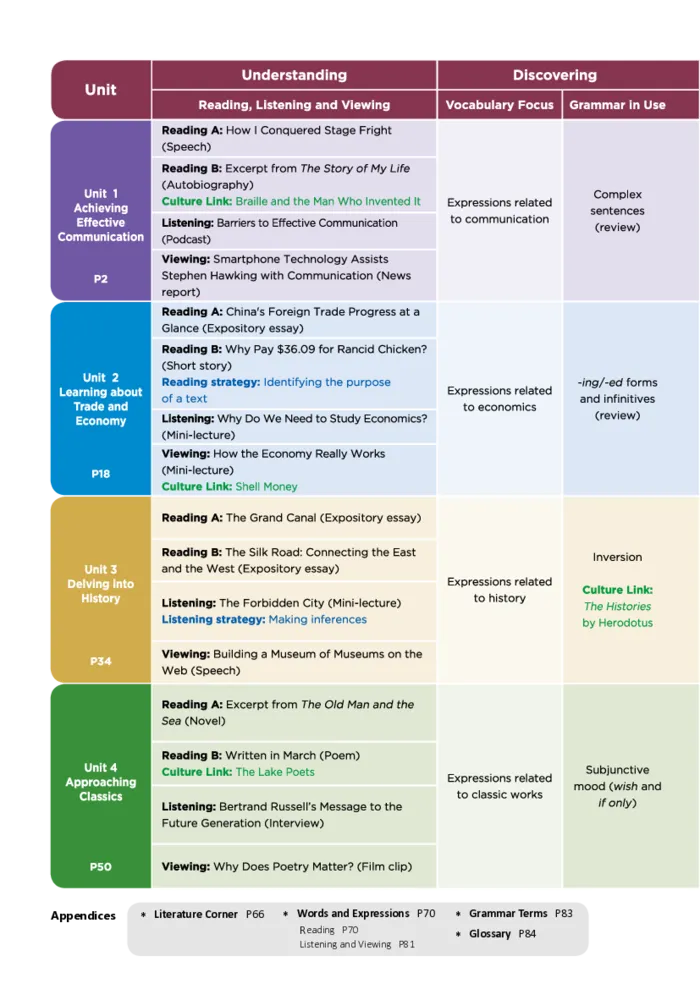
*   Literature Corner   P66    *   Words and Expressions   P70
Reading   P70
Listening and Viewing   P81
*   Grammar Terms   P83
*   Glossary   P84
UNIT 1
No pleasure has any savour for me without
communication.
             — Michel de Montaigne
Look at the following means of
communication, arrange them in the
order according to the time they were
first put into use and then say something
about one of them.
telephone, Internet, smoke signal, fax,
Morse code, carrier pigeon, wireless radio,
mobile phone

UNIT 1
On 5 October 1906, after a musical performance by his daughter,
Mark Twain
1 addressed the audience on the subject of stage fright.
public speech.
UNIT 1
My heart goes out in sympathy
to anyone who is making his first
appearance before an audience of
human beings. By a direct process of
memory I go back forty years, less one
month — for I’m older than I look.
I recall the occasion of my first
appearance. San Francisco knew me then
only as a reporter, and I was to make my
bow to San Francisco as a lecturer. I knew
that nothing short of compulsion would
get me to the theater. So I bound myself
by a hard-and-fast contract so that I
could not escape. I got to the theater
forty-five minutes before the hour set
for the lecture. My knees were shaking
so that I didn’t know whether I could
stand up. If there is an awful, horrible
disease in the world, it is stage fright —
and seasickness. They are a pair. I had
stage fright then for the first and last
hundred other passengers. I was — sick.
those other two hundred passengers.
It was dark and lonely behind the
scenes in that theater, and I peeked
Achieving Effective Communication
theater curtains and looked into the big
auditorium. That was dark and empty,
too. By and by it lighted up, and the
audience began to arrive.
I had got a number of friends
of mine, stalwart men, to sprinkle
themselves through the audience armed
they could possibly guess I intended to
be funny, they were to pound those clubs
in a box up there, also a good friend of
mine, the wife of the governor. She was
to watch me intently, and whenever I
glanced toward her she was going to
deliver a gubernatorial laugh that would
lead the whole audience into applause.
At last I began. I had the manuscript
tucked under a United States flag in
front of me where I could get at it in case
of need. But I managed to get started
without it. I walked up and down — I
was young in those days and needed the
exercise — and talked and talked.
Right in the middle of the speech I
had placed a gem. I had put in a moving,
pathetic part which was to get at the
hearts and souls of my hearers. When I
delivered it, they did just what I hoped
and expected. They sat silent and awed.
I had touched them. Then I happened
to glance up at the box where the
governor’s wife was — you know what
happened.
Well, after the first agonizing five
return. I know if I was going to be hanged
I could get up and make a good showing,
and I intend to. But I shall never forget
my feelings before the agony left me,
and I got up here to thank you for her for
helping my daughter, by your kindness,
of her singing, which is, by the way,
hereditary.
Personal Touch
Have you ever experienced stage fright? Describe the event and how you
dealt with the situation.

Note
1. Mark Twain (pen name of Samuel Langhorne
Clemens, 1835–1910), was an American
writer, publisher and lecturer. He was praised
as “the greatest humorist his country has
ever produced.” In addition to being a great
novelist, Mark Twain was one of the most
celebrated public speakers of his day.
Achieving Effective Communication
UNIT 1
I. Fill in the blanks to complete the outline of the speech.
II. Answer the questions.
Mark Twain expresses his sympathy for those who make their
Mark Twain thanks the audience for helping his daughter
proceed with her performance.
Introduction
Body
Closing remarks
Mark Twain tells a story about
to 1 __________________, he
• bound himself by a contract;
• 2 _______________________________;
• 3 _______________________________;
• 4 _______________________________.
He makes a joke
about his age.
“By a direct process of memory
I go back forty years, less one
month — for I’m older than I
look.” (line 4)
Comprehension
III. Mark Twain is well known for his sense of humour. Fill in the bubbles with details
that show his humour in the speech.
Achieving Effective Communication
Vocabulary Focus
bind
bow
(be) armed with
in case of
manage
recall
set
intend
live through
nothing short of
by and by
light up
convey an idea
catch one’s attention
original idea
well-organised structure
educational background
deliver a speech
build trust
in a natural way
eye contact
cover any occasion
communication skill
engage the audience
I. Key Vocabulary
 Fill in the blanks with the appropriate forms of the given words and expressions
to complete the passage. Note that there are two options more than you need.
Mark Twain experienced stage fright when he worked as a reporter in San
Francisco. He 1 __________ that delivering a speech was so horrible for him at that
time that he had to 2 __________ himself by a contract. On the day he made the
speech, he got to the theatre forty-five minutes before the hour 3 __________ for the
lecture. He peeked through the holes in the theatre curtains. His knees were shaking
while he was to make his 4 __________ to the audience. He had got a number of
friends 5 __________ big clubs to lead the applause. He had the manuscript hidden
under a flag in front of him where he could get at it 6 __________ need, although he
7 __________ to get started without it. In the middle of the speech, he delivered a
moving part 8 __________ to touch the audience, and they did what he had expected.
9 __________, his stage fright left him. Fortunately, Mark Twain 10 __________ his first
public speaking.
Achieving Effective Communication
II. Topic-Related Expressions

Fill in the blanks with the appropriate forms of the given expressions to complete
the passage. Note that there are two options more than you need.
Stephen E. Lucas says that the purpose of public speaking is not to self-
promote, but to change someone’s assumption, which explains why in his book
The Art of Speaking he doesn’t merely talk about the importance of original
ideas and a 1 ___________ to a successful speech, but also mentions effective
2 ______________. They are equally important in making an engaging speech.
“3 ___________ is not an entertaining activity,” Lucas said. “Rather than giving
performances, the speaker is expected to 4 __________ to the audience.” This is why
UNIT 1
Grammar in Use
Complex sentences (review)
it’s important to figure out the types of people in your audience,
who may be composed of individuals of different ages, genders or
5 ________________.
As public speaking 6 _________________, you
need to aim your speech at the audience to
7 __________. For instance, if you are asked to
I. Rewrite each pair of the underlined sentences to form a complex sentence. An
example is given.
speak to a group of young people with learning
difficulties, you might need to use simple, short
sentences. Remember to talk 8 __________ as if
you were talking to the youngsters living in your
neighbourhood. That would help the audience
9 __________ in you.
It’s also important to involve your audience
to make them feel like you are talking to them
one-to-one. Speakers do this with gestures,
intonations, 10 _________, and the like.
Distinguished guests, it’s a great joy for me to be here.
1 It’s not easy standing up here and talking. This is especially true when you
 2 But there is a reason for me to be here.
I’m going to share a few things with you.
First, personal experience is a good thing to draw upon. 3 Many of you have
spoken from personal experiences. Your speeches are very informative. Second,
your speeches need to be logically argued, too. 4 You need to be careful about  the
expression “There are two sides of a coin.” It is not a very strong way of arguing.
When you talk about two sides of a coin, it’s almost like you’re not prepared to tell
us which one you think is right. Finally, be bold. Say what’s important, and don’t try
I applaud each of you for what you’ve done, and I wish you all the best.
Achieving Effective Communication
     Grammar Highlights
A complex sentence is one in which one or more subordinate clauses are
embedded. Subordinate clauses are often introduced by a subordinator
(or subordinating conjunction). For example:
• My heart goes out in sympathy to anyone who is making his first
appearance before an audience of human beings. (relative clause)
• I was so sick that there wasn’t any left for those other two hundred
passengers. (adverbial clause)
• They did just what I hoped and expected. (object clause)
II. Complete the passage by selecting a correct clause (A–G) from the box below.
Computer science has allowed us to create a more accessible world that helps people
with disabilities to engage with their surroundings more conveniently. Just consider
________________.
The Seeing AI, released this week, seems like a completely life-changing app for those
_______________. It’s a smartphone-based software ____________. Dave Heiner, one
of the developers, said that the Seeing AI started as a project at a recent hack contest,
______________. “They realised they can put those things together and finally try to give
vision to the people who are weak in sight. The Seeing AI allows you to hold your phone up
to a person and can tell you what that person looks like, what his or her age is, the colour
of his or her hair, ______________,” said Heiner.
The Seeing AI can read documents and recognise speech and images with very low
error rates, ____________. Cameron Roles, ______________, is excited about the new
apps to help vision-impaired people lead rich, full lives. “In my view, now is definitely the
most exciting time in human history to be blind,” said Roles.
 1
It’s not easy standing up here and talking, especially when you have people like me

 2
____________________________________________________________________
 3  ____________________________________________________________________
 4
____________________________________________________________________
A.  who are vision-impaired
B.  that can even be used to read out a child’s homework questions
C.  how a new technology is beginning to make the lives of more than 350,000 vision-impaired
people in Australia much richer
D.  whether he or she is wearing glasses, and whether he or she looks happy or sad
E.  which means computers can recognise words in a conversation and provide real-time
translation
F.  who has been blind since birth
G. where a group of people decided to build an app combining a smartphone and AI vision
technology
UNIT 1
6
Barriers to Effective Communication (Podcast)
I. Describe the communication barriers you might encounter in the following situations:
 1. when you are talking with your grandparents;
 2. when you are speaking in front of an audience;
Strategy list:
A. Doing breathing exercises
B. Turning to other people for help
C. Using devices such as hearing aids or eyeglasses
G. Speaking slowly and carefully, and stopping every now and then to check
understanding
Smartphone Technology Assists Stephen Hawking with Communication (News report)
I.  How does technology facilitate human communication? List some apps you can think of.
???
Communication barrier type
Picture(s)
Strategy (or Strategies)

1
2
3
4
5
II. Listen and note down the four types of barriers to communication.
III. Listen again. Match the pictures (1–6) and the strategies (A–G) with the
corresponding communication barrier types.
II. Watch the video and tick the true statement(s).
 A. Stephen Hawking controlled his computer by moving only one muscle in his cheek.
 C. Stephen Hawking’s computer was able to predict which character he might choose next.
 D. With the latest upgrade, Stephen Hawking’s computer doubled his speech rate.
In Shanghai dialect
In Cantonese
Achieving Effective Communication
 Step 1    Brainstorm and list occasions where communication often breaks down.
 Step 2    Choose from the list a specific communication problem which you all agree
to deal with. Search for possible causes of the problem.

e.g. Problem: how can we help the blind shop in a supermarket?
 Step 3    Discuss how technology could help to solve the problem, and what is creative
about your solution.

EXAMPLE
  encounter in a supermarket. What do you have in mind?
B: I think reading labels is extremely tricky for them, especially when there is no
one around for them to turn to.
A: Right. Perhaps we can develop a smartphone app that connects to a call centre
with volunteers to help. Whenever a blind person needs help, he/she can simply
use the app to ask for help, and there will be a volunteer to answer his/her call
and to read out the labels for him/her.
B: Yes! And the blind person could use his/her phone camera to display the labels to
the volunteer by video chat.
A: ...
 Step 4    Reach an agreement on the most
creative solution and submit it to
the students’ union.
During group discussions, you need to compromise with the other
group members and come up with one idea or plan that everyone
can agree on, even if some individuals disagree with some points.
Compromising and reaching an agreement
Speaking Strategy
Discussing
problems

Useful Expressions
So, can we all agree on ... ?
Can you live with this?
So, it sounds like we’ve decided ...
What do all our ideas have in common?
III. Watch again and fill in the blanks.
(1) ________, and then tries to predict which character
he might choose next. To do that the start-up’s programme has to learn how Hawking
writes and speaks by (2) ________ dozens of his documents, some published, others not.
2.  An infrared sensor detects when Hawking’s (3) ________ moves up, just the way our
smartphone can sense when it’s close to the face. Future versions of this technology are
aiming to take a bigger (4) ________ of movement into account.
3.  A well-known American tech company is even trying to develop brain control interfaces.
With the market (5) ________ to reach 55 (6) ________ dollars in 2016, it represents the
UNIT 1
The morning after my teacher
came she led me into her room and
gave me a doll. When I had played with
it a little while, Miss Sullivan slowly
spelled into my hand the word “d-o-
l-l.” I was at once interested in this
correctly I was filled with childish
pleasure and pride. Running downstairs
to my mother I held up my hand and
doll. I did not know
that I was spelling a word or even that
words existed; I was simply making my
fingers go in monkey-like imitation. In
the days that followed I learned to spell
in this uncomprehending way a great
many words, among them pin, hat, cup
and a few verbs like sit, stand and walk.
But my teacher had been with me
several weeks before I understood that
everything has a name.
One day, while I was playing with
my new doll, Miss Sullivan put my big
rag doll into my lap also, spelled “d-o-
l-l” and tried to make me understand
that “d-o-l-l” applied to both. Earlier in
the day we had had a strong argument
over the words “m-u-g” and “w-a-t-
e-r.” Miss Sullivan had tried to impress
it upon me that “m-u-g” is mug and
that “w-a-t-e-r” is water, but I kept on
at her repeated attempts and, seizing
the new doll, I threw it on the floor.
I felt a sense of happiness when the
parts of the broken doll fell at my feet. I
felt my teacher sweep the broken parts
to one side of the room, and I had a
my anger was removed. She brought
me my hat, and I knew I was going out
into the warm sunshine. This thought,
if a wordless feeling may be called a
thought, made me hop and skip with
pleasure.
We walked down the path to the
well-house, attracted by the smell of
Someone was drawing water and my
teacher placed my hand under the tap.
As the cool stream flowed over one
hand she spelled into the other the
word water, first slowly, then rapidly.
I stood still, my whole attention fixed
upon the motions of her fingers.
Suddenly I felt a misty awareness as
of something forgotten — a thrill of
returning thought; and somehow the
mystery of language was revealed to
me. I knew then that “w-a-t-e-r” meant
the wonderful cool something that was
UNIT 1
Achieving Effective Communication
I left the well-house eager to
learn. Everything had a name, and each
name gave birth to a new thought. As
we returned to the house every object
which I touched seemed to spring with
life. That was because I saw everything
with the strange, new sight that had
come to me. I learned a great many
new words that day. I do not remember
what they all were; but I do know that
mother, father, sister, teacher were
among them — words that were to
make the world blossom for me.
Note
1. Helen Keller (1880–
1968) was an American
author and lecturer.
She was the first deaf-
blind person to obtain a
Bachelor of Arts degree.
The story of Helen and
her teacher, Anne Sullivan,
was made famous because
of her autobiography,
.
Braille and the Man Who Invented It
Braille is a simplified version of the alphabet made up of six
raised dots to form each individual letter, which can be read
either with the fingers, by the vision-impaired, or with the
eyes, by sighted people. It is a code by which many languages
— such as English, Spanish, Arabic, Chinese, and dozens of
others — may be written and read, and it has become the
most widely used system for blind people across the world.
The code system was named after the inventor, Louis Braille
(1809–1852), a French educator who lost his eyesight in early
childhood in an accident.
Culture Link
I.  Match each paragraph in Column A with one corresponding main point in Column B. An
example is given.
Helen felt stuck in learning and turned her
impatience into satisfaction gained from
damaging things.
Helen learned basically by imitating without
much thinking or comprehension.
Helen was suddenly aware of the meaning
of language that had remained secret to her.
Helen damaged her new doll out of
frustration because she kept confusing the
words mug and water.
Helen was immediately excited about the
spelling game and able to spell many words
in a couple of days.
Helen was hungry for learning as the beauty
of the world was magically revealed to her.
Paragraph 1:
paving the way for what
is coming
Paragraph 2:
a twist in the story
Paragraph 3:
the turning point of the
story
Paragraph 4:
the end of the story
Achieving Effective Communication
Comprehension Plus
II.  Which of the above communication barriers do you encounter most frequently in
daily communication? Which strategies do you find most helpful in dealing with
these communication barriers? Which strategy do you want to try? Why?
UNIT 1
psychological
barrier
stage fright
• preparing a manu-
script in case of need
•

bit rather than to
drawing on personal
resources
physiological
barrier
language
barrier
cultural
barrier
II.  Answer the questions.
1.  What are the problems Helen Keller faces in her “still, dark world”? What basic things
does Helen not understand?
2. “Everything had a name, and each name gave birth to a new thought.” (lines 65–66)
What is your understanding of the statement?
3.  Why are language learning and communicating more of a challenge for Helen than for
others?
Generalising by identifying
common characteristics
Barrier
Strategy (
Strategies)
Achieving Effective Communication
How to Keep Your Audience Engaged While Delivering a Speech
Achieving Effective Communication
A renowned speaker made a speech at your school about how to keep an audience
summary of what you have heard to share with him/her. The following is the script
of the speech.
Distinguished guests, students, friends, it’s a great joy for me to be here.
beforehand will help you feel more relaxed in front of a crowd, but there are a few
things you should bear in mind while you’re improving your skills:
Firstly, speak with passion. Remember that your audience is there because
they are interested in what you have to say. Appearing disengaged gives the
audience a signal that they don’t need to pay much attention. Plus, finding a
passion for your topic can help reduce your fear. As it is said, “One key way to
overcome anxiety is to become passionate about what you want to share with the
world.”
Secondly, moving around on stage when you change topics or approaching
the audience when you make a point or pose a question will give your
awkward and creates a wall between you and the audience. So, make movements
to keep things professional, but letting the audience get to know a little about
your personality makes them more interested in what you’re saying. If you intend
to be kind of funny, put in some humour where appropriate. If you have a lot of
experience with the topic, include a personal story.
Lastly, be a presenter, not a salesman or a saleswoman. The point of your
presentation may very well be to sell something, but that doesn’t mean the
audience wants to listen to a straightforward sales speech. People see right
them into giving you money, they’ll become disengaged or resistant quickly. Build
your presentation around offering them something genuinely valuable, even if
they aren’t going to buy anything.
all the best.
UNIT 1
Summary writing 1 — grasping main points
Writing Strategy
Guided Writing
Step 1    Analyse the script to find its textual pattern and underline the general
statement and specific details.
Step 2    Write a summary of the essay in no more than 60 words.
General statement:  __________________________________________________________
 _____________________________________________________________________________
Detail 1:  _____________________________________________________________________
 _____________________________________________________________________________
Detail 2:  _____________________________________________________________________
 _____________________________________________________________________________
Detail 3:  _____________________________________________________________________
 _____________________________________________________________________________
Detail 4:  _____________________________________________________________________
 _____________________________________________________________________________
Step 3    Proofread your summary and email it to your friend.
a claim, a counterclaim and evidence.
Conducting a survey about the impact of social media on
interpersonal communication
According to a survey, social media has dramatically changed the way teenagers interact
and communicate with other people. Do you feel the same way? Work in groups, conduct
a survey among your classmates and present your findings.
Step 1    Design a questionnaire with 6–8 questions, including items like one’s favourite
way to communicate and the frequency of using social media. The title of
the questionnaire can be “How social media is affecting our interpersonal
communication.”
Achieving Effective Communication
Step 2    Conduct the survey in your class by email or other social media apps.
Step 3    Analyse the data collected and prepare an oral report on your survey findings.
Step 4    Present your findings in class.
1.  What is your favourite way to communicate with others?

A. Social media apps.
C. Phone calls.


B. Rarely.
D. Never.


A. Not at all.
C. Yes, absolutely.

B. It’s hard to say.
D. To some extent.
EXAMPLE
Look at the expected learning outcomes of this unit.
Write a reflective note on the above items. You may include some or all of the
following points:
What you think you have done well and why
One strategy that really has helped your learning
One important thing you have learned about
What you need to improve in the future
What learning resources you find useful
A. Interpreting the underlying messages and humour in a speech and sharing ways
to overcome stage fright
B. Discussing technological solutions to communication problems
C. Understanding how people with physiological difficulties can work through the
barriers and develop effective communication
D. Conducting a survey about the impact of social media on interpersonal
communication
E. Identifying common characteristics of communication barriers and making
generalisations
F. Reaching an agreement by negotiating and compromising
G. Writing a summary of a general-specific essay
UNIT 2
Economy has frequently nothing whatever to do
with the amount of money being spent, but with
the wisdom used in spending it.
— Henry Ford
Read the poem and discuss possible
answers to the questions at the end.
You’ve got a dollar. You deposit it in your savings
account. Now you’ve got a dollar and
the bank’s got a dollar.
The bank loans a dollar to Joe’s Construction.
Now you’ve got a dollar, the bank’s got a dollar,
and Joe’s got a dollar.
Joe buys a board from Hirohito Lumber.
Now Hirohito’s got a dollar too.
Where did you get your dollar?
How much money is there in the world?
Who’s got it?
Where is it?
What happened to all the trees?
UNIT 2
UNIT 2
The text below is a summary of the great progress China has
made in foreign trade. List some words and expressions that you
Since its entry into the WTO
(World Trade Organization), China has
sped up its reform and opening-up
process and economic growth. China’s
development is a forceful driver of
global economic growth.
In 2016, China’s GDP (Gross
Domestic Product) accounted for
14.8 percent of the world total, up
by 10.7 percentage points over 2001,
calculated at exchange rates. Since
2002, China’s contribution to global
economic growth has approached
30 percent on average. The Chinese
economy has become a major engine
for global economic recovery and
growth.
China has quickened its pace in
promoting new industrialization,  IT
(information technology) application,
urbanization, and agricultural
modernization, created enormous
opportunities for consumption and
investment, and created more jobs
for the world. According to a report
released by the International Labor
Organization, “Effects of China on the
Quantity and Quality of Jobs in Latin
America and the Caribbean,” China
created 1.8 million jobs for Latin
America and the Caribbean region from
1990 to 2016.
China’s rapid development has
made great contributions to the cause
of global poverty reduction. Over the
past 40 years of reform and opening-
Learning about Trade and Economy
Learning about Trade and Economy
Personal Touch
Can you give an example to show that you or your family has benefited from
China’s foreign trade progress in the past few years?
up, the Chinese people have emerged
from poverty to moderate prosperity.
According to current UN (United
Nations) standards, more than 700
million Chinese people have been lifted
out of poverty, accounting for more
than 70 percent of the global total
over the same period. This represents
the largest contribution to poverty
reduction in the world.
Since China’s entry into the WTO,
China’s foreign trade has maintained
sustained development, benefiting
more than 1.3 billion Chinese and other
peoples across the world.
C h i n a h a s ta ke n ef fe c t i ve
measures to promote its foreign trade.
According to WTO statistics, China’s
imports accounted for 10.2 percent of
the world’s total merchandise import
in 2017, and its exports 12.8 percent,
making China a major trade partner of
more than 120 countries and regions.
China’s exports have provided high-
quality and inexpensive products to
businesses and people around the
world. From 2001 to 2017, China’s
imports increased by an annual average
of 13.5 percent, 6.9 percentage points
higher than the global average; and
China has become the world’s second
largest importer. Since 2009, China has
been the largest export market for the
LDCs (Least Developed Countries), and
absorbed 20 percent of their exports.
China’s services imports increased
from $39.3 billion in 2001 to $467.6
billion in 2017, up by an annual average
of 16.7 percent, and accounting for
nearly 10 percent of the world total.
Since 2013, China has been the world’s
second largest service importer,
making important contributions to
stimulating consumption, creating jobs
and boosting economic growth in the
exporting countries. Taking tourism
services as an example, China has been
the world’s largest source of outbound
tourists for many years in a row. In
2017, outbound tourist trips made by
Chinese citizens exceeded 130 million
person-times, generating $115.29
billion of overseas tourism spending.
China’s innovation in trade models
has also boosted world trade growth.
Cross-border e-commerce and other
new types and modes of foreign
trade have increased greatly in China,
providing an ever-expanding market
to its trading partners. In 2017, the
value of imported and exported goods
in cross-border e-commerce checked
and released by China Customs totaled
90.24 billion, up by 80.6 percent on a
yearly basis, of which imports stood
at
56.59 billion, up by 120 percent
compared with the previous year.
UNIT 2
Comprehension
 I.  Choose from the following items to complete the statements.
II.  Answer the questions.
III.  Read the text and find the sentences that suggest the importance of China’s foreign
trade progress to the world. Fill in the blanks in the bar chart and answer the question.
1. This text is most likely to be found in a(n)___________.

A. academic essay
C. book review

B. government report
D. magazine article
2. The description of the development of China’s foreign trade is well supported by


_______________.

A. quotations (e.g. direct quotes, paraphrases, summaries)

B. examples (e.g. illustrations of one’s points)

C. statistics (e.g. facts, figures)

D. stories (e.g. personal experiences)
1. According to the text, what policies has China adopted since its entry into the WTO?
2. What effect does the growth of the Chinese economy have on the problem of global
poverty?
3. What goods and services are imported and exported by China?
4. Can you find some verbs or expressions in the text that describe statistics? Give some
examples.
China has made great contributions to global economic growth — its economy is an
integral part of the world’s economy. In the text, figures in various sectors indicate the
importance of China’s foreign trade and economy to the world. The bar chart below shows
China’s rough percentage of the world total in different sectors. Fill in the blanks based on
the information from the text.
According to the text and your own experience, in what ways has China made contributions
to its trading partners and the rest of the world?
Learning about Trade and Economy
A Glimpse into Economics
I. Key Vocabulary
 Write down the words based on their definitions. Choose the suitable words to
fill in the blanks in their appropriate forms.
Vocabulary Focus
The reason why the Belt and Road Initiative is gaining wider recognition is
that it has not only 1 _________ the progress of participating countries, but also
contributed to the recovery of the world economy after the global financial crisis.
The Belt and Road Initiative conforms to the UN 2 _________ development goals and
quickens the 3 _________ of collaboration among peoples and nations. During the
second Belt and Road Forum, cooperation agreements worth over $64 4 _________
were signed at a CEO conference. Participants at the forum said, the Belt and
Road Initiative creates a new model of international cooperation, with the aim of
5 _________ the economic development of the countries involved. China has shared
its development achievements with other Belt and Road participating countries as its
6 _________ demand for imports has 7 _________ many growth opportunities. China has
also increased its direct foreign 8 _________ in the participating countries, leading to
9 _________ growth in those countries. For instance, the Chinese-funded-and-built
Railway in Kenya 10 _________ the country’s economic growth by 1.5 percent. According
to a World Bank study, the Belt and Road Initiative will increase the GDP of East Asian
Learning about Trade and Economy
___________ (v.)
to make sth develop or become more active
___________ (v.)
to produce or create sth
___________ (adj.) able to be used without being completely used up or


destroyed
___________ (v.)
to help sth to happen or develop
___________ (adj.) connected with the trade, industry and development of wealth of

a country, an area or a society
___________ (n.)
the speed at which sth happens
___________ (v.)
to make sth increase, or become better or more successful
___________ (n.)
the act of investing money in sth
___________ (adj.) extremely large
___________ (n.)
one thousand million
II. Topic-Related Expressions

Fill in the blanks with the appropriate forms of the given expressions to complete
the sentences.
1. The government intends to improve its people’s __________.
lift … out of poverty
standard of living
speed up
quicken the pace of
account for
boost economic growth
on average

in a row
UNIT 2
Grammar in Use
-ing/-ed forms and infinitives (review)
I. Fill in the blanks with the appropriate forms of the words or phrases in brackets.
2. Between 2001 and 2018, EU’s exports to China grew by 14.7 percent  __________
each year.
3.  China has __________ 700 million people __________ through more than 30
years of reform and opening-up.
4.  Chinese delivery companies __________ transition to green packaging.
5.  Brazil’s retail sales rise for six months __________ this year.
6.  An improvement in confidence and political stability would __________ in Spain.
7.  Ethiopia’s export revenue to China __________ about 8.25 percent of the
country’s total exports in 2017.
8.  We should lay a firm foundation for the future development of our country and
______________ raising people’s quality of life.
When you’re doing your degree, your main source of income may be a
student loan or, if you’re lucky, a grant or scholarship. But you may still need
to supplement your income by doing some kind of part-time work. Here
are some tips for 1 __________ (avoid) financial problems. Open a current
account at the campus bank — they have a team which specialises in
2 __________ (help) students with their financial matters. If you get into
debt, try to clear your debts as soon as possible. If things are difficult,
you may have to economise by, say, 3 __________ (cut down) on luxuries.
This is far better than 4 __________ (run up) huge debts. If you have a
credit-card debt, try to make a payment every month, however small.
Never exceed your 5 __________ (agree) credit limit. It’s a bad idea to
borrow heavily 6 __________ (repay) your debts. Always seek advice
from your bank about how 7 __________ (clear) outstanding debts and
8 __________ (pay) back loans. Never run up an overdraft if you can avoid
it. If you do need one, remember that most banks will offer students an
interest-free overdraft.
Learning about Trade and Economy
II. Fill in the blanks with the appropriate forms of the words in brackets.
1. In order to get one thing that we like, we usually have to give up another thing. Making
a decision requires __________ (trade) off one goal against another and __________
(compare) the costs and benefits of different courses of action. People __________ (make)
reasonable decisions take an action if and only if the extra benefit of the action is greater
than the extra cost. People’s behaviour may change when the costs or benefits change.
2.  The China (Shanghai) Pilot Free Trade Zone (SHFTZ), ________ (found) in 2013, is located
in Pudong New Area and originally consisted of Waigaoqiao Free Trade Zone, Waigaoqiao
Free Trade Logistics Park, Yangshan Free Trade Port Area, and Pudong Airport Free Trade
Zone. In 2014, the State Council decided ________ (expand) SHFTZ by taking in Lujiazui
Financial Area, Jinqiao Development Subzone, and Zhangjiang High Tech Subzone,
________ (enlarge) the SHFTZ from 28.78 square kilometres to 120.72 square kilometres.
3.  Kiddynomics: An Economics Curriculum for Young Learners is a set of lessons __________
(design) to introduce young children to the economic way of thinking. Informed decision-
making is a critical thinking skill that students can use throughout their school, personal,
and work lives. They should, therefore, understand basic principles of how the economy
operates. The best way __________ (ensure) students develop vital decision-making
skills is to begin economic education early and to build on that learning throughout their
education.
     Grammar Highlights
Non-finite verbs cannot function as predicates and do not need to follow subject-
verb agreement. Their forms, meanings and functions are shown in the table:
Form
Meaning
Functions
(to) do
typically expressing an
action to be taken
subject, predicative, object, attributive,
complement, adverbial
-ing
typically expressing an
action in progress
subject, predicative, object, attributive,
complement, adverbial
-ed
typically expressing a
completed action or a
passive state
predicative, attributive, complement,
adverbial
UNIT 2
Why Do We Need to Study Economics? (Mini-lecture)
I. Answer the question.
 When you plan to take a trip to a foreign country, will you choose a cheap flight with
longer flight time or a more costly one with shorter flight time?
How the Economy Really Works (Mini-lecture)
I.  Answer the question.
 Do you agree that “Trade can make people better off”? Explain your view.

Culture Link
Shell Money
The earliest recorded use of shells as
currency was in China during the Shang
dynasty (1600 BCE–1046 BCE). The
particular shells used were cowrie shells,
called
 in Chinese. The cowrie shells
were an intelligent solution for “small
money” because they were collected in
seas far in the south of China and only
kings could afford them.
II. Watch the video and answer the
questions.
1. What do people use to buy what they
want on the island?
2. What are the jobs of the four people in
the video?
3. How do all the people on the island
become “rich” all of a sudden?
4. Is wealth found in money? Why or why
not?
II. Listen and complete the table.
Economics is the
study of how we
deal with scarcity.

• We have 1 ________ wants and 2 ________ resources.
3 ________.
Thinking like an
economist means
seeing the
4 ________.
5 $________;
6 $________;
7 $________.
She worked in a restaurant from Monday through Friday,
earning about 8 $________ a day.
9 ________.
• Thinking like an economist has saved me 10 ________
and 11 ________.
III. Work in groups and discuss.

Why did the most expensive Saturday morning flight turn out to be the cheapest in fact?
Suggest similar examples from your daily life.
Learning about Trade and Economy
Asking for opinions
Do you think that’s a good idea?
How do you feel about that?
So what do you suggest?
Tell me what you think.
Well, what do you think of that?
Does anyone have an opinion on this?
Does that sound good / OK / all right /
acceptable?
What’s your take on this?
Giving opinions
As far as I am concerned, ... / As
far as I can tell, ...
From my point of view, ... / In my
view, ...
From my perspective / personal
standpoint, ...
I’d say ...
It seems/sounds a bit ... to me.
In my experience, ...
If you ask me, ...
III. Watch the video again and describe how money, goods and services flow among
individuals in a society.
Making a budget plan
Suppose your class has raised a fund of 1,000 yuan for a spring outing. A budget plan
is needed to make the best use of the fund. Discuss with your classmates to decide
which items should be included in your budget by weighing up the costs and benefits
of each one.
Step 1
Work in groups. Brainstorm budget items for the spring outing.
Step 2
Rank the chosen items in order of importance. Then weigh up the costs and
benefits of each item to decide whether to buy it or not.

EXAMPLE


for us to find each other. What do you say?
Step 3
Each group presents its budget plan in class and explains how decisions were
reached. The whole class vote for the best budget plan.
Farmer
Builder
Fisherman
Clothes maker
UNIT 2
UNIT 2
Not long ago, Trilby and I had late
lunch together in a restaurant. The food
was slow in coming, but we had so much
catching-up to do that we didn’t mind.
My chicken, when it arrived, didn’t
look good but I took a bite. It tasted
so awful that I had to spit it out into a
napkin. Absolutely awful! I called the
waitress, who made a suitably horrified
expression, and then took the food away.
Th e m an age r a p p e are d a nd
apologized. She said the chefs were
checking out the dish now, trying to
determine if perhaps the herbs or the
butter had caused the problem.
“I don’t think so,” I told her. “I think
your chicken smells off.” The manager
did not want to admit that. She left and
five minutes later, returned. “You’re
right. The chicken was bad.” Victory!
But for whom? The manager apologized
again, and asked if I’d like a free dessert
or drink. “Well,” I said, “first of all let
me try to find some food on your menu
that doesn’t seem disgusting after that
chicken.”
Trilby and I then ate, fairly happily,
though the unpleasant taste of the
chicken remained with me; in fact, it
remains with me still. Trilby had had a
glass of wine before we ordered, and
took another glass with her meal. I drank
water. When the waitress cleared our
plates, she asked again if we wanted a free
dessert. “Just coffee,” we said instantly.
As Trilby and I talked, our topic
turned to what we might say when our
check came. There seemed two good
any free dessert, thanks, but considering
what happened with the chicken, we’d
like you not to charge for it.” That would
set up an anchor for the manager to
compare with what she intended to offer
“We don’t care for any free dessert,
thanks, but considering what happened
with the chicken, would you please ask
the manager what you can do about the
check.” That would establish another
anchor. These two anchors would set up
the first one aimed at taking the chicken
off the check and the second one getting
a discount.
Just then the waitress brought the
check. It was for $31.09. Without any
what the manager can do about the
check.”
The waitress replied, smiling, that
we had already been given the two
glasses of wine for free. Nevertheless,
the waitress, still smiling, duly took the
check and headed toward the manager.
The manager came right over, also
Learning about Trade and Economy
g
y
Learning about Trade and Economy
Comprehension Plus
I. Finish the tasks based on information from the text.
1.  The author writes this essay to __________.

A. warn the readers that they might be served rancid chicken in a restaurant

B. persuade the readers to take action if they are treated unfairly by other people

C. inform the readers of an economic principle behind their decision-making

D. entertain the readers with a story about how to settle payment disagreements
2.  Was it rational for the narrator to choose the second option? Why or why not?
3.  What risk did the manager take? What enabled the manager to take the risk that was

financially and psychologically in her favour?
4.  If you were the narrator, how would you negotiate with the manager?
smiling. “Considering what happened
with the chicken,” I said, “I wonder what
you can do about the check.”
“We didn’t charge you for the
wines,” she said, in a kindly voice.
“Is that the best that you’re
prepared to offer me?” I said.
She looked at me intently, still
friendly. Here she was making a
calculation, preparing to take the sort
of slight risk that is both financial and
psychological, the sort of risk that each
of us takes every day. She guessed that
I was not the kind of person who would
make a scene. After all, I had been
friendly throughout our conversation,
never raising my voice. And she plainly
thought this behavior would continue.
as in Yes, that is the best that she was
prepared to offer me. “All right,” I said,
and she walked away. Having paid the
check, along with a $5 tip — no sense
punishing the poor waitress, right? —
I walked outside. The manager had bet
that I wouldn’t cause trouble, and she
was right.
II. Complete the table with information from the text and your inferences about
the narrator’s feelings.
What the narrator did
How the narrator might feel
food that was slow in coming
catching up with friend
• took a bite
• spat it out
• called the waitress
• ordered some other food
• ate the food
• drank water
fairly happy despite the
unpleasant taste of the rancid
chicken
a free dessert
the check
only free wine instead of free
chicken
Identifying the purpose of a text
Reading Strategy
UNIT 2
I.  Decision-making in everyday life is often based on some underlying economic
principles. Reflect on the decision-making practices discussed in this unit and fill in
the blanks with economic theories or principles that are useful in explaining how the
decisions are made. An example is given.
II. Think of some important decisions on spending that your family has made and
choose a theory or principle you have learned in this unit to explain them.
Paying for rancid chicken
_______________________
Not accepting shells in trading
when everyone has too
many shells
 _____________________
Choosing a cost-effective flight
_____________________
Ranking items in order of
importance when making
a budget plan
 _____________________
anchoring theory
Justifying decisions by exploring
the underlying principles
Learning about Trade and Economy
Learning about Trade and Economy
Decisions in life are rarely black and
white but usually involve shades of gray.
At dinner time, the decision you face is
not between fasting and eating like a pig,
but whether to take that extra spoonful of
mashed potatoes. When exams roll around,
your decision is not between blowing
them off and studying 24 hours a day, but
whether to spend an extra hour reviewing
your notes instead of watching TV. Economists use the term “marginal changes” to
describe minor adjustments to an existing plan of action.
In many situations, people make the best decisions by thinking at the margin.
Margin means “edge,” so marginal changes are adjustments around the edges of
what you are doing. Suppose, for instance, that you ask a friend for advice about
how many years to stay in school. If he compares for you the lifestyle of a person
with a Ph.D. to that of a grade school dropout, you might complain that this
comparison is not helpful for your decision. You have some education already and
most likely are deciding whether to spend an extra year or two in school. To make
this decision, you need to know the additional benefits that an extra year in school
would offer (higher salaries throughout life and the sheer joy of learning) and the
additional costs that you would pay (tuition and the forgone salaries while you are in
school). By comparing these marginal benefits and marginal costs, you can evaluate
whether the extra year is worthwhile.
As this example shows, individuals and firms can make better decisions by
thinking at the margin. A rational decision-maker takes an action if and only if the
marginal benefit of the action exceeds the marginal cost.
You are going to write a summary of an essay on economics. Read the essay
below and follow the steps on the next page.

UNIT 2
Playing a trading game
Step 1
Divide the class into groups. Each group has ten cards with a total of 20
points, which serve as banknotes. There are five items on the market and
their prices are listed as follows:
  Step 2
strategy.
  Step 3
_________________________________________________________________
_________________________________________________________________
_________________________________________________________________
_________________________________________________________________
_________________________________________________________________
Take part in a trading game to better understand what trading is about. You may use
what you have learned in this unit to help you make decisions. Follow the steps.
  Step 1
Rational People Think at the Margin
Problem

Solution

Evaluation
Summary writing 2 — paraphrasing
Writing Strategy
of the original words. Resources, such as a thesaurus, can guide you in
finding a synonym or an alternative sentence pattern to express the same
“People make the best decisions by thinking at the margin.” can be paraphrased
as “Thinking at the margin helps people make the best decisions.”
Guided Writing
Learning about Trade and Economy
Gold — 5 points per unit
Smartphones — 4 points per unit
Oil — 3 points per unit
Clothing — 2 points per unit
Food — 1 point per unit
Step 2
Conduct the first round of trading for five minutes. The objective is for each
group to get the most points by buying the above items from the market
and selling them to other groups. After ten minutes the world situation has
changed. Draw lots to decide on which item’s price may change. X in the
following statements stands for this item.


and much more expensive.
Step 3
 Conduct the second round of trading for two more minutes. Then all the
groups count their total points.
Step 4
Reflect on what you have learned in the game by answering the following
questions and discuss the principles underlying the flow of goods and money.
• Did your group end the game richer or poorer than when you started?
• Was it easy or difficult to trade? Why?
• Which item was most popular? Which was least popular? Why?
Look at the expected learning outcomes of this unit.
Write a reflective note on the above items. You may include some or all of the
following points:
What you think you have done well and why
One strategy that really has helped your learning
One important thing you have learned about
What you need to improve in the future
What learning resources you find useful
A. Understanding China’s achievements in foreign trade, and how trade and
economy are related to our daily lives
B.  Making a budget plan by analysing the costs and benefits of my decisions
C.  Understanding how the economy works by playing a trading game
D.  Justifying decisions by exploring the underlying principles
E.  Identifying the purpose of a text
F.  Writing a summary of a problem-solution essay
UNIT 3
Past experience, if not forgotten, is a guide for the
future.
   — Chinese saying
Look at the picture and answer the
questions.
Why is the Great Wall considered one of the
greatest wonders in the world? Why do we
need to protect this historic site?
UNIT 3
W h a t a r e C h i n a ’s g r e a t e s t
infrastructural achievements? Probably
the most famous is the Great Wall. But
did you know that the Chinese also built
the longest canal in the world? Extending
around 1,800 km, the Grand Canal links
six provinces and cities, and connects five
river systems. It stretches from Beijing
in the north to Hangzhou in the south
and so, not surprisingly, is also known
by the names of the cities it connects —
Beijing-Hangzhou Grand Canal. Listed
as a UNESCO World Heritage Site, it is
the longest as well as the oldest canal or
artificial river in the world.
But why would China build such
an enormous canal? To find out, we
must travel back to the year 486 BCE.
It was then that the leader of the State
of Wu, which was located near present-
day Suzhou, realised he had to find new
ways of transporting goods and military
supplies to the northern areas of China.
Instead of roads, he opted for a longer-
lasting alternative — a canal, or manmade
channel based on natural waterways, to
link the Yangtze and Huai rivers. It was
this canal that laid the foundation for the
future, longer Grand Canal.
Not until 1,000 years later did the
work on the canal begin again. Emperor
Yang of the Sui dynasty had the old
UNIT 3
Do you know why the Grand Canal was built? What roles has
it played throughout the history of China? Read the text and
Delving into History
waterways rebuilt and, in addition,
connected to one another to form what
is today the Grand Canal. In the centuries
that followed, the artificial waterway
underwent reconstruction to speed its
flow. The course also changed for various
reasons, and the Grand Canal suffered
damage as the result of wars.
Then in 1403 Yongle, the third
emperor of the Ming dynasty, decided
to transfer his capital from Nanjing to
Beijing. Aware that he had to devise a
plan to feed the vast numbers of people
joining him on the move, he elected to
transport grain from south to north via
the waterway system.
To direct its restoration the emperor
appointed Chen Xuan, an expert on
hydraulic engineering, to oversee the
improvements that would permit ships
to pass from one level to another along
the waterway. Never before had such an
ambitious, large-scale canal project been
attempted. More than 47,000 men were
employed to maintain the Grand Canal,
which soon became the economic lifeline
of the empire.
Grain was not the only trade good
transported north. Salt was another,
as it had become one of the most
reliable sources of income during the
Ming dynasty. Goods sent from the
north included cotton, wool, coal, flour,
precious stones, and dried meat.
At times, more than 120,000 soldiers
and officers were needed to operate
the almost 12,000 government barges
that annually travelled along this route.
Many port cities along the Grand Canal
— chief among them Suzhou — became
thriving trade centres. Ferryboats, hotels,
restaurants, pawnshops and many
other businesses were opened to serve
travellers. Not only did the Grand Canal
allow for the growth of cities along its
course, but it also proved a powerful
tool in promoting the economy within
the empire as well as cultural exchanges
between the north and the south.
With the coming of trains and the
expansion of the railway system in the
mid-1800s, the Grand Canal became less
and less important to traders. These days
only a few goods are transported along its
waterways. However, the current South-
to-North Water Diversion Project proves
that the Chinese government still sees the
Grand Canal as important to the welfare
of China. The aim of this project is to
divert huge amounts of water every year
from the Yangtze River to the country’s
more arid regions.
Delving into History
Personal Touch
Have you heard any stories about the Grand Canal or other great
waterways? Share them with your classmates.
UNIT 3
Comprehension
I. The following are four subheadings taken from the text. Can you put them back?
Match them with the corresponding paragraphs.
A. The Canal Today       B. A Busy Waterway
C. The Beginning
D. A Major Change
Paragraphs 2-3:
__________________
Paragraphs 4-5:
__________________
Paragraphs 6-7:
__________________
Paragraph 8:
__________________
II.  Complete the diagram with information about the Grand Canal according to the text.
III. Answer the questions.
1. What is the Grand Canal also known as?
2. For what reason did the leader of the State of Wu build the canal?
your opinion? Why?

linked _____ and
______
to transport _____ and
_____
Sui dynasty
rebuilt and ________
old waterways
to _______ the flow
Ming dynasty
restored
to ______________ from
one level to another; to
transport goods
today
still in use
to _________ from
south to north
Spring and
Autumn period
C
Delving into History
I. Key Vocabulary
 Fill in each blank with the appropriate form of a word from the text.
Vocabulary Focus
1 ________
waterway, often connecting one body of water with another while the former is a narrow
channel of water connecting two larger bodies of water. Both have played important roles in
2 ________ the world economy and cultural exchanges.
The Turkish Straits are two internationally significant waterways in north-western
Turkey, which 3 ________ from the Eastern Mediterranean to Western Eurasia. The Strait
of Hormuz 4 ________ the Persian Gulf with the Arabian Sea. In April 1959 Iran altered the
legal status of the strait with the 5 ________ of its territorial sea.
The Panama Canal 6 ________ 80 kilometres from Panama City on the Pacific Ocean
to Colón on the Caribbean Sea. Sixty percent of American coast-to-coast trade 7 ________
on the channel for transportation. The Suez Canal offers watercraft a more direct route
between the North Atlantic and northern Indian oceans. Countries around it regard free
passage in the Suez Canal as a fundamental element of its 8 ________ and security.
Canals and straits have helped many countries lay a solid 9 ________ for economic
progress by shortening navigation time in transporting cargos between sea ports and
reducing transport expenses. Many of the world’s traded goods, and in particular oil, are
transported along these straits. If the straits were closed down, half of the world’s trading
vessels would be forced to use an 10 ________ route.
Delving into History
II. Topic-Related Expressions

Fill in the blanks with the appropriate forms of the given expressions to complete
the passage. Note that there are two options more than you need.
Why is history important? History is the most valuable legacy passed down from our
ancestors that 1 __________ we live in today. It 2 __________, offers a sense of identity,
and gives us a clearer idea of our desires for the future. Ignoring history will 3 __________
to know how the world has become what we see today. History helps us understand the
world by studying previous examples. It helps us investigate and solve problems that we
face today by allowing us to 4 __________ of the past. Meanwhile, by 5 __________
previously won by people of integrity, we can work to make sure we 6 __________. What
we do today will be part of history in the future. We should always draw attention to
important historical phenomena and events that still 7 __________ on contemporary
societies, because learning about history will help us 8 __________ for the next generation.
handle a crisis
create a better future
avoid mistakes
repeat the errors
lead to failure
shape the world
provide important references
learn from the victories
follow their example
UNIT 3
Grammar in Use
Inversion*
I.   Compare the sentences in each group below. Pay attention to the highlighted parts
and discuss how they differ from each other.
A. Never before had such an ambitious, large-scale canal project been attempted.
B. Such an ambitious, large-scale canal project had never been attempted before.
A. Not until 1,000 years later did the work on the canal begin again.
B. The work on the canal did not begin again until 1,000 years later.
Grammar Highlights
Inversion happens when the normal subject-verb word order is reversed. We use
inversion to change the focus of a sentence.
Types of inversion
Full inversion: The predicate is placed in front of the subject.
Full inversion often happens when an adverbial of direction or place is put at the
beginning of a sentence. For example:
• Here comes the train.
• Directly in front of us stood a magnificent old temple.
Partial inversion: Part of the predicate, the auxiliary or modal verb is placed in
front of the subject.
Partial inversion happens when
1. a negative word or phrase (e.g. seldom, hardly, never, rarely, on no account,
nowhere, not for a moment, no sooner) is put at the beginning of a sentence.
For example:
 • Seldom have I seen anything more remarkable in this book about African
 history.
 • No sooner had the professor touched on the Battle of Waterloo than the bell rang.
only after, only then) is put at the beginning of a
sentence. For example:
Only after understanding the background of the historical
event did the scholar make a comment on it.
negative statement also applies to another person or group. For
example:
She watched the show entitled The Silk Road last night, and so did I.
Group 1
Group 2
*
Delving into History
II.  Complete the sentences with the appropriate forms of the words given in brackets.
1. Not until the coming of trains and the expansion of the railway system in the mid-1800s
____________ (the Grand Canal, lose its importance) to traders.
2. Seldom ____________ (historians, study) this part of the history of Africa.
3. Only in the years of the Yongle reign _____________ (the Grand Canal, undergo) major
structural improvements.
4. Here ____________ (the question, come):  why do we study history?
5. She hasn’t watched the documentary about the American Civil War, nor ____________
(I, have).
Delving into History
The Histories by Herodotus
Culture Link
III.  Rewrite the underlined sentences using inversion to add emphasis.
History is the study of the past and our attempts to understand it. 1 It never fails to
be a pursuit in all human societies. History can be a tremendous story. 2 Each passing
generation can hardly avoid adding something new to our history while reinterpreting and
finding new things in those chapters already written. History gives us a sense of identity.
3 We can better understand who we are only by understanding where we have come from.
History provides a sense of context for our lives and our existence. It helps us understand
the way things are and foresee the ways that we might approach the future. History
teaches us what it means to be human, highlighting the great achievements and disastrous
errors of the human race. 4 History not only offers hints about how we can organise our
societies but urges us to manage them for the benefit and betterment of all those who live
in them as well.
The Histories by Herodotus is considered the
founding work of history in Western literature.
Written in 440 BCE in classical Greek, The Histories
serves as a record of the ancient traditions,
politics, geography, and clashes of various cultures
that were known in Western Asia, Northern Africa
and Greece at that time. It remains one of the
West’s most important sources regarding these
affairs. Moreover, it established the genre and
study of history in the Western world.
UNIT 3
Making inferences
Listening Strategy
III.  Listen again and answer the questions.

1.  Why was the Forbidden City renamed later?

2.  Why do you think we should protect historic sites like the Forbidden City?
2. What other name(s) does it have?
II. Listen and fill in each of the blanks with no more than five words.
1406–1420
1420–1911
History of the Forbidden City
under construction
after a model
under the
leadership of
______________
used as
a living and
working place for
______________ in
the Ming and Qing
dynasties
declared a
______________
under
______________
1987
2002–2021
The Forbidden City (Mini-lecture)
I. Answer the questions.
Delving into History
Building a Museum of Museums on the Web (Speech)
I. Answer the questions.
 Have you visited any world-famous museum online like the Forbidden City? What are
the advantages of establishing an online museum?
Introducing a museum as a tour guide
Work in groups. You are going to do a role-play of a museum tour, where some of you
are tour guides. To prepare, follow the steps below:
  Step 1
Brainstorm and make a list of local, national or international museums you
have visited or heard about respectively. You may even invent your own
museum and give a name to it.
  Step 2
Decide on a museum and come up with its relevant information, including its
name, location, notable collections, historical and cultural significance, and
technological features.
  Step 3
Have one member play the role of tour guide and introduce the museum to
the class.
  Step 4
The audience, in the role of visitors, raise questions after the presentation in
groups. The visitors may decide on the three most interesting features of the
museum that they would recommend to a friend.
It is located at ...
The museum
• specialises in artworks from ...
• uses its collections to explain ...
• holds the world’s most valuable collection of items from ...
The exhibition is sponsored by ...
The collection contains ... objects.
Some objects in the collection provide glimpses into the history of ...
Thanks to the museum’s ...
An online museum of museums
1. The online museum is comprised of ___________ museums across the world after 18
months’ work.
2. The team launched the museum project because ____________________________
_____________.
3. If you are interested in one of the museums available, you may _________ the name
of the museum.
4. Gigapixel technology enables visitors to have a clear look at a(n) ____________ and
learn from artworks.
II.   Watch the video about building an online museum and complete the sentences.
III. Answer the questions.
Why is the Metropolitan Museum of Art one of the speaker’s favourites? What do you
think he has learned from the painting The Harvesters by Pieter Bruegel?
UNIT 3
The Silk Road is not actually a road
but many roads. The legendary Silk
Road is a web of routes that stretch
across China and well beyond its
borders. It links cities now called Xi’an
and Urumqi in China, and connects
China to Europe, reaching all the way
to Istanbul, Turkey (the gateway to
Europe) and Venice, Italy.
Ferdinand Freiherr von Richthofen,
a German geographer, created the
referred to routes where the booming
trade in silk products was carried out
along their entire length. Silk was the
main commodity traded from China
and was a major reason that the trade
routes became so complex. Everyone
wanted it! During the Han dynasty,
Emperor Wu sent Zhang Qian to the
Western Regions twice. Zhang Qian’s
missions to the Western Regions
paved the way for later diplomatic
and commercial exchanges between
the Middle Kingdom and the western
states. The routes eventually became a
two-way movement of economic trade,
cultural values, scientific theories and
achievements as well as a channel for
religious thought. The Silk Road also
became an efficient way to spread
ideas — a kind of ancient version of
the information superhighway.
Besides silk, the Chinese also
traded teas, porcelain, gold, silver,
cotton and lacquerware with the
West. Most goods bought and sold
along the routes were quite expensive
as journeys were long, difficult and
dangerous. Asian techniques and
crafts were also shared along the Silk
Road. Skills such as raising silkworms,
silk spinning, iron casting and channel
digging were all introduced to the West
via the Silk Road. Furthermore, fine
art, architecture, music, dance and
theatrical performances were shared
on these routes. Music and dance from
Central Asia were extremely popular in
China. Often featured were terracotta
dancers, actors in masks and musical
groups. In agriculture, walnut, grape
and other plants were brought from
the Western Regions to China. One
of the most famous Europeans who
travelled on the Silk Road was Marco
Polo of Venice, Italy. He brought home
many treasures like silk, ivory and jade.
But more importantly, he told about
his travels and introduced the East to
a large Western audience for the first
time.
The routes were not restricted to
land. Ships explored water routes from
the Southeast China coast to the Indian
Ocean. They connected China and
Europe. Modern scholars call them the
Maritime Silk Road. Han sailboats left
the coastal ports in Southeast China,
sailed through the Strait of Malacca
in Southeast Asia and arrived at
destinations as far away as the Indian
UNIT 3
Delving into History
Peninsula. By land and by sea, ancient
China built relationships between the
East and the West.
For many centuries, the Silk Road
was an ancient interconnected system
of trade routes where products were
bought and sold. But the countries
along these routes gained much more
than material goods. The Silk Road
connected the East and the West and
brought about an invaluable exchange
of culture between the regions. The
success of the Silk Road was both an
economic and cultural win for the
world.
I. Complete the mini-encyclopedia of the Silk Road.
Name
The Silk Road originally referred to routes where the booming trade in silk
products was carried out.
Routes
By (1) _______,
it links cities now called Xi’an and Urumqi in China; it
connects China to Europe, reaching to Istanbul, Turkey
and Venice, Italy.
By (2) _______,
it starts from the coastal ports in Southeast China,
through the Strait of Malacca, to the Indian Peninsula.
Trade &
exchange
goods traded
along the routes
silk, teas, porcelain, gold, silver, cotton and
lacquerware
(3) _______ &
skills
raising silkworms, silk spinning, iron casting and
channel digging
(4) _______
fine art, architecture, music, dance, theatrical
performances
(5) _______
walnut, grape
(6) ______
•  Zhang Qian paved the way for further diplomatic and commercial
    exchanges between the East and the West.
•  Marco Polo introduced the East to the Western audience for the first time.
Delving into History
Comprehension Plus
II.  Answer the question.
Why does the author state “The success of the Silk Road was both an economic
UNIT 3
I. Reflect on what we’ve learned about historical heritage. Complete the table by
listing their functions at different times. Then predict: what functions might they
perform in the future?
II. Think of a historical site in China. Design a programme to optimise its roles for
the present and for the future. For example, the South-to-North Water Diversion
Project illustrates the importance of the Grand Canal at present and in the near
future.
Historical heritage
Past
Present
The Grand Canal
transport, military, trade,
cultural exchanges
social welfare
The Silk Road
The Forbidden City
Viewing matters from a historical
perspective
UNIT 3
Delving into History
Delving into History
summary to share with your classmates.
Should Historical Buildings in the City Be Reconstructed or Removed?
Renovating or even knocking down old buildings to make way for new ones
is viewed by some people as a sign of progress. Yet many people feel that old
buildings not only provide a link to our history but can also be a testament to
our culture. Thus, historical buildings with rich cultural heritage should not be
reconstructed or removed.
Some hold the idea that old buildings in the city should be rebuilt or torn
down. Old buildings, from their perspective, are outdated and have difficulty
blending in with modern architecture, such as skyscrapers. Reconstructing
or getting rid of those buildings is necessary for long-term urban planning.
Additionally, some believe historical buildings that are not renovated will gradually
lose their value. Only by turning those buildings into restaurants, boutique stores,
for example, can we help them to survive — in a new form.
By contrast, others support the idea that historical buildings should not be
significantly changed. Instead of being outdated, old buildings are attracting
people from different cultural backgrounds who appreciate differences in style,
material and cultural narratives. Cultural tourism is often a driving force of an
economy. People from all over the world will travel to historical sites to learn
more about them. Annually, about 15 million people visit the Forbidden City and
8 million visit the Louvre. Also, historical buildings are important because they
reflect culture, strengthen national identity and remind people of their heritage.
The Forbidden City is one such example. It is a large group of 90 palaces and many
other buildings dating from the 15th century, reminding Chinese people of their
history and culture.
Historical buildings should not be reconstructed or removed. If a building
holds comprehensive cultural and historical value to a society, it is our
responsibility to keep it, preserve it and protect it.
UNIT 3
Guided Writing
Summary writing 3 — proofreading
Writing Strategy
Proofreading is to examine a draft text carefully to find and correct possible
errors in structure, grammar or language.
  Step 1
Complete the outline of the essay.
Proofreading checklist
Item
Do I follow the pattern of the essay?
Do I use synonyms to replace the key words of the original essay?
Do I change sentence structures of the original sentences?
Do I focus only on the most important points?
Do I keep the meaning of the original essay?
Do I have any spelling, punctuation or grammatical mistakes?
Visit a historic site in a local area and design a tourist brochure.
Step 1     Work in groups. Visit a historic site and collect information about it.
e.g. history of the site, historical figures, events or legends associated with the site
  Step 2
Put the main points together. Use your own words to express them in no
more than 60 words.
  Step 3
Go over what you have written with the proofreading checklist given below.
  Step 4
Share your summary with your classmate(s) and ask for tips on how to
improve it.
Designing a brochure about a historic site
Introduction: __________________________________________________
Claim: __________________________________________________
          Evidence 1: _________________________________________
          Evidence 2: _________________________________________
Counterclaim: ____________________________________________
          Evidence 1: _________________________________________
          Evidence 2: _________________________________________
Conclusion: ____________________________________________________
Body
Delving into History
Something for
everyone
From 1933 to 1941, Shanghai
accepted around 30,000
Jewish refugees fleeing
the Holocaust in Europe.
In the “Designated Area
for Stateless Refugees” in
Tilanqiao area of Shanghai,
about 20,000 Jewish refugees
lived harmoniously with
local citizens, overcoming
n u m e r o u s d i f f i c u l t i e s
together.

Opening Hours:
  09:00 – 16:30
Contact:
  62 Changyang Road,
  Hongkou District, Shanghai
  (8621) 65126669
 (the
former site of Ohel
Moshe Synagogue)
This site was established
in 1907 and fully restored
in 2007.
Dr Ho Fengshan and
other Chinese diplomats
saved thousands of Jews
by issuing them visas to
escape the Holocaust.
EXAMPLE
Step 2
Take photos or find pictures of the site, and add information collected from

other sources.

e.g. activities held or to be held at the site
Step 3
Provide contact information and opening hours.
Step 4     Design the brochure in a way to attract readers’ attention.
Step 5     Print the brochure and put it on the bulletin board of the classroom.
Look at the expected learning outcomes of this unit.
Write a reflective note on the above items. You may include some or all of the
following points:
What you think you have done well and why
One strategy that really has helped your learning
One important thing you have learned about
What you need to improve in the future
What learning resources you find useful
A. Understanding the history of China’s Grand Canal and the Silk Road, and how
technology can help people learn about history
B. Describing museums and the value of recording and preserving history
C. Learning about the founding work of history in Western literature
D. Designing a brochure about a historic site
E. Viewing matters from a historical perspective
F. Making inferences while listening
G. Writing a summary of a claim-counterclaim essay
How can the pool be so clear and cool?
For fresh water comes from its source.
— Zhu Xi
Answer the questions.
1. What classic work(s) have you read?
2. Would you recommend it/them to your
friends? Why or why not?
The shark swung over and the old
man saw his eye was not alive and then
he swung over once again, wrapping
himself in two loops of the rope. The
old man knew that he was dead but the
shark would not accept it. Then, on his
back, with his tail lashing and his jaws
clicking, the shark plowed over the water
as a speedboat does. The water was
white where his tail beat it and three
quarters of his body was clear above
the water when the rope came taut,
shivered, and then snapped. The shark
lay quietly for a little while on the surface
and the old man watched him. Then he
went down very slowly.
“He took about forty pounds,” the
old man said aloud. He took my harpoon
too and all the rope, he thought, and
now my fish bleeds again and there will
be others.
He did not like to look at the fish
anymore since he had been mutilated.
When the fish had been hit it was as
though he himself were hit.
But I killed the shark that hit my
fish, he thought. And he was the biggest
dentuso that I have ever seen.
It was too good to last, he thought. I
wish it had been a dream and that I had
never hooked the fish and was alone in
bed on the newspapers.
“But man is not made for defeat,”
he said. “A man can be destroyed but
not defeated.” I am sorry that I killed the
1
UNIT 4
Notes
1. The Old Man and the Sea is a novel written
by the American author Ernest Hemingway
(1899–1961) in 1951. His narrative brilliance
was rewarded with the Nobel Prize in Literature
in 1954.
2. DiMaggio was a baseball star who suffered
from bone spurs; these caused him problems in
games, but he overcame the pain. As a big fan
of DiMaggio, the old man was searching for
inspiration and encouragement from DiMaggio’s
experiences.
fish though, he thought. Now the bad
time is coming and I do not even have
the harpoon. The dentuso
 is cruel and
able and strong and intelligent. But I was
more intelligent than he was. Perhaps
not, he thought. Perhaps I was only
better armed.
“Don’t think, old man,” he said
aloud. “Sail on this course and take it
when it comes.”
But I must think, he thought. Because
it is all I have left. That and baseball. I
wonder how the great DiMaggio
2 would
have liked the way I hit him in the brain?
It was no great thing, he thought. Any
man could do it. But do you think my
hands were as great a handicap as the
bone spurs? I cannot know. I never had
anything wrong with my heel except the
time the sting ray stung it when I stepped
on him when swimming and paralyzed
the lower leg and made the unbearable
pain.
“Think about something cheerful,
old man,” he said. “Every minute now
you are closer to home. You sail lighter
for the loss of forty pounds.”
He knew quite well the pattern of
what could happen when he reached the
inner part of the current. But there was
nothing to be done now.
“Yes there is,” he said aloud. “I can
lash my knife to the butt of one of the
oars.”
So he did that with the tiller under
his arm and the sheet of the sail under
his foot.
“Now,” he said. “I am still an old
man. But I am not unarmed.”
The breeze was fresh now and he
sailed on well. He watched only the
forward part of the fish and some of his
hope returned.
Personal Touch
If you were the old man, what would you do when the shark took forty
pounds of flesh from the fish? Have you had similar experiences of
fighting hard for a goal?
Approaching Classics
I. Complete the outline of the text.
II. Answer the questions according to the text.
1. What happened to the shark?
2. The word “fish” appears seven times in the text. What does it refer to, the shark or the
big fish the old man hooked?
3.  What do you think “the shark” in the story symbolises? How do you understand “A man
can be destroyed but not defeated” (lines 34–35)?
4. “He knew quite well the pattern of what could happen when he reached the inner part
of the current.” (lines 63–65) What is “the pattern”?
The problems
The solution
The shark took away forty pounds of the fish and
1 ___________________.
The fish was bleeding and 2 ___________________.
4 _____________________________________________
The internal
struggle
to 3 _______
to hold on
or
Comprehension
III. Hemingway is well known for his brief writing style. Do you think the writing style
is also displayed in The Old Man and the Sea? Can you find some examples in the
text? How does the style contribute to the portrayal of the characters and the
effects of the writing as a whole?
UNIT 4
Vocabulary Focus
I. Key Vocabulary
 Fill in the blanks with the appropriate forms of the given words and expressions
to complete the book review. Note that there is one option you need twice, and
three more than you need.
II.  Topic-Related Expressions

Fill in the blanks with the appropriate forms of the given expressions to complete
the passage. Note that there are two options more than you need.
The Old Man and the Sea is Hemingway’s best novel. Time may show it to be
the best single piece of his and his contemporaries’. Until now, the victories and
1 ____________ of his men and women have been at the hands of each other, just to
prove to themselves or one another how tough they could be. But this time, he wrote
about pity; he wrote about something somewhere that made them all; he wrote about
the old man who was now handicapped, hardly 2 __________ any weapons and who had
3 __________ for three days with 4 __________ pain to catch a fish, with the charming
pose of decency and determination; he wrote about the fish that 5 __________ and
gave fresh scent, that had to be 6 __________ and then taken away; he wrote about the
sharks which robbed the old man of his fish and had to be killed. He made them all and
loved them all and pitied them all. This time in this novel, the old man knew his victory
over the big fish and the first invading shark was too good to 7 ____________. There
would be more sharks coming. However, the fisherman still chose to fight for his pride
and dignity because he believed he was more 8 __________ than the shark. He truly
believed that “A man can be 9 __________ but not 10 __________.”
defeat
destroy
sail
(be) armed with
bleed
hit
unbearable
intelligent
current
step on
catch
last
rich in wisdom
well-established reputation
touch every person’s life
centre of civilisation
classic works

subject of universal importance
the appreciation of beauty
gracefulness and simplicity
the nature of things
of high authority
The word “classic” is used in different senses. It may be used, for instance, to refer
to a work 1 __________ or of great historical importance in a particular field. So Darwin’s
Origin of Species could be described as a classic work of biology. The word is also used to
describe properties concerned with beauty or 2 __________, such as the style of a dress
or the line of a building. It typically suggests 3 __________. In the field of literature, writers
tend to use “classic” to refer to a literary work not only of superb quality, but also of
4 __________. Literature is 5 __________, offering the best that has been thought and
said. What makes a work of literature a “classic” is that it deals with 6 __________ and
can portray 7 __________, the structure of reality and the enduring timeless truths that
8 __________.
Approaching Classics
Grammar in Use
Subjunctive Mood (wish and if only)*
I.  Read the following sentence from the text and answer the questions.
bed on the newspapers.
 1. Was the old man’s experience at sea a dream?
II.  Use the appropriate forms of the words given in brackets to complete the
 conversations. Remember to put a proper subject before the verb when necessary.
 The first has been done for you.
Grammar Highlights
We can use the verb wish or the phrase if only plus a clause to express wishes for
unlikely or impossible situations, or to express regret.
1.  “Wish + past perfect” can be used to express regret people have about
something that happened or didn’t happen in the past. For example:

• I wish I hadn’t stayed up late reading Gone with the Wind last night. I’m so


tired now.

• He wished he had finished reading War and Peace before taking the literature quiz.
2.  “Wish + simple past” is often used to express regret or to describe an “unreal”
situation that people would like at present. For example:

The English translation of Pablo Neruda’s poetry is really hard to understand.

How she wishes she knew Spanish and could read the poems in Spanish!
3.  “Wish + would (could) do” can be used to express wishes or to
describe an action or event that is opposite to what it is now or will
be in the future. For example:

We wish Mr Keating in the film Dead Poets Society would give us a

lecture on poems one day.
4.  “If only” can sometimes be used as an alternative to “I wish.”
For example:

I really admire Sherlock Holmes. If only I could work as his assistant!
1. Cindy:
What a fantastic story! You are such a talented writer!

Linda:
 Thank you. I know you sing quite well. I wish I had (have) your sweet voice.
*
UNIT 4
2. Sally:
Patty, what book were you reading in the library just now?

Patty:
Oh, it was Thoreau’s Walden.

Sally:
 Wow, that’s really a classic book. I enjoyed reading it, too. How I wish
_________________ (can live) in Thoreau’s cabin and enjoy the simple life at
Walden Pond now!
3. Sun Lin:    Hi, Li Jin! Did you attend our school’s Chinese Poetry Competition yesterday


evening?

Li Jin:
You bet! It was really exciting! I enjoyed every minute of it.
   Sun Lin:    If only _________________ (attend) the competition, too! Who was


the winner?
   Li Jin:
Wang Fang from Class 4. How I wish Tian Lin from our class _____________


(come) out on top!
   Sun Lin:    She was definitely competitive. She’s quite good at “Feihualing.”
   Li Jin:
That’s true! But she failed to recite one line from Li Bai’s “Autumn Air.”
   Sun Lin:    Oh! What a pity!
4.  Tom:
Mum, where’s Dad? I’ve downloaded the film The Old Man and the Sea, so we


can watch it now.
   Mum:
 He’s gone to his office. He has to help his clients solve some urgent problems.
   Tom:
 If only _________________ (be not) so busy with his work today. I really enjoy
his company at weekends.

Mum:
 He also wishes ___________________ (can stay) at home today,
but he can’t. We need to understand that.
5.  Michael:  You look depressed, Susan. What’s happened?
   Susan:
I’ve won the first prize in the Creative Writing Contest held by the National


Young Writers Foundation. I wish ___________________ (attend) the awarding


ceremony tomorrow, but they can’t.

Michael:  How come?

Susan:
 My grandma has got flu, so my parents will have to spend some time with  her
in the hospital tomorrow.

Michael:  I’m sorry to hear that. Let’s pray for her health.
III. Work with a partner and choose one of the topics to talk about

1. a poet or a novelist that you wish you could have as your writing teacher;
2. a classic book that you wish you had read when you were younger;
3. a classic film that you wish you had seen;
4. a literary prize that you wish you would win soon.
Approaching Classics
Bertrand Russell’s Message to the Future Generation (Interview)
I.  Answer the questions.
1. What do you know about Bertrand Russell?
2. Have you read or heard of any of his works?
II. Listen and answer the question.

What are Russell’s two main suggestions for the future generation?
III. Listen again and fulfil the tasks.
1. Complete the quotation with the missing words.

When you are studying any matter, ask yourself only what are the (1) _______________
and what is the (2) ______________ behind them.
2. Discuss this statement, and suggest what else might be fundamental for intellectual
development.
Why Does Poetry Matter? (Film clip)
I.  You are going to see a film clip of a class taught by Mr Keating, a poetry teacher.
Answer the questions.
1. What makes Mr Keating’s class different from most classroom experiences?
2. How do the students’ facial expressions change as Mr Keating talks to them? Why do you
think they change in this way?
II.   Watch the video again and complete the table. Think about how Mr Keating
explains the meaning of poetry to human beings.
Comparison &
contrast
poetry
other fields of study
We read and write poetry because
we are 1 ______ of the human race.
And the human race is filled with
2 _______.
These (medicine, law, business
and engineering) are 3_______
pursuits and necessary to
4 ________ life.
Poetry, beauty, 5 _______, love,
these are what we stay 6 _______
for.
Quotes
(from “O Me! O
Life!” by Walt
Whitman)
What good amid the 7 ______ trains
of the faithless, of cities filled with
the 8 _______?
The answer is that you are here
— that life 9 ______ and that
the 10 _______ play goes on
and you may contribute a verse.
III.   Answer the question.

According to the video, how can comparisons and contrasts help to structure the speaker’s
idea that poetry matters for human beings?
UNIT 4
Recommending Chinese classics
At school, you are going to celebrate World Reading Day on 23 April by sharing your
favourite Chinese classics with each other. Make recommendations about Chinese
classics.
Decide on the purpose of your speech.
Choose the main points that will fulfil the overall purpose of your speech.
Put the main points in an outline and order them in an appropriate way, for
example chronological sequence, cause-effect, and problem-solution.
Decide on what ideas and phrases need special emphasis — that they should
be spoken more loudly, softly, slowly, or rapidly than the other parts of the
speech.
Speaking Strategy  Highlighting key points
Step 1  Find your favourite Chinese classic works.
Step 2  Think about the reasons why you choose the works. Put the main points
in an outline and order them in an appropriate way.
Giving recommendations
 I highly recommend ...
 I find the ideas/information/messages in the book of ... inspiring/enlightening/
    impressive ...
 I have positive/negative comments about this book.
 I’d like to suggest reading ...
 I’d like to advise you to ...
 Have you tried to ...?
 Perhaps we could ...
 Have you thought about ...?
 I would be happy to give you more information about ...
Step 3  Elaborate on their “intellectual” and “moral” values.
Step 4  Make an oral presentation to the class.
Approaching Classics
—
—
 The Lake Poets
The Lake Poets were a group of English
poets who all lived in the Lake District
of England in the first half of the
nineteenth century. As a group, they
followed no single school of thought
or literary practice then known. They
are considered part of the Romantic
Movement. The three main figures of
what has become known as the Lake
School were William Wordsworth,
Samuel Taylor Coleridge, and Robert
Southey.
Culture Link
Note
Wordsworth (1770–1850), who
became Britain’s Poet Laureate in
rest of his life.
UNIT 4
I.  Answer the questions.
 1. Who are the people in the poem?
 2. What is the meaning of “Blue sky prevailing” (line 19)?
 3. What is the tone of the poem?
 4. What kind of message(s) do you think the poet is trying to convey in the poem? Why
 do you think it has become a classic? Can you think of any similar poems written by a
 Chinese poet?
Comprehension Plus
II. Complete the table with examples from the poem for different figures of
speech. An example is given.
Figure of speech
Example
Example from the
poem
Simile: an expression including
the words “like” or “as” to
compare one thing to another
Roberto was white as a
sheet after he watched the
horror film.
Like an army
defeated
Rhyme: a repetition of similar-
sounding words, occurring at the
end of lines in poems or songs
Twinkle, twinkle little star,
How I wonder what you
are!
Alliteration: the appearance of
the same sound or sounds at the
beginning of two or more words
that are next to or close to each
other
Round the rocks runs the
river.
Personification: the description
of an object or an idea as if it had
human characteristics
That kitchen knife will take
a bite out of your hand if
you don't handle it safely.
Onomatopoeia: the act of
creating or using words whose
pronunciation is close to the
actual sound they represent
The clap of thunder went
bang and scared my poor
dog.
Approaching Classics
I.  Russell and Keating offer some good views about life and poetry. Do you think
their views also apply to the reading of classics? Give examples from this unit or
elsewhere to support your ideas.
II. What other values do you find in reading classics? Support your argument(s) with

examples.
View about life and
poetry
Does it apply to
reading classics?
Example(s) from
this unit
Example(s) from
other classics
To pursue facts and
truth (Russell)
To spread love
(Russell)
To understand what
To prove our
existence as human
Forming opinions based
on existing views
UNIT 4
Below is the beginning of a story. Imagine
how it might continue, and write the next
two paragraphs. Follow the steps on the
next page.
1  Ted pressed his nose against the store
window that stood between him and a blue
21-speed racer. He wanted that bike.
2  He knew his father was out of work and his mother could hardly support
the family. But I only turn 13 once. Mum and Dad always promised me
something special when I became a teenager, he thought.
3  He slowly walked back home; his parents were in the kitchen talking. As
he switched TV channels, he caught some of his parents’ conversation.
There were words like “overqualified” and “loan” and something about
unemployment checks. He turned the volume higher.
4  The next morning, Ted’s father woke him. “Hey, Champ, Mum had to go to
work early, so I’ll be making your birthday breakfast. Do you want anything
special? Maybe something with wheels?” “Dad!” Ted was excited and
he bounded into the kitchen. There stood not the shiny racing bike but a
second-hand 10-speed. The metal had been shined up, and the frame was
freshly painted. He looked away, avoiding eye contact with his father. Dad
knows I wanted a new bike, he thought, not an old used one.

Approaching Classics
Writing a continuation (narrative)
Writing Strategy
A story usually has five plot elements: the beginning to introduce characters and the
setting, the rising action in which events happen and lead to the main problem or
conflict, the climax in which the main problem or conflict reaches the boiling point, the
falling action in which the characters work to solve the problem or conflict, and the
resolution where the main problem is resolved or worked out.
To continue a story, you need to analyse the incomplete text, figure out the existing
and missing elements of the plot, and then continue the story with the following tips
considered:
(1) every piece must contribute to the plot;
(2) the plot must contribute to the theme;
(3) the characters must change their attitudes, personalities, etc.;
(4) the causes and effects must arise from the characters’ motivation.
Guided Writing
Step 1  Analyse the incomplete text and choose one plot element to match each
given part of the story.

Paragraphs 1–2: the beginning

Paragraph 3: ________________

Paragraph 4: ________________
   Continue the story in 150–200 words.

Paragraph 5 (the falling action): “I know it’s not exactly what you wanted, but …”
______________________________________________________________
______________________________________________________________
______________________________________________________________
______________________________________________________________
______________________________________________________________

Paragraph 6 (the resolution): “Are you kidding, Dad?” Ted hugged his father.

_________________________________________
_________________________________________
_________________________________________
_________________________________________
_________________________________________
_________________________________________


Step 3  Read and discuss each other’s stories.
UNIT 4
Recommending classic literary works
Step 1  Work in groups. Each group selects
a country and works out a list of
literary works from that country.
Step 2   Consult teachers or specialists.
Narrow down your choices to no
more than 3 books.
Step 3   Group members collect relevant
information about those books,
including the author, time of
writing, genre, theme or topic, social
influence, and literary value.
Step 4  Fill in the recommendation cards with the information collected.
Step 5  Collect the cards and share them in class prior to submitting them to the
festival-organising committee.
Title
Country
Author
Time of writing or publication
Genre
Reasons for recommendation
 Theme or topic
 Social influence
 Literary value
 Other
Your school is going to hold an international culture festival. Each class is asked to
recommend 10 world literary masterpieces for the festival’s organising committee,
which will decide on a final list.
Look at the expected learning outcomes of this unit.
Write a reflective note on the above items. You may include some or all of the
following points:
What you think you have done well and why
One strategy that really has helped your learning
One important thing you have learned about
What you need to improve in the future
What learning resources you find useful
messages
B. Recommending Chinese classics
C. Learning about the Lake Poets and developing awareness of cultural factors in
world classics
D. Fostering spiritual growth by introducing literary classics across cultures
E. Forming opinions based on existing views
F. Highlighting key points while making a presentation
G. Writing a continuation of a story according to basic plot elements
Approaching Classics
Bright moon, when was your birth?
Wine cup in hand, I ask the deep blue sky;
Not knowing what year it is tonight
In those celestial
3 palaces on high.
Yet dread those crystal towers, those courts of jade,
Freezing to death among those icy heights!
Instead I rise to dance with my pale shadow;
Better off, after all, in the world of men.
1
Su Shi
2
iterature Corner
L
Rounding the red pavilion,
Stooping to look through gauze
4 windows,
She shines on the sleepless.
The moon should know no sadness;
Why, then, is she always full when dear ones are parted?
For men, the grief of parting, joy of reunion,
Just as the moon wanes and waxes, is bright or dim;
My one wish for you, then, is long life
And a share in this loveliness far, far away!
(Translated by Yang Xianyi and Gladys Yang)
Notes:
1.
 poems are written into hundreds of tune
patterns, each of which is strictly determined
by the number of characters per line, the
placement of rhymes, and the position of
tones. Originally the
 poems were actually
sung to those tunes, but eventually the
tunes themselves were lost, and all that has
remained are the hundreds of
 patterns
(
) with their variations.“
” is
 of this poem.
2.  Su Shi (1037–1101), courtesy name ( ) Zizhan,
literary name (
) Dongpo Jushi, is also
referred to as Su Dongpo. He was one of China’s
greatest poets and essayists as well as an
artist, calligrapher and statesman of the Song
dynasty. Making significant efforts to loosen
poetic conventions of form and content, Su Shi
became known as the founder of the

(“heroic abandon”) School of writing.
3.
of the sky or of heaven
4.
a type of light transparent cloth, usually
made of cotton or silk
All the world’s a stage,
And all the men and women merely players;
They have their exits and their entrances,
And one man in his time
3 plays many parts,
Mewling and puking in the nurse’s arms.
Then the whining school-boy, with his satchel
And shining morning face, creeping like snail
Unwillingly to school. And then the lover,
Sighing like furnace, with a woeful ballad
Made to his mistress’ eyebrow. Then a soldier,
Full of strange oaths, and bearded like the pard
4,
Jealous in honour
5, sudden and quick in quarrel,
Seeking the bubble reputation
Even in the cannon’s mouth
6. And then the justice
7,
In fair round belly with good capon lined,
With eyes severe and beard of formal cut,
Full of wise saws
8 and modern instances.
iterature Corner
L
All the World’s a Stage
1
William Shakespeare
2
And so he plays his part. The sixth age shifts
Into the lean and slippered pantaloon
9,
With spectacles on nose and pouch on side,
His youthful hose, well saved
10, a world too wide
For his shrunk shank; and his big manly voice,
Turning again toward childish treble, pipes
And whistles in his sound. Last scene of all,
That ends this strange eventful history,
Is second childishness and mere oblivion,
Sans
11 teeth, sans eyes, sans taste, sans everything.
Notes:
1.  This famous monologue is from Shakespeare’s
comedy masterpiece,
 In this play,
first performed in 1599, the character Jaques,
a sorrowful philosopher, gives a humorous and
ironic account of the different stages of a man’s
life.
2.  William Shakespeare (1564–1616), also referred
to as “The Bard” or “The Bard of Avon,” was
an English poet, playwright and actor of the
Renaissance era. He is widely considered to
be the greatest dramatist and poet of all time.
His works, more than 30 plays and over 150
sonnets, have been translated into various
languages. He helped shape the English we
use today, introducing or popularising a huge
number of words and well-known phrases.
3.
a life or lifetime
4.
 (
) a large animal of the cat
family such as a leopard
5.
taking great care of his
honour and his reputation as a good man
6.
even if it means
standing in front of guns, i.e. going to war or
getting into fights
7.
a judge in a court
8.
(
) wise sayings or
phrases
9.
(
)
a thin old man who stays inside
10.
kept carefully
11.
(
or
) without
very bad or unpleasant; used to describe
sth that you do not like

 seasick /
/ adj. feeling ill/sick
or wanting to vomit when you are
travelling on a boat or ship

 peek /
/ v. to look at sth quickly
and secretly because you should not be
looking at it

 curtain /
/ n. a piece of thick,
heavy cloth that hangs in front of the
stage in the theatre
a piece of cloth that is hung to cover a
window

 auditorium /
/ n.
(especially NAmE) a large building
or room in which public meetings,
concerts, etc. are held
the part of a theatre, concert hall, etc. in
which the audience sits

 stalwart /
/ adj. loyal and
situation
physically strong

 sprinkle /
/ v. to shake small
pieces of sth or drops of a liquid on sth

 intend /
/ v. to have a plan,
result or purpose in your mind when
you do sth

 intently /
/ adv. with strong
interest and attention
deliver /
/ v. to give a speech,

 gubernatorial /
/ adj.
(formal) connected with the job of state
governor in the US

 barrier /
/ n. a problem, rule
or situation that prevents sb from doing
sth, or that makes sth impossible

 conquer /
/ v. to succeed in
dealing with or controlling sth
stage fright /
/ n. nervous
feelings felt by performers before they
appear in front of an audience

 sympathy /
/ n. the feeling of
being sorry for someone who is in a
bad situation

 appearance /
/ n. an act of
appearing in public, especially as a
performer, politician, etc., or in court

 compulsion /
/ n. (formal)
strong pressure that makes sb do sth
that they do not want to do

 bind /
/ v. to force sb to do sth
by making them promise to do it or by
making it their duty to do it

 contract /
/ n.
written agreement

 escape /
/ v. to get away from an
unpleasant or dangerous situation

 lecture /
/ n. a talk that is
given to a group of people to teach
them about a particular subject, often
as part of a university or college course

 horrible /
/ adj. making you
feel very shocked and frightened
Words and Expressions

 applause /
/ n.  the noise made by
a group of people clapping their hands
and sometimes shouting to show their
approval or enjoyment

 manuscript /
/ n. a copy
of a book, piece of music, etc. before it
has been printed

 tuck /
/ v. to put sth into a small
space, especially to hide it or keep it
safe or comfortable

 gem /
/ n. a person, place or thing
that is especially good
a precious stone that has been cut and
polished and is used in jewellery
moving /
/ adj. causing you
to have deep feelings of sadness or
sympathy

 pathetic /
/ adj. making you
feel pity or sadness

 agony /
/ n. extreme physical or
mental pain

 hereditary /
/ n. (especially
of illnesses ) given to a child by its
parents before it is born

 nothing short of

 behind the scenes

 by and by

 get at

 in case of

 live through sth
 doll /
/ n. a child's toy in the shape of
a person, especially a baby or a child

 downstairs /
/ adv. on or
than the one you are on, especially the
one at ground level
 imitation /
/ n. the act of
copying sb/sth

 uncomprehending /
/
adj. (formal) (of a person) not
understanding a situation or what is
happening

 verb /
/ n. a word or group of
words that expresses an action (such
as eat), an event (such as happen) or a
state (such as exist)
 rag /
/ n. a piece of old, often torn,
cloth used especially for cleaning
things

 lap /
/ n. the top part of your legs
sitting down

 apply /
/ v. to have an effect on or
to concern a particular person, group,
or situation

 mug /
/ n. a tall cup for drinking
from, usually with straight sides and a
handle, used without a saucer

 impress /
/ v. to make sb
understand how important, serious, etc.
sth is by emphasising it

to have a great effect on sth, especially
sb’s mind, imagination, etc.
confuse /
/ v. to think wrongly
that sb/sth is sb/sth else

 seize /
/ v. to take sb/sth in your hand
suddenly and using force

 sweep /
/ v. to remove sth from a
surface using a brush, your hand, etc.

 satisfaction /
/ n. the
good feeling that you have when you
have achieved sth or when sth that you
wanted to happen does happen
 sunshine /
/ n. the light and
heat of the sun
 hop /
/ v. (of a person) to move by
jumping on one foot

 skip /
/ v. to move forwards lightly
and quickly making a little jump with
each step
 well-house /
/ n. a covered
structure (as a house or room) built
around the top of a well
 tap /
/ n. a device for controlling the
bathtub or sink

 stream /
/ n.
liquid or gas

 motion /
/ n. the act or process
of moving or the way sth moves

 misty /
/ adj. not clear or bright
 thrill /
/ n. a strong feeling of
excitement or pleasure; an experience
that gives you this feeling

 eager /
/ adj. very interested and
excited by sth that is going to happen
or about sth that you want to do

 sight /
/ n. the ability to see
 blossom /
/ v. (of a tree or bush)
to produce blossom


 play with

 give birth (to sb/sth)


 Sullivan /
/

 reform /
/ n. change that is made
to a social system, an organisation, etc.
in order to improve or correct it

 economic /
/ adj.
connected with the trade, industry and
development of wealth of a country, an
area or a society

 calculate /
/ v. to use
amount, distance, etc.


 exchange /
/ n. the process
of changing an amount of one currency
(= the money used in one country) for
an equal value of another

 contribution /
/ n. an
action or a service that helps to cause or
increase sth

 a sum of money that is given to a
person or an organisation in order to
help pay for sth

 approach /
/ v. to come close
to sth in amount, level or quality

 to come near to sb/sth in distance or
time

 recovery /
/ n. the process of
improving or becoming stronger again

 pace /
/ n. the speed at which sb/sth
walks, runs or moves

 industrialization/industralisation
/
/ n. the process of
developing industries in a country or an
area

 urbanization/urbanisation
/
/ n. the process in
which towns, streets, factories, etc. are
built where there was once countryside

 agricultural /
/ adj.
connected with the science or practice
of farming

 consumption /
/ n. the act
of buying and using products

 investment /
/ n. the act of
investing money in sth

 release /
/ v. to make sth available
to the public

 effect /
/ n. a change that sb/sth
causes in sb/sth else; a result

 region /
/ n. a large area of land,
usually without exact limits or borders

 poverty /
/ n. the state of being
poor

 emerge /
/ v. to survive a

 moderate /
/ adj. that is
neither very good, large, hot, etc. nor
very bad, small, cold, etc.

 represent /
/ v. to be sth

 sustain /
/ v. to make sth
continue for some time without
becoming less

 statistic /
/ n. a collection of
information shown in numbers

 import /
/ n. a product or
service that is brought into one country
from another

 merchandise /
/ n. goods
that are bought or sold; goods that are
for sale in a shop/store

 export /
/ n. a product that is
sold to another country

 the selling and transporting of goods to
another country

 annual /
/ adj. happening or
done once every year

 absorb /
/ v. to make sth smaller
and become part of sth larger

 billion /
/ n. 1 000 000 000; one
thousand million

 stimulate /
/ v. to make sth
develop or become more active; to
encourage sth

 boost /
/ v. to make sth increase, or
become better or more successful

 outbound /
/ adj. travelling
from a place rather than arriving in it

 exceed /
/ v. to be greater than a
particular number or amount

 generate /
/ v. to produce or
create sth

 overseas /
/ adj. connected
with foreign countries, especially those
separated from your country by the sea
or ocean

 innovation /
/ n. the
introduction of new things, ideas or
ways of doing sth

 e-commerce /
/ n. business
that is conducted on the Internet

 mode /
/ n. a particular way of
doing sth; a particular type of sth

 customs /
/ n. the government
department that collects taxes on goods
bought and sold and on goods brought
into the country, and that checks what
is brought in

 yearly /
/ adj. happening once a
year or every year

 previous /
/ adj. immediately
before the time you are talking about

 speed up

 account for

 on average

 in a row

 WTO World Trade Organization /
World Trade Organisation


 GDP Gross Domestic Product

 IT Information Technology

 International Labor Organization /
International Labour Organisation
/
/

 the Caribbean /
/

 UN United Nations

 LDC Least Developed Country

 rancid /
/ adj. if food containing
fat is rancid, it tastes or smells unpleasant
because it is no longer fresh

 absolutely /
/ adv. used with
adjectives or verbs that express strong
feelings or extreme qualities to mean
“extremely”


 suitably /
/ adv. showing the
feelings, etc. that you would expect in a
particular situation
in a way that is right or appropriate for
a particular purpose or occasion


/
/ adj. extremely
shocked, disgusted or frightened

 apologize/apologise /
/ v.  to
say that you are sorry for doing sth wrong
or causing a problem

 herb /
/ n. a plant whose leaves,
food, in medicines or for their pleasant
smell

 butter /
/ n. a soft yellow food
made from cream, used in cooking and
for spreading on bread

 fairly /
/ adv. to some extent but
not very

 wine /
/ n. an alcoholic drink
made from the juice of grapes that has
been left to ferment. There are many
different kinds of wine.
instantly /
/ adv. immediately

 considering /
/ prep. used
to show that you are thinking about a
when you make a statement about sth
establish /
/ v. to make people
accept a belief, claim, custom etc.

 anchor /
/ n. a heavy metal object
that is attached to a rope or chain and
dropped over the side of a ship or boat
to keep it in one place

 duly /
/ adv. in the correct or
expected manner


/
/ adj. connected with

 psychological /
/ adj.
connected with a person’s mind and the
way in which it works

 scene /
/ n. a loud, angry argument,
especially one that happens in public
and is embarrassing
tip /
/ n. a small amount of extra
money that you give to sb, for example
sb who serves you in a restaurant

 check out


 Trilby /
/

 canal /
/ n. a long straight
with water for boats and ships to travel
along; a smaller passage used for

 infrastructural /
/
adj. connected with the basic systems
and services that are necessary for
a country or an organisation to run
smoothly, for example buildings,
transport and water and power supplies

 extend /
/ v. to cover a
particular area, distance or length of
time

 to make sth longer or larger

 link /
/ v. to make a physical or
electronic connection between one
object, machine, place, etc. and another

 province /
/ n. one of the areas
that some countries are divided into
with its own local government

 stretch /
/ v. to spread over an
area of land

 to make sth longer, wider or looser,
for example by pulling it; to become
longer, etc. in this way

 goods /
/ n. things that are
produced to be sold

 opt /
/ v. to choose to take or not to
take a particular course of action

 manmade /
/ adj. made by
people; not natural

 channel /
/ n. a deep passage of
water in a river or near the coast that
can be used as route for ships

 a television station

 waterway /
/ n. a river, canal,
etc. along which boats can travel

 foundation /
/ n. a layer
of bricks, concrete, etc. that forms the
solid underground base of a building

 undergo /
/ v. to experience
sth, especially a change or sth
unpleasant

 various /
/ adj. several different

 transfer /
/ v. to move from
one place to another; to move sth/sb
from one place to another

 devise /
/ v. to invent sth new or
a new way of doing sth

 feed /
/ v. to provide food for a
family or group of people

 elect /
/ v. to choose to do sth

 to choose sb to do a particular job by
voting for them

 appoint /
/ v. to choose sb for a
job or position of responsibility

 hydraulic /
/ adj. (of water,
oil, etc.) moved through pipes, etc.
under pressure

 improvement /
/ n. a
change in sth that makes it better; sth
that is better than it was before

 the act of making sth better; the process
of sth becoming better

 permit /
/ v. to make sth possible

 to allow sb to do sth or to allow sth to
happen

 ambitious /
/ adj. needing a
lot of effort, money or time to succeed

 determined to be successful, rich,
powerful, etc.

 large-scale /
/ adj.
involving many people or things,
especially over a wide area

 lifeline /
/ n. something that
is very important for sb and that they
depend on

 a line or rope thrown to rescue sb who

 empire /
/ n. a group of
countries or states that are controlled by
one ruler or government

 income /
/ n. the money that a
person, a region, a country, etc. earns
from work, from investing money, from
business, etc.

 cotton /
/ n. the cloth made from
the cotton plant

 a plant grown in warm countries for the
soft white hairs around its seeds that
are used to make cloth and thread

 wool /
/ n. cloth made from animal’s
wool, used for making clothes, etc.
of sheep, goats and some other animals
 /
/ n.
powder made from grain, especially
wheat, and used in cooking for making
bread, cakes, etc.

 operate /
/ v. to use or control a
machine or make it work

 to work in a particular way

 barge /
/ n.
bottom, used for carrying goods and
people on canals and rivers
/
/ n.
a bus, train, etc. regularly travels or
goods are regularly sent

 a way that you follow to get from one
place to another

 port /
/ n. a place where ships
load and unload goods or shelter from
storms

 a town or city with a harbour, especially
one where ships load and unload goods

 chief /
/ adj. most important

 thrive /
/ v. to become, and
continue to be, successful, strong,
healthy, etc.

 ferryboat /
/ n. a boat that is
used as a ferry

 pawnshop /
/ n. a
pawnbroker’s shop/store

 prove /
/ linking verb if sb or sth
etc

 economy /
/ n. the relationship
between production, trade and the
supply of money in a particular country
or region

 expansion /
/ n. an act of
increasing or making sth increase in
size, amount or importance

 aim /
/ n. the purpose of doing sth;
what sb is trying to achieve

 divert /
/ v. to make sb/sth change
direction

 arid /
/ adj. (of land or a climate)
having little or no rain; very dry


 base on
CE Common Era


 the Grand Canal /
/
Project /
/

 the Yangtze River /
/

 legendary /
/ adj. very
famous and talked about a lot by
people, especially in a way that shows
admiration

 web /
/ n. a complicated pattern
of things that are closely connected to
each other

 route /
/ n. a way that you follow to
get from one place to another

 gateway /
/ n. a place through
which you can go to reach another
larger place

 boom /
/ v. to have a period of
rapid growth; to become bigger, more
successful, etc.

 commodity /
/ n. a product
or a raw material that can be bought
and sold


 complex /
/ adj. made of
many different things or parts that are
connected

 pave /
/ v. to cover a surface with
 diplomatic /
/ adj.
connected with managing relations
between countries

 commercial /
/ adj. connected
with the buying and selling of goods
and services

 kingdom /
/ n. a country ruled
by a king or queen

 two-way /
/ adj. moving in two
different directions; allowing sth to
move in two different directions

 religious /
/ adj. [only before
noun] connected with religion or with a
particular religion


 /
/ adj. doing sth well and
thoroughly with no waste of time, money,
or energy

 version /
/ n. a form of sth that is
slightly different from an earlier form
or from other forms of the same thing
 superhighway /
/ n. an
extensive electronic network such as
the Internet, used for the rapid transfer
of information such as sound, video and
graphics in digital form

 porcelain /
/ n. a hard white
shiny substance made by baking clay
and used for making delicate cups,
plates and decorative objects; objects
that are made of this
 lacquerware /
/ n. articles
that have a decorative lacquer coating,
viewed collectively

 craft /
/ n. an activity involving a
special skill at making things with your
hands

 silkworm  /
/ n. a caterpillar
(= a small creature like a worm with
legs) that produces silk thread

 spin /
/ v. to make thread from
wool, cotton, silk, etc. by twisting it

to turn round and round quickly; to
make sth do this

 iron /
/ n. a hard strong metal that
is used to make steel and is also found
in small quantities in blood and food

 cast /
/ v. to shape hot liquid metal

 theatrical /
/ adj. [only before
noun] connected with the theatre

 performance /
/ n. the act of
performing a play, concert or some other
form of entertainment

 feature /
( )/ v. to include a
particular person or thing as a special
feature

 terracotta /
/ n. reddish-
brown clay that has been baked but not
glazed, used for making pots, etc.

 agriculture /
/ n. the
science or practice of farming
 walnut /
/ n. the tree on which
walnuts grow

 ivory /
/ n. a hard yellowish-
white substance like bone that forms
the tusks (= long teeth) of elephants
and some other animals

 jade /
/ n. a hard stone that is
usually green and is used in making
jewellery and decorative objects

 restrict /
/ v. to limit the size,
amount or range of sth

 maritime /
/ adj. connected
with the sea or ships

 coastal /
/ adj.  of or near a coast

 strait /
/ n. a narrow passage of
water that connects two seas or large
areas of water
destination /
/ n. a place to
which sb/sth is going or being sent

 peninsula /
/ n. an area of
land that is almost surrounded by water
but is joined to a larger piece of land

 gain /
/ v. to obtain or win sth,
especially sth that you need or want
material /
/ n. connected
with money, possessions, etc. rather
than with the needs of the mind or spirit

 invaluable /
/ adj.
extremely useful

 carry out

 pave the way (for sb/sth)

 by land

 by sea

 bring about


 the Silk Road /
/

 Urumqi /
/

Urumchi
 Urumtsi

 Istanbul /
/
Constantinople]

 Turkey /
/

 Venice /
/

 Italy /
/

 Ferdinand Freiherr von Richthofen
/
/

 the Western Regions /
/

 the Middle Kingdom /
/

 Marco Polo /
/

 the South China Sea /
/

 the Indian Ocean /
/

 the Maritime Silk Road /
/

 the Strait of Malacca /
/

 Southeast Asia /
/

 shark /
/ n.


 swing /
/ v. to move or make sth
move with a wide curved movement
to change or make sb/sth change from
one opinion, mood, etc. to another

 wrap /
/ v.
sth/sb

 loop /
/ n. a shape like a curve or
circle made by a line curving right
round and crossing itself

 lash /
/ v. to move or to move sth
quickly and violently from side to side
to fasten sth tightly to sth else with
ropes

 jaw /
/ n. either of the two bones at
the bottom of the face that contain the
teeth and move when you talk or eat
click /
/ v. to make or cause sth to
make a short sharp sound

 plow /
/ v. (NAmE) (BrE plough)
(of a ship or boat) to travel through (an
area of water)

to break and turn over (earth)

 speedboat /
/ n. a boat with a
motor that can travel very fast

 taut /
/ adj. stretched tightly

 shiver /
/ v. (of a person ) to
shake slightly because you are cold,
frightened, excited, etc.

 snap /
/ v. to break sth suddenly
with a sharp noise; to be broken in this
way

 harpoon /
/ n. a weapon like a
whales, etc.


 bleed /
/ v. to lose blood, especially
from a wound or an injury

 mutilate /
/ v. to damage sth
very badly

 hook /
/ v.
hook

 handicap /
/ n. (becoming
old-fashioned, sometimes offensive) a
permanent physical or mental condition
use a particular part of your body or
mind

 spur /
/ n. (Medicine) a short
pointed growth or process on a part of
the body

 heel /
/ n. the back part of the foot
below the ankle
sting ray /
/ n.


 paralyze/paralyse /
/ v. to
make sb unable to feel or move all or
part of their body

 unbearable /
/ adj. too
painful, annoying or unpleasant to deal
with or accept

 pattern /
/ n. the regular way in
which sth happens or is done

 inner /
/ adj.  inside; towards or
close to the centre of a place
current /
/ n. the movement
of water in the sea or a river; the
movement of air in a particular
direction

 butt /
/ n. the thick end of a weapon
or tool

 oar /
/ n.
at one end that is used for rowing a boat

 tiller /
/ n. a bar that is used to turn
the rudder of a small boat in order to
steer it

 sheet /
/ n. (technical) a rope or chain
fastened to the lower corner of a sail to
hold it and to control the angle of the sail

 step on


 DiMaggio /
/

 cock /
/ n. an adult male chicken

 crow /
/ v. (of a cock/rooster)
to make repeated loud high sounds,
especially early in the morning

 twitter /
/ v. (also tweet) when
birds twitter, they make a series of short
high sounds

 doth /
/ v. (old use) the third-person
singular present of “do”

 glitter /
/ v. to shine brightly
diamond

 cattle /
/ n. cows and bulls that are
kept as farm animals for their milk or
meat

 graze /
/ v.  (of cows, sheep, etc.)

 hath /
/ v. (old use) the third-person
singular present of “have”
have


 fare /
/ v. to be successful/
unsuccessful in a particular situation

 bare /
/ adj. (of trees or
countryside) not covered with leaves;
without plants or trees

 whoop /
/ v. to shout loudly
because you are happy or excited

 anon /
/ adv. (old-fashioned or
literary) soon

 joy /
/ n. a feeling of great
happiness

 prevail /
/ v. to exist or be very
common at a particular time or in a
particular place

 at work (on sth)

 visual /
/ adj. of or connected
with seeing or sight

 assist /
/ v. to help sb to do sth

 rely /
/ v. to need or depend on sb/
sth
 upgrade /
/ n. the act of
making a piece of machinery, computer
 start-up /
/ n. a company that
is just beginning to operate
 sensor /
/ n. a device that can
react to light, heat, pressure, etc. in
order to make a machine, etc. do sth or
show sth
 interface /
/ n. the way
a computer programme presents
information to a user or receives
information from a user, in particular
the layout of the screen and the menus
 leap /
/ n. a sudden large change or
increase in sth

 assistive /
/ adj. providing aid
intended to assist disabled persons


/
/ n. a plane making a
particular journey


 declare /
/ v. to say sth

 historic /
/ adj. important
in history; likely to be thought of as
important at some time in the future

 site /
/ n. a place where a building,
town, etc. was, is or will be located

giga- /
/ combining form (in nouns;
used in units of measurement ) 10
 9, or
1,000,000,000
 1,000,000,000
pixel /
/ n. any of the small
individual areas on a computer screen,
which together form the whole display
artwork /
/ n. a work of art,
especially one in a museum


 the Forbidden City /
/

 the Metropolitan Museum of Art /
/
1870


 /
/

 Pieter Bruegel /
/
·
1525?–1569
,
,

 pursuit /
/ n. the act of looking
amid /
/ prep. in the middle of or
during sth, especially sth that causes
excitement or fear
faithless /
/ adj. not loyal; that
you cannot rely on or trust

 contribute /
/ v. to
increase, improve or add to sth
verse /
/ n. a group of lines that
form a unit in a poem or song
hear of

 Bertrand Russell /
/

 Keating /
/
complex sentence
subordinator
subordinating conjunction
subject-verb agreement
subject
inversion

full inversion
partial inversion
modal verb
positive statement
negative statement
 subjunctive mood
Grammar Terms
absolutely /
/ adv.

absorb /
/ v.

agony /
/ n.
agricultural /
/ adj.
agriculture /
/ n.
aim /
/ n.
ambitious /
/ adj.
amid /
/ prep.
anchor /
/ n.
annual /
/ adj.
anon /
/ adv.
apologize/apologise /
/ v.
appearance /
/ n.
applause /
/ n.
apply /
/ v.
appoint /
/ v.
approach /
/ v.
arid /
/ adj.
artwork /
/ n.
assist /
/ v.
assistive /
/ adj.
auditorium /
/ n.
bare /
/ adj.
barge /
/ n.
barrier /
/ n.
billion /
/ n.
bind /
/ v.
bleed /
/ v.
blossom /
/ v.
boom /
/ v.
boost /
/ v.
butt /
/ n.
butter /
/ n.
Glossary
calculate /
/ v.
canal /
/ n.
cast /
/ v.
cattle /
/ n.
channel /
/ n.
chief /
/ adj.
click /
/ v.
coastal /
/ adj.
cock /
/ n.
commercial /
/ adj.
commodity /
/ n.

complex /
/ adj.
compulsion /
/ n.
confuse /
/ v.
conquer /
/ v.
considering /
/ prep.
consumption /
/ n.
contract /
/ n.
contribute /
/ v.
contribution /
/ n.
cotton /
/ n.
craft /
/ n.
crow /
/ v.
current /
/ n.
curtain /
/ n.
customs /
/ n.
declare /
/ v.
deliver /
/ v.
destination /
/ n.
devise /
/ v.
diplomatic /
/ adj.
divert /
/ v.
doll /
/ n.
doth /
/ v.
downstairs /
/ adv.
duly /
/ adv.
eager /
/ adj.
e-commerce /
/ n.
economy /
/ n.
 3
economic /
/ adj.
 2
effect /
/ n.
 /
/ adj.
elect /
/ v.
emerge /
/ v.
empire /
/ n.
escape /
/ v.
establish /
/ v.
exceed /
/ v.
exchange /
/ n.
expansion /
/ n.
export /
/ n.
extend /
/ v.
fairly /
/ adv.
faithless /
/ adj.
fare /
/ v.
feature /
( )/ v.
feed /
/ v.
ferryboat /
/ n.
/
/ adj.
/
/ n.
 /
/ n.
foundation /
/ n.
gain /
/ v.
gateway /
/ n.
gem /
/ n.
generate /
/ v.
giga- /
/

1,000,000,000
glitter /
/ v.
goods /
/ n.
graze /
/ v.
gubernatorial /
/ adj.
handicap /
/ n.
harpoon /
/ n.

hath /
/ v.
have

heel /
/ n.
herb /
/ n.
hereditary /
/ n.
historic /
/ adj.
hook /
/ v.
hop /
/ v.
horrible /
/ adj.
/
/ adj.
hydraulic /
/ adj.
imitation /
/ n.
import /
/ n.
impress /
/ v.

improvement /
/ n.

income /
/ n.
industrialization/industralisation /
/ n.
infrastructural /
/ adj.
inner /
/ adj.
 innovation /
/ n.
instantly /
/ adv.
intend /
/ v.
intently /
/ adv.
interface /
/ n.
invaluable /
/ adj.
investment /
/ n.
 2
iron /
/ n.
ivory /
/ n.
jade /
/ n.
jaw /
/ n.
joy /
/ n.
kingdom /
/ n.
lacquerware /
/ n.
lap /
/ n.
large-scale /
/ adj.
lash /
/ v.
leap /
/ n.
lecture /
/ n.
legendary /
/ adj.
lifeline /
/ n.
link /
/ v.
loop /
/ n.
manmade /
/ adj.
manuscript /
/ n.
maritime /
/ adj.
material /
/ n.
merchandise /
/ n.
misty /
/ adj.
mode /
/ n.
 2
moderate /
/ adj.
motion /
/ n.
moving /
/ adj.
mug /
/ n.
mutilate /
/ v.
oar /
/ n.
operate /
/ v.
opt /
/ v.
outbound /
/ adj.
overseas /
/ adj.

paralyze/paralyse /
/ v.
pathetic /
/ adj.
pattern /
/ n.
pave /
/ v.
pawnshop /
/ n.
peek /
/ v.
peninsula /
/ n.
performance /
/ n.
permit /
/ v.
pixel /
/ n.
plow /
/ v.
porcelain /
/ n.
port /
/ n.
poverty /
/ n.
prevail /
/ v.
province /
/ n.
psychological /
/ adj.
pursuit /
/ n.
rag /
/ n.
rancid /
/ adj.
recovery /
/ n.
reform /
/ n.
region /
/ n.
release /
/ v.
religious /
/ adj.
rely /
/ v.
represent /
/ v.
restrict /
/ v.
route /
/ n.
 3
satisfaction /
/ n.

scene /
/ n.
seasick /
/ adj.
seize /
/ v.
sensor /
/ n.
shark /
/ n.
sheet /
/ n.
shiver /
/ v.
sight /
/ n.
silkworm /
/ n.
site /
/ n.

skip /
/ v.
snap /
/ v.
speedboat /
/ n.
spin /
/ v.
sprinkle /
/ v.
spur /
/ n.
stage fright /
/ n.
stalwart /
/ adj.
start-up /
/ n.
statistic /
/ n.
stimulate /
/ v.
sting ray /
/ n.
strait /
/ n.
stream /
/ n.
stretch /
/ v.
suitably /
/ adv.
sunshine /
/ n.
superhighway /
/ n.
sustain /
/ v.
sweep /
/ v.
swing /
/ v.
sympathy /
/ n.
tap /
/ n
taut /
/ adj.
terracotta /
/ n.
theatrical /
/ adj.
thrill /
/ n.
thrive /
/ v.
tiller /
/ n.
tip /
/ n.
transfer /
/ v.
tuck /
/ v.
twitter /
/ v.
two-way /
/ adj.
unbearable /
/ adj.
uncomprehending /
/ adj.
undergo /
/ v.
upgrade /
/ n.
urbanization/urbanisation /
/ n.
verb /
/ n.
verse /
/ n.
version /
/ n.
visual /
/ adj.
walnut /
/ n.
waterway /
/ n.
web /
/ n.
well-house /
/ n.
whoop /
/ v.
wine /
/ n.
wool /
/ n.
wrap /
/ v.
yearly /
/ adj.