2026年普通高等学校招生全国统一考试英语(新课标I卷)听力试题分析
一、整体分析
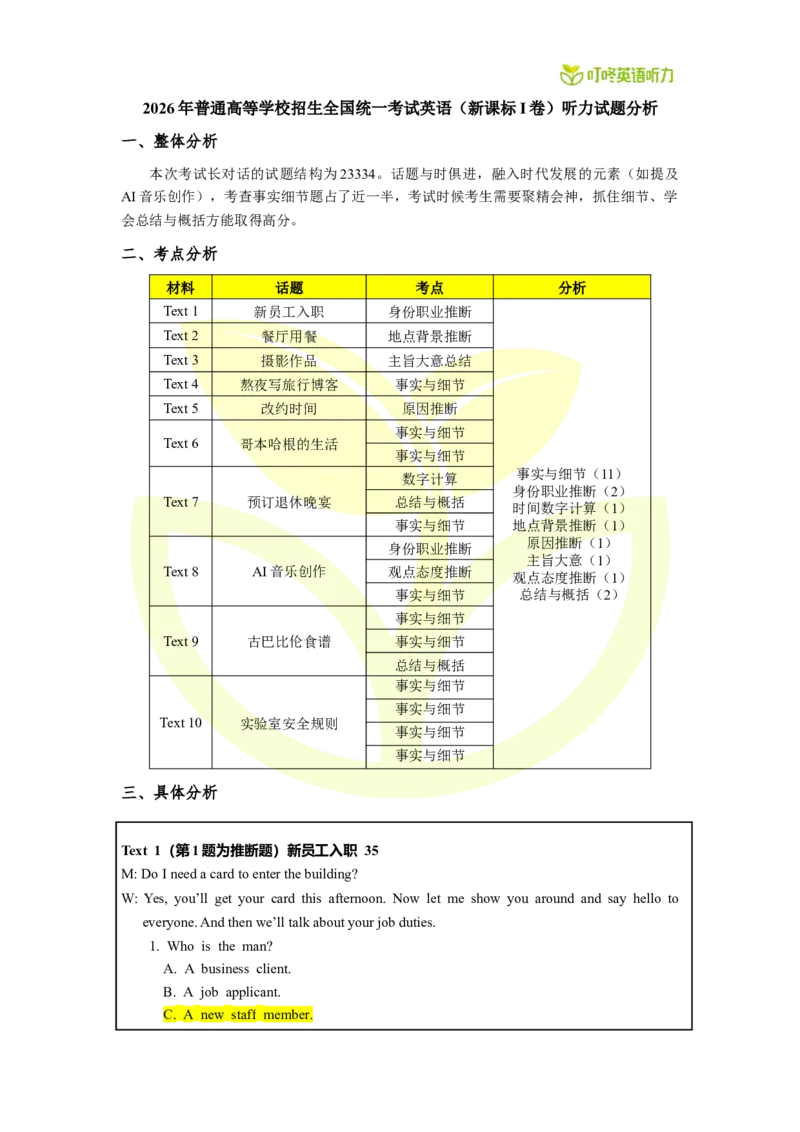
本次考试长对话的试题结构为23334。话题与时俱进,融入时代发展的元素(如提及
AI音乐创作),考查事实细节题占了近一半,考试时候考生需要聚精会神,抓住细节、学
会总结与概括方能取得高分。
二、考点分析
材料 话题 考点 分析
Text 1 新员工入职 身份职业推断
Text 2 餐厅用餐 地点背景推断
Text 3 摄影作品 主旨大意总结
Text 4 熬夜写旅行博客 事实与细节
Text 5 改约时间 原因推断
事实与细节
Text 6 哥本哈根的生活
事实与细节
事实与细节(11)
数字计算
身份职业推断(2)
Text 7 预订退休晚宴 总结与概括
时间数字计算(1)
事实与细节 地点背景推断(1)
原因推断(1)
身份职业推断
主旨大意(1)
Text 8 AI音乐创作 观点态度推断
观点态度推断(1)
事实与细节 总结与概括(2)
事实与细节
Text 9 古巴比伦食谱 事实与细节
总结与概括
事实与细节
事实与细节
Text 10 实验室安全规则
事实与细节
事实与细节
三、具体分析
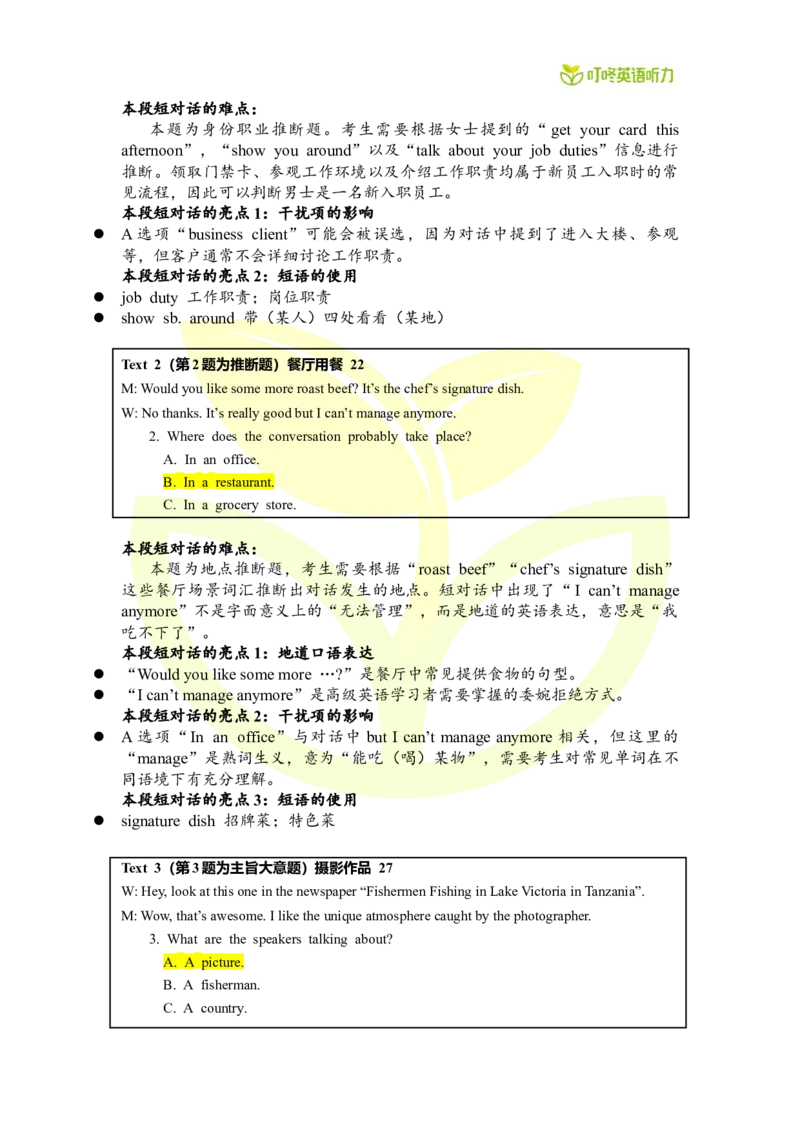
Text 1(第1题为推断题)新员工入职 35
M: Do I need a card to enter the building?
W: Yes, you’ll get your card this afternoon. Now let me show you around and say hello to
everyone. And then we’ll talk about your job duties.
1. Who is the man?
A. A business client.
B. A job applicant.
C. A new staff member.本段短对话的难点:
本题为身份职业推断题。考生需要根据女士提到的“get your card this
afternoon”,“show you around”以及“talk about your job duties”信息进行
推断。领取门禁卡、参观工作环境以及介绍工作职责均属于新员工入职时的常
见流程,因此可以判断男士是一名新入职员工。
本段短对话的亮点1:干扰项的影响
A 选项“business client”可能会被误选,因为对话中提到了进入大楼、参观
等,但客户通常不会详细讨论工作职责。
本段短对话的亮点2:短语的使用
job duty 工作职责;岗位职责
show sb. around 带(某人)四处看看(某地)
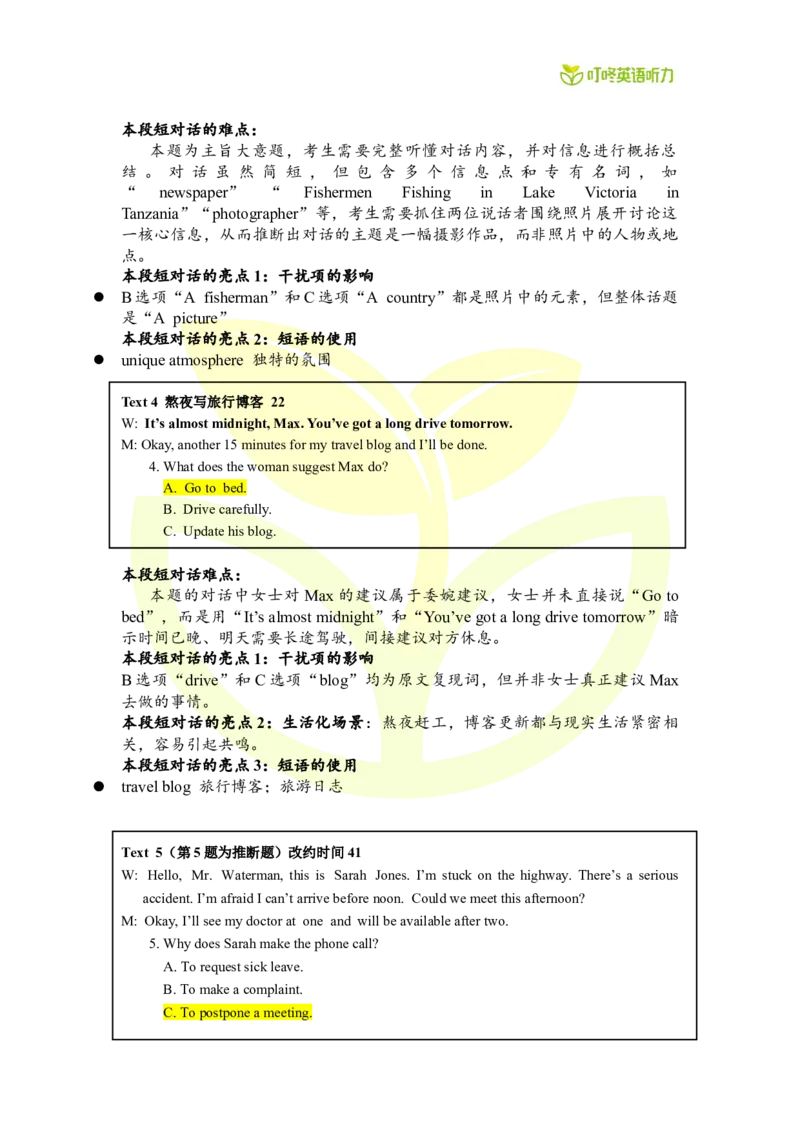
Text 2(第2题为推断题)餐厅用餐 22
M: Would you like some more roast beef? It’s the chef’s signature dish.
W: No thanks. It’s really good but I can’t manage anymore.
2. Where does the conversation probably take place?
A. In an office.
B. In a restaurant.
C. In a grocery store.
本段短对话的难点:
本题为地点推断题,考生需要根据“roast beef”“chef’s signature dish”
这些餐厅场景词汇推断出对话发生的地点。短对话中出现了“I can’t manage
anymore”不是字面意义上的“无法管理”,而是地道的英语表达,意思是“我
吃不下了”。
本段短对话的亮点1:地道口语表达
“Would you like some more …?”是餐厅中常见提供食物的句型。
“I can’t manage anymore”是高级英语学习者需要掌握的委婉拒绝方式。
本段短对话的亮点2:干扰项的影响
A 选项“In an office”与对话中 but I can’t manage anymore 相关,但这里的
“manage”是熟词生义,意为“能吃(喝)某物”,需要考生对常见单词在不
同语境下有充分理解。
本段短对话的亮点3:短语的使用
signature dish 招牌菜;特色菜
Text 3(第3题为主旨大意题)摄影作品 27
W: Hey, look at this one in the newspaper “Fishermen Fishing in Lake Victoria in Tanzania”.
M: Wow, that’s awesome. I like the unique atmosphere caught by the photographer.
3. What are the speakers talking about?
A. A picture.
B. A fisherman.
C. A country.本段短对话的难点:
本题为主旨大意题,考生需要完整听懂对话内容,并对信息进行概括总
结 。 对 话 虽 然 简 短 , 但 包 含 多 个 信 息 点 和 专 有 名 词 , 如
“ newspaper” “ Fishermen Fishing in Lake Victoria in
Tanzania”“photographer”等,考生需要抓住两位说话者围绕照片展开讨论这
一核心信息,从而推断出对话的主题是一幅摄影作品,而非照片中的人物或地
点。
本段短对话的亮点1:干扰项的影响
B选项“A fisherman”和C选项“A country”都是照片中的元素,但整体话题
是“A picture”
本段短对话的亮点2:短语的使用
unique atmosphere 独特的氛围
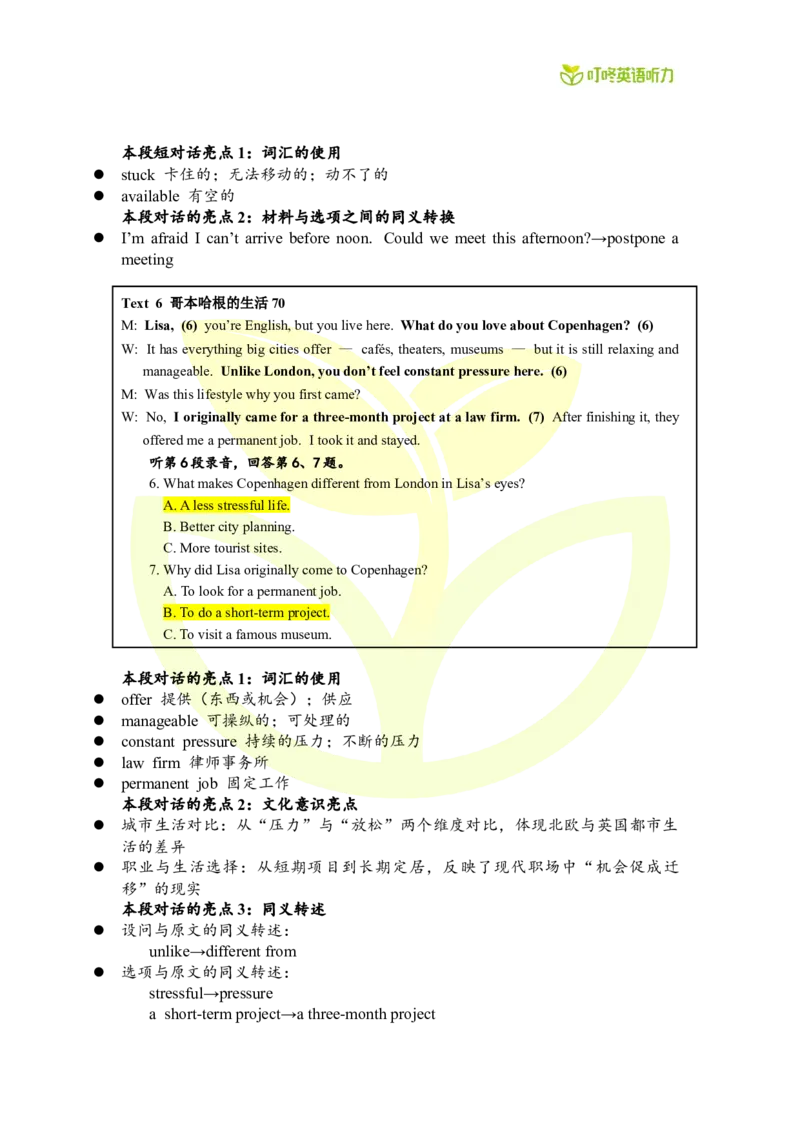
Text 4 熬夜写旅行博客 22
W: It’s almost midnight, Max. You’ve got a long drive tomorrow.
M: Okay, another 15 minutes for my travel blog and I’ll be done.
4. What does the woman suggest Max do?
A. Go to bed.
B. Drive carefully.
C. Update his blog.
本段短对话难点:
本题的对话中女士对 Max的建议属于委婉建议,女士并未直接说“Go to
bed”,而是用“It’s almost midnight”和“You’ve got a long drive tomorrow”暗
示时间已晚、明天需要长途驾驶,间接建议对方休息。
本段短对话的亮点1:干扰项的影响
B选项“drive”和C选项“blog”均为原文复现词,但并非女士真正建议Max
去做的事情。
本段短对话的亮点2:生活化场景:熬夜赶工,博客更新都与现实生活紧密相
关,容易引起共鸣。
本段短对话的亮点3:短语的使用
travel blog 旅行博客;旅游日志
Text 5(第5题为推断题)改约时间41
W: Hello, Mr. Waterman, this is Sarah Jones. I’m stuck on the highway. There’s a serious
accident. I’m afraid I can’t arrive before noon. Could we meet this afternoon?
M: Okay, I’ll see my doctor at one and will be available after two.
5. Why does Sarah make the phone call?
A. To request sick leave.
B. To make a complaint.
C. To postpone a meeting.本段短对话亮点1:词汇的使用
stuck 卡住的;无法移动的;动不了的
available 有空的
本段对话的亮点2:材料与选项之间的同义转换
I’m afraid I can’t arrive before noon. Could we meet this afternoon?→postpone a
meeting
Text 6 哥本哈根的生活70
M: Lisa, (6) you’re English, but you live here. What do you love about Copenhagen? (6)
W: It has everything big cities offer — cafés, theaters, museums — but it is still relaxing and
manageable. Unlike London, you don’t feel constant pressure here. (6)
M: Was this lifestyle why you first came?
W: No, I originally came for a three-month project at a law firm. (7) After finishing it, they
offered me a permanent job. I took it and stayed.
听第6段录音,回答第6、7题。
6. What makes Copenhagen different from London in Lisa’s eyes?
A. A less stressful life.
B. Better city planning.
C. More tourist sites.
7. Why did Lisa originally come to Copenhagen?
A. To look for a permanent job.
B. To do a short-term project.
C. To visit a famous museum.
本段对话的亮点1:词汇的使用
offer 提供(东西或机会);供应
manageable 可操纵的;可处理的
constant pressure 持续的压力;不断的压力
law firm 律师事务所
permanent job 固定工作
本段对话的亮点2:文化意识亮点
城市生活对比:从“压力”与“放松”两个维度对比,体现北欧与英国都市生
活的差异
职业与生活选择:从短期项目到长期定居,反映了现代职场中“机会促成迁
移”的现实
本段对话的亮点3:同义转述
设问与原文的同义转述:
unlike→different from
选项与原文的同义转述:
stressful→pressure
a short-term project→a three-month projectText 7 预订退休晚宴114
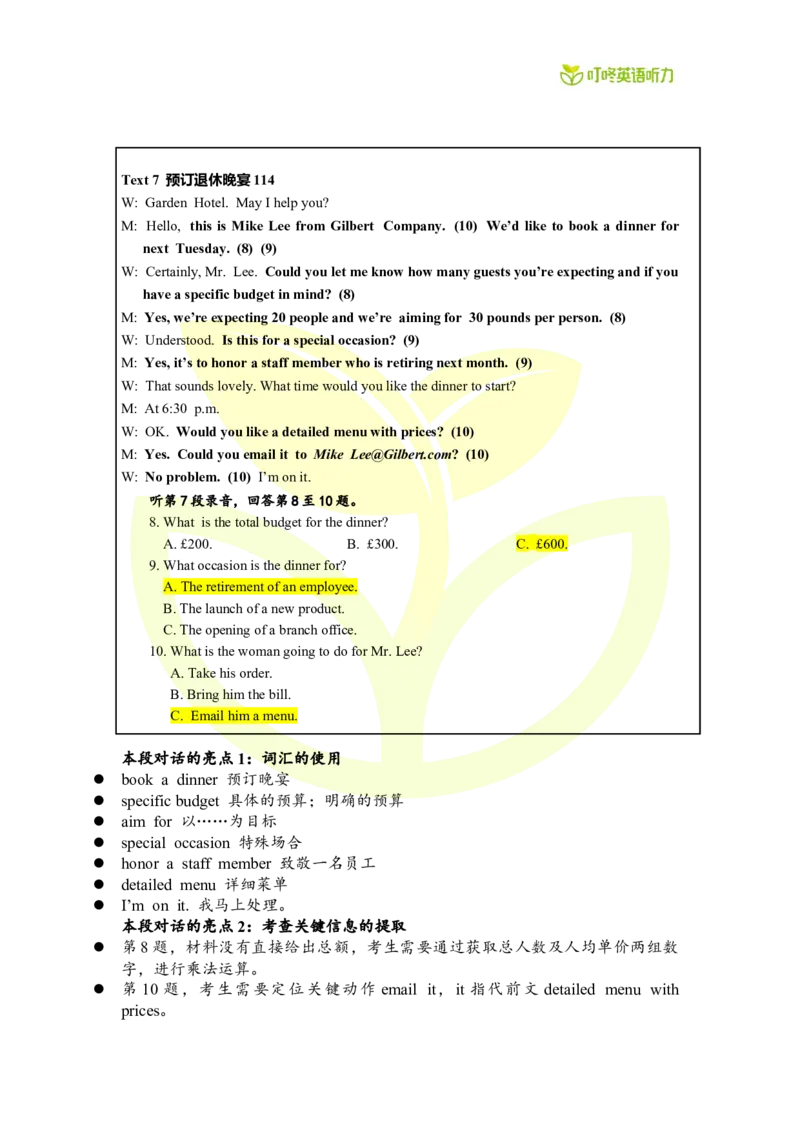
W: Garden Hotel. May I help you?
M: Hello, this is Mike Lee from Gilbert Company. (10) We’d like to book a dinner for
next Tuesday. (8) (9)
W: Certainly, Mr. Lee. Could you let me know how many guests you’re expecting and if you
have a specific budget in mind? (8)
M: Yes, we’re expecting 20 people and we’re aiming for 30 pounds per person. (8)
W: Understood. Is this for a special occasion? (9)
M: Yes, it’s to honor a staff member who is retiring next month. (9)
W: That sounds lovely. What time would you like the dinner to start?
M: At 6:30 p.m.
W: OK. Would you like a detailed menu with prices? (10)
M: Yes. Could you email it to Mike Lee@Gilbert.com? (10)
W: No problem. (10) I’m on it.
听第7段录音,回答第8至10题。
8. What is the total budget for the dinner?
A. £200. B. £300. C. £600.
9. What occasion is the dinner for?
A. The retirement of an employee.
B. The launch of a new product.
C. The opening of a branch office.
10. What is the woman going to do for Mr. Lee?
A. Take his order.
B. Bring him the bill.
C. Email him a menu.
本段对话的亮点1:词汇的使用
book a dinner 预订晚宴
specific budget 具体的预算;明确的预算
aim for 以……为目标
special occasion 特殊场合
honor a staff member 致敬一名员工
detailed menu 详细菜单
I’m on it. 我马上处理。
本段对话的亮点2:考查关键信息的提取
第8题,材料没有直接给出总额,考生需要通过获取总人数及人均单价两组数
字,进行乘法运算。
第 10 题,考生需要定位关键动作 email it,it 指代前文 detailed menu with
prices。本段对话的亮点3:同义转换
a staff member who is retiring→the retirement of an employee
Text 8 AI音乐创作 127
W: Dear listeners, the song we’ve just heard was made with an AI version of Jenny’s singing
voice. (11)
M: Yeah, earlier this year Jenny announced that she’d let anybody make a song using her
AI voice, (11) as long as they were entitled and shared their profits with her. And in just a few
weeks, more than 300 new songs were created using her AI voice.
W: Incredible. Just imagine — Jenny may have been at home drinking a glass of wine while
her AI-cloned voice worked hard to sing her songs. This could be an attractive new
business model for a pop star. (11) (12)
M: Indeed, but some of our listeners called to say they want to hear Jenny’s real voice. (11)
Now let’s play one of her greatest hits, Show Me Your Love. (13)
听第8段录音,回答第11至13题。
11. What does Jenny do?
A. She’s an AI engineer.
B. She’s a pop singer.
C. She’s a radio host.
12. How does the woman feel about what Jenny has done?
A. It might cause legal problems.
B. It would benefit the community.
C. It could be a profitable business.
13. What will the man do next?
A. Play a song.
B. Contact a listener.
C. Recommend a show.
本段对话的亮点1:词汇的使用
version 版本;变体
singing voice 歌喉
entitle 给……命名(或题名)
profit 利润;收益;赢利
clone 克隆
hit 风行一时的流行歌曲(或唱片)
本段对话的亮点2:话题新颖
材料紧扣当下AI数字人声、AI翻唱现象。作为新兴的科技融合文娱的形式,
AI克隆人声凭借其前沿技术特性以及极高的网络讨论度,成为当下文娱行业与
网络舆论的热议焦点。说话者们以电台广播的形式讲述 Jenny授权他人使用其
AI嗓音创作歌曲。此段材料的话题新颖且贴近生活,话题本身也具有科技性与
思辨性,引发对新兴技术与文化创作关系的思考。
本段对话的亮点3:试题与材料之间同义的转换 材料中hit是熟词生义,意为“风行一时的流行歌曲(或唱片)”,与第13题
的A选项中的song为同义转换。
Text 9(第16题为推断题)古巴比伦食谱145
M: Dr. Evans, (14) you just said that these ancient texts are actually the recipes from Ancient
Babylonia. Can you tell us more?
W: Ancient Babylonia is home to many of the things that we use in our cooking today. (14) I
bet about 50% of the energy you need every day comes from vegetables or animals that
originated in this area.
M: Why have these texts taken so long to come to light?
W: These ancient texts have been known since the 1920s but were thought to be medical
texts. (15) In the 1940s, Mary Hussey, an American scholar, suggested that they might be
about food. But people didn’t believe her until French author Jean Bottéro in the 1980s was
asked to write an article about cooking in the past. He had heard about the texts, so he went to
Yale University and found out that they were indeed about food.
听第9段录音,回答第14至16题。
14. What does Evans say about ancient Babylonia?
A. It is rich in energy resources.
B. It is home to several languages.
C. It is the birthplace of many foods.
15. What did people initially think the ancient texts were about?
A. Cookery.
B. Medicine.
C. Education.
16. What do we know about the French author Jean Bottéro?
A. He proved Mary Hussey right.
B. He taught history at Yale University.
C. He was the first to translate the texts.
本段对话的亮点1:词汇的使用
originate in 发源;开始;起源
come to light (新信息)为人所知;被披露出来
medical texts 医学文献
scholar 学者
indeed 确实;的确
本段对话的亮点2:话题新颖,具有特色
这段对话的话题,属于“饮食文化+古代文明+考古发现”的跨学科科普访谈。
它不是单纯介绍一道菜或一种食物,而是围绕古巴比伦食谱的发现过程及其历
史意义展开,兼具历史、考古和饮食文化色彩。既有历史文化内涵,又有学术
研究过程,还能自然地设计细节题和推断题,不会像校园生活、购物、天气等
传统话题那样显得单调,因此具有新颖性和较高的命题价值。本段对话的亮点3:试题与材料之间同义的转换
home to→birthplace
thought to be→initially think
本段对话的亮点4:总结与推断
第 16 小题,这道题并非直接考查事实细节的获取,而是需要根据“Mary
Hussey 提出观点→人们不相信→Jean Bottéro 证实观点”的逻辑关系进行推
断。考查事实细节的获取、因果关系理解及信息整合能力,属于典型的推断
题。
Text 10 实验室安全规则143
Before we begin today’s experiment, let’s review the lab rules. First, safety glasses must
be worn at all times, (17) even if you’re only watching. Second, never mix chemicals unless the
instructions tell you to do so. Today we’re using a strong acid which can cause serious burns if it
touches your skin. If any chemical container is knocked over, don’t panic. Tell me
immediately and I’ll handle the cleanup. (18) Also, keep your hair tied back and avoid wearing
loose clothes. We will work in pairs. One person will handle the tools while the other records the
data. Switch roles after every three trials to ensure everyone gets practice. (19) Remember,
the goal is accurate data, not speed. If you finish early, do not start a new experiment. Instead,
clean your workspace thoroughly. (20) Any questions? No? All right, let’s have a safe and
productive class.
听第10段录音,回答第17至20题。
17. What must the students wear when doing the experiment?
A. Loose clothes.
B. Protective glasses.
C. Waterproof caps.
18. What should the students do if they knock over a chemical container?
A. Report to the teacher.
B. Clear up the mess.
C. Check the instructions.
19. Why should the students switch roles?
A. To speed up the experiment.
B. To double-check the final results.
C. To get an equal chance to practice.
20. What should the students do if they finish early?
A. Analyze the data.
B. Clean their workspace.
C. Start a new experiment.
本段对话的亮点1:重点词汇短语
safety glasses 安全眼镜
strong acid 强酸
chemical container 化学品容器
work in pairs 两人一组合作 accurate data 准确的数据
productive class 富有成效的课堂;有收获的课
本段对话的亮点2:题材新颖
本材料的话题为实验室里的实验规则,不仅贴合了学生学习生活实际,而且打
破了历年高考独白话题类型。
本段对话的亮点3:正确选项的总结与概括
第19题的正确选项需要学生通过材料中的“ensure everyone gets practice”转
换成“get an equal chance to practice”,从而得出答案,考查了学生对于关键
信息的概括能力。