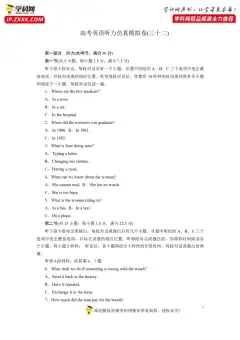
2026 年高考英语听力训练第三十二期(全国一卷)
一、听力题目
第一节
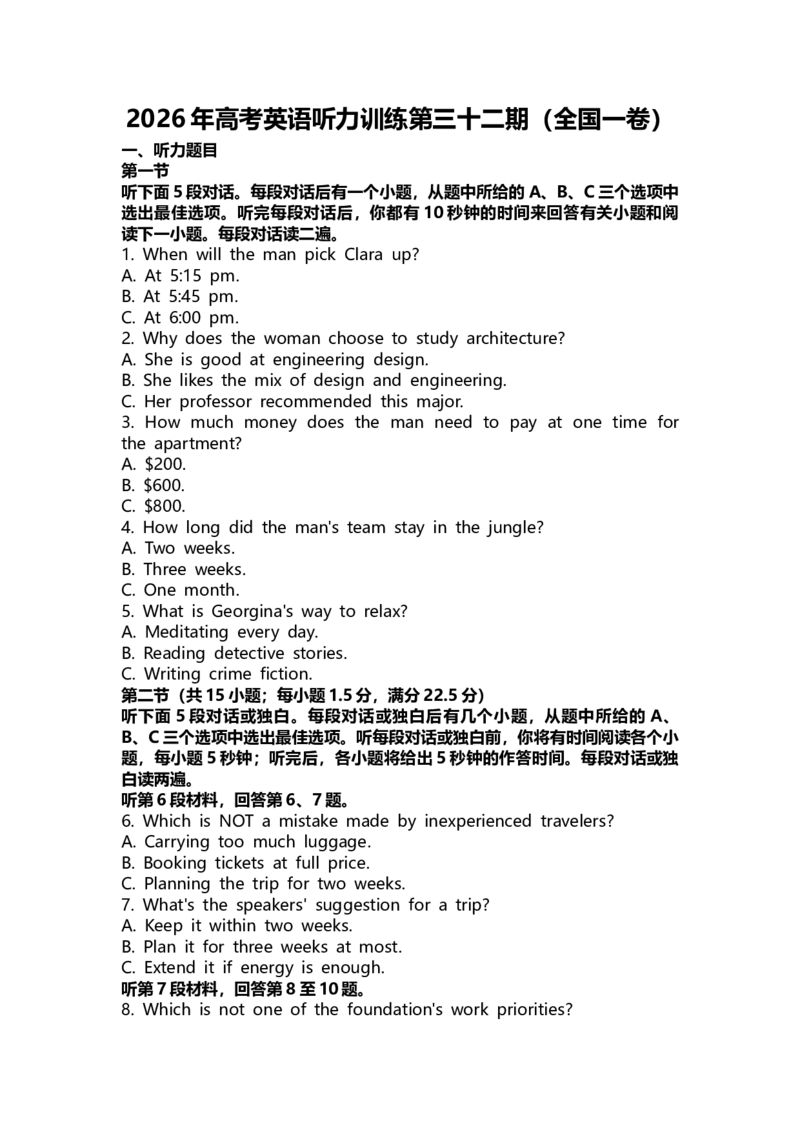
听下面5 段对话。每段对话后有一个小题,从题中所给的A、B、C 三个选项中
选出最佳选项。听完每段对话后,你都有10 秒钟的时间来回答有关小题和阅
读下一小题。每段对话读二遍。
1. When will the man pick Clara up?
A. At 5:15 pm.
B. At 5:45 pm.
C. At 6:00 pm.
2. Why does the woman choose to study architecture?
A. She is good at engineering design.
B. She likes the mix of design and engineering.
C. Her professor recommended this major.
3. How much money does the man need to pay at one time for
the apartment?
A. $200.
B. $600.
C. $800.
4. How long did the man's team stay in the jungle?
A. Two weeks.
B. Three weeks.
C. One month.
5. What is Georgina's way to relax?
A. Meditating every day.
B. Reading detective stories.
C. Writing crime fiction.
第二节(共15 小题;每小题1.5 分,满分22.5 分)
听下面5 段对话或独白。每段对话或独白后有几个小题,从题中所给的A、
B、C 三个选项中选出最佳选项。听每段对话或独白前,你将有时间阅读各个小
题,每小题5 秒钟;听完后,各小题将给出5 秒钟的作答时间。每段对话或独
白读两遍。
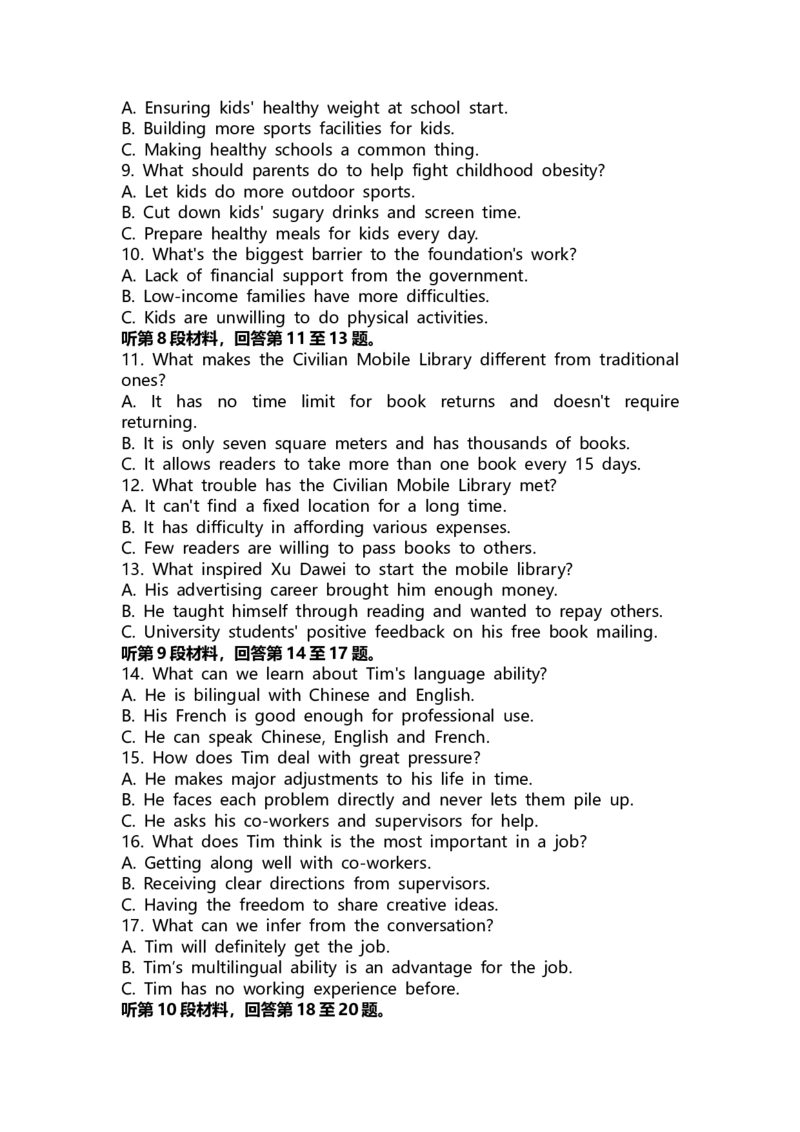
听第6 段材料,回答第6、7 题。
6. Which is NOT a mistake made by inexperienced travelers?
A. Carrying too much luggage.
B. Booking tickets at full price.
C. Planning the trip for two weeks.
7. What's the speakers' suggestion for a trip?
A. Keep it within two weeks.
B. Plan it for three weeks at most.
C. Extend it if energy is enough.
听第7 段材料,回答第8 至10 题。
8. Which is not one of the foundation's work priorities?
A. Ensuring kids' healthy weight at school start.
B. Building more sports facilities for kids.
C. Making healthy schools a common thing.
9. What should parents do to help fight childhood obesity?
A. Let kids do more outdoor sports.
B. Cut down kids' sugary drinks and screen time.
C. Prepare healthy meals for kids every day.
10. What's the biggest barrier to the foundation's work?
A. Lack of financial support from the government.
B. Low-income families have more difficulties.
C. Kids are unwilling to do physical activities.
听第8 段材料,回答第11 至13 题。
11. What makes the Civilian Mobile Library different from traditional
ones?
A. It has no time limit for book returns and doesn't require
returning.
B. It is only seven square meters and has thousands of books.
C. It allows readers to take more than one book every 15 days.
12. What trouble has the Civilian Mobile Library met?
A. It can't find a fixed location for a long time.
B. It has difficulty in affording various expenses.
C. Few readers are willing to pass books to others.
13. What inspired Xu Dawei to start the mobile library?
A. His advertising career brought him enough money.
B. He taught himself through reading and wanted to repay others.
C. University students' positive feedback on his free book mailing.
听第9 段材料,回答第14 至17 题。
14. What can we learn about Tim's language ability?
A. He is bilingual with Chinese and English.
B. His French is good enough for professional use.
C. He can speak Chinese, English and French.
15. How does Tim deal with great pressure?
A. He makes major adjustments to his life in time.
B. He faces each problem directly and never lets them pile up.
C. He asks his co-workers and supervisors for help.
16. What does Tim think is the most important in a job?
A. Getting along well with co-workers.
B. Receiving clear directions from supervisors.
C. Having the freedom to share creative ideas.
17. What can we infer from the conversation?
A. Tim will definitely get the job.
B. Tim’s multilingual ability is an advantage for the job.
C. Tim has no working experience before.
听第10 段材料,回答第18 至20 题。
18. What's the benefit of combining whole grain foods with protein
for exam revision?
A. Preventing hunger for a long time alone.
B. Keeping blood sugar balanced and aiding concentration.
C. Slowing down brain damage and age-related decline.
19. What is the nutrition expert's view on vitamin supplements?
A. Natural food is a better source of nutrients than supplements.
B. Supplements are as effective as food in providing nutrients.
C. People should take plenty of supplements to make up for
nutrient gaps.
20. Which of the following is the expert's key advice for exam
revision?
A. Replace regular meals with berries and nuts for convenience.
B. Take vitamin C tablets to get nutrients more efficiently.
C. Eat regularly and drink an appropriate amount of water.
二、听力原文
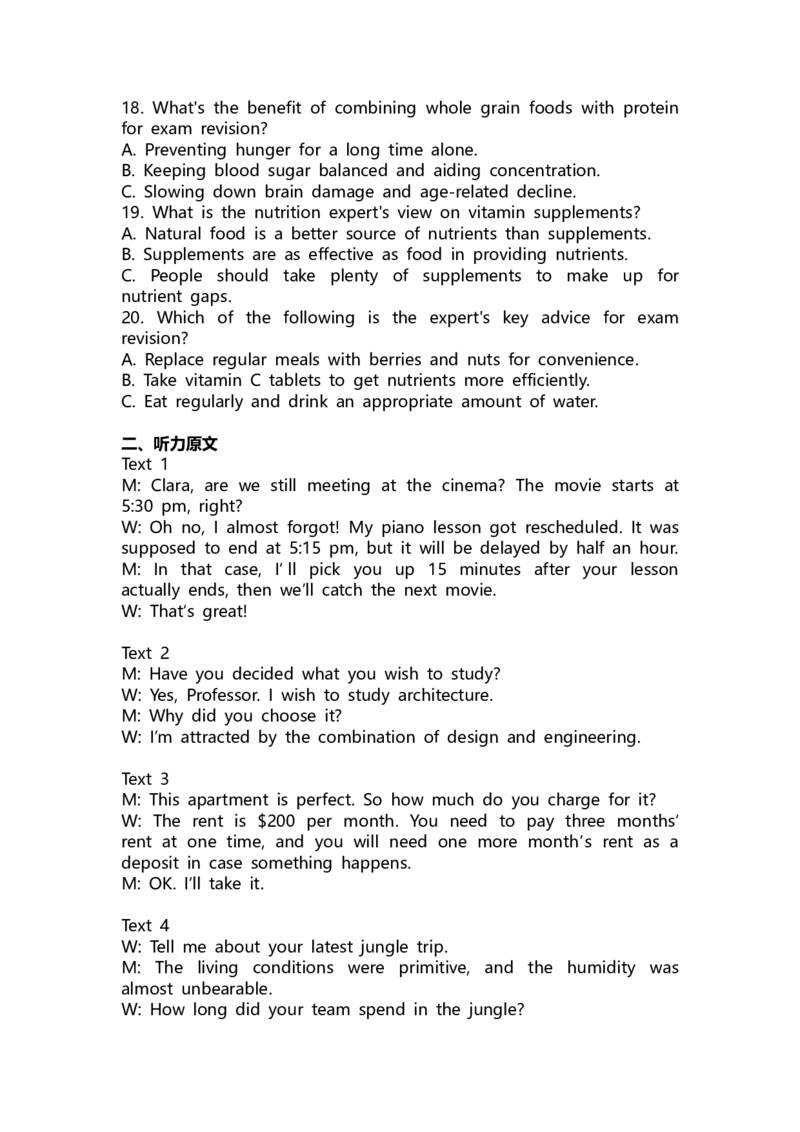
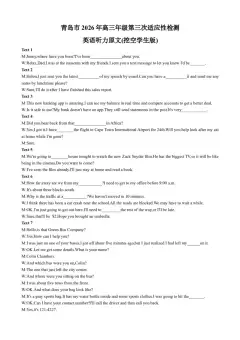
Text 1
M: Clara, are we still meeting at the cinema? The movie starts at
5:30 pm, right?
W: Oh no, I almost forgot! My piano lesson got rescheduled. It was
supposed to end at 5:15 pm, but it will be delayed by half an hour.
M: In that case, I‘ ll pick you up 15 minutes after your lesson
actually ends, then we’ll catch the next movie.
W: That‘s great!
Text 2
M: Have you decided what you wish to study?
W: Yes, Professor. I wish to study architecture.
M: Why did you choose it?
W: I’m attracted by the combination of design and engineering.
Text 3
M: This apartment is perfect. So how much do you charge for it?
W: The rent is $200 per month. You need to pay three months‘
rent at one time, and you will need one more month’s rent as a
deposit in case something happens.
M: OK. I‘ll take it.
Text 4
W: Tell me about your latest jungle trip.
M: The living conditions were primitive, and the humidity was
almost unbearable.
W: How long did your team spend in the jungle?
M: We had planned to be there for a month. But we stayed for
only 2 weeks because we received news that a hurricane was
approaching.
Text 5
M: How do you relax, Georgina?
W: Well, I love reading crime fiction, you know, detective stories by
authors like Ruth Rendell.
M: Really? One thing that I do is meditate to relax.
Text 6
W: Justin, what kind of mistakes do inexperienced travelers make?
M: Firstly, they take far too much luggage. Secondly, they think that
they have to pay full price for air tickets. To make matters worse,
inexperienced travelers often expect everything to go according to
plan. The fact is that travelers need to learn to expect the
unexpected.
W: Yeah. And another point is to not go away for too long. Most
people‘ s efficiency and energy start to decline after two weeks
away.
M: Yes. So I think it’s important to keep your trip short; only go for
two weeks and never for longer than three.
W: OK. Thank you for all this useful information and advice.
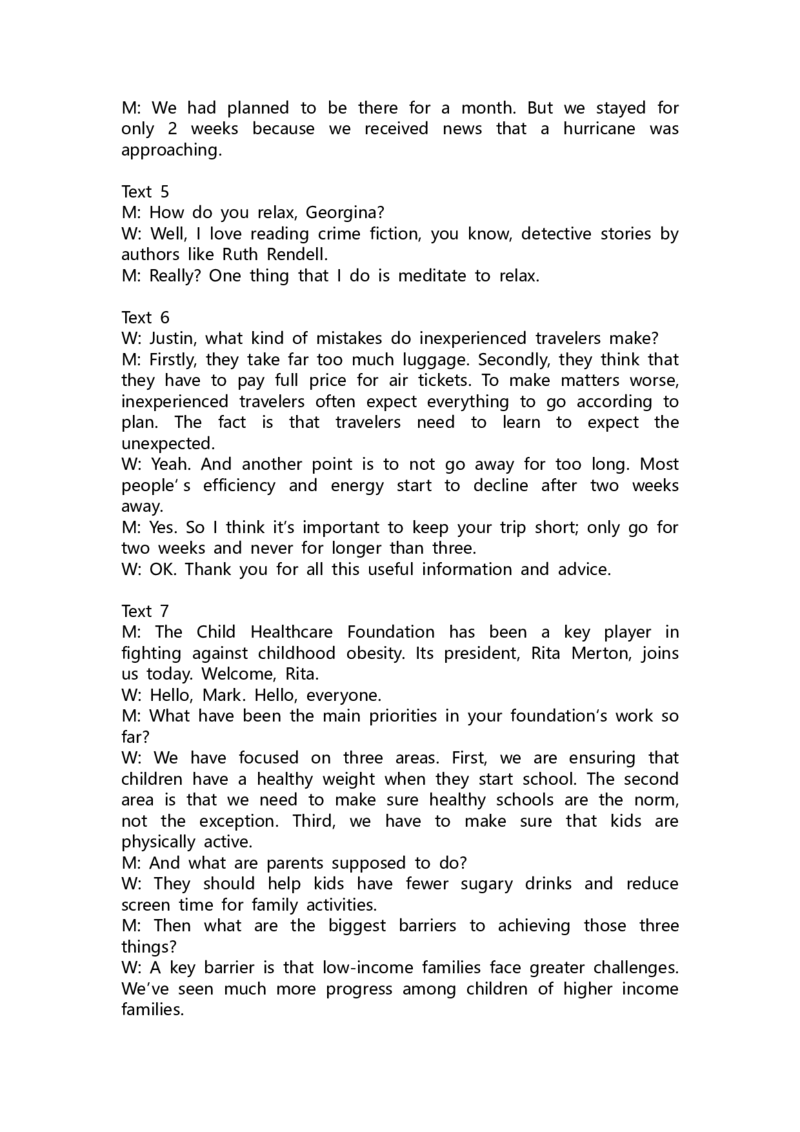
Text 7
M: The Child Healthcare Foundation has been a key player in
fighting against childhood obesity. Its president, Rita Merton, joins
us today. Welcome, Rita.
W: Hello, Mark. Hello, everyone.
M: What have been the main priorities in your foundation‘s work so
far?
W: We have focused on three areas. First, we are ensuring that
children have a healthy weight when they start school. The second
area is that we need to make sure healthy schools are the norm,
not the exception. Third, we have to make sure that kids are
physically active.
M: And what are parents supposed to do?
W: They should help kids have fewer sugary drinks and reduce
screen time for family activities.
M: Then what are the biggest barriers to achieving those three
things?
W: A key barrier is that low-income families face greater challenges.
We’ve seen much more progress among children of higher income
families.
M: Thanks so much, Rita.
W: It‘s my pleasure to be here.
Text 8
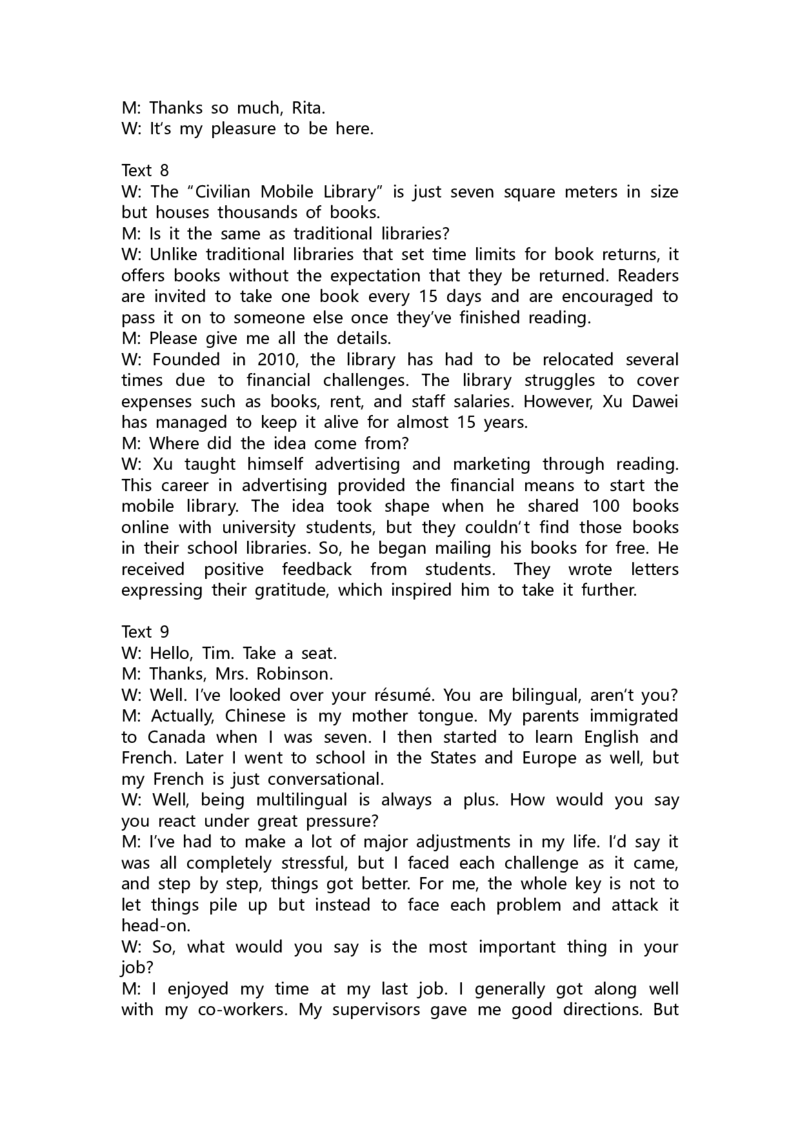
W: The “Civilian Mobile Library” is just seven square meters in size
but houses thousands of books.
M: Is it the same as traditional libraries?
W: Unlike traditional libraries that set time limits for book returns, it
offers books without the expectation that they be returned. Readers
are invited to take one book every 15 days and are encouraged to
pass it on to someone else once they’ve finished reading.
M: Please give me all the details.
W: Founded in 2010, the library has had to be relocated several
times due to financial challenges. The library struggles to cover
expenses such as books, rent, and staff salaries. However, Xu Dawei
has managed to keep it alive for almost 15 years.
M: Where did the idea come from?
W: Xu taught himself advertising and marketing through reading.
This career in advertising provided the financial means to start the
mobile library. The idea took shape when he shared 100 books
online with university students, but they couldn‘t find those books
in their school libraries. So, he began mailing his books for free. He
received
positive
feedback
from
students.
They
wrote
letters
expressing their gratitude, which inspired him to take it further.
Text 9
W: Hello, Tim. Take a seat.
M: Thanks, Mrs. Robinson.
W: Well. I’ve looked over your résumé. You are bilingual, aren‘t you?
M: Actually, Chinese is my mother tongue. My parents immigrated
to Canada when I was seven. I then started to learn English and
French. Later I went to school in the States and Europe as well, but
my French is just conversational.
W: Well, being multilingual is always a plus. How would you say
you react under great pressure?
M: I’ve had to make a lot of major adjustments in my life. I‘d say it
was all completely stressful, but I faced each challenge as it came,
and step by step, things got better. For me, the whole key is not to
let things pile up but instead to face each problem and attack it
head-on.
W: So, what would you say is the most important thing in your
job?
M: I enjoyed my time at my last job. I generally got along well
with my co-workers. My supervisors gave me good directions. But
having a high degree of freedom to share creative ideas is the
most significant.
W: Good. We will be reviewing your information, and you’ll get a
callback within a week.
M: Great! Thanks for your time.
Text 10
It‘s revision time for exams. The pressure is on, so you want all the
help you can get to aid your memory and raise your grades. As a
nutrition expert, I want to say that eating well can make a real
difference to your revision routine, so what brain-boosting food and
drink would I recommend? Whole grain foods will help prevent
hunger.
Examples
include
porridge
and
whole
wheat
bread.
Combining whole grain foods with protein will help keep your
blood sugar levels balanced, which is essential for mood and
concentration. Berries and nuts are a convenient and nutritious
snack. Blueberries can slow down brain damage and age-related
decline. Doctors often recommend taking vitamin supplements to
top up the nutrients you need. But I would say food should always
come before supplements, and the key to getting as many nutrients
as possible is to eat a varied diet. It’s better to get everything you
need from food and drink. For example, oranges contain not only
vitamin C, but also fiber and other components that you can‘t get
packaged together in a tablet. Don’ t forget to drink a proper
amount of water, which can boost attention by almost 25 percent
and can improve your mood as well. Finally, don‘ t skip meals.
Eating regularly will keep blood sugar balanced and feed the brain
with the fuel it needs.
三、答案及解析
第一节
1. 答案:C
解析:Text1 中克拉拉的钢琴课原定5:15 结束,推迟半小时后实际结束时间为
5:45;男士表示课后15 分钟来接她,5:45+15 分钟=6:00 pm。A 是原下课时
间,B 是实际下课时间,均非接人时间,故选C。
2. 答案:B
解析:Text2 中女士明确表示选择建筑学的原因是“ I’m attracted by the
combination of design and engineering”,即被设计和工程的结合所吸引。
A“擅长工程设计”、C“教授推荐该专业”均未提及,故选B。
3. 答案:C
解析:Text3 中公寓月租200 美元,需一次性支付3 个月租金+1 个月押金,总
计200×4=800 美元。A 是单月租金,B 是3 个月租金,均未包含押金,故选
C。
4. 答案:A
解析:Text4 中男士说明团队计划在丛林待一个月,但因飓风逼近只待了两周。
B 未提及,C 是计划时长,并非实际时长,故选A。
5. 答案:B
解析:Text5 中乔治娜表示放松方式是“reading crime fiction, you know,
detective stories”,即读侦探小说。A 是男士的放松方式,C“写犯罪小说”与
原文“读”不符,故选B。
第二节
第6 段材料
6. 答案:C
解析:Text6 中提到无经验旅行者的错误:带太多行李(A)、买全价机票
(B)、期待一切按计划进行;而计划旅行两周是说话者的建议,并非错误。
故选C。
7. 答案:B
解析:男士明确说“keep your trip short; only go for two weeks and
never for longer than three”,即旅行时长最多三周。A“控制在两周内”是推
荐时长,并非上限;C“精力足够就延长”与原文观点相反,故选B。
第7 段材料
8. 答案:B
解析:基金会的三大工作重点:确保孩子入学时体重健康(A)、让健康校园
成为常态(C)、保证孩子有足够的身体活动量;B“为孩子修建更多体育设施”
原文未提及,故选B。
9. 答案:B
解析:Rita 明确指出父母的具体做法:“help kids have fewer sugary
drinks and reduce screen time for family activities”。A“让孩子多做户外
运动”是基金会的工作方向,并非父母的具体举措;C“每天为孩子准备健康餐
食”原文未提及,故选B。
10. 答案:B
解析:Rita 表示基金会开展工作的核心障碍是“low-income families face
greater challenges”,即低收入家庭面临更多的困难。A“缺乏政府财政支持”、
C“孩子不愿进行体育活动”原文均未提及,故选B。
第8 段材料
11. 答案:A
解析:移动图书馆与传统图书馆的核心区别:“Unlike traditional libraries
that set time limits for book returns, it offers books without the
expectation that they be returned”。B 是移动图书馆的自身特点,并非与
传统图书馆的区别;C“15 天可借多本书”与原文“take one book every 15
days”不符,故选A。
12. 答案:B
解析:移动图书馆面临的核心问题是“financial challenges”“struggles to
cover expenses such as books, rent, and staff salaries”,即难以承担各
类运营开支。A“无法找到固定场地”是财政问题引发的结果,并非核心困境;
C“很少读者愿意传书”原文未提及,故选B。
13. 答案:C
解析:徐大伟先为大学生免费邮寄书籍,收到了学生的积极反馈和感谢信,这
一经历激励他进一步创立了移动图书馆。A 是创办图书馆的经济条件,并非灵
感来源;B“自学读书并想回报他人”原文未提及,故选C。
第9 段材料
14. 答案:C
解析:Tim 说明中文是母语,七岁移民后学习了英语和法语,只是法语仅能日
常交流。A“仅会中英双语”表述错误,他掌握三门语言;B“法语可用于专业场
景”与“French is just conversational”不符,故选C。
15. 答案:B
解析:Tim 应对压力的核心方法是“not to let things pile up but instead
to face each problem and attack it head-on”,即直面问题,不堆积问题。
A“及时调整生活”是他的人生经历,并非应对压力的方法;C“向同事和上司求
助”原文未提及,故选B。
16. 答案:C
解析:Tim 明确表示工作中最看重的是“having a high degree of freedom
to share creative ideas”。A、B 是他上一份工作的优点,但并非其认为工作
中最重要的事,故选C。
17. 答案:B
解析:女士明确说“being multilingual is always a plus”,“plus”意为优势,
说明Tim 的多语言能力对这份工作来说是一个优势。A“Tim 肯定能得到这份工
作”,女士仅表示会审核信息并一周内回复,未给出确定结果;C“Tim 之前无工
作经验”,Tim 提到了“my last job”,说明其有工作经验,故选B。
第10 段材料
18. 答案:B
解析:专家说明全谷物搭配蛋白质的好处:“keep your blood sugar levels
balanced, which is essential for mood and concentration”,这对备考
的学生尤为重要。A 是全谷物单独的作用,并非与蛋白质搭配的益处;C 是蓝
莓的功效,故选B。
19. 答案:A
解析:专家的核心观点是“ food should always come before
supplements”“It’s better to get everything you need from food and
drink”,即天然食物是比补充剂更好的营养来源。B 与专家观点相反;C 是医生
的建议,并非专家的观点,故选A。
20. 答案:C
解析:专家给出的备考饮食建议包括:吃全谷物搭配蛋白质、吃浆果和坚果当
零食、优先从天然食物获取营养、喝足量的水、规律饮食不跳过正餐。A“用浆
果和坚果代替正餐”与“不跳过正餐”矛盾;B“吃维C 片高效补充营养”与专家“优
先从食物获取营养”的观点不符,故选C。