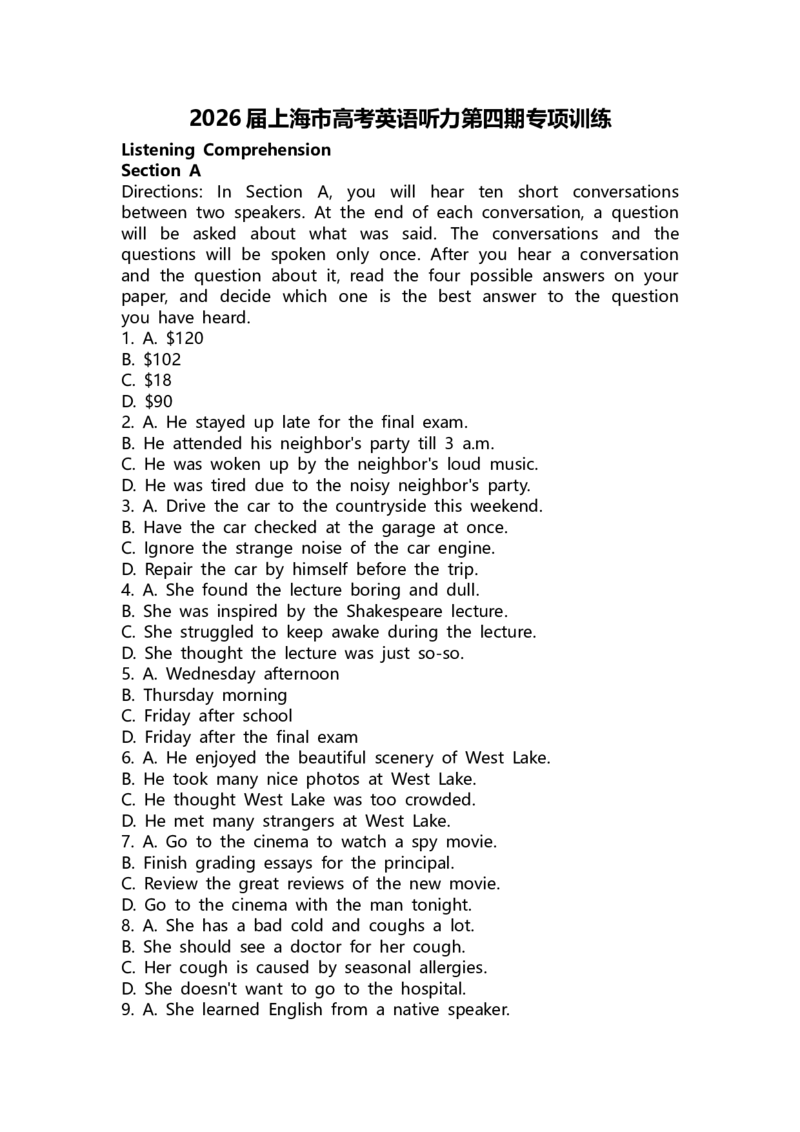
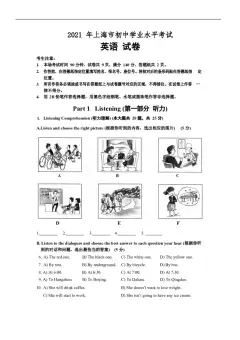
2026 届上海市高考英语听力第四期专项训练
Listening Comprehension
Section A
Directions: In Section A, you will hear ten short conversations
between two speakers. At the end of each conversation, a question
will be asked about what was said. The conversations and the
questions will be spoken only once. After you hear a conversation
and the question about it, read the four possible answers on your
paper, and decide which one is the best answer to the question
you have heard.
1. A. $120
B. $102
C. $18
D. $90
2. A. He stayed up late for the final exam.
B. He attended his neighbor's party till 3 a.m.
C. He was woken up by the neighbor's loud music.
D. He was tired due to the noisy neighbor's party.
3. A. Drive the car to the countryside this weekend.
B. Have the car checked at the garage at once.
C. Ignore the strange noise of the car engine.
D. Repair the car by himself before the trip.
4. A. She found the lecture boring and dull.
B. She was inspired by the Shakespeare lecture.
C. She struggled to keep awake during the lecture.
D. She thought the lecture was just so-so.
5. A. Wednesday afternoon
B. Thursday morning
C. Friday after school
D. Friday after the final exam
6. A. He enjoyed the beautiful scenery of West Lake.
B. He took many nice photos at West Lake.
C. He thought West Lake was too crowded.
D. He met many strangers at West Lake.
7. A. Go to the cinema to watch a spy movie.
B. Finish grading essays for the principal.
C. Review the great reviews of the new movie.
D. Go to the cinema with the man tonight.
8. A. She has a bad cold and coughs a lot.
B. She should see a doctor for her cough.
C. Her cough is caused by seasonal allergies.
D. She doesn't want to go to the hospital.
9. A. She learned English from a native speaker.B. She improved English by watching BBC dramas.
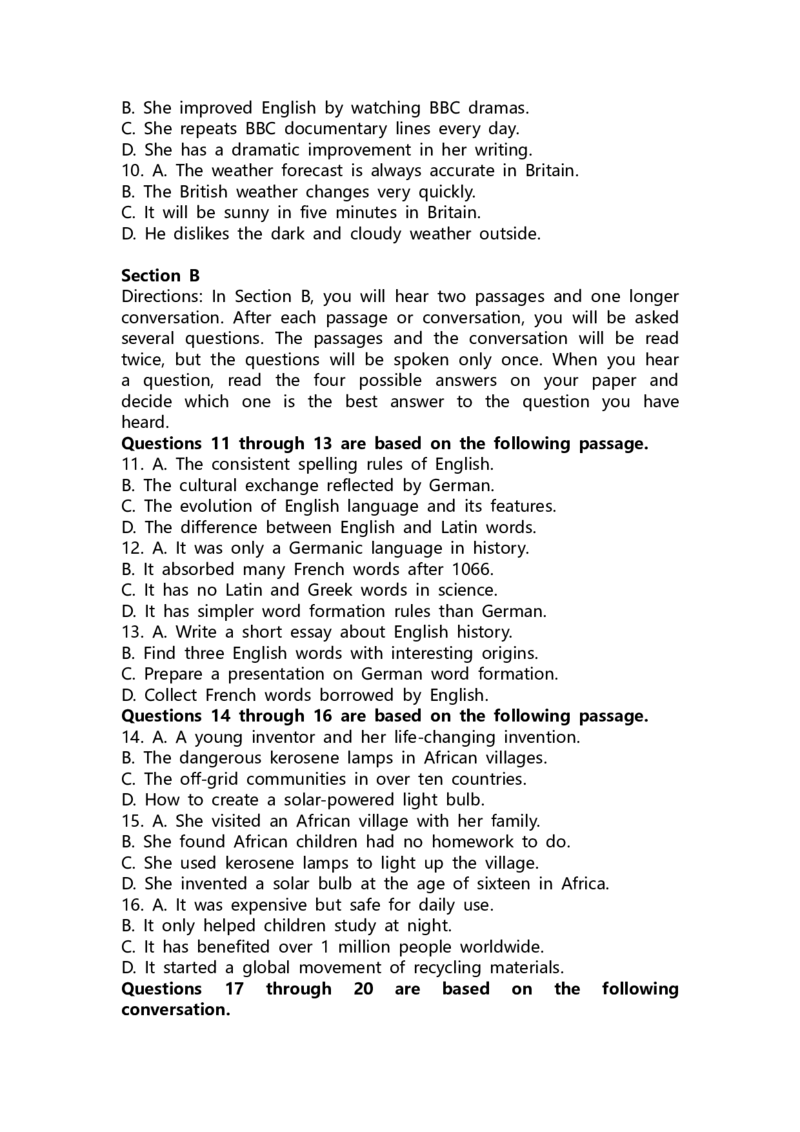
C. She repeats BBC documentary lines every day.
D. She has a dramatic improvement in her writing.
10. A. The weather forecast is always accurate in Britain.
B. The British weather changes very quickly.
C. It will be sunny in five minutes in Britain.
D. He dislikes the dark and cloudy weather outside.
Section B
Directions: In Section B, you will hear two passages and one longer
conversation. After each passage or conversation, you will be asked
several questions. The passages and the conversation will be read
twice, but the questions will be spoken only once. When you hear
a question, read the four possible answers on your paper and
decide which one is the best answer to the question you have
heard.
Questions 11 through 13 are based on the following passage.
11. A. The consistent spelling rules of English.
B. The cultural exchange reflected by German.
C. The evolution of English language and its features.
D. The difference between English and Latin words.
12. A. It was only a Germanic language in history.
B. It absorbed many French words after 1066.
C. It has no Latin and Greek words in science.
D. It has simpler word formation rules than German.
13. A. Write a short essay about English history.
B. Find three English words with interesting origins.
C. Prepare a presentation on German word formation.
D. Collect French words borrowed by English.
Questions 14 through 16 are based on the following passage.
14. A. A young inventor and her life-changing invention.
B. The dangerous kerosene lamps in African villages.
C. The off-grid communities in over ten countries.
D. How to create a solar-powered light bulb.
15. A. She visited an African village with her family.
B. She found African children had no homework to do.
C. She used kerosene lamps to light up the village.
D. She invented a solar bulb at the age of sixteen in Africa.
16. A. It was expensive but safe for daily use.
B. It only helped children study at night.
C. It has benefited over 1 million people worldwide.
D. It started a global movement of recycling materials.
Questions 17 through 20 are based on the following
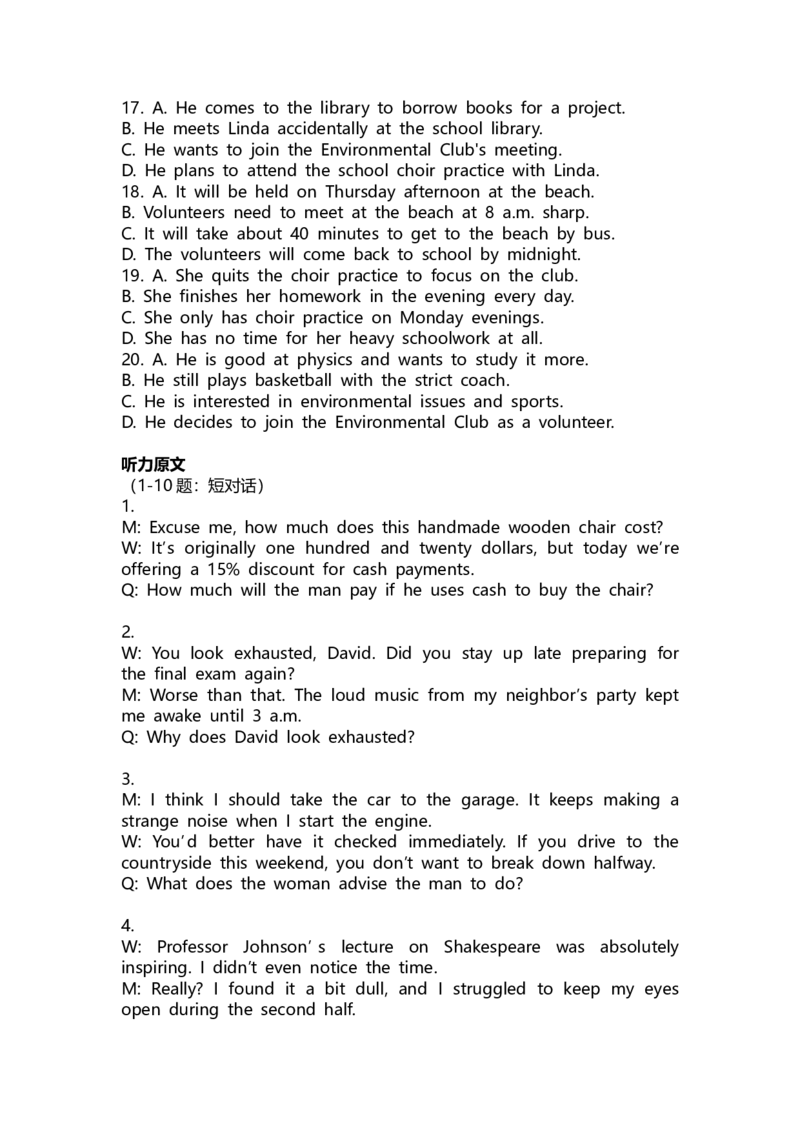
conversation.17. A. He comes to the library to borrow books for a project.
B. He meets Linda accidentally at the school library.
C. He wants to join the Environmental Club's meeting.
D. He plans to attend the school choir practice with Linda.
18. A. It will be held on Thursday afternoon at the beach.
B. Volunteers need to meet at the beach at 8 a.m. sharp.
C. It will take about 40 minutes to get to the beach by bus.
D. The volunteers will come back to school by midnight.
19. A. She quits the choir practice to focus on the club.
B. She finishes her homework in the evening every day.
C. She only has choir practice on Monday evenings.
D. She has no time for her heavy schoolwork at all.
20. A. He is good at physics and wants to study it more.
B. He still plays basketball with the strict coach.
C. He is interested in environmental issues and sports.
D. He decides to join the Environmental Club as a volunteer.
听力原文
(1-10题:短对话)
1.
M: Excuse me, how much does this handmade wooden chair cost?
W: It’s originally one hundred and twenty dollars, but today we’re
offering a 15% discount for cash payments.
Q: How much will the man pay if he uses cash to buy the chair?
2.
W: You look exhausted, David. Did you stay up late preparing for
the final exam again?
M: Worse than that. The loud music from my neighbor’s party kept
me awake until 3 a.m.
Q: Why does David look exhausted?
3.
M: I think I should take the car to the garage. It keeps making a
strange noise when I start the engine.
W: You’d better have it checked immediately. If you drive to the
countryside this weekend, you don’t want to break down halfway.
Q: What does the woman advise the man to do?
4.
W: Professor Johnson’ s lecture on Shakespeare was absolutely
inspiring. I didn’t even notice the time.
M: Really? I found it a bit dull, and I struggled to keep my eyes
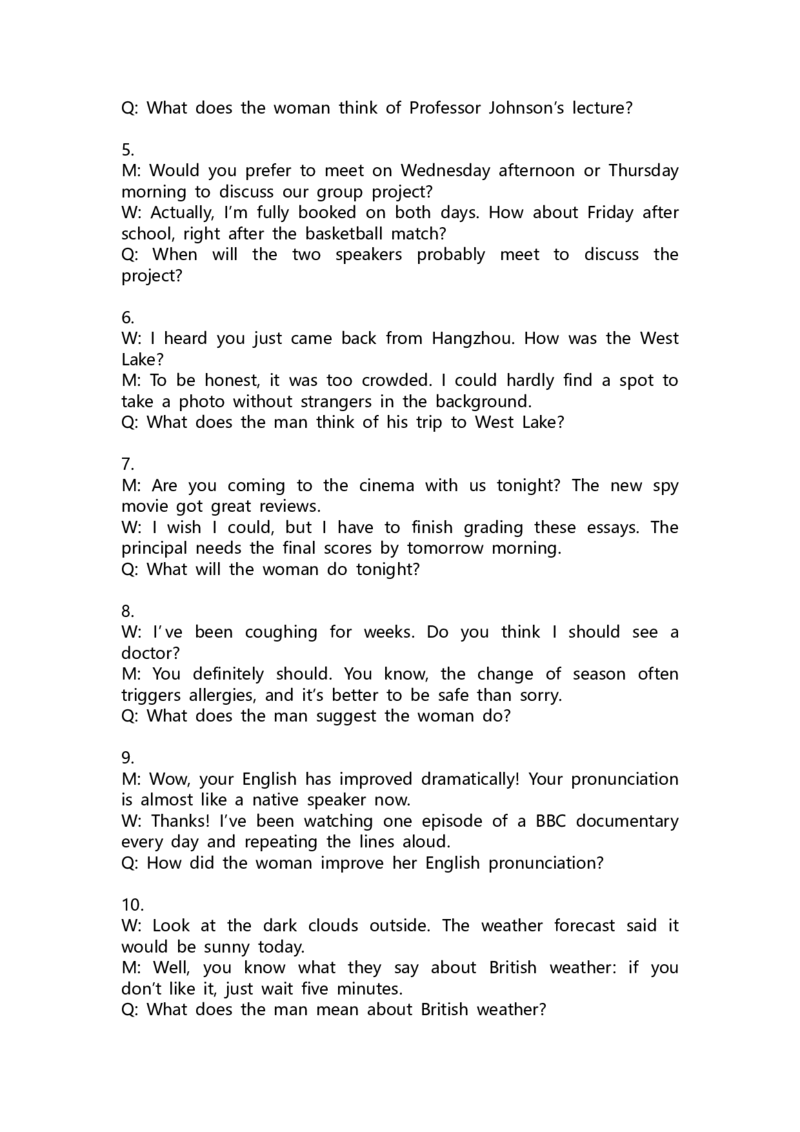
open during the second half.Q: What does the woman think of Professor Johnson’s lecture?
5.
M: Would you prefer to meet on Wednesday afternoon or Thursday
morning to discuss our group project?
W: Actually, I’m fully booked on both days. How about Friday after
school, right after the basketball match?
Q: When will the two speakers probably meet to discuss the
project?
6.
W: I heard you just came back from Hangzhou. How was the West
Lake?
M: To be honest, it was too crowded. I could hardly find a spot to
take a photo without strangers in the background.
Q: What does the man think of his trip to West Lake?
7.
M: Are you coming to the cinema with us tonight? The new spy
movie got great reviews.
W: I wish I could, but I have to finish grading these essays. The
principal needs the final scores by tomorrow morning.
Q: What will the woman do tonight?
8.
W: I’ve been coughing for weeks. Do you think I should see a
doctor?
M: You definitely should. You know, the change of season often
triggers allergies, and it’s better to be safe than sorry.
Q: What does the man suggest the woman do?
9.
M: Wow, your English has improved dramatically! Your pronunciation
is almost like a native speaker now.
W: Thanks! I’ve been watching one episode of a BBC documentary
every day and repeating the lines aloud.
Q: How did the woman improve her English pronunciation?
10.
W: Look at the dark clouds outside. The weather forecast said it
would be sunny today.
M: Well, you know what they say about British weather: if you
don’t like it, just wait five minutes.
Q: What does the man mean about British weather?11-13题:第一篇短文
Good morning, everyone. Today, let's discuss the evolution of the
English language, a topic that reflects centuries of cultural exchange.
Many students wonder why English spelling seems so irregular. The
answer lies in its history. Originally, English was a Germanic
language, but after the Norman Conquest of 1066, it absorbed a
vast number of French words. This is why we have different words
for animals and their meat, like "cow" (from Old English) and "beef"
(from French).
Later, during the Renaissance, scholars introduced many Latin and
Greek terms for science and art. This layered history makes English
rich but complex. For instance, while German has relatively
consistent rules for word formation, English often has multiple
words for the same idea, each with a different nuance, borrowed
from different languages.
So, when you struggle with English vocabulary, remember it's not
just a language; it's a record of history. Mastering it means
understanding these cultural layers. Now, for homework, I'd like you
to find three English words with interesting etymologies and
prepare a short presentation on them.
Questions
11. What is the main topic of the passage?
12. What do we know about the English language from the
passage?
13. What homework does the speaker assign to the students?
14-16题:第二篇短文
Hello, class. Today I want to share a story about a young inventor
named Sarah. When she was sixteen, she visited a village in Africa
with her parents. She was surprised to find that the children there
had no electricity to do homework at night. They used dangerous
kerosene lamps instead.
Sarah decided to help. Back home, she experimented with recycled
materials and finally created a solar-powered light bulb. It was
cheap, safe, and could last for years. She named it "Little Sun" and
started a project to send these bulbs to off-grid communities.
Her invention not only brought light but also changed lives.
Children could now study after dark, and adults could work longer.
What started as a small idea grew into a global movement. Today,
"Little Sun" has reached over one million people in more than ten
countries.
So remember, young people, you don't have to wait to become an
adult to make a difference. A simple idea, when put into action,can brighten the world.
Questions
14. What is the passage mainly about?
15. What happened to Sarah when she was sixteen?
16. What do we know about Sarah's invention "Little Sun"?
17-20题:长对话
M: Hi, Linda! I didn't expect to see you here at the library. I
thought you had your Environmental Club meeting on Thursday
afternoons.
W: Hey, Mark. I just got back from it, actually. I needed to grab a
couple of books for our project. We're organizing a beach cleanup
this Saturday.
M: That sounds meaningful! Count me in if you still need
volunteers. I'm free on weekends.
W: Really? That would be great! We're meeting at the school gate
at 8 a.m. sharp. The bus leaves at 8:15, and it's about a 40-minute
ride. We should be back on campus by noon.
M: Perfect. By the way, I heard you're also in the school choir. How
do you manage your time with all these activities and the heavy
schoolwork?
W: It's a bit challenging, but I've gotten used to it. Choir practice is
only on Monday evenings, so it doesn't conflict with the club. I
usually finish my homework during the lunch break or right after
school. What about you? Any hobbies?
M: I used to play basketball, but I quit last month. The coach was
really strict, and the training every day was just too much. I needed
more time for my physics, you know, it's my weakest subject.
W: Oh, I see. Well, if you're interested in environmental issues,
joining our club is a low-commitment way to get involved. We
usually just have one short meeting per week and an event on
some weekends.
M: Sounds perfect for me. So, I'll see you on Saturday morning
then?
W: Definitely. Don't forget to bring a pair of gloves and wear a hat.
It might be sunny. Oh, and let's exchange numbers so I can text
you if there's any change.
M: Good idea. Here's my phone.
Questions
17. What happened to Mark at the library?
18. What do we know about the beach cleanup activity?
19. What do we learn about Linda's daily schedule?
20. What can we infer about Mark from the conversation?参考答案和解析
1. 答案:B
解析:椅子原价120美元,现金支付享15%折扣,计算得120×(1-15%)=102
美元。A是原价,C是折扣金额,D计算错误,故选B。
2. 答案:D
解析:David看起来疲惫是因为邻居派对的嘈杂音乐让他熬到凌晨 3点没睡着,
并非熬夜备考或参加派对。A与原文不符,B错误,C“被吵醒”表述不当,是一
直没睡着,故选D。
3. 答案:B
解析:男士说车启动有异响想送去修理厂,女士建议立刻去检查,避免周末去
乡下半路抛锚。A未建议周末开车去乡下,C与原文相反,D未提及自己修车,
故选B。
4. 答案:B
解析:女士明确表示约翰逊教授的莎士比亚讲座非常鼓舞人心,甚至没注意到
时间。A、C是男士对讲座的感受,D“一般”与原文不符,故选B。
5. 答案:C
解析:男士提议周三下午或周四上午讨论项目,女士这两天都满了,提议放学
后的周五(篮球赛结束后)。A、B是被拒绝的时间,D“期末考试后”未提及,
故选C。
6. 答案:C
解析:男士坦言西湖太拥挤,几乎找不到没陌生人入镜的拍照点。A未提及欣
赏美景,B与原文不符,D不是核心感受,故选C。
7. 答案:B
解析:女士婉拒看电影,因为需要批改论文,校长明天早上要最终成绩。A、D
是被拒绝的行为,C未提及看影评,故选B。
8. 答案:B
解析:女士咳嗽数周询问是否要看医生,男士建议她肯定应该去看医生。A未
提及感冒,C只是推测咳嗽原因,D与原文不符,故选B。
9. 答案:C
解析:女士说自己每天看一集BBC纪录片并大声跟读台词,因此英语发音进步。
A未提及向母语者学习,B“戏剧”错误,是纪录片,D未提及写作进步,故选
C。
10. 答案:B
解析:女士吐槽天气预报说晴天但外面乌云密布,男士用俗语说明英国天气变
化极快。A与原文相反,C是对俗语的字面误解,D未提及男士讨厌该天气,
故选B。
11. 答案:C
解析:短文围绕英语的演变历程展开,讲述了其吸收不同语言词汇的历史,以
及由此形成的“拼写不规则、词汇丰富复杂”的特点。A与原文“拼写不规则”矛盾,
B核心不是德语,D仅为细节,故选C。
12. 答案:B
解析:短文提到1066年诺曼征服后,英语吸收了大量法语词汇。A“仅为日耳
曼语”错误,原本是日耳曼语后融合了其他语言;C与“文艺复兴引入大量拉丁
语、希腊语科技艺术词汇”矛盾;D与“英语构词规则比德语复杂”矛盾,故选B。
13. 答案:B
解析:演讲者布置的作业是找出三个有有趣词源的英语单词,并准备简短的展
示。A未要求写作文,C不是德语构词法,D未要求收集法语借词,故选B。
14. 答案:A
解析:短文主要讲述了年轻发明家Sarah的故事:她16岁发明太阳能灯泡“小
太阳”,该发明改变了无电社区人们的生活,成为全球运动。B、C仅为细节,
D未讲发明的具体步骤,故选A。
15. 答案:A
解析:Sarah16岁时和父母一起去了非洲的一个村庄,发现当地孩子晚上没有
电做作业。B与原文相反,C她没使用煤油灯,D她是回到家乡后发明的灯泡,
并非在非洲,故选A。
16. 答案:C
解析:Sarah 的发明“小太阳”如今已经惠及全球十多个国家的一百多万人。
A“昂贵”错误,发明便宜又安全;B“只帮助孩子”错误,也让成年人能长时间工
作;D并非开启回收材料的运动,故选C。
17. 答案:B
解析:Mark在图书馆意外碰到了Linda,他原本以为Linda周四下午在开环保
俱乐部的会议。A是Linda来图书馆的原因,C Mark想参加俱乐部会议,原
文并没有讲明,只是说自愿者,同时和题目本身无关了,D未提及合唱团练习,
故选B。
18. 答案:C
解析:海滩清理活动的巴士 8:15出发,乘车到海滩大约需要 40分钟。A会议
在周四下午,活动在周六海滩;B志愿者在学校门口 8点集合;D中午前返校,
而非半夜,故选C。
19. 答案:C
解析:Linda的合唱团练习只在每周一晚,因此和环保俱乐部的活动不冲突。A
她并未退出合唱团,B她在午休或放学后完成作业,非晚上,D她能兼顾学业
和活动,并非没时间做作业,故选C。
20. 答案:D
解析:Mark主动要求加入海滩清理活动,Linda邀请他加入环保俱乐部,他觉
得非常合适,由此可推断他决定加入环保俱乐部做志愿者。A物理是他的薄弱
科目,并非擅长;B 他已经退出篮球社;C 未提及他仍对运动感兴趣,故选
D。