2026 届北京市高考英语听力口语训练第四期
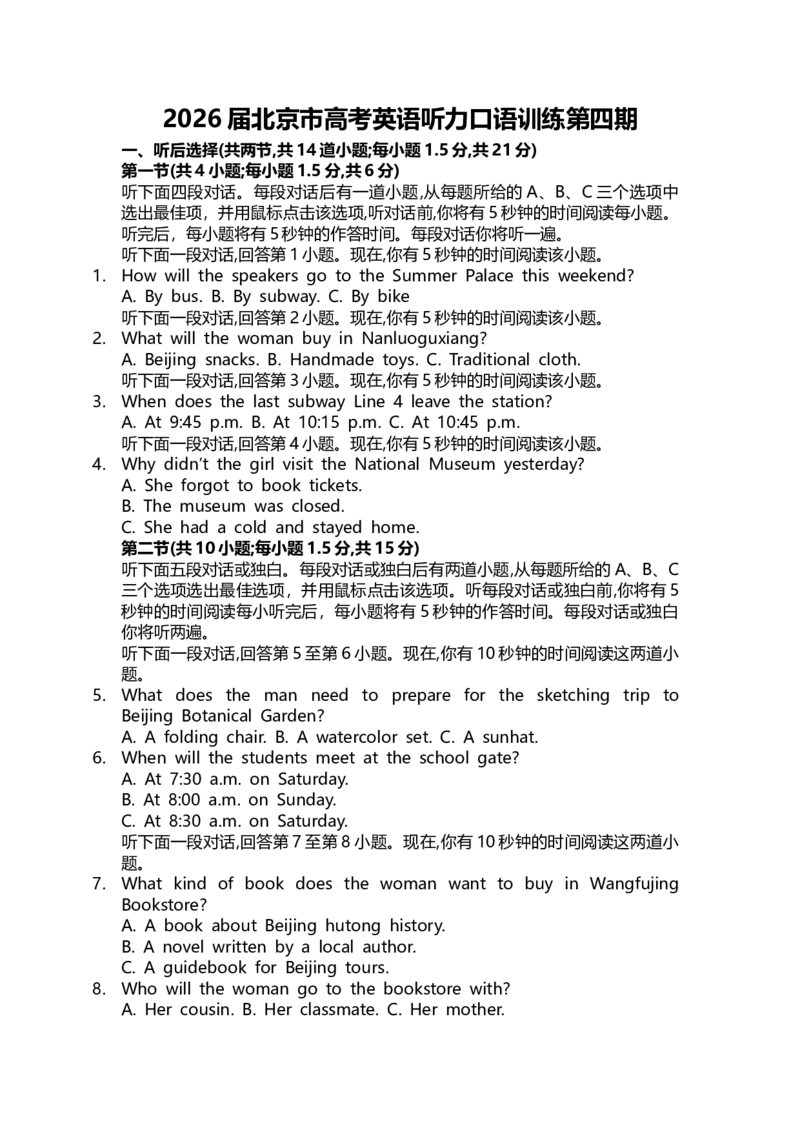
一、听后选择(共两节,共14 道小题;每小题1.5 分,共21 分)
第一节(共4 小题;每小题1.5 分,共6 分)
听下面四段对话。每段对话后有一道小题,从每题所给的A、B、C 三个选项中
选出最佳项,并用鼠标点击该选项,听对话前,你将有5 秒钟的时间阅读每小题。
听完后,每小题将有5 秒钟的作答时间。每段对话你将听一遍。
听下面一段对话,回答第1 小题。现在,你有5 秒钟的时间阅读该小题。
1.
How will the speakers go to the Summer Palace this weekend?
A. By bus. B. By subway. C. By bike
听下面一段对话,回答第2 小题。现在,你有5 秒钟的时间阅读该小题。
2.
What will the woman buy in Nanluoguxiang?
A. Beijing snacks. B. Handmade toys. C. Traditional cloth.
听下面一段对话,回答第3 小题。现在,你有5 秒钟的时间阅读该小题。
3.
When does the last subway Line 4 leave the station?
A. At 9:45 p.m. B. At 10:15 p.m. C. At 10:45 p.m.
听下面一段对话,回答第4 小题。现在,你有5 秒钟的时间阅读该小题。
4.
Why didn’t the girl visit the National Museum yesterday?
A. She forgot to book tickets.
B. The museum was closed.
C. She had a cold and stayed home.
第二节(共10 小题;每小题1.5 分,共15 分)
听下面五段对话或独白。每段对话或独白后有两道小题,从每题所给的A、B、C
三个选项选出最佳选项,并用鼠标点击该选项。听每段对话或独白前,你将有5
秒钟的时间阅读每小听完后,每小题将有5 秒钟的作答时间。每段对话或独白
你将听两遍。
听下面一段对话,回答第5 至第6 小题。现在,你有10 秒钟的时间阅读这两道小
题。
5.
What does the man need to prepare for the sketching trip to
Beijing Botanical Garden?
A. A folding chair. B. A watercolor set. C. A sunhat.
6.
When will the students meet at the school gate?
A. At 7:30 a.m. on Saturday.
B. At 8:00 a.m. on Sunday.
C. At 8:30 a.m. on Saturday.
听下面一段对话,回答第7 至第8 小题。现在,你有10 秒钟的时间阅读这两道小
题。
7.
What kind of book does the woman want to buy in Wangfujing
Bookstore?
A. A book about Beijing hutong history.
B. A novel written by a local author.
C. A guidebook for Beijing tours.
8.
Who will the woman go to the bookstore with?
A. Her cousin. B. Her classmate. C. Her mother.
听下面一段对话,回答第9 至第10 小题。现在,你有10 秒钟的时间阅读这两道小
题。
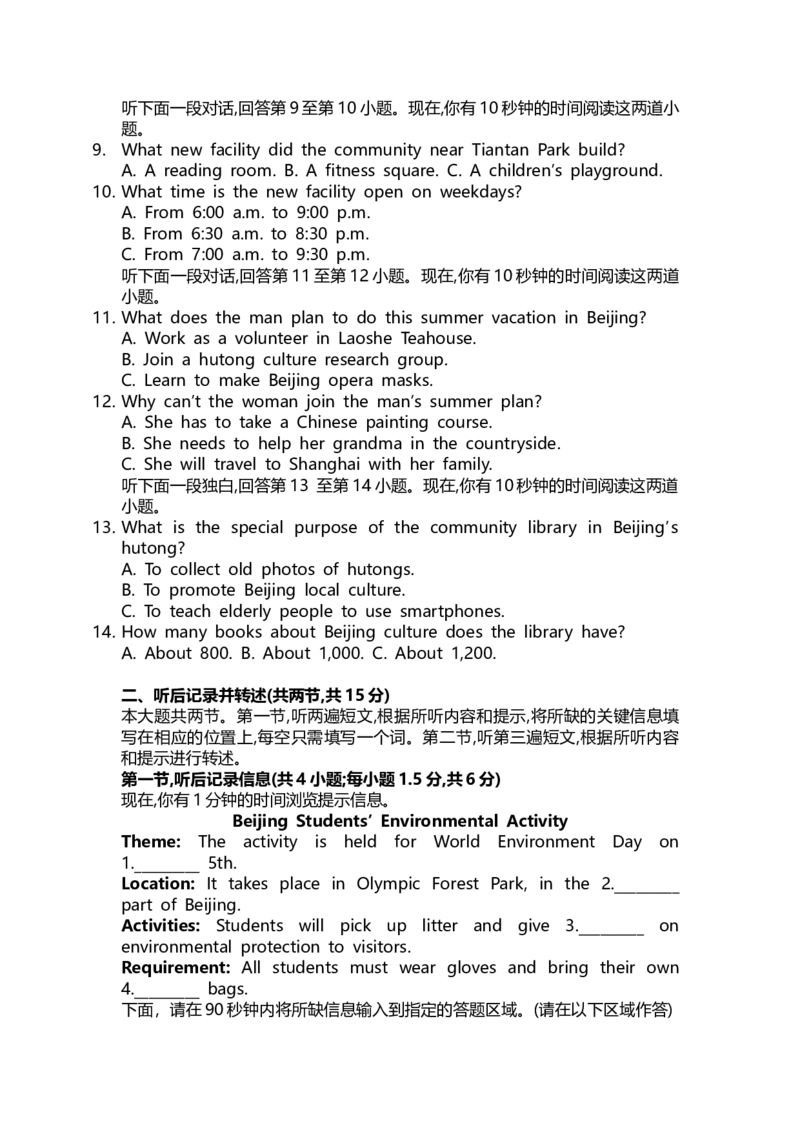
9.
What new facility did the community near Tiantan Park build?
A. A reading room. B. A fitness square. C. A children’s playground.
10. What time is the new facility open on weekdays?
A. From 6:00 a.m. to 9:00 p.m.
B. From 6:30 a.m. to 8:30 p.m.
C. From 7:00 a.m. to 9:30 p.m.
听下面一段对话,回答第11 至第12 小题。现在,你有10 秒钟的时间阅读这两道
小题。
11. What does the man plan to do this summer vacation in Beijing?
A. Work as a volunteer in Laoshe Teahouse.
B. Join a hutong culture research group.
C. Learn to make Beijing opera masks.
12. Why can’t the woman join the man’s summer plan?
A. She has to take a Chinese painting course.
B. She needs to help her grandma in the countryside.
C. She will travel to Shanghai with her family.
听下面一段独白,回答第13 至第14 小题。现在,你有10 秒钟的时间阅读这两道
小题。
13. What is the special purpose of the community library in Beijing’ s
hutong?
A. To collect old photos of hutongs.
B. To promote Beijing local culture.
C. To teach elderly people to use smartphones.
14. How many books about Beijing culture does the library have?
A. About 800. B. About 1,000. C. About 1,200.
二、听后记录并转述(共两节,共15 分)
本大题共两节。第一节,听两遍短文,根据所听内容和提示,将所缺的关键信息填
写在相应的位置上,每空只需填写一个词。第二节,听第三遍短文,根据所听内容
和提示进行转述。
第一节,听后记录信息(共4 小题;每小题1.5 分,共6 分)
现在,你有1 分钟的时间浏览提示信息。
Beijing Students’ Environmental Activity
Theme: The activity is held for World Environment Day on
1._________ 5th.
Location: It takes place in Olympic Forest Park, in the 2._________
part of Beijing.
Activities: Students will pick up litter and give 3._________ on
environmental protection to visitors.
Requirement: All students must wear gloves and bring their own
4._________ bags.
下面,请在90 秒钟内将所缺信息输入到指定的答题区域。(请在以下区域作答)
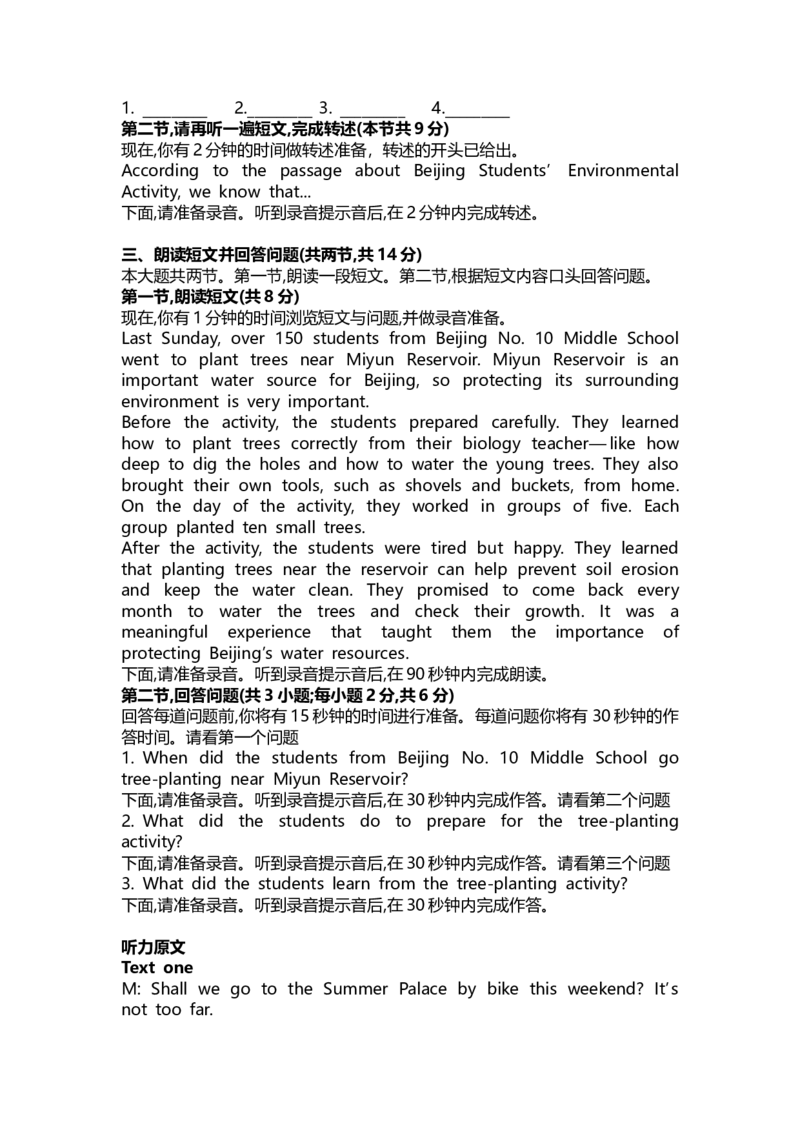
1. _________
2._________ 3. _________
4._________
第二节,请再听一遍短文,完成转述(本节共9 分)
现在,你有2 分钟的时间做转述准备,转述的开头已给出。
According to the passage about Beijing Students’ Environmental
Activity, we know that...
下面,请准备录音。听到录音提示音后,在2 分钟内完成转述。
三、朗读短文并回答问题(共两节,共14 分)
本大题共两节。第一节,朗读一段短文。第二节,根据短文内容口头回答问题。
第一节,朗读短文(共8 分)
现在,你有1 分钟的时间浏览短文与问题,并做录音准备。
Last Sunday, over 150 students from Beijing No. 10 Middle School
went to plant trees near Miyun Reservoir. Miyun Reservoir is an
important water source for Beijing, so protecting its surrounding
environment is very important.
Before the activity, the students prepared carefully. They learned
how to plant trees correctly from their biology teacher— like how
deep to dig the holes and how to water the young trees. They also
brought their own tools, such as shovels and buckets, from home.
On the day of the activity, they worked in groups of five. Each
group planted ten small trees.
After the activity, the students were tired but happy. They learned
that planting trees near the reservoir can help prevent soil erosion
and keep the water clean. They promised to come back every
month to water the trees and check their growth. It was a
meaningful
experience
that
taught
them
the
importance
of
protecting Beijing’s water resources.
下面,请准备录音。听到录音提示音后,在90 秒钟内完成朗读。
第二节,回答问题(共3 小题;每小题2 分,共6 分)
回答每道问题前,你将有15 秒钟的时间进行准备。每道问题你将有30 秒钟的作
答时间。请看第一个问题
1. When did the students from Beijing No. 10 Middle School go
tree-planting near Miyun Reservoir?
下面,请准备录音。听到录音提示音后,在30 秒钟内完成作答。请看第二个问题
2. What did the students do to prepare for the tree-planting
activity?
下面,请准备录音。听到录音提示音后,在30 秒钟内完成作答。请看第三个问题
3. What did the students learn from the tree-planting activity?
下面,请准备录音。听到录音提示音后,在30 秒钟内完成作答。
听力原文
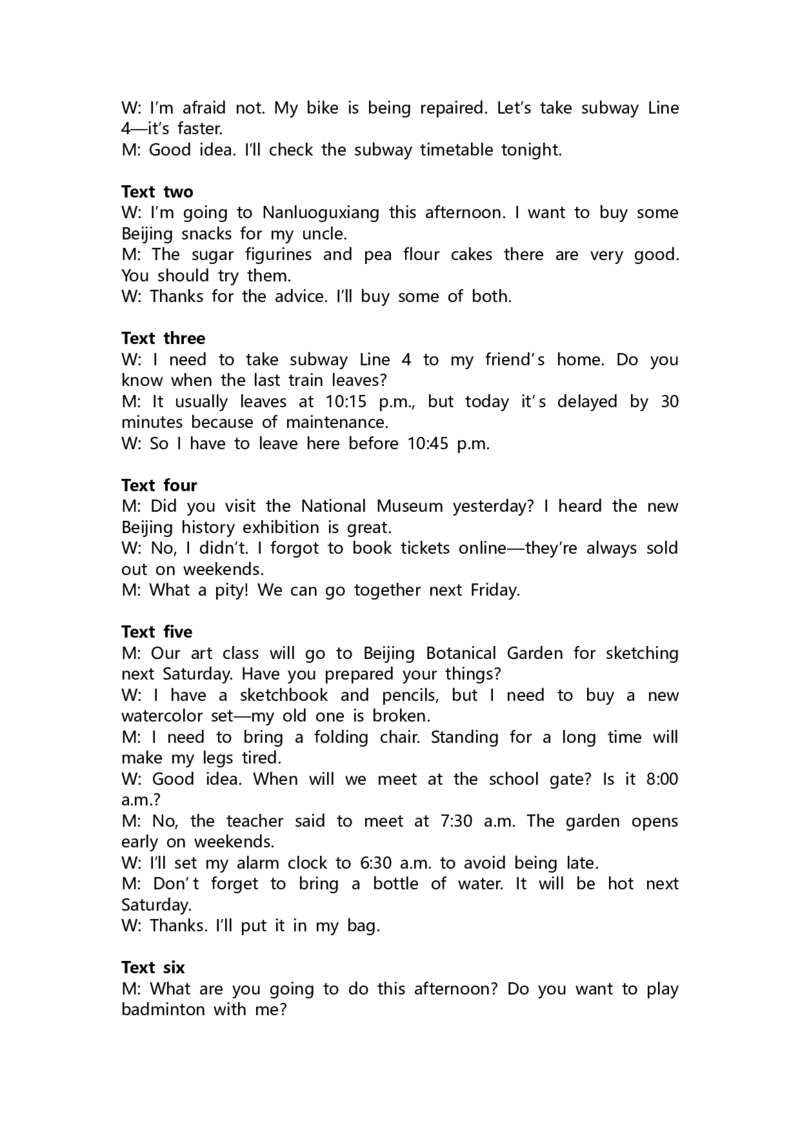
Text one
M: Shall we go to the Summer Palace by bike this weekend? It’s
not too far.
W: I’m afraid not. My bike is being repaired. Let’s take subway Line
4—it’s faster.
M: Good idea. I’ll check the subway timetable tonight.
Text two
W: I’m going to Nanluoguxiang this afternoon. I want to buy some
Beijing snacks for my uncle.
M: The sugar figurines and pea flour cakes there are very good.
You should try them.
W: Thanks for the advice. I’ll buy some of both.
Text three
W: I need to take subway Line 4 to my friend’ s home. Do you
know when the last train leaves?
M: It usually leaves at 10:15 p.m., but today it’ s delayed by 30
minutes because of maintenance.
W: So I have to leave here before 10:45 p.m.
Text four
M: Did you visit the National Museum yesterday? I heard the new
Beijing history exhibition is great.
W: No, I didn’t. I forgot to book tickets online—they’re always sold
out on weekends.
M: What a pity! We can go together next Friday.
Text five
M: Our art class will go to Beijing Botanical Garden for sketching
next Saturday. Have you prepared your things?
W: I have a sketchbook and pencils, but I need to buy a new
watercolor set—my old one is broken.
M: I need to bring a folding chair. Standing for a long time will
make my legs tired.
W: Good idea. When will we meet at the school gate? Is it 8:00
a.m.?
M: No, the teacher said to meet at 7:30 a.m. The garden opens
early on weekends.
W: I’ll set my alarm clock to 6:30 a.m. to avoid being late.
M: Don’ t forget to bring a bottle of water. It will be hot next
Saturday.
W: Thanks. I’ll put it in my bag.
Text six
M: What are you going to do this afternoon? Do you want to play
badminton with me?
W: Sorry, I can’t. I need to go to Wangfujing Bookstore to buy a
book about Beijing hutong history.
M: Oh, I’ve read that book. It has many old stories about hutongs
like Shichahai.
W: Really? That’s exactly what I want. My cousin will go with me—
she’s interested in hutongs too.
M: Can I ask you to buy a book for me? It’s a novel by a local
author.
W: Sure. What’s the name of the book? I’ll look for it.
M: It’s called Stories of Beijing Alleys. Thank you very much.
W: You’re welcome. I’ll call you when I get back.
Text seven
W: Did you see the new facility our community built near Tiantan
Park? It’s very popular.
M: You mean the fitness square? Yes, I went there yesterday. They
have new exercise machines.
W: Great! I want to go there to do morning exercises. What time is
it open on weekdays?
M: It opens from 6:30 a.m. to 8:30 p.m. On weekends, it’s open 30
minutes earlier.
W: Can children play there too? My little brother wants to join me.
M: Yes, there’s a small area for kids with slides and swings.
W: I’ll take my brother there tomorrow morning. Do you want to
come?
M: I’d love to, but I have to go to the market to buy vegetables.
Maybe next time.
Text eight
M: Summer vacation is coming. I plan to work as a volunteer in
Laoshe Teahouse. I can learn about Beijing culture.
W: That sounds interesting! I want to join you, but I can’t. My mom
has other plans for me.
M: Why? Do you have to take any courses?
W: Yes, she signed me up for a Chinese painting course. The
teacher is a famous local artist.
M: Chinese painting is also part of Beijing culture. That’s not a bad
plan.
W: I know, but I really want to work in the teahouse. Maybe I can
go there on weekends.
M: That’ s a good idea. The teahouse needs more volunteers on
weekends.
W: I’ll talk to my mom about it. If she agrees, I’ll let you know.
M: Perfect! We can work together and try the famous Beijing
snacks in the teahouse.
W: Yes! I’m looking forward to it.
Text nine
There is a small but special library in a hutong near Qianmen,
Beijing. Unlike other libraries, its main purpose is to promote Beijing
local culture. The library was opened three years ago by a group of
hutong lovers who wanted to keep the city’ s traditional culture
alive.
The library has about 5,000 books in total, and about 1,000 of
them are about Beijing culture—including books on hutong history,
Beijing opera, local food and folk stories. Every weekend, the library
holds activities like “ Hutong Story Sharing” and “ Beijing Opera
Introduction” for both children and adults.
Local residents often come to the library to read or join activities.
Many tourists also visit it to learn more about Beijing’ s hutong
culture. The library has become a popular place for people to
connect with the city’s traditional roots. It’s a great example of how
to protect and pass on local culture.
听后记录并转述
Every year, Beijing students hold an environmental activity to
celebrate World Environment Day, which is on June 5th. This year’s
activity will take place in Olympic Forest Park, a large park in the
northern part of Beijing. The park is a popular place for people to
run, walk and enjoy nature.
Over 200 students from different middle schools will take part in
the activity. They will do two main things: pick up litter in the park
and give talks on environmental protection to visitors. The talks will
teach people how to save water, reduce waste and protect plants
and animals.
All students must follow two requirements: wear gloves to keep
their hands clean and bring their own cloth bags to collect litter.
The activity will start at 9:00 a.m. and end at 12:00 p.m. It’s a good
way for students to learn about environmental protection and
contribute to their city.
听力答案与解析
一、听后选择
1. 答案:B
解析:男士提议骑自行车去颐和园,女士以自行车维修为由拒绝,提议 “take
subway Line 4”,男士同意,故答案为 B。A(公交)未提及,C(自行车)
是被否定的选项,排除。
2. 答案:A
解析:女士明确说 “want to buy some Beijing snacks for my uncle”,
男士还推荐了糖人、豌豆黄等北京小吃,故答案为 A。B(手工玩具)和 C
(传统布料)未提及,排除。
3. 答案:C
解析:男士说末班车通常 10:15 分发车,“ today it’s delayed by 30
minutes”,10:15 加 30 分钟为 10:45,故答案为 C。A(9:45)未提及,B
(10:15)是平时末班车时间,排除。
4. 答案:A
解析:女士解释未去国家博物馆的原因 “I forgot to book tickets online—
they’re always sold out on weekends”,即忘订票,故答案为 A。B(博
物馆闭馆)和 C(感冒在家)未提及,排除。
5. 答案:A
解析:男士说 “I need to bring a folding chair. Standing for a long
time will make my legs tired”,明确需要带折叠椅,故答案为 A。B(水
彩套装)是女士需要买的,C(遮阳帽)未提及,排除。
6. 答案:A
解析:男士纠正女士的 8 点集合时间,明确 “the teacher said to meet at
7:30 a.m. next Saturday”,故答案为 A。B(周日 8 点)和 C(周六
8:30)与原文不符,排除。
7. 答案:A
解析:女士说 “need to go to Wangfujing Bookstore to buy a book
about Beijing hutong history”,明确想买胡同历史书,故答案为 A。B(本
地作家小说)是男士托买的,C(北京旅游指南)未提及,排除。
8. 答案:A
解析:女士说 “ My cousin will go with me— she’ s interested in
hutongs too”,即和表妹一起去,故答案为 A。B(同学)和 C(妈妈)未提
及,排除。
9. 答案:B
解析:女士问新设施,男士回答 “You mean the fitness square? Yes, I
went there yesterday. They have new exercise machines”,明确是健身
广场,故答案为 B。A(阅览室)和 C(儿童游乐场)未提及,排除。
10. 答案:B
解析:男士说 “It opens from 6:30 a.m. to 8:30 p.m. on weekdays”,故
答案为 B。A(6 点 - 9 点)和 C(7 点 - 9:30)与原文不符,排除。
11. 答案:A
解析:男士说 “I plan to work as a volunteer in Laoshe Teahouse”,明
确暑假计划去老舍茶馆做志愿者,故答案为 A。B(胡同文化调研)和 C(学
做京剧脸谱)未提及,排除。
12. 答案:A
解析:女士说 “she signed me up for a Chinese painting course”,即
要上国画课,故答案为 A。B(去乡下帮奶奶)和 C(去上海旅行)未提及,
排除。
13. 答案:B
解析:短文开篇说 “ its main purpose is to promote Beijing local
culture”,明确胡同图书馆的特殊目的是推广北京本土文化,故答案为 B。A
(收集胡同老照片)和 C(教老人用手机)未提及,排除。
14. 答案:B
解析:短文明确表述 “about 1,000 of them are about Beijing culture”,
即约 1000 本北京文化相关书籍,故答案为 B。A(800 本)和 C(1200
本)与原文不符,排除。
二、听后记录并转述
1. 答案:June
解析:原文明确 “ World Environment Day, which is on June
5th”,“June”(六月)是世界环境日所在月份,单个单词符合要求。
2. 答案:northern
解析:原文提到 “Olympic Forest Park, a large park in the northern
part of Beijing”,“northern”(北部的)是公园所在方位,单个单词符合语境。
3. 答案:talks
解析:原文表述 “ give talks on environmental protection to
visitors”,“talks”(讲座 / 宣讲)是学生的活动内容,复数形式符合 “give
talks” 的固定搭配,单个单词正确。
4. 答案:cloth
解析:原文明确 “ bring their own cloth bags to collect
litter”,“cloth”(布制的)修饰 bags,指环保布袋,单个单词符合要求。
听后转述参考
According to the passage about Beijing Students’ Environmental
Activity, we know that Beijing students hold an environmental
activity every year for World Environment Day on June 5th. This
year’ s activity is in Olympic Forest Park in northern Beijing, with
over 200 middle school students joining. They will pick up litter and
give environmental protection talks to visitors. All students must
wear gloves and bring their own cloth bags. The activity runs from
9 a.m. to 12 p.m., helping students learn about environmental
protection and contribute to Beijing.
三、朗读短文并回答问题
1.
答案:They went tree-planting near Miyun Reservoir last Sunday.
解析:答案来源于短文第一段首句 “Last Sunday, over 150 students from
Beijing No. 10 Middle School went to plant trees near Miyun
Reservoir” 。原文直接给出时间 “ last Sunday” 和地点 “ near Miyun
Reservoir”,无需额外推测,只需准确整合信息,确保时间、主语、谓语搭配
完整。
2.
答案:They learned how to plant trees correctly from their biology
teacher and brought their own tools like shovels and buckets from
home.
解析:答案来源于短文第二段。原文详细描述准备工作:“learned how to
plant trees correctly from their biology teacher”(向生物老师学习正确
植树方法)和 “brought their own tools, such as shovels and buckets,
from home”(从家带铲子、水桶等工具)。需完整涵盖 “学习方法” 和 “准备
工具” 两个要点,用 “and” 连接使句子连贯,不遗漏关键细节。
3.
答案:They learned that planting trees near Miyun Reservoir can
prevent soil erosion and keep the water clean, and they also
realized the importance of protecting Beijing’s water resources.
解析:答案来源于短文第三段。原文提到 “learned that planting trees
near the reservoir can help prevent soil erosion and keep the water
clean”(了解到植树可防止水土流失、净化水质)和 “taught them the
importance of protecting Beijing’s water resources”(认识到保护北京水
资源的重要性)。需整合两个层面的 “所学内容”,既包括具体作用,也包括深
层意义,全面回答 “学到了什么” 的问题,符合原文表述逻辑。