专题18 湖北省高中名校联盟2 月第三次联合测评英语听力
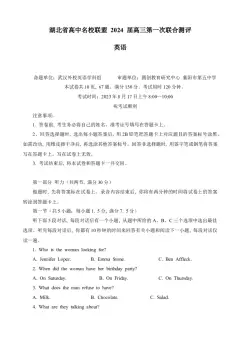
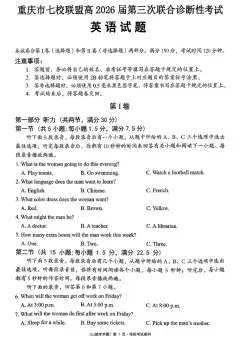
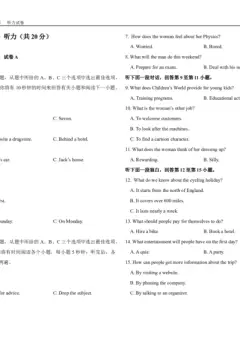
第一部分 听力(共两节,满分30 分)
第一节(共5 小题;每小题1.5 分,满分7.5 分)
听下面5 段对话。每段对话后有一个小题,从题中所给的A、B、C 三个选项中选出最佳选项。
听完每段对话后,你都有10 秒钟的时间来回答有关小题和阅读下一小题。每段对话仅读一遍。
1. What kind of sport does Mike like best?
A. Tennis.
B. Basketball.
C. Football.
2. What does the man think of the film?
A. Interesting.
B. Disappointing.
C. Moving.
3. When will Shirley and David meet?
A. At 6: 10.
B. At 5: 50.
C. At 7: 00.
4. What is the relationship between the man and Judy?
A. Teacher and student. B. Neighbors.
C. Father and daughter.
5. What are the speakers talking about?
A. Making a paper plane.
B. Flying a plane.
C. Buying a toy plane.
第二节(共15 小题;每小题1.5 分,满分22.5 分)
听下面5 段对话或独白。每段对话或独白后有几个小题,从题中所给的A、B、C 三个选项
中选出最佳选项,并标在试卷的相应位置。听每段对话或独白前,你将有时间阅读各个小题,
每小题5 秒钟;听完后,各小题将给出5 秒钟的作答时间。每段对话或独白读两遍。
听第6 段材料,回答第6、7 题。
6. When will Martin get married?
A. On Friday.
B. On Saturday.
C. On Sunday.
7. How are the speakers going to Sydney?
A. By train.
B. By car.
C. By air.
听第7 段材料,回答第8、9 题。
8. Why does Julia do research on music?
A. To study its change.
B. To understand its influence.
C. To show its importance.
9. How will Mr. Morant help with the report?
A. By collecting more data.
B. By checking it.
C. By answering questions.
听第8 段材料,回答第10 至13 题。
10. What is the challenge for Jim?
A. Activity organization.
B. Task design.
C. Classroom management.
11. Who inspire(s) Jim in his career choice?
A. His parents.
B. His English teacher. C. His university classmates.
12. What does Lucy ask about at last?
A. Public opinions.
B. Jim's plans.
C. Teacher's honor.
13. What is the show mainly about?
A. Jim's university major.
B. Jim's working experience.
C. Jim's present job.
听第9 段材料,回答第14 至16 题。
14. What does Eric do every day?
A. Clean the gym.
B. Travel around.
C. Take proper exercise.
15. What is Linda probably?
A. A student.
B.A guide.
C. A trainer.
16. Which month is it when they are talking?
A. September.
B. August.
C. October.
听第10 段材料,回答第17 至20 题。
17. How much should the speaker have paid for the dinner?
A.200 yuan.
B. 190 yuan.
C. 180 yuan.
18. Why did the waiter run a block?
A. To return the change.
B. To thank the speaker.
C. To ask for a favor.
19. What problem did the speaker and her friends meet?
A. They lost their money.
B. They couldn't find their way.
C. They failed to catch the subway.
20. What is the speaker motivated to do?
A. Learn about culture shock.
B. Stay in China longer.
C. Show kindness to others.
答案及听力原文
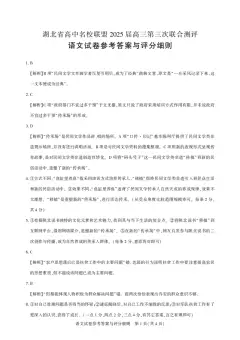
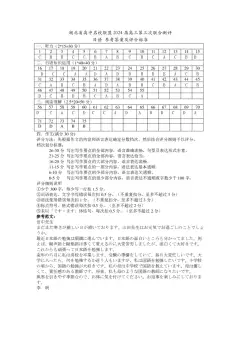
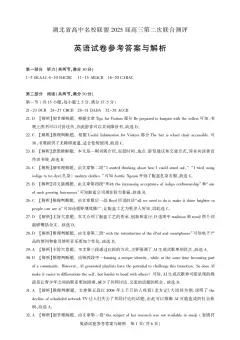
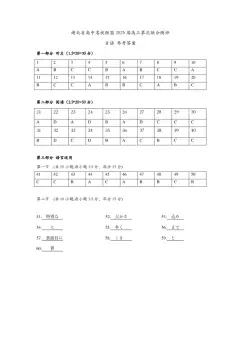
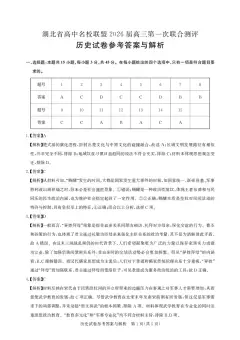
【答案】
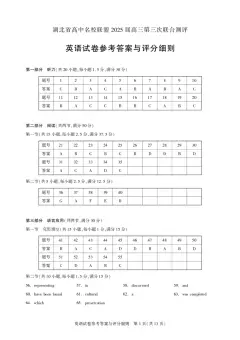
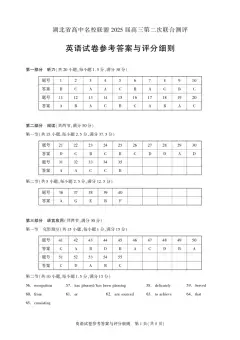
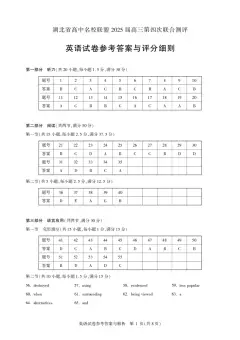
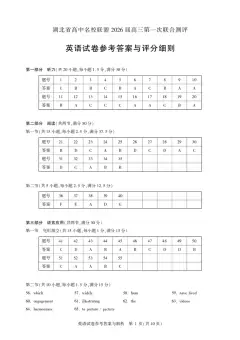
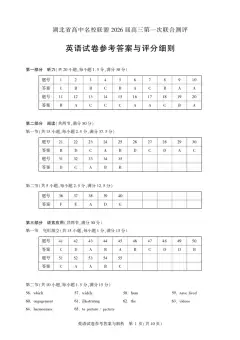
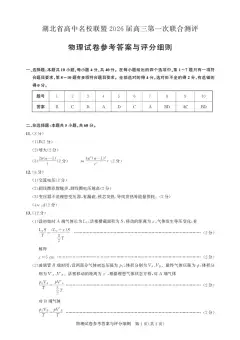
1-5 CBACA
6-10 BABAC
11-15BACCB
16-20BCABC
【听力原文】
(Text 1)
W: What kind of sport do you like, Mike?
M: I once learned tennis, but I was not good at it. Then I preferred basketball, but now I think
nothing can compare with football and it is my favourite now.
(Text 2)
W: How did you like the film No Country for Old Men last night?
M: It’s far from interesting. I’d rather I had stayed at home and had a good sleep.
(Text 3)
M: Shirley, the concert will begin at seven tonight. Shall we meet at ten to six and head for the
stadium together?
W: Well, David, I might be babysitting my brother then. Could we make it twenty minutes later
than that?
M: No problem.
(Text 4)
M: Well, put yourself in my shoes, what would you do then?
W: If Judy were my daughter, I would not worry about her. Her math teacher has already given
her special help after school. She is less likely to fail the course.
(Text 5)
M: What are you doing, Sara?
W: My younger brother Simon likes planes, so I want to make a paper one as his toy. I’ve tried
three times, but none of those planes flew well!
M: You need to fold the wings in half.
W: OK, I’ll try.
(Text 6)
W: Honey, how are we going to Sydney for Martin’s wedding? Today is Wednesday. There are
only three days to go.
M: Should we fly? It can save us a great deal of time. We need to arrive one day earlier, on
Friday.
W: But it’s too costly. What about renting a car?
M: You are not skilled in driving. I’ll get too tired if I drive all the time. Let’s take the train.
We could set off early.
W: OK. Then we won’t miss the beautiful scenery on the way.
M: And we can also rest well.
(Text 7)
W: Mr. Morant, we’re considering writing a report. Could you help us with it?
M: What is it about, Julia?
W: It’s about young people’s music preference. Music is important and it may change us
gradually. We want to know how music affects us.
M: Sounds interesting. What can I do for you? Do you need me to check your report?
W: Actually I wonder if you could help us with these surveys. We did some research in several
middle schools among students between the ages of 13 and 15. And we need to know more
about other age groups. M: You mean I help you hand out these surveys and then take them
back? That’s easy. When do I need to give them back to you? W: By next Sunday.
M: Sure, no problem.
(Text 8)
W: Welcome to our show, Jim. Today our topic is “career”. What is your ideal job?
M: Thank you, Lucy. Well, I have always dreamed of being a great English teacher. And
luckily, that’s my current job.
W: Is that a demanding job?
M: Yes, I think so, although people suppose that being a teacher is easy and boring.
W: What problem do you think you have when doing that job?
M: I have some problems keeping my students organized orderly and focused on tasks. Now
I’m trying my best to improve that skill.
W: Is it hard to make your dream come true?
M: Every job needs time and effort, and a teacher does as well. Apart from the academic
knowledge I was taught at university, I had to learn many other soft skills.
W: Why do you choose that job?
M: I really admire my high school English teacher, and I want to be like him - patient,
thoughtful and sympathetic. My parents both approve of my decision.
W: Does the job have anything to do with your major at university?
M: Sure. I studied English Language and Literature, which does support me a lot in my career
path.
W: What does the society think about your job?
M: I’m not quite sure, but I’m proud to be a teacher, an honorable job and I also believe in
what I’m doing right now.
(Text 9)
W: Hey, Eric. You look so great!
M: Hey, Linda. I go to the gym every day. The proper training really pays off. Now I’m in
good shape and I know more about how to keep fit.
W: I haven’t worked out too long. I’m too busy with my work. I led travelers to Liverpool,
London and Manchester last week and I only spent one night at home.
M: I saw from the news that almost all places of interest were crowded. Many students with
their parents go traveling in July and August. You can get much exercise when you work.
W: That’s true. Tell me more about how you keep fit.
M: Besides sports activities, I also have a healthy and balanced diet. I can share the recipe with
you.
W: It’s so kind of you. I will try that next month, for in September I’ll have time to stay at
home.
M: We can exercise together then. And getting enough sleep is important for good health. I’m
also advised to stay in a good mood. That helps me to improve my physical health.
(Text 10)
About 10 years ago, some friends and I went to a small restaurant for dinner in China. We
finished the delicious food, asked for the check and left some money on the table. It came to
180 yuan. We left two 100- yuan notes, thanked the waiter and left. As we were an entire block
away, we heard someone shouting behind us, waving a piece of paper. We quickly realized it
was the waiter from the restaurant. He didn’t speak English; we didn’t speak Chinese. But he
ran an entire block just to give us the 20 yuan, which was really surprising but moving. Since
we were struggling to find the entrance to the subway then, we decided to turn to him for help.
He nodded and indicated we could follow him. We walked about 3 blocks. Then he pointed to
the entrance, and walked away. I couldn’t believe that he should take so much trouble to help
some strangers. Similar experiences repeated themselves across China. The friendliness of the
people, and their eagerness to help are wonderful. I don’t know if that is classified as “culture
shock” but it has made me think about my own country where I rarely see such kind actions. It
also inspires me to act that way no matter where I am.