ARTICLE · 1129178
3267.72、2014英语一整套试卷:英国新野兽派、美国律师、年轻人的诺贝尔、非人文素质教育


诱人的tempting、
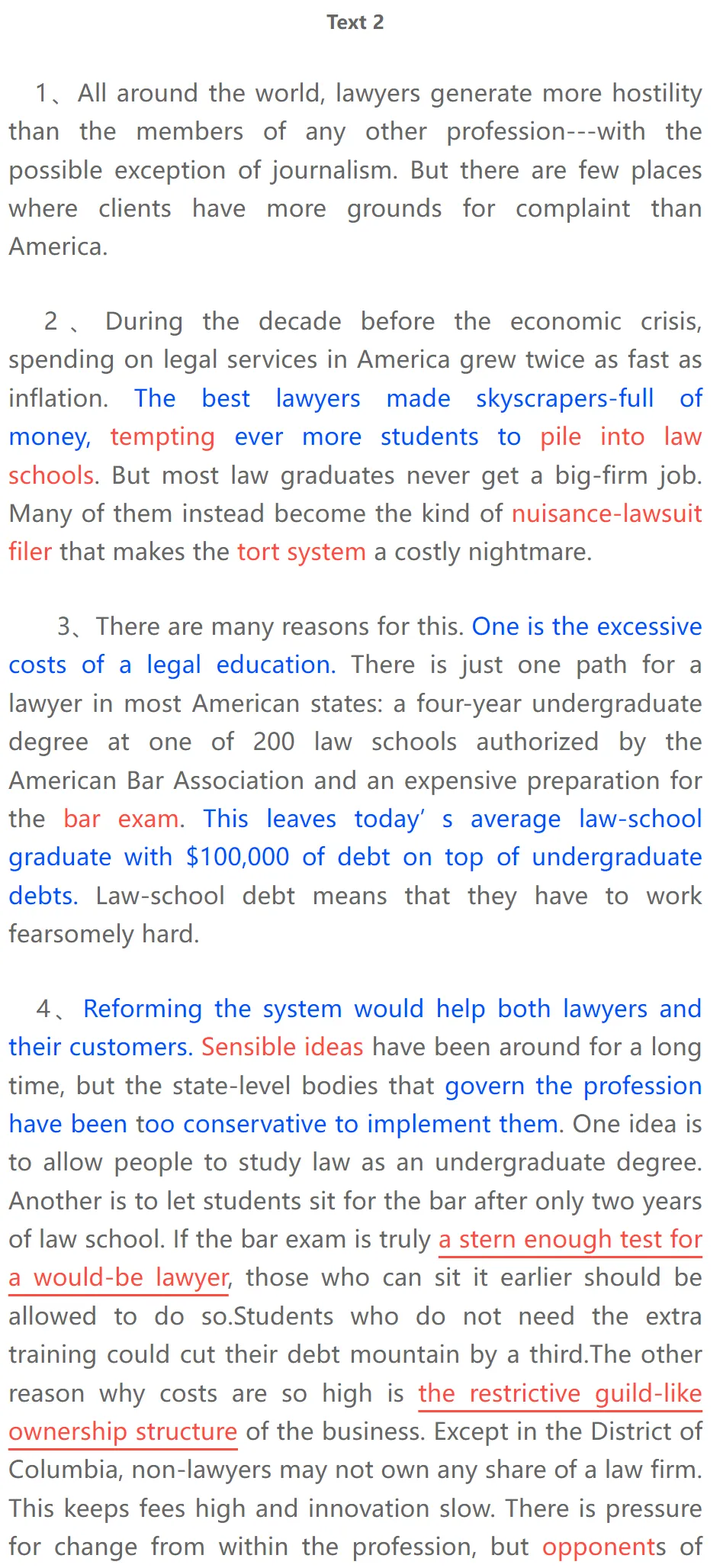
蜂拥进入法学院pile into law schools、
滥诉者nuisance-lawsuit filer、
侵权制度tort system、
律师资格考试bar exam、
合理的理念Sensible ideas、
对准律师而言足够严格的考验a stern enough test for a would-be lawyer、
具有排他性的行会式所有权结构the restrictive guild-like ownership structure、
反对者opponent、
放宽其法律职业限制liberalizing their legal professions、
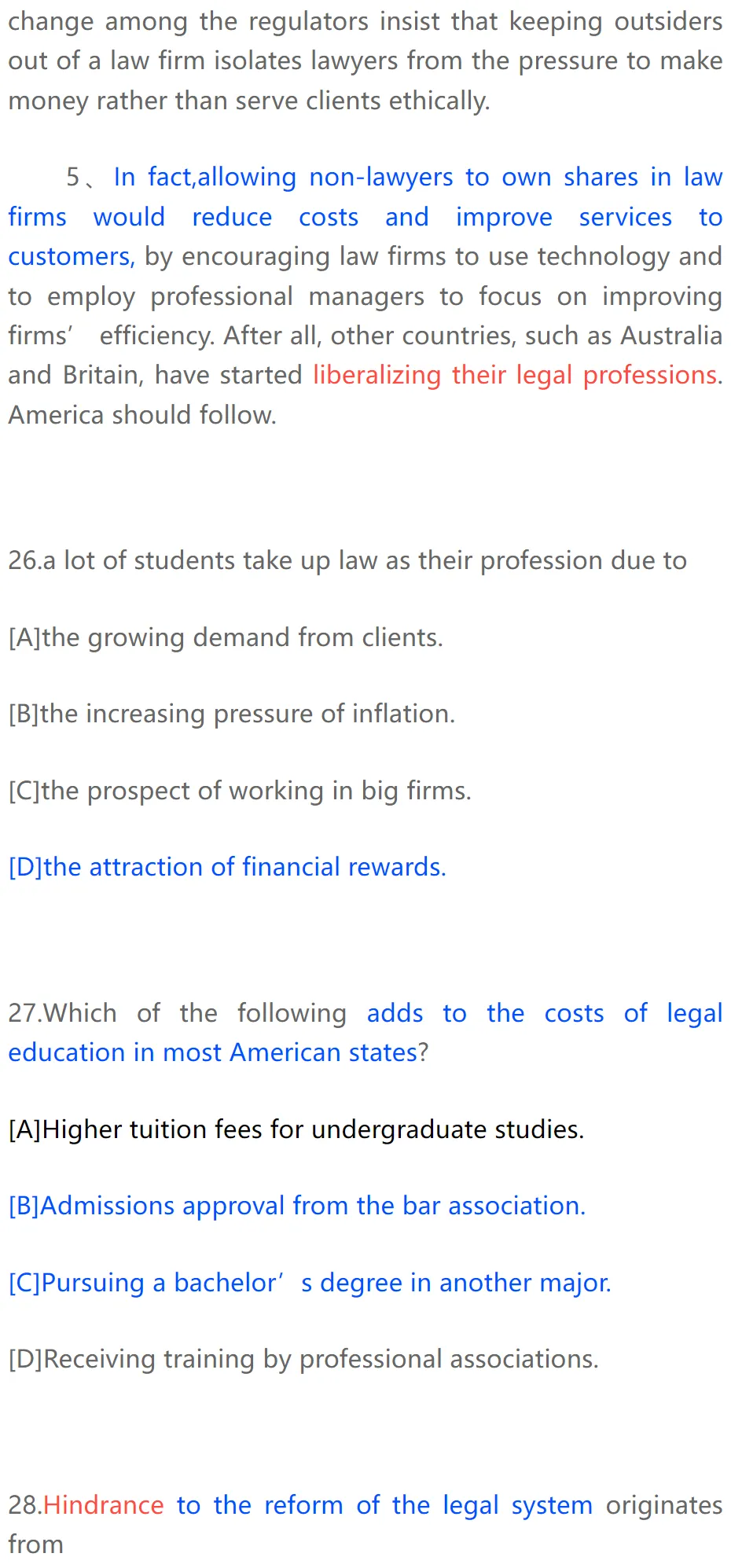
阻碍Hindrance、
司法考试the stem exam、
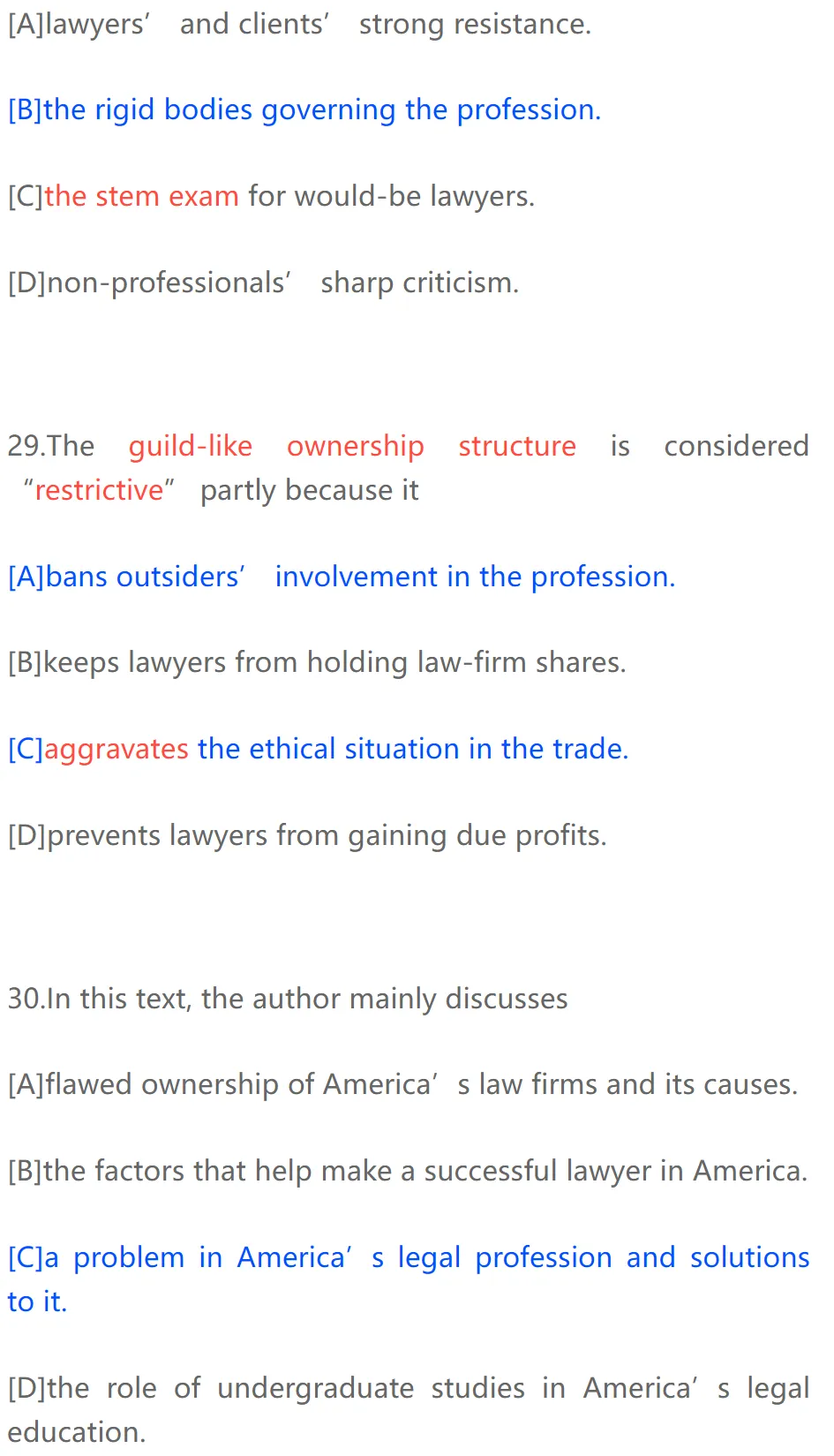
行会式所有权结构guild-like ownership structure、
限制性restrictive、
加剧aggravates
s
基础物理学奖Fundamental physics prize、
一系列丰厚的奖励a string of lucrative、
在新闻特写中被引用quoted in the News Feature、
巩固cement、
延续这一神话perpetuate the myth、
分散scattered、
分配distributed、
今年推出launched this year、
不可避免的争议inevitable row、
希格斯玻色子the Higgs boson、
感激与优雅gratitude and grace、
合理的担忧legitimate concerns

问题的核心The Heart of the Matter、
繁荣与安全prosperity and security、
遗憾的是Regrettably、
顶尖大学校长们top-tier-university presidents、
通常对待routinely treat、
对历史的渐进式解读progressive interpretation of history、
自力更生self-reliance、
常规的界限boundaries of routine、
学术探究intellectual investigation、
非自由主义教育Illiberal Education
Part B
Directions:
The following paragraphs are given in a wrong order. For Questions 41-45, you are required to reorganize into a coherent text by choosing from the list A-G and filling them into the numbered boxes .Paragraphs A and E have been correctly placed. Mark your answers on the ANSWER SHEET.(10 points)
2、[A]Some archaeological sites have always been easily observable—for example, the Parthenon in Athens, Greece; the pyramids of Giza in Egypt; and the megaliths of Stonehenge in southern England. But these sites are exceptions to the norm .Most archaeological sites have been located by means of careful searching, while many others have been discovered by accident. Olduvai Gorge, fell into its deep valley in 1911.Thousands of Aztec artifacts came to light during the digging of the Mexico City subway in the 1970s.
6、[B]In another case, American archaeologists Rene million and George Cowgill spent years systematically mapping the entire city of Teotihuacan in the valley of Mexico near what is now Mexico City .at its peak around AD 600, this city was one of the largest human settlements in the word. The researchers mapped not only the city’s vast and ornate ceremonial areas, but also hundreds of simpler apartment complexes where common people lived.
1、[C]How do archaeologists know where to find what they are looking for when there is nothing visible on the surface of the ground? Typically, they survey and sample (make test excavations on) large areas of terrain to determine where excavation will yield useful information. Surveys and test samples have also become important for understanding the larger landscapes that contain archaeological sites.
5[D] Surveys can cover a single large settlement or entire landscapes.in one case, many researchers working around the ancient Maya city of Copán, Honduras, have located hundreds of small rural village and individual dwellings by using aerial photographs and by making surveys on foot. The resulting settlement maps show how the distribution and density of the rural population around the city changed dramatically between AD500 and 850, when Copán collapsed.
4、[E]To find their sites, archaeologists today rely heavily on systematic survey methods and a variety of high-technology tools and techniques. Airbone technologies, such as different types of radar and photographic equipment carried by airplanes or spacecraft, allow archaeologists to learn about what lies beneath the ground without digging. Aerial surveys locate general areas of interest or larger buried features, such as ancient buildings or fields.
、[F] Most archaeological sites, however, are discovered by archaeologists who have set out to look for them. Such searches can take years. British archaeologist Howard Carter knew that the tomb of the Egyptian pharaoh Tutankhamum existed from information found in other sites. Carter sifted through rubble in the Valley of the King for seven years before he located the tomb in 1922. In the late 1800s British archaeologist Sir Arthur Eyan combed antique dealers’ stores in Athens, Greece. He was searching for thing engraved seals attributed to the ancient Mycenaean culture that dominated Greece from the 1400s to 1200s BC. Evas’s interpretations of those engravings eventually led them to find the Minoan palace at Knossos on the island of Crete, in 1900.
3、[G] Ground surveys allow archaeologists to pinpoint the places where digs will be successful. Most ground surveys involve a lot of walking, looking for surface clues such as small fragments of pottery. They often include a certain amounts of digging to test for buried materials at selected points across a landscape. Archaeologists also may locate buried remains by using such technologies as ground radar, magnetic-field recording, and metal detector. Archaeologists commonly use computers to map sites and the landscapes around sites. Two and three-dimensional maps are helpful tools in planning excavations, illustrating how sites look, and presenting the results of archaeological research.
1、[C]41 ---2、[A] A ---3、[G]42. --- 4、[E]E ---5[D] 43 --- 6、[B]44 --- 45
需要再复习一遍。
Part C
Directions:
Read the following text carefully and then translate the underlined segments into Chinese. Your translation should be written on the ANSWER SHEET(10 points)
Music means different things to different people and sometimes even different things to the same person at different moments of his life. It might be poetic, philosophical, sensual, or mathematical, but in any case it must, in my view, have something to do with the soul of the human being. Hence it is metaphysical; but the means of expression is purely and exclusively physical: sound. I believe it is precisely this permanent coexistence of metaphysical message through physical means that is the strength of music.46) It is also the reason why when we try to describe music with words, all we can do is articulate our reactions to it, and not grasp music itself.
Beethoven’s importance in music has been principally defined by the revolutionary nature of his compositions. He freed music from hitherto prevailing conventions of harmony and structure. Sometimes I feel in his late works a will to break all signs of continuity. The music is abrupt and seemingly disconnected, as in the last piano sonata. In musical expression, he did not feel restrained by the weight of convention. 47) By all accounts he was a freethinking person, and a courageous one, and I find courage an essential quality for the understanding, let alone the performance, of his works.
This courageous attitude in fact becomes a requirement for the performers of Beethoven’s music. His compositions demand the performer to show courage, for example in the use of dynamics. 48) Beethoven’s habit of increasing the volume with an extreme intensity and then abruptly following it with a sudden soft passage was only rarely used by composers before him.
Beethoven was a deeply political man in the broadest sense of the word. He was not interested in daily politics, but concerned with questions of moral behavior and the larger questions of right and wrong affecting the entire society.49) Especially significant was his view of freedom, which, for him, was associated with the rights and responsibilities of the individual: he advocated freedom of thought and of personal expression.
Beethoven’s music tends to move from chaos to order as if order were an imperative of human existence. For him, order does not result from forgetting or ignoring the disorders that plague our existence; order is a necessary development, an improvement that may lead to the Greek ideal of spiritual elevation. It is not by chance that the Funeral March is not the last movement of the Eroica Symphony, but the second, so that suffering does not have the last word. 50) One could interpret much of the work of Beethoven by saying that suffering is inevitable, but the courage to fight it renders life worth living.
感官的sensual、
形而上的metaphysical、
永恒共存的形而上permanent coexistence of metaphysical、
迄今为止占主导地位的传统hitherto prevailing conventions、
和谐与结构harmony and structure、
突然且看似断裂abrupt and seemingly disconnected、
钢琴奏鸣曲piano sonata、
骤然地abruptly、
最广义上的词broadest sense of the word、
人类存在的必然性imperative of human existence、
瘟疫plague、
精神升华spiritual elevation、
英雄交响曲Eroica Symphony、
痛苦是不可避免的suffering is inevitable
Section III Writing
Part A
51. Directions:
Write a letter of about 100 words to the president of your university, suggesting how to improve students’ physical condition.
You should include the details you think necessary.
You should write neatly on the ANSWER SHEET.
Do not sign your own name at the end of the letter. Use “Li Ming” instead.
Do not write the address.(10 points)
Dear Mr. President,
It is my great honor to write to you. As far as I am concerned, we have enough extraordinary lectures and what we need now is physical exercise.
Since most of the time is spent in watching TV and playing computer games, our physical conditions are not good enough. I still have some suggestions for you. To begin with, our university should arrange more PE classes. To continue, we should have a fixed schedule for a certain time of outdoor activity. What is more, teaching faculty should be involved in the same kind of physical exercise.
I hope that our university could take the responsibility for our students’ physical health. I will be highly grateful if you could take my suggestions into account.
Yours sincerely,
Li Ming
就我而言As far as I am concerned、
固定的时间表ixed schedule
Part B
52.Directions:
Write an essay of 160-200 words based on the following drawing. In your essay, you should
1) describe the drawing briefly,
2) interpret its intended meaning, and
3) give your comments.
You should write neatly on the ANSWER SHEET.(20 points)
As is vividly described in the left part of the drawing, thirty years ago, there stood a delicate mother, holding the tiny hand of a lovely girl, who wore a red scarf. On the contrary, the right part of the picture illustrates that with time flying quickly, the little girl, who has already grown up as a gorgeous lady, is supporting her old mother. We are informed: accompanying.
It is without saying that the old and the young are two indispensable parts in society. On the one hand, what we have and enjoy now was created by our parents in the early days, as the old Chinese saying goes, "One generation plants tress under whose shade another generation rests". On the other hand, all of us are supposed to take good care of the youngsters, too. It is children who make us see the future of our state, for they are the future builders of our country.
The young should consider it a moral obligation respecting and taking care of old parents. Meanwhile, it is also the duty of the parents to protect, educate and look after the youths. Let's bear this in mind and cultivate that virtue together, because only by doing so, can we feel as if we were living in a happy and harmonious family.
红领巾red scarf、
一代人种树、另一代人在树荫下安息(前人种树后人乘凉)One generation plants tress under whose shade another generation rests、
道德责任a moral obligation、
和睦家庭harmonious family
学海无涯苦作舟。