ARTICLE · 1147581
AI开发之基础快速入门主流深度学习框架介绍TensorFlow
AI开发之基础快速入门主流深度学习框架介绍TensorFlow
1)tensorFlow框架介绍
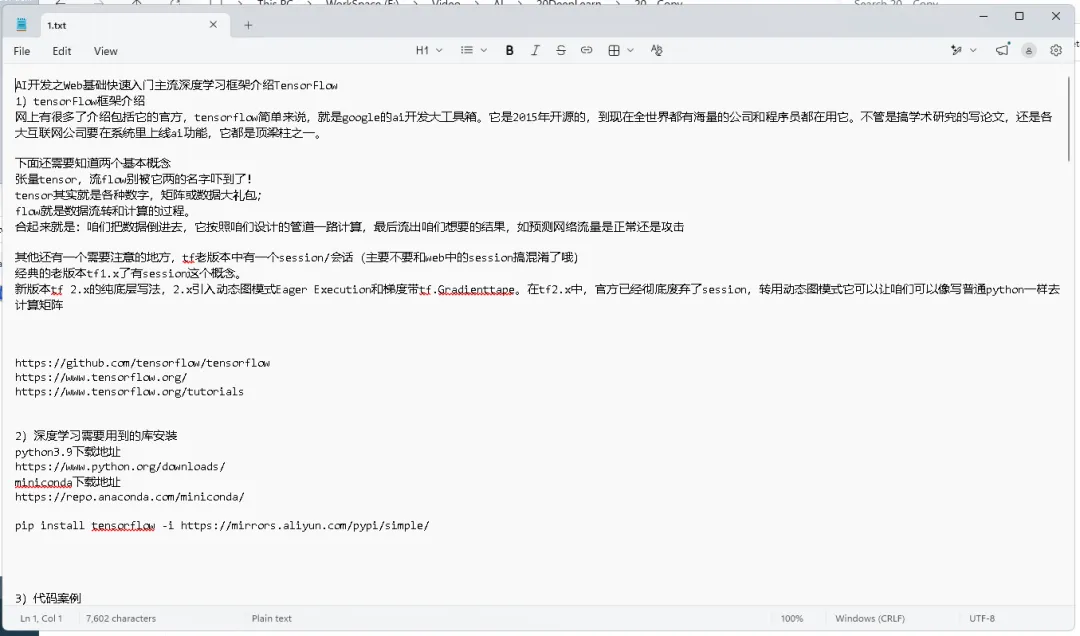
网上有很多了介绍包括它的官方,tensorflow简单来说,就是google的ai开发大工具箱。它是2015年开源的,到现在全世界都有海量的公司和程序员都在用它。不管是搞学术研究的写论文,还是各大互联网公司要在系统里上线ai功能,它都是顶梁柱之一。
下面还需要知道两个基本概念
张量tensor,流flow别被它两的名字吓到了!
tensor其实就是各种数字,矩阵或数据大礼包;
flow就是数据流转和计算的过程。
合起来就是:咱们把数据倒进去,它按照咱们设计的管道一路计算,最后流出咱们想要的结果,如预测网络流量是正常还是攻击
其他还有一个需要注意的地方,tf老版本中有一个session/会话(主要不要和web中的session搞混淆了哦)
经典的老版本tf1.x了有session这个概念。
新版本tf 2.x的纯底层写法,2.x引入动态图模式Eager Execution和梯度带tf.Gradienttape。在tf2.x中,官方已经彻底废弃了session,转用动态图模式它可以让咱们可以像写普通python一样去计算矩阵
https://github.com/tensorflow/tensorflow
https://www.tensorflow.org/
https://www.tensorflow.org/tutorials
2)深度学习需要用到的库安装
python3.9下载地址
https://www.python.org/downloads/
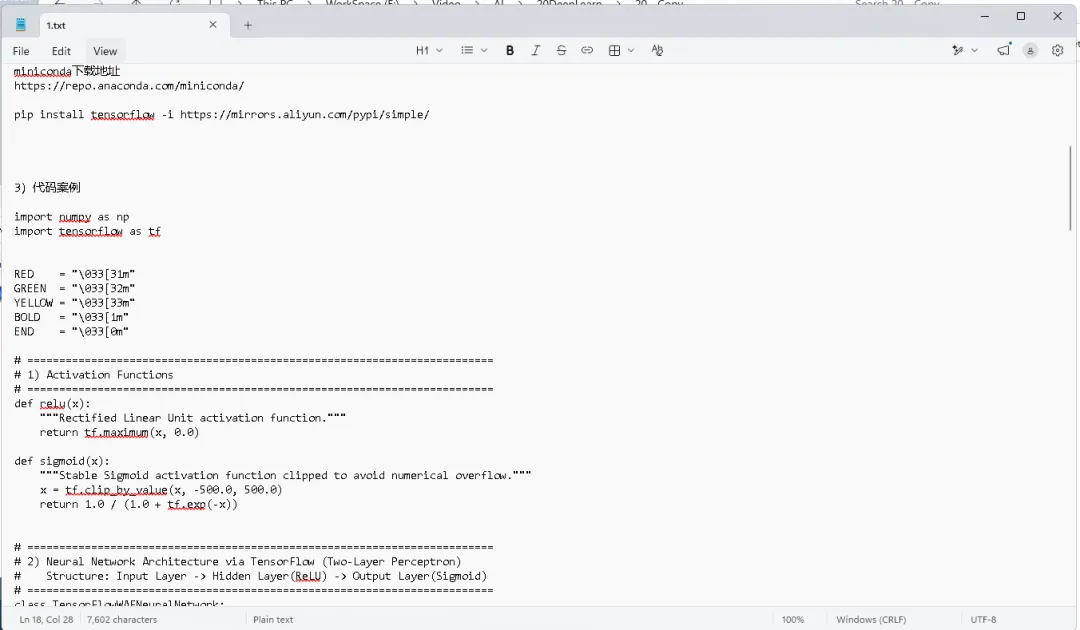
miniconda下载地址
https://repo.anaconda.com/miniconda/
pip install tensorflow -i https://mirrors.aliyun.com/pypi/simple/
3)代码案例
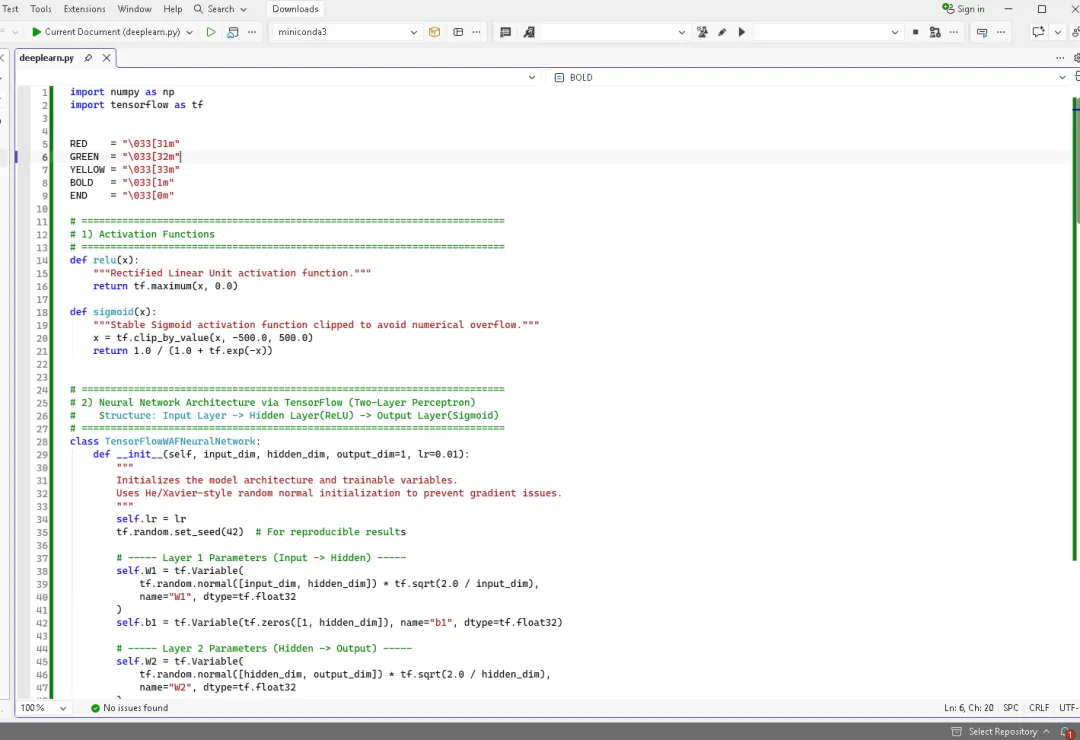
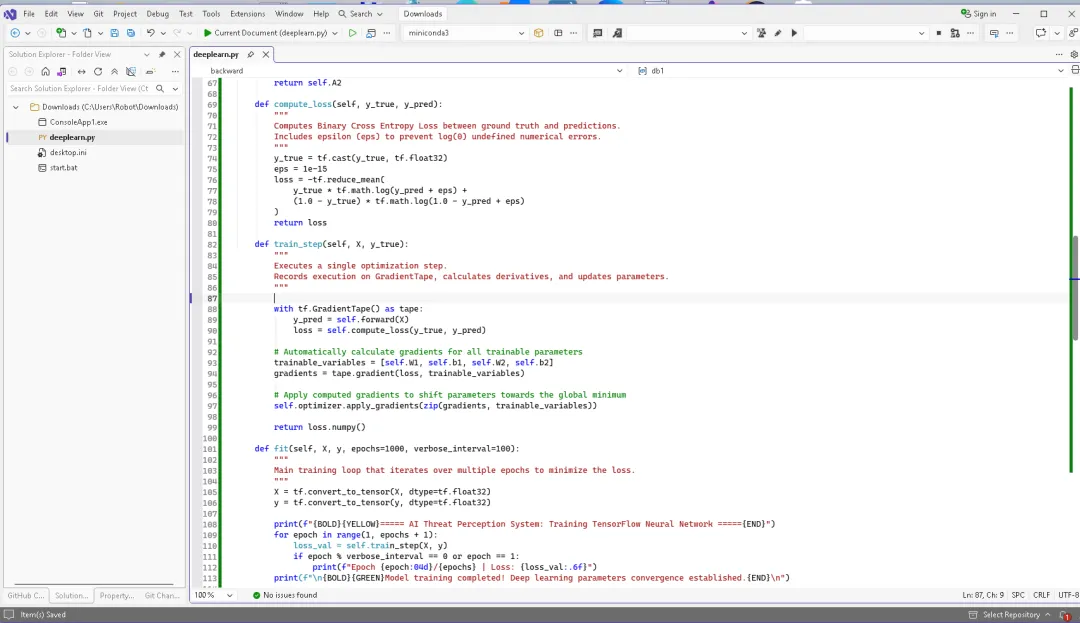
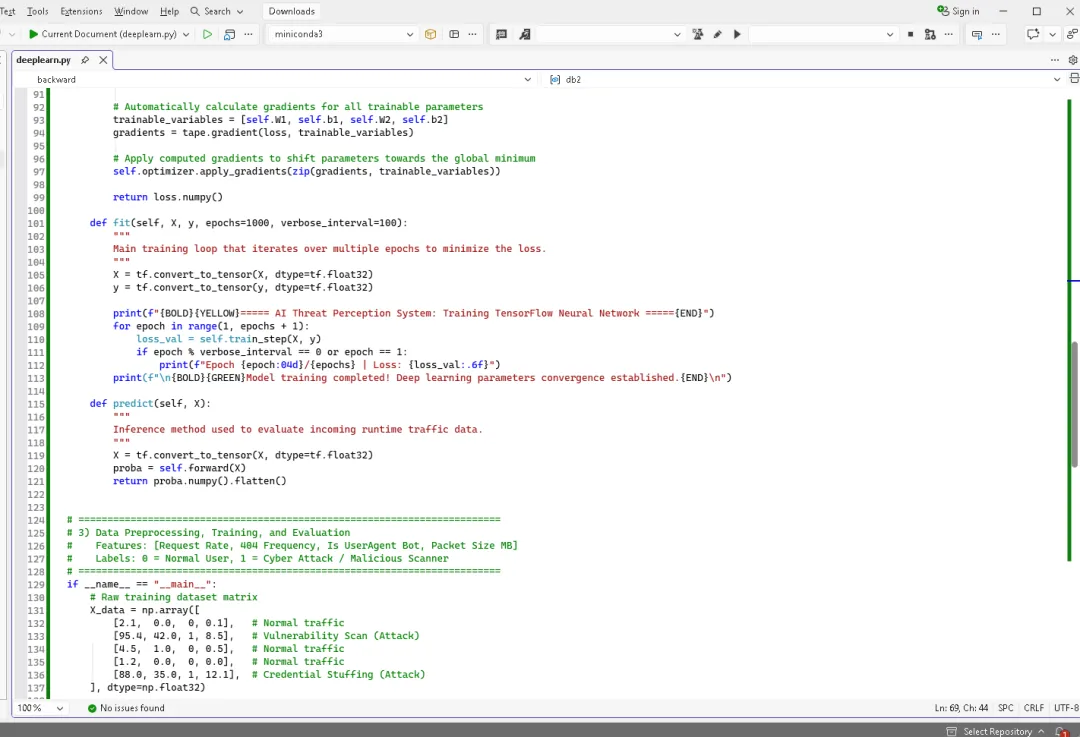
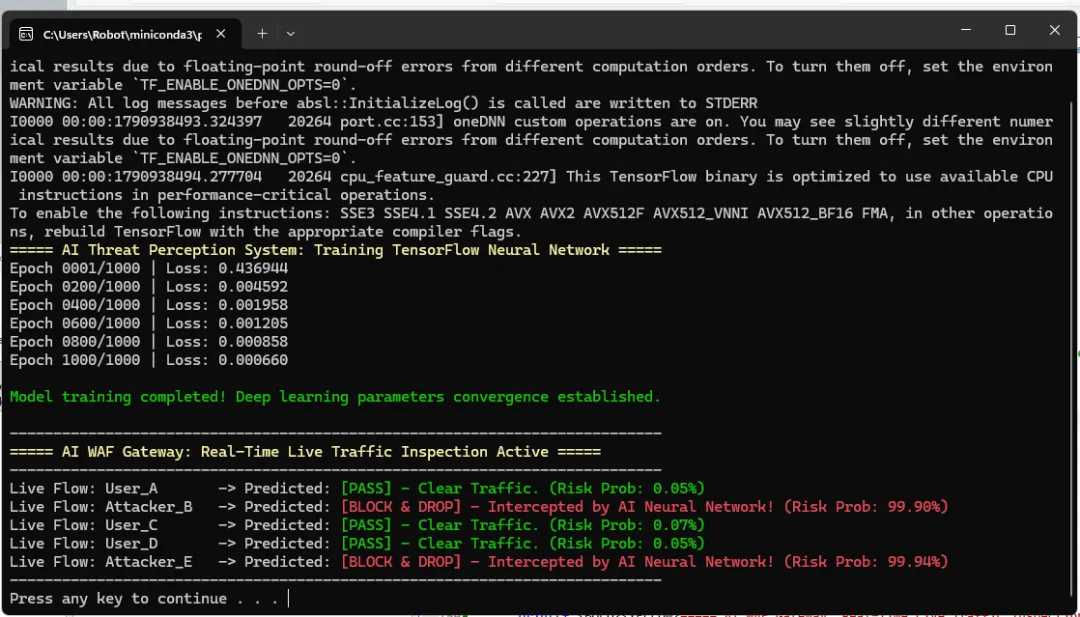
import numpy as npimport tensorflow as tfRED = "\033[31m"GREEN = "\033[32m"YELLOW = "\033[33m"BOLD = "\033[1m"END = "\033[0m"# =========================================================================# 1) Activation Functions# =========================================================================def relu(x):"""Rectified Linear Unit activation function."""return tf.maximum(x, 0.0)def sigmoid(x):"""Stable Sigmoid activation function clipped to avoid numerical overflow."""x = tf.clip_by_value(x, -500.0, 500.0)return 1.0 / (1.0 + tf.exp(-x))# =========================================================================# 2) Neural Network Architecture via TensorFlow (Two-Layer Perceptron)# Structure: Input Layer -> Hidden Layer(ReLU) -> Output Layer(Sigmoid)# =========================================================================class TensorFlowWAFNeuralNetwork:def __init__(self, input_dim, hidden_dim, output_dim=1, lr=0.01):"""Initializes the model architecture and trainable variables.Uses He/Xavier-style random normal initialization to prevent gradient issues."""self.lr = lrtf.random.set_seed(42) # For reproducible results# ----- Layer 1 Parameters (Input -> Hidden) -----self.W1 = tf.Variable(tf.random.normal([input_dim, hidden_dim]) * tf.sqrt(2.0 / input_dim),name="W1", dtype=tf.float32)self.b1 = tf.Variable(tf.zeros([1, hidden_dim]), name="b1", dtype=tf.float32)# ----- Layer 2 Parameters (Hidden -> Output) -----self.W2 = tf.Variable(tf.random.normal([hidden_dim, output_dim]) * tf.sqrt(2.0 / hidden_dim),name="W2", dtype=tf.float32)self.b2 = tf.Variable(tf.zeros([1, output_dim]), name="b2", dtype=tf.float32)# Optimizer responsible for updating weights based on gradientsself.optimizer = tf.keras.optimizers.SGD(learning_rate=self.lr)def forward(self, X):"""Forward propagation pass.Computes the final risk probability (0.0 to 1.0) for the input traffic."""# Hidden layer: Z1 = X * W1 + b1 -> A1 = ReLU(Z1)self.Z1 = tf.matmul(X, self.W1) + self.b1self.A1 = relu(self.Z1)# Output layer: Z2 = A1 * W2 + b2 -> A2 = Sigmoid(Z2)self.Z2 = tf.matmul(self.A1, self.W2) + self.b2self.A2 = sigmoid(self.Z2)return self.A2def compute_loss(self, y_true, y_pred):"""Computes Binary Cross Entropy Loss between ground truth and predictions.Includes epsilon (eps) to prevent log(0) undefined numerical errors."""y_true = tf.cast(y_true, tf.float32)eps = 1e-15loss = -tf.reduce_mean(y_true * tf.math.log(y_pred + eps) +(1.0 - y_true) * tf.math.log(1.0 - y_pred + eps))return lossdef train_step(self, X, y_true):"""Executes a single optimization step.Records execution on GradientTape, calculates derivatives, and updates parameters."""# 2.0with tf.GradientTape() as tape:y_pred = self.forward(X)loss = self.compute_loss(y_true, y_pred)# Automatically calculate gradients for all trainable parameterstrainable_variables = [self.W1, self.b1, self.W2, self.b2]gradients = tape.gradient(loss, trainable_variables)# Apply computed gradients to shift parameters towards the global minimumself.optimizer.apply_gradients(zip(gradients, trainable_variables))return loss.numpy()def fit(self, X, y, epochs=1000, verbose_interval=100):"""Main training loop that iterates over multiple epochs to minimize the loss."""X = tf.convert_to_tensor(X, dtype=tf.float32)y = tf.convert_to_tensor(y, dtype=tf.float32)print(f"{BOLD}{YELLOW}===== AI Threat Perception System: Training TensorFlow Neural Network ====={END}")for epoch in range(1, epochs + 1):loss_val = self.train_step(X, y)if epoch % verbose_interval == 0 or epoch == 1:print(f"Epoch {epoch:04d}/{epochs} | Loss: {loss_val:.6f}")print(f"\n{BOLD}{GREEN}Model training completed! Deep learning parameters convergence established.{END}\n")def predict(self, X):"""Inference method used to evaluate incoming runtime traffic data."""X = tf.convert_to_tensor(X, dtype=tf.float32)proba = self.forward(X)return proba.numpy().flatten()# =========================================================================# 3) Data Preprocessing, Training, and Evaluation# Features: [Request Rate, 404 Frequency, Is UserAgent Bot, Packet Size MB]# Labels: 0 = Normal User, 1 = Cyber Attack / Malicious Scanner# =========================================================================if __name__ == "__main__":# Raw training dataset matrixX_data = np.array([[2.1, 0.0, 0, 0.1], # Normal traffic[95.4, 42.0, 1, 8.5], # Vulnerability Scan (Attack)[4.5, 1.0, 0, 0.5], # Normal traffic[1.2, 0.0, 0, 0.0], # Normal traffic[88.0, 35.0, 1, 12.1], # Credential Stuffing (Attack)], dtype=np.float32)# Expected true targetsy_data = np.array([[0], [1], [0], [0], [1]], dtype=np.float32)visitor_names = ["User_A", "Attacker_B", "User_C", "User_D", "Attacker_E"]# OPTIMIZATION: Feature scaling (Z-score normalization) to prevent gradient explosionmean = X_data.mean(axis=0)std = X_data.std(axis=0) + 1e-8X_data_scaled = (X_data - mean) / std# Instantiate model: 4 input dimensions, 8 hidden layer nodes, Learning Rate = 0.1model = TensorFlowWAFNeuralNetwork(input_dim=4, hidden_dim=8, lr=0.1)# Train the neural network modelmodel.fit(X_data_scaled, y_data, epochs=1000, verbose_interval=200)# Run predictions over scaled dataprobabilities = model.predict(X_data_scaled)classification_threshold = 0.5print("-" * 75)print(f"{BOLD}{YELLOW}===== AI WAF Gateway: Real-Time Live Traffic Inspection Active ====={END}")print("-" * 75)for name, score in zip(visitor_names, probabilities):if score > classification_threshold:action = f"{BOLD}{RED}[BLOCK & DROP] - Intercepted by AI Neural Network! (Risk Prob: {score*100:.2f}%){END}"else:action = f"{BOLD}{GREEN}[PASS] - Clear Traffic. (Risk Prob: {score*100:.2f}%){END}"print(f"Live Flow: {name:<12} -> Predicted: {action}")print("-" * 75)
过去帮客户写的AI案例请看这里:
https://space.bilibili.com/1456034618/lists/3151496?type=season