ARTICLE · 1214722
初中英语:八年级英语上册Unit78优秀作文范文及重要语法
Unit 7 When Tomorrow Comes|My Life in Ten Years
In ten years, I will be a Chinese teacher. I am going to work in a middle school in Yongzhou. I will read more books and help my students love writing. Maybe I will have a small garden, and I can grow flowers after work. Robots may do some housework for us. I think life will be busier but more interesting. To make it come true, I must study hard now.
一、重要短语
(一)谈论未来打算的短语
本单元最基础、最高频的一组。注意它们后面跟的形式不同,考试常考。
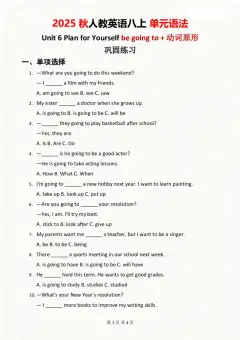
be going to + 动词原形,表示"打算做某事""计划做某事"。这是全单元的核心结构,后必须接动词原形,不能接 ing,也不能省掉 going。
例如:I am going to be a reporter. 我要成为一名记者。I am going to study medicine. 我打算学医。
plan to do something,计划做某事。
例如:He plans to move to Shanghai. 他计划搬到上海。
hope to do something,希望做某事。
例如:I hope to travel around the world. 我希望周游世界。
want to be / become,想成为。
例如:What do you want to be when you grow up? 你长大后想做什么?
would like to be,想成为,语气比 want 更委婉、更礼貌。
例如:I would like to be a teacher.
grow up,长大。
例如:When I grow up, I want to be a pilot.
grow up to be,长大成为。
例如:She wants to grow up to be a scientist.
in the future,在未来。常放在句末。
例如:What are you going to be in the future?
in + 一段时间,用于将来时,表示"在……之后"。
例如:in ten years(十年后)、in five years(五年后)。
注意:in 与 later 不能连用,不能说 in ten years later。
(二)职业与工作状态短语
work as,担任……工作、作为……而工作。
例如:She is going to work as a nurse. 她打算当护士。
work for,为……工作。
例如:He wants to work for a big company. 他想去一家大公司上班。
work in,在……(地点或领域)工作。
例如:I want to work in a hospital. 我想在医院工作。
work with,与……共事、使用……工作。
例如:I want to work with children. 我想和孩子们一起工作。
be able to do something,能够做某事。这是将来时中 can 的替代表达。
例如:I will be able to speak French. 我将能说法语。
(三)学习与自我提升短语
take acting lessons,上表演课。
例如:I am going to take acting lessons. 我打算上表演课。
take art lessons,上美术课。
例如:She is taking art lessons this year.
study medicine,学医。
例如:He is going to study medicine at a famous university.
learn to drive,学开车。
例如:I am going to learn to drive.
get good grades,取得好成绩。
例如:I want to get good grades this term.
get a (part-time) job,找(一份兼职)工作。
例如:He is going to get a part-time job.
make the soccer team,入选足球队。
例如:I am going to make the soccer team.
keep fit / stay healthy,保持健康。
例如:I want to keep fit by running. 我想通过跑步保持健康。
do exercise / do sports,锻炼、做运动。
例如:You should do more exercise.
(四)生活与创作短语
live in,住在。
例如:I am going to live in Beijing.
move to,搬到。
例如:We are going to move to Canada.
get married,结婚。
例如:They are going to get married next year.
have a family,成家。
例如:I want to have a family.
write articles,写文章。
例如:She is going to write articles for a magazine. 她打算为一家杂志写文章。
write for,为……撰稿。
例如:He writes for a newspaper. 他为一家报纸撰稿。
send…to,把……寄给、发送给。
例如:I will send my photos to the newspaper.
hold art exhibitions,举办画展。
例如:He hopes to hold art exhibitions.
take photos,拍照。
例如:I am going to take lots of photos.
travel around the world,周游世界。
例如:I hope to travel around the world.
(五)数量与频率短语
a lot of / lots of,许多,既可修饰可数名词也可修饰不可数名词。
例如:There will be a lot of changes.
hundreds of,数以百计的、许多。
例如:Hundreds of new jobs will appear.
over and over again,反复地、一遍又一遍。
例如:Computers can do the same job over and over again.
more and more,越来越多。
例如:There will be more and more cars.
less free time,更少的空闲时间。
例如:We will have less free time.
(六)话题写作常用短语
come true,实现(梦想)。主语是 dream、wish 等,不能用人作主语。
例如:I believe my dream will come true. 我相信我的梦想会实现。
try one's best,尽某人最大努力。
例如:I will try my best to study hard.
make a resolution,下定决心。
例如:I make a resolution to study harder.
at the beginning of the year,在年初。
例如:People often make resolutions at the beginning of the year.
be sure about,对……有把握。
例如:Are you sure about your future job?
because of,因为、由于,后接名词或短语。
例如:I want to be a doctor because of my grandfather.
in order to,为了。
例如:I get up early in order to catch the bus.
二、重要语法
语法一:一般将来时 be going to 结构(本单元核心)
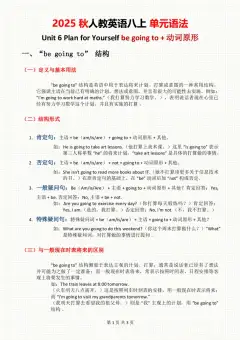
基本构成:主语 + am / is / are + going to + 动词原形。
am、is、are 要随主语的人称和数变化。第一人称 I 用 am,第三人称单数用 is,其余用 are。going to 后面必须跟动词原形,不能跟 ing,也不能用过去式。
肯定句:主语 + be going to + 动词原形。
例如:She is going to be a singer. 她打算当歌手。
I am going to visit my grandparents this weekend. 这个周末我打算去看望祖父母。
否定句:主语 + be + not + going to + 动词原形。
例如:I am not going to live abroad. 我不打算住在国外。
一般疑问句:Be + 主语 + going to + 动词原形?
例如:Are you going to study law? 你打算学法律吗?
肯定回答用 Yes, I am.
否定回答用 No, I am not.
特殊疑问句:疑问词 + be + 主语 + going to + 动词原形?
例如:What are you going to be? 你打算做什么工作?
How are you going to do that? 你打算怎么做?
Where are you going to work? 你打算在哪里工作?
be going to 有两种用法。
第一种是表示事先的打算或计划,体现主观意图。
例如:I am going to call him tonight. 我打算今晚给他打电话。
这是本单元最主要的用法。
第二种是根据现状作出有根据的推测,往往有明显迹象。
例如:Look at those clouds. It is going to rain. 看那些云,要下雨了。
常与 be going to 连用的时间状语:tomorrow(明天)、soon(不久)、next week(下周)、next month(下个月)、in the future(将来)、in ten years(十年后)、this weekend(这个周末)、when I grow up(当我长大后)。
常见错误:一是丢掉 going,说成 He is go to be a doctor,正确应为 He is going to be a doctor;二是 to 后面用错形式,说成 I am going to plays football,正确应为 I am going to play football;三是漏掉 be 动词,说成 I going to be a teacher,正确应为 I am going to be a teacher;四是漏掉 be 动词原形,说成 What are you going to? 正确应为 What are you going to be?
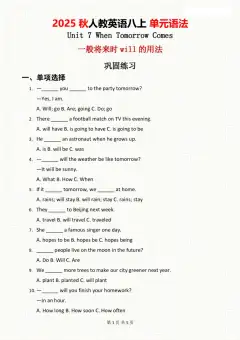
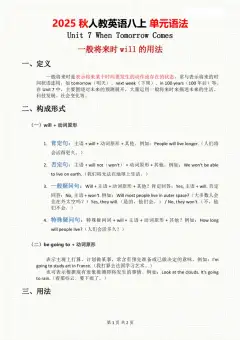
语法二:一般将来时 will 结构
基本构成:主语 + will + 动词原形。will 可用于所有人称,没有人称和数的变化。
肯定句:主语 + will + 动词原形。
例如:Robots will do all the housework. 机器人将做所有的家务。
否定句:主语 + will not(won't)+ 动词原形。
例如:They won't have enough water. 他们将没有足够的水。
一般疑问句:Will + 主语 + 动词原形?
例如:Will people live on the moon? 人们会住在月球上吗?
肯定回答 Yes, they will.
否定回答 No, they won't.
be going to 与 will 的区别
be going to 强调事先的计划或打算,或者有迹象的预测。
例如:I am going to visit my aunt this Sunday. 我打算这个周日去看阿姨。
will 强调临时做出的决定,或者对将来的主观预测。最典型的例子是对话中的即时反应:有人敲门或电话响,你说 I will get it. 我去接。这是一个临时决定,不能用 be going to。
简言之,事前有计划用 be going to,当场临时决定用 will。
语法三:可数名词与不可数名词及修饰词
这一语法点在描述将来时经常用到,尤其涉及 more、less、much、many 的选择。
many 修饰可数名词复数,表示"许多"。
例如:many books 许多书、many students 许多学生。
much 修饰不可数名词,表示"许多"。
例如:much water 许多水、much time 许多时间。
a lot of 与 lots of 既可修饰可数名词,也可修饰不可数名词。
例如:a lot of people、a lot of money。
few 与 a few 修饰可数名词。few 表示"几乎没有",含否定意味;a few 表示"有几个",含肯定意味。
例如:I have few friends here. 我在这里几乎没有朋友。
I have a few friends here. 我在这里有几个朋友。
little 与 a little 修饰不可数名词。little 表示"几乎没有",含否定意味;a little 表示"有一点",含肯定意味。
例如:There is little milk left. 几乎没有牛奶剩下了。
There is a little milk left. 还有一点牛奶。
比较级。many 和 much 的比较级都是 more。little 和 few 的比较级通常用 less,但口语中 less 有时也可修饰可数名词。例如:There will be more pollution. 污染将会更多。We will have less free time. 我们的空闲时间会更少。
常见错误:
一是混淆可数与不可数,说成 many homework,正确应为 much homework,因为 homework 是不可数名词;
二是 there be 结构与 have 混用,说成 There will have more trees,正确应为 There will be more trees,因为 there 后面只能用 be,不能用 have。
语法四:时间状语从句中的"主将从现"
这是本单元最重要的从句规则,也是考试的高频考点。
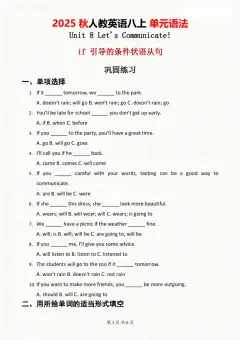
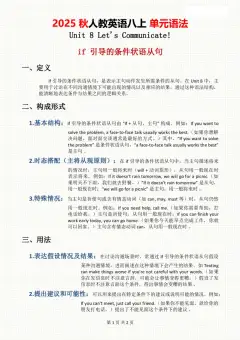
基本规则:主句使用一般将来时,when、as soon as、before、after、until、if 等引导的时间或条件状语从句中,用一般现在时代替一般将来时。
结构是:主句(一般将来时)+ when / as soon as / before / after / until + 从句(一般现在时)。
例如:I will call you when I get there. 我到那儿时会给你打电话。
不能说: I will call you when I will get there。
又如:If it rains, we will stay at home. 如果下雨,我们就待在家里。
不能说: If it will rain。
再如:She will be happy after she moves to Paris. 她搬到巴黎后会很高兴。
不能说: After she will move。
记忆口诀:主将从现。主句是将来时,从句用一般现在时。
这一规则也适用于 until。例如:I won't leave until he comes back. 直到他回来我才离开。
语法五:want、hope、plan、would like 后接不定式
这几个表示意愿和计划的动词,后面都接 to do,即动词不定式,不接动词的 ing 形式,也不接动词原形。
want to do something,想要做某事。
例如:I want to be a doctor. 我想当医生。
hope to do something,希望做某事。
例如:I hope to travel around the world.
plan to do something,计划做某事。
例如:I plan to study harder.
would like to do something,想要做某事,语气更客气。
例如:I would like to work in Beijing.
wish to do something,希望做某事。
例如:She wishes to become a pianist.
这几个表达可以进行同义转换。
例如:I want to be a teacher.
可以改写为 I would like to be a teacher.
也可以改写为 I hope to be a teacher. 意思相近,但语气和侧重点略有不同。
常见错误:
一是 want to 后面误用 ing,说成 I want being a doctor,正确应为 I want to be a doctor;
二是 hope 后面漏掉 to,说成 I hope become a teacher,正确应为 I hope to become a teacher。
语法六:现在进行时表示将来
在英语口语中,现在进行时(be + 现在分词)可以表示已经安排好、确定要发生的将来动作。
例如:I am leaving for Shanghai tomorrow. 我明天动身去上海。
He is arriving at six. 他六点到。
使用条件:只限于表示位置移动的动词,如 go、come、leave、arrive、start、fly、move、return 等;并且通常指已经确定下来的安排。
例如:What are you doing this weekend? 这个周末你打算干什么?(实际是询问计划好的安排)
语法七:特殊疑问句 What 与 How 的选择
问职业用 What。
例如:What are you going to be? 你打算做什么工作?
不能用 How。
问方式用 How。例如:How are you going to do that? 你打算怎么做?
这是一个常见的选择题陷阱:问职业时用 What,问方式或感受时才用 How。
三、本单元易错点汇总
第一,going 不能丢。He is go to be a doctor 是错的,
应为 He is going to be a doctor。
第二,to 后必须是动词原形。 I am going to plays football 是错的,
应为 I am going to play football。
第三,What are you going to be 中的 be 不能省。
不能说 What are you going to。
第四,there be 与 have 不能混用。There will have more trees 是错的,
应为 There will be more trees。
第五,时间状语从句要主将从现。I will tell him when he will come 是错的,
应为 I will tell him when he comes。
第六,问职业用 What 而不是 How。How are you going to be 是错的,
应为 What are you going to be。
第七,homework 是不可数名词。many homework 是错的,
应为 much homework。
第八,in 与 later 不连用。in ten years later 是错的,
应为 in ten years 或 ten years later。
第九,come true 不能用人生作主语。 I will come true my dream 是错的,
应为 My dream will come true 或
I will make my dream come true。
第十,more 与 less 的选择要看名词可数与否。
more 既可用于可数也可用于不可数,
less 用于不可数,修饰可数名词复数时通常用 fewer,但口语中 less 也可见到。
单元核心词块速记
职业名词:reporter 记者,pilot 飞行员,engineer 工程师,scientist 科学家,pianist 钢琴家,violinist 小提琴手,driver 司机,cook 厨师,doctor 医生,nurse 护士,teacher 教师,actor 男演员,actress 女演员,programmer 程序员。
其他重点词:resolution 决心、决议;promise 承诺、诺言;foreign 外国的;able 能够(用于 be able to);own 自己的;improve 改善、改进;physical 身体的、物质的;self-improvement 自我提升;relationship 关系;hobby 爱好。