ARTICLE · 1274657
2026外研社版英语高中必修第二册学生AI智能体深度理解16法:第3篇|Unit 1 Food for thought·Using language · Grammar (Modals 1)
2026外研社版英语高中必修第二册学生AI智能体深度理解16法:第3篇|Unit 1 Food for thought·Using language · Grammar (Modals 1)——深度理解16法之「前见检验」
外研社版高中英语必修第二册 Food for thought Using language · Grammar (Modals 1) 完整精讲
🏫 学校:dxyc2360 👨🏫 指导教师:张元方
📖 一、深度理解16法之「前见检验」
翻到教材第6页,眼睛还没落到 a–e 五个句子上,心里已经装着一套现成的解释:情态动词不过是「必须、可以、应该、能够」几个汉字的对号入座;be able to 跟 can 是一回事;have to 等于 must;dare 只在否定句里露面;had better 后面要跟 to。伽达默尔把这种进门时随身带着的成见叫前见,并且说它并不脏:没有前见,那五行字母对我们只是一串符号,连猜的勇气都没有;有了前见,读到 was able to hold a knife and fork 的一瞬间,我们才敢判断这是在讲本事。危险的动作只有一个,把前见当成结论,读完一页仍在复述进门时的那套说法。
前见检验的第一个动作,是把前见摆到桌面上,让它有形状、可以被指出来。第6页活动1 给的条件很苛刻:五个加粗词组 was able to/dare not try/have to/we’d better not/needn’t 已经印在句子里,五条释义 1–5 也印在下方,中间没有一句解释,只有 Think and work out the meanings of the words in bold 这一行指令。教材在这里要的是先猜后验:合上书,用自己的话说出每个词组的意思并写下来;再打开释义逐条对撞。信念写不出来就无法被检验,写出来之后,哪一条被释义推翻,一眼可见。
第二个检验动作是分流:哪些前见属于合理前见,哪些只是任意前见。「情态动词后面接动词原形」这条前见在五个句子里处处站得住,was able to hold、dare not try、have to find、we’d better not eat、needn’t try,没有一个例外,所以它是可以拿去推新句子的凭据。「have to 就是 must」这条前见站不住:第7页活动3 第1空 You 1 wait until everyone else has been served 讲的是宴席上的客观规矩,第3空 you 3 place the knife and fork together on your plate 讲的是刀叉摆法的章程,第4空却相反,you 4 use a knife and fork when eating a hamburger or pizza 讲的是不必。must 的否定 mustn’t 是禁令,have to 的否定 don’t have to 是自由,两者的否定方向完全相反。同为「必须」,must 出自说话人的意志,have to 出自规矩与环境。
第三个检验动作,让文本反过来修改前见。第7页活动2 的广告把 be able to 从「有本事」推到「管得住自己」:if you’re a sugar addict and aren’t able to say no to chocolate or cola,这里的 able 不问会不会,只问能不能忍住,前见被挪动了半寸。同一段里 you had better download it now 也不像温和建议,限时通牒的味道从 now 一词里冒出来;All you have to do is select the photos of healthy food 把 have to 的重心从「被迫」挪到「只需」。前见被这些真实句子修正一次,手里的尺子就细一格。
检验的收尾不是把前见清零,而是换一把更细的尺子。教材第6–7页四个活动恰好是四级校验:活动1 认形配义,活动2 在整段广告里找形,活动3 按语境挑形并变形,活动4 在评论语篇里辨情态与情绪。四级走完,五个情态(短语)从「几个汉字」变成「有形式、有意义、有语用温度的工具」;下一次在语法填空里撞见它们,被检验过的前见会自动先追问一句:这里的义务是主观的还是客观的,这里的否定是自由还是禁令。
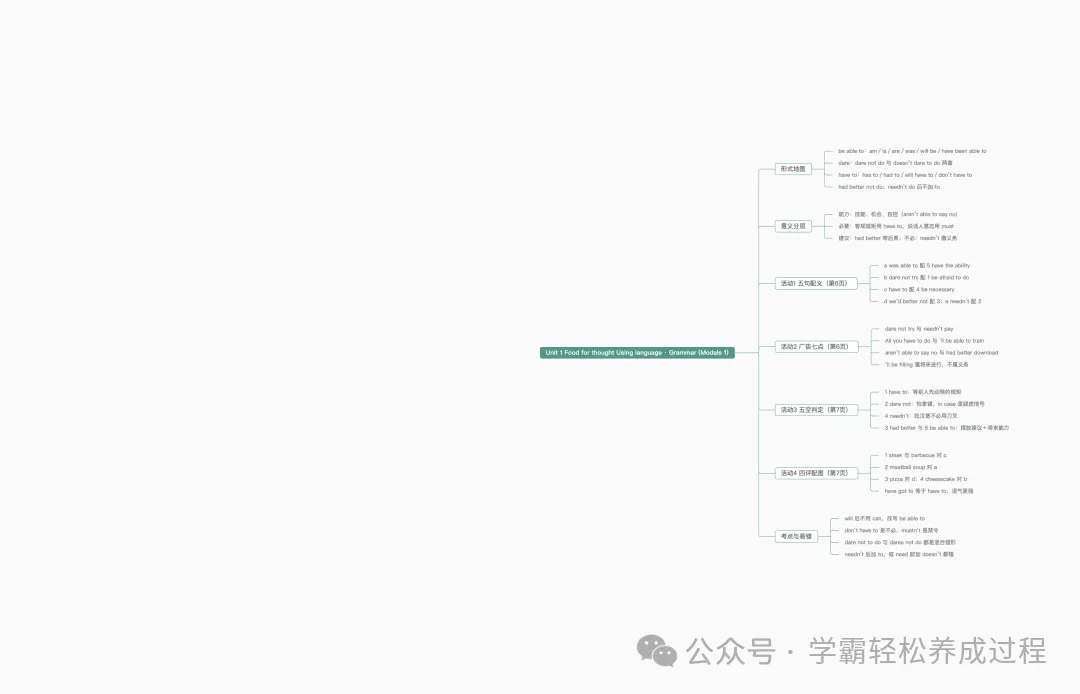
📊 二、思维导图
这张导图把教材第6–7页四个活动压成六条主线:五个情态(短语)各自的形式与释义、活动1 五句配义的判据、活动2 广告语篇里的七个情态点位、活动3 五个空位的语境判定、活动4 四条评论的配图线索,以及 must 与 have to、needn’t 与 don’t have to 这两组最易混的考点提醒。看图先看中心,再看「形式」这一支,把 was able to/dare not/have to/had better/needn’t 五种外形记住,其余分支都是这五种外形在不同语篇里的复用。
中心:Unit 1 Food for thought Using language · Grammar (Modals 1)
🔑 三、重点与难点
重点一:五个情态(短语)的形与义一一对应
教材第6页活动1 的 a–e 五句把本节的骨架摆好了:was able to(能力)、dare not(不敢)、have to(不得不)、we’d better not(最好别)、needn’t(不必)。下方五条释义 1–5 恰好与之一一对应,配义不是背答案,是给每个外形贴一张功能标签。
重点二:be able to 的时态完整性
第6页 a 句 I was able to hold a knife and fork – and chopsticks! 与第7页活动3 第5空 you will 5 enjoy the local cuisine 前后夹住 be able to 的两端:它有过去式,也有将来式。can 没有将来式,也没有完成式,两处空缺只能由 be able to 顶上,这是本册把它单列一节的直接理由。
重点三:have to 与 must 的分野,don’t have to 与 mustn’t 的分野
第6页 c 句 Mum and I just have to find a way 的「不得不」来自处境,第7页活动3 第1、3空的「必须」来自餐桌章程;第4空 you 4 use a knife and fork when eating a hamburger or pizza 则明明白白是「不必」。义务的来源与义务的否定,是本节两条最重的判定线。
重点四:had better 的形式纪律
第6页 d 句 we’d better not eat too much roast food 给出了三条纪律:had 不表过去,’d 是 had 的缩写,否定词 not 紧贴 better 之后。三条纪律合起来才能解释第7页活动3 第3空为什么填 had better place 而不是 had better to place。
重点五:need 的双轨与 needn’t 的单一外形
第6页 e 句 “You needn’t try it if you don’t want to,” 里 needn’t 是情态用法,直接带原形 try;第7页活动2 的 you needn’t pay for it 同形。同一段里 All you have to do is select 的 have to 也在提醒:need 作实义动词时才说 don’t need to do,两套外形不能混。
难点一:dare 的两副面孔
第6页 b 句 Dad dare not try 里 dare 是情态动词:第三人称单数不加 s,后接原形,否定直接加 not。同一个词作实义动词时要说 Dad doesn’t dare to try。学生常把两套外形缝在一起,写成 dare not to try 或 dares not try,这是本节最高频的失分点。
难点二:was able to 与 could 的替换限制
第6页 a 句讲的是那一次吃饭时成功握住了刀叉,用 was able to 有「做到了」的味道;换成 could 只剩「当时有这个本事」,做不到的那一层被抹掉。肯定句里两者并非处处可换,否定句 could not 才可以自由替换 was not able to。
难点三:活动3 五个空位要在同一组情态里挑一个再变形
第7页活动3 的指令是 with the correct form of the modals in Activity 1,五个空位只能用活动1 那五个情态(短语),且要按人称与时态变形。判定靠语境:等别人先动筷是规矩,怕拿错是胆怯,摆刀叉是章程,吃汉堡不必用刀叉,尝到本地菜是能力。
难点四:广告与评论两种语篇的情态温度
第6页活动2 是推销语篇,had better download it now 带着催促,you needn’t pay for it 是让利;第7页活动4 是评价语篇,You’ve got to try the strawberry cheesecake 用 have got to 表达强烈推荐。同一个「必须」,从广告里出来是话术,从食客嘴里出来是赞叹,读不出这层温度,语篇题就会答成语法题。
📝 四、易考题与易错题
易考题一(教材第6页 活动1 配义)
题面:把 a–e 五个加粗词组与释义 1–5 配对。思路:先给每个加粗词贴功能标签,was able to 贴「能力」,dare not try 贴「害怕」,have to 贴「不得不」,we’d better not 贴「建议」,needn’t 贴「不必」。解答:a–5,b–1,c–4,d–3,e–2。警示:c 与 d 都带「劝」的味道,c 句有 just 与感叹号,是处境逼出来的「非做不可」,落在 4 的 be necessary;d 句有 not 与 as 引导的原因,是替人出主意,落在 3 的 give advice。
易考题二(教材第7页 活动3 第5空)
题面:and you will 5 enjoy the local cuisine。思路:空位前是 will,will 后面必须接动词原形,can 没有将来形式,不能填 can。解答:be able to,整句为 and you will be able to enjoy the local cuisine。警示:填 can 的学生只看了意思没看形式,will can 在英语里不存在;填 able to 的漏了 be,情态短语的 be 不能省。
易考题三(教材第7页 活动3 第2空)
题面:Sometimes there are so many knives and forks that you 2 pick them up in case you get it wrong。思路:in case you get it wrong 交代的是怕出错的顾虑,与「不敢」同源;主语是 you,情态 dare 不变形。解答:dare not,整句为 that you dare not pick them up in case you get it wrong。警示:填 mustn’t 把顾虑读成了禁令,与后半句 The trick is to start with the ones on the outside 的宽慰口气相冲。
易考题四(教材第6页 活动1 d 句改写)
题面:把 we’d better not eat too much roast food 改写成完整形式并保持意思不变。思路:’d 是 had 的缩写,否定词位置在 better 之后。解答:we had better not eat too much roast food。警示:写成 we hadn’t better eat 是把 had better 当成了完成时或助动词否定,英语里没有这个形式;写成 we’d better don’t eat 是双重否定叠加。
易错题一:把「不必」写成禁令
错在哪:第7页活动3 第4空写成 you mustn’t use a knife and fork when eating a hamburger or pizza,把「用不着」译成了「不许」,句意从宽松变成禁止。怎么改:改为 you needn’t use a knife and fork,或 you don’t have to use a knife and fork;mustn’t 只留给真正的禁令。
易错题二:needn’t 后面多带一个 to
错在哪:写成 You needn’t to try it,把情态 need 与实义 need 的外形缝在一起。怎么改:情态用法是 needn’t try,实义用法是 don’t need to try,两条路只能走一条;教材第6页 e 句给的就是 needn’t try it 这一条。
易错题三:dare 的两套外形混用
错在哪:写成 Dad dares not try 或 Dad dare not to try,前者把实义动词的 s 加在情态上,后者把实义动词的 to 加在情态上。怎么改:情态路线 Dad dare not try,实义路线 Dad doesn’t dare to try,第6页 b 句原文走的是情态路线。
易错题四:把 was able to 一律换成 could
错在哪:把第6页 a 句改成 I could hold a knife and fork – and chopsticks,原文那一次「真做到了」的意味被抹平,与上文讲小时候不会用刀叉的转折脱钩。怎么改:单次成功用 was able to,一般能力才用 could。
🛠 五、五步学习法应用
第一步:每天锻炼一个小时。把五个情态折成五句口头操练,三分钟一轮:I was able to hold a knife and fork;Dad dare not try the dish;Mum and I have to find a way;we’d better not eat too much;you needn’t try it。一天三轮,比抄语法书稳,嘴巴记住的外形不会在考场丢分。
第二步:扎实掌握第一个知识点。先钉死 be able to。教材第6页 a 句用 was able to 而不用 could,讲的是过去某一次成功做到,「一次」就是它的身份证。把原句抄下来,旁边写三行:一般能力用 could,单次成功用 was able to,将来用 will be able to。第一个知识点扎实了,其余四个情态只是换外形而已。
第三步:能积微者速成。每天只加一句原文加一个变形:今天把 dare not try 拆成两条路,明天把 needn’t try 换成 don’t need to try,后天把 we’d better not eat 的 not 位置钉住。一句一味,三十天三十味,像往罐子里一天丢一粒豆。
第四步:运用对标思维突破学习困境。对标不是抄答案,是找一份比自己更准的说法来量自己。教材第6页那五条释义 1–5 就是标尺,把你的解释与 be afraid to do something、not be necessary to do something 逐字对,短一处补一处。第7页活动3 的五个空位是第二把标尺,填完说得出判据,才算对上标。
第五步:运用杠铃法则缓解学习疲劳。重的一端是判定,轻的一端是朗读。二十分钟做一组硬题:五个空位挑情态、变形式、说判据;随后十分钟只朗读英文原句,一句也不分析,只让耳朵记住节奏。重的压到位,轻的放到位,中间不留灰色的空转时段,五个情态的形与义才不至于背了又忘。
📄 六、课本原文
Food for thought Using language · Grammar (Modals 1)(教材第6–7页)
略
知识点范围:be able to/dare/have to/had better/needn’t 五个情态(短语)的形式与意义,情态动词的共同特征,义务的主客观之分,否定的自由与禁令之分。
例题与练习:第八节例1–例5(was able to 与 could 的取舍、dare 的双轨、have to 与 must、had better 的否定、needn’t 与 will be able to);第九节活动1–活动4 逐题拆解。
💡 七、知识点完整拆解
知识点1:本节板块定位与四个活动的分工
原文:教材第6页标题 Using language 与副标题 Modals (1),下方依次是活动1(五句配义)、活动2(广告里找情态),第7页是活动3(五个空位填情态)、活动4(四条评论配图)。
讲解:四个活动是一条递进链。活动1 只做认形与配义,五个加粗词组与五条释义一一对应;活动2 把同样的外形放进一整段广告,要求在连续语流里指出它们;活动3 反过来给语境、让学生挑形并变形;活动4 把情态放回评价语篇,看它如何与形容词、星级一起表达态度。
用法:复习时按链走,先配义再找形,再填空再读语篇,任何一环跳过都会在下一环卡住。
考点:判断某题考的是「形」(拼写与变形)还是「义」(配义与翻译),两条路线的判据不同,形看主语与时态,义看语境与后果。
知识点2:活动1 句子a 的原句与加粗点
原文:a … I was able to hold a knife and fork – and chopsticks!
讲解:句子的重心不在 hold,而在 was able to:说话人讲的是「那一次我真做到了」,不是「我一向会用」。破折号后的 and chopsticks 是追加的惊喜,语气往上走,与 able 的成功义同向。教材把这句放在首位,是要先立住能力义,再让 dare、have to、had better、needn’t 依次登场。
用法:配义时锁定释义 5 have the ability to do something;改写时若要强调「做到了」,保留 was able to,不要换成 could。
考点:was able to 与 could 在肯定句中的取舍,是本节第一道高频题;判定关键词是「一次」还是「一贯」。
知识点3:be able to 的形式全景
原文:第6页 a 句 was able to hold;第6页活动2 Then you’ll be able to train your brain;第7页活动3 第5空 you will 5 enjoy the local cuisine;同段 aren’t able to say no。
形式:一般现在 am/is/are able to do;一般过去 was/were able to do;将来 will be able to do;完成 have/has been able to do;非谓语 to be able to do;否定 not able to 或 be not able to。
意义:具备做某事的能力、条件或机会,能力义之外还常带「得以、成功做到」的结果义。
用法:需要时态变化、需要与 will/have 连用、需要出现在不定式或分词位置时,一律用 be able to 代替 can。
考点:will be able to 不写成 will can;have been able to 不写成 have could;be 动词不可省。
知识点4:be able to 的意义细分为三层
原文:第6页活动2 if you’re a sugar addict and aren’t able to say no to chocolate or cola。
讲解:这里 able 与 sugar addict 对举,问的不是技术上的会不会,而是意志上的能不能忍住。能力义的第三层就此显形:能力可以是体力、技能,也可以是自控力。
用法:翻译时按语境调整,会握刀叉译「会」,能忍住译「能」,得以进厨房译「能够」。
考点:完形填空常在此设题,前后文有 addict、diet 一类词时,able 取「自控」义而非「技能」义。
知识点5:was able to 与 could 的分工
原文:第6页 a 句 I was able to hold a knife and fork – and chopsticks!
形式:could 只有过去形式,无将来、无完成;was able to 有全套时态。
意义:could 表过去的一般能力,was able to 表过去某一场合成功做到。
用法:叙述一次具体经历时优先 was able to;泛说过去本事时用 could;否定句 could not 与 was not able to 可互换。
考点:题干出现 at last、in the end、that day、managed to 一类信号,答案取 was able to。
知识点6:be able to 的否定与疑问
原文:第6页活动2 aren’t able to say no to chocolate or cola。
讲解:否定把 not 放在 able 前,缩写成 aren’t/wasn’t/won’t be;疑问把 be 提到句首,Are you able to come tonight;特殊疑问 What are you able to do。
用法:口语里 be able to 的否定比 can’t 客气,写申请或正式说明时更常用。
考点:语法填空给 not 与 be 两个提示时,注意主谓一致,主语是 you 用 aren’t,是 he 用 isn’t。
知识点7:活动1 句子b 的原句与 dare 的情态外形
原文:b But there are still some dishes that Dad dare not try even after many years of marriage to my mother.
讲解:主语 Dad 是第三人称单数,dare 却光着身子不加 s,后接原形 try,否定直接加 not,这三条同时出现就是情态用法的证据。even after many years of marriage to my mother 补出时间跨度,把「不敢」写成长期状态,语气里带一点无奈的幽默。
用法:配义锁定释义 1 be afraid to do something;改写为实义路线时写 Dad doesn’t dare to try。
考点:给 dares/dare 二选一的题,先看后面是 not 还是 to;dare not do 属情态,doesn’t dare to do 属实义。
知识点8:dare 的情态路线
原文:第6页 b 句 dare not try;第7页活动3 第2空 you 2 pick them up in case you get it wrong;第6页活动2 If you dare not try a “painful” diet。
形式:dare not do;疑问 Dare he go;第三人称单数不加 s;无 do/does 助动词。
意义:不敢、没有胆量做某事,多数出现在否定句与疑问句。
用法:书面语与较正式的表达偏爱情态路线,第6页两处原句都走这条路。
考点:dare not 后永远原形,加 to 或加 s 都是错形。
知识点9:dare 的实义路线
原文:教材第6页只有情态路线,实义路线需由学生自行改写,改写基准是 b 句 Dad dare not try。
形式:dare 作实义动词,第三人称单数 dares,过去 dared,否定用 don’t/doesn’t/didn’t dare to do,疑问用 Do you dare to do。
意义:与情态路线同义,语体更口语。
用法:美式英语里 to 可省,写成 doesn’t dare do;英式教材通常保留 to。
考点:两套外形不可缝合,dare not to do 与 dares not do 都是混合错误。
知识点10:dare 的意义边界与固定说法
原文:第6页活动2 If you dare not try a “painful” diet to stay healthy。
讲解:dare not try a “painful” diet 的对象是「痛苦的节食法」,敢不敢的对象是行为本身,不是人。引导的 if 从句把「不敢」写成广告要痛点:你怕苦,所以给你一条不苦的路。
用法:I dare say 意为「我猜想」,How dare you 表责问,dare 作名词时指「胆量」,a dare 是「挑战」。
考点:阅读理解推断题常借 dare not 判断说话人的态度:不敢里藏着抗拒,抗拒里藏着立场。
知识点11:活动1 句子c 的原句与 have to 的处境义
原文:c … Mum and I just have to find a way to get him into the kitchen!
讲解:just 把「不得不」的无奈推到最前,find a way 说明还没找到路,感叹号把一点赌气写在纸上。have to 的必要性不来自说话人的权威,来自爸爸不肯进厨房这个事实。
用法:配义锁定释义 4 be necessary or give strong advice to do something;翻译时保留「不得不」的被动感。
考点:have to 的否定 don’t have to 是「不必」,与 mustn’t 的禁令义相反,这是本节最易翻车的一格。
知识点12:have to 的形式与人称时态变化
原文:第6页 c 句 have to find;第7页活动3 第1空 You 1 wait until everyone else has been served;第6页活动2 All you have to do is select the photos of healthy food。
形式:现在 have/has to do;过去 had to do;将来 will have to do;完成 have had to do;否定 don’t/doesn’t/didn’t have to do;疑问 Do you have to。
意义:客观上必须、不得不,必要来自规矩、处境或他人安排。
用法:第7页第1空的主语是 you,用原形 have to;第3空主语也是 you,同一外形;若主语换成 he,则 has to。
考点:have to 是「半个情态」,会随人称与时态变形,这一点与 must 相反。
知识点13:have to 与 must 的三条分界
原文:第7页活动3 第1空 You 1 wait until everyone else has been served before you start eating;对比第6页 c 句 Mum and I just have to find a way。
形式:must 无时态变化、无人称变化;have to 全套变化。
意义:must 的必要来自说话人,have to 的必要来自外部规矩。
用法:讲餐桌章程、公司规章、交通规则,用 have to;讲个人坚持与命令,用 must;否定 mustn’t 是禁令,don’t have to 是自由。
考点:题干出现 rule、regulation、custom、have to 与 must 二选一时,答案取 have to。
知识点14:活动1 句子d 的原句与 had better 的缩写
原文:d … we’d better not eat too much roast food as it may make us suffer from heat inside our bodies, …
讲解:we’d 不是 we would,而是 we had;better 后面直接原形 eat;not 夹在 better 与 eat 之间。as 引导的原因从句给出后果:吃太多烤肉会上火,这是「最好别」的理由。
用法:配义锁定释义 3 give advice to do or not to do something;书面改写时还原为 we had better not eat。
考点:’d better 的 ’d 只能理解为 had,理解成 would 会连带写出 we would better 这种不存在的组合。
知识点15:had better 的形式纪律
原文:第6页 d 句 we’d better not eat;第7页活动3 第3空 you 3 place the knife and fork together on your plate;第6页活动2 you had better download it now。
形式:had better do,缩写 ’d better do;否定 had better not do;疑问 Had you better go;不因人称与时态变形,had 不表过去。
意义:最好做某事,含「否则会有麻烦」的潜台词。
用法:对同辈或下级的劝告,语气直;对上级为免失礼可换 should 或 might want to。
考点:had better 后不带 to,否定不带 don’t,had 不可换成 have 或 has。
知识点16:had better 的语用温度
原文:第6页活动2 So, if you’re a sugar addict and aren’t able to say no to chocolate or cola, you had better download it now!
讲解:下载建议前面先立一个「管不住嘴」的困境,had better 的后果义正好接住:不下载就继续被巧克力与可乐牵着走。now 把建议压成限时,推销语篇的紧迫感由此成立。
用法:写作里表达带后果的建议,句式可套 had better do, or you will 加后果。
考点:推理题问作者态度时,had better 往往暗示「有代价」,不等于中性的 should。
知识点17:had better 与 should、ought to 的程度差
原文:第6页 d 句 we’d better not eat too much roast food;第7页活动3 第3空 you 3 place the knife and fork together。
形式:had better 后原形;should 后原形;ought to 带 to。
意义:had better 最强,should 中性,ought to 偏道义。
用法:餐桌礼仪类文本用 had better 或 have to 都自然,写建议信时先 should 再 had better 递进。
考点:三个词同现的排序题,按强度排 had better、ought to、should 不会失分,实际语用里 ought to 与 should 常并列。
知识点18:活动1 句子e 的原句与 needn’t 的情态外形
原文:e “You needn’t try it if you don’t want to,” Mum said, …
讲解:needn’t 后面直接原形 try,不加 to;if 从句给的是「不想」这个前提,needn’t 因此带一点体谅,是妈妈式的不勉强。配义锁定释义 2 not be necessary to do something。
用法:needn’t 只用于否定与疑问,肯定句要用 must 或 have to;needn’t 的答语 No, you needn’t。
考点:Must I 开头的一般疑问句,否定回答用 needn’t 或 don’t have to,不能用 mustn’t。
知识点19:need 的双轨
原文:第6页 e 句 needn’t try;第6页活动2 you needn’t pay for it;第7页活动3 第4空 you 4 use a knife and fork。
形式:情态路线 needn’t do;实义路线 don’t need to do,第三人称 doesn’t need to do,过去 didn’t need to do。
意义:两者都表「不必」,情态路线更书面,实义路线更口语。
用法:第7页第4空所在句子是礼仪说明,写 needn’t 与 don’t have to 都对,写 don’t need to 也可以。
考点:needn’t 后加 to、need 前面加 doesn’t 再加 not,是两类典型错形。
知识点20:needn’t have done 与 didn’t need to do 的时差
原文:由第7页活动3 第4空 you 4 use a knife and fork 延伸,教材未给完成式例句,此处按本节情态体系补出对照。
形式:needn’t have done 与 didn’t need to do 并存。
意义:needn’t have done 表「做了但本不必做」,didn’t need to do 表「本不必做,是否做了未说明」。
用法:抱怨白费力气用前者,陈述旧情况用后者。
考点:与 must have done、can’t have done 同题出现时,needn’t have done 是唯一表「多余」的一项。
知识点21:情态动词的四个共同特征
原文:第6页 a–e 五句可作证据:was able to hold、dare not try、have to find、we’d better not eat、needn’t try。
形式:后接动词原形;无人称与数的变化(have to 例外);否定直接加 not;疑问直接提前。
意义:给动作加态度,不改变动作本身,属于说话人的判断层。
用法:情态动词不重叠使用,两个态度要分层表达,用 be able to、have to 一类短语替代。
考点:will can、must can、may can 都是重叠错误,改为 will be able to、must be able to。
知识点22:情态意义的两大域
原文:第6页 d 句 as it may make us suffer from heat inside our bodies。
讲解:同一页里 may 与 we’d better 紧挨着,分工很清楚:may 说的是可能性,属于推测域;had better 说的是建议,属于义务域。义务域谈「该不该做」,推测域谈「会不会发生」。
用法:改写句子时先判域,义务域换 must/have to/should,推测域换 may/might/must。
考点:must 在推测域意为「一定」,在义务域意为「必须」,判断依据是主语是不是人、动词是不是动作。
知识点23:活动2 广告文本的七个情态点位
原文:If you dare not try a “painful” diet to stay healthy, this new app is the perfect solution – and you needn’t pay for it! The app works by quickly showing photos of different food. All you have to do is select the photos of healthy food. Then you’ll be able to train your brain to select healthy food in real situations. So, if you’re a sugar addict and aren’t able to say no to chocolate or cola, you had better download it now! Soon, you’ll be filling your cupboards with real healthy food.
讲解:七个点位依次是 dare not try(不敢)、needn’t pay(不必)、have to do(只需)、’ll be able to train(将能)、aren’t able to say no(不能)、had better download(最好)、’ll be filling(将会)。前六个属于义务与能力,第七个是将来进行时,表预期中的持续状态,划归情态层只因 will 的外形。
用法:活动2 要求 underline the modals,划线只划情态词本身,不要连带后面的动词;谈意义时一句一句说,七个点位不要合并成三个。
考点:把 ’ll be filling 当成 have to 一类义务情态,是活动2 最常见的误判。
知识点24:活动3 五个空位的判据对照
原文:第7页活动3 五个空位所在句依次为 You 1 wait until everyone else has been served、you 2 pick them up in case you get it wrong、you 3 place the knife and fork together、you 4 use a knife and fork when eating a hamburger or pizza、you will 5 enjoy the local cuisine。
讲解:五空对应五个情态,判据分别是规矩、顾虑、章程、不必、将来能力。参考答案:1 have to;2 dare not;3 had better;4 needn’t;5 be able to。
用法:填空前先把每句的语境标签写在旁边,再回到活动1 的五个情态里找同一个标签,末了按人称与时态变形。
考点:第1空与第3空都可读成「必须」,若第1空取 have to,第3空取 had better,句子的「建议」与「必要」两层才不重叠。
知识点25:活动4 四条评论里的情态与情感词
原文:第7页四条评论,含 The most tender steak I’ve ever had!、It melts in the mouth!、Worst pizza ever!、You’ve got to try the strawberry cheesecake。
讲解:四条评论靠形容词与情态分工。评论1 用 tender、smoky、spicy 拉高评价;评论2 用 soft、juicy、melts 写口感;评论3 用 tiny、cold、bitter、fishy 连下四刀;评论4 用 smooth、creamy、sweet 与 You’ve got to try 的强烈推荐同向。
用法:have got to 等于 have to,语气更口语更强;写好物推荐用 You’ve got to try 开头,比 You should try 有热度。
考点:评价类阅读题常把形容词与情态分开设问,情态答态度,形容词答品质。
知识点26:本节五个情态的考点速查
原文:五个外形取自第6页活动1,五个空位取自第7页活动3。
讲解:be able to 管时态,dare 管两套外形,have to 管人称与否定方向,had better 管 not 的位置,needn’t 管不加 to。五条各管一件事,互不串门。
用法:做语法填空时按五条依次过一遍,先定时态与人称,再定否定方向,再定 to 的有无。
考点:五条里最易错的是 have to 的否定方向与 needn’t 的 to,两处占本节失分的一半以上。
📝 八、例题完整拆解
例1(教材第6页 活动1 句子a)
题目:把 I was able to hold a knife and fork – and chopsticks! 改成 could,句意有无变化,为什么。
思路:先看这个 was able to 管的是「一次经历」还是「一贯本事」。句子里没有 always、usually 一类频率词,反而有破折号后的追加 and chopsticks,说明讲的是某一顿饭上的具体场面。
解答:改成 I could hold a knife and fork – and chopsticks 语法成立,但句意变薄。could 只交代过去有这个能力,was able to 交代那一次真做到了,与下文讲从小用不惯刀叉的转折相扣。
易错警示:否定句里两者可以互换,I couldn’t hold it 与 I wasn’t able to hold it 都对;肯定句单次成功的位置留给 was able to。
核心发现:情态的选择不只看能不能替换,还看要不要保留「做到」这一层结果义。
例2(教材第6页 活动1 句子b)
题目:把 Dad dare not try 改成实义动词路线,并说明两条路线的形式差别。
思路:先看 dare 后面的词是 not 还是 to,再看主语后有没有 s。原句 dare not try 三形齐备:无 s、无 to、not 直接加,属情态路线。
解答:实义路线为 Dad doesn’t dare to try,或口语中省 to 的 Dad doesn’t dare try。情态路线靠 not 与语序,实义路线靠助动词 doesn’t 与 to。
易错警示:Dad dares not try 与 Dad dare not to try 都是把两套外形缝在一起,考试按错形计。
核心发现:dare 的判定只看两个信号,主语后是否有 s,后面是否有 to,两个信号同向才算对。
例3(教材第6页 c 句与第7页 活动3 第1空)
题目:比较 Mum and I just have to find a way 与 You 1 wait until everyone else has been served 两处的「必须」,说明为什么都用 have to 而不用 must。
思路:找必要性的来源。第一处来自爸爸不肯进厨房这个处境,第二处来自英国餐桌的公共规矩,两者都在说话人之外。
解答:两处都用 have to,因为必要由外部条件给出。第1空填 have to,主语 you 用原形,整句为 You have to wait until everyone else has been served before you start eating。
易错警示:must 也能讲通,但 must 把权威放到说话人身上,与「入乡随俗」的说明口吻不合;第1空的 another 陷阱是填 must 后无法解释后文的 before you start eating 这一客观程序。
核心发现:义务的来源决定选词,规矩与处境用 have to,说话人的意志用 must。
例4(教材第6页 活动1 句子d)
题目:把 we’d better not eat too much roast food 还原为完整形式,并改写成肯定句。
思路:’d 是 had 的缩写,had better 后接原形,否定词紧贴 better 之后。
解答:完整形式为 we had better not eat too much roast food;肯定句为 we had better eat less roast food,也可写 we had better not eat so much roast food 保留原意。
易错警示:we hadn’t better eat 与 we’d better don’t eat 都错;we’d better not to eat 多了一个 to。
核心发现:had better 的否定位置固定,not 之后紧跟原形,中间不插 to,也不借用 don’t。
例5(教材第7页 活动3 第4空与第5空)
题目:补全 you 4 use a knife and fork when eating a hamburger or pizza 与 and you will 5 enjoy the local cuisine,并说明两空为什么不同类。
思路:第4空的语境是「换场合就不必」,第5空的语境是「尝到本地菜」,前者是否定义务,后者是将来能力。
解答:第4空填 needn’t,也可填 don’t have to;第5空填 be able to,因为前面已有 will,不能再用 can。两句合起来:you needn’t use a knife and fork when eating a hamburger or pizza;and you will be able to enjoy the local cuisine。
易错警示:第4空写 mustn’t 把宽松读成禁止;第5空写 can 造成 will can 的双情态重叠。
核心发现:同一组情态填空,先分域再定形,域错了形再对也不得分。
📚 九、练习与习题完整拆解
活动1 逐句配义(教材第6页)
活动指令原文:Look at the sentences from the reading passage. Think and work out the meanings of the words in bold. 五句 a–e 之后另有一步:Now talk about the function of modals. Then match the meanings to the words in bold above. 这一步分两问,先说情态的功能,再配义,答题时两问都要落到纸上。
第1题 句子a:… I was able to hold a knife and fork – and chopsticks! 加粗点是 able。配义取 5 have the ability to do something。判据:hold a knife and fork 是技能,was able to 交代这项技能过去曾经达成,能力义最纯。
第2题 句子b:But there are still some dishes that Dad dare not try even after many years of marriage to my mother. 加粗点是 dare。配义取 1 be afraid to do something。判据:dare not try 的对象是菜,不是人;even after many years 强调「这么多年仍不敢」,胆怯义成立。
第3题 句子c:… Mum and I just have to find a way to get him into the kitchen! 加粗点是 have to。配义取 4 be necessary or give strong advice to do something。判据:just 与感叹号合力写出「非做不可」,必要来自爸爸不进厨房这一处境。
第4题 句子d:… we’d better not eat too much roast food as it may make us suffer from heat inside our bodies, … 加粗点是 we’d better。配义取 3 give advice to do or not to do something。判据:as 引导的原因从句交代后果,建议落在「别吃太多」;否定形式 not 说明这是劝人别做。
第5题 句子e:“You needn’t try it if you don’t want to,” Mum said, … 加粗点是 needn’t。配义取 2 not be necessary to do something。判据:if you don’t want to 给了「不想」的前提,needn’t 撤掉义务,语气带体谅。
五条释义原文(配义用的表格栏位):1 be afraid to do something;2 not be necessary to do something;3 give advice to do or not to do something;4 be necessary or give strong advice to do something;5 have the ability to do something。五条按「胆怯、不必、建议、必须、能力」的顺序排列,与 a–e 的出现顺序并不一致,逐条核对时不要顺着号填。
配义结果(逐条对应):a 对 5;b 对 1;c 对 4;d 对 3;e 对 2。检验办法是把释义倒着填回原句读一遍,读得通才算成。
关于 function of modals 的一问,参考答案是:情态动词不改变动作本身,只给动作加上说话人的态度,能力、胆怯、必要、建议、不必这五种态度就是本节要学的内容。
活动2 广告文本逐点找形(教材第6页)
活动指令原文:Underline the modals in the introduction to an app and talk about their meanings. 广告标题 Healthy Eating Trainer,分类 Health & Fitness,评分 (96),按钮 Download。文本为:If you dare not try a “painful” diet to stay healthy, this new app is the perfect solution – and you needn’t pay for it! The app works by quickly showing photos of different food. All you have to do is select the photos of healthy food. Then you’ll be able to train your brain to select healthy food in real situations. So, if you’re a sugar addict and aren’t able to say no to chocolate or cola, you had better download it now! Soon, you’ll be filling your cupboards with real healthy food.
第1处 dare not try。所在句 If you dare not try a “painful” diet to stay healthy。划线只划 dare not。意义:不敢,指对痛苦节食法的抗拒,广告借此点出用户的痛点。
第2处 needn’t。所在句 you needn’t pay for it。意义:不必,把免费写成让利,needn’t 比 is free 更像在替你省事。
第3处 have to。所在句 All you have to do is select the photos of healthy food。意义:只需、所要做的只是;have to 在这里被 All 一压,义务感降到底,只剩「门槛很低」的意思。
第4处 ’ll be able to。所在句 Then you’ll be able to train your brain to select healthy food in real situations。意义:将能够,用将来形式表训练后的能力,动作 chain 是 train your brain 加 select in real situations。
第5处 aren’t able to。所在句 if you’re a sugar addict and aren’t able to say no to chocolate or cola。意义:不能、忍不住,能力义滑向自控义,与 sugar addict 对举。
第6处 had better。所在句 you had better download it now。意义:最好马上,带后果的强烈建议;now 一词把广告的紧迫感钉住。
第7处 ’ll be filling。所在句 Soon, you’ll be filling your cupboards with real healthy food。意义:将会装满,属将来进行时,表预期中持续的状态;外形用了 will,容易被误划为义务情态,谈意义时要单独说明它不是「必须」。
七处谈完,function 的答案就清楚了:广告把五个情态排成一条心理路线,先承认你的抗拒,再撤掉成本,再降低门槛,再许诺能力,收束时催促下载;情态在这里不只是语法,还是话术。
活动3 五个空位逐空判定(教材第7页)
活动指令原文:Complete the tips for good table manners with the correct form of the modals in Activity 1. 提示语段原文:While going on your first trip to the UK is exciting, new and different customs can also be confusing. Table manners are no exception. But don’t worry – here are some tips:
第1空 You 1 wait until everyone else has been served before you start eating. 语境是等别人先动筷的规矩,空位后是动词原形 wait,主语 you 不需变形。答案 have to。判据:规矩来自餐桌习惯,不在说话人手里;句中的 before you start eating 交代的是程序顺序,属客观必要。可接受替换为 must,但语气会把说明变成命令,与 But don’t worry 的宽慰口气不合。
第2空 Sometimes there are so many knives and forks that you 2 pick them up in case you get it wrong. The trick is to start with the ones on the outside. 语境是刀叉太多、怕拿错,in case you get it wrong 是顾虑信号。答案 dare not。判据:顾虑与胆怯同源,与活动1 b 句 dare not try 对位;下一句 The trick is to start with the ones on the outside 紧接着给出宽慰办法,说明前一句写的是「不敢下手」而不是「不许动手」。写成 dare not pick 后整句为 you dare not pick them up in case you get it wrong。
第3空 When you finish your meal, you 3 place the knife and fork together on your plate with the handles at the four o’clock position. 语境是刀叉摆放的章程,四点钟方向这种细节说明它在给具体做法。答案 had better,整句为 you had better place the knife and fork together。判据:第1空已经用了 have to 讲「必要」,本空若再填 have to,两条建议就重了;活动1 里还有一个尚未用掉的强烈建议义,正好落在 had better 上。
第4空 Table manners, however, can differ in different situations. For example, you 4 use a knife and fork when eating a hamburger or pizza. 语境用 however 一转,从「必须」转到「不必」。答案 needn’t,整句为 you needn’t use a knife and fork when eating a hamburger or pizza。判据:汉堡与披萨用手拿着吃是常识,这里撤掉义务;写成 mustn’t 会把「不必」译成「禁止」,与 when in Rome, do as the Romans do 的随俗态度相反。
第5空 Just remember: when in Rome, do as the Romans do, and you will 5 enjoy the local cuisine! 空位前是 will,空位后是 enjoy。答案 be able to,整句为 you will be able to enjoy the local cuisine。判据:will 后不能接 can,将来能力只能用 be able to;句末感叹号说明这是允诺式的收束,能力义与语气同向。
五空合看,活动1 的五个情态一个不多一个不少地被用掉:have to、dare not、had better、needn’t、be able to。这条「一形一用」的线索本身就是答案的校验器,填完后若有两个空用了同一个情态,必有一空判错。
活动4 四条评论逐条配图(教材第7页)
活动指令原文:Read and match the comments to the pictures. 四条评论各带店名与评论数,右侧四幅插图自上而下标 a、b、c、d。配图以教材插图为唯一依据,下面每条只给判据与结论。
第1题 1 Backyard BBQ, Kansas City, US,56 reviews。评论原文:The most tender steak I’ve ever had! The barbecue gives it that famous smoky flavour, and it comes with a shiny sauce that’s very, very spicy! 关键词是 steak、barbecue、smoky、spicy。配图取 c,那一幅画的是浇了酱汁的烤肉。判据:牛排加烧烤酱,四幅图里只有这一幅是肉块。
第2题 2 Bund 59, Shanghai, China,98 reviews。评论原文:A bowl of soup with a large, round meatball! The meatball is cooked through, which looked slightly pink inside. Incredibly soft and juicy – it melts in the mouth! 关键词是 bowl of soup、meatball、soft and juicy。配图取 a,那一幅画的是汤碗里的狮子头。判据:a bowl 与 large, round meatball 两个细节同时出现,图中只有这一碗。
第3题 3 Antonio’s Pizzeria, London, UK,86 reviews。评论原文:Worst pizza ever! I ordered a large vegetarian pizza, but it was tiny! It was served cold and came with some sort of sticky sauce which tasted bitter and smelt really fishy! The waiter even spilled some beer on me! 关键词是 pizza、tiny、cold、bitter、fishy。配图取 d,那一幅画的是披萨。判据:pizza 一词直接锁定,评论里的差评与星级最低同向。
第4题 4 Madame Laurent’s Bakery, Paris, France,95 reviews。评论原文:You’ve got to try the strawberry cheesecake. It’s smooth and creamy with fresh strawberries, which give it a lovely sweet and fruity taste. Highly recommended! 关键词是 strawberry cheesecake、smooth and creamy。配图取 b,那一幅画的是草莓芝士蛋糕。判据:strawberry 与 cheesecake 两个词都指向甜品,图中唯一带草莓的一块。
四条配完的结果:1 对 c,2 对 a,3 对 d,4 对 b。这一题的情态收获在评论4:You’ve got to try 里的 have got to 等于 have to,语气更强更口语;评论1 的 I’ve ever had 配最高级 The most tender,评论3 的 Worst pizza ever 配最低星级,评价语篇的态度靠形容词与情态一起抬起来。
🎯 十、方法启示总结
前见检验给这一节的最大启示是:语法学习里的错误,多数不是不知道,而是早先知道的那一套太顺手。第6页五个加粗词,学习者几乎都认识,was able to 认识、have to 认识、needn’t 认识,可一旦要求说清「不必」与「不许」、「必须」与「不得不」的分界,认识就露了底。把前见写出来,是让顺手的那一套接受检验的唯一办法。
可迁移的第一条做法是「先写后看」。读任何一节语法,先合上教材,用三句话写下自己的解释,再打开教材逐字对。第6页活动1 的释义 1–5 就适合当标尺:把自己的话与 be afraid to do something、not be necessary to do something 一比,短在哪里立刻显形,这比读完再点头有效得多。
可迁移的第二条做法是「让语篇反驳自己」。第7页活动2 的广告与活动4 的评论都不是语法例句,它们有立场、有脸色。把 had better download it now 读成「最好下载」,与读成「不下载就等着瞧」,差别不在语法,在语用。凡是能在真实语篇里找到反例的前见,都要立刻修正;找不到反例的前见,才可以拿去做题。
可迁移的第三条做法是「一形一用做校验」。第7页活动3 五个空位对应活动1 五个情态,这条一对一的线索是可复算的校验器:填完若有两个空撞了同一个情态,必有一空错。把这种校验习惯搬到完形填空与语法填空,正确率会稳得多,因为错的往往不是词,而是分配。
📊 十一、费曼检验
第一组 自问:don’t have to 与 mustn’t 到底差在哪
自答:don’t have to 是「你不必」,做不做随你;mustn’t 是「你不许」,做了就是违规。第7页活动3 第4空 you needn’t use a knife and fork when eating a hamburger or pizza 讲的是吃汉堡用手也行,属前者;若改成 mustn’t,意思就变成「禁止用刀叉吃汉堡」,与 when in Rome 的随俗态度正好相反。
第二组 自问:was able to 能不能一律换成 could
自答:不能。第6页 a 句 I was able to hold a knife and fork – and chopsticks! 讲的是那一次真做到了,could 只说过去有这个本事,说不出「做到了」。反过来,第7页活动3 第5空 you will be able to enjoy the local cuisine 根本不能换成 can,因为 will 后面接不了 can,时态位置只留给 be able to。
第三组 自问:Dad dare not try 为什么不是 dares not try
自答:因为这句走的是情态路线,情态动词不带人称变化。主语 Dad 虽是第三人称单数,dare 仍写原形,后面 try 也是原形,否定直接加 not。要走实义路线才说 Dad doesn’t dare to try,s 加在 dare 上,to 也得跟上,两套外形不能各取一半。
第四组 自问:we’d better not eat 里的 ’d 是 would 吗
自答:不是,是 had。had better 是一个固定组合,had 不表过去,也不随人称变,所以 we’d better 与 he’d better 里的 ’d 都是 had。否定把 not 放在 better 之后,写成 we had better not eat;写成 we hadn’t better eat 或 we’d better don’t eat 都不成立。第6页活动2 的 you had better download it now 把完整形式直接印出来了,可作对照。
第五组 自问:活动2 里七个情态点位,哪一个最容易划错
自答:Soon, you’ll be filling your cupboards with real healthy food 里的 ’ll。它外形是 will,前方又刚出现过 had better 与 aren’t able to,很容易被一并划成义务情态。它的意义是将来进行,表预期中持续的状态,谈 meaning 时要说「将会一直装满」,不能说「必须装满」。前六个点位才是本节要练的能力与义务。
🚀让学生AI智能体成为你的专属AI导师
如果你觉得这篇文章有用,点个「在看」和「赞」👇转发给你身边的朋友,TA会感谢你的。