文档文本内容
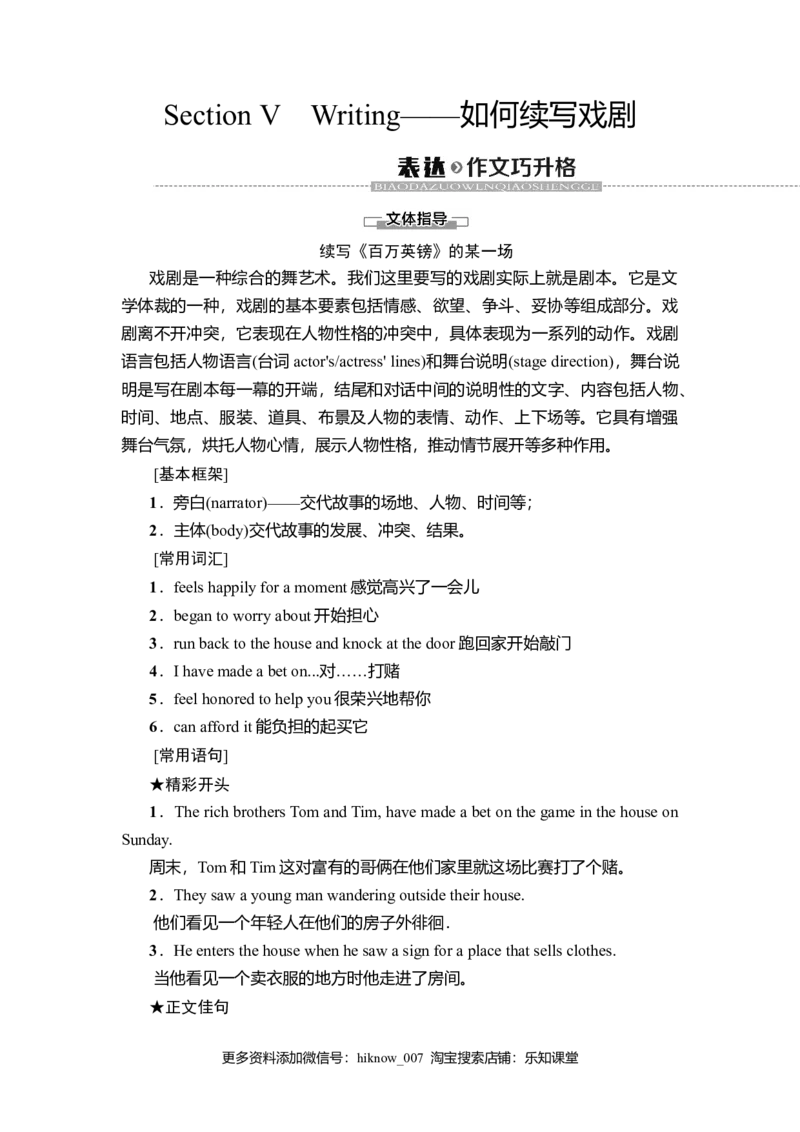
Section Ⅲ Grammar——情态动词和过去
将来时
一、复习情态动词
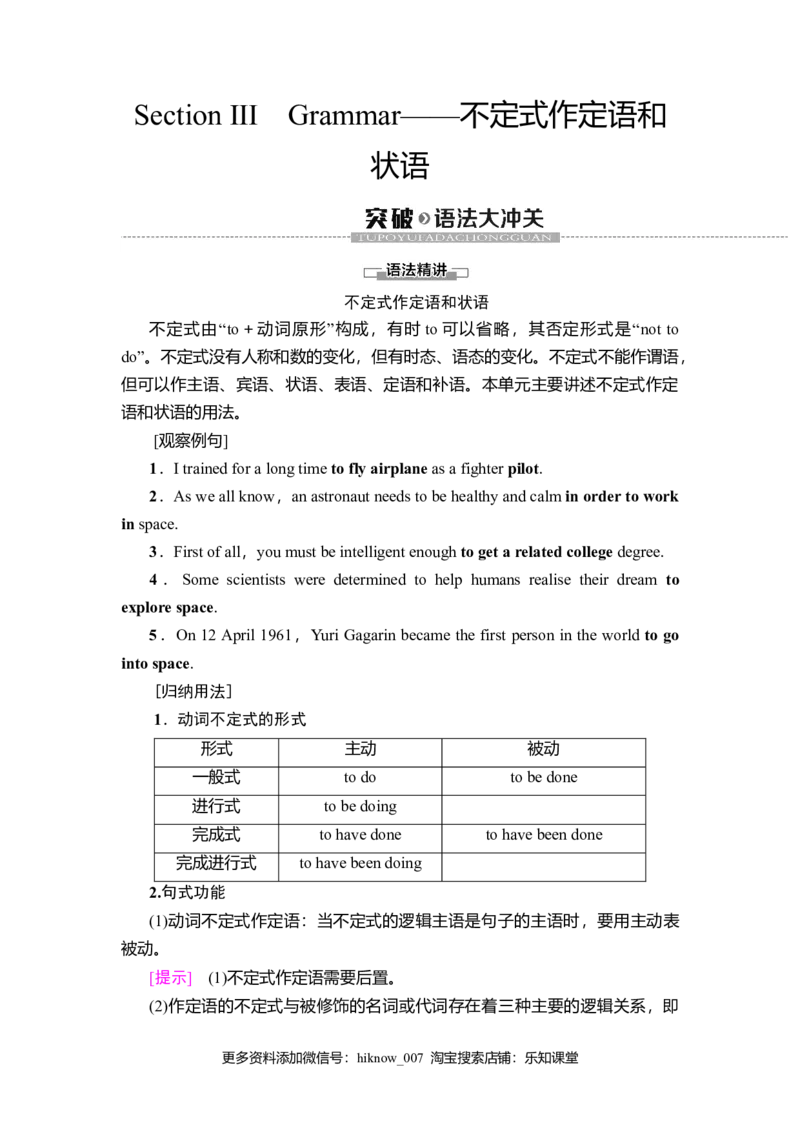
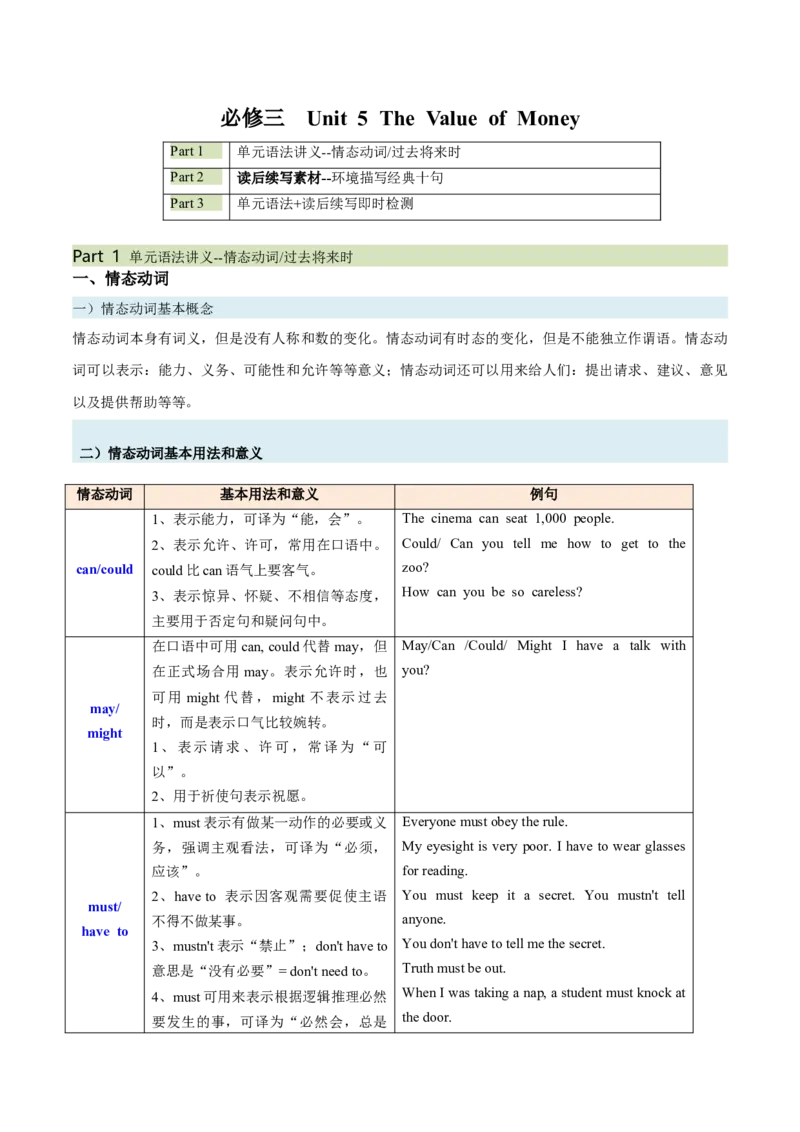
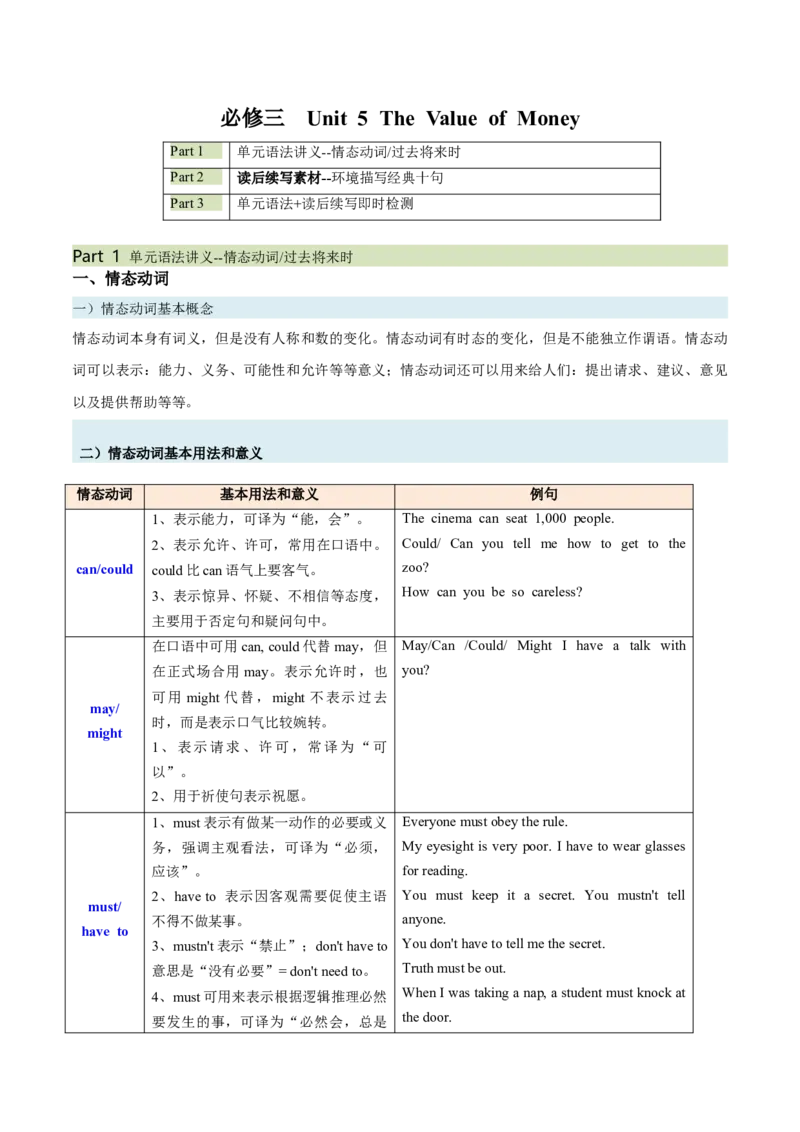
情态动词表示说话人对某一动作或状态的态度。初中阶段大家已经学习了
一些情态动词,这里将对情态动词的特征、功能和用法进行总结。
[观察例句]
1.Oliver believes that with a millionpound bank note a man could live a month
in London.
2.Young man,would you step inside a moment,please?
3.May we ask what you're doing in this country and what your plans are?
4.I can't say that I have any plans.
5.Anyway,I didn't dare to try again.
6.You mustn't worry about that.
7.If you'll excuse me,I ought to be on my way.
[归纳用法]
1.情态动词的基本特征
(1)在形式上,情态动词没有实义动词的各种变化,只有could,would,had
to,might等几个过去式,其他情态动词如must、ought to等的过去式皆与现在
式同形。
(2)在意义上,大多数情态动词有多个意义,如can可以表达“能力;可能;
许可”等。
(3)在用法上,情态动词与助动词一样,需后接动词原形,构成谓语动词。
2.情态动词的否定式及缩略形式
情态动
否定式 缩略形式 情态动词 否定式 缩略形式
词
cannot/
can can't shall shall not shan't
can not
could could not couldn't sould should not shouldn't
更多资料添加微信号:hiknow_007 淘宝搜索店铺:乐知课堂may may not / will will not won't
might
might mightn't would would not wouldn't
not
must must not mustn't need need not needn't
ought
dare dare not daren't ought to oughtn't to
not to
3.情态动词的主要表意功能
用法 例句
The little boy can read and write.
表示能力
I could feel the ground shaking.
Those of you who are familiar with the game will know this.
They made a bet which would settle their argument.
表示可能和 Oh,you must be Sylvia's husband.
推测 It may seem lucky to you but not to me.
That might not be true.
There ought to be enough space for all of us.
You can go off duty now.
You can't open it until two o'clock.
表示许可或
You may not smoke here.
禁止
You shouldn't take her help for granted.
You mustn't do that.
Will you please take her to the library?
表示发出指
Could you offer me work here?
示或提出请
Can I ask a question?
求
May we ask what you're doing in this country?
Will you stay for lunch?
表示提出帮
Wouldn't you like to come with me?
助或发出邀
May I help you?
请
Shall I put it in a box?
You could ask the teacher for help.
表示提出建 You should write him a letter.
议 The cookies Susan made are delicious,you ought to try
some.
更多资料添加微信号:hiknow_007 淘宝搜索店铺:乐知课堂Would you recommend the play to other people?
I would like to know the date.
表示愿望
I'd love to go to your birthday party.
I'd rather not pay you now.
You must come at once.
表示义务和
We have to wear uniforms at school.
需要
I ought to be on my way.
4.情态动词难点透视
英语中的情态动词虽然为数不多,但是要掌握好它们的用法并不容易。下
面结合同学们在使用情态动词时不易掌握的难点谈几点看法。
(1)①can表示可能性时,指的是理论上的可能,它通常不用来表示某事实际
发生的可能性或真实性。如:
Accidents can happen.Anybody can make mistakes.
如果我们要表达某事发生的实际可能性,要用may,could或might等。
We may spend our summer holidays in Hangzhou this year.
Will you answer the telephone?It could/may/might be your mother.
②could用来征求意见时,语气要比can委婉,但在回答问题时我们不能用
could,因为语气委婉,可能性就变小了。如:
—Could I use your telephone?
—Yes,please go ahead.
③在过去时态的肯定句中需要某种条件或努力做成某事,我们要用 was/
were able to而不能用could。如:
It was a holiday and the children were able to go to the seaside.
The girl worked hard so she was able to pass the final test.
(2)must与have to都可以表示“必须”的意思,但要注意以下两点区别。
①must只有现在时,而have to有现在时、过去时和将来时。如:
We must work hard,or we'll fail in the examination.Years ago,the poor girl
had to leave school for lack of money.
②must表示主观看法,have to则侧重于客观需要。如:
We must be strict with ourselves in everything.In cities with many cars,some
people have to wear masks.
(3)must表示推测时,其反意疑问句有好几种形式。①“must+动词原形”对
目前的情况进行推测时以及用must+be+v.ing形式对目前正在发生的情况进行
更多资料添加微信号:hiknow_007 淘宝搜索店铺:乐知课堂推测时,疑问短语部分要与must之后的动词相一致。如:
The mathematics teacher must be in the office now,isn't he?
②“must+have+过去分词”用来表示对已经发生的事情进行推论。如果句子
中有过去的时间状语,疑问部分用助动词 didn't;否则,疑问部分用haven't或
hasn't。如:
The children must have watered the tomatoes yesterday,didn't they?
The minister must have arrived in Shanghai,hasn't he?
(4)shall可以用来征求对方意见,用于第一、三人称。此外它也可以用来表
示说话人的命令、警告、允诺、威胁或决心等,这时它用于第二、三人称。如:
Shall she go to the concert with us this evening?(征求意见)
You shall go to the front at once.(命令)
Don't worry.You shall get the answer this very afternoon.(允诺)
He shall be sorry one day.I tell you.(警告)
Nothing shall stop us from fighting against pollution.(决心)
(5)在表示将来的时间、条件状语从句中,不能用will(这时的will不是情态
动词,而是助动词,帮助构成将来时)。如:
If it will rain tomorrow,we shall not go to the mountain village.(误)
If it rains tomorrow,we shall not go to the mountain village.(正)
当情态动词will表示意愿或决心时,是可以用于条件状语从句的。如:
If you will listen to me,I'll give you some advice on how to learn English.
If you will come this way,the manager will meet you.
(6)should除表示必要或义务外,还可表示推测或可能。如:
The American friends should be here now.
“should/ought to+have+过去分词”既可表示本该做而事实上没有做的事,
也可以表示惊讶、责备、赞叹等情绪。如:
You should have told her about it the day before yesterday.
It's wonderful that you should have achieved so much in these years.
“情态动词+have+过去分词”是很重要的一种句型,除should外,may,
might,must,couldn't,needn't,ought to等都可以用于这一句型,但要注意使
用不同的情态动词句子的意思就有所不同。
(7)ought to与should意思接近,大多数情况下二者可以互换,但是should谈
的是自己的主观看法,ought to则更多反映客观情况,在谈到法律、义务和规定
时使用。如:
We should/ought to help each other and learn from each other in our work.
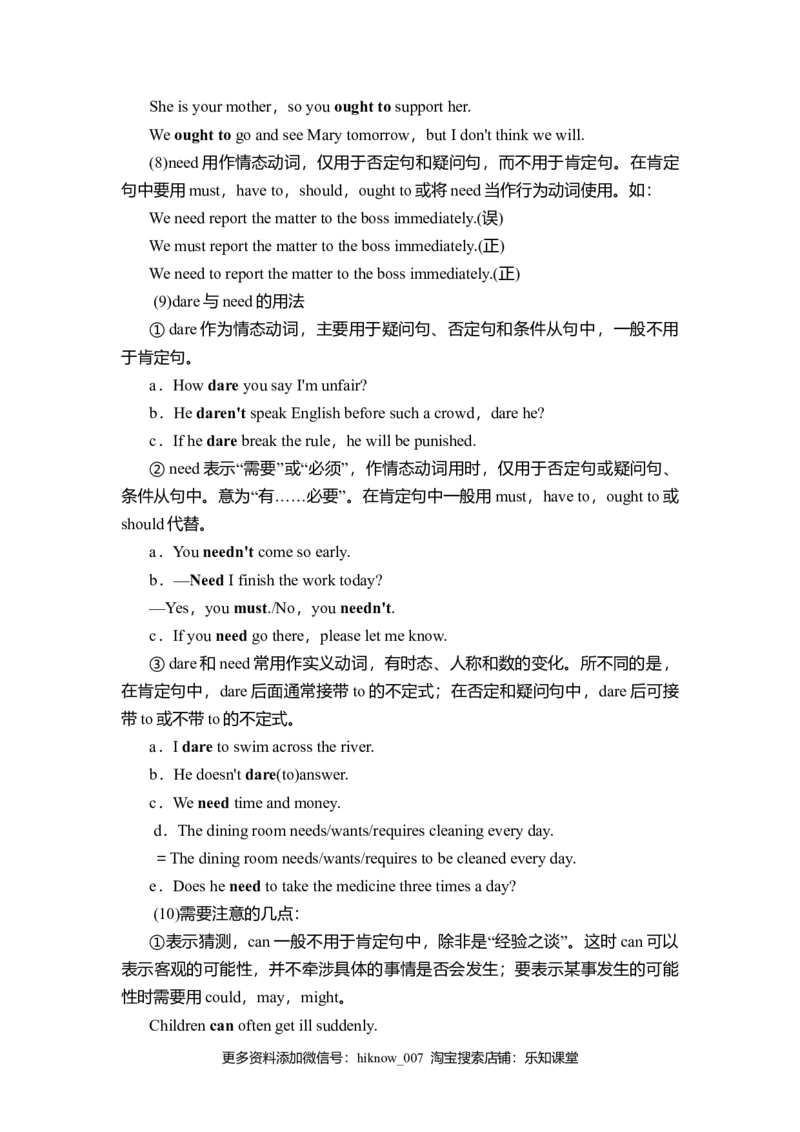
更多资料添加微信号:hiknow_007 淘宝搜索店铺:乐知课堂She is your mother,so you ought to support her.
We ought to go and see Mary tomorrow,but I don't think we will.
(8)need用作情态动词,仅用于否定句和疑问句,而不用于肯定句。在肯定
句中要用must,have to,should,ought to或将need当作行为动词使用。如:
We need report the matter to the boss immediately.(误)
We must report the matter to the boss immediately.(正)
We need to report the matter to the boss immediately.(正)
(9)dare与need的用法
①dare作为情态动词,主要用于疑问句、否定句和条件从句中,一般不用
于肯定句。
a.How dare you say I'm unfair?
b.He daren't speak English before such a crowd,dare he?
c.If he dare break the rule,he will be punished.
②need表示“需要”或“必须”,作情态动词用时,仅用于否定句或疑问句、
条件从句中。意为“有……必要”。在肯定句中一般用must,have to,ought to或
should代替。
a.You needn't come so early.
b.—Need I finish the work today?
—Yes,you must./No,you needn't.
c.If you need go there,please let me know.
③dare和need常用作实义动词,有时态、人称和数的变化。所不同的是,
在肯定句中,dare后面通常接带to的不定式;在否定和疑问句中,dare后可接
带to或不带to的不定式。
a.I dare to swim across the river.
b.He doesn't dare(to)answer.
c.We need time and money.
d.The dining room needs/wants/requires cleaning every day.
=The dining room needs/wants/requires to be cleaned every day.
e.Does he need to take the medicine three times a day?
(10)需要注意的几点:
①表示猜测,can一般不用于肯定句中,除非是“经验之谈”。这时can可以
表示客观的可能性,并不牵涉具体的事情是否会发生;要表示某事发生的可能
性时需要用could,may,might。
Children can often get ill suddenly.
更多资料添加微信号:hiknow_007 淘宝搜索店铺:乐知课堂Certain things in the home can be dangerous,especially if you have young
children.
上面两句可以看作医务工作者或抚养过孩子的人说的话,属“经验之谈”。
②may和might表可能性的推测时都不用于疑问句中。如:
Can/Could it be cloudy tomorrow?(正)
May/Might it be cloudy tomorrow?(误)
③must表肯定推测时的否定式是can't/couldn't,不是needn't或mustn't。
④ should/ought to + 动 词 原 形 : 想 必 现 在 / 将 来 会 … … The dinner
should/ought to be ready now.
He should/ought to ring up this afternoon.
⑤will+动词原形:将来一定/准会……
Try your best,and your wish will come true.
[即学即练] 完成句子
1.我们必须努力学习,否则就不会通过考试。
We must work hard ,or we'll fail in the examination.
2.这个女孩非常用功,所以她通过了最终的考试。
The girl worked hard so she was able to pass the final examination.
3.你怎么能捉弄我呢?
How can you play a trick on me?
4.——我们今天必须把这些玩具分类完毕吗?
——不,你们不必。
—Must we sort these toys today?
—No, you needn't/don't have to .
5.我们应当尊重我们的老师和父母。
We should respect our teachers and parents.
Ⅰ.用适当的情态动词填空
1.—Can't you stay a little longer?
—It's getting late.I really must go now.My daughter is at home alone.
2.—Shall I inform him of the change of the schedule right now?
—I am afraid you mus t ,in case he comes late for the meeting.
3.He couldn't sleep,although he tried to,when he got on such a hunt for an
idea until he had caught it.
更多资料添加微信号:hiknow_007 淘宝搜索店铺:乐知课堂4.You mustn't park here!It's an emergency exit.
5.Doctors say that exercise is important for health,but it must be regular
exercise.
6.The police still haven't found the lost child,but they're doing all they can.
7.—Why are your eyes so red?You can't have slept well last night.
—Yeah,I stayed up late writing a report.
8.According to the newlymade traffic regulation,whoever drives through red
lights shall be fined at least 200 dollars.
9.George can't have gone too far.His coffee is still warm.
10.You must be Carol.You haven't changed a bit after all these years.
Ⅱ.短文语法填空
A long time ago,there was a woman,1.who had two children.One was called
Tom,and the other was named John.One day the woman was very puzzled(疑惑的).
She had some cakes in the kitchen but every night one of her children 2.would eat
them.She thought it 3.might be Tom because he was very tall 4.while John was very
short.But she wasn't sure.The woman had an idea.She put the cakes on a high
shelf.The next day , someone 5.ate(eat) some of the cakes.“Ah ! ” said the
woman.“It 6.can't be John.He's too short!It 7.must be Tom!”She was very angry
with Tom,8.thinking(think),“He 9.shall be punished for what he had done!”Poor
Tom.In fact,he hadn't eaten the cakes.It was John.How?Can you guess?Yes,he
10.must have used a chair!
二、过去将来时
过去将来时表示在过去某一时间将要发生的动作或存在的状态。过去将来
时常用在主句谓语动词为过去时态的宾语从句中。过去将来时句子中有时包含
时间状语the next day,soon等。
[观察例句]
1.I was about to get the letter.
2.They said the letter inside would explain what it was all about.
3.The director said he would meet the famous actor the next day.
4.They were going to find someone to take part in their bet when they saw
Henry walking on the street outside.
[归纳用法]
1.过去将来时的基本构成和用法
更多资料添加微信号:hiknow_007 淘宝搜索店铺:乐知课堂过去将来时由“would+动词原形”构成,主要表示从过去某一时间来看将要
发生的动作(尤其用于宾语从句中),还可以表示过去的动作习惯或倾向。
Jeff knew he would be tired the next day.
He promised that he would not open the letter until 2 o'clock.
She said that she wouldn't do that again.
2.表示过去将来时的其他表达法
(1)was/were going to+动词原形:该结构有两个主要用法,一是表示过去的
打算,二是表示在过去看来有迹象表明将要发生某事。
I thought it was going to rain.
(2)was/were to+动词原形:主要表示过去按计划或安排要做的事情。
She said she was to get married next month.
(3)was/were about to+动词原形:表示在过去看来即将要发生的动作,由于
本身已含有“即将”的意味,所以不再与表示具体的将来时间状语连用。
I was about to go to bed when the phone rang.
(4)was/were+现在分词:表示在过去看来即将发生的动作,通常可用于该
结构中的动词是 come,go,leave,arrive,begin,start,stop,close,open,
die,join,borrow,buy等瞬间动词。
Jack said he was leaving tomorrow.
[即学即练] 完成句子
1.莉莉说晚上将有一场音乐会。
Lily said there would be a concert that evening.
2.她确信她会成功。
She was sure she would succeed .
3.我想知道我们什么时候出发。
I wanted to know when we were going to set off.
4.他说运动会就要开始了。
He said the sport meet was about to begin .
5.他说他今晚要走。
He said he was leaving tonight.
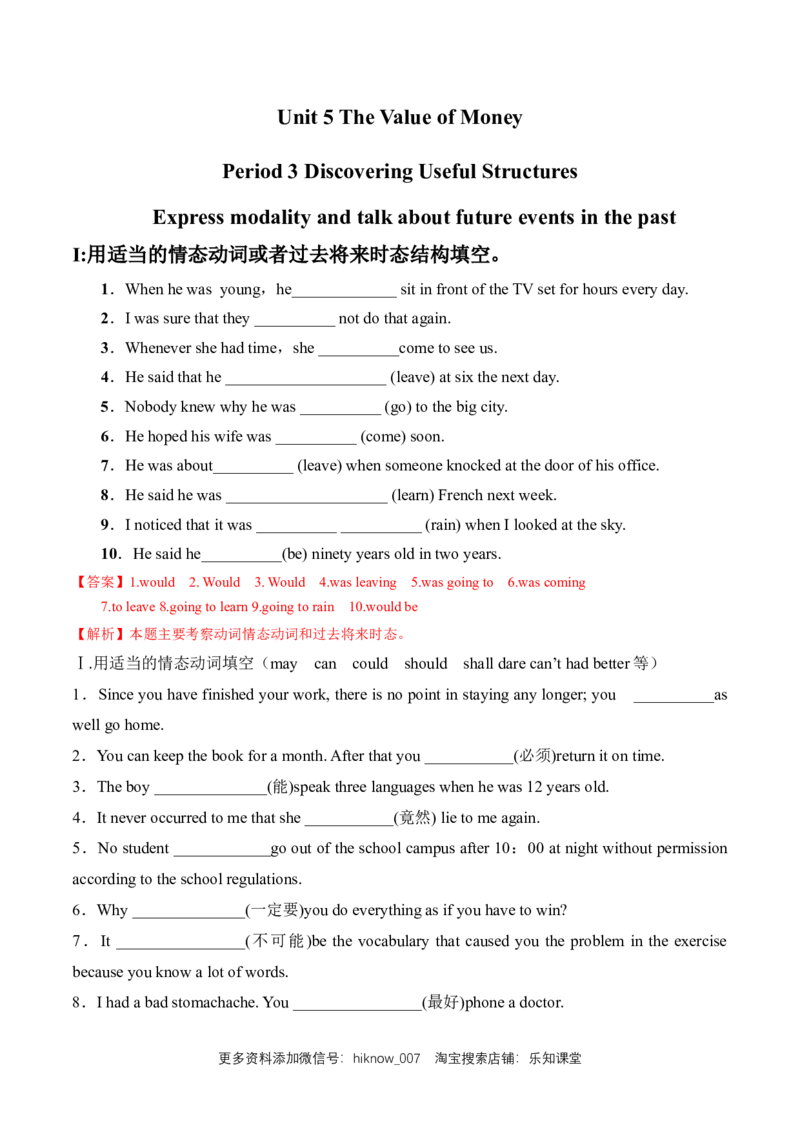
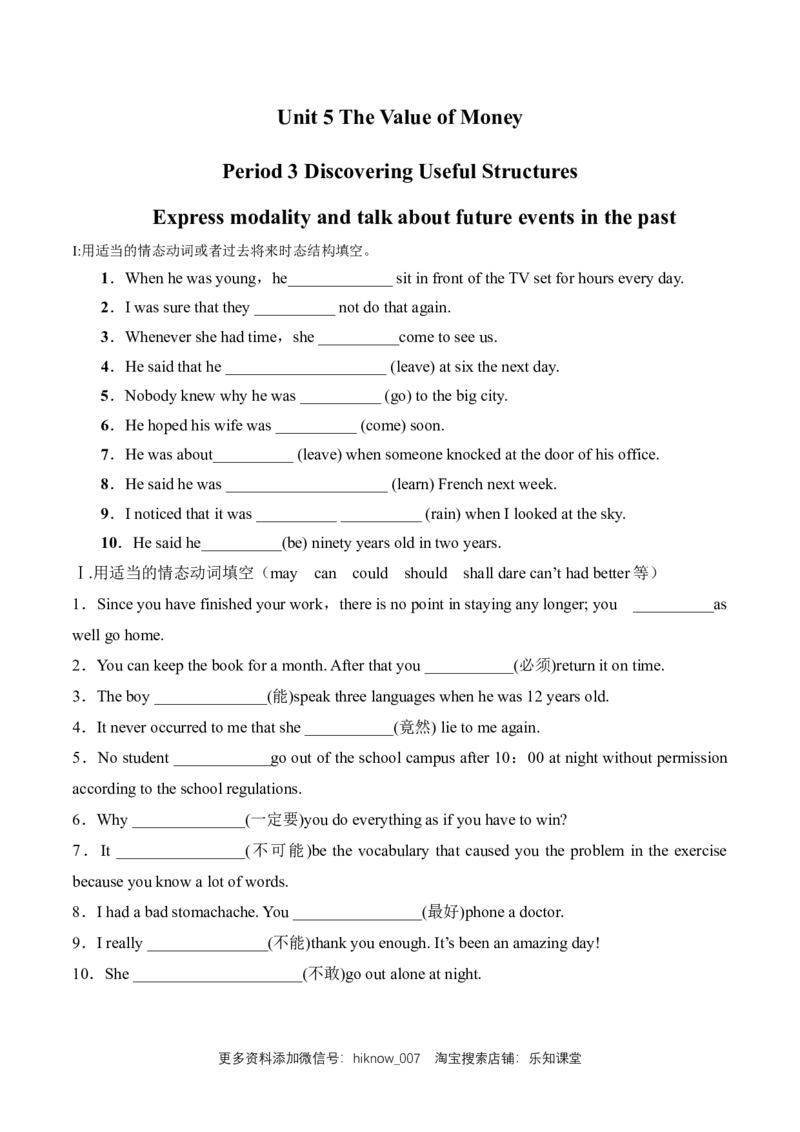
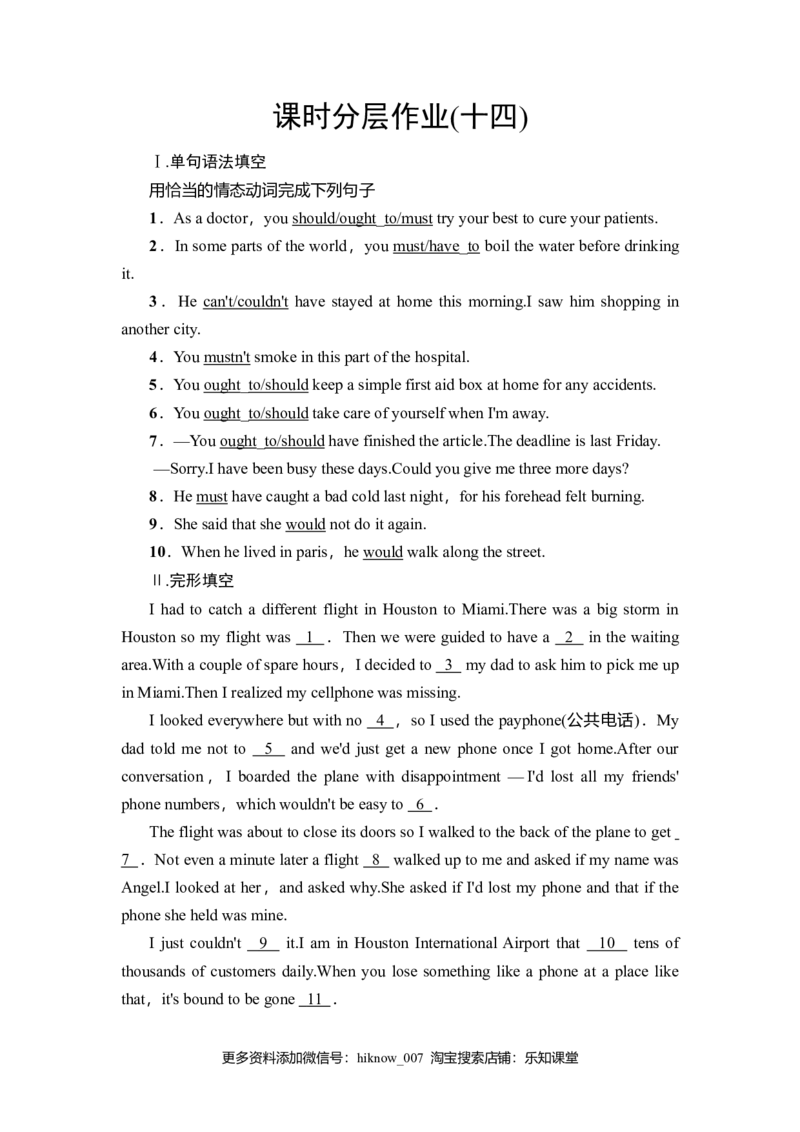
Ⅰ.单句语法填空
1.When he was young,he would sit in front of the TV set for hours every day.
2.I was sure that they would not do that again.
更多资料添加微信号:hiknow_007 淘宝搜索店铺:乐知课堂3.Whenever she had time,she would come to see us.
4.He said that he was leaving (leave) at six the next day.
5.No body knew why he was going (go) to the big city.
6.He hoped his wife was coming(come) soon.
7.He was about to leave (leave) when someone knocked at the door of his
office.
8.He said he was going to learn(learn) French next week.
9.I noticed that it was going to rain(rain) when I looked at the sky.
10.He said he would be ninety years old in two years.
Ⅱ.短文语法填空
The two gentlemen had been having a heated argument for a couple of days,and
had decided to make a bet which 1.would settle their argument.They 2.were going to
find(find) someone to take part in their bet when they saw Henry walking on the street
outside.They invited him into their house,3.where Henry told them he had landed in
Britain 4.by accident.Although he had gone to the American consulate 5.to seek
help,he had not received any.Henry hoped that the brothers 6.would offer him some
jobs because he had no money.Henry got upset with the brothers 7.when they seemed
too happy about his bad luck.They quickly told him not to feel that way and they gave
him an envelope with money in it.They said the letter inside 8.would explain what it
was all about,but he had to postpone 9.opening(open) it until 2 o'clock.Henry felt
that was odd.The story ended with Henry leaving their house and promising that he
10.would not(not) open the letter until 2 o'clock.
更多资料添加微信号:hiknow_007 淘宝搜索店铺:乐知课堂