夜雨聆风
夜雨聆风点击蓝字,关注我们
很多同学看到表格 + 折线图 / 柱状 + 表格组合图就头疼:两张图数据杂乱,不知道怎么拆分段落,概述抓不住核心趋势,写出来逻辑混乱直接丢分。
今天拿一道经典组合图真题,拆解标准化 4 段式写作框架,附带 7 分范文、逐段翻译、20 分钟写完 150 词 +
文中所涉及资料领取方式在文章末尾处

一.真题题目


二、4 段式万能写作思路

第一段:改写题目(开头段,2 句话搞定)
✅核心任务:同义替换改写题干,说明两张图表分别展示什么数据、范围、时间
✅替换词积累:show=illustrate/depict;figure=data;period=timespan❌禁止原句照搬题干,会直接扣分
第二段:Overview 概述段(提分关键,3 个宏观趋势,不写任何数字)
✅核心任务:总结全局变化、极值、强弱对比,不用细节数据
万能逻辑结构:
共性趋势(全部主体统一变化) 极值对比(最高 / 最低国家 / 数据) 特殊反差(增速快慢、前期后期巨大差异)
第三段:主体段 1(单独描述第一张图表数据)
✅操作:按增长幅度排序描述数据,先写数值最高主体,再依次描写其余国家
✅区分增速词汇分层描写,避免重复用 increase
第四段:主体段 2(单独描述第二张图表数据,和上段形成对照)
✅操作:先写整体领先主体,再重点突出变化最剧烈的对象,最后补充剩余国家,呼应概述内容


三.满分范文

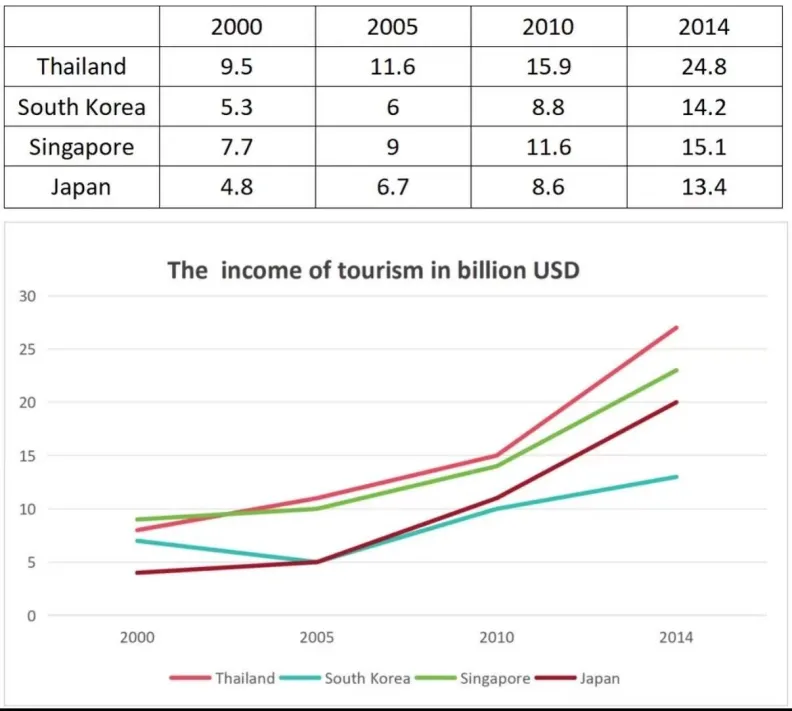
The table and line graph illustrate the number of international tourists (in millions) and the corresponding tourismincome (in billion USD) for four East Asian countries – Thailand, South Korea, Singapore, and Japan – over the period from 2000 to 2014.
表格和折线图展示了 2000 年至 2014 年间,四个东亚国家 —— 泰国、韩国、新加坡和日本 —— 的国际游客数量(百万)及相应旅游收入(十亿美元)
Overall, both the number of international tourists and tourism revenue increased significantly in all four countries over the timeframe. Thailand consistently had the highest tourism income by the end of the period, while South Korea saw the slowest growth in tourist arrivals. Notably, Japan recorded the most dramatic rise in tourism earnings, despite having the lowest initial tourist numbers.
总体而言,在此期间,所有四个国家的国际游客数量和旅游收入均显著增长。截至期末,泰国始终拥有最高的旅游收入,而韩国的游客数量增长最为缓慢。值得注意的是,尽管日本的初始游客数量最低,但其旅游收入实现了最急剧的增长。
Looking at the tourist arrivals first, Thailand welcomed 9.5 million international visitors in 2000, and this figure rose steadily to 11.6 million in 2005, 15.9 million in 2010, and finally peaked at 24.8 million in 2014. Singapore’s tourist numbers grew from 7.7 million to 15.1 million over the same period, while South Korea saw a more gradual increase from 5.3 million to 14.2 million. Japan had the lowest initial arrivals at 4.8 million, but this more than doubled to 13.4 million by 2014.
首先看游客数量,泰国在 2000 年接待了 950 万国际游客,这一数字稳步增长至 2005 年的 1160 万、2010 年的 1590 万,并最终在 2014 年达到 2480 万的峰值。同期,新加坡的游客数量从 770 万增长至 1510 万,而韩国则从 530 万缓慢增长至 1420 万。日本的初始游客数量最低,为 480 万,但到 2014 年这一数字翻了一倍多,达到 1340 万。
Turning to tourism income, Thailand’s revenue grew from around 8 billion USD in 2000 to over 27 billion USD in 2014, making it the highest-earning country. Japan’s tourism income saw the most striking surge, starting at approximately 4 billion USD in 2000, remaining low until 2005, and then rising sharply to 20 billion USD by 2014. Singapore’s earnings increased from roughly 9 billion USD to 23 billion USD, while South Korea’s income rose slowly from about 7 billion USD to 13 billion USD, the lowest among the four nations by the end of the period.


四.考场通用答题小贴士

组合图固定 4 段结构,不要合并图表写在同一段,逻辑分差直接拉开
Overview 是提分核心,一定要单独成段,不要和开头揉在一起
描述数据时区分三种增速词汇,全程不重复,词汇分直接拉满
字数控制160-190 词,不要少于 150 词,无需额外主观推测
告别无效备考
💪和阿宁一起“屠鸭”!
将持续更新更多雅思资料
用最实用的干货,
做你的专属备考搭子!

关注公众号:途鸭雅思说
回复关键词:【雅思】
无偿领取雅思资料PDF版本


求点赞

求分享

求喜欢