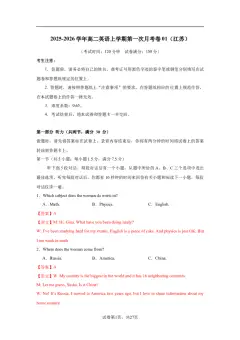
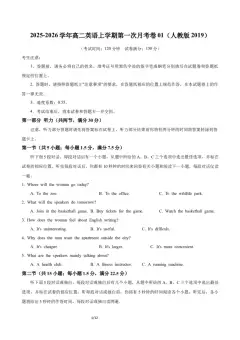
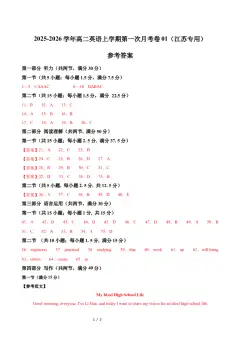
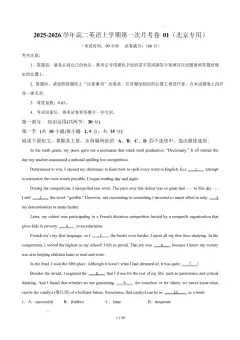
2025-2026学年高二英语上学期第一次月考卷01(江苏)
(考试时间:120分钟 试卷满分:150分)
考生注意:
1.答题前,请务必将自己的姓名、准考证号用黑色字迹的签字笔或钢笔分别填写在试
题卷和答题纸规定的位置上。
2. 答题时,请按照答题纸上“注意事项”的要求,在答题纸相应的位置上规范作答,
在本试题卷上的作答一律无效。
3.难度系数:0.65。
4.考试结束后,将本试卷和答题卡一并交回。
第一部分 听力(共两节,满分 30 分)
做题时,请先将答案标在试卷上。录音内容结束后,你将有两分钟的时间将试卷上的答案
转涂到答题卡上。
第一节(共5小题;每小题1.5分,满分7.5分)
听下面5段对话。每段对话后有一个小题,从题中所给的A、B、C三个选项中选出
最佳选项。听完每段对话后,你都有10秒钟的时间来回答有关小题和阅读下一小题。每段
对话仅读一遍。
1.Which subject does the woman do worst in?
A.Math. B.Physics. C.English.
2.Where does the woman come from?
A.Russia. B.America. C.China.
3.What are the speakers doing?
A.Fishing. B.Swimming. C.Reading.
4.How does the woman feel now?
A.Hungry. B.Tired. C.Thirsty
5.What is the possible relationship between the speakers?
A.Husband and wife. B.Classmates. C.Colleagues.
第二节(共15小题;每小题1.5分,满分22.5分)
听下面5段对话或独白。每段对话或独白后有几个小题,从题中所给的A、B、C三个选项
中选出最佳选项,并标在试卷的相应位置。听每段对话或独白前,你将有时间阅读各个小
试卷第1页,共14页
学科网(北京)股份有限公司题,每小题5秒钟;听完后,各小题将给出5秒钟的作答时间。每段对话或独白读两遍。
听下面一段较长对话,回答以下小题。
6.What is the probable relationship between the speakers?
A.Mother and son.
B.Teacher and student.
C.Interviewer and interviewee.
7.What does the woman recommend the man do?
A.Do some voluntary work.
B.Write a statement by hand.
C.Dress smartly for his interview.
听下面一段较长对话,回答以下小题。
8.How many people are expected to attend the party?
A.About 250. B.About 300. C.About 350.
9.Why can’t the party be held in the Pine Room?
A.There’s not enough room.
B.The decoration isn’t good.
C.It is a bit far.
10.What will Dr. Darren do next Friday night?
A.Listen to a report.
B.Take part in a party.
C.Work on a speech.
听下面一段较长对话,回答以下小题。
11.What’s the function of Gita?
A.To be used as a cellphone.
B.To help carry some groceries.
C.To direct people using the GPS.
12.What does Bob think of the price of Gita?
A.Acceptable. B.Too high. C.Too low.
13.What makes some experts hold a negative attitude to Gita?
A.Its great weight. B.Its complex lock. C.Its simple purpose.
听下面一段较长对话,回答以下小题。
试卷第2页,共14页14.Where are the speakers?
A.In a zoo. B.In a hospital. C.On a train.
15.How much did they pay?
A.$10. B.$30. C.$40.
16.How does the man feel?
A.Regretful. B.Content. C.Worried.
听下面一段独白,回答以下小题。
17.What does the speaker do probably?
A.A businessman. B.An engineer. C.A teacher.
18.What can the audience do in the last part of the presentation?
A.Ask some questions. B.Taste the tea they make. C.Learn about tea leaves.
19.Who will give a lecture next month?
A.A tea expert. B.The head of a restaurant. C.A dishwasher.
20.What does the speech aim to do?
A.To compare. B.To argue. C.To inform.
第二部分 阅读(共两节,满分50分)
第一节 (共15小题;每小题2.5分,满分37.5分)
阅读下列短文,从每题所给的A、B、C和D四个选项中,选出最佳选项。
A
A solo getaway offers the best opportunity to immerse oneself in the authentic culture,
history, and expression of a particular destination. With some planning and expert advice, your
next solo journey can reach new heights.
A walk on the Wilde side in Dublin
There may be no better combination than a pint and a good book — and no better
destination to engage yourself in literature than Oscar Wilde’s birthplace, Dublin, Ireland. Art and
cultural historian Dr. Andrew Lear suggests a hotel with historical significance. “I highly
recommend The Shelbourne, where Oscar Wilde stayed on a speaking tour in Dublin.”
Big dreams fulfilled on Petit St. Vincent
If the idea of an all-inclusive resort sounds appealing but the crowds of guests not so much,
试卷第3页,共14页
学科网(北京)股份有限公司consider the private island of Petit St. Vincent, located 40 miles south of St. Vincent. Getting there
is an adventure, including a private flight from Barbados to Union Island and a boat transfer. The
115-acre island features one-and two-bedroom cottages dotted throughout the grounds where
visitors can get lost in the sound of gentle waves.
Hygge hunting in Copenhagen
If “hygge” — the elusive Danish definition of well-being — is your idea of an ideal
getaway, Copenhagen ranks high for its thoughtful design. Denmark’s capital is the best locale to
spend an afternoon coffeehouse-hopping with a stack of design magazines.
Māori magic on New Zealand’s South Island
Solo travelers looking to connect with local cultures of New Zealand’s South Island have
plenty of opportunities with Māori family-owned businesses like Whale Watch Kaikoura or a day
with Te Rua & Sons Pounamu Tours to explore the West Coast and perhaps to find a
pounamu keepsake, a jade-like stone indigenous to the region.
21.What’s Dr. Andrew Lear’s recommendation for literature fans?
A.Staying at The Shelbourne Hotel.
B.Going to the cultural hub with art galleries.
C.Booking a helicopter ride to Franz Josef Glacier.
D.Considering the private island of Petit St. Vincent.
22.How do travelers reach Petit St. Vincent from Barbados?
A.Directly by boat. B.On a guided hike.
C.By boat after a private flight. D.Using the on-site dive center.
23.Which offers solo travelers opportunities to experience Māori culture?
A.Dublin, Ireland. B.Petit St. Vincent.
C.Copenhagen, Denmark. D.New Zealand’s South Island.
B
I am someone who is outgoing, chatty and friendly. I can appreciate that at first glance I do
not appear to be any different from anyone else. Even though I present myself as neuro typical (神
经正常的),that is entirely down to masking. The only reason I don’t “look like” the traits
associated with autism (自闭症) is because I am often forcing myself to appear “normal”. Not all
autistic people do this, but I do.
I smile whenever I want to bang my head against the wall and scream. I say, “Oh, that’s
试卷第4页,共14页fine!” when a restaurant doesn’t have what I want, and the loss makes me feel like my skin is on
fire. I force myself to make eye contact, laugh and focus on conversations. But sometimes I can’t
maintain it. Sometimes, overwhelmed by unexpected impulses (冲动), my mask slips. How
somebody responds to me in those moments tells me everything I need to know about their view
of autistic people.
I assume that there is a lack of understanding. When people become annoyed that I cancel
plans, or when I freak out (极度不安) when I experience new or strange sounds and tastes, they
undoubtedly lack empathy. In these moments, I can see any acceptance of autistic people from
these kinds of people is for show. It is easy to say that you support autistic people; but if you are
only supportive when that person presents as neurotypical, then that isn’t real support.
So, telling me that I “don’t look autistic” is more denial than it is a praise. Someone
shouldn’t have to “look autistic” for you to believe they are autistic, nor should anyone receive
more support just because they pass as neurotypical. We are all cupcakes, whether we look like it
or not, and are all equally deserving of empathy and support.
24.Why doesn’t the author appear autistic?
A.He feels comfortable with himself.
B.He has good people skills.
C.He tries to behave normally.
D.He is recovering from autism.
25.What does the author think about the way autistic people are treated?
A.They are given a lot of support.
B.They deserve real care and concern.
C.They are taught to control their impulses.
D.They are supported like normal people.
26.How does the author feel when being told he doesn’t look autistic?
A.Delighted. B.Surprised. C.Encouraged. D.Uncomfortable.
27.What is the author’s main purpose in writing this text?
A.To call for more understanding of autistic people.
B.To show his empathy for all those with autism.
C.To share his experience as someone with autism.
D.To remove misunderstandings about autistic people.
试卷第5页,共14页
学科网(北京)股份有限公司C
What Could the School of 2050 Look Like?
Thanks to technology-driven advances in education, the school of 2050 may look different
in many ways. For example, on entering the classroom, biometric scanning (生物识别扫描) will
allow students to check in. Teachers will be able to gather attendance data automatically. For the
school of the future, there will be no need to deal with heavy curtains or dust-covered blinds; we’ll
have smart glass. Windows can automatically adjust their colors, protecting both our eyes and
screens.
By 2050, 3D printers will have become a standard appliance, both in the home and at
school. As a learning aid, they’ll have become crucial, allowing teachers more flexibility to
explain difficult concepts.
Adaptive learning systems driven by artificial intelligence (AI) will have become integrated
into the school environment by 2050. Personalized learning experiences will take into account
learning styles and create adaptive assessments that adjust in real time based on performance. AI
may also be used to analyze pupils’ work, even so far as predicting future performance, helping
teachers understand which students need more guidance on a particular concept before they fall
behind.
Students will be able to get immediate feedback ( 反 馈 ), with suggested areas for
improvement and more personalized tutoring (辅导) based on their strengths and weaknesses. And
homework assignments will mostly be online. From downloading the assignment at the end of the
lesson to submitting it remotely, students will be able to view their coursework, see the percentage
completed, and track general assessments.
Gone will be the days of carrying heavy textbooks, and hurriedly putting them into lockers
after lessons. Students of the future can look forward to having recommended reading materials
right at their fingertips via e-readers and tablet devices which can be operated through virtual
reality. As a result, dependence on paper products will be reduced. Though paper won’t disappear
completely, it’ll be eco-friendly, either recycled or made from fast-growing plants like bamboo.
28.How will students in 2050 sign in?
A.With check-in sheets. B.By biometric scanning.
C.With a teacher’s headcount. D.By messaging the teacher.
试卷第6页,共14页29.What is the main focus of paragraphs 3 and 4?
A.AI’s impact on reducing school operational costs.
B.The role of AI in personalizing student learning paths.
C.The use of virtual reality in enhancing physical education.
D.The benefits of adaptive learning systems for student safety.
30.What can we learn about the future textbooks?
A.They only use bamboo paper. B.They will remain paper-based.
C.Digital ones may replace them. D.All the students in the class only need one.
31.What is the author’s purpose in writing the text?
A.To criticize traditional teaching methods.
B.To highlight the challenges faced by students.
C.To inform readers about the future of schools.
D.To promote the use of technology in education.
D
Hearing live music may be more stirring than listening to a recording of the same tune
because it causes greater activity in the part of the brain linked to processing emotions.
Sascha Fruhholz at the University of Zurich in Switzerland and his colleagues composed 12
pieces of music, each lasting 30 seconds. Half were written with the aim of conveying negative
emotions, such sadness and anger. These were slower and less harmonious than the remaining
songs, written to express positive emotions.
They then recruited (招募) 27 people, who weren’t musically trained, to listen to these 12
pieces twice — once performed by a live pianist, which the participants heard through a speaker,
and once as a recording. The order they heard them was randomly assigned, with 30 seconds of
silence in between. The participants had little idea when they were hearing a recording or live
music. While listening to the music, they lay in an MRI (核磁共振成像) scanner so the team
could monitor their brain activity. The pianist adapted the volume and speed of the live piece
according to their activity. But the recorded music was not adjusted.
The researchers found that live performances of both the negative and positive pieces
consistently led to increased brain activity in the left amygdala (杏仁体) — the region of the brain
that is strongly linked to assigning sensory stimuli, such as sounds, to certain emotions.
试卷第7页,共14页
学科网(北京)股份有限公司Meanwhile, the recorded tunes sparked much less activity in the left amygdala. This matched up
with how emotive the participants rated each piece of music after the experiment. The findings
show that live music intensifies our emotional response, probably due to its free-flowing, dynamic
nature, says Fruhholz.
The researchers hope to repeat the experiment with a larger audience in a concert setting.
“If you go to a live concert, you’re not alone,” says Fruhholz. “This intensified emotional
experience is also a social experience.”
32.What does the underlined word “stirring” mean in paragraph 1?
A.Proper. B.Special. C.Calm. D.Exciting.
33.What do we know about 12 pieces of music?
A.They lasted half a minute in total. B.Fruhholz recorded them in his own right.
C.Not all of them conveyed positive emotions. D.Those conveying sad emotions were
faster.
34.What can be inferred from the experiment?
A.The participants heard the 12 pieces non-stop.
B.The recruited people were divided into 2 groups.
C.The team accordingly adjusted the music pieces.
D.The subjects’ brain activities in it were observed.
35.What is the main idea of the last but one paragraph?
A.The importance of the left amygdala. B.The final findings of the research.
C.The following research directions. D.The underlying logic of the brain
第二节(共5小题:每小题2. 5分, 满分12. 5分)
阅读短文, 从短文后的选项中选出可以填入空白处的最佳选项。选项中有两项为多余选项。
First of all, we need to understand that handling interpersonal relationships is not as simple as
treating others to meals or giving gifts. In today’s era, everyone seems to carry an invisible list of
treating and gifting, from dinner parties to wedding banquets, from Mid-Autumn mooncakes to
Spring Festival red envelopes, which all seem to be tightly wrapped in the “human relationship
culture”. 36
The Mehrabian Principle
Psychologist Albert Mehrabian put forward a very interesting formula, which reveals the
importance of the three major elements in communication: the content of words accounts for only
试卷第8页,共14页7%, the tone of voice accounts for 38%, and a high 55% of the information actually comes from
non-verbal body language. 37 Whether your eyes are wandering or firm when you
speak, whether your gestures are fluttering or quiet, these subtle details that are easily ignored are
the truth of interpersonal communication.
Non-verbal Communication
From the perspective of language psychology, a person’s speaking intonation, pitch, and speed
will affect others’ understanding of his intentions. At the beginning of Martin Luther King’s
speech, his tone was calm and low, with analysis and contemplation, telling the facts of racial
inequality and gradually introducing hope. 38 Finally, it reached the peak in
“Freedom forever”. The reason why this speech moved the audience was not only relying on the
words, but also on the passion and hope conveyed by the tone.
Emotional Capital
The “emotional capital” in sociology can help us understand the role of the Mehrabian Principle in
interpersonal relationships. 39 Treating others to meals can accumulate short-term
goodwill, but only long-term emotional investment can make interpersonal relationships as stable
as bank deposits and play a role at critical moments.
Facial Expression Management
As the saying goes, “You don’t hit a person who smiles at you”. A sincere smile can
instantly shorten the distance between people. 40 A face that often wears a smile will
make people feel that you are friendly and approachable, and they are willing to have in-depth
communication with you.
A.However, in fact, the key to interpersonal communication does not lie in material things, but
in the emotional transmission during communication.
B.When he said “I have a dream”, his tone rose, full of passion and expectation, and his voice
became more powerful and rhythmic.
C.This means that non-verbal signals are far more influential than the words themselves in
communication.
D.Emotional capital is a relational asset accumulated through emotional interaction, which
creates trust in long-term relationships.
E.Whether it’s a workplace meeting or a social gathering, a smile is always the best icebreaker.
试卷第9页,共14页
学科网(北京)股份有限公司F.Many people believe that material gifts are the most direct way to maintain relationships.
G.It is difficult to build trust with others if you always show a cold or unfriendly expression.
第三部分 语言运用(共两节,满分30分)
第一节(共15小题:每小题1分,满分15分)
阅读下面短文, 从每题所给的A、B、C、D四个选项中选出可以填入空白处的最佳选项。
I began my journey at 12, working as a waitress — a job that gave me more about people
than any classroom. When I went on to college, it also 41 for tuition and housing and —
eventually — a camera. But best of all, being a waitress taught me to quickly 42 and
understand all kinds of people. I learned how to make small talk and how to quickly put people at
ease — great training for a 43 .
From the moment I picked up a camera, I was 44 . I lost interest in other hobbies,
and all I wanted to do was take pictures for the university newspaper, the Minnesota Daily. In six
months, I was able to get a lot of great 45 . The week I finished college, I was 46
by the Worthington Daily Globe. By some miracle I was hired, and the two-year experience that
followed was like a master class in photojournalism.
One morning, a phone call 47 everything. “You a photographer?” asked a rough
voice. When I replied that indeed I was, the voice 48 , “This is Bob Gilka. National
Geographic. I need a hail (冰雹) damage 49 . You guys get a big hailstorm last night?” I
50 my nervousness and said, “Yes, sir.” When he asked if I could take the photo for him, I
again said, “Yes, sir.” My little picture of hail damage was well 51 and launched my 40-
year career with the 52 .
Through decades, my lens captured 53 truths: Norwegian farmers and Mongolian
herders sharing identical laughter creases (皱纹); tsunami survivors and wildfire fighter displaying
equal 54 . Crafting my photography exhibition, I feel each frame pulses with 55
stories.
41.A.paid B.earned C.spent D.afforded
42.A.praise B.confirm C.entertain D.assess
43.A.teacher B.waitress C.journalist D.student
44.A.moved B.absorbed C.struck D.thrown
试卷第10页,共14页45.A.money B.equipment C.knowledge D.experience
46.A.visited B.recommended C.contacted D.appointed
47.A.improved B.declared C.recorded D.changed
48.A.shouted B.responded C.doubted D.whispered
49.A.picture B.evidence C.document D.scene
50.A.withdrew B.overcame C.admitted D.showed
51.A.adopted B.examined C.received D.sold
52.A.magazine B.book C.poster D.brochure
53.A.local B.universal C.distant D.national
54.A.courage B.beauty C.fear D.pain
55.A.written B.translated C.copied D.unspoken
第二节(共10小题:每小题1. 5分, 满分15分)
阅读下面短文, 在空白处填入1个适当的单词或括号内单词的正确形式。
Every young person has dreams. Some want to be chefs, others hope to become 56
(engineer) or designers. Vocational school students can learn 57 (practice) skills that
turn these dreams into reality.
Many successful people started just like you. A famous chef might have begun by 58
(study) cooking at a vocational school. A top car mechanic probably practiced repairing engines in
school workshops. These people prove 59 vocational education doesn’t limit your
future-it builds it.
The path isn’t always easy. You’ ll need to 60 (work) hard, keep learning, and
never give 61 when facing difficulties. But remember, every skill you master 62
(bring) you closer to your dream. Your hands-on training is actually your advantage — you’re
gaining real-world experience while 63 (other) are just studying theory.
Hold on to your dreams. With your special skills, you can 64 (creation) your own
success story. After all, the world needs excellent technicians as much 65 it needs
doctors and lawyers. Your dream is waiting-go for it!
第四部分 写作(共两节, 满分40分)
试卷第11页,共14页
学科网(北京)股份有限公司第一节(满分15分)
66.假如你是李华,学校即将举办主题为“My ideal high school life”的英语演讲比赛,请你
写一篇参赛稿,主要内容包括:
1. 介绍自己的想法;
2. 阐述高中学校生活的意义。
注意:
1. 写作词数应为80个左右;
2. 请按如下格式在答题卡的相应位置作答。
_______________________________________________________________________________
_______________________________________________________________________________
_______________________________________________________________________________
_______________________________________________________________________________
_______________________________________________________________________________
_
第二节(满分25分)
67.阅读下面材料,根据其内容和所给段落开头语续写两段,使之构成一篇完整的短文。
Ms. Eleanor, a senior lady, lives by herself in an urban area. She is a lady with a warm
smile and is known for her fondness of bookshops and her habitual walks through the city’s
historical region.
One evening, as she was heading back to her home from a park, Ms. Eleanor suddenly
realized that her purse was missing. She retraced her steps, searching every corner of the park. Her
heart sank with each passing moment, as the purse contained a treasured photograph of her
departed husband, which she carried as a precious treasure.
As the sun set, casting long shadows along the pavements, Ms. Eleanor felt an
overwhelming sense of loss and hopelessness. In the meantime, a young man named Tom was
walking home from her cherished job at the community library. As he passed by the bookshop
which Ms. Eleanor had visited earlier that day, he spotted something nestled in the corner of the
pavement. Interested, he picked it up and discovered it to be a well-worn leather purse. Tom
opened the purse, seeking some identification to return it to its owner. It wasn’t long before he saw
the cash and personal belongings inside. Recognizing the significance of what he held, he decided
试卷第12页,共14页to wait at the spot where he found the purse, hoping that the owner would return to search for it.
As nightfall blanketed the city, Ms. Eleanor, with a heavy heart, headed back to her beloved
bookshop to make her last attempt to get back her purse. Her pace was slow and weary, yet her
determination was strong. As she drew near to the bookshop, she noticed a figure standing under a
street lamp, hold something in his hands.
“Pardon me, young person. I was wondering if you happened to come across an old purse?”
Ms. Eleanor inquired in a low tone The young man’s face brightened and he was about to hand the
purse to the elderly lady. However, he hesitated slightly because he wasn’t entirely certain that the
purse actually belonged to the elderly lady.
注意:1. 续写词数应为150左右;
2. 请按如下格式在答题卡的相应位置作答。
Paragraph 1: Sensing the young man’s worry, Ms. Eleanor decided to confirm her
ownership.
_______________________________________________________________________________
_______________________________________________________________________________
_______________________________________________________________________________
_______________________________________________________________________________
_______________________________________________________________________________
Paragraph 2: Tom said, “It’s my pleasure. Forget about the money.”
_______________________________________________________________________________
_______________________________________________________________________________
_______________________________________________________________________________
_______________________________________________________________________________
_______________________________________________________________________________
试卷第13页,共14页
学科网(北京)股份有限公司