Inductive Test 12
Solutions Booklet
AssessmentDay
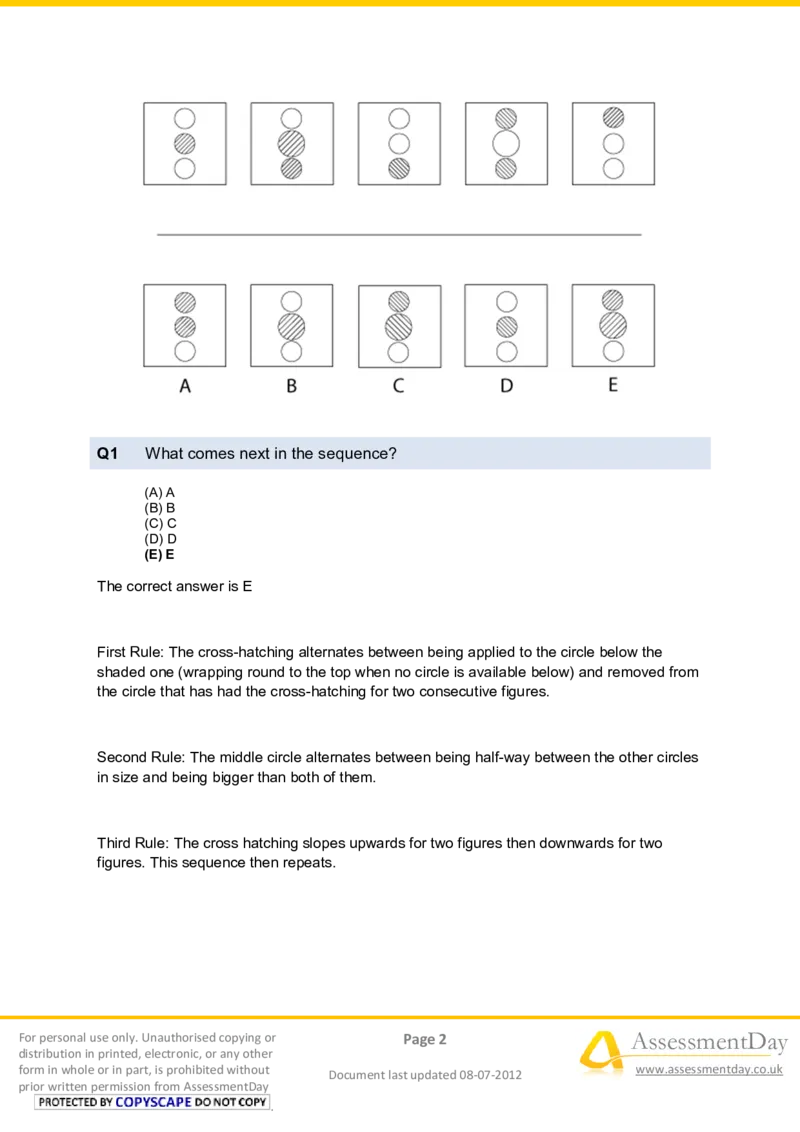
Practice Aptitude TestsQ1 What comes next in the sequence?
(A) A
(B) B
(C) C
(D) D
(E) E
The correct answer is E
First Rule: The cross-hatching alternates between being applied to the circle below the
shaded one (wrapping round to the top when no circle is available below) and removed from
the circle that has had the cross-hatching for two consecutive figures.
Second Rule: The middle circle alternates between being half-way between the other circles
in size and being bigger than both of them.
Third Rule: The cross hatching slopes upwards for two figures then downwards for two
figures. This sequence then repeats.
For personal use only. Unauthorised copying or Page 2 AssessmentDay
distribution in printed, electronic, or any other
form in whole or in part, is prohibited without
Document last updated 08-07-2012
www.assessmentday.co.uk
prior written permission from AssessmentDay
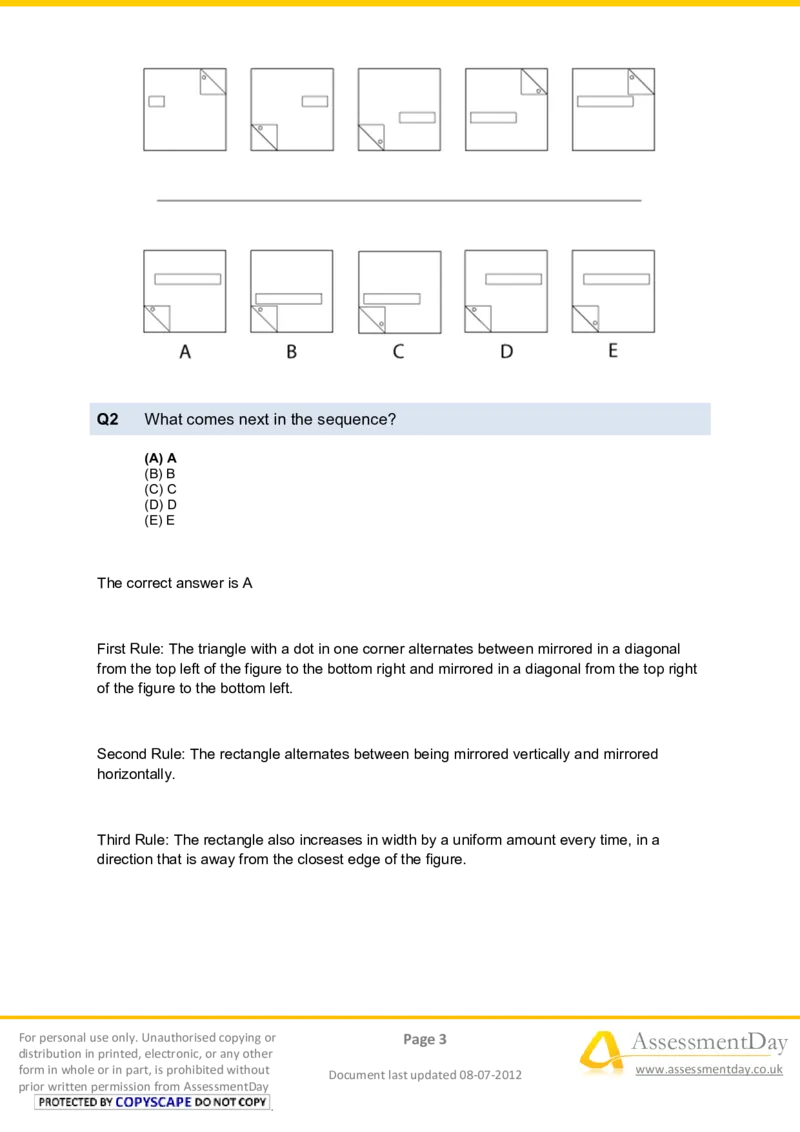
.Q2 What comes next in the sequence?
(A) A
(B) B
(C) C
(D) D
(E) E
The correct answer is A
First Rule: The triangle with a dot in one corner alternates between mirrored in a diagonal
from the top left of the figure to the bottom right and mirrored in a diagonal from the top right
of the figure to the bottom left.
Second Rule: The rectangle alternates between being mirrored vertically and mirrored
horizontally.
Third Rule: The rectangle also increases in width by a uniform amount every time, in a
direction that is away from the closest edge of the figure.
For personal use only. Unauthorised copying or Page 3 AssessmentDay
distribution in printed, electronic, or any other
form in whole or in part, is prohibited without
Document last updated 08-07-2012
www.assessmentday.co.uk
prior written permission from AssessmentDay
.Q3 What comes next in the sequence?
(A) A
(B) B
(C) C
(D) D
(E) E
The correct answer is D
First Rule: Every time, the small triangle nearest the bottom right corner is split into two
equal triangles of the same proportions.
Second Rule: The two, newly created, smallest triangles are always unshaded. The rest
alternate between being shaded and unshaded in each image.
Third Rule: The stick figure moves up the hypotenuse of the largest triangle by an equal
amount every time.
For personal use only. Unauthorised copying or Page 4 AssessmentDay
distribution in printed, electronic, or any other
form in whole or in part, is prohibited without
Document last updated 08-07-2012
www.assessmentday.co.uk
prior written permission from AssessmentDay
.Q4 What comes next in the sequence?
(A) A
(B) B
(C) C
(D) D
(E) E
The correct answer is E
First Rule: The shading of the small triangles moves 3 triangles anti-clockwise each time.
Second Rule: The cross-hatching on the kite shapes near the corners of the figure, which is
always in the direction of the nearest corner, moves clockwise, alternating between moving
one shape and moving two.
Third Rule: The centre shapes alternates between having downward sloping cross-hatching
and having upward sloping cross-hatching.
For personal use only. Unauthorised copying or Page 5 AssessmentDay
distribution in printed, electronic, or any other
form in whole or in part, is prohibited without
Document last updated 08-07-2012
www.assessmentday.co.uk
prior written permission from AssessmentDay
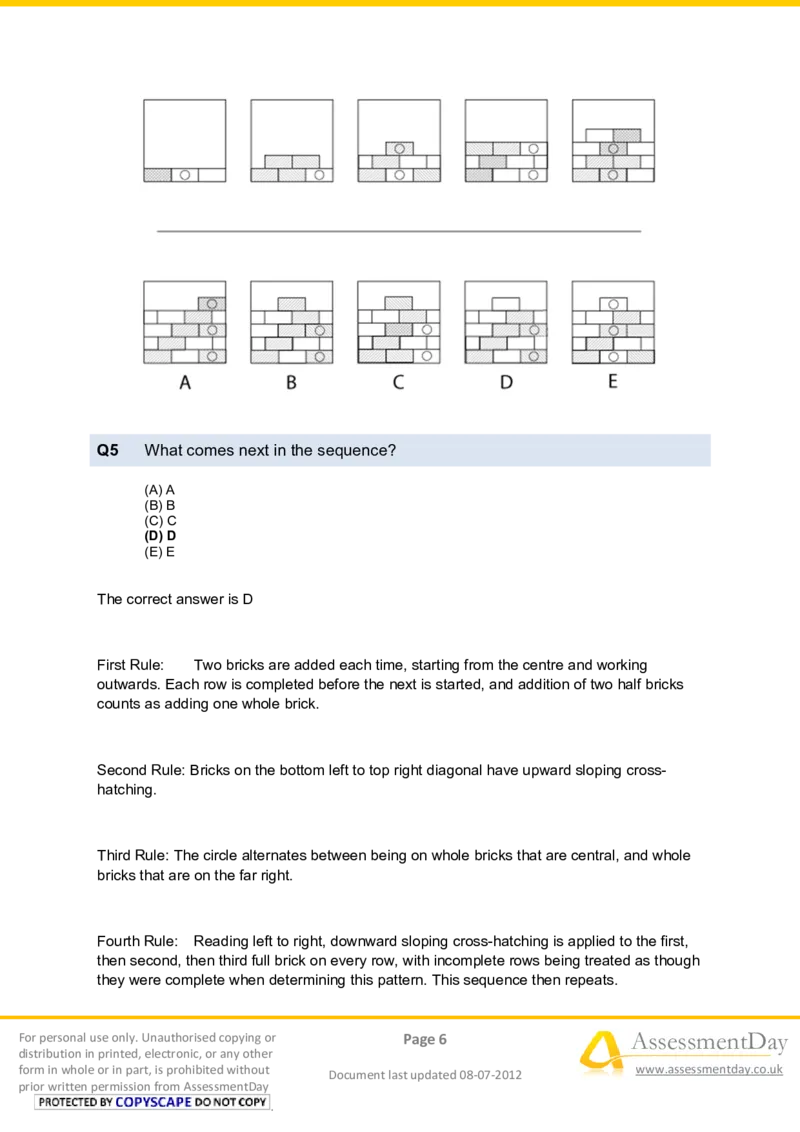
.Q5 What comes next in the sequence?
(A) A
(B) B
(C) C
(D) D
(E) E
The correct answer is D
First Rule: Two bricks are added each time, starting from the centre and working
outwards. Each row is completed before the next is started, and addition of two half bricks
counts as adding one whole brick.
Second Rule: Bricks on the bottom left to top right diagonal have upward sloping cross-
hatching.
Third Rule: The circle alternates between being on whole bricks that are central, and whole
bricks that are on the far right.
Fourth Rule: Reading left to right, downward sloping cross-hatching is applied to the first,
then second, then third full brick on every row, with incomplete rows being treated as though
they were complete when determining this pattern. This sequence then repeats.
For personal use only. Unauthorised copying or Page 6 AssessmentDay
distribution in printed, electronic, or any other
form in whole or in part, is prohibited without
Document last updated 08-07-2012
www.assessmentday.co.uk
prior written permission from AssessmentDay
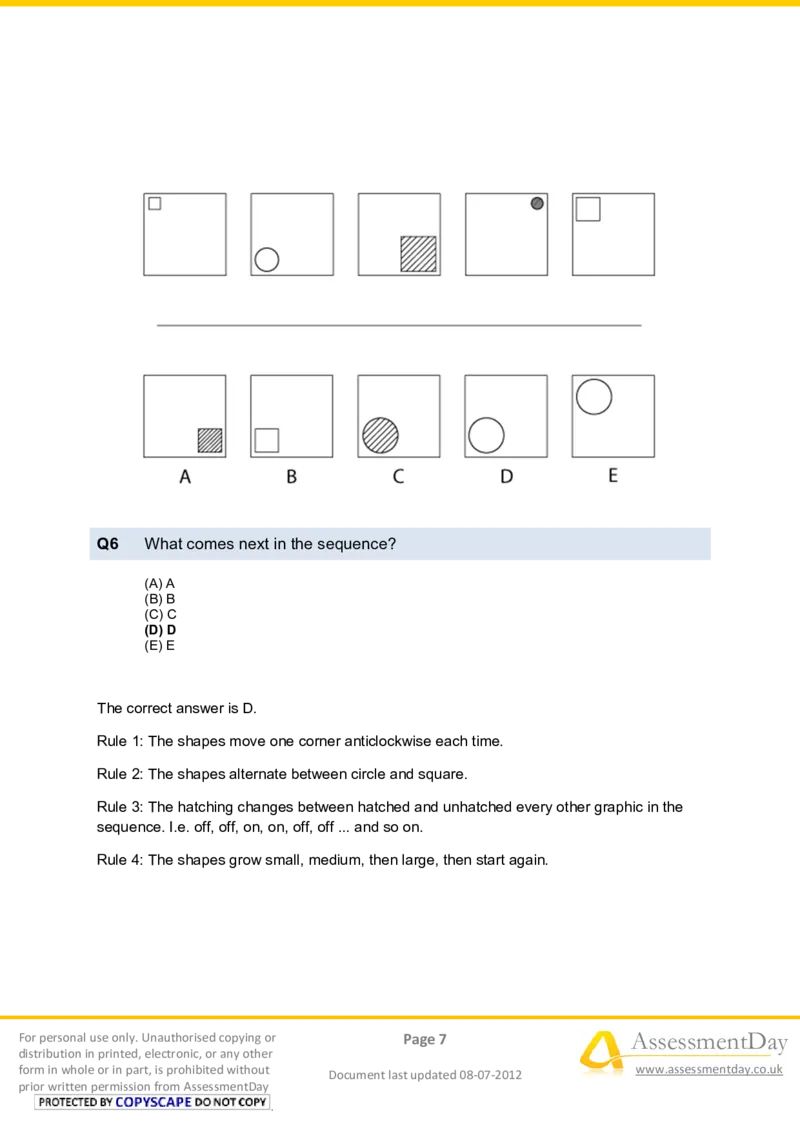
.Q6 What comes next in the sequence?
(A) A
(B) B
(C) C
(D) D
(E) E
The correct answer is D.
Rule 1: The shapes move one corner anticlockwise each time.
Rule 2: The shapes alternate between circle and square.
Rule 3: The hatching changes between hatched and unhatched every other graphic in the
sequence. I.e. off, off, on, on, off, off ... and so on.
Rule 4: The shapes grow small, medium, then large, then start again.
For personal use only. Unauthorised copying or Page 7 AssessmentDay
distribution in printed, electronic, or any other
form in whole or in part, is prohibited without
Document last updated 08-07-2012
www.assessmentday.co.uk
prior written permission from AssessmentDay
.Q7 What comes next in the sequence?
(A) A
(B) B
(C) C
(D) D
(E) E
The correct answer is E.
Rule 1: The shapes grow small, medium, then large, then start again.
Rule 2: The shapes alternate between circle and square
Rule 3: The shading in the shapes increases from empty, to hatched, to full shading.
Rule 4: The shapes move anticlockwise around following a square shape.
For personal use only. Unauthorised copying or Page 8 AssessmentDay
distribution in printed, electronic, or any other
form in whole or in part, is prohibited without
Document last updated 08-07-2012
www.assessmentday.co.uk
prior written permission from AssessmentDay
.Q8 What comes next in the sequence?
(A) A
(B) B
(C) C
(D) D
(E) E
The correct answer is A.
Rule 1: The position of the shapes in the current item is determined by the direction the
triangle is pointing in the previous item. There is no rule to determine the direction of the
arrow in the current item, only its position.
Rule 2: The shape inside the triangle changes in the repeating sequence circle, square, star.
Rule 3: The shading in the shapes alternates between the shape in the middle and the
triangle.
Rule 4: The shapes grow small, medium, large then back to small, medium etc.
For personal use only. Unauthorised copying or Page 9 AssessmentDay
distribution in printed, electronic, or any other
form in whole or in part, is prohibited without
Document last updated 08-07-2012
www.assessmentday.co.uk
prior written permission from AssessmentDay
.Q9 What comes next in the sequence?
(A) A
(B) B
(C) C
(D) D
(E) E
The correct answer is E.
Rule 1: The number of lines increases by one each time, alternating between adding a
horizontal line, then a vertical.
Rule 2: The circle in the top left corner alternates between shaded and clear.
Rule 3: There is a star in the top right corner twice running, then none twice running,
repeated etc.
For personal use only. Unauthorised copying or Page 10 AssessmentDay
distribution in printed, electronic, or any other
form in whole or in part, is prohibited without
Document last updated 08-07-2012
www.assessmentday.co.uk
prior written permission from AssessmentDay
.Q10 What comes next in the sequence?
(A) A
(B) B
(C) C
(D) D
(E) E
The correct answer is C.
Rule 1: The number of stars in the top right predicts how many horizontal lines will be in the
next box.
Rule 2: The circles alternate with triangles.
Rule 3: The number of circles or triangles is the sum of the number of circles and triangles in
the previous two boxes, with the black shading obscuring some shapes.
Note: even though the black shading is obscuring some of the 13 triangles, it is possible to
see that C is the correct answer by process of elimination; i.e. a particular rule excludes all of
the other possible answers.
For personal use only. Unauthorised copying or Page 11 AssessmentDay
distribution in printed, electronic, or any other
form in whole or in part, is prohibited without
Document last updated 08-07-2012
www.assessmentday.co.uk
prior written permission from AssessmentDay
.Q11 What comes next in the sequence?
(A) A
(B) B
(C) C
(D) D
(E) E
The correct answer is B.
Rule 1: The face changes in sequence from smiley to ambivalent to frowning.
Rule 2: The weather symbol alternates between sun and cloud.
Rule 3: The weather symbol is clear for two items then shaded for two items, then clear for
two items.
For personal use only. Unauthorised copying or Page 12 AssessmentDay
distribution in printed, electronic, or any other
form in whole or in part, is prohibited without
Document last updated 08-07-2012
www.assessmentday.co.uk
prior written permission from AssessmentDay
.Q12 What comes next in the sequence
(A) A
(B) B
(C) C
(D) D
(E) E
The correct answer is A.
Rule 1: The nose changes in sequence from hook to oval to none.
Rule 2: The eyes look towards the flower.
Rule 3: The number of hairs corresponds to the number of freckles.
Rule 4: Each turn alternates eyebrows present or not.
For personal use only. Unauthorised copying or Page 13 AssessmentDay
distribution in printed, electronic, or any other
form in whole or in part, is prohibited without
Document last updated 08-07-2012
www.assessmentday.co.uk
prior written permission from AssessmentDay
.Q13 What comes next in the sequence?
(A) A
(B) B
(C) C
(D) D
(E) E
The correct answer is A
First Rule: The scales are tipped fully to the left, then straight, then tipped fully to the right,
then straight. This sequence then repeats.
Second Rule: Squares weigh more than triangles and circles, which weigh the same as each
other.
Third Rule: The support for the scales alternates between having downward cross-hatching
and having upwards cross-hatching.
Fourth Rule: The cross hatching of any triangles being ‘weighed’ is the opposite of that of
the support.
For personal use only. Unauthorised copying or Page 14 AssessmentDay
distribution in printed, electronic, or any other
form in whole or in part, is prohibited without
Document last updated 08-07-2012
www.assessmentday.co.uk
prior written permission from AssessmentDay
.Q14 What comes next in the sequence?
(A) A
(B) B
(C) C
(D) D
(E) E
The correct answer is B
First Rule: The level of the liquid in the container rises by a consistent amount every time.
Second Rule: The liquid alternates between being light and dark.
Third Rule: The container has a spout to the right, then no spout, then to the left, then to
both left and right. This sequence then repeats.
Fourth Rule: The fish is absent, then faces right, then faces left. This sequence then
repeats.
For personal use only. Unauthorised copying or Page 15 AssessmentDay
distribution in printed, electronic, or any other
form in whole or in part, is prohibited without
Document last updated 08-07-2012
www.assessmentday.co.uk
prior written permission from AssessmentDay
.For personal use only. Unauthorised copying or Page 16 AssessmentDay
distribution in printed, electronic, or any other
form in whole or in part, is prohibited without
Document last updated 08-07-2012
www.assessmentday.co.uk
prior written permission from AssessmentDay
.Q15 What comes next in the sequence?
(A) A
(B) B
(C) C
(D) D
(E) E
The correct answer is C
First Rule: The downward sloping cross-hatching follows the sequence top left circle, bottom
right circle, bottom left circle, top right circle. This sequence then repeats.
Second Rule: The upward sloping cross-hatching follows the sequence top right circle,
bottom left circle, bottom right circle. This sequence then repeats.
Third Rule: The arrow points to where the small circle will be in the next figure.
Fourth Rule: The square is in the position occupied by the small circle in the previous
figure.
For personal use only. Unauthorised copying or Page 17 AssessmentDay
distribution in printed, electronic, or any other
form in whole or in part, is prohibited without
Document last updated 08-07-2012
www.assessmentday.co.uk
prior written permission from AssessmentDay
.Q16 What comes next in the sequence?
(A) A
(B) B
(C) C
(D) D
(E) E
The correct answer is B
First Rule: The shading type furthest from the flagpole on one figure becomes the shading
closest to the flagpole on the next figure, and every other form of shading moves one band
to the right.
Second Rule: The flag alternates between the wave going down first and the wave going up
first.
Third Rule: The flag’s position on the pole is at half-mast, then fully raised, then half-mast,
then fully lowered. This cycle then repeats.
For personal use only. Unauthorised copying or Page 18 AssessmentDay
distribution in printed, electronic, or any other
form in whole or in part, is prohibited without
Document last updated 08-07-2012
www.assessmentday.co.uk
prior written permission from AssessmentDay
.Q17 What comes next in the sequence?
(A) A
(B) B
(C) C
(D) D
(E) E
The correct answer is D
First Rule: The matchstick giraffe visits the corners in the order top left, top right,
bottom left, bottom right. The sequence then repeats.
Second Rule: The matchstick giraffe faces right when it is at the top and left when it is at the
bottom.
Third Rule: The giraffe’s neck alternates between being up and down.
Fourth Rule: The giraffe’s tail points horizontally, then at 45o, then vertically. The sequence
then repeats.
For personal use only. Unauthorised copying or Page 19 AssessmentDay
distribution in printed, electronic, or any other
form in whole or in part, is prohibited without
Document last updated 08-07-2012
www.assessmentday.co.uk
prior written permission from AssessmentDay
.For personal use only. Unauthorised copying or Page 20 AssessmentDay
distribution in printed, electronic, or any other
form in whole or in part, is prohibited without
Document last updated 08-07-2012
www.assessmentday.co.uk
prior written permission from AssessmentDay
.Q18 What comes next in the sequence?
(A) A
(B) B
(C) C
(D) D
(E) E
The correct answer is C
First Rule: The direction of the arrow rotates by 30o each time.
Second Rule: Following it in the direction of the arrow, the wavy line alternates between
crossing in front of the straight line first and crossing behind it first.
Third Rule: The horizontal line passes behind the wavy line but crosses in front of the
straight line.
Fourth Rule: The arrow head is a V shape, then a double V, then a solid triangle. This
sequence then repeats.
For personal use only. Unauthorised copying or Page 21 AssessmentDay
distribution in printed, electronic, or any other
form in whole or in part, is prohibited without
Document last updated 08-07-2012
www.assessmentday.co.uk
prior written permission from AssessmentDay
.Q19 What comes next in the sequence?
(A) A
(B) B
(C) C
(D) D
(E) E
The correct answer is A
First Rule: The door moves to the right, centre, left then centre, always in line with the
window immediately above it, and then the pattern repeats.
Second Rule: First only upper storey windows are leaded, then only the lower storey
windows are leaded, then all windows are leaded. This pattern then repeats.
Third Rule: Starting at the bottom right window, the figure visits each window in turn in an
anticlockwise direction.
Fourth Rule: The house alternates between not having a chimney stack and having a
chimney stack.
For personal use only. Unauthorised copying or Page 22 AssessmentDay
distribution in printed, electronic, or any other
form in whole or in part, is prohibited without
Document last updated 08-07-2012
www.assessmentday.co.uk
prior written permission from AssessmentDay
.Q20 What comes next in the sequence?
(A) A
(B) B
(C) C
(D) D
(E) E
The correct answer is D
First Rule: The number of circles that are grouped together increases by one every time,
with the final group containing all the circles that do not fit into a whole group.
Second Rule: One circle is removed every time.
Third Rule: Half of the circles are shaded and half are unshaded. When there is an odd
number of circles, the ‘extra’ circle is shaded.
Fourth Rule: The face in the box in the bottom right is happy when the groupings work
perfectly and sad when there are incomplete groups.
For personal use only. Unauthorised copying or Page 23 AssessmentDay
distribution in printed, electronic, or any other
form in whole or in part, is prohibited without
Document last updated 08-07-2012
www.assessmentday.co.uk
prior written permission from AssessmentDay
.Q21 What comes next in the sequence?
(A) A
(B) B
(C) C
(D) D
(E) E
The correct answer is C
First Rule: The shape in the centre comprises 1 fewer straight line every time.
Second Rule: The shape in the top left alternates between being a triangle and being a
square.
Third Rule: There is a cross when both shapes have the same number of sides, and a tick
when they have different numbers of sides.
Fourth Rule: The location of the cross or tick moves from the top right to bottom left to
bottom right, and the pattern then repeats.
For personal use only. Unauthorised copying or Page 24 AssessmentDay
distribution in printed, electronic, or any other
form in whole or in part, is prohibited without
Document last updated 08-07-2012
www.assessmentday.co.uk
prior written permission from AssessmentDay
.For personal use only. Unauthorised copying or Page 25 AssessmentDay
distribution in printed, electronic, or any other
form in whole or in part, is prohibited without
Document last updated 08-07-2012
www.assessmentday.co.uk
prior written permission from AssessmentDay
.Q22 What comes next in the sequence?
(A) A
(B) B
(C) C
(D) D
(E) E
The correct answer is B
First Rule: Each step, the shaded square moves 3 squares clockwise round the edge of the
figure.
Second Rule: Each step, the cross-hatching moves 1 square anticlockwise round the edge
of the figure, disappearing behind the shading when the two coincide.
Third Rule: The circle (which starts behind the shaded square in figure 1) moves 1 square
left to right, starting again at the left of the figure when it drops down a row.
Fourth Rule: The triangle moves 1 square right to left, starting again at the right of the
figure when it goes up a row, and disappearing behind the shading when they coincide.
-- End of Test --
For personal use only. Unauthorised copying or Page 26 AssessmentDay
distribution in printed, electronic, or any other
form in whole or in part, is prohibited without
Document last updated 08-07-2012
www.assessmentday.co.uk
prior written permission from AssessmentDay
.