


文档内容
Numerical Reasoning
Free Test 2
Solutions Booklet
Instructions
This numerical reasoning test comprises 12 questions, and you will have 12 minutes in
which to correctly answer as many as you can. Calculators are permitted for this test, and it is
recommended you have some rough paper to work on.
You will have to work quickly and accurately to perform well in this test. If you don't know the
answer to a question, leave it and come back to it if you have time. Each question will have
five possible answers, one of which is correct. You may click Back and Next during the test to
review or skip questions.
You can submit your test at any time. If the time limit is up before you click submit the test will
automatically be submitted with the answers you have selected. It is recommended to keep
working until the time limit is up.
Try to find a time and place where you will not be interrupted during the test. The test will
begin on the next page.
AssessmentDay
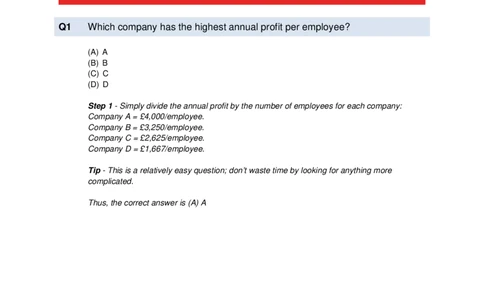
Practice Aptitude TestsQ1 Which company has the highest annual profit per employee?
(A) A
(B) B
(C) C
(D) D
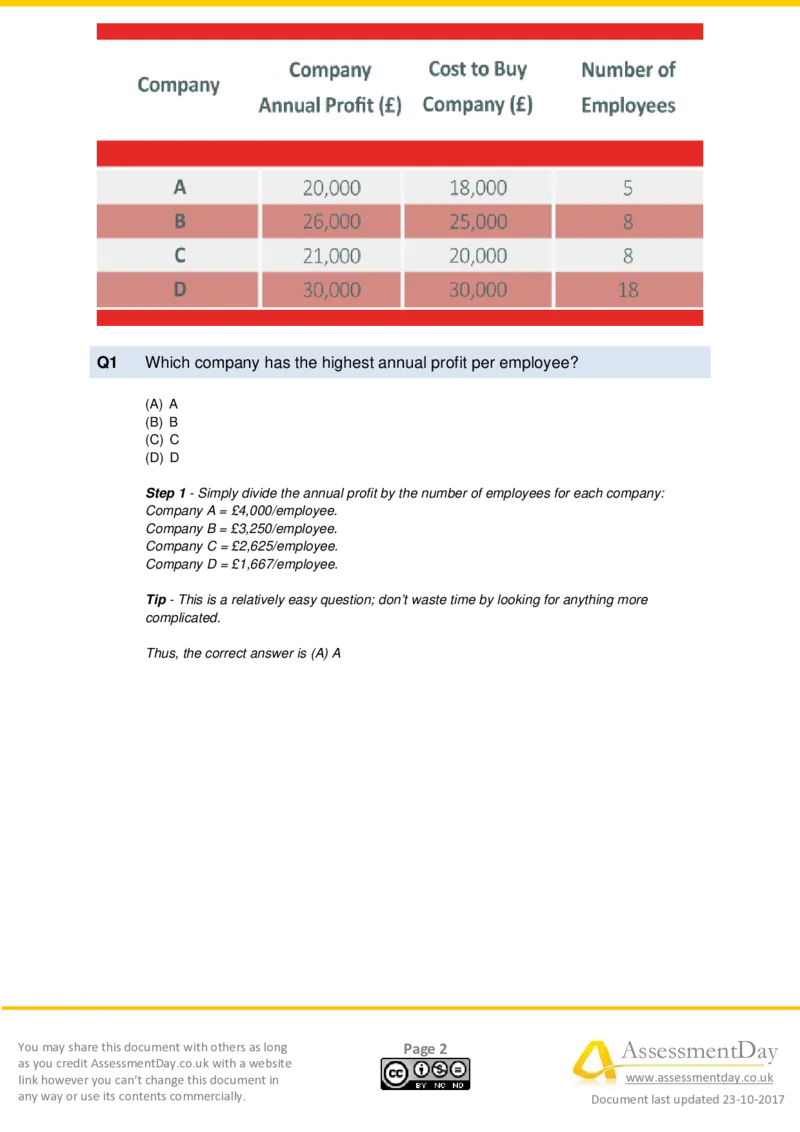
Step 1 - Simply divide the annual profit by the number of employees for each company:
Company A = £4,000/employee.
Company B = £3,250/employee.
Company C = £2,625/employee.
Company D = £1,667/employee.
Tip - This is a relatively easy question; don’t waste time by looking for anything more
complicated.
Thus, the correct answer is (A) A
You may share this document with others as long Page 2 AssessmentDay
as you credit AssessmentDay.co.uk with a website
link however you can’t change this document in www.assessmentday.co.uk
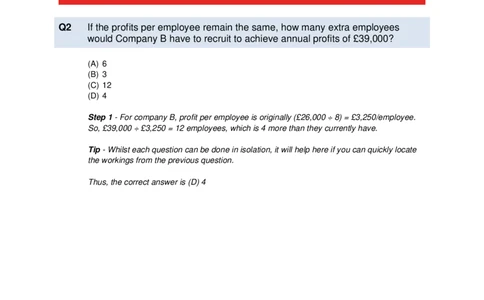
any way or use its contents commercially. Document last updated 23-10-2017Q2 If the profits per employee remain the same, how many extra employees
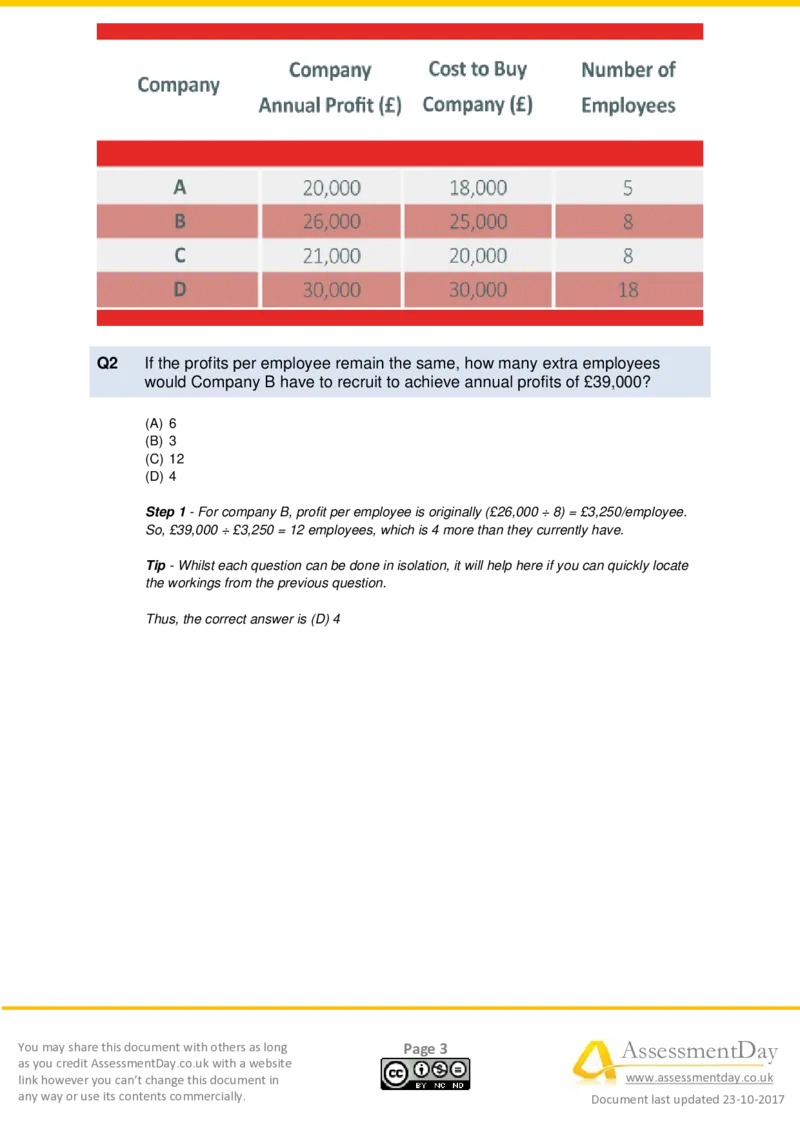
would Company B have to recruit to achieve annual profits of £39,000?
(A) 6
(B) 3
(C) 12
(D) 4
Step 1 - For company B, profit per employee is originally (£26,000 ÷ 8) = £3,250/employee.
So, £39,000 ÷ £3,250 = 12 employees, which is 4 more than they currently have.
Tip - Whilst each question can be done in isolation, it will help here if you can quickly locate
the workings from the previous question.
Thus, the correct answer is (D) 4
You may share this document with others as long Page 3 AssessmentDay
as you credit AssessmentDay.co.uk with a website
link however you can’t change this document in www.assessmentday.co.uk
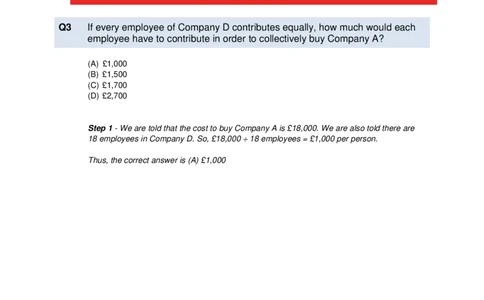
any way or use its contents commercially. Document last updated 23-10-2017Q3 If every employee of Company D contributes equally, how much would each
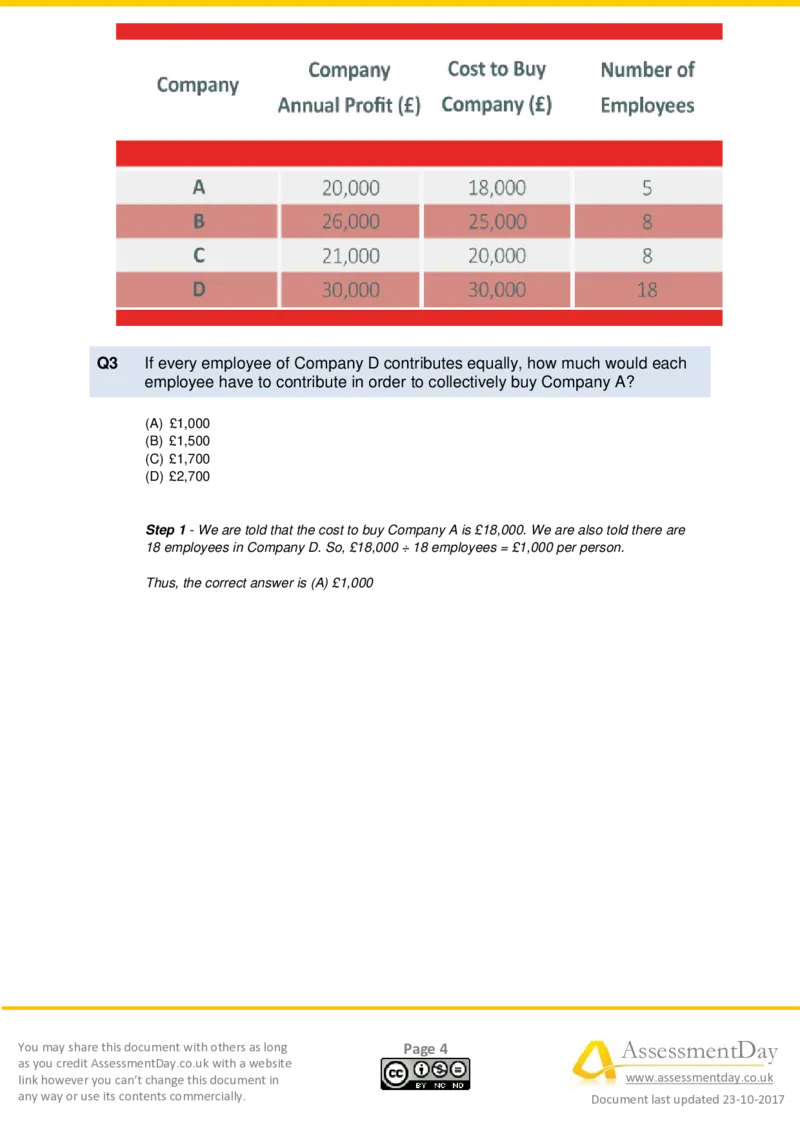
employee have to contribute in order to collectively buy Company A?
(A) £1,000
(B) £1,500
(C) £1,700
(D) £2,700
Step 1 - We are told that the cost to buy Company A is £18,000. We are also told there are
18 employees in Company D. So, £18,000 ÷ 18 employees = £1,000 per person.
Thus, the correct answer is (A) £1,000
You may share this document with others as long Page 4 AssessmentDay
as you credit AssessmentDay.co.uk with a website
link however you can’t change this document in www.assessmentday.co.uk
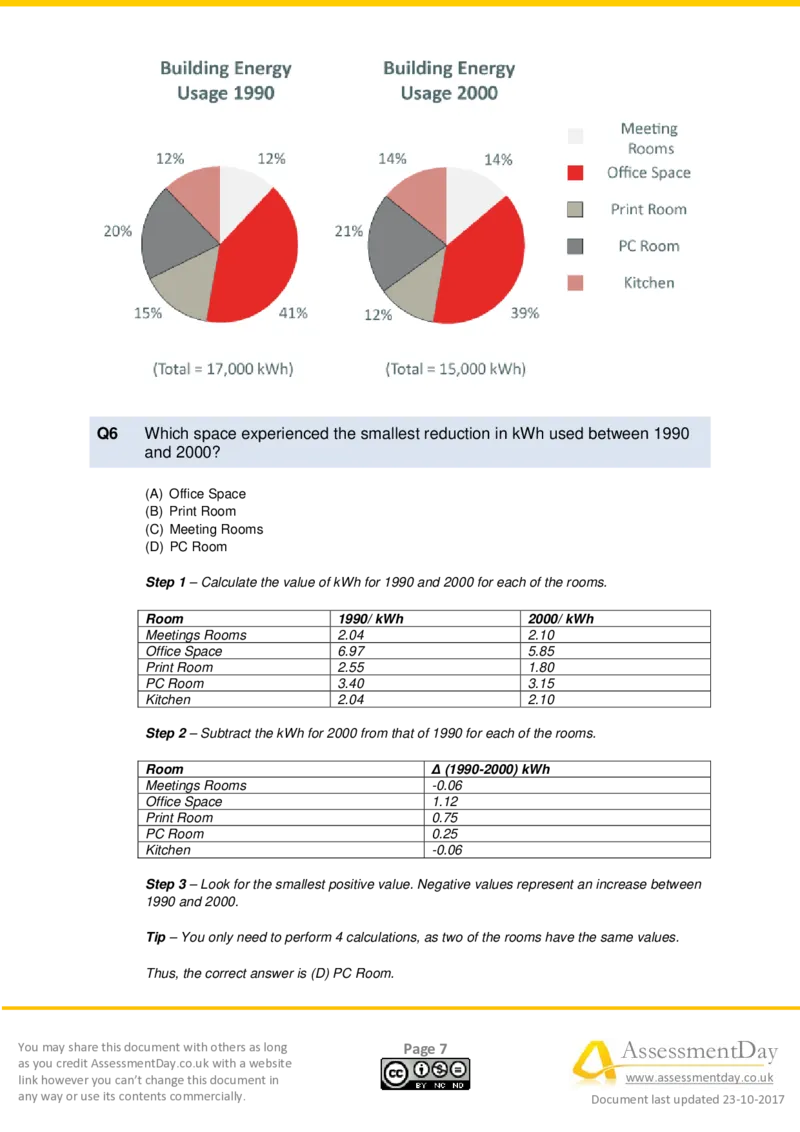
any way or use its contents commercially. Document last updated 23-10-2017Q4 Between 1990 and 2000, what was the decrease in energy use for the PC
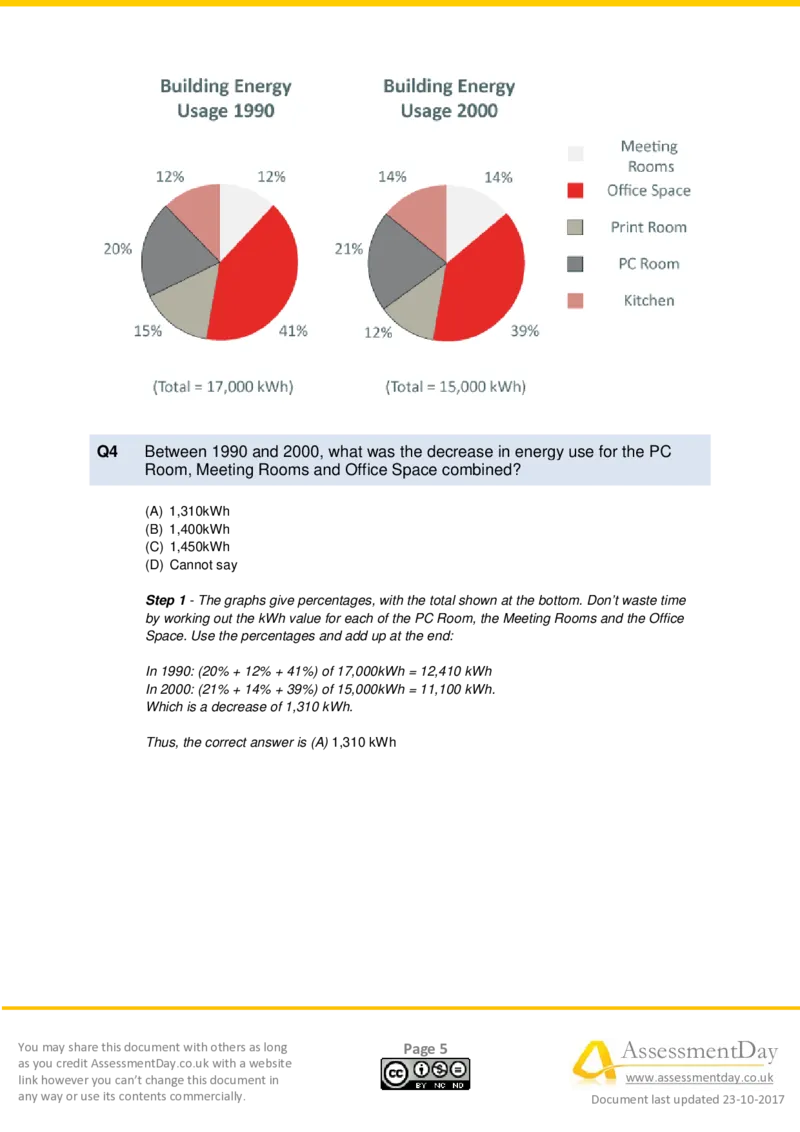
Room, Meeting Rooms and Office Space combined?
(A) 1,310kWh
(B) 1,400kWh
(C) 1,450kWh
(D) Cannot say
Step 1 - The graphs give percentages, with the total shown at the bottom. Don’t waste time
by working out the kWh value for each of the PC Room, the Meeting Rooms and the Office
Space. Use the percentages and add up at the end:
In 1990: (20% + 12% + 41%) of 17,000kWh = 12,410 kWh
In 2000: (21% + 14% + 39%) of 15,000kWh = 11,100 kWh.
Which is a decrease of 1,310 kWh.
Thus, the correct answer is (A) 1,310 kWh
You may share this document with others as long Page 5 AssessmentDay
as you credit AssessmentDay.co.uk with a website
link however you can’t change this document in www.assessmentday.co.uk
any way or use its contents commercially. Document last updated 23-10-2017Q5 If the Building Energy Use today is 6% less than it was in 2000, by what
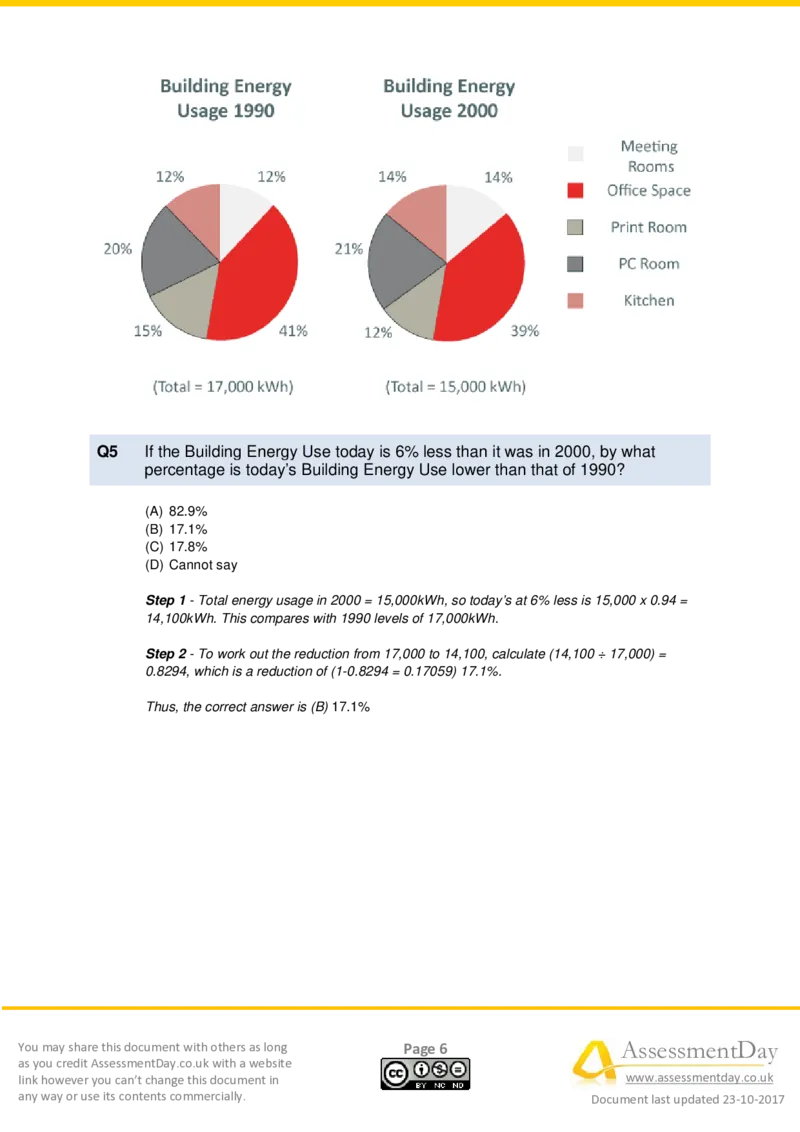
percentage is today’s Building Energy Use lower than that of 1990?
(A) 82.9%
(B) 17.1%
(C) 17.8%
(D) Cannot say
Step 1 - Total energy usage in 2000 = 15,000kWh, so today’s at 6% less is 15,000 x 0.94 =
14,100kWh. This compares with 1990 levels of 17,000kWh.
Step 2 - To work out the reduction from 17,000 to 14,100, calculate (14,100 ÷ 17,000) =
0.8294, which is a reduction of (1-0.8294 = 0.17059) 17.1%.
Thus, the correct answer is (B) 17.1%
You may share this document with others as long Page 6 AssessmentDay
as you credit AssessmentDay.co.uk with a website
link however you can’t change this document in www.assessmentday.co.uk
any way or use its contents commercially. Document last updated 23-10-2017Q6 Which space experienced the smallest reduction in kWh used between 1990
and 2000?
(A) Office Space
(B) Print Room
(C) Meeting Rooms
(D) PC Room
Step 1 – Calculate the value of kWh for 1990 and 2000 for each of the rooms.
Room 1990/ kWh 2000/ kWh
Meetings Rooms 2.04 2.10
Office Space 6.97 5.85
Print Room 2.55 1.80
PC Room 3.40 3.15
Kitchen 2.04 2.10
Step 2 – Subtract the kWh for 2000 from that of 1990 for each of the rooms.
Room Δ (1990-2000) kWh
Meetings Rooms -0.06
Office Space 1.12
Print Room 0.75
PC Room 0.25
Kitchen -0.06
Step 3 – Look for the smallest positive value. Negative values represent an increase between
1990 and 2000.
Tip – You only need to perform 4 calculations, as two of the rooms have the same values.
Thus, the correct answer is (D) PC Room.
You may share this document with others as long Page 7 AssessmentDay
as you credit AssessmentDay.co.uk with a website
link however you can’t change this document in www.assessmentday.co.uk
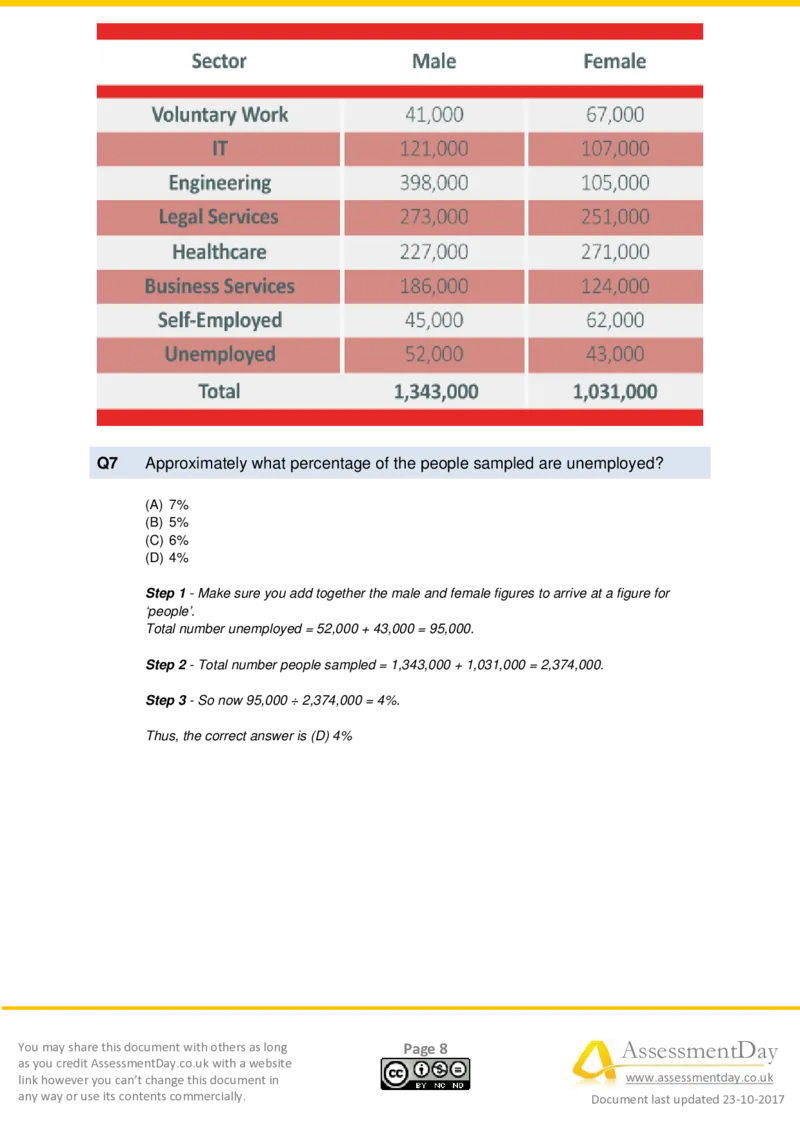
any way or use its contents commercially. Document last updated 23-10-2017Q7 Approximately what percentage of the people sampled are unemployed?
(A) 7%
(B) 5%
(C) 6%
(D) 4%
Step 1 - Make sure you add together the male and female figures to arrive at a figure for
‘people’.
Total number unemployed = 52,000 + 43,000 = 95,000.
Step 2 - Total number people sampled = 1,343,000 + 1,031,000 = 2,374,000.
Step 3 - So now 95,000 ÷ 2,374,000 = 4%.
Thus, the correct answer is (D) 4%
You may share this document with others as long Page 8 AssessmentDay
as you credit AssessmentDay.co.uk with a website
link however you can’t change this document in www.assessmentday.co.uk
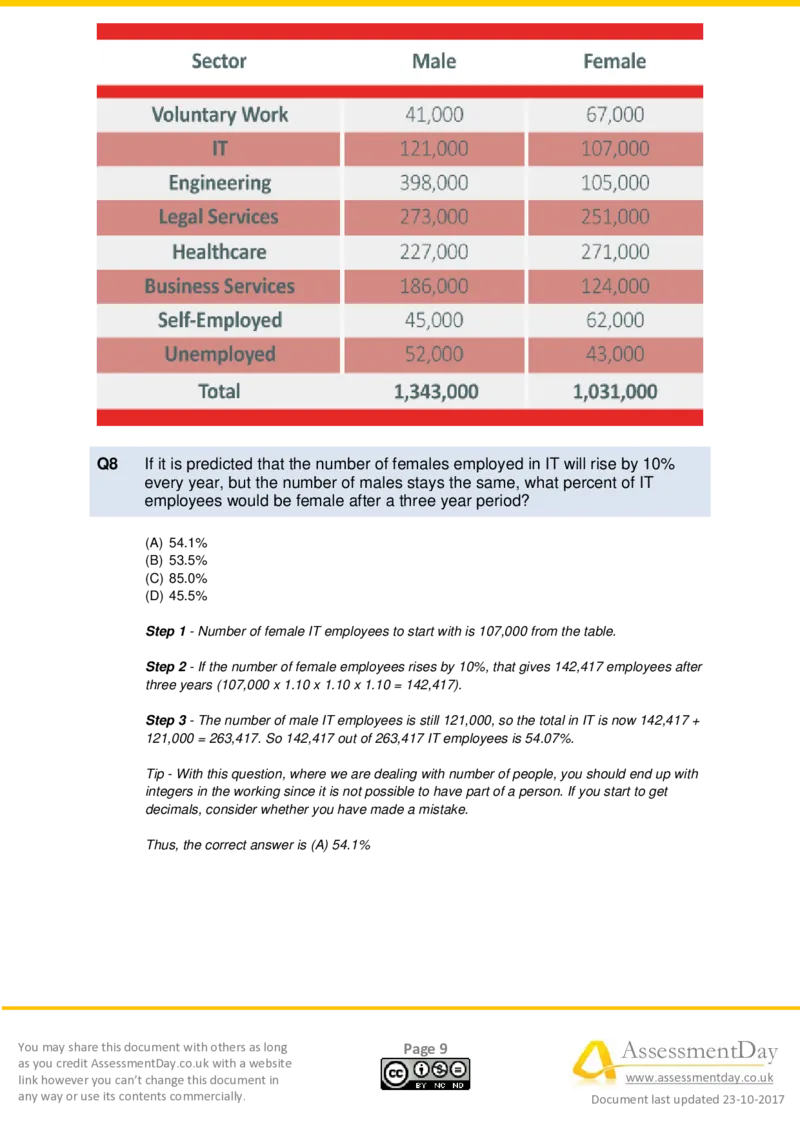
any way or use its contents commercially. Document last updated 23-10-2017Q8 If it is predicted that the number of females employed in IT will rise by 10%
every year, but the number of males stays the same, what percent of IT
employees would be female after a three year period?
(A) 54.1%
(B) 53.5%
(C) 85.0%
(D) 45.5%
Step 1 - Number of female IT employees to start with is 107,000 from the table.
Step 2 - If the number of female employees rises by 10%, that gives 142,417 employees after
three years (107,000 x 1.10 x 1.10 x 1.10 = 142,417).
Step 3 - The number of male IT employees is still 121,000, so the total in IT is now 142,417 +
121,000 = 263,417. So 142,417 out of 263,417 IT employees is 54.07%.
Tip - With this question, where we are dealing with number of people, you should end up with
integers in the working since it is not possible to have part of a person. If you start to get
decimals, consider whether you have made a mistake.
Thus, the correct answer is (A) 54.1%
You may share this document with others as long Page 9 AssessmentDay
as you credit AssessmentDay.co.uk with a website
link however you can’t change this document in www.assessmentday.co.uk
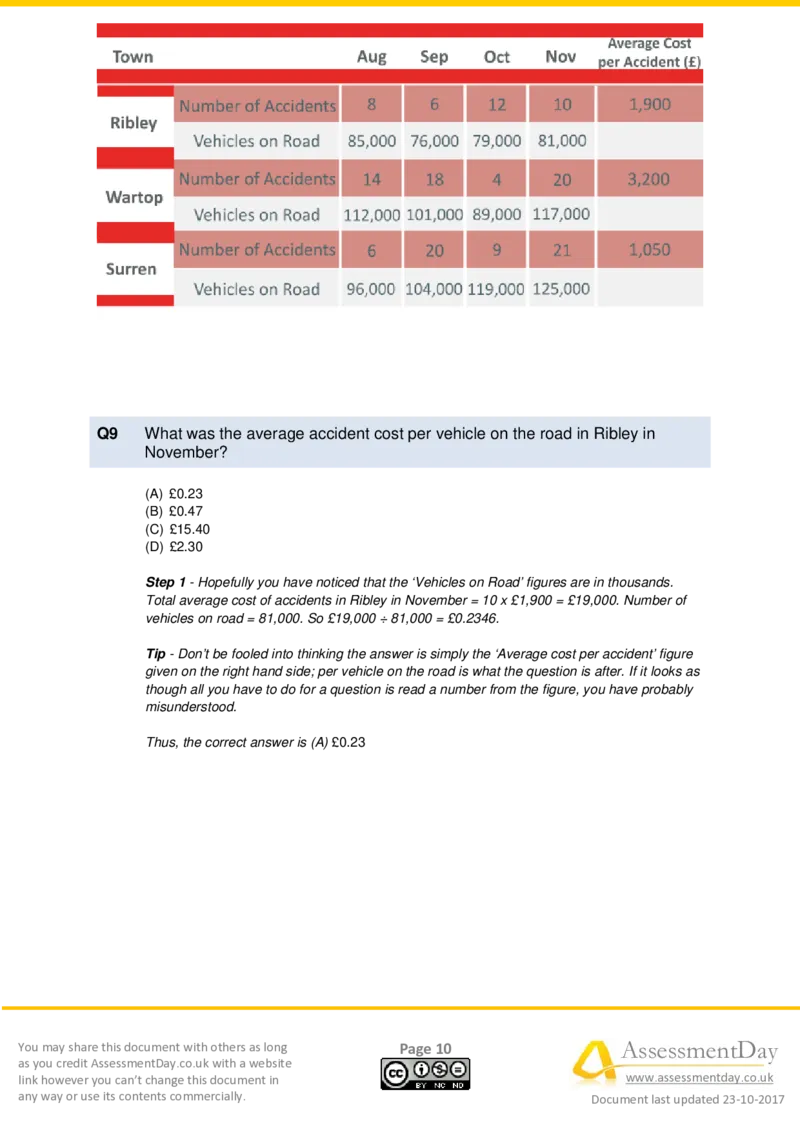
any way or use its contents commercially. Document last updated 23-10-2017Q9 What was the average accident cost per vehicle on the road in Ribley in
November?
(A) £0.23
(B) £0.47
(C) £15.40
(D) £2.30
Step 1 - Hopefully you have noticed that the ‘Vehicles on Road’ figures are in thousands.
Total average cost of accidents in Ribley in November = 10 x £1,900 = £19,000. Number of
vehicles on road = 81,000. So £19,000 ÷ 81,000 = £0.2346.
Tip - Don’t be fooled into thinking the answer is simply the ‘Average cost per accident’ figure
given on the right hand side; per vehicle on the road is what the question is after. If it looks as
though all you have to do for a question is read a number from the figure, you have probably
misunderstood.
Thus, the correct answer is (A) £0.23
You may share this document with others as long Page 10 AssessmentDay
as you credit AssessmentDay.co.uk with a website
link however you can’t change this document in www.assessmentday.co.uk
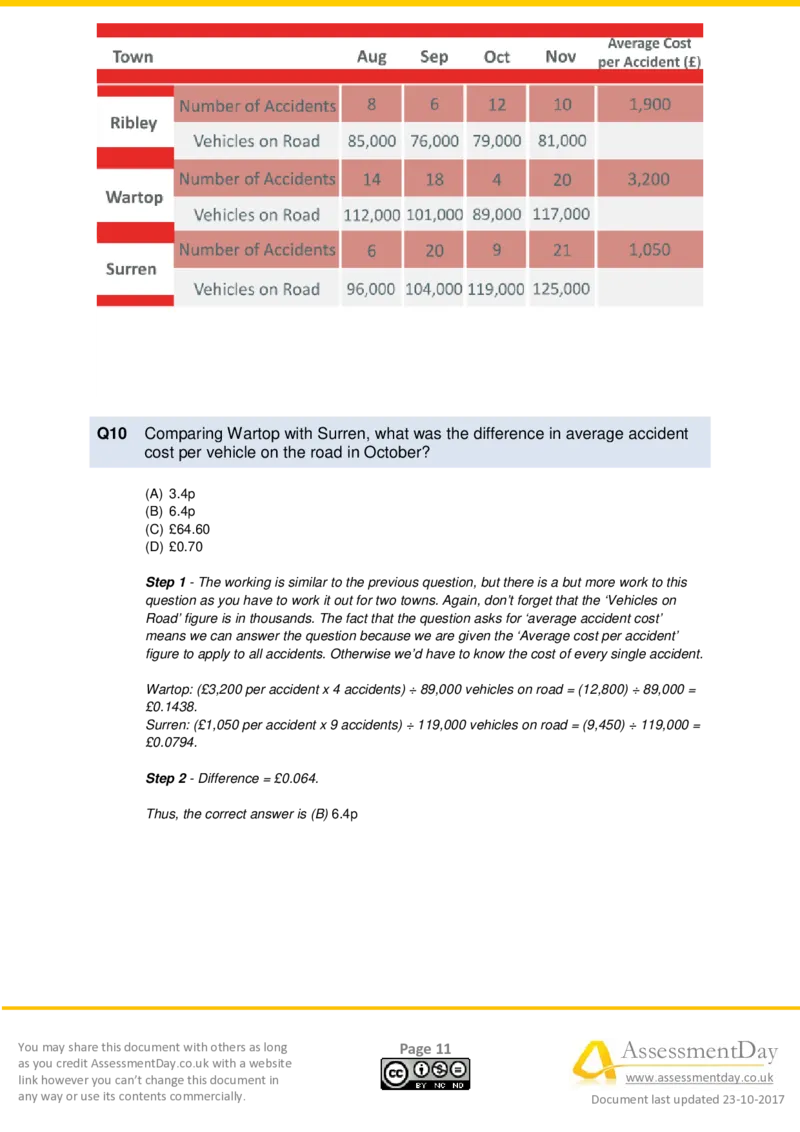
any way or use its contents commercially. Document last updated 23-10-2017Q10 Comparing Wartop with Surren, what was the difference in average accident
cost per vehicle on the road in October?
(A) 3.4p
(B) 6.4p
(C) £64.60
(D) £0.70
Step 1 - The working is similar to the previous question, but there is a but more work to this
question as you have to work it out for two towns. Again, don’t forget that the ‘Vehicles on
Road’ figure is in thousands. The fact that the question asks for ‘average accident cost’
means we can answer the question because we are given the ‘Average cost per accident’
figure to apply to all accidents. Otherwise we’d have to know the cost of every single accident.
Wartop: (£3,200 per accident x 4 accidents) ÷ 89,000 vehicles on road = (12,800) ÷ 89,000 =
£0.1438.
Surren: (£1,050 per accident x 9 accidents) ÷ 119,000 vehicles on road = (9,450) ÷ 119,000 =
£0.0794.
Step 2 - Difference = £0.064.
Thus, the correct answer is (B) 6.4p
You may share this document with others as long Page 11 AssessmentDay
as you credit AssessmentDay.co.uk with a website
link however you can’t change this document in www.assessmentday.co.uk
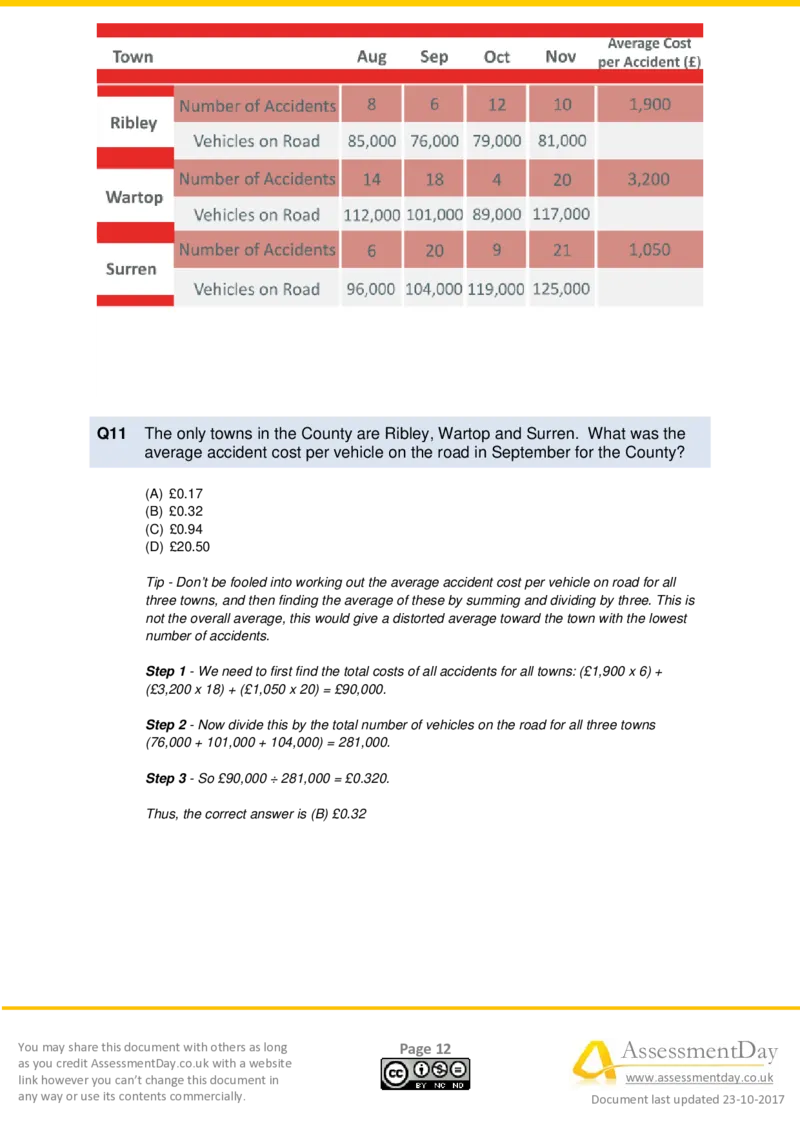
any way or use its contents commercially. Document last updated 23-10-2017Q11 The only towns in the County are Ribley, Wartop and Surren. What was the
average accident cost per vehicle on the road in September for the County?
(A) £0.17
(B) £0.32
(C) £0.94
(D) £20.50
Tip - Don’t be fooled into working out the average accident cost per vehicle on road for all
three towns, and then finding the average of these by summing and dividing by three. This is
not the overall average, this would give a distorted average toward the town with the lowest
number of accidents.
Step 1 - We need to first find the total costs of all accidents for all towns: (£1,900 x 6) +
(£3,200 x 18) + (£1,050 x 20) = £90,000.
Step 2 - Now divide this by the total number of vehicles on the road for all three towns
(76,000 + 101,000 + 104,000) = 281,000.
Step 3 - So £90,000 ÷ 281,000 = £0.320.
Thus, the correct answer is (B) £0.32
You may share this document with others as long Page 12 AssessmentDay
as you credit AssessmentDay.co.uk with a website
link however you can’t change this document in www.assessmentday.co.uk
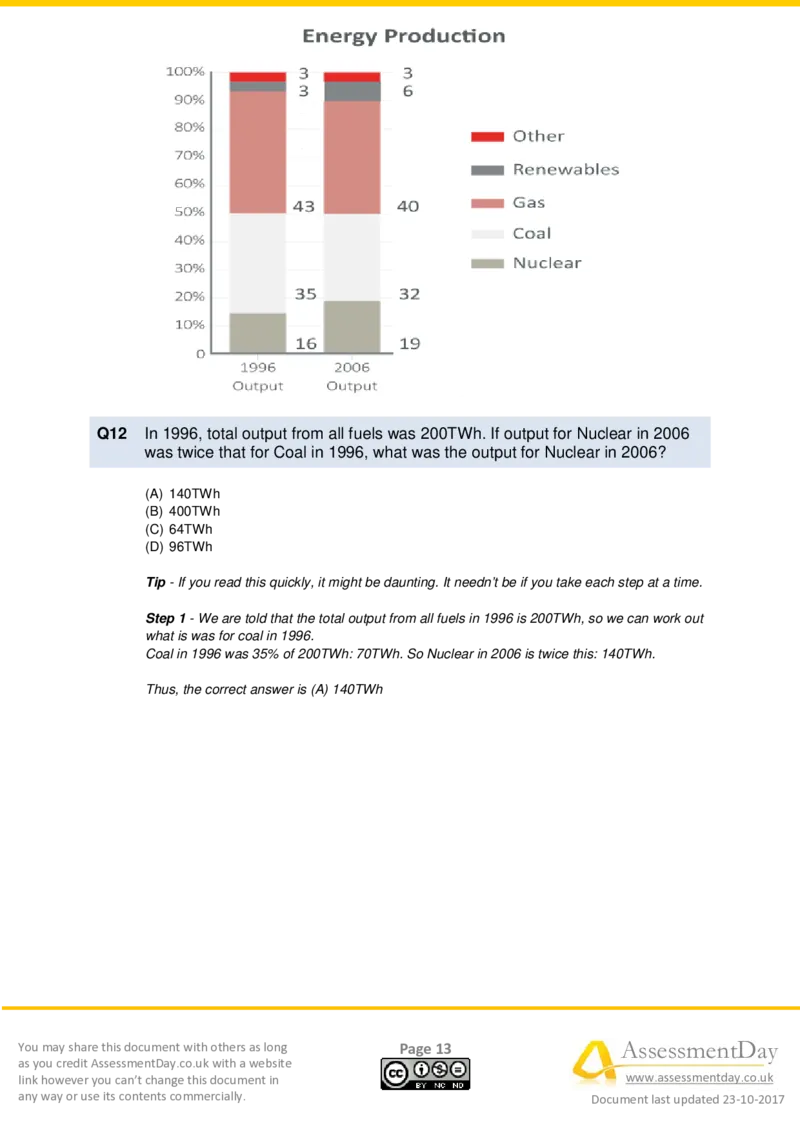
any way or use its contents commercially. Document last updated 23-10-2017Q12 In 1996, total output from all fuels was 200TWh. If output for Nuclear in 2006
was twice that for Coal in 1996, what was the output for Nuclear in 2006?
(A) 140TWh
(B) 400TWh
(C) 64TWh
(D) 96TWh
Tip - If you read this quickly, it might be daunting. It needn’t be if you take each step at a time.
Step 1 - We are told that the total output from all fuels in 1996 is 200TWh, so we can work out
what is was for coal in 1996.
Coal in 1996 was 35% of 200TWh: 70TWh. So Nuclear in 2006 is twice this: 140TWh.
Thus, the correct answer is (A) 140TWh
You may share this document with others as long Page 13 AssessmentDay
as you credit AssessmentDay.co.uk with a website
link however you can’t change this document in www.assessmentday.co.uk
any way or use its contents commercially. Document last updated 23-10-2017-- End of Test --
For more numerical reasoning tests visit AssessmentDay.co.uk
You may share this document with others as long Page 14 AssessmentDay
as you credit AssessmentDay.co.uk with a website
link however you can’t change this document in www.assessmentday.co.uk
any way or use its contents commercially. Document last updated 23-10-2017