








文档内容
2023 北京通州初三一模
英语
考生须知
1. 本试卷共10页, 共五道大题, 38道小题, 满分60分, 考试时间90分钟。
2. 请在试卷和答题卡上准确填写学校名称、班级、姓名。
3. 试题答案一律填涂或书写在答题卡上, 在试卷上作答无效。
4. 在答题卡上, 选择题用2B铅笔作答, 其他试题用黑色字迹签字笔作答。
5. 考试结束, 请将答题卡交回。
第一部分
本部分共33题, 共40分。在每题列出的四个选项中, 选出最符合题目要求的一项。
一 、单项填空(每题0. 5分, 共6分)
从下面各题所给的A、B、C、D四个选项中, 选择可以填入空白处的最佳选项。
1. Mr. Smith is ________ English teacher. He is very kind to us.
A. her B. your C. our D. their
2. Peter often goes to see his uncle ________ Sunday afternoon and they have dinner together.
.
A on B. in C. at D. from
3. —________ do you want to be a doctor?
—Because I want to help people live longer and healthier.
A. What B. Why C. Who D. How
4. — Tom, ________ you help me take these books to the classroom?
— Yes, I can.
A. can B. may C. need D. must
5. Remember to put on your coat when you go outside, ________ you will catch a cold.
A. or B. but C. and D. so
6. I think physics is one of ________ subjects because I like doing experiments.
A. interesting B. more interesting C. most interesting D. the most interesting
7. Be quiet. Lucy ________ a maths class online and she must listen to the teacher carefully.
A. has B. is having C. will have D. has had
8. — Jack, did you go to see a film last Sunday?
— No. I ________ the Palace Museum with my friends and we saw a lot of exhibits there.
A. visit B. will visit C. visited D. have visited
第1页/共11页
学科网(北京)股份有限公司9. Kate is my classmate. We ________ good friends for more than 5 years.
A. are B. were C. will be D. have been
10. If you listen to the speech this afternoon, you ________ more knowledge about health.
A. learn B. learned C. will learn D. have learned
11. I ________ to a birthday party by my friend last Friday and we had a good time there.
A. invite B. will be invited C. invited D. was invited
12. —Mary, can you tell me ________ the dictionary?
—Oh, yes. I bought it in Xin Hua Bookstore.
A. where did you buy B. where you bought C. where do you buy D. where you buy
二 、完形填空(每题1分, 共8分)
阅读下面的短文, 掌握其大意, 然后从短文后各题所给的 A、B、C、D 四个选项中, 选择最
佳选项。
Drums in Space
Brenda was a happy, artistic girl, a girl with one big dream—to play the ____13____ in a band. But one big
problem lay in her way. To be good enough to play in a band, Brenda had to practice a lot, but she lived next door
to a lot of old people—many of them liked living in the quiet place. She knew that the sound of beating drums
would really make them feel nervous.
Brenda was a very good, ____14____ girl. She always tried to find a way of practicing her drums without
bothering(打扰)other people. So she had tried playing in the strangest places: a basement, a kitchen, and even in
a shower. But it was no good, there was always someone to be ____15____ with her when she was practicing it.
However, Brenda decided to practice as much as she could, she spent most of her time playing on books and boxes,
and looking for new places to practice.
One day, while watching a science program on TV, she heard that ____16____ cannot travel in space,
because there’s no air. At that moment, Brenda decided to become a musical astronaut.
With the help of a lot of time, a lot of books and a lot of work, Brenda built a space bubble(气泡). It was a
big glass ball connected to a machine which ____17____ out all the air inside. All those would be left inside were
drums and a chair. Brenda put on the space suit she had made, ____18____ the bubble, turned on the machine,
then she played the drums like a wild child!
It wasn’t long before Brenda—“The Musical Astronaut”—had become very famous. So many people came to
see her play in her space bubble. Shortly afterwards she came out of the bubble and started giving concerts. Her
fame spread so much that the government suggested that she could form part of a unique space journey. Finally,
Brenda was a real musical ____19____ , and had gone far beyond her first dream of playing the drums in a band.
第2页/共11页
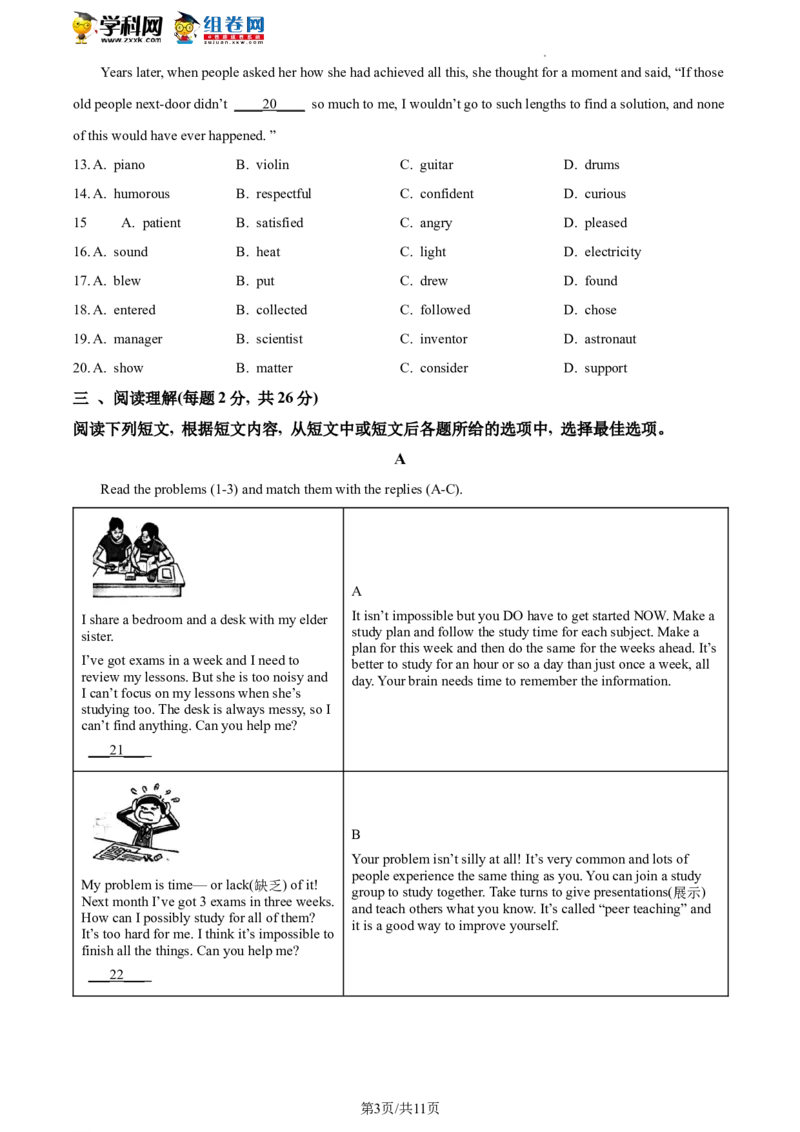
学科网(北京)股份有限公司Years later, when people asked her how she had achieved all this, she thought for a moment and said, “If those
old people next-door didn’t ____20____ so much to me, I wouldn’t go to such lengths to find a solution, and none
of this would have ever happened. ”
13. A. piano B. violin C. guitar D. drums
14. A. humorous B. respectful C. confident D. curious
.
15 A. patient B. satisfied C. angry D. pleased
16. A. sound B. heat C. light D. electricity
17. A. blew B. put C. drew D. found
18. A. entered B. collected C. followed D. chose
19. A. manager B. scientist C. inventor D. astronaut
20. A. show B. matter C. consider D. support
三 、阅读理解(每题2分, 共26分)
阅读下列短文, 根据短文内容, 从短文中或短文后各题所给的选项中, 选择最佳选项。
A
Read the problems (1-3) and match them with the replies (A-C).
A
It isn’t impossible but you DO have to get started NOW. Make a
I share a bedroom and a desk with my elder
study plan and follow the study time for each subject. Make a
sister.
plan for this week and then do the same for the weeks ahead. It’s
I’ve got exams in a week and I need to better to study for an hour or so a day than just once a week, all
review my lessons. But she is too noisy and day. Your brain needs time to remember the information.
I can’t focus on my lessons when she’s
studying too. The desk is always messy, so I
can’t find anything. Can you help me?
___21___
B
Your problem isn’t silly at all! It’s very common and lots of
people experience the same thing as you. You can join a study
My problem is time— or lack(缺乏) of it!
group to study together. Take turns to give presentations(展示)
Next month I’ve got 3 exams in three weeks.
and teach others what you know. It’s called “peer teaching” and
How can I possibly study for all of them?
it is a good way to improve yourself.
It’s too hard for me. I think it’s impossible to
finish all the things. Can you help me?
___22___
第3页/共11页
学科网(北京)股份有限公司C
Why don’t you discuss with your sister so that you can use the
My problem is silly and a bit
desk at different times? Or maybe you can study at the local
embarrassing(令人尴尬的). I just find it
library or cultural centre for a few days this week. Put your own
hard to study. I always stop and start,
things in your drawer, and ask your sister to do so It can help
sometimes I think I’m learning the wrong
you find your things easily.
things. I don’t know what to do. I don’t
think you can really help me.
___23___
B
Alice and Betty were best friends. They had known each other since Betty moved here in the 2nd grade. They
hung out almost every day after school.
They were very different people. Alice did great with her schoolwork, read quietly and took ballet classes.
Betty, on the other hand, would rather play soccer, chat with other kids at school and hardly sat still for long enough
to finish reading a book. Often, Alice and Betty would play together at the park across the street. They’d play on the
sports equipment or play soccer. Sometimes they could not agree on what to do. “Come on, let’s play on the
equipment. We’ve played soccer for the last three days!” Alice said. “I love playing soccer. I don’t want to play on
the equipment.” Betty replied. “We always do what you want to do, Betty, it’s my turn to choose.”Alice was getting
frustrated. “Fine, go to play on the equipment by yourself, I’m playing soccer!” Betty shouted. Alice left angrily.
When she got home, Alice realized she still had Betty’s notebook. “Well, I’m not giving it back today. I’m too
mad at her.”Alice thought. The next day at school, their teacher asked for their notebooks. Betty didn’t have hers
and their teacher Mrs. Stone was angry with her. Betty looked sad and walked quietly back to her desk.
Alice knew she should tell Mrs. Stone that she had the notebook, but she was still mad at Betty. When it was
time for lunch, Alice came back to talk with Mrs. Stone. “Mrs. Stone, I have Betty’s notebook. I should have said
something earlier, but we had a problem yesterday, and I’m still mad at her. Could you help us solve our problem?”
Alice asked.
“Thank you for being honest, Alice. I’m sure Betty will be happy that you give me her notebook. I’m glad you
asked for help in solving the problem.”
After class, Mrs. Stone sat and talked with the girls. Mrs. Stone helped them realize that maybe they didn’t
have to play together every day. They decided to just play together a couple of times a week, and take turns picking
the activity. They were very happy to solve the problem.
24. What do we know about Alice and Betty?
第4页/共11页
学科网(北京)股份有限公司A. They had different hobbies. B. They liked doing the same activities.
C. Betty was a quiet girl but Alice was active. D. Both of them loved reading and playing soccer.
25. Alice was angry because ________.
A. Betty didn’t want to play soccer with her
B. Betty didn’t care about her feelings
C. she couldn’t find her notebook at home
D. her friend took away her notebook by mistake
26. They would probably ________ after talking with Mrs. Stone.
A. respect their parents’ suggestions B. have ballet classes together
C. play soccer together every day D. take turns making decisions
C
When you tell the truth, your brain doesn’t have to do anything out of the ordinary. But lying takes much more
work. Science shows why lying can be hard on more than just your conscience(良知). It can also impair(减弱) how
well you can think.
Imagine you are late for class and you decide to lie. Now you have to come up with a reason or make a story.
If your teacher asks questions, you must quickly decide how to respond.
So you say: “I had to stop by the library and pick up a book.”
Your teacher asks: “The book I assigned (布置的) last week?”
,
Immediately you must decide how to respond—and quickly. If you say yes, the teacher might ask to see
the book. Or she might expect you to read from it in class. So, you have to imagine these possibilities. So you
might say: “No. It was a different book” In this situation, you must figure out (想出) what you need to say to keep
this whole lie from falling apart.
When you are lying, you give your brain a ton of extra work. A lot of that work is done in the prefrontal cortex
(前额皮质). It’s the part of the brain in charge of working memory. And it keeps things in mind for a short while.
The prefrontal cortex also plays a role in other mental skills. Some examples are planning, problem-solving and
self-control. Scientists call these skills “executive function” (执行功能). You use your executive function in many
ways when you lie. You might use self-control, for example. It stops you from blurting out (脱口而出) the truth.
Calling on your executive function uses up a lot of brain power. There’s less left over for other things. The
brain is obtuse when it switches (转换) between lying and truth-telling. It also makes more mistakes.
Victoria Talwar studies lying in children and she says that there are things people can do to encourage honesty.
Young people want to make others feel good, so finding ways to support their friends while still being truthful is
one strategy. “When people’s friends are truthful with them,” she says, “it creates a culture of honesty among
第5页/共11页
学科网(北京)股份有限公司them.” she argues, “it will build stronger friendships.”She adds that it’s more important to reward people for telling
the truth.
Telling important truths can be hard. She says sharing those truths feels good.
27. When people are lying, they have to ________.
A. figure out what extra work they need to prepare
B. find enough time to decide how to respond to others
C. avoid using the executive function to tell the truth
D. imagine possible answers to keep the lie from falling apart
28. The word “obtuse” in Paragraph 6 probably means ________.
A. clear B. quick C. slow D. relaxed
29. The passage is mainly about ________.
A. how much extra work your brain can afford
B. why telling lies will steal people’s brain power
C. why telling lies is a matter of conscience
D. how a culture of honesty builds stronger friendships
D
Think back to when you were in a classroom, maybe a maths classroom and the teacher set a difficult problem.
Which of the two following responses is closer to the way you reacted?
,
A: Oh no this is too hard for me. I’m not even going to seriously try and work it out.
B: Ah, this is quite hard but I like to push myself. Even if I don’t get the answer right, maybe I’ll learn
something in the attempt (尝试).
Early in her career, the psychologist Carol Dweck of Stanford University gave a group of ten-year-olds
problems that were slightly too hard for them. One group reacted positively said they loved challenge and
understood that their abilities could be developed. She said they had a “growth mindset” and focused on what they
could achieve in the future. But another group of children felt that their intelligence was being judged and they had
failed. They had a “fixed mindset” and were unable to imagine improving. These students even looked for someone
who had done worse than them to boost (提升) their self-esteem (自尊). Professor Dweck believes that there is a
problem in education at the moment. For years, children have been praised for their intelligence or talent, but thus
makes them vulnerable (脆弱的) to failure. They want to please by getting high grades, but they are not necessarily
interested in learning for its own sake (目的). The solution, according to Dweck, is to praise the process that
children are engaged (忙于) in making an effort, using learning strategies, persevering (坚持) and improving. This
way they will become mastery-oriented (interested in getting better at something) and will achieve more. She thinks
第6页/共11页
学科网(北京)股份有限公司that keeping working hard over time is the key to outstanding achievement.
Psychologists have been testing these theories. Students were taught that if they left their comfort zone and
,
learned something new and difficult the neurons (神经元) in their brains would form stronger connections,
making them more intelligent. These students made faster progress than a control group. In another study, some
under-performing school children were exposed (接触) to growth mindset skills for a year. The results were
surprising. They came top in tests, beating children from much more better schools. These children had previously
(以前) felt that making an effort was a sign of stupidity, but they came to see it as the key to learning.
So, back to our original question. If you answered B, well done —you already have a growth mindset. If A,
don’t worry, everyone can become mastery-oriented with a little effort and self-awareness.
30. A growth mindset person is the one who ________.
A. focuses on what he has achieved at present
B. faces challenges positively to help himself grow
C. looks for someone who did worse than him
D. is unwilling to experience what he doesn’t know
31. What can we learn from Professor Dweck’s study?
A. Praising children for their intelligence has a positive influence on learning.
B. A person with a fixed mindset can easily improve himself in his comfort zone.
C. Intelligence or talent is the key to people’s outstanding achievement.
D. Guiding students to focus on learning process can help them achieve more.
32. The writer would agree that ________.
A. testing students often can make them more intelligent
B. keeping working hard makes people vulnerable to failure
C. practicing growth mindset skills helps students get improvement
D. staying in the comfort zone is a good way to boost students’ self-esteem
33. What is the writer’s main purpose in writing this passage?
A. To encourage people to develop a growth mindset.
B. To explain a scientific experiment about intelligence.
C. To discuss what the true meaning of achievement is.
D. To compare the differences between growth mindset and fixed mindset.
第二部分
本部分共5题, 共20分。根据题目要求, 完成相应任务。
四、阅读表达(34-36小题每题2分, 37题4分, 共10分)
阅读短文,根据短文内容回答问题。
第7页/共11页
学科网(北京)股份有限公司Gardening as part of the school curriculum (课程) began in the United States in the early 1900s and school
gardening has become very popular during these years. Parents and teachers say these hands-on lessons can be used
to teach many subjects.
Susan Hobart is a school teacher at Lake View Elementary School in Madison. She and her students look after
the school’s large garden with 12 raised beds.
“Gardens are a great way to get kids outside with a purpose. With the school gardens, kids can get to see a
beginning, a middle and an end to their project. If they just sat at desks, they wouldn’t have this experience.”Hobart
said. She added that the gardens helped calm the kids and gave them a different viewpoint about soil and food.
“If we had to buy the seedlings, they’d cost $3 each and we could never afford that, ” Hobart says. “But there
are plenty of creative ways to find help. We found seeds and seedlings from local botanical gardens(植物园) and
our communities.”Each spring, the school’s children plant seeds and seedlings in the garden. Over the summer,
teachers and young children take care of the garden together.
Hobart says that gardens do not have to take up a large area outdoors. For schools without space for even a
small garden, turning to local botanical gardens and parks can sometimes be the answer.
In the school garden, teachers can teach students how to grow food and flowers. They can also teach science,
social studies and even art there. “Giving kids the opportunity to move outside, get their hands dirty, and find
worms, especially if their teachers are excited about it—that’s important,” Hobart said.
Finley, their headmaster, supports teaching city kids about seeds and growing. He aims to “change the culture
around food”. He remembered how amazing it was for his students to see “a seed becomes food”.
“Having a garden in a school is just as important as any other education,”Finley says. “The act of gardening
teaches you where our food source comes from and teaches you to have a feeling of great respect for soil. If kids
have a reverence(尊敬) for soil, they have a reverence for themselves and respect for this planet … Gardening is
not a hobby, it’s a life skill. I see this as one of the most valuable lessons of humanity.”
34. When did gardening begin as part of school curriculum in the United States?
______________________________________________________
35. Where did the students at Lake View Elementary School find seeds and seedlings?
______________________________________________________
36. What can teachers teach in the school garden?
______________________________________________________
37. What do you think of doing gardening in your school? Why? (至少给出2个理由)
______________________________________________________
五、文段表达(10分)
第8页/共11页
学科网(北京)股份有限公司从下面两个题目中任选一题, 根据所给提示, 完成一篇不少于50词的英语文段写作。文中已
给出内容不计入总词数。所给提示词语仅供选用。请不要写出你的校名和姓名。
38. 假如你是李华,你们学校一直倡导“环保生活,从我做起”,你的笔友Peter的学校也要举办相同
的环保活动。请用英文写一封信,谈谈你对绿色生活的看法以及你建议他如何践行绿色生活。
要求:根据所给提示,完成一篇不少于50词的英语文段写作。文中已给出内容不计入总词数。所给提示词
语仅供选用。请不要写出你的校名和姓名。
提示词语: important, protect the environment, save, reuse, recycle
提示问题:
What do you think of green life?
What do you advise Peter to do?
Dear Peter,
How is it going?
I’m writing to tell you something about green life.
____________________________________________________________________________________________
____________________________________________________________________________________________
____________________________________________________________________________________________
____________________________________________________________________________________________
____________________________________________________________________________________________
______________
I’m looking forward to your early reply.
Yours,
Li Hua
39. 某英文网站正在开展以“好习惯是开启成功之门的金钥匙”为主题的征文活动。 假如你是李华,请
用英语写一篇短文投稿,谈谈你的好习惯是什么,你是如何保持这个好习惯的以及取得了哪些效果。
要求:根据所给提示,完成一篇不少于50词的英语文段写作。文中已给出内容不计入总词数。所给提示词
语仅供选用。请不要写出你的校名和姓名。
提示词语:a good habit, keep doing, improve, progress
提示问题:
What is your good habit?
How do you keep your good habit?
What have you achieved?
____________________________________________________________________________________________
第9页/共11页
学科网(北京)股份有限公司____________________________________________________________________________________________
____________________________________________________________________________________________
____________________________________________________________________________________________
____________________________________________________________________________________________
______________
第10页/共11页
学科网(北京)股份有限公司第11页/共11页
学科网(北京)股份有限公司