专题 01 考点拓展 1&代词、数词&写作指导(节日庆祝)
目录
一.词汇拓展.............................................................................................................................................................1
二.考点拓展.............................................................................................................................................................2
三.语法考点.............................................................................................................................................................6
四.写作考点...........................................................................................................................................................15
五.阅读拓展...........................................................................................................................................................17
一.词汇拓展
1.class n.同学;班级→________(复数)
2.good adj.好的→________(比较级)→________(最高级)
3.friend n.朋友→________ adj.友好的→________ n.友谊;友好
4.meet v.遇见,结识→________ n.会议;集会
5.go v.走;去→________(第三人称单数)
6.sit v.坐→________(现在分词)
7.this pron.这;这个(指较近的人或事物)→________(复数) pron.这些→________(对应词) pron.那,那个
(指较远的人或事物)→________(对应词复数) pron.那些
8.put v.放;置→________(现在分词)
9.old adj ……年龄的,……岁的→________(反义词) adj.年轻的
10.teacher n.老师→________(对应词) n.学生
11.boy n.男孩→________(复数)→________(对应词) n.女孩
12.write v.写→________(现在分词)→________ n.作家
13.help v.帮助→________ adj.有用的;提供帮助的→________ adj.无望的
14.know v.知道,懂得→________ n.知识;学识
15.thank v.谢谢→________ adj.感谢的;感激的
1.classes 2.better best 3.friendly friendship4.meeting 5.goes6.sitting6.these that those
7.putting 8.young10.student 11.boys girl12.writing writer13.helpful helpless14. knowledge
15.thankful
二.考点拓展
考点1.辨析speak、talk、say和tell
Frank knew that she thought it was better to talk about feelings instead of getting angry.
词汇含义及用法常用词组或结构
speak意为“说”,强调说的语言或者说话能力speak English 说英语;speak highly of 高度赞扬
talk意为“谈话”,强调与某人交谈talk to/with sb.与某人交谈;talk about sth.谈论某事
say意为“说”,侧重说话的内容say thanks/sorry to sb.向某人道谢/道歉
tell意为“告诉;讲述”,强调讲给别人听tell sb. (about) sth.=tell sth.to sb.告诉某人(关于)某事;tell lies 说谎;tell jokes 讲笑话
用方框中所给单词的正确形式填空(每个单词只能用一次)。
speak talk say tell
1.—An English corner was set up in our school yesterday.
—It's good for us to practice English there.
2.Seeing the offer from the university which she was looking forward to, Lily was too excited to
anything.
3.Mr. Li will give us a next week.All of us are looking forward to it.
4.The idiom (成语) “Mengzi's mother makes three moves” us about a mother who tried her
best to provide the best environment for her child.
1.speaking 2.say 3.talk 4.tells
考点2 “be good + 介词”的短语
Meat is healthy but too much meat is not good for children. 肉是健康的,但是吃太多肉对孩子们来说不好。
be good at “擅长……”,其后接名词、代词或 动词的 -in g 形式。与do well in同义
be good for “对……有好处”,其反义短语为be bad for/be harmful to
be good with “善于应付……的”,其后接表示“人”的名词或代词
be good to “对……好”,后接名词或代词。与be kind/friendly to同义
1.毫无疑问,中国非常擅长修建桥梁和铁路。(be good at)
__________________________________________________________________________________
2.这位老师对学生很有一套。(be good with)
____________________________________________________
3.Walking on sand requires more effort than on the pavement. And the sea air is good people with
breathing problems too.
1.Without doubt, China is good at building bridges and railways.
2.The teacher is very good with students.
3.for
考点3.辨析family、home和house
After knowing the reason, the family had a meeting.
词汇含义及用法
family作集体名词,意为“家庭”,作主语时,谓语动词用单数;作个体名词,意为“家人”,作主语时,谓语动词
用复数
home意为“家”,指一个人出生或居住的地方
house意为“房子”,即居住的房屋用方框中所给单词的正确形式填空(每个单词只能用一次)。
home house family
1.Since I was born, my have lived in the same flat.
2.Tom likes the with a big garden very much, but its price goes beyond his ability to pay.
3.Thanks to the internet, we can do shopping at .
1.family 2.house 3.home
考点4.辨析look、watch、see和read
They would look at all the technologies a person could use and advise on the best ones and how to get the most
out of them.
look 强调“看”的动作,作不及物动词,后面接
宾语时,要加介词at
看黑板 look at the blackboard
watch强调“(聚精会神地)观看;注视”,如看电
视、看比赛等
看电视 watch TV
see 强调“看”的结果
看见了一条蛇 see a snake
read意为“阅读”,如看书、看报纸、看杂志
等
看报纸 read the newspaper
watch 专注用时长,比赛影视常登场。
see 以结果为导向,看到内容心中藏。
look 动作要先想,单独使用不恰当。
look at 搭配强,指向目标不能忘。
read 文字书中躺,阅读书籍心欢畅。
用方框中所给单词的正确形式填空(每个单词只能用一次)。
watch see look read
1. ! The children are listening to the teacher carefully. They are interested in the colorful culture
in our country.
2.—While , the more careful you are, the more easily you can find answers in the article.
—That's true.
3.The documentary(纪录片) A Plastic Ocean is so educational that I have it several times so
far.
4.I didn't you yesterday morning. Where were you?
1.Look 2.reading 3.watched 4.see考点5.help的用法
With the help of the government, great changes have taken place in many old villages.
按要求完成句子。
1.There is a robot dog in the airport helping the work now.(盲填)
2.Thank you for (help) me with my lessons.(用括号内所给词的适当形式填空)
3.Let's invite some more people to help the project on air pollution in this area.(盲填)
1.with 2.helping 3.with
考点6.try的用法
You should always try to describe something using the five senses.
根据汉语意思完成句子。
1.—Giving others a helping hand not only helps us make friends but also makes us happy.
—That's true. I'll (尽我最大的努力)to help others.
2.The workers are (尽力)repair my car, because three days ago I had a crash.
3.—Although I have failed three times, I will (第四次尝试).
—Failure is the mother of success. I will be with you all the way.
1.try my best 2.trying to 3.have a fourth try
考点7 “What + be + 主语 + like?”句型的用法
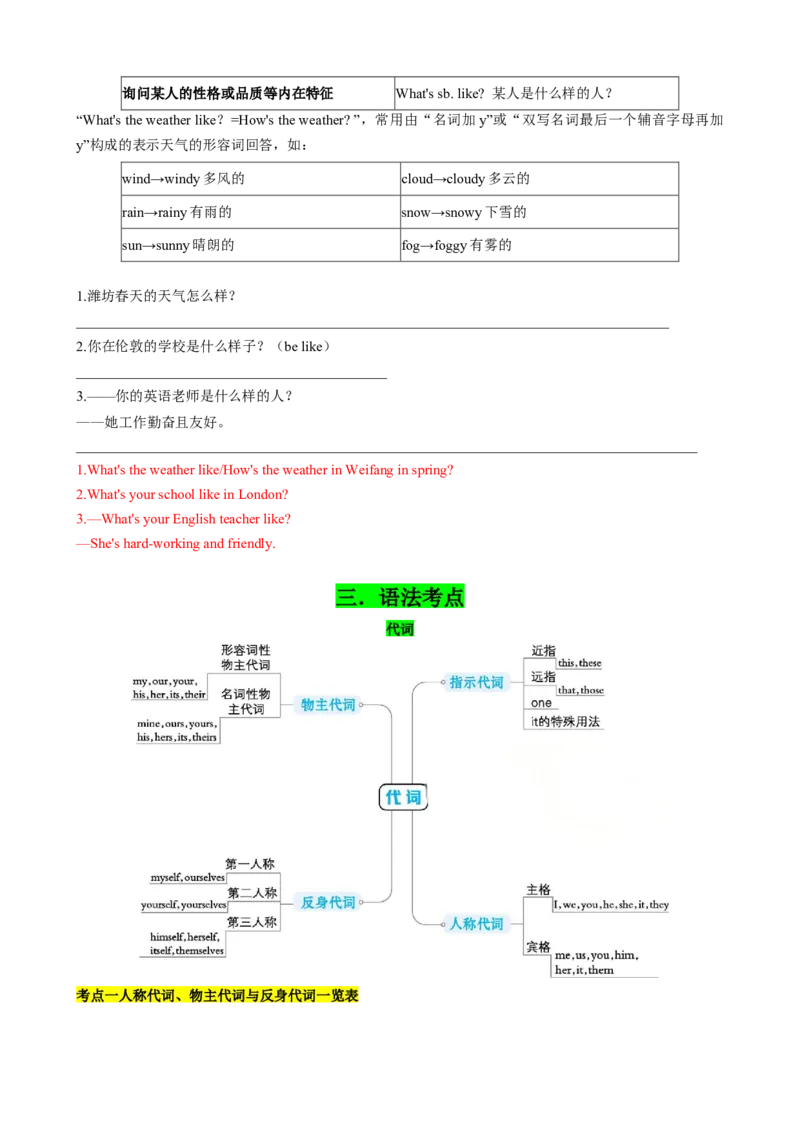
What's the weather like? 天气如何?
询问天气如何 What's the weather like?天气如何?
询问某物如何 What's sth. like? 某物什么样子?询问某人的性格或品质等内在特征 What's sb. like? 某人是什么样的人?
“What's the weather like?=How's the weather? ”,常用由“名词加y”或“双写名词最后一个辅音字母再加
y”构成的表示天气的形容词回答,如:
wind→windy多风的 cloud→cloudy多云的
rain→rainy有雨的 snow→snowy下雪的
sun→sunny晴朗的 fog→foggy有雾的
1.潍坊春天的天气怎么样?
____________________________________________________________________________________
2.你在伦敦的学校是什么样子?(be like)
____________________________________________
3.——你的英语老师是什么样的人?
——她工作勤奋且友好。
________________________________________________________________________________________
1.What's the weather like/How's the weather in Weifang in spring?
2.What's your school like in London?
3.—What's your English teacher like?
—She's hard-working and friendly.
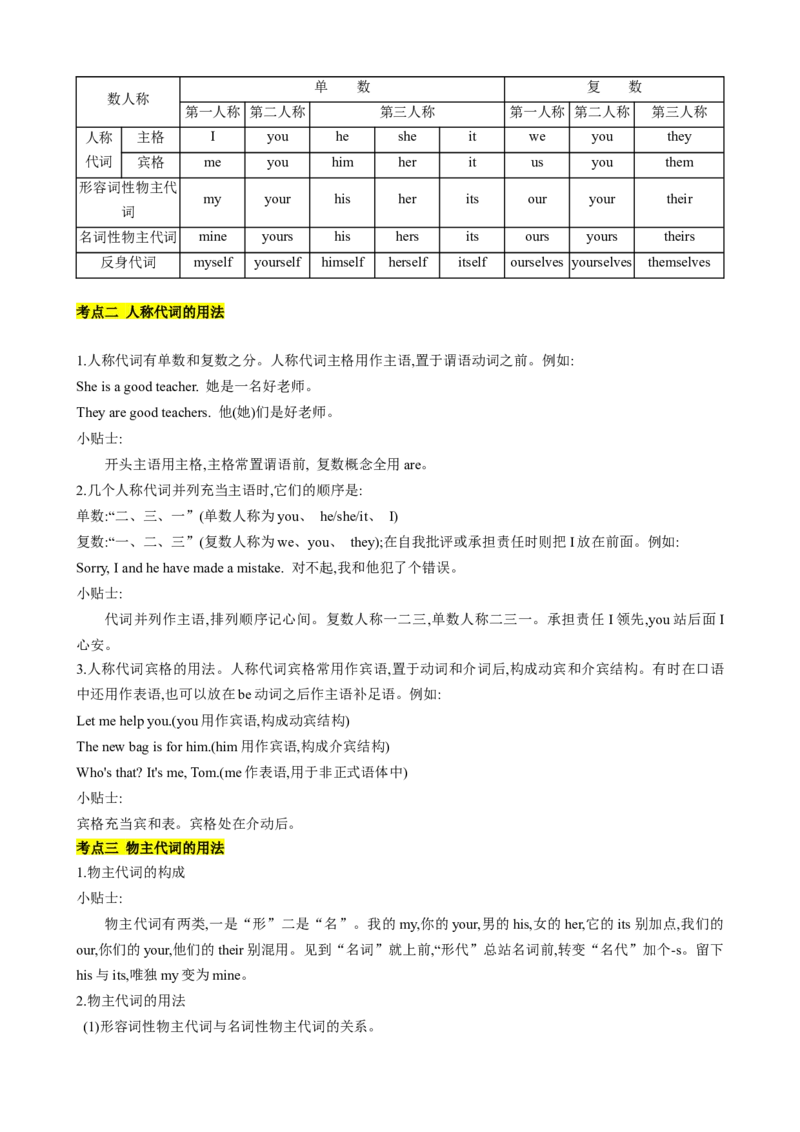
三.语法考点
代词
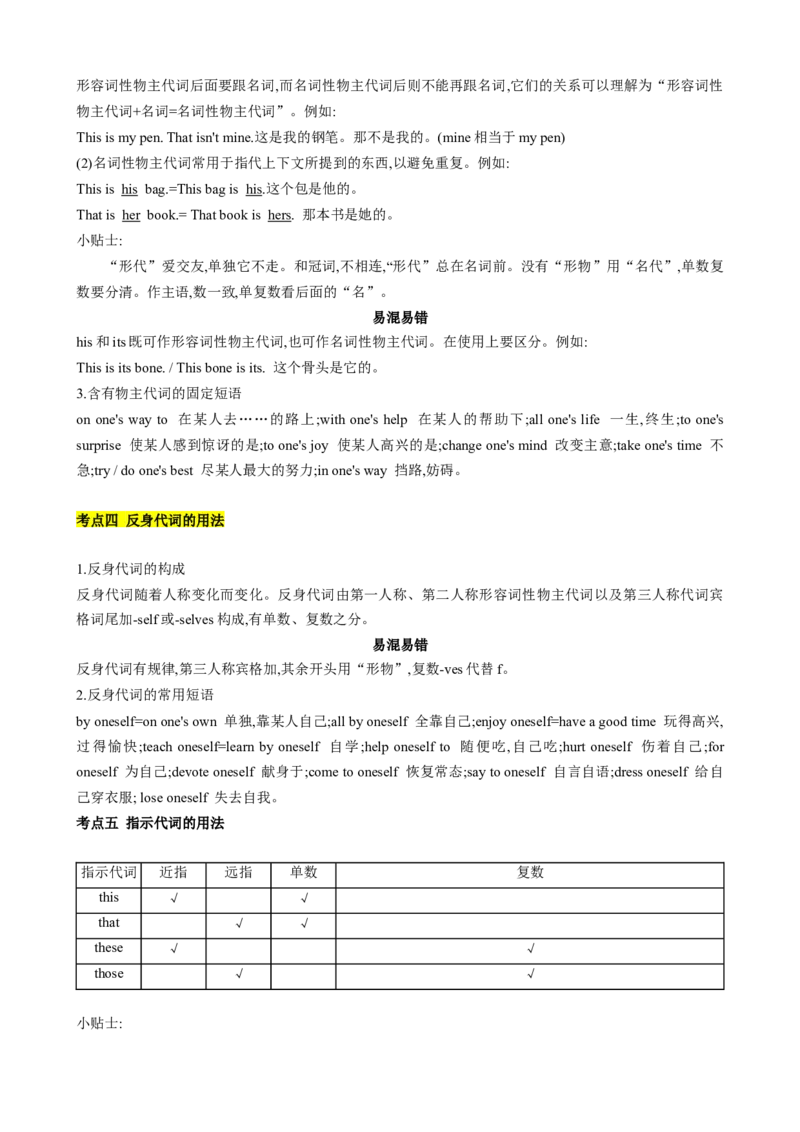
考点一人称代词、物主代词与反身代词一览表单 数 复 数
数人称
第一人称 第二人称 第三人称 第一人称 第二人称 第三人称
人称 主格 I you he she it we you they
代词 宾格 me you him her it us you them
形容词性物主代
my your his her its our your their
词
名词性物主代词 mine yours his hers its ours yours theirs
反身代词 myself yourself himself herself itself ourselves yourselves themselves
考点二 人称代词的用法
1.人称代词有单数和复数之分。人称代词主格用作主语,置于谓语动词之前。例如:
She is a good teacher. 她是一名好老师。
They are good teachers. 他(她)们是好老师。
小贴士:
开头主语用主格,主格常置谓语前, 复数概念全用are。
2.几个人称代词并列充当主语时,它们的顺序是:
单数:“二、三、一”(单数人称为you、 he/she/it、 I)
复数:“一、二、三”(复数人称为we、you、 they);在自我批评或承担责任时则把I放在前面。例如:
Sorry, I and he have made a mistake. 对不起,我和他犯了个错误。
小贴士:
代词并列作主语,排列顺序记心间。复数人称一二三,单数人称二三一。承担责任I领先,you站后面I
心安。
3.人称代词宾格的用法。人称代词宾格常用作宾语,置于动词和介词后,构成动宾和介宾结构。有时在口语
中还用作表语,也可以放在be动词之后作主语补足语。例如:
Let me help you.(you用作宾语,构成动宾结构)
The new bag is for him.(him用作宾语,构成介宾结构)
Who's that? It's me, Tom.(me作表语,用于非正式语体中)
小贴士:
宾格充当宾和表。宾格处在介动后。
考点三 物主代词的用法
1.物主代词的构成
小贴士:
物主代词有两类,一是“形”二是“名”。我的my,你的your,男的his,女的her,它的its别加点,我们的
our,你们的your,他们的their别混用。见到“名词”就上前,“形代”总站名词前,转变“名代”加个-s。留下
his与its,唯独my变为mine。
2.物主代词的用法
(1)形容词性物主代词与名词性物主代词的关系。形容词性物主代词后面要跟名词,而名词性物主代词后则不能再跟名词,它们的关系可以理解为“形容词性
物主代词+名词=名词性物主代词”。例如:
This is my pen. That isn't mine.这是我的钢笔。那不是我的。(mine相当于my pen)
(2)名词性物主代词常用于指代上下文所提到的东西,以避免重复。例如:
This is his bag.=This bag is his.这个包是他的。
That is her book.= That book is hers. 那本书是她的。
小贴士:
“形代”爱交友,单独它不走。和冠词,不相连,“形代”总在名词前。没有“形物”用“名代”,单数复
数要分清。作主语,数一致,单复数看后面的“名”。
易混易错
his和its既可作形容词性物主代词,也可作名词性物主代词。在使用上要区分。例如:
This is its bone. / This bone is its. 这个骨头是它的。
3.含有物主代词的固定短语
on one's way to 在某人去……的路上;with one's help 在某人的帮助下;all one's life 一生,终生;to one's
surprise 使某人感到惊讶的是;to one's joy 使某人高兴的是;change one's mind 改变主意;take one's time 不
急;try / do one's best 尽某人最大的努力;in one's way 挡路,妨碍。
考点四 反身代词的用法
1.反身代词的构成
反身代词随着人称变化而变化。反身代词由第一人称、第二人称形容词性物主代词以及第三人称代词宾
格词尾加-self或-selves构成,有单数、复数之分。
易混易错
反身代词有规律,第三人称宾格加,其余开头用“形物”,复数-ves代替f。
2.反身代词的常用短语
by oneself=on one's own 单独,靠某人自己;all by oneself 全靠自己;enjoy oneself=have a good time 玩得高兴,
过得愉快;teach oneself=learn by oneself 自学;help oneself to 随便吃,自己吃;hurt oneself 伤着自己;for
oneself 为自己;devote oneself 献身于;come to oneself 恢复常态;say to oneself 自言自语;dress oneself 给自
己穿衣服; lose oneself 失去自我。
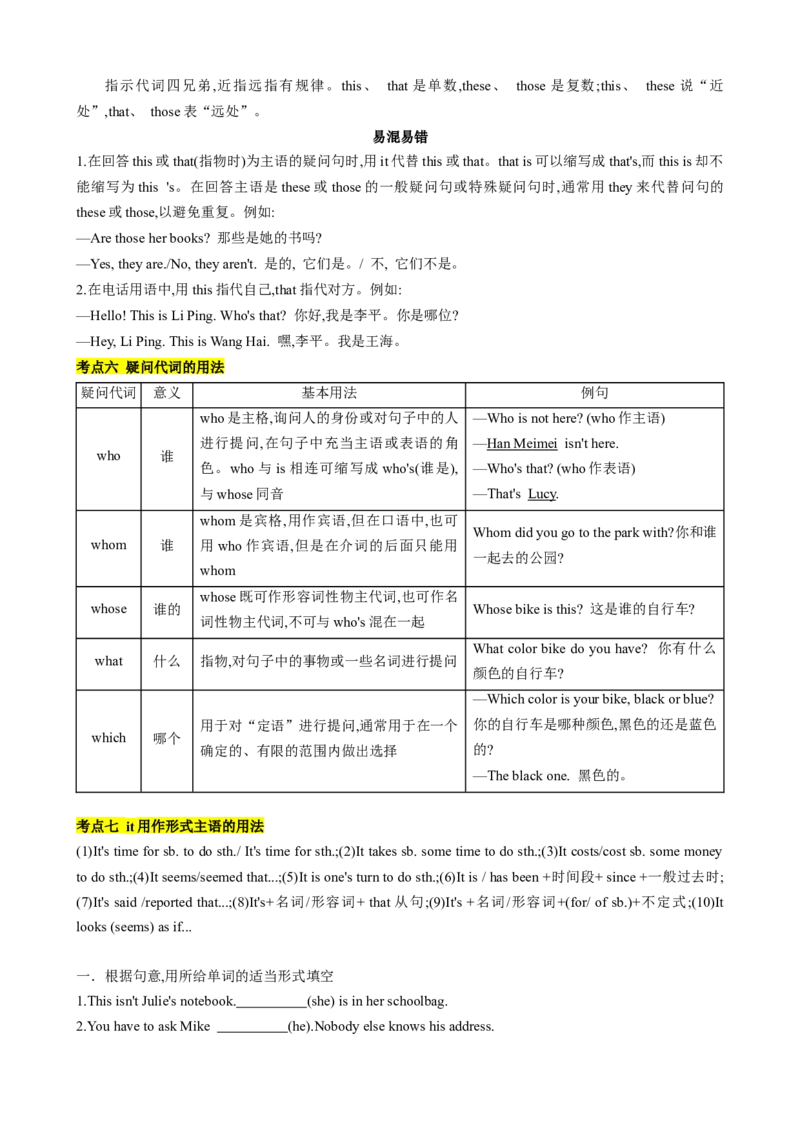
考点五 指示代词的用法
指示代词 近指 远指 单数 复数
this √ √
that √ √
these √ √
those √ √
小贴士:指示代词四兄弟,近指远指有规律。this、 that 是单数,these、 those 是复数;this、 these 说“近
处”,that、 those表“远处”。
易混易错
1.在回答this或that(指物时)为主语的疑问句时,用it代替this或that。that is可以缩写成that's,而this is却不
能缩写为this 's。在回答主语是these或those的一般疑问句或特殊疑问句时,通常用they来代替问句的
these或those,以避免重复。例如:
—Are those her books? 那些是她的书吗?
—Yes, they are./No, they aren't. 是的, 它们是。/ 不, 它们不是。
2.在电话用语中,用this指代自己,that指代对方。例如:
—Hello! This is Li Ping. Who's that? 你好,我是李平。你是哪位?
—Hey, Li Ping. This is Wang Hai. 嘿,李平。我是王海。
考点六 疑问代词的用法
疑问代词 意义 基本用法 例句
who是主格,询问人的身份或对句子中的人 —Who is not here? (who作主语)
进行提问,在句子中充当主语或表语的角 —Han Meimei isn't here.
who 谁
色。who与is相连可缩写成who's(谁是), —Who's that? (who作表语)
与whose同音 —That's Lucy.
whom是宾格,用作宾语,但在口语中,也可
Whom did you go to the park with?你和谁
whom 谁 用who作宾语,但是在介词的后面只能用
一起去的公园?
whom
whose既可作形容词性物主代词,也可作名
whose 谁的 Whose bike is this? 这是谁的自行车?
词性物主代词,不可与who's混在一起
What color bike do you have? 你有什么
what 什么 指物,对句子中的事物或一些名词进行提问
颜色的自行车?
—Which color is your bike, black or blue?
用于对“定语”进行提问,通常用于在一个 你的自行车是哪种颜色,黑色的还是蓝色
which 哪个
确定的、有限的范围内做出选择 的?
—The black one. 黑色的。
考点七 it用作形式主语的用法
(1)It's time for sb. to do sth./ It's time for sth.;(2)It takes sb. some time to do sth.;(3)It costs/cost sb. some money
to do sth.;(4)It seems/seemed that...;(5)It is one's turn to do sth.;(6)It is / has been +时间段+ since +一般过去时;
(7)It's said /reported that...;(8)It's+名词/形容词+ that 从句;(9)It's +名词/形容词+(for/ of sb.)+不定式;(10)It
looks (seems) as if...
一.根据句意,用所给单词的适当形式填空
1.This isn't Julie's notebook. (she) is in her schoolbag.
2.You have to ask Mike (he).Nobody else knows his address.3.These flowers belong to Miss Wang.They are as beautiful as (we).
4.“Sit down and make (you) at home, boys and girls!” said Mrs.Li kindly.
5.George introduced us to some friends of (he) at the party.
6.—Oh, I'm feeling so thirsty and tired.
— (I), too.
7.This physics problem isn't hard at all.I can work it out (I).
8. (I) Chinese teacher asked me with whom I had discussed the problem.
9.—Do you know Alice?
—Yes.I know (she) very well.We have been friends for long.
10.This English dictionary is not mine.It must be (Tom).
11.Lily's backpack is much bigger than (me).
12.Mrs.Guo teaches (we) history.
13.We should always keep (we) away from danger.
14.I found it impossible for (he) to work out the maths problem.
15.The boy who comes to the party is given a wooden apple with (he) own name in it as a souvenir.
16.These boys have been able to dress (them) at the age of five.
17.Betty and her sister went to the museum with a relative of (them).
18.—Is this your cousin's sweater?
—No. (she) is on the chair behind the desk.
【参考答案】1.Hers 2.himself 3.ours 4.yourself/yourselves5.his 6.Me 7.myself 8.My 9.her
10.Tom's 11.mine 12.us 13.ourselves 14.him 15.his16.themselves 17.theirs 18.Hers
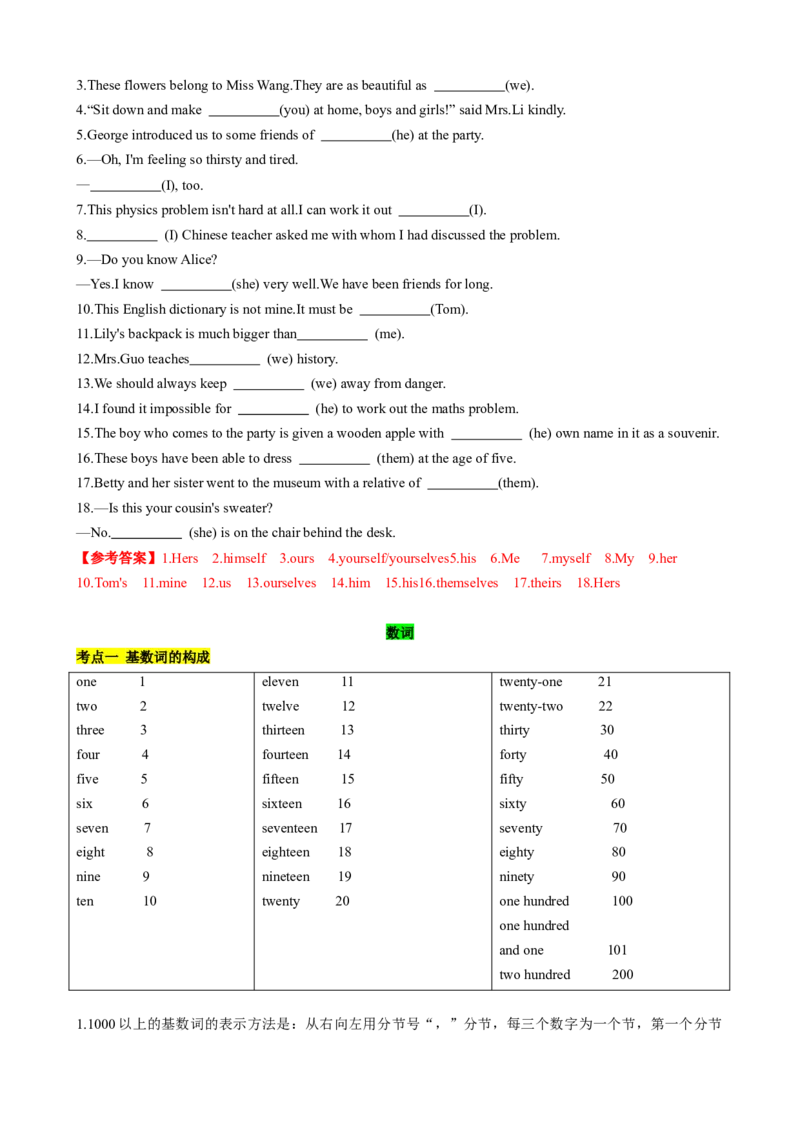
数词
考点一 基数词的构成
one 1 eleven 11 twenty-one 21
two 2 twelve 12 twenty-two 22
three 3 thirteen 13 thirty 30
four 4 fourteen 14 forty 40
five 5 fifteen 15 fifty 50
six 6 sixteen 16 sixty 60
seven 7 seventeen 17 seventy 70
eight 8 eighteen 18 eighty 80
nine 9 nineteen 19 ninety 90
ten 10 twenty 20 one hundred 100
one hundred
and one 101
two hundred 200
1.1000以上的基数词的表示方法是:从右向左用分节号“,”分节,每三个数字为一个节,第一个分节号前用thousand,第二个分节号前用million,第三个分节号前用billion (美)或thousand million(英)。
如:2,418,000,000 two billion, four hundred and eighteen million 或 two thousand, four hundred and
eighteen million
2.hundred,thousand,million,billion 等用在具体的数字后面时不能加-s 或 of;hundred, thousand, million,
billion等前面没有具体的数字时通常加-s或of。如:
eight thousand people八千人
fifty thousand trees五万棵树
thousands of成千上万的
millions of数百万
3.“基数词+单数名词”相当于复合形容词,作名词的定语,用于表示时间、距离等。如:
the 100-metre race 100米赛跑
a ten-minute walk 10分钟的路程
4.常见的数字符号和等式的读法:=(等于号)读作 equals,+(加号)读作 plus或and,-(减号)读作minus,
×(乘号)读作times 或multiplied by,÷(除号)读作divided by。如:
3+2=5读作Three plus two equals(或is)five./Three and two is(或equals)five./Three and two makes five.
5-3=2读作 Five minus three equals(或is)two.
8×7=56读作Eight times seven equals(或is)fifty-six./Eight multiplied by seven is fifty-six.
10÷5=2读作Ten divided by five equals(或is)two.
5.“基数词+more”或“another+基数词”表示“在原来的基础上增加的数量”。如:
My grandmother will stay in Shanghai for two more weeks.
=My grandmother will stay in Shanghai for another two weeks.我的奶奶将在上海再待两周。
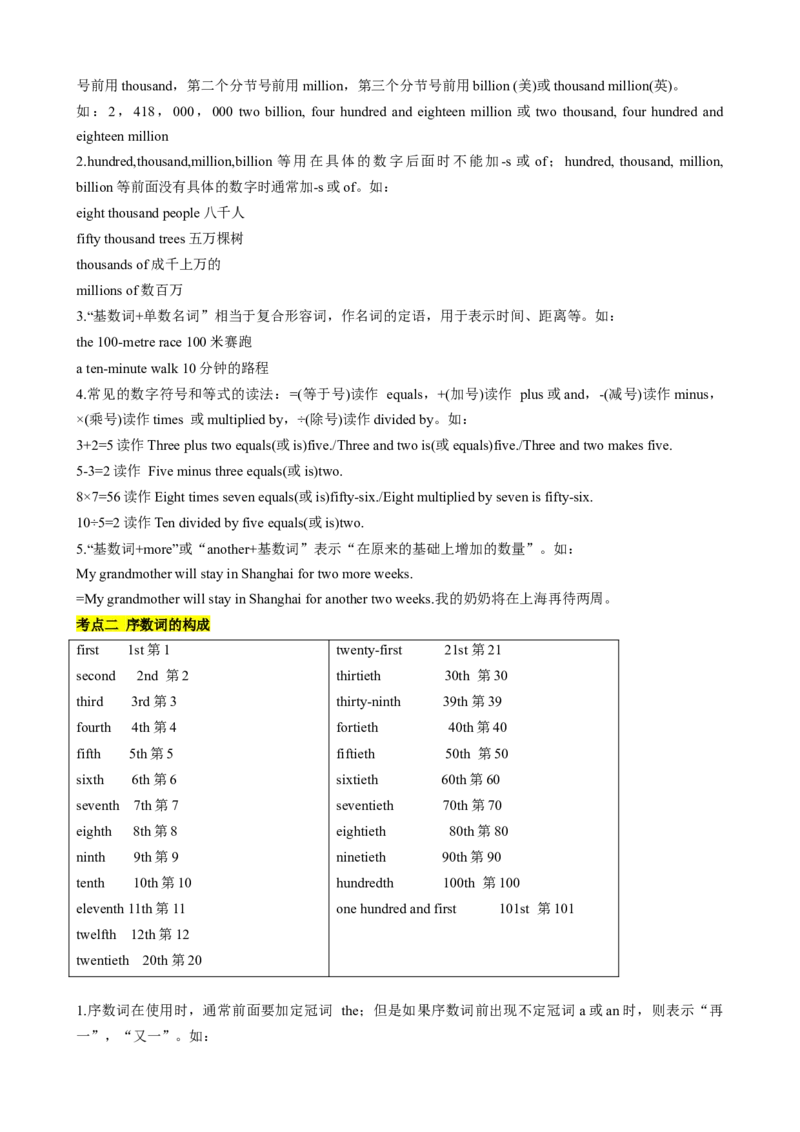
考点二 序数词的构成
first 1st第1 twenty-first 21st第21
second 2nd 第2 thirtieth 30th 第30
third 3rd第3 thirty-ninth 39th第39
fourth 4th第4 fortieth 40th第40
fifth 5th第5 fiftieth 50th 第50
sixth 6th第6 sixtieth 60th第60
seventh 7th第7 seventieth 70th第70
eighth 8th第8 eightieth 80th第80
ninth 9th第9 ninetieth 90th第90
tenth 10th第10 hundredth 100th 第100
eleventh 11th第11 one hundred and first 101st 第101
twelfth 12th第12
twentieth 20th第20
1.序数词在使用时,通常前面要加定冠词 the;但是如果序数词前出现不定冠词 a或an时,则表示“再
一”,“又一”。如:We’ll go over it a second time.我们得再念第二遍。We’ve tried it three times. Must we try it a fourth time?我们
已经试过三遍了,还必须试一次(第四次)吗?
2.基数词也可以表示顺序。只需将基数词放在它所修饰的名词之后即可,不需要添加定冠词。如:
the first lesson——Lesson One
the fifth page——Page 5(Five)
the twenty-first room——Room 21(Twenty-one)
考点三 数词的常见用法
用法 例子
句 主语 It is said that thirteen is an unlucky number.
法 The first day of May is International Labour Day.
功 宾语 It is worth three hundred.
能 He was among the first to arrive.
定语 There are only three boys in the class.
May is the fifth month of a year.
表示事物编号 No. Ten Middle School, Lesson One
表示年代 in the 1890s
表示年、月、日 On May 1st,2008
表示分数 分子是基数词,分母是序数词,当分子大于1时,分母用复数形式。如:one
third, five sixths
表 整点 Tom often gets up at six in the morning.
示 与汉语 4:25four twenty-five
时 顺序相同 6:30six thirty
间 几点过几分 at twenty past six, at a quarter past eleven
差几分到 at five to six, at twenty-nine to ten
几点
1.表示年、月、日时,年用基数词,日用序数词。
如:July 5th,1989 1989年7月5日(读为July the fifth, nineteen, eighty-nine)
August 1st,2005 2005年8月1日(读为August the first, two thousand and five)
2.表示年代时,在年份的阿拉伯数字后面加-s或’s。如:
1730’s /1730s the seventeen thirties十八世纪三十年代
1960’s /1960s the nineteen sixties二十世纪六十年代
the late nineties九十年代末期
the early eighties八十年代初期
the mid 1960’s/1960s the mid nineteen sixties 二十世纪六十年代中期
3.表示某人约几十岁时,在表示整十位的基数词后面加-s。如:
Tom went to New York in his twenties.汤姆在二十多岁时去了纽约。4.分数作主语时,谓语动词由of后面的名词的数来确定。of 后为可数名词复数时,谓语动词用复数形
式;of后面的名词为 不可数名词时,谓语动词用单数形式。如:
Two thirds of the work is hard to finish.三分之二的工作很难完成。
Two thirds of the students in our class are League members.我们班里三分之二的学生是团员。
一. 单项选择。
1. —Good morning, Madam. Can I help you?
—Sure, I’d like ________for cooking vegetables.
A. two cups of tea B. three pieces of bread
C. five kilos of oil D. four bottles of milk
2. Nearly _______of the earth _______ covered by sea.
A. three fourth,is B. three fourths,is
C. three fourth,are D. three fourths,are
3. —We’ll be back for our school’s ____anniversary ceremony.
—I see. That means you’ll have a get-together with your classmates in _______ years.
A. fifteen,seven B. fifteenth,seven C. fifteen,seventh D. fifteenth,seventh
4. —Which class won the match in the end?
—I’m not quite sure. Perhaps _________did.
A. Class Third B. Third Class C. Class Three D. Three Class
5. There are ________ people in the supermarket. It’s so crowded.
A. hundred B. hundreds C. hundred of D. hundreds of
6. The number of the students in our school is about nine ______. ______ of them are boys.
A. hundred; Two thirds B. hundred; Two third
C. hundreds; Two thirds D. hundreds; Two third
7. My brother is a ______ boy and he can’t go to school now.
A. four years B. four-year-old
C. four-years-old D. four years old
8. It is said that the big fish in the lake is about ______.
A. four meters long B. four meter long
C. four-meter long D. four-meters long
9. —What’s the date today?
—It is _______.
A. March the eighth B. March eight C. eight March D. eighth March
10.—Where does your English teacher live?
—He lives on _____ floor of that red building..
A. five B. fifth C. the fifth D. the five
11. This is my _____time to play the piano at our school.
A. second B. two C. seconds D. the two
12. Our English teacher tells us that the _____day of the week is Sunday.
A. seven B. seventh C. first D. one13. There are _____days in a year.
A. three hundreds sixty-five B. three hundred and sixty-five
C. three hundred and sixty five D. three hundreds and sixty five
14. My pen pal, Jack, is in_______ in a high school in American.
A. Three Class, One Grade B. Class Three, Grade One
C. Grade One, Class Three D. One Grade, Three Class
15. There are ______months in a year and December is the ______month of the year.
A. twelve; twelve B. twelve; twelfth
C. twelfth; twelve D. twelfth; twelfth
1. C。本题考查数量词的表达法,由句意可知,需要油做菜,所以选C,指“五公斤食用油”。
2. B。本题考查分数的表达法,分子用基数词,分母用序数词,分子大于一时,分母要加-s。所以四分之
三是“three fourths”,地球表面是不可数名词,所以谓语用单数is。
3. B。本题考查基数词和序数词的用法,第一空指第十五个纪念仪式,用序数词fifteenth,第二空指七年
后,用基数词seven,注意in后接一段时间的句子,常用将来时。
4. C。本题考查基数词用来表示年级、班级、房间号码、电话号码和编号。要求单词开头字
母要大写。名词在前,数词在后。
5. D。本题考查基数词的单位hundred,thousand,million和billion等,当用来表示具体数
目,前面有具体的基数词时,这些词的后面不加-s。但是当hundred,thousand,million和
billion等用来表示不具体的数目时用“hundreds/ thousands/millions/ billions of +名词”来表
示,这些词的前面也不用具体的基数词。本题属于后者。
6. A。基数词后面的hundred不加-s,三分之二的正确表达是Two thirds。
7.B。本题考查复合形容词的用法,由基数词+单数名词+形容词构成,中间用连字符。所以选择B。
8.A。 本题考查形容词作表语的用法,表示某物多长、多宽或者多高,把形容词放在后面,中间的名词
用复数形式,这些词中间不用连字符。
9. A。表示日期用序数词,三月八日用March the eighth或者March 8th表示。
10. C。本题考查序数词的用法,表示居住在第几楼是定冠词the和序数词连用。
11.A。本题考查序数词的用法,物主代词和序数词连用表示“某人的第几次”的意思,从本句子的意思
理解是选择A表示“这是我的第二次在学校弹钢琴。”
12. C。本题考查序数词的用法。根据西方文化习惯Sunday是一星期的第一天,所以用the和first连用。
13. B。本题考查基数词的用法,三位数的基数词表达是百位和十位间用 and,十位和个位间用连字符。
14. B。本题考查基数词的用法。表示在几年级几班用基数词,注意:名词在前,数词在后;班级在前,
年级在后;第一个字母要大写。
15. B。本题考查基数词和序数词的用法。表示一年有十二个月用基数词twelve;十二月是一年的第十二
个月用序数词twelfth。所以选择B。
二. 用括号中所给的词的适当形式填空。
1. My sister is going to have a party for her _______ (twelve) birthday.
2. You can see ______ (thousand) of trees around our village.
3. Four ______ (seven) of the people are going to plant trees on the hill tomorrow
4. There are ______ (hundred) of people dancing at the square after supper.5. His______ (one) name is Mike. But I don’t know his family name.
6. I am in my (three)year in this middle school.全品中考
7. He plans to take ______ (second)months for his climb.
8. Alex is ______ years old and is taken good care of in the kindergarten.(fourth)
1.twelfth 2.thousands 3.sevenths 4.hundreds 5. first 6. third 7. two 8. four
四.写作考点
介绍自己最喜欢的节假日,并能正确描述与该节假日有关的传统文化及习俗。与此相关的写作通常有:
①向外国朋友介绍中国的某个传统节日;②介绍自己最喜欢的节日并说明原因。
在具体介绍某一节日时,通常包含以下要点:①介绍节日名称以及节日时间;②介绍该节日的相关
习俗或传统;③表明自己对这个节日的感受或喜欢它的原因。
你的英国朋友Michael想了解中国的传统节日。请你根据以下要点和要求,以“The Mid-Autumn Festival”
为题,写一篇英语短文向他介绍该节日。
要点:
(1)When is the festival celebrated?
(2)What activities do people do during the festival?
(3)How do you like it?
要求:
(1)文章应包含以上所有要点,可适当发挥;
(2)词数不少于90。
审主题:介绍节日
审体裁:说明文
审人称:第三人称和第一人称
审时态:一般现在时
审要点:节日庆祝时间、庆祝活动、对节日的感受
The Mid-Autumn Festival
The Mid-Autumn Festival is one of the most important traditional festivals in China.It takes place on the
fifteenth day of the eighth lunar month.
During this festival, people usually get together with their families for a big dinner. Eating moon cakes is a
must during the festival. Its round shape stands for family reunions. At night, people always enjoy the full moon.It makes them think of their relatives and friends.
I really like the festival, not only because I can enjoy the delicious moon cakes, but because I can have a family
reunion. It always makes me feel warm in my heart.
写作训练
假如你是刘伟,你的英国笔友Jim写邮件询问你最喜欢的中国传统节日。请你以“My Favourite
Festival”为主题,并根据以下要点和要求,给他写一封回信。
要点:
1. What’s your favourite festival?
2. How do you usually celebrate it?
3. What do you think of the festival?
要求:
1. 内容须包含所有要点,可适当发挥;
2. 词数100左右,开头和结尾已给出,不计入总词数。
Dear Jim,
I am glad to receive your email.
___________________________________________________________________________________________
___________________________________________________________________________________________
___________________________________________________________________________________________
___________________________________________________________________________________________
___________________________________________________________________________________________
___________________________________________________________________________________________
___________________________________________________________________________________________
___________________________________________________________________________________________
___________________________________________________________________________________________
___________________________________________________________________________________________
_______________________________________________________________
Yours,
Liu Wei
【写作提示】
1.主题:介绍最喜欢的节日
2.人称:以第一人称和第三人称为主
3.时态:一般现在时
4.要点:节日名称、时间、庆祝活动、个人感受
5.写作思路:开篇点明最喜欢的节日名称及基本信息,接着介绍该节日的庆祝活动,最后表达个人感受。
【范文赏读】
Dear Jim,I am glad to receive your email. Let me tell you something about my favourite festival.
My favourite festival is the Dragon Boat Festival. It’s one of the most important traditional festivals in
China. It falls on the 5th day of the 5th lunar month.
The festival is celebrated to remember the great ancient Chinese poet Qu Yuan. On that day, my family
usually get together to eat zongzi and other delicious dishes. In the south of China, people often have dragon
boat races. Besides, we have a 3-day holiday during the festival. So we can have a break from work and
spend time with our family.
I like the festival very much and I always have fun. What do you think of it?
Yours,
Liu Wei
五.阅读拓展
一
In January this year, Logos Hope, the world's largest
floating((浮动的)library stayed in Port Said for 20 days. This
was the second time it came to Egypt(埃及).It left for Jordan on
January 23,2023.
Logos Hope sells over 5.000 different kinds of books from
around the world. Visitors can not only read and buy the books. but also watch a show and taste
delicious food on the ship.
The floating library has about 400 workers from different countries, such as Germany, Switzerland
and Australia. And it's open to
visitors every day from 10 am to 10 pm except(除了)Sunday. On Fridays, it opens at 3 pm, and
closes at 6 pm.
Visitors older than 13 need to buy a ticket, but those under 13 can get on the ship for free(免费
地).Logos Hope welcomes millions of visitors every year.
1.Where did Logos Hope go after leaving Port Said?
A. Egypt. B. Jordan. C. Germany. D. Australia.
2.What can visitors do on Logos Hope?
① Read books. ②Watch a show. ③ Hear a concert. ④ Eat delicious food.
A.①②③ B.①③④ C.①②④ D.②③④
3.If Jack wants to go to the floating library, he can go there______.
A. at 9 am on Monday B. at 10 am on Sunday
C. at 5 pm on Friday D. at 11 pm on Saturday
4.According to the last paragraph, which word can best describe the floating library?
A. Popular. B. Boring. C. Expensive. D. Beautiful.
5.Where can we find the passage?
A. In a science book. B. In a travel magazine.
C. In a sports report. D. In a picture book.答案详析
1.B 细节理解题。根据第一段最后一句“It left for Jordan on January 23,2023.”可知,“望道号”在离开
埃及的塞得港后,去了约旦。
2.C 细节理解题。根据第二段第二句“Visitors can not only read and buy the books, but also watch a show and
taste delicious food on the ship.”可知,游客们可以在“望道号”上读书、买书、看演出和品尝美食。故
①②④正确。
3. C 推理判断题。根据倒数第二段中的“And it's open to visitors every day from 10 am to 10 pm except
Sunday. On Fridays, it opens at 3 pm, and closes at 6 pm.”可知,除了周日,浮动图书馆每天的营业时间为上
午10点到晚上10点。周五则是下午3点到6点。由此可推知,Jack 可以在周五下午5点去那里。
4.A 推理判断题。根据最后一段中的“Logos Hope welcomes millions of visitors every year.”可知,浮动图
书馆每年会接待数百万游客。由此可推知,浮动图书馆非常受欢迎。
5.B推理判断题。通读全文可知,本文介绍了“望道号”在埃及停泊的事情,并详细介绍了其为游客提供的
服务、员工的情况、营业时间以及门票等信息。由此可推知,我们可能在一本旅游杂志上看到这篇文
章。
二
Cheng Feng is a 33-year-old rural(乡村的)teacher. And many
students also see her as their mother because of her love and concern (关心)
for them.
During the last summer vacation, Cheng spent her free time visiting
the rural students in the mountains. Most students' parents have to go to
work far away from home. These students stay at home and their
grandparents take care of them.
Getting on with these students, Cheng knew that they want to go out of the mountains by studying. Over the
past years. Cheng has taught in several poor rural schools to help rural students get a good education. She also
used her money to buy computers and more useful books for them.
After helping transform(改造)a rural school, she moves on to the next place which needs her. From her
different experiences(经历)in those rural schools, she learned that rural students need help from more excellent
and helpful teachers. “We should let the light in ourselves shine on more people, and help them to see further and
dream bigger," she said.
1.How old is Cheng Feng?
2.Why do some rural students live with their grandparents?
3.According to Paragraph 3, what did Cheng Feng do besides(除了)teaching?
4.What did Cheng Feng learn from her different experiences?
5. What do you think of Cheng Feng? Why?长难句分析
原句:(最后一段第一句)After helping transform a rural school, she moves on to the next place which
needs her.
译文:在帮助改造完一所乡村学校后,她又去往下一个需要她的地方。
分析:本句是一个复合句。After helping transform a rural school 是时间状语:which needs her 是
which 引导的定语从句,修饰先行词the next place。
答案详析
1. She is thirty-three/33 years old. 根据第一段第一句“Cheng Feng is a 33-year-old rural teacher.”可知,程风
是一位33岁的乡村教师。
2. Because most students' parents have to go to work far away from home. 根据第二段最后两句可知,大多数
学生的父母不得不去离家很远的地方工作。这些学生待在家里,他们的祖父母照顾他们。
3. She used her money to buy computers and more useful books for rural students.根据第三段最后一句“She
also used her money to buy computers and more useful books for them.”可知,除了教学之外,程风为乡村学
生买了电脑和更多有用的书籍。
4. She learned that rural students need help from more excellent and helpful teachers.根据最后一段第二句
“From her different experiences in those rural schools, she learned that rural students need help from more
excellent and helpful teachers.”可知,程风从她不同的经历当中了解到农村的学生需要更多优秀且乐于助人
的教师的帮助。
5. She is kind. Because she does a lot for her students and gives them love and care. (本题为开放题,答案不唯
一。结合本文主旨回答即可。)
三
Do you like paper planes? How far do you think a paper
plane can fly?
Dillon Ruble is 1 23-vear-old man from the
US. He 2 (love) making paper planes very much. On
December 2,2022,he did something really cool 3 his
two friends—Garrett Jensen and Nathaniel Erickson. They were his 4 (classmate),too. The
three friends made a paper plane 5 they named it the “Mach 5”.It 6 ( fly) about
88.318 m, making a new world record(纪录).
Making a paper plane that could fly very far wasn't easy. The three spent about 400 hours thinking
about how 7 (make) the plane fly far. And it took 8 (they) about 20minutes to make
the“Mach 5”with A4 paper.
After 9 (see) how far the paper plane could fly, Dillon was very happy. He said,“It was
10 (difficulty), but we did it.”
1. 2. 3. 4. 5.
6. 7. 8. 9. 10.
长难句分析
原句:(第三段第一句)Making a paper plane that could fly very far wasn't easy.
译文:制作一架可以飞得很远的纸飞机并不轻松。分析:本句是一个复合句。Making a...very far 为动名词短语作主语,其中 that could fly very far 是
that引导的定语从句,修饰先行词a paper plane。
答案详析
1.a Dillon Ruble是一名来自美国的23岁的男子。此处表泛指,且空后的23-year-old以辅音音素开头,故
填不定冠词a。
2.loves 他非常喜欢制作纸飞机。此处描述的是一般情况,时态应用一般现在时。主语 He为第三人称单
数,故填loves。
3. with 此处指2022年12月2日,他和两个朋友一起做了一件很酷的事情,故填介词with“和......一起;
同;跟”。
4.classmates 他们也是他的同班同学。classmate 是可数名词,且空前有 They were,故填其复数形式
classmates。
5.and 这三个朋友制作了一架纸飞机,并把它命名为“Mach 5”。分析句子结构可知,空处缺少连词连接
两个分句,且空前后的内容为顺承关系,故填and。
6.flew 此处指它飞了大约88.318米远。此处描述过去的事情,时态应用一般过去时,故填fly的过去式
flew。
7.to make 他们三个人用了大约400个小时来思考如何让飞机飞得远。此处应填make 的不定式to make,
构成“疑问词+动词不定式”结构,在句中作think about的宾语。
8. them 他们花了大约 20分钟用 A4纸制作“Mach 5”。空处作 took 的宾语,故填 they的宾格形式
them。
9. seeing 在看到这架纸飞机能飞多远后,Dillon非常高兴。空前的After为介词,“介词+v.-ing形式”为
固定用法,故填seeing。
10.difficult 此处表示“这很难,但我们做到了”。空处缺少形容词作表语,故填形容difficult。