专题 02 考点拓展 2&冠词、名词&写作指导(学校生活)
目录
一.词汇拓展...............................................................................................................................................................1
二.考点拓展...............................................................................................................................................................2
三.语法考点...............................................................................................................................................................5
冠词.......................................................................................................................................................................6
名词.......................................................................................................................................................................9
四.写作考点.............................................................................................................................................................13
五.阅读拓展.............................................................................................................................................................15
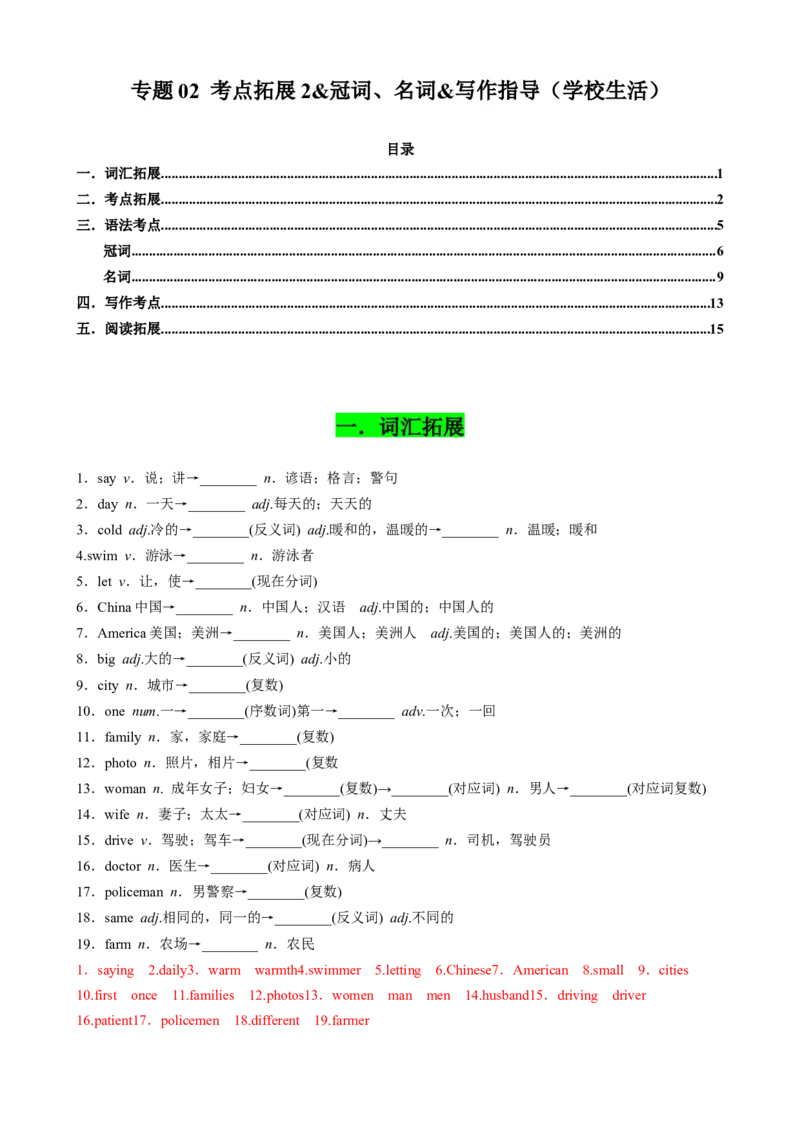
一.词汇拓展
1.say v.说;讲→________ n.谚语;格言;警句
2.day n.一天→________ adj.每天的;天天的
3.cold adj.冷的→________(反义词) adj.暖和的,温暖的→________ n.温暖;暖和
4.swim v.游泳→________ n.游泳者
5.let v.让,使→________(现在分词)
6.China中国→________ n.中国人;汉语 adj.中国的;中国人的
7.America美国;美洲→________ n.美国人;美洲人 adj.美国的;美国人的;美洲的
8.big adj.大的→________(反义词) adj.小的
9.city n.城市→________(复数)
10.one num.一→________(序数词)第一→________ adv.一次;一回
11.family n.家,家庭→________(复数)
12.photo n.照片,相片→________(复数
13.woman n. 成年女子;妇女→________(复数)→________(对应词) n.男人→________(对应词复数)
14.wife n.妻子;太太→________(对应词) n.丈夫
15.drive v.驾驶;驾车→________(现在分词)→________ n.司机,驾驶员
16.doctor n.医生→________(对应词) n.病人
17.policeman n.男警察→________(复数)
18.same adj.相同的,同一的→________(反义词) adj.不同的
19.farm n.农场→________ n.农民
1.saying 2.daily3.warm warmth4.swimmer 5.letting 6.Chinese7.American 8.small 9.cities
10.first once 11.families 12.photos13.women man men 14.husband15.driving driver
16.patient17.policemen 18.different 19.farmer二.考点拓展
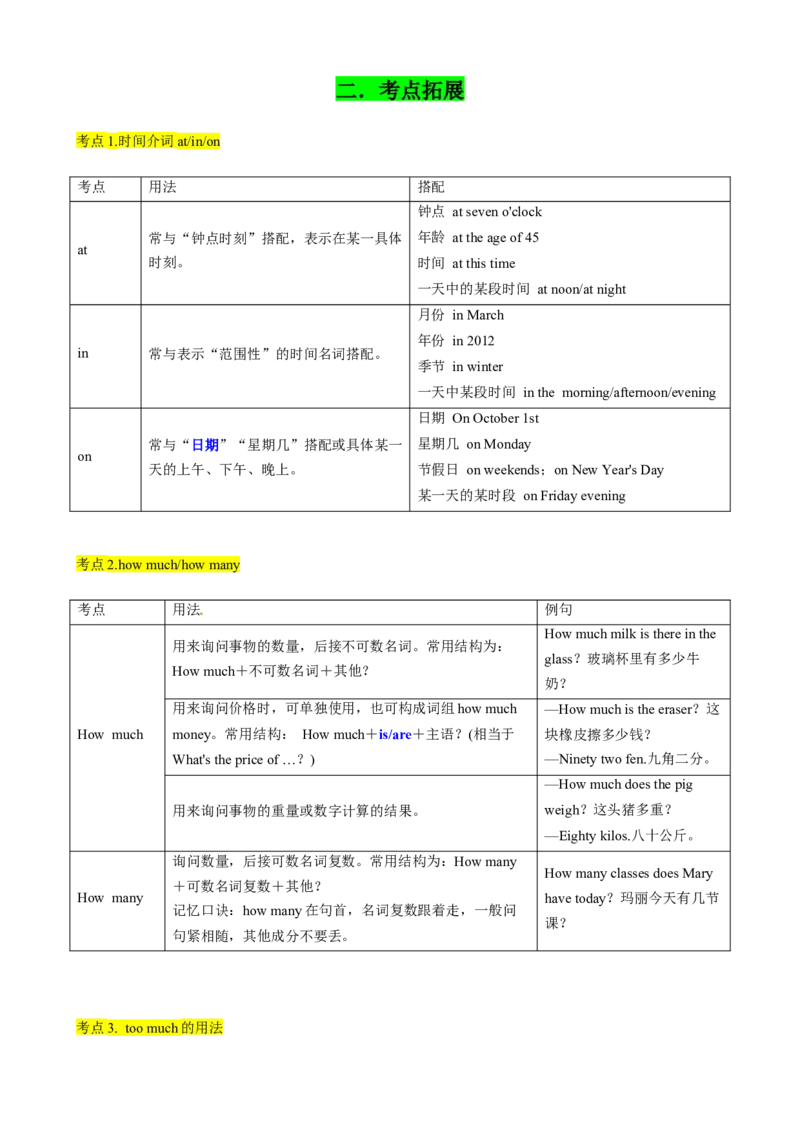
考点1.时间介词at/in/on
考点 用法 搭配
钟点 at seven o'clock
常与“钟点时刻”搭配,表示在某一具体 年龄 at the age of 45
at
时刻。 时间 at this time
一天中的某段时间 at noon/at night
月份 in March
年份 in 2012
in 常与表示“范围性”的时间名词搭配。
季节 in winter
一天中某段时间 in the morning/afternoon/evening
日期 On October 1st
常与“日期”“星期几”搭配或具体某一 星期几 on Monday
on
天的上午、下午、晚上。 节假日 on weekends;on New Year's Day
某一天的某时段 on Friday evening
考点2.how much/how many
考点 用法 例句
How much milk is there in the
用来询问事物的数量,后接不可数名词。常用结构为:
glass?玻璃杯里有多少牛
How much+不可数名词+其他?
奶?
用来询问价格时,可单独使用,也可构成词组how much —How much is the eraser?这
How much money。常用结构: How much+is/are+主语?(相当于 块橡皮擦多少钱?
What's the price of …?) —Ninety two fen.九角二分。
—How much does the pig
用来询问事物的重量或数字计算的结果。 weigh?这头猪多重?
—Eighty kilos.八十公斤。
询问数量,后接可数名词复数。常用结构为:How many
How many classes does Mary
+可数名词复数+其他?
How many have today?玛丽今天有几节
记忆口诀:how many在句首,名词复数跟着走,一般问
课?
句紧相随,其他成分不要丢。
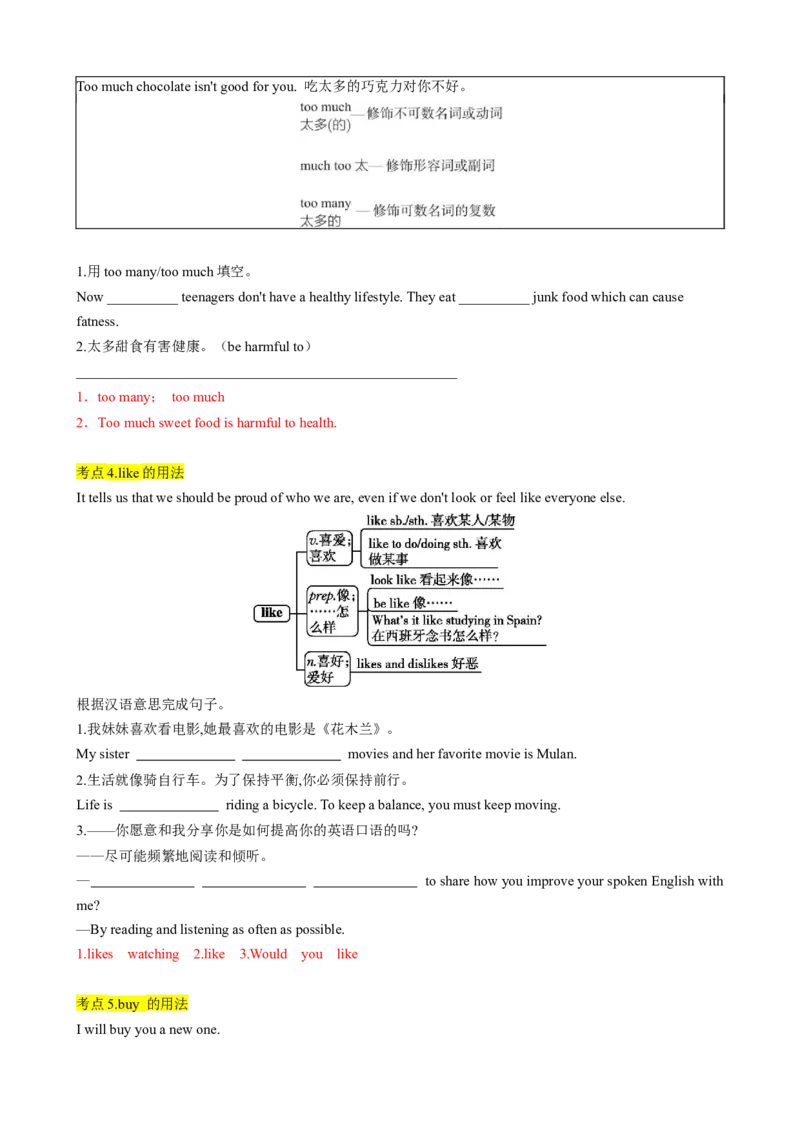
考点3. too much的用法Too much chocolate isn't good for you. 吃太多的巧克力对你不好。
1.用too many/too much填空。
Now __________ teenagers don't have a healthy lifestyle. They eat __________ junk food which can cause
fatness.
2.太多甜食有害健康。(be harmful to)
______________________________________________________
1.too many; too much
2.Too much sweet food is harmful to health.
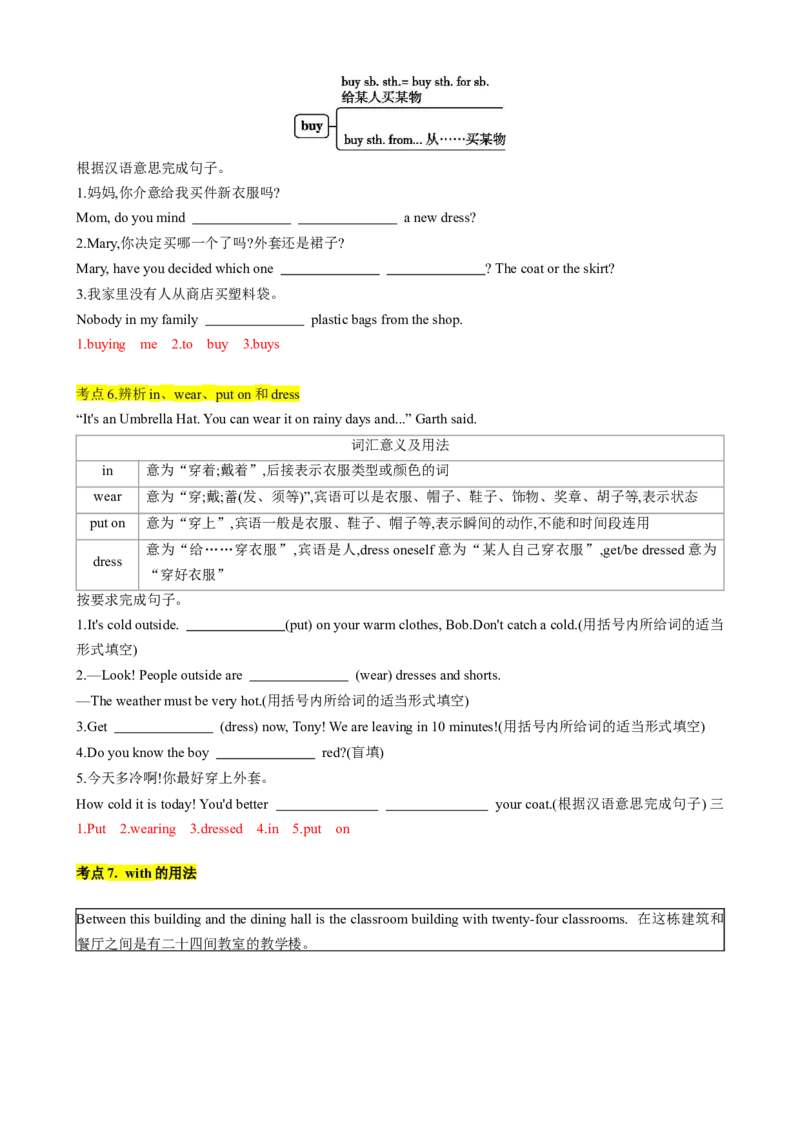
考点4.like的用法
It tells us that we should be proud of who we are, even if we don't look or feel like everyone else.
根据汉语意思完成句子。
1.我妹妹喜欢看电影,她最喜欢的电影是《花木兰》。
My sister movies and her favorite movie is Mulan.
2.生活就像骑自行车。为了保持平衡,你必须保持前行。
Life is riding a bicycle. To keep a balance, you must keep moving.
3.——你愿意和我分享你是如何提高你的英语口语的吗?
——尽可能频繁地阅读和倾听。
— to share how you improve your spoken English with
me?
—By reading and listening as often as possible.
1.likes watching 2.like 3.Would you like
考点5.buy 的用法
I will buy you a new one.根据汉语意思完成句子。
1.妈妈,你介意给我买件新衣服吗?
Mom, do you mind a new dress?
2.Mary,你决定买哪一个了吗?外套还是裙子?
Mary, have you decided which one ? The coat or the skirt?
3.我家里没有人从商店买塑料袋。
Nobody in my family plastic bags from the shop.
1.buying me 2.to buy 3.buys
考点6.辨析in、wear、put on和dress
“It's an Umbrella Hat. You can wear it on rainy days and...” Garth said.
词汇意义及用法
in 意为“穿着;戴着”,后接表示衣服类型或颜色的词
wear 意为“穿;戴;蓄(发、须等)”,宾语可以是衣服、帽子、鞋子、饰物、奖章、胡子等,表示状态
put on 意为“穿上”,宾语一般是衣服、鞋子、帽子等,表示瞬间的动作,不能和时间段连用
意为“给……穿衣服”,宾语是人,dress oneself意为“某人自己穿衣服”,get/be dressed意为
dress
“穿好衣服”
按要求完成句子。
1.It's cold outside. (put) on your warm clothes, Bob.Don't catch a cold.(用括号内所给词的适当
形式填空)
2.—Look! People outside are (wear) dresses and shorts.
—The weather must be very hot.(用括号内所给词的适当形式填空)
3.Get (dress) now, Tony! We are leaving in 10 minutes!(用括号内所给词的适当形式填空)
4.Do you know the boy red?(盲填)
5.今天多冷啊!你最好穿上外套。
How cold it is today! You'd better your coat.(根据汉语意思完成句子) 三
1.Put 2.wearing 3.dressed 4.in 5.put on
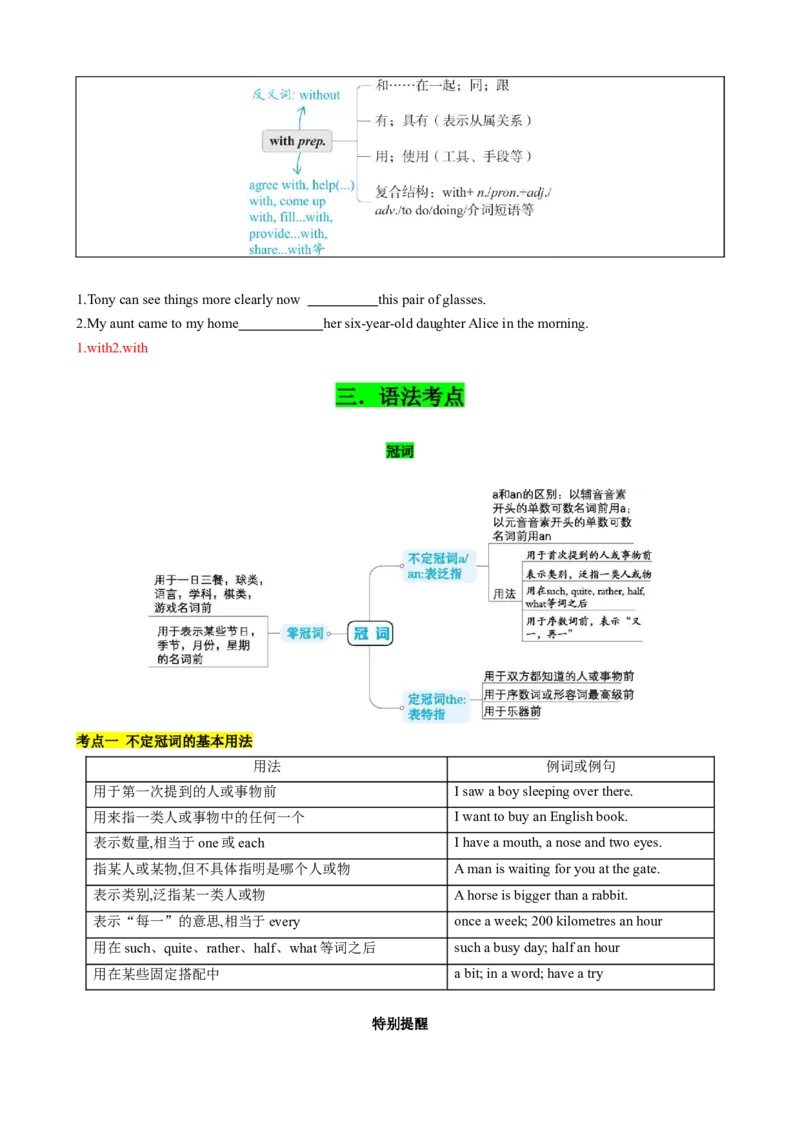
考点7. with的用法
Between this building and the dining hall is the classroom building with twenty-four classrooms. 在这栋建筑和
餐厅之间是有二十四间教室的教学楼。1.Tony can see things more clearly now this pair of glasses.
2.My aunt came to my home her six-year-old daughter Alice in the morning.
1.with2.with
三.语法考点
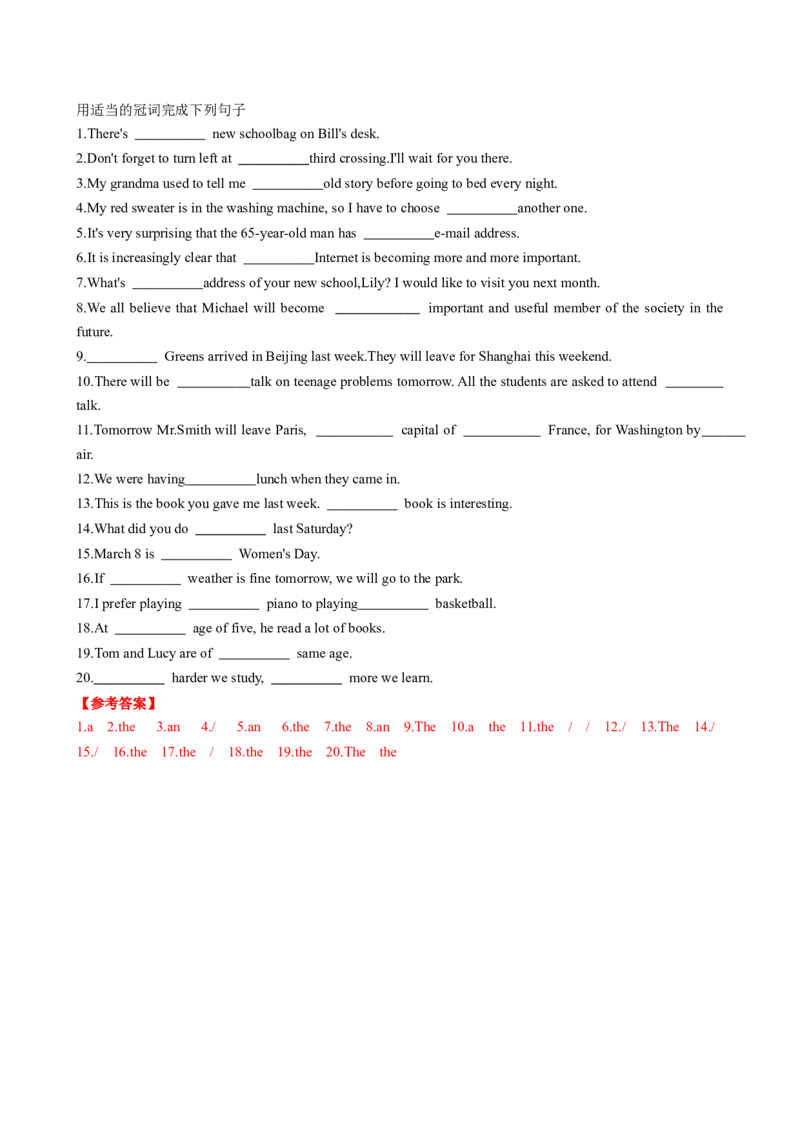
冠词
考点一 不定冠词的基本用法
用法 例词或例句
用于第一次提到的人或事物前 I saw a boy sleeping over there.
用来指一类人或事物中的任何一个 I want to buy an English book.
表示数量,相当于one或each I have a mouth, a nose and two eyes.
指某人或某物,但不具体指明是哪个人或物 A man is waiting for you at the gate.
表示类别,泛指某一类人或物 A horse is bigger than a rabbit.
表示“每一”的意思,相当于every once a week; 200 kilometres an hour
用在such、quite、rather、half、what等词之后 such a busy day; half an hour
用在某些固定搭配中 a bit; in a word; have a try
特别提醒1.不定冠词a和an的区别
a用在以辅音音素开头的单数可数名词前;an用在以元音音素开头的单数可数名词前。判断一个单词是以
元音音素开头还是以辅音音素开头,要根据其读音,而不是仅仅根据其首字母。例如:a horse、an hour、an
apple。
2.发音为元音音素开头的字母
26个字母中发音为元音音素开头的有12个,它们分别是a、e、f、h、i、l、m、n、o、r、s、x。例如:
There is an “m” in the word “map”.
巧学妙记
1.巧记不定冠词a和an的区别:
冠词a、an两种帽,许多名词常需要。
开头读音若是元,要把an帽来戴好。
辅音起首用a帽,记住规律别乱套。
2.巧记不定冠词的用法:
不定冠词两变体,用a或an都表“一”。可数名词首次提,何人何物不具体。某类人、物任一个,有时还要
表“每一”。
考点二 定冠词的基本用法
用法 例词或例句
特指有修饰语的或第二次提及的同一事物或谈 On the right there was a bed. And on the bed there was a
话双方都知道的某个或某些人或事物 toy.
用于由限制性定语所修饰的名词前,指一类人
The man on the right is my father.
或事物中特定的人或事物
表示世界上独一无二的东西 the sun; the world; the Great Wall
用在单数可数名词前,表示某一类人或事物 The mobile phone is more useful than the camera.
用在序数词及形容词或副词的最高级之前 the first floor; the tallest building
用在江河、海洋、湖泊、山脉、群岛的名称前 the Changjiang River; the Pacific
用在由普通名词构成的一些表示机构、文娱场
the Science Museum; the Friendship Store
所、商店、设施等专有名词前
用在姓氏的复数形式前,指一家人或一对夫妇 the Smiths; the Wangs
和某些形容词连用,表示一类人,在意义上常是
the old; the rich; the sick
复数
与某些名词所有格连用时表示“在……处” at the doctor's
用在乐器前 play the guitar
用在next、last、same、only等词前 the next moment
用在某些固定搭配中 all the year round; in the end
巧学妙记
巧记定冠词的基本用法:特指重提与唯一,岛屿海峡和海湾;
海洋党派最高级,沙漠河流与群山;
方位顺序和乐器,年代团体与机关;
船名建筑和组织,会议条约与报刊;
姓氏复数国全名,请你记住用定冠。
考点三 不用冠词(零冠词)的情况
情况 例词或例句
复数名词和物质名词表示泛指时 Cats like fish, don't they?
人名、地名、街道名、城市名、洲、省、机
Beijing Street; Mount Tai; Baiyun Airport;
场以及大多数大学、公园、节日等专有名词
Teachers' Day
前
表示职位、身份、称呼、头衔的名词前 Mr. Green; head of our province
节假日、季节、月份、星期前 National Day; summer; May; Sunday
表示一日三餐、球类、语言、学科、棋类、
have supper; play football
游戏等名词前
在与by连用的表示交通工具的名词前 by train; by bus
名词前有物主代词、指示代词、不定代词、
this book; my son; Jack's bike
疑问代词或名词所有格修饰时
在某些固定搭配中 day and night; by mistake
特别提醒
1.节假日前一般不加冠词,但节日名中含有“Festival”的中国传统节日名前,通常要加the。例如:
the Spring Festival
2.在表示一日三餐的名词前通常不加冠词,但如果特指或指具体的饮食,可用定冠词;有修饰词时用不定冠
词。例如:
①Were you at the lunch with the English teacher?
②I had a big supper just now.
3.某些短语中有无the表达的意义不同。例如:
be in hospital 住院;be in the hospital 在医院;go to school 去上学;go to the school 去学校
巧学妙记
巧记不用冠词的情况:
不用冠词有几点,名前代词这那限;
星期月份和季节,专名球类及语言;
复数名词表泛指,棋类学科三餐前;
交通方式和节日,称呼职务与头衔;
颜色电视和国名,固定搭配记心间。用适当的冠词完成下列句子
1.There's new schoolbag on Bill's desk.
2.Don't forget to turn left at third crossing.I'll wait for you there.
3.My grandma used to tell me old story before going to bed every night.
4.My red sweater is in the washing machine, so I have to choose another one.
5.It's very surprising that the 65-year-old man has e-mail address.
6.It is increasingly clear that Internet is becoming more and more important.
7.What's address of your new school,Lily? I would like to visit you next month.
8.We all believe that Michael will become important and useful member of the society in the
future.
9. Greens arrived in Beijing last week.They will leave for Shanghai this weekend.
10.There will be talk on teenage problems tomorrow. All the students are asked to attend
talk.
11.Tomorrow Mr.Smith will leave Paris, capital of France, for Washington by
air.
12.We were having lunch when they came in.
13.This is the book you gave me last week. book is interesting.
14.What did you do last Saturday?
15.March 8 is Women's Day.
16.If weather is fine tomorrow, we will go to the park.
17.I prefer playing piano to playing basketball.
18.At age of five, he read a lot of books.
19.Tom and Lucy are of same age.
20. harder we study, more we learn.
【参考答案】
1.a 2.the 3.an 4./ 5.an 6.the 7.the 8.an 9.The 10.a the 11.the / / 12./ 13.The 14./
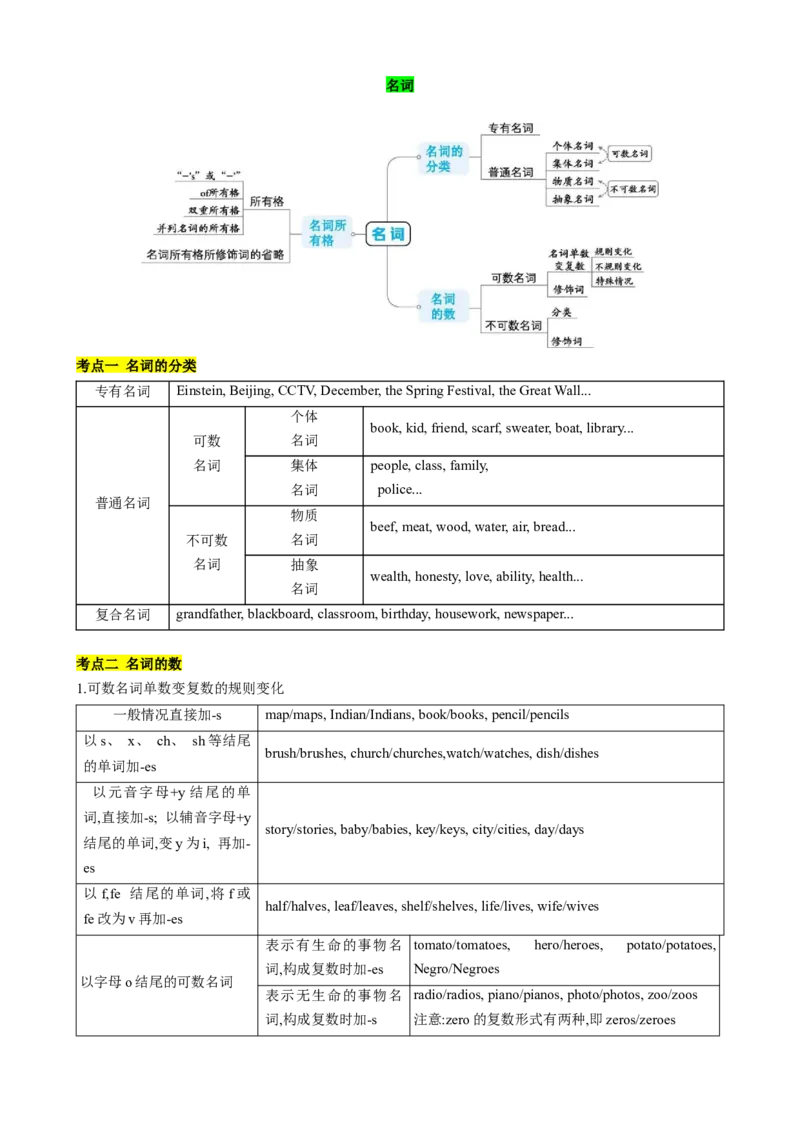
15./ 16.the 17.the / 18.the 19.the 20.The the名词
考点一 名词的分类
专有名词 Einstein, Beijing, CCTV, December, the Spring Festival, the Great Wall...
个体
book, kid, friend, scarf, sweater, boat, library...
可数 名词
名词 集体 people, class, family,
名词 police...
普通名词
物质
beef, meat, wood, water, air, bread...
不可数 名词
名词 抽象
wealth, honesty, love, ability, health...
名词
复合名词 grandfather, blackboard, classroom, birthday, housework, newspaper...
考点二 名词的数
1.可数名词单数变复数的规则变化
一般情况直接加-s map/maps, Indian/Indians, book/books, pencil/pencils
以s、 x、 ch、 sh等结尾
brush/brushes, church/churches,watch/watches, dish/dishes
的单词加-es
以元音字母+y 结尾的单
词,直接加-s; 以辅音字母+y
story/stories, baby/babies, key/keys, city/cities, day/days
结尾的单词,变y为i, 再加-
es
以f,fe 结尾的单词,将f或
half/halves, leaf/leaves, shelf/shelves, life/lives, wife/wives
fe改为v再加-es
表示有生命的事物名 tomato/tomatoes, hero/heroes, potato/potatoes,
词,构成复数时加-es Negro/Negroes
以字母o结尾的可数名词
表示无生命的事物名 radio/radios, piano/pianos, photo/photos, zoo/zoos
词,构成复数时加-s 注意:zero的复数形式有两种,即zeros/zeroes★元音字母o结尾的名词变复数
小贴士:
名词词尾字母o,名词+es变复数也不多。英雄爱吃土豆和西红柿,剩下“零”也不出错。例如:
hero/heroes、 tomato/tomatoes、 potato/potatoes、 zero/zeros或zeroes
★以f,fe结尾的名词变复数
以f, fe结尾的名词,多数是将f, fe变为v,再加-es。这类词可这样串联记忆:
小贴士:
树叶(leaf)半数(half)自己黄,妻子(wife)拿刀(knife)去割粮,架(shelf)后窜出一只狼(wolf),就像小偷(thief)逃
命(life)忙。例如:
leaf/leaves、 half/halves、 wife/wives、 knife/knives
2.可数名词复数的不规则变化
单复数同形 sheep, Chinese, Japanese, deer, fish
man/men, woman/women, policeman/policemen, Englishman/Englishmen,
把a改为e
Frenchman/Frenchmen
oo变ee式 tooth/teeth, foot/feet, goose/geese
词尾加-ren child/children
只有复数式 trousers, clothes, glasses, congratulations, pants, scissors, gloves
易混易错
man 和 woman 作定语时,修饰单数名词用单数,修饰复数名词用复数,如 a man teacher、 two women
doctors。注意:有些名词如学科类名词maths、 physics、 politics,虽以s结尾,但不是复数形式。
★有些名词单数与复数形式相同
小贴士:
单数复数不变形,特殊词语记一记。“中”“日”友好不变,“鱼”“鹿”“绵羊”来作证。例如:
Chinese、 Japanese、 fish、 deer、 sheep
★有关国籍的复数形式构成(表示“某国人”的名词)
小贴士:
世界要友好,国籍要分清。中日不变,英法变,其他加-s来转变,特殊情况记心间。例如:
Chinese 、 Japanese; Englishman/Englishmen 、 Frenchman/Frenchmen;Indian/Indians 、
American/Americans。特例:German的复数形式是Germans。
考点三 不可数名词的分类
物质 食物 bread, meat, rice, food, salt, wheat, cheese, fish, chicken...
名词 饮料 juice, milk, tea, water, cola, coffee...
自然物质 air, soil, sand, wood...
情感、概念 peace, love, friendship, joy, happiness, time, news, population, knowledge...
抽象
名词 学科 Chinese, English, maths, physics, chemistry, politics, history...国家、城市
China, England, Japan, Sydney...
等专有名词
小贴士:
不可数名词成员多,常用词语记心头。茶水牛奶兑橘汁,米肉面包和食品;作业家务工作忙,幸福时间钱
财多。即 tea、 water、 milk、 orange、 rice、 meat、 bread、 food、 homework、 housework、
work、 happiness、 time、 money。
4.既可作可数名词又可作不可数名词的名词
名词 用作可数名词 用作不可数名词
表示条数,单数复数形式相同
fish 意为“鱼肉”
表示各种各样的鱼,fish加-es
“玻璃杯”,其复数形式为glasses;glasses还可
glass 意为“玻璃”
意为“眼镜”
orange 意为“橘子;橙子”,复数加-s 意为“橙汁;橙色”
room 意为“房间”,复数加-s 意为“余地;地方;空间”
意为“文件;试卷;
paper 意为“纸”
报纸”,复数加-s
work 意为“著作”,复数加-s 意为“工作”
chicken 意为“小鸡”,复数加-s 意为“鸡肉”
light 意为“灯;灯具”,复数加-s 意为“光线”
考点四 名词的所有格
有生命的名词单数 在词尾加“'s” Lucy's cat
(1)以-s结尾加“'” the teachers' office
有生命的名词复数 her children's
(2)不以-s结尾的加“'s”
homework
表示两者或多者共同
在最后一个名词后加“'s” Lucy and Lily's desk(Lucy和Lily共同的课桌)
拥有
表示两者或多者各自 Jim's and Sam's
各名词后都要加上“'s”
拥有 bikes (Jim和Sam各自的自行车)
表示时间、距离、国 单数加“'s” an hour's walk
家、机构等无生命的
复数加“'” ten minutes' walk
名词
of +'s所有格 two students of Mr. Wu's
双重所有格 of +名词性物主代词 a friend of mine
of+one's own a house of my own易混易错
's不全是名词所有格
It looks like Lily's hat! 它看起来像Lily的帽子。(此句话中的Lily's是所有格,而不是Lily is的缩写。)
My dog is from China, but her dog's from Japan. 我的狗来自中国,但是她的狗来自日本。(此句中的dog's应
是dog is的缩写,而不是名词所有格。)
根据句意,用所给单词的适当形式填空
1.Johnny is so hungry that he can eat up all the (bread).
2.This morning market sells different kinds of fresh (fish).
3.How amazing! The little cat caught two (mouse) last night.
4.The little boy has to peel three baskets of (potato) before lunch.
5.Jack spent about two hours sweeping (leaf) in the back garden.
6.It's about twenty (minute) drive from my house to the park.
7.There are few spelling and grammar (mistake) in Lily's homework.
8.The old man likes reading books very much.He owns two private (library).
9.There are more than one hundred teachers in our school, and most of them are (man) teachers.
10.The worst thing about working in the shopping mall is that you're on your (foot) all day.
11.Different people have different (hobby).
12.You can look for (information) about the shop on the Internet.
13.She bought a pair of (glove).
14.—Are those (sheep)?
—No, they aren't.They're (cow).
15. 15 , 15 . ( Lucy and Lily ) room is on the 5th floor.
【参考答案】1.bread 2.fishes 3.mice 4.potatoes 5.leaves
6.minutes' 7.mistakes 8.libraries 9.men 10.feet 11.hobbies 12.information 13.gloves 14.sheep
cows15.Lucy and Lily's
四.写作考点
以“崭新的初中学校生活”为话题,主要围绕“勤学善思”“制订好的计划”“努力学习”等方面展
开,与此相关的写作通常涉及以下几个方面:
1.介绍自己初中的第一节课;
2.描述初中生活面临的问题;
3.给同学/朋友提供初中生活建议;
4.发表如何看待初中生活的观点。
假如你是李华,刚进入初中的你,面临着许多新问题,你很苦恼,请你写一封信给学生会,寻求建议与
帮助。
信件要点如下:
1.学习科目增多,学习内容难度加大。2. 学习任务很多,不知道如何制订计划。
3. 学校活动很多,不知道如何选择。
要求:
1.信件应包含所有要点内容,可适当发挥;
2.词数不少于80(信的开头和结尾已给出,不计入总词数)。
佳作展示
Dear Students’ Union,
Hi! I’m Li Hua from Class 3, Grade 7. I’m writing to ask for some advice. The new term is beginning and
I’m facing many problems. First, it’s hard for me to learn the subjects well. There are many new subjects at junior
high, such as History,Geography and Biology. And I’m not good at Maths or History. Second, it’s difficult for me
to make good plans. There are many different kinds of tasks and I can’t decide what to do first. Lastly, it’s hard for
me to choose the school activities. There are many activities at school, but I don’t know which one is good for me.
写作训练
假如你是李华,学生会给你回了信,就初中生如何充分利用时间提出了两点建议。请根据他们的建
议,再写封回信,与他们分享一下你的认识和打算。
要点如下:
1. 表达感谢。
2. 根据建议合理安排时间:列任务清单,优先做最重要的事情;分解任务,逐一完成小任务。
3. 表明信心。
要求:
1. 短文应包含以上所有要点,可适当发挥。
2. 条理清楚,行文连贯;
3. 词数不少于90(开头和结尾已给出,不计入总词数)。
Dear Students’ Union,
It’s great to hear from you. Thanks a lot for your advice and help.
___________________________________________________________________________________________
___________________________________________________________________________________________
___________________________________________________________________________________________
___________________________________________________________________________________________
______________________________________________________________________________________________________________________________________________________________________________________
___________________________________________________________________________________________
__________________________________
Yours sincerely,
Li Hua
【写作提示】
1. 主题:恰当的学习方法与策略
2. 体裁:应用文(信件)
3. 人称:以第一人称为主
4. 时态:以一般将来时为主,穿插使用一般现在时
5. 要点:表达感谢、合理安排时间的方式、对初中学习生活的信心
6. 写作思路:先表达感谢,再具体阐述如何利用好时间,最后表达对初中生活的信心
【范文赏读】
Dear Students’ Union,
It’s great to hear from you. Thanks a lot for your advice and help.
Now I know it’s normal for us to have these problems at junior high, so I am not worried about myself
too much. I learn to make plans to solve the problems I’m facing. According to your advice, I’m going to do
the following two things. First, I will list my tasks and the time for each task. And I will do the most
important thing first when there are too many tasks at the same time. Second, if the project takes long, I plan
to turn it into small ones and work on them one by one. In a word, I’ll work hard and try my best.
I hope everything goes well and I’m sure that I will make progress. Thank you so much!
Yours sincerely,
Li Hua
五.阅读拓展
一
A family in East Side, Detroit, is so thankful(感激的)for their dog. The dog
“Blue” 1 their 1-year-old kid, Chantal, from fire. When the fire started, he
went inside the house and ran toward the 2 . And because of him, the girl
could 3 safely.
Zoey,the eldest(年龄最大的) daughter of the family, Chantal and their uncle
were at home when 4 house caught fire. The uncle and Zoey 5
ran out but they forgot Chantal. At that time, the dog went running back into the house 6 he knew
Chantal was still there. The firefighters(消防队员)had to chase him up and 7 Chantal.
During this time of the year, the family is 8 of money. So they have to live in a van(小型货车)with
their dog. "People can't bring a dog into a shelter(收容所).And I don't want to 9 Blue. It is because noone knows where my family would be 10 him, "the mother said.
1.A.wore B. bought C. saved D. took
2.A. girl B. student C. policeman D. driver
3.A. get up B. get out C. get off D. get on
4.A. her B. its C. your D. their
5. A. easily B. silently C. quickly D. difficultly
6.A. but B. though C. because D. when
7.A. though B. brought C. drew D. taught
8.A. afraid B. tired C. proud D. short
9.A. leave B. follow C. forget D. buy
10.A. over B. toward C. without D. around
长难句分析
原句:(第二段倒数第二句)At that time,the dog went running back into the house because he knew Chantal
was still there.
译文:那时,这只狗跑回了房子里,因为它知道Chantal还在里面。
分析:本句是一个复合句。because he knew Chantal was still there是because引导的原因状语从句;在该从
句中,Chantal was still there是省略了引导词 that的宾语从句,作knew的宾语。
答案详析
1.C 根据上文中的thankful以及第一段最后一句"And because of him, the girl could 3 safely.”可知,此处指
Blue 从火灾中救了他们一岁的孩子。save“救”,符合语境。
2. A 根据下文中的“the girl could 3safely”可推知,此处指Blue进到房子里,向那个女孩跑去,故选girl。
3.B 根据上文可知,房子失火,一岁的孩子还在房子里面。由此可知,此处指因为这只狗,这个女孩才
能安全逃出来。get out“逃离;离开”,符合语境。
4.D根据语境可知,此处指当他们的房子着火时,Zoey、Chantal和她们的叔叔在房子里面,故选their。
5.C根据语境可知,此处指叔叔和 Zoey快速跑了出来,故选quickly。
6.C 空后的“它知道Chantal仍然在房子里”与空前的“那时,这只狗跑回了房子”构成因果关系,故选
because。
7.B 根据第一段的内容可知,房子失火后,Blue进到房子里,向那个女孩跑去;结合6空后的“he knew
Chantal was still there”可推知,此处指消防队员追逐它,发现了Chantal。find“发现”,符合语境。
8.D 根据空后的“So they have to live in a van with their dog.”可知,他们不得不和他们的狗一起住在小型货
车里。由此可推知,今年这段时间,这家人缺钱。be short of“缺少”,为固定搭配。
9. A 根据空前的“People can't bring a dog into a shelter.”可知,人们不能携带狗进入收容所。结合语境可
知,此处指这位母亲不想丢弃Blue。leave“丢弃”,符合语境。
10.C根据语境及备选词可知,此处指这是因为没人知道没有 Blue 这家人会怎么样。without“没有”,符
合语境。
二Early in the morning in Lanzhou, Gansu province, Xie Yanting wakes
up. After 1 (get)out of bed, he goes to Lanzhou University. He is
an auditor(旁听生) at the school. It 2 (take)him about 13
minutes to get there.
Xie has had cerebral palsy(脑瘫)for many years. He had no 3
(able)to speak, write or walk normally(正常地). 4 he could not
go to school like other kids. 5 (lucky),he had a great family.
His parents and grandpa helped him learn 6 . home
Now, Xie's 7 (数学)is so good that he's a big star at Lanzhou University. In June,
2023, he will 8 (完成)his
doctorate studies(博士学业)and leave the school.“ When people 9 (想起)of me, I want
them to forget that I'm a man who has cerebral palsy. I 10 (希望)that they know how good
my math is ," says Xie.
1. 2. 3. 4. 5.
6. 7. 8. 9. 10.
长难句分析
原句:(最后一段第三句)When people think of me , I want them to forget that I'm a man who has cerebral
palsy.
译文:当人们想起我时,我希望他们忘记我是一个患有脑瘫的人。
分析:这是一个复合句。When people think of me是when引导的时间状语从句。主句中,that I'm a man
who has cerebral palsy是that引导的宾语从句,作forget的宾语;在该宾语从句中,who has cerebral palsy
是who引导的定语从句,修饰a man。
答案详析
1.getting 根据空前的wakes up可知,此处指起床后,他去兰州大学。get out of bed意为“起床”,是固定
短语。空前的After是介词,“介词+v.-ing”是固定用法,故填getting。
2.takes 根据语境可知,他用了约13分钟到达那里。it takes sb. some time to do sth.意为“某人花费一些时
间做某事”,是固定句型,此处描述客观事实,应用一般现在时,故填takes。
3.ability 根据上一句可知,谢炎廷患有脑瘫很多年了。由此可知,此处指他不能正常地说话、写字和走
路。have no ability to do.“能够做某事”,为固定用法,故填ability。
4.So 根据空前的“Xie has had cerebral palsy for many years. He was not...”可知,谢炎廷患有脑瘫很多年
了,他不能正常地说话、写字和走路。结合提示可知,此处指所以他不能像其他孩子一样去上学,故填
So。
5.Luckily根据语境可知,此处指幸运的是,他有一个好的家庭,故填Luckily。
6.at 根据5空前的“he could not go to school like other kids”可知,他不能像其他孩子一样去上学:再根据
空前的“His parents and grandpa helped him learn"和提示可知,此处指他的父母和祖父帮助他在家里学
习,故填at。
7. math 根据提示及10空后的“how good my math is"可知,此处指谢炎廷的数学非常好。
8.finish 根据空后的leave the school及提示可知,此处指他将完成博士学业。finish“完成”,符合语境。9.think 根据语境及提示可知,此处指谢炎廷希望当人们想起他时,他们能忘记他是个患有脑瘫的人。
think of“想起”,为固定短语,故填 think。
10.hope 根据语境及提示可知,此处指谢炎廷希望他们知道自己的数学有多好。
三
Boo is a rooster(公鸡). Boo He loves going on road trips, playing the
piano, watching TV, and walking out with other house pets: chickens and
cats. ★ But most of all, he loves to play with his human mom,
Mary Bowman.
Before he came to the Bowman family, Boo's life wasn't always this
beautiful. He spent the first six months of his life on a farm with many
other chickens. There he was more like a product. Mary adopted(收养)Boo
after learning about him from a friend. She was very sad knowing his poor life. She then decided to help him
leave the farm and finally live safely.
Boo, just like a dog, welcomes the family when they come home. He likes to spend time with his dad
reading the comics. He spends time with his grandma too. Boo even likes to look at pictures in the books because
that's fun too!
1.Which can be the best for“ ★ ”?
A. He likes playing the piano best.
B. He enjoys many things in his life.
C. He is popular with the Bowman family.
D. He lives a happier life than other house pets.
2.Mary learned about Boo from_____.
A. a farmer B. her dad C. a friend D. her grandma
3.What can we infer(推断) from the passage?
A. Boo likes taking pictures very much.
B. Boo will go back to the farm six months later.
C. The Bowman family lives a busy life.
D. The Bowman family may be very kind to Boo.
4.What is the best title of the passage?
A. A terrible farm B. A happy family
C. A mom's love D. A rooster's new life
长难句分析
原句:(文章最后一句)Boo even likes to look at pictures in the books because that's fun
too!
译文:Boo甚至喜欢看书里的图片,因为那也很有趣!
分析:本句是一个复合句。because that's fun too是because引导的原因状语从句。
答案详析
1.B 句子还原题。根据第一段第二句可知,Boo喜欢公路旅行、弹钢琴、看电视以及和其他家养宠物一起
出去散步。再根据第一段最后一句可知,但最重要的是.Boo喜欢和它的人类母亲——Mary Bowman一起玩耍。故B项“它喜欢生活中的许多事情”可承上启下,符合语境。
2.C 细节理解题。根据第二段中的“Mary adopted Boo after learning about him from a friend.”可知,Mary从
一个朋友那里得知Boo的情况后收养了它。
3.D 推理判断题。通读第三段可知,Boo喜欢和它的人类父亲和人类奶奶共度时光。由此可推知,这家人
可能对Boo很好。
4.D 主旨大意题。通读全文可知,本文主要讲述了公鸡 Boo 在新家的幸福生活.故D项“一只公鸡的新生
活”最适合作本文标题。