Unit 1 My day
教材分析 本单元学习的主题是日常学习生活以及周末活动安排。教学重点是能够听、说、读、写核心句
型 “ — When do you… ?— I usually/often… at… ” “ — What do you do on the
weekend/Saturdays/Sundays?—I usually/often…”;能够听、说、读、写五个有关日常作息活动的短
语:do morning exercises, eat breakfast, have…class, play sports, eat dinner;能够听、说、读、写
四个日常活动的短语:clean my room, go for a walk, go shopping, take a dancing class。
教学目标 知识与能力目标:
•能够听、说、读、写句型:“—When do you finish class in the morning? —We finish class at 1 o’
clock.” “—What do you do on the weekend? —I often watch TV and play ping-pong with my
father./ I usually wash my clothes. /Sometimes I cook dinner.”
•能够在情境中运用以下句型询问并回答某人的日常作息与周末安排:—When do you finish class
in the morning? —We finish class at 1 o’ clock. —What do you do on the weekend?— I often watch
TV and play ping-pong with my father.
•能够在语境中理解词汇“finish class, go back to school, classes start”,并能就学校的课程安排时
间进行问答;能够理解句型“ Why are you shopping today?”“I’ m also hard-working.” 的意思,
并能正确发音
•能够听、说、读、写五个有关日常作息活动的短语: do morning exercises, eat breakfast, have class,
play sports, eat dinner;能够听、说、读、写四个日常活动的短语:clean my room, go for a walk, go
shopping, take a dancing class;能够在语境中正确运用这些短语询问并回答关于日常作息和周末
安排的问题、描述日常活动与周末安排
•能够运用核心词汇完成关于日常作息的问答活动,完成调查及填表活动并根据结果展开问答
•能够按照正确的语音、语调、意群朗读对话,并能进行角色扮演
•能够在图片的帮助下理解 Robin 的台词;能够按照正确的语音、语调、意群朗读 Robin 的台词;能
够运用核心句型完成书信填写任务
•能够掌握字母组合 cl 和 pl 的发音规则,即 cl 和 pl 在单词中的发音分别为/ kl / 和/ pl /
•能够读出符合cl 和pl 的发音规则的单词,并能够根据发音拼写出符合cl 和pl 的发音规则的单词
•能够在单线上完成抄写句子的活动,做到书写规范
情感态度、文化意识、学习策略目标:
•能够在生活中主动询问别人或对别人的询问能热情应答,相互了解各自的日常学习及生活情况
•能够合理安排日常学习和周末活动
•能够了解学校及社会生活中相关活动的名称,激发学生热爱学习、热爱生活的美好情感
•能够根据 cl / pl 的发音规则拼读、拼写单词
课时安排 第一课时: Part A Let’ s try & Let’ s talk
第二课时: Part A Let’ s learn & Ask and write
第三课时: Part A Let’ s spell
第四课时: Part B Let’ s try & Let’ s talk
第五课时: Part B Let’ s learn & Do a survey
第六课时: Part B Read and write & Let’ s check & Let’ s wrap it up
3The first period(第一课时)
Part A Let’ s try & Let’ s talk
教学内容与目标
▶
课时教学内容 课时教学目标
Let’ s try •能够从听觉上感知新句型,并根据录音选出适当的图片
Let’ s talk •能够通过观察、谈论 Let’ s talk 板块的图片,在图片、PPT 和教师的帮助下理解对话大意
•能够通过听录音,学会按照正确的语音、语调及意群朗读对话,并能在小组中进行角色扮演
•能够在情境中运用句型“—When do you…?—I usually/often…at…”询问和回答作息安排
•能够在语境中借助图片等帮助理解频率副词“usually, often, always, sometimes”的意思,并
能正确发音
教学重点
▶
能够在实际语境中运用句型“—When do you ? —I usually/often at ” 来问答作息时间。
教学难点
▶
能够听懂对话大意,并能用正确的语音、语调及意群朗读对话。
教学准备
▶
1.预习《状元大课堂》《创优作业100分》《状元作业本》中本课时的相关内容。
2.PPT课件、课文录音、视频、头饰等。
教学过程
▶
Step 1: Warm-up & Lead-in①
1. Greetings. Teaching purpose①
2. Play a game.
通过活泼有趣的小游戏
Wolf, Wolf, what time is it now? 复习时间的表达,将学生迅
T: Now, you are the wolf. I ask, and you answer. 速带入到英语课堂中来。通
过播放小视频,呈现教师一
(课件出示:显示不同时间的图片,如:8 点、10 点、12 点、1 点等)
天的时间安排,拉近与学生
T: Wolf, Wolf, what time is it now?
的距离,为授新课做好铺垫。
Ss: It’s eight o’clock / ten o’clock / twelve o’clock / one o’clock /
3. Show a video to students.
The video is about a teacher’ s day.
( 课件出示:一段“教师的一天” 的视频) Teaching purpose②
Step 2: Presentation 此处只出现时间,不出
现要做的事,让学生进行猜
1. Guess the teacher’s timetable.②
测,极大地激励学生积极动
Show the teacher’ s timetable. (课件出示:一张教师的时间安排表)
脑、参与课堂,迅速掀起课
Only show the time. Ask students to guess what the teacher does.
堂小高潮。
T: Guess, what do I do at 6:00?
Ss: Get up at 6:00?
T: You are right.
T: What do I do at 6:30?
4Ss: Wash your face?
T: No, I eat breakfast. What do I do at 8:00?
Teaching purpose③
Ss: Go to school?
学生两人一组,结合教
T: Oh, I start class at 8:00.
师的时间安排表进行句型
(Write down “start class” on the blackboard.) Teach “finish class” 练习。
in the same way.
2. Pair work.③
One student plays the teacher. The other plays a reporter and asks
questions according to the teacher’s timetable.
S1: When do you…?
S2: I… at…
3. Learn “usually, often, always, sometimes”.④
Show the picture of main scene. (课件出示:Unit 1 主情景图)
Students answer some questions:
Teaching purpose④
① Who are they?
通过观看主情景图,
② What are they talking about?
以提问等形式引出频率副
After that, the teacher shows a timetable of Pedro.
词,并以表格形式呈现给学
( 课件出示:教材人物 Pedro 的时间安排表) 生,帮助学生理解与掌握。
T: When does Pedro get up?
Ss: Often at 7 o’ clock.
T: When does Pedro start class?
Ss: Usually at 9 o’ clock.
The teacher explains the meanings of “usually, often, always,
sometimes”.
(课件出示:频率副词频率分析表)
4. Learn “ Let’ s try”.⑤
Teaching purpose⑤
(1) Students watch the three pictures carefully and predict: Where
此部分为听力活动,
are Zhang Peng and Pedro?(课件出示:Let’s try的图片)
培养学生的听力策略。与
Answer: They are in the classroom. Let’s talk 板块紧密相关,
(2) Listen and tick. 为对话教学做好铺垫。
(3) Check the answer together. (出示课件)
5. Learn “Let’ s talk”.⑥
(1) Fast reading. Teaching purpose⑥
Show the picture of “Let’s talk”. (课件出示: Let’s talk情景图) 由于前面的铺垫,学生
能够快速反应过来对话是
T: Look! Are Zhang Peng and Pedro in the classroom now?
讲 Pedro 的作息安排,并
Ss: No.
能从课文中快速找到相应
T: You are right. They are walking and talking now. What are they
的活动与时间。
talking about? Read the text and find out the answer.
Students read and find out the answer.
Ss: They are talking about the timetable.
(课件出示:西班牙国旗和地图)
5T: Pedro comes from Spain, a beautiful country in Europe. Does he
have the same timetable with Zhang Peng?
Ss: No, he doesn’t.
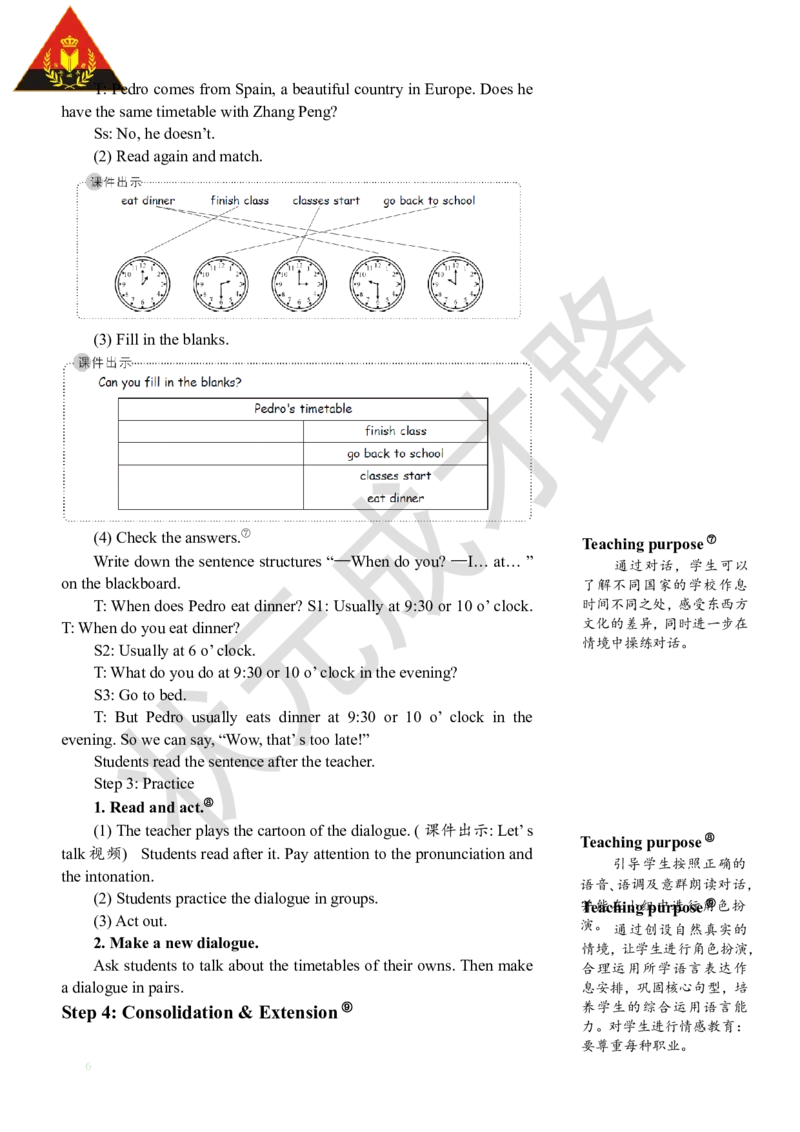
(2) Read again and match.
(3) Fill in the blanks.
(4) Check the answers.⑦
Teaching purpose⑦
Write down the sentence structures “—When do you? —I… at… ”
通过对话,学生可以
on the blackboard. 了解不同国家的学校作息
T: When does Pedro eat dinner? S1: Usually at 9:30 or 10 o’ clock. 时间不同之处,感受东西方
T: When do you eat dinner? 文化的差异,同时进一步在
情境中操练对话。
S2: Usually at 6 o’ clock.
T: What do you do at 9:30 or 10 o’ clock in the evening?
S3: Go to bed.
T: But Pedro usually eats dinner at 9:30 or 10 o’ clock in the
evening. So we can say, “Wow, that’ s too late!”
Students read the sentence after the teacher.
Step 3: Practice
1. Read and act.⑧
(1) The teacher plays the cartoon of the dialogue. ( 课件出示: Let’ s
Teaching purpose⑧
talk视频) Students read after it. Pay attention to the pronunciation and
引导学生按照正确的
the intonation.
语音、语调及意群朗读对话,
(2) Students practice the dialogue in groups.
并Te能ac在hi小ng组 p中ur进po行se角⑨色扮
(3) Act out.
演。
通过创设自然真实的
2. Make a new dialogue.
情境,让学生进行角色扮演,
Ask students to talk about the timetables of their owns. Then make 合理运用所学语言表达作
a dialogue in pairs. 息安排,巩固核心句型,培
Step 4: Consolidation & Extension⑨ 养学生的综合运用语言能
力。对学生进行情感教育:
要尊重每种职业。
61. Look and talk.
(课件出示:不同职业的人的时间安排表)
Let students watch different people’s timetables and talk about
them.
2. Role-play.
(1) Ask and answer.
Prepare the headwear of a driver, a cook, a basketball player and a
doctor.
T: (Show the headwear of a driver) What do you do?
S1: I’ m a driver.
T: (Show the headwear of a basketball player) What do you do?
S2: I’ m a basketball player.
(2) Make a model.
T: Hello, Cook, when do you get up?
S1: I usually get up at 5:00 o’clock. Hello! Nurse, when do you
have lunch?
T: I often have lunch at 2:00 o’clock.
(3) Students work in groups.
(4) Show time.
Summary: Labor creates beauty. Everyone has his / her value. We
should respect the jobs of other people.
板书设计
▶
作业设计
▶
1. Practice the dialogue.
2. Do the exercises.(见“状元成才路”系列丛书《创优作业100分》P1 第三题)
7教学反思
▶
1.整个教学设计流程清晰,由易到难,层层递进,很好地达成了课程教学目标。
2.活动丰富多样,有视频、动画、角色扮演等形式,贴近学生实际生活,寓教于乐。
3.以问题为导向,创造“信息沟”,激励学生动脑动口,参与到课堂学习中来。
4.板书设计清晰明了,重点突出,起到了很好的辅助作用。
▶Teaching Contents & Teaching Aims
Let’s try
• Be able to perceive the new sentence structures from the auditory, and be able to listen to the
dialogue and choose the right picture.
Let’s talk
• Be able to understand the main idea of the dialogue by observing and talking about the pictures.
• Be able to read the dialogue and act out.
• Use the sentence structures “—When do you…? —I usually…at…” properly.
• Be able to understand the meaning of the frequency adverbs “usually, often, always, sometimes”
in the context and pronounce them correctly.
▶Teaching Priorities
•Be able to understand the sample sentences. Try to imitate the sentence structures.
▶Teaching Difficulties
•Be able to read the dialogue correctly and fluently.
▶Teaching Procedures
Teaching Stages Teacher’ s Activities Students’ Activities Teaching Purposes
Warm-up & 1. Greetings. 1. Greetings. Cultivate students’
Lead-in 2. Play a game. 2. Play a game. learning interest. Lead
3. Show a video to students. 3. Watch the video. in the topic.
Create “information
1. Guess the teacher’s
Learn the new phrases. gap” to help students
timetable.
Presentation learn the new phrases.
Practise the sentence Practise the main
2. Pair work.
structures. sentences to prepare for
8Teaching Stages Teacher’ s Activities Students’ Activities Teaching Purposes
the next part.
Observe the picture of Practise sentences and
3. Learn “usually, often, main scene and answer get to know the
always, sometimes”. the questions. meanings of frequency
Understand the adverbs.
meanings of the words
“usually, often, always,
sometimes”.
4. Learn “Let’s try”. Predict the picture. Develop the listening
Listen to the recording strategies of students
and tick the right one. and prepare for “Let’ s
talk”.
5. Learn “Let’s talk”. Read the text. Finish Understand the main
(1) Fast reading. the exercises. Check idea of the text.
(2) Read again and match. the answers with the Practice the key
(3) Fill in the blanks. teacher. sentence structures.
(4)Check the answers. Cultivate students’
analytical and logical
thinking ability.
Practice 1. Read and act. Read after the Make sure the students
recording. Practice and read the dialogue
act out. correctly and fluently.
2. Make a new dialogue. Work in pairs to share Practise the dialogue.
the timetables of their
owns.
Consolidation & 1. Look and talk. 1. Look at different Create a natural reality
Extension people’s timetables and situation. Students can
talk about them. use the sentences
2. Role-play. 2. Do the role-play. reasonably. Cultivate
students’
comprehensive
language using ability.
Homework 1. Practice the dialogue.
2. Do the exercises.
9