Unit 1 What’s he like?
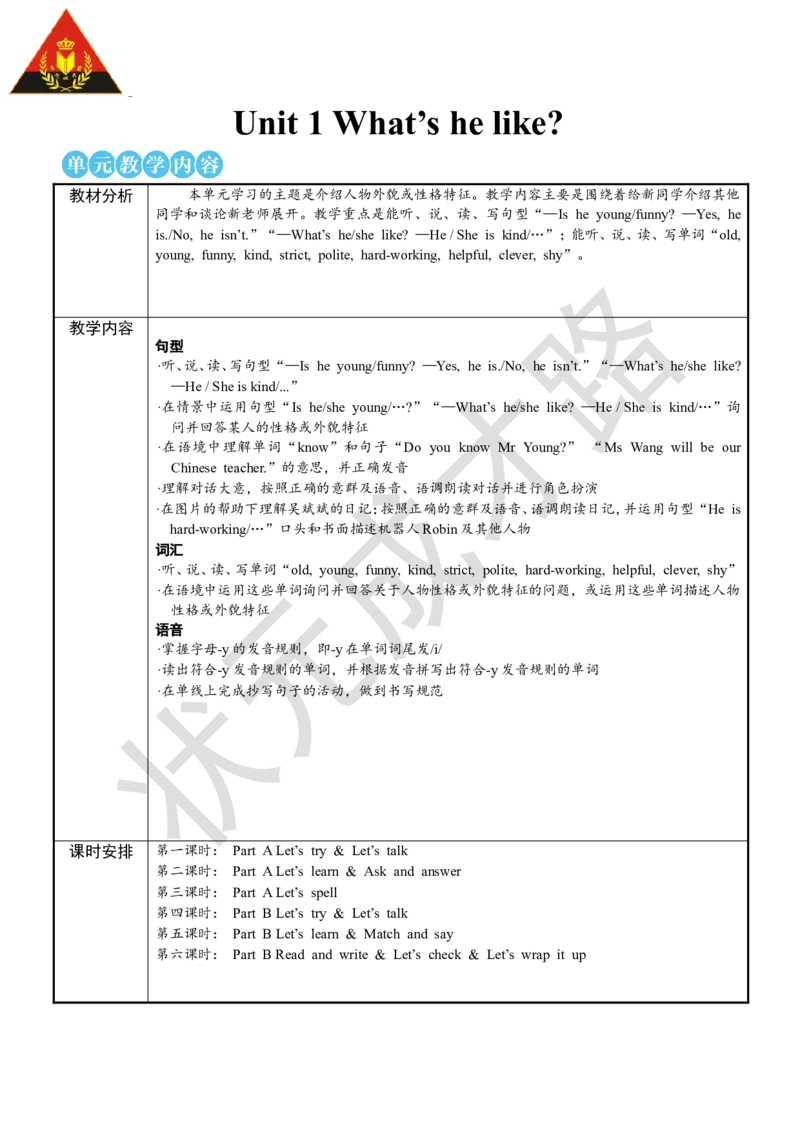
教材分析 本单元学习的主题是介绍人物外貌或性格特征。教学内容主要是围绕着给新同学介绍其他
同学和谈论新老师展开。教学重点是能听、说、读、写句型“—Is he young/funny? —Yes, he
is./No, he isn’t.”“—What’s he/she like? —He / She is kind/…”;能听、说、读、写单词“old,
young, funny, kind, strict, polite, hard-working, helpful, clever, shy”。
教学内容
句型
·听、说、读、写句型“—Is he young/funny? —Yes, he is./No, he isn’t.”“—What’s he/she like?
—He / She is kind/...”
·在情景中运用句型“Is he/she young/…?”“—What’s he/she like? —He / She is kind/…”询
问并回答某人的性格或外貌特征
·在语境中理解单词“know”和句子“Do you know Mr Young?” “Ms Wang will be our
Chinese teacher.”的意思,并正确发音
·理解对话大意,按照正确的意群及语音、语调朗读对话并进行角色扮演
·在图片的帮助下理解吴斌斌的日记;按照正确的意群及语音、语调朗读日记,并运用句型“He is
hard-working/…”口头和书面描述机器人Robin及其他人物
词汇
·听、说、读、写单词“old, young, funny, kind, strict, polite, hard-working, helpful, clever, shy”
·在语境中运用这些单词询问并回答关于人物性格或外貌特征的问题,或运用这些单词描述人物
性格或外貌特征
语音
·掌握字母-y的发音规则,即-y在单词词尾发/i/
·读出符合-y发音规则的单词,并根据发音拼写出符合-y发音规则的单词
·在单线上完成抄写句子的活动,做到书写规范
课时安排 第一课时: Part A Let’s try & Let’s talk
第二课时: Part A Let’s learn & Ask and answer
第三课时: Part A Let’s spell
第四课时: Part B Let’s try & Let’s talk
第五课时: Part B Let’s learn & Match and say
第六课时: Part B Read and write & Let’s check & Let’s wrap it up
3The first period (第一课时)
Part A Let’s try & Let’s talk
教学内容
▶
Let’s try ·借助图片听懂简短对话,抓住关键信息,提高听的能力
·对新句型在听觉上有所感知,并完成听录音选图片活动
Let’s talk ·理解对话大意,按照正确的意群及语音、语调朗读对话并进行角色扮演
·在情景中运用句型“—Is he young/funny? —Yes, he is./No, he isn’t.”询问并回答某人的
性格和外貌特征
·运用所学句型和参考词汇并根据教师的特点进行问答
·在语境中理解新单词“know”及句子“Do you know Mr Young?”的意思并正确发音
教学重点
▶
1.学生能够理解和掌握本课时重点单词和句型。
2.学生能够在情景中运用句型“—Is he young/funny? —Yes, he is./No, he isn’t.”询问并回
答某人的性格和外貌特征。
教学难点
▶
学生能够灵活运用所学句型在情景中谈论人物的性格和外貌特征,实现语言输出。
教学准备
▶
1. 预习《状元大课堂》《创优作业100分》《状元作业本》中本课时的相关内容。
2. PPT课件、课文录音、视频、卡片、照片、人物头饰等。
教学过程
▶
Step 1: Warm-up & Lead-in① Teaching purpose①
1. Greetings. 采用快闪的手法,通过
2. Sing the song—Who’s your teacher? (出示课件) 展示熟悉的面孔,让学生学
习三会单词“know”,领悟
3. Lead-in.
句子“Do you know?”的
T: It’s a new term now. Do you remember your classmates?
含义。适时引出新同学
(Quick Flash) Show some pictures of the characters in the
Oliver,以Oliver为主线,可
textbook one by one. (出示课件) Then talk about them with
以有效地引导学生进一步学
students like this: 习本课时的内容。
4T: Do you know him/her? Ss: Yes!
T: Who is he/she? Ss: He’s…/She’s…
Write down the word “know” in time. Lead students to read it:
know—know—Do you know? —I know. At last show the picture of
Oliver and ask: Do you know him? Help students answer.
Ss: No, I don’t.
T: Who’s he? Let’s watch the video. (课件出示: Unit 1主情景
图视频)
T: Now do you know the boy?
Ss: Yes! He’s Oliver. /His name is Oliver.
T: You’re right. In this term, we will have a new classmate. His
name is Oliver. Let’s say hello to Oliver.
Ss: Hello, Oliver!
Step 2: Presentation
1. Let’s try.② Teaching purpose②
通过观察图片,引导学
T: Wu Binbin and Oliver see Mr Li. Here are three pictures. (出示
生猜测,让学生带着问题,
课件) Who is Mr Li? Can you guess?
有目的地听录音,培养学生
Ss: …
的观察能力和逻辑推理能
T: Really? Oliver is a new classmate. So he doesn’t know his 力。通过选出正确图片的任
teachers. Let’s listen and tick. And you can check what you guess. 务引导学生进行描述,让学
Play the recording of “Let’s try”. (出示课件) Let students listen to 生有意识地感知目标句型。
the recording, grasp the key information, and then find the answer.
Check the answer with students. According to the right picture, ask like
this:
T: Is he strong? Ss: Yes, he is.
T: Is he a good basketball player? (with some actions) Ss: Yes, he
is.
T: Good job! And sometimes he is strict. (with some expressions)
(课件出示:教材P4 Let’s try板块的听力材料)
2. Let’s talk.
Teaching purpose③
(1) Teach some new words.③
充分发挥多媒体和图
① Show a picture of a young teacher who students know
片的作用,用图片对比、单
very well.
词拆分等多种方法让学生
T: Do you know him/her? Ss: Yes.
理解新词的含义,并做到词
T: Who is he/she? Ss: He / She is… 不离句,为学生透彻理解对
T: Yes, he/she is our Chinese/maths/…teacher, Mr/Miss X. 话扫清障碍,同时也可以培
Emphasize the word “our” with some actions. Help students read it 养学生的观察能力和逻辑
and understand its meaning: our—our—our teacher—our classroom— 思维能力。
our friends. Write it down on the blackboard.
② Show the picture of Mr Young on the PPT. (出示课件)
Point to it and ask: Do you know him?
5Ss: No, I don’t know.
T: He’s Mr Young.
Ask students to read it three times: young—young—Mr Young.
T: (Point to his white hair.) Is he old? Ss: Yes, he is.
T: (Point to Mr/Miss X.) Is he/she old? Ss: No, he/she isn’t.
Help students answer slowly: He / She is young. Write down
the word“young”on the blackboard. Then teach: young—young—
She’s young. He’s young. (Show some pictures of young students.)
(出示课件)
Lead students to compare the forms of “young” in “Mr Young” and
“He’s young.” Help students find out the difference and understand their
meanings.
③T: Mr Young is old. And he’s very funny.
Show a word card of “funny”. Read it and help students understand
its meaning.
T: fun-ny—fun-ny—funny. He’s funny. She’s funny. (Show
some pictures of funny students.) (出示课件) And I like funny Teaching purpose④
任务型教学法能让学
teachers.
生对文本有比较全面的认
(2)Teach the dialogue.④
识;根据问题的答案组织语
T: Wu Binbin and Oliver are talking about Mr Young now. Let’s
言对人物进行描述,可以锻
watch the cartoon and read the dialogue after it. Try to know more about
炼学生的语言表达能力,进
Mr Young. 一步强化学生对文本的理
Play the cartoon of“Let’s talk”. (出示课件) Let students 解。而不同形式的朗读旨在
培养学生使用正确的语音、
read after it. Ask students to read the dialogue again and answer
语调,并在具体的语境中落
the following questions:
实核心句型的运用。利用板
①Who is Mr Young? ②Is he young? ③Is he funny?
书让学生复述课文,加深对
Check the answers with students. Lead students to make an 文本的记忆。
introduction of Mr Young according to the answers like this: Mr Young
is Wu Binbin and Oliver’s music teacher. He isn’t young. He’s old. And
he’s funny.
(3)Read and act.
①Play the cartoon again. (出示课件) Let students read after
it and try to imitate the intonation and the pronunciation of the
recording. Then ask students to read together. At last ask students Teaching purpose⑤
to read freely. 通过先引导学生进行
操练,然后学生结对自主合
② Let students act out the dialogue in pairs. Several minutes
作练习,最后进行展示等一
later, take out some headwear and ask some students to act out.
系列的活动,强化学生对核
③Choose the best performers with students and give awards.
心句型的理解和掌握,让学
(4)Retell the dialogue according to the blackboard. 生在语言支架的帮助下,有
Make a model first and then lead students to retell. 话可说,增强学生的自信,
Step 3: Practice⑤ 激发学生的学习兴趣。
61. Sharp eyes.
Show the words “tall, friendly, quiet, funny, young, old” on the
PPT. (出示课件)Let students read them out quickly
2. Talk about your classmates and teachers.
(1)I ask and you answer.
Choose three pictures of students in the class. Ask and answer
according to these pictures.
T: Who’s he/she? Ss: He’s /She’s…
T: Is he/she funny/young/old? Ss: Yes, he/she is. /No, he/she isn’t.
(2)Pair work.
Show some photos of students’ teachers one by one.
T: Do you know him/her? Ss: Yes, he/she is our…teacher.
T: Can you talk about your teachers? Ss: …
Show the part of “Talk about your teachers.” on Page 4. Provide
some sentences patterns “Who’s your…teacher?” “—Is she/he…? —
Yes, she/he is. /No, she/he isn’t.” (出示课件) Let students ask and
answer with their partners.
(3)Show time.
Ask some students to act out and encourage more students to
participate in.
(4) Show time.
Teaching purpose⑥
Step 4: Consolidation & Extension⑥
通过学科整合进行拓
Make a dialogue.
展,构建有效的对话情境,
(1)Make a model.
创编对话,让学生学以致用,
T: (Draw a picture on the blackboard.) Do you know…? 提升学生的综合语言运用
Ss: No, I don’t. Who is he/she? 能力。
T: He’s/She’s my father/friend/grandpa/uncle/sister…
Ss: Is he/she…?
T: Yes, he/she is./No, he/she isn’t. I like him/her.
(2)Look and say.
Ask each student to draw a picture. Then let them imitate to talk
about it with their partners.
(3)Show time.
Ask some students to show their dialogues and encourage more
students to participate in.
板书设计
▶
7作业设计
▶
1. Practice the dialogue.
2. Do the exercises. (见“状元成才路”系列丛书《创优作业100分》或《状元作业本》对应课
时作业)
教学反思
▶
1.本节课采用Quick Flash的方法,通过让学生在新学期伊始回忆熟悉的面孔并认识新同学
Oliver,然后从Oliver 的角度去认识新老师,适时地导入新知并进行新词和核心句型的学习。
2.新词的学习做到了词不离句; 任务型教学法的采用强化了学生对文本的理解; 以学生为本,
构建有效的对话情景,引导学生自主合作;突出语言的语用功能,通过学科整合进行拓展,让学生
学以致用,提升了学生的综合语言运用能力。
3.不同形式的朗读及角色扮演,训练了学生使用正确的语音、语调,并在具体的语境中落实了
核心句型的运用。
4.板书简洁清晰,重点突出,对学生的复述起到了很好的辅助作用。
▶Teaching Contents
Let’s try
·Understand the dialogue, grasp the key information and improve listening abilities.
·Perceive the key sentence patterns and tick the right answer.
Let’s talk
·Understand the main idea of the dialogue and read the dialogue with correct sense groups,
pronunciation and intonation and act it out.
·Use the target words and sentence patterns to ask and answer in context properly.
·Understand and read the word“ know” and the sentence“ Do you know Mr
Young?”correctly.
▶Teaching Priorities
·Be able to understand and master the key words and sentence patterns of this lesson.
·Be able to use the target sentence patterns to ask and answer in context properly.
▶Teaching Difficulties
·Be able to talk about characters’ features by using the sentence patterns flexibly.
8▶Teaching Procedures
Teaching
Teacher’ s Activities Students’ Activities Teaching Purposes
Stages
Warm-up 1. Greetings. 1. Greetings. Learn the new word
& 2. Sing the song—Who’s 2. Learn to sing the song— “know” and understand
Lead-in your teacher? Who’s your teacher? the meaning of the
3. Lead-in. 3. Look at the pictures and sentence “Do you
Show some pictures one by answer the questions. know?” through the
one and ask questions “Do Know the new classmate. quick flash. Lead in the
you know him/her? Who is Learn the new word new lesson.
he/she?” Introduce a new “know”.
classmate. Teach the new
word “know”.
Presentation 1. Let’s try. Observe the three pictures Lead students to guess
Presenta Ask students to observe the and guess the answer. by observing the
tion three pictures and guess Listen to the recording and pictures. Cultivate
the answer. tick the answer. students’ observation
Play the recording of Check the answer with the and logical reasoning
“Let’s try”. teacher. abilities. Help students
Check the answer with Answer the questions perceive the key
students. according to the right picture. sentence patterns.
Ask some questions
according to the right
picture.
2. Let’s talk. Learn and understand the Understand the
(1)Teach the new words. new words “our, young, meanings of the new
①Teach the new funny”. Know the words by comparing
word“our” in phrases difference of “young” and and word splitting. And
and sentences. “Young”. practice the new words
②Teach the new word in sentences. Reduce
“young”. Compare the the difficulty of
learning and stimulate
forms of it in “Mr Young”
students’ learning
and “He’s young.”
interest by using some
③Lead students to learn
pictures of students.
the word“funny”with
some pictures of funny
students.
(2)Teach the dialogue. Watch the cartoon and Let students know the
Play the cartoon and let know more about Mr text thoroughly by
students know more about Young. Read after the answering the
Mr Young. Ask some cartoon and find the questions. Train
9students’ language
questions. Check the
answers to the questions. competence by
answers with students.
Check the answers with the describing the
Lead students to make an
teacher. Make an character. Strengthen
introduction of Mr Young
introduction of Mr Young. their understanding of
according to the answers.
the text.
(3)Let students read and act. Read after the cartoon Help students
①Play the cartoon again. again. Try to imitate the understand and deepen
② Take out some headwear intonation and the the impression of the
and ask some students to pronunciation. Then read text by retelling the
act out. together. At last read text.
③Give awards. freely. Act out the dialogue
in pairs and choose the best
performers.
(4)Make a model and then (4)Retell the text according to Make sure students can
ask students to retell the the writing on the read the dialogues
text according to the blackboard. correctly and act them
writing of the blackboard. out.
Practice 1. Sharp eyes. 1.Read the words out quickly. Help students
Show the words “tall, 2. Answer the questions. Ask strengthen the key
friendly, quiet, funny, and answer in pairs sentence patterns.
young, old” on the PPT. according to the sentence Encourage students to
2. Talk about your classmates patterns that the teacher show with the help of
and teachers.. provides. Show the language support.
(1) I ask and you answer. dialogues in class. Enhance students’
Choose some pictures of confidence. Stimulate
students in the class and students’ learning
ask “Who’s he/she? Is interest.
he/she…?”
(2)Pair work.
Show some photos of
students’ teachers one by
one.
Provide some sentence
patterns for students to use.
(3)Show time.
Ask some students to act
out and encourage more
students to participate in.
10Consolidation Make a dialogue. (1)Talk about the picture with Create a natural and
& (1)Make a model. the teacher. real situation to develop
Extension Draw a picture on the (2)Draw a picture and talk students’
blackboard and talk about about it with partners. comprehensive
the picture with students. (3)Show their dialogues with language using
(2)Look and say. partners. abilities.
Ask students to draw a
picture and talk about it
with their partners.
(3)Show time.
Ask students to show their
dialogues. Encourage more
students to participate in.
Homework 1. Practice the dialogue.
2. Do the exercises.
11