研
考
创
聚
考研要上就选聚创!
研
@
考
创
研
聚
考
研
@
创
考
聚
2025 年全国硕士研究生招生考试 创
研
@
试题
聚
考
(英语二)
@
创
(科目代码:204)
研
聚
考
研
@
创
考
聚
创
研
@
聚
考
@
创
聚
研
@
考
创
聚
@研
考
创
聚
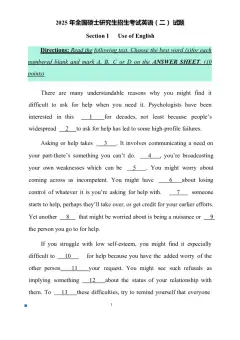
2025 年全国硕士研究生 @ 招生考试英语(二)试题 研
Section I Use of English 考
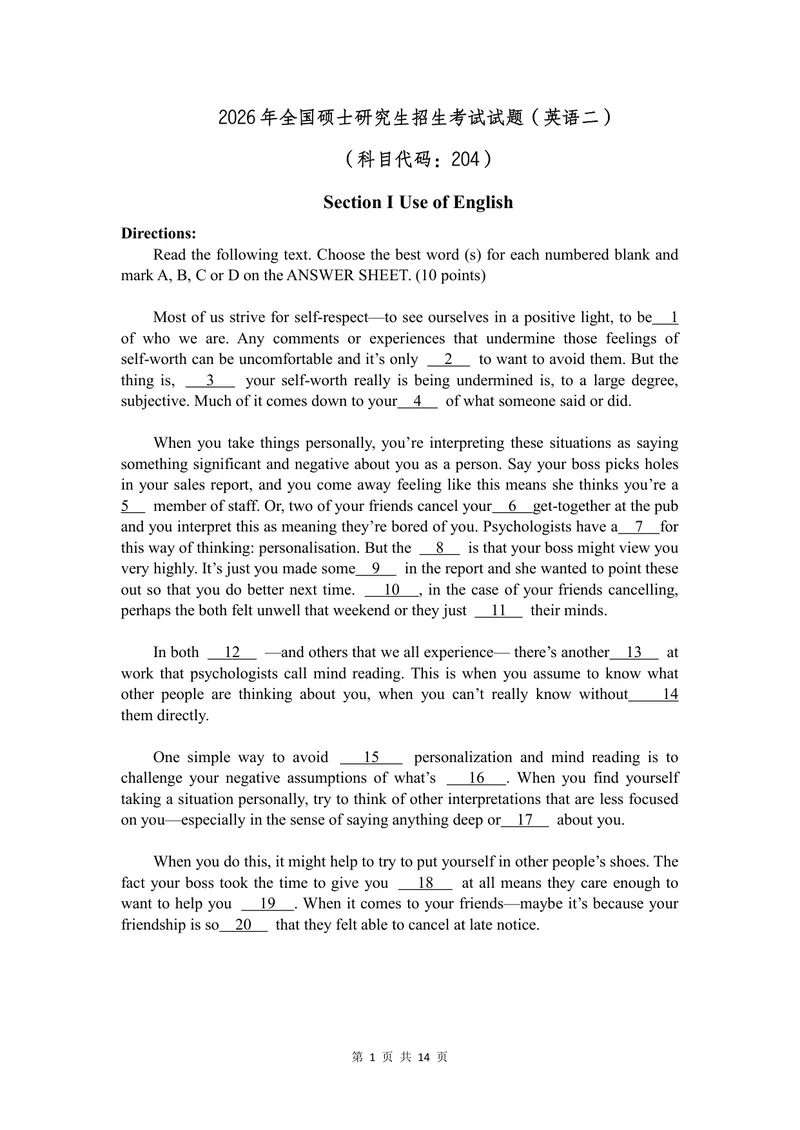
Directions: Read the following text. Choose the best word (s) for创each
研
numbered blank and mark A, B, C or D on the ANSWER SHEET. (10
聚
考
points)
研
@
创
There are many understandable reasons why you might find it
考
聚difficult to ask for help when you need it. Psychologists have been
创
interested in this 1 for decades, not least because people’s
研
@
widespread 2 to ask for help has led to some high-profile failures. 聚
考
Asking or help takes 3 . It involves communicating a need on
@
创
研 your part-there’s something you can’t do. 4 , you’re broadcasting
聚
your own weaknesses which can be 5 . You might worry about
考
研
coming across as in@competent. You might have 6 about losing
创
control of whatever it is you’re asking for help with. 7 someone
考
聚
starts to help, perhaps they’ll take over, or get credit for your earlier efforts.
创
研
@
Yet another 8 that might be worried about is being a nuisance or 9
聚
考the person you go to for help.
@
If you struggle with low self-esteem, you might find it especially
创
difficult to 10 for help because you have the added worry of the
聚
other person 11 your request. You might see such refusals as
研
@
implying something 12 about the status of your relationship with
考
them. To 13 these difficulties, try to remind yourself that everyone
1
创
聚
@研
考
创
聚
needs help sometimes. Nobody knows everything and can do everything 研
@
all by themselves. And while you might 14 coming across as
考
incompetent, there’s actually research that shows that advice-seekers are
创
15 as more com研petent, not less.
聚
Perhaps most encouraging of all is a paper from 2022 by researchers
考
研
at Stanford University that involved a mix of contrived@help-seeking
创
interactions and asking people to 16 times they’d sought help in the 考
聚
past. The findings showed that help-seeker generally underestimate how
创
研
@
17 other people will be to help and how good it’ll make the help-giver
聚
feel (for most people, having the考chance to help someone is highly
@
18 ).
创
研
So, bear all this in mind the next time you need to ask for help
聚
考
19 , take care over who you ask and when you ask them. And if
研
@
创 someone can’t help right now, avoid talking it personally. They might just
考
be too 20 , or they might not feel confident about their ability to help
聚
创
研
@ 1. [A]illusion [B]discussion [C]tradition [D]question
聚
2. [A]reluctance [B]ambition [C]tendency [D]enthusiasm
考
3. [A]attention [B]talent [C]courage [D]patience
@
创4. [A]Atanytime [B]Inotherwords [C]Byallmeans [D]Onthecontrary
5. [A]unrealistic [B]deceptive [C]tiresome [D]uncomfortable
聚
6. [A]doubts [B]concerns [C]suggestions [D]secrets
7. [A]Once [B]Unless 研[C]Although [D]Before
@
8. [A]theory [B]choice [C]factor [D]context
考
9. [A]overpraising [B]outperforming [C]reassessing [D] 无
2
创
聚
@研
考
创
聚
10. [A]reachout [B]settledown [C]turnover [D]lookback
研
@
11. [A]declining [B]considering [C]criticising [D]evaluating
考
12. [A]unnecessary [B]negative [C]strange [D]impractical
13. [A]explain [B]identify [C]predict [D]overcome
创
14. [A] deny [研B]forget [C]miss [D]fear
15. [A] disguised [B]perceived [C]followed [D]introduced 聚
考
16. [A] read [B]classify [C]analyse [D]compare
研
@
17. [A] brave [B]surprising [C]rewarding [D]demanding
创
18. [A] relaxing [B]disappointed [C]willing [D]hesitant
考
聚19. [A] Thus [B]Also [C]Finally [D]Instead
创
20. [A]polite [B]proud [C]busy [D]lazy
研
@
Section II Reading Comprehension 聚
考
PartA
@
创
研
聚
Directions: Read the following four texts. Answer the questions below
考
研
each text by choosing@A, B, C or D. Mark your answers on the ANSWER
创
SHEET. (40 points) 考
聚
Text 1
创
研
@
U.S. customers historically tipped people they assumed were earning
聚
考most of their income via tips, such as restaurant servers earning less than
@
the minimum wage. In the early 2010s, a wide range of businesses started
创
processing purchases with iPads and other digital payment systems. These
聚
systems prompted customers to tip for services that were not previously
研
@
tipped.
考
Today's tip requests are often not connected to the salary and service
3
创
聚
@研
考
创
聚
norms that used to determine when oud how people tip. Customers in the 研
@
past nearly always paid tips after receiving a service, such as at the
考
conclusion of a restaurant meal, after getting a haircut or once a pizza was
创
delivered. That tim研ing could reward high-quality service and give workers
聚
an incentive to provide it.
考
研
It's becoming more common for tips to be requested be@forehand. And
创
new tipping technology may even automatically add tips. 考
聚
The prevalence of digital payment devices has made it easier to ask
创
研
@
customers for a tip. That helps explain why tip requests are creeping into
聚
new kind of services. Customers no考w routinely see menus of suggested
@
default options-often well above 70% of what they owe. The amounts have
创
研
risen from 10% or less in the 1950s to 15% around the year 2000 to 20% or
聚
考
higher today. This increase is sometimes called tipflation-the expectation
研
@
创 of ever-higher tip amounts.
考
Tipping has always been a vital source of income for workers in
聚
historically tipped services, like restaurants, where th创e tipped minimum
研
@
wage can be as low as US $2.13 an hour. Tip creep and tip flation are now
聚
考
further supplementing the income of many low-wage service workers.
@
创
Notably, tipping primarily benefits some of these workers, such as
聚 cooks and dishwashers. To ensure that all employees were paid fair wages,
some restaurants banned tipp研ing and increased prices, but this movement
@
toward no-tipping services has largely fizzled out.
考
4
创
聚
@研
考
创
聚
研
@
21. According to paragraph 1, the practice of tips in the U.S.________.
考
[A] was regarded by many customers as a sign of generosity
创
研
[B] was considered essential for waiters
聚
考
[C]was a way of rewarding diligence
研
@
[D创] was optional in most businesses
考
22. Compared with tips in the past, today's tips________.
聚
创
[A] are paid much less frequently
研
@
聚
[B] are less often requested in advance
考
[C] have less to do with service quality @
创
研
[D] contributed less to workers' income
聚
考
23. Tip requests are creeping into new kind of service as a result of
研
@
创 ________.
考
[A] the advancement of technology
聚
创
[B] the desire for income increase
研
@
聚
[C] the diversification of business
考
[D] the emergence of tipflation @
创
24. The movement toward to no-tipping service was intended to________.
聚
[A] promote consumption
研
@
[B] enrich income sources
考
5
创
聚
@研
考
创
聚
[C] maintain reasonable prices 研
@
[D] guarantee income fairness
考
25. It can be learned from the last paragraph that tipping ________.
创
研
[A] is becoming a burden for customers
聚
[B] help考s encourage quality service
研
[C] is vital to business development @
创
[D] reflects the need to reduce prices 考
聚
创
Text 2
研
@
When it was established, the National Health service (NHS) was 聚
考
visionary: offering high-quality, timely care to meet the dominant needs of
@
创
研 the population it served/Nearly 75 years on; with the UK facing very
聚
different health challenges, it is clear that model is out of date.
考
研
From life expec@tancy to cancer and infant mortality rates, we are
创
lagging behind many of our peers/With more than 6.8 million on waitlists,
考
聚
healthcare is becoming increasingly inaccessible for those who can not opt
创
研
@
to pay for private treatment; and the cost of providing healthcare is
聚
考increasingly squeezed out investment in other public services/ As demand
@
for healthcare continues to grow, pressures on the workforce-which is
创
already near breaking point-will only become more acute.
聚
Many of the answers to the crisis in health and care are well
研
@
rehearsed./We need to be much better at reducing and diverting demand on
考
health services, rather than simply managing it./Much more needs to be
6
创
聚
@研
考
创
聚
invested in communities and primary care to reduce our reliance on 研
@
hospital's/And capacity in social care needs to be greater, to support the
考
growing number of people living with long-term conditions.
创
研
聚
26. According to the first two paragraphs, the NHS________.
考
研
[A] is troubled by funding deficiencies @
创
[B] can hardly satisfy people's needs 考
聚
[C] can barely retain its current employees
创
研
@
[D] is rivalled by private medical services
聚
27. One answer to the crisis in heal考th and care is to________.
@
[A] boost the efficiency of hospitals
创
研
[B] lighten the burden on social care
聚
考
[C] increase resources for primary care
研
@
创 [D] reduce the pressure on communities
考
28. "Reimagining health" is aimed to________.
聚
[A] reinforce hospital management 创
研
@
[B] readjust healthcare regulations
聚
考
[C] restructure the health system
@
创
[D] resume suspended health reforms
聚 29.To maximise the nation's health, the author suggests________.
[A] introducing relevant研taxation policies
@
[B] paying due attention to social factors
考
7
创
聚
@研
考
创
聚
[C] reevaluating major health outcomes 研
@
[D] enhancing the quality of healthcare
考
30.It can be inferred that local leaders should ________.
创
[A] exercise th研eir power more reasonably
聚
[B] develop a stronger sense of responsibility
考
研
[C] play a bigger role in then health system @
创
[D] understand people's health needs better 考
聚
Text 3
创
研
@
Heat action plans, or HAPs, have been proliferating in India in the
聚
past few years. In general, a HAP spe考lls out when and how officials should
@
issue heat warnings and alert hospitals and other institutions. Nagpur's plan,
创
研
for instance, calls for hospitals to set aside "cold wards" in the summer for
聚
考
treating heatstroke patients, and advises builders to give construction
研
@
创 laborers a break from work on very hot days.
考
But implementation of existing HAPs has been uneven, according to a
聚
report from the Centre for Policy Research. Many lack a创dequate funding, it
研
@
found. And their triggering thresholds often are not customized to the local
聚
考
climate. In some areas, high daytime temperatures alone might serve as an
@
创
adequate trigger for alerts. But in other places, nighttime temperatures or
聚 humidity might be as important a gauge of risk as daytime highs.
Mumbai's April heatstr研oke deaths highlighted the need for more
@
nuanced and localized warnings, researchers say. That day's high
考
8
创
聚
@研
考
创
聚
temperature of roughly 36℃ was 1℃ shy of the heat wave alert threshold 研
@
for coastal cities set by national meteorological authorities. But the effects
考
of the heat were amplified by humidity—an often neglected factor in heat
创
alert systems -and t研he lack of shade at the late-morning outdoor ceremony.
聚
To help improve HAPs, urban planner Rajashree Kotharkar's team is
考
研
working on a model plan that outlines best practices and cou@ld be adapted
创
to local conditions. Among other things, she says, all cities should create a 考
聚
vulnerability map to help focus responses on the populations most at risk.
创
研
@
Such mapping doesn't need to be complex, Kotharkar says. "A useful
聚
map can be created by looking at eve考n a few key parameters." For example,
@
neighborhoods with a large elderly population or informal dwellings might
创
研
be poorer with heat could get special warnings or be bolstered with cooling
聚
考
centers. The Nagpur project has already created a risk and vulnerability
研
@
创 map, which enabled Kotharkar to tell officials which neighborhoods to
考
focus on in the event of a heat wave this summer.
聚
HAPs shouldn't just include short-term eme创rgency responses,
研
@
researchers say, but also recommend medium-to long-term measures that
聚
考
could make communities cooler. In Nagpur, for example, Kotharkar's team
@
创
has been able to advise city officials about where to plant trees to provide
聚 shade. HAPs could also guide efforts to retrofit homes or modify building
regulations. "Reducing death研s in an emergency is good target to have, but
@
it's the lowest target," says climate researcher Chandri Singh.
考
9
创
聚
@研
考
创
聚
研
@
31.According to Paragraph 1, Nagpur's plan proposes measures to
考
________.
创
[A] tackle extr研eme weather
聚
[B] ensure construction quality
考
研
[C] monitor emergency warnings @
创
[D] address excessive workloads 考
聚
32.One problem with existing HAPs is that they________.
创
研
@
[A] prove too costly to be implemented
聚
[B] lack localized alert-issuing c考riteria
@
[C] give delayed responses to heat waves
创
研
[D] keep hospitals under great pressure
聚
考
33.Mumbai's case shows that India's heat alert systems need to________.
研
@
创 [A] include other factors besides temperature
考
[B] take subtle weather changes into account
聚
[C] prioritize potentially disastrous heat waves 创
研
@
[D] draw further support from local authorities
聚
考
34.Kotharkar holds that a vulnerability map can help________.
@
创
[A] prevent the harm of high humidity
聚 [B] target areas needing special attention
[C] expand the Nagpur p研roject's coverage
@
[D] make relief plans for heat-stricken people
考
10
创
聚
@研
考
创
聚
35.According to the last paragraph, researchers believe that HAPs should 研
@
________.
考
[A] focus more on heatstroke treatment
创
[B] apply for m研ore government grants
聚
[C] invite wider public participation
考
研
[D] serve a broader range of purposes @
创
Text 4 考
聚
Navigating beyond the organised pavements and parts of our urban
创
研
@
spaces, desire paths are the unofficial footprints of a community, revealing
聚
考
the unspoken preferences, shared shortcuts and collective choices of
@
humans. Often appearing as 创trodden dirt tracks through otherwise neat
研
green spaces, these routes of collective disobedience cut corners, bisect
聚
考
lawns and cross hills, representing the natural capability of people cand,
研
@
创
animals, to go from pointAto point B most effectively.
考
聚 Urban planners interpret desire paths as more than just convenient
创
shor研tcuts; they offer valuable insights into the dynamics between planning
@
聚
and behaviour.
考
Navigating beyond the organised pavem@ents and parks of our urban
创
spaces, desire paths are the unofficial footprints of a community, revealing
聚
the unspoken preferences, shared shortcuts and collective choices of
研
@
humans. Often appearing as trodden dirt tracks through otherwise neat
green spaces, these ro考utes of collective disobedience cut corners, bisect
11
创
聚
@研
考
创
聚
lawns and cross hills, representing the natural capability of people (and 研
@
animals) to go from pointAto point B most effectively.
考
Urban planners interpret desire paths as more than just convenient
创
研
shortcuts; they offer valuable insights into the dynamics between planning
聚
and behavio考ur. Ohio State University allowed its students to navigate the
研
@
Oval, a lawn in the centre of campus, freely, then proceeded to pave the
创
desire paths, creating a web of effective routes students had established. 考
聚
Yet, reluctance persists among other planners to integrate desire paths 创
研
@
into formal plans, citing concerns about safety, environmental impact, or
聚
考
primarily, aesthetics. A Reddit webpage devoted to the phenomenon,
@
创
boasting nearly 50,000 members, showcases images of local desire paths
研
adorned with signs instructing pedestrians to adhere to designated
聚
考
walkways, underscoring the rebellious nature inherent in these
研
@
创
human-made tracks. This clash highlights an ongoing struggle between the
考
聚 organic, user-driven evolution of public spaces and the desire for a visually
创
cura研ted and controlled urban environment.
@
聚
The Wickquasgeck Trail is an example of a historical desire path,
考
created by Native Americans to cross the for@ests of Manhattan and move
创
between settlements quickly. This trail, when Dutch colonists arrived, was
聚
widened and made into one of the main trade roads across the island,
研
@
known at the time as de Heere Straat, or Gentlemen’s Street. Following the
British assumption o考f control in New York, the street was renamed
12
创
聚
@研
考
创
聚
Broadway. Notably, Broadway stands out as one of the few areas in NYC 研
@
that defies the grid-based system applied to the rest of the city, cutting a
考
diagonal across parts of the city.
创
研
In online spaces, desire paths have sparked a fascination that can
聚
approach ob考session, with the Reddit page serving as a hub. Contributors
研
@
offer a wide array of stories, from little-known new shortcuts to
创
long-established alternate routes. 考
聚
Animal desire paths, such as ducks forging trails through frozen ponds 创
研
@
or dogs carving direct routes in gardens, highlight the adaptability of these
聚
考
trails in both human and animal experiences. As desire paths criss-cross
@
创
through both physical and virtual landscapes, they stand as a proof of the
研
collective insistence on forging unconventional routes and embracing the
聚
考
spirit of communal choice.
研
@
创
考
聚
36. According to Paragraph 1, desire paths are a result of ________.
创
研
@ [A] the curiosity to explore surrounding hills
聚
考[B] the necessity to preserve green spaces
@
创 [C] the tendency to pursue convenience
[D] the wish to find comfort in solitude
聚
37. It can be inferred that Ohio State University ________.
研
@
[A] intends to improve its desire paths
考
13
创
聚
@研
考
创
聚
[B] leads in the research on desire paths 研
@
[C] guides the creation of its desire paths
考
[D] takes a positive view of desire paths
创
研
38. The images on the Reddit webpage reflect ________.
聚
考
[A] conflicting opinions on the use of desire paths
研
@
创
[B] the call to upgrade the designing of public spaces
考
聚
[C] the demand for proper planning of desire paths
创
研
@[D] growing concerns over the loss of public spaces
聚
39. The example of the Wickguasgeck考Trail illustrates ________.
@
[A] the growth of New Yo创rk City
研
[B] the Dutch origin of desire paths
聚
考
[C] the importance of urban planning
研
@
创
[D] the recognition of desire paths
考
聚
40. It can be learned from the last paragraph that desire paths ________.
创
研
@
[A] reveal humans’deep respect for nature
聚
考
[B] are crucial to humans’mental wellbeing
@
创
[C] are a human imitation of animal behaviour
聚
[D] show a shared trait in humans and animals
@ Part B 研
Directions: Read the following text and answer the questions by
考
14
创
聚
@研
考
创
聚
choosing the most suitable subheading from the list A-G for each numbered 研
@
paragraphs (41-45). There are two extra subheadings which you do need
考
to use. Mark your answers on the ANSWER SHEET. (10 points)
创
研
聚
[A] Stay positive
考
研
[B] Respect the past @
创
[C] Use channels 考
聚
[D] Give it time
创
研
@
[E] Invite resistance
聚
[F] Be a salesman 考
@
[G] Be humble
创
研
Five Steps to Suggesting a Change at Work That'llActually Get Taken
聚
考
Seriously
研
@
创
Everyone wants to be that person—the one who looks at the same
考
聚
information as everyone else, but who sees a fresh, innovative solution.
创
研
@ However, it takes more than simply having a good idea. How you share it
聚
考is as important as the suggestion itself. Why? Because writing a new
script-literally or figuratively-means that othe@r team members will have to
创
adapt to something new. So whether you're suggesting a (seemingly)benign
聚
change like streamlining outdated protocol, or a bigger change like adding
研
@
an hour to each workday so people can leave early on Fridays, you're
考
asking others to reimagine their workflow or schedule. Not to mention, if
15
创
聚
@研
考
创
聚
the process your scrapping is one someone else suggested, there's the 研
@
possibility of hurt feelings. To gain buy-in on an innovative, new idea,
考
follow these steps:
创
研
41 ________.
聚
考
Great ideas don’t stand alone. In other words, you can’t mention your
研
@
sugges创tion once and expect it to be adopted. To see a change, you’ll need
考
to champion your plan and sell its merits. In addition, you need to be
聚
创
willing to stand up to scrutiny and criticism and be prepared to explain
研
@
your innovation in different ways for various audiences. 聚
考
42 ________.
@
创
Sometimes it makes sense to go to your boss first. But other times, it’s
研
useful to build a coalitio聚n among your co-workers or other stakeholders.
考
When it works, it works great—because you’re ready for your st研ubborn
@
创
supervisor’s pushback with answers like, “Actually, I connected with a
考
聚
few people in our tech department to discuss how much time these kinds of
创
研
@ website updates would take, and they suggested they have the bandwidth.
聚
考However, just be certain you can explain your end-around approach as
one that built your case, rather than simply @circumvented your manager.
创
The last thing you want is for your boss to feel embarrassed he wasn’t
聚
informed—which could lead him to quash the idea before it even takes off.
研
@
43 ________.
考
16
创
聚
@研
考
创
聚
One of the biggest barriers to gaining buy-in occurs when the owner 研
@
of an idea is viewed as argumentative, defensive, or close-minded. Because,
考
let’s be honest: No one likes a know-it-all. So, if people disagree with you,
创
don’t be indignant.研Instead, listen to their concerns fully, try to understand
聚
their perspective, and include their concerns (and possible remedies) in
考
研
future discussions. @
创
考
So, instead of saying, “Martha, our current slogan is confusing and
聚
创
should be updated,” you could try, “Martha raises a great point that our
研
@
current slogan has a long history for our stakeholders, but I wonder if we 聚
考
might able to brainstorm a tagline that could build on that—and be clearer
@
创
for new customers.”
研
44 ________. 聚
考
New ideas are the grandchildren of old ones. In other words研, don’t
@
创
throw old solutions under the bus to make your improvement stand out.
考
聚
Remember that in light of whatever the problem the old system solved—or,
创
研
@ maybe, has failed to solve in recent memory—it was a great idea at the
聚
考time. Appreciating the older contributions as you suggest future
innovations helps bolster the credibility of you@r idea.
创
45 ________.
聚
When pitching a new idea, it’s important use the language of
研
@
abundance instead of the language of deficit. Instead of saying what is
考
wrong, broken, or suboptimal, talk about what is right, fixable, or ideal.
17
创
聚
@研
考
创
聚
For example, try, “I can see lots of applications for this new approach” 研
@
rather than, “This innovation is the only way.” Be optimistic but realistic,
考
and you will stand out.
创
研
聚
Section III Translation
考
研
46. Directions: Translate the following text into Chines@e. Write your
创
translation on the ANSWER SHEET. (15 points) 考
聚
You know the moment - the conversation. Slows, then there's a pause.
创
研
@
It's awkward, and so awkward that some people will panic and say
聚
anything. Do we all find such silences考so stressful?
@
Researchers analysed the frequency and impact of gaps greater than 2
创
研
seconds daring conversations, including an overview of previous studies
聚
考
which indicate that the fear of awkward silences can be so extreme that
研
@
创 people avoid taking to strangers, even though doing so is likely to be an
考
enjoyable experience.
聚
During conversations with short gaps, people feel创more connected to
研
@
their conversation partners. But such feeing of connection markedly dip
聚
考
when entering a long gap. Long gaps between strangers are likely to be
@
创
followed by a change in topic.
聚 But the opposite seems to be true for conversations between friends.
Long gaps there saw increas研ed connection. Between friends, longer gaps
@
seem to provide natural moments for reflection and expression.
考
18
创
聚
@研
考
创
聚
Section IV Writing 研
@
PartA
考
47. Directions:
创
研
Suppose you are planning a short play based on a classic Chinese novel.
聚
Write you考r friend John an e-mail to.
研
@
1) introduce the play and
创
考
2) invite him take part in it
聚
You should write about 100 words on theANSWER SHEET.
创
研
@
Do not use your own name. Use “Li Ming” instead.(10 points)
聚
考
@
Part B 创
研
48. Directions:
聚
考
Write an essay based on the chart below. In your writing, you
研
@
创
should
考
聚 1) interpret the chart, and
创
2) give your comments.
研
@
You should write about 150 words on theA聚NSWER SHEET. (15
考
points)
@
创
聚
研
@
考
19
创
聚
@研
考
创
聚
研
@
考
创
研
聚
考
研
@
创
考
聚
创
研
@
聚
考
@
创
研
聚
考
研
@
创
考
聚
创
研
@
聚
考
@
创
聚
研
@
考
20
创
聚
@