班级 姓名 学号 分数
Unit 5 What are the shirts made of?单元测试 (A卷·夯实基础)
(时间:60分钟,满分:100分)
一、词汇填空(本题共15小题,每小题1分,共15分。)
1.We like our English teacher very much because he can make his class l________.
2.Water covers a large proportion of the earth’s s________.
3.She was fishing around in her h________, trying to find the key.
4.The quilt is made of c________. And it’s very warm.
5.The Adventures of Robinson Crusoe (《鲁滨孙漂流记》) by Daniel Defoe is w________ read by teenagers in
our city.
6.As an experienced teacher, she has built up a good number of teaching m________ over the years.
7.The woman writer’s novel was p________ last year.
8.She is k________________ for her work on the human brain.
9.This book is about ________(历史的)events in the 1890s.
10.There are many colorful ________(气球)in the sky.
11.The first and earliest paper ________ (剪纸) was found in China 1,500 years ago.
12.She looks beautiful because she wears a ________ (银) necklace around her neck.
13.The writer has gone to the countryside to collect ________________(材料) for his new book.
14.I think the work will be ________________(完成) in two hours.
15.The ________ (邮递员) brought me a large package.
二、用括号内所给单词的适当形式填空(本题共15小题,每小题1分,共15分。)
16.Everything is ___________________ (do). Let’s begin our breakfast.
17.Driving after drinking wine ________ (not allow) in China.
18.The beautiful painting is made from grass, flowers and ________________(leaf).
19.The star avoided ________________(answer) any private questions.
20.What language is ________________ (speak) in Canada?
21.The Great Wall is well ________________ (know) around the world.
22.Cotton is ________________ (grow) in the south-east of China.
23.Glass didn’ t become ________________ (wide) used until the 13th century.
24.These characters come from a ________________(history) story.25.The girl has no time because she ________ (make) to practice playing the piano all day.
26.Mary is a ________(live) child and popular with everyone.
27.We are not __________ (suppose) to talk loudly in the reading room.
28.The singing competition is ________ (hold) in our school every spring.
29.Jim is so smart that he ________ (love) by all his teachers.
30.I don’t know how ________ (drive) a car.
三、单项选择(本题共10小题,每小题1分,共10分。)
31.People have realized how important the environment is, but still many trees ________ in the world every year.
A.were cut down B.cut down C.are cut down D.will be cut down
32.He didn’t spend enough time on Maths. ________ , he failed his exam.
A.Although B.Even though C.As a result D.In order that
33.The customers are pleased with the ________ of the restaurant.
A.balance B.experience C.surface D.service
34.You may watch TV after your homework ________.
A.was done B.is done C.has done D.will be done
35.—How soon ________ all the work ________?
—In a week.
A.will;finish B.is;going to finish C.is;going to be finished D.are;finished
36.—May I take some photos in the museum?
—________, or you will be in trouble.
A.Go ahead B.Help yourself C.I hope not D.You’d better not
37.Many kids ________ hard to study for good grades.
A.push B.are pushed C.are pushing D.have pushed
38.He is famous ________ his articles, and he is also famous ________ a speaker.
A.for; as B.for; for C.as; for D.as; as
39.________ you eat, you should make sure that it is clean.
A.However B.Whenever C.No matter D.No matter what
40.—There are more than 1000 parks in Shenzhen and the air is so nice.
—So it is. It ________ trees and flowers everywhere.
A.is short of B.is covered with C.is connected with
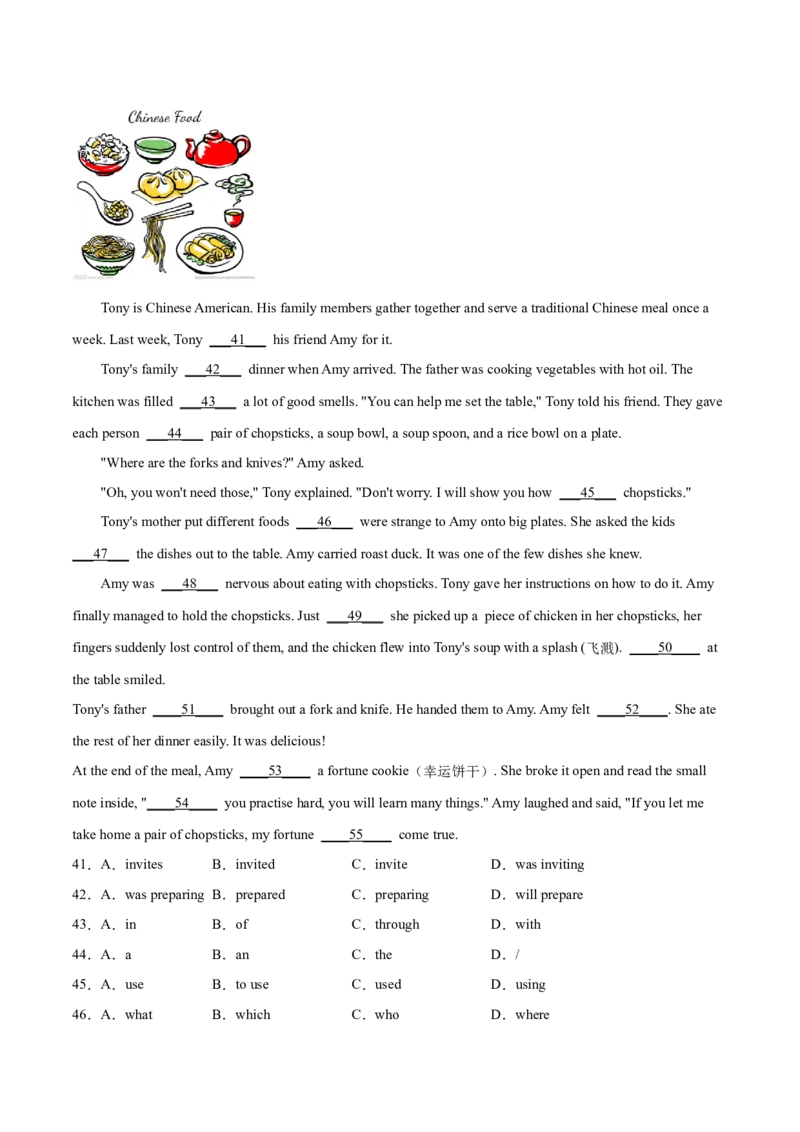
四、完形填空(本题共15小题,每小题1分,共15分。)Tony is Chinese American. His family members gather together and serve a traditional Chinese meal once a
week. Last week, Tony ___41___ his friend Amy for it.
Tony's family ___42___ dinner when Amy arrived. The father was cooking vegetables with hot oil. The
kitchen was filled ___43___ a lot of good smells. "You can help me set the table," Tony told his friend. They gave
each person ___44___ pair of chopsticks, a soup bowl, a soup spoon, and a rice bowl on a plate.
"Where are the forks and knives?" Amy asked.
"Oh, you won't need those," Tony explained. "Don't worry. I will show you how ___45___ chopsticks."
Tony's mother put different foods ___46___ were strange to Amy onto big plates. She asked the kids
___47___ the dishes out to the table. Amy carried roast duck. It was one of the few dishes she knew.
Amy was ___48___ nervous about eating with chopsticks. Tony gave her instructions on how to do it. Amy
finally managed to hold the chopsticks. Just ___49___ she picked up a piece of chicken in her chopsticks, her
fingers suddenly lost control of them, and the chicken flew into Tony's soup with a splash (飞溅). ____50____ at
the table smiled.
Tony's father ____51____ brought out a fork and knife. He handed them to Amy. Amy felt ____52____. She ate
the rest of her dinner easily. It was delicious!
At the end of the meal, Amy ____53____ a fortune cookie(幸运饼干). She broke it open and read the small
note inside, "____54____ you practise hard, you will learn many things." Amy laughed and said, "If you let me
take home a pair of chopsticks, my fortune ____55____ come true.
41.A.invites B.invited C.invite D.was inviting
42.A.was preparing B.prepared C.preparing D.will prepare
43.A.in B.of C.through D.with
44.A.a B.an C.the D./
45.A.use B.to use C.used D.using
46.A.what B.which C.who D.where47.A.carrying B.carried C.carry D.to carry
48.A.a little B.little C.a few D.few
49.A.where B.how C.why D.when
50.A.No one B.Someone C.Everyone D.Anyone
51.A.kind B.kindly C.kindness D.unkindly
52.A.more comfortable B.comfortably C.most comfortable D.much comfortable
53.A.gave B.has given C.was given D.was giving
54.A.Because B.If C.Although D.But
55.A.should B.must C.would D.may
五、阅读理解(本题共10小题,每小题2分,共20分。)
A
Tea bag drinking is most Westerner’s favorite way of drinking tea. Do you know how it came about?
The tea bag was invented in 1980 by Thomas Sullivan, an American tea seller. He was sending out free tea in
silk bags for people to try. People put the bags together with the tea leaves into the cup and added hot water. The tea
tasted good, and people thought it was easy to clean the cup. They were not happy when Sullivan started sending
them loose(散的) tea again.
Sullivan realized that he had a hot new thing in his hands, and he built a machine to pack the bags. As tea bags
became popular, they were changed from silk to gauze(薄纱) and later paper. In 1952, Lipton Tea made the tea bag
even more popular with its invention of the four-sided tea bag. Tea bags were soon a hit in the UK, and today 85%
of the tea in the UK is packed in paper bags.
However, many people still prefer loose-leaf tea. This is because some tea companies put not very good tea in
their tea bags. But for most drinkers, tea bags are still the easy, tasty way to go.
56.Who invented tea bag? _________.
A.An English tea seller B.The Chinese
C.Lipton D.Thomas Sullivan
57.The tea in silk bags was welcome because ________.
A.the tea in bags was free and very good
B.the tea tasted good and the cups was easy to wash
C.people were happy with the loose tea
D.people didn’t know any better way to enjoy the tea
58.The underlined part “Tea bags were soon a hit in the UK” means “_________ in the UK”.A.Tea bags soon became popular
B.Tea bags surprised everyone very much
C.Tea bags kicked(踢) the loose-leaf out of the market
D.Tea bags weren’t allowed to be sold
59.The material of the tea bag is usually ________ now.
A.silk B.gauze C.paper D.plastic
60.What can be the best title for this passage?
A.The invention of tea B.The way of drinking tea
C.The history of tea bags D.People’s favorite tea in the world
B
Late on a Friday night, Asia Faircloth had one question for the seven teenagers for the next three hours. “You
want to play with knives?” the cooking teacher asked.
In two groups, the students were busy in a kitchen at the High Point Community Center in Seattle, the US.
Asia Faircloth taught one group how to cook noodles with tofu and chicken. The other group joined Jacob Alhadeff
to practice new chopping skills with knives.
The center’s four-week cooking course was centered on cooking and food justice. The city recruited students
from poor families. Each student received 100 dollars at the end of the course.
“Low-income(低收入)people of color are more likely to meet food injustice(不公正),” Alhadeff said.
“So teaching cooking skills and putting money back in the pockets of our community members seemed very
important.”
Alhadeff and Faircloth started the course not only to teach kids how to cook, but also to encourage them to
think more deeply about something behind food. They were shown how to connect the dots between personal
choices and the cost of global food supplies(供给).
Tahir Adams and Najah Goodrich, two juniors at Seattle Lutheran High School, joined the classes. They talked
about how farmers have a hard time putting food on their own kitchen tables while growing fresh vegetables for the
rest of the country.
“We started with more personal things, then looked at the bigger, global view like, how climate change has
influenced food,” Adams said. “It can be really bad when droughts(干旱)turn places into deserts.”
61.What do we know about the cooking course?
A.It mainly focused on cooking skills.
B.It was held in Seattle, the US.C.The students were from rich families.
D.Each student paid 100 dollars for the course.
62.What does the underlined word “recruited” mean in Chinese?
A.招募 B.关注 C.派遣 D.调查
63.In the fourth paragraph, Alhadeff explains _________.
A.the standards for choosing students
B.community members are stupid
C.the importance of giving students money
D.why the course provides cooking skills
64.In the cooking course, students were encouraged ________.
A.to use cooking skills to make money
B.to focus on personal choices
C.to learn to grow fresh vegetables
D.to think more deeply about food
65.What can we infer(推断)from what Adams and Goodrich said?
A.They were proud of the cooking skills they learned.
B.They learned nothing much from the course.
C.The course widened their views on food.
D.The course taught them how to solve droughts.
六、补全对话(本题共5小题,每小题1分,共5分。)
根据对话内容,从下列选项中选出恰当的选项补全对话,其中有两项多余。
根据对话内容,从文后A-G七个选项中,选出五个能补全对话的最佳选项。(有两项多余)
Susan: Hi, Anita. I bought three shirts for 200 yuan yesterday!
Anita: Oh, really? What are they made of?
Susan:A hundred percent cotton._________66_________
Anita: Oh, OK. By the way, where did you buy those chopsticks?
Susan: Oh,________67________ They’re nice, aren’t they?
Anita: Yeah. Chopsticks are usually made of wood._________68_________
Susan: Oh, steel chopsticks are more popular in Korea. Hey, do you think this ring looks OK?
Anita: Hmm... yes, I think it’s quite pretty.________69________
Susan: Yes, and it was made in Thailand._________70_________Anita: Oh, I’m sure she’ll love it.
A.They’re nice and soft.
B.I don’t like them.
C.I got them in Yunnan.
D.I’ve never seen steel ones.
E.I’ll give it to my best friend for her birthday.
F.They are very expensive.
G.Is it made of silver?
七、书面表达(共20分。)
根据以下表格中的内容,写一篇不少于80词的英文短文。
mobile phone
inventor Martin Cooper
time 20世纪70年代
be widely used in our daily life 1. 通话;2. 拍照;3. …
your opinion and reasons 至少两条…
…… ……
____________________________________________________________________________________________
____________________________________________________________________________________________
____________________________________________________________________________________________
____________________________________________________________________________________________
____________________________________________________________________________________________
____________________________________________________________________________________________
____________________________________________________________________________________________
____________________________________________________________________________________________
____________________________________________________________________________________________
____________________________________________________________________________________________
__________
参考答案:
1.(l)ively【解析】
【详解】
句意:我们非常喜欢我们的英语老师,因为他让课堂充满趣味。根据“We like our English teacher very
much because he can make his class”并结合所给单词首字母可知,应该是英语老师让课堂充满趣味,所以空
缺处用形容词lively“充满趣味的”作宾补,故填(l)ively。
2.(s)urface
【解析】
【详解】
句意:水覆盖了地球表面的很大一部分。根据“Water covers a large proportion of the earth’s”可知,水覆盖
了地球的表面,“表面”译成:surface;由the earth’s可知,这里用单数形式。故填(s)urface。
3.(h)andbag
【解析】
【详解】
句意:她在手提包里找了许久,试图找到钥匙。根据空后的“trying to find the key”并结合所给单词首字母
可知,应该是在手提包里找了许久,名词handbag意为“手提包”,故填(h)andbag。
4.(c)otton
【解析】
【详解】
句意:被子是用棉花做的。很暖和的。根据首字母提示可知,此空指cotton“棉花”,为不可数名词。故填
(c)otton。
5.(w)idely
【解析】
【详解】
句意:丹尼尔·笛福的《鲁滨逊漂流记》被我们城市的青少年广泛阅读。根据“is…read by teenagers”可知,
此空使用副词修饰过去分词read,widely“普遍地,广泛地”。故填(w)idely。
6.materials
【解析】
【详解】
句意:作为一个经验丰富的老师,这些年来她已经积累了大量的教学材料。根据“As an experienced
teacher”可知她是一个有经验的老师,所以这些年来,应是积累了教学方面的材料,结合首字母可知应填
material,material表具体意义时,是可数名词,故填materials。7.(p)ublished
【解析】
【详解】
句意:去年这位女作家的小说出版了。根据题干“The woman writer’s novel was…last year”和首字母提示可
知,此处是指小说被出版;publish“出版”符合语境。主语novel和动词publish是被动关系;结合时间状语
“last year”可知本句是一般过去时的被动语态,用“was done”结构;publish的过去分词为published,故填
(p)ublished。
8.(k)nown
【解析】
【详解】
句意:她因为对人脑的研究工作而闻名。根据句意和首字母可知,此处应填形容词,表“闻名的,著名
的”,英文表达为“known”。故填(k)nown。
9.historical
【解析】
【详解】
句意:这本书是关于19世纪90年代的历史事件。“历史的”historical,形容词,在句中作定语。故填
historical。
10.balloons
【解析】
【详解】
句意:天空中有许多五颜六色的气球。“气球”balloon,many后跟可数名词复数形式。故填balloons。
11.cutting
【解析】
【详解】
句意:最早的剪纸是1500年前在中国发现的。根据所给汉语意思可知,空缺处应该填的是剪纸,paper
cutting意为“剪纸”,故填cutting。
12.silver
【解析】
【详解】
句意:她看起来很漂亮,因为她脖子上戴着一条银项链。根据汉语提示可知,此空使用形容词silver作定
语修饰名词necklace,silver necklace“银项链”。故填silver。13.material
【解析】
【分析】
【详解】
句意:作者去农村为他的新书搜集材料。句中“材料”表示写作素材,不可数名词material。故填
material。
14.completed
【解析】
【详解】
句意:我认为这项工作在两小时后将会完成。in two hours意为“两小时之后”,为一般将来时的时间状语。
the work与“完成”之间为被动关系,故应填一般将来时的被动语态,will be+动词过去分词。句中已包含
will be,故填complete的过去分词即可。故填completed。
15.postman
【解析】
【详解】
句意:邮递员给我送来一个大包裹。postman“邮递员”,是可数名词,此处用了定冠词表示特指,结合语
境可知名词用单数,故填postman。
16.done
【解析】
【详解】
句意:一切都完成了。我们开始吃早餐吧。主语“Everything”和动词“do”之间是被动关系,需用被动语态
(be done)。do的过去分词为done。故填done。
17.isn’t allowed
【解析】
【详解】
句意:在中国酒后驾驶是不允许的。句子为一般现在时,allow“允许”,是动词,主语Driving after
drinking wine与谓语not allow之间是被动关系,因此用被动语态,主语是动名词短语,谓语用第三人称单
数形式,故填isn’t allowed。
18.leaves
【解析】
【分析】【详解】
句意:这幅美丽的画是由草,花和树叶做的。根据所给词汇和句意可知,空处应填名词复数,“leaf”的复
数形式是“leaves”。
19.answering
【解析】
【详解】
句意:那位明星避免回答任何私人问题。avoid doing sth.避免做某事,根据前文“avoided”,可知空格处应
该填写动名词形式。故填answering。
20.spoken
【解析】
【详解】
句意:加拿大讲什么语言? what language与speak是被动关系,可知此处填过去分词与is构成一般现在时
被动语态。故填spoken。
21.known
【解析】
【详解】
句意:长城举世闻名。句子的主语(The Great Wall)与“know”之间的关系是被动关系可知,本题考查be
well known“众所周知”。故填known。
22.grown
【解析】
【详解】
句意:棉花被种植在中国东南部。分析句意,主语和动词之间是被动关系,故应用被动语态;结合空前is
提示可知,应用一般现在时的被动语态,构成形式为:be done;grow的过去分词是grown。故填grown。
23.widely
【解析】
【详解】
句意:直到十三世纪玻璃才变得广泛地应用。此处是副词修饰动词,wide广泛的,形容词,widely广泛地,
副词。故填widely。
24.historical
【解析】
【详解】句意:这些角色来自于一个历史故事。story名词,故事,需要在之前添加形容词作定语。history名词,历
史;historical形容词,历史的。故填historical。
25.is made
【解析】
【详解】
句意:这个女孩没有时间,因为她被迫整天练习弹钢琴。根据所给单词和“she … to practice”可知,make
在此作使役动词,表示“使;使成为”,常用于make sb. do sth.的结构中,she和make之间为被动关系,
其被动语态结构为“sb. be made to do sth.”,表示“某人被迫/被强制做某事”,句子时态为一般现在时,
she为第三人称单数,be动词用is。故填is made。
26.lively
【解析】
【详解】
句意:玛丽是个活泼的孩子,很受大家欢迎。名词“child”之前应该用形容词修饰,lively是live的形容词,
表示“活泼的”。故填lively。
27.supposed
【解析】
【详解】
句意:我们不应该在阅览室大声说话。此处是固定搭配,be supposed to do sth“应该做某事”。故填
supposed。
28.held
【解析】
【详解】
句意:每年春天我们学校都举行歌唱比赛。根据句意可知,主语“The singing competition”与动词“hold”是
被动关系,所以谓语用被动结构“is+hold的过去分词held”。故填held。
29.is loved
【解析】
【详解】
句意:Jim是如此聪明,他深受老师们的喜爱。主语he与love是被动关系,被动语态的结构为“be+动词
的过去分词”。根据前面的动词is,所以这里也用一般现在时,故填is loved。
30.to drive
【解析】【详解】
句意:我不知道怎样驾驶小汽车。drive“开车”,是动词。根据“I don’t know how...a car.”可知考查“疑问
词+不定式”作宾语,how to drive a car作know的宾语。故填to drive。
31.C
【解析】
【详解】
句意:人们已经意识到环境有多重要,但是每年世界上仍然有许多树木被砍伐。
考查一般现在时的被动语态。分析句子结构可知,“many trees”与“cut down”之间是被动关系,应使用被
动语态(be done),所以排除B项;根据“every year”可知,时态是一般现在时,所以空处应用一般现在
时的被动语态,结构:is/are done。故选C。
32.C
【解析】
【详解】
句意:他没有花足够的时间在数学上,结果他考试不及格。
考查词义辨析。although尽管;even though即使;as a result结果;in order that为了。根据“He didn’t
spend enough time on Maths.”和“he failed his exam.”可知他考试不及格是在数学上用的时间不够的结果,故
选C。
33.D
【解析】
【详解】
句意:顾客们对这家饭店的服务感到满意。
考查名词辨析。balance平衡;experience经验;经历;surface表面;service服务。根据“The customers are
pleased with”可知,顾客应该是对餐厅的服务感到满意。故选D。
34.B
【解析】
【详解】
句意:你在作业做完之后可以看电视。
考查被动语态。在after引导的时间状语从句中,主语“your homework”是动词do的承受者,应用被动语态,
结构是be动词+动词过去分词;主句中含有情态助词may,结合语境可知时间状语从句用一般现在时,所
以是is done。故选B。
35.C【解析】
【详解】
句意:——所有的工作要多久才能完成? ——一个星期。
考查一般将来时的被动语态。主语“all the work”与谓语动词“finish”之间是被动关系,需用被动语态;根
据“how soon”可知,本句需用一般将来时,故用一般将来时的被动语态will be finished或is going to be
finished。故选C。
36.D
【解析】
【详解】
句意:——我可以在博物馆照相吗?——你最好不要,否则你将会有麻烦。
考查情景交际用语辨析。Go ahead开始做吧,表同意;Help yourself随便吃;I hope not我希望不是;You’d
better not你最好不要。根据答句中的“or you will be in trouble”可知,此处是委婉地建议对方不要在博物馆
拍照。You’d better not符合语境。故选D。
37.B
【解析】
【详解】
句意:许多孩子为了取得好成绩被推动着去努力学习。
考查一般现在时的被动语态。push推动,为动词原形;are pushed被推动,为一般现在时被动语态;are
pushing正在推动,为现在进行时;have pushed已经推动,为现在完成时。根据后文“for good grades”可知,
为了取得好成绩,孩子们被家长推动去学习。故选B。
38.A
【解析】
【详解】
句意:他以他的文章而闻名,他也作为一名演讲家而闻名。
考查形容词短语辨析。be famous for因……而闻名;be famous as作为……而闻名。根据“his articles”可知,
第一空应该用for。根据“a speaker”可知,第二空应该是as。故选A。
39.D
【解析】
【详解】
句意:无论你吃东西,你应该确保它是干净的。
考查状语从句。However然而;Whenever无论何时;No matter what无论什么。分析语境可知,题意为无论吃什么都应该确保它干净。故选D。
40.B
【解析】
【详解】
句意:——深圳有1000多个公园,而且空气很好。——的确如此。它到处都覆盖着树木和鲜花。
考查短语。is short of缺乏;is covered with覆盖;is connected with连接。根据“the air is so nice”及“trees
and flowers”,可知句子表达覆盖着树和花,用“is covered with”。故选B。
41.B
42.A
43.D
44.A
45.B
46.B
47.D
48.A
49.D
50.C
51.B
52.A
53.C
54.B
55.C
【解析】
【分析】
本文叙述了托尼邀请他的好友艾米来家里做客吃中餐的有趣经历。
41.
句意:上周,托尼为此邀请了他的朋友艾米。
invites邀请,动词三单形式,用于一般现在时;invited 动词过去式,用于一般过去时;invite动词原形,
用于一般现在时;was inviting用于过去进行时。根据空前“Last week”可知,本句为一般过去时,动词应
该用过去式。故选B。
42.句意:艾米来的时候,托尼的家人正在准备晚餐。
was preparing正在准备,用于过去进行时;prepared准备,动词过去式;preparing动词现在分词/动名词形
式;will prepare将要准备,用于一般将来时。根据空后的“when Amy arrived”结合句意可知,此处表示
“托尼的家人正在准备晚餐”,应该用过去进行时,动词应该用was/were doing。故选A。
43.
句意:厨房里充满了各种香味。
in在……里面; of属于,关于;through穿过;with用。根据空前的“was filled”可知,此处是固定短语be
filled with充满。故选D。
44.
句意:他们给每人一双筷子,一个汤碗,一个汤勺,一个放在盘子上的饭碗。
a一个,不定冠词,用于以辅音音素开头的单词前;an一个,不定冠词,用于以元音音素开头的单词前;
the定冠词,表特指。根据空后“pair of chopsticks”结合句意可知,此处是表“一双筷子”a pair of
chopsticks,a pair of一双。故选A。
45.
句意:别担心。我来教你怎么用筷子。
use用,动词原形;to use动词不定式;used动词过去式;using动词现在分词/动名词形式。根据空前“I
will show you how”可知,此处是“疑问词+不定式”,表达“怎样用筷子”how to use chopsticks。故选B。
46.
句意:托尼的母亲把艾米看起来有些奇怪的不同食物放在大盘子里。
what什么;which哪个;who谁;where哪儿。根据句意可知,此处是定语从句,先行词是物foods,引导
词在从句中作主语,空处用which。故选B。
47.
句意:她让孩子们把菜端到桌子上。
carrying拿,动词现在分词形式;carried动词过去式;carry动词原形;to carry动词不定式形式。根据句意
可知,此处是ask sb to do sth,意为“要求某人做某事”,空处应该用动词不定式形式。故选D。
48.
句意:艾米用筷子吃饭有点紧张。
a little一点,修饰不可数名词,表肯定意义,也可修饰形容词;little很少,修饰不可数名词,表否定意义;
a few一点,修饰可数名词,表肯定意义;few很少,修饰可数名词,表否定意义。根据空后的nervous是
形容词可知,此处应该用a little修饰,表示有点紧张。故选A。
49.句意:就在她用筷子夹起一块鸡肉时,她的手指突然失去了控制,鸡肉飞溅到托尼的汤里。
where哪儿;how怎样;why为什么;when何时,当……时。根据句意可知,此处是when引导的时间状语
从句,表达“在她用筷子夹起一块鸡肉时”。故选D。
50.
句意:桌上的每个人都笑了。
No one没有人;Someone某人;Everyone每个人;Anyone任何人。根据前面说鸡肉飞溅到托尼的汤里,此
处应该表示桌上的每个人都笑了,强调所有人,应该用everyone。故选C。
51.
句意:托尼的父亲友善地拿出一副刀叉。
kind友善的,形容词;kindly友善地,副词;kindness善意,名词;unkindly不友善地,副词。根据空后的
“brought out a fork”可知,此处应该用副词修饰后面的实义动词,排除选项A和C;根据后面“He handed
them to Amy”可知,此处是表达“友善地拿出一副刀叉”,应该用kindly。故选B。
52.
句意:艾米觉得更舒服了。
more comfortable更舒服,形容词比较级;comfortably舒服地,副词;most comfortable最舒服,形容词最
高级;much comfortable错误构成,much不能修饰形容词原级。根据空前的felt充当系动词可知,空处应
该用形容词作表语,排除选项B;形容词最高级前应该有the,所以此处是表达艾米觉得更舒服了,应该用
比较级形式。故选A。
53.
句意:饭后,艾米得到了一块幸运饼干。
gave给,动词过去式;has given已经给,用于现在完成时;was given被给,用于被动语态;was giving正
在给,用于过去进行时。根据句意可知,主语与give之间是被动关系,所以应该是被动语态。故选C。
54.
句意:如果你努力练习,你会学到很多东西。
Because因为,表因果关系;If如果,表条件;Although虽然,表让步;But但是,表转折。根据句意可
知,前后句是条件关系,应该用if。故选B。
55.
句意:如果你让我带一双筷子回家,我的好运将会实现。
should应该;must必须;would将会;may可以。根据前面的条件状语结合句意可知,此处表达“我的好
运将会实现”,这里应该用would。故选C。
56.D57.B
58.A
59.C
60.A
【解析】
【分析】
本文主要介绍了茶包的历史以及它的优缺点。
56.
细节理解题。根据第二段“The tea bag was invented in 1980 by Thomas Sullivan, an American tea seller”可知
茶包是Thomas Sullivan发明的,故选D。
57.
细节理解题。根据第二段“He was...The tea tasted good, and people thought it was easy to clean the cup”可知茶
味道很好,杯子也很容易洗,所以丝绸袋里的茶很受欢迎,故选B。
58.
推理判断题。根据第三段“Tea bags were soon a hit in the UK, and today 85% of the tea in the UK is packed in
paper bags.”可知如今英国85%的茶叶是用纸袋包装的,所以茶包在英国是很受欢迎的,故选A。
59.
细节理解题。根据第三段“Sullivan realized...As tea bags became popular, they were changed from silk to
gauze(薄纱) and later paper.”可知随着茶叶袋的流行,它们从丝绸变成了纱布,后来又变成了纸,所以现在
茶包的材料通常还是纸,故选C。
60.
最佳标题题。根据第一段“Tea bag drinking is most Westerner’s favorite way of drinking tea. Do you know how
it came about?”可知文章主要在介绍茶包的历史,故选A。
61.B
62.A
63.A
64.D
65.C
【解析】
【分析】
本文主要讲述美国的一个社区为青少年提供免费的烹饪课,它以烹饪和食物公平为主。学生们对自己学到的烹饪技巧感到自豪,并开始着眼于更大的、全球性的观点。
61.
细节理解题。根据“In two groups, the students were busy in a kitchen at the High Point Community Center in
Seattle, the US”可知,它是在美国西雅图举办的,故选B。
62.
词义猜测题。根据“The city recruited students from poor families. Each student received 100 dollars at the end
of the course”可知,这个城市招募来自贫困家庭的学生,在课程结束时,他们会获得100美元,所以是招
募的含义,故选A。
63.
推理判断题。根据“‘Low-income(低收入)people of color are more likely to meet food injustice(不公
正),’ Alhadeff said. ‘So teaching cooking skills and putting money back in the pockets of our community
members seemed very important.’”可知,低收入的有色人种更有可能遭遇食物不公,所以教授烹饪技巧和把
钱放回我们社区成员的口袋里似乎非常重要。本段主要讲述选择烹饪课学生的标准,故选A。
64.
细节理解题。根据“Alhadeff and Faircloth started the course not only to teach kids how to cook, but also to
encourage them to think more deeply about something behind food”可知,不但教他们如何做饭,而且还鼓励他
们更深入地思考食物背后的东西,故选D。
65.
推理判断题。根据“We started with more personal things, then looked at the bigger, global view like, how
climate change has influenced food”可知,学生们从个人的事情开始,然后着眼于更大的、全球性的观点,
所以这门课开阔了他们对食物的看法,故选C。
66.A
67.C
68.D
69.G
70.E
【解析】
【分析】
文中两个人主要就购买的东西展开了对话。
66.上文提到衬衫是百分百棉质的,下文没有对衬衫进行其他方面进行回答,可知Susan仅对棉质衬衫发表了
自己的看法。A项意为“它们质量好又柔软”,符合语境,故选A。
67.
上文询问购买筷子的地点,故此句对此回答。C项意为“我在云南买的”,符合语境,故选C。
68.
根据下文钢筷在韩国更流行,可知此句提到了钢筷。D项意为“我从未见过钢筷”,符合语境,故选D。
69.
根据答语中的“Yes”可知,此句为一般疑问句。选项中只有G项为一般疑问句,意为“它是银做的吗?”,
故选G。
70.
根据答语“哦,我确定她会喜欢”,可知此句是说Susan要把这个礼物送给人。E项意为“我要把它送给
我最好的朋友当生日礼物”,符合语境,故选E。
71.例文
Mobile phones are without doubt one of the most useful inventions. It was invented by an American called
Martin Cooper in the 1970s.
I should say that the mobile phones have really changed our lives. First, it's more convenient to communicate
with others by using the mobile phones. Second, people are used to taking photos with mobile phones instead of
cameras. And we can even go shopping, listen to music and watch movies on the phone. Third, we can easily learn
something useful by surfing online. In this way, it helps us study.
In my opinion, we teenagers should be allowed to use mobile phones, but not on weekdays. And it's necessary
to use them in the right way with the help of our teachers and parents.
【解析】
【详解】
1. 题干解读:这篇作文要求考生根据表格提示的内容要点,写一篇短文介绍手机的发明者、发明时间及手
机用途,并谈论如何合理地利用手机,属于给材料作文。
2. 写作指导:审题可知,本文宜采用三段式:第一段介绍手机发明时间及发明者,第二段介绍手机的用途,
第三段谈论如何合理地利用手机。人称用第一、三人称,时态以一般现在时为主,以一般过去时为辅。行
文注意主谓一致和上下文的过度,符合逻辑关系,保证无语法和单词拼写错误。