Starter Unit 3 What color is it?
(3a-4d)
Language goals
To master the use of pronunciation of the five vowel letters.
Key words and phrases
the, now, see, can, say, my
Teaching
Key sentences
Aims
1. The key is yellow.
2. —What's this in English? —It's a key.
—Spell it,please. —K-E-Y.
—What color is it? —It's yellow.
Teaching Let Ss to master the use of pronunciation of the five vowel letters.
Difficulties
Teaching
Aids multimedia courseware or other realia that the T needs for teaching
Teaching Procedures Tips
Step 1 Warming up
Revision
Let Ss review the colors. Tell them that they can use the following
structures:
— What's this / this letter? — It's ...
— What color is it? — It's ...
Step 2 Presentation & Practice (3a-3d)
While-listening
3a
Ask Ss to listen and color the things.
After completion of 3a, have Ss focus on real objects as well as
the pictures in the book. Bring a cup, a key and a ruler to class
and show Ss each object, one at a time. Elicit from Ss the name of
each object ad its color. Also have Ss repeat the activity using their
1own objects such as rulers, keys and cups.
3b
Have Ss try to write the words first and then listen to check
the answers. In this way, Ss have more time to think about the
spelling of the words and T can instruct Ss to listen for specific
sounds in the words to confirm that their spelling of the words is
correct.
Answers: 1. The key is yellow. 2. The ruler is blue. 3. The cup
is red.
Show Ss the listening material, ask them to role-play the
conversation with their partner.
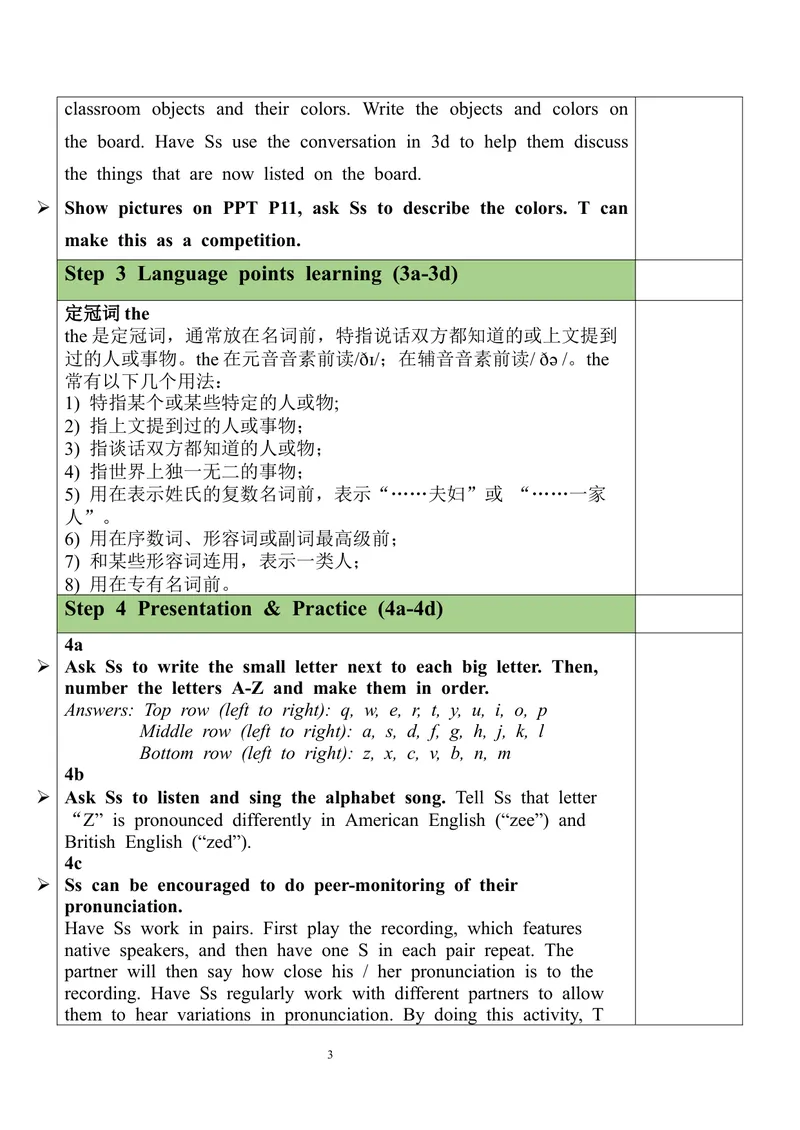
3c
Ask Ss to listen and complete the chart.
Before doing 3c, have Ss predict what they will hear in the
recording. Ask Ss to guess what they will hear and write down
three things and their colors in the chart. After completion of 3c,
have Ss say whether any of their predictions were correct.
Answers:
3d
Ask Ss to make conversations using the things in 3a-3c.
After completing 3d, have Ss create conversations using real objects
(things in the classroom). As a class, brainstorm or elicit a list of
2classroom objects and their colors. Write the objects and colors on
the board. Have Ss use the conversation in 3d to help them discuss
the things that are now listed on the board.
Show pictures on PPT P11, ask Ss to describe the colors. T can
make this as a competition.
Step 3 Language points learning (3a-3d)
定冠词the
the是定冠词,通常放在名词前,特指说话双方都知道的或上文提到
过的人或事物。the在元音音素前读/ðɪ/;在辅音音素前读/ ðə /。the
常有以下几个用法:
1) 特指某个或某些特定的人或物;
2) 指上文提到过的人或事物;
3) 指谈话双方都知道的人或物;
4) 指世界上独一无二的事物;
5) 用在表示姓氏的复数名词前,表示“……夫妇”或 “……一家
人”。
6) 用在序数词、形容词或副词最高级前;
7) 和某些形容词连用,表示一类人;
8) 用在专有名词前。
Step 4 Presentation & Practice (4a-4d)
4a
Ask Ss to write the small letter next to each big letter. Then,
number the letters A-Z and make them in order.
Answers: Top row (left to right): q, w, e, r, t, y, u, i, o, p
Middle row (left to right): a, s, d, f, g, h, j, k, l
Bottom row (left to right): z, x, c, v, b, n, m
4b
Ask Ss to listen and sing the alphabet song. Tell Ss that letter
“Z” is pronounced differently in American English (“zee”) and
British English (“zed”).
4c
Ss can be encouraged to do peer-monitoring of their
pronunciation.
Have Ss work in pairs. First play the recording, which features
native speakers, and then have one S in each pair repeat. The
partner will then say how close his / her pronunciation is to the
recording. Have Ss regularly work with different partners to allow
them to hear variations in pronunciation. By doing this activity, T
3can also raise Ss’ awareness of common pronunciation errors.
4d
Ask Ss to listen and repeat the chant.
T may want to make this activity more interesting by varying the
chant. E.g. T can have Ss compete to say the chant as slowly as
possible, as quickly as possible, as clearly as possible, as softly as
possible or as loudly as possible.
Step 5 Language points learning (4a-4d)
26个英文字母
1) 英文字母共有26个,A, E, I, O, U是5个元音字母,其余21个是
辅音字母。
2) 26个字母的书写规则
①每个字母都应稍向右倾斜约5°,斜度要一致。
②大写字母都应一样高, 占上面两格。
③小写字母a, c, e, m, n, o, r, s, u, v, w, x, z占中间格, 上下抵线, 但
都不出格。
④小写字母b, d, h, k, l 的上端顶第一线,占上两格。
⑤小写字母 i 和 j 的点、f 和 t的上端都在第一格,f 和 t的第二
笔紧贴在第二线下。
⑥小写字母a, d, h, i, k, l, m, n, t 和u, 它们的书写中都有一个上挑的
小圆钩,不能写成锐角。
在now you see这个表达中,now作副词,意思是“现在;目前”
强调现在的事实或所处的状态。see在此处意为“理解、明白”。see
还可意为“看见”,强调看的结果。
在I can say my ABC.这句话中,can是情态动词, 意思是“能;
会”,情态动词没有人称和数的变化,后要加动词原形。can常用来
说明某人有能力做某事,其否定形式是在can后面加not, 即can’t
或cannot。
say 是及物动词, 意为“说;讲”, 强调说的内容。say sth. to
sb.“对某人说某事”。
Step 6 Summary & Homework
Summary
Ask Ss to do the exercises from PPT P26-28.
Homework:
Review the new words and expressions in this period.
Do the exercises in students’ book.
4Teaching
Reflection
5