学科网(北京)股份有限公司
学科网(北京)股份有限公司
学科网(北京)股份有限公司
1 / 7
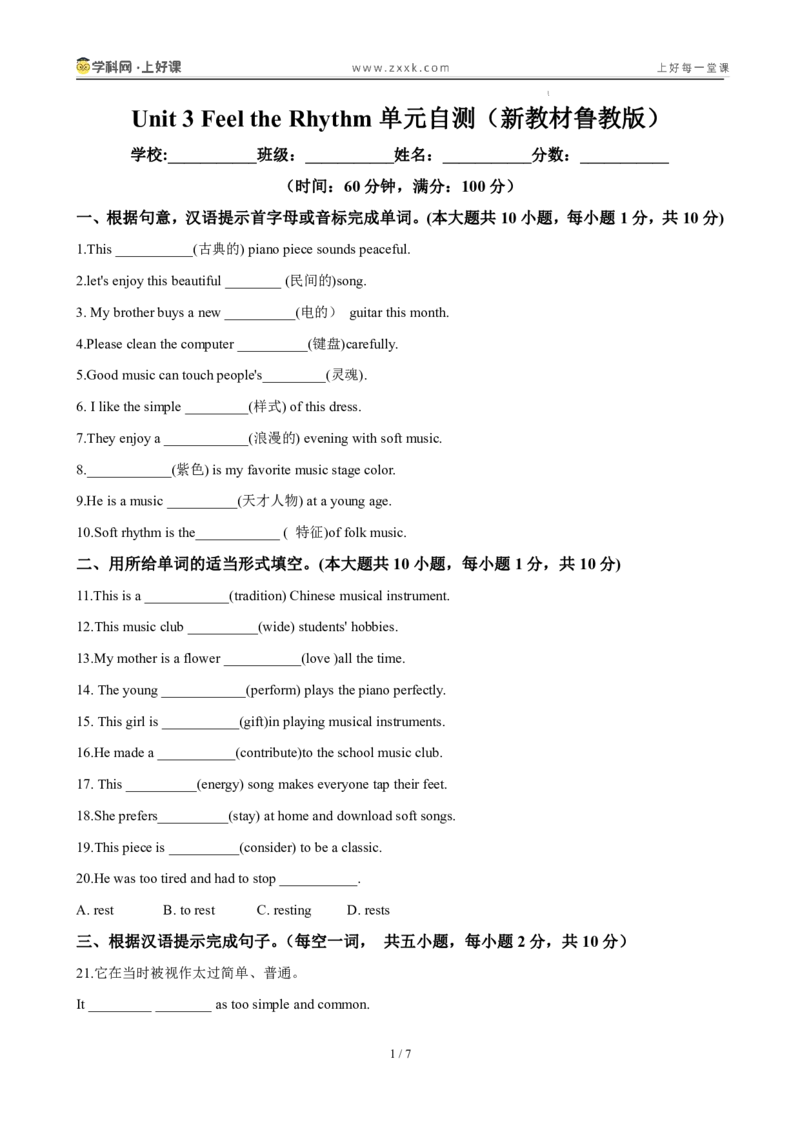
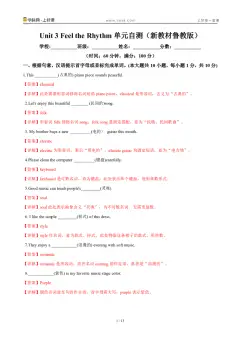
Unit 3 Feel the Rhythm 单元自测(新教材鲁教版)
学校:___________班级:___________姓名:___________分数:___________
(时间:60 分钟,满分:100 分)
一、根据句意,汉语提示首字母或音标完成单词。(本大题共10 小题,每小题1 分,共10 分)
1.This ___________(古典的) piano piece sounds peaceful.
2.let's enjoy this beautiful ________ (民间的)song.
3. My brother buys a new __________(电的)guitar this month.
4.Please clean the computer __________(键盘)carefully.
5.Good music can touch people's_________(灵魂).
6. I like the simple _________(样式) of this dress.
7.They enjoy a ____________(浪漫的) evening with soft music.
8.____________(紫色) is my favorite music stage color.
9.He is a music __________(天才人物) at a young age.
10.Soft rhythm is the____________ ( 特征)of folk music.
二、用所给单词的适当形式填空。(本大题共10 小题,每小题1 分,共10 分)
11.This is a ____________(tradition) Chinese musical instrument.
12.This music club __________(wide) students' hobbies.
13.My mother is a flower ___________(love )all the time.
14. The young ____________(perform) plays the piano perfectly.
15. This girl is ___________(gift)in playing musical instruments.
16.He made a ___________(contribute)to the school music club.
17. This __________(energy) song makes everyone tap their feet.
18.She prefers__________(stay) at home and download soft songs.
19.This piece is __________(consider) to be a classic.
20.He was too tired and had to stop ___________.
A. rest
B. to rest
C. resting
D. rests
三、根据汉语提示完成句子。(每空一词,共五小题,每小题2 分,共10 分)
21.它在当时被视作太过简单、普通。
It _________ ________ as too simple and common.
学科网(北京)股份有限公司
学科网(北京)股份有限公司
学科网(北京)股份有限公司
2 / 7
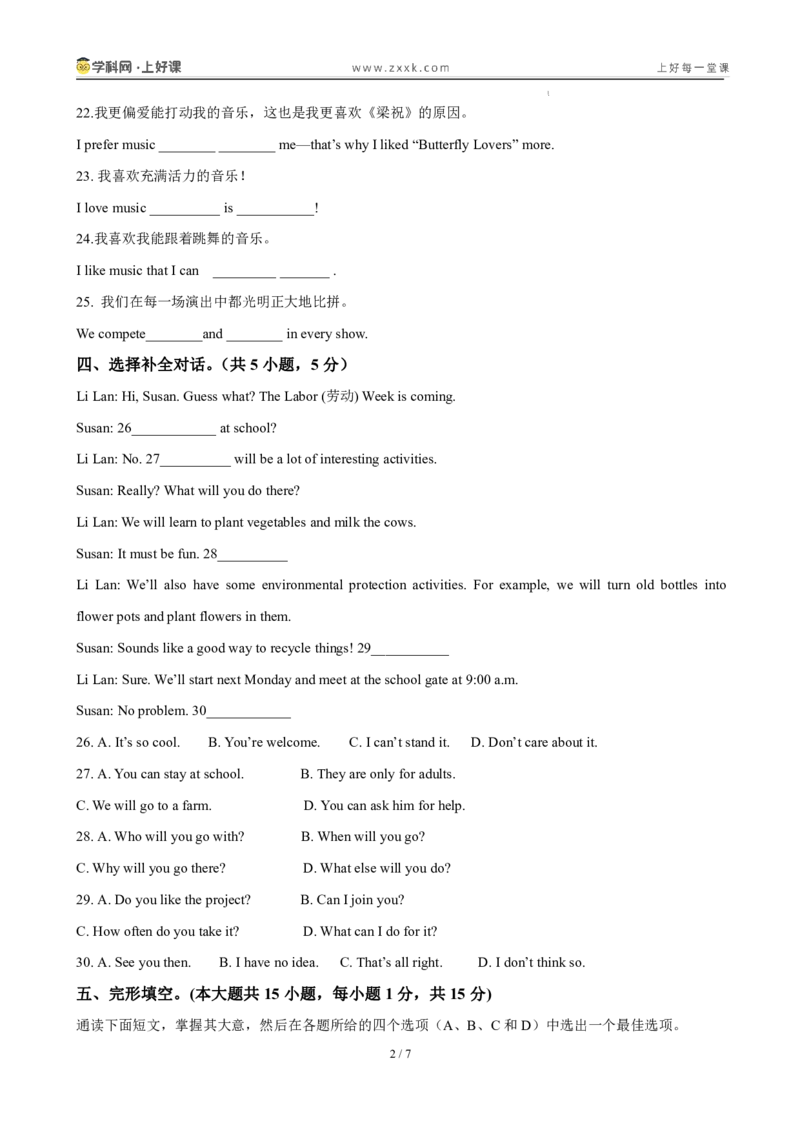
22.我更偏爱能打动我的音乐,这也是我更喜欢《梁祝》的原因。
I prefer music ________ ________ me—that’s why I liked “Butterfly Lovers” more.
23. 我喜欢充满活力的音乐!
I love music __________ is ___________!
24.我喜欢我能跟着跳舞的音乐。
I like music that I can
_________ _______ .
25. 我们在每一场演出中都光明正大地比拼。
We compete________and ________ in every show.
四、选择补全对话。(共5 小题,5 分)
Li Lan: Hi, Susan. Guess what? The Labor (劳动) Week is coming.
Susan: 26____________ at school?
Li Lan: No. 27__________ will be a lot of interesting activities.
Susan: Really? What will you do there?
Li Lan: We will learn to plant vegetables and milk the cows.
Susan: It must be fun. 28__________
Li Lan: We’ll also have some environmental protection activities. For example, we will turn old bottles into
flower pots and plant flowers in them.
Susan: Sounds like a good way to recycle things! 29___________
Li Lan: Sure. We’ll start next Monday and meet at the school gate at 9:00 a.m.
Susan: No problem. 30____________
26. A. It’s so cool.
B. You’re welcome.
C. I can’t stand it.
D. Don’t care about it.
27. A. You can stay at school.
B. They are only for adults.
C. We will go to a farm.
D. You can ask him for help.
28. A. Who will you go with?
B. When will you go?
C. Why will you go there?
D. What else will you do?
29. A. Do you like the project?
B. Can I join you?
C. How often do you take it?
D. What can I do for it?
30. A. See you then.
B. I have no idea.
C. That’s all right.
D. I don’t think so.
五、完形填空。(本大题共15 小题,每小题1 分,共15 分)
通读下面短文,掌握其大意,然后在各题所给的四个选项(A、B、C 和D)中选出一个最佳选项。
学科网(北京)股份有限公司
学科网(北京)股份有限公司
学科网(北京)股份有限公司
3 / 7
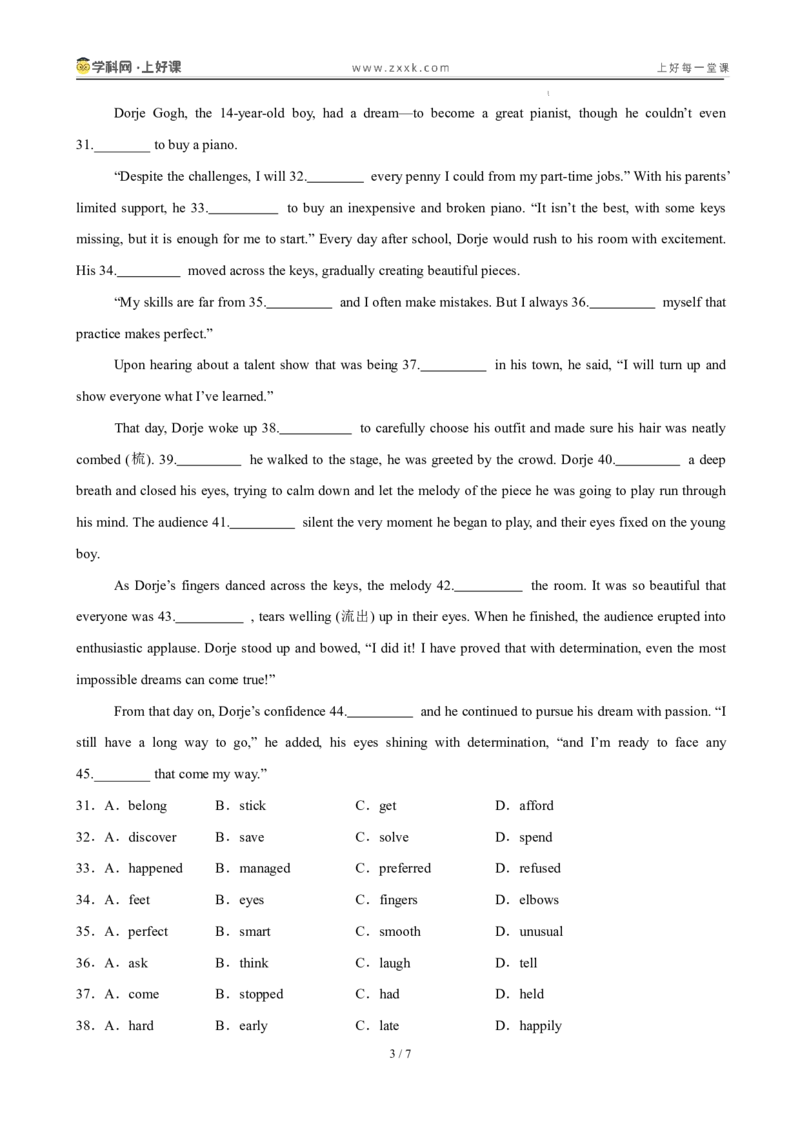
Dorje Gogh, the 14-year-old boy, had a dream—to become a great pianist, though he couldn’t even
31.________ to buy a piano.
“Despite the challenges, I will 32.
every penny I could from my part-time jobs.” With his parents’
limited support, he 33.
to buy an inexpensive and broken piano. “It isn’t the best, with some keys
missing, but it is enough for me to start.” Every day after school, Dorje would rush to his room with excitement.
His 34.
moved across the keys, gradually creating beautiful pieces.
“My skills are far from 35.
and I often make mistakes. But I always 36.
myself that
practice makes perfect.”
Upon hearing about a talent show that was being 37.
in his town, he said, “I will turn up and
show everyone what I’ve learned.”
That day, Dorje woke up 38.
to carefully choose his outfit and made sure his hair was neatly
combed (梳). 39.
he walked to the stage, he was greeted by the crowd. Dorje 40.
a deep
breath and closed his eyes, trying to calm down and let the melody of the piece he was going to play run through
his mind. The audience 41.
silent the very moment he began to play, and their eyes fixed on the young
boy.
As Dorje’s fingers danced across the keys, the melody 42.
the room. It was so beautiful that
everyone was 43.
, tears welling (流出) up in their eyes. When he finished, the audience erupted into
enthusiastic applause. Dorje stood up and bowed, “I did it! I have proved that with determination, even the most
impossible dreams can come true!”
From that day on, Dorje’s confidence 44.
and he continued to pursue his dream with passion. “I
still have a long way to go,” he added, his eyes shining with determination, “and I’m ready to face any
45.________ that come my way.”
31.A.belong
B.stick
C.get
D.afford
32.A.discover
B.save
C.solve
D.spend
33.A.happened
B.managed
C.preferred
D.refused
34.A.feet
B.eyes
C.fingers
D.elbows
35.A.perfect
B.smart
C.smooth
D.unusual
36.A.ask
B.think
C.laugh
D.tell
37.A.come
B.stopped
C.had
D.held
38.A.hard
B.early
C.late
D.happily
学科网(北京)股份有限公司
学科网(北京)股份有限公司
学科网(北京)股份有限公司
4 / 7
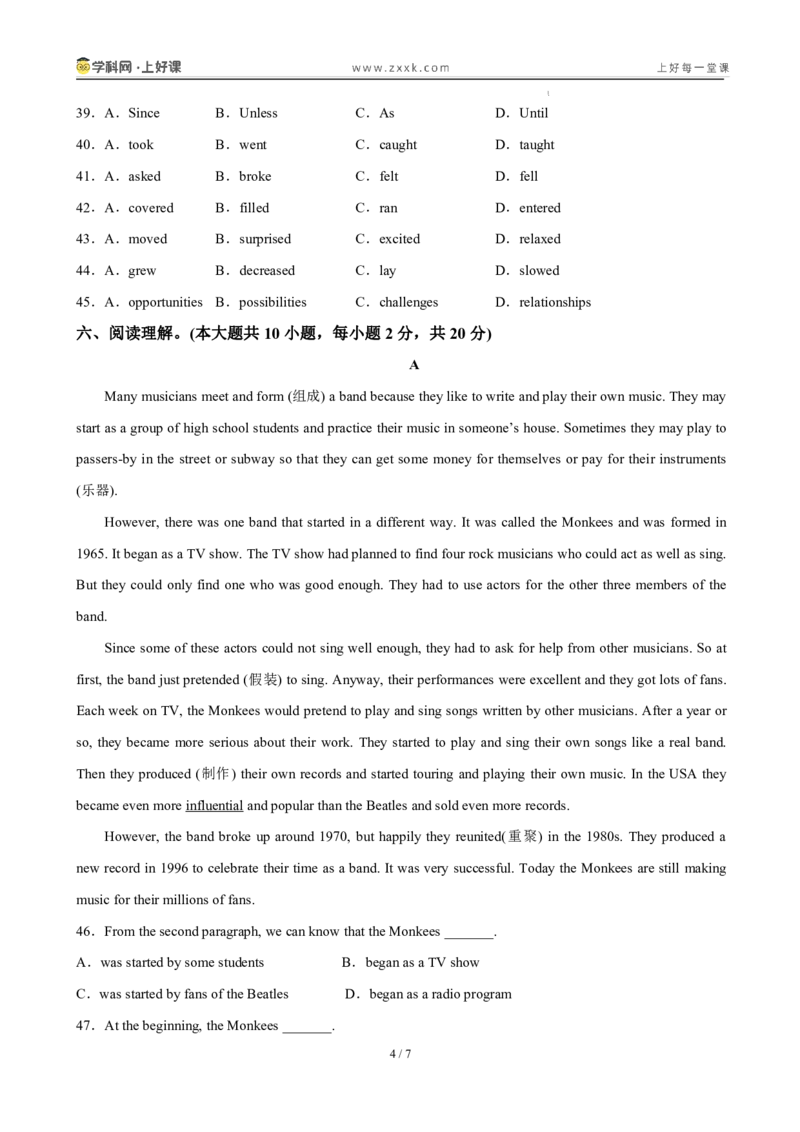
39.A.Since
B.Unless
C.As
D.Until
40.A.took
B.went
C.caught
D.taught
41.A.asked
B.broke
C.felt
D.fell
42.A.covered
B.filled
C.ran
D.entered
43.A.moved
B.surprised
C.excited
D.relaxed
44.A.grew
B.decreased
C.lay
D.slowed
45.A.opportunities
B.possibilities
C.challenges
D.relationships
六、阅读理解。(本大题共10 小题,每小题2 分,共20 分)
A
Many musicians meet and form (组成) a band because they like to write and play their own music. They may
start as a group of high school students and practice their music in someone’s house. Sometimes they may play to
passers-by in the street or subway so that they can get some money for themselves or pay for their instruments
(乐器).
However, there was one band that started in a different way. It was called the Monkees and was formed in
1965. It began as a TV show. The TV show had planned to find four rock musicians who could act as well as sing.
But they could only find one who was good enough. They had to use actors for the other three members of the
band.
Since some of these actors could not sing well enough, they had to ask for help from other musicians. So at
first, the band just pretended (假装) to sing. Anyway, their performances were excellent and they got lots of fans.
Each week on TV, the Monkees would pretend to play and sing songs written by other musicians. After a year or
so, they became more serious about their work. They started to play and sing their own songs like a real band.
Then they produced (制作) their own records and started touring and playing their own music. In the USA they
became even more influential and popular than the Beatles and sold even more records.
However, the band broke up around 1970, but happily they reunited(重聚) in the 1980s. They produced a
new record in 1996 to celebrate their time as a band. It was very successful. Today the Monkees are still making
music for their millions of fans.
46.From the second paragraph, we can know that the Monkees _______.
A.was started by some students
B.began as a TV show
C.was started by fans of the Beatles
D.began as a radio program
47.At the beginning, the Monkees _______.
学科网(北京)股份有限公司
学科网(北京)股份有限公司
学科网(北京)股份有限公司
5 / 7
A.had five members
B.wrote songs for the Beatles
C.had other musicians sing for them
D.was not very interested in country music
48.What does the underlined word “influential” in Paragraph 3 mean in Chinese?
A.有权势的
B.有野心的
C.有争议的
D.有影响的
49.The Monkees has a history of more than _______ years.
A.thirty
B.forty
C.fifty
D.sixty
50.The writer writes this passage mainly to _______.
A.show his love for the Monkees
B.introduce the history of the Monkees
C.ask more people to buy the Monkees’ records
D.tell how the Monkees is different from the Beatles
B
Yu Boya was a skilled guqin player from Chu, and later he became an official in Jin.
On the night of the Mid-Autumn Festival, Boya went to Jiangkou, Hanyang by boat on the way to Chu. After a
storm, Boya saw the beautiful river and mountains. He started to play the guqin on the boat.
Suddenly, he noticed a woodcutter listening with his eyes closed. Boya was suspicious about how there was
someone in the wild field who would understand music. The woodcutter replied, “Don’t be suspicious. I was
blocked here by the storm. When I was about to go home, I suddenly heard a guqin sound. I was attracted.”
Boya played another piece of music, and the woodcutter said, “At first, your guqin sound was so high and
powerful, just like these high mountains; later, your guqin sound was so wide, just like waves and running
water…” Boya thought he found his dream friend. He knew the woodcutter’s name was Zhong Ziqi and they
talked happily. They became brothers. Then they made a date to meet here the next Mid-Autumn Festival.
The following year, Boya returned on the Mid-Autumn Festival. But he learned that Ziqi had passed away. He was
very sad and played the music in front of Ziqi’s tomb. And then he broke his guqin and vowed never to play the
guqin again, because he believed no one could ever understand the meaning of his music again.
High Mountain and Flowing Water shows valuable friendship in Chinese culture. Although the piece usually
performed today is not the same one that Boya played thousands of years ago, it shows the same idea.
51. What was Boya good at?
A. Cutting wood.
B. Rowing a boat.
C. Playing the guqin.
D. Playing the guzheng.
52. What’s the Chinese meaning of the underlined word “suspicious” in Paragraph 3?
学科网(北京)股份有限公司
学科网(北京)股份有限公司
学科网(北京)股份有限公司
6 / 7
A. 感觉可疑的
B. 感觉兴奋的
C. 感到放心的
D. 感到害怕的
53. What does Paragraph 4 mainly tell us?
A. Boya and Ziqi became good friends.
B. Boya and Ziqi decided to meet again.
C. Boya and Ziqi wanted to live together.
D. Boya and Ziqi were both interested in music.
54. Why was Boya sad the next year?
A. Because he forgot the music.
B. Because his friend Ziqi died.
C. Because his guqin was broken.
D. Because he didn’t find Ziqi’s tomb.
55. What can we infer from the passage?
A. Boya stopped playing guqin for good after Ziqi’s death.
B. The music High Mountain and Flowing Water we hear now is totally different from Boya’s.
C. Boya met Zhong Ziqi on New Year’s Eve.
D. Zhong Ziqi was also a guqin player.
七、短文填空。(本大题共10 小题,每小题1.5 分,共15 分)
阅读下面材料,在空白处填入适当的内容(1 个单词)或括号内单词的正确形式。
When Sarah was a teenager, she used to fight over almost everything with her family. But five years ago,
while she was studying abroad in England, she heard a song 56.________ is full of feelings of returning home on
the radio. It made Sarah think about her family and friends back in the US. She came to realize how much
she57._______(actual)
missed all of them. Ever since then, she has been 58._______ fan of American country
music.
Country is a traditional kind of music from the southern states of America. Nashville, Tennessee is the home of
country music. Many songs these days are just about modern life in the US, such as the
59._________(important)of money and success, but not about belonging to a group. 60._________, country music
brings us back to the “good old days” when people were kind to each other and trusted one another. It reminds us
that the 61.________(good)
things in life are free — laughter, friends, family, and the beauty of nature and the
countryside.
Sarah hasn’t been to Nashville yet, but it is her dream to go there one day. She 62..________(read) a lot already
about the place and done some research on it. She knows that there is the Country Music Hall of Fame Museum in
Nashville. There are also always a lot of great country music concerts with famous musicians and singers, like
Garth Brooks. Sarah has already listened to most of his songs. “Garth is one of the most successful
63.___________(musician) in American history.
more than 10 million of his records 64. .________(sell) last
学科网(北京)股份有限公司
学科网(北京)股份有限公司
学科网(北京)股份有限公司
7 / 7
year. I hope to see 65.________(he)
sing live one day!”
八、书面表达(共1 题,15 分)
假如你是李华,你的美国笔友Sam 想知道你是否喜欢音乐,喜欢哪种音乐。请你根据以下提示,给
Sum 写一封信,介绍你最喜欢的音乐。
提示:
1. 你非常喜欢音乐,尤其喜欢古典音乐,并且你经常去听音乐会;
2. 我最喜欢的一首歌是《I Believe》, 这首歌充满活力(energy)鼓励我实现梦想永不言弃。
2. 当你空闲和学习疲乏的时候,音乐能帮你减轻(relieve)压力;
3. 你经常去音乐俱乐部练习唱歌,并希望某天能参加歌唱比赛。
要求:
1. 参考提示内容,可适当发挥;
2. 语句通顺,意思连贯,书写工整;
3. 文中不得出现你的任何真实信息(姓名、校名和地名等);
4. 词数:不少于50 词(开头已给出, 但不计入总词数)。
Dear Sam,
You want to know whether I love music or not.
___________________________________________________________________________________________
___________________________________________________________________________________________
___________________________________________________________________________________________
___________________________________________________________________________________________
___________________________________________________________________________________________
___________________________________________________________
Yours,
Li Hu