【生态环保、自然灾害类】话题阅读练习(一)
(阅读理解 10 篇)
Passage 1
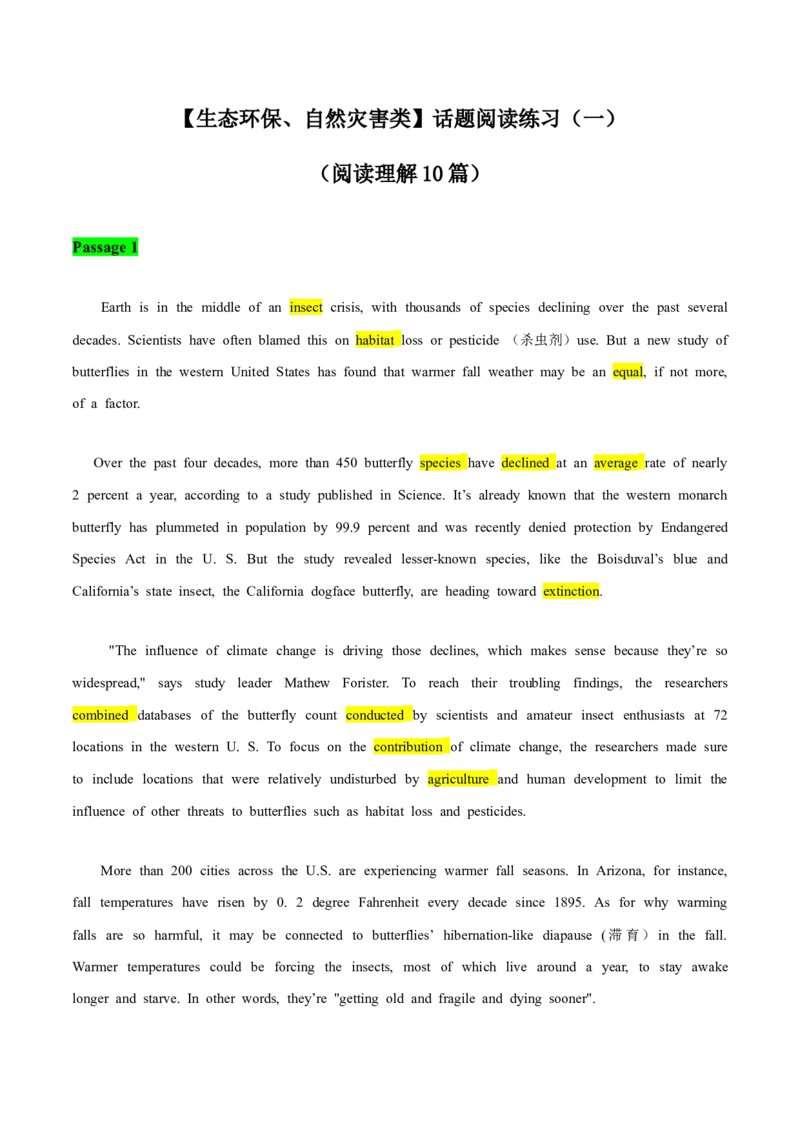
Earth is in the middle of an insect crisis, with thousands of species declining over the past several
decades. Scientists have often blamed this on habitat loss or pesticide (杀虫剂)use. But a new study of
butterflies in the western United States has found that warmer fall weather may be an equal, if not more,
of a factor.
Over the past four decades, more than 450 butterfly species have declined at an average rate of nearly
2 percent a year, according to a study published in Science. It’s already known that the western monarch
butterfly has plummeted in population by 99.9 percent and was recently denied protection by Endangered
Species Act in the U. S. But the study revealed lesser-known species, like the Boisduval’s blue and
California’s state insect, the California dogface butterfly, are heading toward extinction.
"The influence of climate change is driving those declines, which makes sense because they’re so
widespread," says study leader Mathew Forister. To reach their troubling findings, the researchers
combined databases of the butterfly count conducted by scientists and amateur insect enthusiasts at 72
locations in the western U. S. To focus on the contribution of climate change, the researchers made sure
to include locations that were relatively undisturbed by agriculture and human development to limit the
influence of other threats to butterflies such as habitat loss and pesticides.
More than 200 cities across the U.S. are experiencing warmer fall seasons. In Arizona, for instance,
fall temperatures have risen by 0. 2 degree Fahrenheit every decade since 1895. As for why warming
falls are so harmful, it may be connected to butterflies’ hibernation-like diapause (滞育)in the fall.
Warmer temperatures could be forcing the insects, most of which live around a year, to stay awake
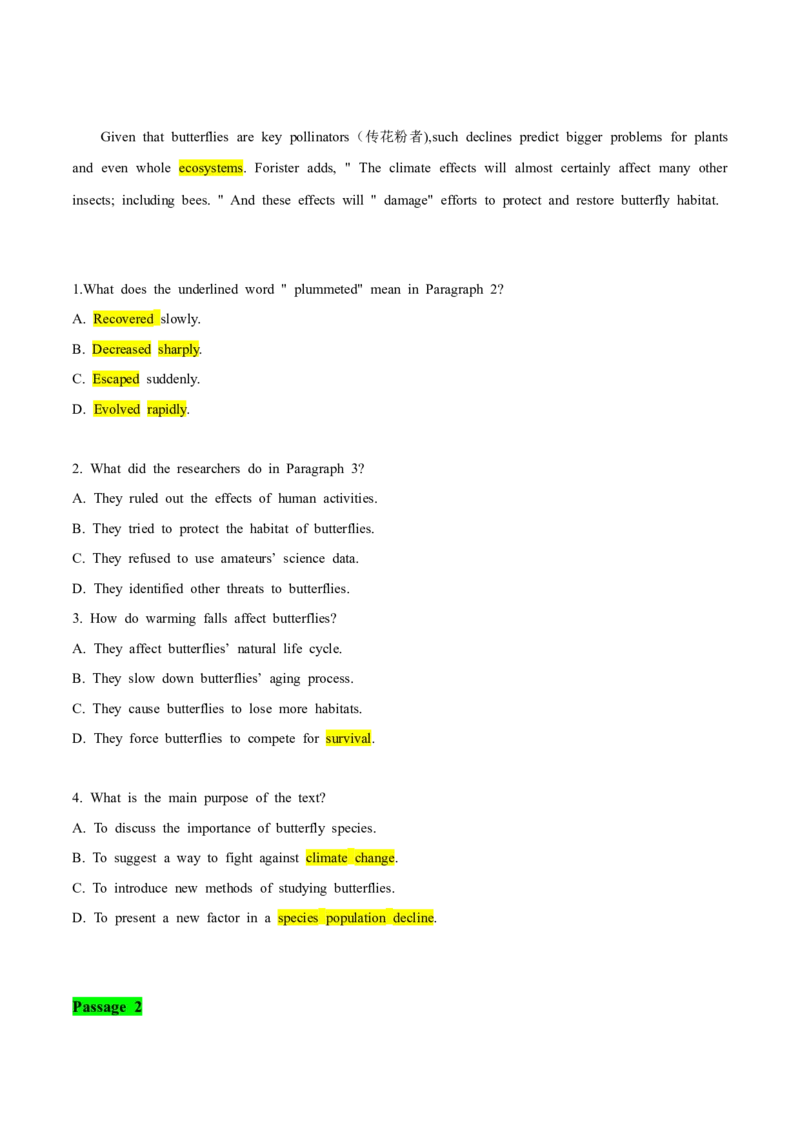
longer and starve. In other words, they’re "getting old and fragile and dying sooner".Given that butterflies are key pollinators(传花粉者),such declines predict bigger problems for plants
and even whole ecosystems. Forister adds, " The climate effects will almost certainly affect many other
insects; including bees. " And these effects will " damage" efforts to protect and restore butterfly habitat.
1.What does the underlined word " plummeted" mean in Paragraph 2?
A. Recovered slowly.
B. Decreased sharply.
C. Escaped suddenly.
D. Evolved rapidly.
2. What did the researchers do in Paragraph 3?
A. They ruled out the effects of human activities.
B. They tried to protect the habitat of butterflies.
C. They refused to use amateurs’ science data.
D. They identified other threats to butterflies.
3. How do warming falls affect butterflies?
A. They affect butterflies’ natural life cycle.
B. They slow down butterflies’ aging process.
C. They cause butterflies to lose more habitats.
D. They force butterflies to compete for survival.
4. What is the main purpose of the text?
A. To discuss the importance of butterfly species.
B. To suggest a way to fight against climate change.
C. To introduce new methods of studying butterflies.
D. To present a new factor in a species population decline.
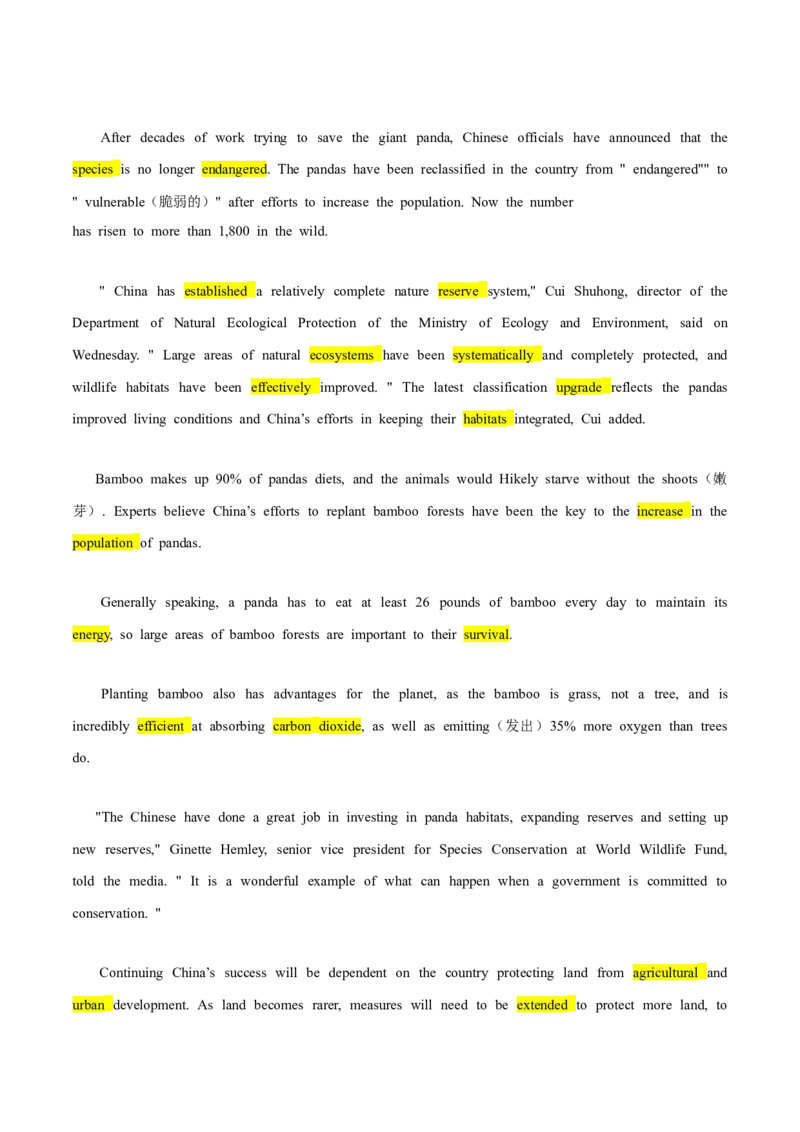
Passage 2After decades of work trying to save the giant panda, Chinese officials have announced that the
species is no longer endangered. The pandas have been reclassified in the country from " endangered"" to
" vulnerable(脆弱的)" after efforts to increase the population. Now the number
has risen to more than 1,800 in the wild.
" China has established a relatively complete nature reserve system," Cui Shuhong, director of the
Department of Natural Ecological Protection of the Ministry of Ecology and Environment, said on
Wednesday. " Large areas of natural ecosystems have been systematically and completely protected, and
wildlife habitats have been effectively improved. " The latest classification upgrade reflects the pandas
improved living conditions and China’s efforts in keeping their habitats integrated, Cui added.
Bamboo makes up 90% of pandas diets, and the animals would Hikely starve without the shoots(嫩
芽). Experts believe China’s efforts to replant bamboo forests have been the key to the increase in the
population of pandas.
Generally speaking, a panda has to eat at least 26 pounds of bamboo every day to maintain its
energy, so large areas of bamboo forests are important to their survival.
Planting bamboo also has advantages for the planet, as the bamboo is grass, not a tree, and is
incredibly efficient at absorbing carbon dioxide, as well as emitting(发出)35% more oxygen than trees
do.
"The Chinese have done a great job in investing in panda habitats, expanding reserves and setting up
new reserves," Ginette Hemley, senior vice president for Species Conservation at World Wildlife Fund,
told the media. " It is a wonderful example of what can happen when a government is committed to
conservation. "
Continuing China’s success will be dependent on the country protecting land from agricultural and
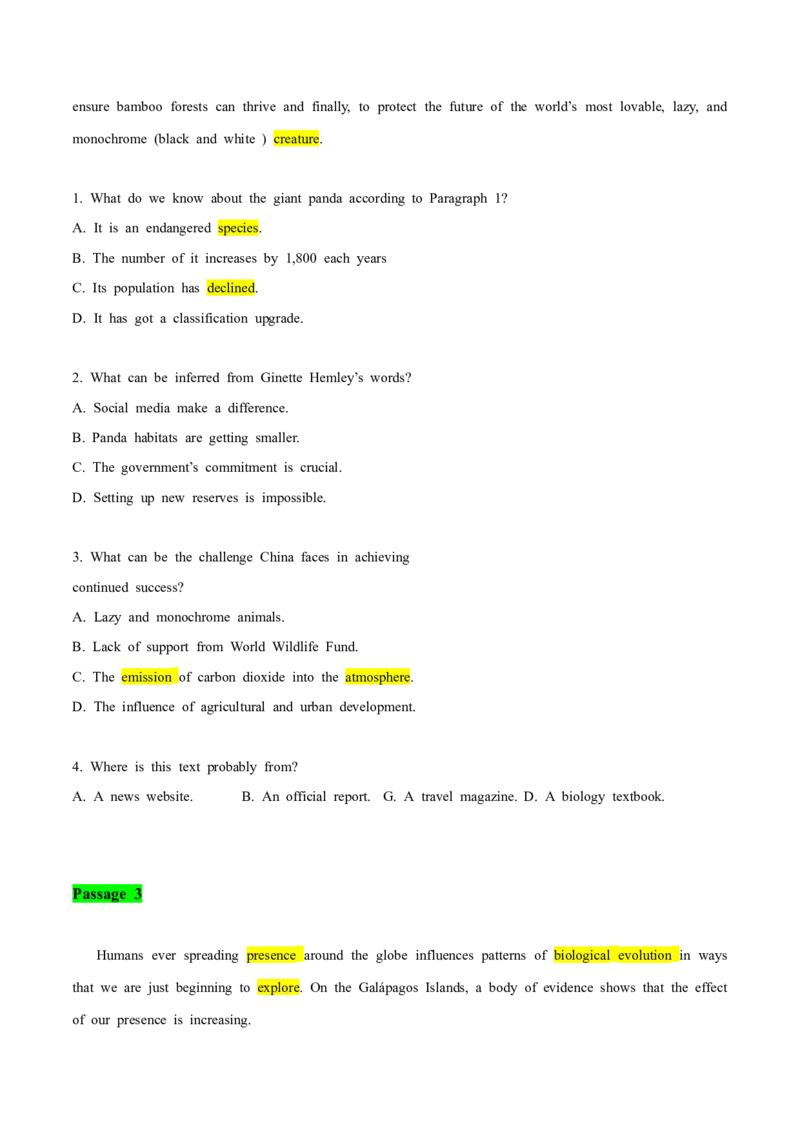
urban development. As land becomes rarer, measures will need to be extended to protect more land, toensure bamboo forests can thrive and finally, to protect the future of the world’s most lovable, lazy, and
monochrome (black and white ) creature.
1. What do we know about the giant panda according to Paragraph 1?
A. It is an endangered species.
B. The number of it increases by 1,800 each years
C. Its population has declined.
D. It has got a classification upgrade.
2. What can be inferred from Ginette Hemley’s words?
A. Social media make a difference.
B. Panda habitats are getting smaller.
C. The government’s commitment is crucial.
D. Setting up new reserves is impossible.
3. What can be the challenge China faces in achieving
continued success?
A. Lazy and monochrome animals.
B. Lack of support from World Wildlife Fund.
C. The emission of carbon dioxide into the atmosphere.
D. The influence of agricultural and urban development.
4. Where is this text probably from?
A. A news website. B. An official report. G. A travel magazine. D. A biology textbook.
Passage 3
Humans ever spreading presence around the globe influences patterns of biological evolution in ways
that we are just beginning to explore. On the Galápagos Islands, a body of evidence shows that the effect
of our presence is increasing.Luis F. De León from the University of Massachusetts Boston, together with other 6 scientists spent
two years observing Darwin’s finches (雀科小鸟)to evaluate our effects on their behavior. They started
by conducting feeding observations on coexisting finch species at sites that ranged from non-urban areas
to urban areas. They also employed finch-human interaction experiments to
test whether and how finches respond to human presence. To measure whether finch feeding preferences
varied with the degree of urbanization, . "cafeteria " experiments were carried out— Finches were
presented with a selection of human and native food items.
The scientists found that Darwin’s finches fed almost on human foods like rice and cookies or
introduced garden species at urban locations. contrast, at non-urban sites, finches fed mainly on native
plant species and insects. Interaction tests suggest that urban birds get more accustomed to the presence
of humans. Finally, at all sites of regular human presence, finches preferred human foods to natural foods.
The researchers warn that exploiting urban environments might present challenges for organisms,
including shorter lifespans brought by the consumption of highly processed foods. Furthermore, the year-
round availability of abundant human foods in urban environments might affect ecological and
evolutionary processes that promoted species diversity. While the results clearly show a shift to human
foods at urban sites, the adaptive significance of that shift is still an
open question.
These findings also suggest that human behavior is the main driver of finch preference for human
foods. The researchers propose a possibility that the effect of human behavior is facilitated by our
tendency to feed birds, be it directly or inadvertently via food dropping or littering.
1. How did the scientists carry out the study?
A. By carrying out experiments in labs.
B. By training finches and observing results.
C. By observing finches in natural conditions.
D. By analyzing findings from previous experiments.2. Which is probably finches favorite food at non-urban sites frequently visited by humans?
A. Rice. B. An insect. C. The fruit of a native plant. D. The seed of an introduced plant.
3. What does the underlined word in Paragraph 5 probably mean?
A. Illegally. B. Voluntarily. C. Deliberately. D. Unintentionally.
4. What can we learn from the findings?
A. All finches observed are willing to approach humans.
B. Human food availability might lead to biodiversity loss.
C. The reason for the shift of finch diets remains unknown.
D. The more processed foods finches consume, the longer they live.
Passage 4
The yogurt that’s past its sell-by date. The banana in your lunch that turned brown. The leftovers in
the fridge that you forgot to eat. For most people, all that food goes right into the garbage can.
Eight to ten percent of global greenhouse gas emissions are related to food waste, according to a
report by the UN’s Intergovernmental Panel on Climate Change. " When you throw away an egg or a
Sandwich," says Yvette Cabrera, food waste director at the Natural Resources Defense Council ( NRDG),
you’re also throwing away all the resources that went into producing those things. "
They include not only all the water, land, and fertilizer that went into producing that food, but also
the massive amounts of fossil fuels used to power the farms, transport the food, and create the packaging.
Then there’s the issue of what happens to food after it’s thrown out. More food ends up in U.S.
landfills than any other type of trash. Food rotting in landfills produces methane(甲烷),a greenhouse
gas that’s roughly 25 times more powerful at trapping heat in the atmosphere than carbon dioxide, whichis produced by burning fossil fuels.
Food waste is a difficult problem to solve, though, in part because it happens for different reasons
depending on the country. In developing nations, 40 percent of food is lost before it ever reaches people’s
homes, because many of those countries lack the technology and tools to preserve food.
It’s another story in wealthier countries, where most of the food is wasted in people’s kitchens.
Americans, for example, throw out a quarter of their groceries each year, on average, according to the
NRDC. That’s like going to the grocery store, leaving with four bags of groceries, and then throwing one
of them into the garbage before you get home.
1. What does the passage mainly talk about?
A. The problem of food waste.
B. The awareness of food saving.
C. The necessity of food diversity.
D. The ways of food preservation.
2. What does the underlined word "They" in Paragraph 3 refer to?
A. The leftovers in the fridge.
B. The packaging materials of products.
C. The thrown eggs or sandwiches.
D. The resources to produce food.
3. What does the author intend to do in Paragraph 4?
A. Provide a persuasive example.
B. Add more background information.
C. Discuss a more serious consequence.
D. Summarize the previous paragraphs.
4. In what stage does food waste mainly happen in developed countries?
A. Storage. B. Transportation. C. Processing. D. Consumption.Passage 5
Created in 1998 by Casey and Shelley Black, the Northern Lights Wildlife Wolf Center focuses on not only
rescuing young abandoned wolves but educating the public. Unlike other centers, you can actually walk with the
wolves and have exciting, hands-on interaction with them here. And so, we gathered one late winter morning to
learn, prepare and walk.
Scrappy and Flora, our wolves that day, were brought to the center when only a few days old. " They lived in the
house with us for the first several months. We treated them like human babies, fed them and slept with them," said
Shelley. So, they are totally used to people. However, these are wild animals. For that reason, Shelley and Casey
explained, the walk is totally on the wolf’s terms. "We don’t approach them, but if they come up to us, we can
touch them."
With all this in mind, we headed for the woods. We were walking on a logging road when suddenly, Flora, all 60
pounds of her, hurried up to me and raised up on her legs. She was almost as tall as me. As she leaned in, put her
huge muddy paws on my shoulders and sniffed my face, apparently she was saying hello in wolf talk.
We walked farther, maybe half a mile, while Scrappy and Flora dashed in and out of the woods stopping
occasionally to roll in the snow, dig for this or that and just play. Then we all headed into the trees to a picturesque
stream where the wolves splashed, drank and had a great time.
One could point out that this whole adventure was staged and quite artificial. But the purpose, Casey and
Shelley said, is to explain the wolves place in the environment and, primarily, to let people know wolves don’t have
to be universally feared they really don’t hide secretly in the woods just waiting to eat people, but they’d rather
avoid people, for the most part.
1. How is the Northern Lights Wildlife Wolf Center different from others?
A. It trains and educates wild wolves.B. It aims to rescue young abandoned wolves.
C. It raises wolves for commercial purposes.
D. It allows visitors to take a walk with wolves.
2. What can be inferred from Shelley and Casey’s explanation in
Paragraph 2?
A. The walk can be potentially dangerous.
B. The wolves have lost all their wildness.
C. People should get close to the wolves actively.
D. The wolves can read people’s mind like human babies.
3. Why did Flora behave like that when she saw the author on the logging road?
A. To express curiosity.
B. To show friendliness.
C. To attract attention.
D. To seek companionship.
4. Why do Casey and Shelley organize such an adventure?
A. To advertise the center.
B. To publicize wolf hunting.
C. To promote environmental protection.
D. To clarify some conventional views of wolves.
Passage 6
Only 366 North Atlantic right whales are left, representing a shocking 8% decline in a single year
and the lowest number in about 20 years for this famous species. Human impacts - specifically fishing
nets and ship strikes - remain the biggest threats to the survival of this species in eastern Canada and the
United States.North Atlantic right whales have been in decline since 2011 when the species was at an estimated
481 whales. In the past decade, the species has decreased by 30%. Recent research shows these threats
are affecting their overall health with less energy to devote toward growth and reproduction (繁殖), and
body lengths reducing over the past four decades. Researchers estimate there are fewer than 100 breeding
(繁育的)females alive and more than 86% of identified whales had been entangled (被网困住)at
least once in their lifetime.
There is still hope: in 2021, scientists tracked 18 mother-kid pairs, a number that is cause for
optimism - though still well below the annual average of 23 pairs from the previous decade.
Industry representatives, government agencies, and organizations, including WWF, gathered in October
2011 at the annual North Atlantic Right Whale Consortium meeting to discuss and arrange right whale
conservation efforts in the US and Canada.
"It’s going to be challenging, but everyone involved in right whale conservation believes we can create
an environment where right whales can bounce back," said Chris Johnson, the global leader for WWF’s
Protecting Whales and Dolphins initiative. "However, it’s going to take significant investment and the
greatest urgency and commitment to create conditions where we prevent entanglements and collisions with
ships in the whales’ critical habitats."
1. Which of the following best describes the right whale population?
A. Well conserved. B. Slowly decreasing.
C. Rapidly growing. D. Critically endangered.
2. What does Chris Johnson say about the right whale conservation?
A. It needs the government to ban fishing in certain areas.
B. It will not work without funds from the government.,
C. It can help increase the number of right whales.
D. It is not practical and will fail eventually.3. What can we learn about female right whales?
A. Most of them have never been entangled.
B. Mother right whales may have slightly decreased.
C. There are more female right whales than male right whales.
D. Their population has decreased by 30% in the past decade.
3. What can be inferred about the right whale species?
A. Their size has been decreasing due to climate changes.
B. They may have found home in other parts of the ocean.
C. They were hunted by people for their meat in the past.
D. They are well on the way to dying out if not well protect.
Passage 7
The Adélie penguin, which has been named Pingu, was discovered by a local resident Harry Singh
"looking lost" on the shores of New Zealand, over 3, 000 kilometers away from its natural habitat. "
At first I thought it was a soft toy," Singh told the media. "But suddenly the penguin moved its head,
so I realized it was real. It didn’t move for one hour... and looked exhausted. " He then called penguin
rescuers as he was concerned that it was not getting into the water, making it a potential target for any
predatory(捕食性) animals wandering on the beach.
On arriving at the scene, Thomas Stracke, who has been rehabilitating (1€ A IL) penguins on New
Zealand’s South Island for the last 10 years, was shocked to find that the penguin was an Adélie penguin
- a species that lives exclusively on the Antarctic peninsula. Stracke said, "It is quite unusual since they
are known only living in the Antarctic area. Fortunately, apart from being a bit starving and severely
dehydrated, it was actually not too bad, so we gave it some fluids and some fish smoothies. "
It is only the third recorded incident of an Adélie penguin being found on New Zealand’s coast - theprevious recorded incidents were in 1962 and 1993 —and although sites remain incredibly rare, if they
become more common it could be a worrying sign, say experts.
" I think if we started getting annual arrivals of Adélie penguins, we’d go actually. Something’s
changed in the ocean that we need to understand," zoology professor Philip Seddon in the University of
Otago told The Guardian. " More studies will give us more understanding about where penguins go, what
they do, what the population trends are like - they’re going to tell us something about the health of that
ocean ecosystem in general. "
Pingu has now been released into a bay on the Banks Peninsula, and it is hoped that it may be able
to make the journey home.
1. What happened to Pingu?
A. It was hunted by local people.
B. It lost its food and looked upset.
C. It was finding a new natural habitat.
D. It landed New Zealand by accident.
2. What does the author intend to do in Paragraph 4?
A. Introduce a new topic to discuss.
B. List numbers to prove an opinion.
C. Add some background information.
D. Summarize the previous paragraphs.
3. What can be inferred from Philip’s words?
A. The number of penguins is on the decrease.
B. The health of the ocean ecosystem should be concerned.
C. More studies about penguins have been undertaken.
D. Adélie penguins have built habitats in New Zealand.
4. What can be the best title of the text?A. The Unexpected Arrival of a Rare Penguin
B. The Dangerous Situation of Adélie Penguins
C. An Amazing Discovery by a Local Resident
D. Magical Travel to New Zealand
Passage 8
Students at Huonville High School in Australia are riding bikes out of desire to fight climate change,
carrying out a dizzyingly-thorough transformation of their school building into an energy-efficient
inspiration.
It’s paying off big time, as they’ve helped save $ 44,000 in utility bills since they started their
energy- saving project, but it’s also inspiring young people in the community. Recently the school won
the Zayed FutureEnergy Prize of $ 133,000, some of which was used to turn a building into the Zayed
Future Energy Hub, a clubhouse where 13 volunteers learn and teach about how renewable energy can be
applied to our everyday lives.
Among all the efficiency adjustments, they set up solar panels on the roof, and replaced the old
windows with double and triple glazed ones. They added approved insulation( 隔热)and energy-efficient
curtains. They even have stationary bikes that create electricity to cook doughnuts.
The classroom was cold in the mornings, but the students wanted zero carbon emission through their
heating. So they went out and got a pellet stove, and then if that wasn’t enough, they went out and built
a pellet mill (颗粒机)to make their fuel from waste sawdust.
Powering one small building on a high school campus or cooking doughnuts in renewable fat fryers is
nice, but will do little on their own to slow global climate change. However, the Hub is much more
about the big picture. Nel Smit, the volunteer teacher - head of the Hub, knows their biggest contribution
is exciting the minds of the next generation."This little school in the Huon Valley is actually doing amazing things," Smit said. " It’s raised public
awareness of renewable energy, energy efficiency, and opportunities in the community for engaging people
in that sort of technology."
1. What’s special about Huonville High School?
A. It attaches importance to riding bikes.
B. It promotes the idea of energy saving.
C. It encourages students to be creative.
D. It is powered entirely by solar energy.
2. What can be learned about Zayed Future Energy Hub?
A. It is a club center for volunteers.
B. It is the place to produce energy.
C. It is built at the cost of $ 133,000.
D. It is used to hold learning activities.
3. Why did students make fuel from waste sawdust?
A. To save the electricity bill.
B. To keep low carbon emissions.
C. To get rid of waste sawdust.
D. To test the pellet stove.
4. What is the greatest contribution of the project according to Smit?
A. Saving a lot of energy.
B. Creating more great minds.
C. Educating the next generation.
D. Slowing global climate change.
Passage 9City parks have long been a place for urban residents to get a small amount of green. As cities
increasingly feel the impacts of rising seas and temperatures, people are rethinking the roles of urban
parks.
All of the dark-gray asphalt(沥青) in cities collect heat. Dallas is one of the country’s fastest-
warming cities thanks in part to its extensive impervious(不透水的)surfaces, but with a new $ 312
million bond package, the city is hoping to change that. Using satellite data, the city is able to see what
neighborhoods most need the cooling effect of green space.
Cities are increasingly flooding and city planners think parks can help with this issue too. A report
published in February by The Nature Conservancy looked at the best ways to deal with flooding in
Houston, a city with many neighborhoods built on floodplains and regularly flooded by rising waters.
Offering affected homeowners buyouts and transforming homes into green space would save more money
than installing infrastructure(基础设施)like pipes, they found.
Brendan Shane, a climate program director, says parks can create opportunities for people to exercise
and play, in addition to cooling neighborhoods and absorbing floodwater. " The stronger the bonds are
between neighbors, the better they are able to react to a shock," he says.
" Not a single solution by itself will avoid the climate crisis. We see parks as an important part of it,
but there is no silver bullet," says Diane Regas, CEO of The Trust for Public Land. " Parks are an
example of what we in the environmental community need to do to reach solutions that address climate
change and make people’s lives better at the same time. "
1. What does the city Dallas want to deal with?
A. The lack of green space. B. The way of collecting heat.
C. The effect of rising seas. D. The bond between neighborhoods.
2. What can be inferred from the report by The Nature Conservancy?A. Cities in the world are frequently flooded.
B. City parks may help prevent city flooding.
C. Cities needn’t invest much money in infrastructure.
D. City parks affect people’s choice of a neighborhood.
3. What does Brendan Shane say about parks?
A. They can enable people to get over a shock.
B. They can reduce air pollution effectively.
C. They can perform positive social functions.
D. They can help people to keep a cool head.
4. What does the underlined phrase " silver bullet" in paragraph 5 mean?
A. A fast and effective solution. B. A successful example.
C. An immediate and clear cause. D. An impractical method.
Passage 10
Fashion designers are always looking for new materials to work with. Lately, it’s all about
environment-friendly materials recycled tires, mushrooms, even pineapple fibers! What if you want
such a pair of shoes? Thaely is here to help.
This sneaker brand out of Dubai wants to fight the growing problem of plastic pollution. Led by 23-
year-old Indian businessman Ashay Bhave, they may have found a winning approach: making shoes out
of plastic grocery bags. "Thaely" means" plastic bag" in the Hindi language.
" I was looking to create footwear that is cost-effective and safe for the environment," Bhave said in
an interview with a newspaper. " I needed to come up with something that uses recycled plastic without
creating any more plastic waste. " Plastic bags were the perfect solution. He said five trillion plastic bags
are used around the world each year. "I was motivated to find a solution to this problem, " Bhave said.That solution was the fiber called ThaelyTex. Made entirely from plastic bags, the material looks and
feels like leather. That sounds promising. Better yet, the production process requires no additional
chemicals and produces no poisonous by-products. The result is a smart-looking pair of white low-top
sneakers.
Bhave wouldn’t expose the full process for making ThaelyTex, but he said that each pair of shoes
was made from up to 15 plastic bags and 22 plastic bottles. Where do they get the materials? Bhave told
Elle that was the hardest part. "The biggest challenge we faced was right at the first step of acquiring
the plastic bags. "
Finally, they got help from TrioTap Technologies, a waste management plant. Bhave said they offered
to collect the bags and also process them into ThaelyTex.
So far, it seems like things are falling into place. There are already hundreds of pre-orders in place. It
sounds like they have some plans for the future. " We have a few more colors coming up," said Bhave.
They also plan to put out a high-top model and bring in a line of clothing. Let’s hope their growth is
also friendly to the environment.
1. Why did Bhave choose to make shoes out of plastic bags?
A. To set a new footwear trend.
B. To test new materials for footwear.
C. To reduce the use of plastic bags in his home country.
D. To use recycled plastic in an environment-friendly way.
2. What was the most difficult task for Bhave?
A. Having a few more colors for Thaely.
B. Processing plastic bags into ThaelyTex.
C. Collecting enough production materials.
D. Dealing with many poisonous by-products.
3. The underlined part "put out" in the last paragraph probably means"A. produce B. design C. provide D. broadcast
4. What can be the best title for this passage?
A. Bhave: a promising young man
B. Thaely: the killer of waste plastic bags
C. ThaelyTex: the material out of plastic bags
D. TrioTap Technologies: a waste management plant