文档文本内容
英语《译林版》八年级上册
Unit 8 Natural disasters作业设计
【教学内容】
本单元六个板块都围绕“Natural disasters”这一主题展开,介绍了常见的自然灾害、意
外事故,如何远离危险的贴士以及基本的急救措施。
【学情分析】
1. 八年级的学生有强烈的求知欲,具有一定的安全知识储备,但对于一些灾害事故和急
救措施有待学习和了解。
2. 八年级学生已经具备基本的语篇分析能力和概括能力,能够阅读丰富的语篇获取更多
的有效信息。
3. 八年级学生富有探究精神,学生正处于个性形成的重要时期,需要给他们提供平台进
行自我展示,通过任务探究体验学习的乐趣。
【作业目标】
1. 通过基础性作业的练习,掌握本单元的目标词汇和句式;
2. 围绕“Natural disasters”的主题,在拓展性练习中掌握更多类型的自然灾害及对应的急救
措施,自主学习和合作学习相结合;
3. 通过中国重大灾害点位图引导学生关注中国常见的自然灾害,关注生活、社会和自
然,并以小组合作的方式用自己喜欢的方式宣传表达(调查报告、海报等)。
4. 通过活动的开展,提升学生敬畏自然、珍爱生命的意识。英语《译林版》八年级上册
Unit 8 Natural disasters作业设计
基础性作业
经过本单元的学习,同学们了解了常见的自然灾害、意外事故,阅读了有关如何远离危
险的贴士并掌握了基本的急救措施。老师将本单元的主题词汇分为四个版块:types(类型),
hazards(危害),rescue(救援)和prevention(预防)。接下来,让我们在练习中掌握主题词
汇,并提高自然灾害防范意识和自我保护能力吧!
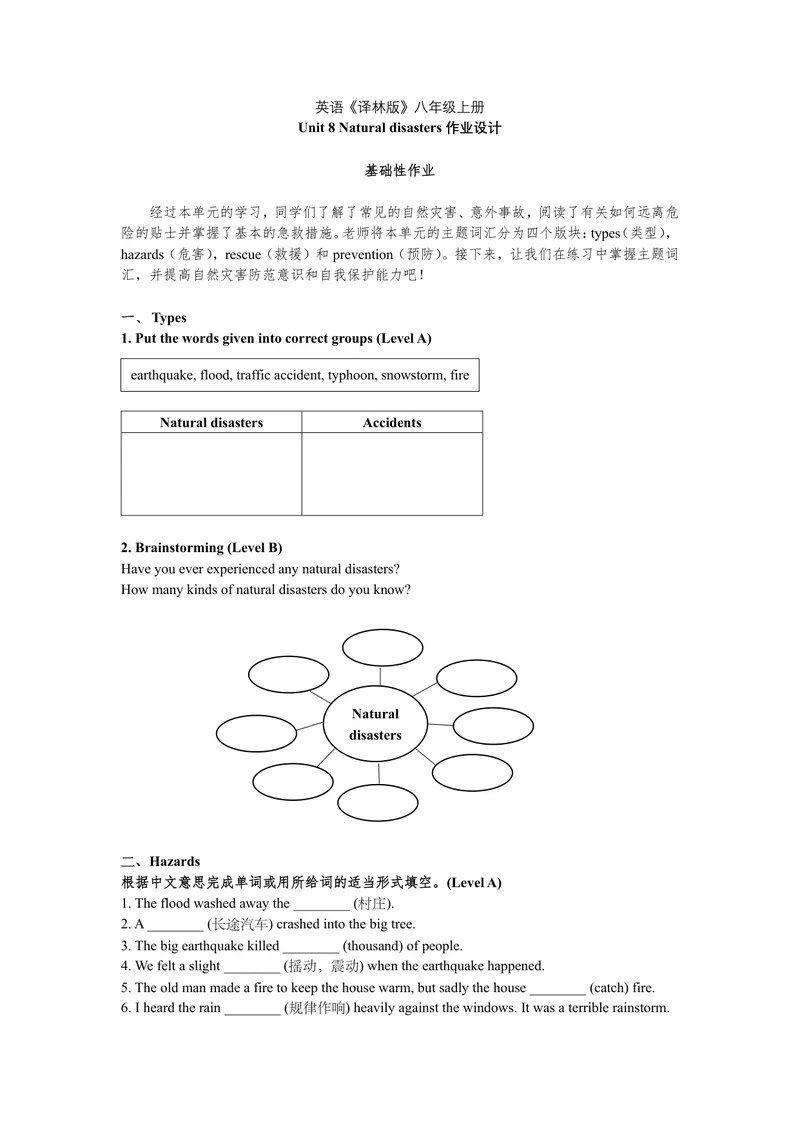
一、 Types
1. Put the words given into correct groups (Level A)
earthquake, flood, traffic accident, typhoon, snowstorm, fire
Natural disasters Accidents
2. Brainstorming (Level B)
Have you ever experienced any natural disasters?
How many kinds of natural disasters do you know?
Natural
disasters
二、Hazards
根据中文意思完成单词或用所给词的适当形式填空。(Level A)
1. The flood washed away the ________ (村庄).
2. A ________ (长途汽车) crashed into the big tree.
3. The big earthquake killed ________ (thousand) of people.
4. We felt a slight ________ (摇动,震动) when the earthquake happened.
5. The old man made a fire to keep the house warm, but sadly the house ________ (catch) fire.
6. I heard the rain ________ (规律作响) heavily against the windows. It was a terrible rainstorm.用括号中所给单词的正确形式填空,使短文内容完整、准确。(Level B)
A tornado (龙卷风) hit my city last month. In the 1. ________ (begin), the sky became dark.
Everyone could 2. ________ (hear) a strange noise. They were very afraid. But nobody knew what
was 3. ________ (happen). A few 4. ________ (minute) later, people heard the thunder and saw the
lightning. Then everything began 5. ________ (move). Finally, it 6. ________ (sudden) stopped.
During the disaster, a few people lost 7. ________ (they) lives. Lots of houses fell down.
Thousands of people had nowhere 8. ________ (live). The students had no 9. ________ (classroom)
to have lessons. After the disaster, people began to help each other. Many policemen 10. ________
(come) to help. I think everyone should be willing to help people in need, and the world will be full
of love.
三、Rescue
请根据汉语意思完成句子。(Level A)
1. 我们应该做什么来保护自己免受火灾和洪灾?
What should we do _____________________________________________?
2. 我们应当尽力跑向安全的地方。
We should ____________________________________________________.
3. 被困后我们应当冷静下来。
__________________________________________ if we are ___________.
4. 我们相信可以找到出路。
We believe that we can __________________________________________.
5. 我开始在黑暗中缓慢移动身体。
I started to ____________________________________________________.
四、Prevention (Level B)
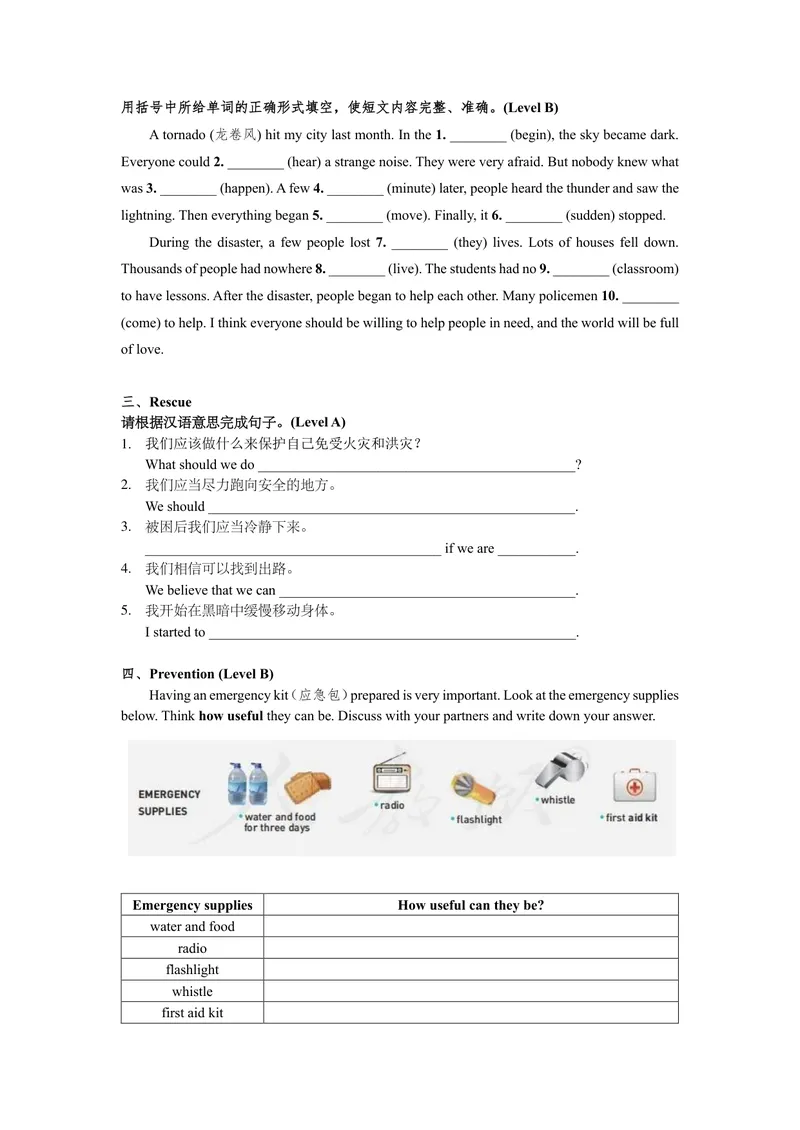
Having an emergency ki(t 应急包)prepared is very important. Look at the emergency supplies
below. Think how useful they can be. Discuss with your partners and write down your answer.
Emergency supplies How useful can they be?
water and food
radio
flashlight
whistle
first aid kit拓展性作业
聚焦自然灾害“地震”,接下来我们将围绕自我防护这一任务,开展语篇阅读、准备生
存应急包等活动,在问题情境中灵活运用语言知识。
Task 1:根据短文内容,从各题所给的四个选项中选择一个最佳答案。(Level A)
Safety tips in an earthquake
Is an earthquake dangerous? Yes, of course. However, if you know what to do in an earthquake,
you can be safe.
Keep a cool head. Worry may cause bad decisions. Think about what you should do. The first
several minutes are important.
If you are indoors during an earthquake, quickly move to a safe place in the room such as under
a desk or table. Take care of your head. Stay away from windows and things that may fall and hurt
you.
If you are in a crowded room and far away from the door, don’t rush to it. You will find too
many people trying to escape(逃生)at the same time. Instead, stay under a desk or table. Don’t
use an elevator. You may not get out of it.
Stay in a safe place until you are sure it’s OK to leave. Some aftershocks(余震)may follow
an earthquake. These are as dangerous as the earthquake.
If you are in debris, try to free your hands and legs. You may make much noise by hitting stones.
Shouting will make you tired. Try to find some water. They are important for you if you aren’t found
in a short time. Wait patiently till you get help.
1. What should you do in the first several minutes during an earthquake?
A. Follow others.
B. Rush to the door anyway.
C. Keep a cool head and think about what you should do.
D. Wait patiently for help.
2. Which of the following is the closest to the meaning of the underlined phrase “in debris”?
A. 困惑中 B. 废墟中 C. 陷阱中 D. 恐慌中
3. If you are indoors during an earthquake, you can _________________.
A. hide (藏) yourself under a glass table
B. stay near a window
C. stay under a strong desk
D. stay under an air conditioner (空调) on the wall
4. Why can’t you use an elevator during an earthquake?
A. Because the elevator may be too far for you to reach.
B. Because there are too many people trying to escape by elevator.
C. Because some aftershocks may follow an earthquake.
D. Because you may not get out of it.
5. You’d better not _____________________ when you are in debris.
A. free your hands and legs B. make noises by hitting stones
C. shout loudly D. try to find any water and foodTask 2:仔细阅读文章内容和Task 3中的图片,并回答下列问题。(Level B)
Something we can say for sure about nature is that it is unpredictable. We can’t always tell
when an earthquake will occur. Earthquakes are known to cause widespread chaos and confusion
but having the right supplies at your fingertips can make all the difference. By creating an earthquake
survival kit, you and your family can prepare yourselves in case such an event occurs. A well-
stocked kit (stored in an easy to reach location) should prove invaluable during those critical hours
or days after a catastrophic event.
1. The text says that nature is unpredictable. What does unpredictable mean?
______________________________________________________________.
2. Why it is important to have the right supplies at your fingertips if an earthquake happens?
______________________________________________________________.
3. How much food should you pack?
______________________________________________________________.
4. What is the most important message in this text?
______________________________________________________________.
Task 3: 根据上文内容,罗列出地震中的防护措施,并为自己准备应急救生包。(Level B)
How to protect ourselves from an earthquake?
_______________________________________________________________________________
_______________________________________________________________________________
_______________________________________________________________________________
_______________________________________________________________________________
_______________________________________________________________________________
1 6 8 9
2
10
3 11
4
12
5
7
(write down numbers in the boxes )
Task 4: 通过查找网页、浏览书籍等方式,获取有关遭遇自然灾害时的救援手段。(Level B)
1. search and rescue dogs / robots / vessels (船舶)
2. life detectors (探测器)
3. helicopters (直升机)
4. mobile hospitals
5. satellite positioning systems (卫星定位系统)
6. other ways: ______________________________综合实践性作业
Live to tell: Rasing awareness, Reducing Mortality.
用生命呼吁:增强减灾意识,减少人员伤亡。
——United Nations International Strategy for Disaster Reduction(2016)
——联合国国际减灾战略(2016)
(中国重大自然灾害点位图)
一、通过查找网页、浏览书籍等方式,获取更多有关自然灾害的信息。以自己家乡所在区
域的自然灾害为调查内容,完成一份调查报告,包括自然灾害形成的原因、造成的后果以
及遭遇自然灾害时的防护措施。(Level A and B)
A Report on ________________________
Causes of _______________
_______________________________________________________________________________
_______________________________________________________________________________
_______________________________________________________________________________
_______________________________________________________________________________
_______________________________________________________________________________
_______________________________________________________________________________
Possible effects of ________________
_______________________________________________________________________________
_______________________________________________________________________________
_______________________________________________________________________________
_______________________________________________________________________________
_______________________________________________________________________________
_______________________________________________________________________________
_______________________________________________________________________________Tips for staying safe during ______________
_______________________________________________________________________________
_______________________________________________________________________________
_______________________________________________________________________________
_______________________________________________________________________________
_______________________________________________________________________________
_______________________________________________________________________________
二、作业延伸(Optional homework)
To be continue—watch movies about natural disasters
1.What was Pompeii? (庞贝末日)
2.The Day After Tomorrow (后天)
3. The Mist (迷雾)