Unit 5 Good manners 单元作业
基础性作业
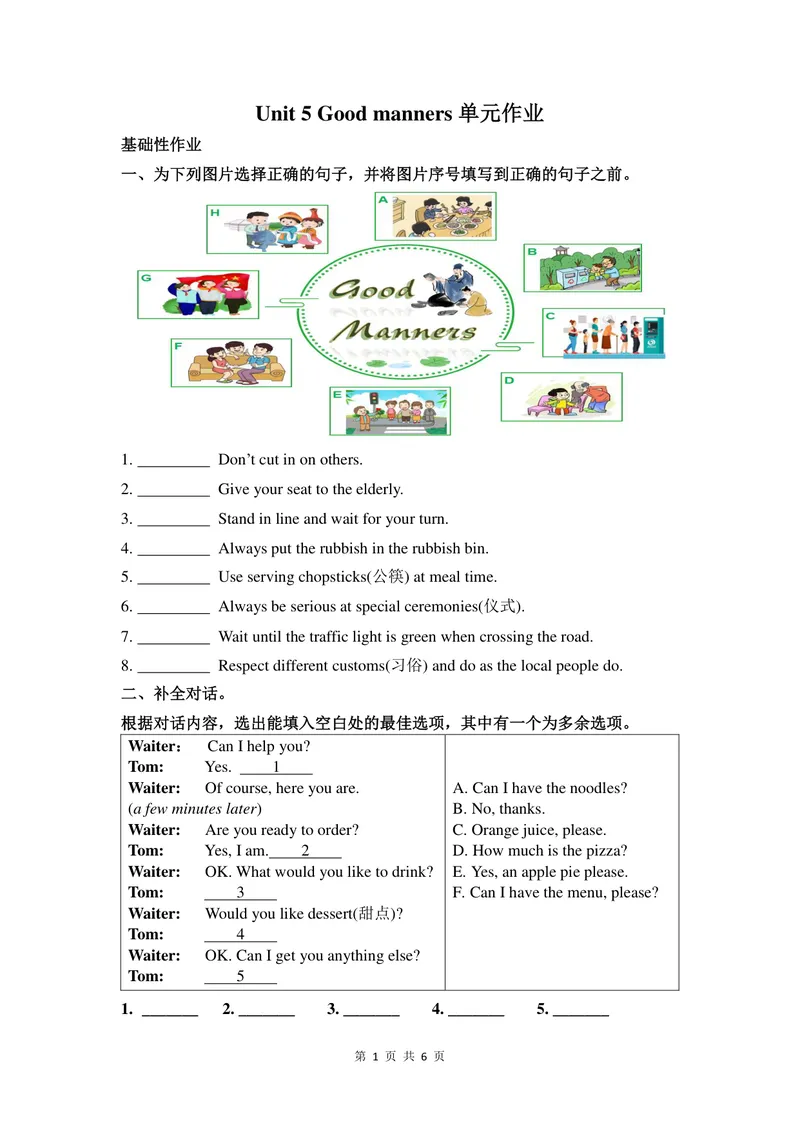
一、为下列图片选择正确的句子,并将图片序号填写到正确的句子之前。
1. Don’t cut in on others.
2. Give your seat to the elderly.
3. Stand in line and wait for your turn.
4. Always put the rubbish in the rubbish bin.
5. Use serving chopsticks(公筷) at meal time.
6. Always be serious at special ceremonies(仪式).
7. Wait until the traffic light is green when crossing the road.
8. Respect different customs(习俗) and do as the local people do.
二、补全对话。
根据对话内容,选出能填入空白处的最佳选项,其中有一个为多余选项。
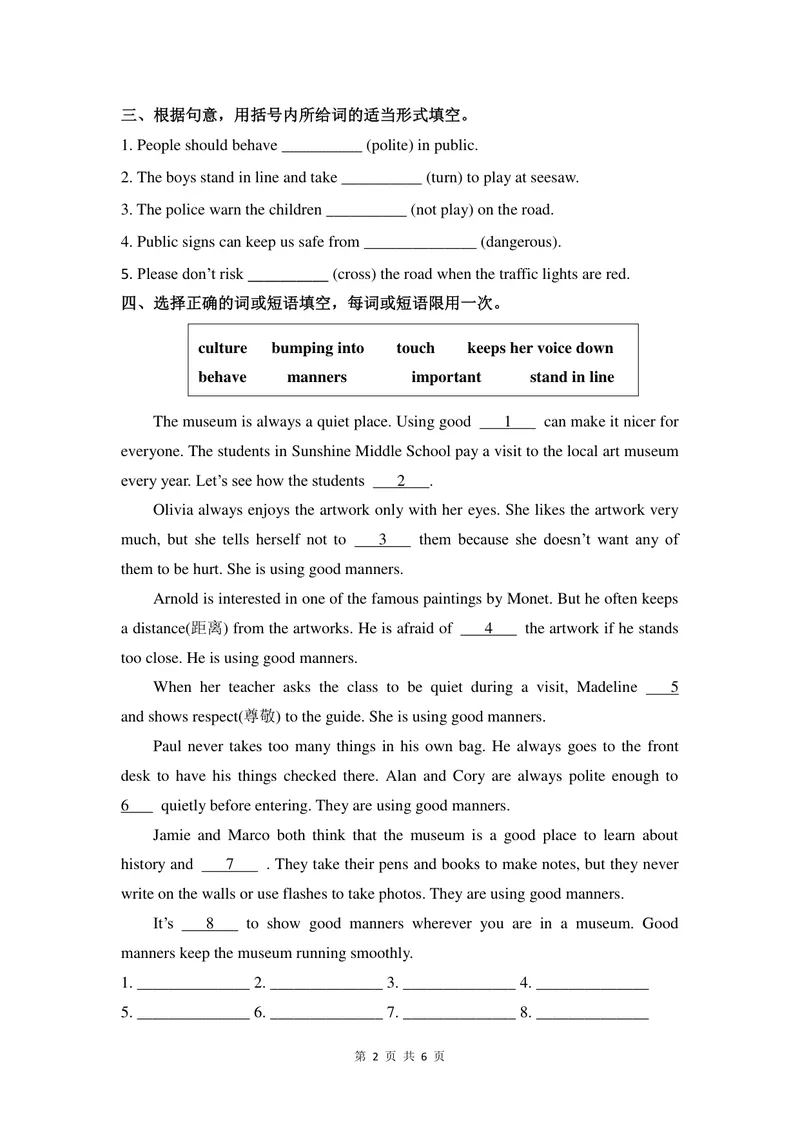
Waiter: Can I help you?
Tom: Yes. 1
Waiter: Of course, here you are. A. Can I have the noodles?
(a few minutes later) B. No, thanks.
Waiter: Are you ready to order? C. Orange juice, please.
Tom: Yes, I am. 2 D. How much is the pizza?
Waiter: OK. What would you like to drink? E. Yes, an apple pie please.
Tom: 3 F. Can I have the menu, please?
Waiter: Would you like dessert(甜点)?
Tom: 4
Waiter: OK. Can I get you anything else?
Tom: 5
1. _______ 2. _______ 3. _______ 4. _______ 5. _______
第 1 页 共 6 页三、根据句意,用括号内所给词的适当形式填空。
1. People should behave __________ (polite) in public.
2. The boys stand in line and take __________ (turn) to play at seesaw.
3. The police warn the children __________ (not play) on the road.
4. Public signs can keep us safe from ______________ (dangerous).
5. Please don’t risk __________ (cross) the road when the traffic lights are red.
四、选择正确的词或短语填空,每词或短语限用一次。
culture bumping into touch keeps her voice down
behave manners important stand in line
The museum is always a quiet place. Using good 1 can make it nicer for
everyone. The students in Sunshine Middle School pay a visit to the local art museum
every year. Let’s see how the students 2 .
Olivia always enjoys the artwork only with her eyes. She likes the artwork very
much, but she tells herself not to 3 them because she doesn’t want any of
them to be hurt. She is using good manners.
Arnold is interested in one of the famous paintings by Monet. But he often keeps
a distance(距离) from the artworks. He is afraid of 4 the artwork if he stands
too close. He is using good manners.
When her teacher asks the class to be quiet during a visit, Madeline 5
and shows respect(尊敬) to the guide. She is using good manners.
Paul never takes too many things in his own bag. He always goes to the front
desk to have his things checked there. Alan and Cory are always polite enough to
6 quietly before entering. They are using good manners.
Jamie and Marco both think that the museum is a good place to learn about
history and 7 . They take their pens and books to make notes, but they never
write on the walls or use flashes to take photos. They are using good manners.
It’s 8 to show good manners wherever you are in a museum. Good
manners keep the museum running smoothly.
1. ______________ 2. ______________ 3. ______________ 4. ______________
5. ______________ 6. ______________ 7. ______________ 8. ______________
第 2 页 共 6 页拓展性作业
一、阅读理解。
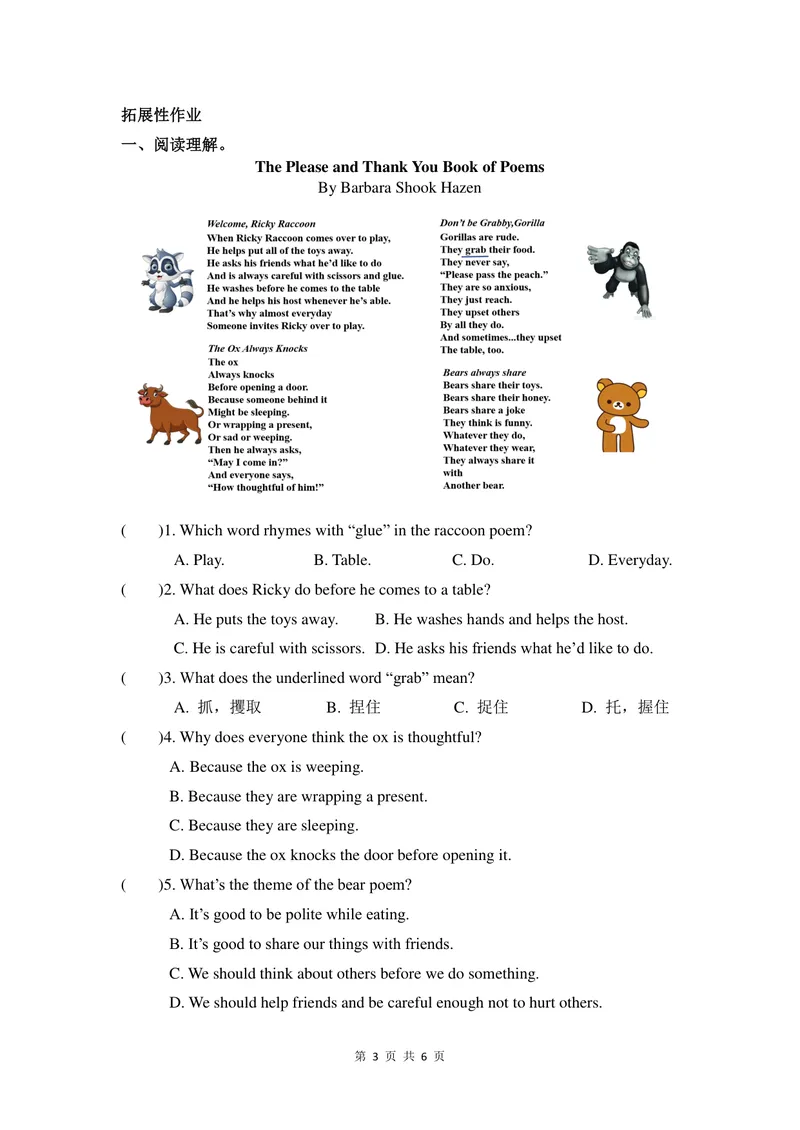
The Please and Thank You Book of Poems
By Barbara Shook Hazen
( )1. Which word rhymes with “glue” in the raccoon poem?
A. Play. B. Table. C. Do. D. Everyday.
( )2. What does Ricky do before he comes to a table?
A. He puts the toys away. B. He washes hands and helps the host.
C. He is careful with scissors. D. He asks his friends what he’d like to do.
( )3. What does the underlined word “grab” mean?
A. 抓,攫取 B. 捏住 C. 捉住 D. 托,握住
( )4. Why does everyone think the ox is thoughtful?
A. Because the ox is weeping.
B. Because they are wrapping a present.
C. Because they are sleeping.
D. Because the ox knocks the door before opening it.
( )5. What’s the theme of the bear poem?
A. It’s good to be polite while eating.
B. It’s good to share our things with friends.
C. We should think about others before we do something.
D. We should help friends and be careful enough not to hurt others.
第 3 页 共 6 页二、阅读短文并回答问题。
My name is Wu Zhou. I have lived in Canada for twenty-three years. In Canada,
I call myself Joe Wu. Joe is an English name that sounds like Zhou.
Though I have lived here for a long time, I still
don’t feel Canadian. This is probably because North
American manners and Chinese manners are so
different.
In China, being modest is a virtue. If someone
praises you and says that your English is excellent,
you should be modest and say, “ No, no. My English
is still poor. ” But in North America, this is usually a
sign of being weak and not confident. You should just
say, “ Thank you. ”
In Canada, people only ask children about their age. It’s not polite to ask an
adult’s age. They think it is private. But this is common in many places in China.
In both China and North America, it is polite to offer an elderly person a seat on
the bus. In North America, however, an elderly person may feel embarrassed about
being offered a seat.
When Chinese people eat out in restaurants, they may take turns paying for the
meal. In Canada, however, people often share the cost of a meal.
In China, if your guests have no food on their plates, it’s polite to put food on
their plates. In Canada, you pass food to guests, but you don’t usually put food on
their plates.
In China, people seldom give extra money to waiters, waitresses, taxi drivers or
hotel workers. In North America, this is always done. It is called “tipping”. It’s
interesting to experience two different cultures. I think understanding cultural
differences really helps us to understand each other, live together and work together.
1. Why does Wu Zhou call himself Joe in Canada?
_____________________________________________________________________
2. What do Canadians think about you if you are too modest?
_____________________________________________________________________
第 4 页 共 6 页3. How do Canadians pay when eating out in restaurants?
_____________________________________________________________________
4. How many differences in manner are mentioned in the passage?
_____________________________________________________________________
5. What helps Joe Wu make many good friends in Canada?
_____________________________________________________________________
三、将下列名言翻译成中文。
Confucius
1. What you do not want done to yourself, do not do to others.
(551 BC – 479 BC)
__________________________________________________
2. It is a sin to steal a bin.
__________________________________________________
3. Manners make the man.
__________________________________________________
综合实践性作业
一、综合写作。
任务一 制作海报
请为学校英文网站设计一张宣传校园文明规则的海报,内容包括校园内提倡
的文明行为和禁止的不文明行为,要求图文并茂。
活动二 撰写倡议书
结合海报内容,写一篇 100词左右的倡议书,号召全体同学共创文明校园。
A civilized campus is the cornerstone (基石) of a harmonious society. It’s our duty
to___________________________________________________________________
_____________________________________________________________________
_____________________________________________________________________
第 5 页 共 6 页_____________________________________________________________________
_____________________________________________________________________
_____________________________________________________________________
_____________________________________________________________________
_____________________________________________________________________
_____________________________________________________________________
_____________________________________________________________________
二、学唱歌曲 Manner Man (by Juny&Tony), 并向同学和家人展示。
歌曲资源:
https://www.kugou.com/mixsong/3nzfop98.html?fromsearch=manner%20man
三、思考以下问题,并在班级向同学阐述你的观点。
Why do we need rules?
第 6 页 共 6 页