8B Unit 5 Good manners单元作业
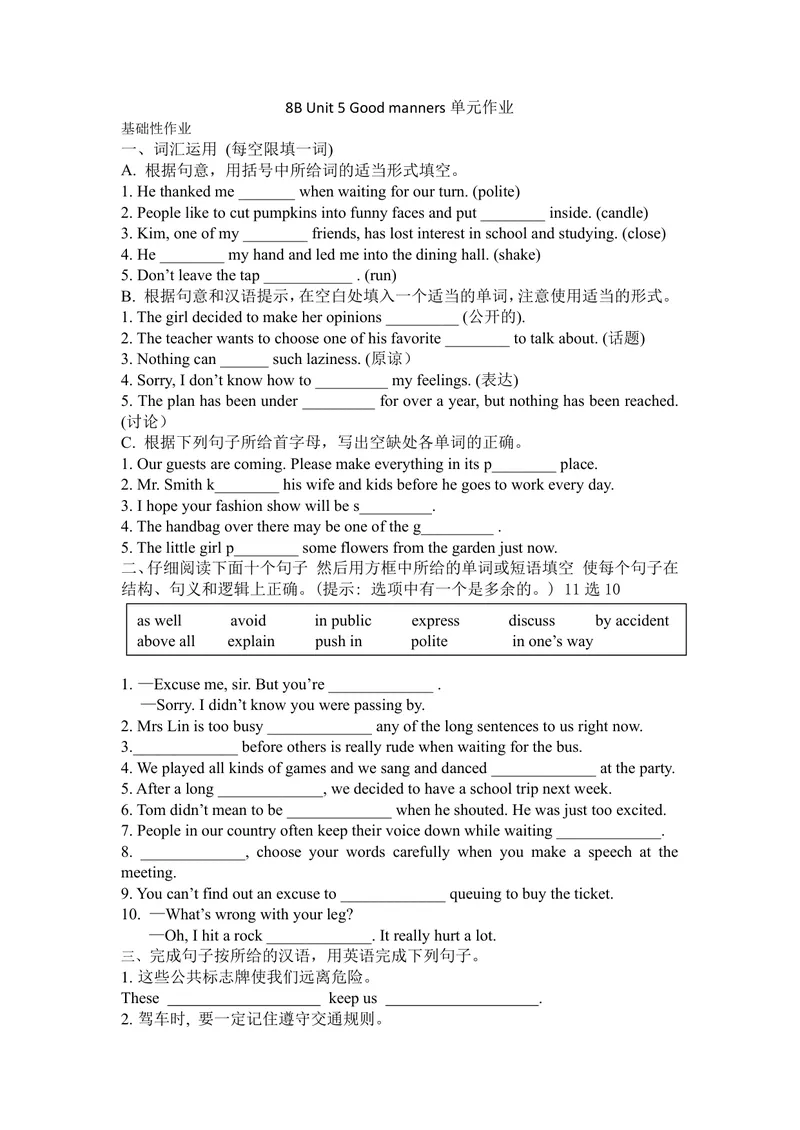
基础性作业
一、词汇运用 (每空限填一词)
A. 根据句意,用括号中所给词的适当形式填空。
1. He thanked me _______ when waiting for our turn. (polite)
2. People like to cut pumpkins into funny faces and put ________ inside. (candle)
3. Kim, one of my ________ friends, has lost interest in school and studying. (close)
4. He ________ my hand and led me into the dining hall. (shake)
5. Don’t leave the tap ___________ . (run)
B. 根据句意和汉语提示,在空白处填入一个适当的单词,注意使用适当的形式。
1. The girl decided to make her opinions _________ (公开的).
2. The teacher wants to choose one of his favorite ________ to talk about. (话题)
3. Nothing can ______ such laziness. (原谅)
4. Sorry, I don’t know how to _________ my feelings. (表达)
5. The plan has been under _________ for over a year, but nothing has been reached.
(讨论)
C. 根据下列句子所给首字母,写出空缺处各单词的正确。
1. Our guests are coming. Please make everything in its p________ place.
2. Mr. Smith k________ his wife and kids before he goes to work every day.
3. I hope your fashion show will be s_________.
4. The handbag over there may be one of the g_________ .
5. The little girl p________ some flowers from the garden just now.
二、仔细阅读下面十个句子 然后用方框中所给的单词或短语填空 使每个句子在
结构、句义和逻辑上正确。(提示: 选项中有一个是多余的。) 11选10
as well avoid in public express discuss by accident
above all explain push in polite in one’s way
1. —Excuse me, sir. But you’re _____________ .
—Sorry. I didn’t know you were passing by.
2. Mrs Lin is too busy _____________ any of the long sentences to us right now.
3._____________ before others is really rude when waiting for the bus.
4. We played all kinds of games and we sang and danced _____________ at the party.
5. After a long _____________, we decided to have a school trip next week.
6. Tom didn’t mean to be _____________ when he shouted. He was just too excited.
7. People in our country often keep their voice down while waiting _____________.
8. _____________, choose your words carefully when you make a speech at the
meeting.
9. You can’t find out an excuse to _____________ queuing to buy the ticket.
10. —What’s wrong with your leg?
—Oh, I hit a rock _____________. It really hurt a lot.
三、完成句子按所给的汉语,用英语完成下列句子。
1. 这些公共标志牌使我们远离危险。
These keep us .
2. 驾车时, 要一定记住遵守交通规则。Always remember to while driving.
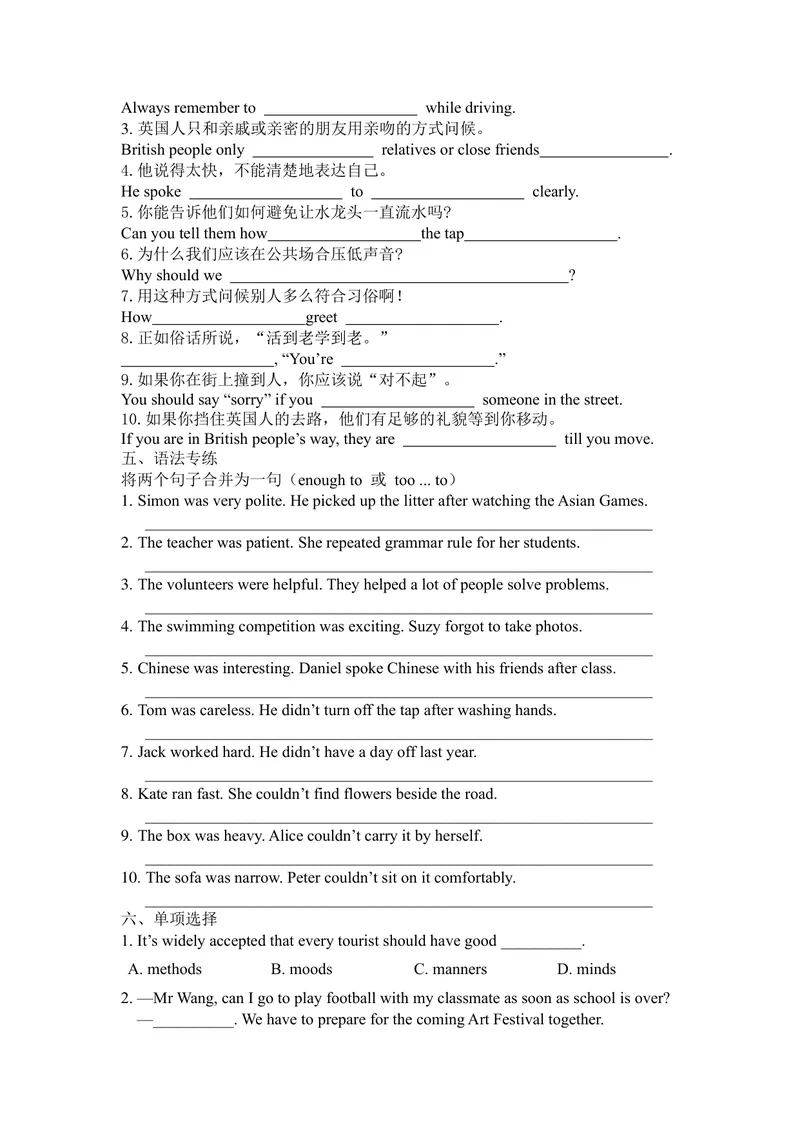
3. 英国人只和亲戚或亲密的朋友用亲吻的方式问候。
British people only relatives or close friends .
4.他说得太快,不能清楚地表达自己。
He spoke to clearly.
5.你能告诉他们如何避免让水龙头一直流水吗?
Can you tell them how the tap .
6.为什么我们应该在公共场合压低声音?
Why should we ?
7.用这种方式问候别人多么符合习俗啊!
How greet .
8.正如俗话所说,“活到老学到老。”
, “You’re .”
9.如果你在街上撞到人,你应该说“对不起”。
You should say “sorry” if you someone in the street.
10.如果你挡住英国人的去路,他们有足够的礼貌等到你移动。
If you are in British people’s way, they are till you move.
五、语法专练
将两个句子合并为一句(enough to 或 too ... to)
1. Simon was very polite. He picked up the litter after watching the Asian Games.
_______________________________________________________________
2. The teacher was patient. She repeated grammar rule for her students.
_______________________________________________________________
3. The volunteers were helpful. They helped a lot of people solve problems.
_______________________________________________________________
4. The swimming competition was exciting. Suzy forgot to take photos.
_______________________________________________________________
5. Chinese was interesting. Daniel spoke Chinese with his friends after class.
_______________________________________________________________
6. Tom was careless. He didn’t turn off the tap after washing hands.
_______________________________________________________________
7. Jack worked hard. He didn’t have a day off last year.
_______________________________________________________________
8. Kate ran fast. She couldn’t find flowers beside the road.
_______________________________________________________________
9. The box was heavy. Alice couldn’t carry it by herself.
_______________________________________________________________
10. The sofa was narrow. Peter couldn’t sit on it comfortably.
_______________________________________________________________
六、单项选择
1. It’s widely accepted that every tourist should have good __________.
A. methods B. moods C. manners D. minds
2. —Mr Wang, can I go to play football with my classmate as soon as school is over?
—__________. We have to prepare for the coming Art Festival together.A. Why not? B. I hope so. C. I’m afraid not. D. Of course.
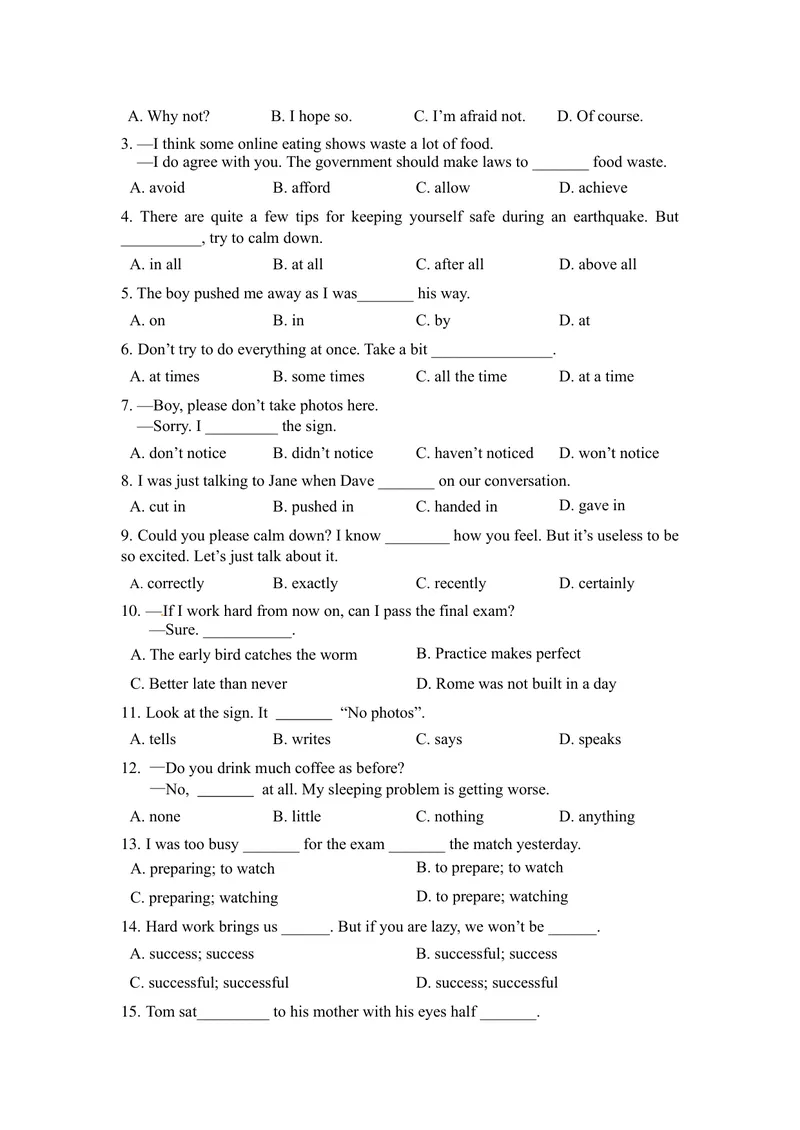
3. —I think some online eating shows waste a lot of food.
—I do agree with you. The government should make laws to _______ food waste.
A. avoid B. afford C. allow D. achieve
4. There are quite a few tips for keeping yourself safe during an earthquake. But
__________, try to calm down.
A. in all B. at all C. after all D. above all
5. The boy pushed me away as I was_______ his way.
A. on B. in C. by D. at
6. Don’t try to do everything at once. Take a bit _______________.
A. at times B. some times C. all the time D. at a time
7. —Boy, please don’t take photos here.
—Sorry. I _________ the sign.
A. don’t notice B. didn’t notice C. haven’t noticed D. won’t notice
8. I was just talking to Jane when Dave _______ on our conversation.
A. cut in B. pushed in C. handed in D. gave in
9. Could you please calm down? I know ________ how you feel. But it’s useless to be
so excited. Let’s just talk about it.
A. correctly B. exactly C. recently D. certainly
10. —If I work hard from now on, can I pass the final exam?
—Sure. ___________.
A. The early bird catches the worm B. Practice makes perfect
C. Better late than never D. Rome was not built in a day
11. Look at the sign. It “No photos”.
A. tells B. writes C. says D. speaks
12. —Do you drink much coffee as before?
—No, at all. My sleeping problem is getting worse.
A. none B. little C. nothing D. anything
13. I was too busy _______ for the exam _______ the match yesterday.
A. preparing; to watch B. to prepare; to watch
C. preparing; watching D. to prepare; watching
14. Hard work brings us ______. But if you are lazy, we won’t be ______.
A. success; success B. successful; success
C. successful; successful D. success; successful
15. Tom sat_________ to his mother with his eyes half _______.A. closed; opened B. close; open
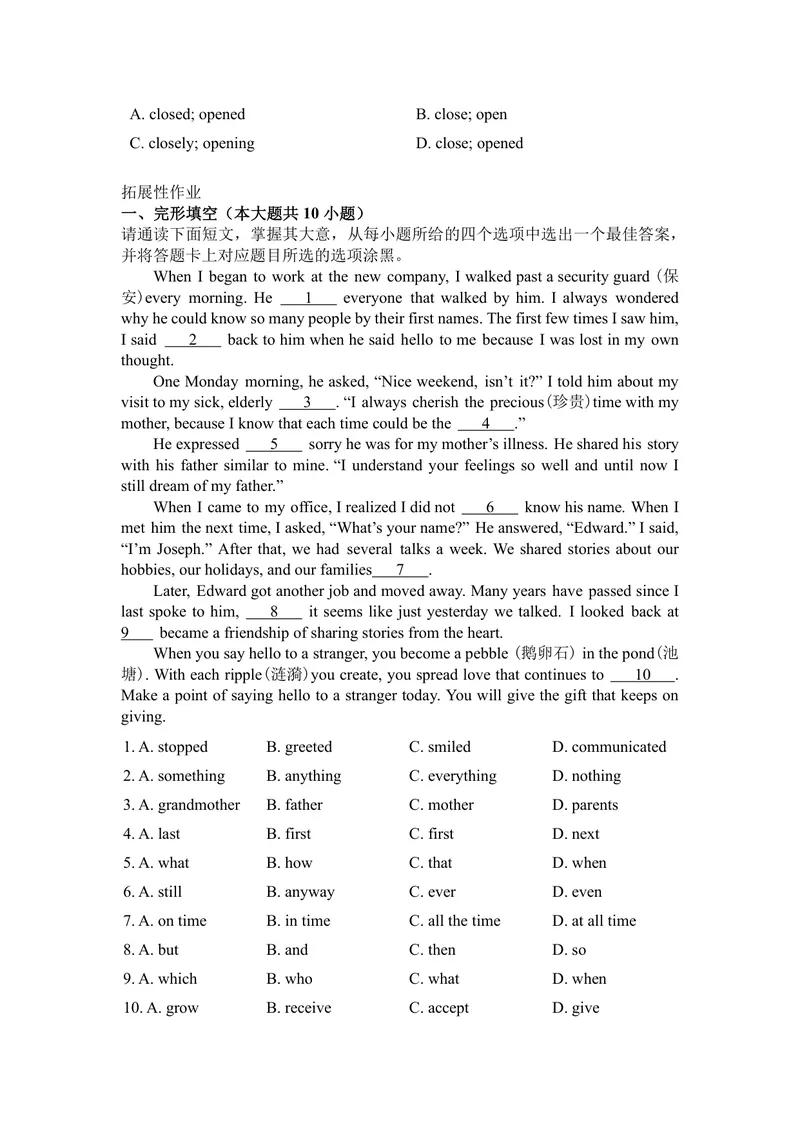
C. closely; opening D. close; opened
拓展性作业
一、完形填空(本大题共 10小题)
请通读下面短文,掌握其大意,从每小题所给的四个选项中选出一个最佳答案,
并将答题卡上对应题目所选的选项涂黑。
When I began to work at the new company, I walked past a security guard (保
安)every morning. He 1 everyone that walked by him. I always wondered
why he could know so many people by their first names. The first few times I saw him,
I said 2 back to him when he said hello to me because I was lost in my own
thought.
One Monday morning, he asked, “Nice weekend, isn’t it?” I told him about my
visit to my sick, elderly 3 . “I always cherish the precious(珍贵)time with my
mother, because I know that each time could be the 4 .”
He expressed 5 sorry he was for my mother’s illness. He shared his story
with his father similar to mine. “I understand your feelings so well and until now I
still dream of my father.”
When I came to my office, I realized I did not 6 know his name. When I
met him the next time, I asked, “What’s your name?” He answered, “Edward.” I said,
“I’m Joseph.” After that, we had several talks a week. We shared stories about our
hobbies, our holidays, and our families 7 .
Later, Edward got another job and moved away. Many years have passed since I
last spoke to him, 8 it seems like just yesterday we talked. I looked back at
9 became a friendship of sharing stories from the heart.
When you say hello to a stranger, you become a pebble (鹅卵石) in the pond(池
塘). With each ripple(涟漪)you create, you spread love that continues to 10 .
Make a point of saying hello to a stranger today. You will give the gift that keeps on
giving.
1. A. stopped B. greeted C. smiled D. communicated
2. A. something B. anything C. everything D. nothing
3. A. grandmother B. father C. mother D. parents
4. A. last B. first C. first D. next
5. A. what B. how C. that D. when
6. A. still B. anyway C. ever D. even
7. A. on time B. in time C. all the time D. at all time
8. A. but B. and C. then D. so
9. A. which B. who C. what D. when
10. A. grow B. receive C. accept D. give二、阅读理解
A
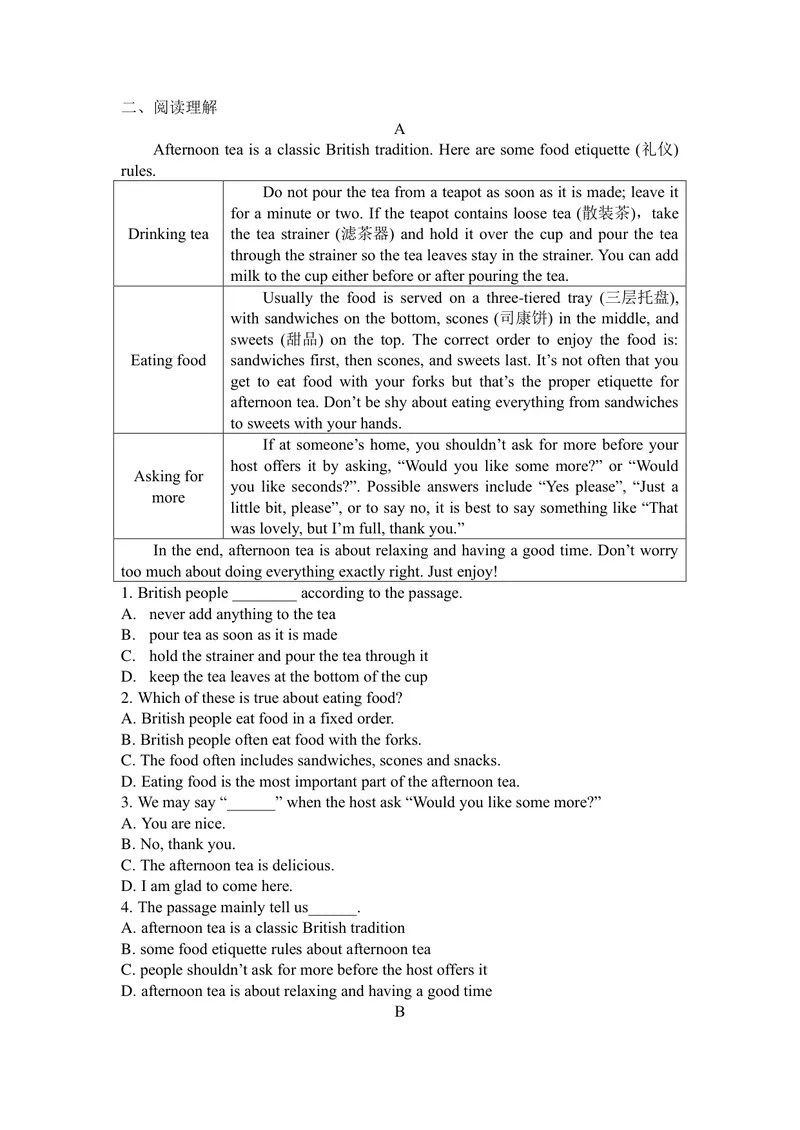
Afternoon tea is a classic British tradition. Here are some food etiquette (礼仪)
rules.
Do not pour the tea from a teapot as soon as it is made; leave it
for a minute or two. If the teapot contains loose tea (散装茶),take
Drinking tea the tea strainer (滤茶器) and hold it over the cup and pour the tea
through the strainer so the tea leaves stay in the strainer. You can add
milk to the cup either before or after pouring the tea.
Usually the food is served on a three-tiered tray (三层托盘),
with sandwiches on the bottom, scones (司康饼) in the middle, and
sweets (甜品) on the top. The correct order to enjoy the food is:
Eating food sandwiches first, then scones, and sweets last. It’s not often that you
get to eat food with your forks but that’s the proper etiquette for
afternoon tea. Don’t be shy about eating everything from sandwiches
to sweets with your hands.
If at someone’s home, you shouldn’t ask for more before your
host offers it by asking, “Would you like some more?” or “Would
Asking for
you like seconds?”. Possible answers include “Yes please”, “Just a
more
little bit, please”, or to say no, it is best to say something like “That
was lovely, but I’m full, thank you.”
In the end, afternoon tea is about relaxing and having a good time. Don’t worry
too much about doing everything exactly right. Just enjoy!
1. British people ________ according to the passage.
A. never add anything to the tea
B. pour tea as soon as it is made
C. hold the strainer and pour the tea through it
D. keep the tea leaves at the bottom of the cup
2. Which of these is true about eating food?
A. British people eat food in a fixed order.
B. British people often eat food with the forks.
C. The food often includes sandwiches, scones and snacks.
D. Eating food is the most important part of the afternoon tea.
3. We may say “______” when the host ask “Would you like some more?”
A. You are nice.
B. No, thank you.
C. The afternoon tea is delicious.
D. I am glad to come here.
4. The passage mainly tell us______.
A. afternoon tea is a classic British tradition
B. some food etiquette rules about afternoon tea
C. people shouldn’t ask for more before the host offers it
D. afternoon tea is about relaxing and having a good time
BChinese are very proud of their culture of food and will do their best to show
their hospitality. The following dining manners can help you learn more about China.
If you are being treated by a Chinese host, be prepared for a ton of food. And
sometimes the Chinese host use their chopsticks to put food in your bowl or plate.
This is a sign of politeness. The proper thing to do would be to eat whatever it is and
say how yummy it is. If you feel uncomfortable with this, you can just say a polite
thank you and leave the food there.
When you have meals in China, don’t stick your chopsticks upright in the rice
bowl. Instead, lay them on your dish. The reason for this is that when somebody dies,
the shrine (盒子) to them includes a bowl of sand or rice with two sticks of incense
(香) stuck upright in it. So if you stick your chopsticks in the rice bowl, it looks like
this shrine and is like wishing death upon a person at the table!
Make sure the spout (壶嘴) of the teapot is not facing anyone. It is impolite to set
the teapot down where the spout is facing towards somebody. The spout should
always be directed to where nobody is sitting, usually just outward from the table.
Don’t tap on your bowl with your chopsticks. Beggars tap on their bowls, so this
is not polite. Also, when the food is coming too slow in a restaurant, people will tap
their bowls. If you are in someone’s home, it is like blaming the cook.
The meal usually begins with a set of at least four cold dishes, to be followed by
the main courses of hot meat and vegetable dishes. Soup then will be served to be
followed by staple food (主食) from rice, noodles to dumplings. If you wish to have
your rice to go with other dishes, you should say so in good time, for most of the
Chinese choose to have the staple food at last or have none of them at all.
5. How many dining manners are mentioned in the passage?
A. Two B. Three C. Four D. Five
6. If you are a guest, you should ______.
A. tap on your bowl with your chopsticks
B. make the spout of the teapot face someone at the table
C. lay your chopsticks on your dish when you have meals
D. refuse the food the host use his chopsticks to put in your bowl
7. What does the underlined phrase “in good time” in the last paragraph mean?
A. 提前 B. 及时 C. 好时光 D. 按时
8. This passage is most probably written for ______.
A. the cooks in the restaurant B. the waiters and waitresses
C. Chinese visitors to foreign countries D. foreign visitors to China
三、阅读下面短文,从短文后所给的选项中选出能填入短文空白处的最佳选项,
使短文通顺连贯,其中有一或两项是多余选项。
Asian Games —— Care About Manners
The Asian Games, not only provide sportsmen a chance to compete but also
provide a platform for cultural exchanges among the Asian countries.
1 .
Sportsmen in the Asian Games should care about their behavior both on and off
the field. They should try to show sportsmanship and fair play, respecting(尊重) the
rules of each sport. 2 . No matter what their nationality or background is,sportsmen should also show respect to their coaches, officers, and competitors.
Officers and referees (教练) play an important role in making the Asian Games fair
and successful. 3 .
As for spectators, their behavior should also show good manners. 4 .
Keeping cleanliness and order in competition areas is also important, as littering or
causing disturbances can destroy the whole experience for everyone.
Above all, it is necessary to respect the culture and customs of the host country.
Understanding the traditions and values of the host country can make cultural
exchange further and improve the overall experience of the Asian Games. 5 .
To sum up, by following these rules, the Asian Games can truly become a great
event that not only celebrates sports but also improve cultural understanding and unity
among countries.
A. Sportsmen, officers and spectators are all very excited about taking part in such an
event.
B. Spectators should show support and cheer for their favorite sportsmen in a
respectful manner.
C. Taking the time to learn a few key phrases in the host country's language and being
open-minded towards different cultural practices will help create a welcoming and
inclusive environment for all the people.
D. Therefore, it is important for sportsmen, officers, and spectators(观众) to care
about their manners.
E. They should exercise fairness in their decision-making and have clear
communication with sportsmen.
F. Some of the officers sometimes quarrel or even fight with sportsmen and this lead
to a lot of problems later.
G. Supporting honesty and avoiding improper behavior is important to have a healthy
competitive spirit.
四、任务型阅读
1. 阅读表达
阅读短文,根据短文内容回答问题,每个题目的答案不超过 10个单词。(共
5小题)
Good manners are an important thing to have since it shows. Having good social
manners can help you develop better relationships and make you more enjoyable to be
around. If you’re having a meal with others, then make sure you use good manners
while you’re eating. You should be polite while you’re online so you don’t offend or
overshare(过度分享)with others.
● Having Good Conversational Manners
Use “please” and “thank you” when you’re asking for something. Whenever you
make a request or you need to ask for something, start by saying “please.” That way, it
doesn’t sound like you’re demanding the other person to do things for you. Once
someone finishes the task that you asked them to do, respond (回应) by saying “thank
you” so the other person knows you’re grateful for what they just did.
● Introduce yourself by name when you meet someone for the first time.
If you’re getting together with someone and you haven’t met before, introduceyourself by name and ask them what their name is. When they say their name, repeat
it so you have a better chance at remembering it later on. Offer your hand for a
handshake and use a firm grip, but not so firm that you hurt the other person.
● Listen to other people without interrupting (打断) them.
When another person starts talking, make eye contact with them and pay
attention to what they’re saying so you can carry on the conversation. Avoid trying to
talk over them or cutting them off since you’ll come across as rude. Once the person
finished speaking, respond to what they just said so they know you were listening to
what they were telling you.
● Avoid using bad language.
Impolite language can come across as rude, especially when you use it in public
conversation. Do your best to try and eliminate(消除) bad words from your
vocabulary while you’re talking with other people. Rather than saying the word, try to
find a replacement or just pause during your conversation to recollect your thoughts
and plan out what you’re going to say.
1. What should you do if you are having a meal with others?
_____________________________________________________________________
2. How can we respond once someone finishes the task that you asked them to do?
_____________________________________________________________________
3. Why should we repeat it when they say their name?
_____________________________________________________________________
4. When can we respond to what they just said?
_____________________________________________________________________
5. What do you think of using bad language?
_____________________________________________________________________
2. 阅读填空
先通读下面的短文,然后根据短文内容,在文章后表格的空格内填入一个最
恰当的单词。每个空格只能填一个单词。 (10空)
Different countries have different ideas about manners-how you behave when
you are eating. In England, table manners are i 1 . Good table manners in
England are as follows:
★How to sit: You should sit up s 2 in your chair. It is not a good idea to
lean(倾斜)forwards or backwards. When you eat, you should not lean towards the
plate, but bring the k 3 , fork or spoon towards you. At the same time, do not
out your elbows on the table, nor r 4 over someone’s plate for something.
★Using your f 5 : English people normally don’t pick food up with their
fingers when they are eating main courses. If you are not sure, the s 6 is to use
your knife or fork. There are, h 7 , some foods that are usually eaten with
fingers. They include sandwiches, burgers, crisps and fruit.
★Your mouth: It is not polite to talk with your mouth full of food, or to eat with
your mouth open. And if p 8 , do not make any noises. Never lick(舔) your
plate after eating.
★How much to eat: It is polite to eat up the food that you have been offered, so
a c 9 plate is a good plate. It shows that you enjoyed the food. If you can’tfinish e 10 and need to leave a little, that’s also okay. You could say something
like“That was very nice, thank you, but I’m just too full to eat another bite.”
综合实践
假如你叫 Mike, 是一名初二学生, 请根据下表内容, 以“How to Be a
Student with Good Manners?”为题写一篇英语小短文。
1. turn off the lights ...
Save energy
2. ...
1. keep quiet ...
Public places
2. ...
1. ...
Table manners
2. ...
... ...
要求:
1. 应包含表格中的所有内容并适当发挥;
2. 词数100左右。
How to Be a Student with Good Manners?
_______________________________________________________________________________
_______________________________________________________________________________