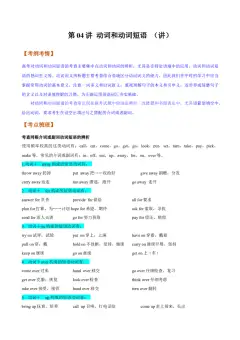
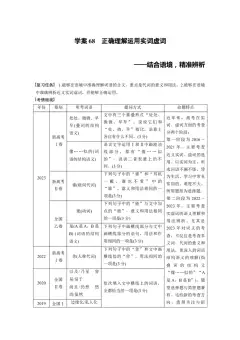
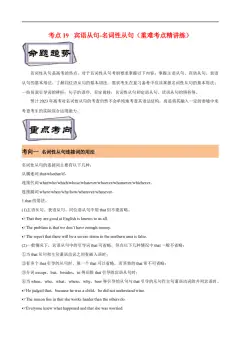
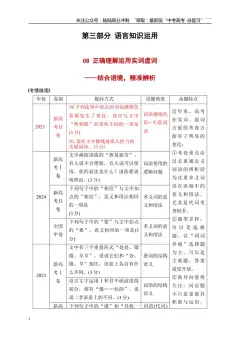
04.必备词汇用法辨析
第一部分 语义辨析
A
about ; around ; round
作副词时都含“四处”、“遍地”的意思。
about 系常用词。 例如:look about 四处看。
around 具有 about 的基本意思, 因此 look about=look around, 但在以下短语里 around没有 about正式。 例如:travel
around 各处旅行
round和around在非正式用法中可以互换, 但一般用round时更简练。
在正式用语中, 一般用 round指“旋转”, 而用 around指“处处”, “到处”。
例如:She turned round at such a noise. 听到这样的吵声, 她回头看。
I have been looking for it all around. 我到处都找过了。
另外, 英国人用 round的地方, 美国人倾向于用 around。
例如:[英] Winter comes round. [美] Winter comes around.
above all ; after all ; at all
above all意为“尤其是”、“首先”、“最重要的是”,常位于句首或句中,作插入语,起强调作用。
例如: But above all tell me quickly what I have to do.可首先快些告诉我该做什么。
A clock must above all keeps good time.时钟最重要的是必须走得准。
after all意为“毕竟”、“终究”、“终归”、“到底”,在句中位置较灵活。可位于句首、句中或句末。
例如: After all,your birthday is only two weeks away.毕竟,两周后就是你的生日。
He is,after all,a small child.他毕竟还是个小孩子。
He failed after all.他终于失败了。
at all用于否认句时,意为“丝毫;根本”,用于疑问句时意为“究竟;到底”;
用于肯定句中,表示说话人的某种情绪或情感〔如疑心或惊奇等〕,意为“竟然”等。
用于条件句时,常译为“当真;实在”。
例如: He doesn’t like you at all.他根本不喜欢你。
Are you going to do it at all?你究竟做不做这件事?
If you do it at all,do it well.假设你真要做这件事,就得做好。
I was surprised at his coming at all.他竟然来了,我很惊讶。add ; add to ; add…to ; add up to
add作“加,增加”解时,既可作及物动词,又可用作不及物动词;
作“又说,补充说”解时,与直接或间接引语连用。
例如: If the tea is too strong, add some more hot water. 如果茶太浓了,再加点开水。
After a short while, he added that he would try his best. 过了一会儿,他又接着说他会尽力。
add to意为“增添,增加,增进”。
例如: The bad weather added to our difficulties. 恶劣的天气增加了我们的困难。
add...to意为“把……加到……”,是把前一项加到后一项之后或之中。
例如: Add two to seven, and you will get nine.七加二等于九。
add up to意为“加起来总共是/累计得”,该短语不用于被动语态。
例如: All his school education added up to no more than one year. 他的学校教育加起来不过一年。
affair ; thing ; matter ; business
affair意为“事情、事件”, 含义较广,泛指已做或待做的事;
复数affairs一般指商业事务及政府的日常事务,如财政管理、外交事务等。
thing意为“事情、事物”,不管大事小事、好事坏事均称为thing,一般不能专指事务;
复数things还可作“形势”解。
matter侧重指须留心的要事或问题、难题。
business作“事务、事情”解时,一般不能用复数,常常指所指派的任务、责任;
有时说的是指派的工作或商业上的买卖活动。
a great deal ; a great deal of
a great deal用作名词,意为“大量”,“许多”,作主语、宾语;
用作副词,意为“很”或“非常”,作状语,修饰动词或用来强调比较级。
例如:A great deal has been studied and this is the best way. 经过大量研究后,这〔被认为〕是最好的方法。
We are a great deal cleverer than before.我们比以前聪明多了。
a great deal of意为“大量的”,“非常多的”,相当于much,作定语,后接不可数名词。
例如: A great deal of time/money/energy has been spent on the project.
大量的时间/金钱/能源花在那个工程上了。
agree on ; agree to ; agree with ; agree that
agree on作“就……取得一致意见”解。例如: The building of a new car factory was agreed on last month.
上月,就建一座新汽车厂之事达成了协议。
agree to有两层含义和用法:
其一:是to作为动词不定式符号,其后跟动词原形,作“同意〔答应〕做某事”解。
例如: My father agreed to buy a new pen for me. 父亲答应给我买支新钢笔。
其二:是to作为介词,之后跟表示“计划/条件/建议等一类的名词或代词”。
例如: They have a greed to our plan. 他们已同意我们的计划。
agree with作“同意某人的意见”解,其后可跟表示人的名词或代词,也可跟表示“意见”或“说的话”的名词或从句。
例如: He agreed with my opinions. 他同意了我的意见。
We agreed with what he said at the meeting. 我们同意他在会上讲的话。
agree that作“认为……”解,其后跟宾语从句。
例如: I agree that your composition is very good. 我认为你的这篇作文写得不错。
allow ; let
二者均可作“允许”解,但各有侧重:
allow重在“允许”或“容许”,也可表示客气的请求。
例如: He allowed me to take his dictionary.他允许我拿走他的词典。
Will you allow me to use your bike? 我可以用你的自行车吗?
let作“允许”或“让”解,主要用于口语,一般可与allow互换。
作“允许”解时,常暗含“听任”、“默许”之意;作“让”解时,常含“祈使”或“建议”之意。
注意:let之后作宾补的不定式不带to,且不可用于被动语态,而allow则相反。
例如:Please let me walk with you〔=Please allow me to walk with you.〕.我〔请允许我〕跟你一起走。注:allow
常用于allow sb.to do sth.或allow doing sth.结构中。
although ; though ; as
三者均可表示“尽管;虽然”,引导让步状语从句。
although用法较正式,语气较强;
though较常用;
as则主要用于倒装句。
它们的用法有如下几点值得注意:
状语从句由although, though或as引导,主句之前不可有but, and, so, however等并列连词,但可有yet或still等副词。
although与though常可互换。例如: Although/Though he believes it, yet he will not act. 他虽然相信它,但却不肯有所行动。
as表示“尽管;虽然”,只能用于倒装句,即:将表语、状语或谓语动词放在 as之前。though也可这么用。 例如:
Young as/though he is, he knows a lot. 他虽然年纪不大,却懂得很多。
注意:如果表语是单数名词,要省略a。
例如: Child as/though he is, he can speak two foreign languages. 虽然他是个孩子,但他会说两门外语。
though可以放在句末,表示“但是”,although却不能。
例如: They said they would come; they did not, though. 他们说他们会来,可是他们并没有来。
although只用来陈述“事实”,不能表示“假设”。因此可以说even though“即使”以及as though“好似(=as if)”,不
能说even although或as although。
例如: I believe you are on duty—even though you’re in plain clothes.
尽管你穿着便衣,我相信你是在值勤。
among ; between
这两个介词都有“在……之间”的意思。
between常用于两者之间;
among一般指三者或三者以上之间。
假设指三个以上人或物中的每两个之间时,仍然要用between。
例如:The girl walked between her father and mother.这个女孩走在她父亲和母亲之间。
She is the tallest among her classmates.她在她同学之间是最高的。
Switzerland lies between France,Italy,Austria and Germany.
瑞士位于法国、意大利、奥地利和德国之间。
argue ; debate ; dispute
都含“辩论”的意思。
argue着重“说理”、“论证”和“企图说服”。
例如:I argued with her for a long time, but she refused to listen to reason.
我和她辩论了好久, 但她还是不听。
debate 着重“双方各述己见”, 内含“交锋”的意思。
例如:We have been debating about the issue. 我们一直在就这个问题进行辩论。
dispute 指“激烈争辩”, 含有“相持不下”或“未得解决”之意。
例如:Whether he will be elected as chairman is still disputed.他是否当选为主席, 仍然有争论。argue ; quarrel ; discuss
这三个动词均有“争”的意思,但“争”法不同。
argue着重就自己的看法或观点,提出论证,同他人“争论”或“辩论”。
例如: We heard them arguing in the other room.我们听见他们在另一个房间里争论。
另外,argue同with搭配,其后接人;与about连用,其后接事物。
例如: We argued with them about this problem for a long time.这个问题我们同他们辩论了很长时间。
quarrel是指对某事不喜欢或强烈不满而发生的“争吵”或“吵架”。
同with搭配,其后接某人;和about连用,其后接某事。
例如: He often quarrels about their housework with his wife.他常为家务事同妻子争吵。
discuss是指认真交换自己的意见或看法的“讨论”。
例如: We'll discuss the use of the articles tomorrow.明天我们将讨论冠词的用法。
as (so) far as ; as (so) long as
as〔so〕far as的意思是“就……而言〔所知〕”,as (so) far as sth.is concerned是其中一种具体用法,意为“就某事而
言”;
as (so) long as意为“只要”,引导条件状语从句。
例如:As far as I know, more than 10 million laid-off workers have found their new jobs.
就我所知,一千多万下岗工人已经找到了新的工作。
There is nothing that we can’t do so / as long as we keep on trying to do it.
只要我们不断地努力去做,就没有什么事干不成。
As far as the tourism of China is concerned, there is a long way to go.
就中国的旅游业而言,需要做的工作还很多。
asleep ; sleeping
二者都是形容词。
asleep仅用作表语,不能作定语,表示“睡着,熟睡”的意思;
而sleeping一般只能用作定语,放在名词前,表示“睡眠中的,休止的”意思。
例如:我们不能说:an asleep baby,但可以说:a sleeping baby〔一个熟睡的婴儿〕。
例如:He was asleep with his head on his arms.他头枕着手臂在熟睡。
asleeping dog正在熟睡的狗 sleeping car卧车 sleeping bag睡袋assert ; affirm ; maintain
assert宣称、断言,常指某人主观自信,坚持己见,有时不顾客观事实而断言下结论。
affirm指以事实为依据,深信不疑地肯定某种观点或看法。
maintain指在相反的证据或论点面前,重申原来的某种观点、立场。
as though ; even though ; though
as though〔=as if〕 意为“好似;似乎”,引导方式状语从句或表语从句。
例如: He spoke as though〔as if〕he had been here before.他说话的口气好似他以前来过这里。
It looks as if〔as though〕it is going to rain.看起来好似要下雨。
even though〔=even if〕 意为“即使”,引导让步状语从句。
though也引导让步状语从句,意为“虽然”;
even though有退一步设想的意味,与though不同。
though引导的句子所说的是事实,even though引导的句子所说的则不一定是事实。
例如: He will not tell the secret even though〔even if〕he knows it.
即使他知道这个秘密,他也不肯说出来。
He will not tell the secret though he knows it.他虽然知道这个秘密,但他不会说出来。
at the beginning ; in the beginning
at the beginning 在……初;在……开始的时候。常与of连用。
例如: Students usually have a study plan at the beginning of term. 学生们在开学初制定学习计划。
in the beginning 相当于at first,表示“起初、开始”时,含“起初是这种情况,而后来却不是这种情况”之意,不与of连
用。
例如: In the beginning,some of us took no interest in physics. 起初我们有些人对物理不感兴趣。
attack ; assail ; assault ; charge ; beset
都含有"攻击"的意思。
attack 是常用词, 指"攻击敌人"或"用言论攻击他人"。
例如:Germany began to attack the Soviet Union in 1941. 德国在1941年开始进攻苏联。
assail 指"猛烈连续地攻击"。
例如:The enemy plane assailed our defence position.敌机不断猛烈地攻击我们的阵地。
assault 语气比 assail强, 指"突然猛烈地进攻", 暗示"武力的直接接触" (如肉搏等), 也有"暴力"的意思, 例如:The
enemy assaulted us at dawn. 敌人在黎明时向我进攻。charge 指"冲击"或"骑兵的突然攻击"。
例如:The cavalry charged to the front. 骑兵猛烈向前线冲击。
beset 指"围攻", 即从各个方向攻击。
例如:In the swamp we were beset by mosquitoes. 在沼泽地里, 我们受到蚊子的围攻。
at the age of ; by the age of
at the age of表示“在……岁时”,后面接基数词,强调某一时刻的情况或动作,用于一般过去时,作时间状语。
例如: At the age of six,he began to learn English.他六岁的时候开始学英语。
She learned to play the piano at the age often.她十岁的时候学弹钢琴。
by the age of表示“到……岁的时候”、“在……岁以前”,后面接基数词,强调到某一时刻为止的结果,用于过去完成
时或将来完成时,作时间状语。
例如: By the age of sixteen,he had learned to drive a car.到十六岁的时候,他已经学会了开小汽车。
You will have learned more than 2000 English words by the age of fourteen.
到你十四岁的时候,你将学会2000多个英语单词。
at the time ; at that time ; at one time ; at a time
at the time通常用于过去时句子中,指某件事情发生的“当时”、“那时”。
例如:Many people saw the strange thing happen at the time.
当时,许多人都看到了这件奇怪的事情的发生。
有时,at the time的后面可接“of...”短语。这时,它表示“在〔某事态〕发生的时候”或“在……的时代”。 例如:
Were you in San Francisco at the time of the big earth quake in 1989﹖
1989年旧金山发生地震时,你在那里吗?
It happened at the time of King Alfred. 事情发生在阿尔弗雷德国王时期。
at that time则通常指前文明确提到的某个时期、时候。通常其后不带“of...”短语。
例如:In the 17th century much corn was grown in Tibet and Sichuan.At that time(=At the 17th century) the land
along the Changjiang River was becoming very crowded.
at one time=during a period of time in the past意为“过去有一段时期”,“曾经”。
例如: They used to be good friends at one time. 他们曾经是好朋友。
at a time则意为“一次”,表示一个时间单位。它常与表示数量的词语连用,表示频率。
例如:Don’t speak all at once.One at a time, please. 不要同时一起说。一次只一个人说。
Take the medicine three times a day and three pieces at a time.这些药每天服三次,每次服三粒。at ... speed ; with ... speed
at the speed of或者at ... speed,意为“以……的速度”。
而当speed被all, lightning, great等修饰时,介词应用with。
我们可用一句口诀来帮助记忆:都〔all〕以闪电般〔lightning〕大〔great〕的速度行驶。
例如:Our car was running with all speed on the expressway. 我们的车在高速公路上全速行驶。
The Long March No.2 Rocket sent up the satellite into space at the speed of 11.2 kilometers per second.
长征二号火箭以每秒钟11.2公里的速度将卫星发射到太空。
B
because ; since ; as ; for
这四个词都是表示原因或理由的连接词,但是as,because,since是从属连词,引导原因状语从句,for是并列连词,所引
导的不是原因状语从句,而是表示理由的对等句子,是对前面所讲内容补充和说明。
在语气上由强至弱依次为because→since→as→for。
because引导的从句多置于句末,表示直接的原因或理由,表示产生那种结果的必然的因果关系,在答复why的提问时,必
须用because作答。
例如:We stayed at home because it rained.因为下雨我们呆在家里。
as与since引导的从句多置于句首,不过as表示十分明显的原因,只说明一般的因果关系,可译为“因为、由于”;而
since则表示稍加分析、对方已知的原因,一般可译为“既然”。
例如:As he was not feeling well,I decided to go there alone.由于他身体欠佳,我决定单独去那里。
Since everyone is here,let's start.既然大家都到了,咱们就开始吧。
for引导的从句一般放在句末,其前用逗号,它所表达的理由是间接的,即推测性理由,或是对前面表达的事实或看法的补
充说明。
例如:There must be nobody in the classroom,for the light is off.
教室里一定没有人,因为灯灭了。〔推测性理由〕
believe ; believe in
believe作及物动词时,其后可跟名词,表示“相信”;
后接从句或复合宾语时,表示“认为;料想;相信”等。
例如:I believe what he says.我相信他的话。
I believe that he will succeed.我相信他会成功的。
believe in是一个动介型短语动词,表示“信奉;信仰”〔指对某种思想、主张、观念、行动具有信心〕和“信任〔havetrust in〕”。
例如:They believe in God.他们信仰上帝。
I believe in having plenty of exercise.我相信多锻炼有好处。
believe和believe in后均可接表示人的名词或代词,但含义不同。
试比较: I believe in him〔I think he is a frustworthy man〕.我信任他。
I believe him.〔I believe what he says〕.我相信他的话。
belief ; faith ; trust ; confidence
都含有“相信”的意思。
belief 指“承认某事是真的, 尽管有或没有确凿的证据”。
例如:belief in ghosts. 相信有鬼。
faith 指“认为有确凿证据或道理而完全相信”。
例如:I have faith in his ability to succeed. 我相信他有成功的能力。
trust 指“信赖”、“信任”, 含有“坚定的信念”的意思。
例如:enjoy the trust of the people 得到人民的信任。
confidence 指“在有证据的基础上相信”, 也常指“自信”、“有把握”。
例如:She has great confidence in her success. 她对自己的成功充满信心。
besides ; except ; but
三者都可以用作介词。
用于肯定句中时:except/but意为“除……外〔不再有〕”;
besides意为“除……外〔还有〕”。
请比较: All of them have seen the film except/but Wu Dong. 除了吴东外,他们都看过了那部影片。
All of them have seen the film besides Wu Dong. 除了吴东看过那部影片外,他们也都看过了。
except后接名词、代词、-ing或不定式时,可以与but互换;
except后接副词、介词短语时,一般不能为but所替换。
例如:I’ll do everything except/but cook. 除了做饭,我什么事情都干。
This window is never opened except in summer. 除了在夏天,这个窗子从不打开。
用在否认句中,三者可以互换。
例如: There aren’t any other people to do the work except/but/besides you.
除了你,没人能做这工作。
be anxious to ; be anxious for ; be anxious about ; be anxious thatbe anxious to表示“急于”、“渴望”,其中to是不定式符号,后面接动词原形;
be anxious for表示“渴望”,后面接名词或代词时,强调渴望得到某物或渴望了解某事;后面接 sb.to do sth.时,表示
“渴望某人能做某事”,其中for sb.to do sth.是不定式复合结构。
be anxious about 表示“对…感到不安”、“为…担忧”、“为…忧虑”;
be anxious that表示“渴望”,后面接从句,that从句的谓语动词须用虚拟语气;
be known as ; be known for ; be known to ; be known in
be known as 意为“作为……而著名”,其后的名词表示一个人的身份、职业等。
例如:Liu Huan is known as a singer.刘欢作为一个歌手而出名。
We’re sure you’ll be well-known as an artist.我们相信你会成为一位著名的画家。
be known for 意为“因……而著名”,其后所接内容表示某人或物的特点、特长等。
例如:Guilin is known for her beautiful mountains and rivers.桂林因其美丽的山水而闻名。
Mr Geldof is well-known for organizing two big pop concerts on the same day.
盖尔多夫先生因在同一天组织两场大型的流行音乐会而出名。
be known to “为……所了解/知道”,其后接表示人的词语。“〔人们都〕知道”,其后接动词原形。
例如:He is known to all in our village.村子里的人都了解他。
He was known to have invented many things.=It was known that he had invented many things.
人们都知道他已经发明了很多东西。
be known in 意为“在某地很著名”。
例如:He is well-known in the town where he was born. 他在自己出生的那个镇子上很出名。
be made of ; be made in ; be made from ; be made by ; be made up of
be made of表示“由……制成”,指从原料到制成品,只发生了形状变化,没有发生本质变化〔属物理变化〕。 be
made in当后面接时间的数词或名词时,表示“某物何时制造的或何时产的”。
当后面接指地点的名词时,表示“某地产某物”。
be made from表示“由……制成”,指从原料到制成品,发生了质的变化,已无法复原〔属化学变化〕。
be made by表示“由……制做”,后面接指人的名词或代词,强调动作的执行者。
be made up of表示“由……构成〔组成〕”,强调主语由两部分或两个以上的部分构成或组成。
be used for ; be used as ; be used by
be used for表示“被用作……”或“被用来作……”,后面接名词或v-ing,其中for表示目的。
be used as表示“作为……而用”或“用作……”,后面接名词或动词不定式,强调使用的工具及手段。be used by表示“由……使用”,后面接指人的名词或代词,强调使用者。
【练习】用be used for,be used as或be used by填空。
①A telephone better communication〔交流〕.
②The motorbike Liu Ming.
③A ruler often a knife by him to cut a piece of paper open.
Keys:1)is used for;2)is used by;3)is,used as
be pleased with ; be pleased at(或about) ; be pleased to
1) The manager ___ you before.
2) My boss must ___ see you again in HongKong.
3) I ___ seeing so many students present.
4) I hear Mr Zhao ___ your article.
解析: ①was pleased with 表示“对……满意;喜欢……”后面通常接指人的名词或代词。
②be pleased to 表示“很高兴或很乐意做某事”,其中to是不定式符号,后面接动词原形。
③am pleased at(或about)表示“对〔看到或听到的〕事感到高兴,”后面接指事的名词或v-ing。
④is pleased at(或about) 解析同③。
be to do sth ; be about to do sth ; be going to do sth
be to do sth.表示按计划或安排即将发生的动作,后可跟时间状语。
例如:You're to hand in your papers by 10 o'clock.十点钟以前你得交上试卷。
be about to do sth.表示打算或安排即将发生的动作,它通常不与时间状语连用。
例如: I was about to go out when someone knocked at the door.我正要出去,这时有人敲门。
be going to do sth.有三层含义:
① 表示打算、计划或决定要做某事。
例如:We're going to spend our holidays in Wales this year. 今年我们打算到威尔士度假。
② 用以表示某事物即将发生或很可能发生。
例如:I'm going to be twenty next month. 下个月我就二十岁了。
③ 有迹象说明即将发生的动作或状态。
例如:Look at those black clouds, there is going to be a storm. 瞧那些乌云,暴风雨就要来了。
beat ; strike ; hit
strike通常表示“打一下、打假设干下”,不一定都是有意的;
还有“打动、使……着迷、某种想法突然闪现在脑海里”的含义;也可指“打、擦出〔火〕,〔蛇、兽〕抓,咬,或〔钟〕敲响”。
hit指“打中”或“对准……来打”,“敲打或打击对方的某一点”。
beat着重“连续地打击”。
例如:殴打或体罚;
也指在游戏、竞赛或战争中击败对方;
也指“心跳”。
blame ; scold
blame“责备;责怪”,指某人应对自己不好的行为负责〔常与for连用〕,或将某件不好的事情归咎于他人〔常与on或
upon连用〕,往往含有把自己当作评判人来评判某事,没有用言语来进行责骂的意思。
例如:He blamed Tom for the failure.他责怪汤姆造成了失败。
Don't blame it on him, but on me. 别怪他,该怪我。
scold“责骂”,指唠唠叨叨地数说某人,多用于上级对下级、长辈对晚辈的“责骂”。
例如:Don't scold the child.It's not his fault. 不要责骂那孩子,这不是他的过失。
I hate to scold, son, but you mustn't stay out so late at night.
我不喜欢斥责,孩子,可你不该呆在外面那么晚不回家。
blow down ; blow in ; blow off ; blow over
blow down表示“吹倒”、“刮倒”;
blow in表示“吹进”、“吹入”;
blow off表示“吹掉”、“炸掉”、“发泄”;
blow over表示“(暴风雨等)平息、(云等)吹散”、“过去”、“结束”。
break up ; break down ; break out ; break into ; break in ; break away ; break through
break up表示“打碎”、“变坏”、“分解”、“终止”、“破裂”。
break down表示“瓦解”、“分解”、“失败”、“出故障”、“破坏”、“拆毁”。
break out表示“爆发”、“突然发生”。
break into表示“强行进入”、“闯入”、“破门而入”、“打断〔谈话、讨论〕”、“突然……起来”。
break in表示“闯入”、“打断”、“插嘴”,其中in是副词。
break away表示“脱逃”、“脱离”、“突然离开”、“革除”、“戒除”,常与from连用。
break through表示“战胜”、“突围”、“穿过……而出现”、“突破”。bring on ;bring in ;bring out
bring on 使发生;引起;端上〔饭菜〕。
例如:Tom often brings on meals and his brother,Jim picks up the dishes after meals.
汤姆常常端上饭菜,〔而〕他弟弟吉姆饭后收拾碗碟。
The sudden cold weather brought on his cold again. 天气突然变冷,使他再次感冒。
bring in 引来;引进;吸收。
例如:His new business brings in 1,000 dollars. 他的新生意使他赚了一千美元。
We also brought in some words from English. 我们也从英语中吸收了一些词汇。
bring out 取出;说出;阐明;出版。
例如:He brought out his gun and pointed at me.他掏出枪来指着我。
Bring out the meaning more clearly.请把意思讲清楚些。
They have brought out a set of children’s books.他们出版了一套儿童读物。
bring down ; bring back ; bring up ; bring in
bring down表示“使倒下”、“减少”、“降低〔价格、温度〕”;
bring back表示“使回想起”、“归还”、“带回来”;
bring up表示“呕吐出”、“养育”;
bring in表示“把......引进来”、“赚入”、“获利”、“把......拿进来”、“吸收”。
broad ; wide
两者都表示两边或两点之间的距离都有“宽的”之意。
但broad着重某物覆盖面的范围 (如肩、背、胸等的宽),还可表示“宽宏大量”;
wide着重指边沿间相隔的距离以及“广泛”之意。
例如:Looking at the new-type camera, the young man with broad shoulders was surprised with his mouth wide open.
看着那个新型相机,那个肩宽背阔的年轻人惊奇得张大了嘴巴。
He’s a broad-minded person; he’ll never be disappointed by such a small failure.
他是个心胸宽广的人;决不会因为那么一次小小的失败而感到失望。
but ; however
这两个连词都有“但是,可是,然而”之意。
but连接两个分句或有关部分,表示转折或逻辑上的比照关系,使用最广,口语中更为常见。
例如: We love peace but we are not afraid of war.我们热爱和平,但我们并不害怕战争。however转折意味比but弱,连接的两个分句或有关部分的关系较为松弛,后一部分常起附带说明或衬托作用。
however常以插入语形式出现在句子中间,前后用逗号隔开,也可置于句首或句末。
例如: Later,however,he decided to go.可是后来他决定去了。
by oneself ; oneself
by oneself=alone,without help 强调“在无他人或他物的情况下”或“无帮助的情况下”;
oneself作同位语,表示强调本人。
试比较:If you come to my house,I’ll cook for you myself.
如果你来我家,我将亲自下厨。〔强调亲手为你做饭〕
Can you cook by yourself now? 你现在能单独做饭了吗?〔强调无他人协作〕
by sea ; by the sea
by sea意为“走海路;坐轮船”,其中by表示乘坐交通工具或行走方式,by与名词间不可用冠词;
by the sea意为“在海边”,其中by表示“在……旁边”,by与后面的名词间常有冠词修饰。
例如:They will go to America by sea. 他们将坐轮船去美国。
There is a small village by the sea.海边有个小村庄。
请比较下面类似有这样区别的短语:
by ship 乘船 by a ship 在一艘轮船旁边
by land 从陆路 by the land 在岸边〔在陆地旁边〕
by taxi 乘出租车 by the taxi 在出租车旁边
by road 从陆路 by the road 在路边
C
catch sb.doing sth. ; be (get) caught in sth.
catch sb.doing sth.作“碰〔遇〕上某人正在做某事”解。
例如: The policeman caught two men fighting in the street.警察碰见两个人在街上打架。
The man was caught stealing the apples.那人偷苹果时,被当场发现。
be (get) caught in sth.“遇上……而受阻”之意。
例如: I got caught in the traffic.我因交通堵塞而受阻。
I was caught in a storm on my way to school.我在去学校的路上遇到了暴雨。
care about ; care for ; care ; care tocare about“关心;计较;在乎”。指由于某事重要,或因责任所在而关心计较,一般用于否认句。
例如: He doesn't care about his clothes.他不讲究衣着。
I don't care about going there.去不去那里,我无所谓。
care for“关心;照料;喜欢;愿意”。作“关心;照料”讲,一般用于肯定句或疑问句。
例如: Who will care for your children when you are away﹖ 你离开期间谁照顾你的孩子?
How the Party cares for us! 党是多么关心我们啊!
Would you care for a walk 你愿意去散步吗?
He cares more for fine new clothes than for anything else.他喜爱漂亮的新衣胜于其他的一切。
care还可作及物动词,但其后通常接从句。
例如: I don't care who you are.我不管你是谁。
I don't care what you say.不管你说什么,我都不在乎。
care to“愿意,欲望”,后接动词原形。
例如: I don’t care to go there.我不愿意去那里。
carry off ; carry away ; carry out
表示“运走”;“掠走”,用carry off或carry away均可。
但两者也有不同之处:carry off可表示“夺得”某种奖赏;
carry away可表示“吸引住”。
例如: After destroying the village, the enemy carried off/away all the cattle.
在毁掉村子之后,敌人把牲畜都掠走了。
I carried off the first prize.我获得了头等奖。
We were carried away by her songs.她的歌声令我们浑然忘我。
carry out的意思是“搬出〔某物〕”;“履行〔计划或义务等〕”。
例如: Would you please carry out the desk into the garden﹖ 请你把桌子搬到花园里去好吗?
You must carry out your duty. 你必须履行你的职责。
carry out ; carry on
注意两者的区别:carry out意为“执行、实行”;
carry on表示“〔继续〕进行、进行下去”,强调坚持。
例如:The group of soldiers carried out a secret military action the other day.
几天前,这群士兵执行了一次秘密的军事行动。
Comrades in Germany were carrying on a heroic fight against war under conditions of fascism at that time.
那时,在德国的同志正在法西斯的统治区进行一场英勇的反战斗争。cause ; reason ; excuse
cause意为“起因”、“原因”,指引起某种结果的必然原因,即主要事实方面的原因,常和effect连用,表示因果关系。
例如: I don’t know the cause and effect.我不知道此事的前因后果。
The cause of the fire was carelessness.失火的原因是粗心大意。
reason意为“理由”、“原因”,指用以解释某些已发生的事情的理由或借口,这种理由可能是也可能不是真正的理由,强
调逻辑推理方面的理由。
例如: There are many reasons for animals dying out.动物的绝种有许多原因。
Tell us your reason for changing the plan.告诉我们你改变计划的原因。
excuse指为免受指责和推卸责任而找的“理由”、“原因”也就是我们常说的“借口”。
例如: Too much work is no excuse for absence.工作太忙不能成为缺席的理由。
I haven’t done the work well,my excuse is that I have been ill.
我没把工作做好,我的理由是我病了。
cheer ; greet ; welcome
cheer意为“欢呼”,侧重表示高声呼叫以示欢送,强调气氛的活跃,常含鼓励之意。
例如:The boys cheered their football team.孩子们为他们的足球队喝彩。
greet表示用语言、行动等“迎接”,常含“友好、热情、亲切”之意。
例如:We greeted our guests at the gate. 我们在大门口迎接客人。
welcome常表示“欢送新人、新事、新主张”等。
例如:We welcome the new ideas. 我们欢送新思想。
clear away ; clear up ; clear off
clear away表示“清除掉”、“收拾掉”、“散掉”、“消散”;
clear up表示“露出〔喜色〕”、“〔天气〕放晴”、“清理”、“整理”;
clear off表示“走开”、“离开”。
close ; closely
close、closely这两个词都可以用作副词:
close表示“靠近”、“紧紧地”;
closely则表示“紧密地”、“严密地”、“密切地”。
例如:1) I went closer, and saw clearly a tall man in the moonlight.2) Come close, I want to tell you something important.
3) The policeman followed the strange man closely.
4) The scientists got closely in touch with the astronauts.
come up ; come on ; come out
come up常表示位置“上升”;从水中或 土中“冒出”;芽苗等“长出”;“引起注意、被提出”等。
例如:The seeds haven’t come up. 种子还没发芽。
Your question came up at the meeting. 你的问题在会上被提出来讨论。
come on 常用来催促别人,意为“加油、加快”,也可表示“来临、袭击”。
例如:I can feel a headache coming on.
我觉得头痛了。
come out常表秘密等“传出、被得悉”,书籍等的“出版”;“结果是”。
例如:When will her new book come out﹖
她的新书什么时候出版?
The answer to the math problem came out wrong.
这道数学题的结果错了。
complete ; finish
finish是普通用语,用得比较广泛,可作及物动词或不及物动词,多用来指“完成”一项任务或活动,后面可接名词、代词
或-ing,不接不定式。
例如: Have you finished your work﹖
你的工作完成了吗?
He finished writing the letter last night.
这封信他是昨晚完成的。
complete一般用作及物动词,用法较正式,通常用来表示完成某个计划、理想、事业、工程、建筑、书籍及作品等,后面可
接名词或代词,不接-ing或不定式。
例如: He’s never completed a project on time.他从未按时完成过计划。
The bridge is not completed yet.这座桥至今尚未完工。
表示完成学业、精细的工作、吃完某物及在被动结构中表示“一切都完了;没希望了”等意时,均用 finish。 例如:
He finished school in 1991.他1991年从学校毕业。
The wood-work is beautifully finished.这件木器做得很精细。
注意:complete a book的意思是“写完一本书”;finish a book意为“看完一本书”。Common ; ordinary ; general
都含“普通的”意思
common强调“常见的”、“ 不足为奇的”。
例如:Colds are common in winter.
感冒在冬天很常见。
ordinary强调“平常的”、“平淡无奇的”。
例如:His ordinary supper consists of only bread and milk.
他通常的晚餐不过是面包和牛奶。
general意为“普遍的”、“一般的”。
例如:This book is intended for the general reader, not for the specialist.
这本书是为一般读者写的,不是为专家写的。
normal指“正常的”、“正规的”、“常态的”。
例如:the normal temperature of the human body 人的正常体温
compare…with ; compare…to ; compared with/to
compare…with意为“把……与……相比”,侧重指两者间的区别。
例如:Compare this car with that one, and you will find the differences between them.
把这辆汽车与那辆汽车相比较,你就会发现它们之间的区别。
compare…to…意为“把……比作……”,着重注意两者间的相似点。
例如:This song compares our country to a big family.这首歌把我们的国家比作一个大家庭。
compare既可以单独用作及物动词,也可用作不及物动词。用作不及物动词时,以compare with…形式出现,表示“与……
相比”。
例如: Living here can’t compare with living in Shanghai.在这儿生活不能和在上海〔生活〕相比。
If you compare the two words, you can tell the difference between them.
如果你比较这两个单词,你就会区分出它们之间的不同。
compared with…和compared to…都可用作状语,意义基本相同,可互换。
例如: Compared to/with him,you are lucky. 与他相比,你是幸运的。
It was a small town then,compared to/with what it is now. 和现在比起来,那时它还是个小镇。
cover ; interview
两者都可用作动词,意为“采访”。cover的宾语是事情;
interview的宾语是人。
例如: Reporters are then sent to cover the events.然后记者们就被派去采访这些事件。
He interviewed five people in the morning.他上午采访了五个人。
country ; nation ; state ; land
country意为“国家;国土”,侧重指版图;疆域。
例如: China is a great country with a long history.中国是一个历史悠久的伟大国家。
注意:country含义广泛,适合各种文体,也可代替本组中的任何一个词,有时作“祖国”解,带有感情色彩。
例如: After many years abroad,he wanted to return to his country.
在国外呆了多年后,他想回到自己的祖国。
Some parts of this country (land) are much warmer than others.
该国某些地区的气候较其他地区温暖得多。
nation意为“民族;国家”,侧重指人民;国民;民族。
例如: The whole nation was in deep sorrow at this news.听到这一噩耗,全国人民悲哀万分。
注意:在国际交往等正式场合,nation语体庄重,比country常用。
例如: the United Nations (UN)联合国
the law of nations国际公法
a most favored nation 最惠国
Trade between nations is much better than war.国与国之间进行贸易往来比兵戎相见好得多。
state意为“国家;政府”,侧重指政权;政体。
例如: In our country,railways are state-owned. 在我国铁路为国家所有。
land意为“国土;国家”,带有感情色彩,多用于文学作品中。
例如: This is my native land.I’ll defend it with my life!
这是我的祖国,我要用自己的生命保卫她!
cross ; across ; crossing
cross作动词用时,意思是“横过”。
例如: They are crossing the river. 他们正在过河。
The idea has just crossed my mind. 这个主意是我刚刚想到的。
cross作名词用时,指“十字形的东西”。
across可作介词或副词,意为“横穿,横过”。
例如: They pushed the cart across the bridge. 他们推着车过桥。The post office is across the street.邮局在街道对面。
crossing意为“横穿,交叉,十字路口,人行横道”。
例如: They are standing at a crossing.他们正站在十字路口。
cut off ; cut up ; cut through
cut off表示“隔绝”、“断绝”、“〔电路〕切断”、“剪下”、“砍掉”;
cut up表示“切割开来”、“切碎”、“使难过”;
cut through表示“凿穿”、“穿过”、“穿透”。
D
daily ; everyday ; every day
daily用作名词,意为“日报”;
例如:China Daily《中国日报》
用作形容词,意同everyday;
用作副词,意同everyday。
everyday意为“每日的、日常的”,在句中作定语。
例如:everyday English=daily English日常英语;
everyday life=daily life日常生活。
every day〔分开写〕意为“每天”,在句中作状语。
例如: He comes here every day.
=He comes here daily.
他每天来这儿。
damage ; destroy ; ruin
这三个词都有“破坏;损坏”的意思,区别如下:
damage意为“损坏、破坏”。它可用于表示损坏或破坏具体的物品,一般暗示损坏后价值或效益会降低,这种损坏是部分
性的,通常指损坏的程度不那么严重,还可以修复再用。也可用于表示损坏抽象的东西,有时该词也用于借喻。
例如: The car was not damaged badly in the accident, but five people were seriously hurt.
汽车在事故中损坏不严重,但却有五个人受了重伤。
Her heart was slightly damaged as a result of her long illness.长期生病使她的心脏受到轻度损伤。
What they said and did damaged the relations between the two countries.
他们的言行损害了这两个国家之间的关系。Smoking has damaged his health badly. 吸烟严重地损害了他的健康。
damage还可用作可数或不可数名词。
例如: The earthquake did a lot of damages to the city.这场地震给这座城市带来了巨大的破坏。
destroy意为“破坏;摧毁;消灭;消灭”,通常指程度非常严重的“毁坏”,一般情况下不可以修复再用。另外,它既可
表示毁坏具体的物品,也可表示毁坏抽象的东西。
例如: The big fire destroyed the whole house. 这场大火把整座房子都烧毁了。
The Nazi wanted to destroy people's hopes, but in the end what was destroyed was the Nazi's dream by the
power of people.纳粹想摧毁人民的希望,最终是纳粹的梦想被人民的力量所摧毁。
ruin多用于借喻之中,有时泛指一般性的破坏,指把某物损坏到了不能再使用的程度。
例如: My new coat is ruined.我的外套不能再穿了。
The rain will ruin the crops.这雨会把庄稼毁掉的。
I was ruined by that law case; I'm a ruined man我被那场官司毁了,我破产了。
damp ; wet ; dank ; moist ; humid
都含"潮湿的"意思。
damp指"轻度潮湿, 使人感觉不舒服的"。
例如:I don't like damp weather. 我不喜欢潮湿的天气。
wet 指"含水分或其他液体的"、"湿的"。
例如:be wet to the skin 浑身湿透。
dank 指"阴湿的"。
例如:a dark dank and chilly cave 一个既黑暗又潮湿、又阴冷的洞。
moist指"微湿的"、"湿润的", 常含"不十分干, 此湿度是令人愉快的"意思。
例如:Grasses were moist with dew. 草被露水润湿了。
humid为正式用语, 常表示"空气中湿度大的"。
例如:In the east, the air is humid in summer. 在东方, 夏季空气潮湿。
day by day ; day after day
day by day意为“一天一天地”、“逐日”,表示事情的逐渐变化过程。该短语只能作状语。
例如: It's getting colder day by day.天气一天天冷了起来。
The boy is getting better day by day.那孩子一天天好了起来。
day after day意为“日复一日”、“一天又一天”,表示一个重复〔周而复始或循环重复〕的动作或事件。该短语可作主
语和状语。例如: Day after day went by, and still no message arrived.日子一天天过去,仍然杳无音讯。
I have to do the work day after day.我得天天做这项工作。
deal with ; do with ; get rid of
get rid of表示“处理”,侧重“消灭;摆脱或清除”;
deal with和do with侧重“处理”的手段、方法或方式;
do的后面可接宾语,deal的后面不接宾语;
do with常与what连用,deal with常与how连用。
Demonstrate ; illustrate
demonstrate 证明,论证,以科学严谨的态度,通过推理、辩论或提供证据来证明事物的正谬。
illustrate 指用实物、图片等进行说明;
illustrate后常用介词by,with。
discover;invent;find;find out
invent意为“发明”,指通过劳动运用聪明才智“发明/创造”出以前从未存在过的新事物。
例如:Who invented the telephone? 是谁发明 的?
He invented a new teaching method.他发明了一种新的教学方法。
find意为“找到、发现”,指找到或发现自己所需要的东西或丧失的东西,着重指找到的结果。
例如:We've found oil under the South Sea.我们已在南海发现了石油。
They finally found a way. 他们终于找到了方法。
discover意为“发现”, 表示“偶然”或“经过努力”发现客观存在的事物、真理或错误,即指发现原来客观存在但不为
人所知的事物,也可表示发现已为人所知的事物的新的性质或用途。
例如:Columbus discovered America in1492. 哥伦布1492年发现了美洲。
We soon discovered the truth. 我们很快就弄清了真相。
find out指经过研究或询问查明某事或真相。
disgrace ; dishonor ; shame ; infamy ; scandal
都含“丢人”、“耻辱”的意思
disgrace 指“失去别人的尊敬”、“因自己或别人的行为所产生的耻辱感”。
例如:He was in disgrace after his ungentlemanly behavior.他因为行为不检而为人所不齿。
dishonor指“因自己的言行而丧失自尊或玷辱名誉”。例如:His desertion to the enemy was a dishonor to his family. 他的投敌行为对他的家庭是耻辱。
shame指“由于失去自尊心而感到羞愧或羞耻”。
例如:I think it a shame to be so wasteful. 我认为那样浪费太可耻了。
infamy指“声名狼藉”、“臭名昭著”。
例如:His name will live in infamy. 他的名字将遗臭万年。
scandal指“引起公愤的行为”、“丑事”。
例如:Iran Scandal 伊朗丑闻(指美国向伊朗出售武器的秘密被揭露后, 所引起的批评)。
E
ever before ; ever since ; ever after
ever since意为“从……之后一直”,其中的since既可作副词,也可作连词;该短语与完成时连用;有时ever可以省略。
ever before意为“比以往任何时候”,其中的before为副词,常与比较级连用并放在than之后。ever用来加强before的语气,
before有时可以省略。
ever after意为“从那以后”,其中的after可作连词,也可作副词,该短语常与过去时连用。
except ; but
二者意思均为:除……之外。
except强调所除外的人〔或事物〕;而but则将重点置于其他人〔或事物〕。
例如:We all passed the exam except Tom.除了汤姆没及格外,我们都及格了。〔汤姆一人不及格〕
Nobody knew her name but me.
除我以外,没有人知道他的名字。〔强调除“我”知道外,其他人都不知道〕
except前常有all,any,every,no及其复合词等;
but也常与no,nobody,nothing,all,anywhere等词连用。
二者后都可接名词、代词、动词的ing形式和原形动词,可以互换;
但except后还可跟副词、介词短语等,此时,不能用but来代替。
例如:He answered all the questions except/but the last one.除最后一个问题没答外,其余问题他都答了。
He has always been in high spirits except recently.除近来外,他总是精神饱满。〔except后跟副词〕
The window is never opened except in summer.
除夏季外,这扇窗户从来不开。〔except后跟介词短语〕
except,but用于否认句时,可以互换。
例如:There aren't any other people to be considered except/but you.除你之外,其他人将不予考虑。F
fall off ; fall down ; fall onto ; fall into
fall off用作及物动词,表示“从……上落下,掉下,摔下”;
例如: The house moved and a few pictures fell off the wall,but that was all.
房子动了动,几幅画从墙上掉了下来,就这些。
He had fallen off a ladder and hurt his leg. 他从梯子上摔下来,伤了腿。
有时,它也可用作不及物动词,表示“落下,掉下,脱落”;也可表示“减少,越来越少”。
例如: I watched all the glasses that were on the table fall off. 我看着桌子上的杯子全掉下来。
His supporters were falling off. 支持他的人越来越少了。
fall down通常用作不及物动词,表示“〔人〕跌倒,摔倒,绊倒”或“〔房屋等〕倒塌”。
例如: The old lady fell down in the street and broke her leg.那老太太在街上跌倒了,摔坏了腿。
fall onto意为“掉到……上”,其中onto为介词,也可用to。
例如: The books fell off the desk onto/to the ground. 书从桌上掉到了地上。
fall into意为“掉到……里陷入〔困难〕”等,into是介词。
例如: fall into the river 掉进河里
fasten ; tie
fasten意为“栓住、捆牢、扎紧”;
常用作及物动词(用于fasten ... to...结构时,可以与tie互换,但语气上fasten比tie重);
也可用作不及物动词,意为“〔把目光、思想、注意力〕集中于……”。
tie意为“系、栓、扎”;
常用作及物动词,后接其同源宾语tie, knot等;
用作不及物动词时,意为“打领带、打领结”。
feed...on ; feed...to
feed...to 指“将……喂给……”,feed 后跟表示食物的词;
feed...on 指“用……喂……”,feed 后接表示人或动物的词。
例如:What did you feed to the baby just now? 你刚刚给婴儿喂的什么﹖
I feed the dog on meat. 我用肉喂狗。
festival ; holiday ; vacation
festival指盛大的节日,或定期在某地举行的主题节日;如音乐节等。holiday源自“holy”,原意为“神圣的日子”,或指国家或民族规定的节日。后词意扩展,指一切不工作的日子。
vacation任何节假日或休息日,持续时间较长,主要用于美国。在英国,则着重指法院和大学的假期。
finally ; at last ; in the end
本组词语均有“终于”之意,但有区别:
finally的用法有二:
一、用来表示某一动作发生的顺序是在“最后”。
例如:Finally,turn off the lights and lock the door.最后关上灯锁好门。
二、是用在句中动词前,表示等了好久“终于……”。
例如:We waited and waited,and finally they arrived.我们等了又等,〔最后〕他们终于来了。
at last是表示经过一番曲折或努力之后某事才发生,强调其结果,其语气和感情色彩较强。
例如:At last the project has been completed and we can rest.这项工程终于竣工了,我们可以休息了。
in the end用法有二:
一、表示经过假设干周折或努力而“最后”发生了某事。
例如:We did experiment after experiment,and in the end we got a good harvest of rice in Africa.
我们作了一个又一个实验,〔最后〕终于在非洲获得了水稻丰收。
二、表示预测未来〔而finally和at last无此用法〕。
例如:He hopes that his son will be a fine teacher in the end.
他希望他儿子最终成为一名优秀教师。
find ; found ; founded
find意为“发现、找到”,为动词原形。
found既是不规则动词find的过去式和过去分词,本身又是一个动词原形,意为“建立、成立、创办”。
例如:He has already found his watch. 他已经找到了手表。
founded为动词found的过去式和过去分词。
例如:The school was founded ten years ago. 这所学校是十年前创办的。
fit ; be fit for ; be fit to
fit可用作及物或不及物动词,意为“适合”,“合身”,主要指大小适合。
例如: This cap fits me well.这顶帽子很适合我。
The coat doesn’t fit me well. 这件大衣不太合身。另外,fit还有“安装”、“试穿”之意。
例如: You can fit this skirt on your daughter.你可以给你的女儿试一下这条裙子。
I will fit my new house with a telephone.我要在新房间装 。
be fit for意为“适合;能胜任”。
其中,fit是形容词,意为“适合的;能胜任的”,for后面接名词或-ing形式。
例如: The water in the well is fit for drinking.这口井里的水可以喝。
The man is not fit for his office.那人不称职。
Your shoes are not fit for traveling.你的鞋子不适合旅行。
be fit to意为“适合;能胜任”;
在这个短语中,fit也是形容词,to为动词不定式符号,因此后面只能接动词原形。
例如: The food is not fit to eat. 这食物不可以吃。
The girl is easy to get angry,so she is not fit to be a nurse.
这女孩容易发脾气,因此她不适合当护士。
Forbid ; ban ; prohibit
都含“禁止”的意思;
forbid系常用词, 指“命令某人不做某事”;
例如:The doctor forbids him to smoke. 医生禁止他吸烟。
ban 语气较重, 指权威机关“正式禁止”, 含“严厉谴责”之意,只能用事物作其宾语,
例如:Ban atomic and nuclear weapons! 禁止原子武器和核武器!
prohibit指“通过法律或政府法令禁止”;
例如:The soldiers were prohibited from leaving camp after dark. 天黑后士兵不准离开营房。
suit ; fit ; suitable
fit用作及物动词,意为“与……相符、符合;合……身”;
用作不及物动词,意为“适合、合身”。多指衣物等尺寸大小合身、合脚。
suit意为“适合”。多指衣物等的颜色、款式、质地等适合,穿起来协调、好看;合乎需要、口味、性格、条件和地位等。
例如:This coat doesn't suit you.
这件外套不适合你。〔比较:This coat doesn't fit you.这件外套不合你的身。〕
fit直接可用作形容词,常构成be fit for意为“适于;称职”;
suit的形容词为suitable,be suitable for相当于be fit for。
另外:suit常用作名词,意为“一套/副〔衣服等〕”:
例如:a man's suit包括外套 jacket、背心waist coat和裤子trousersa woman's suit包括上衣coat和裙子skirt;
fit还可作“安装”解。
for example ; such as ; like
such as用来举例说明,通常放在被列举的事物的前面以及需要说明的事物的后面。
for example常用来补充说明,表示在众多的例子中仅仅取一、二加以说明、解释。
like是介词,意为“像”。
for the first time ; the first time
for the first time 首次;第一次。表示有生以来或一段时间内第一次做某事,在句中一般单独作状语。
例如: The two girl students talked for the first time at the beginning of the term.
两位女生开学初首次交谈。
the first time 首次;第一次。常引导时间状语从句,其重点不是讲第一次做什么,而是说明另一动作或情况;也可以作表
语,强调到说话为止某一情况或动作的次数。
例如: I knew we would be good friends the first time I met her.
第一次见到她,我就知道我们会成为好朋友。
This is the first time I have been to the Great Wall. 这是我第一次去长城。
G
gather round ; gather in ; gather up ; gather from
gather round表示“聚集在……周围”、“聚集在一起”。
gather in表示“收获庄稼”。
gather up表示“收拾起来”、“抱起来”。
gather from表示“从……推测”、“从……推想”,后面与that-clause连用。
get away (from) ; run away (from) ; escape (from) ; flee (from)
这几个词均可表示“逃”,但含义有别:
escape指安全地“逃走或跑掉”,强调结果;
get away from及run away from表示“逃”的动作或行为,含有动作快速而敏捷之意,多用于口语中;
flee强调“逃”这一动作急促或迅速,不强调结果。选用时根据上下文的含义来定。
例如: The bird has escaped from the cage.那只鸟逃出鸟笼了。
He ran away/got away/escaped from the fire.他从火灾中逃出来了。He fled (from) the burning house.他从燃烧的房子中逃出。
另外,表示“从某处抽身”,一般用get away from。
例如: I’m afraid she can’t get away from the meeting. 我恐怕她很难从会议中抽身。
give up ; give in ; give out
give up指行为或努力受挫或别的原因而主动放弃,可用作及物动词,跟名词或v-ing作宾语;
也可作不及物动词;
give in指不再坚持自己的行为或观点等,而按别人的要求去做,一般作不及物动词;
give out意为“用完;耗尽;体力不支”,是不及物动词。
例如: ①The wind was strong and the waves were big,so he had to give up attempting/his attempt to swim the
channel.
风急浪高,他只好放弃横渡海峡的打算。
②All the girls finished the race except two who gave up half way.
除有两个中途放弃外,其它所有的姑娘都跑完了比赛的全程。
③As neither of the two sides would give in,the agreement fell through.
由于双方都不肯让步,所以没能达成协议。
④After a long journey,my strength gave out and couldn’t walk any farther.
走了很长的路,我已筋疲力尽,再也走不动了。
glance ; stare ; glare
这组动词都与“看”有关
glance意为“匆匆一瞥”,是不及物动词,其后必须接介词at, over等才可以接宾语。
例如: 1) He glanced at his watch.他匆匆看了一下手表。
2) She glanced down the list of names. 她由上而下匆匆地看了一下名单。
stare意为“凝视”,它也是一个不及物动词,其后通常接介词at才能接宾语。
例如: She stared at him in surprise.她惊讶地瞪着他看。
He was staring out to the sea. 他凝目眺望大海。
glare意为“怒视;瞪眼”,也是不及物动词,其后要接介词at后才能接宾语。
例如: They stood glaring at each other.他们互相怒目而视地站着。
go on to do sth. ; go on doing sth. ; go on with sth.
这三个短语都有继续做某事的意思,但在含义上有所不同。go on to do sth.表示“接着做另一件事”,即接下去做与原来不同的一件事;
go on doing sth.表示“继续不停地做某事或间断后继续做原来没有做完的事”;
go on with sth.表示“间断后继续做原来没有做完的事”,其后一般接代词作宾语。
通常情况下,go on doing sth.和go on with sth.可互换。
例如: After they had read the text,the students went on to do the exercises.
读完课文后,学生们继续做练习。
The students went on talking and laughing all the way. 一路上学生们一直有说有笑。
After a rest,we went on with our lesson〔=After a rest,we went on having our lesson.〕.
休息以后,我们继续上课。
H
habit ; practice ; custom ; convention
这组名词一般含义为“习惯”。
habit指个人的“习惯”,通常用于表示做事、思考问题或行为举止的不自觉的方式方法
例如:That proved to be my undoing, for I soon got back to my old bad habit of dozing off in front of the screen.
这证明是我的失败,因为我不久就回到在电视屏幕前打瞌睡的坏习惯去了。
practice 既可表示个人的也可表示社会的“习惯”,这种“习惯”从性质上看是一种反复不断的或是有选择性的行为或者方
法
例如:On the other hand, your stomach would turn at the idea of frying potatoes in animal fat——the normally
accepted practice in many northern countries.
在另一方面,一想到用动物油煎马铃薯,你便会作呕。然而在许多北欧国家里,这是为大家接受的通常习惯。
She walked slowly into the hall and at once noticed that all the room doors were open,yet following her
general practice she had shut them before going out.
她慢慢地走进厅堂,并且立刻发现所有的房门都是开着的。但是按照她自己的一般习惯,她在外出前总是把门全
部关好的。
custom 具有 habit 和 practice 的一切含义,此外,custom 还包含这样一层意思:长期而广泛采用的行为或方法,即风俗习
惯,按照某地区人们共同生活及其行为的准则或标准,它不仅有指导意义,而且具有必须遵循的意义
例如:Don't be a slave to custom. 不要做风俗习惯的奴隶。
From the moment of his birth the customs into which he is born shape his experience and behaviour.
一个人从诞生的那一时刻起,他降生后所处的风俗习惯便给他的阅历和行为定型。
convention 其实是其他3个词的近义词,它的含义为:固定的或公众一致承认的行事或表达思想的方法例如:They disregard social conventions without being conscious that they are doing anything extraordinary.
他们不顾社会习俗,并未意识到自己在做些与众不同的事。
hand down ; hand in ; hand over ; hand out ; by hand ; hands up
hand down作“把……传下来”解。
例如: …knowledge,customs and memories were handed down by the elders of the race.
……他们的知识,生活习惯以及人们所思念的事情,都是由他们的祖先传下来的。
The story was handed down from one generation to another.这个故事世代相传。
hand in为“把……交上来” 、“交给”、“递交”之意。
例如: Time is up.Hand in your examination papers.时间到了,请把试卷交上来。
hand over作“转交”或“移送”解。
例如: Please hand over this money to XiaoZhou.请将这笔钱转交小周。
The thief was handed over to the police.小偷已被移送到公安机关了。
hand out为“散发”之意。
例如:When I got to the classroom the teacher had already begun handing out the test papers.
我赶到教室时,老师已开始分发试卷了。
hands up表示“举起手来”;
by hand表示“用手”、“手工”,是介词短语,作方式状语。
have sb. do sth. ; have sb./sth. doing sth. ; have sth. done
have sb. do sth. 为“使〔让、请〕某人做某事”之意,其中作宾补的不带to的不定式只表示发生过某事。
例如: The soldiers had the boy stand with his back to his father. 士兵们让男孩背对着父亲站着。
have sb./sth. doing sth. 为“让某人〔某事〕一直做某事”之意,其中作宾补的现在分词表示保持或一直存在的状态。
例如: The two cheats had their lights burning all night long. 两个骗子让灯整夜地亮着。
Although the farm is large,my dad has only two men working for him.
虽然农场大,但我爸爸只雇了两人为他〔一直〕干活。
have sth.done 有两层含义和用法:
其一,作“〔有意地〕让他人为自己做某事”解,即过去分词所表示的动作由别人完成,而宾语是过去分词所表示动作的承
受者或动作对象。
例如: I’ll have a new suit made of this cloth. 我要用这种布料做一套新衣服。
其一,作“〔无意识地〕让某人〔或某物〕遭受不幸”解。
例如: He had his handbag stolen. 他的手提包被人偷了。hear of ; hear from ; hear
hear of表示“听人说起”、“听说过”,侧重于间接听说;
hear from表示“收到……的来信”、“收到……的来电”,后面接指人的名词或代词;
hear表示“听见”、“听到”,后面接名词、代词或宾语从句。
holiday(holidays) ; leave ; vacation
这三个词都有“假日(期)”的意思,但含义用法并不相同。
holiday(holidays)一般指“休假”
例如:Tom and I are going to have a holiday. 我和汤姆准备去度假。
I've already had my holidays this year. 我今年已经度过假了。
During a holiday in Sweden, I found this note on my car.
在瑞典度假期间,我在我的车子上发现了这张字条。
Postcards always spoil my holidays. 明信片总是弄得我过不好假日。
My holidays passed quickly, but I did not send any cards to my friends.
我的假日过的很快,但是我一张明信片也没有寄给朋友。
注:have a (或one's)holiday 度假,during a holiday 在一次假期中。
这种用法的holiday 总用单数形式,但并不只是“一天”假。
复数形式的holidays 泛指“假日”,如summer holidays 暑假。
但“Sunday is a holiday ”中的holiday 却是“一天”的假。
leave 指“请假”,被批准后离开自己的工作的一段时间
例如:He stays at home on sick leave. 他请了病假呆在家里。
He asked for a six months' leave. 他请了6个月的假。
vacation 在英国指大学的寒暑假或法定不工作的日子,美国可指任何假日〔期〕
例如:The students are planning how to spend their summer vacation.
这些大学生在计划着怎样过暑假。
Mr. Fuller is on vacation now. 费勒先生在度假。
honour ; homage ; reverence ; deference
都含“尊敬”、“敬意”的意思
honour 指“普遍承认或钦佩某人的人格、事迹等因而受到的尊敬”;
例如:in hono(u)r of the martyred dead 向死难烈士致敬。
homage 指“以诚恳恭敬的态度表示敬意”;例如:They bowed in homage to the Unknown Soldiers. 他们向无名烈士墓鞠躬致敬。
reverence指“崇敬”;
例如:He held her in reverence. 他崇敬她。
deference指“听从长者、上司、或值得尊重的人表现出的尊敬”。
例如:Do you treat your parents and teachers with deference 你对父母师长尊敬吗
hurt ; injure ; wound ; cut
hurt为普通用语,既可指肉体上的伤害〔可被badly, slightly, seriously等修饰〕,也可指精神上、感情上的伤害〔被very
much/rather/deeply修饰〕,多指伤痛。
例如: I hurt my leg badly in the football match.在那场足球赛中,我的腿受了重伤。
He felt rather hurt at your words.你的话使他很难过。
injure比hurt正式,主要指意外事故中损害健康、容貌等,强调功能的损失。
例如: A bullet injured his left eye.一颗子弹伤了他的左眼。
wound指枪伤、刀伤、刺伤等皮肉之伤,是出血的、严重的伤,尤其指用武器有意造成的伤口、伤疤或战场上受伤。也可指
人们精神上的创伤。
例如: The thief wounded him with a knife.那小偷用刀刺伤了他。
You have wounded his pride.你伤害了他的自尊心。
cut指无意中造成的轻伤。
例如: How did you get that cut on your hand﹖你手上的伤口是怎么弄的?
I
Identical ; alike ; resemble
identical adj.指同一个人或物时,表示“同一的”,可以与same互换。
在描写两个或两个以上人或物时,表示“完全一样的”。
alike adj.常作表语,表示在外表、性格或品质等方面几乎相同。
resemble v.指看起来象。
illness ; sickness ; disease
三者均有“病或疾病”之意
disease 具体指身体上发生的任何不适或疾病,可引申为某种“弊端”;
例如:heart disease “心脏病”; disease of society“社会弊端”等。sickness 和 illness 可指任何疾病或不适。
但在英国,用法有些区别:sickness 多用来指恶心、呕吐之类的疾病及因某种外因引出的疾病;
illness主要用于因人体内部的虚弱或失调引起的疾病。
在时间上,短时的病痛多用 sickness,较长时间的病痛多用 illness。
例如:He suffered from mountain sickness. 他患有高山病。
The child has suffered from illness for two years. 这孩子已经病了两年了。
Rough seas caused much sickness among the passengers. 汹涌的海浪使许多乘客感到恶心。
increase(decrease)…by ; increase(decrease)…to
与increase,decrease搭配时,by表示数量增加或减少的幅度,即在原有的基础上“增加或减少了多少”;
to则表示“增加或减少到多少”。
试比较: The production cost of these trucks has decreased by one third compared to last year.
与去年相比,这些卡车的生产成本降低了三分之一。
The population of India has increased to one billion.印度的人口已经增加到了十亿。
in all ; at all ; after all
in all意为“总共”,既可放在句首,也可放在句末。
例如: There are 25,000 Inuit in all.(=In all, there are 25,000 Inuit.) 这儿共有25,000因努伊特人。
after all意为“毕竟”。表示“和预期相反”常放在句末;
用来提醒不要忘记某个重要的结论或理由,一般放在句首。
后者也可译为“要记住,别忘了”。
例如: I thought he was going to help us, but he didn’t after all.
我以为他会帮助我们的,但他终究没有帮我们。
After all your birthday is only two weeks away. 别忘了,再过两周就是你的生日了。
at all用在否认句或本身带不肯定意义的肯定句中,以加强语气,意为“根本;竟然”。
例如: I don’t agree with you at all.我根本不同意你的意见。
I was surprised at his coming at all. 我很奇怪,他竟然来了。〔本来我以为他不会来的。〕
in the morning ; on the morning of
按英语的习惯用法,in the morning〔afternoon/evening〕表示“在早上〔下午〕晚上”之意;
而on the morning〔afternoon/evening〕of则表示“在某个具体的一天的早上〔下午/晚上〕”之意。
试比较: 1〕He often reads English and Chinese in the morning. 他常在早上朗读英语和语文。2〕At 5∶13 on the morning of April 18th,1906,the city of San Francisco was shaken by a terrible
earthquake.
1906年4月18日早晨5点13分,旧金山市发生了一次可怕的地震。
in the way ; in a way ; in no way ; on the way
in the way 意为“挡道;阻碍〔某人〕”。
例如: Tell the boy not to stand in the way.叫那个男孩别挡道碍事。
in a way 意为“用某种方法〔做某事〕”。
名词way前面常有形容词或this/that修饰。
例如: He worked out the problem in a simple way.他用简单的方法算出了这道题。
In this way over several days the artist and his mouse became good friends.
就这样一连过了好几天,艺术家和他的老鼠成了好朋友。
注意:如果in a way单独使用,way前不加任何修饰语,意为“在某种程度上;在某些方面〔某一点上〕”。
例如: The article is well written in a way.从某种程度上来说,这篇文章写得不错。
in no way 意为“决不;一点也不”,常用来加强语气。
例如: They are in no way similar to each other.他们毫无相似之处。
on the way 意为“在途中”,其后常接to,表示“在去某地或做某事的路上”。
例如: He lost his ticket on the way to the cinema.他在去电影院的路上把票弄丢了。
J
just ; just now
它们都有“刚”的意思,都与时间有关。
just表示“刚,刚刚”。多与完成时态连用。
例如:I've just borrowed a picture-book.我刚借了一本图画书。
just now表示“刚刚”,强调过去的动作,所以与一般过去时态连用。
例如:She ate a big apple jus tnow.她刚刚吃了一个大苹果。
K
knock…into ; knock into ; knock down ; knock at/on
knock…into…意为“把……插/撞/敲/打入……中”。例如: Then they knocked a stick into the earth. 然后他们把木棒插入泥土中。
knock into意为“撞在……上”。into是介词,只能位于其宾语前。
例如: Look out!Don’t knock into others. 小心!别撞到别人身上。
knock down意为“撞倒、打倒”。down为副词,宾语是名词时,down可位于名词前或后宾语是人称代词时,down必须
位于宾语后。
例如: The car knocked the house down〔=knocked down the house〕.小汽车把房子给撞倒了。
Be careful with the little trees.Don’t knock them down. 注意小树,不要把它们撞倒了。
knock at/on意为轻轻而有节奏地“敲”。它常用来表示“敲门/窗”等。
例如: Who is knocking at the door﹖ 谁在敲门?
Knock on the window pane; they may be in. 敲一下玻璃窗,他们或许在里面。
L
late ; lately ; later ; latest
late可作形容词或副词,意为“迟〔的〕;晚〔的〕”。
例如: He often comes late for school.他上学常迟到。 They were late for the film.他们看电影迟到了。
lately是副词,意为“最近;近来”相当于recently,常与现在完成时连用。
例如: I haven’t heard from him lately.我最近没收到他的来信。
later为late的比较级,意为“较迟的〔地〕”。另外,还可用作副词,意为“后来”。
例如: He goes home later than anybody.他回家比谁都晚。 See you later.回头见。
latest为late的最高级,意为“最迟的〔地〕”;也相当于newest,意为“最新的”。
例如: I go to bed latest in the family.我是家里睡觉最迟的。
Here is the latest news from a broad.下面是来自国外的最新消息。
Like ; as
二者都可以用作连词,作“像……一样”解;
但like多用于非正式的美国英语里,as用于较为正式的场合。
此外as从句中的谓语部分可以省略,而like从句中则不能省略谓语。
例如: Please do the experiment as Mr Li〔does〕.请像李先生那样做实验。〔does可以省略〕
The fish doesn’t taste like〔as〕it should. 那鱼的味道不应该是那样的。
二者用作介词时,as强调同类属或完全像,往往指本身就是;like侧重于比较,本身不是。
例如: He works like a waiter. 他像侍者那样工作。〔本身不是侍者〕
He works as a waiter. 他做侍者工作。〔本身是侍者〕Likely ; probable ; possible
这三个词都表示“可能”;但possible和probable是形容词,只能修饰事、物;
而likely既是形容词又是副词,可以修饰物,也可以修饰人。
同时likely语气最强,probable次之,possible最弱。
例如:The USA is likely to carry out another attack on Iraq with the excuse of fighting terrorism.
美国很可能以打击恐怖主义为借口,再次对伊拉克进行攻击。
It’s possible but not probable / likely that he will stick to his incorrect proposal.
他也许会坚持他的错误主张,但可能性不大。
living ; alive ; live
意思都含“活的”;
living 用于生物时, 指“活着的”;
例如:Shelly was still living when Keats died. 济慈死时, 雪莱还在世。
alive 指“活着的”、“在世的”, 着重于状态, 它用作表语, 或放有名词或代词后作定语;
例如:The spy was caught alive though he died from wounds the next day.
特务被活捉, 不过第二天便因重伤而死。
live只用于物, 指“活的”。
例如:a live rat一只活鼠。
live on ; live by
live on意为“以……为主食”;“靠……过活”后接表示“食物”、“人”、“收入”等的词。
例如:The soldiers lived on wild plants. 那些士兵靠吃野菜为生。
The whole family lived on the earnings of the two sisters.全家靠两姐妹挣钱过日子。
live by意为“靠……〔手段〕谋生”,后常接表示“获得经济手段”的名词或-ing形式。
例如:Writers live by their pens while fishermen live by fishing. 作家靠笔谋生而渔夫以捕鱼为生。
luggage ; baggage
两者都表示“行李”,均是不可数名词;luggage属英式英语,是随身携带行李的总称;
baggage属美式英语,是各种行李的总称。
询问行李的多少,用how much引导疑问句;
指行李的件数,需与a piece of或an article of连用。例如: two pieces of luggage/baggage 两件行李 ;
three articles of luggage/baggage 三件行李
How much baggage/luggage does she have?她有多少行李?
M
manage ; try
manage to do sth. 暗含succeed in doing sth. 之意,指“〔经过努力和克服困难之后〕将某事做成”,即经过努力到达了
目的,重点在于结果,后接动词不定式,不接v-ing。
例如: He managed to finish the work in time. 他总算按时完成了任务。
Do you think you can manage to get us some tickets? 你看能想方法给我们搞几张票吗?
try to do sth. 指“设法或试图”做某事,强调要做某事或尽力做某事〔但不一定成功〕。
例如: She will try to learn English. 她要设法学会英语。 Try not to be late again. 注意别再迟到了。
try doing sth. 的意思是“〔用某种方法〕试一试或试试看”,指“试”的方法或方式,看看情况会怎样或结果是否满意。
例如: Try knocking at the back door if nobody answers you at the front door.
如果前门没人应,试着敲敲后门。
He tried sending her flowers,but it didn’t have any effect. 他试着给她送花,但无济于事。
meet ; meet with
meet可作“遇见”、“迎接”解;
meet with表示“遇见”、“碰到”时,常含有“偶尔”的意思〔=come across,come upon〕;
此外,meet with还可表示“遭遇”或“经历”的意思;
在美国英语中,meet with还可以表示“会见”。
meeting ; conference ; gathering ; party
meeting可以用于两人或多人,表示偶然的或拟定的,短暂的或持续的聚会。它的用途很广,可用于日常普通场合,也可用
于特殊的或官方的正式场合。
例如: The students had a class meeting last Friday.
The summit meeting of the state heads came to an end two days later.
conference指专门性的正式会议,常用于就某个重大问题进行专门研究或交换意见的讨论会、协商会等。
例如: Many reporters came to attend the press conference.
The annual conference of geologists will be held in Chicago this year.gathering一般指非正式的集会,常用于群众性的活动〔像联欢会等〕。
例如: A public gathering was held in Zhongshan Park on May Day.
party指社交性或娱乐性的集会。
例如: Mary and I were invited to Jane’s birthday party the other day.
Mr.Brown gave a dinner party last Thursday.
merely ; only ; just
这三个词作副词表示 “仅、只”可以换用,并且都放在它们所修饰的成分之前,merely的用法较正式。
例如: Instead of answering,she merely/only/just smiled. 她没有作答,只是微笑而已。
She’s come here just/only/merely to see you. 她来这里只是为了看你。
作形容词时, only表示“仅有的”;
mere表示“仅仅的、单单的”;
just意为“公正的”。
例如: a just man 光明正大的人
They were the only people who had the keys. 只有他们有钥匙。
Mere words won’t help. 光说〔不做〕无济于事。
N
none ; nobody (no, one) ; nothing
none既可指人又可指物,意为“没有任何人或物;一个人也没有”,后可跟of短语连用,
作主语时,谓语动词用单数或复数均可。
例如: —Have you bought any clothes?你买衣服了?
—None.一件也没买。
None of us has/have been to Macao.我们没有一个人去过澳门。
no one=nobody只能指人,意为“没有人”;
nothing只能指物,表示“没有什么〔东西〕”;
它们不可与of短语连用,作主语时谓语动词只能用单数。
例如: Nobody〔No one〕likes to lose money,does he?谁也不喜欢丢钱,对吗?
There's nothing in the bag.口袋里什么也没有。
Ooccur ; happen ; take place
三者都表示“发生”,都是不及物动词。
happen指“偶然发生”时,主语为“事”;
当主语是“人”时,意为“碰巧”。
occur 指“发生”时可与 happen 换用;
但后接to sb./sth. 时,两者含义不同:
happen to sb./sth. 指不好的事情发生在某人〔物〕身上;
occur to sb./sth. 指“某种思想等呈现于某人的知觉中”。
take place 表示“发生”,可与 happen 或occur换用,但其后面一般不接 to sb./sth.结构;
指必然会发生的事情时,多用 take place;
此外take place 还可表示“举行某种活动”。
例如: He happened to know the place. 他碰巧知道那个地方。
When did the earthquake occur/happen? 地震是什么时候发生的﹖
Didn’t it occur to you to phone them about it? 你难道就没想过给他们打个 ﹖
Has anything happened to him﹖ 他出什么事了吗﹖
In 1919, the May 4th Movement took place in China.一九一九年,中国发生了五四运动。
official ; officer
official常指政府官员,行政官员,高级职员;
例如:the government officials政府官员。
officer常指穿着特别制服的官员军官,武官等。
例如:officers of state部长〔职位较高的〕; customs officer海关人员;
railway officer乘务员;
an officer of the law法官; police officer警官。
on earth ; on the earth ; in the earthon earth
有三层含义和用法:
作“到底”或“究竟”解,置于 what,when等疑问词之后,以加强问句的语气。
例如:①What on earth is it?这到底是什么东西?
②Why on earth did you tella lie?你究竟为什么要说谎?
作“当今”或“世界上”解,用于最高级之后,以加强语气。
例如: He said,“I'm the happiest man on earth.”他说:“我是世界上最幸福的人。”用于否认词之后,作“一点儿也不”解,以加强否认的语气。
例如: It's no use on earth.这一点儿也没有用。
He said,“Nothing on earth can change my mind.”他说:“无论什么也不能改变我的主意。”
on the earth作“在地球上”解。
例如: We live on the earth.我们生活在地球上。
in the earth为“在地下”之意。
例如: Many other animals dig holes in the earth.许多其他动物在地下挖洞。
once ; as soon as
两者均为从属连词,引导时间状语从句,都表示主句的动作紧跟在从句的动作之后发生。
主要区别在于:
once除含时间之意外,还表示“条件”,一般译作“一旦……就……”。
例如: Once he makes up his mind,he’ll never give it up.
他一旦下定决心,就决不会放弃〔本句不可用as soon as〕。
而as soon as强调的只是时间,译作“刚……就……”或“一……就……”。
例如: As soon as I get to Beijing,I’ll write to you.我一到北京就写信给你。
one another ; each other
两者均表示“互相;彼此”,为代词,仅作动词或介词的宾语,不作其它成分。
两者虽可换用,但each other多用于两者之间的关系;
one another多用于三者或三者以上之间的情况。
例如: We both see each other at the office every day.我们俩每天在办公室碰面。
The six blind men couldn’t agree with one another.这六个瞎子各执己见。
They hate each other/one another.他们互相憎恨。
one's own ; oneself
如属于句子主语的“身内之物”〔包括穿戴之物〕或思想范畴内的东西,通常用one's own。
例如:He cut his own hand.他割了自己的手。
I won't believe you until I've seen you in the jar with my own eyes.
我要亲眼看见你在坛子里才会相信。
one's own有时可指代前面提到过的同类事物。
例如:I don't need to borrow your pen.I've got my own.我不需要借你的钢笔,我有我自己的。
oneself反身代词,强调句子主语发出的动作的承受者就是主语“自身”,即主语本身就是动作的承受者。例如:The little child cannot look after himself. 这小孩不能自己照顾自己。
〔该句中用himself,因为the little child 既是动作执行者,也是动作承受者。〕
The girl put on her new clothes and looked about herself in the mirror.
那姑娘穿上新衣服,对着镜子打量着自己。
oneself一般不作定语,而one's own则可以作定语。
例如:This is myself's book.〔×〕
This is my own book.〔√〕
P
particular ; especial ; special
particular着重指同类事物中某一个具有独特性质的事例,是相当“一般”而言的“特殊”、“特定”。
例如: On that particular day the stores are closed.
在特定的那一天店铺都关了门。〔平时没有这种现象〕
special和especial都有“特殊的,特别的”之意。
例如: What are your special interests? 你有些什么特别的爱好?
Collecting stamps is a matter of especial interest. 集邮是特别有趣的事。
不同的是,special还有“专门的,额外的”的意思。
例如: You need a special tool to do that.干那个活儿要用专用工具。
Take special care of it.对这东西要特别细心。
persuade sb.to do sth. ; advise sb.to do sth. ; try to persuade sb.to do sth.
persuade sb.to do sth.意为“说服某人干某事”,其结果是成功的〔即成功地说服某人干某事〕。
例如: Tom persuaded his father to give up smoking at last.汤姆终于说服他父亲戒烟了。
advise sb.to do sth.意为“劝说某人干某事”,其结果可能是劳而无功〔即“说”而未“服”〕。
例如: She advised her parents to give up smoking, but they wouldn’t listen.
她劝她的父母戒烟,但他们不愿听。
try to persuade sb.to do sth.意为“尽力说服某人干某事”,相当于advise sb.to do sth。
例如: I tried to persuade him to continue his study, but I failed.
我尽力劝他继续学习,但没有成功。
penny ; pence ; pennies
penny“便士”,为硬币,是英国及爱尔兰等国的货币单位,100便士等于一英磅。pence及pennies都是penny的复数,但用法有别:pence指钱的总额,pennies指一个一个的硬币。
例如: This pen costs thirty pence. 这支钢笔卖三十便士。
Give me ten pennies for this ten-penny piece. 请把这枚十便士的硬币换成十枚一便士的硬币。
“数词+penny”表示“……便士的”,为形容词,作定语;
“数词+pence”表示“……便士”,为名词。
试比较: five penny五便士的〔形容词〕 five pence五便士〔名词〕
pity ; shame
两者均可表示“遗憾的事”,常与a连用,指没实现某种愿望而感到遗憾、懊悔或可惜,可以换用。
例如: What a pity/shame that she can not come! 她不能来真是遗憾!
It is a shame/pity that you can’t help us. 你不能帮助我们真是遗憾。
shame还可表示“可耻之事;令人难堪的事”,指说话人对某种行为感到厌烦、憎恶或讨厌;
而pity没有这一意思。
例如: It’s a shame to be so wasteful. 这么浪费,太可耻了。
It’s a shame to treat animals like that. 那样对待动物真是太过分了。
point to ; point out
point to表示“指向”、“指着”,其中to表示方向;
point out表示“指出”。
possibly ; probably ; perhaps ; maybe
这几个副词都有“可能”的意思,用法如下:
possible“或许、也许”;所指的可能性较小;
为加强语气,可与can或could连用;与may连用,表示的可能性更小。
例如: It may possibly be true.也许是真的。
Please call me as soon as you possibly can.请尽快给我打 。
Could you possibly tell me the answer﹖你能告诉我这个答案吗?
probably“很有可能;十之八九”;其语义较强,可能性较大;
在否认句中,probably不能紧跟在否认词之后。
例如: It will probably be fine tomorrow.明天大概会是晴天。
译:她大概不会来这里。 正:Probably she won’t come here.
正:She probably won’t come here.正:She won’t come here probably.
误:She won’t probably come here.
perhaps“或许”,含有“可能这样,也可能不这样”之意,其含义和用法与maybe一样,多用于口语。
maybe多用于美国英语。
在这几个单词中,语义最强的是probably,其次是perhaps和maybe,最弱的是possibly。
例如: Perhaps we will be late for work.或许我们上班会迟到。
Perhaps we’d better take a bus.也许我们最好乘公共汽车。
power ; force ; strength
都含"力"、"力量"的意思。
power 指 "身体上、精神上或心理上的力量, 不管是表现出来的还是潜在的",
例如:It's beyond his power. 这是他力所不及的。
force 指"运用或发挥出来的力量, 可以克服阻力, 使人或物按要求方向运动",
例如:He did it with a great force. 他用了很大的力才把它做完了。
strength 指"内部固有的力量";
表示物质力量时, 着重"体格或构造健全、完善等方面的力量", 如体力强度等;
表示精神力量时, 指"持久、坚定、无畏、坚韧等",
例如: the strength to lift something 举起某物的力。
prefer…to… ; prefer to… rather than…
两个动词短语均可作“喜欢……而不喜欢……”或“宁愿……而不愿……”解,其后均可接名词。
例如: I prefer volleyball to basketball〔=I prefer to volleyball rather than basketball〕.
我喜欢排球而不喜欢篮球。
主要区别在于:prefer…to…之后接动词时,均用-ing形式。
例如: He prefers walking to cycling. 他宁愿步行而不愿骑自行车。
而prefer to…rather than…之后接动词时,均要用动词原形。
例如: Liu Hulan preferred to die rather than surrender before the enemy. 刘胡兰在敌人面前宁死不屈。 Xiao Wu
prefers to work rather than sit idle. 小吴喜欢工作而不喜欢闲坐。
prepare ; prepare for ; prepare…for ; be prepared for ; be〔get〕ready
prepare sth.意为“准备某事”强调准备的过程或动作,宾语必须是这一动作的直接承受者;另有“配置、调制”之意。
prepare for意为“为……作准备”,for后面的宾语是准备的目的,即所要应付的情况。prepare sth.for意为“为……做好准备”。
be prepared for强调准备好的状态。
be〔get〕ready意为“准备好”,着重指准备的结果;
be〔get〕ready to do还有“乐于干……”的意思。
prize ; medal
prize是表示“奖品”或“奖〔彩〕金”之意。
例如: Einstein won the Nobel Prize for Physics in 1921. 1921年,爱因斯坦获得了诺贝尔物理奖。
She took the first prize for her singing. 她获得了唱歌一等奖。
而medal是指“奖牌〔章〕”或“勋章”。
例如: Carl Lew is won four gold medals. 卡尔 刘易斯夺得四块金牌。
A medal was given to the brave fighter. 勋章授给了那位英勇的战士。
put ; place ; lay
三个词都能作“放”解,细微的差异在于:
put常指把某物弄到某个地方,并把它留在那里。
例如: Please put the umbrella behind the door.请把伞放在门后。
place主要指把东西放在一定的位置上。
例如: She placed the table in the middle of the room.她把桌子放在房间的中央。
lay常指把某物平放在某处。
例如: She laid the table for lunch.她摆好桌子准备吃饭。
注意下面几个动词的词形、词性及意义的区别:
lie (vi).-lied-lied-lying 撒谎
例如: He has lied since his childhood.他从小就一直撒谎。
lie(vi.) lay-lain-lying 躺;位于
例如: He lay on the floor, reading a book.他躺在地板上看书。
lay (vt.) laid-laid-laying 放;搁
例如: He laid the book on the table.他把书放在桌子上。
Q
quiet ; silent ; still
quiet意为“安静的、寂静的”。用于自然环境,指没有活动、喧闹的寂静状态;指人时,表示生性安静、不易激动。
例如: Be quiet.Your father is sleeping now.安静点,你爸爸正在睡觉呢。
Jane was a quiet girl.简是个天性好静的女孩。
silent意为“寂静的、沉默的”,表示不说话、不弄出声响,但不一定指没有活动。
例如: He always keeps silent when the teacher questions him. 老师向他提问时,他总是保持沉默。
The class was silent as the teacher explained the exam rules. 当老师解释考规时教室里寂静无声。
still意为“安静的、不动的”,不指心理状态,而指环境和人外表上无动作的平静状态。
例如: Stand still while I take your photo.站着别动,我给你拍照。
R
raise ; keep ; support ; feed
这四个词都有“抚养”、“养家”、“赡养”的意思,但也有区别:
raise意为“抚养〔指人〕;饲养〔指动物或禽畜〕”之意。
例如: He raised the children himself;his wife died years ago.
他的妻子多年以前就去世了,他一手把孩子拉扯大。
He raised those goats from new-born kids.那些羊从小羊羔时就是他喂养的。
keep表示“养活〔指人〕;饲养〔指动物或禽畜〕”。
例如: John has his wife and six children to keep〔support〕.约翰要养活妻子和六个孩子。
They kept some hens and pigs.他们养了一些鸡和猪。
support意为“养活”,不用于饲养动物。
例如: She supports her old mother.她赡养老母亲。
He has a large family to support.他要养活一大家子。
feed意为“喂养;饲养;以……为食”。
例如: Have you fed the baby/cow yet?婴儿/牛喂了吗?
She fed meat to her dog. =She fed her dog with/on meat.她用肉喂狗。
Foxes feed on small animals.狐狸以小动物为食。
rather than ; would rather〔…than〕
rather than是连词,前后两端所连的词性是一致的,通常译为“而不是”或“与其说是……不如说是”,有时可用短语介
词instead of替代。
例如:He was writing a letter rather than=〔instead of〕reading the newspaper.
他那时正在写信而不在看报纸。John should go rather than=〔instead of〕Jean.应该去的是约翰,而不是简。
These shoes are comfortable rather than pretty.这些鞋子谈不上漂亮,但穿起来倒很舒服。
Evans is a doctor rather than a teacher.与其说埃文斯是个老师,不如说是个医生。
would rather表示选择或主观上的愿望,其中的would亦可理解为had,它表示“宁愿、宁可”的意思。
如果要把取舍的双方都表达出来,则应该用would〔or:had〕rather…than,表示“宁愿……也不……”的意思。
例如:My aunt invited me to the film, but I said I'd rather go on a picnic with the girls.
我的姑妈邀请我去看电影,可是我说我倒愿意跟女孩子们一起去野餐。
I am sure they would〔or:had〕rather die than give up.我深信他们一定会宁死不屈。
refer to ; refer…to
refer to意为①“谈及”,“提到”;②“查阅”,“参考”。
例如: You are the very person I referred to just now.你正是我刚刚所指的人。
Please refer to the map of the city when you first drive here.
当你第一次在这儿驾驶时,请参看市政地图。
refer…to意为①“把……提交给”,“把……归功于”②“让……处理/查找”,可用于被动语态。
例如: The dispute was referred to the United Nations.争端被提交联合国解决。
He referred me to the notes.他建议我参看一下注释。
We referred our great development to the correct leadership of the Party.
我们把我们所取得的巨大发展归功于党的正确领导。
reply ; answer
二者均可表示“答复”,可作名词和动词。
answer 为一般用语,主要用于对问题、指责等的答复;
reply的用法较正式,多用于对问题作出解释、辩论或陈述性答复。
二者作名词时都指“……的答案或答复”,均与 to 连用。
例如:Answer this question. 答复这个问题。
I asked her the reason, but she didn’t reply.我问她为什么,她却不答复。
I received no reply / answer to my request. 我的要求没有收到任何答复。
answer 后面可直接跟宾语,而reply 跟宾语时须与 to 连用;
answer 可表示对 、敲门等作出的“应答”,reply 则不能。
例如:You must reply to/answer this letter right away. 你应当马上回复这封信。Who answered the telephone? 谁接的 ?
如果是指练习题的“答案”,一般用 answer。
例如: The answer to 6×10 is 60. 6乘以10 的答案是60。
reporter ; journalist
reporter=news reporter“新闻记者”,特指外出采访的记者。
journalist“记者”泛指新闻工作者,如报纸的编辑、采访记者、摄影记者都可以叫journalist。
road ; street ; way ; path
road意为“路”,“道路”,指供车辆或人通过的广阔平坦的大道,常指“公路”,“马路”等,两侧一般没有建筑物。
例如: Jim and Li Lei meet on the road.吉姆和李雷在路上相遇。
The car is running along the road.汽车沿着这条路行驶。
street指城镇、乡村两旁有建筑物的“街道”。“在街上”可以说on the street,也可以说in the street,前者是美国英语,
后者是英国英语。
例如: Go along the street,and take the third turning on the right.沿着大街走,在第三个路口往右拐。
There are many shops in the street. 街上有许多商店。
way意为“道路”,指street,road或任何可以通行的路,含义较抽象。口语中问路时常用way。way还可指路程距离。
例如: How can I get there I don't know the way. 我怎么能到达那里?我不知道路。
I asked the way to the station.我打听去车站的路。
It was a long way from here. 它离这儿很远。
path通常指“小路、小径”,只供人行走的路,可以是人们践踏而成的路,如山中、林间的羊肠小道;
也可以指公园、田间的小路,还可以指供人或事物移动的“路线”等。
例如: They walked along the path across the field.他们沿着穿越田野的路走去。
room ; place ; space
room有两层含义,一、为“房间”,是可数名词;
二、表示人或物体所占的“空间或场所”、处事的“余地”等意思,是不可数名词;
可用little,much,no,plenty等词修饰。
可构成:make room for给……让出地方;
take up room占地方;
leave room for留出空间给……等短语。place指人们从事各种活动的“地方,场所,位置”,是可数名词;
常用的短语有take one’s place就坐,入席;
in place在适当的位置。
space意为“空间”,是不可数名词,表示万物存在之处;
作“空隙、空白”解时,是可数名词。
run away ; run after ; run through
run away意为“逃走;逃跑;溜掉”等。
run after意为“追赶;追逐;寻找;搜寻”等。
run through意为“穿过;流过”等。
run out ; run out of
run out of表示“某人用完某物”,相当于及物动词,后面可接宾语,并可用于进行时。
例如: We are running out of fuel.我们的燃料快用完了。
run out指“某物用完了”,为不及物动词,不能用于被动语态。
例如: The fuel was rapidly running out.燃料很快就要用完了。
Time is running out.时间快到了。
S
satisfaction ; content
satisfaction“满足”,为名词,指到达希望时所感觉到的较强的满足感;
其形容词为satisfactory〔指事物,不可用人作主语〕或satisfied〔可用人作主语〕。
例如: His success gave me great satisfaction. 他的成功令我非常满意。
Your work is satisfactory. 你的工作令人满意。
I am satisfied at your success. 我对你的成功感到满意。
content“满足”,为普通用语,语气较弱,其要求值不高,一般的事情只要过得去或没有什么不满就算;
可作名词或形容词〔可用人作主语〕。
例如: He takes content in nothing. 他这人从不知足。
He takes content in everything. 他这人容易满足。
He is content to live in the countryside. 他满足于住在乡下。search ; search for ; search…for ; in search of
search vt. search sb.搜某人的身;
search a place 搜某个地方。
例如: The policeman is searching a thief.那警察正在搜小偷的身。
search for sb./sth.搜寻、寻找某人、某物。
例如: They searched for that man everywhere.他们到处寻找那个人。
search…for sb./sth.搜……寻找某人、某物。
例如: They searched the woods for a lost child.他们在树林里搜寻一个丧失的孩子。
insearch of中的search为名词,意为“寻找;寻求”。
例如: They went to Australia in search of gold.他们去澳大利亚寻找金子。
search ; search for ; look for
search用作及物动词,后跟“人”时,意为“搜身”;
后跟地点名词时,表示“对某地进行搜查”;
也可在宾语后加for短语,表示搜查具体目标。
例如: The policemen searched everyone at the party. 警察对参加聚会的每个人都进行了搜身。
The enemy searched the mountain for the Red Army, but they failed.
敌人在山上搜寻红军,但没找到。
search for意为“寻找”,可视为是search...for的省略式,此时search为不及物动词。
例如: She searched for her lost cat everywhere,but failed. 她到处寻找走失的猫,但没找到。
另外,search用作名词,常构成短语:in one’s search for相当于in search of, 后者search前不用冠词或人称代词。
例如: They went out in their search for food.=They went out in search of food.他们外出寻找食物。
look for意为“寻找”,但没有search for注意力集中,地点名词不可直接跟在look后作宾语,其前需加介词。
例如: What are you looking for on the playground﹖ 你在操场上找什么呢?
set up ; set out ; set off ; set about
set up 建立政权、组织、国家等。
例如: The government has set up a working party to look into the problem of drug abuse.
政府已成立工作组调查毒品泛滥问题。
set out 出发;动身。
例如: They set out for Beijing yesterday.他们昨天动身去北京。〔此种情况下out可用off替换〕。
set out to do sth.开始做某事。例如:She set out to break the world land speed record.她决心打破陆上速度的世界纪录。
set off使〔地雷、炸弹〕等爆炸。
例如:Do be careful with those fireworks; the slightest spark could set them off.
要格外小心这些烟火,稍有火星就会引起爆炸。
set sb.off doing sth.使某人开始干某事。
例如: Her imitations always set us off laughing.她模仿别人的动作,每次都把我们逗笑。
set about用于set about sth./doing sth.结构中,表示开始做某事,着手干某事。
例如: The new government must set about finding solutions to the country's economic problems.
新政府必须立即找出解决国家经济问题的方法。
so ; such
两者都可以表示“如此”、“这样”。
so是副词,用来修饰形容词或副词;
such是形容词,用来修饰名词;
如果修饰单数可数名词〔名词前常有形容词修饰〕,其后需加不定冠词a或an,即把不定冠词置于such的后面,形容
词的前面。
例如:He writes so well.他字写得这么好。
He told us such a funny story.他给我们讲了一个很有趣的故事。
另外,当名词前有many,much,few,little等词修饰时,用so,不用such;当单数可数名词前有形容词修饰时,也可以用
so,但要调整冠词的位置,即冠词置于形容词之后,单数可数名词前。
例如: They made so much noise,our teacher got angry.他们吵得这么历害,老师生气了。
It's so cold a day to day.〔=It's such a cold day today.〕今天是这么寒冷的一天。
so as to ; in order to ; so…as to
so as to与in order to二者均表示“以便;为了”,后接动词不定式作目的状语,可以换用;
但so as to引导的目的状语不能置于句首,而in order to则可以。
例如: He stopped working in order to/so as to take a rest.他停止工作以便休息。
In order to make a living, he had to work day and night.为了谋生,他不得不日夜工作。
“so+形容词/副词+as to”的意思是“如此的……以致于”,引导表示结果的状语。
例如: He ran so fast as to get a pain in his side.他跑得太快,结果导致腹侧疼痛。
sometimes ; sometime ; some timesometimes是个频度副词,意为“有时”,表示动作发生的不经常性,常与一般现在时或一般过去时连用。
例如: Sometimes I have lunch at school.有时我在学校吃午饭。
sometime是个副词,意为“某时”,指时间上不确定的某一点,常用于过去时或将来时。
例如: I saw him sometime in July.七月有一天我曾见到过他。
some time是个名词短语,意思是“一段时间”,在句中常与for,take等词连用。
例如: I'll stay here for some time. 我将在这儿呆一段时间。
sow ; plant ; grow
sow意为“播、撒、播种、种”,其后跟〔the〕seeds或“植物〔结成种状的〕”。
例如: It’s time to sow wheat now. 现在该种小麦了。
Don’t sow the seeds of hatred. 请不要撒下仇恨的种子。〔比喻用法〕
plant意为“栽、插、移植”,其后跟作物〔多为苗状的〕。
例如: He plants rice fastest in the village. 他在那个村子里插秧的速度最快。
The garden was planted with Chinese roses. 园子里栽上了月季。
grow作及物动词时,意为“种植、培植”,后接宾语〔不说明种状还是苗状,强调种植后的栽培及管理过程〕;
作不及物动词时,意为“生长、发育”;
作系动词时,意为“变得”。
例如: They can only grow potatoes in the fields. 他们只能在地里种土豆。
It grows up straight and thin. 它长得又直又细。
It began to grow dark. 天渐渐黑了。
spend ; take ; pay
spend“花费”常用于 Sb.spend〔s〕some money〔time〕on sth.
或 Sb.spend〔s〕some money〔time〕〔in〕doing sth.其主语一般是人。
例如:He spent 20 yuan on the pen.他花了20元钱买了这支钢笔。
I spent a week〔in〕finishing reading the book.我花了一周时间读完这本书。
take常用于占用或花费“时间”,其句型为:Sth.takes sb.time
或 It takes sb.time to do sth.
例如:The work will take us two hours.这项工作将花费我们两小时。
It took me three days to travel to Beijing.我在北京旅游了三天。
pay“付款、给……报酬”,它可作及物动词也可作不及物动词。
pay常用于以下几种句型:
①Sb.pay〔s〕sb.money意为“某人付款给另一个人或某人给另一个人多少报酬”。例如:He pays me fifty yuan a week.他每周给我五十元的报酬。
②pay for sth.意为“付……款、给……报酬”。
例如:He has paid for the meal.他已付了那顿饭的钱。
③pay money for sth.意为“花多少钱买某物”。
例如:My father paid 40 pounds for the desk.我父亲花了40英磅买了这张书桌。
step ; walk
这两个词都与“走、步行”有关,它们都可以作动词或名词。
step多用来指“短步,台步或急步”;
而walk多用来表示“漫步,散步或稳步”。
作动词: The young man stepped into the house.那位年轻人走进房子里。〔表示走的动作短、急〕
The young man walked into the house.那位年轻人走进房子里。〔表示走的动作慢、稳〕
作名词: We heard his steps of coming home.我们听到了他回家的脚步声。〔表示脚步声〕
Let's have〔take〕a walk,shall we?咱们散散步,好吗?〔表示四处走动走动〕
steady ; firm
firm常译为“坚固的”,“坚决的”,表示具体的事物地位牢固不易动摇;
也可表示意志、信仰的“坚定”。
例如: We must stop people walking on this floor until it is firm.
我们一定不能让人在这地板上走动,要等地板牢固了才行。
Our friendship is as firm as a rock. 我们的友谊坚如磐石。
steady则意为“稳固的”,“扎实的”,强调保持平衡不动摇,如指有形物,则指根基的稳固;
也可用于指运动中的平稳。
例如: It is hard to hold a steady position on the beam. 在平衡木上保持平衡是很困难的。
He is making steady progress.他正取得稳步的进步。
stop ; pause ; end
三者都表示“停止”,都可作动词用。
stop后跟to do时,表示停下来去做另一件事;
后跟doing时,表示停止正在做的事情。
例如:He stopped to greet us. 他停下来向我们打招呼。
I have stopped smoking. 我已戒烟了。
pause含有“休、止”之义,强调“中止”。end多指“自然的结束”。
例如:The book ends on page 364. 该书在第364页结束。
struggle ; fight
fight意为“打仗,战斗,和……作斗争”。
常构成词组:fight for为……而战;
fight against为反对……而斗争;
fight with和……一起战斗。
例如: Lincoln fought hard for freedom of all people.林肯为全民的自由而奋斗。
Some countries who fought with each other in World War II fought against each other in the Cold War.
有些在二战中并肩作战的国家在冷战中却互相进行争斗。
struggle意为“挣扎”,也可指“斗争”,与fight相比,斗争更为费力,处境更难。
struggle against和〔同〕……斗争;
struggle for为……斗争。
例如: The Canadians struggled all through the years with us against the Japanese.
那些加拿大人那些年一直和我们一起同日本人斗争。
The book is about their struggle for liberation. 这本书写的是他们为解放而作的斗争。
supply ; provide
两者均可表示“供给;供给”,指对于缺乏或不足的事物进行补充或供给,用法如下:
supply常与to/for或with连用,其结构是:supply sth.to/for sb.或supply sb.with sth.。
例如: They supply food to/for the survivors.=They supply the survivors with food.
他们供给食物给幸存者。
provide常与for或with连用,其结构是:provide sth.for sb.或provide sb.with sth.。
例如: He provides food and clothes for his family.=He provides his family with food and clothes.
他给家人提供衣食。
T
take along ; take care of ; take place ; take out
1) Miss Wang ___ a handkerchief and blew her nose.
2) Mr Zhang ___ some of his pictures in the hope of getting a job there.
3) Since 1996, great changes ___ in our school.4) My grandmother was ill.I must stay at home to ___ her.
解析: ①took out。表示“拿出;掏出”。
②took along。表示“携带;随身带着”,其中along是副词。
③have taken place。表示“发生”,相当于一不及物动词,无被动语态。
④take care of。表示“照料;照管;照顾”。
tell ... from ; tell ... between
二者均为习惯用法:tell A from B意为“区分A和B”,也可以说成tell the difference between A and B。
例如:Can you tell American English from British English﹖ 你能分辨出美国英语和英国英语吗?
To tell the truth, I really can’t tell the differences between the Maori and American Indians.
老实说,我真的分不清毛利人和印第安人。
the same as ; the same that
the same as是表示“相似或同一类的人和事”之意。
例如: Many of the sports were the same as they are now. 过去的很多体育项目和现在的一样。
This is the same book as Mr Wang lost. 这本书跟王先生丧失的那本一模一样。
而the same that作“同一个人或同一件事”解。
例如: This is the same book that Mr Wang lost. 这本书就是王先生丧失的那本书。
That is the same bike that I lost. 那辆自行车就是我丧失的那辆。
think of ; think about ; think over
这三个词组都与“想”有关,但所表达的含义有所不同。
think of多用来指“想起,认为”。
例如:Last night,before I went to bed,I thought of my parents.昨晚我睡觉前,想起了我的父母。
What do you think of that book?你认为那本书怎么样?
think about 多用来指“考虑某事情或对某事进行思考”。
例如:Think about what you have done!想想你所做的这一切吧!
think over意思是“仔细考虑,认真思考”。
例如:Before you answer this question,please think it over.在答复这个问题之前,请认真考虑一下。
this kind of ; of this kind
二者都表示“这种……”。“this kind of+名词”作主语时,谓语动词的数常与kind保持一致;
“名词+of this kind”作主语时,谓语动词的数常与该名词保持一致。
例如: This kind of actress is easy to find but directors of this kind are scarce.
这种女演员不难找,可是这种导演却不多见。
though ; although ; as
这三个词都可以表示“虽然”、“尽管”。
though和although引导让步状语从句时,常可互换,只是although的语气更强一些。
例如: Though/Although it was late,the farmers kept on harvesting the crops by the lights of the tractors.
此外:though可以用于省略句,although很少这样用;
though引导的从句可以部分倒装,although引导的从句不用倒装语序。
例如: Though poor, he is always neatly dressed.
Poor though I am, I can afford it.
as表示“虽然”、“尽管”引导让步状语从句时,从句要用倒装语序,将表语、状语等置于句首。
例如: Tired as he was, he went on working with his workmates.
Child as he is, he knows a lot about the computer.
注意:as引导让步状语从句时,假设充当表语的名词位于句首,则该名词前面不用冠词。
through ; over ; across ; into
1) The PLA man jumped ___ the water to save the boy.
2) The highway goes under the river ___ the tunnel.
3) There is a bridge ___ the river.
4) The ship sailed ___ the Atlantic.
5) The students walked ___ the gate with Mr Liu.
解析: ①into意为“进入;到……里”,含动作方向为由外向里之意。
⑤through意为“通过;穿过”,侧重于指从物体的中间穿过。
③over此处意为“〔位置〕横跨;在……上面”,表示动作时为“越过……”之意。
④across意为“横过;穿过”;
一般指从房间、原野、海洋等一端横越到另一端或两个动作方向成十字交叉状。
trip ; journey ; travel ; tour
trip是非正式用语,指短时间内往返的商业旅行或观光旅行。
例如: We went on a pleasant trip to the nearest seaside during our vacation.在假期里我们到最近的海滨作了一次愉快的旅行。
journey常指由某一地点到另一地点的旅行,也指旅行的路程,是比较正式的用语。
例如: He made a long journey from Beijing to London. 他从北京到伦敦做了一次长途旅行。
travel泛指旅行、游历,是最为普通的用语,但无路程的含义。
例如: He came home after five years of travel. 五年的旅行后,他回到家中。
tour常指访问多处的观光旅行,常指周游后回到原出发地之意。
例如: Confucius began to make his tour among the states. 孔夫子开始周游列国。
try on ; try out
try on指“试穿〔衣服、鞋子〕”及“试戴〔帽子〕”等,其中的on为副词;
当宾语是代词时,该宾语要放在on之前;
如果宾语是名词,该宾语放在on之前或之后均可。
例如: try on a coat=try a coat on 试穿衣服
The new hat is for you.Please try it on. 这新帽子是给你的,请试试看。
try out指“试验或试用”某种机器、理论或方法,其中的out为副词,当宾语是代词时,try out要分开用。
例如: We tried out this new crop on a large area last year. 去年我们大面积试种这种新庄稼。
I'll try it out and see if it works. 我来试试看能否行得通。
U
used to ; be used to ; get used to
used to意为“过去常常〔做某事〕”,后接动词原形。
常用来表示今昔比照,含“〔现在〕已不那样做了”之意。
例如: She used to work hard.她过去工作很努力。〔暗指现在工作不努力了。〕
be used to 有两个含义:①“被用来做某事”,后接动词原形。
②“习惯于;适应”,后接名词、代词或v-ing,表示一种状态。
例如: Computers are used to do many things for people now. 现在电脑被用来做许多事情。
He is used to hard work. 他现在习惯于艰苦的工作。
She isn’t used to living in the countryside now. 她不习惯在乡下生活。
get used to 意为“习惯于”,表示一个动作,含“由不适应向适应的转变”,其后接名词、代词或v-ing。
例如: You’ll soon get used to the weather here.你很快就会适应这儿的天气。
Vvast ; huge
两者都是形容词,意思是“巨大的、庞大的”。
在强调面积和范围的宽广或博大时,用vast;
指体积或容量等方面“巨大、超过一般标准”时,用huge。
例如:This area is covered in vast forests. 这个地区被一片广阔无垠的森林覆盖。
That’s a huge ship. 那艘船好大。
very ; right ; just
三者都含有“正好;就是”之意。
very是形容词,用来修饰名词,位于the, this,my等限定词后;
right和just作副词,用来修饰谓语〔常为动词be〕或作状语的介词短语等,须放在the, this,my等限定词之前。
例如: At the very beginning of this term, they took an exam.
就在学期开始的时候,他们举行了一次考试。
He is just the actor I want.他正是我所想要的演员。
The police looked at the thief right in the eye.警察目不转睛地盯着小偷。
W
wash ; wash away
wash表示“洗〔手、衣服等〕”,既可作及物动词,又可作不及物动词;
wash away表示“冲走”、“冲垮”、“洗掉”,作及物动词短语用。
[EXERCISES]
①The flood some of the houses in the village.
②He his face and hands,then went downstairs.
③You must before dinner.
〔Keys: ①washed away ②washed ③wash〕
wear ; have on ; put on ; dress ;〔be〕in+颜色〔服装、眼镜等〕
wear主要用于穿衣服、戴眼镜〔手套、首饰、帽〕等,以强调“穿〔戴〕着”的状态。
例如: Mr Wu always wears a blue coat in winter. 吴老师冬天总是穿着一件蓝色大衣。
have on作“穿〔戴〕着”解,同wear一样,也表状态,但不用于进行时态。
例如: Xiao Wang has on a white shirt today.〔=Xiao Wang is wearing a white shirt today.〕
小王今天穿着一件白衬衫。put on着重强调“穿〔戴〕上”的动作。
例如: I like to put on my hat when I go out in winter. 冬天,我喜欢外出时戴上帽子。
dress既可作及物动词,又可作不及物动词,所接宾语是人而不是衣、帽等物。
例如: 1〕Her mother is dressing her. 她母亲正在给她穿衣服。
2〕The nurses are dressed in white. 护士穿着白衣服。
“〔be〕in+颜色或服装、眼镜等”也表示“穿着”的状态,在句中作表语或定语。
例如: He is in uniform today. 他今天穿着制服。
work on ; work at
work on表示“从事”、“创作”、“进行”,后面接名词、代词或V-ing,强调做具体的事;
还可表示“继续工作”、“努力说服”,既可作及物动词短语用,又可作不及物动词短语用。
例如: Miss Liu is working on a new book.刘老师正在写一部新书。
We'll work on till midnight.我们将继续工作到午夜。
work at表示“致力于”、“从事于”、“研究”、“学习”,后面接名词、代词或V-ing,强调把时间和精力等用在某一
方面的事情上,侧重于说明所从事的工作性质。
例如: Mr.Zhang is working at a new invention.张先生正从事于一项新的发明。
He has worked at this subject for many years.他研究这门学科已经好多年了。
would do sth. ; used to do sth.
这两个短语都可以表示“过去经常做某事”,但区别是:
would do sth.表示过去某一段时间内习惯性的行为、活动;
used to do sth.在时间上主要是同现在比照,暗含“现在已不这样了”的意思;其后既可接表示动作的动词,也可接表示认
知或状态的动词。
第二部分 运用强化
1. From his ______ expression, we can tell that he was not aware of the topic we were discussing.
A. amazed B. puzzled C. amazing D. puzzling
2. If you ________ a word you have never seen before, you can look it up in the dictionary.
A. come up B. come up with C. come across D. come out
3. The CCTV show Chinese Characters Dictation Competition has taken the country by storm, which is partly
designed to arouse people’s ______ in the Chinese language.
A. prejudice B. enthusiasm
C. awareness D. desire
4. He sold this car for only 2000 dollars, so the buyer got a wonderful________.A. cost B. worth
C. value D. bargain
5. Do you ________ of the idea that success can be measured in terms of money alone?
A. consist B. approve C. assume D. prove
6. First aid __________ medical attention that is usually administered immediately after the injury occurs and at
the location where it occurred.
A. relates to B. refers to C. prior to
7. hearing what he said, the whole hall fell _________ with no one saying anything.
A. calm B. silent
C. quiet D. still
8. To carry out the research on the chimp will ______ living in the jungle for several years.
A. include B. contain C. focus D. involve
9. Happy people don't necessarily have the best things; they ________ everything that comes their way.
A. get the hang of B. think little of
C. make the most of D. take possession of
10. In the fast-paced society, there are times when people want nothing more than to be ________.
A. left alone B. left aside C. left over D. left behind
11. The journey was adventurous and they went through great hardship, but it .
A. paid back B. paid off C. paid for D. paid out
12. High-tech scans sometimes yield murky (浑浊不清的) results, so patients have to get the more
________procedure anyway.
A. firm B. invasive C. humble D. minor
13. After all that hard work, you really ___________ a holiday.
A. replace B. describe
C. respect D. deserve
14. It greatly ______ me that this film, adapted from my favorite novel, is going to be shown soon.
A. entertains B. thrills
C. absorbs D. strikes
15. Although the National DNA Database has proved to be a (an) ________ tool in the fight against crime, many
people are concerned about its ethical issues.
A. inexpensive B. invaluable C. valueless D. worthless16. The head teacher would take Mary’s recent illness into ________when marking her exams.
A. concern B. consideration C. constitution D. thought
17. Since the ________ of new working method, production has gone up.
A. adoption B. adaptation C. adjustment D. advancement
18. Some research has indicated that unemployed workers should _________any job they can get, including,
temporary work, as a bridge to well-paid employment.
A. build up
B. pick up
C. take up
D. make up
19. You should ______ advice from your English teacher on this matter,Tom.
A. wait B. seek
C. carry D. put
20. I’d been travelling for long hours on a lonely country road when I had a _______ tyre. So I had to stop and
get the tools to fix the problem.
A. flat B. spare C. missing D. unique
21. Yuan Longping devoted his life to the research and development of high-yielding rice, making outstanding
contributions to China’s food ________.
A. lack B. cuisine C. security D. purchase
22. I don’t know how to ___________ the problem, so I asked my English teacher for help.
A. take apart B. do with
C. take off D. deal with
23. Across China, ordinary people are becoming more and more ______ of the issue of environmental protection.
A. dependent B. ignorant C. alike D. aware
24. Looking forward, we hope to expand our businesses in several of our overseas _____.
A. barriers B. branches
C. functions D. recipes
25. Don’t worry. I’m sure your missing glasses will ________ sooner or later.
A. stand out B. turn up C. get out D. break up
26. Proof has shown that natural selection has played a _________ role in the evolution of some species.
A. capable B. brilliant C. significant D. virtual27. The expert advised the boy, who always fails to remember new words, to______ an effective way of
learning new words.
A. adjust B. adopt
C. invent D. admire
28. The stormy and treacherous weather difficulty and uncertainty in the search for the missing passengers.
A. added to B. added up to C. added up D. added
29. While there are some dangers that ________regular texting with your partner, couples that exchange
affectionate texts can actually enhance their relationships.
A. exchange B. accompany C. reveal D. uncover
30. The young man had no____ for hard work.
A. appetite B. taste C. joy D. enjoyment
31. I really wanted to turn around and tell him to keep silent and ______ me ______.
A. leave...out B. leave...for C. leave...behind D. leave...alone
32. My schedule is quite _____. That is to say, I could arrange to meet with you any day next week.
A. flexible B. abundant C. concrete D. various
33. According to the new research, the ________economic growth involves different factors, including the
government, the public and the proper policy.
A. reusable B. previous C. renewable D. sustainable
34. They were ________ killing the girl, though there was no absolute proof.
A. to be blamed forB. suspected of C. accused of D. engaged in
35. Thanks to Chinese authorities’ effective measures, Covid-19 across China is under control for the time being;
however, the impact of the lockdown on the Chinese economy was laid _______ in a new data.
A. bare B. invalid C. evident D. generous
36. One valuable tip for graduates is that first impressions during a job interview really________.
A. apply B. function C. award D. count
37. We did all we could to________ the girl,who had been feeling down because of her failure in the job
interview.
A. adjust B. comfort
C. toast D. recommend
38. As there is less and less coal and oil, scientists are exploring new ways of making use of ____ energy, such as
sunlight, wind and water for power and fuel.A. original B. alternative C. convenient D. staple
39. The problem of garbage pollution is getting so serious that many cities around the world are now being
surrounded by garbage and people are suffering from the_________ of it.
A. circumstances B. components C. consequences D. conclusions
40. The dress is a cheaper ______ of the one seen at the Paris fashion shows.
A. vision B. version C. variety D. vehicle
41. To write a good essay you must first ________ your ideas in an orderly way.
A. organize B. recognize
C. transport D. ignore
42. All theories ________practice and in turn service practice.
A. originate from
B. date from
C. learn from
D. differ from
43. To draw the young into cinemas, the director ____________ superstars for leading roles in the film.
A. selected B. respected
C. organized D. exchange
44. I’m so ________ to all those kind people who helped brighten up my terrible day.
A. unique B. disappointed C. grateful D. anxious
45. All the workers will get paid for their services at the _______ .
A. instruction B. exhibition C. discussion D. graduation
46. None of the students in the class likes the professor, who is used to being _____ of everything they do.
A. optimistic B. criticaL
C. interested D. emotional
47. I was so surprised that he________ my invitation.
A. turned in B. turned out C. turned down D. turned into
48. -----Why do graduates like to work in the eastern part of China?
------ Because the economy there is _________ stronger and there are more chances.
A. commonly B. slightly
C. comparatively D. necessarily
49. He finally decided to come out with us, although it took us a long time to _____ him.A. warn B. advise
C. persuade D. remind
50. I’m surprised at his good of Chinese poems in the final test.
A. message B. information C. knowledge
51. Although he was a world-famous fashion photographer, Cunningham’s approach to life was ________.
A. associated B. artificial C. uncomplicated D. desperate
52. It often happens that a number of applicants with almost ________ qualifications and experience all apply for
the same position.
A. passionate B. identical C. ambitious D. weekly
53. He said he would be_____ me in the election, but in fact he wasn’t, which upset me.
A. in need of B. in favour of C. in search of D. in honour of
54. Mrs. White lives in the flat alone and the dog has been her ______ in the past ten years.
A. combination B. companion C. connection D. consideration
55. Mary tiptoed over and took the clock away because she hated to hear it ________when she was trying to go to
sleep.
A. sounding B. ringing C. ticking D. humming
56. Publishers don't see e-books as a threat to written books. ______________, they see them as an opportunity to
draw in a new generation of readers.
A. Therefore. B. Anyway
C. Instead D. Besides
57. — Why was our foreign teacher unhappy yesterday?
— News about the tsunami striking her country ______ an attack of homesickness.
A. set for B. set out
C. set about D. set off
58. Those who are ________ their present situations will surely make no more advances in life.
A. content to B. satisfied of C. pleased to D. content with
59. Luckily, there is a hospital ____ and they soon took the wounded man there.
A. nearly B. beyond C. nearby D. away
60. Faced with economic slowdown, some companies are planning to use robots to ______ human workers to
reduce their labor costs.
A. compensate B. substituteC. symbolize D. discriminate
61. Many experts will come to the factory to ________ the work done today.
A. assure B. assess
C. assign D. assemble
62. Don’t try to persuade your boss;he won’t have the of employing me—a fresh student.
A. intention B. attention C. sense D. attraction
63. It is important to have your eyes examined regularly to check for any sign of eye disease that may not have any
________.
A. symptom B. similarity C. sample D. shadow
64. When the whole area was ______ by the flood, the government sent food there by helicopter.
A. cut away B. cut down C. cut up D. cut off
65. The policeman_________ two thieves who were caught stealing in the supermarket.
A. brought up B. brought into
C. brought in D. brought out
66. All entrances to the national park are ________ closed due to the dangerous flooding caused by the recent
heavy rain.
A. annually B. gradually C. initially D. temporarily
67. In 1620, about half the USA forests.
A. was covered B. covered with
C. were filled with D. was covered with
68. Miss Wang is ill, so I’ll _____ to teach you Lesson 20.
A. take place B. take his place
C. take place of D. take a place
69. She was so ________ in her job that she didn't hear anybody knocking at the door.
A. attracted B. absorbed
C. drawn D. concentrated
70. You are a producer of "green food"----your food is _______ of chemical fertilizers and is grown away from
industrial areas and dirty water supplies.
A. fertile B. barre C. free D. short
71. The physician made a prescription against car-sickness for him.
A. 治疗 B. 形式 C. 外观 D. 药方72. Advertisements give us ________ about products, such as their prices and uses.
A. information B. news C. words D. pictures
73. Starting a small business is always risky, and the chance of success is really _____.
A. fantastic B. obvious C. slim D. gentle
74. should be paid to our study, and only in this way can we make more progress.
A. Heart B. Mind
C. Notice D. Attention
75. Although the ring is not made of real diamond, its shape and design still ______ many young girls.
A. appeal to B. fit in C. attend to D. apply for
76. The soldiers were trained to be able to _____ any difficult conditions.
A. adapt to B. adapt with C. be adapted to D. adapt for
77. Currently car insurance is not _______ in the annual inspection; all the vehicles are required to register
insurance covering safety and property.
A. temporary B. optional C. arbitrary D. confidential
78. Luckily, I ________ before the deal turned bad, which saved me much money.
A. dropped out B. turned out
C. gave out D. got out
79. Apple and Microsoft _______ with each other for the world market to sell more PC with their own free
software.
A. compare B. compete
C. fight D. deal
80. Seeing the girl struggling in the lake, he threw himself in the icy water without , and saved her from
drowning.
A. hesitation B. application
C. suggestion D. repetition
81. The thief was determined to ______ once he was released from prison.
A. lift a finger B. drag his feet
C. turn over a new leaf D. keep cool as a cucumber
82. Inside are over 500 paintings, prints, watercolors, and a _______ of other art objects.
A. sort B. kind
C. amount D. variety83. I love to buy a new dress at a _______ at the Spring Festival.
A. discount B. bargain C. pay D. cost
84. —What do you think of Alice’s idea?
—Honestly, I agree with her, though not ______.
A. entirely B. thoroughly C. widely D. extensively
85. The________ people take to cloning varies widely from country to country.
A. attitude B. advantage C. pride D. part
86. The red light above the elevator______ that he was at the tenth floor then.
A. suggested B. symbolized C. observed D. indicated
87. I trust the historian completely. His description of these events ________ other accounts written at the time.
A. subscribes to B. attends to C. relates to D. corresponds to
88. The effects of the drug naturally within a few hours.
A. wear out B. put down C. put off D. wear off
89. These comments are not directly ________ to the inquiry about safety standards.
A. controversial B. accessible
C. appropriate D. relevant
90. Having pictures to color will keep children ______for hours.
A. amused B. amusing
C. amuse D. to amuse
91. some scientists believe that the development of full artificial intelligence could _____ the end of the human
race.
A. spell B. increase C. promote D. threaten
92. Jack and then dived into the water.
A. held his breath B. took a deep breath
C. caught his breath D. was out of breath
93. The little girl is walking along the beach, happy and joyful, _____bending down to pick up a beautiful
seashell.
A. approximately B. regularly
C. apparently D. occasionally
94. —I think you should phone Jenny and _____ her for what you did.
—No way. It is her fault. I’ll never ______ her for what she has done to my parents.A. apologize; forgive B. apologize to; forgive
C. forgive; apologize D. apologize to; forgave
95. —Do you believe what they reported in yesterday’s newspaper?
—No, I think they ________.
A. told the public the truth
B. got the wrong end of the stick
C. made few mistakes in their report
D. should not report the truth
96. The film is ________ a novel by D. H.Lawrence.
A. depended on B. based on C. come on D. put on
97. ________ the difference between the two research findings will be the worst mistake you make.
A. Ignoring B. Focusing C. Assuming D. Respecting
98. In the future, you will be________ to more and more choice, not less.
A. symbolized B. exposed C. strengthened D. abandoned
99. Some people do not normally when they are worried.
A. believe B. conduct
C. behave D. react
100. If you don’t know how to spell new words ,_______ in a dictionary.
A. look them up B. find out them C. look up them D. look at them.
参考答案
1. B
【解析】考查形容词词义辨析。句意:从他感到困惑的表情,我们知道他不了解我们正在讨论的话题。A.
amazed感到吃惊的;B. puzzled感到困惑的;C. amazing令人吃惊的;D. puzzling令人困惑的。根据下文的
he was not aware of the topic we were discussing.可知此处用“感到困惑的表情”符合语境,故选B项。
2. C
【解析】考查动词短语。句意:如果你遇到一个你以前从未见过的单词,你可以查字典。A. come up发生,
开始,上升;B. come up with提出;C. come across碰见;D. come out出现,出版,结果是。结合句意,此
处是指遇到一个新单词。故选C。
3. B
【解析】试题分析:考查名词词义辨析。A偏见;B热情;C意识;D欲望;句意:中央电视台的《汉字书写大赛》已经风靡全国,这个节目旨在于激发人们对于中文的热情。ACD三项与句意不相符。故B正确。
考点:考查名词词义辨析
4. D
【解析】考查名词。A. cost费用; B. worth价值,财产; C. value价值; D. bargain交易,便宜货。句意:
他以二千美元的价格把这辆车卖了,买主买得很便宜。结合句意可知答案为D。
5. B
【解析】考查动词词义辨析。句意:你同意成功只能通过金钱来衡量的观点吗?A. consist由……组成;B.
approve赞成,认可;C. assume假设;D. prove证明。根据句意可知,“成功只能通过金钱来衡量”是一种
观点,问你是否同意这种观点,approve of sth表示“赞成某事”符合句意。故选B项。
6. B
【解析】考查动词短语辨析。句意:急救是指通常在受伤发生后立即在受伤部位进行的医疗护理。A.
relates to与……有关;B. refers to引用、涉及、参考;C. prior to在……之前。后文“medical attention that is
usually administered immediately after the injury occurs and at the location where it occurred”主要在解释急救,
即急救是指通常在受伤发生后立即在受伤部位进行的医疗护理。故选B。
7. B
【解析】试题分析:句意:一听到他讲话,整个大厅鸦雀无声,没有人说话。四个词的辨析见表格
8. D
【解析】考查动词词义辨析。句意:要对黑猩猩进行研究,就涉及到要在丛林里生活好几年。A. include包
含,包括,只能用于表示所包含之物中的一部分;B. contain包含,容纳,表示包含所含之物的的全部或部
分;C. focus集中;D. involve涉及,牵涉,强调必须包含某种结果。结合句意,故选D。
9. C
【解析】考查动词短语辨析。句意:快乐的人未必拥有最好的东西,他们只是充分利用了自己所遇到的一
切。get the hang of“掌握……的要领”;think little of“不把……当一回事”;make the most of“充分利用”;
take possession of“取得”。根据句意可知,故选C。
10. A
【解析】考查动词短语辨析。句意:在快节奏的社会里,有时人们只想不被打扰。A. left alone不打扰,不
理会;B. left aside不予考虑;C. left over剩下;D. left behind落后。nothing more than意为“仅仅”。根据
句中的“In the fast-paced society”可知,这里是说社会节奏快的时候人们有时候只想独处。故选A。
11. B
【解析】短语辨析。paid back偿还借款等;paid off计划顺利成功;paid for付……的货款;paid out付钱。句意:这次旅行非常冒险,他们经历了很多困难,但是最后成功了。所以选B。
12. A
【解析】考查形容词词义辨析。句意:高科技扫描有时会产生模糊的结果,因此患者无论如何都必须进行
更严格的检查。A. firm严格的;B. invasive侵袭的 ;C. humble谦逊的;D. minor轻微的。根据“High-
tech scans sometimes yield murky (浑浊不清的) results”可知,患者无论如何都必须进行更严格的检查。故选
A项。
13. D
【解析】考查动词辨析。句意:在辛苦了这么长时间之后,你真得好好休息度个假。A. replace替换;B.
describe描述;C. respect尊重;D. deserve 应得。根据题干得知,在辛苦之后值得好好度假。故选D。
14. B
【解析】考查动词词义辨析。根据句意:这部改编自我最喜欢的小说的电影即将上映,这让我非常激动。
A. entertains娱乐,招待,容纳;B. thrills使…颤动,使…感到兴奋或激动;C. absorbs吸收,吸引,理解;
使……全神贯注;D. strikes打,罢工,撞击,冲击。根据语意“根据我最喜欢的小说改编的电影即将上
映”,可知会让我激动(thrills),故选B。
15. B
【解析】考查形容词词义辨析。句意:尽管国家DNA数据库已被证明是打击犯罪的极其宝贵的工具,但
许多人仍对其伦理问题感到担忧。A. inexpensive不贵的;B. invaluable极其宝贵的;C. valueless无价值的、
不值钱的;D. worthless无价值的。根据句意可知,DNA数据库在打击犯罪方面是具有重要价值的。故选
B项。
16. B
【解析】考查名词词义辨析。句意:在给玛丽的考试评分时,班主任会考虑到她最近生病的情况。A.
concern担心;B. consideration考虑;C. constitution宪法;D. thought想法。根据上文“The head teacher
would take Mary’s recent illness into”可知表示“考虑某事;将某事考虑进去”短语为take sth. into
consideration。故选B。
17. A
【解析】考查名词词义辨析。句意: 自从采用了新的工作方法,产量提高了。 A.adoption采用;
B.adaptation适应;C.adjustment调整;D.advancement发展;前进。根据句意可知,采用了新的工作方式以
后产量提高了,故选A。
18. C
【解析】试题分析:考查动词短语辨析。短语build up增强;增进;pick up捡起,用车接;take up占据,从事于,开始做;make up化妆,编造,弥补,组成;句意:一些研究显示失业的人应该做他们能够找到
的任何工作,包括临时工作,作为好工作的过渡。本句中take up表示开始做。故C正确。
考点:考查动词短语辨析
19. B
【解析】考查动词。A. wait 等待; B. seek寻求;C. carry 搬运; D. put放。句意:汤姆,你应该向你的
英语老师请教这个问题。seek advice意为“寻求意见,请教”,其它搭配不妥。根据句意可知选B。
20. A
【解析】考查形容词词义辨析。句意:我在一条偏僻的乡村公路上行驶了很长时间,这时我的轮胎漏气了。
所以我不得不停下来拿工具来解决这个问题。A. flat瘪了的,(轮胎)没气的;B. spare备用的;C.
missing丢失的;D. unique独一无二的。根据“I had to stop and get the tools to fix the problem”可知,车轮胎
漏气了。故选A。
21. C
【解析】考查名词词义辨析。句意:袁隆平一生致力于高产水稻的研究和开发,为中国的粮食安全做出了
杰出的贡献。A. lack缺乏;B. cuisine风味;C. security安全;D. purchase采购。由语意可知,袁隆平一生
致力于研究高产、安全的水稻。故选C项。
22. D
【解析】考查动词短语辨析。句意:不知道怎么解决这个问题,所以我向我的英语老师求助。A. take apart
拆开,拆卸;B. do with处理,应付;C. take off起飞,脱掉;D. deal with应付,对待。根据句意,此句表
示“如何处理”,故用how to deal with…或what to do with…。故选D。
23. D
【解析】试题分析:考查固定短语。句意:在中国,普通百姓正逐渐意识到环境保护问题。A. dependent
依靠的;B. ignorant无知的; C. alike相似的;D. aware意识到的; be aware of意识到,为固定搭配,故
选D项。
考点:考查固定短语
24. B
【解析】考查名词词义辨析。句意:展望未来,我们希望在几家海外分公司拓展业务。A. barriers屏障;B.
branchs分支结构,旁系;C. functions功能;D. recipe食谱。根据句意和空格前的形容词overseas以及句中
的expand our businesses 分析句子可知,空格处应该填入一个名词,且意义为“分支,分部”。故选B项。
25. B
【解析】考查动词短语辨析。句意:别担心。我相信你丢失的眼镜迟早会找到的。A. stand out突出;B.turn up出现;C. get out离开;D. break up打破。根据上文“your missing glasses will”指丢失的眼镜迟早会
出现,应用turn up。故选B。
26. C
【解析】考查形容词词义辨析。句意:证据表明,自然选择在某些物种的进化中发挥了重要作用。A.
capable能干的;B. brilliant聪明的;C. significant重要的;D. virtual事实上的。根据常识判断可知,自然选
择在物种进化中发挥了重要的作用。故选C。
27. B
【解析】考查动词词义辨析。句意:那位专家建议那个老记不住生词的男孩采用一种新方法学习新单词。A.
adjust调整;B. adopt采纳;C. invent发明;D. admire欣赏。根据语境可知,记不住单词,故采纳新的方法,
故选B。
28. A
【解析】考查动词(短语)辨析。句意:暴风骤雨的天气增加了寻找失踪乘客的难度和不确定性。A.
added to 增加;B. added up to 合计是多少; C. added up 把……加起来; D. added 增加。add作“加,增
加”解时,既可作及物动词,又可用作不及物动词;作“又说,补充说”解时,与直接或间接引语连用。
如:If the tea is too strong, add some more hot water. 如果茶太浓了,再加点开水。After a short while, he
added that he would try his best. 过了一会儿,他又接着说他会尽力。At last his mother added he must be more
careful next time. 最后他母亲又说下次他必须更加小心。add to意为“增添,增加,增进”。如:The bad
weather added to our difficulties. 恶劣的天气增加了我们的困难。He did nothing but add to our trouble. 他什么
也没做,只是增加了我们的麻烦。结合上述分析,本题选择added to。故选A。
29. B
【解析】考查动词词义辨析。句意:虽然定期给伴侣发短信有一些危险,但情侣之间互发深情的短信实际
上可以增进他们的关系。A. exchange交换;B. accompany陪伴,伴随;C. reveal透露,显示;D. uncover
揭开,发现。空格前定语从句引导词that代指先行词dangers,根据后文“regular texting with your partner”
句意可知,此处指“危险伴随着定期给伴侣发短信”。故选B项。
30. A
【解析】考查名词词义辨析。句意:这个年轻人对艰苦的工作没有兴趣。A. appetite嗜好; B. taste品味;
C. joy欢乐; D. enjoyment享受。根据句意,可知这里意思是这个年轻人对艰苦的工作没有兴趣,have
no appetite for对……没有兴趣,故选A。
31. D
【解析】考查动词短语辨析。句意:我真想转过身去告诉他保持安静,别烦我。A. leave...out遗漏;B.leave...for离开……前往;C. leave...behind把……遗留在;D. leave...alone别管……。由keep silent可知,句
子表示“我真想转过身去告诉他保持安静,别烦我”,空格处意为“别管……”,故选D。
32. A
【解析】试题分析:句意:我的时刻表很灵活,也就是说,我可以在下周的任何一天安排和你见面。A.
flexible灵活的;B. abundant丰富的,充裕的;C. concrete具体的;D. various各种各样的。故选A。
考点:考查形容词的词义辨析。
33. D
【解析】考查形容词词义辨析。句意:根据这项新的研究,可持续的经济增长涉及到不同的因素,包括政
府,公众和适当的政策。A. reusable可再用的;B. previous以前的;C. renewable可再生的;D. sustainable
可持续的。由后文“involves different factors, including the government, the public and the proper policy”可知,
此处讲的是应该是可持续的(sustainable)经济增长。故选D。
34. B
【解析】考查形容词短语辨析。句意:他们被怀疑杀害了那个女孩,尽管没有确凿的证据。A. to be blamed
for因……而受到责备;B. suspected of被怀疑(做)……;C. accused of被指控;D. engaged in从事于。根
据“though there was no absolute proof”可知,此处是指他们被怀疑杀害了那个女孩。故选B。
35. A
【解析】考查形容词词义辨析。句意:由于中国当局采取了有效措施,中国各地的Covid-19暂时得到控制;
然而,封锁对中国经济的影响在一项新数据中暴露出来。A. bare暴露的,显现的;B. invalid无效的;C.
evident明显的;D. generous慷慨的。固定短语lay sth. bare“暴露;揭露”,be laid bare是被动式,此处表
示封锁对于经济的影响在新数据中暴露出来。故选A项。
36. D
【解析】考查动词词义辨析。句意:对于毕业生一个有价值的提示就是在面试中重视第一印象。A.apply申
请,应用;B.function功能;C.award授予,奖励;D.count有价值,重要。通过分析句子可知,“One
valuable tip for graduates”给毕业生的有价值的提示为面试中重视第一印象很重要。故选D项。
【点睛】
37. B
【解析】考查动词。句意:我们竭尽全力安慰这位女孩,她因为面试失败而变得非常沮丧。adjust调节;
comfort安慰;toast烤,烘; recommend推荐。由句意可知选B。
38. B
【解析】形容词辨析。A原始的;B替代的;供选择的;C便利的;D经常需要的;经常用的;结合句意可知B正确。句意:因为煤炭和石油越来越少,科学家正在寻找新方法利用替代能源。
39. C
【解析】考查名词词义辨析。句意:垃圾污染问题越来越严重,世界上许多城市现在都被垃圾包围,人们
正在承受其带来的后果。A. circumstances情况;B. components组件;C. consequences后果、影响;D.
conclusions结论。根据上文的“The problem of garbage pollution”可知,人们正在承受垃圾污染带来的后果,
故选C。
40. B
【解析】考查名词词义辨析。句意:这条裙子是巴黎时装秀上的便宜版。A. vision愿景,幻想;B. version
版本,型号;C. variety种类;D. vehicle交通工具。结合句意,此处是指这条裙子是时装秀上看到的那条
裙子的便宜版本。故选B。
41. A
【解析】考查动词辨析。句意:要写一篇好文章,你必须先有条理地组织你的思想。A. organize组织;B.
recognize认出;C. transport运输;D. ignore忽视。此处指组织思想,故选A.
42. A
【解析】考查动词短语词义辨析。句意:一切理论来源于实践,反过来又服务于实践。A. originate from源
于;B. date from追溯到;C. learn from向……学习;D. differ from不同于。根据“and in turn service
practice.”可知,理论来源于实践。故选A。
43. A
【解析】考查动词词义辨析。句意:为了吸引年轻人进电影院,导演挑选了超级明星领衔主演这部电影。A.
selected挑选;选择;B. respected尊重;C. organized组织;D. exchange交换。根据句意故选A。
44. C
【解析】考查形容词词义辨析。我非常感激那些善良的人,他们帮助照亮了我糟糕的一天。A. unique独一
无二的;B. disappointed 失望的;C. grateful感激的;D. anxious焦虑的。根据后文who helped brighten up
my terrible day可知,此处表达感激之情。故选C项。
45. B
【解析】考查名词词义辨析。句意:所有的工人都将因他们在展览会上的服务而获得报酬。A. instruction
指令,命令;B. exhibition展览;C. discussion讨论;D. graduation毕业。根据句中的get paid for their
services可知,在instruction/ discussion/ graduation上不可能得到报酬,只有在“展览会”上才能得到报酬。
故选B。
46. B【解析】B 考查形容词辨析。 A. optimistic乐观的;B. critical 批评的;C. interested有趣的;D.
emotional令人动情的;句意:班里没有一个学生喜欢这个教授,他习惯于批评任何人做的任何事;根据语
境可知选B项。
47. C
【解析】考查动词短语辨析。句意:我很惊讶,他拒绝了我的邀请。A. turned in上交;B. turned out结果
是;C. turned down拒绝;D. turned into变成。根据后文invitation指拒绝邀请。故选C。
48. C
【解析】试题分析:考查副词辨析。A普遍地;B轻微地;C比较地、相当地;D必要地,句意:为什么
大学生喜欢在中国东部工作呢?因为那儿的经济相较来说更强,有更多的机会。故选C
考点:考查副词辨析
49. C
【解析】考查动词词义辨析。A. warn警告;B. advise建议;C. persuade说服;D. remind提醒;句意:尽
管花了很长时间才说服了他,他最终决定和我一起。根据主句部分含义可知他最终决定于我们一起努力,
说明我们成功说服了他。故C项正确。
50. C
【解析】考查名词词义辨析。句意:在期末考试中,我对他的中文诗歌知识感到惊讶。A. message消息;
B. information信息,资料;C. knowledge知识。根据后文of Chinese poems可知是指“中文诗歌知识
(knowledge)”。故选C。
51. C
【解析】考查形容词词义辨析。句意:尽管坎宁安是世界著名的时尚摄影师,但他的生活方式并不复杂。
A. associated有关联的;B. artificial人造的;C. uncomplicated不复杂的;D. desperate绝望的。根据句意可
知,他的生活方式并不复杂,应用形容词uncomplicated。故选C项。
52. B
【解析】考查形容词词义辨析。句意:很多资历和经验几乎相同的求职者都申请同一个职位,这是常有的
事。A. passionate热情的;B. identical相同的;C. ambitious有雄心的;野心勃勃的;D. weekly每周的。根
据“all apply for the same position.”可知,很多资历和经验几乎相同的求职者都申请同一个职位。故选B。
53. B
【解析】考查介词短语辨析。句意:他说他会在选举中支持我,但实际上他没有,这使我很不高兴。A. in
need of需要;B. in favour of支持;C. in search of寻找;D. in honour of为了纪念。此处表示“支持”用in
favour of。故选B。54. B
【解析】考查名词词义辨析。句意:怀特太太独自住在公寓里,这条狗在过去十年里一直是她的伴侣。A.
combination联合;B. companion同伴;C. connection连接;D. consideration考虑。根据句意可知,此处是
指狗狗陪着独居的怀特太太,即它是她的同伴。故选B。
55. C
【解析】考查动词词义辨析。句意:玛丽蹑手蹑脚走过来把钟拿走了,因为她讨厌在自己想睡觉的时候听
它滴哒地响。A. sounding意为作声,发声;B. ringing意为鸣,发出清脆响亮的声音;C. ticking意为发出
滴哒声;D. humming意为发连续低沉的声音,如蜜蜂、马达的嗡嗡声。根据上文“took the clock away
because she hated to hear it”指钟表的滴哒声,应用ticking。故选C。
56. C
【解析】考查副词词义辨析。A. Therefore因此;B. Anyway无论如何;C. Instead相反;D. Besides此外。
句意:出版商并不认为电子书会对书面书籍构成威胁,相反,他们认为这是一个吸引新一代读者的机会。
根据句意可知此处表示“相反、反而”,故C项正确。
57. D
【解析】试题分析:考查短语。句意:为什么我们的外教今天不开心?海啸袭击她的国家的新闻引发了她
的思乡之情。A. set for安排;B. set out出发,开始;C. set about着手,开始;D. set off引发;根据词义可
知是引发了思乡之情,故选D项。
考点:考查短语
58. D
【解析】考查形容词短语辨析。句意:那些满足于现状的人在生活中肯定不会有什么进步。A. (be) content
to满足于;B. (be) satisfied of使相信;C. (be) pleased to乐于;D. (be) content with满足于。此处考查形容词
短语“对……感到满意”,可表达为be content with,be satisfied with,be pleased with,with后接名词短语
their present situations,作其宾语。而A项(be) content to,C项(be) pleased to 引导动词不定式,不符题意。
故选D项。
59. C
【解析】考查副词。句意:幸运地,这附近有一个医院,他们很快带着伤员到达了。A.nearly几乎;
B.beyond超出;C.nearby附近;D.away离开。根据“they soon took the wounded man there.”可知,这附近有
一个医院。故选C项。
60. B
【解析】考查动词。句意:面对着经济下滑,一些公司计划使用机器人代替人力工人来降低他们的劳动力支出。 compensate补偿,弥补;substitute以……替代;symbolize象征;discriminate 歧视。根据句意可知,
“替代”符合语境。故选B项。
61. B
【解析】考查动词辨析。句意:许多专家将要来这家工厂评估今天完成的工作。A. assure保证;B. assess
评估;C. assign分配;D. assemble集合。专家是来评估工作,故选B。
62. A
【解析】 本题考查名词。intention意图;目的;意向;打算;attention注意;sense感觉;意义;attraction
吸引;吸引力;have the intention of doing sth. 打算作某事。句意:不要试图劝服你们老板了,他并不打算
雇佣我—一名无经验的学生。
63. A
【解析】考查名词词义辨析。句意:定期对眼睛检查是很重要的,以便检查出任何可能的眼部疾病的征兆,
这些疾病可能是没有症状的。A. symptom症状,征兆;B. similarity相似之处;C. sample样品,样本;D.
shadow阴影。that引导定语从句,修饰eye disease,根据“any sign of eye disease”可知,可知,此处表示眼
部疾病的任何症状。故选A。
64. D
【解析】考查动词短语辨析。句意:当整个地区与外界的联系被洪水切断时,政府用直升机将食物运送到
那里。A. cut away去掉,切成;B. cut down削减,砍倒;C. cut up切碎; D. cut off中断,切断。结合语境,
表示联系被切断,选择cut off符合语境。故选D。
65. C
【解析】试题分析:考查动词词组辨析。bring into强调把人或物带进某个场所或封闭性的空间,后面加表示
地点的词,如房间,剧场,教室等.bring in 表示带来,后接带的人或物。故选C。
考点:考查动词词组辨析。
66. D
【解析】考查副词词义辨析。句意:由于近期的暴雨引发了危险的洪水,国家公园的所有入口暂时关闭。
A. annually每年;B. gradually逐渐地;C. initially开始;D. temporarily暂时地。根据后文“due to the
dangerous flooding caused by the recent heavy rain”指公园入口因为洪水暂时关闭。故选D。
67. D
【解析】考查被动语态和句意理解。句意:1920年,美国一半的土地都被树林覆盖。cover sth. with sth意
为“用……覆盖……”。about half the USA和cover之间是被动关系,故该句应用被动语态,故D选项正
确。68. B
【解析】考查动词短语。句意:王女士病了,因此我将代替他给你们上第二十课。take place发生;take
one’s place取代……人;take place of没有这个搭配;take a place没有这个搭配。故选B项。
69. B
【解析】试题分析:考查固定搭配。固定搭配be absorbed in…全神贯注于…;专心致志于…;句意:她全
神贯注于她的工作以至于她没有听见敲门声。故B正确。
考点:考查固定搭配
点评:任何一种语言都有大量的固定搭配词组,英语也不例外。那些约定俗成的词组我们必须对其高度重
视,认真对待。实质上,这类题属于记忆性的考查,因为固定的搭配必定产生固定的意思,一旦记住了它
的搭配和意思,解题就不会困难。在平时的学习中,对于固定用法的积累是非常必要的,在考试中遇到类
似题目,拿过来直接用就可以。多阅读文章,从中学习有用的固定用法。
70. C
【解析】考查形容词辨析。句意:你是绿色食品的生产者,那你的食品就不含化肥,远离工业区和不洁净
的水源。A. fertile富饶的,肥沃的;B. barren贫瘠的;C. free自由的,业余的;D. short 矮的,短的。be
free of/from 固定短语,表示“远离……,无.....;没有....”,故选C。
71. D
【解析】考查名词词义辨析。句意:医生给他开了治晕车的药方。根据句中“The physician(医生)及
against car-sickness(治疗晕车)”可知,医生开具的是“药方”,因此“prescription”意为“药方”。故选
D。
72. A
【解析】考查名词。句意:广告给我们提供了产品信息,比如价格和用途。A. information信息;B. news
新闻,消息;C. words词语;D. pictures图画。根据所给句子句意可知,此处表示“广告能够提供信息”。
故选A。
73. C
【解析】考查形容词词义辨析。句意:创业总是有风险的,而且成功的机会很小。A. fantastic极好的;B.
obvious明显的;C. slim苗条的; (机会或可能性) 微小的;D. gentle温柔的。结合句意可知,and表达并列
顺承关系,前一句提及创业有风险,后一句进一步解释成功的机会较小(slim)。故选C项。
74. D
【解析】考查名词词义辨析。句意:应该注意我们的学习,只有这样我们才能取得更大的进步。A. Heart
内心;B. Mind头脑;C. Notice注意;D. Attention注意力。句中pay attention to为固定短语,意为“集中注意力”,此处使用的是情态动词的被动语态结构。故选D。
75. A
【解析】考查动词短语词义辨析。句意:虽然这枚戒指不是由真正的钻石制成的,但它的形状和设计仍然
吸引着许多年轻女孩。A. appeal to呼吁,吸引;B. fit in适合;C. attend to照料;D. apply for申请。根据
“Although the ring is not made of real diamond,”可知,这枚戒指的形状和设计仍然吸引着许多年轻女孩。故
选A。
76. A
【解析】考查动词短语辨析。句意:士兵们接受了训练,能够适应任何困难的条件。A. adapt to变得习惯
于…,适应于……; B. adapt with 为不正确搭配;C. be adapted to适应(含有被动含义,表示适应的状
态);D. adapt for调整(后接目标或需要)。本句中士兵们接受了训练,应该是能主动去适应任何困难的
条件,故选A。
77. B
【解析】考查形容词词义辨析。句意:目前汽车保险在年检中不是可有可无的;所有车辆均须办理保险及
财产登记。A. temporary临时的;B. optional可选择的;C. arbitrary任意的;D. confidential受信任的。根据
后文“all the vehicles are required to register insurance covering safety and property”可知,指汽车保险在年检
中不是可选择的,所有车辆均须办理保险及财产登记。故选B。
78. A
【解析】试题分析:本题考查动词词组。句意:幸运的是,这笔交易变糟之前我退出了,这省了我很多钱。
Drop out 表示退出,符合题意,故选A
考点:考查动词词组
79. B
【解析】试题分析:考查动词。句意:苹果和微软互相竞争市场上更多的电脑能装他们的免费软件。 A.
compare 相比; B. compete 竞争;C. fight 打架; D. deal处理。根据句意知选B。
考点:考查动词
80. A
【解析】考查名词词义辨析。句意:看到那个女孩在湖里挣扎,他毫不犹豫地跳进冰冷的水里救下眼看要
溺水的女孩。A.hesitation犹豫;B.application申请,运用;C.suggestion建议;D.repetition重复。根据句意
和“he threw himself in the icy water ”可知,用without hesitation表示“毫不犹豫地”。故选A项。
81. C
【解析】考查动词短语辨析。句意:这个小偷一从监狱里放出来,就决心重新做人。A. lift a finger尽举手之劳;B. drag his feet故意拖拉;C. turn over a new leaf重新做人;D. keep cool as a cucumber保持冷静。根
据句意可知,此处应表示小偷出狱后重新做人。故选C项。
82. D
【解析】考查固定短语。A. sort种类,方式;B. kind种类;C. amount数量;D. variety多样,种类。句意:
里面有500多种绘画作品、印刷品、水彩画和许多其他艺术品。a variety of意为“许多”,故选D。
83. A
【解析】考查动词辨析。句意:我喜欢在春节买一件打折的新衣服。A. discount折扣;B. bargain交易;便
宜货;C. pay支付;偿还;D. cost费用;代价。短语at a discount“打折扣”,故选A。
84. A
【解析】考查副词词义辨析。句意:——你觉得爱丽丝的主意怎么样?——老实说,我同意她的意见,虽
然不是完全同意。A. entirely完全地;B. thoroughly彻底地;C. widely普遍地;D. extensively广大地。根据
上文“Honestly, I agree with her, though not”指不是完全同意爱丽丝的主意,应用entirely。故选A。
85. A
【解析】考查名词词义辨析。句意:人们对克隆的态度因国而异。A. attitude态度;B. advantage优势;C.
pride骄傲;D. part部分。根据空后 “to cloning”可知,空处需用名词attitude,attitude to…对……态度,固
定搭配。故选A。
86. D
【解析】试题分析:句意:电梯上红灯显示他在十层。suggested 建议; symbolized象征; observed观察;
indicated显示,表明。根据句意故选D。
考点:考查动词辨析。
点评:本题难度适中。动词辨析及非谓语动词都是近几年高考常考的知识点,动词辨析常考的是同义词或
近义词的用法及意义,需要根据不同的语境来确定答案。
即学即练:He made a telescope through which he could ______ the stars.
A. suggest B. symbolize C. observe D. indicat
解析:C。句意:他做了个望远镜,用其观察星座。
87. D
【解析】考查动词短语辨析。句意:我完全信任这位历史学家。他对这些事件的描述与当时其他记载相符。
A. subscribes to订阅;B. attends to注意,照料;C. relates to与……有关;D. corresponds to符合。根据前后
文“His description of these events ________ other accounts written at the time”可知,此处指对这些事件的描
述与当时其他记载相符,应用correspond to。故选D。88. D
【解析】考查动词短语辨析。句意:这种药的药效在几个小时内就会自然消失。A. wear out 磨损;耗尽;
B. put down记下;C. put off推迟;D. wear off逐渐消失。根据句意可知表示药效逐渐消失。故选D。
89. D
【解析】考查形容词词义辨析。句意:这些评论与安全标准的调查没有直接关系。A. controversial有争议
的;B. accessible易接近的;C. appropriate适当的; D. relevant相关的。结合句意可知,此处指“和……
有关”,be relevant to和……有关。故选D项。
90. A
【解析】考查形容词词义辨析。句意:给图片上色会让孩子们开心好几个小时。A.amused愉快的;B.
amusing令人愉快的;C.amuse使愉快;D. to amuse使愉快。本题考查“keep+n.+宾语补足语”的结构,根
据句意可知,给图片上色会让孩子们开心好几个小时,空处要用形容词作宾语补足语,表示宾语children
的状态,应用-ed结尾形容词amused“愉快的”。故选A。
91. A
【解析】考查动词。A. spell意味着;B. increase 增加;C. promote 促进,提升;D. threaten威胁。句意:
一些科学家认为,完全人工智能的发展可能意味着人类的终结。此处表示意味着,故选A.
92. B
【解析】考查动词短语辨析。句意:杰克深吸一口气,然后潜入水中。A. held his breath屏住呼吸;B. took
a deep breath深呼吸;C. caught his breath屏住呼吸;倒吸一口气;D. was out of breath上气不接下气。根据
dived into the water,此处指“深呼吸”。故选B。
93. D
【解析】选D 考查副词辨析。句意:那个小女孩高兴地沿着沙滩漫步,偶尔弯下腰捡一个美丽的贝壳。
根据句意可知,此处应用occasionally,表示“偶尔,间或”。
94. B
【解析】考查动词用法和词义辨析。句意:——我觉得你应该给珍妮打电话,为你的所作所为向她道歉。
——不可能。那是她的错。我永远不会原谅她对我父母所做的事。apologize道歉 (不及物动词);forgive原
谅 (及物动词)。结合句意,第一空处用固定搭配apologize to sb. for sth.,意为“因某事向某人道歉”,第
二空处为固定搭配forgive sb. for sth.,意为“原谅某人(做了)某事”,符合句意。故选B。
95. B
【解析】考查情景交际和动词短语。句意:—你相信他们在昨天报纸上报道的内容吗? —不,我认为他
们完全搞错了。A. told the public the truth告诉公众真相;B. got the wrong end of the stick完全搞错了;C.made few mistakes in their report在他们的报告中几乎没有错误;D. should not report the truth不应该报道真
相。根据回答中的No可知,后者认为报道有误,动词短语get the wrong end of the stick,意为“完全搞错
了,完全误解”。故选B项。
96. B
【解析】试题分析:考查动词短语辨析。句意:这部电影是根据D. H. Lawrence的小说制作的。A依靠,
取决于;B基于,以......为基础;C快点,开始,进展;D上演,增加,打开,假装,穿上。这里指电影是
根据小说改编的,故选B。
考点:考查动词短语辨析
97. A
【解析】考查动词词义辨析。句意:忽略这两项研究发现的差异,将成为你犯下的最糟糕的错误。A.
Ignoring忽略;B. Focusing集中注意力于;C. Assuming假设;D. Respecting尊重。根据句意可知,说话人
应当是认为这两项研究发现间有着细小但重要的差别,如果对其忽视,就会导致很糟糕的结果。故选A。
98. B
【解析】考查动词词义辨析。句意:在未来,你将面临越来越多的选择,而不会比现在少。A. symbolized
象征;B. exposed暴露;C. strengthened加强;D. abandoned抛弃。根据句意可知,句中涉及固定短语“be
exposed to”,意为“面临”,句中指“面临越来越多的选择”,“exposed”为“expose”的过去分词,意为
“暴露”,动词词性。故选B项。
99. C
【解析】考查动词词义辨析。句意:有些人担忧时举止不正常。A. believe信任;B. conduct表现,实施;
C . behave表现,举止端正;D. react反应。由语意可知,有些人担忧时,举止表现不太正常。behave和
conduct都有“表现”的意思,但是conduct作“表现”之义时一般与反身代词连用,此处不符合。故选C
项。
100. A
【解析】考查动词短语辨析。句意:如果你不知道如何拼写新单词,查一下字典。find out弄清楚;查明白;
look at看,look up查询。“查字典”的英文表达是look up in a dictionary,此处用them代替前面出现的名
词new words,且them放在look up中间,故选A。