文档文本内容
高中英语重难点词汇辨析汇总(讲义)
Lesson 8 词汇 C1
call at; call on/upon; drop in; visit
【词义辨析】
这几个词组都有“访问,拜访”的意思。
1 call at后面接表示地点或场所的词语。
We called at his company yesterday. (我们昨天访问了他的公
司。)
I will call at his farm this afternoon. (我今天下午要去他的农场拜
访。)
2 call on/upon 一般指比较正式地拜访某人,常指进行短暂的访
问,访问者和受访者一般只有社交或公共关系,后边要接表示人的
名词或代词。
They called on us in a great hall. (他们在大厅里拜访了我们。)
He often calls on me. (他常常来拜访我。)
3 drop in指顺便走访,非正式的拜访,通常是计划之外或者事先
没有打招呼的,多用于口语中。
Drop in any time you want to. (你随时都可以来串门。)
Do drop in if you happen to be passing!(如果你碰巧经过,一定要
进来坐坐。)
4 visit 是最正式的访问,可以表示逗留时间较长的访问,除了指进行友好或社交性的访问外,有时还表示因职务和工作关系而进行
的访问。
When you visit London, one of the first things you will see is Big
Ben. (当你参观伦敦时,首先看到的东西之一就是大本钟。)
The President is visiting America. (总统正在访问美国。)
calm; quiet; silent; still
【词义辨析】
这四个词都可以表示“静”,但意思有所区别。
1 calm 是“平静,镇定”的意思,既可表示天气、海洋等的平静,
又可表示内心的安静。
The sea was very calm. (海面很平静。)
The police did what he could to make the woman calm. (警察尽力
让那个女人平静下来。)
2 quiet 是“静止的,宁静的”,侧重指由于无骚扰而产生的“安
静,无动静,无声响”,或心里没有烦恼、焦虑。
They lived a quiet life in a small town. (他们在一个小城里过着宁
静的生活。)
He is a quiet person and never go out in the evening. (他爱静,晚
上从不外出。)
3 silent 指“寂静的,无声的,声音极小的”,指人“沉默不语”,主
要是指不发出声音,但是还可以动。
You'd better be silent about what's happened. (对已经发生的事,你最好保持沉默。)
The guests left, and the hall was silent. (客人们都走了,大厅变得
寂静无声。)
4 still 指“静止的,寂静的”,含寂然不动,鸦雀无声的意思,强
调没有动作发生。
Please stand still while I take your picture. (我为你拍照时,请站
好别动。)
You need to stay still. (你需要静静地待着。)
can't help doing; can't help to do
【词义辨析】
1 can't help doing的意思是“忍不住做某事,禁不住做某事”,help
后跟动名词。
He couldn't help smiling. (他禁不住笑了起来。)
We cannot help being touched by their kindness. (我们不由得被他
们的善良所打动。)
2 can't help to do 意思是“不能帮助做某事”,有时不定式符号 to
可省略。
I can't help (to) take care of my grandma because I'll go abroad
tomorrow. (我不能帮忙照顾奶奶了,因为我明天就要出国了。)
He can't help to water the flowers. (他不能帮忙浇花了。)
care about; care for; take care of
【词义辨析】三者都有“关心,照顾”的意思,但具体含义和用法不一样。
1 care about是“关心,在意”的意思,指由于某事重要,或者因为
责任所在而关心计较,多用于否定句。
I don't care about the price, so long as the house is of high quality.
(我不计较价钱,只要房子质量好就行了。)
I don't care about others' opinions. (我不在意别人的意见。)
She didn't care about anything people might say. (人们说什么她都
不在乎。)
2 care for是“喜欢,喜爱”的意思,相当于be fond of。
She doesn't care for that colour. (她不喜欢那种颜色。)
She did not care for him. (她不喜欢他。)
3 take care of 意为“照顾,照料”,侧重于负有责任这一层意思,
相当于look after。
Please take care of my house. (请照看一下我的家。)
My sister takes care of the children while we are away. (我们不在
的时候由我妹妹来照顾孩子们。)
She is old enough to take care of herself. (她大了,能照顾自己
了。)
carry on; carry out; carry through
【词义辨析】
1 carry on表示“进行,继续下去”。
We will carry on the dialogue between the two countries. (我们将要继续两国之间的对话。)
Though it was hot, the workers carried on working in the open air.
(虽然外面很热,工人们还是继续在户外干活。)
2 carry out意思是“执行,实行,进行”。
We are going to carry out our policy to the minority. (我们要执行
我们的少数民族政策。)
We hope America can carry out its obligations. (我们希望美国能
履行义务。)
3 carry through意思是“完成,实现,进行到底”。
We will carry the plan through to the end. (我们要彻底实行计
划。)
He'll carry through the work in a year. (在一年内他要彻底完成工
作任务。)
catch fire; (be) on fire
【词义辨析】
1 catch fire的意思是“着火,开始燃烧”,强调动作。
Paper catches fire easily. (纸张容易着火。)
Suddenly a pan of oil catches fire. (突然一锅油着火了。)
2 (be) on fire的意思是“着火,失火,燃烧着”,强调状态。
The store-room is on fire. (这仓库着火了。)
Soon the whole floor was on fire and it was impossible for people on
the floors above to escape. (不久,整层楼都着火了,楼上的人根本不可能逃生。)
catch up with; keep up with
【词义辨析】
1 catch up with 的意思是“赶上,追上”,重点在于从落后追赶
上,是迎头赶上。
I study hard, but I still can't catch up with the others. (我努力学
习,但还是赶不上其他人。)
The criminal had gone five miles before the police caught up with
him. (在警察追赶上之前,那个罪犯已经跑了5公里了。)
2 keep up with 的意思是“跟上……”,重点在于保持在同一水平
上,保持一致。
You must keep up with the times. (你必须跟上时代的步伐。)
Hurry up, or you won't keep up with them. (快点,否则你就跟不
上他们了。)
cause; excuse; reason
【词义辨析】
1 cause 的意思是“原因,起因”,常指引发、激发某事的直接原
因。
The cause of the accident was the fact that he was driving too fast.
(事故的起因是他开得太快。)
I don't know the cause of their quarrel. (我不知道他们吵架的起
因。)2 excuse 的意思是“理由,借口”,往往是为推卸责任或逃避惩罚
而找的借口。
Too much work is no excuse for not studying. (工作太多不能成为
不学习的理由。)
Do you have any good excuse to give? (你还有其他更好的理由
吗?)
3 reason的意思是“理由,原因”,常指需要推理分析的原因。
The reason for my absence was that I was ill. (我缺席的原因是我
病了。)
Tell me the reason why you killed him. (告诉我你为什么把他杀
了。)
celebrate; observe
【词义辨析】
两者都有“庆祝”之意。
1 celebrate 主要指庆祝节日、生日、重大事件等,常以欢乐或喜
庆的形式进行。
Today is our National Day. Let's celebrate it. (今天是国庆节,让
我们庆祝一下。)
Every country has its way to celebrate New Year. (每个国家都有自
己庆祝新年的方式。)
2 observe 比较中性,可以用于愉快、悲伤、表示关注或其他内
容的节日、纪念日或活动。Nowadays more and more Chinese people observe Christmas as the
Westerners do. (如今,越来越多的中国人像西方人那样过圣诞
节。)
They observe Chairman Mao's birthday every year. (他们每年都纪
念毛主席的诞辰。)
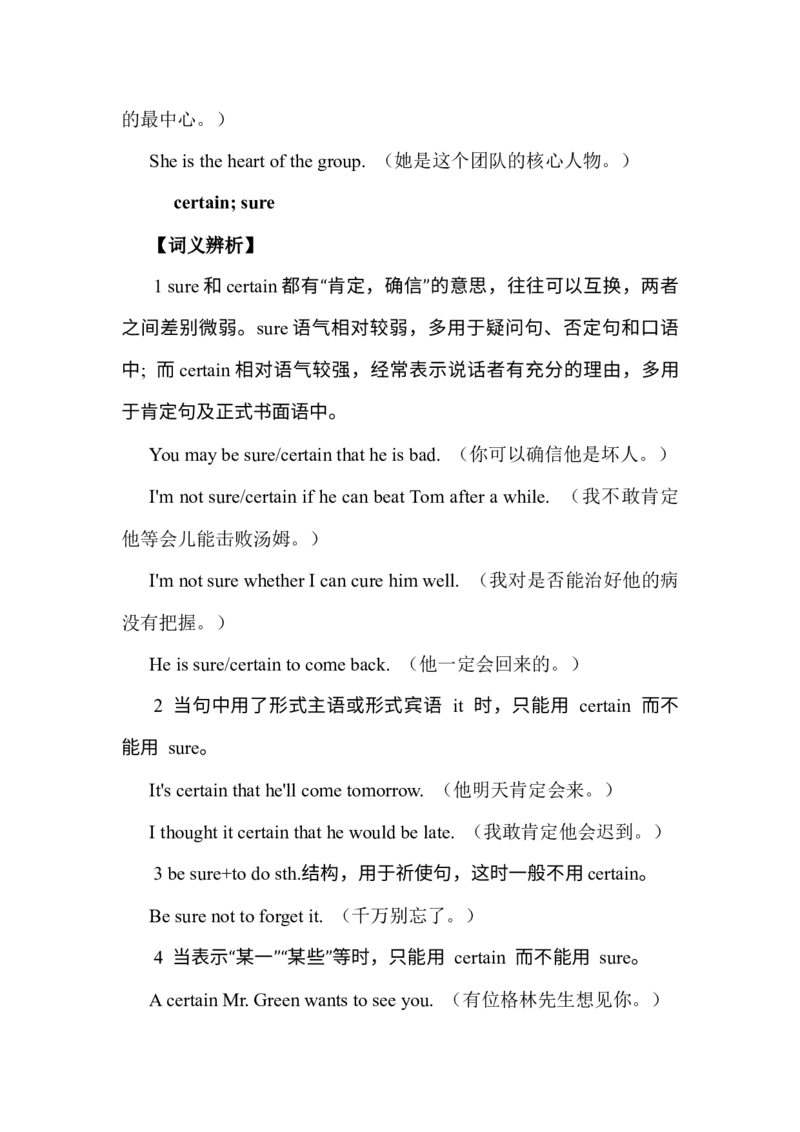
center; middle; heart
【词义辨析】
三者都和“中间”有关系,但用法各异。
1 centre作“中央,中心”讲,通常用于空间方面,强调正中心。
This is the shopping center of the town. (这是这个城市的商业中
心。)
Our home is located at the center of the city. (我们家位于市中
心。)
2 middle 意为“中间”,指两端之间的位置,并不强调中心,既可
用于指空间,也可用于指时间。
The mother sits in the middle of the room. (妈妈坐在屋子的中
间。)
We left in the middle of the film. (电影演了一半我们就离开
了。)
3 heart 指事物最内部或最重要的部分,表地理位置时可与 center
换用。
The sculpture stands in the very heart of Rome. (雕像坐落于罗马的最中心。)
She is the heart of the group. (她是这个团队的核心人物。)
certain; sure
【词义辨析】
1 sure 和 certain 都有“肯定,确信”的意思,往往可以互换,两者
之间差别微弱。sure 语气相对较弱,多用于疑问句、否定句和口语
中; 而 certain 相对语气较强,经常表示说话者有充分的理由,多用
于肯定句及正式书面语中。
You may be sure/certain that he is bad. (你可以确信他是坏人。)
I'm not sure/certain if he can beat Tom after a while. (我不敢肯定
他等会儿能击败汤姆。)
I'm not sure whether I can cure him well. (我对是否能治好他的病
没有把握。)
He is sure/certain to come back. (他一定会回来的。)
2 当句中用了形式主语或形式宾语 it 时,只能用 certain 而不
能用 sure。
It's certain that he'll come tomorrow. (他明天肯定会来。)
I thought it certain that he would be late. (我敢肯定他会迟到。)
3 be sure+to do sth.结构,用于祈使句,这时一般不用certain。
Be sure not to forget it. (千万别忘了。)
4 当表示“某一”“某些”等时,只能用 certain 而不能用 sure。
A certain Mr. Green wants to see you. (有位格林先生想见你。)Certain animals are good at swimming but others are not. (有些动
物擅长游泳,而其他一些则不。)
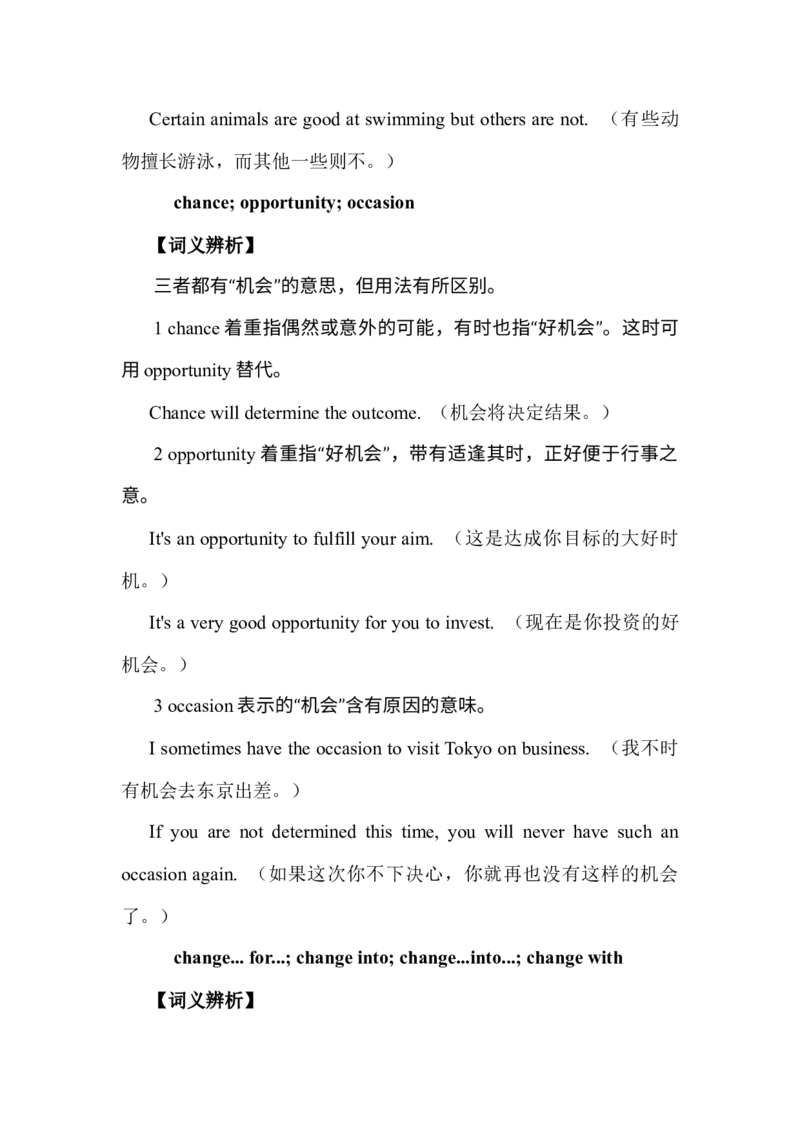
chance; opportunity; occasion
【词义辨析】
三者都有“机会”的意思,但用法有所区别。
1 chance 着重指偶然或意外的可能,有时也指“好机会”。这时可
用opportunity替代。
Chance will determine the outcome. (机会将决定结果。)
2 opportunity 着重指“好机会”,带有适逢其时,正好便于行事之
意。
It's an opportunity to fulfill your aim. (这是达成你目标的大好时
机。)
It's a very good opportunity for you to invest. (现在是你投资的好
机会。)
3 occasion表示的“机会”含有原因的意味。
I sometimes have the occasion to visit Tokyo on business. (我不时
有机会去东京出差。)
If you are not determined this time, you will never have such an
occasion again. (如果这次你不下决心,你就再也没有这样的机会
了。)
change... for...; change into; change...into...; change with
【词义辨析】1 change...for... 的意思是“将……更换为……”,多表示在同一性质
上的变换。
I'd like to change this watch for another. (我想更换另一件相同款
式的手表。)
He wanted to change a big room for two singles. (他想把一个大房
间换成两个单间。)
2 change into的意思是“变成……”,多指自然而然的变化。
When he finished his speech, he changed into a spider man. (当他
讲完话后,立刻变成了一个蜘蛛人。)
3 change...into...的意思是“把……变成……”,多强调人为的因素。
You can't change mud into gold. (你无法使土变成金。)
4 change with的意思是“随着……而变化”。
The sweater changes colors with temperature. (这件毛衣随着温度
的变化而改变颜色。)
A man's character can change with time. (一个人的性格可以随着
时间的推移而改变。)
chat; talk
【词义辨析】
两者都有“说,谈”的意思,但仍有区别。
1 chat 一般指“闲聊”,多用于非正式场合的聊天,常用的词组为
chat with…,意思为“跟某人闲聊”。
My mother often chats with our neighbors on Sundays. (星期天,我妈妈经常跟邻居们聊天。)
The old worker was chatting with his wife when I entered his room.
(当我进入房间时,老工人正在跟他的老伴聊天。)
2 talk 的意思是“交谈,说话”,为不及物动词,后面不直接跟宾
语,一般也指非正式演讲(讲话)”,但比 chat 正式,常用的 talk
with/to sb.意思是“和……谈话”,talk about sth.意思是“谈论某事”。
The teacher often talks with his students. (老师经常找他的学生谈
话。)
They are talking about the accident. (他们正在谈论那个事故。)
cheat; fool
【词义辨析】
两者作动词都有“欺骗”的意思。
1 cheat是指用不诚实或者不正当的手段骗取好处或利益。
The salesman never cheats his customers. (那个推销员从来不欺骗
他的顾客。)
The man cheated the girl that he never got married before. (那个人
欺骗女孩说他以前从来没有结过婚。)
2 fool指把别人当傻瓜捉弄或者愚弄别人以取乐。
On April Fool's Day the students in this class fool each other. (这个
班级里的学生们在愚人节那天互相捉弄。)
Don't fool me, I'm not a child. (不要愚弄我,我不是孩子。)
choose; select; pick【词义辨析】
三者都表示“选择”的意思。
1 choose 用法最广,表示“选择,挑选”,侧重于通过意志或判断
进行的选择。
I choose a computer as my birthday gift. (我选择了一台电脑作为
我的生日礼物。)
He chooses French as his second foreign language. (他选择法语作
为他的第二外语。)
2 select 是“精选”之意,比较正式,不常用于口语中,指从同类
的许多东西中仔细辨别后选 择,挑选最合适的,从而淘汰一部分。
The four astronauts are selected from more than one hundred pilots.
(这四个宇航员是从一百多名飞行员中精心挑选出来的。)
We selected some for seeds. (我们选了一些做种子。)
3 pick 的意思是“挑选,挑拣”,指标准不太严格的选择,表示在
不需要作出重大决定或者不需要进行鉴定的情况下进行选择,多指
挑选有形的东西。
Will you help me pick strawberries? (你帮我挑拣一下草莓好
吗?)
We should pick the right person for the task. (我们必须选出适合
这项工作的人。)
class; course; lecture; lesson
【词义辨析】这四个词都跟“课”或“课程”有关。
1 class指整个课堂,包括老师讲授和学生听讲的全部授课过程,
比如数学课、英语课、物理课等。
The class is over after one hour. (一个小时候后,下课了。)
The students were having a physics class when the earthquake
happened. (地震发生时,学生们正在上物理课。)
2 course 指课程安排,针对某一门或某个专业的全部课程设置,
一般由学校里专门负责课程的部门安排制定,贯穿整个学期或学习
计划。
Usually a course of university will be completed within four years.
(一般来说,大学的课程要在四年之内完成。)
He took up a three-year course in English in middle school. (在中
学,他学了三年的英语课程。)
3 lecture一般为“讲座”的意思,有时也指 “给人上课”。
The professor is giving a lecture. (教授正在作一个讲座。)
He will deliver a lecture to his students this afternoon. (今天下午他
要给学生上一节课。)
4 lesson是指课时本身,所指范围非常小。
We have 4 lessons in the morning. (我们上午有四节课。)
Today let's learn Lesson One. (今天,让我们学习第一课。)
climate; weather
【词义辨析】1 climate 指某地的平均气温或经常性的气候,包括气温,降雨
量,风力等。
The climate of this area is semi-tropical. (这个地区的气候属于半
热带气候。)
The wet climate is not good for people's legs. (潮湿的气候对人们
的腿不利。)
2 weather 指某地在一天内的天气情况,包括阴、晴、雨、雾、
雪等,其前不可加不定冠词。
What will be the weather like tomorrow? (明天的天气如何?)
The weather is changeable in this city. (这个城市的天气变化无
常。)
注意 climate 与 weather 都可以用作比喻意义,都指“环境”、“情
况”,但使用场合有些不同。
The favorable political climate is good for the economic development.
(良好的政治气候有利于经济发展。)
You cannot rely on your friends to help you in all weathers. (你不
要指望你的朋友在各种环境里都能帮助你。)
close; closely
【词义辨析】
两者都可以用作副词。
1 用于本义,表示“接近地”“挨近地”“紧紧地”,两者可互换。
close 通常放在动词之后,但在过去分词之前要用 closely。The mother and her son sat close together. (这对母子紧挨着坐在
一起。)
We are closely followed by a dog. (我们被一只狗紧紧地跟着。)
2 用于引申义,表示“仔细地”或“紧密地”,通常用 closely。可放
在动词之后或之前,或过去分词之前。
The students listened closely while the teacher read. (老师朗读时
学生们仔细地听着。)
His fate was closely connected with his country. (他的命运和他的
祖国紧密相连。)
The secret must be closely guarded. (这个秘密要严加保守。)
close; shut; shut off; turn off
【词义辨析】
四者都有“关,关闭”的意思,但是在不同的场合有不同的意义。
1 close 和shut 都可以表示“关上”的意思。 close 用法最普通,有
时可以和 shut 互换使用,但语气比 shut 弱。close the door (window)
可指把门窗等全关上或半开半闭,而 shut the door (window)则指把门
窗关紧,但是在表示关闭公路、铁路、交通工具或作“结束”讲时,
只能用close。
That hospital closes/ shuts at 10 p.m. (那家医院晚上 10 点钟关
门。)
The airport was closed yesterday for thick fog. (由于大雾,那家机
场昨天关闭了。)She shut the door quickly. (她迅速把门关上。)
2 shut off 和 turn off 都可以用来表示“关上电视、电灯、煤气”之
类,通过旋钮、开关来关的都可用turn off。
Don't forget to turn off all the lights before you go outside. (出门前
不要忘记关掉所有的灯。)
Turn off your mobile before the plane takes off, please. (飞机起飞
前请关掉你的手机。)
clothes; clothing; dress
【词义辨析】
1 clothes 可用作“衣服”的统称,含义比较具体,是一个没有单数
形式的复数名词, 其前不可加不定冠词,也不可加数词,但可以由
限定词his、your、my或the、these、those等来修饰。表示数量时,
常用a suit/two suits of clothes。
He has to buy a good many clothes because he is an actor. (因为他
是演员,所以要买很多衣服。)
There are many new kinds of clothes in the shop. (这个商店里有许
多新式服装。)
2 clothing 也可用作“衣服”的统称,但含义比 clothes 广,比较抽
象,在语体上 clothing 比 clothes 更正式,它是一个集合名词,为
不可数名词,可用量词piece和article表示件数。
They had food and clothing sufficient for their needs. (他们有足够
的食物和衣物满足他们的需要。)The people in the earthquake-affected areas need warm clothing for
the winter. (地震灾区的人们需要暖和的衣服过冬。)
3 dress 含义不如 clothes 和 clothing 广,作服装讲时是不可数名
词,一般指外穿衣着或正式 场合用的盛装;也可以指连衣裙、童装
或特殊服装等,例如工作服working dress,这时是可数名词。
She makes all her own dresses. (她所有的连衣裙都是自己做
的。)
She couldn't afford the dress. (她买不起这件连衣裙。)
【正误比较】
昨天他买了一套衣服。
【错误】 He bought a suit of clothing yesterday.
【正确】 He bought a suit of clothes yesterday.
clue; hint
【词义辨析】
两者都有“线索”或“暗示”的意思,但用法有区别。
1 clue一般用作名词,意思是“线索,提示”。
Police are still looking for clues in their search for the missing boy.
(警方正在搜寻失踪男孩的线索。)
I'm never going to guess the answer if you don't give me a clue. (如
果你不给我提示的话,我永远都不会猜到答案。)
2 hint 可以用作名词和动词,多指“暗示”。
The hostage hinted that the criminal had a gun in his pocket. (人质暗示,罪犯兜里有把枪。)
Did he give you any hints about where he was going? (他向你暗示
过他要去哪吗?)
collect; gather
【词义辨析】
两者都有“收集”的意思,但是含义不同。
1 collect 是指为了研究、爱好或欣赏而进行的整理性质的收集,
侧重于“精心地有选择地收集”。
His work is to collect information about technology from some
countries. (他的工作就是从一些国家搜集科技情报。)
I have collected some stamps. (我收集了一些邮票。)
2 gather 意思是“收集,聚集”。它是表示收集或聚集的一般用
语,指一点点收集或把分散的东西聚集在一起。
He gathered his clothes and food. (他把衣服和食物收集在一
起。)
The clouds gathered together again. (云又很快集结在一起。)
come in; come into; enter
【词义辨析】
三者都有“进来,进入”的意思,但用法有一些区别。
1 come in一般为不及物动词短语,后面不跟宾语。
May I come in? (我可以进来吗?)
When does the train come in? (火车什么时候来?)2 come into为及物动词短语,后面要跟地点名词。
He came into my room without knocking. (他没有敲门就进了我
的房间。)
When you come into the restaurant, you will find us waiting for you.
(你进入饭店后,就 会看到我们在等你。)
3 enter 作及物动词时,相当于 come into 或者 go into。作不及物
动词时,相当于come in或者go in。enter还有“升入大学”的意思。
His son will enter Beijing University this autumn. (今年秋天他的
儿子就要进入北大读书。)
The train entered a tunnel. (那列火车进入了隧道。)
come to do; get to do
【词义辨析】
两者都有“渐渐地做,终于做”之意,表示一种逐渐变化的过程。
1 come to do 一般用来表示一个连续性的动作,指慢慢达到对某
事物的认识、理解、相信等境界。
We came to know the old man well. (我们渐渐了解了这个老
人。)
We'll assign some tasks to the employees once we come to know them
well. (当我们开始了解这些雇员时,我们会分配给他们任务。)
He came to love the city at last. (最后他爱上了这个城市。)
2 get to do 指“开始感觉到、认识、成为”, 一般用来表示一个瞬
间性的动作。How did you get to realize you were wrong at that time? (那时候你
是怎么意识到自己错了的?)
I got to realize it before school age. (在学龄前我就意识到了这件
事。)
common; general; ordinary
【词义辨析】
三者都含有“普通的,平常的”意思,但用法各异。
1 common 强调“常见的,不足为奇的,共同的,公共的”的意
思,指某一事物经常在许多地方出现或发生,可引申为“平凡”之
意。
Snow is common in cold countries. (在寒冷的国家下雪是很常见
的。)
Rose is a common flower in this country. (玫瑰在这个国家是很常
见的花。)
2 general是指“普遍的,整体的,一般的”。
What is your general impression about the country? (你对这个国
家的总体印象如何?)
Give me a general idea of the work. (把你对这项工作的整体想法
讲给我听听。)
3 ordinary强调“平常的,平淡无奇的”。
His speech is just ordinary. (他的演说平淡乏味。)
It is a very ordinary day today. (今天是很平常的一天。)