文档文本内容
高中英语重难点词汇辨析汇总(讲义)
Lesson 23 词汇 Q-R
词汇Q
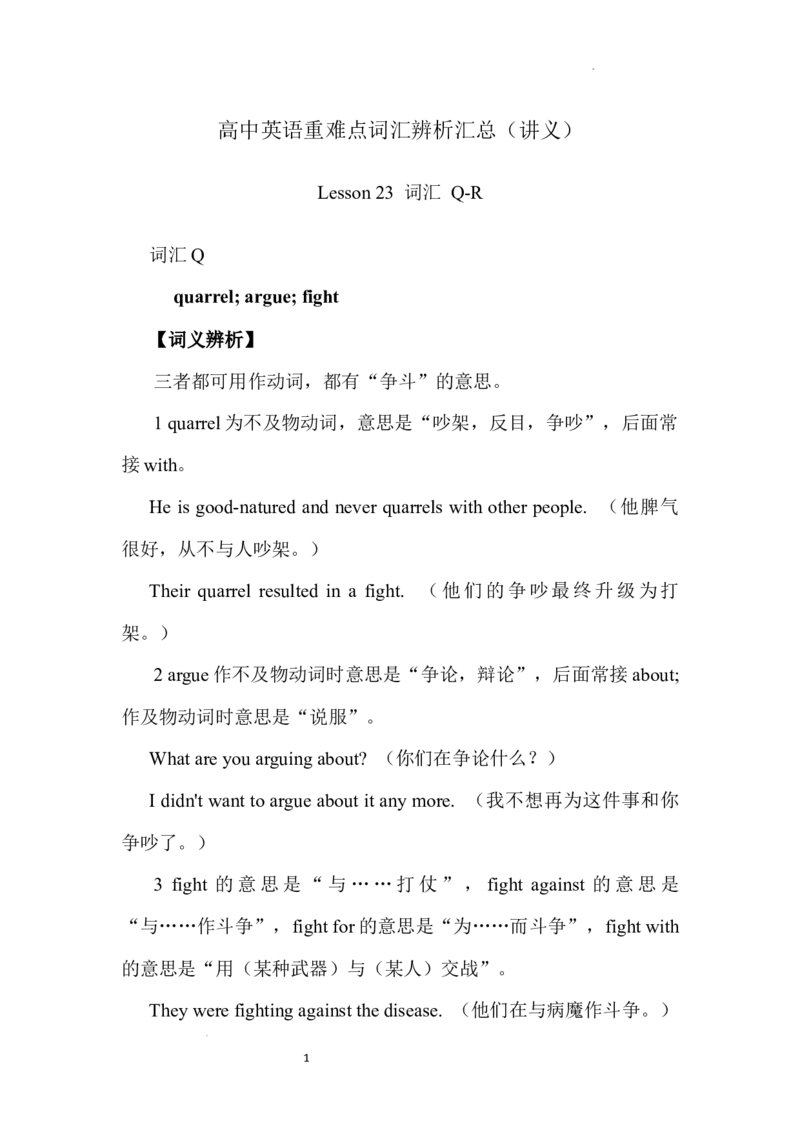
quarrel; argue; fight
【词义辨析】
三者都可用作动词,都有“争斗”的意思。
1 quarrel为不及物动词,意思是“吵架,反目,争吵”,后面常
接with。
He is good-natured and never quarrels with other people. (他脾气
很好,从不与人吵架。)
Their quarrel resulted in a fight. (他们的争吵最终升级为打
架。)
2 argue作不及物动词时意思是“争论,辩论”,后面常接 about;
作及物动词时意思是“说服”。
What are you arguing about? (你们在争论什么?)
I didn't want to argue about it any more. (我不想再为这件事和你
争吵了。)
3 fight 的意思是“与……打仗”, fight against 的意思是
“与……作斗争”,fight for的意思是“为……而斗争”,fight with
的意思是“用(某种武器)与(某人)交战”。
They were fighting against the disease. (他们在与病魔作斗争。)
1
学科网(北京)股份有限公司They fought for their freedom. (他们为自由而战。)
We fight with guns. (我们用枪打仗。)
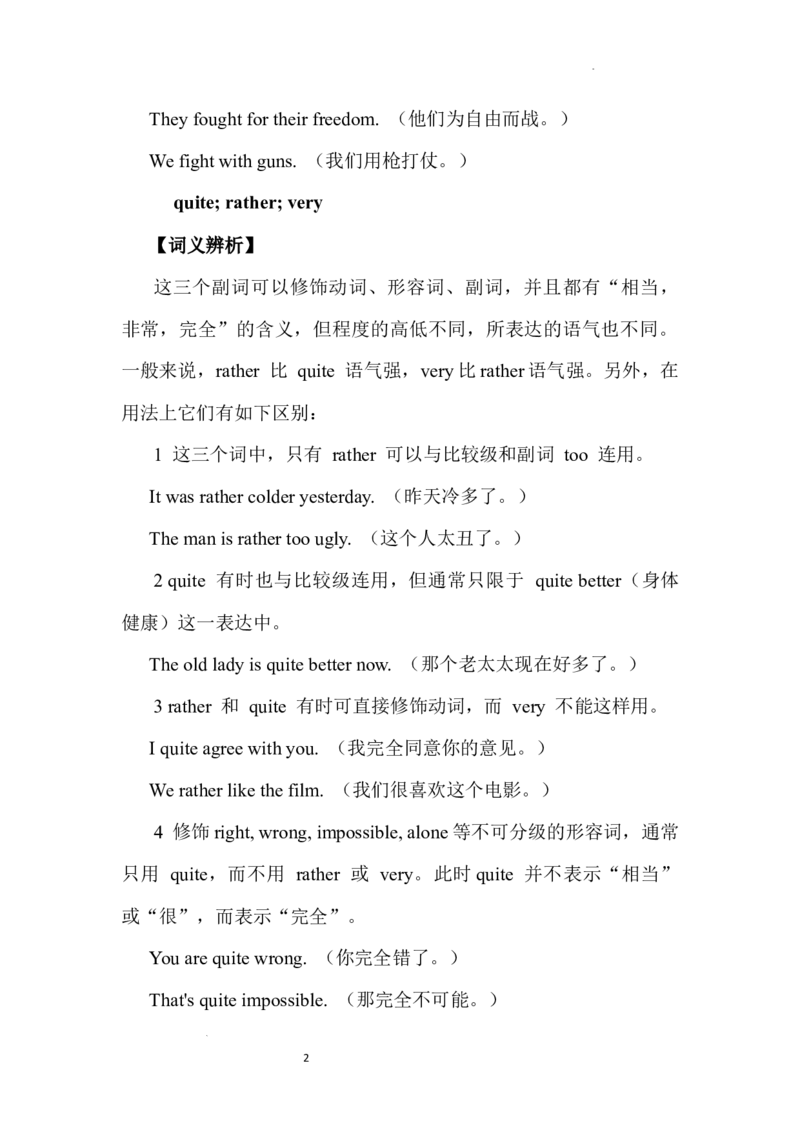
quite; rather; very
【词义辨析】
这三个副词可以修饰动词、形容词、副词,并且都有“相当,
非常,完全”的含义,但程度的高低不同,所表达的语气也不同。
一般来说,rather 比 quite 语气强,very比rather语气强。另外,在
用法上它们有如下区别:
1 这三个词中,只有 rather 可以与比较级和副词 too 连用。
It was rather colder yesterday. (昨天冷多了。)
The man is rather too ugly. (这个人太丑了。)
2 quite 有时也与比较级连用,但通常只限于 quite better(身体
健康)这一表达中。
The old lady is quite better now. (那个老太太现在好多了。)
3 rather 和 quite 有时可直接修饰动词,而 very 不能这样用。
I quite agree with you. (我完全同意你的意见。)
We rather like the film. (我们很喜欢这个电影。)
4 修饰right, wrong, impossible, alone 等不可分级的形容词,通常
只用 quite,而不用 rather 或 very。此时 quite 并不表示“相当”
或“很”,而表示“完全”。
You are quite wrong. (你完全错了。)
That's quite impossible. (那完全不可能。)
2
学科网(北京)股份有限公司词汇R
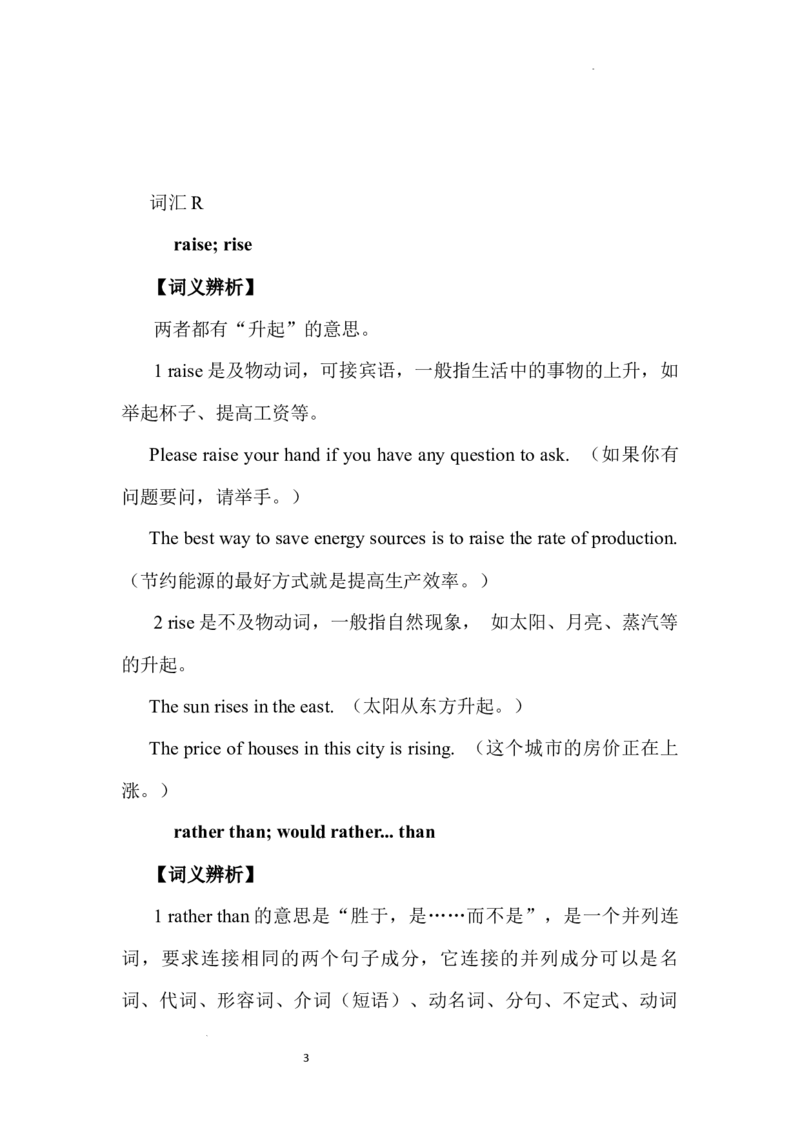
raise; rise
【词义辨析】
两者都有“升起”的意思。
1 raise是及物动词,可接宾语,一般指生活中的事物的上升,如
举起杯子、提高工资等。
Please raise your hand if you have any question to ask. (如果你有
问题要问,请举手。)
The best way to save energy sources is to raise the rate of production.
(节约能源的最好方式就是提高生产效率。)
2 rise是不及物动词,一般指自然现象, 如太阳、月亮、蒸汽等
的升起。
The sun rises in the east. (太阳从东方升起。)
The price of houses in this city is rising. (这个城市的房价正在上
涨。)
rather than; would rather... than
【词义辨析】
1 rather than 的意思是“胜于,是……而不是”,是一个并列连
词,要求连接相同的两个句子成分,它连接的并列成分可以是名
词、代词、形容词、介词(短语)、动名词、分句、不定式、动词
3
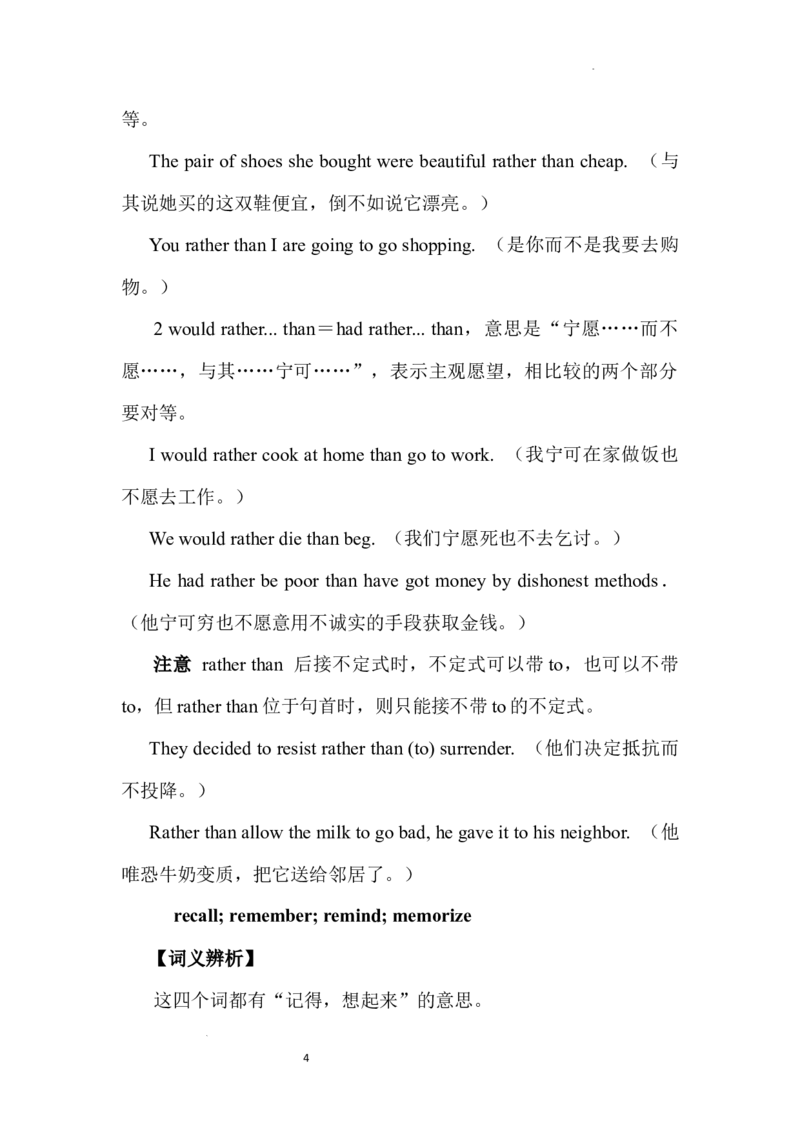
学科网(北京)股份有限公司等。
The pair of shoes she bought were beautiful rather than cheap. (与
其说她买的这双鞋便宜,倒不如说它漂亮。)
You rather than I are going to go shopping. (是你而不是我要去购
物。)
2 would rather... than=had rather... than,意思是“宁愿……而不
愿……,与其……宁可……”,表示主观愿望,相比较的两个部分
要对等。
I would rather cook at home than go to work. (我宁可在家做饭也
不愿去工作。)
We would rather die than beg. (我们宁愿死也不去乞讨。)
He had rather be poor than have got money by dishonest methods.
(他宁可穷也不愿意用不诚实的手段获取金钱。)
注意 rather than 后接不定式时,不定式可以带 to,也可以不带
to,但rather than位于句首时,则只能接不带to的不定式。
They decided to resist rather than (to) surrender. (他们决定抵抗而
不投降。)
Rather than allow the milk to go bad, he gave it to his neighbor. (他
唯恐牛奶变质,把它送给邻居了。)
recall; remember; remind; memorize
【词义辨析】
这四个词都有“记得,想起来”的意思。
4
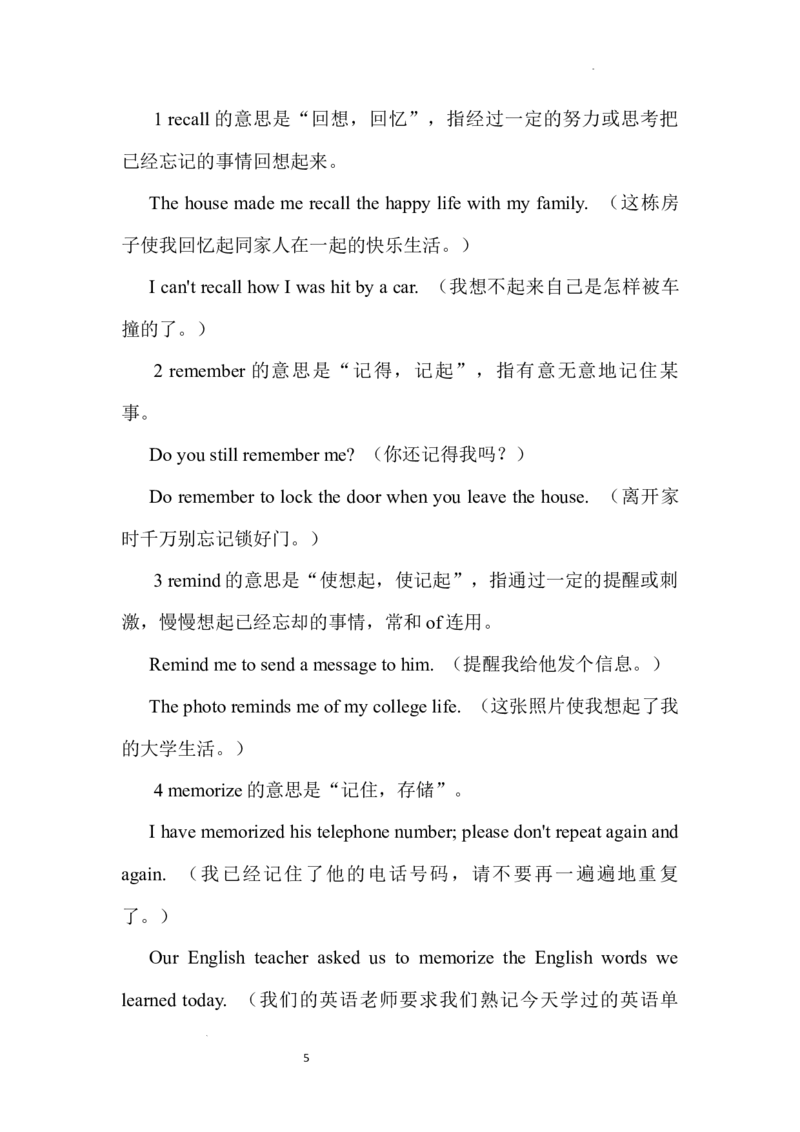
学科网(北京)股份有限公司1 recall 的意思是“回想,回忆”,指经过一定的努力或思考把
已经忘记的事情回想起来。
The house made me recall the happy life with my family. (这栋房
子使我回忆起同家人在一起的快乐生活。)
I can't recall how I was hit by a car. (我想不起来自己是怎样被车
撞的了。)
2 remember 的意思是“记得,记起”,指有意无意地记住某
事。
Do you still remember me? (你还记得我吗?)
Do remember to lock the door when you leave the house. (离开家
时千万别忘记锁好门。)
3 remind的意思是“使想起,使记起”,指通过一定的提醒或刺
激,慢慢想起已经忘却的事情,常和of连用。
Remind me to send a message to him. (提醒我给他发个信息。)
The photo reminds me of my college life. (这张照片使我想起了我
的大学生活。)
4 memorize的意思是“记住,存储”。
I have memorized his telephone number; please don't repeat again and
again. (我已经记住了他的电话号码,请不要再一遍遍地重复
了。)
Our English teacher asked us to memorize the English words we
learned today. (我们的英语老师要求我们熟记今天学过的英语单
5
学科网(北京)股份有限公司词。)
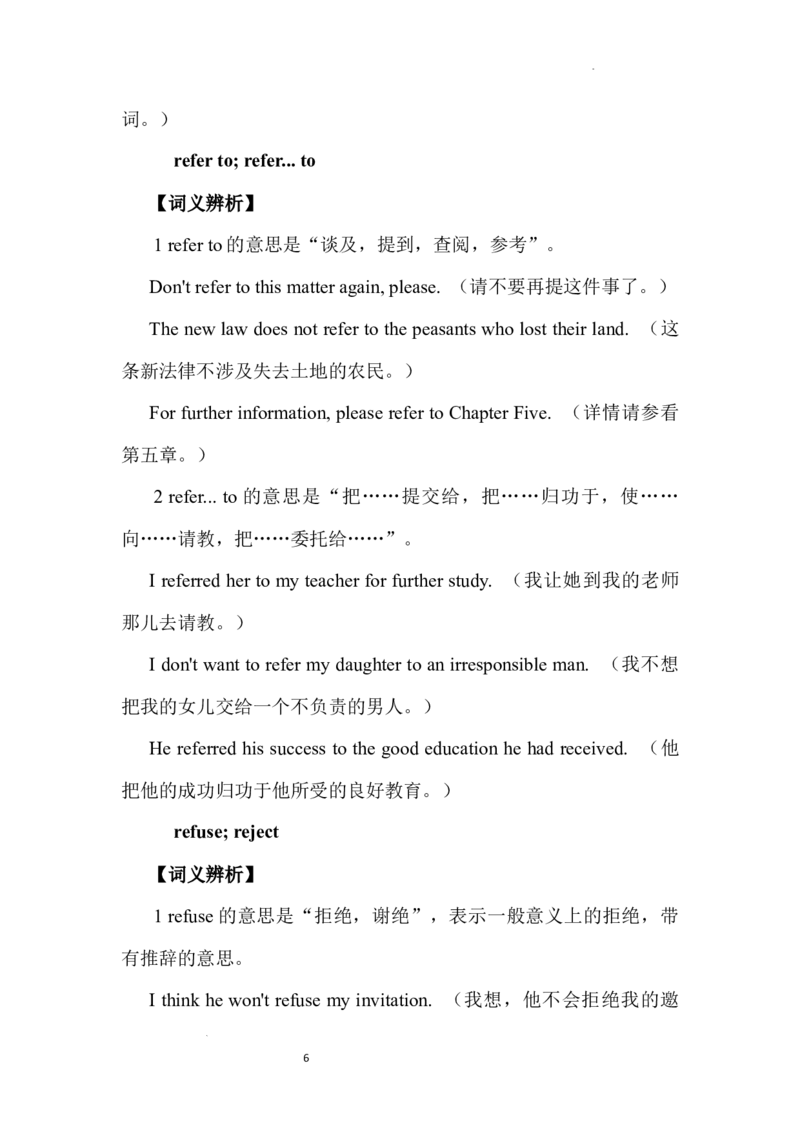
refer to; refer... to
【词义辨析】
1 refer to的意思是“谈及,提到,查阅,参考”。
Don't refer to this matter again, please. (请不要再提这件事了。)
The new law does not refer to the peasants who lost their land. (这
条新法律不涉及失去土地的农民。)
For further information, please refer to Chapter Five. (详情请参看
第五章。)
2 refer... to 的意思是“把……提交给,把……归功于,使……
向……请教,把……委托给……”。
I referred her to my teacher for further study. (我让她到我的老师
那儿去请教。)
I don't want to refer my daughter to an irresponsible man. (我不想
把我的女儿交给一个不负责的男人。)
He referred his success to the good education he had received. (他
把他的成功归功于他所受的良好教育。)
refuse; reject
【词义辨析】
1 refuse 的意思是“拒绝,谢绝”,表示一般意义上的拒绝,带
有推辞的意思。
I think he won't refuse my invitation. (我想,他不会拒绝我的邀
6
学科网(北京)股份有限公司请。)
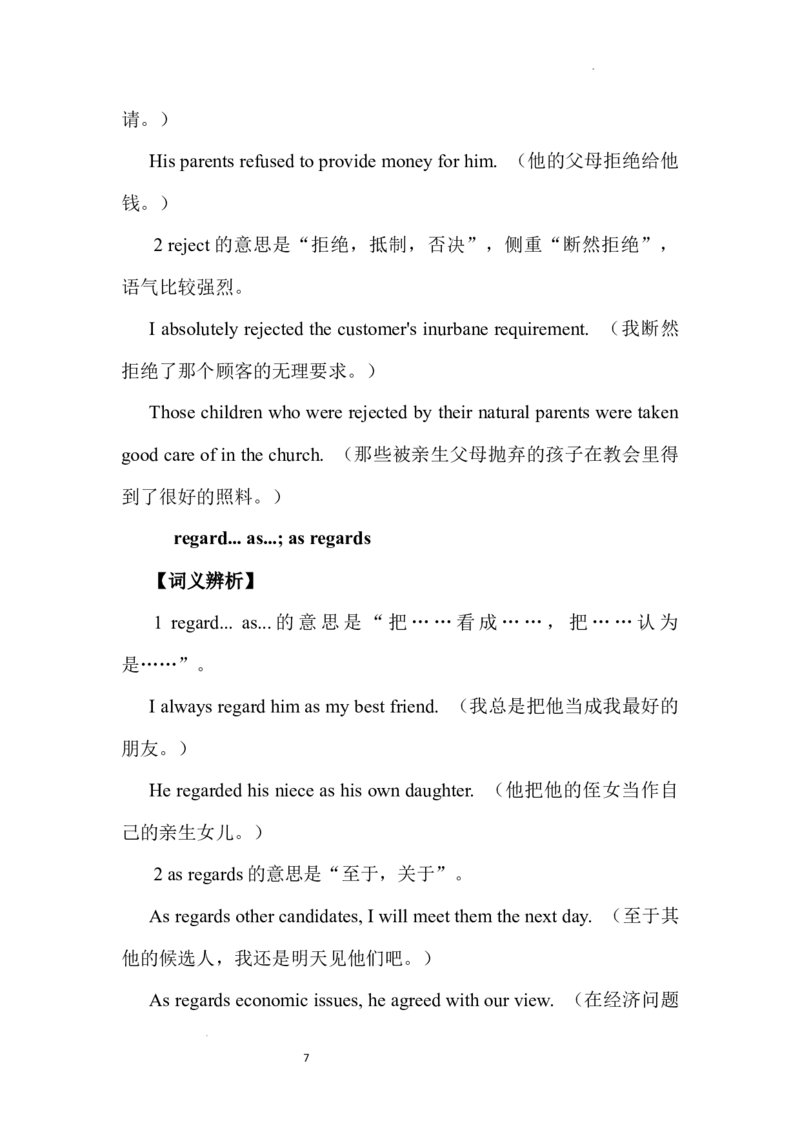
His parents refused to provide money for him. (他的父母拒绝给他
钱。)
2 reject 的意思是“拒绝,抵制,否决”,侧重“断然拒绝”,
语气比较强烈。
I absolutely rejected the customer's inurbane requirement. (我断然
拒绝了那个顾客的无理要求。)
Those children who were rejected by their natural parents were taken
good care of in the church. (那些被亲生父母抛弃的孩子在教会里得
到了很好的照料。)
regard... as...; as regards
【词义辨析】
1 regard... as...的意思是“把……看成……,把……认为
是……”。
I always regard him as my best friend. (我总是把他当成我最好的
朋友。)
He regarded his niece as his own daughter. (他把他的侄女当作自
己的亲生女儿。)
2 as regards的意思是“至于,关于”。
As regards other candidates, I will meet them the next day. (至于其
他的候选人,我还是明天见他们吧。)
As regards economic issues, he agreed with our view. (在经济问题
7
学科网(北京)股份有限公司上,他同意我们的看法。)
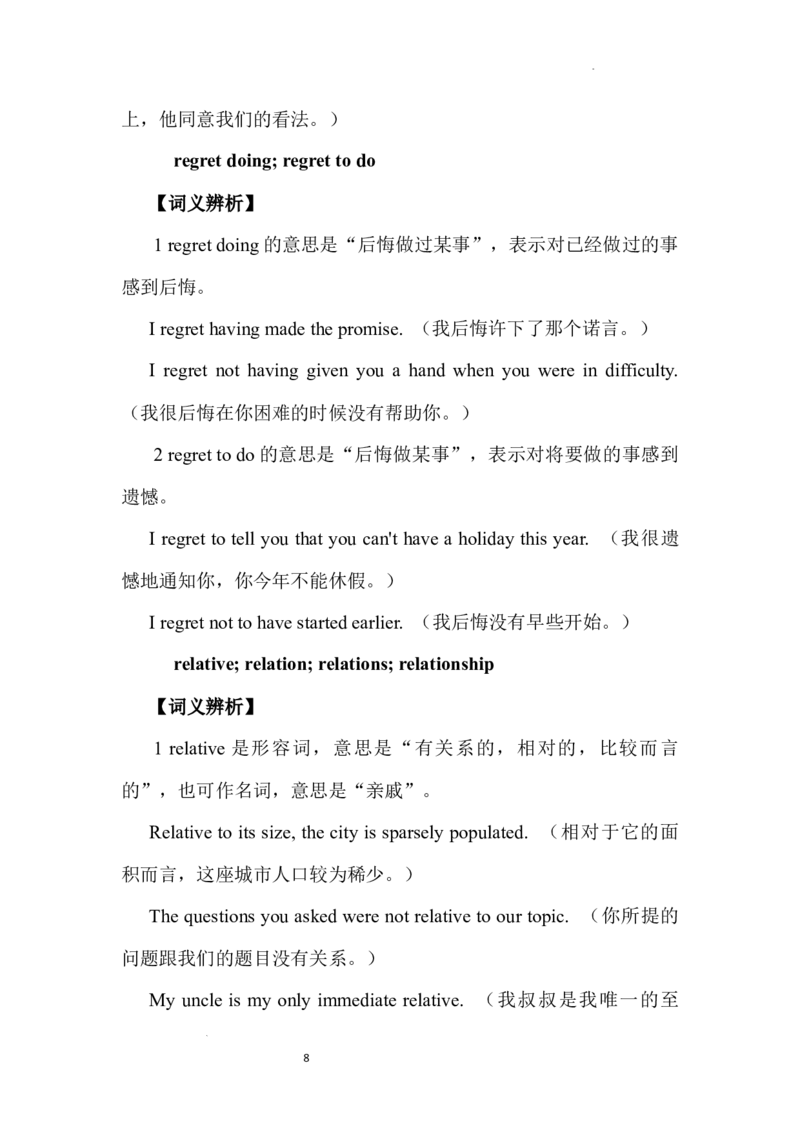
regret doing; regret to do
【词义辨析】
1 regret doing的意思是“后悔做过某事”,表示对已经做过的事
感到后悔。
I regret having made the promise. (我后悔许下了那个诺言。)
I regret not having given you a hand when you were in difficulty.
(我很后悔在你困难的时候没有帮助你。)
2 regret to do 的意思是“后悔做某事”,表示对将要做的事感到
遗憾。
I regret to tell you that you can't have a holiday this year. (我很遗
憾地通知你,你今年不能休假。)
I regret not to have started earlier. (我后悔没有早些开始。)
relative; relation; relations; relationship
【词义辨析】
1 relative 是形容词,意思是“有关系的,相对的,比较而言
的”,也可作名词,意思是“亲戚”。
Relative to its size, the city is sparsely populated. (相对于它的面
积而言,这座城市人口较为稀少。)
The questions you asked were not relative to our topic. (你所提的
问题跟我们的题目没有关系。)
My uncle is my only immediate relative. (我叔叔是我唯一的至
8
学科网(北京)股份有限公司亲。)
2 relation 的意思是“关系,联系,叙述”,是不可数名词,侧
重事物之间的联系。
The good relation between employees and the boss is helpful in
improving work efficiency. (员工和老板之间的良好关系有助于提高
工作效率。)
The bad relation between his mother and his wife makes him bored.
(他妈妈和他妻子之间的不和令他很烦恼。)
3 relations 的意思是“关系,联系”,侧重团体、国家之间的关
系、联系或交往。
The relations between our nation and other parts of the world have
greatly improved. (我国和世界上其他国家的关系得到了很大的改
善。)
The two countries break off their diplomatic relations because of the
island dispute. (由于岛屿纷争,两国断绝了外交关系。)
4 relationship的意思是“关系,关联”,用法比较正式,常用于
法律上或人与人、国与国之间的关系。
He has a close relationship with his brothers and sisters. (他和他的
兄弟姐妹之间关系亲密。)
remain; stay
【词义辨析】
两者都有“留下,逗留”的意思。
9
学科网(北京)股份有限公司1 remain较为正式,暗指待在原地或保持原来的形状或状态,只
能用作不及物动词,没有被动形式,不能带宾语。主语可以是人,
也可以是物。
In winter many birds remain in this city. (冬季,有很多鸟留在这
个城市。)
Some historic relics still remain in the city. (这座城市里仍留有一
些古迹。)
The father told the son to remain at home until he came back. (父亲
要儿子待在家里等他回来。)
2 stay 常用于口语中,指某人逗留在某一场所,也可指来访或做
客时暂住,主语一般是人。
We stayed at home all evening. (我们整晚待在家里。)
He stayed with his father while he was ill. (当他生病时,他和父
亲待在一块儿。)
remark; comment
【词义辨析】
1 remark的意思是“备注,评论,注意,注释”,常用来表示一
种比较简短的评论。
They made rude remarks about her dress. (他们对她的着装作了无
礼的评论。)
Their remark to his words made him angry. (他们对他的话的评论
令他很生气。)
10
学科网(北京)股份有限公司2 comment的意思是“评论,注释,意见”,常用来强调一种不
同意见或争论。
What's your comment about his behavior? (你对他的行为有何评
价?)
I made no comments on his proposal. (我对他的建议没有作评
论。)
remember doing; remember to do
【词义辨析】
1 remember doing 的意思是“记得做过某事”,表示这件事情已
经做了。
I remember calling him before. (我记得以前给他打过电话。)
I remember having posted the letter. (我记得把那封信寄出去
了。)
2 remember to do 的意思是“记住要去做某事”,表示动作尚未
发生。
Remember to take your son to the school. (记住带你的儿子去学
校。)
Remember to buy some milk after work. (下班后记得去买牛
奶。)
【正误比较】 在你离开房间之前,记得把灯关了。
【错误】 Remember tuning off the lights when you leave the room.
【正确】 Remember to turn off the lights when you leave the room.
11
学科网(北京)股份有限公司repair; fix; mend
【词义辨析】
三者都有“修理”的意思。
1 repair 常指损失重大或构造较复杂的事物,如房屋、汽车、桥
梁、自行车等的修理,也可指修鞋。
The house has been out of repair. (这幢房子年久失修。)
I am going to have my bike repaired tomorrow. (我打算明天找人
把自行车修理一下。)
2 fix 的意思是“使固定,安装装置,修理”,是非正式用语,
侧重检修或调整。
The workers are fixing the machine. (工人们在安装机器。)
Have you had your computer fixed? (你已找人修理你的电脑了
吗?)
3 mend 着重指修补,可以用来表示对打破、撕破、穿破的物品
或衣服进行修理或修补,也可以表示治愈创伤、矫正过错或使破裂
的感情重归于好。
Can you mend the hole in my shirt? (你能补一下我衬衫上的洞
吗?)
The workmen are mending the road. (工人们正在修路。)
They devoted to mending the relation between the two countries.
(他们致力于改善两国关系。)
注意 有一些动作需要别人来完成,要使用 have sth. done 句型,
12
学科网(北京)股份有限公司例如理发、修车、拔牙等。
I will have my hair cut tomorrow. (我明天要理发。)
She will have her house painted. (她要找人刷墙。)
respectable; respectful; respective
【词义辨析】
1 respectable的意思是“可敬的,有名望的,高尚的”。
He is a respectable teacher. (他是一位令人尊敬的老师。)
Hundreds of candidates applied for the respectable position in the
government. (许多人申请较为体面的政府机关工作。)
2 respectful 表示主动含义,意思是“恭敬的,尊敬的,尊重人
的,有礼貌的”。
Many people are respectful to the policeman. (许多人对那个警察
很尊敬。)
He is always respectful to the aged. (他一贯尊重老人。)
3 respective的意思是“各自的”。
The students went to their respective homes when the class was over.
(放学了,学生们回到各自的家。)
They are reading their respective books. (他们在读各自的书。)
result in; result from
【词义辨析】
1 result in的意思是“导致”。
The earthquake resulted in the death of more than two thousand
13
学科网(北京)股份有限公司people. (这次地震造成两千多人死亡。)
The conflict resulted in the breaking out of the war. (冲突最后导致
战争的爆发。)
2 result from的意思是“由……产生”。
His death resulted from malnutrition. (他的死是由营养不良引起
的。)
His failure resulted from not working hard enough. (他的失败是工
作不够努力造成的。)
reward; award
【词义辨析】
1 reward的意思是“报酬,奖金”。
We don't expect substantial rewards. (我们并不期望得到优厚的报
酬。)
I gave the reward of the month to my wife. (我把月度奖金给了我
妻子。)
2 award 的意思是“奖,奖品”,既可以作名词,也可以作动
词。
He won the first award of $1,000. (他获得了 1 000 美元的一等
奖。)
The teacher awarded prizes to the winners. (老师给获胜者颁
奖。)
room; space; place
14
学科网(北京)股份有限公司【词义辨析】
三者都有“空间”的意思。
1 room 表示人或物体所占的“空间或场所”,是不可数名词,
可用 little, much, no, plenty 等词修饰;也可用作可数名词,意思是
“房间”。
How many rooms do you have in your house? (你家有几间屋
子?)
The large table takes up too much room. (这张大桌子太占地方
了。)
2 space 的意思是“空白,间隔,空格键,太空,宇宙”等,是
不可数名词。
There is no space for another table in this room. (这房间没有再放
一张桌子的空地了。)
People have travelled through space to the moon. (人们已经穿越
太空登上了月球。)
3 place 的意思是“地方,地点,位置”, 一般指具体在哪个地
点。
Where is your birth place? (你的出生地在哪里?)
His home is in a place nearby. (他家就在附近某个地方。)
The right place for the books is the shelf. (书应该放在架子上。)
rubbish; garbage; trash; waste
【词义辨析】
15
学科网(北京)股份有限公司四者都有“垃圾”的意思。
1 rubbish的意思是“垃圾,废物,废话”,一般指废料或没有用
了可以收集起来处理的废物,如报纸等,也可指愚蠢的言语和思
想。
The dustman comes twice a day to collect the rubbish. (清洁工每
天来收两次垃圾。)
Will you take the rubbish away? (你能把垃圾带走吗?)
What he said is sheer rubbish. (他所说的全是废话。)
2 garbage的意思是“垃圾,废物”,有时也指骂人的话。
The old man collected the garbage from a restaurant to feed the pigs.
(那个老人从一家饭店收集剩菜剩饭喂猪。)
Their advice turned out to be nothing but garbage. (他们的意见仅
仅是废话。)
Please take the garbage out of the kitchen, it smells!(请把垃圾从厨
房拿出去,真难闻!)
3 trash的意思是“垃圾,废物”,一般指小型无价值的杂物,或
没有价值的作品。
Please throw the trash into the garbage can. (请把垃圾扔到垃圾筒
里。)
I told my son not to read that trash. (我叫我的儿子不要读那种蹩
脚作品。)
4 waste 的意思是“废物”,用法最广,可指一切被遗弃的东
16
学科网(北京)股份有限公司西。
Industrial waste is poured into the river. (工业废弃物被倒入河
里。)
Don't be worried. It's just a kind of waste. (不要担心,那只是一
种垃圾。)
run out; run out of
【词义辨析】
1 run out的意思是“跑出,离开,完成,被用完”等,是不及物
动词短语,后面不能加宾语,也没有被动语态。
Our supplies finally ran out. (我们的供给终于耗尽了。)
Time is running out. (时间快到了。)
My ink has run out. (我的墨水用光了。)
2 run out of的意思是“用完,耗尽,缺乏”,是及物动词短语,
后面可接宾语,也有被动语态,还可用于进行时。
We are running out of edible oil. (我们的食用油快吃完了。)
He has run out of money before his wedding ceremony. (他在婚礼
之前就把钱花光了。)
Her money has been run out. (她的钱花光了。)
17
学科网(北京)股份有限公司