文档文本内容
Ⅰ.阅读单词——会意
1.maple n.枫树,槭树
2.pudding n.布丁
3.black pudding血肠,黑香肠
4.snack n.(正餐以外的)小吃,点心
5.cuisine n.烹饪(法)
6.spicy adj.(食物)加有香料的,辛辣的
7.hot pot火锅
8.butcher n.肉贩
9.bacon n.(通常切成薄片的)咸猪肉,熏猪肉
10.sausage n.香肠
11.toast n.烤面包(片),吐司
12.butter n.黄油,牛油
13.roast n.大块烤肉 adj.烤好的,烤制的
14.stinky adj.难闻的,有臭味的
15.cheese n.干酪,奶酪
16.someday adv.将来会有一天,有朝一日
17.china n.瓷,瓷料
18.tender adj.嫩的,软的
19.steak n.牛排
20.sauce n.调味汁,酱汁
21.vegetarian adj.(全是)蔬菜的,没有肉类的
22.bakery n.面包店,糕饼店
23.creamy adj.似奶油的,软厚平滑的,光滑细软的
24.acid n.酸
25.yoghurt n.酸乳,酸奶26.homemade adj.自制的,家里做的
27.chef n.厨师
28.recipe n.烹饪法,食谱
29.breast n.(禽类的)胸脯肉
30.onion n.洋葱(头)
Ⅱ.重点单词——记形
1.dare modal verb胆敢,敢于
2.wedding n.婚礼
3.sort n.种,类
4.super adj.极好的,了不起的
5.typical adj.典型的,有代表性的
6.gather v.聚集
7.bite n.咬
8.symbol n.象征,标志
9.opinion n.意见,看法
10.download v.下载(信息或程序)
11.diet n.日常饮食
12.tip n.指点,建议
13.custom n.风俗,习惯,传统
14.manners n.礼貌,礼仪
15.trick n.诀窍,技巧,技法
16.plate n.盘,碟
17.handle n.柄,把手
18.slightly adv.略微,稍微
19.incredibly adv.极端地,非常地
20.bitter adj.苦的,有苦味的
21.attack v.侵袭,侵蚀 n.攻击,进攻
22.within prep.在……里
23.lifestyle n.生活方式
24.swing v.(使)(前后)摆动,(使)摇摆
25.honey n.蜂蜜
26.blog v.写博客 n.博客,网络日志
27.ranking n.排行,排名
28.salty adj.含盐的,咸的
29.sour adj.酸(味)的Ⅲ.拓展单词——悉变
1.marriage n.婚姻→marry v.结婚→married adj.结婚的;已婚的
2.suffer v.(身体或精神上)受苦→suffering n.苦难
3.horrible adj.糟糕的→horribly adv.可怕地;非常地→horror n.畏惧;憎恶;震惊
4.poison n.毒素,毒物,毒药 v.毒害;下毒→poisonous adj.有毒的
5.function n.(事物的)功能;作用→functional adj.实用的;功能的
6.related adj.有关系的,相关的→relate v.与……有联系,相关联;叙述→relative n.亲
戚→relation n.关系→relationship n.关系
7.addict n.对……着迷的人→addicted adj.入迷的;上瘾的→addiction n.上瘾,沉溺
8.differ v.不同,不一样,有区别→different adj.不同的→difference n.区别,差异
9.recommend v.推荐→recommendation n.推荐,建议;推荐信
10.belong v.属于→belongings n.所有物;财产
11.construction n.建造,建筑→construct v.建造,建筑→reconstruct v.重建,再建
12.satisfying adj.令人高兴的,令人满意的→satisfy v.使满意,使满足→satisfied adj.感到
满意的→satisfaction n.满意
13.convenient adj.方便的,便利的→inconvenient adj.不方便的→conveniently adv.方便地,
便利地→convenience n.便利,方便
14.identify v.确定,发现→identification n.鉴定,识别
15.originally adv.原先,最初→original adj.原先的,最初的 n.原件;原作→origin n.起
源
16.official n.官员,高级职员→office n.办公室→officer n.军官
17.resist v.忍住,按捺→resistance n.抵制;反对;抗拒→resistant adj.抵抗的;有抵抗
力的
18.adapt v.(使)适应;(使)适合→adaptation n.适应;适合;改编本→adaptable adj.能适
应的
1.adjacent /ə'dʒeIsnt/ adj.与……毗邻的;邻近的
2.shed /ʃed/ n.简易房;工棚;库房 vt.去除;摆脱;使掉下
3.sparkling /'spɑːklIŋ/ adj.闪烁的;闪耀的;起泡的
4.dull /dʌl/ adj.沉闷的;乏味的;迟钝的
5.grave /ɡreIv/ adj.庄严的;表情沉重的;严重的 n.坟墓;逝世
6.glow /ɡləʊ/ vi.发出暗淡的光;(人体或脸因运动或情绪影响)发热 n.暗淡的光;满面红
光
7.gleam /ɡliːm/ vi.闪烁;显得光洁明亮;流露出
8.blazing /'bleIzIŋ/ adj.酷热的;炙热的9.portray /pɔː'treI/ vt.表现;描绘
10.acquaintance /ə'kweIntəns/ n.认识的人;熟人
Ⅳ.背核心短语
1.in case以防万一
2.belong to属于
3.end up (尤指经历一系列意外后)最终处于,到头来
4.catch up打听(不在时所发生的事情),别后叙谈
5.pick up买,购买
6.deal with处理;应付
7.take to doing 开始喜欢,对……有好感
8.traditional Chinese medicine 传统中医药
9.suffer from遭受,忍受
10.come across偶遇,遇到
11.remind...of 提醒,使想起
12.feel at home with感觉自在
13.had better 最好
14.bring up抚养;培养;教育;养育;提出
15.try out试用,试验
Ⅴ.悟经典句式
1.Growing up in England with a British father and a Chinese mother,I’ve enjoyed food
from both countries ever since I was able to hold a knife and fork—and chopsticks!(v.-ing短语作
状语)
我在英国长大,父亲是英国人,母亲是中国人,自从我能拿起刀叉——还有筷子,我就一直
在享受来自这两个国家的食物!
2.We all love roast beef and vegetables,but Mum says we’d better not eat too much roast food
as it may make us suffer from heat inside our bodies ,according to traditional Chinese
medicine.(as引导原因状语从句)
我们都喜欢烤的牛肉和蔬菜,但妈妈说最好不要吃太多烧烤食物,因为根据传统中医的说法,
这会引起上火。
3.My fridge is usually half empty and I’m often too tired to eat much anyway.(too...to...)
我的冰箱通常是半空的,反正我也经常累得吃不下多少。
4.As a doctor,I know I had better change the way I eat,but I just don’t have the time or the
energy right now.(way作先行词的定语从句)
作为一名医生,我知道我最好改变我的饮食方式,但我现在完全没有时间和精力。
5.Cooking together gives us a chance to relax and catch up on each other’s days.(v.-ing短语
作主语)一起做饭给了我们一个放松的机会,也让我们有机会聊聊彼此日常的情况。
Ⅰ.阅读单词(每小题1分,共10分)
1.snack n. ( 正餐以外的 ) 小吃,点心
2.spicy adj. ( 食物 ) 加有香料的,辛辣的
3.roast n.大块烤肉 adj.烤好的,烤制的
4.stinky adj.难闻的,有臭味的
5.someday adv.将来会有一天,有朝一日
6.china n.瓷,瓷料
7.tender adj.嫩的,软的
8.vegetarian adj. ( 全是 ) 蔬菜的,没有肉类的
9.homemade adj.自制的,家里做的
10.recipe n.烹饪法,食谱
Ⅱ.重点单词(每小题1分,共10分)
1.typical adj.典型的,有代表性的
2.gather v.聚集
3.symbol n.象征,标志
4.diet n.日常饮食
5.tip n.指点,建议
6.custom n.风俗,习惯,传统
7.trick n.诀窍,技巧,技法
8.attack v.侵袭,侵蚀 n.攻击;进攻
9.lifestyle n.生活方式
10.salty adj.含盐的,咸的
Ⅲ.拓展单词(每小题1.5分,共15分)
1.suffer v.(身体或精神上)受苦→suffering n.苦难
2.poison n.毒素,毒物,毒药 v.毒害;下毒→poisonous adj.有毒的
3.function n.(事物的)功能;作用→functional adj.实用的;功能的
4.related adj.有关系的,相关的→relate v.与……有联系,相关联;叙述→relative n.亲
戚→relation n.关系→relationship n.关系
5.official n.官员,高级职员→office n.办公室→officer n.军官
6.belong v.属于→belongings n.所有物;财产
7.construction n.建造,建筑→construct v.建造,建筑→reconstruct v.重建,再建
8.identify v.确定,发现→identification n. 鉴定,识别9.differ v.不同,不一样,有区别→different adj.不同的→difference n.区别,差异
10.resist v.忍住,按捺→resistance n.抵制;反对;抗拒→resistant adj.抵抗的;有抵抗
力的
Ⅳ.拔高词汇(每小题1分,共5分)
1.sparkling adj.闪烁的;闪耀的;起泡的
2.dull adj.沉闷的;乏味的;迟钝的
3.glow vi. 发出暗淡的光; ( 人体或脸因运动或情绪影响 ) 发热 n.暗淡的光;满面红光
4.portray vt.表现;描绘
5.acquaintance n.认识的人;熟人
Ⅴ.核心短语(每小题2分,共10分)
1.come across 偶遇,遇到
2.deal with 处理;应付
3.suffer from 遭受,忍受
4.try out 试用,试验
5.bring up 抚养;培养;教育;养育;提出
Ⅰ.词形变化填空(每小题2.5分,共20分)
1.What made him satisfied was that his son got a satisfying job,making him smile with
satisfaction.(satisfy)
2.They fell in love with each other at first sight and got married soon.Up to now,their
marriage has lasted for more than 20 years.(marry)
3.Originally the book described the origin of hip hop;however,he cancelled it from the
original.(origin)
4.In horror,he stood there witnessing the horrible accident,unable to utter a word.(horror)
5.Is it convenient for you to contact her?Please reply at your earliest convenience.(convenient)
6.In fact,they are very adaptable and they can soon adapt to living abroad.You should have
confidence in their adaptation.(adapt)
7.Aware that his son has become addicted to playing computer games,the manager is very
concerned for his addiction.(addict)
8 . The young man was recommended as manager of the big company thanks to the
recommendation of his professor.(recommend)
Ⅱ.选词填空(每小题3分,共15分)
1.To my satisfaction,I picked up some real bargains in the sales.
2.My uncle demanded that I keep to the track in case I could get lost.
3.I subscribe to the view that cultural relics belong to human beings rather than individuals.4.While studying,fix your mind on what is really important,or you will end up remembering
nothing.
5.Since we haven’t seen each other for a long time,let’s go grab some coffee and catch up
for a while.
Ⅲ.经典句型仿写(每小题3分,共15分)
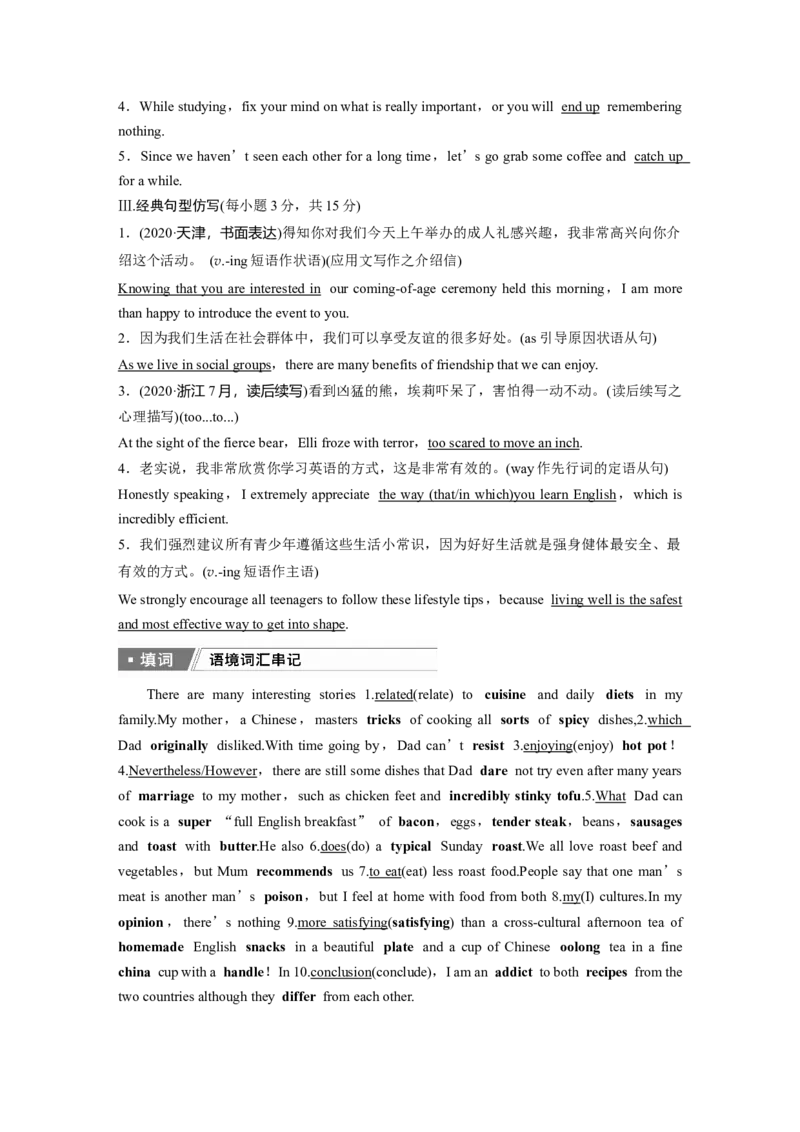
1.(2020·天津,书面表达)得知你对我们今天上午举办的成人礼感兴趣,我非常高兴向你介
绍这个活动。 (v.-ing短语作状语)(应用文写作之介绍信)
Knowing that you are interested in our coming-of-age ceremony held this morning,I am more
than happy to introduce the event to you.
2.因为我们生活在社会群体中,我们可以享受友谊的很多好处。(as引导原因状语从句)
As we live in social groups,there are many benefits of friendship that we can enjoy.
3.(2020·浙江7月,读后续写)看到凶猛的熊,埃莉吓呆了,害怕得一动不动。(读后续写之
心理描写)(too...to...)
At the sight of the fierce bear,Elli froze with terror,too scared to move an inch.
4.老实说,我非常欣赏你学习英语的方式,这是非常有效的。(way作先行词的定语从句)
Honestly speaking,I extremely appreciate the way (that/in which)you learn English,which is
incredibly efficient.
5.我们强烈建议所有青少年遵循这些生活小常识,因为好好生活就是强身健体最安全、最
有效的方式。(v.-ing短语作主语)
We strongly encourage all teenagers to follow these lifestyle tips,because living well is the safest
and most effective way to get into shape.
There are many interesting stories 1.related(relate) to cuisine and daily diets in my
family.My mother,a Chinese,masters tricks of cooking all sorts of spicy dishes,2.which
Dad originally disliked.With time going by,Dad can’t resist 3.enjoying(enjoy) hot pot!
4.Nevertheless/However,there are still some dishes that Dad dare not try even after many years
of marriage to my mother,such as chicken feet and incredibly stinky tofu.5.What Dad can
cook is a super “full English breakfast” of bacon,eggs,tender steak,beans,sausages
and toast with butter.He also 6.does(do) a typical Sunday roast.We all love roast beef and
vegetables,but Mum recommends us 7.to eat(eat) less roast food.People say that one man’s
meat is another man’s poison,but I feel at home with food from both 8.my(I) cultures.In my
opinion,there’s nothing 9.more satisfying(satisfying) than a cross-cultural afternoon tea of
homemade English snacks in a beautiful plate and a cup of Chinese oolong tea in a fine
china cup with a handle!In 10.conclusion(conclude),I am an addict to both recipes from the
two countries although they differ from each other.提示:题干中加底纹词汇为本单元词汇
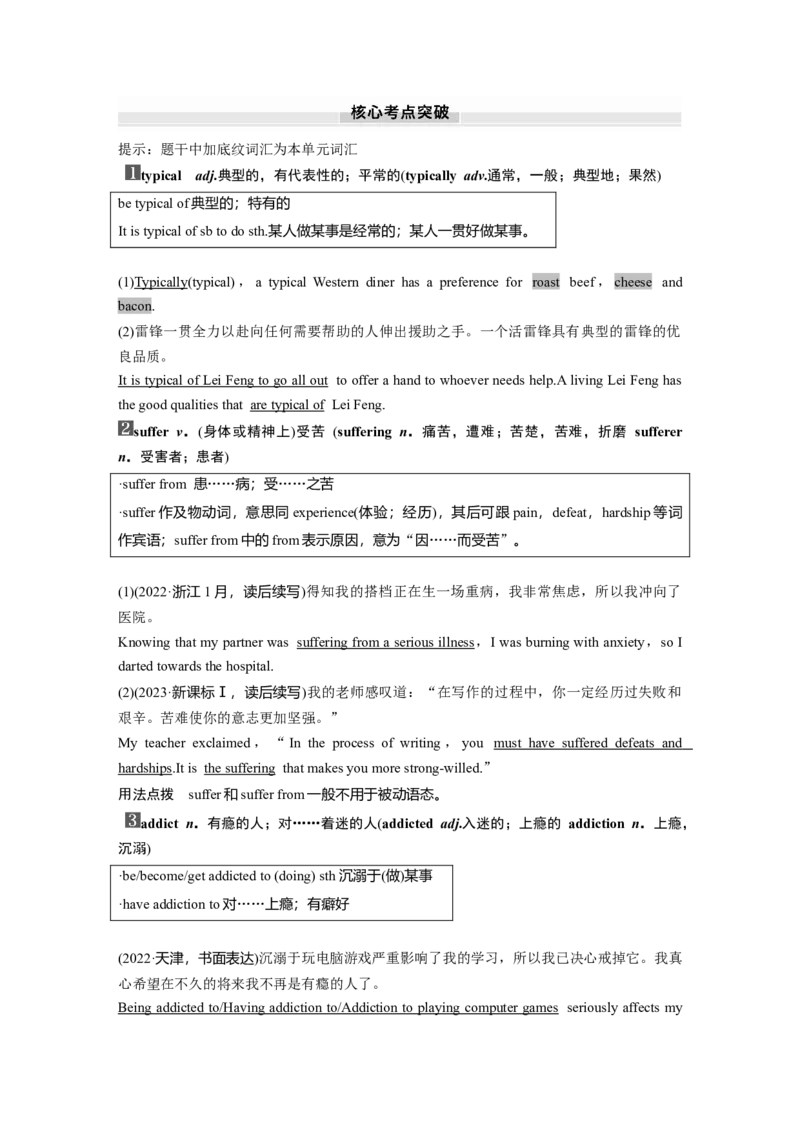
typical adj.典型的,有代表性的;平常的(typically adv.通常,一般;典型地;果然)
be typical of典型的;特有的
It is typical of sb to do sth.某人做某事是经常的;某人一贯好做某事。
(1)Typically(typical),a typical Western diner has a preference for roast beef,cheese and
bacon.
(2)雷锋一贯全力以赴向任何需要帮助的人伸出援助之手。一个活雷锋具有典型的雷锋的优
良品质。
It is typical of Lei Feng to go all out to offer a hand to whoever needs help.A living Lei Feng has
the good qualities that are typical of Lei Feng.
suffer v.(身体或精神上)受苦 (suffering n.痛苦,遭难;苦楚,苦难,折磨 sufferer
n.受害者;患者)
·suffer from 患……病;受……之苦
·suffer作及物动词,意思同experience(体验;经历),其后可跟pain,defeat,hardship等词
作宾语;suffer from中的from表示原因,意为“因……而受苦”。
(1)(2022·浙江1月,读后续写)得知我的搭档正在生一场重病,我非常焦虑,所以我冲向了
医院。
Knowing that my partner was suffering from a serious illness,I was burning with anxiety,so I
darted towards the hospital.
(2)(2023·新课标Ⅰ,读后续写)我的老师感叹道:“在写作的过程中,你一定经历过失败和
艰辛。苦难使你的意志更加坚强。”
My teacher exclaimed,“In the process of writing,you must have suffered defeats and
hardships.It is the suffering that makes you more strong-willed.”
用法点拨 suffer和suffer from一般不用于被动语态。
addict n.有瘾的人;对……着迷的人(addicted adj.入迷的;上瘾的 addiction n.上瘾,
沉溺)
·be/become/get addicted to (doing) sth沉溺于(做)某事
·have addiction to对……上瘾;有癖好
(2022·天津,书面表达)沉溺于玩电脑游戏严重影响了我的学习,所以我已决心戒掉它。我真
心希望在不久的将来我不再是有瘾的人了。
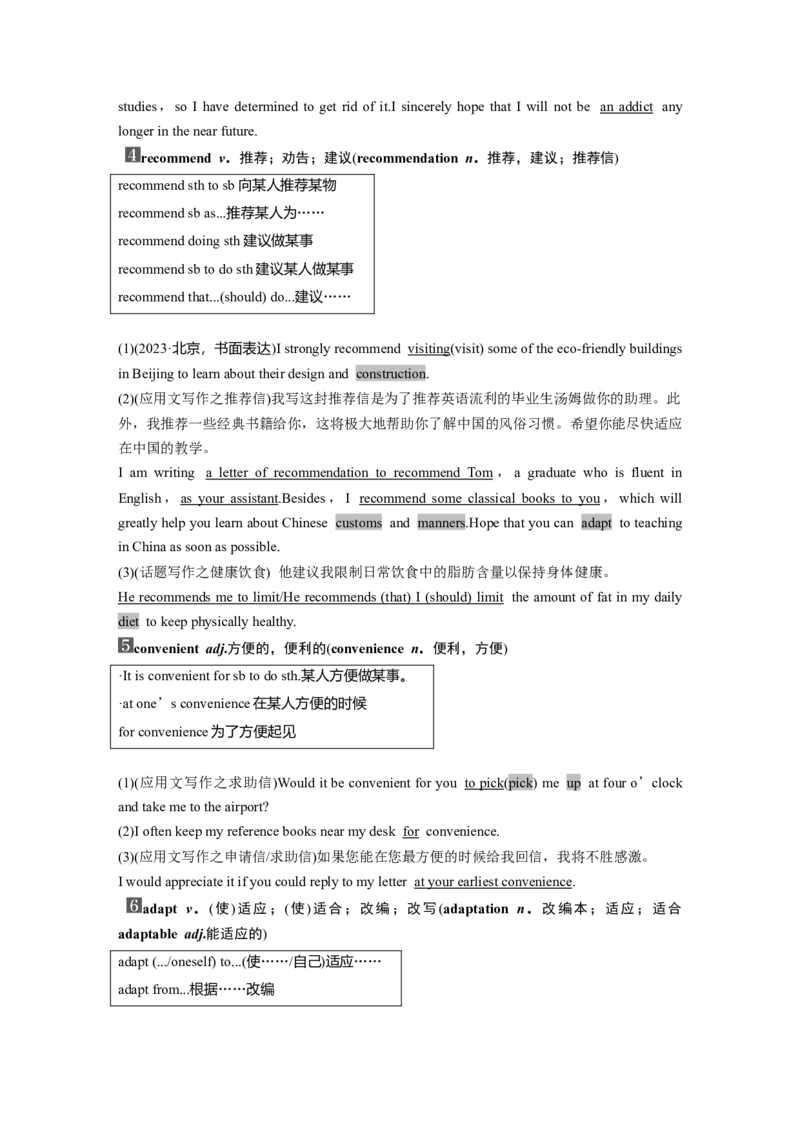
Being addicted to/Having addiction to/Addiction to playing computer games seriously affects mystudies,so I have determined to get rid of it.I sincerely hope that I will not be an addict any
longer in the near future.
recommend v.推荐;劝告;建议(recommendation n.推荐,建议;推荐信)
recommend sth to sb向某人推荐某物
recommend sb as...推荐某人为……
recommend doing sth建议做某事
recommend sb to do sth建议某人做某事
recommend that...(should) do...建议……
(1)(2023·北京,书面表达)I strongly recommend visiting(visit) some of the eco-friendly buildings
in Beijing to learn about their design and construction.
(2)(应用文写作之推荐信)我写这封推荐信是为了推荐英语流利的毕业生汤姆做你的助理。此
外,我推荐一些经典书籍给你,这将极大地帮助你了解中国的风俗习惯。希望你能尽快适应
在中国的教学。
I am writing a letter of recommendation to recommend Tom,a graduate who is fluent in
English,as your assistant.Besides,I recommend some classical books to you,which will
greatly help you learn about Chinese customs and manners.Hope that you can adapt to teaching
in China as soon as possible.
(3)(话题写作之健康饮食) 他建议我限制日常饮食中的脂肪含量以保持身体健康。
He recommends me to limit/He recommends (that) I (should) limit the amount of fat in my daily
diet to keep physically healthy.
convenient adj.方便的,便利的(convenience n.便利,方便)
·It is convenient for sb to do sth.某人方便做某事。
·at one’s convenience在某人方便的时候
for convenience为了方便起见
(1)(应用文写作之求助信)Would it be convenient for you to pick(pick) me up at four o’clock
and take me to the airport?
(2)I often keep my reference books near my desk for convenience.
(3)(应用文写作之申请信/求助信)如果您能在您最方便的时候给我回信,我将不胜感激。
I would appreciate it if you could reply to my letter at your earliest convenience.
adapt v.(使)适应;(使)适合;改编;改写(adaptation n.改编本;适应;适合
adaptable adj.能适应的)
adapt (.../oneself) to...(使……/自己)适应……
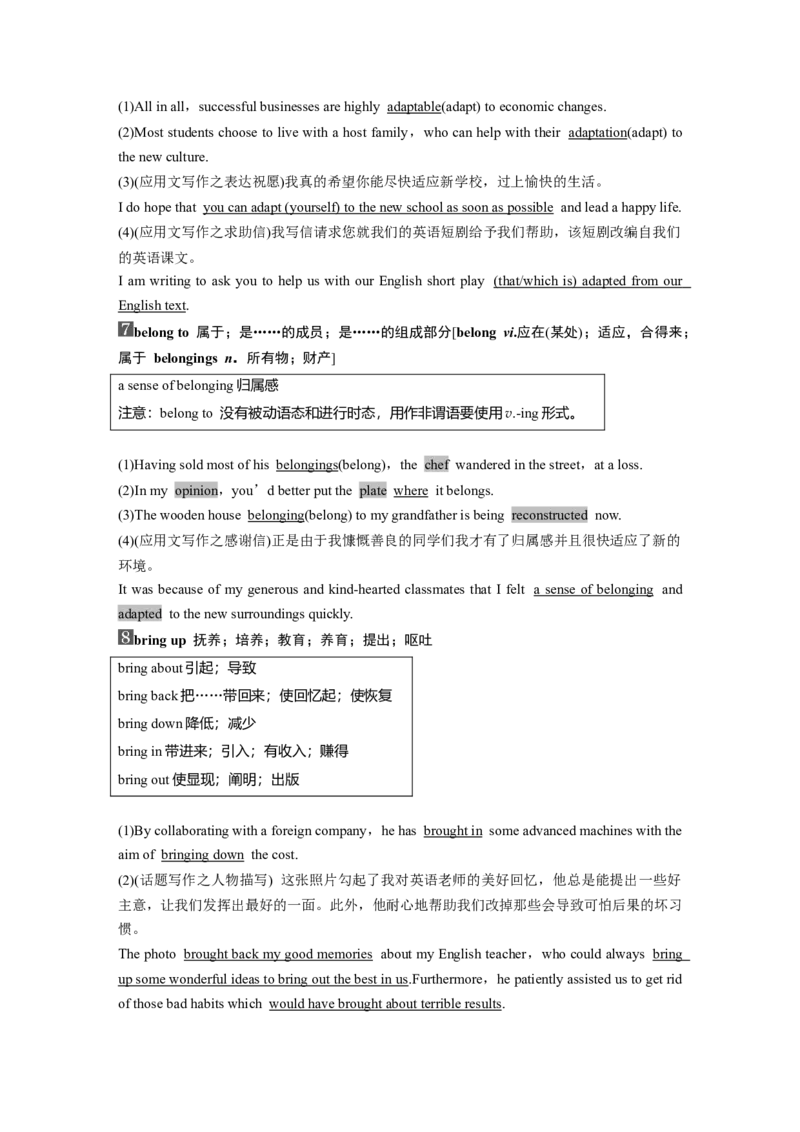
adapt from...根据……改编(1)All in all,successful businesses are highly adaptable(adapt) to economic changes.
(2)Most students choose to live with a host family,who can help with their adaptation(adapt) to
the new culture.
(3)(应用文写作之表达祝愿)我真的希望你能尽快适应新学校,过上愉快的生活。
I do hope that you can adapt (yourself) to the new school as soon as possible and lead a happy life.
(4)(应用文写作之求助信)我写信请求您就我们的英语短剧给予我们帮助,该短剧改编自我们
的英语课文。
I am writing to ask you to help us with our English short play (that/which is) adapted from our
English text.
belong to 属于;是……的成员;是……的组成部分[belong vi.应在(某处);适应,合得来;
属于 belongings n.所有物;财产]
a sense of belonging归属感
注意:belong to 没有被动语态和进行时态,用作非谓语要使用v.-ing形式。
(1)Having sold most of his belongings(belong),the chef wandered in the street,at a loss.
(2)In my opinion,you’d better put the plate where it belongs.
(3)The wooden house belonging(belong) to my grandfather is being reconstructed now.
(4)(应用文写作之感谢信)正是由于我慷慨善良的同学们我才有了归属感并且很快适应了新的
环境。
It was because of my generous and kind-hearted classmates that I felt a sense of belonging and
adapted to the new surroundings quickly.
bring up 抚养;培养;教育;养育;提出;呕吐
bring about引起;导致
bring back把……带回来;使回忆起;使恢复
bring down降低;减少
bring in带进来;引入;有收入;赚得
bring out使显现;阐明;出版
(1)By collaborating with a foreign company,he has brought in some advanced machines with the
aim of bringing down the cost.
(2)(话题写作之人物描写) 这张照片勾起了我对英语老师的美好回忆,他总是能提出一些好
主意,让我们发挥出最好的一面。此外,他耐心地帮助我们改掉那些会导致可怕后果的坏习
惯。
The photo brought back my good memories about my English teacher,who could always bring
up some wonderful ideas to bring out the best in us.Furthermore,he patiently assisted us to get rid
of those bad habits which would have brought about terrible results.too...to... My fridge is usually half empty and I’m often too tired to eat much
anyway.我的冰箱通常是半空的,反正我也经常累得吃不下多少。
·“too+adj./adv.(for sb)+to do sth”结构表示否定的意义,意为“太……而不能……”。
·当too...to...结构用来修饰表达人的态度、情绪倾向的形容词,如 anxious,eager,glad,
happy,pleased,ready,willing等时,不定式表示肯定意义,意为“非常”。
·can’t/can never...too...再怎么……也不过分。
得知您喜欢长城,我非常高兴。长城太壮观而不容错过。正如一句老话所说:“不到长
城非好汉。” 因此,我怎么强调爬长城的意义都不过分。
I am too pleased to learn that you are keen on the Great Wall.The Great Wall is too
spectacular to miss.Just as an old saying goes,“He who does not reach the Great Wall is not a
true man.” So I can ’ t/can never stress the significance of climbing the Great Wall too much .
way作先行词的定语从句 As a doctor,I know I had better change the way I eat,
but I just don’t have the time or the energy right now.作为一名医生,我知道我最好改变我
的饮食方式,但我现在完全没有时间和精力。
·当先行词way(方式,方法)在定语从句中作状语时,定语从句用in which或that引导,也可
省略关系词。
·当先行词way在定语从句中作主语或宾语时,关系词用that或which,作宾语时可省略关系
词。
·way表示“方式,方法”时,其后还可接不定式或of doing sth。
(1)In my opinion,the way that/which was put forward at the meeting was satisfying.
(2)(2022·浙江6月,读后续写)那位热心的女士意识到我不知所措,便耐心地告诉我能更有
效地把食物分给无家可归的人的方法。
Sensing that I was at a loss,the warm-hearted lady patiently told me the way (that/in which) I
could hand out food to the homeless more efficiently.
提示:题干中加底纹词汇为上一单元词汇
Ⅰ.一词多义练/熟词生义练——清除阅读障碍
1.pick up
(1)It is necessary to use a shortwave radio to pick up the programmes. B
(2)The old expert lying in bed is beginning to pick up now. D
(3)His first priority is to pick up his son at the school gate after his brother’s wedding. C(4)(2023·全国甲)The invitation is clear:Weiner wants you to pick up a coffee or tea and sit
down with this book. A
(5)(2021·新课标Ⅰ)On our first morning in Paris,I went around the corner to the food market to
pick up some groceries. E
2.tip
A.n.小费 B.n.技巧;提示 C.n.尖端 D.v.给小费 E.v.倾斜,倾倒
(1)Sorry,your name is just on the tip of my tongue. C
(2)After I had my hair cut,I gave the hairdresser a tip. A
(3)(2023·新课标Ⅱ)So I’ve put together some good tips for starting an art journey. B
(4)The boat tipped to one side. E
(5)She tipped the waiter two dollars for his excellent service. D
3.快速阅读下列句子并猜测句中加黑词汇的汉语意思
(1)The house had all the modern conveniences that were unusual at that time.n.便利设施
(2)(2023·浙江1月)Consider turning your travel plan over to a travel agent and letting him double-
check all the details,make suggestions,and then handle the actual reservations.vt.处理
(3)(2021·天津)I wrote my poems in this manner for nearly ten years before my first book was
published.n.方式;方法
(4) My recipe for happiness and a long life is living every day to the fullest.n.秘诀
(5) It’s really bitter cold out today,and as a consequence,you’d better stay indoors.adj.(天
气)严寒的;刺骨的
Ⅱ.核心知识强化练——巩固语言知识
1.His design for the new building combined different(differ) elements and styles.
2.The pleasant flavour of the butter in this restaurant reminds me of the days in New York.
3.We are advised to take a first-aid kit in case of unexpected injuries when traveling.
4.Honestly speaking,the house doesn’t belong to me and I rented it five days ago.
5.Therefore,it is good manners to shake(shake) hands with others the first time you meet each
other.
6.The expert offered some tips on how to relieve our inner suffering(s)(suffer).
7.The priority is that you must try to adapt to the new surroundings as soon as possible.
8.I can’t resist reading(read) the book the moment it is published.
9.For consumers,there is nothing more satisfying(satisfy) than high-quality service.
10.He brought up a good idea on how we could make full use of our limited resources.2023·天津6月你作为交换生去英国学校,学校要办一个名为 Chinese Workshop的促进中
英文化交流的活动,活动内容包括中国美食、手工艺品和书法,并且活动有一项是教别人做
中国传统的东西。
请描述这项活动的意义,并申请参加此次活动,阐述参加内容及想法。
完成句子
1.我非常激动,写信申请参加贵校的Chinese Workshop活动。(too...to)
2.作为一名来自中国的交换生,我强烈建议大家参加这次活动,通过传统美食、手工艺品
和书法来了解中国文化。(recommend;定语从句)
3.我沉迷于中国烹饪。(be addicted to)
4.我想提供一个关于如何教别人做宫保鸡丁的课程。(the way)
5.如果您能尽快给我答复,我将不胜感激。(convenience)
组句成篇
把以上句子用适当的过渡词语和过渡句组成一篇80词左右的短文。
参考范文
Dear Coordinator,
I am too excited to write to apply to participate in the Chinese Workshop event at your
school.As an exchange student from China,I strongly recommend all of you to take part in the
event which enables you to learn about Chinese culture through traditional cuisine,handicrafts
and calligraphy.I am addicted to Chinese cuisine.As a result,I would like to offer a session on
teaching others the way (that/in which) they cook Kung Pao Chicken.By teaching this craft to
others,I hope to not only help them learn a new skill but also to foster a greater appreciation of
Chinese cuisine.
Thank you for considering my application.I would appreciate it if you could reply to me at
your earliest convenience.
Yours sincerely,
Li Hua
教材语料整合[情感描写] dare;suffer;bitter;horrible;sour;resist;super;incredibly
亮词 [动作描写] gather;bite;recommend;attack;swing;catch up;identify;
adapt;pick up
1.He once told me he was surprised by what he saw on the table when he first visited
my mother’s parents in China.He was even shocked at their wedding when he saw
美句 how the Chinese ate almost every part of an animal.(心理描写)
2.“You needn’t try it if you don’t want to,” Mum said,but I gathered all my
courage to take a bite and was amazed to find it wasn’t so bad.(矛盾冲突)
拓展语料积累 情感细节描写:宽慰与温暖
relieve vt.使减轻;使解除(痛苦、忧愁等)→ relieved adj.欣慰的;宽慰的→relief
单词 n.(痛苦等的)减轻;宽慰 warm adj.温暖的→warmly adv.温暖地→warmth n.
温暖
to one’s relief 使某人宽慰的是 a mixture of warmth and relief既温暖又宽慰
词块
breathe a sigh of relief/gasp with relief松了口气 feel a surge of relief如释重负
Tears of appreciation welling up in her eyes,she thanked the driver for his help,but
he just smiled warmly.她眼含感激的泪水,感谢司机的帮助,而他只是热情地笑
了笑。
When I heard this,a mixture of warmth and relief welled up in my deep heart.(无
灵主语句)
当我听到这句话时,我的内心深处既温暖又欣慰。
She stroked my hair with her fingers and said,“Things are going to be fine.”
她用手指抚摸着我的头发说:“一切都会好起来的。”
句型 He reached out his hand with his fingers forming a “heart”,saying,“I’ll
always be there with you.”(with复合结构)他伸出手,用手指捏成“心形”,说:
“我将永远与你同在。”
She held my hands,weeping,“Thank you so much!You have no idea how much
this means to me.”
她握着我的手哭着说:“非常感谢!你不知道这对我有多重要。”
What made me relieved was that I finally finished the task on time.(what引导的主语
从句)
使我感到宽慰的是,我终于按时完成了任务。
语料运用 烹饪
Addicted to cooking,I,a head chef,mastered many tricks of cooking and ①it was typical
of me to handle unexpected incidents.One night,a young cook had a roast burnt.②I nervously bit
my lips,considering what to do next.③What made me relieved was that the guest was satisfiedwith the new dish(what引导的主语从句).He reached out his hand ④with his fingers forming a
“ hear t ” (with复合结构),saying,“Thanks for bringing the super taste of hometown back to
me.” ⑤I breathed a sigh of relief,feeling a warm flow spreading inside of me.⑥A mixture of
warmth and relief welled up in my deep heart(无灵主语).
作为一名厨师长,我沉迷于烹饪,掌握了许多烹饪技巧,处理突发事件是我的典型特征。
一天晚上,一个年轻的厨师把一块烤肉烤焦了。我紧张地咬着嘴唇,考虑着下一步该怎么办。
使我松了一口气的是客人对这道新菜很满意。他伸出手,手指形成一个“心形”,说:“谢
谢你把家乡的超级味道带回给我。”我松了一口气,感到一股暖流在我体内扩散。一种温暖
和宽慰的感觉涌上心头。
高考题型组合练
Ⅰ.阅读理解
A(★)
For the first 18 years of my life,my mom cooked Chinese food every day,all served
family-style.But when it came time for me to teach myself how to cook,I didn’t ask my mom
for help.Instead,I turned to the online recipes.By the time I got married,I could cook many
dishes.What I didn’t really know how to cook at all,however,was Chinese food.
Part of the problem was that I only knew how to cook by following recipes.And up until
maybe 5 or 10 years ago,the number of English-language recipes for Chinese dishes you could
find in a cookbook or on the Internet still felt extremely limited—at least when it came to homey,
everyday recipes written with a younger Chinese American audience in mind.
That was the experience,too,for sisters Sarah and Kaitlin Leung.Like so many other
ABCs(American-born Chinese) and younger first- and second-generation Chinese immigrants(移
民),the Leung sisters reached a point in their adult lives when they started to love to eat the food
they’d grown up on,but found it really difficult to learn how to prepare it.
As it turns out,though,the Leung sisters were uniquely positioned to do something about
it : Their father had spent years cooking at his family’s Chinese American takeout
restaurant.Their mom had deep knowledge about traditional Shanghainese cooking.Meanwhile,
the two sisters had grown up in New York,eating their parents’ food,but also immersed(沉浸)
in America’s own food culture.
So,in 2013,the Leungs started a food blog “The Woks of Life”.What made their blog
different from other blogs was that the intergenerational transfer of knowledge that the Leungs
were so eager for was baked right into the concept:The four family members took turns posting
recipes,each sharing their own favorites.In that way,Sarah says,the blog reflected—and
continues to reflect—the diversity of the Chinese diaspora(海外华人).1.What partly stopped the author learning to cook Chinese dishes?
A.She was too busy to cook at home.
B.She had no access to such recipes.
C.She didn’t like Chinese dishes at all.
D.Her mother left her no chance to cook.
2.Who might be the targeted readers of the Leungs’ blog?
A.Young American housewives.
B.American students studying overseas.
C.The Chinese immigrant’s family.
D.The Chinese chefs working in restaurants.
3.What sets the Leungs’ blog apart from others’?
A.Being written by several people.
B.Aiming to share people’s favorite dishes.
C.Introducing Chinese baked food in particular.
D.Involving the intergenerational transfer of knowledge.
4.What can be the best title for the text?
A.The Popularity of “The Woks of Life”
B.The Comeback of Chinese Food in America
C.Take a Glance of the Daily Life of Overseas Chinese
D.Help a New Generation of Chinese Americans Learn to Cook
B(★)
We all know eating ultra-processed foods—such as sauces,and frozen pizza—isn’t good
for our health.Studies have found they can raise our risk of obesity,heart problems,diabetes and
cancer.They may even shorten our lives.Now,a new study has revealed eating more ultra-
processed foods may contribute to overall cognitive decline , including the brain executive
functioning—the ability to process information and make decisions.
“While in need of further study,the new results are quite compelling and emphasize the
critical role for proper nutrition in preserving and promoting brain health and reducing risk for
brain diseases,” said Tanzi,professor at Harvard Medical School.“They are very high in
sugar,salt and fat,promoting systemic inflammation(发炎),perhaps the most major threat to
healthy aging.Meanwhile,since they are convenient and quick,they also replace fiber foods
important for maintaining the health and balance of bacteria in your gut , ” added
Tanzi,“which is particularly important for brain health and reducing risk of age-related brain
diseases like Alzheimer’s disease.”
The study followed over 10,000 Brazilians for 10 years.“In Brazil,ultra-processed foods
make up 25% to 30% of total calorie intake.We have McDonald’s and Burger King.It is not verydifferent from many other Western countries,” said coauthor Dr.Suemoto.Ultra-processed foods
are defined as “industrial formulations of food substances containing little or no whole foods and
typically include flavorings,colorings and other chemical additives”,according to the study.
“People consuming over 20% of daily calories from processed foods had a 28% faster
decline in global cognition and a 25% faster decline in executive functioning compared to people
who not,” said study co-author Natalia.Those in the study who ate the most ultra-processed
foods were “more likely to be younger,women,white,had higher education and incomes,
and were more likely to have never smoked,” the study found.
“People need to know they should cook more,” Suemoto said.“And it’s worth it
because you’re going to protect your heart and guard your brain,” she added.
5.What does the underlined word “compelling” mean in paragraph 2?
A.Convincing. B.Surprising. C.Suspicious. D.Invaluable.
6.What do we know from the passage?
A.Whoever never cooks is sure to develop Alzheimer.
B.Ultra-processed foods only affect your executive function.
C.Tanzi is the first to find the problem with ultra-processed foods.
D.Brazilians’ calorie intake is not different from most westerners.
7.Who is likely to eat more ultra-processed foods?
A.An old beggar. B.A heavy smoker. C.A young professor. D.A low-income man.
8.What’s the main idea of this passage?
A.Ultra-processed foods can harm your health.
B.Fiber foods can reduce the risk of Alzheimer.
C.Fiber foods may maintain the balance of bacteria.
D.Ultra-processed foods will lead to cognitive decline.
C(★)
“I know when to go out,and when to stay in.”,English rock star David Bowie once
confidently sang in his hit single.When it comes to consuming food,the decisiveness claimed by
the singer-songwriter is hard to achieve.I disagree with the statement and argue it’s better to eat
out than to order home delivery.
To begin with,when setting foot in a restaurant,we’re immediately greeted not only by a
server ready to seat us,but by a flood of physical feelings—the eyes take in the internal decoration
of the place,the nose breathes in the pleasant smell of expertly plated food and the ears pick up on
attractive in-store music.To eat out is to experience an atmosphere unique to each
restaurant.Something as special as that simply can’t be reproduced by ordering home
delivery.Eating out is,without doubt,the more exciting and thus better choice.
Eating out becomes even more appealing when staying home proves too painful.Whether it is
because we need a temporary fight from our family or that we simply want to spend some qualitytime outside with loved ones,going out for a meal can be a break from the hard labour of
domestic living.
We could take it as an opportunity for self-care—to treat ourselves by dressing up,arriving in
style at a fancy restaurant and ordering a slightly more luxurious meal to refresh our weary
soul.Ordering home delivery would only contribute to feelings of being penned in while;eating
out is an escape for the trapped individual.Food delivery app users reason it’s a trouble and less
convenient to dress up and eat out.
However,it’s worth noting we may not always get our food in the most satisfactory
condition when opting for home delivery.There’s a risk of receiving food orders with missing
items or even entirely wrong orders.What we sacrifice for convenience might just wind up being
inconvenient.Consequently,it makes more sense to eat out rather than risk disappointment by
ordering home delivery.
9.What does the author mainly talk about?
A.Dining options. B.Cuisine culture.
C.Consumption level. D.Food categories.
10.What advantage of eating out is highlighted in paragraph 2?
A.Quality service. B.Comfort and convenience.
C.Sensory enjoyment. D.A reasonable mix of nutrition.
11.What does the author think of ordering home delivery?
A.It’s quite pricey. B.It may let consumers down.
C.It may cause food waste. D.It’s not environmental-friendly.
12.How is the text developed?
A.By providing examples. B.By following space order.
C.By making comparisons. D.By analyzing mental processes.
Ⅱ.七选五
What is heritage? The word can be difficult to define.Heritage is always something that is
passed down by families or other groups for many years. 1 It can also be the customs,
traditions,and values shared by groups of people.One way to think about heritage is to break it
down into three groups.These are the tangible(有形的),the natural,and the intangible.
2 It can include many human-made objects that hold cultural value.Some examples are
national monuments and works of art.Many ancient sites are also part of this group.On a smaller
scale,a family home can be part of an individual’s heritage.
Many parts of the natural world are also important to cultural heritage.This can include bodies
of water,plant life,landforms and more.One example is the Nile River. 3 Efforts to protect
natural heritage are key in many cultures.
The intangible group includes any part of cultural heritage that you can’t feel through
touch.Maybe you’ve read about forms of dance,like Flamenco dancing.You might know aboutthe music of Mariachi Bands.These are all examples of intangible heritage. 4
Exploring your own heritage can be fun.It can help you learn about yourself,your family,
and your ancestors.But it’s also important to learn about the heritage of others. 5 It can also
lead you to find things you may have in common with others!
A.They are treasures that can be touched.
B.What tangible items can be part of heritage?
C.However,heritage isn’t limited to concrete objects.
D.Languages,holidays and customs also make the list.
E.Therefore,it’s difficult to protect them from fading away.
F.Doing so can help you build a stronger understanding of other cultures.
G.It has been part of cultural heritage in many African nations for centuries.