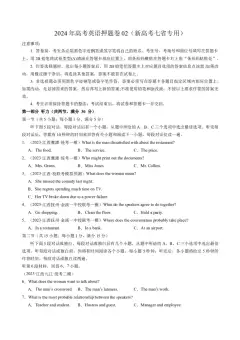
2024 年高考精准预测卷 02【新高考九省卷】
英 语
(考试时间:120分钟 试卷满分:150分)
注意事项:
1. 答卷前,考生务必将自己的姓名、准考证号填写在答题卡上。
2. 回答选择题时,选出每小题答案后,用铅笔把答题卡上对应题目的答案标号涂黑。如需改动,用橡
皮擦干净后,再选涂其他答案标号。回答非选择题时,将答案写在答题卡上,写在本试卷上无效。
3. 考试结束后,将本试卷和答题卡一并交回。
第一部分 听力(共两节,满分 30 分)
做题时,请先将答案标在试卷上。录音内容结束后,你将有两分钟的时间将试卷上的答案转涂到答题卡上。
第一节(共5小题;每小题1.5分,满分7.5分)
听下面5段对话。每段对话后有一个小题,从题中所给的 A、B、C三个选项中选出最佳选项。听完
每段对话后,你都有10秒钟的时间来回答有关小题和阅读下一小题。每段对话仅读一遍。
1.What are the speakers talking about?
A.TV programs. B.Free-time activities. C.Some athletes.
2.Where is the woman probably?
A.At a restaurant, B.In an office. C.At home.
3.What does the man dislike about the movie?
A.The actors. B.The ending. C.The music.
4.What will the woman do tomorrow?
A.Visit a school. B.See an exhibition. C.Watch a performance.
5.Why did Mike go to China?
A.To have a business trip.
B.To meet with his boss.
C.To learn about tea culture.
第二节(共15小题;每小题1.5分,满分22.5分)
听下面5段对话或独白。每段对话或独白后有几个小题,从题中所给的A、B、C三个选项中选出最佳选项,
并标在试卷的相应位置。听每段对话或独白前,你将有时间阅读各个小题,每小题5秒钟;听完后,各小
题将给出5秒钟的作答时间。每段对话或独白读两遍。
听下面一段较长对话,回答以下小题。6.What is the relationship between the speakers?
A.Strangers. B.Roommates. C.Neighbors.
7.What will the woman probably do next?
A.Find a street map. B.Run to catch a bus. C.Walk to the market.
听下面一段较长对话,回答以下小题。
8.What did David do last night?
A.He played volleyball. B.He watched television. C.He read the newspaper.
9.What time will the match on Saturday afternoon start?
A.At 2:30. B.At 3:00. C.At 3:30.
10.What will Lisa do first?
A.Give David a call. B.Talk with her mom. C.Take a piano lesson.
听下面一段较长对话,回答以下小题。
11.When does the conversation probably take place?
A.In the morning. B.In the afternoon. C.In the evening.
12.Which bus are the speakers going to take?
A.No. 3. B.No. 11. C.No. 17.
13.How will the woman go to work tomorrow?
A.By underground. B.On foot. C.By bus.
听下面一段较长对话,回答以下小题。
14.What is the woman doing?
A.Serving a customer. B.Giving an interview. C.Asking for directions.
15.What does Bill Harrington do?
A.He’s a student. B.He’s a bus driver. C.He’s a photographer.
16.What are the speakers going to do?
A.Visit a local park. B.Buy a dishwasher. C.Look at some flats.
听下面一段独白,回答以下小题。
17.What made the blog first known to the public?
A.A newspaper report. B.A TV program. C.A photo.
18.What does Bonnie do for the blog?
A.He takes photos.
B.He acts as models.
C.He does Eden’s make-up.19.What is the main topic of Ella’s blogs?
A.Fashion trends.
B.Money saving tips.
C.Clothes for students.
20.Which period of clothes has recently inspired Ella most?
A.The 1920s. B.The 1970s. C.The 1980s.
第二部分 阅读(共两节,满分50分)
第一节 (共15小题;每小题2.5分,满分37.5分)
阅读下列短文,从每题所给的A、B、C和D四个选项中,选出最佳选项。
A
Nowhere is the interconnection of the natural world more evident than in the delicate balance of its
ecosystems. These books examine the secret to that balance, making complex concepts accessible to readers just
beginning their scientific journeys.
The Elephant
By Jenni Desmond.Illustration: by the author. 2018.
The caring nature,intelligence,and incredible size of African and Asian elephants shine through in Desmond’s
magnificent presentation of these mammals. Her illustrations are showstoppers, and the text includes general
characteristics and habits. Desmond’s writing,precise and inviting, calls attention to the elephant’s role as a
keystone species in the ecosystem and humans’ roles in elephants’ declining numbers.
Beavers
By Rachel Poliquin. Illustration: by Nicholas John Frith. 2018.
This first in the Superpower Field Guide series, about the natural world’s resident superheroes, offers
effervescent examinations of a beaver’s super characteristics. Poliquin explains in simple but exact language how
these “wet land warriors” chew down trees,build dams and lodges,and most awesome of all, function as a keystone
species to create entire new ecosystems.
The Wolves Are Back
By Jean Craighead George. Illustration: by Wendell Minor. 2008.
As George follows one wolf s growth from pup to adult, the emphasis is not as much on the wolves and their
habits but on how their presence has changed the ecosystem of Yellowstone and returned its natural balance.
Minor’s finely detailed illustrations feature spectacularly rendered animals in the foreground of the bold, western
landscapes. Together the words and pictures make for a highly effective and enjoyable explanation of how thepresence of one animal can profoundly affect an ecosystem.
21.Who illustrates the book The Elephant?
A.Jenni Desmond
B.Nicholas John Frith.
C.Rachel Poliquin.
D.Wendell Minor.
22.What can we learn from the text?
A.Poliquin describes beavers using complex language.
B.George does the research mainly on the wolves and their habits.
C.Desmond’s writing focuses on humans’ active roles in elephant conservation.
D.The species mentioned above are likely to influence the ecosystem.
23.Where is the text probably taken from?
A.A zoo guidebook.
B.An academic article:
C.A nature magazine.
D.A research report.
B
The day I met Hani Irmawati, she stood alone in the parking lot of the International school, a shy seventeen-
year-old in worn clothing. Despite the school’s policy against Indonesian students, she approached me, begging to
improve her English. When I inquired about her motivation, expecting a local job search, she quietly expressed her
dream of attending an American university.
Moved by her determination, I volunteered to help her after school. Each day, Hani woke at dawn, studying
on the bus to her public high school, then joining me in the afternoon, exhausted but eager to learn. Despite her
struggles with college-level English, her perseverance amazed me.
Hani’s family lived modestly, her parents working as a custodian and a maid. Their income couldn’t support
her American university aspirations, dampening my initial optimism.
In December 1998, a scholarship opportunity arose, but upon reviewing the requirements, I despaired. Hani
lacked the extracurricular experience and standardized test scores typical of applicants. Despite my
discouragement, she remained resolute, asking me to submit her application. Unable to refuse, I completed the
application, highlighting her courage and perseverance. I warned her of slim acceptance odds, but she remained
steadfast.In the following weeks, Hani intensified her English studies, and I arranged for her to take the Test of
English Fluency. The computerized test posed a significant challenge for her. Just before departing for the test, she
received a letter from the scholarship association. I began reading the letter with her, only to discover she’d been
accepted.
Overjoyed, I celebrated while Hani stood quietly, perhaps bewildered by my shock. In that moment, I
realized what Hani had known all along: success requires not just intelligence, but also the drive to persevere and
the courage to believe in oneself.
24.What motivated Hani to improve her English?
A.Pressure from family members. B.Curiosity about foreign languages.
C.Job prospects in the local community. D.Ambition of entering an American university.
25.What can we infer about the difficulties that Hani had?
A.Hani’s parents were unsupportive of her dream.
B.Hani was uninterested in extracurricular activities.
C.Hani’s application form was not submitted on time.
D.Hani was not academically qualified for the scholarship.
26.How did the author likely feel upon discovering Hani’s acceptance to the scholarship?
A.Surprised and proud. B.Relieved but envious.
C.Touched and honored. D.Shocked but concerned.
27.Which of the following is the best title for the text?
A.From Shyness to Success B.A Scholar’s Journey
C.The Power of Perseverance D.Hani’s Unrealistic Dream
C
Pretty much everyone has, at some point, made excuses to avoid working on a task they fear. But some
people do this more often than others, which can result in disastrous consequences. Regularly putting off difficult or
unpleasant tasks can lead to low grades at school, poor performance at work and financial consequences, such as
late fees. Procrastination can also harm relationships and even affect your health, as it increases stress levels,
sometimes resulting in illness.
It's possible to procrastinate by binge-watching (大量观看) your favorite show or doing other mindless
activities, but procrastination doesn't always look like laziness. Some people procrastinate to avoid difficult tasks
by working on easier but less important tasks. This can make them feel productive even as they neglect the most
important items on their to-do lists.In order to overcome procrastination, you must first understand why you procrastinate. Perhaps you are a
perfectionist, so you find not completing a task less upsetting than doing it badly. Perhaps the task is complicated or
confusing, and you don't know where to begin. Or perhaps you are waiting to feel inspired to complete the task or
believe that you become better under pressure.
Correcting your thinking can aid you in overcoming procrastination. You probably tend to overestimate how
quickly you can finish tasks and how motivated you will feel later. Most work does not need to wait until you feel
inspired, and if you begin the task, feelings of inspiration may follow. Further, research shows that despite some
people's perceptions (感知), most individuals do not actually produce better work under pressure.
If you are procrastinating because a task seems too overwhelming or too complicated, break it up into
smaller pieces that feel more manageable. This can mean doing a part of the task, or dedicating a set amount of time
- say, 15 minutes - to working on it.
It may help to think about why the task is important. How will it contribute to your goals? How will it affect
other people? What negative consequences could come from not doing it in a timely manner?
Scheduling when you will work on tasks can be helpful as well, and so can ruthlessly eliminating
distractions. You may need to put away your phone or go to a quiet room.
Overcoming procrastination is a challenge, but doing so leads to benefits in many areas of life.
28.The word procrastinate in the second paragraph most probably means ______.
A.keep off B.get off C.put off D.take off
29.According to the passage, how many kinds of consequences may result from procrastination?
A.5. B.2. C.6. D.7.
30.What can we conclude from the passage?
A.Nobody can entirely avoid procrastination in his personal life.
B.Doing easier or unimportant tasks can make us more productive.
C.The more pressure we have, the more productive we will become.
D.It's generally more subjective than objective to procrastinate in life.
31.The best title for the passage may be ______.
A.The challenges of procrastination and strategies to solve it
B.The reasons of procrastination and the ways of avoiding it
C.The advantages and disadvantages of procrastination in life
D.The causes and process of procrastination in communication
DPlenty of audiences have warned: don’t see the new French movie The Taste of Things on an empty
stomach. Juliette Binoche plays a longtime personal cook to a man who’s a gourmand (美食家). They share a
passion for food. Filled with delicious meals, the film celebrates food, and all the work and love that go into
making it.
When you see a delicious meal in a movie or an ad, chances are that it’s not fit to eat. Food stylists have been
known to substitute glue for milk, and coat meat with motor oil. All this was a big “No” for Vietnamese French
director Tran Anh Hung.
Tran says he wanted everything in The Taste of Things “to be real,” from the raw ingredients (食材) to the
menu to the way the cooks move in the kitchen. Real food can’t always handle multiple takes. Plus, Tran needed to
show dishes at different stages of preparation. So he needed a lot of everything. For a classic French dish, “we
needed 40 kilos of meat for the shooting.” He also had to find vegetables that looked like they were harvested in the
19th century. “They’re not as beautiful as today,” he says, “They’re not straight, and they have many spots on the
skin.”
After doing extensive research into the history of French cuisine and working with a historian, Tran enlisted
three-star chef Pierre Gagnaire to make sure the menu he’d come up with worked in real life.
Gagnaire also cooked for Tran for five days, so the director could study his movements in preparation for
filming. Tran says watching Gagnaire move around the kitchen taught him that “simplicity is important and you
don’t need to have the perfect gesture for this or that. You need only to be very free.” Gagnaire says the movie feels
like a gift. “For my creativity, it’s an honor,” he says. The famous chef agreed to take a small part in the film.
“When you leave this film, you feel calm because instead of violence, there’s tenderness,” Gagnaire says.
32.What can we say about The Taste of Things?
A.It shows that food represents love.
B.It gives audience a good appetite.
C.Its characters only focus on cooking.
D.Its story is based on a food stylist.
33.Which of the following best describes Tran as a film director?
A.Romantic. B.Caring.
C.Demanding. D.Humorous.
34.Why did Gagnaire cook for Tran for five days?
A.To get a role in Tran’s movie.
B.To give Tran some inspiration.C.To test Tran’s menu for the film.
D.To show Tran his food creativity.
35.What’s the author’s purpose in writing the text?
A.To show a film shooting style. B.To recommend a film.
C.To call on people to save food. D.To promote food culture.
第二节(共5小题:每小题2. 5分, 满分12. 5分)
阅读下面短文, 从短文后的选项中选出可以填入空白处的最佳选项。选项中有两项为多余选项。
People have always believed that nature is good for health and happiness. According to scientific studies,
being in nature makes people less stressed. In a recent experiment in Japan, one group of people were asked to walk
through a forest while another group had to walk through a busy city. 36 . However, researchers found
that after the walks, the people who had walked in the forest had better moods, less anxiety and even lower blood
pressure. So the experiment showed that it was being in nature that helped people feel less stressed, not just the
walk.
Gregory Bratman from Stanford University in the United States found in experiments that a walk in nature
could have important cognitive (认知) benefits, improving a person’s memory and creativity. 37 .
Teachers find that when children are enjoying the natural world, their awareness and creativity are improved, along
with their reasoning and observational skills.
Why does being in nature bring so many benefits for us? 38 , so we have an instinctive (本能的)
love for it. Even just looking out of the window at a beautiful tree can help us feel less stressed.
Scientists also think that being in nature helps our brain recover from a lot of activities that we usually do
during the day such as working on math problems or using our cell phone. 39 — putting all our attention
into one thing, which can make us feel tired. But when we are outside, we use undirected attention. We see an
interesting cloud or a beautiful flower, and our attention moves quickly and easily from one thing to another. So
being in nature gives our brains the chance to rest.
40 . For many of us, nature is something we can enjoy just by walking out of our door. So enjoy the
nature around you!
A.The walks were equally long and hard
B.Regular workouts are surprisingly helpful
C.One idea is that human beings come from nature
D.Nature’s benefits have been scientifically confirmed
E.In these activities, we use a lot of directed attentionF.Being in nature increases people’s mental health as well
G.We can see this in schools where outdoor learning has been introduced
第三部分 语言运用(共两节,满分30分)
第一节(共15小题:每小题1分,满分15分)
阅读下面短文, 从每题所给的A、B、C、D四个选项中选出可以填入空白处的最佳选项。
In October 2020, 71-year-old Bill Sumiel, battling kidney failure, found himself in an unlikely situation—a
ride with Uber that would change his life. Little did he know that his 41 with Timothy Letts, the Uber
driver, would lead to an extraordinary tie that went beyond the boundaries of mere 42 .
Having lived with a(n) 43 that caused kidney issues for over two decades, Sumiel relied on Uber for
transportation to his specialized center. During the journey, they 44 over their conversation. “Bill really
lit up the car with positive energy,” says Letts. 45 , he offered to donate his kidney after learning about
Sumiel’s search for a donor. Despite being 46 by Letts’unforeseen generosity, Sumiel quickly 47
that Letts was genuinely sincere about his offer. Following months of screening and 48 , it was confirmed
that Letts was an ideal donor and a perfect 49 for Sumiel. On December 7, 2021, the successful surgeries
changed Sumiel’s life for the better, 50 him from kidney treatment. Sumiel 51 the
extraordinary nature of living donors like him and was 52 Letts’ selfless act.
Now, Sumiel cherishes precious moments with his family. Letts, although relocated to another country for
work commitments, 53 a solid relationship with Sumiel, anxiously awaiting their 54 . As fate
would have it, their unexpected Uber 55 became a life-saving journey, showcasing the power of
kindness, empathy (共情), and human connection in the face of adversity.
41.A.experiment B.encounter C.competition D.appointment
42.A.passengers B.travellers C.friends D.strangers
43.A.failure B.infection C.condition D.loss
44.A.bonded B.debated C.reflected D.observed
45.A.Naturally B.Eventually C.Normally D.Directly
46.A.delighted B.puzzled C.surprised D.embarrassed
47.A.requested B.realized C.predicted D.hesitated
48.A.consulting B.treating C.admitting D.testing
49.A.match B.candidate C.partner D.supporter
50.A.relieving B.enhancing C.freeing D.rescuing
51.A.estimated B.shared C.recognized D.recalled52.A.interested in B.cautious about C.sympathetic to D.grateful for
53.A.acknowledges B.maintains C.explores D.ends
54.A.reunion B.commitment C.conversation D.memory
55.A.participation B.transportation C.transformation D.interaction
第二节(共10小题:每小题1. 5分, 满分15分)
阅读下面短文, 在空白处填入1个适当的单词或括号内单词的正确形式。
Have you ever felt stressed and anxious when your maths teacher asks you 56 question? Or when
you are doing your maths homework? If so, you might have experienced 57 is called maths anxiety —
the feeling of being extremely nervous when 58 (face) with doing basic mathematics. If you have
experienced maths anxiety, you are not alone.
Mathematics 59 (be) a necessary skill that people use throughout their lives. 60
(fortunate), many people feel anxious when they have to do maths. That seed of fear may come from many sources.
Cultural expectations may also be 61 (blame) — girls may be more likely to catch maths anxiety,
perhaps because of stereotypes (刻板印象) that girls are naturally not very good at maths. Your genes, meanwhile,
might lead you to anxiety more generally — 62 (make) you more likely to respond unwillingly to maths.
Whatever its origins, once the seed of the fear takes root, it may grow by 63 (it): the more anxious
you feel, the worse you perform; the more you shy away from maths, the more you worry when you face it again.
Adults with maths anxiety often have trouble 64 maths in their careers and everyday life. Adults with
maths anxiety are 65 (little) likely to show interest, enter, and succeed in careers relating to science,
technology, engineering, and mathematics.
第四部分 写作(共两节, 满分40分)
第一节(满分15分)
假定你是李华,你校将于4月23日(世界读书日)开展主题为“The Power of Reading”的英语演讲比赛,请你
以此为主题写一篇演讲稿参赛,内容包括:
1.你的经历;
2.你的感受。
注意:
1.词数80左右;
2.请按如下格式在答题纸的相应位置作答。
The Power of Reading
Good morning, ladies and gentlemen!____________________________________________________________________________________________
____________________________________________________________________________________________
____________________________________________________________________________________________
____________________________________________________________________________________________
___________________________
第二节(满分25分)
阅读下面材料,根据其内容和所给段落开头语续写两段,使之构成一篇完整的短文。
At Piedmont Middle School, a kid could run track or play tennis, but everyone wanted to be on the soccer
team. Laura had dreamed of earning glory for the Falcons ever since the first grade, when her older brother Toni
scored the winning goal in the county middle school championship. The day she joined the team as a sixth-grader,
she felt like she could fly.
But, unfortunately, her joy didn’t last. She spent most of the season on the bench. It was all because of the
huge mistake she made in her first game. She passed the ball in the completely wrong direction! Straight to an
enemy in blue, who quickly shot it into the corner of the net, scoring. The coach benched Laura for the rest of the
game. When the Falcons lost 1-0,she was crushed.
Now that the season was over, she just wanted to forget about soccer. She clearly wasn’t good enough to play
with the Falcons, and that was that.
A few days later, Laura’s mother found her lying on the sofa, watching music videos on her . phone.
“You’d be better off praticing,” her mother said.
“What for?” Laura said, rolling her eyes. “It won’t help me. I need someone to watch me and tell me how I
can improve. I can’t get better by myself.”
Sighing, her mom sank down on the sofa. “Laura, for every lock, there is a key. We just have to find it.”
After a moment, she added, “What if I film you during practice to help you find ways to improve?”
“But the season’s over, Mom. No more practice, remember?”
“The best players keep practicing even when the season’s over,” her mother said. “You remember Toni
spending all summer bouncing a ball off his head in the driveway. He used to run ten miles a day in the Arizona
summer sun. You think he did that for fun?“
“But to practice plays I need at least one other person,” Laura protested.
Her mother patted her on the knee. “We’ll find that key, too,” she said.
注意:
1.续写词数应为150左右;2.请按如下格式在答题卡的相应位置作答。
The next morning, Laura’s mother shook her awake early, “Come on, Laura; it’ s soccer time.”
____________________________________________________________________________________________
____________________________________________________________________________________________
____________________________________________________________________________________________
____________________________________________________________________________________________
____________________________________________________________________________________________
When the next season came around, Laura was ready.
____________________________________________________________________________________________
____________________________________________________________________________________________
____________________________________________________________________________________________
____________________________________________________________________________________________
____________________________________________________________________________________________