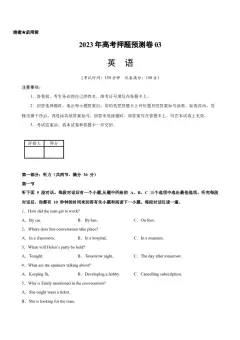
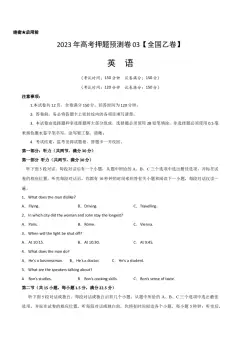
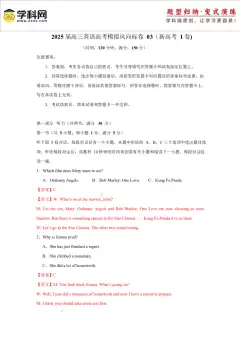
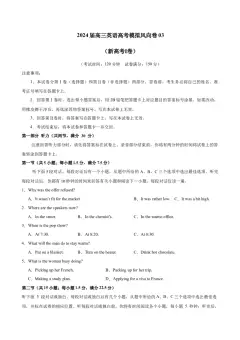
2025 届高三英语高考精准预测卷(新高考 I 卷)03
英语
(考试时间:120分钟 试卷满分:150分)
注意事项:
1.答卷前,考生务必将自己的姓名、考生号等填写在答题卡和试卷指定位置上。
2.回答选择题时,选出每小题答案后,用铅笔把答题卡对应题目的答案标号涂黑。如需改动,用橡
皮擦干净后,再选涂其他答案标号。回答非选择题时,将答案写在答题卡上。写在本试卷上无效。
3.考试结束后,将本试卷和答题卡一并交回。
第一部分 听力(共两节,满分 30 分)
第一节(共5小题;每小题1.5分,满分7.5分)
听下面5段对话。每段对话后有一个小题,从题中所给的A、B、C三个选项中选出最佳选项。听完每
段对话后,你都有10秒钟的时间来回答有关小题和阅读下一小题。每段对话仅读一遍。
1.How is the woman feeling now?
A.Worried. B.Excited. C.Uninterested.
2.What does the man want to do?
A.Take photos. B.Buy a camera. C.Call the woman.
3.Whose birthday is it?
A.Bob’s. B.Tina’s. C.Ruth’s.
4.Where are the speakers?
A.In an office. B.In a supermarket. C.In a restaurant.
5.What does the woman want to do?
A.Buy another jacket. B.Return a jacket. C.Change a jacket.
第二节(共15小题;每小题1.5分,满分22.5分)
听下面 5段对话或独白。每段对话或独白后有几个小题,从题中所给的 A、B、C三个选项中选出最
佳选项。听每段对话或独白前,你将有时间阅读各个小题,每小题5秒钟;听完后,各小题将给出5秒钟
的作答时间,每段对话或独白读两遍。
听第 6 段材料,回答第 6至7题。
6.Which groups tend to have the most overweight people?
A.The high-income families. B.The middle-class families. C.The low-income families.
7.What happened to the woman in the end?A.She lost 5 pounds. B.She became heavier. C.She gained 10 pounds.
听第7段材料,回答第 8至10题。
8.Where is Gina probably from?
A.England. B.America. C.France.
9.Why is Gina visiting Tokyo?
A.To have a holiday. B.To buy an apartment. C.To work in a branch office.
10.What is the relationship between Gina and Steve?
A.Client and project manager.
B.Colleagues.
C.Friends.
听第8段材料,回答第11至14题。
11.What did Jin enjoy most when she visited her grandparents?
A.Climbing the trees. B.Playing in the rivers. C.Lying in the grass.
12.Where did the air balloons Jin saw in childhood take off?
A.From Gloucestershire. B.From Somerset. C.From Worcestershire.
13.How did Jin feel about her first air balloon ride?
A.Scared. B.Hesitant. C.Surprised.
14.What is the conversation mainly about?
A.How Jin became interested in air ballooning.
B.How lovely the countryside is.
C.How air balloons fly.
听第9段材料,回答第15至17题。
15.How are those penguins now?
A.In need of help. B.In search of sweaters. C.In the care of the teacher.
16.What are the penguin sweaters like?
A.Useful. B.Thick. C.Beautiful.
17.How does the woman plan to help?
A.To raise an injured penguin.
B.To call for animal protection.
C.To join the university teacher.
听第10段材料,回答第18至20题。
18.What is the total number of students at Deep Springs College?A.24. B.9,000. C.17,000.
19.Which of the following is TRUE of the Deep Springs College?
A.Its library is often crowded with students.
B.Its school buildings are old.
C.It is located in a college town.
20.What can students at Deep Springs do in their spare time?
A.Watch TV. B.Go to the cinema. C.Take a walk in the desert.
第二部分 阅读(共两节,满分50分)
第一节 (共15小题;每小题2.5分,满分37.5分)
阅读下列短文,从每题所给的A、B、C、D四个选项中选出最佳选项。
A
Four Science Research Competitions for High Schoolers
Participating in a science research competition as a high schooler can allow you to explore one of your
passions, making you a more competitive candidate during the college admissions process. Here are four science
research competitions designed for high schoolers.
Breakthrough Junior Challenge
The Breakthrough Junior Challenge tasks students with creating a short two-minute video in which they
explain a complex scientific concept and demonstrate how it works in practice.
Awards include a $250,000 college scholarship, and a $50,000 award to a teacher of the winner’s choosing.
Eye on the Future Teen Video Contest
Participants are tasked with creating a video between 30 seconds and three minutes long, either on their own
or in teams of up to three members. Winners receive a paid trip to the National Institute of Health in Bethesda,
Maryland.
Regeneron International Science and Engineering Fair
This competition is the world’s largest international pre-college STEM competition. Students showcase
independent research and compete across 22 categories for awards ranging from $500 to $75,000.
This is not a group-based competition — individual students sign up for local school science fairs before
advancing to upper-level competitions.
American Academy of Neurology Neuroscience Research Prize
This competition challenges students to investigate problems regarding the brain or nervous system. It is
only open to individual students — group projects are excluded.Winners receive a monetary prize and the chance to present their projects at the AAN Annual Meeting.
21.What is the aim of the competitions?
A.To ensure admission to college. B.To fuel the passion for science.
C.To excel in high school exams. D.To select outstanding talents.
22.What do the first two competitions have in common?
A.Winners will receive a paid trip. B.The participants need to team up.
C.Presentation of a video is a must. D.The winner’s teacher will be awarded.
23.Which competition might attract participants interested in medicine?
A.Breakthrough Junior Challenge.
B.Eye on the Future Teen Video Contest.
C.Regeneron International Science and Engineering Fair.
D.American Academy of Neurology Neuroscience Research Prize.
B
On a summer trip to Maharashtra, India, Aryaman Khandelwal saw a little boy, no more than ten years old,
carrying a bag of corn twice his size. “They had to work so hard to make do,” Khandelwal said, “Something needed
to change. ”
Then a senior at Parkland High School, Khandelwal went on to design Get2Greater over the next couple of
years, an AI-driven app to improve access to healthcare services. His efforts earned him the GloriaBarron Prize,
which is given to young people with significant social initiatives.
The young man was passionate about improving healthcare in Maharashtra, a place that lacked qualified
doctors and healthcare workers. Moreover, there were many quacks, who might quit studying after a year of
medicine school and return home as “healthcare providers”.
Then Khandelwal was introduced to the a MAHAN Trust, a healthcare organization serving rural parts of
Maharashtra. At the time, the MAHAN Trust was training village health workers to carry out basic medical tasks,
such as taking measurements and transporting data to hospitals for review. Through them, Khandelwal learned that
only 10 to 15 trained workers served a population of 200,000. While the method showed results, it was time-
consuming and required significant improvement to handle the large volume of cases more efficiently.
That’s where Get2Greater came in — it separates the unhealthy from the healthy, so doctors can focus on
more pressing cases. The app can record basic health-related data points, compile (汇编) them in order of priority
and send them to doctors nearby. Khandelwal sent a tablet computer equipped with a basic software prototype (软
件原型) to the MAHAN Trust and established a line of communication with healthcare workers there. “I askedthem to provide feedback on the app,” he said.
Khandelwal’s proposal won him funding and after numerous trials, he created a Wi-Fi component so the
devices could connect to the local hospitals. He has also been in talks with the UN to help take the device to other
parts of the world.
24.What does the underlined word “quacks” in paragraph 3 refer to ?
A.Students who quit school. B.Doctors who are unqualified.
C.Nurses who work in hospitals. D.Professionals who help in healthcare work.
25.What was the challenge faced by the MAHAN Trust?
A.The difficulty in transporting data accurately.
B.Village health workers’ unwillingness to be trained.
C.Insufficient healthcare providers for vast communities.
D.Lack of medical equipment for performing medical tasks.
26.How does the app Get2Greater function?
A.By cutting healthcare costs for patients.
B.By processing data for doctors’ attention.
C.By automatically recording treatment process.
D.By identifying the symptoms quickly and correctly.
27.Which of the following can best describe Khandelwal?
A.Innovative and committed. B.Confident and modest.
C.Humble and determined. D.Generous and ambitious.
C
The differences in health outcomes are neither new nor unknown. From differences in life span to uneven
access to quality healthcare, the so-called “Health Gap” is a persistent and troubling indication of inequality. People
living in low and middle-income countries are far more likely to die from preventable and treatable causes.
According to the World Health Organization, obvious differences in health outcomes persist (持续存在) within
countries, cutting along socioeconomic and geographic lines.
Closing these health gaps is both a moral and practical need because every human being has a right to a
healthy, dignified life; practical because health inequities bring about substantial economic and social costs. Health
inequities could cost the U. S. economy approximately $ 320 billion annually and rise to $ 1 trillion by 2040 if not
addressed. These figures emphasize the need for systemic solutions that look at the root causes.
Artificial intelligence has entered the scene as a new tool in the attempt to remake the health system. Broadlyspeaking, pattern recognition and personalized care are the two focuses in that context. AI applications can detect
diseases—often earlier and more accurately than humans—tailor treatments to individual patients, and support
healthcare professionals in managing complex caseloads (病例). Preventive interventions can save lives and
resources while increasing the quality of life of humans. AI-powered prediction models have been used to identify
patients at high risk of complications or chronic (慢性病) conditions such as kidney disease, which otherwise often
goes unnoticed until significant damage is done to the body.
Beyond clinical settings, AI-driven analyses of large datasets — from hospital records to socioeconomic
indicators — can highlight at-risk communities, helping policymakers and health organizations distribute resources
more effectively. By locating under-served areas and identifying populations least likely to access preventive
services, AI can guide targeted community interventions, mobile clinics, health education programs, and other
initiatives to close the health gap.
While the potential is large, AI’s effectiveness in closing the health gap depends on more than just
technological advancement. AI must be deliberately designed, trained, tested, and targeted to bring out the best in
and for people and the planet.
28.What can we learn about the health gap from paragraph 1?
A.It rarely exists in wealthy countries. B.It is the root of economic difference.
C.It refers to unfairness in health outcomes. D.It shows the equal distribution of resources.
29.What do the figures indicate in paragraph 2?
A.Economic trouble in US. B.Costly medical expenses in US.
C.The urgency of closing health gap. D.The moral dilemma facing Americans.
30.What can AI do to improve the health system?
A.Prevent the spread of diseases. B.Cure patients with chronic conditions.
C.Replace doctors to manage caseloads. D.Detect diseases and offer tailored treatments.
31.What is the passage mainly about?
A.How AI serves to get rid of inequality. B.What role AI plays in closing health gap.
C.What challenges AI faces in medical field. D.How AI stimulates technological advancement.
D
The human mind is a remarkable device. However, it is not without limits, which has to do with our brain’s
executive (执行的) function.
Imagine that you are facing a very difficult decision about which of two job offers to accept. One position
offers good pay but is pretty boring, while the other job is really interesting but the pay is not ideal. Clearly you cansolve this problem in many ways. Few people, however, know that you might choose the wrong job because you
resisted the urge to eat a piece of cake before considering the job offers.
Unrelated activities can exhaust (消耗) the executive function and disturb your ability to make an important
decision. It’s long been recognized that challenging cognitive (认知的) tasks can make it harder to focus later on.
But recent research suggests that these mental activities may be much broader. One study found that participants
who made choices in a shop were more likely to delay preparing for an important test. Instead of studying, these
“tired” minds engaged in other leisure activities.
Why is making a decision so tough? One theory suggests that when you switch from thinking about options
to actually making a decision, this switch requires executive resources. Other studies show that making choices
itself may be taxing. For example, in one study, the scientists show that people who had to rate the attractiveness of
different options were much less worn out than those who had to actually make choices between the very same
options.
These findings have important real-world significance. Our brain works like a muscle: when exhausted, it
becomes less effective. Furthermore, we should take this knowledge into account when making decisions. If we’ve
just spent lots of time focusing on a particular task, or even if we’ve just made lots of seemingly minor choices,
then we probably shouldn’t try to make a major decision. These harmful effects from a tired brain may have a
strong shaping effect on our lives.
32.According to the text, what may make you choose the wrong job?
A.Both jobs are equally appealing. B.You didn’t eat the cake.
C.There are too many solutions. D.Your brain is tired out.
33.What does the underlined word “taxing” in paragraph 4 mean?
A.Confusing. B.Tiring. C.Scaring. D.Disappointing.
34.What does the author suggest?
A.Train the brain like exercising muscles.
B.Spend less time on making small choices.
C.Make vital choices with a refreshed brain.
D.Avoid concentrating on a task for too long.
35.Which of the following is the best title for the text?
A.Tough Choices. B.Mental Function.
C.Facts of the Brain. D.Studies of Jobs.
第二节 (共5小题;每小题2.5分,满分12.5分)阅读下面短文,从短文后的选项中选出可以填入空白处的最佳选项。选项中有两项为多余选项。
Life disappoints everyone from time to time. When friends experience hardship, they may come to you for
help. Supporting someone when they express negative emotions can be healthy to your relationship, because it’s a
mood-lifter and trust-builder. However, others get stuck in negativity, constantly complaining about it. 36
You may slip into their orbit of pessimism and find yourself complaining too. Here are some tips for relating to
habitual complainers while caring for your needs.
Use empathy, but be aware of wrestling with it. You don’t have to share the complainer’ s emotional
reactions in order to empathize with them. 37 “Yes, you sound frustrated; you sound let down. I get how
you’re feeling; I’d be frustrated too if I were in that situation.” In other words, you’re not joining the emotion. 38
Make a shift. If maintaining a relational moment just isn’t working or is too much of a strain for you, you
can shift the topic or the scene. It’s strongly recommended that you talk about something else, or walk into another
room or an outdoor space. 39
Take a break. If all else fails, you can go beyond a boundary and take a break. It doesn’t need to be a forever
break; it can just be a break from the conversation.
40 Or do it verbally. “I work really hard to keep my own happiness. I love you, but sometimes it’s
really hard to listen to you when you are in a complaining mood, and I think that I have to give myself some space
right now.”
A.You can simply mirror back what you notice.
B.But you’re not mentally dismissing it either.
C.Being friends with them can be emotionally draining.
D.Remember that you are in charge of your emotional reactions.
E.The constant complaining indicates that he is habitually unhappy.
F.You can do this mentally by remembering you don’t need to engage.
G.This may help break up a thought pattern that the complainer is stuck in.
第二部分 语言运用(共两节,满分30分)
第一节 (共15小题;每小题1分,满分15分)
阅读下面短文,从每题所给的A、B、C、D四个选项中选出可以填入空白处的最佳选项。
When I was a child, I met my cousin, Bruce, who was five years older than me. Though our families had
41 backgrounds, we quickly became friends. Bruce’s dad was severely disabled, and it 42 his life in
many ways. Bruce and his mom faced 43 from the community, but he always 44 it with
strength.One evening, after a birthday party, Bruce and I were playing a game to see who could keep a book on their
head the longest. I was doing well, but then Bruce lightly 45 my wrist. I lost 46 and the book
fell. I accused him of cheating. Bruce 47 explained, “I didn’t cheat. I only tapped your wrist. You let it
48 yourself and lost the game.” His words made me think carefully.
Bruce told me how 49 it was when people called him names because of his dad’s disability. He
said, “I want to 50 , but I know it would only make things worse. I have to stay· 51 and
focused and move forward.” I nodded, though I couldn’t fully 52 his feelings.
Over time, we grew apart, but I never forgot that 53 . Even though we don’t keep in touch now, I
still remember the book, balancing on my head, a 54 of the strength he showed in the face of difficulty.
I hope he knows how much I appreciate him. His quiet 55 taught me more than any textbook.
41.A.familiar B.successful C.reliable D.different
42.A.examined B.affected C.assessed D.improved
43.A.challenges B.honors C.requirements D.promotions
44.A.remembered B.believed C.handled D.judged
45.A.touched B.compared C.matched D.watched
46.A.excuse B.courage C.focus D.talent
47.A.madly B.proudly C.shyly D.calmly
48.A.copy B.surprise C.change D.cure
49.A.hurtful B.careful C.confusing D.simple
50.A.go away B.bend down C.set out D.fight back
51.A.regretful B.strong C.grateful D.nervous
52.A.grasp B.replace C.predict D.record
53.A.lecture B.request C.gift D.lesson
54.A.principle B.secret C.reminder D.platform
55.A.duty B.promise C.wisdom D.threat
第二节 (共10小题;每小题1.5分,满分15分)
阅读下面短文,在空白处填入1个适当的单词或括号内单词的正确形式。
Young Chinese are fighting against society through a simple act of resistance: lying down. Examples of the
“tangping”, or “lying flat”, way of life 56 (include) not getting married, not having children, and refusing
to work extra hours or to hold a job at all. “I stay at home and sleep and watch television series.” said Zhang, who
described herself as “lying flat” for the last two weeks 57 leaving her job in the film industry in Wuxi.“Tangping” 58 (emerge) over the last few months. Some compare them to the 1950s Beat Generation
in the United States. 59 (other) call their behavior a form of nonviolent resistance. “People realize there is
no upward mobility,” said Yicheng Wang, a PhD student in political science at Boston University. The term
developed after 60 April post on the Tieba forum, whose author, unemployed for the last two years,
described a low-effort, low-cost lifestyle consisting of just a few months’ work out of the year.
“Lying flat is my movement,” he 61 (write), referring to the Greek philosopher Diogenes, who was
known for living in a large container. He posted a picture of himself lying in bed in the middle of the day with the
curtains 62 (draw).
But as “tangping” gained 63 (popular), it also brought a level of dishonor. Nanfang Daily called the
philosophy “shameful”. Global Times made light of it describing “lying flat” as “not a serious philosophy”.
For Zhang in Wuxi, lying flat is not about giving up or withdrawing from society. “Many people want to lie
down because 996 is too 64 (tire), ” she said, referring to the constant hours common in tech industry, 65
the staff are expected to work from 9 a. m. to 9 p. m. , six days a week. The philosophy is also about giving oneself
a break.
第三部分 写作(共两节,满分40分)
第一节 (满分15分)
假定你是李华,最近你参加了主题为“体验职业,发现自己,启迪未来”的职业体验日实践活动,请
你给英国朋友 Chris 写一封邮件分享你的这次经历。内容包括:
1. 活动情况(包括具体体验的职业);
2. 活动感悟。
注意:写作词数应为 80 左右;请按如下格式在答题卡的相应位置作答。
Dear Chris,
____________________________________________________________________________________________
____________________________________________________________________________________________
____________________________________________________________________________________________
____________________________________________________________________________________________
____________________________________________________________________________________________
____________________
Yours,
Li Hua
第二节 (满分25分)阅读下面材料,根据其内容和所给段落开头语续写两段,使之构成一篇完整的短文。
As I turned into the parking lot at the high school the other day, I pulled my hoodie(连帽衫)over my face
and lowered down in the driver’s seat so nobody on my tennis team would see me. They’ve been after me for
weeks, and they’re like: “Hey, come on. We need you in the team.” They are such great peer pressure! They totally
know I’m not ready yet because I hurt my wrist and now I have to learn to serve with my other hand. It could take
years for a former leftie to develop a right-handed serve (发球)that’s good enough for competitive play. I
slipped out of the car.
“Hey!” Oh no. Coach Johnson. My team leader. “Are you going to play in the match next week?” she
shouted at me from the court where she was overseeing practice. I rushed past. “Hey, come back here! Are you
even on this team?” That was so embarrassing. I was trying to ignore her because I just wasn’t ready. I needed more
time to recover.
Just then, luckily, I saw Alex, my tennis role model and former doubles partner, standing up on the other side
of the court. He would have to protect me. I walked toward him. Then the worst thing ever happened: Alex turned
on me, too. “Hey, are you ever going to play again?” he said aloud.
“I don’t think I can do this,” I said.
“Why not?” he asked.
“I’m scared.”
“Of what?” he asked.
“Embarrassing myself,” I said.
“You don’t need a hard serve to win,” he said. “All you need to do is get the ball over the net every time it
comes to you. The winner, in tennis and in life, is usually the one with fewer unforced errors.” he said.
His words impressed me. The unforced error is when you beat yourself and the worst error of all is when you
don’t even try.
“I’m ready to play,” I whispered to myself.注意:
1. 续写词数应为150左右;
2. 请按如下格式在答题卡的相应位置作答。
With a newfound determination, I walked back towards Coach Johnson.
____________________________________________________________________________________________
____________________________________________________________________________________________
____________________________________________________________________________________________
________________________________________________________________________________________________________________________________________________________________________________________
____________________________________________________________________________________________
The match came, and I stepped onto the court.
____________________________________________________________________________________________
____________________________________________________________________________________________
____________________________________________________________________________________________
____________________________________________________________________________________________
____________________________________________________________________________________________
____________________________________________________________________________________________