绝密★启用前
2026 年高考二轮培优必刷卷03
英  语
(考试时间:120 分钟  试卷满分:150 分)
注意事项:
1. 答题前,考生先将自己的姓名、准考证号码填写清楚,将条形码准确粘贴在条形码区域内。
2. 选择题必须使用2B 铅笔填涂;非选择题必须使用0. 5 毫米黑色字迹的签字笔书写,字体工整,笔记清
楚。
3. 请按照题号顺序在答题卡各题目的答题区域内作答,超出答题区域书写的答案无效;在草稿纸、试卷上
答题无效。
4. 作图可先使用铅笔画出,确定后必须用黑色字迹的签字笔描黑。
5. 保持卡面清洁,不要折叠、不要弄破、弄皱,不准使用涂改液、修正带、刮纸刀。
第一部分  听力(共两节,满分30 分)
做题时,先将答案标在试卷上。录音内容结束后,你将有两分钟的时间将试卷上的答案转涂到答题卡
上。
第一节(共5 小题;每小题1.5 分,满分7.5 分)
听下面5 段对话。每段对话后有一个小题,从题中所给的A、B、C 三个选项中选出最佳选项。听完每
段对话后,你都有10 秒钟的时间来回答有关小题和阅读下一小题。每段对话仅读一遍。
1. What is the probable relationship between the speakers?
A. Boss and employee.
B. Business partners.
C. Interviewer and interviewee.
2. Where is the main office?
A. In Switzerland.
B. In Sweden.
C. In America.
3. When will the man see Dr. Know?
A. At 9:00.
B. At 10:00.
C. At 11:00.
4. What does the woman suggest the man do?
A. Move to France.
B. Learn more French words.
C. Research into French culture.
5. What will the woman do next?
A. Go to find a bus station herself.
B. Follow the man to a bus station.
C. Ask a guard about a bus station.
第二节(共15 小题;每小题1.5 分,满分22.5 分)
听下面5 段对话或独白。每段对话或独白后有几个小题,从题中所给的A、B、C 三个选项中选出最佳
选项。听每段对话或独白前,你将有时间阅读各个小题,每小题5 秒钟;听完后,各小题将给出5 秒钟的
作答时间。每段对话或独白读两遍。
听下面一段对话, 回答以下小题。
6. Where does the conversation most likely take place?
A. At a traffic station.
B. At a car service center.
C. In a shopping mall.
7. What will the woman do next?
A. Wait for her turn.
B. Have an oil change.
C. Drive to the town.
听下面一段对话, 回答以下小题。
8. Why does the woman want to cancel the visit?
A. She is stuck in a traffic jam.
B. She’s difficulty getting there.
C. She’ll attend the marathon.
9. What is the cancellation policy of the museum?
A. Most cancellations are free of charge.
B. Partial money back for exhibit cancellation.
C. Full money back if the exhibit is cancelled.
10. What does the man advise the woman to do at last?
A. Reschedule the visit.
B. Attend another event.
C. Get a membership card.
听下面一段对话, 回答以下小题。
11. What is the relationship between Lisa and Tom?
A. Teacher and student.
B. Strangers.
C. Colleagues.
12. What can we know about Maplewood Drama Club?
A. It is newly-established.
B. It has children members.
C. It features historical plays.
13. When will the speakers meet?
A. In two weeks.
B. In three weeks.
C. In four weeks.
听下面一段对话,回答以下小题。
14. What is the woman doing?
A. Making a campus survey.
B. Hosting a radio program.
C. Conducting a job interview.
15. Why did the man decide to study at Gramwell University?
A. It is near where he grew up.
B. His parents advised him to go there.
C. It offers an excellent course in his subject.
16. What does the man say about his law study?
A. It is worth studying hard.
B. It makes him feel stressed.
C. It’s less challenging than it used to be.
17. What is the man’s advice for students?
A. Addressing challenges bravely.
B. Communicating with teachers actively.
C. Learning to balance study and part-time jobs.
听下面一段独白,回答以下小题。
18. What is expected of the wildlife session?
A. Instructive and inspiring.
B. Adventurous and eco-friendly. C. Personalized and professional.
19. Which activity is designed to enrich students’ experience?
A. Various workshops.
B. Outdoor survival training.
C. Campfire parties.
20. What is the purpose of the speaker’s talk?
A. To sum up camp highlights.
B. To promote a summer event.
C. To announce the summer vacation.
第二部分  阅读(共两节, 满分50 分)
第一节(共15 小题;每小题2.5 分, 满分37.5 分)
阅读下列短文, 从每题所给的A、B、C 和D 四个选项中选出最佳选项。
A
Sports are not a modern invention. People around the world have enjoyed exciting and meaningful sports since
ancient times. Here are some examples of ancient sports from different cultures.
Egyptian Pharaohs’ Running Race
In ancient Egypt, kings demonstrated their physical strength by running during the Sed Festival. This special
event took place after a king had ruled for 30 years. For example, Pharaoh Djoser ran around the temple for a long
time to prove he was still healthy and strong.
Minoan Bull-Leaping
The Minoan people created a very dangerous sport called bull-leaping. In this event, athletes would run
directly at a charging bull, grab its horns (角), and leap over its back. Wall paintings from the Palace of Knossos
show these exciting scenes.
Mesopotamian Wrestling
Ancient Mesopotamians practiced wrestling and boxing. Stone carvings show strong fighters wearing skirts
during matches. These matches were intense, with fighters wrestling like wild animals.
Ancient Chinese Archery (射箭)
In the Zhou Dynasty’s royal education, archery was a required skill for men. Competitions, called “sheyi”,
were held with strict rules and ceremonies. To win, a person needed both physical skill and qualities such as grace,
self-control and respect. These contests often took place in temples and served to promote moral values and social
order.
Although ancient sports varied widely in form and intent, they universally highlighted the value of skill.
Beyond mere competition, these activities were deeply integrated into their societies, reflecting cultural beliefs and
shaping a sense of community.
21. What do Minoan bull-leaping and Mesopotamian wrestling have in common?
A. They followed strict ceremonies.
B. They were created to honor kings.
C. They were physically demanding.
D. They included fighting against animals.
22. What is special about ancient Chinese archery?
A. It had flexible rules.
B. It helped build character.
C. It encouraged self-expression.
D. It served as public entertainment.
23. What is the purpose of the text?
A. To stress the importance of sports.
B. To inform readers of modern sports.
C. To discuss the possible origins of sports.
D. To show some ancient sports and their cultural value.
B
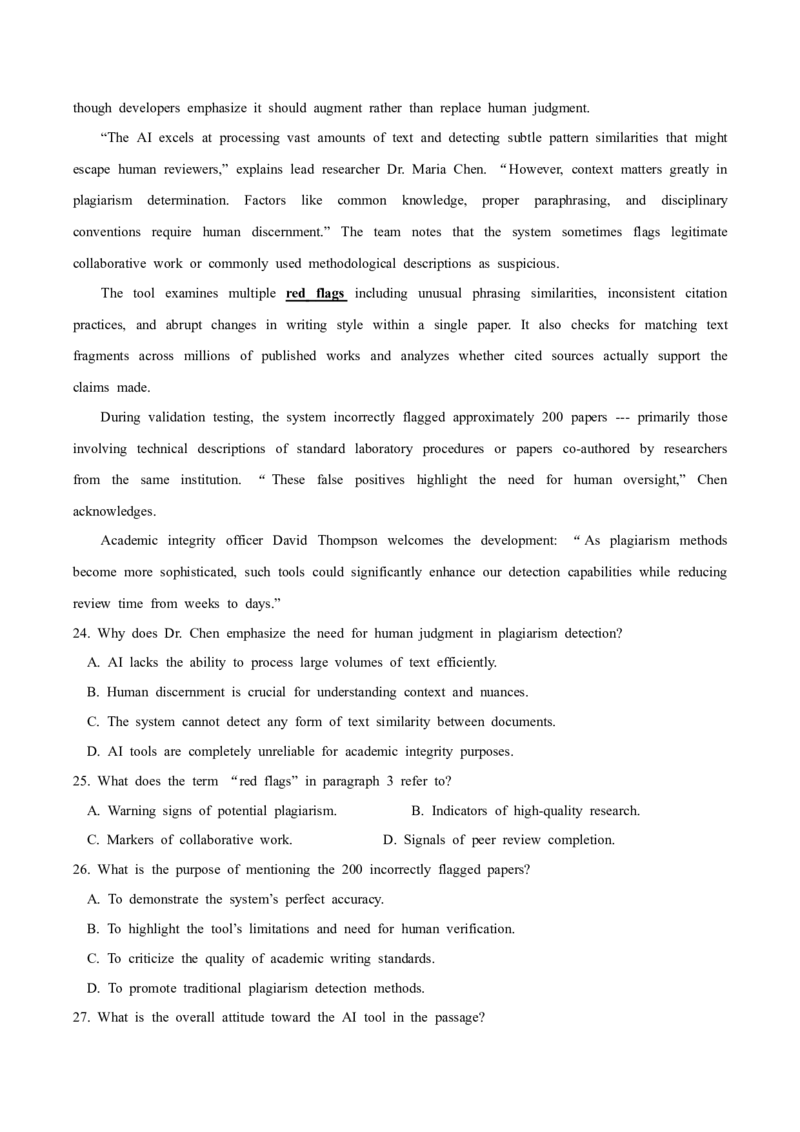
Researchers Develop AI to Detect Plagiarism in Academic Papers
A team from Stanford University has created an artificial intelligence system capable of
identifying sophisticated plagiarism in academic writing. The tool analyzes writing patterns, citation
networks, and semantic structures to flag papers that may contain improperly attributed content. In tests
involving over 50,000 research papers, the system identified potential plagiarism cases with 92% accuracy,
though developers emphasize it should augment rather than replace human judgment.
“The AI excels at processing vast amounts of text and detecting subtle pattern similarities that might
escape human reviewers,” explains lead researcher Dr. Maria Chen. “However, context matters greatly in
plagiarism determination. Factors like common knowledge, proper paraphrasing, and disciplinary
conventions require human discernment.” The team notes that the system sometimes flags legitimate
collaborative work or commonly used methodological descriptions as suspicious.
The tool examines multiple red

  flags

 including unusual phrasing similarities, inconsistent citation
practices, and abrupt changes in writing style within a single paper. It also checks for matching text
fragments across millions of published works and analyzes whether cited sources actually support the
claims made.
During validation testing, the system incorrectly flagged approximately 200 papers --- primarily those
involving technical descriptions of standard laboratory procedures or papers co-authored by researchers
from the same institution. “ These false positives highlight the need for human oversight,” Chen
acknowledges.
Academic integrity officer David Thompson welcomes the development: “ As plagiarism methods
become more sophisticated, such tools could significantly enhance our detection capabilities while reducing
review time from weeks to days.”
24. Why does Dr. Chen emphasize the need for human judgment in plagiarism detection?
A. AI lacks the ability to process large volumes of text efficiently.
B. Human discernment is crucial for understanding context and nuances.
C. The system cannot detect any form of text similarity between documents.
D. AI tools are completely unreliable for academic integrity purposes.
25. What does the term “red flags” in paragraph 3 refer to?
A. Warning signs of potential plagiarism.
B. Indicators of high-quality research.
C. Markers of collaborative work.
D. Signals of peer review completion.
26. What is the purpose of mentioning the 200 incorrectly flagged papers?
A. To demonstrate the system’s perfect accuracy.
B. To highlight the tool’s limitations and need for human verification.
C. To criticize the quality of academic writing standards.
D. To promote traditional plagiarism detection methods.
27. What is the overall attitude toward the AI tool in the passage?
A. Completely negative.
B. Overly enthusiastic.
C. Realistically balanced.
D. Indifferent and neutral.
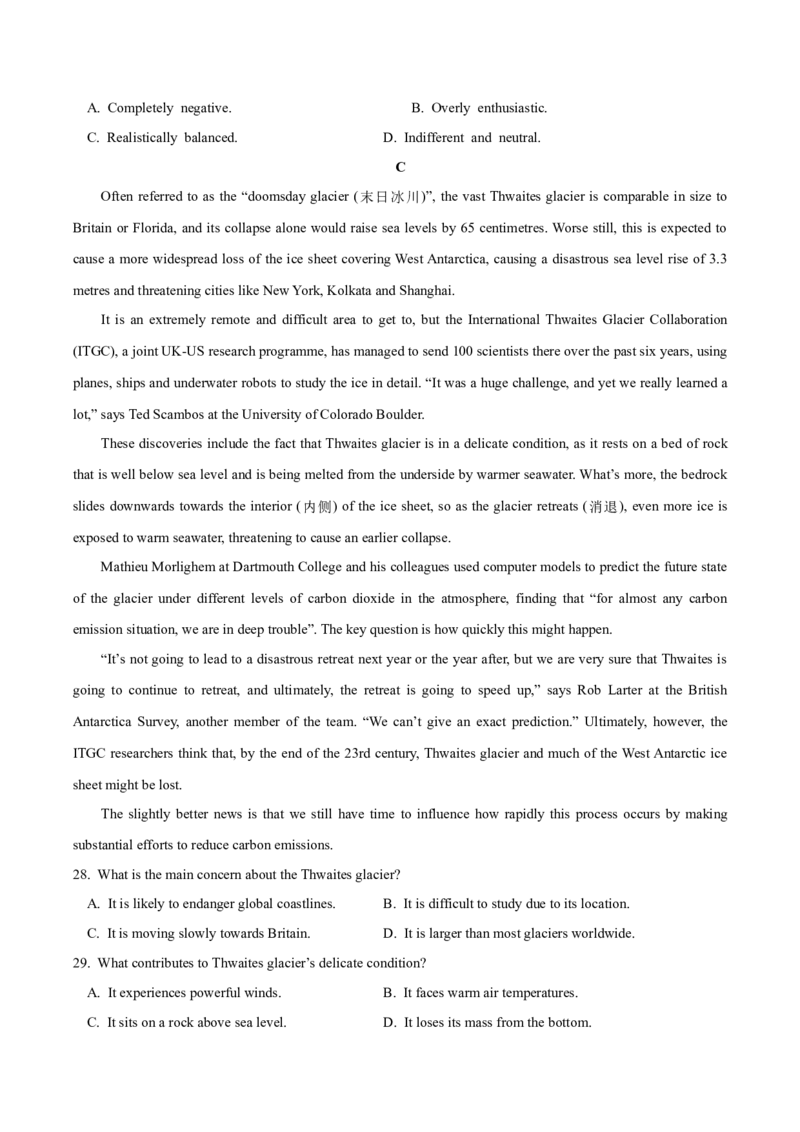
C
Often referred to as the “doomsday glacier (末日冰川)”, the vast Thwaites glacier is comparable in size to
Britain or Florida, and its collapse alone would raise sea levels by 65 centimetres. Worse still, this is expected to
cause a more widespread loss of the ice sheet covering West Antarctica, causing a disastrous sea level rise of 3.3
metres and threatening cities like New York, Kolkata and Shanghai.
It is an extremely remote and difficult area to get to, but the International Thwaites Glacier Collaboration
(ITGC), a joint UK-US research programme, has managed to send 100 scientists there over the past six years, using
planes, ships and underwater robots to study the ice in detail. “It was a huge challenge, and yet we really learned a
lot,” says Ted Scambos at the University of Colorado Boulder.
These discoveries include the fact that Thwaites glacier is in a delicate condition, as it rests on a bed of rock
that is well below sea level and is being melted from the underside by warmer seawater. What’s more, the bedrock
slides downwards towards the interior (内侧) of the ice sheet, so as the glacier retreats (消退), even more ice is
exposed to warm seawater, threatening to cause an earlier collapse.
Mathieu Morlighem at Dartmouth College and his colleagues used computer models to predict the future state
of the glacier under different levels of carbon dioxide in the atmosphere, finding that “for almost any carbon
emission situation, we are in deep trouble”. The key question is how quickly this might happen.
“It’s not going to lead to a disastrous retreat next year or the year after, but we are very sure that Thwaites is
going to continue to retreat, and ultimately, the retreat is going to speed up,” says Rob Larter at the British
Antarctica Survey, another member of the team. “We can’t give an exact prediction.” Ultimately, however, the
ITGC researchers think that, by the end of the 23rd century, Thwaites glacier and much of the West Antarctic ice
sheet might be lost.
The slightly better news is that we still have time to influence how rapidly this process occurs by making
substantial efforts to reduce carbon emissions.
28. What is the main concern about the Thwaites glacier?
A. It is likely to endanger global coastlines.
B. It is difficult to study due to its location.
C. It is moving slowly towards Britain.
D. It is larger than most glaciers worldwide.
29. What contributes to Thwaites glacier’s delicate condition?
A. It experiences powerful winds.
B. It faces warm air temperatures.
C. It sits on a rock above sea level.
D. It loses its mass from the bottom.
30. What will happen to the glacier according to Later?
A. It will collapse next year.
B. It will retreat at an average pace.
C. It will shrink at a faster rate.
D. It will cease to melt in centuries.
31. What is the general tone of the text?
A. Emergent but hopeful.
B. Confident and faithful.
C. Critical and concerned.
D. Optimistic but cautious.
D
As a Spanish major, I chose the IES Santiago program because it provides opportunities for service-learning
programs. During my first few weeks in Santiago, I visited various organizations to get an idea of what fields I
could work in. On the brochure from the Asociación Nacional de Discapacitado Mental (ANDIME), a school for
children with Down syndrome (唐氏综合征), I noticed there was a music therapist (治疗师) on staff. Since my
other major is music, this seemed like an ideal opportunity to get a taste of the profession.
At ANDIME, I was able to work with Ernesto, a professional music therapist, for a few hours twice a week. I
spent my hours at ANDIME walking and clapping with the music, swaying and bouncing with hula hoops (呼啦圈),
 beating on drums, singing songs, conducting concerts, and loving a group of extremely lovely kids.
By far my most memorable moment at ANDIME happened during one of my classes with Ernesto. Most of the
students had severe cases of Down syndrome, and several of them couldn’t speak and were only minimally
responsive. One such student, Miguelito, was even unable to sit still, make controlled movements, or fix his eyes on
anything.
On this particular day, Ernesto brought out a brand new instrument to use with the class. Ernesto held the
instrument in front of Miguelito’s face. We watched excitedly as Miguelito’s eyes began to search for its sound and
slowly follow it up and down. A seemingly small event was a big step in the development of this little boy.
Now back in the U.S., I am unsure of my next step. Between looking for jobs and picking out which path to
pursue, I love going back to my photographs and remembering the school and my students. The pride shining in
their eyes was a reward in itself.
32. According to paragraph 1, the author chose ANDIME partly because ________.
A. he didn’t have better choices
B. his friends recommended it
C. he loved the atmosphere there
D. he had learned music before
33. Which of the following best describes the author’s activities at ANDIME?
A. Demanding.
B. Colorful.
C. Repetitive.
D. Ordinary.
34. How did Miguelito respond to the new instrument?
A. He showed no interest in it.
B. He wanted to play it on his own.
C. He was deeply attracted to it.
D. He expressed his love in words.
35. What can we infer about the author from the last paragraph?
A. He is determined to continue pursuing music.
B. He feels confused about his future.
C. He desires to work again for ANDIME.
D. He is grateful for his experience at ANDIME.
第二节(共5 小题;每小题2. 5 分, 满分12. 5 分)
阅读下面短文, 从短文后的选项中选出可以填入空白处的最佳选项。选项中有两项为多余选项。
What is moderation (适度)? Basically, it means eating only as much food as your body needs. You should feel
satisfied at the end of a meal, but not too full. For many of us, moderation means eating less than we do now.     36
Take your time. It’s important to slow down and think about food as something nutritious rather than just
something to eat in between meetings. Don’t swallow a meal on the way to work. It actually takes a few minutes
for your brain to tell your body that it has had enough food,   37
Eat with others whenever possible.   38   And be careful about the foods you keep at hand. It’s more
challenging to eat in moderation if you have unhealthy snacks at the ready, like cookies. Instead, surround yourself
with healthy choices.
  39   We don’t always eat just to satisfy hunger. Many of us also turn to food to deal with unpleasant
emotions such as sadness, loneliness, or boredom. But by learning healthier ways to manage emotions, you can
regain control over the food you eat and your feelings.
Eat properly throughout the day. A healthy breakfast can start your metabolism (新陈代谢), while eating
small, healthy meals keeps your energy up all day.   40   Try to eat dinner earlier and fast for 14–16 hours until
breakfast the next morning. Studies suggest that eating only when you’re most active and giving your digestive
system a long break each day may help to regulate weight.
A. Avoid eating late at night.
B. Control emotional eating.
C. so eat slowly and stop eating before you feel full.
D. Drink plenty of water before each meal.
E. Eating alone, especially in front of the TV or computer, often leads to mindless overeating.
F. But it doesn’t mean saying goodbye to the foods you love.
G. Exercise regularly to burn more calories.
第三部分 语言运用(共两节,满分30 分)
第一节(共15 小题,每小题1 分,满分15 分)
阅读下面短文, 从每题所给的A、B、C 和D 四个选项中选出可以填入空白处的最佳选项。
Emma specializes in ancient art history. She has a unique talent for identifying artistic styles in a
41
       manner, even when they are highly unusual.
Last summer, while exploring a remote valley, she
  42

   a cave entrance hidden behind thick vines. Inside,
she found walls covered with colorful
  43

   that depicted daily life scenes.
Based on her preliminary ( 细致的)
  44
      , Emma believed these artworks were from an unknown
civilization. After
  45

   numerous historical records, she confirmed her hypothesis (观点): the paintings were
46
       as part of a ritual tradition from a tribe that lived around 2000 years ago.
Emma took a
  47
       approach to this finding and requested funding from her institute for further study.
With approval granted, she returned to the site. She noted the painting techniques
  48
      significantly from other
known styles of that era.
Despite many
  49
      , including poor lighting and fragile surfaces, Emma managed to document the cave
thoroughly. Her research paper was
  50
      in a famous journal, where she explained in detail: The artworks
  51

by this ancient tribe were preserved through natural mineral pigments and
  52
     .
The tribe kept
  53
      against harsh environments for centuries. But it
  54
      vanished after a major climate
change. Emma’s paper became a
  55

   in historical research, inspiring renewed interest in lost civilizations.
41. A. global
B. narrow
C. native
D. specific
42. A. blocked
B. cleaned
C. discovered
D. decorated
43. A. texts
B. patterns
C. posters
D. notes
44. A. investigation
B. drawing
C. experiment
D. discussion
45. A. referring to
B. applying for
C. looking up
D. giving out
46. A. honored
B. recommended
C. employed
D. regarded
47. A. casual
B. serious
C. hurried
D. simple
48. A. suffered
B. benefited
C. differed
D. heard
49. A. emergencies
B. accidents
C. failures
D. challenges
50. A. supplied
B. rejected
C. published
D. collected
51. A. sheltered
B. affected
C. created
D. damaged
52. A. bricks
B. stone
C. wood
D. glass
53. A. struggling
B. winning
C. uniting
D. resting
54. A. suddenly
B. positively
C. finally
D. rarely
55. A. problem
B. hit
C. trend
D. tool
第二节(共10 小题;每小题1.5 分 ,满分15 分)
阅读下面短文,在空白处填入1 个适当的单词或括号内单词的正确形式。
Some 4,000 years ago, the Liangzhu culture, known for its sophisticated city of canals   56   (call) “China’s
Venice of the Stone Age,” suddenly disappeared. Historians debated whether war, disease, or starvation caused its
collapse, but recent research points to climate change   57   a key factor.
Located near the East China Sea, Liangzhu was home to   58   advanced Stone Age civilization for about
1,000 years, supporting an active agricultural system through its canals. Liangzhu City was listed as a UNESCO
World Heritage Site in 2019.
Researchers from the University of Innsbruck had long sought

 59


  (explain) why Liangzhu was
abandoned, and the discovery of a thin layer of clay on the ruins suggested a possible connection between the ends
of the advanced civilization   6

 0
   floods of the Yangtze River or floods from the East China Sea. However, no
clear conclusions on the cause were possible from the mud layer itself.
A breakthrough came   6

 1       scientists studied stalagmites (石笋) from two nearby underwater caves. As Dr.
Peter Dockrill reported for Science Alert, their team   6

 2
   (discover) chemical signatures from about 4,300
years ago that showed extremely high rainfall,   63   (probable) caused by the warming of ocean waters in the
Pacific — an event known as the El Niño (厄尔尼诺).
The study notes that wet conditions lasted for several hundred years following the collapse of Liangzhu,
eventually   64   (pave) the way for the rise of the Xia dynasty in 2070 B. C. E. Its celebrated   65   (found),
Yu the Great, introduced more extensive flood-control methods and is known as the “Tamer of the Flood.”
第四部分  写作(共两节, 满分40 分)
第一节(满分15 分)
假定你是李华,你班的英语报要增设一个栏目。外教Jenny 提出“Traditional Culture in My
Hometown”和“Chinese Culture in Movies”两个选项供大家选择。请给Jenny 写一封邮件,内容包括:
1.你的选择;
2.说明理由。
注意:1.写作词数应为80 个左右;
2.请按如下格式在答题卡的相应位置作答。
Dear Jenny,
I
really
like
the
idea
of
adding
a
new
column
to
our
English
newspaper.
_____________________________
____________________________________________________________________________________________
____________________________________________________________________________________________
____________________________________________________________________________________________
____________________________________________________________________________________________
           Yours,
                 Li Hua
第二节(满分25 分)
阅读下面材料,根据其内容和所给段落开头语续写两段,使之构成一篇完整的短文。
When I was ten, my parents told me we were going to China for our summer holiday. I was over the moon — I
had only ever seen the Great Wall and the Forbidden City in books, and now I would actually get to walk through
history!
For weeks, I imagined the towering palaces, the red-and-gold gates, and the stories hidden in every corner.
Finally, the day arrived, and there I was, standing in the heart of Beijing, staring up at the most magnificent
buildings I had ever seen.
The Forbidden City was even more incredible in real life. The golden roofs shone under the sun, the delicate
carvings told silent tales of emperors and warriors, and the vast courtyards made me feel like I had stepped into a
fairy tale. Every turn revealed something new — a dragon statue, a marble staircase, a hidden garden — and I
couldn’t stop taking pictures, desperate to capture every detail. My parents laughed as I dragged them from one
spot to another, insisting on yet another photo.
What struck me most were the colors. The imperial yellow of the rooftops against the deep red walls looked
brighter than any picture could show. Even the stone pathways seemed to glow with centuries of footsteps. I
remembered running my fingers along a carved marble railing, wondering how many hands had touched that same
spot over six hundred years.
The place was packed with tourists, all murmuring in different languages, their faces filled with the same
amazement as mine. Some pointed at the architecture, others posed for pictures, and a few just stood quietly, taking
it all in. The energy was infectious — everyone seemed to feel the magic of this ancient place.
As the afternoon wore on, we followed the crowd toward the exit. The sea of people was overwhelming, and I,
being small for my age, grasped my father’s hand tightly, afraid to get lost in the rushing crowd. The noise, the
heat, and the excitement made everything feel like a blur — until suddenly, I looked down at the large hand I was
holding — the wrong watch, the wrong-colored ring.
注意:
1.续写词数应为150 左右;
2.请按如下格式在答题卡的相应位置作答。
My blood turned to ice. _____________________________________________________________________
____________________________________________________________________________________________
____________________________________________________________________________________________
____________________________________________________________________________________________
____________________________________________________________________________________________
____________________________________________________________________________________________
There he was, just three people away. _________________________________________________________
____________________________________________________________________________________________
____________________________________________________________________________________________
____________________________________________________________________________________________
____________________________________________________________________________________________
____________________________________________________________________________________________