绝密★启用前
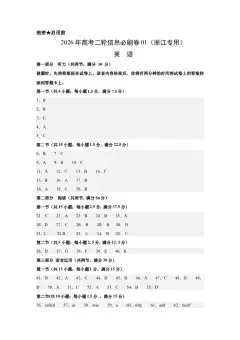
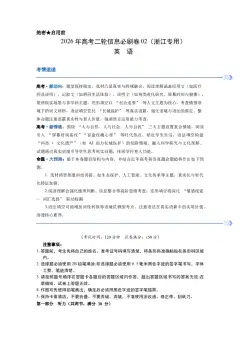
2026 年高考二轮培优必刷卷01(浙江专用)
英  语
(考试时间:120 分钟  试卷满分:150 分)
注意事项:
1. 答题前,考生先将自己的姓名、准考证号码填写清楚,将条形码准确粘贴在条形码区域内。
2. 选择题必须使用2B 铅笔填涂;非选择题必须使用0. 5 毫米黑色字迹的签字笔书写,字体工整,笔记清
楚。
3. 请按照题号顺序在答题卡各题目的答题区域内作答,超出答题区域书写的答案无效;在草稿纸、试卷上
答题无效。
4. 作图可先使用铅笔画出,确定后必须用黑色字迹的签字笔描黑。
5. 保持卡面清洁,不要折叠、不要弄破、弄皱,不准使用涂改液、修正带、刮纸刀。
第一部分  听力(共两节,满分 30 分)
做题时,先将答案标在试卷上。录音内容结束后,你将有两分钟的时间将试卷上的答案转涂到答题卡上。
第一节(共5 小题;每小题1.5 分,满分7.5 分)
听下面5 段对话。每段对话后有一个小题,从题中所给的A、B、C 三个选项中选出最佳选项。听完每
段对话后,你都有10 秒钟的时间来回答有关小题和阅读下一小题。每段对话仅读一遍。
1. What happened to the man’s favorite jacket?
A.It was dirty with some coffee.B.It was held by the coffee shop.
C.It was taken away by someone.
2. What is the entry price for a student?
A.$22.
B.$11.
C.$12.
3. Where are the speakers?
A.On the road.
B.On the beach.
C.On the golf course.
4. What was the woman dissatisfied with about the restaurant?
A.The staff.
B.The surroundings.
C.The location.
5. What are the speakers talking about?
A.How to save on costs.
B.Whether to hire new staff.
C.When to reduce employees.
第二节(共15 小题;每小题1.5 分,满分22.5 分)
听下面5 段对话或独白。每段对话或独白后有几个小题,从题中所给的A、B、C 三个选项中选出最佳
选项。听每段对话或独白前,你将有时间阅读各个小题,每小题5 秒钟;听完后,各小题将给出5 秒钟的
作答时间。每段对话或独白读两遍。
听第6 段材料,回答第6、7 题。
6.What does the man intend to do by seeing Ryan Adams?
A.To discuss a design.
B.To have a job interview.
C.To purchase personal insurance.
7.How does the woman sound in the end?
A.Disappointed.
B.Embarrassed.
C.Confused.
听第7 段材料,回答第8 至10 题。
8.When does the conversation probably take place?
A.In the morning.
B.Around noon.
C.In the evening.
9.When was the woman aware of the unusual situation?
A.When she was doing the dishes.
B.When she was polishing the table.
C.When she was cleaning the living room.
10.Who is the man probably?
A.A police officer.
B.The woman’s husband.
C.The woman’s neighbor.
听第8 段材料,回答第11 至13 题。
11.What kind of computer course will the man take?
A.The beginner course.
B.The medium course.
C.The advanced course.
12.Where should the man take the computer course?
A.In the library.
B.In the Office Building.
C.In the Computer Science Building.
13.When will the man take the computer course?
A.At 4:30 p.m. on Mondays. B.At 5:00 p.m. on Tuesdays.
C.At 2:00 p.m. on Thursdays.
听第9 段材料,回答第14 至17 题。
14.What is the relationship between the speakers?
A.Editor and writer.
B.Bookseller and consumer.
C.Interviewer and interviewee.
15.What does the man do when writing?
A.Use a special pen.
B.Open the windows.
C.Limit the interruptions.
16.What is different about the man’s next book?
A.The targeted readers.
B.The time period setting.
C.The seriousness of the message.
17.What is the man’s new book like?
A.It is completely fictional.B.It is set in the countryside. C.It is mainly lighthearted.
听第10 段材料,回答第18 至20 题。
18.How long will it usually take to make the writing disappear?
A.More than 3 days.
B.About 20 minutes.
C.Less than 10 minutes.
19.What can speed the writing’s disappearance?
A.Chemicals.
B.Light.
C.Heat.
20.What do we know about the newly invented paper?
A.It can be printed on repeatedly.
B.It might make ink widely used.
C.It will replace the ordinary paper.
第二部分  阅读(共两节, 满分50 分)
第一节(共15 小题;每小题2.5 分, 满分37.5 分)
阅读下列短文, 从每题所给的A、B、C 和D 四个选项中选出最佳选项。
A
Volunteer Recruitment Notice for City International Marathon
To ensure the smooth operation of the 2025 City International Marathon (to be held on Sunday,
November 16), we are now recruiting volunteers from senior high school students. The details are as
follows:
1. Volunteer Duties:
●Guiding runners to check-in areas and competition routes
●Providing water, energy gels and first-aid supplies at supply stations
●Assisting with crowd management and maintaining on-site order
●Answering runners' inquiries in English or Chinese
2. Requirements:
●Senior 3 students aged 17 or above (with student ID for verification)
●Proficient in basic oral English (able to communicate simple instructions)
●Responsible, patient and able to work under pressure
●Available for the full day on November 16 (7:00 AM–5:00 PM)
●Those with first-aid training or volunteer experience are preferred
3. Benefits:
●Official volunteer certificate issued by the Marathon Organizing Committee
●Free marathon T-shirt, hat and waterproof backpack
●Catering (breakfast, lunch and snacks) during the event
●Transportation subsidy of 50 yuan per person
4. Application Method:
●Fill in the online application form via the official WeChat mini-program “City Marathon Volunteer”
before October 31
●Attach a photo of your student ID and a short self-introduction (within 100 words)
●Wait for a telephone interview (to be conducted between November 3 and November 5)
●For any questions, please email volunteer@citymarathon.org or contact the volunteer service team at
020-XXXX8899.

City Marathon Organizing Committee
October 15, 2025
21. Which of the following is a basic requirement for volunteers?
A. Having first-aid training                      B. Being able to speak fluent English
C. Being a Senior 3 student aged 17 or above        D. Having participated in marathon events
before
22. What benefit will volunteers receive?
A. A cash reward of 100 yuan                    B. Free accommodation for one night
C. Official volunteer certificate                   D. A free entry ticket to next year's marathon
23. How should applicants submit their applications?
A. By visiting the Organizing Committee's office in person
B. By filling in the online form via the designated WeChat mini-program
C. By sending an email with a detailed resume
D. By calling the volunteer service team directly
B
When I arrived at the Sign Language Center in Manhattan for my first American Sign Language (ASL) class,
a man took one look at my hesitant posture and held up some fingers. One? Two? I put up one finger, and he
directed me to the Level 1 class. It was disorienting: Class time was strictly “voices off” to encourage immersive
learning and to show respect to the deaf teachers. Without the power of speech, all my classmates and I could do
was smile and nod at one another as we took in the new vocabulary.
Learning ASL in the early weeks was a culture shock. As a writer, I pride myself on a certain facility with
language. I was taught that there’s a perfect combination of words that can most precisely communicate any
thought. With ASL, I expected to feel similarly, and thought fluency would come once I collected a critical mass of
signs. The first thing you learn in ASL class is the alphabet. As my classmates and I asked and answered questions
using words we didn’t have the signs for, those early weeks were filled with laborious spelling. It was
embarrassing: Seeing a dozen politely smiling faces watching me as I slowly spelled, misspelled and restarted
spelling words —often multiple times — was its own kind of torture.
Over time, I picked up on new conventions, like waving a hand or stomping (跺脚) on the ground to get
someone’s attention. My fingers stopped as they reached for new shapes, and I struggled to differentiate very
similar looking signs. Eventually I realized that when you’re communicating in sign language, diction (措辞) is not
as important as the way you embody (具体化) what you’re communicating. I once asked a teacher how to sign the
word “desperate”. “ASL doesn’t have a direct translation of every English word,” he told me. “If you want to sign
‘desperate’, you might just sign the word ‘want’, but with the appropriate facial and body posturing to show your
desperation. It doesn’t make sense to sign ‘frustrated’ if your face doesn’t look at all frustrated,” he added — it’s
like speaking in a single unvarying tone while claiming you’re angry.
I’ve been attending ASL classes for almost two years. Initially, my reason was insignificant: a childhood
fascination with “secret languages”. While ASL may not wholly share a vocabulary with English, that doesn’t mean
it lacks precision. Its precision, I’ve learned, lies in the common language of the body.
24.How did the author feel in the first ASL class?
A.Confused.
B.Frustrated.
C.Anxious.
D.Ambitious.
25.What made the author embarrassed when learning the alphabet?
A.Putting on smiling facial expressions.
B.Being made fun of in front of the class.
C.Misspelling and respelling words repeatedly. D.Waving a hand to get someone’s attention.
26.According to the passage, what can we learn about ASL?
A.It requires a combination of signs and emotions.
B.It conveys more emotions than verbal language.
C.It’s a universal language system across cultures.
D.It has a direct translation of signs for every word.
27.What has the author learned from her learning experience?
A.ASL prioritizes precision over communication.
B.Diction is what gives language flavour.
C.Fluency comes from the mastery of signs.
D.The body is what gives language life.
C
Recent research highlights that the timing of our meals, particularly the last one of the day, can significantly
affect our health. The story is not merely about what we consume, but also about when we do so.
The debate about dinner timing finds substantial, scientific support with a Brigham and Women’s Hospital
(BWH) study published in Cell Metabolism in October 2022, suggesting that early dinners could have more health
benefits than previously believed. And it defined an early dinner as a meal consumed three to four hours before
bedtime, in line with our body’s circadian rhythm (生理节奏).
The BWH study discovered clear differences in metabolic (新陈代谢的) profiles of early and late diners.
Early diners demonstrated lower blood glucose (葡萄糖) levels, improved fat-burning capacity, better sleep quality,
and higher energy levels. Meanwhile, late dinners led to increased hunger, slower calorie burning, and higher fat
storage, posing risks for conditions like diabetes(糖尿病).
The exact timing of dinner isn’t a one-size-fits-all choice, as people’s routines vary widely. Maya Feller, a
nutritionist based in Brooklyn, NY, emphasizes that our schedules —ranging from traditional nine-to-five to round-
the-clock — are critical when considering “ideal” meal times. Therefore, finding a dinner time that fits into your
schedule is essential, rather than sticking to a strict, potentially impossible timetable.
Wendy Bazilian, DrPH, offers insightful tips for those whose routines may not permit an early dinner. She
recommends consuming meals or snacks every three to five hours. This regular eating pattern can help . stabilize
blood sugar levels, preventing the feeling of hunger. Furthermore, it’s advantageous to leave a gap of two to three
hours between your last meal and bedtime. This gap ensures your body has sufficient time for most of the digestion
process — letting you get adequate rest and repair during sleep.
So it’s time to reconsider not just the contents of your plate, but also the clock. After all, leading a healthy
lifestyle isn’t merely about counting calories but alșo understanding when and how to fuel our bodies.
28.What did the Brigham and Women’s Hospital(BWH) study mainly focus on?
A.The recommended daily diet.
B.Our body’s circadian rhythm.
C.The drawbacks of early dinners.
D.The importance of dinner timing.
29.What may be the result of having an early dinner?
A.Having a strong sense of hunger.
B.Storing up more fat in your body.
C.Having a higher risk of diabetes.
D.Enjoying a sound night’s sleep.
30.What advice does Wendy Bazilian give to the late diners?
A.They’re supposed to grab some food every 5. hours.
B.They’d better have access to adequate rest and repair,
C.They should allow for digestion process before bedtime.
D.They are advised to keep their blood sugar level stable.
31.What is the best title for the text?
A.The Healthiest Time to Eat Dinner.
B.We Are What We Eat.
C.Benefits of Good Dietary Habits.
D.Eating Less in the Evening.
D
A recent study has shown that different kinds of songs bring back different kinds of memories. Softer,
acoustic (原声的) music tends to remind people of calm or even sad moments, while louder, high-energy songs
more often bring back fun and exciting events.
“We all know the feeling of hearing a song and suddenly being taken back to a past moment,” explained
Safiyah Nawaz from Goldsmiths University in London. “Our study shows that qualities of the music itself — such
as how energetic, loud, or acoustic it is — are connected to the emotions and clarity of those memories.”
Scientists have long known that music can conjure strong memories. What’s new is how the emotional
qualities of music are linked to memory, which could help in medical treatments, such as helping people with
dementia (痴呆) or Alzheimer’s disease. Music therapies are already used with patients, often reducing anxiety and
improving their relationships with caregivers.
To explore this further, researchers surveyed 233 people aged 18 to 76. Participants were asked about
memories connected to both their favorite songs and popular hits from their teenage years. Previous research
suggests that around age 14, people form the strongest music-related memories.
The analysis revealed several patterns. More acoustic songs were tied to vivid and unique memories, often
involving emotions like romance or admiration. In contrast, high-energy songs, such as Prince’s When Doves Cry,
brought back memories of excitement and amusement, and were recalled more quickly. Another key finding was
that self-chosen songs led to more positive and specific memories than chart hits, showing that it’s not just the
musical features that influence memory, but also how much a person likes a song and how familiar it is to them.
The team has also launched an online collection of songs and musical memories, aiming to expand it beyond
Western samples. “We hope this collection will help us better understand how music, together with personal
experience, produces such deep and meaningful memories,” said Nawaz, adding that future research will explore
how musical elements interact with personal factors to create meaningful memories in everyday life.
32.What is the main focus of the recent study?
A.Why people prefer acoustic songs.
B.How music treats dementia patients.
C.How music affects emotions directly.
D.How music qualities influence memory.
33.What does the underlined word “conjure” in Paragraph 3 most likely mean?
A.Hold back.
B.Search for.
C.Put down.
D.Bring about.
34.What is a possible benefit of music therapy?
A.Stop memory decline.
B.Improve patient mood.
C.Help patients live longer.
D.Slow down aging process.
35.Which kind of music recalls more pleasant memories?
A.Songs from the music charts.
B.Songs that are soft and acoustic.
C.Songs frequently played on the radio.
D.Songs personally preferred by listeners.
第二节(共5 小题;每小题2. 5 分, 满分12. 5 分)
阅读下面短文, 从短文后的选项中选出可以填入空白处的最佳选项。选项中有两项为多余选项。
4 Ways to Calm a Tense Situation
Dealing with arguments can be challenging. However, staying calm and self-aware is your greatest tool to
find common ground again.     36     Remember, while working through disagreements is important, your
safety comes first. If you ever feel unsafe, it is always okay to set boundaries, ask for help, or walk away.
●Use “Opposite Energy”
When people start shouting and talking over each other, it’s easy to copy that same angry energy, which only
makes things worse.     37     Stay calm, control your emotions, and respond thoughtfully. When one person
remains reasonable, the argument usually cools down much faster.
●Stick to the Main Point
Sometimes, one small problem can bring up every other past complaint. Try not to get distracted by these
side issues or hurtful comments. Keep the conversation focused on the most important problem at hand.     38
●Mind Your Words and Body Language
    39     Speak softly and clearly. Avoid blaming phrases and defensive body language like pointing or
crossing your arms. Instead, use open-ended questions to let the other person express themselves. Use positive
phrases like, “Let’s solve this together,” or “I see your point,” to show that you understand and want to find an
answer.
●Listen to the Feelings Behind the Words
When people are upset, their words don’t always show their true feelings.     40     Are they scared,
stressed, or hurt? Recognizing these hidden emotions can prevent you from focusing only on their sharp words.
Even if you disagree, everyone wants to feel heard. Maintain eye contact, nod to show you are listening, and repeat
their concerns in your own words to show you truly understand.
A.Instead, try to break the pattern.
B.Avoid focusing on their negative feelings.
C.The following tips may help you stay safe.
D.You can always deal with smaller issues later.
E.Try to understand why they are acting this way.
F.Try these techniques to promote more productive discussions.
G.Your communication style can make the situation better or worse.
第三部分 语言运用(共两节,满分30 分)
第一节(共15 小题,每小题1 分,满分15 分)
阅读下面短文, 从每题所给的A、B、C 和D 四个选项中选出可以填入空白处的最佳选项。
There comes a time for every family when the tables are turned and the parent has to answer to the child.
Mine came recently when my wife and I stayed with our elder son in Los Angeles. A whole week under his     41
!
“Dad, don’t leave the tap water     42     when you brush your teeth.” Nathaniel warned on our first
night. All right, I figured, this is California, where     43     is a concern. More rules followed. Don’t wear a
neck warmer when     44     the dogs in the morning — it will warm up when we get to the park.
At first I wondered how I had     45     such a tyrant (暴君). Then I remembered how often I     46
my golden rule of parenting when he was young. “Someday, you’ll have a home of your own and can live however
you want,” I’d say. “    47     then, you’ll have to do as we ask.” Now it was payback time. So, despite a touch
of resistance, I     48     followed Nathaniel’s household orders. Our changed role     49     another side
of Nathaniel, giving me hope for his future       50       ability.
On our last afternoon there, we were walking on El Matador Beach. We came to a big area full of       51
, and I thought it was as far as we could go. But Nathaniel didn’t want to stop. He patiently helped me       52
my way from one rock to another, showing me where to put my arthritic (关节炎的) feet and hands as ocean waves
came close. I was       53      , but after a couple hundred yards we made it to a fresh sandy beach. “You did
it! I’m really proud.” he said, beaming,       54       I’d just learned to ride a bike. It was then that I knew my
elder son also rose to       55      .
41.A.roof
B.care
C.belt
D.feet
42.A.bubbling
B.freezing
C.running
D.steaming
43.A.cold
B.weather
C.flood
D.drought
44.A.training
B.walking
C.feeding
D.waking
45.A.raised
B.tolerated
C.crushed
D.met
46.A.challenged
B.stressed
C.reminded
D.broke
47.A.since
B.until
C.after
D.from
48.A.willingly
B.desperately
C.randomly
D.smilingly
49.A.masked
B.relayed
C.revealed
D.protected
50.A.parenting
B.organizational
C.lecturing
D.communicative
51.A.weeds
B.shells
C.rocks
D.bottles
52.A.settle
B.drag
C.bounce
D.pick
53.A.content
B.regretful
C.thrilled
D.scared
54.A.as if
B.even if
C.in case
D.so that
55.A.fame
B.greatness
C.fatherhood
D.power
第二节(共10 小题;每小题1.5 分 ,满分15 分)
阅读下面短文,在空白处填入1 个适当的单词或括号内单词的正确形式。
For the first time, more than 500 humanoid robots from five continents competed in their own global games.
Under the slogan “Racing Toward a Shared Intelligent Future”, the 2025 World Humanoid Robot Games (WHRG),
56     (hold) from Aug 14 to 17 in Beijing, brought together around 280 teams from 16 countries to compete in 26
events.
According to the official WHRG website, the four-day games drew moderate inspiration from human sports
competitions, including track and field events and gymnastics, to showcase the     57     (late) advancements in
robot technology. Each running, jumping,     58     competing humanoid robot represented a vivid display of
human creativity and technological skill.
Beyond these human-inspired     59     (competition), the games also featured practical, skill-based
challenges such as moving materials, sorting medicines, and     60     (clean) in varied conditions, showing
robots’ real-world applications.
The games proved popular on the Internet, with the official topic gaining 150 million views on social media.
One of the most exciting events was the 5v5 humanoid robot soccer match,     61     was entirely controlled by
AI without any human intervention. In the thrilling final on Aug 17, Tsinghua University     62     (defeat) a
team from Germany and won the gold medal.
“When our robots play     63     (independent) on the field, they rely on an integrated system that
includes observation, decision-making, and motion control,” said Chen Penghui, leader of the Tsinghua team. Chen
explained that observation involves using the cameras of the robots     64     (gather) visual information. Based
on this feedback, the robots decide on actions, automatically chase the ball, and perform defensive moves      65
blocking — all without human input.
第四部分  写作(共两节, 满分40 分)
第一节(满分15 分)
假定你是李华,你校将举办“校园AI 创新实践周”活动,你的英国笔友Tom 对人工智能兴趣浓
厚。请你给他写一封邮件,内容包括:
1. 活动时间与主题;
2. 核心活动安排;
3. 邀请他线上参与互动环节。
注意:1. 词数80 左右;
2. 可以适当增加细节,以使行文连贯。
Dear Tom,
____________________________________________________________________________________________
____________________________________________________________________________________________
____________________________________________________________________________________________
____________________________________________________________________________________________
___________________________
Yours,
Li Hua
第二节(满分25 分)
阅读下面材料,根据其内容和所给段落开头语续写两段,使之构成一篇完整的短文。
For the last decade, I’ve been a housewife. With kids home all day and various house chores to do, I couldn’t
find any place that made me feel relaxed.
Then I decided to make things easier. I gave myself time in the morning to care for myself: brush my hair
and pick out clothes and even paint my nails. It did work well to delight myself for some time. Soon I realized that
doing those things was just personal chores to feel presentable(体面的), which was physical self-care. I needed
mental self-care, too.
I’ve been passionate about reading and dreaming of living in a library since I was ten years old. I tried to
restart reading at night. It was my personal time to forget everything but the fictional world I was sinking into. But I
was so tired from the day that I’d read two pages and fall asleep. If I manage, a dog would bark for attention. A cat
would scratch at the door until I let it in. A kid would wake up. Relaxing? Not quite.
Then one of my personal favorite days of the year arrived—a giant book sale of the library was annually held
in my community, where I usually came home with no less than twenty books. I never missed the event.
My husband and I were first in line to wait as the workers chatted beside us. I overheard(无意中听到)that
this would be the last year for the event. People who ran it would be retiring. No one had stepped up to take their
place to run the book sale, because no one was willing to stay at the locked basement(地下室)where all the books
were kept to work with books, not even for just three times a week. “This can’t be true. I’ve been coming here for
more than half my life!” I said to my husband.
注意:
(1)续写词数应为150 个左右;
(2)请按如下格式在答题卡的相应位置作答。
Then my husband had an idea for me.
____________________________________________________________________________________________
____________________________________________________________________________________________
____________________________________________________________________________________________
____________________________________________________________________________________________
______________________________________________________________________________________
After my worry faded away, I went to the library again the next day.
____________________________________________________________________________________________
____________________________________________________________________________________________
____________________________________________________________________________________________
____________________________________________________________________________________________
______________________________________________________________________________________