绝密★启用前
2026 年高考二轮培优必刷卷
英  语
(考试时间:120 分钟  试卷满分:150 分)
注意事项:
1. 答题前,考生先将自己的姓名、准考证号码填写清楚,将条形码准确粘贴在条形码区域内。
2. 选择题必须使用2B 铅笔填涂;非选择题必须使用0. 5 毫米黑色字迹的签字笔书写,字体工整,笔记清楚。
3. 请按照题号顺序在答题卡各题目的答题区域内作答,超出答题区域书写的答案无效;在草稿纸、试卷上
答题无效。
4. 作图可先使用铅笔画出,确定后必须用黑色字迹的签字笔描黑。
5. 保持卡面清洁,不要折叠、不要弄破、弄皱,不准使用涂改液、修正带、刮纸刀。
第一部分  听力(共两节,满分 30 分)
做题时,先将答案标在试卷上。录音内容结束后,你将有两分钟的时间将试卷上的答案转涂到答题卡上。
第一节(共5 小题;每小题1.5 分,满分7.5 分)
听下面5 段对话。每段对话后有一个小题,从题中所给的A、B、C 三个选项中选出最佳选项。听完每
段对话后,你都有10 秒钟的时间来回答有关小题和阅读下一小题。每段对话仅读一遍。
1.What did the woman do last night?
A.She submitted a report. B.She attended a lecture.
C.She cared for her mother.
【答案】C
【原文】M: Ruth, you were absent from the lecture yesterday. What was happening?
W: My mom passed out suddenly, and I attended to her the whole night.
M: Sorry to hear that. So you haven’t finished your report yet?
W: Yes.
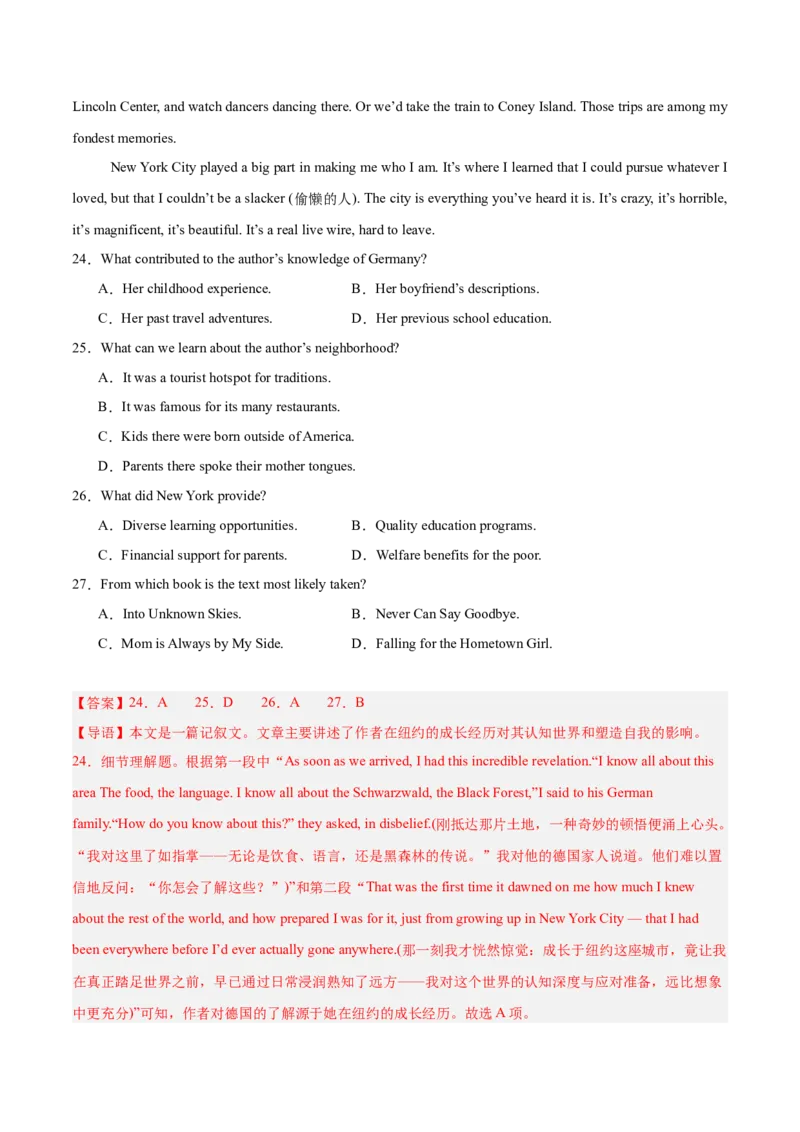
2.What did the man’s cousin do for him?
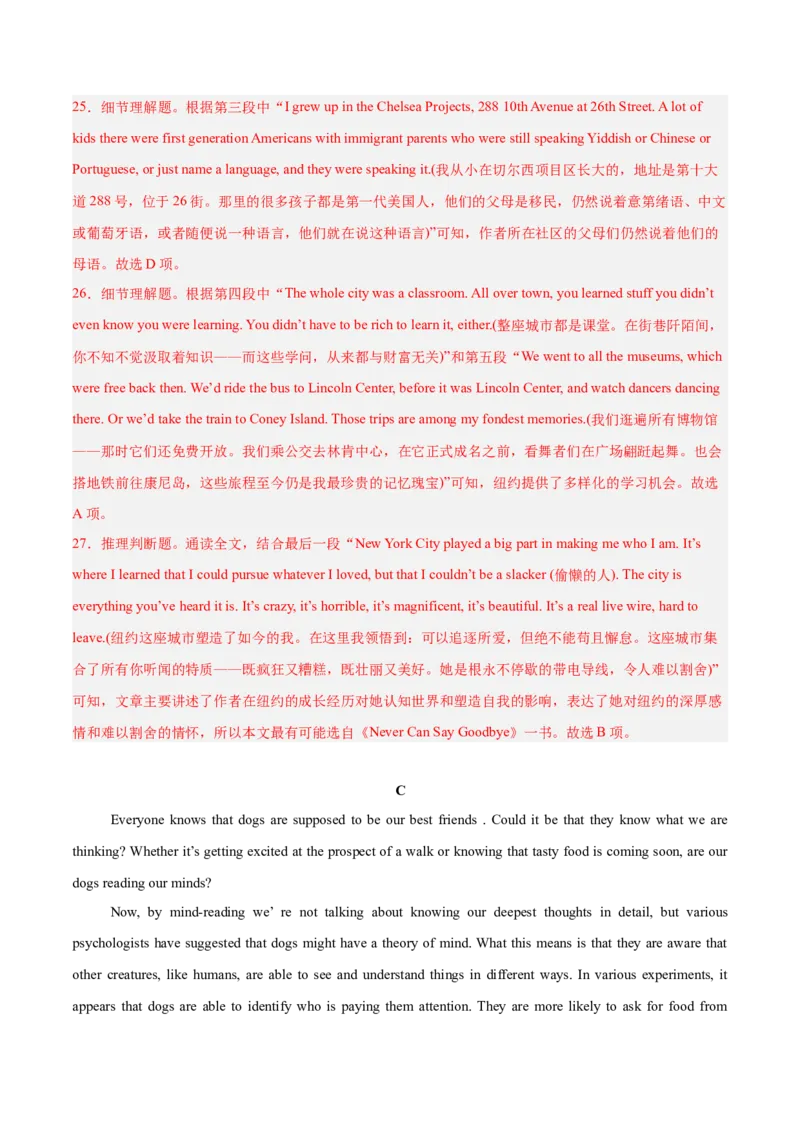
A.He showed him around.
B.He booked him in at a hotel.
C.He offered him temporary accommodation.
【答案】C
【原文】W: How was the hotel during your stay in Belfast?
M: There were so many people traveling there that we failed to book a hotel. But luckily, a cousin of mine just lived
there and invited us to stay for a couple of days.
3.When does the conversation probably take place?
A.Before an interview.
B.During an interview.
C.After an interview.
【答案】A
【原文】W: Mr. Williams, I’m calling to tell you that we also need a personal reference letter.
M: Okay, I will bring it to you tomorrow afternoon.
W: I hope you can bring out the best in you in the first round of interviews.
4.Why doesn’t the man choose the Polar Primary school?
A.Because it’s far away from his home.
B.Because it doesn’t have school buses.
C.Because its standards of education are low.
【答案】A
【原文】W: Alex is old enough to go to school. Why don’t you send him to the Polar Primary School?
M: Well, it takes ages to get to the bus stop, let alone the school. So we have to give up the school with high
educational standards.
5.What is the main topic of the conversation?
A.What paintings to buy.
B.Whether to get a TV.
C.Which movie to watch.
【答案】B
【原文】M: I don’t think we need a TV. We can watch TV shows and movies on our phones.
W: I believe a TV is essential for a home.
M: Instead of buying a TV, I’d rather buy a few paintings to hang on the wall.
第二节(共15 小题;每小题1.5 分,满分22.5 分)
听下面5 段对话或独白。每段对话或独白后有几个小题,从题中所给的A、B、C 三个选项中选出最佳
选项。听每段对话或独白前,你将有时间阅读各个小题,每小题5 秒钟;听完后,各小题将给出5 秒钟的
作答时间。每段对话或独白读两遍。
听第6 段材料,回答第6、7 题。
6.What does the man like about the house?
A.The stairs.
B.The light.
C.The windows.
7.What are the speakers going to do next?
A.Get a gate.
B.Look at more rooms.
C.Bargain with the seller.
【答案】6.A    7.C
【原文】M: It’s quite dark in here, isn’t it?
W: Yes, but that’s because it’s an old house with small windows.
M: Those wooden stairs are beautiful. No one makes anything like that these days.
W: I would worry about the children falling downstairs, though.
M: We could put a gate at the top.
W: Maybe, but don’t you think a house like this is more than we can afford?
M: I suppose so, but maybe we can negotiate (协商) a better price.
W: Right. We should call the seller and see what he says.
M: Okay, let’s do that right now.
听第7 段材料,回答第8 至10 题。
8.Which city library did Mychal work in?
A.Fairfield.
B.San Jose.
C.Phoenix.
9.Why did Mychal stop working at the library?
A.He got a better job working for PBS.
B.He wanted to go back to university.
C.He struggled with the impact of fame.
10.What is the purpose of the speaker’s talk?
A.To present a guest.
B.To introduce a library.
C.To promote a reading activity.
【答案】8.A    9.C    10.A
【原文】    Since starting out six years ago, our program has featured “book people” of different kinds. However,
I’ve never interviewed a social media star before. In recent years, 34-year-old librarian Mychal’s love for his work
has taken the world by storm. As a child, Mychal spent hours at the local library in Fairfield, California, calling it
his “home-away-from-home”. After gaining a communications degree from the University of Phoenix, followed by
a master’s in library information science from San Jose State University, the 23-year-old returned home and began
working at the very library which had made him feel so welcome as a child. Mychal took to social media in the
hope of encouraging his audience to visit their local libraries. Sharing book reviews, library experiences, and
positive messages, he gradually gained a huge following and millions of views. Earlier this year, the pressures of
fame became too much, and Mychal stepped back from his job to focus on his mental health. However, he
continues to inspire others. He’s now a “resident librarian” for PBS, America’s biggest not-for-profit TV service.
Mychal, welcome…
听第8 段材料,回答第11 至13 题。
11.What did the woman order for her sister’s party?
A.A pair of shoes.
B.A dress.
C.A necklace.
12.Why did the delivery man make the mistake?
A.He mixed up two addresses.
B.The package labels were torn.
C.The order numbers were not clear.
13.What did the delivery company offer the woman for the trouble?
A.A full refund of the dress.
B.A free delivery next time.
C.A discount on her next order.
【答案】11.B    12.A    13.C
【原文】W: Hi, Mike, you won’t believe what happened to me yesterday. I received a package, but when I opened
it, there was a pair of men’s shoes inside.
M: That’s strange. Did you order shoes?
W: No, I ordered a blue dress for my sister’s birthday party, which is a good match with my new necklace. I
checked the address on the package — it had my name and a very similar apartment number, but the order number
was completely different. And the box looked fine, no sign of damage.
M: What did you do then?
W: I called the delivery company right away. The customer service woman said she’d track it down and send the
delivery man back within an hour.
M: Did he come back on time?
W: Yes, he arrived in 40 minutes. He kept apologizing and said he’d mixed up two packages. He brought my dress
and took the shoe box back.
M: Did the delivery company offer anything to make up for the trouble?
W: The customer service said they would give me a full refund for this delivery and a 20% discount on my next
order.
M: The shoes must be bought by a lady who has the same name with you. What a coincidence!
W: Yes. And the delivery man said she lives only two blocks away.
听第9 段材料,回答第14 至17 题。
14.What is Emma’s role in theater production?
A.She plays the lead role in the play.
B.She creates the lighting effects.
C.She writes stories for the performance.
15.What does Emma need to research for her work?
A.Light styles for different emotions.
B.The history of the theater.
C.The audience’s favorite plays.
16.Who does Emma show her plan to?
A.The actor.
B.The stage manager.
C.The director.
17.What does Emma think about her job?
A.Challenging.
B.Repetitive.
C.Straightforward.
【答案】14.B    15.A    16.B    17.A
【原文】M: Hey Emma, I heard you work in a theater, what’s your job?
W: I’m a stage lighting designer. I use lights to set the mood for each scene.
M: Oh, so it’s just turning lights on and off?
W: Not at all. I have to understand the story’s emotions first.
M: How do you prepare for that?
W: I read the script carefully and figure out the feelings of each scene. If it’s a sad moment, I might research soft,
cool-colored lights. For exciting parts, I look into bright, dynamic light setups.
M: What comes next after that?
W: I make a plan and show it to the stage manager. We discuss if it matches the director’s vision.
M: Is that the end of your work?
W: Nearly. I still watch the final runs to make sure the lights change at the right time and enhance the performance.
M: That sounds more complicated than I thought.
W: It is, but I love it. Being able to shape how the audience feels about the play makes it all worth it.
听第10 段材料,回答第18 至20 题。
18.What is the aim of the Nature Reimagined section?
A.To show bold art.
B.To challenge old views.
C.To reflect real scenes.
19.How does the exhibition involve visitors?
A.Talking to artists.
B.Using VR glasses.
C.Hands-on art activities.
20.What does the guide think about the exhibition?
A.It mixes traditional and modern.
B.It interests professionals.
C.It focuses on city life.
【答案】18.B    19.C    20.A
【原文】
Welcome to the Harmony of Colors Art Exhibition! I’m your guide for today, and I’m excited to show you
this journey of creativity. The exhibition features over 50 works, blending traditional techniques with modern
innovation, and is divided into three sections. First, Nature Reimagined showcases landscapes and wildlife through
bold colors, challenging traditional views of nature. Next, Urban Stories captures the energy of cities with abstract
and street-style art, reflecting urban complexity and diversity. Finally, Dreamscapes invites you into surreal worlds,
pushing the boundaries of imagination. Before you leave, don’t miss the interactive stations, where you can
contribute to a mural or create digital art. The exhibition runs daily from 10 a.m. to 6 p.m., ending this Sunday.
Let’s begin!
第二部分  阅读(共两节, 满分50 分)
第一节(共15 小题;每小题2.5 分, 满分37.5 分)
阅读下列短文, 从每题所给的A、B、C 和D 四个选项中选出最佳选项。
A
Earth Champions®: A Quest (探索) for Local Environmental Heroes
THEROLE
The Earth Champions® Foundation encourages local communities to drive environmental change. Its Quest
recognizes people or organizations working in areas such as water, air, energy, biodiversity, waste, and wellbeing
applicants are reviewed by an international committee including UNEP and IUCN experts. Selected Champions
lead community programmes and share solutions with others.
SHARING KNOWLEDGE
The “Knowledge Pond” spreads best practices across regions. A “State of the Local PlanetReport” records
environmental conditions in plain language, helping communities track their progress and understand local issues.
To build on this knowledge, the Foundation has launched Quests in various countries, turning local ideas into
global inspiration.
EARTH CHAMPIONS®: THE HISTORY
Quests have been held in several countries:
● Australia: In 2000, Nelson Mandela presented the first Earth Champion Award inMelbourne to Gina Litton
for protecting the Great Jarrah Forests. A second Quest in Byron Shire recognized 47 Champions.
● Switzerland: Launched at IUCN in Canton Vaud, 76 local Champions were honored. Achim Steiner of
IUCN called it “the first time we have found local Swiss heroes.”
● China (Hong Kong): Supported by Christine Loh and the Fu Tak lam Foundation, the Hong Kong Quest
received 239 nominations (提名) in 8 weeks and gained strong media attention.
● Bristol, UK: Launched by Mayor George Ferguson, the Quest honored 71 of 127 nominees. IUCN
Director Inger Andersen praised the Foundation’s work.
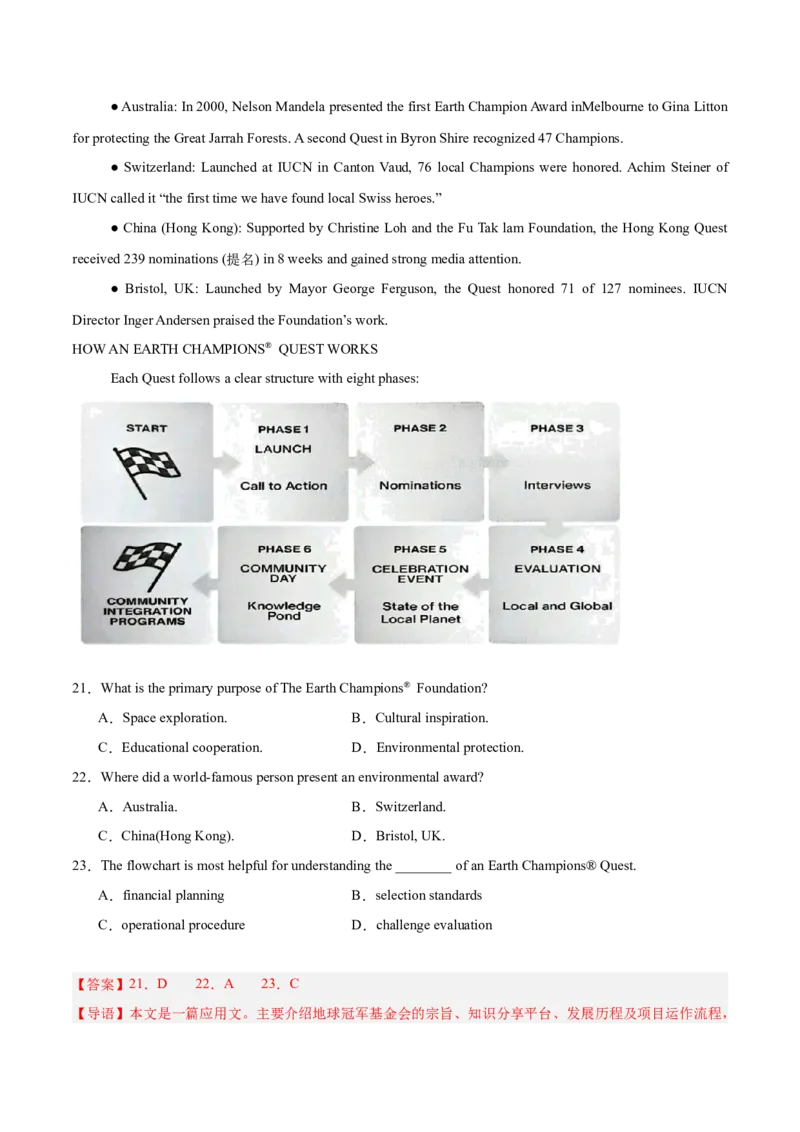
HOW AN EARTH CHAMPIONS® QUEST WORKS
Each Quest follows a clear structure with eight phases:
21.What is the primary purpose of The Earth Champions® Foundation?
A.Space exploration.
B.Cultural inspiration.
C.Educational cooperation.
D.Environmental protection.
22.Where did a world-famous person present an environmental award?
A.Australia.
B.Switzerland.
C.China(Hong Kong).
D.Bristol, UK.
23.The flowchart is most helpful for understanding the ________ of an Earth Champions® Quest.
A.financial planning
B.selection standards
C.operational procedure
D.challenge evaluation
【答案】21.D    22.A    23.C
【导语】本文是一篇应用文。主要介绍地球冠军基金会的宗旨、知识分享平台、发展历程及项目运作流程,
旨在表彰本地环保英雄。
21.细节理解题。根据第一段中的“Its Quest recognizes people or organizations working in areas such as
water, air, energy, biodiversity, waste, and wellbeing applicants are reviewed by an international committee
including UNEP and IUCN experts.(其 Quest 旨在表彰在水资源、空气、能源、生物多样性、废弃物及福祉
等领域做出贡献的个人或组织,申请者将由包含联合国环境规划署(UNEP)和世界自然保护联盟
(IUCN)专家在内的国际委员会进行评审)”可知,该基金会的核心宗旨是环境保护。故选D 项。
22.细节理解题。根据“EARTH CHAMPIONS®: THE HISTORY”部分中的“Australia: In 2000, Nelson
Mandela presented the first Earth Champion Award in Melbourne to Gina Litton for protecting the Great Jarrah
Forests.(澳大利亚:2000 年,纳尔逊·曼德拉在墨尔本向吉娜·利顿颁发了首个地球冠军奖,以表彰她对大贾
拉森林的保护)”可知,纳尔逊·曼德拉这位世界著名人物在澳大利亚颁发了环保奖项。故选A 项。
23.推理判断题。根据最后一段中的“Each Quest follows a clear structure with eight phases:(每个探索计划都
遵循清晰的结构,包含八个阶段:)”可知,流程图旨在展示探索计划的运作步骤,因此对理解其“操作流
程”最有帮助。故选C 项。
B
The first time I went to Germany with my boyfriend, I was very young and hadn’t been to many
places. As soon as we arrived, I had this incredible revelation.“I know all about this area. The food, the language. I
know all about the Schwarzwald, the Black Forest,”I said to his German family.“How do you know about this?”
they asked, in disbelief.
That was the first time it dawned on me how much I knew about the rest of the world, and how prepared I
was for it, just from growing up in New York City — that I had been everywhere before I’d ever actually gone
anywhere.
I grew up in the Chelsea Projects, 288 10th Avenue at 26th Street. A lot of kids there were first generation
Americans with immigrant parents who were still speaking Yiddish or Chinese or Portuguese, or just name a
language, and they were speaking it. You ate every imaginable food from the rest of the world there. You were
exposed to all different kinds of traditions.
It wasn’t just that. The whole city was a classroom. All over town, you learned stuff you didn’t even know
you were learning. You didn’t have to be rich to learn it, either. My mom was a teacher — a great Head Start
teacher — and she made sure I partook of everything New York had to offer people who didn’t have any money,
because she knew it was the greatest education in the world.
We went to all the museums, which were free back then. We’d ride the bus to Lincoln Center, before it was
Lincoln Center, and watch dancers dancing there. Or we’d take the train to Coney Island. Those trips are among my
fondest memories.
New York City played a big part in making me who I am. It’s where I learned that I could pursue whatever I
loved, but that I couldn’t be a slacker (偷懒的人). The city is everything you’ve heard it is. It’s crazy, it’s horrible,
it’s magnificent, it’s beautiful. It’s a real live wire, hard to leave.
24.What contributed to the author’s knowledge of Germany?
A.Her childhood experience.
B.Her boyfriend’s descriptions.
C.Her past travel adventures.
D.Her previous school education.
25.What can we learn about the author’s neighborhood?
A.It was a tourist hotspot for traditions.
B.It was famous for its many restaurants.
C.Kids there were born outside of America.
D.Parents there spoke their mother tongues.
26.What did New York provide?
A.Diverse learning opportunities.
B.Quality education programs.
C.Financial support for parents.
D.Welfare benefits for the poor.
27.From which book is the text most likely taken?
A.Into Unknown Skies.
B.Never Can Say Goodbye.
C.Mom is Always by My Side.
D.Falling for the Hometown Girl.
【答案】24.A    25.D    26.A    27.B
【导语】本文是一篇记叙文。文章主要讲述了作者在纽约的成长经历对其认知世界和塑造自我的影响。
24.细节理解题。根据第一段中“As soon as we arrived, I had this incredible revelation.“I know all about this
area The food, the language. I know all about the Schwarzwald, the Black Forest,”I said to his German
family.“How do you know about this?” they asked, in disbelief.(刚抵达那片土地,一种奇妙的顿悟便涌上心头。
“我对这里了如指掌——无论是饮食、语言,还是黑森林的传说。”我对他的德国家人说道。他们难以置
信地反问:“你怎会了解这些?”)”和第二段“That was the first time it dawned on me how much I knew
about the rest of the world, and how prepared I was for it, just from growing up in New York City — that I had
been everywhere before I’d ever actually gone anywhere.(那一刻我才恍然惊觉:成长于纽约这座城市,竟让我
在真正踏足世界之前,早已通过日常浸润熟知了远方——我对这个世界的认知深度与应对准备,远比想象
中更充分)”可知,作者对德国的了解源于她在纽约的成长经历。故选A 项。
25.细节理解题。根据第三段中“I grew up in the Chelsea Projects, 288 10th Avenue at 26th Street. A lot of
kids there were first generation Americans with immigrant parents who were still speaking Yiddish or Chinese or
Portuguese, or just name a language, and they were speaking it.(我从小在切尔西项目区长大的,地址是第十大
道288 号,位于26 街。那里的很多孩子都是第一代美国人,他们的父母是移民,仍然说着意第绪语、中文
或葡萄牙语,或者随便说一种语言,他们就在说这种语言)”可知,作者所在社区的父母们仍然说着他们的
母语。故选D 项。
26.细节理解题。根据第四段中“The whole city was a classroom. All over town, you learned stuff you didn’t
even know you were learning. You didn’t have to be rich to learn it, either.(整座城市都是课堂。在街巷阡陌间,
你不知不觉汲取着知识——而这些学问,从来都与财富无关)”和第五段“We went to all the museums, which
were free back then. We’d ride the bus to Lincoln Center, before it was Lincoln Center, and watch dancers dancing
there. Or we’d take the train to Coney Island. Those trips are among my fondest memories.(我们逛遍所有博物馆
——那时它们还免费开放。我们乘公交去林肯中心,在它正式成名之前,看舞者们在广场翩跹起舞。也会
搭地铁前往康尼岛,这些旅程至今仍是我最珍贵的记忆瑰宝)”可知,纽约提供了多样化的学习机会。故选
A 项。
27.推理判断题。通读全文,结合最后一段“New York City played a big part in making me who I am. It’s
where I learned that I could pursue whatever I loved, but that I couldn’t be a slacker (偷懒的人). The city is
everything you’ve heard it is. It’s crazy, it’s horrible, it’s magnificent, it’s beautiful. It’s a real live wire, hard to
leave.(纽约这座城市塑造了如今的我。在这里我领悟到:可以追逐所爱,但绝不能苟且懈怠。这座城市集
合了所有你听闻的特质——既疯狂又糟糕,既壮丽又美好。她是根永不停歇的带电导线,令人难以割舍)”
可知,文章主要讲述了作者在纽约的成长经历对她认知世界和塑造自我的影响,表达了她对纽约的深厚感
情和难以割舍的情怀,所以本文最有可能选自《Never Can Say Goodbye》一书。故选B 项。
C
Everyone knows that dogs are supposed to be our best friends . Could it be that they know what we are
thinking? Whether it’s getting excited at the prospect of a walk or knowing that tasty food is coming soon, are our
dogs reading our minds?
Now, by mind-reading we’ re not talking about knowing our deepest thoughts in detail, but various
psychologists have suggested that dogs might have a theory of mind. What this means is that they are aware that
other creatures, like humans, are able to see and understand things in different ways. In various experiments, it
appears that dogs are able to identify who is paying them attention. They are more likely to ask for food from
someone if there is a reason that the human would know where the dog treats are . If dogs have been forbidden food
by someone, they are more likely to try and get it quietly.
As well as these behavioural studies, there are other things that show how dogs are able to relate closely to
humans. Brain imaging studies have shown not only that canine brains react to human voices, but that they also
show an emotional response to those human sounds which demonstrate strong feelings, such as laughing or crying.
Brain scan studies have also shown that human faces also provoke an emotional response in dogs. Other studies
have shown that sweat from people feeling scared could make dogs feel more stressed than sweat from happy
people.
There is some debate about whether dogs have evolved to respond to human emotions as they have become
domesticated or whether this behaviour is a learned reaction to stimuli. Experiments like those described above
have also been carried out on wolves that have been raised by humans/who may have learned to respond to their
carer’s behaviour, but do not have the genes of a domesticated species/Wolves did show some abilities to respond to
human emotions, but were less able to pick up more subtle clues.
Whether it’s learned or innate, dogs’ ability to read human emotions and intentions is one reason that we
have included them in our lives for centuries. It’s also why they have been successful as assistance dogs, helping
their owners to get through everyday life.
28.Why do dogs usually ask some specific humans for food?
A.Those humans often offer more dog treats.
B.Those humans are aware of where the dog treats are kept.
C.Those humans are more kind to dogs.
D.Those humans have more spare time.
29.What do brain imaging studies show about dogs?
A.Dogs’ brains only react to human voices with strong feelings.
B.Scared people’s sweat stresses dogs more than other sounds.
C.Human faces affect dogs’ emotions more than voices.
D.Dogs have emotional responses to human voices and faces.
30.What can the wolf experiment show?
A.Learned reactions have little to no effect on how animals respond to humans.
B.Domestication has made dogs more dependent on humans than wolves are.
C.Wolves are less intelligent than dogs when it comes to interacting with humans.
D.Genes may play a role in animals’ ability to understand human emotional clues.
31.What can be inferred about the relationship between dogs and humans from the text?
A.Dogs’ emotion-reading helps them stay with humans.
B.Only assistance dogs help humans.
C.Humans keep dogs for their looks.
D.Dogs’ ability to read human emotions is completely innate rather than learned.
【答案】28.B    29.D    30.D    31.A
【导语】这是一篇说明文。文章主要探讨了狗是否能够“读心”,即理解人类的情绪和意图。
28.细节理解题。根据第二段“They are more likely to ask for food from someone if there is a reason that the
human would know where the dog treats are.(如果人类知道狗零食放在哪里,它们更有可能向这个人要食
物。)”可知,狗通常会向知道狗零食放在哪里的人要食物。故选B。
29.细节理解题。根据第三段“Brain imaging studies have shown not only that canine brains react to human
voices, but that they also show an emotional response to those human sounds which demonstrate strong feelings,
such as laughing or crying. Brain scan studies have also shown that human faces also provoke an emotional
response in dogs.(脑成像研究表明,狗的大脑不仅对人类的声音有反应,而且对那些表现出强烈情感的人类
声音,如笑声或哭声,也有情绪反应。脑扫描研究还表明,人类的脸也会在狗身上引起情绪反应。)”可知,
脑成像研究对狗的发现是狗对人类的声音和面部表情有情绪反应。故选D。
30.推理判断题。根据倒数第二段“Experiments like those described above have also been carried out on
wolves that have been raised by humans/ who may have learned to respond to their carer’s behaviour, but do not
have the genes of a domesticated species/ Wolves did show some abilities to respond to human emotions, but were
less able to pick up more subtle clues.(上述类似的实验也在由人类饲养的狼身上进行过,这些狼可能已经学
会了对饲养者的行为做出反应,但它们没有驯化物种的基因。狼确实表现出了一些对人类情绪做出反应的
能力,但它们不太能够捕捉到更微妙的线索。)”可知,狼的实验说明基因可能在动物理解人类情感线索的
能力中发挥作用。故选D。
31.推理判断题。根据最后一段“Whether it’s learned or innate, dogs’ ability to read human emotions and
intentions is one reason that we have included them in our lives for centuries. It’s also why they have been
successful as assistance dogs, helping their owners to get through everyday life.(无论是后天习得的还是天生的,
狗解读人类情绪和意图的能力是我们几百年来一直将它们纳入我们生活的原因之一。这也是它们作为辅助
犬成功的原因,帮助主人度过日常生活。)”可知,狗解读人类情绪的能力有助于它们与人类相处。故选
A。
D
The Stanford marshmallow (棉花糖) test was originally conducted by psychologist Walter Mischel
in the late 1960s. Children aged four to six at a nursery school were placed in a room. A single sugary treat, selected
by the child, was placed on a table. Each child was told if they waited for 15 minutes before eating the treat, they
would be given a second treat. Then they were left alone in the room. Follow-up studies with the children later in
life showed a connection between an ability to wait long enough to obtain a second treat and various forms of
success.
As adults we face a version of the marshmallow test every day. We’re not tempted (诱惑) by sugary treats,
but by our computers, phones, and tablets — all the devices that connect us to the global delivery system for
various types of information that do to us what marshmallows do to preschoolers.
We are tempted by sugary treats because our ancestors lived in a calorie-poor world, and our brains
developed a response mechanism to these treats that reflected their value — a feeling of reward and satisfaction.
But as we’ve reshaped the world around us, dramatically reducing the cost and effort involved in obtaining calories,
we still have the same brains we had thousands of years ago, and this mismatch is at the heart of why so many of us
struggle to resist tempting foods that we know we shouldn’t eat.
A similar process is at work in our response to information. Our formative environment as a species was
information-poor, so our brains developed a mechanism that prized new information. But global connectivity has
greatly changed our information environment. We are now ceaselessly bombarded (轰炸) with new information.
Therefore, just as we need to be more thoughtful about our caloric consumption, we also need to be more
thoughtful about our information consumption, resisting the temptation of the mental “junk food” in order to
manage our time most effectively.
32.What was the key for children to get a second treat in the Stanford test?
A.Selecting their favorite sugary snack.
B.Remaining alone in the room for 15 minutes.
C.Resisting the immediate desire to eat the first one.
D.Following the instructions given by the psychologist.
33.What does the author imply by “a version of the marshmallow test” for adults?
A.Adults are tested with digital devices instead of treats.
B.Adults face more complex temptations than children.
C.Adults must also delay contentment in the digital age.
D.Adults are assessed on the ability to share information.
34.According to the text, what is the root cause of people’s struggle against temptation?
A.The lack of self-discipline in our contemporary society.
B.The mismatch between our ancient brains and modern environment.
C.The overabundance of calorie-rich foods in the market.
D.The constant bombardment of new information from digital devices.
35.Which of the following is the best title for the text?
A.The Marshmallow Test: Lessons for Modern Life
B.Delaying Satisfaction: A Key to Success
C.Why Our Brains Struggle in the Modern World
D.How to Manage Information Consumption
【答案】32.C    33.C    34.B    35.A
【导语】本文是一篇议论文。文章结合棉花糖实验,论述信息时代需理性控制信息消费的观点。
32.细节理解题。根据第一段中“Each child was told if they waited for 15 minutes before eating the treat, they
would be given a second treat.(每个孩子都被告知,如果他们在吃糖果前等待15 分钟,就会得到第二份糖
果。)”可知,孩子们得到第二份糖果的关键在于抵抗住立刻吃掉第一份糖果的冲动。故选C。
33.推理判断题。根据第二段中“As adults we face a version of the marshmallow test every day. We’re not
tempted by sugary treats, but by our computers, phones, and tablets — all the devices that connect us to the global
delivery system for various types of information that do to us what marshmallows do to preschoolers.(作为成年人,
我们每天都要面对棉花糖测试的一个版本。我们不会被甜食诱惑,而是会被我们的电脑、手机和平板电脑
诱惑——所有这些设备都将我们与全球信息传递系统连接起来,这些信息对我们所起的作用就像棉花糖对
学龄前儿童所起的作用一样。)”可知,作者暗示成人在数字时代也必须延迟满足感。故选C。
34.细节理解题。根据第三段中“But as we’ve reshaped the world around us, dramatically reducing the cost
and effort involved in obtaining calories, we still have the same brains we had thousands of years ago, and this
mismatch is at the heart of why so many of us struggle to resist tempting foods that we know we shouldn’t eat.(但
是,随着我们重塑了周围的世界,大大降低了获取卡路里的成本和努力,我们仍然拥有几千年前相同的头
脑,这种不匹配正是为什么我们很多人难以抗拒我们知道不应该吃的诱人食物的核心原因。)”可知,人们
与诱惑作斗争的根本原因是我们古老的大脑与现代环境之间的不匹配。故选B。
35.主旨大意题。通读全文,尤其是由文章第一段“The Stanford marshmallow test was originally conducted
by psychologist Walter Mischel in the late 1960s.(斯坦福棉花糖实验最初由心理学家沃尔特
米歇尔于
・
20 世
纪 60 年代末开展。)”和最后一段“A similar process is at work in our response to information. Our formative
environment as a species was information-poor, so our brains developed a mechanism that prized new information.
But global connectivity has greatly changed our information environment. We are now ceaselessly bombarded with
new information. Therefore, just as we need to be more thoughtful about our caloric consumption, we also need to
be more thoughtful about our information consumption, resisting the temptation of the mental “junk food” in order
to manage our time most effectively.(我们对信息的反应也遵循着类似的逻辑。人类在成长关键期所处的环境
信息匮乏,因此大脑进化出了珍视新信息的机制。但全球互联彻底改变了我们的信息环境,如今我们不断
受到新信息的“轰炸”。因此,正如我们需要更理性地控制热量摄入一样,我们也需要更审慎地对待信息
消费,抵制精神 “垃圾食品” 的诱惑,以最有效地管理时间。)”可知,文章首先介绍了斯坦福棉花糖测
试,然后类比到成人面对信息诱惑的情况,指出我们也需要像对待热量摄入一样谨慎对待信息摄入,以有
效管理时间。因此,A 选项“The Marshmallow Test: Lessons for Modern Life(棉花糖测试:现代生活的启
示)”最能概括文章主旨。故选A。
第二节(共5 小题;每小题2. 5 分, 满分12. 5 分)
阅读下面短文, 从短文后的选项中选出可以填入空白处的最佳选项。选项中有两项为多余选项。
We tend to respect and even idolize those who exhibit a lot of willpower. That colleague who manages to
stay calm and focused in nearly every situation. The social media influencer who maintains a particularly
decorated, camera-ready home.     36     Research suggests that these people are not only viewed as
trustworthy but also morally superior. How can we mere mortals (凡人) compare?
It seems that some are born with stronger self-control.     37

   Traditionally, psychologists have
defined self-control as the ability to wait for later, larger rewards. But it can also be thought of as a way to alter
your thoughts, feelings and behaviors to reach a specific goal. When we have self-control, we can resist unhealthy
impulses and persevere when we feel like quitting, experts say.
    38     To improve willpower, it boils down to “just try harder,” said Kentaro Fujita, a professor of
psychology at Ohio State University who studies self-regulation and decision making.     39     Preparation,
mind-set and the ability to either avoid or reframe temptation (诱惑) can be far more effective than trying to “force
that desire down,” Dr. Fujita said. There are multiple strategies for improving self-control. Research suggests that
trying several is more effective than picking just one.
First, create routines. People who are good at self-control tend to structure their lives and avoid having to
make decisions in the moment. This could be by scheduling the same activity at the same time each day. Second,
monitor your progress. Keep notes tracking what you have done each day toward your goal.     40     Also, edit
your inner circle. People who support you and lift you up will give you a greater capacity for self-control.
A.What is self-control and why does it matter?
B.The friend who hits up the gym five times a week.
C.Willpower shouldn’t be confused with self-control.
D.Research indicates that willpower is the best strategy.
E.And it takes both efforts and time to develop willpower.
F.But self-control involves a set of skills that can be learned.
G.Monitoring is the easiest and fastest way to improve self-control.
【答案】36.B    37.A    38.C    39.F    40.G
【导语】这是一篇说明文。文章指出人们推崇有意志力的人,介绍了自控力的定义与作用,说明其虽有天
生差异但可后天学习,还给出了建立习惯、监测进度等提升自控力的具体策略。
36.根据上文“We tend to respect and even idolize those who exhibit a lot of willpower. That colleague who
manages to stay calm and focused in nearly every situation. The social media influencer who maintains a
particularly decorated, camera-ready home.(我们往往会尊重甚至崇拜那些展现出强大意志力的人。比如那位
能够在各种情况下都保持冷静和专注的同事。还有那位拥有精心布置、随时准备拍照的家的社交媒体红
人)”可知,前文列举了“冷静专注的同事”、“家居精致的网红”两类展现意志力的人,空格处需延续
“举例”逻辑,补充同类人物。选项B“每周去五次健身房的朋友”符合“展现自控力/意志力”的举例场
景,与前文结构一致,故选B。
37.根据后文“Traditionally, psychologists have defined self-control as the ability to wait for later, larger
rewards. But it can also be thought of as a way to alter your thoughts, feelings and behaviors to reach a specific
goal. When we have self-control, we can resist unhealthy impulses and persevere when we feel like quitting,
experts say.(传统上,心理学家将自我控制定义为能够等待更长远、更大的回报的能力。但也可以将其视为
一种改变思想、情绪和行为的方式,以实现特定目标。专家表示,当我们拥有自我控制能力时,就能抵制
不良冲动,并在想要放弃时坚持下去)”可知,空格后先介绍心理学家对自控力的传统定义,再补充其另一
层含义,最后说明自控力的作用(抵抗冲动、坚持目标),核心围绕 “自控力是什么”、“为什么重
要”展开。选项 A 直接点明这两个核心问题,能总领后文内容,故选A。
38.根据后文“To improve willpower, it boils down to “just try harder,” said Kentaro Fujita, a professor of
psychology at Ohio State University who studies self-regulation and decision making.(俄亥俄州立大学的心理学
教授肯塔罗·富田表示,要增强意志力,关键在于“再努力一把”。他研究的是自我调节和决策制定方面的
问题)”可知,空处表示的是意志力和自控之间的不同;结合选项可知,选项C.Willpower shouldn’t be
confused with self-control.(不要将意志力与自控力混淆。)与后文描述呼应,切题。故选C。
39.根据后文“There are multiple strategies for improving self-control. Research suggests that trying several is
more effective than picking just one.(改善自我控制能力的方法有很多。研究表明,尝试多种方法比只采用一
种方法更为有效)”可知,前文提到如何提高自我控制;结合选项可知,选项F.But self-control involves a set
of skills that can be learned.(但自我控制涉及一系列可以习得的技能。)与下午呼应,切题。故选 F。
40.根据上文“First, create routines. People who are good at self-control tend to structure their lives and avoid
having to make decisions in the moment. This could be by scheduling the same activity at the same time each day.
Second, monitor your progress. Keep notes tracking what you have done each day toward your goal.(首先,制定
常规。善于自我控制的人往往会规划好自己的生活,避免在当下仓促做决定。这可以通过每天在同一时间
进行相同的活动来实现。其次,监测自己的进展。记录每天朝着目标所完成的事情)”可知,前文提出“监
测自己的进步”这一策略,空格处需进一步说明该策略的价值或作用,保持话题一致。选项G“监测是提升
自控力最简单、最快的方式”直接呼应“monitor your progress”,强化该策略的有效性,故选 G。
第三部分 语言运用(共两节,满分30 分)
第一节(共15 小题,每小题1 分,满分15 分)
阅读下面短文, 从每题所给的A、B、C 和D 四个选项中选出可以填入空白处的最佳选项。
At the end of a busy month, a friend told me about her endless schedule. She had been rushing from one
meeting to another, always putting on her best face. By the end, she was completely    41   . “I want to hug my
family,” she said, “have a good cry, and then everything will feel better.”
And she was right. Crying can act like a    42    button. Music, in particular, helps us let out feelings we
normally hold back. A single sad pop song can push us into    43    when life feels too heavy. I even keep a
playlist ready for those moments when I feel stressed out.
In real life, I have a very low    44    for crying. Tears in the office, for example, feel awkward and out of
place. My own crying is private, quick, and ideally exercised in contexts that do not affect me    45    —
perhaps a moving documentary, or a film where an old man dies alone.
No one has ever really solved the mystery of why humans cry, nor the    46    of tears. Charles Darwin
considered emotional tears “purposeless”, and there remains little agreement on their meaning even now. In the
1980s, William H. Frey suggested that crying helps remove toxins (毒素) built up from stress. It’s a(n)    47
idea, but it never gained strong scientific support. Another psychologist, Ad Vingerhoets, has said that crying often
48    helplessness, hopelessness, or separation from loved ones. Death, divorce, or homesickness are among the
most common causes. Yet even his studies show    49    results: only about half the people surveyed felt better
after crying. Much depends on how others react to our tears.
For me,    50   , crying is not something to be shared. Perhaps I am marked by that keep-it-in culture that
still sees crying as something that should be    51   . My grandmother lived through enormous loss, but I never
once saw her cry. Perhaps she, too, had her own secret way of releasing    52    — maybe with music, alone in a
darkened room.
And perhaps this explains why so many people find themselves    53    on long flights. At 30,000 feet,
surrounded by strangers, normal rules seem to    54   . You can cry through a sad film without embarrassment.
In no way are these moments social, nor do we seek observers to justify our tears. But, man, it feels    55    to
cry.
41.A.relaxed
B.exhausted
C.embarrassed
D.motivated
42.A.record
B.panic
C.reset
D.play
43.A.action
B.conflicts
C.reflection
D.tears
44.A.requirement
B.tolerance
C.competence
D.concern
45.A.socially
B.physically
C.emotionally
D.personally
46.A.silence
B.point
C.trace
D.memory
47.A.dangerous
B.strange
C.appealing
D.basic
48.A.comes from
B.results in
C.depends upon
D.protects against
49.A.mixed
B.consistent
C.expected
D.notable
50.A.shortly
B.moreover
C.otherwise
D.though
51.A.treasured
B.judged
C.communicated
D.shamed
52.A.doubts
B.emotions
C.fear
D.joy
53.A.weeping
B.sleeping
C.arguing
D.exercising
54.A.matter
B.evolve
C.disappear
D.emerge
55.A.tiring
B.heavy
C.good
D.awkward
【答案】
41.B    42.C    43.D    44.B    45.D    46.B    47.C    48.A    49.A    50.D

51.D    52.B    53.A    54.C    55.C
【导语】本文是一篇议论文。文章围绕“哭泣 这一话题展开,结合作者自身经历及相关研究,探讨了哭
泣的作用、原因及社会文化对哭泣的看法。
41.考查形容词词义辨析。句意:最后,她完全筋疲力尽了。A. relaxed 放松的;B. exhausted 筋疲力尽的;
C. embarrassed 尴尬的;D. motivated 有动力的。根据前文“She had been rushing from one meeting to another,
always putting on her best face.”可知,朋友接连参加会议、强撑状态,最终会“筋疲力尽”。故选B 项。
42.考查名词词义辨析。句意:哭泣就像一个重置按钮。A. record 记录;B. panic 恐慌;C. reset 重置;D.
play 播放。根据前文“have a good cry, and then everything will feel better”可知,哭泣后一切会变好,如同
“重置”了情绪状态。故选C 项。
43.考查名词词义辨析。句意:当生活让人不堪重负时,一首悲伤的流行歌曲就能让我们落泪。A. action
行动;B. conflicts 冲突;C. reflection 反思;D. tears 眼泪。根据后文“when life feels too heavy.”可知,生活
不堪重负时,悲伤的歌曲会触发“哭泣”。故选D 项。
44.考查名词词义辨析。句意:在现实生活中,我对哭泣的容忍度很低。A. requirement 要求;B. tolerance
容忍度;C. competence 能力;D. concern 关心。根据后文“Tears in the office, for example, feel awkward and
out of place.”可知,作者认为在办公室哭泣很尴尬,说明对哭泣的“容忍度”低。故选B 项。
45.考查副词词义辨析。句意:我自己哭泣的时刻很私密,转瞬即逝,而且最好是在那些不会对我个人产
生影响的情境中落泪——比如一部感人的纪录片,或者是一部有老人孤独离世情节的电影。A. socially 社
会地;B. physically 身体地;C. emotionally 情感地;D. personally 个人地。前文提到“My own crying is
private”以及“Tears in the office, for example, feel awkward and out of place”,说明作者倾向于在私人场合
(如独自看电影)哭泣,避免对自己的个人生活或状态产生影响。故选D 项。
46.考查名词词义辨析。句意:没有人真正解开人类为什么哭泣的奥秘,也没有人解开眼泪的意义。A.
silence 沉默;B. point 意义;C. trace 痕迹;D. memory 记忆。根据前文“why humans cry”以及后文
“Charles Darwin considered emotional tears ‘purposeless’, and there remains little agreement on their meaning
even now.”可知,此处讨论的是眼泪的“意义”。故选B 项。
47.考查形容词词义辨析。句意:这是一个有吸引力的想法,但从未获得强有力的科学支持。A. dangerous
危险的;B. strange 奇怪的;C. appealing 有吸引力的;D. basic 基础的。根据后文“but it never gained strong
scientific support.”可知,“but”转折说明该理论虽appealing(吸引人)但未被证实。故选C 项。
48.考查动词短语辨析。句意:另一位心理学家阿德·温格霍茨说,哭泣通常源于无助、绝望或与亲人分离。
 A. comes from 源于;B. results in 导致;C. depends upon 取决于;D. protects against 保护免受。根据后文
“helplessness, hopelessness, or separation from loved ones. Death, divorce, or homesickness are among the most
common causes.”可知,此处指哭泣的“原因”,“源于”符合语境。故选A 项。
49.考查形容词词义辨析。句意:然而,即使是他的研究也显示出混合的结果:只有大约一半的受访者在
哭泣后感觉更好。A. mixed 混合的;B. consistent 一致的;C. expected 预期的;D. notable 显著的。根据后
文“only about half the people surveyed felt better after crying. Much depends on how others react to our tears. ”
可知,研究结果并非统一的,而是“混合的”,即部分人感觉好,部分人可能不然。故选A 项。
50.考查副词词义辨析。句意:不过,对我来说,哭泣不是一件可以分享的事情。A. shortly 不久;B.
moreover 此外;C. otherwise 否则;D. though 不过。前文提到“Much depends on how others react to our
tears.”,说明他人的反应会影响哭泣后的感受,后文转而说明自己的态度“crying is not something to be
shared.”,“though”表示转折,符合逻辑。故选D 项。
51.考查动词词义辨析。句意:也许我深受那种“隐忍”文化的影响,这种文化仍然认为哭泣是应该感到
羞愧的事情。A. treasured 珍视;B. judged 评判;C. communicated 交流;D. shamed 使羞耻。根据“keep-it-
in culture”(隐忍文化)及作者偏爱私下哭泣可知,这种文化认为哭泣是不光彩、应“感到羞愧”的。故选
D 项。
52.考查名词词义辨析。句意:也许她也有自己释放情绪的秘密方式——也许是在黑暗的房间里,独自听
着音乐。A. doubts 怀疑;B. emotions 情绪;C. fear 恐惧;D. joy 喜悦。根据前文“My grandmother lived
through enormous loss”和“had her own secret way of releasing”以及后文“maybe with music”可知,祖母经历
巨大损失可知,作者推测可能有她自己的释放“情绪”的秘密方式,或许是通过音乐。故选B 项。
53.考查动词词义辨析。句意:也许这也解释了为什么很多人会在长途飞行中哭泣。A. weeping 哭泣;B.
sleeping 睡觉;C. arguing 争论;D. exercising 锻炼。根据后文“You can cry through a sad film without
embarrassment”可知,此处指在长途飞行中“哭泣”。故选A 项。
54.考查动词词义辨析。句意:在3 万英尺的高空,周围都是陌生人,常规规则似乎消失了。A. matter 重
要;B. evolve 进化;C. disappear 消失;D. emerge 出现。根据后文“You can cry through a sad film without
embarrassment”可知,在长途飞行中,平时的社交规则不再适用,即“消失”了。故选C 项。
55.考查形容词词义辨析。句意:但是,天啊,哭泣的感觉真好。A. tiring 累人的;B. heavy 沉重的;C.
good 好的;D. awkward 尴尬的。根据前文“without embarrassment”可知,在高空不会感到尴尬,所以哭后
感觉“好”(good)。故选C 项。
第二节(共10 小题;每小题1.5 分 ,满分15 分)
阅读下面短文,在空白处填入1 个适当的单词或括号内单词的正确形式。
China’s Chang’e-6 (CE-6) lunar mission team was honored with the 2025 World Space Award by the
International Astronautical Federation (IAF),     56     recognizes their historic achievement of collecting the
first-ever samples from the far side of the Moon.
The CE-6 probe successfully landed in the Apollo crater within the South Pole-Aitken basin on June 2, 2024.
This mission is of great     57     (significant) to scientists worldwide because the lunar far side, which is
58     (extreme) different from the nearside, may hold answers     59     fundamental questions about the
Moon’s formation and evolution.
To collect these     60     (value) samples, the probe used a drill and a robotic arm. Researchers now aim
61     (analyze) the samples to find evidence of early meteorite impacts. “This data means we have     62

unique chance to understand how the solar system     63     (construct) in its early days,” said lead geologist
Zongyu Yue.
The returned samples,     64     (weigh) a total of 1,935.3 grams, were displayed at the International
Astronautical Congress in Sydney. Their analysis in the coming years will be vital for planning future lunar
exploration. The success of Chang’e-6 not only demonstrates China’s technological advancement,     65

profoundly contributes to humanity’s understanding of the Moon.
【答案】
56.which    57.significance    58.extremely    59.to    60.valuable    61.to analyze    62.a
63.was constructed    64.weighing    65.but
【导语】本文是一篇新闻报道。文章主要报道嫦娥六号获世界航天奖及任务相关情况。
56.考查定语从句。句意:中国的嫦娥六号(CE-6)月球任务团队被国际宇航联合会(IAF)授予2025 年
世界航天奖,该奖项表彰了他们从月球背面采集首批样本的历史性成就。空处引导非限制性定语从句,先
行词为the 2025 World Space Award,指物,在定语从句中作主语,需用关系代词which 引导。故填which。
57.考查名词。句意:这项任务对全球科学家具有重要意义,因为月球背面与正面极为不同,可能蕴藏着
关于月球形成和演化的根本性问题的答案。根据空前的形容词great 可知,空处需填名词作介词of 的宾语;
significant 的名词形式为significance,且固定搭配“be of great +名词”=“be +形容词”,“be of great
significance”意为“具有重要意义”。故填significance。
58.考查副词。句意:这项任务对全球科学家具有重要意义,因为月球背面与正面极为不同,可能蕴藏着
关于月球形成和演化的根本性问题的答案。空处修饰形容词different,需用副词extremely,意为“极其;
非常”,作状语。故填extremely。
59.考查介词。句意:这项任务对全球科学家具有重要意义,因为月球背面与正面极为不同,可能蕴藏着
关于月球形成和演化的根本性问题的答案。answers to 为固定短语,意为“……的答案”。故填to。
60.考查形容词。句意:为了采集这些宝贵的样本,探测器使用了钻头和机械臂。空处修饰名词samples,
需用形容词valuable,意为“宝贵的;有价值的”,作定语。故填valuable。
61.考查非谓语动词。句意:研究人员现在旨在分析这些样本,寻找早期陨石撞击的证据。aim to do sth.
为固定短语,意为“旨在做某事”,空处需填动词不定式作宾语。故填to analyze。
62.考查冠词。句意:首席地质学家岳宗玉表示:“这些数据意味着我们有一个独特的机会来了解太阳系
在早期是如何构建的。”chance 为可数名词,此处表示泛指“一个独特的机会”,且unique 发音以辅音音
素开头,需用不定冠词a 修饰。故填a。
63.考查动词时态和语态。句意:首席地质学家岳宗玉表示:“这些数据意味着我们有一个独特的机会来
了解太阳系在早期是如何构建的。”根据in its early days 可知,此处使用一般过去时,主语the solar system
和construct 为被动关系,需用被动语态,主语为单数,be 动词用was。故填was constructed。
64.考查非谓语动词。句意:总重1935.3 克的返回样本在悉尼举行的国际宇航大会上展出。句子已有谓语
动词were displayed,空处需填非谓语动词作后置定语,修饰名词samples,weigh 意为“重……”,与逻辑
主语samples 为主谓关系,需用现在分词形式。故填weighing。
65.考查连词。句意:嫦娥六号的成功不仅展示了中国的技术进步,也为人类对月球的理解做出了巨大贡
献。not only…but (also)…为固定短语,意为“不仅……而且……”。故填but。
第四部分  写作(共两节, 满分40 分)
第一节(满分15 分)
假定你是李华,上周你校组织了一场主题为“旧物改造(upcycling)”的环保作品展示活动,你在活动中
展示了自己的作品。你的英国朋友Chris 得知后很感兴趣,来信向你了解情况。请你给他回复邮件,内容
包括:
(1)介绍你的作品;
(2)分享你的收获。
注意:
1. 词数80 个字左右;
2. 可以适当增加细节,以使行文连贯。
Dear Chris,
____________________________________________________________________________________________
____________________________________________________________________________________________
____________________________________________________________________________________________
____________________________________________________________________________________________
____________________________________________________________________________________________
____________________________________________________________________________________________
____________________________________________________________________________________________
Yours,
Li Hua
【答案】例文
Dear Chris,
Knowing that you are interested in our school’s “Upcycling” exhibition, I’m delighted to share my creation
—a fashion backpack made from my old jeans.
The process was simple but enjoyable. I cut off the legs, kept the upper section with its pockets as the main
body, sewed the bottom shut, and added two shoulder straps for both style and practicality.
This rewarding waste-to-treasure experience has made me realize how individual efforts help with
sustainable living. I wonder if you might feel inspired to give upcycling a try? It would be fun!
Yours,
Li Hua
【导语】本文是一篇介绍信,要求考生就学校组织的旧物改造活动进行介绍,考生要注意题目要求的两个
要点,还要补充合理细节。
【详解】1. 词汇积累:
①高兴的:delighted→overjoyed, elated
②创造:creation→invention,
③添加:add→append, include
④意识到:realize→recognize, perceive
2. 句式拓展
同义句转化
原句:This rewarding waste-to-treasure experience has made me realize how individual efforts help with
sustainable living.
拓展句:This rewarding waste-to-treasure experience has made me realize how to help with sustainable living
through individual efforts.
【点睛】【高级句型1】Knowing that you are interested in our school’s “Upcycling” exhibition, I’m delighted to
share my creation—a fashion backpack made from my old jeans. (运用了现在分词作状语及that 引导的宾语从
句)
【高级句型2】I wonder if you might feel inspired to give upcycling a try? (运用了if 引导的宾语从句)
第二节(满分25 分)
阅读下面材料,根据其内容和所给段落开头语续写两段,使之构成一篇完整的短文。
The corner of 71st Street is my corner. Most folks look at it and say there’s nothing there, just an empty lot.
But they’re not looking hard enough.
My name is Tia. I live on the third floor of an apartment building. Some days, when my sisters are chasing
each other, and my brothers are yelling, and I feel like the walls of our apartment are about to burst, I run down to
my corner. I walked through the tall grass. Butterflies and crickets scare up at my feet. I’m careful not to step on the
flowers that grow here. If I’m real quiet, the birds go on about their business all around me. I sit down and close my
eyes and listen to their songs. The sun warms my skin, and I wonder why I’m the only one who’s thankful for this
place.
Some folks don’t respect this corner. I’ve seen them throw trash from their car windows as they speed down
71st. There is junk here, too — old chairs, a broken bicycle wheel, someone’s rusty mailbox.
One evening, Mama says, “Tia, the city wants to pave over that corner of yours, turn it into a parking lot. It’s
in the paper today.” I stop in my tracks. “Not my corner, Mama! They can’t do that!” “They can and they will,”
says Mama, “unless somebody comes up with a better idea.”
“It just needs some cleaning up, that’s all. How come they can’t see that?” I run to my room and slam the
door. Out my window I can see my corner. Where will the birds and butterflies go when it’s all blacktop and
concrete?
Mama knocks softly at the door and steps in. “Tia, you see something in that corner that most folks don’t.
You got to make them see what you see. Make some noise about it. No one ever got anyplace by sitting back and
staying quiet.” That night, I lie awake for a long time. I’m thinking about what Mama said to me. In my heart, I
know she’s right. I’ve got to do something.
注意:
1. 续写词数应为150 左右;
2. 请按如下格式在答题卡相应位置作答。
Early the next morning, I bring my “NO PARKING LOT!” sign to the corner. ________________________
____________________________________________________________________________________________
____________________________________________________________________________________________
____________________________________________________________________________________________
____________________________________________________________________________________________
____________________________________________________________________________________________
____________________________________________________________________________________________
____________________________________________________________________________________________
___________________________________________________________________________________
A week later, signs and noise spread all along 71st Street. ________________________________________
____________________________________________________________________________________________
____________________________________________________________________________________________
____________________________________________________________________________________________
____________________________________________________________________________________________
____________________________________________________________________________________________
____________________________________________________________________________________________
____________________________________________________________________________________________
____________________________________________________________________________________________
____________________________________________________________________________________________
【答案】范文:
Early the next morning, I bring my “NO PARKING LOT!” sign to the corner. I hammer it firmly into the
ground, the sound echoing through the quiet morning air. I start to pick up the trash scattered around, my hands
getting dirty but my heart full of determination. Soon, my siblings see what I am doing and come to help.
Neighbors walking by stop to ask what is going on. I tell them about the city’s plan and show them the beauty of
the butterflies, crickets, and birds here. They look around thoughtfully, as if seeing the lot in a new light.
A week later, signs and noise spread all along 71st Street. More and more neighbors flock to join me. They
wave anti-parking-lot banners high in the air and bring tools to clean it up further. When a city official comes to
assess the site, he finds people gardening and talking happily. I step forward and explain why this place is precious.
He looks at the lively scene and nods in approval. Days later, we receive the wonderful news: the parking lot plan is
canceled!My corner is saved, proving that the world shifts not from silence but brave noise.
【导语】本文以人物为线索展开,讲述了作者将71 街的一块空地视为专属角落,这里有花鸟虫蝶,是她的
避风港。当得知城市计划将其铺成停车场时,她在妈妈鼓励下,举牌抗议并清理空地,带动兄弟姐妹和邻
居们一同发声。最终,城市取消了计划,空地得以保留,也证明勇敢表达才能推动改变。
【详解】1.段落续写:
①由第一段首句内容“第二天一大早,我把“禁止停车”的牌子带到街角。”可知,第一段可描写作者开
始捡起散落在周围的垃圾的同时大家都过来帮忙以及作者的心声。
②由第二段首句内容“一周后,标语和声音传遍了71 街。”可知,第二段可描写作者的努力终于取得了成
功以及停车场计划取消了。
2.续写线索:把“禁止停车”的牌子带到街角——开始捡起散落在周围的垃圾——大家都过来帮忙——到
处是反对停车场的横幅——停车场计划取消了——感悟
3.词汇激活
行为类
①展示:show/ demonstrate
.
②评估:assess/ evaluate
.
③取消:canceled / called off
情绪类
.
①愉快地:happily / merrily
.
②决心:determination / resolution
【点睛】[高分句型1]. I hammer it firmly into the ground, the sound echoing through the quiet morning air.(运
用了独立主格结构。)
[高分句型2]. When a city official comes to assess the site, he finds people gardening and talking happily.(运用
了When 引导的时间状语从句。)