绝密★启用前
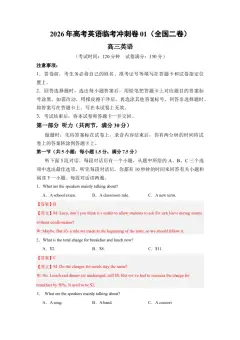
2026 年高考二轮培优必刷卷01
英  语
(考试时间:120 分钟  试卷满分:150 分)
注意事项:
1. 答题前,考生先将自己的姓名、准考证号码填写清楚,将条形码准确粘贴在条形码区域内。
2. 选择题必须使用2B 铅笔填涂;非选择题必须使用0. 5 毫米黑色字迹的签字笔书写,字体工整,笔迹清
楚。
3. 请按照题号顺序在答题卡各题目的答题区域内作答,超出答题区域书写的答案无效;在草稿纸、试卷上
答题无效。
4. 作图可先使用铅笔画出,确定后必须用黑色字迹的签字笔描黑。
5. 保持卡面清洁,不要折叠、不要弄破、弄皱,不准使用涂改液、修正带、刮纸刀。
第一部分  听力(共两节,满分30 分)
做题时,先将答案标在试卷上。录音内容结束后,你将有两分钟的时间将试卷上的答案转涂到答题卡
上。
第一节(共5 小题;每小题1.5 分,满分7.5 分)
听下面5 段对话。每段对话后有一个小题,从题中所给的A、B、C 三个选项中选出最佳选项。听完每
段对话后,你都有10 秒钟的时间来回答有关小题和阅读下一小题。每段对话仅读一遍。
1. What are the speakers probably talking about?
A. The bike price.
B. A bike race.
C. The man’s bike.
2. Why has the woman moved the boys seat?
A. He talks too much.
B. He has trouble in listening.
C. She wants to see him
better.
3. When did the man get his niece’s call?
A. At 6:05.
B. At 6:00.
C. At 5:45.
4. What does the man think is most needed to succeed?
A. Effort.
B. Luck.
C. Talent.
5. Where does the conversation probably take place?
A. At home.
B. In a shop.
C. In a restaurant.
第二节(共15 小题;每小题1.5 分,满分22.5 分)
听下面5 段对话或独白。每段对话或独白后有几个小题,从题中所给的A、B、C 三个选项中选出最佳
选项。听每段对话或独白前,你将有时间阅读各个小题,每小题5 秒钟;听完后,各小题将给出5 秒钟的
作答时间。每段对话或独白读两遍。
听第6 段材料,回答6、7 题。
6. What seems to be the man’s problem?
A. He doesn’t sleep well.
B. He is always tired.
C. He can’t focus properly.
7. What is the man advised to do?
A. Stay home from work.
B. Have a check-up.
C. Take exercise.
听第7 段材料,回答8 至10 题。
8. How does the man get to work usually?
A. By bike.
B. By bus.
C. In a car.
9. What is the man’s major concern about driving a car?
A. Safety.
B. Health.
C. Expenses.
10. What is the man’s win-win solution?
A. Keep taking bus.
B. Drive and then walk.
C. Bike part-way, bus the rest.
听第8 段材料,回答11 至13 题。
11. What was Prof. Stone’s grandfather afraid of?
A. Leaving his home.
B. Parting from his son.
C. Taking early retirement.
12. What does old age mean to many elderly Americans?
A. Lack of moral support.
B. Loss of self-worth.
C. Change of living habits.
13. What will Prof. Stone talk about next concerning elderly people?
A. Public services they ask for.
B. Health care available to them. C. Contributions they can make.
听第9 段材料,回答14 至16 题。
14. What is the man doing?
A. Chairing a meeting.
B. Hosting a radio program.
C. Conducting a job interview.
15. What benefits Mary most in her job?
A. Her wide reading.
B. Her leaders’ guidance.
C. Her friends’ help
16. Who will Mary talk about next?
A. Her teacher.
B. Her father.
C. Her mother.
听下面一段独白,回答17 至20 题。
17. Where is Jeff from?
A. Liverpool.
B. Coventry.
C. Newcastle.
18. Where do young men go to watch big games according to Jeff?
A. Pubs.
B. Stadiums.
C. Friends’ homes.
19. Why does Jeff have to pick a team to support?
A. To avoid being bothered.
B. To open a conversation.
C. To earn respect from others.
20. What does Jeff mainly talk about?
A. England’s moment of success.
B. English flag as a symbol of hope.
C. England’s all-time favourite sport.
第二部分  阅读(共两节, 满分50 分)
第一节(共15 小题;每小题2.5 分, 满分37.5 分)
阅读下列短文, 从每题所给的A、B、C 和D 四个选项中选出最佳选项。
A
Welcome to Greenfield College. Our goal is to build a supportive community where every student
feels safe, valued, and at home.
Campus Residences: Garden Halls and College Suites
Greenfield College provides two styles of student accommodation: Garden Halls and College Suites.
Garden Halls are made up of ten separate blocks. Each block includes six single bedrooms, shared bathrooms, and a
common kitchen with an oven and microwave. There is also a music room and a quiet reading lounge.
College Suites are located in a four-story building. Every floor has five suites, each with four bedrooms,
bathroom facilities, and a small kitchenette. Each floor features a shared lounge equipped with a television, sofas,
and board games.
Safety and Support
Campus Safety Patrol is on duty 24/7. If you notice any unusual or unsafe activity, contact Campus Safety
immediately at 0800123400.
All students are advised to obtain personal property insurance. The college is not liable for loss or damage to
personal items in residences.
Cleaning and Repairs
Cleaning teams regularly maintain all common spaces. Students are expected to clean their own bedrooms
and shared kitchen areas.
  Repairs and maintenance are handled by the facilities team. If you notice a problem in your room or a shared
space, notify the Housing Office. Staff may need to access your room to complete repairs—advance notice will be
given.
Moving Out
Students must pay accommodation fees for the entire contract period. When your contract ends, schedule a
check-out time with housing staff. An inspection will be conducted, and you may be charged for damages or
missing items. If you do not follow this procedure, an inspection will be carried out without you, and any necessary
charges will be determined.
21. What do both Garden Halls and College Suites provide?
A. A music room and shared bathroom.
B. Kitchen facilities and a television.
C. Board games and a reading lounge.
D. Kitchen facilities and a private bedroom.
22. What should a student do if they see someone acting suspiciously near the dormitory?
A. Email the Housing Office.
B. Call Campus Safety Patrol.
C. Tell the cleaning staff.
D. Contact their insurance company.
23. If a student does not schedule a check-out inspection, what will happen?
A. The contract will be extended automatically.
B. The student will not receive their deposit back.
C. An inspection will be done without the student present.
D. The student must return later to arrange a new time.
B
Leading museums worldwide are experimenting with augmented reality (AR) and virtual reality (VR)
technologies to create new experiences for audiences to engage with art and culture.
To reinvent an interactive experience, museums in China have started using digital humans — computer-
generated 3D images resembling real people—to transform visitors’ encounters with history and culture. In
cooperation with AI companies, Chinese museums have introduced digital humans as tour guides and ambassadors
of tradition.
Ai Wenwen, a digital employee at the National Museum of China, can instantly change outfits, from modern
clothing to Chinese traditional dress, and give guided tours of the museum. To give its digital employee the appeal
of a human celebrity, the National Museum create a song that is presented as if sung by Ai Wenwen herself.
In addition to museums, digital humans can help bring historical figures to life. The Zhonghua Book Company
has launched a virtual avatar (化身) of Su Shi, a celebrated Chinese poet and statesman. With the texts about Su
Shi’s life and literary work being fed into the virtual avatar, it can respond to real people in a manner and language
resembling this great man in Chinese history. It made its first appearance in a CCTV youth talent show about
Chinese poetry, surprising audiences with its remarkable human likeness.
The virtual avatar had conversations with live audiences about poems Su Shi wrote about 1,000 years ago. The
TV show even presented an episode of the digital version of Su Shi acting with a human who played his close
friend, the great calligrapher Huang Tingjian.
The Su Shi avatar has also become a social media influencer, posting quizzes and educational content on
literature, geography, and customs. Additionally, the company organizes in-person events where students interact
with digital humans to learn history and literature.
Museums and cultural institutions across China have incorporated the virtual avatar of Su Shi to create
interactive exhibitions with themes including afternoon tea, poetry and calligraphy. Audiences at these exhibitions
have opportunities to experience the daily life of a renowned poet from the distant past.
24. Why Chinese museums apply digital humans?
A. To reduce the cost of hiring real tour guides.
B. To enhance visitors’ cultural experience.
C. To promote latest AR and VR technologies.
D. To compete with international museums.
25. What can Ai Wenwen do during tours?
A. Switch clothes in a flash.
B. Compose original music.
C. Repair historical artifacts.
D. Conduct academic research.
26. How did the Su Shi avatar surprise audiences on TV?
A. By composing poetry on the spot.
B. By acting out his close friend vividly.
C. By responding in a human-like way.
D. By having a touchable human look.
27. Which is the best title of the passage?
A. The End of Human Guides.
B. The Making of a Virtual Pop Star.
C. A Digital Bridge to the Past.
D. The Role of AI in Cultural Heritage.
C
Simon took as much time as he could pulling on his snow trousers and boots, zipping up his jacket, and
finding his helmet and gloves. His brother Gabe paced the front hall. “Let’s go!”
The brothers walked to the park, the sleds (雪橇) bouncing against their snow pants. Swish, swish, swish.
Simon could see the sledding hill ahead of them. To him, it looked more like a sledding mountain. It was so high
that the park district had built wooden steps into the slope to help sledders climb back up. Kids were taking turns on
sleds, screaming all the way down. Simon couldn’t tell if their cries meant they were happy or terrified. Yet he
knew which one he felt.
Gabe was taking the steps two at a time. “Come on!” he called to Simon. Simon stared up. He was both
sweating and freezing, his stomach knotted like a pretzel. Should he turn back? But the line of kids on the steps
behind him meant he had to keep climbing.
At the top his brother stopped and looked at Simon. “Do you want me to go down with you?” he asked.
Knowing Gabe wanted to fly down the sledding hill without his little brother, Simon took a deep breath. “I’m
going. By myself.”
“Good for you, Simon,” Gabe said.
Simon sat crossed-legged on the sled and gripped (紧握) the plastic handles on each side. His heart was doing
leapfrogs. Gabe gave him a small nudge on his back. Suddenly, he was dashing down the hill like a wild penguin.
The wind whooshed. The cold stung. He had the handles in a death grip when the sled swung around and sent him
flying down the hill backward. BACKWARD! He couldn’t stop. Faster and faster he went. He couldn’t even
scream. Was he going to crash? Why had he thought this was a good idea?
The ground leveled off, and Simon’s sled slowed and then came to a stop at last. He rolled out and lay on his
back, breathing hard.
“Are you all right?” Gabe asked.
Simon sat up slowly and looked around.
“Simon, say something! Say something!” Gabe said.
Simon grinned, “Again?”
28. How did Simon feel before leaving for the park?
A. Excited and confident.
B. Hesitant and unwilling.
C. Eager and amazed.
D. Shocked and depressed.
29. Why did Simon decide to keep climbing the steps despite his fears?
A. Because Gabe was pushing him to do so.
B. Because he didn’t want to disappoint his brother.
C. Because other kids were waiting behind him.
D. Because the view from the top was too inviting.
30. What happened to Simon when he was sledding down the hill?
A. He lost control and flew backward.
B. He skillfully made a perfect turn.
C. He crashed into the ground and got injured.
D. He enjoyed a smooth ride down.
31. What can be inferred about Simon’s attitude at the end of the story?
A. He was regretful and didn’t want to sled again.
B. He was relieved and grateful to be safe.
C. He was eager to sled a second time at once.
D. He felt it unworthy to take the risk.
D
The needs of plus size consumers have long been the elephant in the room of the fashion industry until body
positivity and fat acceptance movements promoted the slogan (口号) that large-bodied people are not those who are
left behind. This size-inclusive (尺码包容) trend has become so popular that it is influencing mainstream culture.
As a result, fashion brands have finally decided to extend their size ranges. In 2022, the plus-size market grew
twice as fast as the standard size market in both North America and the UK.
Yet, many consumers say fashion brands broadening their ranges are not truly inclusive. “Inclusive sizing
means that all bodies are included in fashion, not just the ones who fit in standard sizes,” says Marie Southard
Ospina, a UK-based journalist who covers body-image issues. “However, what many designers do right now is pick
a number that they think is big enough to include plus sizes and stop. This is even more disrespectful.”
Researchers also criticize that some brands are just taking advantage of the trend. “Brands that used to
promote so-called perfect bodies in their advertisements are now trying to get in on the trend by adding a few sizes.
It doesn’t feel like they really care about plus-size people,” says Tom Burgess, analyst in fashion industry. “If
brands cared about large-bodied consumers, then it wouldn’t have taken until now to acknowledge that they exist,”
he says. “It gives the impression that companies are just trying to gain a share of the market without a real
commitment to the community.”
The fashion industry must go beyond merely producing clothing in a range of sizes if they hope to succeed
with a body-diverse world. The whole industry has to connect on a personal level with consumers. That involves
showing shoppers that they are seen, understood and important to brands. “Consumers care about values, and so
they want to buy from brands that reflect the values they believe in. Everyone should enjoy the same range of
fashion options,” says Ludovica Cesareo, professor of marketing at the College of Business in the US.
32. What do the underlined words “the elephant in the room” mean in the first paragraph?
A. The hot issue that is valued.
B. The obvious truth that is ignored.
C. The important principle that is recognized.
D. The common phenomenon that is criticized.
33. Why do consumers say fashion brands are not truly inclusive?
A. They pick sizes randomly.
B. They offer limited plus sizes.
C. They treat designers disrespectfully.
D. They haven’t broadened standard sizes.
34. For what do researchers mainly criticize some brands?
A. Their designs.
B. Their quality.
C. Their motivations.
D. Their advertisements.
35. What does the last paragraph imply?
A. Buyers may deserve fashion that fits their figure.
B. Consumers prefer brands with personalized values.
C. Brands should catch up with the size-inclusive trend.
D. A good brand image is critical in the fashion industry.
第二节(共5 小题;每小题2. 5 分, 满分12. 5 分)
阅读下面短文, 从短文后的选项中选出可以填入空白处的最佳选项。选项中有两项为多余选项。
Without enabling your body to recover, the efforts you make in the gym amount to nothing. That one hour you
spend lifting weights is of great necessity to build muscles.   36


   All workouts stress and kind of damage
muscle tissue. It’s during the time away from the weights, known as workout recovery period, that it actually
grows.
Workout recovery allows people to get the maximum benefit from workouts.   37


   Repeated again and
again, this process of stress and recovery is what results in your improved health and fitness. Here are some
strategies.
If you’re experiencing burnout from strength training, the simplest way is a total break of exercise.
  38

You can also engage in a lower-intensity bike ride or walk for your body to circulate ( 循环) the waste products
generated by the intense activity. Or try a gentle yoga practice to stretch out tired muscles.
Soft tissue treatments work especially effectively.
  39

   It involves using cups on the skin, creating a
vacuum (真空) by heating and drawing the underlying tissues upward. This technique can enhance blood flow and
bring more oxygen and nutrients to the tissues.

  40

   A whole-foods-based diet provides your body with the building blocks needed to repair muscles and
promote recovery, setting off the right changes in your body between workouts. Plus, sleep is a must as it makes the
body produce the majority of its growth factors. Avoid screen time and alcohol before bed to help ensure quality
sleep.
A. Don’t skip nutritional recovery.
B. It keeps you safe and injury-free.
C. Just lie on the bed and kick up your feet.
D. The other 23 are just as essential, though.
E. The right way of exercising makes a difference.
F. You can’t attach too much importance to your figure.
G. An ancient Chinese practice is well: worth a mention.
第三部分 语言运用(共两节,满分30 分)
第一节(共15 小题,每小题1 分,满分15 分)
阅读下面短文, 从每题所给的A、B、C 和D 四个选项中选出可以填入空白处的最佳选项。
Today, I visited my bank to put a cheque into my account. The process was
  41

  , but I decided to confirm
the details with the teller to
  42

   any issues. The teller, apparently a new employee, was unsure about the  43

. He called his manager for assistance. The manager
  44

   explained everything to me, which I truly appreciate.
However, during the explanation, I noticed that the teller was
  45

   in something else and didn’t pay
attention to his manager’s instructions. The manager also didn’t
  46

   him to listen carefully and understand the
procedure.

  47

   the situation, I realized that the manager failed to use a
  48

   method. This might result in the
teller’s asking for help again in the future, causing the manager to repeatedly leave his desk to
  49

   the same
issues. This would interrupt his routine work and waste his precious time, which could
  50

   be better spent on
his core duties. If the root cause of the problem is not solved, it will potentially affect customer
  51

  .
This situation reminded me of a saying, “Teach a man to fish, and you feed him for a lifetime.” It emphasizes
the significance of enabling people to handle tasks independent of
  52

   assistance. The importance of having a
clear
  53

   is evident in this case. It involves
  54

   future needs and making the right moves to address them.
Thus, we should begin with the
  55

   in mind, planning for long-term success.
41. A. boring
B. straightforward
C. complicated
D. detailed
42. A. avoid
B. address
C. ignore
D. simplify
43. A. regulations
B. methods
C. responsibilities
D. steps
44. A. hurriedly
B. reluctantly
C. patiently
D. briefly
45. A. embarrassed
B. educated
C. skilled
D. engaged
46. A. persuade
B. permit
C. urge
D. recommend
47. A. Focusing on
B. Referring to
C. Dealing with
D. Reflecting on
48. A. practical
B. preventive
C. scientific
D. innovative
49. A. manage
B. negotiate
C. confirm
D. describe
50. A. still
B. otherwise
C. therefore
D. merely
51. A. satisfaction
B. account
C. investment
D. involvement
52. A. emergent
B. professional
C. external
D. consistent
53. A. explanation
B. procedure
C. instruction
D. vision
54. A. ignoring
B. adjusting
C. anticipating
D. challenging
55. A. case
B. task
C. situation
D. end
第二节(共10 小题;每小题1.5 分 ,满分15 分)
阅读下面短文,在空白处填入1 个适当的单词或括号内单词的正确形式。
The Ancient Town of Bamboo Grove
Have you ever visited the Ancient Town of Bamboo Grove? Situated in Fujian’s Yongtai
County, this ancient town,
  56

   (date) back to the Song Dynasty, once served as an important trading
post. Its well-designed waterways and stone bridges stand
  57
       a proof of the wisdom of ancient
engineers.
The town displays classic Minnan architecture, featuring gray-tiled roofs and carved wooden doors.
The Tianhou Temple,
  5 8
   was constructed during the Yuan Dynasty, holds great historical and cultural
59 (significant). It attracts many tourists
  60

   (learn) about maritime culture and folk beliefs. Winding
alleys guide visitors past craft shops
  61

   small courtyards, where vendors sell handmade goods.
The annual Bamboo Culture Festival,
  62

   exciting event, includes folk dances and local food
markets. Visitors can try “bamboo leaf rice,”
  63

   (prepare) using traditional recipes. Improvements
such as eco-friendly lighting help preserve the town without harming its atmosphere.
So far, the Ancient Town of Bamboo Grove
  64

   (become) a must-see attraction, offering visitors
a mix of history, crafts, and
  6 5    (nature) scenery.
第四部分  写作(共两节, 满分40 分)
第一节(满分15 分)
假定你是李华,上周日你参加了你校组织的防火知识宣传志愿者活动。请你给外教Mr. Smith 写封邮
件,分享此次活动,内容包括:
1. 活动时间、地点;
2. 活动形式、内容;
3. 你的感受。
注意:1. 写作词数应为80 个左右;
2. 可以适当增加细节,以使行文连贯。
____________________________________________________________________________________________
____________________________________________________________________________________________
____________________________________________________________________________________________
____________________________________________________________________________________________
____________________________________________________________________________________________
第二节(满分25 分)
阅读下面材料,根据其内容和所给段落开头语续写两段,使之构成一篇完整的短文。
From the time I was old enough to help on our Indiana farm, I knew what my father expected of me. Three
generations of men in my family were doctors. I heard stories of the lives my grandfather had saved and I heard
similar tales about my father. As Dad grew ever more godlike in my mind, so did the force of the expectation that I
would follow in the family tradition.
But as college neared, I began to feel that becoming a doctor was not what I really wanted to do. I didn’t dare
tell him about my uncertainty. With the weight heavy on my mind the summer before college, I was given a
challenge that I hoped would be a distraction.
Dad kept several bird dogs which I trained on our farm. As usual, Dad turned Jerry over to me. “See what you
can do with him,” he said.
I didn’t anticipate problems. Jerry was a willing dog of about ten months. The first part of his training was
easy. He mastered the basics: sit, stay, down, walk. His only problem was “come”. I’d call “Jerry! Here!” He would
turn and look at me, then go on about his business. In the following days, I noticed he would just take off through
the grass, fast as a wild thing. Despite my intense desire to train him well, I began to feel a strange sense of joy
when he ran.
“Why won’t he do what I want him to?” I asked myself. I had never failed with a dog before, but I was surely
failing now. When September came, I finally had to tell Dad that this bird dog wouldn’t hunt. The thought that I
had failed us both made me guilty.
“Son, I know this dog doesn’t do what he should,” he said, “but what he does do is something he likes.” He
continued to look at me firmly. For a moment I felt he could see into my very heart.
注意:1.续写词数应为150 左右;2.请按如下格式在答题卡的相应位置作答。
“Dad, I don’t think I can do medicine,” I took a solid breath. _______________________________________
____________________________________________________________________________________________
____________________________________________________________________________________________
____________________________________________________________________________________________
He

gave

me

a

tight

hug,

said

good

night

and

left

me.
______________________________________________
____________________________________________________________________________________________
____________________________________________________________________________________________
____________________________________________________________________________________________