绝密★启用前
2026 年高考二轮培优必刷卷02
英  语
(考试时间:120 分钟  试卷满分:150 分)
注意事项:
1. 答题前,考生先将自己的姓名、准考证号码填写清楚,将条形码准确粘贴在条形码区域内。
2. 选择题必须使用2B 铅笔填涂;非选择题必须使用0. 5 毫米黑色字迹的签字笔书写,字体工整,笔迹清
楚。
3. 请按照题号顺序在答题卡各题目的答题区域内作答,超出答题区域书写的答案无效;在草稿纸、试卷上
答题无效。
4. 作图可先使用铅笔画出,确定后必须用黑色字迹的签字笔描黑。
5. 保持卡面清洁,不要折叠、不要弄破、弄皱,不准使用涂改液、修正带、刮纸刀。
第一部分  听力(共两节,满分30 分)
做题时,先将答案标在试卷上。录音内容结束后,你将有两分钟的时间将试卷上的答案转涂到答题卡
上。
第一节(共5 小题;每小题1.5 分,满分7.5 分)
听下面5 段对话。每段对话后有一个小题,从题中所给的A、B、C 三个选项中选出最佳选项。听完每
段对话后,你都有10 秒钟的时间来回答有关小题和阅读下一小题。每段对话仅读一遍。
1. What does the man want to know?
A. The address.
B. The time.
C. The participants.
2. What happened to the woman’s computer?
A. It’s broken.
B. It’s dark.
C. It’s dead.
3. Why does the man apologize to the woman?
A. He tore her coat.
B. He dirtied her coat.
C. He bought her a coat.
4. What benefits does online teaching bring to the woman?
A. She needn’t make lots of video calls.
B. She needn’t tidy a classroom.
C. She needn’t drive to work.
5. What information was misunderstood by the woman?
A. The time.
B. The location.
C. The phone number.
第二节(共15 小题;每小题1.5 分,满分22.5 分)
听下面5 段对话或独白。每段对话或独白后有几个小题,从题中所给的A、B、C 三个选项中选出最佳
选项。听每段对话或独白前,你将有时间阅读各个小题,每小题5 秒钟;听完后,各小题将给出5 秒钟的
作答时间。每段对话或独白读两遍。
听第6 段材料,回答6、7 题。
6. What is the probable relationship between the speakers?
A. Strangers.
B. Waitress and customer.
C. Teacher and student.
7. What did the man go to Hong Kong for?
A. Business.
B. Sightseeing.
C. Meeting a friend.
听第7 段材料,回答8、9 题。
8. When will the woman go with the man?
A. At 3:30 pm.
B. At 4:00 pm.
C. At 4:30 pm.
9. How will the speakers go to the Smiths?
A. By bus.
B. By bike.
C. On foot.
听第8 段材料,回答10 至12 题。
10. What kind of the tickets did the speakers buy?
A. Regular tickets.
B. Special tickets.
C. Discount tickets.
11. How do the speakers feel now?
A. Satisfied.
B. Disappointed.
C. Uncaring.
12. What will the woman do to pass the time on the plane?
A. Read a book.
B. Read a magazine.
C. Read newspapers.
听第9 段材料,回答13 至16 题。
13. Why did Carla quit her job?
A. It was very tiring.
B. The pay was too low.
C. She wanted more freedom.
14. How does Carla feel about running her own business?
A. Challenging.
B. Enjoyable.
C. Boring.
15. When does Carla exercise now?
A. In the morning.
B. At noon.
C. In the evening.
16. What does Carla probably suggest we do to save time?
A. Make to-do lists.
B. Check emails on the bus.
C. Buy a lot of similar clothes.
听下面一段独白,回答17 至20 题。
17. Where do the pilots get the water?
A. From a river.
B. From a lake.
C. From a pond.
18. What is the most dangerous part of the job?
A. Picking up water.
B. Running in front of the fire.
C. Flying high above the trees.
19. What can we learn from the text?
A. The firefighters did a good job.
B. The plane’s tanks were too small.
C. The crew were not experienced enough.
20. What is the speaker?
A. A fire fighter.
B. A program host.
C. A news reporter.
第二部分  阅读(共两节, 满分50 分)
第一节(共15 小题;每小题2.5 分, 满分37.5 分)
阅读下列短文, 从每题所给的A、B、C 和D 四个选项中选出最佳选项。
A
IMMERSIVE DINING
Menu
Contact
Robots and Immersive Dining
We have recently opened a fancy outlet in Tech Park, specializing in weaving together the fields of robotics
and dining.
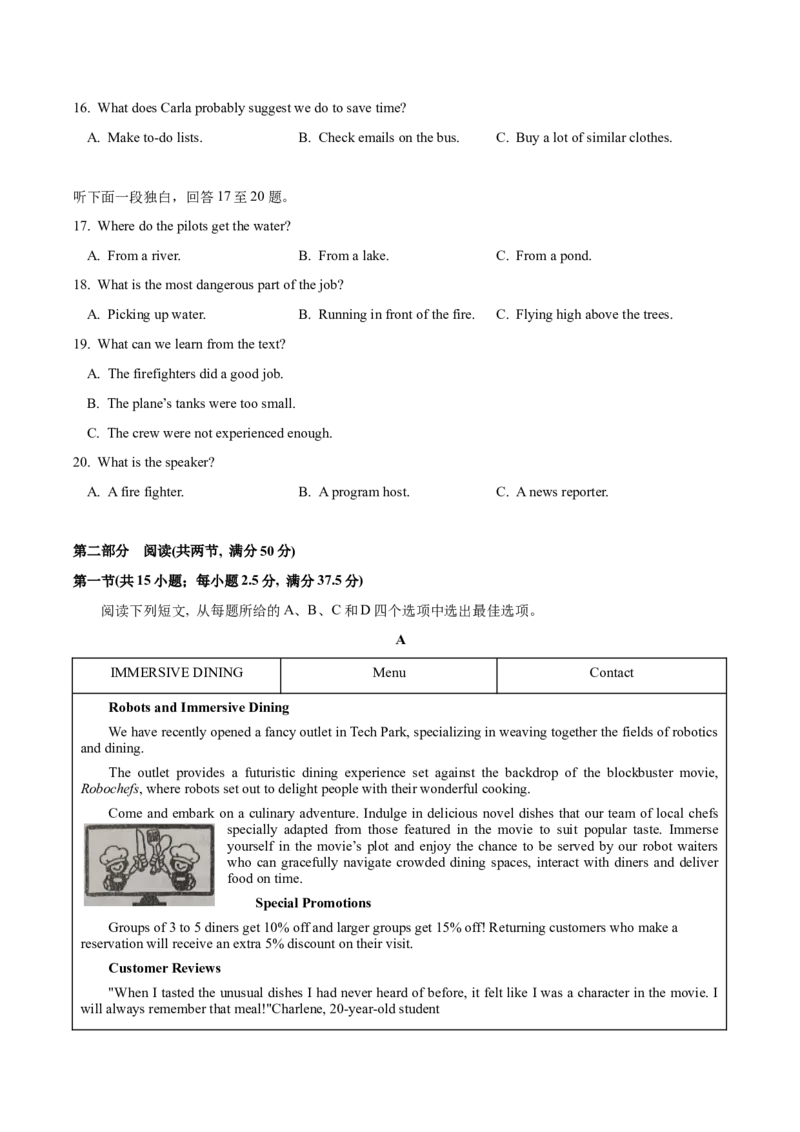
The outlet provides a futuristic dining experience set against the backdrop of the blockbuster movie,
Robochefs, where robots set out to delight people with their wonderful cooking.
Come and embark on a culinary adventure. Indulge in delicious novel dishes that our team of local chefs
specially adapted from those featured in the movie to suit popular taste. Immerse
yourself in the movie’s plot and enjoy the chance to be served by our robot waiters
who can gracefully navigate crowded dining spaces, interact with diners and deliver
food on time.
Special Promotions
Groups of 3 to 5 diners get 10% off and larger groups get 15% off! Returning customers who make a
reservation will receive an extra 5% discount on their visit.
Customer Reviews
"When I tasted the unusual dishes I had never heard of before, it felt like I was a character in the movie. I
will always remember that meal!"Charlene, 20-year-old student
“What really left an impression on us were the robot waiters. We made quite a number of requests and they
were able to instantly respond in an appropriate manner. It was an unforgettable family outing!” Thomas, father
of two.
Friendly Reminders
 Scan the QR code on your table to look at the menu and place your order online.
 Press the buzzer on your table to report a robot malfunction.
21. What does the outlet feature?
A. Movie-themed dishes.
B. Role-play experience.
C. Customized service.
D. Robotic chefs.
22. What is the maximum discount a group of 6 regular diners can enjoy?
A. 10%.
B. 15%.
C. 20%.
D. 25%.
23. What is the text probably?
A. A poster.
B. A blog.
C. A report.
D. An advertisement.
B
Being seventeen without money can be depressing. When the opportunity arrives to earn some needed cash, it
would be foolish to pass it up. It is for this reason that when the opportunity to referee elementary basketball came
my way, I jumped at the chance. I thought it would be a fun way to earn some “easy money”.
During the years I played on the court and watched the games, I often found myself criticizing the referees. I
completely believed that I could do a much better job because of my love for basketball and my familiarity with the
game. How difficult could it be, especially with a bunch of third graders?
I looked forward to my first night as a referee but all of my fantasies wore off from the beginning of the game.
These sweet third grade boys immediately transformed into horrible creatures right before me. Never in my wildest
dreams did I ever imagine the extent of competitiveness in the game.
A battle was in progress on the court while the crazy bystanders cheered and yelled from the stands. My only
companion, the whistle, suffered from a severe case of stage fear, filling my head with doubt every time I wished to
blow it. My lack of action fueled the heartless crowd. Even on the rare occasions when my whistle gained enough
courage to pause the fight, the bystanders still couldn’t calm. The sense of failure flooded every inch of my soul.
With only five minutes remaining, Michael, another referee, came in time, saving me from losing my mind. In a
flash, I passed my whistle and quickly ran to the safety of the stands.
I realized just how difficult refereeing was. I could have let this heartbreaking evening destroy my future on
the court, but instead it stimulated a sense of determination in me to do it better. I still hope to become a great
referee someday. In order for this to become a reality, it will take many hours of practice and hard work. No matter
how much I wish the cash would be handed to me without requiring any effort, I learned from this experience that
there is no such thing as "easy money".
24. What made the author agree to serve as a basketball referee?
A. His desire to make money.
B. His passion for the job.
C. His confidence in third graders.
D. His knowledge of basketball.
25. What did the author think of the third grade boys before refereeing the game?
A. Lovely.
B. Selfish.
C. Impolite.
D. Competitive.
26. What happened to the author during the game?
A. He was too nervous to blow the whistle.
B. He was at a loss to announce the results.
C. He couldn’t avoid the bystanders’ physical attack.
D. He couldn’t handle the tough situation on the court.
27. What can we learn from the author’s experience?
A. lazy hands make for poverty.
B. Money does not grow on trees.
C. Hope for the best and prepare for the worst.
D. Nothing is impossible to a willing heart.
C
We take our speech abilities for granted. Most people do not stop to think of how other animals and insects
communicate with each other. Ants are amazing creatures that have a tireless work pattern and complex social
structure. To achieve this, they must have some ways of communicating with each other. Obviously, ants do not
speak as we do, so how do they communicate?
Ants communicate by releasing pheromones (信息素) that function outside of the body to send chemical
messages to the ant that receives it and by touching their antennae (触角) to feel and smell each other. The best
example that we can see very clearly is that ants find food sources and drop pheromones on their ways. By using
their antennae to detect pheromone trails and following a sweeping pattern, they encounter a trail. Once the
pheromone trail is found, they follow it with one antenna on either side of the path, ensuring they keep on track.
This allows other ants to follow the pheromones. The result of these pheromone paths is long convoys of ants,
marching one behind each other to collect food.
The queen ant uses pheromones to signal. As the queen ages, she gives off pheromones that tell the ant colony
that she is dying. They begin feeding and preparing a pupa (蛹) to be the new queen. When ants greet each other
with their antennae, they can tell if they are friends or foes and what function each ant fulfills in the nest.
Scientists know that this is possible, but they are still trying to identify which pheromones share this
information. Ants also give off pheromones that identify the nest they belong to, their social status, and their
maturity. The more researchers study ants, the more they discover about their ability to translate information to one
another, learn, form collective memories and sound alarms. Ants are truly amazing communicators.
28. How could ants communicate according to the text?
A. By attracting companions via sounds.
B. By sending alarm signals to the queen.
C. By identifying pheromones with antennae.
D. By keeping on the same track.
29. What is the function of the pheromone trail?
A. To spot enemies in the ant colony.
B. To help companions find food sources.
C. To keep the orders of the ant community.
D. To enable ants to communicate with humans.
30. What is the closest in meaning to the underlined word “convoys” in Para 2?
A. Circles.
B. Signals.
C. Lines.
D. Exchanges.
31. What can be inferred from the last paragraph?
A. Ants have no collective memories.
B. Ants alarm-sounding ability is unique.
C. Researchers have identified the types of pheromones.
D. More secrets on ants’ communication remain unknown.
D
A recent study suggests that long-term use of high-dose vitamin D supplements may be linked to an
increased risk of arterial calcification (动脉钙化), a condition associated with cardiovascular disease. Vitamin D,
essential for bone health and immune function, is widely taken as a dietary supplement, particularly in regions with
limited sunlight.
Cardiovascular diseases remain a primary health concern globally. While vitamin D deficiency has been
historically linked to poor bone outcomes, the effects of its over-supplementation are less understood.
To investigate this, Dr. Elena Martinez and her team at the Boston Medical Center conducted an observational
study involving 2,900 adults aged 50-70 with no prior heart conditions. Participants were divided into two groups:
regular users of high-dose vitamin D supplements (over 2000 IU/day) and non-users. Over four years, the team
tracked the development of arterial calcification using CT scans.
The results showed that the supplement group had a 55% higher incidence of arterial calcification compared to
the non-user group. Further cell culture experiments revealed that excessive vitamin D promotes the deposit of
calcium in smooth muscle cells of blood vessels, a key step in calcification. “This doesn’t mean vitamin D is
harmful at recommended levels, but consistently exceeding them might be,” Martinez noted.
Vitamin D over-supplementation is common. Many adults take it for presumed benefits like improved mood
or immunity, often without medical guidance. “There’s a misconception that if a little is good, more must be
better,” said Martinez. Additionally, foods like milk and orange juice are often fortified with vitamin D in many
countries, potentially contributing to high overall intake.
Dr. James Lee from Stanford University commented, “This study provides a crucial warning against self-
prescribed high-dose supplements. However, as the participants were primarily older adults, the findings may not
be generalizable to younger populations. More research is needed.”
32. What is the main purpose of paragraph 3?
A. To explain the research method.
B. To present the study’s conclusions.
C. To describe the health risks of vitamin D deficiency.
D. To compare different types of vitamin D supplements.
33. What does the underlined word “them” in paragraph 4 refer to?
A. Blood vessels.
B. Recommended levels.
C. Smooth muscle cells.
   D. Non-users.
34. What can be inferred from Dr. James Lee’s comments in the last paragraph?
A. The study’s findings fully explain the link between vitamin D and heart disease.
B. Younger populations should take high-dose vitamin D supplements with caution.
C. The research methodology was fundamentally flawed and needs re-evaluation.
D. More diverse demographic studies are needed to confirm the findings.
35. What is Dr. James Lee’s attitude toward the study’s findings?
A. Fully supportive.
B. Clearly disapproving.
C. Cautiously accepting.
D. Completely indifferent.
第二节(共5 小题;每小题2. 5 分, 满分12. 5 分)
阅读下面短文, 从短文后的选项中选出可以填入空白处的最佳选项。选项中有两项为多余选项。
Many of us face a tricky trap on social media: either chase endless likes with constant posting or escape by
ignoring it all. We stress over this forced choice — approval or isolation — as if they can’t mix.   36   Here are
three practical ways to find balance in the digital world.
Focus on genuine connections.
Likes and comments bring short-term excitement, but they fade fast. True connections matter more. When you
share real stories or chat deeply with others, you feel warm inside.   37   So pick activities that make you feel
truly good, like talking about hobbies or helping friends online — no need to care about likes!
  38
Peace on social media starts with how you see it. Mindful scrolling (浏览) means noticing nice things — an
inspiring post, a friend’s happy news — without comparing yourself. The colors of a photo or a kind word can
make you smile. You don’t need big tricks.   39   Then you’ll enjoy both: staying connected and feeling
peaceful.
Celebrate small digital joys.
Every little win online — sharing a useful tip, getting a sweet reply — deserves cheers. If you only wait for
lots of followers, you’ll miss daily fun.   40   For example, celebrate finishing a post you care about, not just
hitting a follower goal. Treat yourself to a snack after a nice chat. These turn online time into a happy journey.
A. Try browsing with intention.
B. Chasing likes will make you tired.
C. Just fix your attention on the little joys online.
D. Minor accomplishments in the digital world lift your mood.
E. In fact, mixing work and rest online helps you stay balanced.
F. But our time online doesn’t have to be stuck in this dilemma.
G. That cozy glow from within doesn’t depend on likes or comments.
第三部分 语言运用(共两节,满分30 分)
第一节(共15 小题,每小题1 分,满分15 分)
阅读下面短文, 从每题所给的A、B、C 和D 四个选项中选出可以填入空白处的最佳选项。
Last winter, I was having a difficult week. Work pressure was building up, and personal
problems made me feel overwhelmed. One evening, I decided to walk through the park to clear my
mind.
The park was nearly empty, covered in fresh snow. The only sound was the
  41

   of my boots on
the frozen path. I was so absorbed in my thoughts that I barely noticed the world around me until I saw
an elderly woman feeding birds by a frozen pond.
As I passed by, she looked up and smiled. “Beautiful, isn’t it?” she said. Her
  4 2
   took me by
surprise.
“I suppose so,” I replied coldly, not really wanting conversation.
But she
  4 3   , “Each season has its own magic. Winter teaches us the beauty of
  4 4
  .”
Something in her tone made me pause. We talked about simple things --- the frost on branches, the
birds in cold weather. Her words weren’t
  4 5
  , but they carried wisdom.
When I left, she said, “Remember, even in the coldest moments, there’s warmth to be found if you
4  6
   it.” That brief meeting stayed with me.
The next morning, I suddenly bought a coffee for a homeless man I usually
  4 7
  . His grateful
smile filled me with
  4 8
  .
That encounter
  4 9
   something in me. I began to notice how often we
  5 0
   chances for small
kindnesses. A
  5 1
   decision to be more present can change everything.
Now I see that life’s most valuable lessons come from
  5 2    moments of connection. By
  5 3
our light with others, we don’t lose our own; we make the world
  5 4
  . Sometimes the smallest
moments teach us the most
  5 5
   lessons.
41. A. crunch
B. whisper
C. echo
D. splash
42. A. appearance
B. gesture
C. judgment
D. question
43. A. went on
B. went out
C. went away
D. went by
44. A. silence
B. nature
C. change
D. strength
45. A. complicated
B. clear
C. meaningful
D. original
46. A. look for
B. give up
C. turn down
D. put away
47. A. helped
B. noticed
C. respected
D. ignored
48. A. relief
B. pride
C. warmth
D. satisfaction
49. A. awakened
B. killed
C. protected
D. tested
50. A. wait for
B. look for
C. miss
D. create
51. A. quick
B. difficult
C. conscious
D. random
52. A. quiet
B. exciting
C. formal
D. public
53. A. hiding
B. sharing
C. discovering
D. protecting
54. A. darker
B. safer
C. brighter
D. smaller
55. A. temporary
B. academic
C. complex
D. profound
第二节(共10 小题;每小题1.5 分 ,满分15 分)
阅读下面短文,在空白处填入1 个适当的单词或括号内单词的正确形式。
I am Derek from the US. It’s the first time that I’ve travelled to China. Amazingly, I’ve got to know that China
has a rich heritage of distinctive brocades (织锦), each reflecting the artistry and traditions of different regions.
56   (example) include Yunjin brocade from Nanjing in East China’s Jiangsu Province, known for its luxurious silk
threads and gold weaving and Su brocade from Suzhou in Jiangsu province,   57   (admire) for its fine
embroidery (刺绣) and delicate patterns.
These brocades, often associated with the royal family and high society, show China’s mastery of textile (纺织
品) art,   58   has developed with technological advancements and cultural influences.
When digging deeper I’ve found that Li brocade is   59   rare, ancient textile tradition that has remained
60
       (large) unchanged for over 3,000 years. Unlike the sophisticated silk looms (织布机) used for other brocades,
Li brocade is made on a waist loom,   61   (preserve) one of the world’s oldest techniques. Patterns of exotic
flowers, plants, birds, the sun, the moon and stars, as well as dancing and working figures on Li brocade, are a
62   (reflect) of their customs, religious beliefs and daily life.
I think Li women are credited with the great skills and dedication. They   63   (teach) textile techniques
from a young age by their mothers.   64   the lack of books or illustrated records, generations of Li women have
designed traditional elements using their imaginations to create colorful patterns. I am totally impressed.
In 2006, the textile techniques of the Li people were among the first   65   (name) a national intangible
cultural heritage. It is an awesome achievement made by Li people.
This is definitely a rewarding trip to China. I am sure my fellows back home will be stunned when I show off
a brocade as well as my newly acquired knowledge about them.
第四部分  写作(共两节, 满分40 分)
第一节(满分15 分)
假定你是李华,为提升大家的英语运用能力,外教 Jenny 计划开展英语课外活动,并提供了两个备选
方案:“Community English Teaching”或“School English Corner”,让同学们从中选择一项。请给Jenny 写
一封邮件,内容包括:
(1)你的选择及理由;
(2)相应的活动规划。
Dear Jenny,
____________________________________________________________________________________________
____________________________________________________________________________________________
____________________________________________________________________________________________
____________________________________________________________________________________________
                   Yours,
                        Li Hua
第二节(满分25 分)
阅读下面材料,根据其内容和所给段落开头语续写两段,使之构成一篇完整的短文。
Little Notes
Once again, I headed out to look for a job. Although I wasn’t very confident about the interview, I still held my
head high, trying to stay hopeful under the morning sun. Before leaving, I made sure to stick a note on the fridge
that read, “Son, finish your breakfast and have a good day.” Then I walked out of the door.
This quiet tradition came from my father. I still remember how, before every trip, he would leave a note on my
desk: “I’ll come back with gifts for you.” When I stayed up late studying, I would open my pencil box and find
another note inside: “Go to bed and have a good dream.” During summer camp, I would find a little note in my
pocket that said, “Take care of yourself.” Those small pieces of paper were my first understanding of love — a
gentle way of reminding me that someone always cared.
Years later, when my own son Jack was old enough to read, I continued the tradition. I left little notes
throughout his life: “You are smarter than you think” in his math book, “Son, my little sun” on his bedroom door,
and “Good luck at soccer” inside his shoe. He never said anything about them, but he became a happy, brave, and
kind boy. That was enough for me.
Then came the hardest winter of my life. My company cut our pay, and people began whispering about who
might lose their jobs. I worked every day with a heavy heart, always anxious, but in the end, I was still told to
leave. It was a huge shock — but things got even harder. My husband lost his job too and had to move to another
city to find work. I didn’t have time to feel sad. I needed to find a new job quickly to support our family.
注意:
1. 续写词数应为150 个左右;
2. 请按如下格式在答题纸的相应位置作答。
That evening, after another long, unsuccessful day, I came home exhausted. ___________________________
____________________________________________________________________________________________
____________________________________________________________________________________________
____________________________________________________________________________________________
____________________________________________________________________________________________
The

apple

was

refreshing

and

sweet,

and

so

was

the

note.
__________________________________________
____________________________________________________________________________________________
____________________________________________________________________________________________
____________________________________________________________________________________________
____________________________________________________________________________________________