绝密★启用前
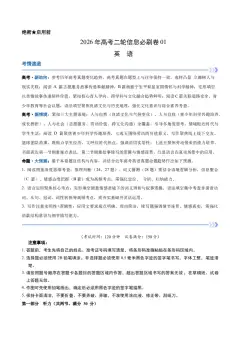
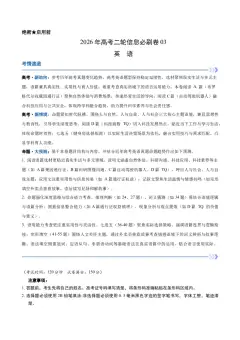
2026 年高考二轮培优必刷卷01
英  语
(考试时间:120 分钟  试卷满分:150 分)
注意事项:
1. 答题前,考生先将自己的姓名、准考证号码填写清楚,将条形码准确粘贴在条形码区域内。
2. 选择题必须使用2B 铅笔填涂;非选择题必须使用0. 5 毫米黑色字迹的签字笔书写,字体工整,笔迹清楚。
3. 请按照题号顺序在答题卡各题目的答题区域内作答,超出答题区域书写的答案无效;在草稿纸、试卷上
答题无效。
4. 作图可先使用铅笔画出,确定后必须用黑色字迹的签字笔描黑。
5. 保持卡面清洁,不要折叠、不要弄破、弄皱,不准使用涂改液、修正带、刮纸刀。
第一部分  听力(共两节,满分 30 分)
做题时,先将答案标在试卷上。录音内容结束后,你将有两分钟的时间将试卷上的答案转涂到答题卡上。
第一节(共5 小题;每小题1.5 分,满分7.5 分)
听下面5 段对话。每段对话后有一个小题,从题中所给的A、B、C 三个选项中选出最佳选项。听完每
段对话后,你都有10 秒钟的时间来回答有关小题和阅读下一小题。每段对话仅读一遍。
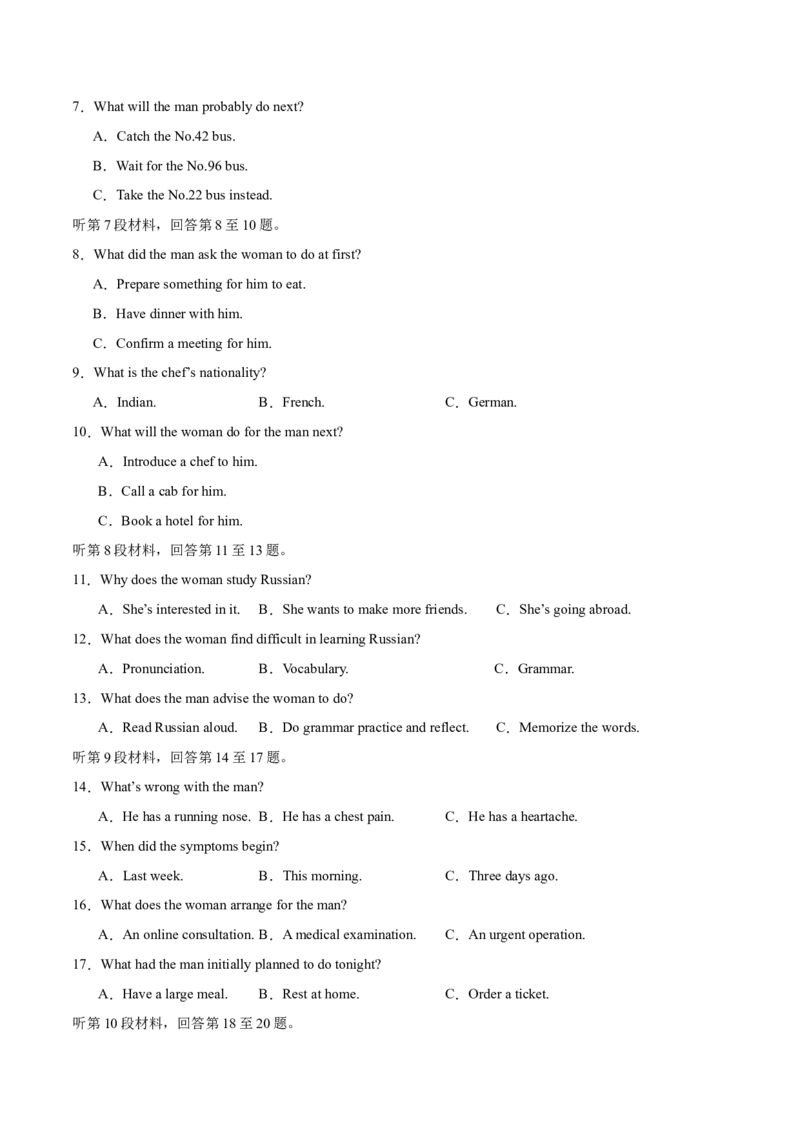
1.What is Angela going to do today?
A.Practise martial arts.
B.Visit her grandparents.
C.Help her father in a store.
2.What is the weather probably like?
A.Cool.
B.Hot.
C.Wet.
3.What does the woman think of Jacob?
A.He’s capable.
B.He’s experienced.
C.He’s bad-tempered.
4.What does the man forget to do?
A.Settle a debt.
B.Check his app.
C.Send a WeChat.
5.Where does the conversation probably take place?
A.In a library.
B.At a hairdresser’s.
C.In a clothes shop.
第二节(共15 小题;每小题1.5 分,满分22.5 分)
听下面5 段对话或独白。每段对话或独白后有几个小题,从题中所给的A、B、C 三个选项中选出最佳
选项。听每段对话或独白前,你将有时间阅读各个小题,每小题5 秒钟;听完后,各小题将给出5 秒钟的
作答时间。每段对话或独白读两遍。
听第6 段材料,回答第6、7 题。
6.What is the last stop of the No.22 bus?
A.The museum.
B.The train station.
C.The shopping center.
7.What will the man probably do next?
A.Catch the No.42 bus.
B.Wait for the No.96 bus.
C.Take the No.22 bus instead.
听第7 段材料,回答第8 至10 题。
8.What did the man ask the woman to do at first?
A.Prepare something for him to eat.
B.Have dinner with him.
C.Confirm a meeting for him.
9.What is the chef’s nationality?
A.Indian.
B.French.
C.German.
10.What will the woman do for the man next?
A.Introduce a chef to him.
B.Call a cab for him.
C.Book a hotel for him.
听第8 段材料,回答第11 至13 题。
11.Why does the woman study Russian?
A.She’s interested in it.
B.She wants to make more friends.
C.She’s going abroad.
12.What does the woman find difficult in learning Russian?
A.Pronunciation.
B.Vocabulary.
       C.Grammar.
13.What does the man advise the woman to do?
A.Read Russian aloud.
B.Do grammar practice and reflect.
C.Memorize the words.
听第9 段材料,回答第14 至17 题。
14.What’s wrong with the man?
A.He has a running nose. B.He has a chest pain.
C.He has a heartache.
15.When did the symptoms begin?
A.Last week.
B.This morning.
C.Three days ago.
16.What does the woman arrange for the man?
A.An online consultation. B.A medical examination.
C.An urgent operation.
17.What had the man initially planned to do tonight?
A.Have a large meal.
B.Rest at home.
C.Order a ticket.
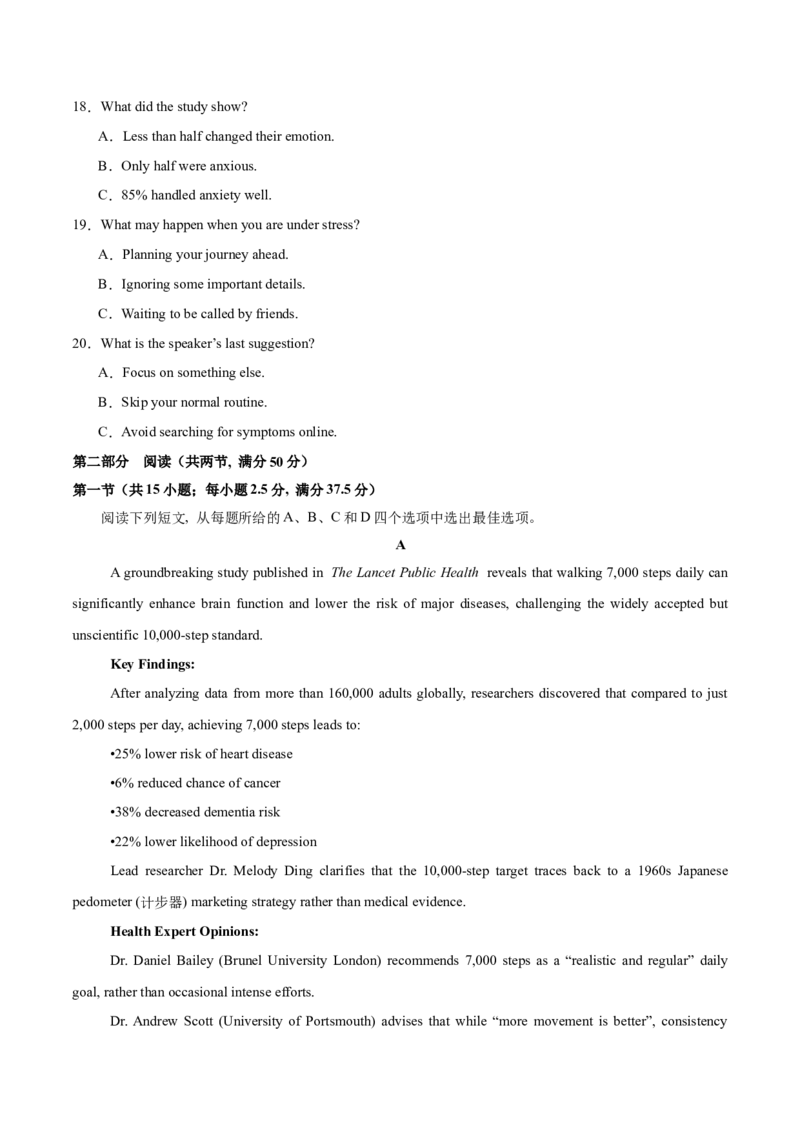
听第10 段材料,回答第18 至20 题。
18.What did the study show?
A.Less than half changed their emotion.
B.Only half were anxious.
C.85% handled anxiety well.
19.What may happen when you are under stress?
A.Planning your journey ahead.
B.Ignoring some important details.
C.Waiting to be called by friends.
20.What is the speaker’s last suggestion?
A.Focus on something else.
B.Skip your normal routine.
C.Avoid searching for symptoms online.
第二部分  阅读(共两节, 满分50 分)
第一节(共15 小题;每小题2.5 分, 满分37.5 分)
阅读下列短文, 从每题所给的A、B、C 和D 四个选项中选出最佳选项。
A
A groundbreaking study published in The Lancet Public Health reveals that walking 7,000 steps daily can
significantly enhance brain function and lower the risk of major diseases, challenging the widely accepted but
unscientific 10,000-step standard.
Key Findings:
After analyzing data from more than 160,000 adults globally, researchers discovered that compared to just
2,000 steps per day, achieving 7,000 steps leads to:
•25% lower risk of heart disease
•6% reduced chance of cancer
•38% decreased dementia risk
•22% lower likelihood of depression
Lead researcher Dr. Melody Ding clarifies that the 10,000-step target traces back to a 1960s Japanese
pedometer (计步器) marketing strategy rather than medical evidence.
Health Expert Opinions:
Dr. Daniel Bailey (Brunel University London) recommends 7,000 steps as a “realistic and regular” daily
goal, rather than occasional intense efforts.
Dr. Andrew Scott (University of Portsmouth) advises that while “more movement is better”, consistency
matters most.
Prof. Azeem Majeed (Imperial College London) highlights that routine daily activities like gardening or
cleaning also contribute meaningfully in the long run.
Practical Advice:
Make it social: Walk with friends/family to stay motivated and enjoy quality time.
Start small: Even 4,000 daily steps show measurable health improvements over inactivity.
Focus on feeling good: Regular walker Jon Stride emphasizes that mental well-being benefits outweigh strict
step counts.
While official guidelines recommend 150 weekly exercise minutes, this study shows regular 7,000-step
walking provides major health benefits. The key is consistent movement — whether through walking, daily tasks,
or other activities — without overemphasizing perfect numbers. Small, sustainable efforts make the real difference.
21.How many steps per day can significantly lower disease risks according to the study?
A.2,000 steps.
 B.4,000 steps.
C.7,000 steps.
D.10,000 steps.
22.What do health experts emphasize in walking advice?
A.Impressive records.
B.Official guidance.
C.Intensive movement.
D.Sustainable habits.
23.What is recommended to make walking more enjoyable?
A.Sharing walks with friends.
B.Starting with small goals.
C.Focusing on step counts.
D.Setting MUST-DO daily tasks.
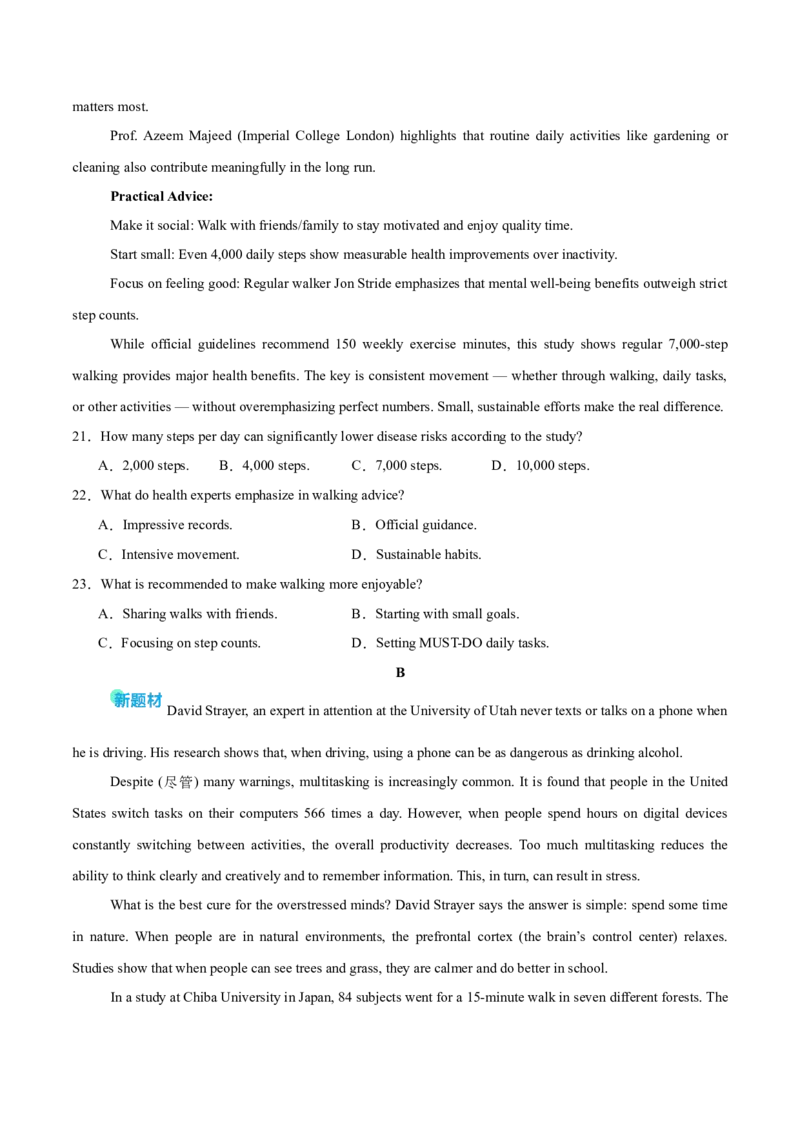
B
David Strayer, an expert in attention at the University of Utah never texts or talks on a phone when
he is driving. His research shows that, when driving, using a phone can be as dangerous as drinking alcohol.
Despite (尽管) many warnings, multitasking is increasingly common. It is found that people in the United
States switch tasks on their computers 566 times a day. However, when people spend hours on digital devices
constantly switching between activities, the overall productivity decreases. Too much multitasking reduces the
ability to think clearly and creatively and to remember information. This, in turn, can result in stress.
What is the best cure for the overstressed minds? David Strayer says the answer is simple: spend some time
in nature. When people are in natural environments, the prefrontal cortex (the brain’s control center) relaxes.
Studies show that when people can see trees and grass, they are calmer and do better in school.
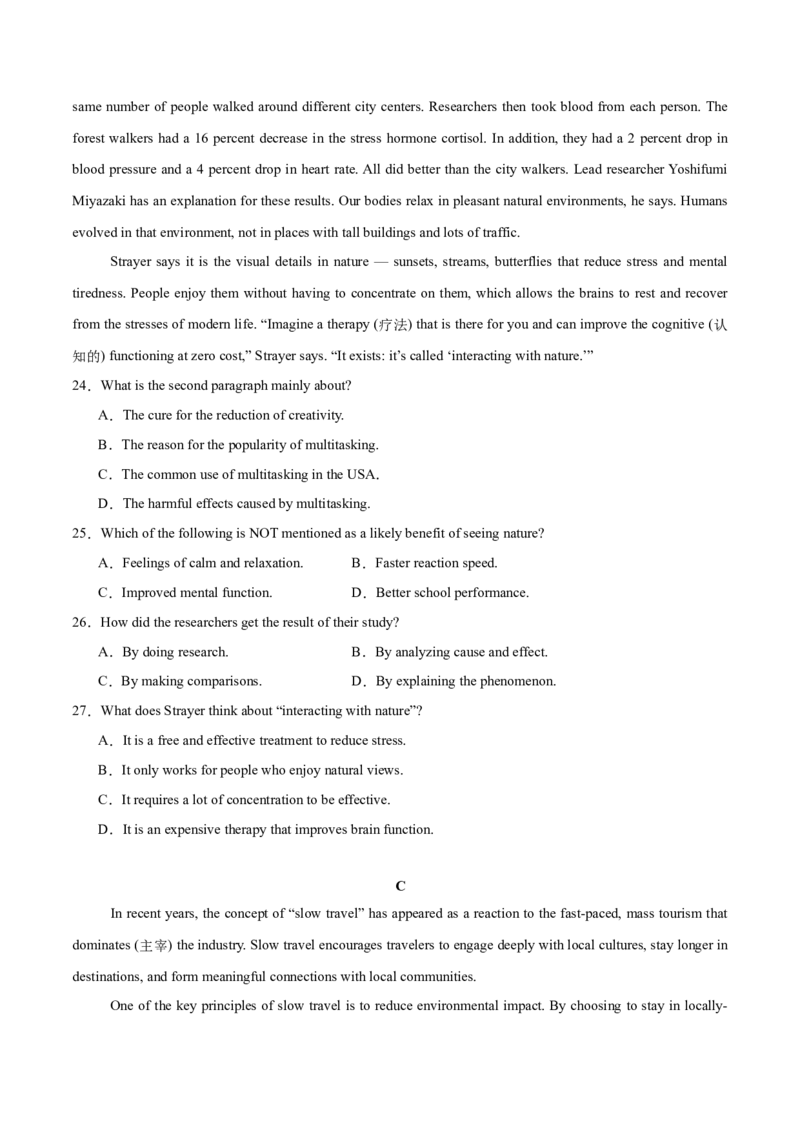
In a study at Chiba University in Japan, 84 subjects went for a 15-minute walk in seven different forests. The
same number of people walked around different city centers. Researchers then took blood from each person. The
forest walkers had a 16 percent decrease in the stress hormone cortisol. In addition, they had a 2 percent drop in
blood pressure and a 4 percent drop in heart rate. All did better than the city walkers. Lead researcher Yoshifumi
Miyazaki has an explanation for these results. Our bodies relax in pleasant natural environments, he says. Humans
evolved in that environment, not in places with tall buildings and lots of traffic.
Strayer says it is the visual details in nature — sunsets, streams, butterflies that reduce stress and mental
tiredness. People enjoy them without having to concentrate on them, which allows the brains to rest and recover
from the stresses of modern life. “Imagine a therapy (疗法) that is there for you and can improve the cognitive (认
知的) functioning at zero cost,” Strayer says. “It exists: it’s called ‘interacting with nature.’”
24.What is the second paragraph mainly about?
A.The cure for the reduction of creativity.
B.The reason for the popularity of multitasking.
C.The common use of multitasking in the USA.
D.The harmful effects caused by multitasking.
25.Which of the following is NOT mentioned as a likely benefit of seeing nature?
A.Feelings of calm and relaxation.
B.Faster reaction speed.
C.Improved mental function.
D.Better school performance.
26.How did the researchers get the result of their study?
A.By doing research.
B.By analyzing cause and effect.
C.By making comparisons.
D.By explaining the phenomenon.
27.What does Strayer think about “interacting with nature”?
A.It is a free and effective treatment to reduce stress.
B.It only works for people who enjoy natural views.
C.It requires a lot of concentration to be effective.
D.It is an expensive therapy that improves brain function.
C
In recent years, the concept of “slow travel” has appeared as a reaction to the fast-paced, mass tourism that
dominates (主宰) the industry. Slow travel encourages travelers to engage deeply with local cultures, stay longer in
destinations, and form meaningful connections with local communities.
One of the key principles of slow travel is to reduce environmental impact. By choosing to stay in locally-
owned accommodations, eating at family-run restaurants, and using public transportation or bicycles, travelers can
greatly decrease their carbon footprint. For instance, a study found that tourists who engage in slow travel produce
up to 70% less greenhouse gas emissions compared to those on traditional package tours.
Slow travel also allows for a deeper cultural understanding. Instead of rushing through tourist attractions,
slow travelers take the time to participate in local traditions, learn about historical importance, and interact with
locals. This not only enriches the travel experience but also provides economic benefits to local communities. In
some rural areas, “slow travel” has helped preserve (保存) endangered crafts and save dying traditions.
However, slow travel is not without challenges. It requires more planning and flexibility. As travelers need to
research local customs, transportation options, and authentic(真实的) experiences. Additionally, slow travel may
not be feasible for everyone due to time or budget limit. For busy professionals or families with limited vacation
days, spending weeks in a single destination may seem unrealistic.
Despite these challenges, the slow travel movement continues to grow. Travelers are becoming more aware
of their environmental and cultural impact, and many are seeking more authentic and sustainable ways to explore
the world. As a result, travel companies are starting to offer more slow-travel options, such as longer home-stays
and cultural experience programs.
28.Which is the benefit of slow travel?
A.It can save money on traveling.
B.It can allow travelers to visit more places hurriedly.
C.It can be more environmentally friendly.
D.It can increase the income of travel companies.
29.What can we learn about slow travel from the third paragraph?
A.It has little impact on local economies.
B.It focuses on interactions with travelers.
C.It discourages travelers from learning about history.
D.It may contribute to the preservation of traditional crafts
30.What does the underlined word “feasible” mean in this context?
A.desirable
B.affordable
C.practical
D.classical
31.What can be inferred about the future of slow travel?
A.It will take the place of traditional tourism entirely.
B.It will only be accessible to rich travelers.
C.It will cost less as time passes.
D.It may become more popular in the future.
D
According to the Food and Agriculture Organization of the United Nations, about two billion
people eat bugs, or insects, as part of their daily diet. That’s nearly a quarter of the global population, and yet most
countries in Europe and North America, despite the nutritional and environmental benefits, are quite unwilling to
eat bugs. So why should Westernized countries agree to include bugs in their daily diet?
Eating bugs as a replacement for larger farm animals could contribute greatly to a more sustainable (可持续
的) world. Bugs have a high feed-to-product rate and use much less materials than traditional farm animals per
pound. According to an article written by the former manager of the Toronto Food Policy Council, Wayne Roberts,
“Eatable insects don’t appear on any endangered species lists, and their sustainable use could help protect other
wildlife since the approach may contribute to habitat protection.”
The nutritional benefits of eating bugs can be important in fighting childhood deaths, and malnutrition (营养
不良) rates. Monica Aiyeko of the Food and Agriculture department at Bondo University College has studied and
published the effects of including native crickets into school meal programs in Kenya. Her studies have found that
about 30% of Kenyan households are short of food, leading to wide-spread malnutrition among children,
particularly under the age of 5. Putting bugs into school feeding programs could provide children with the
necessary nutrients to prevent poor growth. Generally, bugs are extremely nutritionally beneficial, rich in protein,
omega-3 fats and iron.
The popular Western opinion is best stated by New York Times writer Ligaya Mishan, “Europeans, and
European settlers in North America, never had a bug-eating tradition. Indeed, we largely consider insects dirty and
related to disease. This is a big misunderstanding that we need to clear up. All I want is a food cultural change, is
that so much to ask?”
32.What can we learn from paragraph 2?
A.Endangered bugs taste less delicious.
B.Eating bugs can threaten other wildlife.
C.Bugs need less feed for the same production.
D.Bugs produce less using more materials.
33.What was the main focus of Aiyeko’s study?
A.The general health benefits of bugs.
B.The climbing malnutrition rates among Kenyan kids.
C.The problem of food safety in Kenyan households.
D.The benefits of having bugs in school meals in Kenya.
34.What is Mishan attitude towards bug-eating?
A.Doubtful.
B.Favourable.
C.Unclear.
D.Indifferent.
35.Which is the best title for the passage?
A.Bugs: a Change in the Menu
B.Bugs: an Unwanted Future Choice
C.Bugs: an Unseen Threat to the Crop
D.Bugs: a Game-changer in Agriculture
第二节(共5 小题;每小题2. 5 分, 满分12. 5 分)
阅读下面短文, 从短文后的选项中选出可以填入空白处的最佳选项。选项中有两项为多余选项。
It is never too late to develop great study habits. However, starting making some changes is hard. Even if
you want to do well enough in school and improve your grades, you’re probably having trouble getting started in
the first place!     36
Plan your time carefully. Make a list of your weekly tasks. Make a schedule of your time. Then decide on
good, regular time for studying.    37    , but it will make you more aware of how you spend your time
Find a good place to study. Choose one place for your study area. It may be a desk or a chair at home or in
the school library, but it should be comfortable and quiet. When you begin to work, you should be able to
concentrate on the subject.
Skim before you read.     38    . As you preview the material, you get some idea of the passage and
how it is organized.
    39    . Listening to what the teacher says in class means less work later. Taking notes helps you
remember what the teacher says.
Develop a good attitude to tests. The purpose of a test is to show what you have learned about a subject.
40    . Tests provide grades, but they also let you know that you need to spend more time studying.
There are other skills that might help you with your study. Share with your classmates some of the skills you
have found to be helpful.
A.Study regularly
B.Make good use of your time in class
C.There are several ways that can help you
D.Develop a positive attitude by setting realistic goals
E.This weekly schedule may not solve all of your problems
F.The world won’t end if you don’t pass a test, so don’t worry too much about a test
G.This means looking over a passage quickly before you begin to read it more carefully
第三部分 语言运用(共两节,满分30 分)
第一节(共15 小题,每小题1 分,满分15 分)
阅读下面短文, 从每题所给的A、B、C 和D 四个选项中选出可以填入空白处的最佳选项。
Alistair made a living by running an antique shop. One afternoon, while polishing a set of silverware (银器),
he     41     a hidden space in the old wooden box he had bought at a street market.     42    , he opened it.
Inside was a single, beautifully cut diamond.
Alistair immediately visited a trusted appraiser (估价师). The assessment was     43     — enough to
guarantee a comfortable life for him for years. His heart     44    . This was no ordinary small item; its value
could solve all his     45     problems. His tight budget whispered to him, urging him to sell the diamond and
forget it. Yet, his     46     made him hesitate. He resolved to find the box’s previous     47     instead.
Days turned into a week of hard research.     48    , he found Elara, an elderly woman in a nearby town.
When she heard Alistair’s     49    , her voice trembled with emotion. She     50     the diamond was part
of her family treasure, which she thought was lost decades ago during a hard time when many of her possessions
were     51     to make ends meet. Without a second thought, Alistair arranged to     52     it.
Moved deeply, Elara, a local historian, later     53     his shop for an important preservation project, and
it gained some funds. This single act of returning a lost treasure     54     the future of Alistair’s beloved shop
— a     55     far beyond the diamond’s material worth.
41.A.brushed against
B.painted over
C.emptied out
                    D.broke into
42.A.Grateful
B.Nervous
C.Embarrassed
D.Curious
43.A.misleading
B.confusing
C.disappointing
D.surprising
44.A.sank
B.raced
C.softened
D.warmed
45.A.medical
B.educational
C.financial
D.emotional
46.A.generosity
B.honesty
C.enthusiasm
D.optimism
47.A.designer
B.owner
C.renter
D.discoverer
48.A.Eventually
B.Instantly
C.Temporarily
D.Frequently
49.A.inquiry
B.instruction
C.description
D.comment
50.A.promised
B.disagreed
C.hoped
D.explained
51.A.sold
B.donated
C.protected
D.improved
52.A.explore
B.return
C.maintain
D.promote
53.A.investigated
B.purchased
C.decorated
D.recommended
54.A.disturbed
B.reflected
C.secured
D.predicted
55.A.reward
B.solution
C.reminder
D.purpose
第二节(共10 小题;每小题1.5 分 ,满分15 分)
阅读下面短文,在空白处填入1 个适当的单词或括号内单词的正确形式。
Ask a Cantonese cook what “wok hei (锅气)” is, and the matter-of-fact description might refer to it as “that
smoky flavor”. A more poetic one comes from Chef Steph Li, the owner of Savory Kitchen,     56     describes
it as a quality achieved from “that     57     (mystery) taste of the restaurant oil and the    58    (noticeable)
deeper restaurant browning.” My dad has always been a wok hei lover — that restaurant magic is his gold standard.
Wok hei can only happen when food     59     (cook) at very high heat. Unfortunately, that heat is hard
to achieve on a home stove top.     60     a professional cook, I’ve spent 15 years     61     (experiment)
with wok hei in a home kitchen. Last year, I finally got there.
The secret doesn’t just come from using a hot stove top. It’s also important to use the right kind of woks —
and Steph Li expresses a preference for     62     (one) made with carbon steel. There are two extra things a
home cook can do: One is to add soy sauce around the edge of the wok     63     (give) food a “seared (焦的)
soy sauce flavor”. The second is to take a kitchen torch (火枪) in a method called “torch hei” — that involves
spreading food in a single layer on a baking sheet     64     “giving it a few leisurely passes with a torch”.
When I cook with a carbon steel wok and add some seared soy sauce to the mix, I can almost smell     65

breath of the wok — and suddenly, it’s like I hear my dad pushing open my kitchen door, saying, “I like the food
here.”
第四部分  写作(共两节, 满分40 分)
第一节(满分15 分)
假定你是李华,外教Mr. Chuck 发现你的作文完全由 AI 生成,故将其判为不及格。请你给外教写一
封邮件,内容包括:
(1)承认错误;
(2)做出许诺;
(3)补救措施。
注意:
1. 词数80 左右;
2. 可以适当增加细节,以使行文连贯。
Dear Mr. Chuck,
____________________________________________________________________________________________
____________________________________________________________________________________________
____________________________________________________________________________________________
____________________________________________________________________________________________
____________________________________________________________________________________________
____________________________________________________________________________________________
____________________________________________________________________________________________
Yours,
Li Hua
第二节(满分25 分)
阅读下面材料,根据其内容和所给段落开头语续写两段,使之构成一篇完整的短文。
It was my twelfth birthday, and what I really wanted was a new bicycle. But I knew that my family couldn’t
afford one. A new bike was just a dream, so I was forced to accept a bedside table with lockable drawers. At least I
would have a safe place to keep my private stuff.
We went to a charity shop, where we found an old dark one among the donated items. It didn’t look too cool,
but I thought that I would paint it to make it look better.
After we took it home, I was getting ready to paint it. When I pulled the drawers out, I felt something stuck
to the back. I reached in all the way, and guess what? A sealed bag with some papers in it.
When I opened the bag, I realized that the papers were official documents. And, wrapped in them were a
bunch of ten-dollar and twenty-dollar bills! Talk about finding a treasure! And on my birthday!
“Is this some kind of joke?” I said aloud. I went ahead and read the papers, and it turned out to be a will.
Some old lady was leaving her savings for her son and grandchildren.
My mind was going crazy. Was I the luckiest twelve-year-old ever? With this money I could buy the coolest
bicycle. Who knows?
I began counting. When I reached a thousand dollars, my mother was knocking on my bedroom door. I
quickly closed the drawer with the money in it.
“Do you want some help? Is everything all right?” she asked.
No, everything was not right. Actually, my stomach was growling.
“I’m okay,” I lied.
When my mother left my room, I lay on my bed, starting thinking. What a dilemma! I wished there were
someone I could talk with. Could I keep it and get all kinds of stuff for me and my family? It wouldn’t be too bad
for me to keep it, if I shared it... right? Thoughts ran through my mind.
注意:
1. 续写词数应为150 左右;
2. 请按如下格式在答题卡相应位置作答。
I finally made a decision and called my parents into my bedroom.  ________________________________
____________________________________________________________________________________________
____________________________________________________________________________________________
____________________________________________________________________________________________
____________________________________________________________________________________________
____________________________________________________________________________________________
Though surprised, the shop owner helped find the family’s telephone number. ________________________
____________________________________________________________________________________________
____________________________________________________________________________________________
____________________________________________________________________________________________
____________________________________________________________________________________________
____________________________________________________________________________________________
____________________________________________________________________________________________