《2026 浙江1 月卷英语真题完全解读与考后提升》
专题05 2026 浙江1 月卷阅读七选五(回读现象) (解读+技巧+变式) 原卷版
阅读七选五关键词:说明文,人与自我,专注阅读技巧,回读现象,阅读能力提升
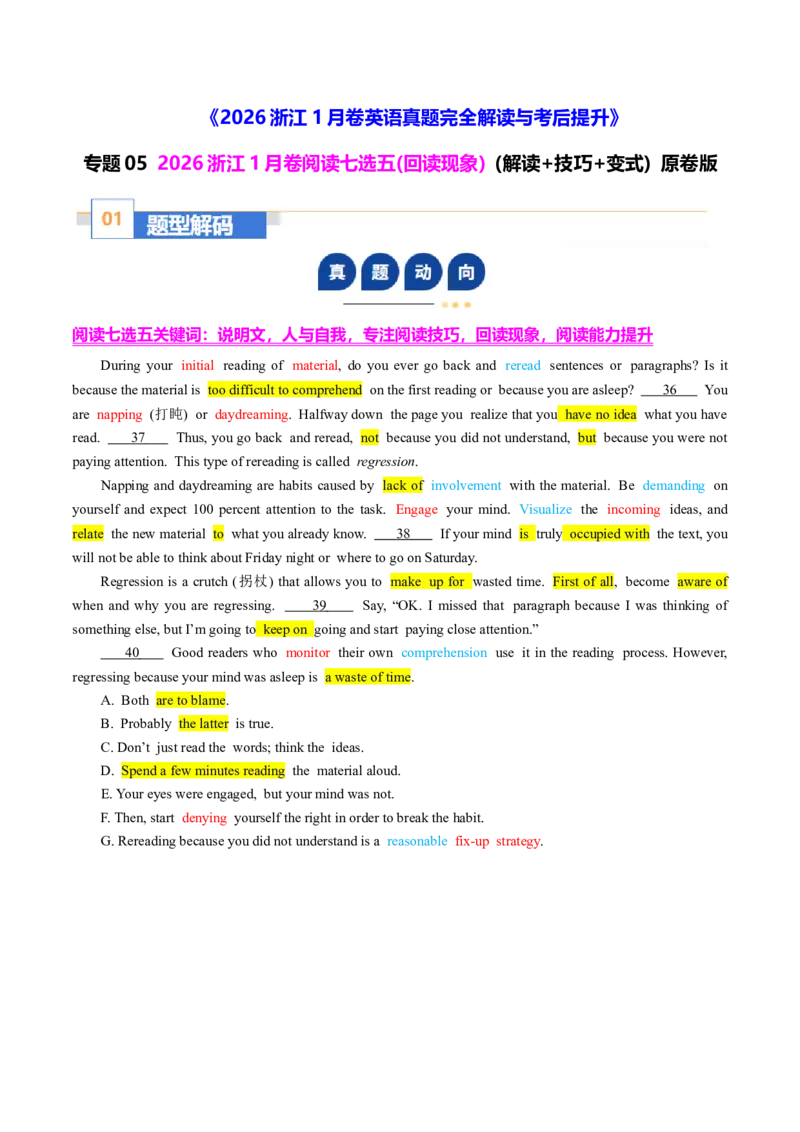
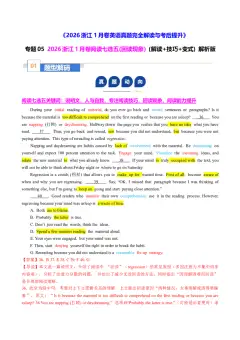
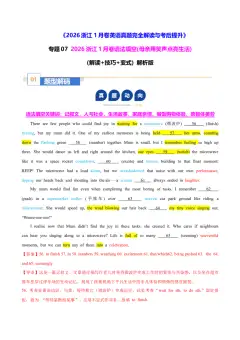
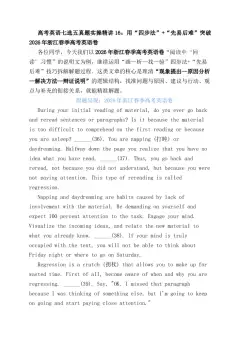
During your initial reading of material, do you ever go back and reread sentences or paragraphs? Is it
because the material is too difficult to comprehend on the first reading or because you are asleep?
  36

   You
are napping (打盹) or daydreaming. Halfway down the page you realize that you have no idea what you have
read.
  3 7
   Thus, you go back and reread, not because you did not understand, but because you were not
paying attention. This type of rereading is called regression.
Napping and daydreaming are habits caused by lack of involvement with the material. Be demanding on
yourself and expect 100 percent attention to the task. Engage your mind. Visualize the incoming ideas, and
relate the new material to what you already know.
  3 8
   If your mind is truly occupied with the text, you
will not be able to think about Friday night or where to go on Saturday.
Regression is a crutch (拐杖) that allows you to make up for wasted time. First of all, become aware of
when and why you are regressing.

 3 9

  Say, “OK. I missed that paragraph because I was thinking of
something else, but I’m going to keep on going and start paying close attention.”

  40

   Good readers who monitor their own comprehension use it in the reading process. However,
regressing because your mind was asleep is a waste of time.
A. Both are to blame.
B. Probably the latter is true.
C. Don’t just read the words; think the ideas.
D. Spend a few minutes reading the material aloud.
E. Your eyes were engaged, but your mind was not.
F. Then, start denying yourself the right in order to break the habit.
G. Rereading because you did not understand is a reasonable fix-up strategy.
语篇解读
关键词
fake review, positive review, negative review
语篇结构
本文是一篇说明文,介绍了关于虚假评价的一项学术研究,揭示了人们更信任差评的认知偏
见,并分析了评价长度、细节和其携带的情绪对其可信度的影响,最后指出了AI 生成虚假评
价带来的新挑战。
原文出处
本 文 选 自 Brenda D. Smith 作 著 作 Bridging the Gap:College Reading 中的第十章
重难点词
initial adj 最初的;comprehend v 理解;daydream v 做白日梦; demanding adj 要求严格的;
engage v 使参与;visualize v 想象,设想; incoming adj 正来临的; regress v 回读;monitor v
[熟词生义] 监测;reasonable adj 合情理的
重难点
词块
lack of involvement with 没有投入到……中;relate sth to sth 把……与……联系起来;be
occupied with 专注于;make up for 弥补;deny yourself (sth) 克制自己……; fix-up strategy 补救
方法
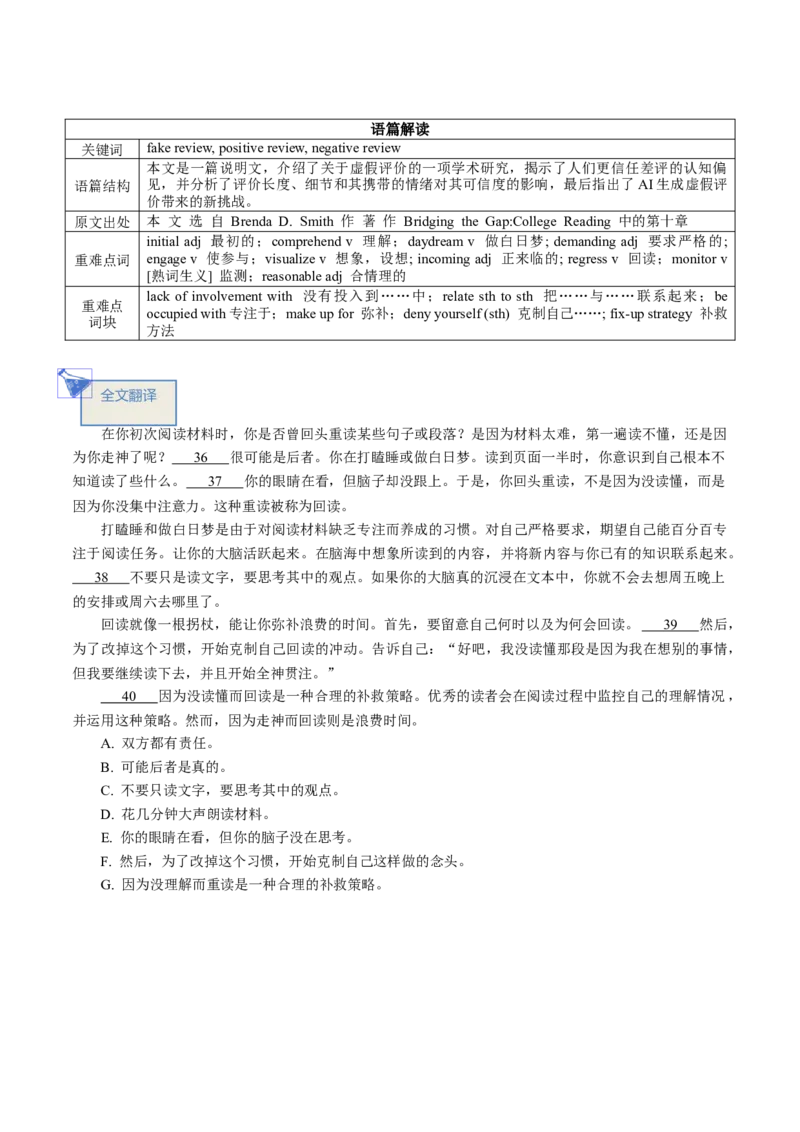
在你初次阅读材料时,你是否曾回头重读某些句子或段落?是因为材料太难,第一遍读不懂,还是因
为你走神了呢?
  36

 很可能是后者。你在打瞌睡或做白日梦。读到页面一半时,你意识到自己根本不
知道读了些什么。
  37

 你的眼睛在看,但脑子却没跟上。于是,你回头重读,不是因为没读懂,而是
因为你没集中注意力。这种重读被称为回读。
打瞌睡和做白日梦是由于对阅读材料缺乏专注而养成的习惯。对自己严格要求,期望自己能百分百专
注于阅读任务。让你的大脑活跃起来。在脑海中想象所读到的内容,并将新内容与你已有的知识联系起来。

  38

 不要只是读文字,要思考其中的观点。如果你的大脑真的沉浸在文本中,你就不会去想周五晚上
的安排或周六去哪里了。
回读就像一根拐杖,能让你弥补浪费的时间。首先,要留意自己何时以及为何会回读。
  39

 然后,
为了改掉这个习惯,开始克制自己回读的冲动。告诉自己:“好吧,我没读懂那段是因为我在想别的事情,
但我要继续读下去,并且开始全神贯注。”
   40   因为没读懂而回读是一种合理的补救策略。优秀的读者会在阅读过程中监控自己的理解情况,
并运用这种策略。然而,因为走神而回读则是浪费时间。
A. 双方都有责任。
B. 可能后者是真的。
C. 不要只读文字,要思考其中的观点。
D. 花几分钟大声朗读材料。
E. 你的眼睛在看,但你的脑子没在思考。
F. 然后,为了改掉这个习惯,开始克制自己这样做的念头。
G. 因为没理解而重读是一种合理的补救策略。
全文翻译
       核心素养统领 综合能力导向
绍兴市第一中学 正高级教师、特级教师 蔡红
    金华市教育教学研究中心 高级教师 徐钰
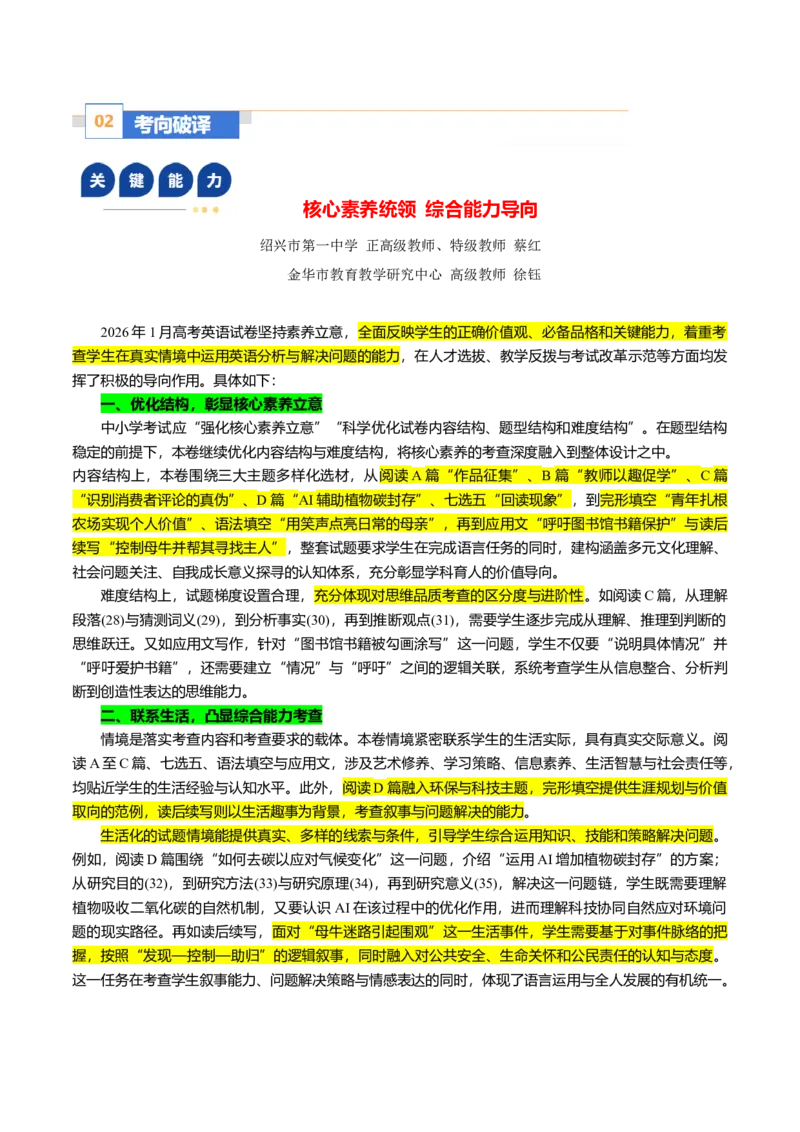
2026 年1 月高考英语试卷坚持素养立意,全面反映学生的正确价值观、必备品格和关键能力,着重考
查学生在真实情境中运用英语分析与解决问题的能力,在人才选拔、教学反拨与考试改革示范等方面均发
挥了积极的导向作用。具体如下:
一、优化结构,彰显核心素养立意
中小学考试应“强化核心素养立意”“科学优化试卷内容结构、题型结构和难度结构”。在题型结构
稳定的前提下,本卷继续优化内容结构与难度结构,将核心素养的考查深度融入到整体设计之中。
内容结构上,本卷围绕三大主题多样化选材,从阅读A 篇“作品征集”、B 篇“教师以趣促学”、C 篇
“识别消费者评论的真伪”、D 篇“AI 辅助植物碳封存”、七选五“回读现象”,到完形填空“青年扎根
农场实现个人价值”、语法填空“用笑声点亮日常的母亲”,再到应用文“呼吁图书馆书籍保护”与读后
续写“控制母牛并帮其寻找主人”,整套试题要求学生在完成语言任务的同时,建构涵盖多元文化理解、
社会问题关注、自我成长意义探寻的认知体系,充分彰显学科育人的价值导向。
难度结构上,试题梯度设置合理,充分体现对思维品质考查的区分度与进阶性。如阅读C 篇,从理解
段落(28)与猜测词义(29),到分析事实(30),再到推断观点(31),需要学生逐步完成从理解、推理到判断的
思维跃迁。又如应用文写作,针对“图书馆书籍被勾画涂写”这一问题,学生不仅要“说明具体情况”并
“呼吁爱护书籍”,还需要建立“情况”与“呼吁”之间的逻辑关联,系统考查学生从信息整合、分析判
断到创造性表达的思维能力。
二、联系生活,凸显综合能力考查
情境是落实考查内容和考查要求的载体。本卷情境紧密联系学生的生活实际,具有真实交际意义。阅
读A 至C 篇、七选五、语法填空与应用文,涉及艺术修养、学习策略、信息素养、生活智慧与社会责任等,
均贴近学生的生活经验与认知水平。此外,阅读D 篇融入环保与科技主题,完形填空提供生涯规划与价值
取向的范例,读后续写则以生活趣事为背景,考查叙事与问题解决的能力。
生活化的试题情境能提供真实、多样的线索与条件,引导学生综合运用知识、技能和策略解决问题。
例如,阅读D 篇围绕“如何去碳以应对气候变化”这一问题,介绍“运用AI 增加植物碳封存”的方案;
从研究目的(32),到研究方法(33)与研究原理(34),再到研究意义(35),解决这一问题链,学生既需要理解
植物吸收二氧化碳的自然机制,又要认识AI 在该过程中的优化作用,进而理解科技协同自然应对环境问
题的现实路径。再如读后续写,面对“母牛迷路引起围观”这一生活事件,学生需要基于对事件脉络的把
握,按照“发现—控制—助归”的逻辑叙事,同时融入对公共安全、生命关怀和公民责任的认知与态度。
这一任务在考查学生叙事能力、问题解决策略与情感表达的同时,体现了语言运用与全人发展的有机统一。

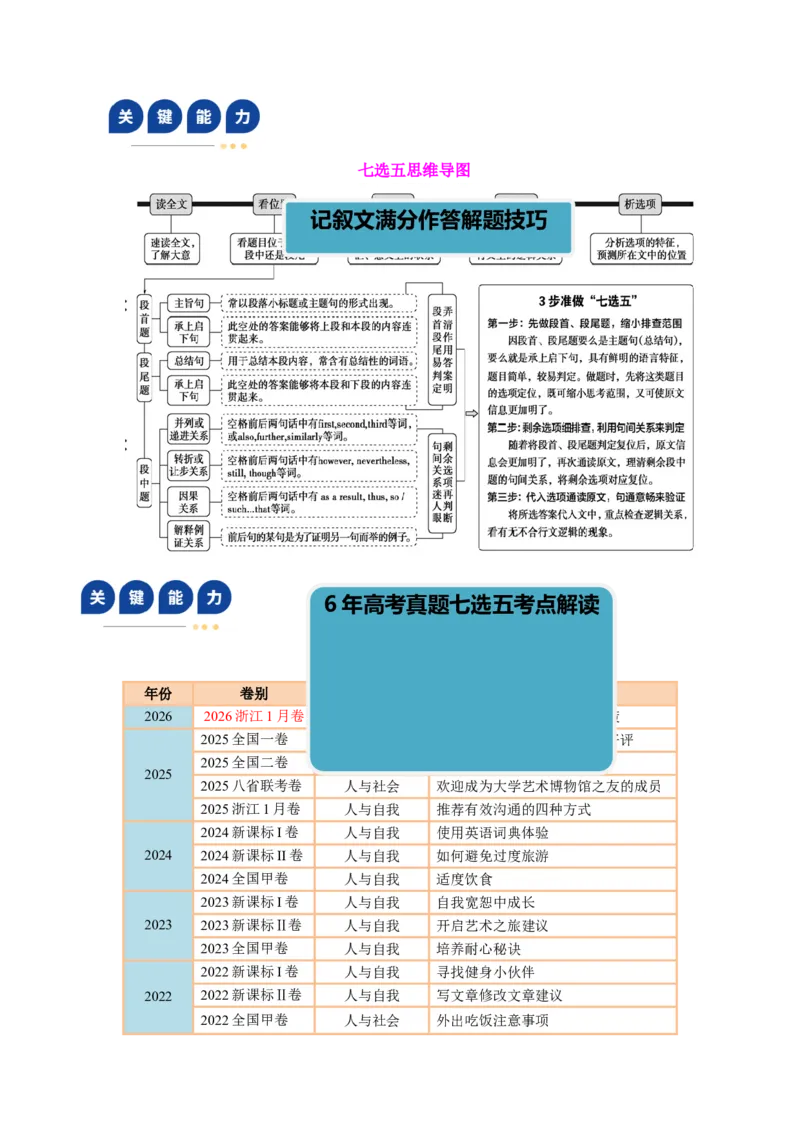
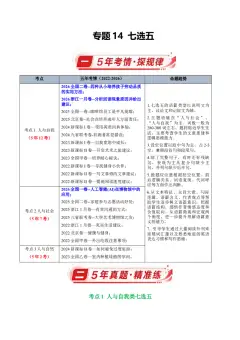
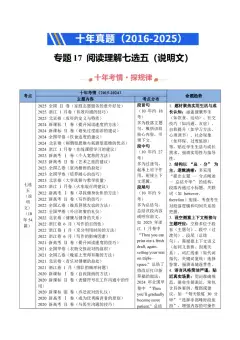
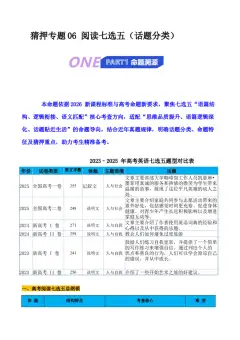
七选五思维导图
年份
卷别
主题
话题
2026
2026 浙江1 月卷
人与自我
阅读回读现象成因分析及对策
2025
2025 全国一卷
人与社会
热爱事业的咖啡馆员工赢得好评
2025 全国二卷
人与社会
介绍了家庭志愿服务的好处
2025 八省联考卷
人与社会
欢迎成为大学艺术博物馆之友的成员
2025 浙江1 月卷
人与自我
推荐有效沟通的四种方式
2024
2024 新课标I 卷
人与自我
使用英语词典体验
2024 新课标II 卷
人与自我
如何避免过度旅游
2024 全国甲卷
人与自我
适度饮食
2023
2023 新课标I 卷
人与自我
自我宽恕中成长
2023 新课标Ⅱ卷
人与自我
开启艺术之旅建议
2023 全国甲卷
人与自我
培养耐心秘诀
2022
2022 新课标I 卷
人与自我
寻找健身小伙伴
2022 新课标Ⅱ卷
人与自我
写文章修改文章建议
2022 全国甲卷
人与社会
外出吃饭注意事项
6 年高考真题七选五考点解读
记叙文满分作答解题技巧
2021
2021 全国甲卷
人与社会
交换衣服派对
2020
2020 全国I 卷
人与社会
表情符号有助于职场
2020 全国III 卷
人与社会
乔迁聚会安排
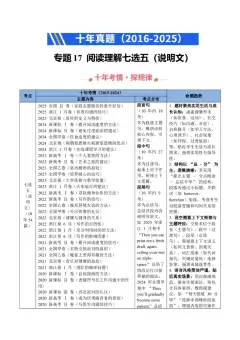
       七选五十大技巧
技巧一 | 从细节逻辑上判断——因果关系
在做题时最重要的是要读懂空白前后的句子,明白这几句话的确切意思,然后根据意思的连贯性或逻
辑性从选项中选取正确答案。在读懂意思的基础上,判断它们之间的关系来进一步确认答案。
因果关系主要指前后的句子有着原因和结果之间的关系,这种关系往往说明了前因后果或者前果后因
等情况。表示因果关系的连词有as a result 结果,thus/therefore 因此,so (such)...如此……以至于等。
技巧二 | 从细节逻辑上判断——转折关系
转折关系主要指英语行文中后句对前句构成逆转逻辑关系。如果空格前后两句话之间是逻辑上的逆转,
则空格处很有可能是个转折逻辑的句子。表示转折关系的连接词有:however 然而等。
技巧三 | 从细节逻辑上判断——例证关系
前后句的某句是为了证明另一句而举的例子。例证的形式多样,但就其本质而言无非是思维上的形象
(例子、类比等)和抽象(观点)的辩证关系,用到的思维过程无非就是基本的归纳(从例子到观点)和
推理(从观点到例子)。
技巧四 | 从细节逻辑上判断——递进关系
递进关系主要指英语行文中后句对前句是一种顺承逻辑关系。如果空格前后两句话之间是逻辑上的层
进关系,则空格处很有可能是个递进的句子。表示递进关系的连词有:also 也, 而且, further 另外(的),
furthermore 而且,此外等。
技巧五 | 从细节逻辑上判断——平列关系
表示列举关系的有:firstly 第一, 首先secondly 第二, thirdly 第三in the first place 第一,首先for one
thing 首先等。
技巧六 | 从词汇线索上判断——代词指代
英语表达中的代词出现的频率极高,代词的作用是指代前面提及的名词或形容词概念,巧妙利用这样
的指代关系和根据代词的单复数差异可以准确而快速地解题。
技巧七 | 从词汇线索上判断——同义词/近义词
英语前言后语之间往往有同义词、近义词、近义表达语甚至相同词汇的重复使用,这是我们解题的一
个很好的判断线索。其实就其本质而言,上文讲的代词和下文将涉及的上下义词和同一范畴词都是特殊的
同义/近义词。
技巧八 | 从词汇线索上判断——同畴词
上下义词和同一范畴词就是前者包含了后者,或可以说后者是前者的一个子集。利用前后句中这样的
特殊的同义关系常常可以很轻松地解题
技巧九 | 从试题位置上判断——问题在段首
假如问题出现在段首,它通常是段落主题句。认真阅读后文内容,根据段落一致性原则,查找同义词
或其他相关的词,推断出主题句。通常正确答案的最后一句与空白后的第一句在意思上是紧密衔接的,因
此这两句间会有某种的衔接手段,尤其当选项是几句话时。
技巧十 | 从试题位置上判断——问题在段尾
如果第一段的段尾是空白,要认真阅读,看此处是细节还是主题。通常文章第一段要提出文章的主题,
如果在段尾提出主题,会用一些信号词如转折词引出来,正确答案中应有这样的特征词。
段尾通常是结论、概括性语句。注意在选项中查找表示结果、结论、总结等的信号词,如therefore, as
a result, thus, hence, in short, to sum up, to conclude, in a word 等词语,选项中也可发现前文的同义词句。
一、词性转换
1. involve
vt. 包含;使参与;牵涉→n.             参与;卷入;包含
2. demand
vt. 要求;需要;查询→adj.             要求高的;苛求的;费力的
3. visual
adj. 视觉的;视力的;看得见的→vt.             想象;设想;使形象化
4. comprehend vt. 理解;领悟;包括→n.             理解;领悟;理解力
5. reason
n. 原因;理由;理性→adj.             合理的;通情达理的;公道的
6. true
adj. 真正的→adv.           真正地
二、识词知意
1. initial
adj.
2. nap
v.
n.
3. daydream v.
n.
4. engage
v.
5. incoming adj.
6. monitor
v.             n.
7. deny
v.
8. fix-up
n.
9. strategy
n.
三、高频语块
1. too... to do

2. have no idea

3. not ...but ...

4. lack of...

5. relate... to

6. be occupied with
7. make up for

8. first of all

9. aware of

10. keep on

11. a waste of time
12. be to blame
考点变式
13. the latter

14. spend time doing
四、长难句分析
1. Napping and daydreaming are habits caused by lack of involvement with the material.
2. If your mind is truly occupied with the text, you will not be able to think about Friday night or
where to go on Saturday.
五、知识拓展
1. 阅读习惯研究:现代心理学研究表明,良好的阅读习惯对于提高阅读效率和理解能力至关重要。像回读
这种习惯,在不同年龄段和阅读水平的人群中都较为常见,尤其是在阅读难度较大或注意力不集中时。例
如,儿童在学习阅读初期,回读现象较为普遍,随着阅读能力的提升会逐渐减少。
2. 注意力训练:在当今信息爆炸的时代,人们的注意力容易分散。许多研究关注如何提高注意力,以改善
阅读效果。一些方法包括冥想训练、专注力游戏等。例如,每天进行10 - 15 分钟的冥想练习,可以帮助人
们提高注意力和专注力。
3. 常见阅读误区:很多人在阅读时只是眼睛扫过文字,而大脑没有真正思考内容,就像选项E 中提到的
“眼睛在看,但思维没跟上”,这会导致阅读效率低下。此外,逐字阅读、反复回读等也是常见的不良阅
读习惯。4. 高效阅读技巧:阅读时可以像选项C 所说,不仅读文字,更要思考其中的观点和想法。另外,
还可以采用略读、扫读等方式,快速了解文章的主旨和关键信息。同时,阅读前先预览文章标题、小标题、
图片等,对内容有一个初步的框架认知,也有助于提高阅读效率。
5. 阅读读策略的应用:当遇到不理解的内容时,如选项G 提到的,重新阅读是一种合理的解决策略。然而,
要避免过度的无意义重读,应该有针对性地重读关键部分。此外,还可以结合上下文、查阅资料等方式来
加深理解。
6. 教育应用:在教育领域,教师会针对学生的阅读习惯进行指导。例如,通过阅读训练课程,帮助学生认
识到自己的阅读问题,如回读、默读等,并逐步纠正这些习惯,提高阅读速度和理解能力。
典例引领
01【2025 浙江1 月卷】
阅读下面短文,从短文后的选项中选出可以填入空白处的最佳选项。选项中有两项为多余选项。
One of the most common mistakes in communication is trying to do too much.    36    There’s no value in
delivering any kind of communication, whether written, spoken, formal, or informal, if the message doesn’t come
across clearly. Being clear and brief – while maintaining interest and including everything your listeners need to
know – is a high-level communication skill.
Here are some tips worth following in order to communicate more effectively.
●Keep your audience in mind.
Your audience will naturally be more interested and engaged when you tailor your communications to their
interests.    37    This will engage their desire to understand and interact with the information.
●Don’t use ten words when one will do.
Even the most engaged and committed audience will eventually get bored. Keeping your message simple and
clear will make it easier for people to understand.    38    However, they’re hearing it for the first time. Keep it
simple.
●   39
If you’ve ever worked as an instructor, manager, trainer or coach, you’ll know that there are few better ways to
learn new information than to teach it. Ask the audience to contribute their ideas or to take a role in explaining new
concepts and policies to others. Allow them to lead discussions and meetings to develop their communication skills.
●Consider the best method to deliver your message.
If the information you’re communicating isn’t urgent, consider sending an email. Written communication will
give your audience more time to review it, think it over, and follow up with questions.    40
Building effective communication skills takes time, but the effects are worth the effort.
A. Be patient.
B. Get the audience involved.
C. The best messages are often simple.
D. Speak directly to what matters to them.
E. You may be surprised by what your listeners offer.
F. It will also give them a handy record to refer back to.
G. As the speaker, you already know what you’re going to say.
02【2024 浙江1 月卷】
根据短文内容, 从短文后的选项中选出能填入空白处的最佳选项。选项中有两项为多余选项。
In the past few years, online learning has become a significant part of the university and college experience.
36   But are all online courses created equal? How can you be sure that digital learning is right for you?    37
We interviewed students and professors to get their advice about online courses, The most obvious advantage
of online learning is that you can study anywhere and anytime.    38    “I think a point that many people lose
sight of is how easy it can be to fall behind schedule,” says graduate student Amanda Bindman. Before choosing to
study online, consider whether you’re a self-motivated learner and if the material seems interesting enough to keep
you going.
The tip that comes up most often is simple: build online courses into your weekly schedule, just like what you
would do with in person courses.    39    He noted that his online students usually end up with lower grades. It
is so easy to let an online course slide, but your grades will suffer as a result. Be sure to schedule set times to watch
your lectures, read materials and contribute to online discussion boards.
    40    A social connection is often a big part of learning. There are things you can do to ease this
problem. Jessica Pink, an undergraduate student, suggests taking online courses with a friend, so you can motivate
each other to stay on track. You can also find students on the class discussion board to organize a study group, or
schedule in-person meetings with your professor to discuss course concepts.
A. But that doesn’t mean there aren’t deadlines.
B. Your motivation should be your main concern.
C. Do you know that online courses are also part of your education?
D. Professor Alex Davidson teaches the same course in person and online.
E. The chief complain t about online courses is that they lack human interaction.
F. If you take an online course, what can you do to ensure the best possible grade?
G. A survey found that 29 percent of college students registered for online courses.
03【2023 浙江1 月卷】
阅读下面短文,从短文后的选项中选出可以填入空白处的最佳选项。选项中有利项为多余选项。
With gas prices rising and airport security lines snaking longer than ever, why not book your next domestic
vacation on a train? Compared to other alternatives, it’s comfortable and relaxing. Here is some advice on how to
make a trip by rail as pleasant as possible.
Plan ahead. Most long-distance trains, especially the sleeping car accommodations, sell out very quickly.
36      But no matter when you travel, it’s a good idea to make your reservations at least 90 days in advance.
Use a travel agent. Consider turning your travel plan over to a travel agent and letting him double-check all
the details, make suggestions, and then handle the actual reservations. A good one can sometimes find you
discounted tickets.   37      Then you won’t have to walk through several cars on a moving train three times a
day for your meals.
Bring a blanket. When you’re riding on trains, you won’t be provided with a blanket for free, even if your
trip is an overnight one.    38      In the summer in particular, the air conditioning can make them quite cold.
Arrive early. Most trains operate just once a day and some run only three times a week, so missing yours can
be a disaster.   39      Note: The times listed on the schedules are departure times, not arrival times.
Have fun.   40      Read a book, knit, do a crossword puzzle, or simply watch the world unfold outside
the window. To calculate your speed as you do, divide 3,600(the number of seconds in an hour)by the number of
seconds it takes you to travel one mile(the distance between two mileposts). If it takes the train 53 seconds to travel
one mile, you’re going 67.92 mph.
A. Train trips aren’t for impatient types.
B. You’ll have views from both sides of the train.
C. The temperature on rail cars is often hard to control.
D. That’s particularly true during busy summer months.
E. You might have to wait longer than 24 hours to catch the next one.
F. Chances are the cost will be a lot less than the cost of one bedroom.
G. He may also book you in a sleeping car that’s right next to the diner.
变式一、阅读技巧类七选五3 篇
01(2025·浙江·一模)How to Develop Effective Reading Habits?
Reading is a fundamental skill that enriches our knowledge and broadens our perspectives. However, many
people struggle to maintain consistent reading habits. With the right strategies, anyone can become a regular reader
and enjoy the benefits it brings.
    1    . Before you start, think about what you want to gain from reading. Do you want to learn new
skills, explore different cultures, or simply relax? Your goals will help you choose the right books and stay
motivated. For example, if you aim to improve your vocabulary, you might focus on literary classics or non-fiction
works with rich language.
Create a reading schedule that fits your daily routine.     2    . It could be 20 minutes in the morning
before work, 15 minutes during your lunch break, or half an hour before bed. Consistency is more important than
the amount of time you spend reading each day. Set a reminder on your phone or mark your reading time on a
calendar to help you stick to the schedule.
Choose the right reading environment.     3    . Some people prefer quiet places like libraries or their
home study, while others enjoy reading in cafes with soft background music. Make sure your reading space is
comfortable — have a good chair, proper lighting, and keep distractions like phones or TVs to a minimum.
Take notes while reading to enhance comprehension.     4    . Write down key ideas, unfamiliar words,
or questions that come to mind. You can use a notebook, sticky notes, or digital tools like e-readers with note-taking
features. Reviewing your notes later will help you remember what you’ve read.
Finally, celebrate your progress.     5    . Whether you finish a book, reach a reading goal, or discover a
new favorite author, take time to acknowledge your achievement. Reward yourself with a trip to a bookstore, a new
bookmark, or simply the satisfaction of knowing you’re building a valuable habit.
A. Set clear reading goals
B. This makes reading more interactive and social
C. Everyone has different preferences for where they read best
D. Reading in short, regular sessions is more effective than long, occasional ones
E. Keeping track of your reading journey can motivate you to keep going
F. Not every book will resonate with you, and that’s perfectly normal
G. This helps you engage actively with the text and retain information better
02 (2025·吉林长春·三模)Deep reading, defined as immersive engagement with text that promotes
comprehension and critical thinking, is increasingly rare in the digital age.     1     For students and
变式演练
professionals alike, reclaiming this skill can unlock new levels of learning and insight. Here are four evidence-
based strategies to cultivate deep reading habits.
First, practice “pre-reading setup” to prepare your mind for engagement. Before diving into a text, spend 5-10
minutes examining its structure: scan headings, subheadings, and topic sentences.     2     This initial
framework helps you organize new information and connect it to existing knowledge.
Second, minimize distractions to enter a state of “flow” with the text. Digital devices are the biggest
troublemaker — studies show even passive phone presence reduces reading comprehension by 27%.     3

Create a dedicated reading space free of screens, and consider using tools like website blockers during reading
sessions. For longer texts, work in 25-minute intervals to maintain focus without mental fatigue.
    4     Instead of highlighting every other sentence, use active note-taking methods: circle key terms,
write marginal notes to challenge arguments, and draw connections between paragraphs. One effective technique is
the “SQ3R” method — Survey, Question, Read, Recite, Review — which integrates active engagement with
periodic recall.
Finally, engage in “post-reading reflection” to solidify understanding. After finishing a text, take 10 minutes
to summarize its main points in your own words.     5     Discussing the text with peers or writing a short
response also strengthens memory and critical analysis. Think of this step as “closing the loop” — it transforms
passive absorption into active mastery.
By combining these strategies, you can rebuild the lost art of deep reading. In an era of information overload,
this skill isn’t just valuable — it’s essential for making sense of complex ideas.
A. Active note-taking is key to deep reading.
B. This practice is far more effective than passive skimming.
C. Distractions not only reduce focus but also impair memory consolidation.
D. However, digital tools can also enhance deep reading with interactive features.
E. You can also sum up the text in a single paragraph to test your comprehension.
F. This helps you identify the author’s main arguments and structural logic in advance.
G. Many like to read in a shallow way — scanning for key words instead of deep engagement.
03(2026 高三下·全国·专题练习)Don’t Rush Through Books
I love books. I love reading. I do it as much as I can. I tell people they should do the same. But when I hear
that people are using apps to try to read more in less time, I just shake my head. Guys, you’re doing it wrong!
Reading is like eating, dating, and travelling. The whole point is that it’s pleasurable and meaningful.    1
Unfortunately, reading always falls victim to seeking productivity shortcuts. People may rush through books
over dinner table to save ten minutes but willingly fly across the country for a three-day conference where nothing
gets accomplished. Actually, such an act tends to be penny wise and pound foolish.    2    Simply put: You don’t
need to squeeze reading into the in-between moments of your life; you need to squeeze out the non-essentials and
make reading, and reading well, the priority.
Once on a flight, I was surrounded by businessmen — the type of people who would say things like “I’m too
busy to read”. And what were they doing on this flight? Watching videos, texting, or chatting. I was the only one
reading. In two and a half hours, I got all the way through the book. But it wasn’t finishing a book that mattered.
3    The book was about a man’s attempt to retract Coronado’s expedition on horseback. I was transported from
that plane to the desert. I was fully engaged.
We have to remember: we don’t get a prize at the end of life for having rushed through as many books as
possible. Remember: quality over quantity. Always,    4    The time you spend reading them, the time you
carved out and gave to the process — that’s what you’ll remember at the end of your life. That is the prize.
   5    They don’t fit it in between other tasks they make it the priority. And from that, everything follows:
the more you read, the better you get, and the more you want to read. They don’t rush. They savor. And so should
you.
A. It was those quiet, reflective hours.
B. You’re not supposed to rush through it.
C. Never miss the chance to win the prize.
D. It doesn’t matter how much you end up reading.
E. All great readers share one rule: they value reading.
F. When I am reading, I feel like someone else understands me.
G. What really needs changing is not reading speed but daily priorities.
变式二、注意力训练3 篇
01(25-26 高三上·河北邢台·期中)How to Be an Active Listener
In a world full of noise, truly listening to someone is a rare and valuable gift. Active listening is more than just
hearing words.    1    Here are some tips to help you become a better listener.
Pay Full Attention
When you're in a conversation, give the speaker your undivided attention.    2    Put away your phone, turn
off the TV, and make eye contact. Thus non-verbal cue shows the speaker that you are focused on them and that
what they are saying is important to you. It also helps you to pick up on their body language and other non-verbal
signals.
Show You're Listening
   3    This can be as simple as nodding your head occasionally. A simple nod can show you understand,
and an occasional "uh-huh" or "I see" can encourage the speaker to continue. These small signals show that you are
listening attentively and following their train of thought without interrupting (打断) their flow.
Avoid Interrupting The Speaker
Interrupting sends the message that you think your own thoughts are more important than the speaker's. It can
be discouraging for the speaker and can break their concentration. Wait for them to pause before you ask questions
or offer your own viewpoint.    4
Respond Properly
Active listening is a model for respect and understanding. You are gaining information and viewpoint.    5
Be open and honest in your response, but always be respectful. Share your own thoughts and feelings without
judging or ignoring what the other person has shared.
A. It shows respect and patience.
B. Try to finish their sentences for them.
C. You are not there to immediately solve their problems.
D. Stay focused and listen carefully to the person speaking.
E. It's about understanding the complete message being sent.
F. Ask clarifying questions if you are confused about something.
G. Use your own body language and gestures to express your attention.
02(25-26 高二上·河北·月考)How to Keep Focus in the Digital Age
The popularity of digital devices has made distraction a common problem for students. Many find it hard to
concentrate on study for even 20 minutes without checking phones.     1     This kind of attention loss not only
reduces study efficiency but also affects memory consolidation.
Limiting device use is a basic but not the only solution. Simply putting phones away may not work for those
used to constant digital access.     2     It requires changing daily habits and adjusting mental attitudes towards
digital products.
Practicing “focused intervals” is an effective method. Choose a single task and focus on it fully for a certain
period.     3     Gradually extending the interval can help build up concentration ability step by step.
Creating a distraction-free environment also matters. Keep study areas away from electronic devices and
unnecessary items.     4     Such an environment sends a signal to the brain that it’s time to focus on study.
Finally, managing digital notifications is crucial. Most distractions come from sudden messages or app alerts.
5     Turning off non-essential notifications can greatly reduce unnecessary interruptions during study.
A. Constant distraction weakens learning effects.
B. It needs more than just physical separation.
C. Digital devices should be kept out of sight.
D. Focus on one task rather than multiple ones.
E. Take a short break after each focus interval.
F. A quiet space helps improve study efficiency.
G. Notifications often disrupt continuous focus.
03(25-26 高二上·河北保定·期中)I’ve been studying attention for several years now, and this statement
that the quality of your attention determines the quality of your life has become my north star. Here’s why I believe
it’s true.
Your attention is a filter (过滤器). Every moment, you’re flooded by information, thoughts, feelings, and
impulses (冲动). What you focus on, whether by choice or by force, becomes your reality. The things you attend to
register as targets in your brain and shape your behaviour.     1
That’s why two people can sit in the same room, experience the same events, yet have completely different
days. One notices the annoyances and frustrations and the things going wrong.     2     It’s the same external
reality, but very different internal experiences.
Concentration really is the foundation of everything meaningful. You can’t read deeply, listen fully, learn
effectively, or connect authentically without the ability to direct and maintain your attention.
Most knowledge workers who struggle to be productive think they have time management problems.     3
You could have all the time in the world, but if your attention is broken, constantly controlled by notifications and
impulses, that time becomes worthless.
    4     And like any skill, it can be trained. Every time you bring your wandering mind back to the
present task, you’re doing a mental exercise. Every time you resist the pull of a distraction, you’re building
strength.
In a world where big tech is spending billions upon billions of dollars in tracking and breaking your
attention, developing this skill gives you an incredible advantage over others.     5     While others are
controlled by their impulses, you can choose your focus. When AI is replacing your colleagues, you’re doing
important creative work that your boss values and can’t replace.
A. Attention is a skill.
B. Everything else fades into background noise.
C. Your attention is the most valuable resource you have.
D. I think they actually have attention management problems.
E. The other sees opportunities, moments of beauty and reasons to be grateful.
F. While everyone else is drowning in shallow engagement, you can go deep.
G. People who can maintain focus report higher life satisfaction and achievement.