《2024年1月“九省联考”英语真题解读与考后变式训练》
专题05 阅读理解C篇 (二次开发+微技能+名校模拟) 原卷版
原题呈现
变式方向:词形转换;高考考点;熟词新意;态度推断题技巧;人际关系话题
阅读理解关键词:说明文,人与社会,争论的意义,人际关系,人际沟通,和谐相处,社会热点
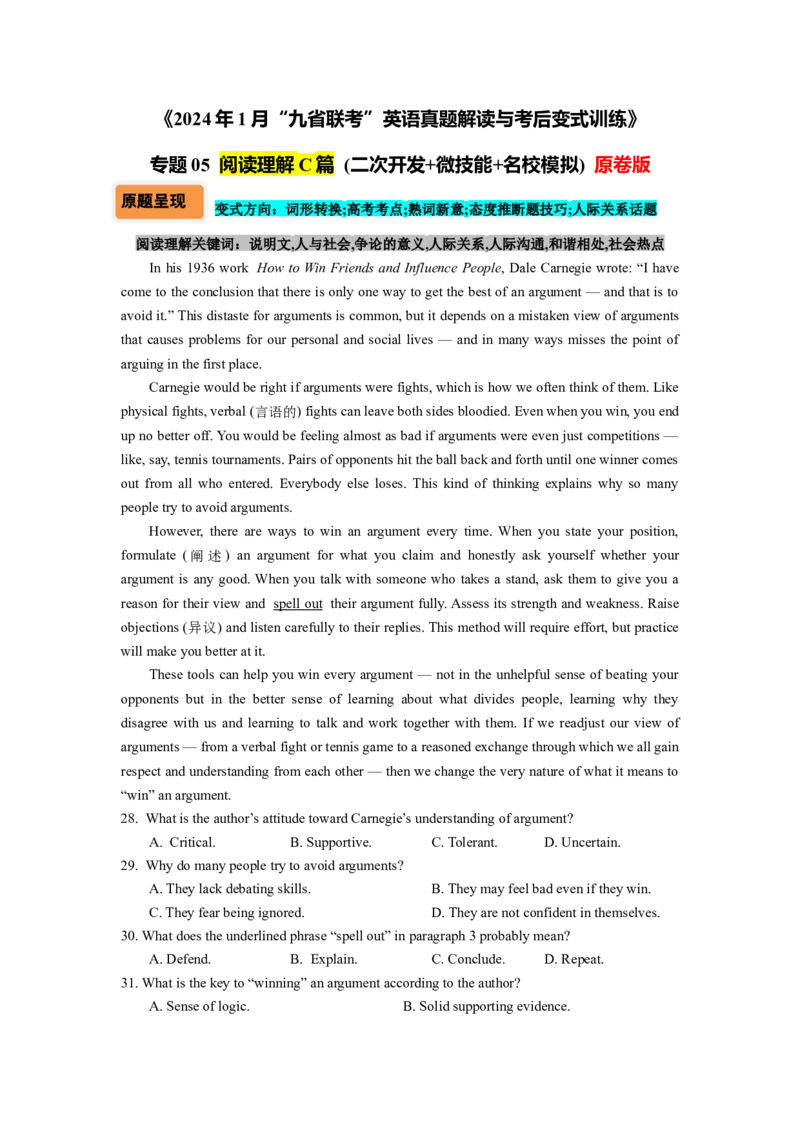
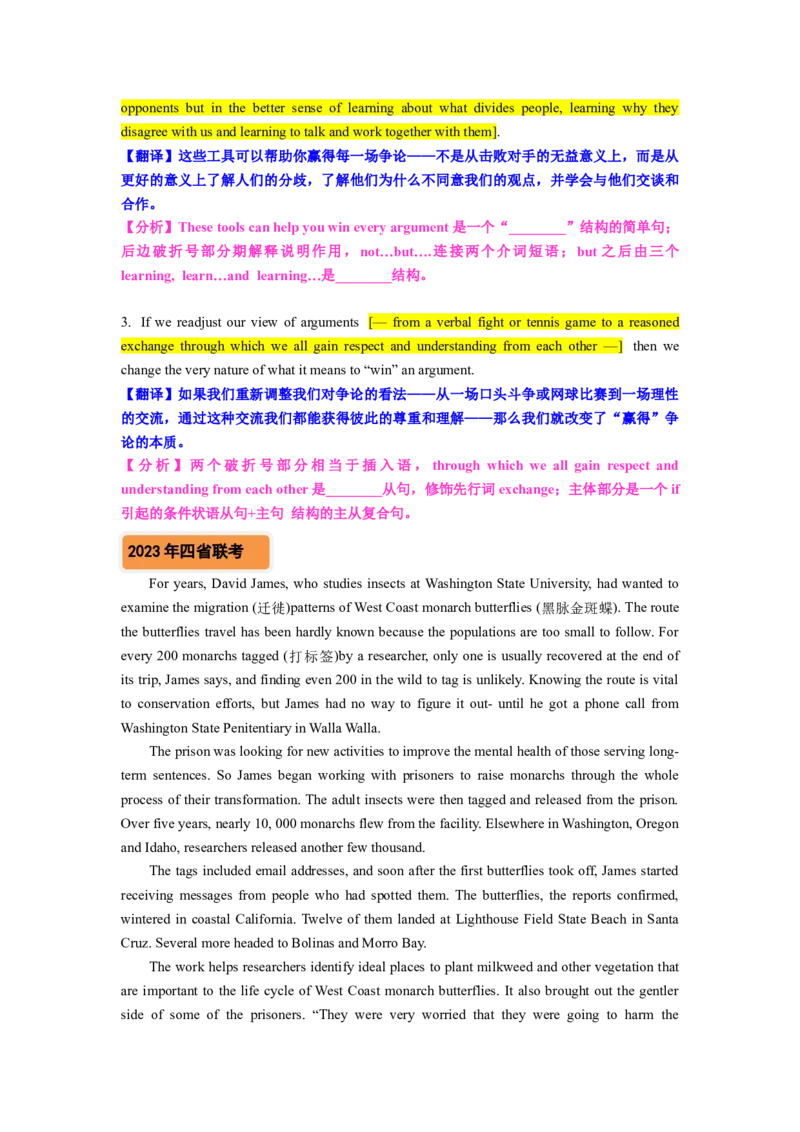
In his 1936 work How to Win Friends and Influence People, Dale Carnegie wrote: “I have
come to the conclusion that there is only one way to get the best of an argument — and that is to
avoid it.” This distaste for arguments is common, but it depends on a mistaken view of arguments
that causes problems for our personal and social lives — and in many ways misses the point of
arguing in the first place.
Carnegie would be right if arguments were fights, which is how we often think of them. Like
physical fights, verbal (言语的) fights can leave both sides bloodied. Even when you win, you end
up no better off. You would be feeling almost as bad if arguments were even just competitions —
like, say, tennis tournaments. Pairs of opponents hit the ball back and forth until one winner comes
out from all who entered. Everybody else loses. This kind of thinking explains why so many
people try to avoid arguments.
However, there are ways to win an argument every time. When you state your position,
formulate (阐述) an argument for what you claim and honestly ask yourself whether your
argument is any good. When you talk with someone who takes a stand, ask them to give you a
reason for their view and spell out their argument fully. Assess its strength and weakness. Raise
objections (异议) and listen carefully to their replies. This method will require effort, but practice
will make you better at it.
These tools can help you win every argument — not in the unhelpful sense of beating your
opponents but in the better sense of learning about what divides people, learning why they
disagree with us and learning to talk and work together with them. If we readjust our view of
arguments — from a verbal fight or tennis game to a reasoned exchange through which we all gain
respect and understanding from each other — then we change the very nature of what it means to
“win” an argument.
28. What is the author’s attitude toward Carnegie’s understanding of argument?
A. Critical. B. Supportive. C. Tolerant. D. Uncertain.
29. Why do many people try to avoid arguments?
A. They lack debating skills. B. They may feel bad even if they win.
C. They fear being ignored. D. They are not confident in themselves.
30. What does the underlined phrase “spell out” in paragraph 3 probably mean?
A. Defend. B. Explain. C. Conclude. D. Repeat.
31. What is the key to “winning” an argument according to the author?
A. Sense of logic. B. Solid supporting evidence.C. Proper manners. D. Understanding from both sides.
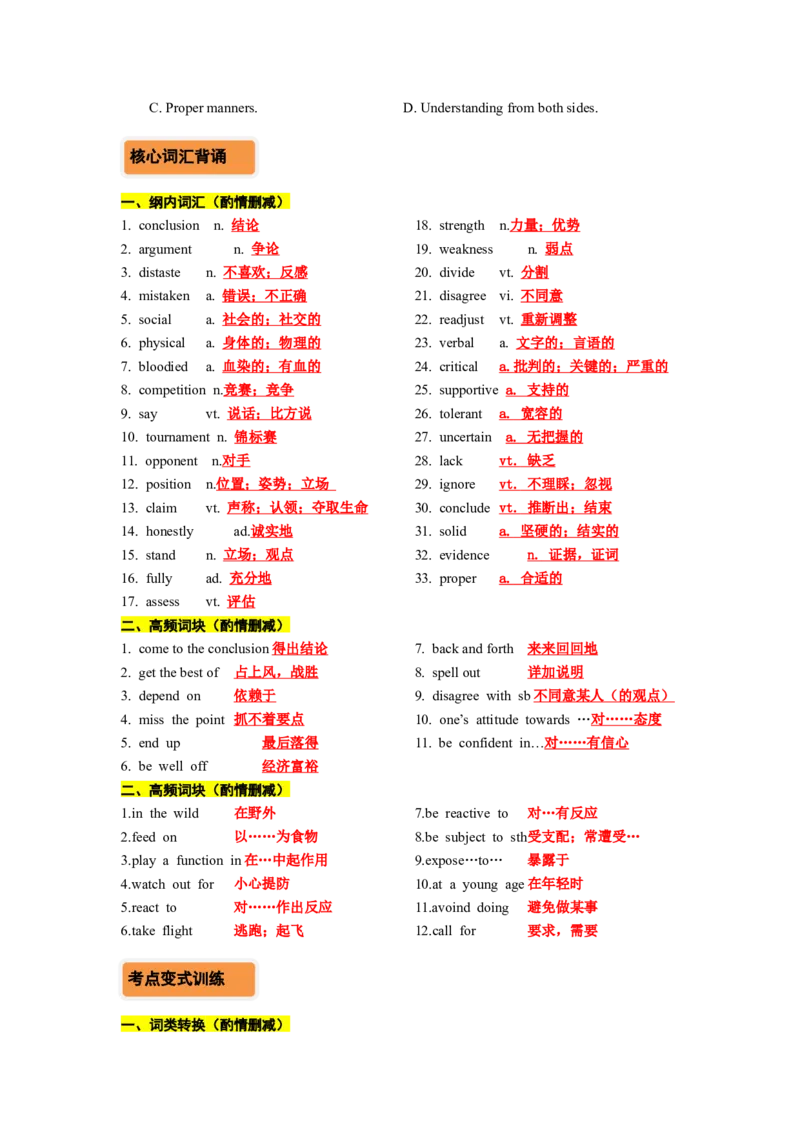
核心词汇背诵
一、纲内词汇(酌情删减)
1. conclusion n. 结论 18. strength n.力量;优势
2. argument n. 争论 19. weakness n. 弱点
3. distaste n. 不喜欢;反感 20. divide vt. 分割
4. mistaken a. 错误;不正确 21. disagree vi. 不同意
5. social a. 社会的;社交的 22. readjust vt. 重新调整
6. physical a. 身体的;物理的 23. verbal a. 文字的;言语的
7. bloodied a. 血染的;有血的 24. critical a . 批判的;关键的;严重的
8. competition n.竞赛;竞争 25. supportive a . 支持的
9. say vt. 说话;比方说 26. tolerant a . 宽容的
10. tournament n. 锦标赛 27. uncertain a . 无把握的
11. opponent n.对手 28. lack vt . 缺乏
12. position n.位置;姿势;立场 29. ignore vt . 不理睬;忽视
13. claim vt. 声称;认领;夺取生命 30. conclude vt . 推断出;结束
14. honestly ad.诚实地 31. solid a . 坚硬的;结实的
15. stand n. 立场;观点 32. evidence n . 证据,证词
16. fully ad. 充分地 33. proper a . 合适的
17. assess vt. 评估
二、高频词块(酌情删减)
1. come to the conclusion得出结论 7. back and forth 来来回回地
2. get the best of 占上风,战胜 8. spell out 详加说明
3. depend on 依赖于 9. disagree with sb不同意某人(的观点)
4. miss the point 抓不着要点 10. one’s attitude towards …对……态度
5. end up 最后落得 11. be confident in…对……有信心
6. be well off 经济富裕
二、高频词块(酌情删减)
1.in the wild 在野外 7.be reactive to 对…有反应
2.feed on 以……为食物 8.be subject to sth受支配;常遭受…
3.play a function in在…中起作用 9.expose…to… 暴露于
4.watch out for 小心提防 10.at a young age在年轻时
5.react to 对……作出反应 11.avoind doing 避免做某事
6.take flight 逃跑;起飞 12.call for 要求,需要
考点变式训练
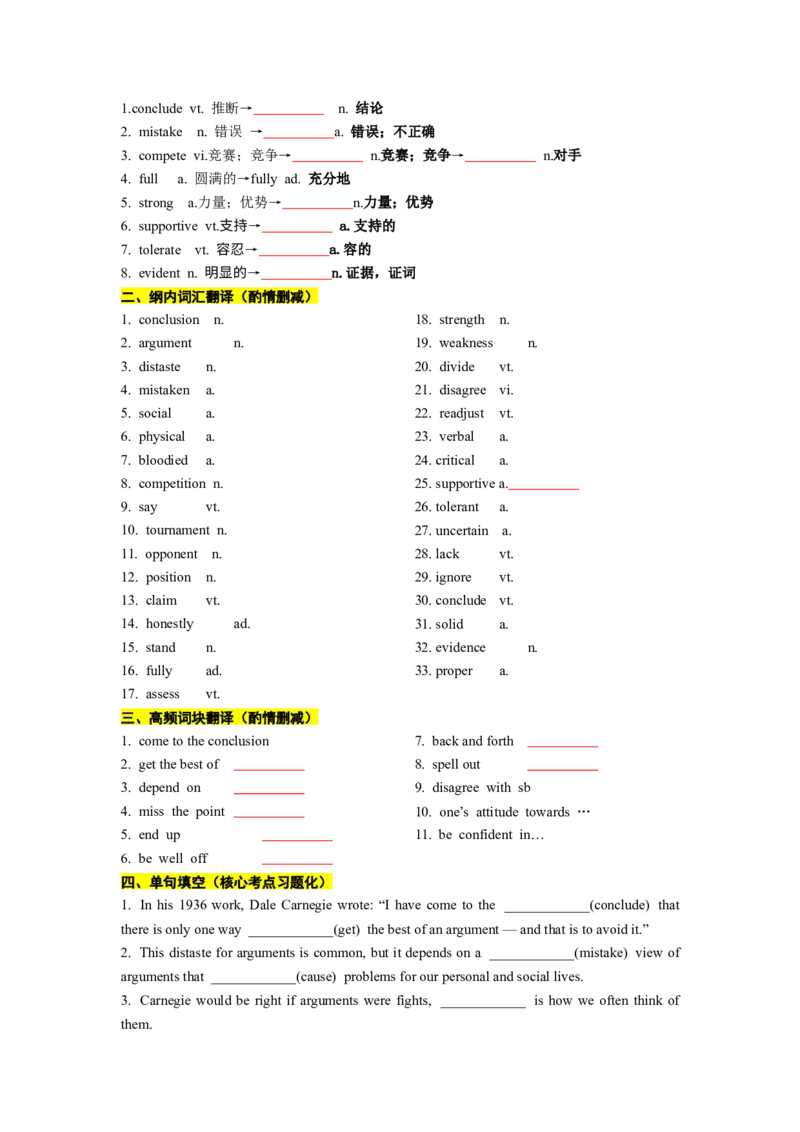
一、词类转换(酌情删减)1.conclude vt. 推断→ n. 结论
2. mistake n. 错误 → a. 错误;不正确
3. compete vi.竞赛;竞争→ n.竞赛;竞争→ n.对手
4. full a. 圆满的→fully ad. 充分地
5. strong a.力量;优势→ n.力量;优势
6. supportive vt.支持→ a.支持的
7. tolerate vt. 容忍→ a.容的
8. evident n. 明显的→ n.证据,证词
二、纲内词汇翻译(酌情删减)
1. conclusion n. 18. strength n.
2. argument n. 19. weakness n.
3. distaste n. 20. divide vt.
4. mistaken a. 21. disagree vi.
5. social a. 22. readjust vt.
6. physical a. 23. verbal a.
7. bloodied a. 24. critical a.
8. competition n. 25. supportive a.
9. say vt. 26. tolerant a.
10. tournament n. 27. uncertain a.
11. opponent n. 28. lack vt.
12. position n. 29. ignore vt.
13. claim vt. 30. conclude vt.
14. honestly ad. 31. solid a.
15. stand n. 32. evidence n.
16. fully ad. 33. proper a.
17. assess vt.
三、高频词块翻译(酌情删减)
1. come to the conclusion 7. back and forth
2. get the best of 8. spell out
3. depend on 9. disagree with sb
4. miss the point 10. one’s attitude towards …
5. end up 11. be confident in…
6. be well off
四、单句填空(核心考点习题化)
1. In his 1936 work, Dale Carnegie wrote: “I have come to the ____________(conclude) that
there is only one way ____________(get) the best of an argument — and that is to avoid it.”
2. This distaste for arguments is common, but it depends on a ____________(mistake) view of
arguments that ____________(cause) problems for our personal and social lives.
3. Carnegie would be right if arguments were fights, ____________ is how we often think of
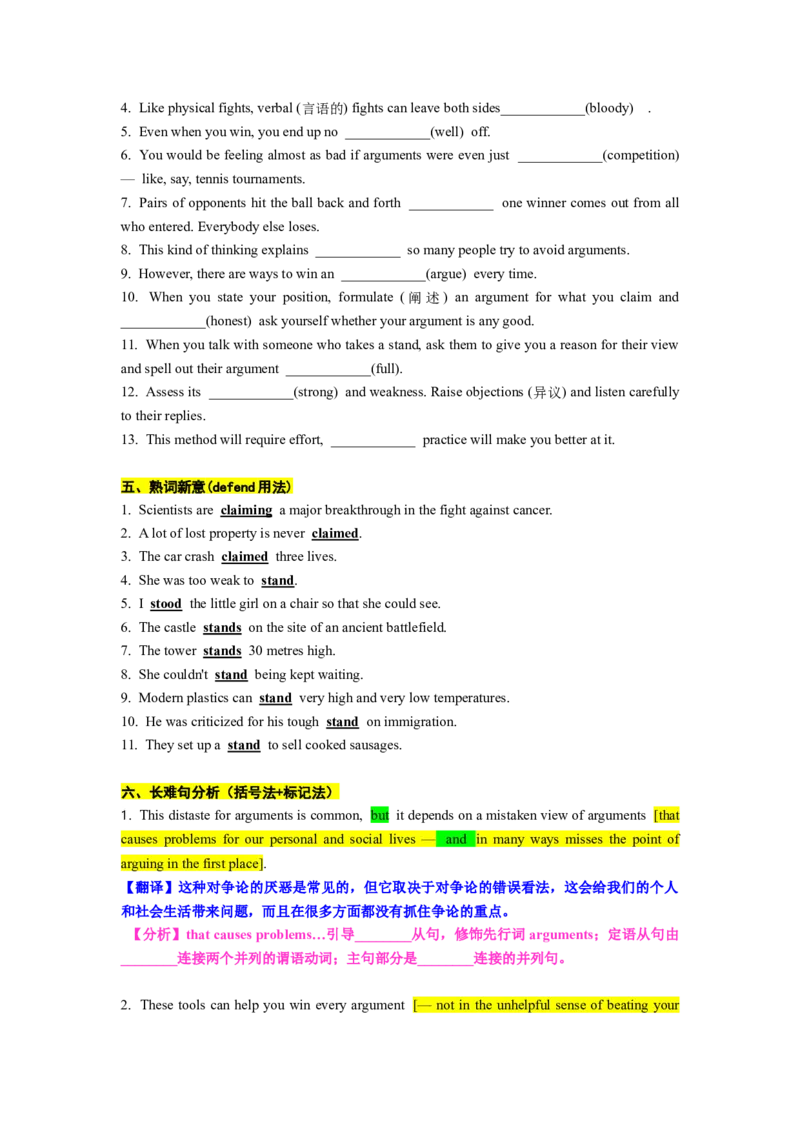
them.4. Like physical fights, verbal (言语的) fights can leave both sides____________(bloody) .
5. Even when you win, you end up no ____________(well) off.
6. You would be feeling almost as bad if arguments were even just ____________(competition)
— like, say, tennis tournaments.
7. Pairs of opponents hit the ball back and forth ____________ one winner comes out from all
who entered. Everybody else loses.
8. This kind of thinking explains ____________ so many people try to avoid arguments.
9. However, there are ways to win an ____________(argue) every time.
10. When you state your position, formulate (阐述) an argument for what you claim and
____________(honest) ask yourself whether your argument is any good.
11. When you talk with someone who takes a stand, ask them to give you a reason for their view
and spell out their argument ____________(full).
12. Assess its ____________(strong) and weakness. Raise objections (异议) and listen carefully
to their replies.
13. This method will require effort, ____________ practice will make you better at it.
五、熟词新意(defend用法)
1. Scientists are claiming a major breakthrough in the fight against cancer.
2. A lot of lost property is never claimed.
3. The car crash claimed three lives.
4. She was too weak to stand.
5. I stood the little girl on a chair so that she could see.
6. The castle stands on the site of an ancient battlefield.
7. The tower stands 30 metres high.
8. She couldn't stand being kept waiting.
9. Modern plastics can stand very high and very low temperatures.
10. He was criticized for his tough stand on immigration.
11. They set up a stand to sell cooked sausages.
六、长难句分析(括号法+标记法)
1. This distaste for arguments is common, but it depends on a mistaken view of arguments [that
causes problems for our personal and social lives — and in many ways misses the point of
arguing in the first place].
【翻译】这种对争论的厌恶是常见的,但它取决于对争论的错误看法,这会给我们的个人
和社会生活带来问题,而且在很多方面都没有抓住争论的重点。
【分析】that causes problems…引导________从句,修饰先行词arguments;定语从句由
________连接两个并列的谓语动词;主句部分是________连接的并列句。
2. These tools can help you win every argument [— not in the unhelpful sense of beating youropponents but in the better sense of learning about what divides people, learning why they
disagree with us and learning to talk and work together with them].
【翻译】这些工具可以帮助你赢得每一场争论——不是从击败对手的无益意义上,而是从
更好的意义上了解人们的分歧,了解他们为什么不同意我们的观点,并学会与他们交谈和
合作。
【分析】These tools can help you win every argument是一个“________”结构的简单句;
后边破折号部分期解释说明作用,not…but….连接两个介词短语;but 之后由三个
learning, learn…and learning…是________结构。
3. If we readjust our view of arguments [— from a verbal fight or tennis game to a reasoned
exchange through which we all gain respect and understanding from each other —] then we
change the very nature of what it means to “win” an argument.
【翻译】如果我们重新调整我们对争论的看法——从一场口头斗争或网球比赛到一场理性
的交流,通过这种交流我们都能获得彼此的尊重和理解——那么我们就改变了“赢得”争
论的本质。
【分析】两个破折号部分相当于插入语,through which we all gain respect and
understanding from each other是________从句,修饰先行词exchange;主体部分是一个if
引起的条件状语从句+主句 结构的主从复合句。
2023年四省联考
For years, David James, who studies insects at Washington State University, had wanted to
examine the migration (迁徙)patterns of West Coast monarch butterflies (黑脉金斑蝶). The route
the butterflies travel has been hardly known because the populations are too small to follow. For
every 200 monarchs tagged (打标签)by a researcher, only one is usually recovered at the end of
its trip, James says, and finding even 200 in the wild to tag is unlikely. Knowing the route is vital
to conservation efforts, but James had no way to figure it out- until he got a phone call from
Washington State Penitentiary in Walla Walla.
The prison was looking for new activities to improve the mental health of those serving long-
term sentences. So James began working with prisoners to raise monarchs through the whole
process of their transformation. The adult insects were then tagged and released from the prison.
Over five years, nearly 10, 000 monarchs flew from the facility. Elsewhere in Washington, Oregon
and Idaho, researchers released another few thousand.
The tags included email addresses, and soon after the first butterflies took off, James started
receiving messages from people who had spotted them. The butterflies, the reports confirmed,
wintered in coastal California. Twelve of them landed at Lighthouse Field State Beach in Santa
Cruz. Several more headed to Bolinas and Morro Bay.
The work helps researchers identify ideal places to plant milkweed and other vegetation that
are important to the life cycle of West Coast monarch butterflies. It also brought out the gentler
side of some of the prisoners. “They were very worried that they were going to harm thebutterflies, ”James says. Watching the monarch change their form also touched the men. “This
butterfly changed, ” James recalls prisoners telling him, “and maybe we can too. ”
28. What was hard for David to do in his study?
A. Gain financial support. B. Hire qualified workers.
C. Build a new laboratory. D. Find enough monarchs.
29. Why are the butterflies tagged before being released?
A. To guarantee their safety.
B. To enable them to fly longer distances.
C. To track their travel routes.
D. To distinguish them from other species.
30. What makes the prisoners feel that they can change?
A. The patience the butterflies showed.
B. The hardship the butterflies underwent.
C. The transformation of the butterflies.
D. The devotion of James to the butterflies.
31. What is the last paragraph mainly about?
A. The impact of the research.
B. The findings of James’ study.
C. The release of the prisoners.
D. The life cycle of the butterflies.
解题指导
态度观点态度类试题解题指导
态度观点态度类试题的解题方法:
第一:结合题干人物和内容定位原文出现在哪一(些)段;然后仔细比对该句言外之意;
第二:加入自己的态度。要注意区分试题考查的是作者的态度还是作者引用别人的态度;
第三:态度没有明确提出时,要学会根据作者在文章中所运用词汇的褒贬性去判断作者的
态度,尤其是动词、形容词和副词,如wonderfully, successfully, unfortunately, doubtfully 等。
乐观支持类词汇:optimistic 乐观的;positive 肯定的;favorable 支持的,赞同的;
supportive支持的;approving赞成的
客观中立类词汇:objective客观的;neutral中立的;cautious谨慎的
消极反对类词汇:negative否定的;opposite相反的;unfair公正的;doubtful怀疑的;
indifferent漠不关心的;critical批评的;ironic讽刺的;skeptical质疑的;disappointed失望
的;disapproving不赞同的;pessimistic悲观的;dismissive轻蔑的,不屑一顾的
考例1(2023年全国甲卷C篇)
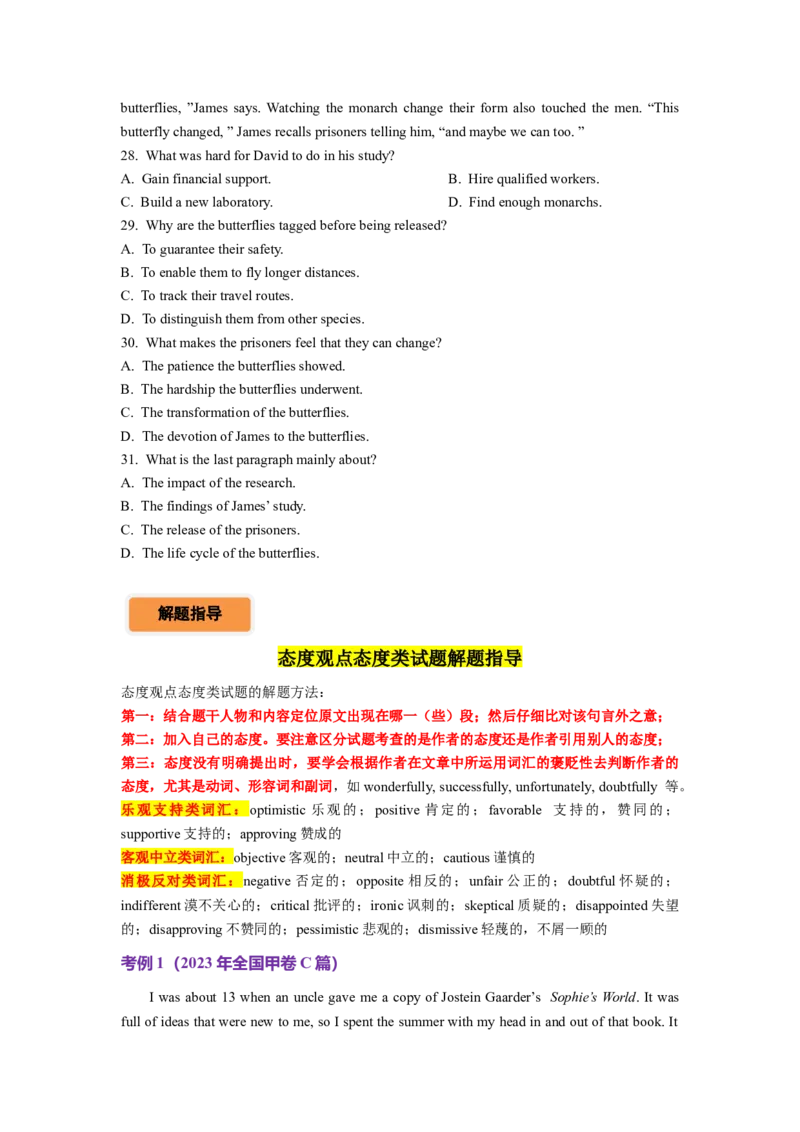
I was about 13 when an uncle gave me a copy of Jostein Gaarder’s Sophie’s World. It was
full of ideas that were new to me, so I spent the summer with my head in and out of that book. Itspoke to me and brought me into a world of philosophy (哲学).
That love for philosophy lasted until I got to college. Nothing kills the love for philosophy
faster than people who think they understand Foucault, Baudrillard, or Confucius better than you
— and then try to explain them.
Eric Weiner’s The Socrates Express: In Search of Life Lessons from Dead Philosophers
reawakened my love for philosophy. It is not an explanation, but an invitation to think and
experience philosophy.
Weiner starts each chapter with a scene on a train ride between cities and then frames each
philosopher’s work in the context (背景) of one thing they can help us do better. The end result is
a read in which we learn to wonder like Socrates, see like Thoreau, listen like Schopenhauer, and
have no regrets like Nietzsche. This, more than a book about understanding philosophy, is a book
about learning to use philosophy to improve a life.
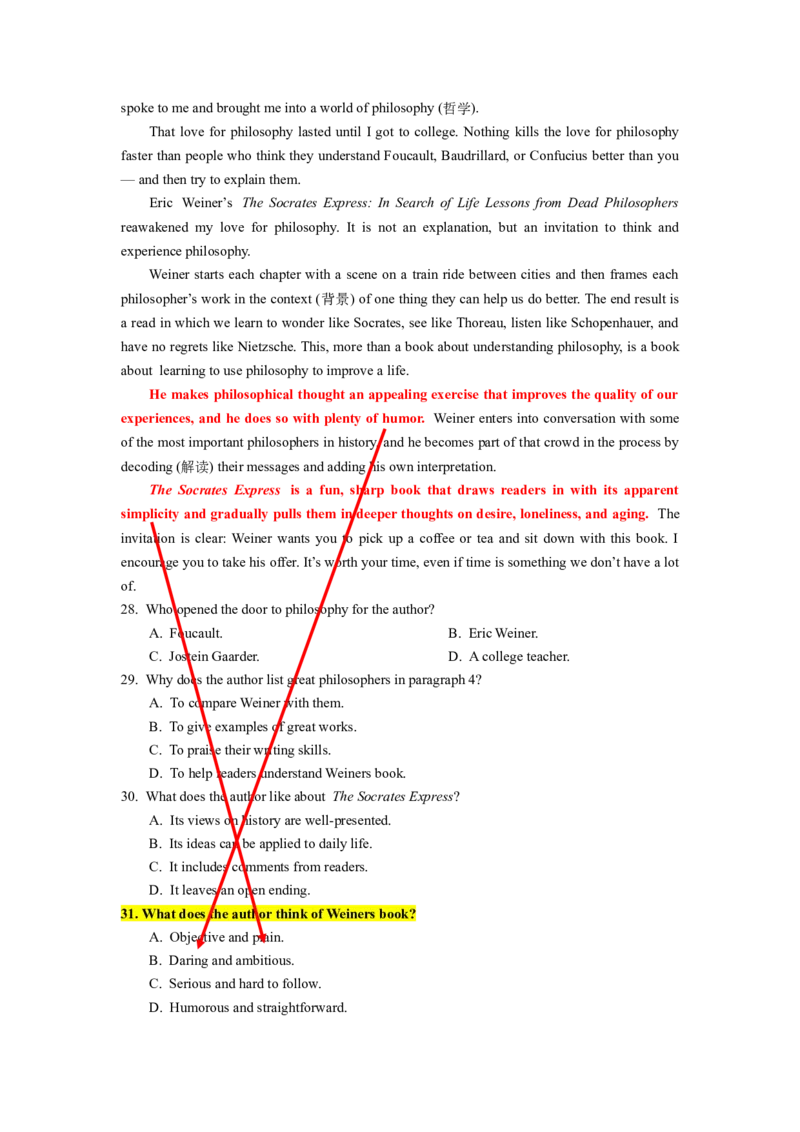
He makes philosophical thought an appealing exercise that improves the quality of our
experiences, and he does so with plenty of humor. Weiner enters into conversation with some
of the most important philosophers in history, and he becomes part of that crowd in the process by
decoding (解读) their messages and adding his own interpretation.
The Socrates Express is a fun, sharp book that draws readers in with its apparent
simplicity and gradually pulls them in deeper thoughts on desire, loneliness, and aging. The
invitation is clear: Weiner wants you to pick up a coffee or tea and sit down with this book. I
encourage you to take his offer. It’s worth your time, even if time is something we don’t have a lot
of.
28. Who opened the door to philosophy for the author?
A. Foucault. B. Eric Weiner.
C. Jostein Gaarder. D. A college teacher.
29. Why does the author list great philosophers in paragraph 4?
A. To compare Weiner with them.
B. To give examples of great works.
C. To praise their writing skills.
D. To help readers understand Weiners book.
30. What does the author like about The Socrates Express?
A. Its views on history are well-presented.
B. Its ideas can be applied to daily life.
C. It includes comments from readers.
D. It leaves an open ending.
31. What does the author think of Weiners book?
A. Objective and plain.
B. Daring and ambitious.
C. Serious and hard to follow.
D. Humorous and straightforward.考例2 (2021年新高考I卷D篇)
Popularization has in some cases changed the original meaning of emotional (情感的)
intelligence. Many people now misunderstand emotional intelligence as almost everything
desirable in a person’s makeup that cannot be measured by an IQ test, such as character,
motivation, confidence, mental stability, optimism and “people skills.” Research has shown that
emotional skills may contribute to some of these qualities, but most of them move far beyond
skill-based emotional intelligence.
We prefer to describe emotional intelligence as a specific set of skills that can be used for
either good or bad purposes. The ability to accurately understand how others are feeling may be
used by a doctor to find how best to help her patients, while a cheater might use it to control
potential victims. Being emotionally intelligent does not necessarily make one a moral person.
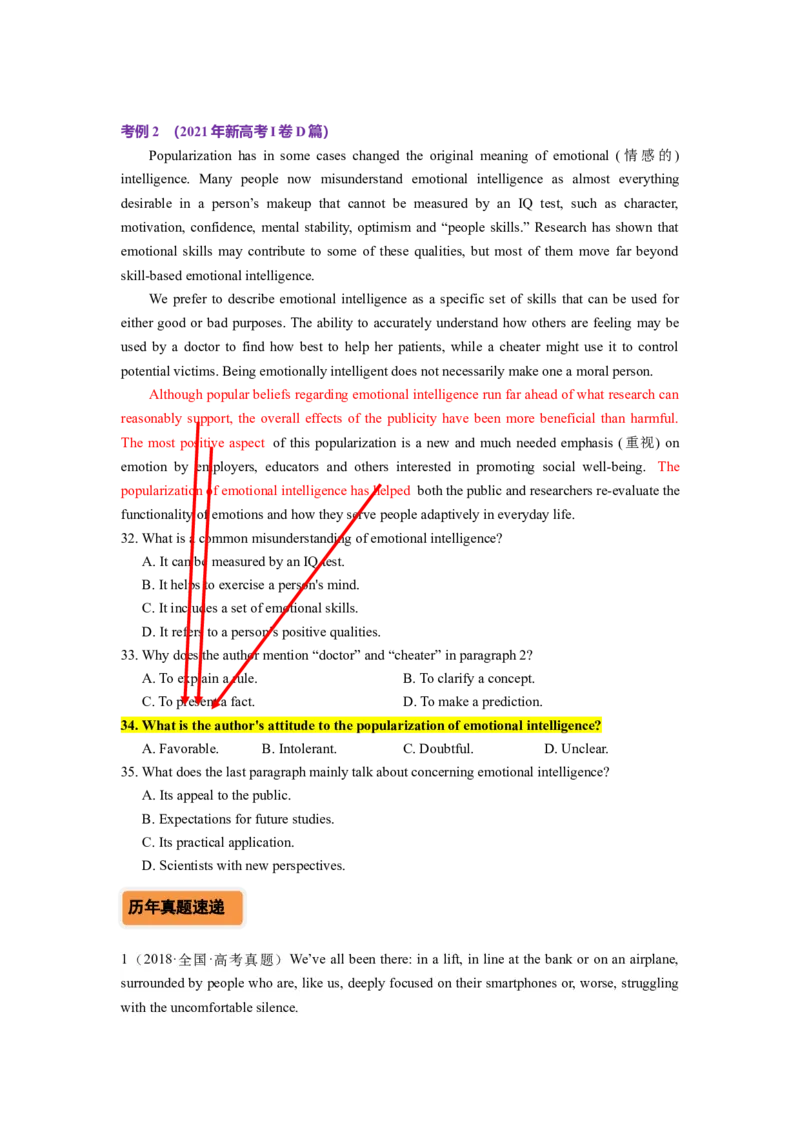
Although popular beliefs regarding emotional intelligence run far ahead of what research can
reasonably support, the overall effects of the publicity have been more beneficial than harmful.
The most positive aspect of this popularization is a new and much needed emphasis (重视) on
emotion by employers, educators and others interested in promoting social well-being. The
popularization of emotional intelligence has helped both the public and researchers re-evaluate the
functionality of emotions and how they serve people adaptively in everyday life.
32. What is a common misunderstanding of emotional intelligence?
A. It can be measured by an IQ test.
B. It helps to exercise a person's mind.
C. It includes a set of emotional skills.
D. It refers to a person’s positive qualities.
33. Why does the author mention “doctor” and “cheater” in paragraph 2?
A. To explain a rule. B. To clarify a concept.
C. To present a fact. D. To make a prediction.
34. What is the author's attitude to the popularization of emotional intelligence?
A. Favorable. B. Intolerant. C. Doubtful. D. Unclear.
35. What does the last paragraph mainly talk about concerning emotional intelligence?
A. Its appeal to the public.
B. Expectations for future studies.
C. Its practical application.
D. Scientists with new perspectives.
历年真题速递
1(2018·全国·高考真题)We’ve all been there: in a lift, in line at the bank or on an airplane,
surrounded by people who are, like us, deeply focused on their smartphones or, worse, struggling
with the uncomfortable silence.What’s the problem? It’s possible that we all have compromised conversational intelligence.
It’s more likely that none of us start a conversation because it’s awkward and challenging, or we
think it’s annoying and unnecessary. But the next time you find yourself among strangers, consider
that small talk is worth the trouble. Experts say it’s an invaluable social practice that results in big
benefits.
Dismissing small talk as unimportant is easy, but we can’t forget that deep relationships
wouldn’t even exist if it weren’t for casual conversation. Small talk is the grease(润滑剂) for
social communication, says Bernardo Carducci, director of the Shyness Research Institute at
Indiana University Southeast. "Almost every great love story and each big business deal begins
with small talk," he explains. "The key to successful small talk is learning how to connect
with others, not just communicate with them."
In a 2014 study, Elizabeth Dunn, associate professor of psychology at UBC, invited people
on their way into a coffee shop. One group was asked to seek out an interaction(互动) with its
waiter; the other, to speak only when necessary. The results showed that those who chatted with
their server reported significantly higher positive feelings and a better coffee shop experience. "
It’s not that talking to the waiter is better than talking to your husband," says Dunn. "But
interactions with peripheral(边缘的) members of our social network matter for our well-being
also."
Dunn believes that people who reach out to strangers feel a significantly greater sense of
belonging, a bond with others. Carducci believes developing such a sense of belonging starts with
small talk. "Small talk is the basis of good manners," he says.
1.What phenomenon is described in the first paragraph?
A.Addiction to smartphones.
B.Inappropriate behaviours in public places.
C.Absence of communication between strangers.
D.Impatience with slow service.
2.What is important for successful small talk according to Carducci?
A.Showing good manners. B.Relating to other people.
C.Focusing on a topic. D.Making business deals.
3.What does the coffee-shop study suggest about small talk?
A.It improves family relationships. B.It raises people’s confidence.
C.It matters as much as a formal talk. D.It makes people feel good.
4.What is the best title for the text?
A.Conversation Counts B.Ways of Making Small Talk
C.Benefits of Small Talk D.Uncomfortable Silence
2(2024·浙江·统考高考真题)The Stanford marshmallow (棉花糖) test was originally
conducted by psychologist Walter Mischel in the late 1960s. Children aged four to six at a nursery
school were placed in a room. A single sugary treat, selected by the child, was placed on a table.Each child was told if they waited for 15 minutes before eating the treat, they would be given a
second treat. Then they were left alone in the room. Follow-up studies with the children later in
life showed a connect ion between an ability to wait long enough to obtain a second treat and
various forms of success.
As adults we face a version of the marshmallow test every day. We’ re not tempted (诱惑) by
sugary treats, but by our computers, phones, and tablets — all the devices that connect us to the
global delivery system for various types of information that do to us what marshmallows do to
preschoolers.
We are tempted by sugary treats because our ancestors lived in a calorie-poor world, and our
brains developed a response mechanism to these treats that reflected their value — a feeling of
reward and satisfaction. But as we’ve reshaped the world around us, dramatically reducing the
cost and effort involved in obtaining calories, we still have the same brains we had thousands of
years ago, and this mismatch is at the heart of why so many of us struggle to resist tempting foods
that we know we shouldn’t eat.
A similar process is at work in our response to information. Our formative environment as a
species was information-poor, so our brains developed a mechanism that prized new information.
But global connectivity has greatly changed our information environment. We are now ceaselessly
bombarded (轰炸) with new information. Therefore, just as we need to be more thoughtful about
our caloric consumption, we also need to be more thoughtful about our information consumption,
resisting the temptation of the mental “junk food” in order to manage our time most effectively.
5.What did the children need to do to get a second treat in Mischel’s test?
A.Take an examination alone.
B.Show respect for the researchers.
C.Share their treats with others.
D.Delay eating for fifteen minutes.
6.According to paragraph 3, there is a mismatch between ___________.
A.the calorie-poor world and our good appetites
B.the shortage of sugar and our nutritional needs
C.the rich food supply and our unchanged brains
D.the tempting foods and our efforts to keep fit
7.What does the author suggest readers do?
A.Absorb new information readily.
B.Be selective information consumers.
C.Use diverse information sources.
D.Protect the information environment.
8.Which of the following is the best title for the text?
A.Eat Less, Read More
B.The Bitter Truth about Early Humans
C.The Later, the BetterD.The Marshmallow Test for Grownups
3(2023·全国·统考高考真题)On March 7, 1907, the English statistician Francis Galton
published a paper which illustrated what has come to be known as the “wisdom of crowds” effect.
The experiment of estimation he conducted showed that in some cases, the average of a large
number of independent estimates could be quite accurate.
This effect capitalizes on the fact that when people make errors, those errors aren’t always the
same. Some people will tend to overestimate, and some to underestimate. When enough of these
errors are averaged together, they cancel each other out, resulting in a more accurate estimate. If
people are similar and tend to make the same errors, then their errors won’t cancel each other out.
In more technical terms, the wisdom of crowds requires that people’s estimates be independent. If
for whatever reasons, people’s errors become correlated or dependent, the accuracy of the estimate
will go down.
But a new study led by Joaquin Navajas offered an interesting twist (转折) on this classic
phenomenon. The key finding of the study was that when crowds were further divided into smaller
groups that were allowed to have a discussion, the averages from these groups were more accurate
than those from an equal number of independent individuals. For instance, the average obtained
from the estimates of four discussion groups of five was significantly more accurate than the
average obtained from 20 independent individuals.
In a follow-up study with 100 university students, the researchers tried to get a better sense of
what the group members actually did in their discussion. Did they tend to go with those most
confident about their estimates? Did they follow those least willing to change their minds? This
happened some of the time, but it wasn’t the dominant response. Most frequently, the groups
reported that they “shared arguments and reasoned together”. Somehow, these arguments and
reasoning resulted in a global reduction in error. Although the studies led by Navajas have
limitations and many questions remain, the potential implications for group discussion and
decision-making are enormous.
9.What is paragraph 2 of the text mainly about?
A.The methods of estimation. B.The underlying logic of the effect.
C.The causes of people’s errors. D.The design of Galton’s experiment.
10.Navajas’ study found that the average accuracy could increase even if ________.
A.the crowds were relatively small B.there were occasional underestimates
C.individuals did not communicate D.estimates were not fully independent
11.What did the follow-up study focus on?
A.The size of the groups. B.The dominant members.
C.The discussion process. D.The individual estimates.
12.What is the author’s attitude toward Navajas’ studies?
A.Unclear. B.Dismissive. C.Doubtful. D.Approving.
名校好题速递4(2023·云南昆明·昆明一中校考一模)Recently I’ve been drawn to books which motivate me
to look at myself, and hopefully make me a better “me”. The Courageto Be Disliked, by Ichiro
Kishimi and Fumitake Koya, has a title I just can’t go past.
The book has taken Japan by storm, using the theories of philosopher Alfred Adler to create
conversations between a fictional philosopher and a young man. The conversations cover many
broad, interesting and touchy topics. The philosopher character sticks by the theories of Adler, and
explains how we are competent to determine our own lives, and be free of the influence of past
experiences and others’ expectations. It’s a way of thinking that allows us to develop the courage
to change and to ignore the limitations placed on us.
These often complex topics are played out in a conversational style between the two men.
While it’s easy to follow the conversations, the topics will knock around in your own head as you
work out whether you sit on the side of the philosopher, the young man, or somewhere in between.
The book is well-received by readers primarily owing to the fact that it presents two well-balanced
perspectives in the arguments. You’ll find yourself doing household chores, or at your keyboard,
unpacking all the information in your mind and coming to your own conclusions.
You will wholeheartedly agree on some points and want to throw the book at the wall at
others. Its content is polarising (两极化的) and I certainly don’t agree with everything the
philosopher or the young man says, but I think that’s the point. The Courage to Be Disliked is
there to spark a conversation with yourself and do some slightly uncomfortable soul-searching.
13.Which category does the book belong to?
A.Classic literature. B.Science fiction.
C.Philosophy theory. D.Self improvement.
14.Which statement might the philosopher character agree with?
A.People can take charge of their life course.
B.People are free of the influence of their past.
C.People should hide their eagerness to change.
D.People ought to take their limitations seriously.
15.How does the book develop?
A.By presenting dialogues. B.By making comparisons.
C.By arguing theoretically. D.By listing adequate data.
16.Why is the book popular with readers?
A.It shows ideas in plain language. B.It offers balanced sides to the topics.
C.It displays the scientific statistics. D.It avoids the use of philosophic terms.
5(2023·宁夏银川·银川一中校考模拟预测)If you are a perfectionist, you are probably
familiar with the feeling of wanting to get everything just right. You may struggle with handing in
papers, agonize over projects at work, and even worry about small errors from the past. Highstandards are one thing, but perfectionism is quite another. And as some researchers have
discovered, pursuing perfection can have serious consequences to both mental and physical well-
being.
According to researchers, perfectionists hold themselves to unrealistically high standards and
become selfcritical if they believe they haven’t met these standards. Perfectionists are also likely
to feel guilt and shame if they experience failures, which often leads them to avoid situations
where they are worried they might fail.
In one study, researchers looked at a total of 284 studies (with over 57,000 participants) and
found that perfectionism was associated with symptoms of depression, anxiety, obsessive-
compulsive disorder, and eating disorders. They also found that people higher in perfectionism
(i.e. participants who more strongly identified with perfectionist traits) also reported higher levels
of overall psychological distress.
In an article published in 2016, researchers looked at how perfectionism and depression were
related over time. They found that people higher in perfectionism tended to have increases in
depression symptoms, which suggests that perfectionism may be a risk factor for developing
depression. In other words, although people may think of their perfectionism as something that
helps them succeed, it appears that their perfectionism may actually be harmful for their mental
health.
Since perfectionism is associated with negative outcomes, what can someone with
perfectionist tendencies do to change their behavior? Although people are sometimes hesitant to
give up their perfectionist tendencies, psychologists point out that giving up on perfection doesn’t
mean being less successful. In fact, because mistakes are an important part of learning and
growing, embracing imperfection can actually help us in the long run.
17.Why does the author describe the scene in the first paragraph?
A.To introduce the topic. B.To make comparisons.
C.To support the author’s argument. D.To define a concept.
18.Who can be defined as a perfectionist?
A.A person who is determined to achieve high goals.
B.A person who tends to feel sorry for what he has done.
C.A person who blames himself for not being that successful.
D.A person who holds high standards for themselves.
19.How can perfectionism be harmful?
A.It may lower one’s mental health.
B.It reflects one’s psychological level.
C.It results in depression immediately.
D.It stops one from recovering from depression.
20.What will be discussed in the following paragraph?
A.A call for not being a perfectionist.
B.Another sideeffect of perfectionism.C.Why perfectionism is harmful.
D.How to avoid perfectionism.
6(2023·重庆·模拟预测)Arguments is on the menu tonight at the café La Chope. This evening,
as on every Thursday night, psychologist Maud Lehanne is leading two of France’s favorite
pastimes, coffee drinking and the “talking cure”. Here they are learning to get in touch with their
true feelings. It isn’t always easy. They customers — some thirty Parisians who pay just under $2
(plus drinks) per session — are quick to intellectualize (高谈阔论), slow to open up and connect.
“You are forbidden to say ‘one feels’ or ‘people think’,” Lehane told them. “Say ‘I think’ ‘Think
me’.”
A café society where no intellectualizing is allowed? It couldn’t seem more un-French. But
Lehanne’s psychology café is about more than knowing oneself: It’s trying to help the city’s
troubled neighborhood cafes. Over the years, Parisian cafés have fallen victim to changes in the
French lifestyle — longer working hours, a fast-food boom and a younger generation’s desire to
spend more time at home. Dozens of new theme cafés appear to change the situation. Cafes
focused around psychology, history, and engineering are catching on, filling tables well into the
evening.
The city’s psychology cafés, which offer great comfort, are among the most popular places.
Middle-aged homemakers, retirees, and the unemployed come to such cafes to talk about lover,
anger, and dreams with a psychologist. And they come to Lehance’s group just to learn to say what
they feel. There’s a strong need in Paris for communication, says Maurice Frisch, a café La Chope
regular who works as religious instructor in a nearby church. “People have few real friends. And
they need to open up.” Lehanne says she’d like to see psychology cafés all over France. “If people
had normal lives, these cafés wouldn’t exist,” she says. “If life weren’t a battle, people wouln’t
need a special place just to speak.” But then, it wouldn’t be France.
21.What are people encouraged to do at the caféLa Chope?
A.Learn a new course. B.Contact friends.
C.Show off their knowledge. D.Convey their true feelings.
22.How are cafés affected by French lifestyle changes?
A.They are less visited. B.They stay open for longer hours.
C.They have more people at night. D.They begin to offer fast food.
23.What are theme cafés expected to do?
A.Create more jobs. B.Provide better drinks.
C.Save the cafe business. D.Serve the community.
24.Why are psychology cafés accepted by so many people?
A.They bring people true friendship. B.They give people spiritual support.
C.They help people achieve their dreams. D.They connect all kinds of businesses.
7(2023·安徽蚌埠·统考模拟预测)Have you ever wondered what animals are talking about?With the development of AI, we may be able to understand their languages!
In Professor Karen Bakker’s new book, The Sounds of Life: Hone Digital Technology Is
Bringing Us Closer to the Worlds of Animals and Plants, she talks about how AI is helping us to
make an animal version of Google Translate.
All around the animal kingdom, there are sounds that we can hardly pick up and understand.
Elephants for example talk with each other using infrasound (次声波) —far below our human
hearing range. Coral (珊瑚) in the ocean also sends sound waves to attract baby coral to safer
areas to grow. This is surprising as coral doesn’t have any ears! Scientists have placed listening
equipment into these environments to pick up the sounds humans cannot hear.
After the sounds are recorded, AI can study their meaning, according to the news website
Vox. For example, Israeli researchers used AI to translate bats’15,000 calls. They found that more
than 60 percent were arguments about four things: food, sleep positions, occupation of personal
space, and unwanted advances.
This technology can not only understand the animals but communicate back to them. For
example, bees use dances to communicate. A research team in Germany, therefore, put the bee
language AI system into a robot bee. They asked the robot to create a dance route to tell the bees
where the nectar (花蜜) was, Vox reported.
25.What is Karen Bakker’s new book mainly about?
A.How AI helps translate animals’ sounds.
B.Why AI can help people research animals.
C.How AI helps people do translations better.
D.Why animals need help from human beings.
26.What do we know about the sounds made by animals?
A.No sounds by animals can be heard by humans.
B.The sounds guarantee animals safer areas to live.
C.Corals have ears to send and receive sound waves.
D.Elephants’ sound waves are beyond human hearing.
27.What is paragraph 4 mainly about?
A.The arguments of bats.
B.The recording of animal sounds.
C.The contents of the news website.
D.The findings of AI translation.
28.How could scientists tell bees where the nectar was?
A.By learning the bee language.
B.By creating a route with AI system.
C.By employing a robot bee as their guide.
D.By asking a robot bee to teach them dance.
8(2023·安徽·校联考三模)Modern life is full of things that can influence your ability to besensitive and responsive to your child. These include extra work, lack of sleep, and things like
mobile devices. Some experts are concerned about the effects that these things trigger off on
emotional bonding and children’s language development, social interaction, and safety.
If parents are inconsistently available, kids can get distressed(苦恼的)and feel hurt, rejected,
or ignored. They may have more emotional outbursts and feel alone. They may even stop trying to
compete for their parent’s attention and start to lose emotional connections to their parents.
“There are times when kids really do need your attention and want your recognition. Parents
need to communicate that their kids are valuable and important, and children need to know that
parents care what they’re doing,” explains Crnic, a psychologist. “Kids start to regulate their own
emotions and behavior around age three. Up until then, they depend more on you to help them
regulate their emotions, whether to calm them or help get them excited,” he adds.
Dr. Carol Metzler, who studies parenting at the Oregon Research Institute, explains, “They’re
watching you to see how you do it and listening to how you talk to them about it. Parents need to
be good self-regulators. You’re not only trying to regulate your own emotions in the moment, but
helping your child learn to manage their emotions and behavior. It can be tough to respond to your
kids with sensitivity during tantrums(精神痛苦), arguments, or other challenging times. If parents
respond by being bad-tempered or aggressive(攻击性的)themselves, children can copy that
behavior, and a negative cycle then continues to upgrade.”
As kids become better at managing their feelings and behavior, it’s important to help them
develop coping skills, like active problem solving. Such skills can help them feel confident in
handling what comes their way.
29.Which of the following can replace the underlined words “trigger off”?
A.Set off. B.Burst into.
C.Consist of. D.Dive for.
30.Why does Metzler think it tough to respond to kids sensitively in Paragraph 4?
A.Because kids are unable to make out their parents’ arguments.
B.Because parents are too sensitive to train kids to be aggressive.
C.Because kids can not copy their parents’ behavior on these occasions.
D.Because parents have to control their feelings and teach it to their kids.
31.What’s the text mainly about?
A.Parents should not be bad-tempered in front of their kids.
B.Parents should consistently develop their problem solving skills.
C.Parents should engage with kids and respond to them positively.
D.Parents should continuously upgrade their language and emotions.
32.What will the writer probably talk about next?
A.The way to train kids to be confident.
B.The way to train kids’ abilities to deal with matters.
C.The way to train kids to self-regulate their emotions.
D.The way to train kids’ abilities to be sensitive and responsibe.9(2023·全国·模拟预测)There has been a bitter argument within the Australian community
over a horse racing event advertised on the Sydney Opera House. While some believe the Opera
House is Australia’s “biggest billboard (大幅广告牌)” and should be used for economic gain,
others are shocked that the government has allowed the national landmark to be polluted with
branding.
As a UNESCO World Heritage Site, the Sydney Opera House is an important Australian
building recognized all over the world and one of the country’s most frequently visited tourist
attractions. In the past, the Opera House has been used to promote a handful of charities, cultural
festivals, etc. However, these have aimed to highlight events that bring advantage to ordinary
people, not a single profiting brand.
Some have argued that promoting brands on the sails of the Opera House is just like
advertising on any other billboard or marketing space with the power to significantly encourage
tourism and growth. While this may be true, if advertising continues to happen, the Opera House
could risk losing its reputation, which could devalue the landmark and actually damage its tourism
appeal.
Although landmarks around the world such as the Eiffel Tower and Moscow’s Red Square
have been used for advertising, they also caused some arguments among the public. For instance,
a major fashion brand placed a giant branded suitcase in the center of Moscow’s Red Square;
however, it was removed shortly afterwards as tourists complained it was so big that it blocked
views of major landmark sites. The advertisement caused arguments among the public and finally
failed to leave a positive impact.
So what will advertising on the Opera House look like to international tourists? Will they be
amazed and drawn to a wonderful country, or will they see advertising as something reducing the
cultural value of a national symbol? We think it’s clear that our national treasures deserve the
respect and admiration that come with them, and advertising should be limited to important
causes, not campaigns for commercial gain.
33.What caused the heated debate among Australians?
A.The biggest billboard at the Opera House.
B.The Opera House’s being used for advertising.
C.The horse racing event held at the Opera House.
D.The famous national landmark’s being polluted.
34.What can be learned about the previous activities at the Opera House?
A.They were in the public interest.
B.They caught international attention.
C.They were designed to attract tourists.
D.They brought great economic benefits.
35.Why does the author mention the example of Moscow’s Red Square?
A.To present how companies benefit from attractions.B.To stress the various types of promotions in attractions.
C.To explain why tourists dislike billboards on landmarks.
D.To show the negative effects of advertising on landmarks.
36.What is the author’s attitude toward the commercial act mentioned at the beginning?
A.Favourable. B.Doubtful. C.Intolerant. D.Objective.
10(2023·四川·校联考模拟预测)The cloning technology has aroused heated discussions
among people. Some of them speak highly of the technology by claiming that it offers a way for
human beings to conquer their own genetic defects. Others consider it an ogre (食人恶魔) who
will destroy us all in the end.
FOR
Cloning is important for women who are single to have a child, using cloning instead of
artificial insemination (授精). Cloning could also provide a copy of a child for a couple whose
◆
child died.
Another goal of cloning is to produce livestock ( 家畜 ) with ideal characters for
agriculture and industry and to be able to manufacture biological products such as proteins for
◆
humans.
Cloning could be used in various ways to benefit the lives of humans.
It may provide a way for completely sterile individuals to reproduce! It may provide a way
◆
for homosexual couples to reproduce themselves, and it will probably provide a valuable basic
◆
research and possibly spin off technologies related to reproduction and development.
Cloning would also mean that organs could be cloned, so it would be a source of perfect
organs for transplant. This surely would be immensely beneficial to millions of unfortunate people
◆
who are expected to lose their lives due to failure of a single organ or more organs.
AGAINST
Cloning would intervene in the normal cycle of life. There would be a large number of
identical (相同的) genes, which minimizes (使减少到最低限度) the chances of mutation (变异),
◆
and, in turn, evolution—the fundamental reason why living things naturally adapt to the ever-
changing environment.
With genetic engineering and human cloning it is possible to use these in the arsenal (兵
工厂) of ethnic cleansing (清洗) creating inequality in our society, which would be the beginning
◆
of many wars.
Another argument against cloning is that it would be available only to the wealthy and
therefore would increase social inequality.
◆
If the technology were to be so, scientists could transfer human genes into animals’ and
vice versa, which would heighten the danger of developing zoonoses, diseases that are transmitted
◆
from animals to humans. It could create a worldwide catastrophe that no one would be able to
stop.
Genetic engineering will cause unseen disasters spiraling our world into chaotic darkness.
Cloning dead loved ones will not bring them back; they may look like them, but they will
◆
◆have a different personality.
37.If a single lady wants a baby but she does not accept artificial insemination, she might
________.
A.think about cloning technology to copy one
B.be against having a child from cloning technology
C.produce livestock with ideal characters
D.speak little of the cloning technology
38.The purpose of the writer writing the passage is to ________.
A.encourage us to support the ideas of FOR
B.advise us to accept the ideas of AGAINST
C.tell us to understand the ideas of FOR and AGAINST correctly
D.introduce us to remember the ideas of FOR and AGAINST
39.What’s the author’s attitude towards cloning?
A.Favorable. B.Objective. C.Critical. D.Doubtful.
40.What would be the best title for the passage?
A.How many advantages are there? B.How many disadvantages are there?
C.Which side is wrong? D.Which side are you with?