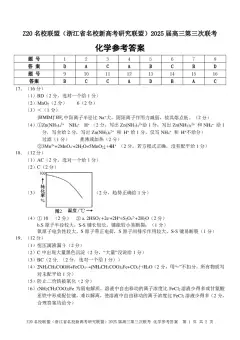
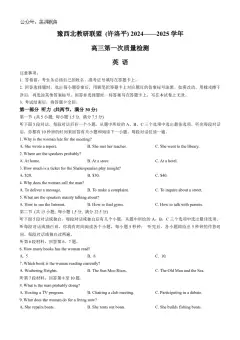
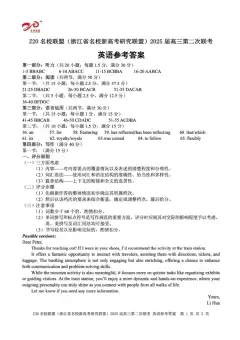
2 2026 届浙江省Z20
名校联盟高三上学期
第一次联考英语试题
(题型二次开发)
The Future of Clean Energy in Homes
Heating, cooling, and powering homes contribute significantly to global CO₂ emissions. As nations strive
to reduce their carbon footprints, residential energy use — responsible for nearly 20% of energy-related
emissions — poses unique challenges. Below is the 2022 breakdown of household emissions by source.
ELECTRICITY  52%
HEATING  28%
COOLING  12%
APPLIANCES  6%
LIGHTING  2%
Clean energy solutions for homes must be affordable, efficient, and adaptable to diverse climates. While
technologies vary, here are key innovations driving the shift toward sustainability.
HEAT PUMPS — Efficient Heating/Cooling
Replacing gas boilers, electric heat pumps transfer warmth from air or ground, cutting heating emissions
by 50%. Hybrid models, hopefully, might be able to work in sub-zero temperatures in the near future.
SMART GRIDS (电网) — Dynamic Electricity Management
AI-powered grids optimize energy use, storing surplus solar power during peak hours and reducing
reliance on fossil-fuel backups.
SOLAR PANELS — Rooftop Revolution
Solar energy is the most accessible renewable source for households. Advances in photovoltaic cells have
cut costs by 80% since 2010, making them viable in numerous regions.
WIND TURBINES — Community Microgrids
Small-scale turbines (涡轮机) in windy areas can power neighborhoods, though land use debates persist.
“The scale of this transition is staggering,” says Dr. Elena Torres, a climate scientist at MIT. Residential
renewables like solar and heat pumps could meet 90% of global household demand by 2050 — but only if
investments triple within this decade. Recent studies show that every $1 invested in green homes today saves
$5 in future climate adaptation costs. This isn’t just an environmental imperative; it’s economically
inevitable.
1. What is the combined percentage of household emissions from Cooling and Appliances?
A. 12%
B. 18%
C. 28%
D. 40%
2. According to the text, what is a key function of AI-powered smart grids?
A. To replace gas boilers in homes.
B. To store extra solar energy and reduce fossil fuel use.
C. To cut the cost of solar panels by 80%.
D. To enable heat pumps to work in sub-zero temperatures.
3. What is the author’s main message in the passage?
A. Household energy use is the largest source of global CO₂ emissions.
B. Current clean energy technologies are not yet affordable.
C. Transitioning to residential clean energy is both necessary and economically beneficial.
D. Wind turbines are the most promising solution for home energy needs.
When Clara took over her grandfather’s Brooklyn bookshop in 2018, the first thing she removed wasn’t
the outdated stocks, but the WiFi router. Regulars protested. A lawyer threatened to transfer his $500 monthly
coffee budget elsewhere. “Books deserve the same undivided attention we demand from lovers,” she told me,
polishing the brass counter her grandfather installed in 1967.
Her stubbornness seemed self-destructive as stores around them closed down. Yet something unusual
happened. By 2020, the shop had become an unofficial sanctuary (庇护所). Teenagers sprawled on Persian
carpets with Dostoevsky, their phones forgotten in backpacks. A retired judge started hosting Saturday poetry
circles where participants recited verses from memory — a practice Clara called “brain tattooing.”
The pandemic should have been their death knell. Instead, when Clara launched “Survival Bundles”
(handpicked books with handwritten notes), orders poured in from tech executives exhausted by Zoom. A
Silicon Valley CEO admitted these were the first physical books he’d touched since graduate school. “We’re
starving for texture,” Clara noted, wrapping parcels in recycled paper.
Last winter, I found her battling a new threat. A property developer had purchased their building, tripling
the rent overnight. What unfolded next could fill a novel: customers organized protests on the sidewalk; the
judge represented them for free; even the lawyer who once threatened to leave funded their legal defense.
In the court, Clara quoted Melville: “We cannot live only for ourselves. A thousand fibers connect us.”
The judge — her poetry circle regular — pronounced the rent increase unreasonable. Now their shop displays
this judgment alongside signed first editions, proof that some bonds still resist digital disruption.
1. What did Clara do immediately after taking over the bookshop that surprised some customers?
A. She replaced the old books with new ones.
B. She introduced poetry circles.
C. She renovated the brass counter.
D. She removed the WiFi router.
2. How did the bookshop respond to the challenge during the pandemic?
A. It launched “Survival Bundles” with personalized touches.
B. It started selling coffee to attract more customers.
C. It expanded the store to allow more people to enter.
D. It began offering free books to tech executives.
3. What is the main idea of paragraph 4?
A. The financial struggles of a small business.
B. The community’s united effort to save the bookshop.
C. The lawyer’s change of heart toward the bookshop.
D. The impact of property development in Brooklyn.
4. Which of the following best summarizes the theme of the text?
A. Digital technology is essential for modern bookstores to survive.
B. Traditional bookstores have no place in today’s world.
C. Human connection and resilience can overcome modern challenges.
D. Profit is the most important goal for any business.
Britain’s housing crisis has created a distinct generational divide. While older generations often own
property, millions of young adults face increasing rents and unachievable homeownership. A recent official
report warns that 630, 000 people under 35 may face homelessness in old age due to chronic shortages of
affordable homes.
This crisis originates from decades of policy failure. Since the mid-1990s, house prices have skyrocketed
dramatically, widening the gap between property owners and others. Government projects like “Help-to-Buy”
intended to assist first-time buyers instead inflated prices further, making housing less accessible. University
graduates carry heavy debts from tuition fees exceeding £9, 000 annually since 2010, weakening their savings
potential.
The rental market offers little relief. Private renters have jumped from 2. 8 million to 4. 5 million
households since 2007, with those aged 25-34 consisting of over a third. Yet renters face instability and
exploitation. “No-fault drivings” allow landlords (房东) to end rentings without cause, while rents exceed
wage growth. Even social housing renters experience widening inequality compared to homeowners.
Policy responses are emerging but controversial. London Mayor Sadiq Khan proposed a landlord registry
and rent control commission to regulate the private sector. Scotland has established “rent pressure zones” to
stop increases. The Labour Party advocates abolishing no-fault drivings, arguing that secure right of habitation
are essential for dignity.
Ultimately, this is about intergenerational fairness. A functional society cannot thrive when younger
citizens bear unreasonable burdens. As one analyst notes: “We depend on the young to sustain our future —
denying them housing security damages everyone.”
1. What was one unintended consequence of the "Help-to-Buy" government project mentioned in the
text?
A. It helped graduates pay off their student debts.
B. It made housing even less affordable.
C. It stabilized the rental market for young adults.
D. It reduced the number of private renters.
2. According to the text, what is a specific challenge faced by private renters in Britain?
A. They are predominantly elderly citizens.
B. Their wages are capped by rent control policies.
C. They are unable to access social housing.
D. They face potential eviction without cause.
3. What is the primary focus of paragraph 4?
A. The proposed or implemented policy measures.
B. The historical causes of the housing crisis.
C. The demographic changes in the rental market.
D. The financial struggles of university graduates.
4. Which statement best captures the author's overall perspective on the housing crisis?
A. It is a temporary issue that will resolve naturally.
B. It is primarily the responsibility of young adults to solve.
C. Young adults' housing security should be guaranteed.
D. It is an inevitable outcome of economic progress.
AI Radiology: Faster, Smarter, and More Accurate
Hospital waiting time for scan results could soon be reduced from days to minutes. A 2025 Stanford study
reveals that DeepMedScan, an AI system analyzing CT/MRI images, detects tumors 30% faster than human
radiologists (放射科医生) while matching top experts’ 98% accuracy. The system is now used in 40+ EU
hospitals, reducing diagnosis delays by up to 80%.
The breakthrough lies in 3D neural mapping. Unlike traditional AI recognizing 2D patterns,
DeepMedScan constructs dynamic 3D models of organs: It cross-references scans with global databases —
processing 200,000+ historical cases in 0.2 seconds. “It’s like giving each radiologist a super-powered second
brain,” explains lead researcher Dr. Aris Thorne.
Critical advantages include identifying micro-lesions under 2 mm — often missed by human eyes — and
predicting disease progression. In German trials, the AI detected early-stage pancreatic cancer in 83% of high-
risk patients a year before symptoms emerged, enabling life-saving interventions.
Challenges persist, however, Legal frameworks struggle with responsibility for AI misdiagnosis
(occurring in 0.7% of cases vs. human 1.2%). Inaccuracy risks also exist; early versions performed poorly on
pediatric (小儿科的) scans due to limited child data. Regulatory authorities now enforce “human-AI co-
diagnosis” — requiring doctor confirmation for critical cases.
Future upgrades focus on accessibility. Lightweight versions for rural clinics are being tested in India,
using smartphone-compatible calculation procedure. As WHO advisor Dr. Priya Sharma notes, “Making this
tech widely accessible could prevent 500,000+ annual late-stage cancer deaths globally by 2030.”
1. What does the term "3D neural mapping" refer to in the context of this passage?
A. A traditional 2D pattern recognition system
B. A technology that creates dynamic three-dimensional organ models
C. A global database of historical medical cases
D. A smartphone-compatible calculation procedure
2. What can be inferred about AI radiology systems from the pediatric scan example?
A. They work perfectly on all patient age groups
B. Their performance depends on the quality and quantity of training data
C. They are particularly skilled at children's medical imaging
D. They have replaced the need for pediatric radiologists
3. What is the main idea of paragraph 4?
A. The challenges and regulatory solutions for AI implementation in medicine
B. The complete superiority of AI over human diagnosis
C. The technical specifications of the DeepMedScan system
D. The global adoption rates of AI radiology technology
3. Which statement best summarizes the author's overall message about AI radiology?
A. It represents a perfect solution that will immediately replace all human doctors
B. It offers significant advantages but requires careful implementation and human oversight
C. It is too dangerous to use in medical settings due to high error rates
D. It only benefits developed countries with advanced medical infrastructure
     Once a year, Bannister climbs to High Rock Lookout where she scattered her mother’s ashes 23 years
ago.       1      Last August, Bannister, then 79, went on her own, figuring she’d be fine because she’s an
experienced hiker.
She arrived at the trail early and made her way to the lookout.       2      As she headed back down, her foot
got caught in a hole in the ground. She fell forward and heard a sharp crack. When sitting up, she knew
immediately she had broken her leg. She cried out for help, and before long, a stranger approached and called
911. They were told a search and rescue team would arrive in five hours.
“It wasn’t very encouraging,” Bannister says. “I asked if anyone had painkillers, because the pain was
pretty substantial then.”       3       But two young men, Troy May, an Air Force airman and his friend Layton
Allen, came over to see what was going on. When seeing Bannister in extreme pain, they offered to carry her
to the bottom of the trail.
May eased Bannister onto his back and started hiking downward.       4       During the long hike down,
her rescuers shared stories to distract her from the mounting pain. Once reaching the parking lot, they rushed
Bannister to the nearest hospital.
The kindness of these strangers created a lasting bond.      5
A. Unfortunately, no one carried any medical supplies.
B. This annual journey helps her feel connected to her mother.
C. The descent was challenging with the added weight on rough terrain.
D. Surprisingly, several other hikers stopped to offer assistance as well.
E. She typically prefers hiking alone to reflect quietly on memories.
F. However, the response from emergency services was slower than expected.
G. They have maintained contact and formed an unexpected friendship since.
Karen, 16, was a college freshman at a local university. She was thrilled to earn a
  1
   in the renowned
choir for their international tour. However,

 2

   overcame her when she overslept before a key
performance at a distant church. Missing the bus, she

 3

   helplessly in her dorm hallway. She had no
car nor friends nearby to help. Ironically, her neighbor Pam emerged, the

 4

   person Karen expected to
see.
Their relationship had been

 5

  . Karen's group frequently disturbed the floor with late-night
noise,

 6

  Pam's requests for quiet. They

 7

   temporarily just long enough to catch their breath —
before the disruptions came crashing back in. Now facing

 8

   of her own mistake, Karen awkwardly
confessed her dilemma to Pam.
To her astonishment, Pam offered a ride immediately, which stunned Karen — Why did she extend
kindness to someone who had shown

 9

  ? They raced to Pam's car and arrived just as the choir entered
the church — a miraculous

 10


  .
Decades later, Karen still         1

 1

   that gesture. It was never

 12


  a ride, but a profound lesson in
grace. Pam's complaints gave way to forgiveness,

 13


   Karen redemption she hadn't earned. If she could
speak to Pam today, Karen would offer an apology for her youthful selfishness, and

 14


   for that
transformative compassion. Its ripple effects

 15


   her next thirty years, proving that true mercy bridges
divides and heals hearts.
1. A. position
B. spot
C. role
D. place
2. A. delight
B. panic
C. relief
D. confidence
3. A. paced
B. marched
C. danced
D. jumped
4. A. first
B. last
C. best
D. worst
5. A. tense
B. friendly
C. distant
D. special
6. A. ignoring
B. considering
C. accepting
D. discussing
7. A. paused
B. waited
C. stopped
D. rested
8. A. processes
B. reasons
C. results
D. conclusions
9. A. respect
B. kindness
C. consideration
D. rudeness
10. A. escape
B. help
C. save
D. success
11. A. values
 B. remembers
C. questions
D. regrets
12. A. just
B. ever
C. always
D. quite
13. A. giving
B. offering
C. sending
D. teaching
14. A. sympathy
B. anger
C. apology
D. gratitude
15. A. changed
B. shaped
C. limited
D. destroyed
41. A. spot
B. chance
C. bonus
D. prize
42. A. calmness
B. panic
C. thrill
D. relief
43. A. paced
B. stormed
C. bounced
D. tripped
44. A. best
B. worst
C. first
D. last
45. A. tense
B. close
C. familiar
D. distant
46. A. disapproving
B. doubting
C. supporting
D. dismissing
47. A. stayed
B. waited
C. paused
D. hesitated
48. A. processes
B. conclusions
C. causes
D. consequences
49. A. some
B. none
C. any
D. much
50. A. save
B. contribution
C. performance
D. movement
51. A. calls on
B. reflects on
C. holds back
D. looks back
52. A. totally
B. rarely
C. merely
D. fairly
53. A. gifting
B. rewarding
C. supplying
D. sparing
54. A. complaint
B. gratitude
C. welcome
D. regret
55. A. restricted
B. formed
C. constructed
D. shaped
答案与解析
阅读A 篇
【答案】 1. B 2. B 3. C
1. 解析:本题为细节理解题。解题关键在于定位家庭排放来源的数据部分。文中明确列出:
Cooling(制冷)占12%,Appliances(家用电器)占6%。两者相加为18%。因此B 选项正确。
2. 解析:本题为细节理解题。解题需定位至“Smart Grids”部分。原文说明:“AI-powered
grids optimize energy use, storing surplus solar power during peak hours and reducing reliance on
fossil-fuel backups.”(人工智能电网优化能源使用,在高峰时段储存多余的太阳能,并减少对化石
燃料备用能源的依赖)。因此,智能电网的关键功能是储存多余太阳能并降低对化石燃料的依赖,
B 选项正确。A 选项是热泵的作用,C 选项是太阳能电池板的进展,D 选项是热泵的未来发展,均与
智能电网无关。
3. 解析:本题为主旨大意题。需要综合全文理解作者的核心观点。文章开头指出家庭能源使用
排放占比较大,继而介绍多种清洁能源技术,并引用专家观点强调投资家庭可再生能源的经济和环
境必要性,如“every $1 invested in green homes today saves $5 in future climate adaptation costs.
This isn’t just an environmental imperative; it’s economically inevitable.”(如今在绿色家居上每
投资1 美元,未来就能节省5 美元的气候适应成本。这不仅是环境上的必然要求,也是经济上的必
然趋势。)因此,作者的主要意图是说明向家庭清洁能源转型既必要又经济有益,C 选项正确。A
选项夸大事实(家庭排放占比大但并非最大),B 选项与文意相反(文章强调技术已变得可行且成
本下降),D 选项过于片面(风能仅是解决方案之一)。
阅读B 篇
【答案】 1. D 2. A 3. B 4. C
1. 解析:本题为细节理解题。解题依据位于第一段首句:“ ...the first thing she removed
wasn’t the outdated stocks, but the WiFi router.”(她撤下的第一样东西不是过时的存货,而是无
线路由器)。因此D 选项正确。
2. 解析:本题为细节理解题。解题需定位至第三段。原文指出:“ when Clara launched
‘Survival Bundles’ (handpicked books with handwritten notes), orders poured in...”(当Clara 推
出“生存套装”——附手写笔记的精选书籍时,订单纷至沓来)。故A 选项正确。B、C、D 选项的
内容均未在文中体现。
3. 解析:本题为段落大意题。第四段描述了房东大幅提高租金后,顾客组织抗议、法官无偿代
理、甚至之前威胁离开的律师也出资支持等情节,表明社区团结一致帮助书店渡过难关。因此B 选
项(社区共同努力拯救书店)最符合该段主旨。
4. 解析:本题为主旨大意题。全文通过Clara 的书店经历强调:尽管面临数字化冲击、疫情和租
金危机,但通过人的联结(如社区支持、深度阅读体验和共同文化价值),传统书店仍能找到生存
之道。最后一句“proof that some bonds still resist digital disruption”(证明某些纽带仍然能抵抗数
字 disruption)进一步点明主题。C 选项准确概括了这一核心思想。A、B 选项与文中观点相反;D
选项并非文章主旨。
阅读C 篇
【答案】 1. B 2. D 3. A 4. C
1. 解析:本题为推理判断题。解题需定位至第二段。原文指出:"Government projects like
'Help-to-Buy' intended to assist first-time buyers instead inflated prices further, making housing less
accessible."(诸如"Help-to-Buy"之类的政府项目本意是帮助首次购房者,结果却进一步推高了房价,
使住房更难以获得)。由此可推断,该政策产生了意想不到的后果,即使住房更加难以负担(B 选
项)。A、C、D 选项均与文意不符或相反。
2. 解析:本题为推理判断题。解题需定位至第三段。原文明确说明:"'No-fault evictions' allow
landlords to end rentals without cause"("无过错驱逐"允许房东无缘无故地终止租赁)。因此,私人
租户面临的一个具体挑战就是可能被无故驱逐(D 选项)。A 选项(主要是老年人)和C 选项(无
法获得社会住房)在文中未直接说明;B 选项(工资被租金上限政策限制)与文中"rents exceed
wage growth"(租金涨幅超过工资增长)的表述不符。
3. 解析:本题为段落大意题。第四段首句"Policy responses are emerging but controversial"(政
策回应正在出现但有争议)点明了该段主题。后续内容具体列举了伦敦市长、苏格兰以及工党提出
的各项政策措施(如房东登记、租金控制、废除无过错驱逐等)。因此,本段主要关注点是提出或
已实施的政策措施(A 选项)。B 选项(历史原因)是第二段内容,C 选项(租赁市场的人口变
化)是第三段内容,D 选项(毕业生的财务困境)是第二段内容。
4. 解析:本题为主旨大意题。需要综合全文理解作者的观点。文章开篇揭示了住房危机造成的
代际不公,接着分析了其政策根源和市场表现,最后一段强调"this is about intergenerational
fairness"(这是关于代际公平的问题)并引用分析师的话指出剥夺年轻人住房安全会损害所有人。由
此可见,作者认为年轻人的住房安全应该得到保障(C 选项)。A 选项(临时问题)和D 选项(经
济进步的必然结果)与文章的严峻警告相悖;B 选项(年轻人的责任)与文章认为年轻人承受了不
合理负担的立场相反。
阅读D 篇
【答案】 1. B 2. C 3. A 4. D
1. 解析:本题为词义猜测题。解题需定位至第二段。原文说明:"The breakthrough lies in 3D
neural mapping. Unlike traditional AI recognizing 2D patterns, DeepMedScan constructs dynamic 3D
models of organs"(突破在于3D 神经映射。与识别2D 模式的传统AI 不同,DeepMedScan 构建动态
的3D 器官模型)。因此,"3D neural mapping"指的是创建动态三维器官模型的技术(B 选项)。A
选项与文意相反;C、D 选项是系统的其他功能,并非该术语的直接含义。
2. 解析:本题为推理判断题。解题需定位至第四段。原文指出:"early versions performed
poorly on pediatric scans due to limited child data"(早期版本由于儿童数据有限而在儿科扫描上表
现不佳)。由此可推断,AI 系统的表现依赖于训练数据的质量和数量(C 选项)。A 选项与文意相
反;B 选项未提及;D 选项与文中要求"human-AI co-diagnosis"(人类-AI 协同诊断)的要求不符。
3. 解析:本题为段落大意题。第四段首先提出AI 诊断面临的法律框架和责任归属挑战,以及特
定领域(如儿科)的准确性问题,最后介绍监管机构采取的"human-AI co-diagnosis"(人类-AI 协同
诊断)解决方案。因此,本段主要讨论AI 在医学中实施的挑战和监管解决方案(A 选项)。B 选项
与段落内容相反;C、D 选项不是本段重点。
4. 解析:本题为主旨大意题。需要综合全文理解作者的观点。文章既介绍了AI 在放射学中的显
著优势(速度快、精度高、微病变识别),也客观讨论了其面临的挑战(法律责任、特定人群准确
性),同时提到解决方案(人机协同诊断)和未来发展方向(轻量版用于农村地区)。因此,作者
的主要观点是AI 具有重要优势但需要谨慎实施和人类监督(D 选项)。A 选项中的"immediately
replace all human doctors"与文意不符;B 选项中的"too dangerous"与文中AI 错误率低于人类的描述
矛盾;C 选项中的"only benefits developed countries"与末段针对农村地区的开发计划相反。
阅读七选五
【答案】 1. E 2. F 3. A 4. D 5. G
1. 解析:本题为段首题。后文提到"went on her own"(独自前往),因此空白处应涉及独自徒
步的习惯或原因。E 选项"She typically prefers hiking alone to reflect quietly on memories"(她通
常喜欢独自徒步,安静地回忆)与下文逻辑衔接自然,解释了为何这次独自前往。
2. 解析:本题为段中题。下文提到"heard a sharp crack"(听到尖锐的断裂声)和呼叫帮助后得
知救援五小时后到达,因此空白处应铺垫意外发生或救援响应情况。F 选项"However, the response
from emergency services was slower than expected"(然而,应急服务的响应比预期慢)与后文救援
需要五小时的信息形成因果逻辑。
3. 解析:本题为段中题。前文提到她询问止痛药,后文转折说"But two young men... came
over",因此空白处应描述无人提供药品的困境。A 选项"Unfortunately, no one carried any medical
supplies"(不幸的是,没有人携带医疗用品)正好承接上文请求并引出后续帮助。
4. 解析:本题为段中题。前文描述背负下山,后文提到其他徒步者的帮助,因此空白处应引入
更多援助行为。D 选项"Surprisingly, several other hikers stopped to offer assistance as well"(令人
惊讶的是,其他几位徒步者也停下来提供帮助)与下文描述他人包扎、做呼吸练习等帮助内容连贯。
5. 解析:本题为段尾题。前文强调陌生人的善意形成持久联系,因此空白处应延续这种关系的
发展。G 选项"They have maintained contact and formed an unexpected friendship since"(他们自此
保持联系,形成了意想不到的友谊)与全文结尾的友谊主题完美契合。
完形填空
1-5: ABDCA    6-10: ADCBC       11-15: BABDB
1. 答案: A
解析: 本题考察名词辨析。position 指"位置,职位",特别适合描述在团队或组织中获得的位置。
spot 虽然也可表示"位置",但更强调"具体地点"或"名额",不如position 正式准确。role"角色"通常指
戏剧或特定职能中的身份,choir member 更是一个position 而非role。place"地方"含义过于宽泛,不
符合"在合唱团中获得一席之地"的语义。原文说"earn a ___ in the renowned choir",强调通过努力
获得合唱团中的正式位置,故A 最合适。
2. 答案: B
解析: 本题考察上下文逻辑和名词辨析。根据后文"overslept before a key
performance"和"Missing the bus"可知,这是一场紧急情况,panic"恐慌"最符合她睡过头后的心理状
态。delight"高兴"和relief"解脱"与紧急情境矛盾。confidence"自信"与后文"helplessly"体现的无助感
不符。原文使用"overcame her"表示情绪突然袭来,panic 最能体现这种突发性和强烈性。
3. 答案: D
解析: 本题考察动词辨析和语境搭配。paced"踱步"生动描绘了她在走廊里焦急无助地来回走动的
画面。marched"行军"显得过于有目的性和纪律性,与"helplessly"矛盾。danced"跳舞"和jumped"跳
跃"都带有积极情绪,与困境中的焦虑状态不符。paced 常与helplessly/ anxiously 等副词搭配,形象
表现人物的焦虑状态。
4. 答案: C
解析: 本题考察固定搭配和语境理解。"the last person"是英语固定表达,意为"最不可能或最不
希望见到的人",完美契合"ironically"带来的转折意味——尽管关系紧张,Pam 却出现帮忙。first"第
一个"、best"最好的"和worst"最坏的"都不符合这个固定搭配的表达习惯和语境需要表达的意外性。
5. 答案: A
解析: 本题考察上下文逻辑和形容词辨析。后文明确描述Karen 小组制造噪音、忽视Pam 的请求,
说明关系紧张(tense)。friendly"友好的"和special"特殊的"与后文矛盾。distant"疏远的"虽可能相关,
但不如tense 准确体现冲突对立的紧张关系。原文通过具体行为描写展现的是明确的紧张关系而非简
单的疏远。
6. 答案: A
解析: 本题考察动词辨析和上下文逻辑。ignoring"忽视"准确描述Karen 小组对Pam 请求置之不理
的行为,与"disturbed the floor"形成因果逻辑。considering"考虑"和accepting"接受"与事实相反。
discussing"讨论"不符合"频繁制造噪音"的语境。原文使用"frequently disturbed"和"requests for
quiet"的对比,强调故意忽视。
7. 答案: D
解析: 本题考察动词辨析和语境搭配。paused"暂停"指噪音暂时停止,与"just long enough to
catch their breath"形成完美搭配,体现短暂的安静。waited"等待"和stopped"停止"不能准确表达这种
短暂性。rested"休息"主语通常是人而非噪音。paused 生动描绘了噪音间歇性停止的状态。
8. 答案: C
解析: 本题考察名词辨析和固定搭配。facing the results of one's mistake 是常用表达,意为"面对
自己错误的后果"。processes"过程"、reasons"原因"和conclusions"结论"都不如results 符合"面对错误
带来的直接结果"这层含义。后文"confessed her dilemma"也表明她正在面对错误造成的困境。
9. 答案: D
解析: 本题考察上下文逻辑和名词辨析。rudeness"粗鲁"准确对应前文Karen 小组忽视请求、制造
噪音的不友好行为。respect"尊重"、kindness"善良"和consideration"体贴"都是正面品质,与上下文描
述的Karen 之前的行为完全相反。原文通过反问强调Pam 以德报怨的难得。
10. 答案: C
解析: 本题考察名词辨析和语境理解。save 作名词时表示"挽救,救星",完美描述及时赶到避免
错过表演的奇迹性救援。escape"逃脱"强调自身逃离,help"帮助"过于泛泛,success"成功"不够具体。
a miraculous save 是地道的英语表达,强调在危急时刻得到解救。
11. 答案: B
解析: 本题考察动词短语辨析。remembers"记得"最直接表达几十年后仍然记得这个举动。
values"重视"可能程度过重,questions"质疑"和regrets"后悔"与后文"profound lesson"的积极评价矛盾。
原文强调这个记忆的持久性而非当前的价值判断。
12. 答案: A
解析: 本题考察副词辨析和语境理解。just"仅仅"与never 形成搭配"never just",强调"不仅仅是一
次搭车",而是有更深层意义。ever"曾经"、always"总是"和quite"相当"都无法构成这种强调深层含义
的搭配。原文通过转折强调这次经历超越表面意义的深刻价值。
13. 答案: B
解析: 本题考察动词辨析和搭配。offering"提供"与redemption 搭配最恰当,表示"给予救赎"。
giving"给"较口语化,sending"发送"和teaching"教导"与redemption 搭配不当。offer 强调主动提供帮
助,更符合Pam 主动施援的情境。
14. 答案: D
解析: 本题考察名词辨析和上下文逻辑。gratitude"感激"与apology 形成并列,完整表达既道歉又
感谢的复杂情感。anger"愤怒"和regret"后悔"与transformative compassion 的积极影响矛盾。
sympathy"同情"是Pam 的情感而非Karen 需要表达的。原文通过and 连接两个相对的情感反应。
15. 答案: B
解析: 本题考察动词辨析和搭配。shaped"塑造"与ripple effects 形成完美搭配,强调这种影响对
她未来三十年的塑造性作用。changed"改变"程度不足,limited"限制"和destroyed"破坏"与全文积极
正面的主题矛盾。shape 强调深刻而持续的塑造过程,最符合三十年时间跨度的深远影响。