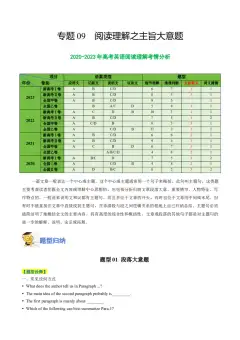
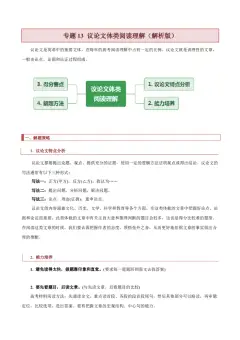
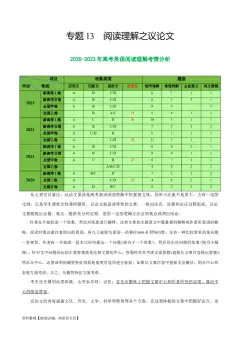
专题 09 阅读理解议论文
目录
题型综述.............................................................................................................................................2
解题攻略.............................................................................................................................................3
题型01 主旨大意题........................................................................................................................3
题型02 细节理解题..........................................................................................................................5
题型03 推理判断题..........................................................................................................................6
题型04 词义猜测题..........................................................................................................................9
高考练场...........................................................................................................................................10
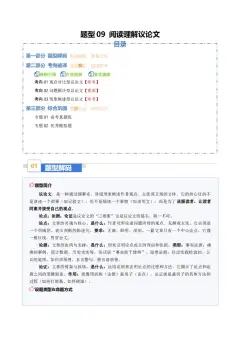
题型简介高考英语阅读理解议论文,通常围绕某一观点、现象或问题展开论述,作者通过摆事实、讲道理,运用
逻辑推理来阐明自身看法,说服读者接受其观点。文章往往结构清晰,包含论点、论据与论证过程,选
材涉及社会热点、教育理念、科技发展争议、文化现象剖析等诸多领域,旨在考查学生对复杂文本的理
解、分析及批判性思维能力。
命题类型
主旨大意题:要求提炼文章核心论点,常以 “What's the main idea of the passage?” 这类问句出现,选项可
能是对全文中心思想的精准概括,也可能是过于宽泛、片面的干扰表述。
细节理解题:针对文中论据、支撑性事例或特定关键信息设题,题目会明确指向文章某一处,如
“According to the passage, which of the following statements about... is true?”,考查学生捕捉精准细节的能力。
推理判断题:需依据文章现有论述、语气倾向推测隐含意义、作者态度,题干表述多为 “What can be
inferred from the passage?”,答案并非原文直白呈现,要经适度推导。
词义猜测题:聚焦文中超纲词、熟词僻义或特定语境下有特殊含义的词汇,例如 “The underlined word
‘XXX’ in the paragraph most probably means...”,要求结合上下文破解词义谜团。
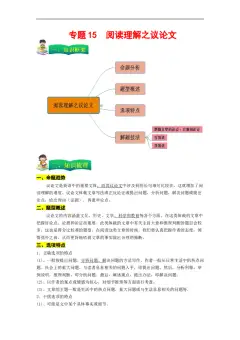
解题思路
读题预判:快速浏览题目与选项,圈出关键信息,像主旨题中的 “main idea”、细节题里的专有名词等,预
判阅读重点,带着问题意识去读文章。
通读抓论点:首次通读,定位文章开头段,多数议论文在此点明主题、抛出论点;同时留意各段首句,它
们常起承上启下、引出分论点的作用,梳理出全文论述脉络。
定位找论据:碰上细节、词义类题目,依据题目关键词,精准回文定位,在定位段落中细读上下文,借助
因果、对比、举例等逻辑关系锁定答案,比如出现 “for example” 后的内容大概率是在解释前面论点,对
理解词义、补充细节很关键。
推理重逻辑:面对推理题,紧扣文章已知观点、事实,杜绝过度臆想,分析作者用词褒贬、论证走向来判
断态度倾向;梳理段落、句子间的逻辑链条,像因果推导、让步转折后的语义走向,让推理有理有据。
核查避陷阱:选完答案后,代入原文再次核查,看选项是否契合全文主旨、对应细节是否无误,警惕偷换
概念、无中生有、以偏概全这类常见陷阱选项。题型01 主旨大意题
关注文章的首尾段落:议论文的主旨通常出现在文章的开头或结尾。首段往往提出论点或问题,尾
段则总结观点或得出结论。
抓住主题句和关键词:主题句是概括文章主旨的关键。在阅读过程中,要注意段落中的主题句以及
文章中反复出现的关键词。
综合各段大意,归纳总结:如果文章没有明确的主题句,可以先概括每一段的大意,然后综合各段
内容,归纳出文章的中心思想。
(23-24高三上·江苏扬州·期末)
“Woman reading book, under a night sky, dreamy atmosphere,” I type into Deep Dream Generator’s Text 2
Dream feature. In less than a minute, an image is returned to me showing what I’ve described.
Welcome to the world of AI image generation, where you can create what on the surface looks like top-rank
artwork using just a few text prompts (提示). But closer examination shows oddities. The face of the woman in my
image has very odd features, and appears to be holding multiple books. And, while there’s an initial thrill at seeing
an image appear, there’s no creative satisfaction.
AI image generation could influence everything from film to graphic novels and more. Children’s illustrators
were quick to raise concerns about the technology. They say AI-generated art is the exact opposite of what art is
believed to be. Fundamentally, art is all about translating something that you feel internally into something that
exists externally. Whatever form it takes, true art is about the creative process much more than it’s about the final
piece. And simply pressing a button to generate an image is not a creative process.
Beyond creativity, there are deeper issues. To create images from prompts, AI generators rely on databases of
already existing art and text. This could lead to the creation of images that are intentionally meant to imitate the
style of other artists, without their agreement. There is an argument that AI generators work no differently to
humans when it comes to being influenced by others’ work. However, a human artist is also adding emotion and
nuance (细微差别) into the mix. AI doesn’t do the same — it can only copy.
The increasing use of AI will also lead to a devaluing (贬低) of the work of artists. There’s already a
negative prejudice towards the creative industry. People will begin to think that their “work” is as excellent as that
created by someone who has spent a career making art. It’s nonsense, of course. You can use your mobile phone to
take a nice picture of your daughter, but you are no match for professionals.
7.What is Paragraph 4 of the text mainly about?A.The styles of human artworks and AI ones.
B.Human artists’ influence on AI generators.
C.Different means used in human and AI art creation.
D.The drawbacks of drawing from existing art and text.
8.Which of the following best summarizes the last paragraph?
A.Art is the mirror of life. B.Rome is not built in a day.
C.No man can do two things at once. D.Don’t judge a book by its cover.
题型02 细节理解题
抓论点、寻论据:阅读议论文时,要抓住作者提出的观点、给出的例证及最后得出的结论。这些论
点和论据是理解文章细节的关键,能够帮助考生快速定位到相关信息。
注重文章结构,理清文章脉络:把握文章的论证结构,如“提出问题—分析问题—解决问题”或
“论点—论据—结论”,这样可以更好地理解作者的论证过程和细节信息。
利用寻读法:对于直接信息题,可以快速浏览文章,寻找与题目相关的关键词或信息点。对于间接
信息题,则需要对原文信息进行同义转换或归纳概括。
(23-24高三上·湖南娄底·期末)
Recently, I was walking with some parents when we came across a five-pound note lying on the ground. We
stood around it for a moment, a bit awkwardly, until someone suggested putting it on a nearby bench. Then one of
the parents remarked that we’d probably have behaved differently — that is, we would have just taken the money
— had we been alone.
This relates to a classic question in studies of human generosity: do we behave more selfishly when we
aren’t being observed? The debate goes on across the psychological and biological sciences, as well as in popular
culture, about whether kindness can exist in a competitive world.
Yom Kippur is a Jewish (犹太人的) religious holiday when Jewish people fast and ask for forgiveness for
the wrongs they’ve committed. One of the points of Yom Kippur is to behave better regardless of who is watching.
There’s an evolutionary beauty to the teachings of Yom Kippur, which are the products of thousands of years of
cultural changes and evolution.
The Maasai people of Kenya practice osotua: relationships between people that operate based on need. Whensomeone forms an osotua relationship with another, they enter into an unwritten contract to help their partner in
times of need. And hunter-gatherer groups, which can represent the circumstances our species evolved in, have
many similar examples.
Cultural evolution helps to explain the existence and complexity of these systems. Cultural changes are far
faster than biological evolution, allowing intelligent species like humans to develop behavioral adaptations for
managing complex social environments. Osotua, or any other practice that helps to maintain good treatment of
others in society, is the result of tens of thousands of years of cultural trial and error. The customs passed down over
time are those that help us to develop as cultural groups.
The study of those changes has helped us to understand how we successfully spread around the world as
cooperative groups. Biological evolution has helped humans be more cooperative, but cultural changes have
accelerated this process.
Cultural evolution helps us to overcome our selfish natures. Try to understand rules before you ignore them
— and next time you find a fiver on the ground, you might think about the awkward situation your discovery
represents.
13.What made the parents feel a bit awkward?
A.The difficulty sharing the money.
B.The difficulty finding the owner of the money.
C.The thought of putting the money on the bench.
D.The thought of keeping the money for themselves.
15.How is biological evolution different from cultural evolution?
A.It evolves much slower. B.It takes much less time.
C.It is a more complex process. D.It makes humans more cooperative.
题型03 推理判断题
以事实为依据,进行逻辑推理:推理判断题要求考生根据文章中的事实信息,通过逻辑推理得出结论。
要注意区分事实与观点,确保推理过程符合文章的逻辑关系。
体会文章语言特点,把握作者写作态度:理解作者的观点和态度是进行推理判断的基础。有时候作者
的观点和态度并不是明确表达出来的,需要考生认真体察和分析。
关注文章中的隐含信息:推理判断题往往考查文章中隐含或深层的含义。考生需要关注文章中的修辞、
语气、隐含意思等,挖掘出文章的深层含义。(23-24高三上·河北石家庄·期末)
Would you BET on the future of this man? He is 53 years old. Most of his adult life has been a losing
struggle against debt and misfortune. A war injury has made his left hand stop functioning, and he has often been in
prison. Driven by heaven-knows-what motives, he deter-mines to write a book.
The book turns out to be one that has appealed to the world for more than 350 years. That former prisoner
was Cervantes, and the book was Don Quixote (《堂吉诃德》). And the story poses an interesting question: why
do some people discover new vitality and creativity to the end of their days, while others go to seed long before?
We’ve all known people who run out of steam before they reach life’s halfway mark. I’m not talking about
those who fail to get to the top. We can’t all get there. I’m talking about people who have stopped learning on
growing because they have adopted the fixed attitudes and opinions that all too often come with passing years.
Most of us, in fact, progressively narrow the variety of our lives. We succeed in our field of specialization
and then become trapped in it. Nothing surprises us. We lose our sense of wonder. But, if we are willing to learn,
the opportunities are everywhere.
The things we learn in maturity seldom involve information and skills. We learn to bear with the things we
can’t change. We learn to avoid self-pity. We learn that however much we try to please, some people are never
going to love us——an idea that troubles at first but is eventually relaxing.
With high motivation and enthusiasm, we can keep on learning. Then we will know how important it is to
have meaning in our life. However, we can achieve meaning only if we have made a commitment to something
larger than our own little egos (自我), whether to loved ones, to fellow humans, to work, or to some moral concept.
Many of us equate (视……等同于) “commitment” with such “caring” occupations as teaching and nursing.
But doing any ordinary job as well as one can is in itself an admirable commitment. People who work toward such
excellence whether they are driving a truck, or running a store———make the world better just by being the kind
of people they are. They’ve learned life’s most valuable lesson.
1.The passage starts with the story of Cervantes to show that ________.
A.loss of freedom stimulates one’s creativity
B.age is not a barrier to achieving one’s goal
C.misery inspires a man to fight against his fate
D.disability cannot stop a man´s pursuit of success
2.What could be inferred from Paragraph 4?
A.Those who dare to try often get themselves trapped.
B.Those who tend to think back can hardly go ahead.
C.Opportunity favors those with a curious mind.
D.Opportunity awaits those with a cautious mind.
3.What does the author intend to tell us in Paragraph 5?
A.A tough man can tolerate suffering.
B.A wise man can live without self-pity.
C.A man should try to satisfy people around him.D.A man should learn suitable ways to deal with life.
4.What is the author’s purpose in writing the passage?
A.To provide guidance on leading a meaningful adult life.
B.To stress the need of shouldering responsibilities at work.
C.To state the importance of generating motivation for learning.
D.To suggest a way of pursuing excellence in our lifelong career.
题型04 词义猜测题
利用上下文语境:通过阅读上下文,根据已知的信息或常识来推测生词或短语的含义。上下文提供的
语境线索是推断词义的关键。
注意词义的多义性和搭配:一个词可能有多个义项,要结合上下文选择最合适的词义。同时注意词与
词之间的搭配习惯,如固定搭配、习惯用法等。
借助语法知识:根据句子结构和语法关系来判断词义。例如,通过句子成分、从句关系等来推断词义。
(23-24 高三上·广东东莞·期末)The mushrooming video screens in buses, taxis and apartment halls in
cities like Shanghai are taking away our already rare resource: a place for a moment of peace. Taking a nap or
reading a book on buses is less pleasant now, as the LCD screens broadcast news, entertainment and advertisements
at unbearable volumes.
You pay the bus fare simply to get a ride—undisturbed—but now you are exposed to this “added value”,
whether you like it or not. If it’s a crowded bus, the noise is even more exasperating. More and more Chinese cities
have joined Shanghai, regarded as the first to put video screens on buses, disturbing millions of passengers.
..........
29.What does the underlined word “exasperating” in Paragraph 2 mean?
A.Entertaining.
B.Encouraging.
C.Disappointing.
D.Annoying.(23-24 高三上·广东深圳·期末)First-year college students often are expected or required to live in
dormitories. In the rest years, it’s usually up to those students to decide whether to live on or off campus.
...........
At first glance, off-campus housing can appear less expensive. But the additional expenses outside of rent —
like utilities, groceries, Internet access, cable and furniture — are often overlooked. To reduce off-campus costs,
some students choose to overpack houses or apartments, sometimes with four or five people in a two-bedroom
house. Unlike off-campus housing, the total cost of living on campus is typically all-inclusive, coveting rent,
utilities, furniture, Wi-Fi and a meal plan.
19.What does the underlined word “overpack” in the last paragraph mean?
A.Overlook. B.Overconsume. C.Overestimate. D.Overload.
(2024年新课标高考英语I卷C篇)
Is comprehension the same whether a person reads a text onscreen or on paper? And are listening to and
viewing content as effective as reading the written word when covering the same material? The answers to both
questions are often “no”. The reasons relate to a variety of factors, including reduced concentration, an
entertainment mindset (心态) and a tendency to multitask while consuming digital content.
When reading texts of several hundred words or more, learning is generally more successful when it’s on
paper than onscreen. A large amount of research confirms this finding. The benefits of print reading particularly
shine through when experimenters move from posing simple tasks — like identifying the main idea in a reading
passage — to ones that require mental abstraction — such as drawing inferences from a text.
The differences between print and digital reading results are partly related to paper’s physical properties. With
paper, there is a literal laying on of hands, along with the visual geography of distinct pages. People often link their
memory of what they’ve read to how far into the book it was or where it was on the page.
But equally important is the mental aspect. Reading researchers have proposed a theory called “shallowing
hypothesis (假说)”. According to this theory, people approach digital texts with a mindset suited to social media,
which are often not so serious, and devote less mental effort than when they are reading print.
Audio (音频) and video can feel more engaging than text, and so university teachers increasingly turn to these
technologies — say, assigning an online talk instead of an article by the same person. However, psychologists have
demonstrated that when adults read news stories, they remember more of the content than if they listen to or view
identical pieces.
Digital texts, audio and video all have educational roles, especially when providing resources not available in
print. However, for maximizing learning where mental focus and reflection are called for, educators shouldn’t
assume all media are the same, even when they contain identical words.
28. What does the underlined phrase “shine through” in paragraph 2 mean?A. Seem unlikely to last. B. Seem hard to explain.
C. Become ready to use. D. Become easy to notice.
29. What does the shallowing hypothesis assume?
A. Readers treat digital texts lightly. B. Digital texts are simpler to understand.
C. People select digital texts randomly. D. Digital texts are suitable for social media.
30. Why are audio and video increasingly used by university teachers?
A. They can hold students' attention. B. They are more convenient to prepare.
C. They help develop advanced skills. D. They are more informative than text.
31. What does the author imply in the last paragraph?
A. Students should apply multiple learning techniques.
B. Teachers should produce their own teaching material.
C. Print texts cannot be entirely replaced in education.
D. Education outside the classroom cannot be ignored.
(2024年新课标高考英语甲卷D篇)
“I didn’t like the ending,” I said to my favorite college professor. It was my junior year of undergraduate, and I
was doing an independent study on Victorian literature. I had just finished reading The Mill on the Floss by George
Eliot, and I was heartbroken with the ending. Prof. Gracie, with all his patience, asked me to think about it beyond
whether I liked it or not. He suggested I think about the difference between endings that I wanted for the characters
and endings that were right for the characters, endings that satisfied the story even if they didn’t have a traditionally
positive outcome. Of course, I would have preferred a different ending for Tom and Maggie Tulliver, but the ending
they got did make the most sense for them.
This was an aha moment for me, and I never thought about endings the same way again. From then on, if I
wanted to read an ending guaranteed to be happy, I’d pick up a love romance. If I wanted an ending I couldn’t
guess, I’d pick up a mystery (悬疑小说). One where I kind of knew what was going to happen, historical fiction.
Choosing what to read became easier.
But writing the end—that’s hard. It’s hard for writers because endings carry so much weight with readers. You
have to balance creating an ending that's unpredictable, but doesn’t seem to come from nowhere, one that fits
what’s right for the characters.
That’s why this issue (期) of Writer’s Digest aims to help you figure out how to write the best ending for
whatever kind of writing you’re doing. If it’s short stories, Peter Mountford breaks down six techniques you can try
to see which one helps you stick the landing. Elizabeth Sims analyzes the final chapters of five great novels to see
what key points they include and how you can adapt them for your work.
This issue won’t tell you what your ending should be—that’s up to you and the story you’re telling—bu it
might provide what you need to get there.
12. Why did the author go to Prof. Gracie?
A. To discuss a novel. B. To submit a book report.
C. To argue for a writer. D. To ask for a reading list.13. What did the author realize after seeing Gracie?
A. Writing is a matter of personal preferences.
B. Readers are often carried away by character.
C. Each type of literature has its unique end.
D. A story which begins well will end well.
14. What is expected of a good ending?
A It satisfies readers’ taste. B. It fits with the story development.
C. It is usually positive. D. It is open for imagination.
15. Why does the author mention Peter Mountford and Elizabeth Sims?
A. To give examples of great novelists. B. To stress the theme of this issue.
C. To encourage writing for the magazine. D. To recommend their new books.
(2024年北京卷英语真题)
The notion that we live in someone else’s video game is irresistible to many. Searching the term “simulation
hypothesis” (模拟假说) returns numerous results that debate whether the universe is a computer simulation — a
concept that some scientists actually take seriously. Unfortunately, this is not a scientific question. We will probably
never know whether it’s true. We can, instead, use this idea to advance scientific knowledge.
The 18th-century philosopher Kant argued that the universe ultimately consists of things-in-themselves that
are unknowable. While he held the notion that objective reality exists, he said our mind plays a necessary role in
structuring and shaping our perceptions. Modern sciences have revealed that our perceptual experience of the world
is the result of many stages of processing by sensory systems and cognitive (认知的) functions in the brain. No one
knows exactly what happens within this black box. If empirical (实证的) experience fails to reveal reality,
reasoning won’t reveal reality either since it relies on concepts and words that are contingent on our social, cultural
and psychological histories. Again, a black box.
So, if we accept that the universe is unknowable, we also accept we will never know if we live in a computer
simulation. And then, we can shift our inquiry from “Is the universe a computer simulation? ” to “Can we model
the universe as a computer simulation? ” Modelling reality is what we do. To facilitate our comprehension of the
world, we build models based on conceptual metaphors (隐喻) that are familiar to us. In Newton’s era, we
imagined the universe as a clock. In Einstein’s, we uncovered the standard model of particle (粒子) physics.
Now that we are in the information age, we have new concepts such as the computer, information
processing, virtual reality, and simulation. Unsurprisingly, these new concepts inspire us to build new models of the
universe. Models are not the reality, however. There is no point in arguing if the universe is a clock, a set of
particles or an output of computation. All these models are tools to deal with the unknown and to make discoveries.
And the more tools we have, the more effective and insightful we can become.
It can be imagined that comparable to the process of building previous scientific models, developing the
“computer simulation” metaphor-based model will also be a hugely rewarding exercise.
1.What does the author intend to do by challenging a hypothesis?
A.Make an assumption. B.Illustrate an argument.C.Give a suggestion. D.Justify a comparison.
2.What does the phrase “contingent on” underlined in Paragraph 2 probably mean?
A.Accepted by. B.Determined by. C.Awakened by. D.Discovered by.
3.As for Kant’s argument, the author is _________.
A.appreciative B.doubtful C.unconcerned D.disapproving
4.It is implied in this passage that we should _________.
A.compare the current models with the previous ones
B.continue exploring the classical models in history
C.stop arguing whether the universe is a simulation
D.turn simulations of the universe into realities up.
(2023年全国乙卷英语真题)
If you want to tell the history of the whole world, a history that does not privilege one part of humanity, you
cannot do it through texts alone, because only some of the world has ever had texts, while most of the world, for
most of the time, has not. Writing is one of humanity’s later achievements, and until fairly recently even many
literate (有文字的) societies recorded their concerns not only in writing but in things.
Ideally a history would bring together texts and objects, and some chapters of this book are able to do just
that, but in many cases we simply can’t. The clearest example of this between literate and non-literate history is
perhaps the first conflict, at Botany Bay, between Captain Cook’s voyage and the Australian Aboriginals. From the
English side, we have scientific reports and the captain’s record of that terrible day. From the Australian side, we
have only a wooden shield (盾) dropped by a man in flight after his first experience of gunshot. If we want to
reconstruct what was actually going on that day, the shield must be questioned and interpreted as deeply and strictly
as the written reports.
In addition to the problem of miscomprehension from both sides, there are victories accidentally or
deliberately twisted, especially when only the victors know how to write. Those who are on the losing side often
have only their things to tell their stories. The Caribbean Taino, the Australian Aboriginals, the African people of
Benin and the Incas, all of whom appear in this book, can speak to us now of their past achievements most
powerfully through the objects they made: a history told through things gives them back a voice. When we consider
contact (联系) between literate and non-literate societies such as these, all our first-hand accounts are necessarily
twisted, only one half of a dialogue. If we are to find the other half of that conversation, we have to read not just
the texts, but the objects.
5.What is the first paragraph mainly about?
A.How past events should be presented. B.What humanity is concerned about.
C.Whether facts speak louder than words. D.Why written language is reliable.
6.What does the author indicate by mentioning Captain Cook in paragraph 2?
A.His report was scientific. B.He represented the local people.C.He ruled over Botany Bay. D.His record was one-sided.
7.What does the underlined word “conversation” in paragraph 3 refer to?
A.Problem. B.History. C.Voice. D.Society.
8.Which of the following books is the text most likely selected from?
A. How Maps Tell Stories of the World B. A Short History of Australia
C. A History of the World in 100 Objects D. How Art Works Tell Stories
A
【来源】湖北省沙市中学2024-2025学年高三上学期12月月考英语试题
There have been many problems with our schools today, the biggest of which is closely related to our
culture. In general, our culture, as represented in the media, gets excited by famous stars, and constantly stresses
that it’s what you have, not what you are, that counts. Parents are encouraged to be away from even very small
children for most of the day. Too many voters go for politicians who would rather cut school funding than to get rid
of tax cuts for the wealthy. All contribute greatly to the problems of educating our children.
Today’s teachers have to deal with a culture that is vastly different than in the past. They report that there is,
among more children than ever, a lack of motivation, no drive to succeed or even try. The role models that boys
view in the media mostly consist of men in comedies and other shows who are rude and often extremely immature;
self-centered overpaid athletes; men in movies, television dramas, video games, etc. who are preoccupied with
violence and power. As Leonard Sax wrote in Boys Adrift, “Teenage boys are looking for models of mature
adulthood, but we no longer make any collective effort to provide such models.” Girls are attacked not only with
such annoying images of males, but also with women who are preoccupied with appearance and are extremely
materialistic.
In such a cultural environment, it is more important than ever to have responsible, loving and caring parents
who have enough time and motivation to devote to their children and see to it as their duty to model for them and
raise them with high standards of honesty and responsibility along with tending to their physical needs. They need
to care enough to see that their children are not attacked with the garbage that comes from movie, television and
computer screens. In today’s culture, they are basically alone in this effort since, unfortunately, so much is working
against them.
Until we, as a culture, face the truth about ourselves — that we are not providing adequately for a great
many of our children — the storm will continue to sweep over our education system.1.How is paragraph 1 mainly developed?
A.By analyzing causes. B.By showing differences.
C.By describing a process. D.By using time order.
2.What does today’s culture probably bring to the children?
A.Narrow access to entertainment. B.Little desire for success.
C.Few materialistic models. D.Poor understanding abilities.
3.According to the text, in today’s culture parents need to _________.
A.devote more to their children B.find honest models for their children
C.keep their children away from computersD.help their children develop motivation
4.What is the author’s attitude towards today’s culture?
A.Positive. B.Dissatisfied. C.Uncertain. D.Approving
B
【来源】湖南省雅礼中学2024-2025学年高三上学期月考英语试题
The negative nature of peer pressure is often presented without question. The undesirable effect of peer
pressure cannot be denied, but is it also possible that peer pressure might not entirely deserve its bad reputation?
Could peer pressure also have positive effects on the personal development and behavior of young people? A look
at the scientific literature reveals exactly that: peer pressure is not always a force for the dark side.
Many studies suggest that peer pressure and the desire to conform (顺从) are simply a part of being human.
Humans, after all, are highly social beings. If humans are hard-wired to respond to peer pressure, then it makes
sense to examine how it can be used to change behavior in a positive way. Imagine a situation: student X has
always enjoyed playing the guitar but is lazy and unmotivated. Although initially unwilling, she is persuaded to join
a school band. The group of students is preparing for a performance and the existing members are enthusiastic,
focused and hardworking. Gradually, student X is caught up in the spirit of the band and before long she is
willingly making the same commitment of time and effort so they can all achieve a common goal.
So how does it work? Peer pressure — both positive and negative — follows a recognizable psychological
process. If student X does not conform to the established culture of the band, she risks rejection. To dispel this
tension, student X changes her habits and increases the amount of time and energy she devotes to practice. Some
psychologists describe this rearrangement of personal goals or standards to achieve harmony as part of a group as
an “identity shift”.
The key to understanding the concept of peer pressure and its power over humans is to closely examine the
science of the process, rather than focus on its negative aspects. Providing a one-dimensional view of the concept
encourages the bias(偏见) that peer pressure is a strictly undesirable feature of human society. Instead, we should
be exploring ways to use its power for good.
5.Why does the author raise the two questions about peer pressure in paragraph 1?
A.To present misinterpretations of it. B.To encourage reflection on it.C.To doubt the investigations into it. D.To show general perceptions of it.
6.What should student X do to fit into the band?
A.Enhance her leadership. B.Stick to her old routines.
C.Learn to play more instruments. D.Invest more energy in playing the guitar.
7.What does the underlined word “dispel” in paragraph 3 mean?
A.Hide. B.Sense. C.Remove. D.Display.
8.How does the author look at peer pressure?
A.It can be put to good use.
B.It is an unwanted feature of human society.
C.It goes far beyond scientific explanation.
D.It has more advantages than disadvantages.
C
【来源】江西省赣州市赣州赣抚吉十五校联考2024-2025学年高三上学期12月月考试题
“To get ahead in this world, don’t we need a little bit of perfectionism?” As someone who has researched
perfectionism for over a decade, I’m asked this question a lot. And I used to think that was true. It’s hard to succeed
nowadays. You’ve got to sacrifice yourself, keep pushing well beyond what’s comfortable, and live life on your
tiptoes. That’s just the common things in a competitive society where there are only a few winners, I believed.
Yet, research finds that perfectionism has no relationship with performance. Perfectionistic people struggle
really hard, but they’re no more likely to be successful. One reason is that perfectionistic people work hard but
unsustainably so. They often find themselves in the sapping zone and opposite returns on their efforts.
Another is that many perfectionists are world champions at self-doubt. When things get tough, when it looks
like failure is heading their way, the anticipated shame and embarrassment are so fierce that perfectionistic people
are unwilling to put forth any further effort that might allow others to discover their shortcomings. So, they simply
give up to avoid fears of failure, which makes failure more likely.
For perfectionists, dialing down goals and aiming for excellence instead doesn’t usually work. On the
contrary, it’s important to learn to embrace the inevitability of setbacks, failures, and things not going quite as
planned. It’s important to be able to sit comfortably with these humanizing experiences, to let them be, and not
need to drive them out of existence.
So we shouldn’t struggle to be perfect because perfectionism doesn’t lead to success. Instead, do recognize
that learning to embrace imperfections and setbacks helps us to accept ourselves and keep moving forward.
9.What is the author’s initial belief about perfectionism?
A.It has no relationship with performance.
B.It leads to self-doubt and fear of failure.
C.It is unsustainable and leads to burnout.
D.It is necessary for success in tough society.10.What does the underlined word “sapping” mean in paragraph 2?
A.Falling. B.Reserving.
C.Exciting D.Refreshing.
11.Why do many perfectionists give up when faced with challenges?
A.They are not willing to work hard.
B.They are afraid of shame from failure.
C.They are unwilling to accept any failure.
D.They are unable to dial down their goals.
12.What is the best title of the text?
A.Why You Should Embrace “Good Enough”
B.Why Kids Need “Intelligent Failure”
C.What Is A Better Way To Seek Guidance
D.What We Can benefit From Perfectionism
D
【来源】江苏省泰州中学2024-2025学年高三上学期12月月考英语试题
Teaching is a caregiving profession. We all have that one teacher who inspired us to aim higher, choose a
certain career path, or simply discover our passions. This role comes with not only many satisfactions, but lots of
pressure to hold yourselves to a higher standard. The responsibilities of teachers only increased during the
pandemic, so teachers had to show compassion for students and parents — often without expecting the same
treatment. That’s why it’s so easy to think of teachers as selfless people that give it all for future generations.
However, where does that leave teachers? Educators are taught to do many things, but their education is
usually lacking in addressing the emotional problems of being a teacher. During the pandemic, I failed to make my
online classes as enjoyable as possible for my students. Later, it turned out that other teachers were having
problems as well. I had zero reasons to feel so isolated in my experience. What I needed was self-compassion.
According to Dr. Kristin Neff, a lead researcher in this field, “Self-compassion is simply compassion directed
inwards.” In other words, it’s about showing yourself the same care and understanding that you typically show
students or other people in your life. Some people have more self-compassion than others, and working towards
achieving more of it can help you in all aspects of your life.
Being a teacher comes with so many expectations and responsibilities. In theory, nobody’s perfect, but
there’s great pressure to be a good role model, educator, mentor, etc. The inner critic has so much more “material”
to work with when you’ re in front of a class. It’s no wonder that in stressful situations, it’s harder to control your
self-talk. For example, if you fail to upload a lesson on time, your inner critic will jump at the chance to say, “You’
re so forgetful, and I can’t believe you did this.”
It’s no secret that teachers are usually under a lot of stress. A part of the solution can be incorporating self-
compassion into teaching, which can not only enhance a satisfactory job but also have a good effect on students.13.What does the underlined word “that” in paragraph 2 refer to?
A.Teachers’ dedicating themselves to the cause of teaching.
B.Teachers’ showing great compassion for themselves.
C.Teachers’ suffering from unknown mental pressure.
D.Teachers’ failing to learn something in their careers.
14.Which of the following fits with Dr. Kristin Neff’s view on self-compassion?
A.Self-compassion is hard for teachers to learn.
B.Self-compassion helps teachers understand students well.
C.The more self-compassion you have, the more benefits you’ll get.
D.The more you understand others, the more self-compassion you’ll have.
15.What can be inferred from the example given in paragraph 3?
A.Teachers’ responsibilities matter. B.Teachers have a lot of work pressure.
C.Teachers play a big role in students’ life.D.It’s normal for teachers to do wrong things.
16.What is mainly talked about in the text?
A.The importance of teachers’ self-compassion.
B.The suggestions on raising future generations.
C.The necessity of reducing the burden on teachers.
D.The approaches to teachers’ growth and development.