Chapter VI Chinese Art 中国艺术
Lesson 1 Peking Opera and its Facial Design
京剧和脸谱
Originally a form of local theatre, Peking Opera spread all over the country and then became the national
opera of China. About 200 years ago, the Qing Emperor Qianlong toured in southern China
and developed an interest in the local operas. On his 80th birthday, he let local opera troupes
come to Beijing to perform for him. Some remained in Beijing after the celebration. The ones
from Anhui and Hubei were combined with the palace opera - Kunqu Opera, which formed the
Peking Opera. Peking Opera combines stylized acting with singing, dancing, musical dialogues, martial arts,
colorful facial make-up and fantastic costumes.
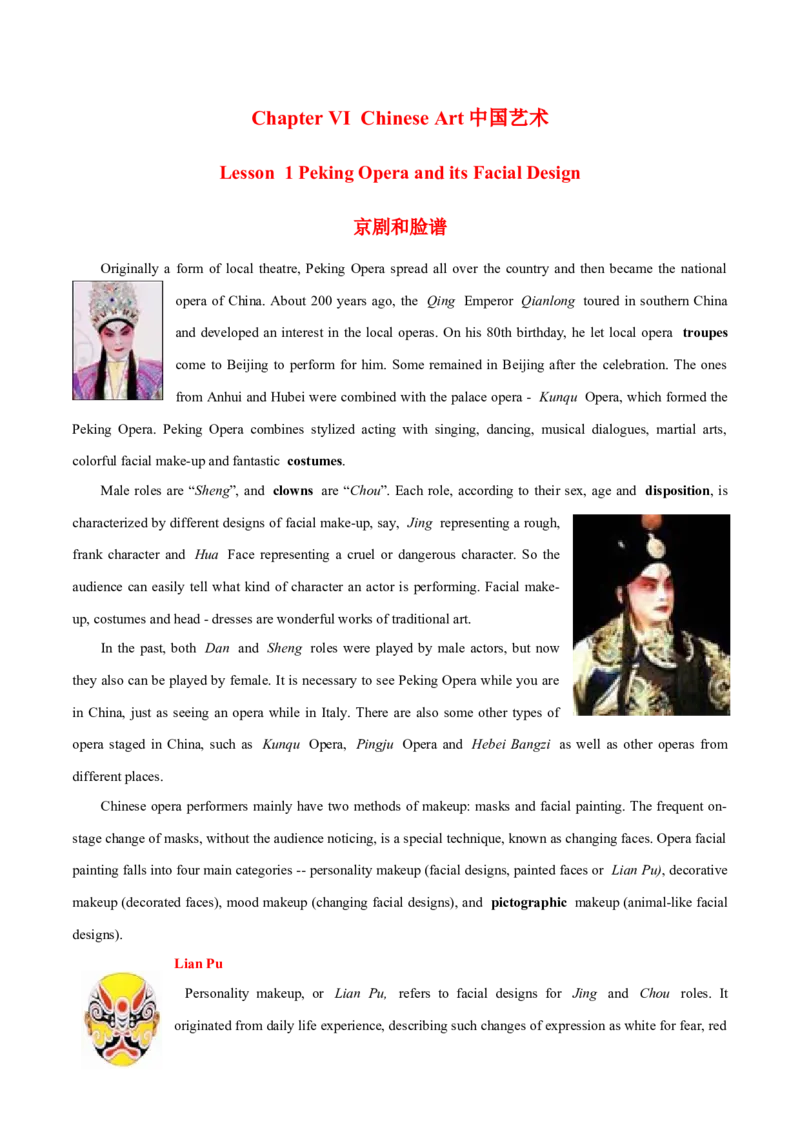
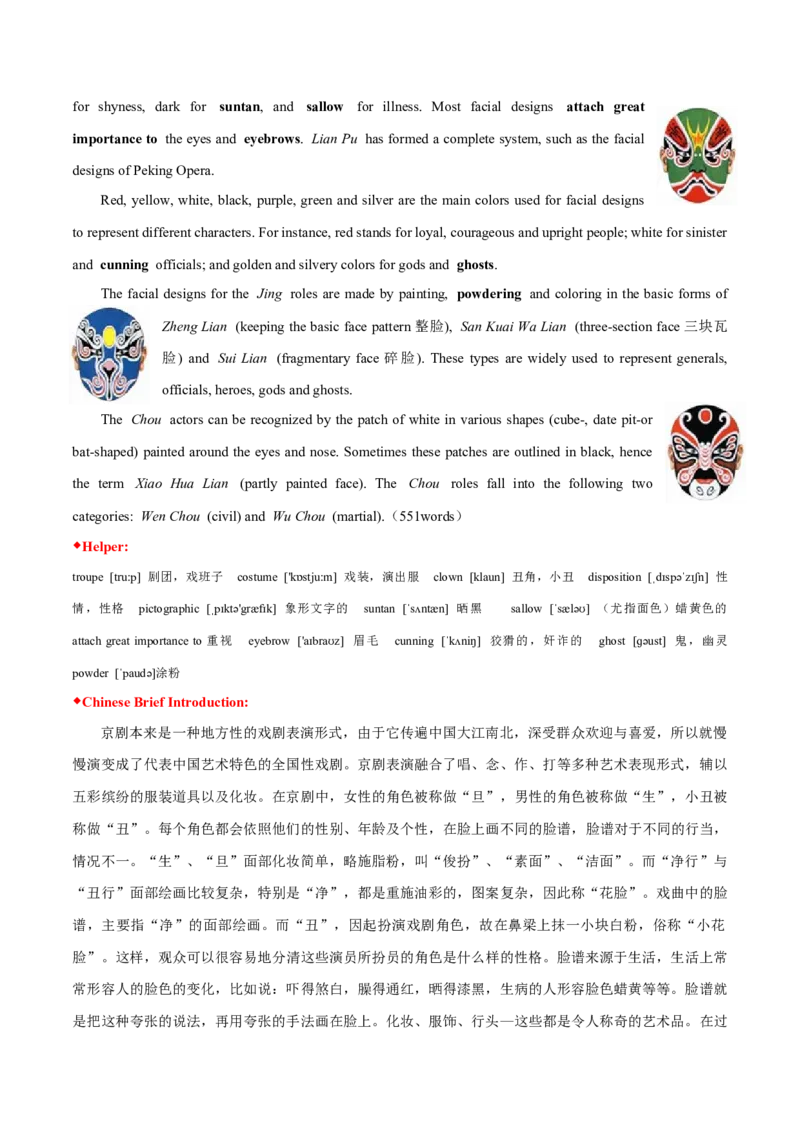
Male roles are “Sheng”, and clowns are “Chou”. Each role, according to their sex, age and disposition, is
characterized by different designs of facial make-up, say, Jing representing a rough,
frank character and Hua Face representing a cruel or dangerous character. So the
audience can easily tell what kind of character an actor is performing. Facial make-
up, costumes and head - dresses are wonderful works of traditional art.
In the past, both Dan and Sheng roles were played by male actors, but now
they also can be played by female. It is necessary to see Peking Opera while you are
in China, just as seeing an opera while in Italy. There are also some other types of
opera staged in China, such as Kunqu Opera, Pingju Opera and Hebei Bangzi as well as other operas from
different places.
Chinese opera performers mainly have two methods of makeup: masks and facial painting. The frequent on-
stage change of masks, without the audience noticing, is a special technique, known as changing faces. Opera facial
painting falls into four main categories -- personality makeup (facial designs, painted faces or Lian Pu), decorative
makeup (decorated faces), mood makeup (changing facial designs), and pictographic makeup (animal-like facial
designs).
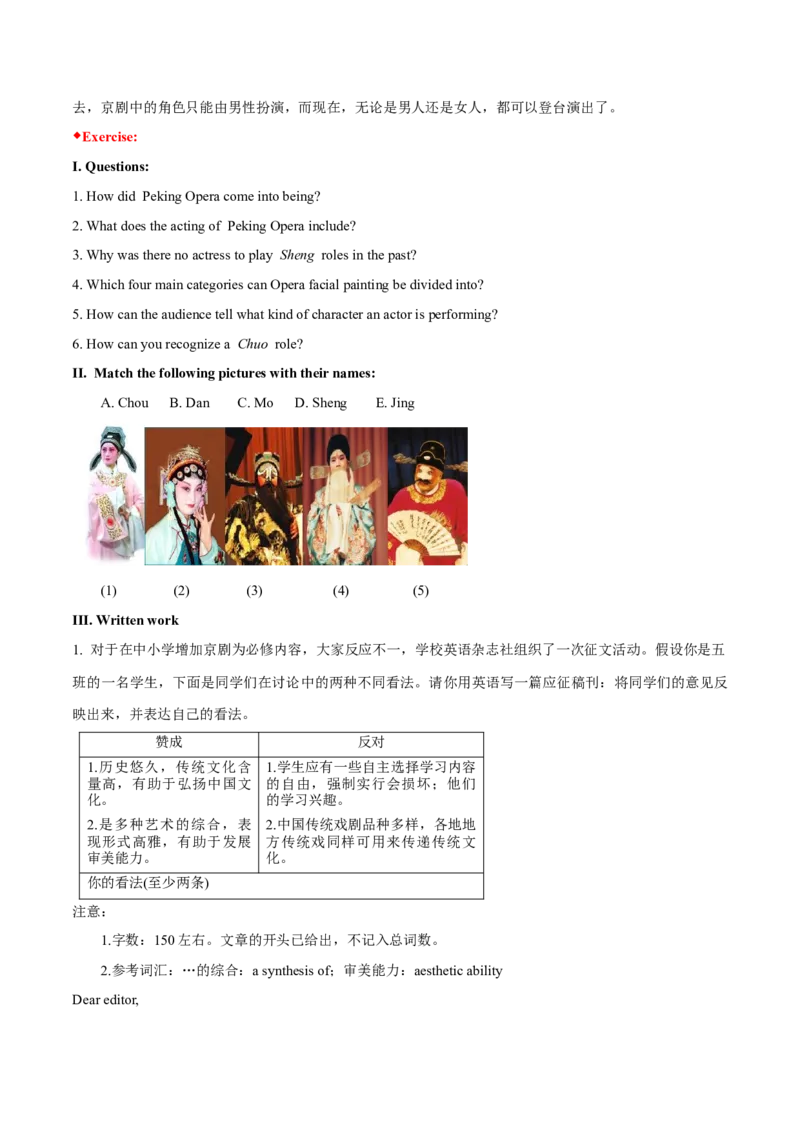
Lian Pu
Personality makeup, or Lian Pu, refers to facial designs for Jing and Chou roles. It
originated from daily life experience, describing such changes of expression as white for fear, redfor shyness, dark for suntan, and sallow for illness. Most facial designs attach great
importance to the eyes and eyebrows. Lian Pu has formed a complete system, such as the facial
designs of Peking Opera.
Red, yellow, white, black, purple, green and silver are the main colors used for facial designs
to represent different characters. For instance, red stands for loyal, courageous and upright people; white for sinister
and cunning officials; and golden and silvery colors for gods and ghosts.
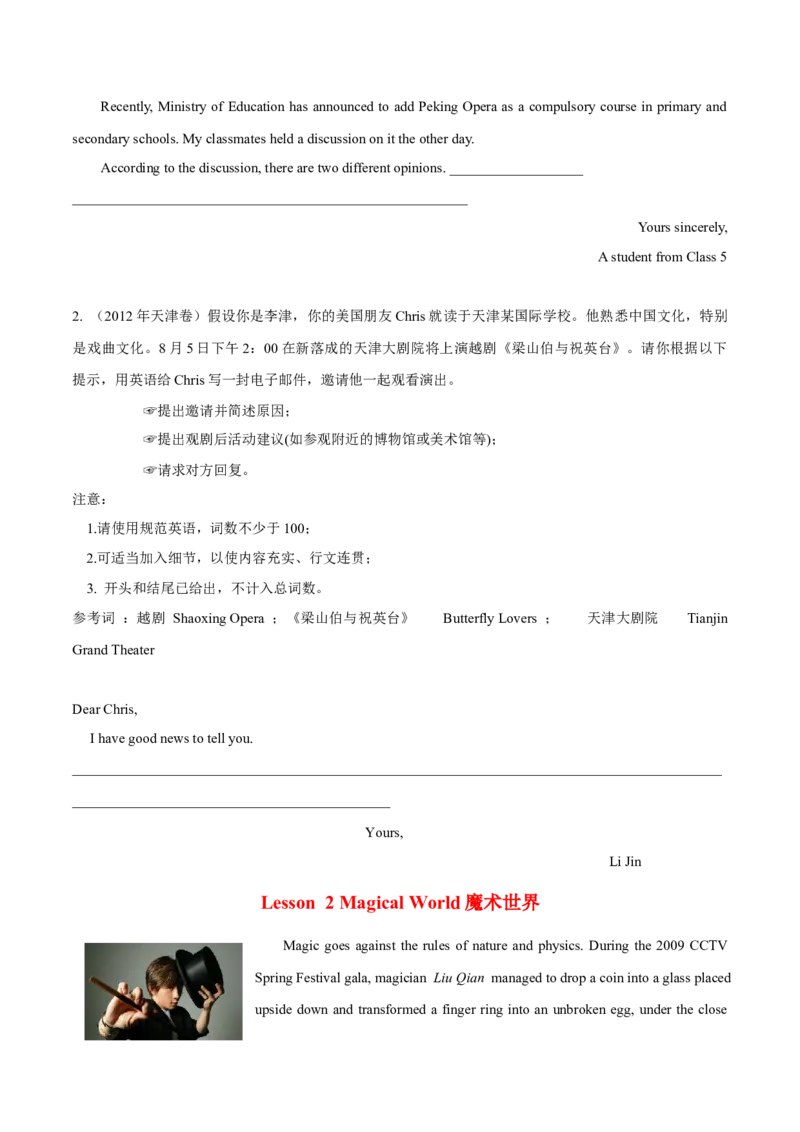
The facial designs for the Jing roles are made by painting, powdering and coloring in the basic forms of
Zheng Lian (keeping the basic face pattern整脸), San Kuai Wa Lian (three-section face三块瓦
脸) and Sui Lian (fragmentary face 碎脸). These types are widely used to represent generals,
officials, heroes, gods and ghosts.
The Chou actors can be recognized by the patch of white in various shapes (cube-, date pit-or
bat-shaped) painted around the eyes and nose. Sometimes these patches are outlined in black, hence
the term Xiao Hua Lian (partly painted face). The Chou roles fall into the following two
categories: Wen Chou (civil) and Wu Chou (martial).(551words)
◆Helper:
troupe [tru:p] 剧团,戏班子 costume ['kɒstju:m] 戏装,演出服 clown [klaun] 丑角,小丑 disposition [ˌdɪspəˈzɪʃn] 性
情,性格 pictographic [ˌpɪktə'græfɪk] 象形文字的 suntan [ˈsʌntæn] 晒黑 sallow [ˈsæləʊ] (尤指面色)蜡黄色的
attach great importance to 重视 eyebrow ['aɪbraʊz] 眉毛 cunning [ˈkʌniŋ] 狡猾的,奸诈的 ghost [ɡəust] 鬼,幽灵
powder [ˈpaudə]涂粉
◆Chinese Brief Introduction:
京剧本来是一种地方性的戏剧表演形式,由于它传遍中国大江南北,深受群众欢迎与喜爱,所以就慢
慢演变成了代表中国艺术特色的全国性戏剧。京剧表演融合了唱、念、作、打等多种艺术表现形式,辅以
五彩缤纷的服装道具以及化妆。在京剧中,女性的角色被称做“旦”,男性的角色被称做“生”,小丑被
称做“丑”。每个角色都会依照他们的性别、年龄及个性,在脸上画不同的脸谱,脸谱对于不同的行当,
情况不一。“生”、“旦”面部化妆简单,略施脂粉,叫“俊扮”、“素面”、“洁面”。而“净行”与
“丑行”面部绘画比较复杂,特别是“净”,都是重施油彩的,图案复杂,因此称“花脸”。戏曲中的脸
谱,主要指“净”的面部绘画。而“丑”,因起扮演戏剧角色,故在鼻梁上抹一小块白粉,俗称“小花
脸”。这样,观众可以很容易地分清这些演员所扮员的角色是什么样的性格。脸谱来源于生活,生活上常
常形容人的脸色的变化,比如说:吓得煞白,臊得通红,晒得漆黑,生病的人形容脸色蜡黄等等。脸谱就
是把这种夸张的说法,再用夸张的手法画在脸上。化妆、服饰、行头—这些都是令人称奇的艺术品。在过去,京剧中的角色只能由男性扮演,而现在,无论是男人还是女人,都可以登台演出了。
◆Exercise:
I. Questions:
1. How did Peking Opera come into being?
2. What does the acting of Peking Opera include?
3. Why was there no actress to play Sheng roles in the past?
4. Which four main categories can Opera facial painting be divided into?
5. How can the audience tell what kind of character an actor is performing?
6. How can you recognize a Chuo role?
II. Match the following pictures with their names:
A. Chou B. Dan C. Mo D. Sheng E. Jing
(1) (2) (3) (4) (5)
III. Written work
1. 对于在中小学增加京剧为必修内容,大家反应不一,学校英语杂志社组织了一次征文活动。假设你是五
班的一名学生,下面是同学们在讨论中的两种不同看法。请你用英语写一篇应征稿刊:将同学们的意见反
映出来,并表达自己的看法。
赞成 反对
1.历史悠久,传统文化含 1.学生应有一些自主选择学习内容
量高,有助于弘扬中国文 的自由,强制实行会损坏;他们
化。 的学习兴趣。
2.是多种艺术的综合,表 2.中国传统戏剧品种多样,各地地
现形式高雅,有助于发展 方传统戏同样可用来传递传统文
审美能力。 化。
你的看法(至少两条)
注意:
1.字数:150左右。文章的开头已给出,不记入总词数。
2.参考词汇:…的综合:a synthesis of;审美能力:aesthetic ability
Dear editor,Recently, Ministry of Education has announced to add Peking Opera as a compulsory course in primary and
secondary schools. My classmates held a discussion on it the other day.
According to the discussion, there are two different opinions. ___________________
________________________________________________________
Yours sincerely,
A student from Class 5
2. (2012年天津卷)假设你是李津,你的美国朋友Chris就读于天津某国际学校。他熟悉中国文化,特别
是戏曲文化。8月5日下午2:00在新落成的天津大剧院将上演越剧《梁山伯与祝英台》。请你根据以下
提示,用英语给Chris写一封电子邮件,邀请他一起观看演出。
☞提出邀请并简述原因;
☞提出观剧后活动建议(如参观附近的博物馆或美术馆等);
☞请求对方回复。
注意:
1.请使用规范英语,词数不少于100;
2.可适当加入细节,以使内容充实、行文连贯;
3. 开头和结尾已给出,不计入总词数。
参考词 :越剧 Shaoxing Opera ;《梁山伯与祝英台》 Butterfly Lovers ; 天津大剧院 Tianjin
Grand Theater
Dear Chris,
I have good news to tell you.
____________________________________________________________________________________________
_____________________________________________
Yours,
Li Jin
Lesson 2 Magical World魔术世界
Magic goes against the rules of nature and physics. During the 2009 CCTV
Spring Festival gala, magician Liu Qian managed to drop a coin into a glass placed
upside down and transformed a finger ring into an unbroken egg, under the closeand watchful eyes of the studio audience, leaving tens of thousands of viewers puzzled by his showmanship.
The mind-blowing performance has set off an enthusiasm of magic all over the country. However, people
seldom know that more than 3600 years ago, the history of magic in China was already underway.
In China, magic goes back many years and has developed from superstitious wizardry into a
technologically inspired, sophisticated art form.
Ancient Chinese magic made its appearance as early as 1600 BC, and was closely associated with divination
and wizardry, according to Biographies of Exemplary Women (Lie Nu Zhuan) by Liu Xiang, the well-known
historian of the Han Dynasty (206 BC- AD220).
In 108 BC, Liu Che, emperor of the Western Han Dynasty, gathered more than a hundred acrobats and
magicians in the imperial palace and hosted the biggest magic show in history. Zhang Heng's Western Metropolis
Rhapsody (Xi Jing Fu西京赋) records that Duke Huang of the Eastern Sea (Donghai
Huanggong), a showman and magician, did knife-swallowing and fire-spitting shows at
this gathering.
Magic continued to thrive in the Tang Dynasty (AD 618-907) and began to branch
off into separate fields in the Song Dynasty (960-1279). Some traditional Chinese
tricks such as "Immortal Plants Bean" and "Ancient Color Trick" marked the start of
international recognition for Chinese magic.
In the late Qing Dynasty (1644-1911), there were many cultural exchanges between China and the West. The
first generation of modern Chinese magicians like Ching Ling Foo (Zhu Liankui), Han Pingchien and Mu
Wenqing went abroad to perform and also learned to incorporate foreign stunts into traditional tricks.
The later generation of magic practitioners, headed by Zhang Huichong, furthered the hybrid form of magic
acts by infusing traditional Chinese magic into Western-style illusion acts.
After China's reform and opening-up in the late 1970s, magicians from abroad began visiting China more
frequently. In 1980, Marc Wilson from the United States became the first magician to perform on the Chinese
mainland since the founding of New China in 1949. In 2002, David Copperfield caused a stir with his performances
of walking through the Great Wall.
And now, Liu Qian has created a hit with his remarkable close-up performances and exposed Chinese
audiences to a new, refreshing and delightful art form. (416 words)
◆Helper:
showmanship ['ʃəʊmənʃɪp] 表演技巧 mind-blowing 引起幻觉的 underway 正在进行中的 superstitious[ˌsuːpə'stɪʃəs] 迷信的 wizardry ['wɪzədri] 魔术,巫术 sophisticated [sə'fɪstɪkeɪtɪd] 复杂的,久经世故的 divination
[ˌdɪvɪ'neɪʃn] 占卜,预测 acrobat['ækrəbæt] 杂技演员 immortal [ɪ'mɔːtl] 不朽的 incorporate [ɪn'kɔːpəreɪt]合并的
stunt[stʌnt] 特技
◆Introduction:
中国是魔术的发源地之一。魔术也是我国对外文化交流活动中开展得最早的领域之一,东汉张衡的《西
京赋》记载了来自西域的魔术师“吞刀吐火”等魔术节目。清代中叶以后,中国艺人一部分飘零海外,欧
美和日本的魔术团体也不断来华演出,促进了中外魔术的交流,中国魔术师们在保持自己魔术的传统习惯
的基础上,吸收了大量的外国魔术的表演形式、内容、技巧,逐渐形成了中国魔术舞台上今天这样五花八
门的节目。刘谦在 2010年春晚上的魔术表演更是震撼了全国观众,掀起全国的魔术热潮。
◆Exercises:
I. Questions:
1. How long is it since magic in China appeared?
2. When did magicians from abroad begin visiting China more often?
3. Who was it that wrote a book recording knife-swallowing and fire-spitting shows?
II. Written work
刘 谦 在 2018湖南卫视春
简介著名魔术师,1976年出生于台湾。7岁时开始对魔术感兴趣,
晚魔术《魔壶》 继 2010 中央电
12岁荣获“全台湾儿童魔术大赛冠军”。2010年春晚表演使他
视台年春晚上的 成为中国内地最热魔术师。 手穿玻璃取硬
币,又一次震撼 成就表演深受世人欢迎,曾到美国、日本、韩国、英国等演出。 了电视观众,使
他再次成为中国 内地最热的魔术
爱好他善于和观众互动、创造性地进行思考;认为使魔术成功的原
师。请你根据下 因是思想而非操作能力。 表提示,用英语
对刘谦做一简单 介绍,写一篇
120-150词的英语作文。Suggested Answers to Chapter VI
1. Peking Opera and its Facial Design
II. Match the following pictures with their names:
(1) D (2) B (3) E (4) C (5) A
III. Written work
1.Recently, Ministry of Education has announced to add Peking Opera as a compulsory course in primary and
secondary schools. Different people have different opinions on it. My classmates held a discussion on it the other
day.
According to the discussion, there are two different opinions. Some students support the projectwholeheartedly. They think Peking Opera can help promote Chinese culture because it has a long history and is rich
in traditional culture. Besides, Peking Opera is a synthesis of different arts and has an elegant form of expression,
which can help develop students' aesthetic ability.
Others hold a different opinion. They think students should have some freedom to choose what to learn. If they
are forced to learn, their learning interest can be damaged. They also argue that there are many local operas all over
China. Different local operas can be taught in different areas to pass down Chinese traditional culture.
I share the view of the second group. Besides their reasons, I also worry whether there are enough qualified
teachers for the task. In addition, we have so many traditional arts in history that it's impossible to learn them all in
classroom.
2. Dear Chris,
I have good news to tell you. A Shaoxing Opera named Butterfly Lovers will be on show in Tianjin Grand
Theater, which was just completed, at 2:00 p.m. on August 5th. It is because I know you like the culture of China,
especially drama, that I would like to invite you to admire it.
As we all know, Butterfly Lovers is a traditional drama, telling about two young person’s moving love story.
After watching it, shall we visit some places nearby, such as the art museum, in which lots of rich art will appeal to
you enormously?
I would be very glad if you come. Looking forward to your early reply.
Yours,
Li Hua
2. Magical World
II. Written work
Born in 1976 in Taiwan, Liu Qian is one of the greatest young magicians in the world. He became interested
in magic when he was seven years old. At the age of 12, he won Taiwan's Children Magic Contest.
As a young magician from Taiwan, he is popular wide for his magic shows. Countries he has performed in
include the United States, Japan, South Korea, the UK and so on. He is known for his interaction with his
audiences. He thinks it is actually thinking rather than one's controlling skills that makes magical shows successful.
What's more, he suggests the magician think carefully about how to design the shows creatively to make them
appear more interesting.At the 2010 CCTV's Spring Festivals Gala, Liu Qian performed an amazing magic trick, which makes him
the hottest magician in the mainland.