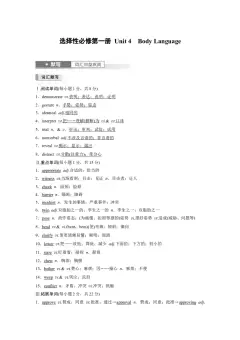
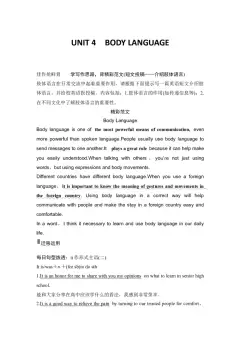
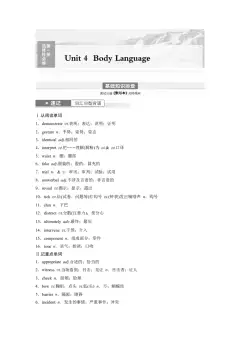
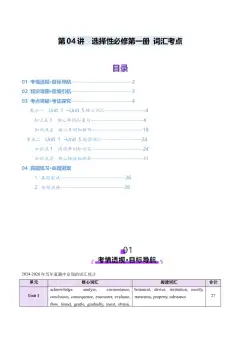
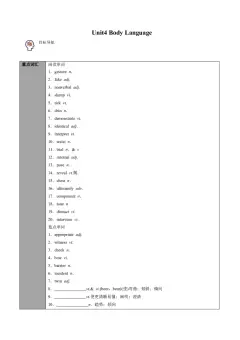
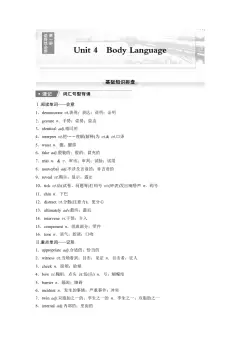
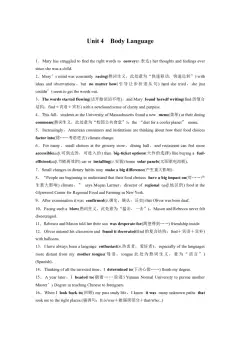
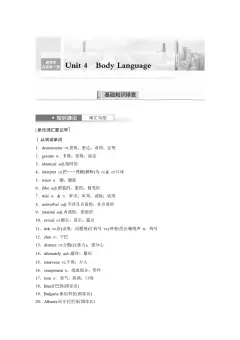
Unit4 Body Language
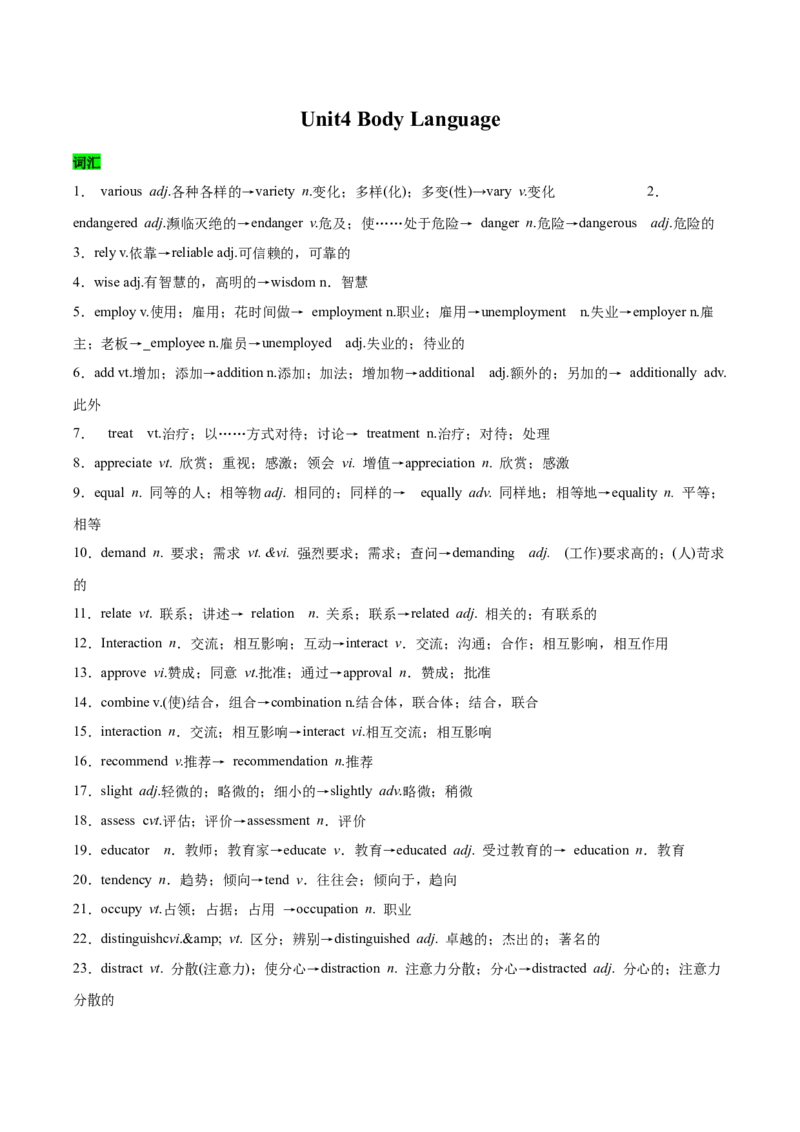
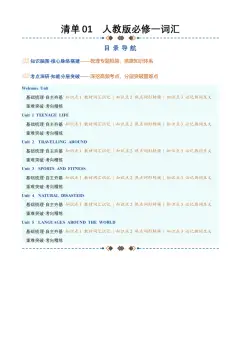
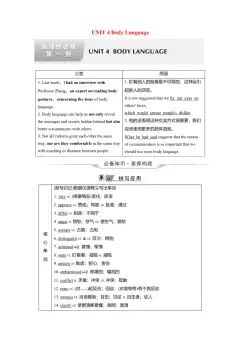
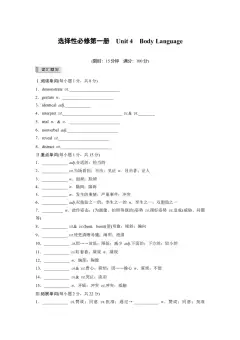
词汇
1. various adj.各种各样的→variety n.变化;多样(化);多变(性)→vary v.变化 2.
endangered adj.濒临灭绝的→endanger v.危及;使……处于危险→ danger n.危险→dangerous adj.危险的
3.rely v.依靠→reliable adj.可信赖的,可靠的
4.wise adj.有智慧的,高明的→wisdom n.智慧
5.employ v.使用;雇用;花时间做→ employment n.职业;雇用→unemployment n.失业→employer n.雇
主;老板→ employee n.雇员→unemployed adj.失业的;待业的
6.add vt.增加;添加→addition n.添加;加法;增加物→additional adj.额外的;另加的→ additionally adv.
此外
7. treat vt.治疗;以……方式对待;讨论→ treatment n.治疗;对待;处理
8.appreciate vt. 欣赏;重视;感激;领会 vi. 增值→appreciation n. 欣赏;感激
9.equal n. 同等的人;相等物adj. 相同的;同样的→ equally adv. 同样地;相等地→equality n. 平等;
相等
10.demand n. 要求;需求 vt. &vi. 强烈要求;需求;查问→demanding adj. (工作)要求高的;(人)苛求
的
11.relate vt. 联系;讲述→ relation n. 关系;联系→related adj. 相关的;有联系的
12.Interaction n.交流;相互影响;互动→interact v.交流;沟通;合作;相互影响,相互作用
13.approve vi.赞成;同意 vt.批准;通过→approval n.赞成;批准
14.combine v.(使)结合,组合→combination n.结合体,联合体;结合,联合
15.interaction n.交流;相互影响→interact vi.相互交流;相互影响
16.recommend v.推荐→ recommendation n.推荐
17.slight adj.轻微的;略微的;细小的→slightly adv.略微;稍微
18.assess cvt.评估;评价→assessment n.评价
19.educator n.教师;教育家→educate v.教育→educated adj. 受过教育的→ education n.教育
20.tendency n.趋势;倾向→tend v.往往会;倾向于,趋向
21.occupy vt.占领;占据;占用 →occupation n. 职业
22.distinguishcvi.& vt. 区分;辨别→distinguished adj. 卓越的;杰出的;著名的
23.distract vt. 分散(注意力);使分心→distraction n. 注意力分散;分心→distracted adj. 分心的;注意力
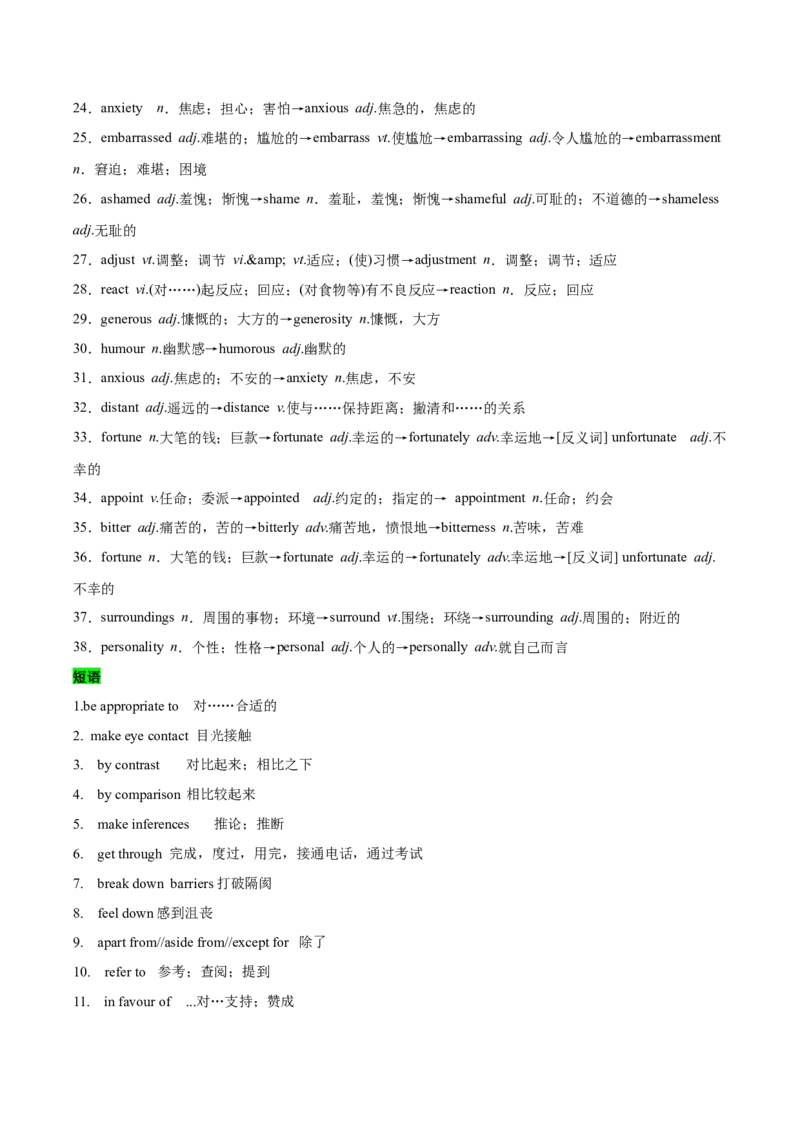
分散的24.anxiety n.焦虑;担心;害怕→anxious adj.焦急的,焦虑的
25.embarrassed adj.难堪的;尴尬的→embarrass vt.使尴尬→embarrassing adj.令人尴尬的→embarrassment
n.窘迫;难堪;困境
26.ashamed adj.羞愧;惭愧→shame n.羞耻,羞愧;惭愧→shameful adj.可耻的;不道德的→shameless
adj.无耻的
27.adjust vt.调整;调节 vi.& vt.适应;(使)习惯→adjustment n.调整;调节;适应
28.react vi.(对……)起反应;回应;(对食物等)有不良反应→reaction n.反应;回应
29.generous adj.慷慨的;大方的→generosity n.慷慨,大方
30.humour n.幽默感→humorous adj.幽默的
31.anxious adj.焦虑的;不安的→anxiety n.焦虑,不安
32.distant adj.遥远的→distance v.使与……保持距离;撇清和……的关系
33.fortune n.大笔的钱;巨款→fortunate adj.幸运的→fortunately adv.幸运地→[反义词] unfortunate adj.不
幸的
34.appoint v.任命;委派→appointed adj.约定的;指定的→ appointment n.任命;约会
35.bitter adj.痛苦的,苦的→bitterly adv.痛苦地,愤恨地→bitterness n.苦味,苦难
36.fortune n.大笔的钱;巨款→fortunate adj.幸运的→fortunately adv.幸运地→[反义词] unfortunate adj.
不幸的
37.surroundings n.周围的事物;环境→surround vt.围绕;环绕→surrounding adj.周围的;附近的
38.personality n.个性;性格→personal adj.个人的→personally adv.就自己而言
短语
1.be appropriate to 对……合适的
2. make eye contact 目光接触
3. by contrast 对比起来;相比之下
4. by comparison 相比较起来
5. make inferences 推论;推断
6. get through 完成,度过,用完,接通电话,通过考试
7. break down barriers打破隔阂
8. feel down感到沮丧
9. apart from//aside from//except for 除了
10. refer to 参考;查阅;提到
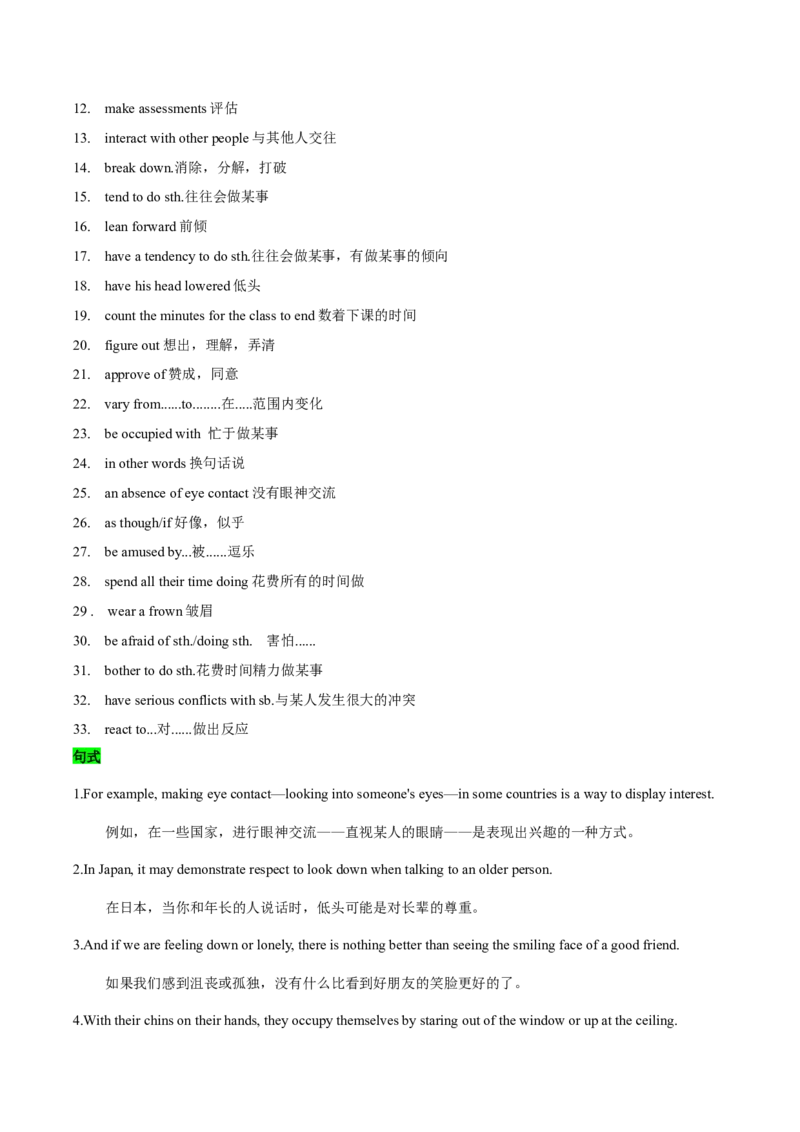
11. in favour of ...对…支持;赞成12. make assessments评估
13. interact with other people与其他人交往
14. break down.消除,分解,打破
15. tend to do sth.往往会做某事
16. lean forward前倾
17. have a tendency to do sth.往往会做某事,有做某事的倾向
18. have his head lowered低头
19. count the minutes for the class to end数着下课的时间
20. figure out想出,理解,弄清
21. approve of赞成,同意
22. vary from......to........在.....范围内变化
23. be occupied with 忙于做某事
24. in other words换句话说
25. an absence of eye contact没有眼神交流
26. as though/if好像,似乎
27. be amused by...被......逗乐
28. spend all their time doing花费所有的时间做
29 . wear a frown皱眉
30. be afraid of sth./doing sth. 害怕......
31. bother to do sth.花费时间精力做某事
32. have serious conflicts with sb.与某人发生很大的冲突
33. react to...对......做出反应
句式
1.For example, making eye contact—looking into someone's eyes—in some countries is a way to display interest.
例如,在一些国家,进行眼神交流——直视某人的眼睛——是表现出兴趣的一种方式。
2.In Japan, it may demonstrate respect to look down when talking to an older person.
在日本,当你和年长的人说话时,低头可能是对长辈的尊重。
3.And if we are feeling down or lonely, there is nothing better than seeing the smiling face of a good friend.
如果我们感到沮丧或孤独,没有什么比看到好朋友的笑脸更好的了。
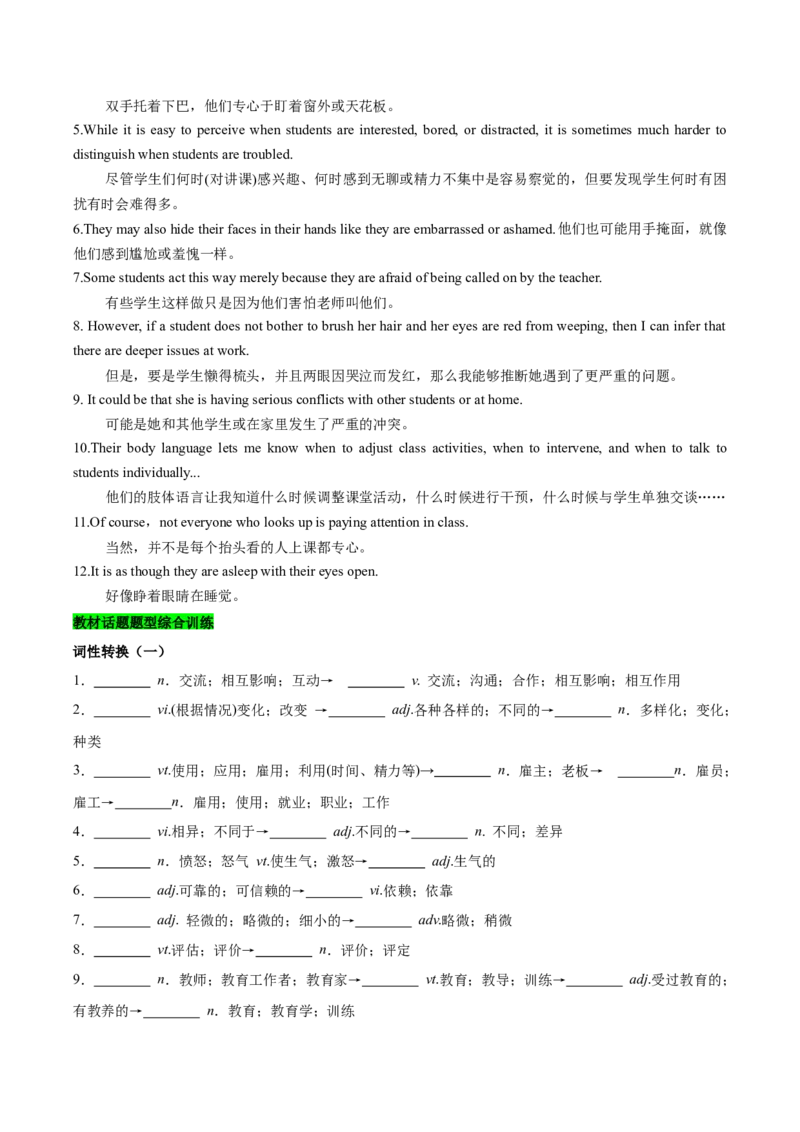
4.With their chins on their hands, they occupy themselves by staring out of the window or up at the ceiling.双手托着下巴,他们专心于盯着窗外或天花板。
5.While it is easy to perceive when students are interested, bored, or distracted, it is sometimes much harder to
distinguish when students are troubled.
尽管学生们何时(对讲课)感兴趣、何时感到无聊或精力不集中是容易察觉的,但要发现学生何时有困
扰有时会难得多。
6.They may also hide their faces in their hands like they are embarrassed or ashamed.他们也可能用手掩面,就像
他们感到尴尬或羞愧一样。
7.Some students act this way merely because they are afraid of being called on by the teacher.
有些学生这样做只是因为他们害怕老师叫他们。
8. However, if a student does not bother to brush her hair and her eyes are red from weeping, then I can infer that
there are deeper issues at work.
但是,要是学生懒得梳头,并且两眼因哭泣而发红,那么我能够推断她遇到了更严重的问题。
9. It could be that she is having serious conflicts with other students or at home.
可能是她和其他学生或在家里发生了严重的冲突。
10.Their body language lets me know when to adjust class activities, when to intervene, and when to talk to
students individually...
他们的肢体语言让我知道什么时候调整课堂活动,什么时候进行干预,什么时候与学生单独交谈……
11.Of course,not everyone who looks up is paying attention in class.
当然,并不是每个抬头看的人上课都专心。
12.It is as though they are asleep with their eyes open.
好像睁着眼睛在睡觉。
教材话题题型综合训练
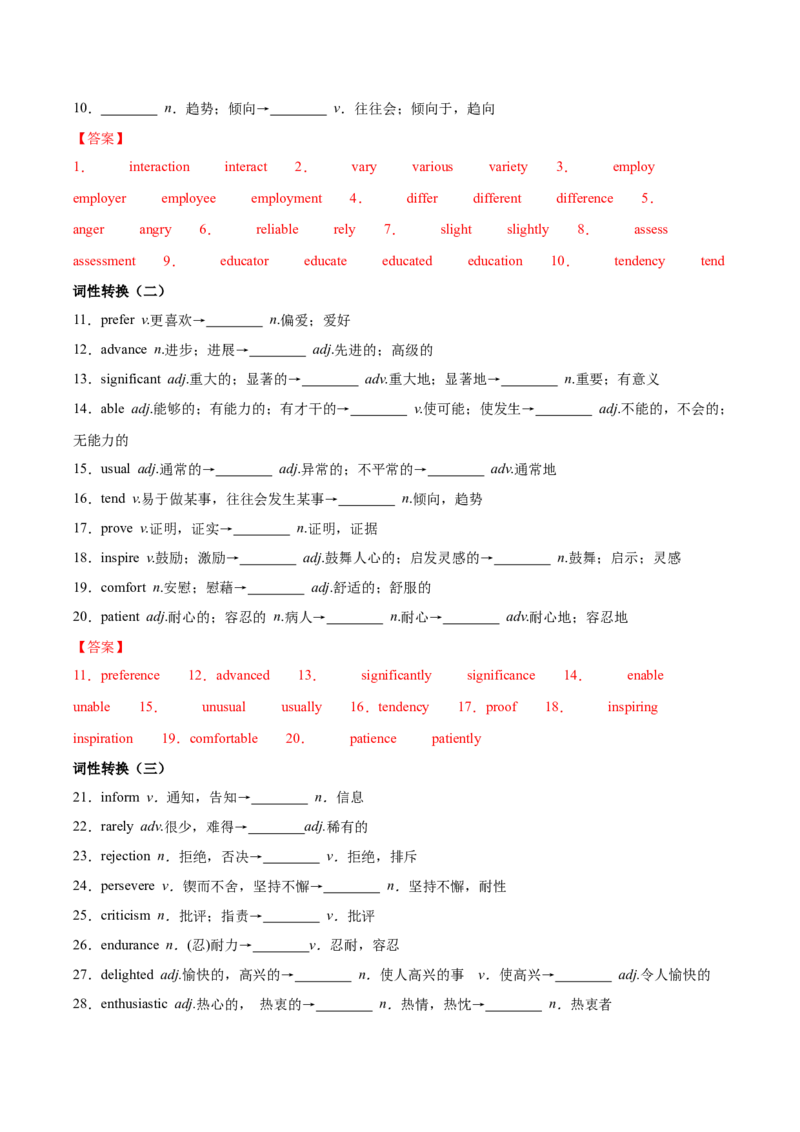
词性转换(一)
1. n.交流;相互影响;互动→ v. 交流;沟通;合作;相互影响;相互作用
2. vi.(根据情况)变化;改变 → adj.各种各样的;不同的→ n.多样化;变化;
种类
3. vt.使用;应用;雇用;利用(时间、精力等)→ n.雇主;老板→ n.雇员;
雇工→ n.雇用;使用;就业;职业;工作
4. vi.相异;不同于→ adj.不同的→ n. 不同;差异
5. n.愤怒;怒气 vt.使生气;激怒→ adj.生气的
6. adj.可靠的;可信赖的→ vi.依赖;依靠
7. adj. 轻微的;略微的;细小的→ adv.略微;稍微
8. vt.评估;评价→ n.评价;评定
9. n.教师;教育工作者;教育家→ vt.教育;教导;训练→ adj.受过教育的;
有教养的→ n.教育;教育学;训练10. n.趋势;倾向→ v.往往会;倾向于,趋向
【答案】
1. interaction interact 2. vary various variety 3. employ
employer employee employment 4. differ different difference 5.
anger angry 6. reliable rely 7. slight slightly 8. assess
assessment 9. educator educate educated education 10. tendency tend
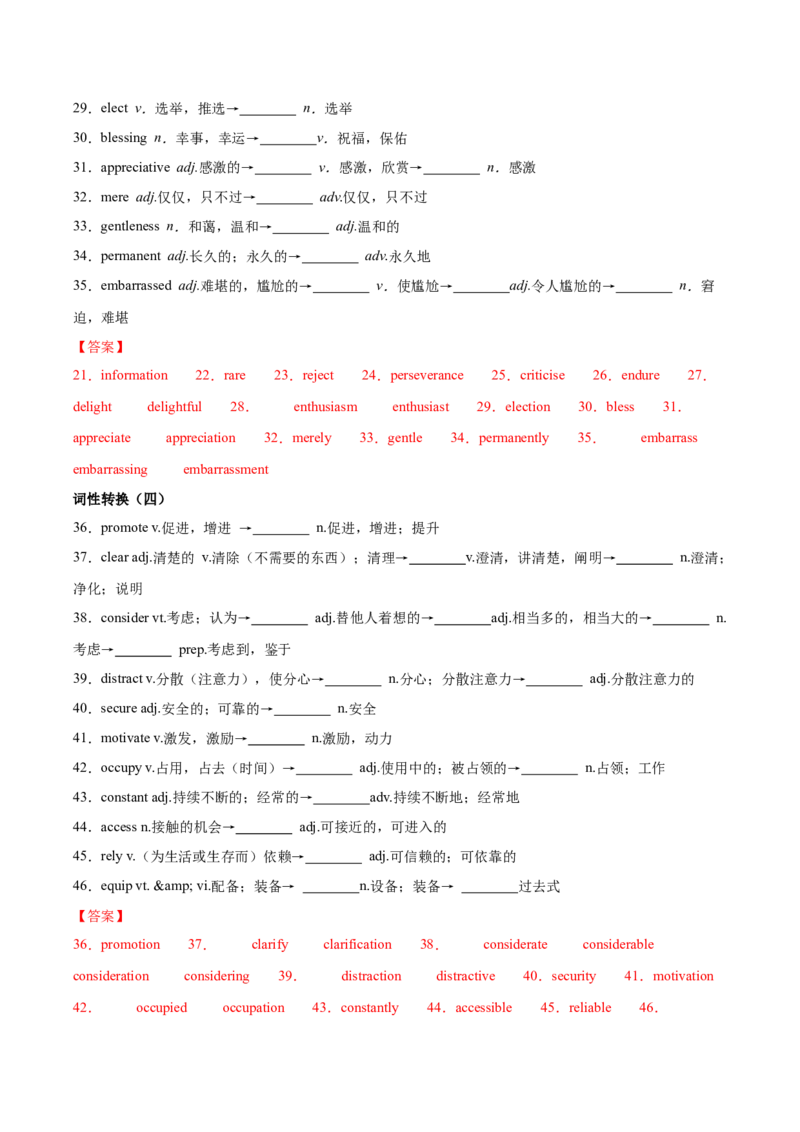
词性转换(二)
11.prefer v.更喜欢→ n.偏爱;爱好
12.advance n.进步;进展→ adj.先进的;高级的
13.significant adj.重大的;显著的→ adv.重大地;显著地→ n.重要;有意义
14.able adj.能够的;有能力的;有才干的→ v.使可能;使发生→ adj.不能的,不会的;
无能力的
15.usual adj.通常的→ adj.异常的;不平常的→ adv.通常地
16.tend v.易于做某事,往往会发生某事→ n.倾向,趋势
17.prove v.证明,证实→ n.证明,证据
18.inspire v.鼓励;激励→ adj.鼓舞人心的;启发灵感的→ n.鼓舞;启示;灵感
19.comfort n.安慰;慰藉→ adj.舒适的;舒服的
20.patient adj.耐心的;容忍的 n.病人→ n.耐心→ adv.耐心地;容忍地
【答案】
11.preference 12.advanced 13. significantly significance 14. enable
unable 15. unusual usually 16.tendency 17.proof 18. inspiring
inspiration 19.comfortable 20. patience patiently
词性转换(三)
21.inform v.通知,告知→ n.信息
22.rarely adv.很少,难得→ adj.稀有的
23.rejection n.拒绝,否决→ v.拒绝,排斥
24.persevere v.锲而不舍,坚持不懈→ n.坚持不懈,耐性
25.criticism n.批评;指责→ v.批评
26.endurance n.(忍)耐力→ v.忍耐,容忍
27.delighted adj.愉快的,高兴的→ n.使人高兴的事 v.使高兴→ adj.令人愉快的
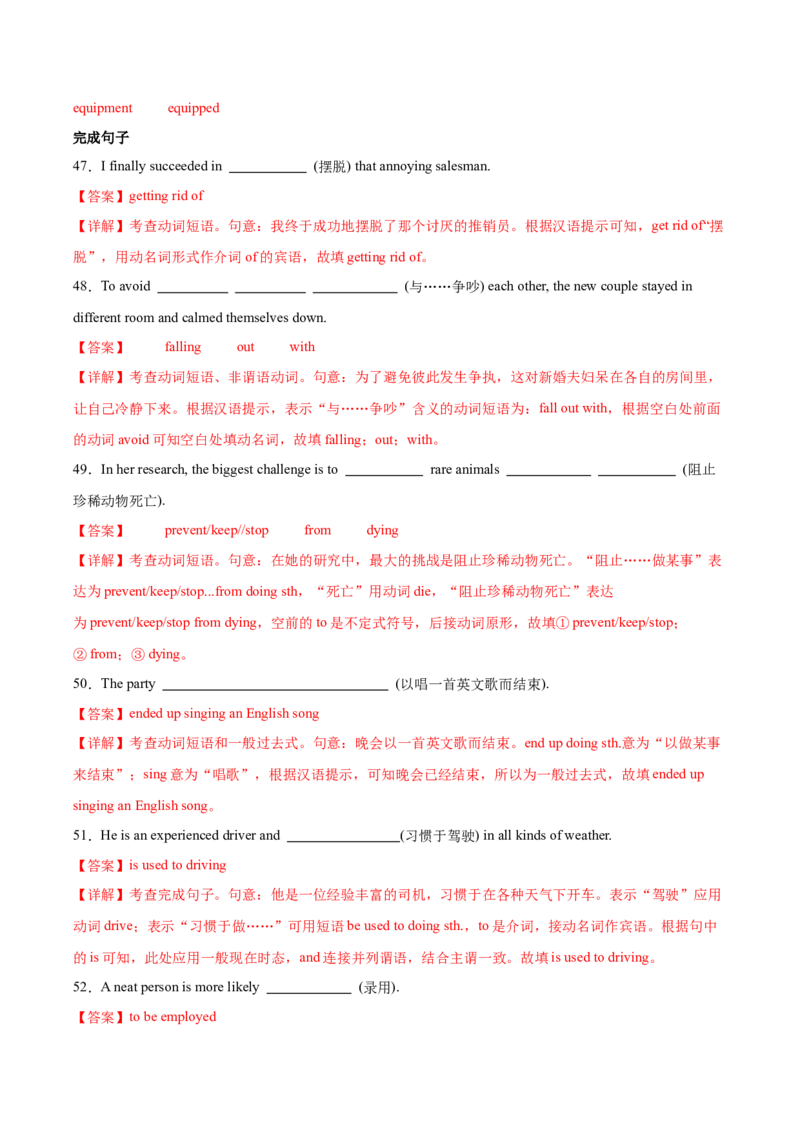
28.enthusiastic adj.热心的, 热衷的→ n.热情,热忱→ n.热衷者29.elect v.选举,推选→ n.选举
30.blessing n.幸事,幸运→ v.祝福,保佑
31.appreciative adj.感激的→ v.感激,欣赏→ n.感激
32.mere adj.仅仅,只不过→ adv.仅仅,只不过
33.gentleness n.和蔼,温和→ adj.温和的
34.permanent adj.长久的;永久的→ adv.永久地
35.embarrassed adj.难堪的,尴尬的→ v.使尴尬→ adj.令人尴尬的→ n.窘
迫,难堪
【答案】
21.information 22.rare 23.reject 24.perseverance 25.criticise 26.endure 27.
delight delightful 28. enthusiasm enthusiast 29.election 30.bless 31.
appreciate appreciation 32.merely 33.gentle 34.permanently 35. embarrass
embarrassing embarrassment
词性转换(四)
36.promote v.促进,增进 → n.促进,增进;提升
37.clear adj.清楚的 v.清除(不需要的东西);清理→ v.澄清,讲清楚,阐明→ n.澄清;
净化;说明
38.consider vt.考虑;认为→ adj.替他人着想的→ adj.相当多的,相当大的→ n.
考虑→ prep.考虑到,鉴于
39.distract v.分散(注意力),使分心→ n.分心;分散注意力→ adj.分散注意力的
40.secure adj.安全的;可靠的→ n.安全
41.motivate v.激发,激励→ n.激励,动力
42.occupy v.占用,占去(时间)→ adj.使用中的;被占领的→ n.占领;工作
43.constant adj.持续不断的;经常的→ adv.持续不断地;经常地
44.access n.接触的机会→ adj.可接近的,可进入的
45.rely v.(为生活或生存而)依赖→ adj.可信赖的;可依靠的
46.equip vt. & vi.配备;装备→ n.设备;装备→ 过去式
【答案】
36.promotion 37. clarify clarification 38. considerate considerable
consideration considering 39. distraction distractive 40.security 41.motivation
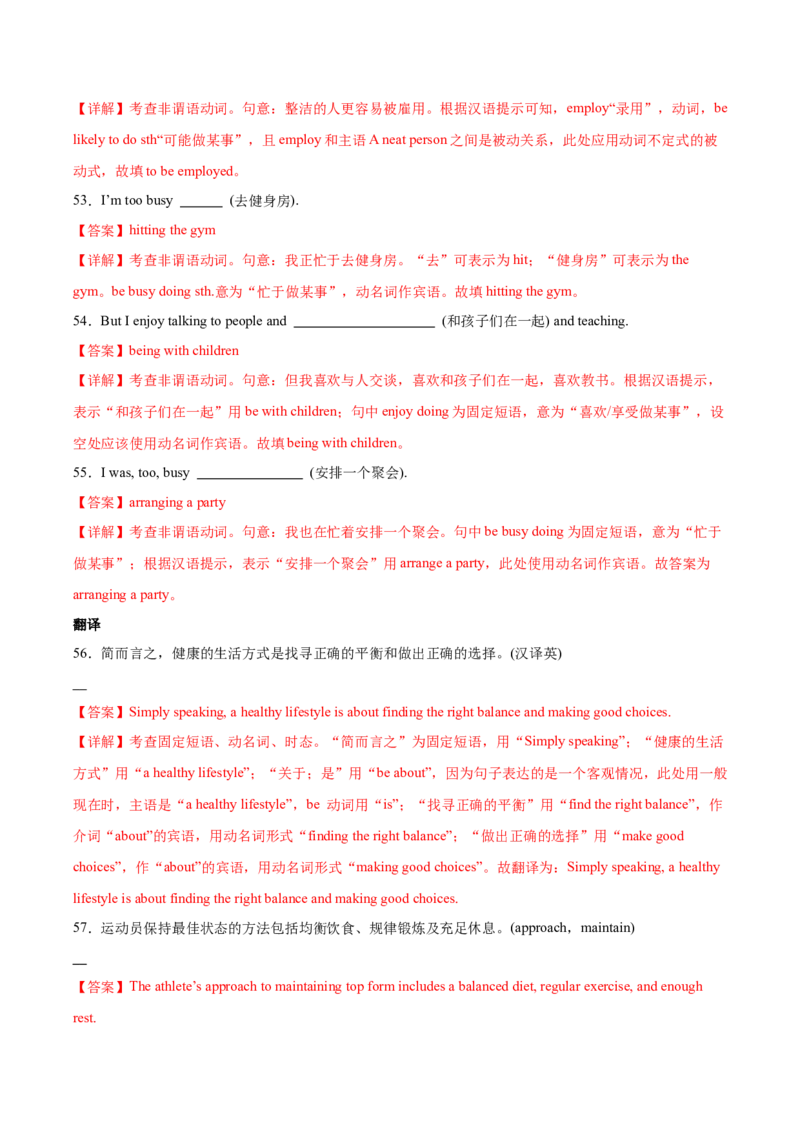
42. occupied occupation 43.constantly 44.accessible 45.reliable 46.equipment equipped
完成句子
47.I finally succeeded in (摆脱) that annoying salesman.
【答案】getting rid of
【详解】考查动词短语。句意:我终于成功地摆脱了那个讨厌的推销员。根据汉语提示可知,get rid of“摆
脱”,用动名词形式作介词of的宾语,故填getting rid of。
48.To avoid (与……争吵) each other, the new couple stayed in
different room and calmed themselves down.
【答案】 falling out with
【详解】考查动词短语、非谓语动词。句意:为了避免彼此发生争执,这对新婚夫妇呆在各自的房间里,
让自己冷静下来。根据汉语提示,表示“与……争吵”含义的动词短语为:fall out with,根据空白处前面
的动词avoid可知空白处填动名词,故填falling;out;with。
49.In her research, the biggest challenge is to rare animals (阻止
珍稀动物死亡).
【答案】 prevent/keep//stop from dying
【详解】考查动词短语。句意:在她的研究中,最大的挑战是阻止珍稀动物死亡。“阻止……做某事”表
达为prevent/keep/stop...from doing sth,“死亡”用动词die,“阻止珍稀动物死亡”表达
为prevent/keep/stop from dying,空前的to是不定式符号,后接动词原形,故填①prevent/keep/stop;
②from;③dying。
50.The party (以唱一首英文歌而结束).
【答案】ended up singing an English song
【详解】考查动词短语和一般过去式。句意:晚会以一首英文歌而结束。end up doing sth.意为“以做某事
来结束”;sing意为“唱歌”,根据汉语提示,可知晚会已经结束,所以为一般过去式,故填ended up
singing an English song。
51.He is an experienced driver and (习惯于驾驶) in all kinds of weather.
【答案】is used to driving
【详解】考查完成句子。句意:他是一位经验丰富的司机,习惯于在各种天气下开车。表示“驾驶”应用
动词drive;表示“习惯于做……”可用短语be used to doing sth.,to是介词,接动名词作宾语。根据句中
的is可知,此处应用一般现在时态,and连接并列谓语,结合主谓一致。故填is used to driving。
52.A neat person is more likely (录用).
【答案】to be employed【详解】考查非谓语动词。句意:整洁的人更容易被雇用。根据汉语提示可知,employ“录用”,动词,be
likely to do sth“可能做某事”,且employ和主语A neat person之间是被动关系,此处应用动词不定式的被
动式,故填to be employed。
53.I’m too busy (去健身房).
【答案】hitting the gym
【详解】考查非谓语动词。句意:我正忙于去健身房。“去”可表示为hit;“健身房”可表示为the
gym。be busy doing sth.意为“忙于做某事”,动名词作宾语。故填hitting the gym。
54.But I enjoy talking to people and (和孩子们在一起) and teaching.
【答案】being with children
【详解】考查非谓语动词。句意:但我喜欢与人交谈,喜欢和孩子们在一起,喜欢教书。根据汉语提示,
表示“和孩子们在一起”用be with children;句中enjoy doing为固定短语,意为“喜欢/享受做某事”,设
空处应该使用动名词作宾语。故填being with children。
55.I was, too, busy (安排一个聚会).
【答案】arranging a party
【详解】考查非谓语动词。句意:我也在忙着安排一个聚会。句中be busy doing为固定短语,意为“忙于
做某事”;根据汉语提示,表示“安排一个聚会”用arrange a party,此处使用动名词作宾语。故答案为
arranging a party。
翻译
56.简而言之,健康的生活方式是找寻正确的平衡和做出正确的选择。(汉译英)
【答案】Simply speaking, a healthy lifestyle is about finding the right balance and making good choices.
【详解】考查固定短语、动名词、时态。“简而言之”为固定短语,用“Simply speaking”;“健康的生活
方式”用“a healthy lifestyle”;“关于;是”用“be about”,因为句子表达的是一个客观情况,此处用一般
现在时,主语是“a healthy lifestyle”,be 动词用“is”;“找寻正确的平衡”用“find the right balance”,作
介词“about”的宾语,用动名词形式“finding the right balance”;“做出正确的选择”用“make good
choices”,作“about”的宾语,用动名词形式“making good choices”。故翻译为:Simply speaking, a healthy
lifestyle is about finding the right balance and making good choices.
57.运动员保持最佳状态的方法包括均衡饮食、规律锻炼及充足休息。(approach,maintain)
【答案】The athlete’s approach to maintaining top form includes a balanced diet, regular exercise, and enough
rest.【详解】考查短语、时态和非谓语动词。“运动员”翻译为athlete;“……的方法”用短语approach to,
to为介词,后接动名词形式;“保持最佳状态”翻译为maintain top form;“包括”用动词form;“均衡
饮食”翻译为 balanced diet;“规律锻炼”翻译为 regular exercise;“充足休息”翻译为enough rest。陈
述客观事实,用一般现在时。主语是The athlete’s approach,谓语动词用第三人称单数形式。故翻译为The
athlete’s approach to maintaining top form includes a balanced diet, regular exercise, and enough rest.
58.她没有像大多数的女孩那样走上婚姻这一传统道路,而是选择了学医。
【答案】Instead of following the traditional path of marriage like the majority of girls, she chose to study
medicine.
【详解】考查固定搭配、非谓语动词、形容词、名词、时态。表示“而不是”用instead of。表示“跟随,
遵循”用follow,用动名词形式,作Instead of的宾语。表示“传统的”用形容词traditional,作前置定语,
修饰名词“道路”,表示“道路”用名词path,此处为特指,path前加the。表示“婚姻”用名词
marriage,the traditional path of marriage作following的宾语。表示“像”用介词like。表示“大多数”用固
定搭配the majority of。表示“女孩”用girl,根据“大多数的女孩”可知,用复数形式girls。表示“她”
用she,作主语。表示“选择”用choose,本句描述过去的动作,故时态用一般过去时,谓语用过去式
chose,choose to do sth. (选择做某事)。表示“学习”用study,用不定式,作chose的宾语。表示“医学”
用medicine,作study的宾语。故翻译为Instead of following the traditional path of marriage like the majority of
girls, she chose to study medicine.
59.在做评论前,你最好想清楚要说什么。(prior to)
【答案】Prior to making comments, you’d better think twice about what to say.
【详解】考查固定短语,动名词,名词,情态动词,介词,疑问词,动词不定式。表示“在……”之前用
prior to,此处的to为介词,其后加动名词;“评论”为comment;“作出评论”为make comments,所以
前面翻译为Prior to making comments。表示“最好要做某事”为had better do sth.,“思考”为think,“想
清楚”为think twice;“什么”用what,what+to do表示“要做什么”;“关于”用about,所以后半句翻
译为you’d better think twice about what to say。故答案为Prior to making comments, you’d better think twice
about what to say.
60.让你找到工作的是智商,但让你升职的是情商。(用强调句型)
【答案】It is IQ that gets you employed, but it is EQ that gets you promoted.【详解】考查强调句型、名词和动词。句子叙述客观事实,时态宜用一般现在时。结合题干要求,可用强
调句型It is... that...来分别强调两个主语“智商”和“情商”。第一句中被强调的主语“智商”IQ,为单数,
“让你找到工作”可理解为“让你被雇佣”,可用动词短语get you employed,过去分词employed表被动
意义,主语是单数,谓语动词使用第三人称单数形式gets;第二句中被强调的主语“智商”EQ,为单数,
“让你升职”即“让你被晋升”,可用动词短语get you promoted,过去分词promoted表被动意义,主语
是单数,谓语动词使用第三人称单数形式gets;两个句子之间用意为“但(是)”的连词but连接。故翻
译为It is IQ that gets you employed, but it is EQ that gets you promoted.
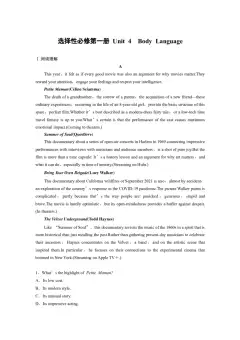
阅读理解
People often say your feelings are “written all over your face” because our facial expressions are a main way
we communicate emotions. Now according to a recent research led by Patty Van Cappellen of Duke University,
besides our faces, our body posture (姿势) also plays a role.
In one study, Van Cappellen and her colleagues asked a group of participants to show four faceless
mannequins (人体模型) in postures that represented four different emotions: dominance (支配), joy, hope and
respect. The research assistants then looked at photos of the mannequins that participants had created and assessed
their head positions, arm positions, and degrees of expansiveness — how much space they took up by standing
straight or opening up different parts of their bodies. Then, the researchers compared these positions to the feelings
they supposedly expressed.
Van Cappellen found that people viewed an expansive posture as representing dominance. But joy and
respect were also represented by expansive postures, with hope involving the least expansive posture. “We’re
finding that positive emotions are also marked by expansiveness — especially joy,” she says.
Besides, arm and head positions also mattered. For example, joyful postures were described by arms raised
above the head, while respectful postures showed hands touching the face. Dominant postures, on the other hand,
tended to show arms akimbo (双手叉腰) with the head facing forward.
To know if other people seeing the mannequins could recognize the feelings being expressed by different
postures, Van Cappellen had a new group of participants look at photos of mannequins posed in many different
ways. The participants found that expansive postures with arms held high represented positive emotion — with
arms akimbo representing dominance and negative emotion.
Her research suggests that our body posture helps express our emotions and may help us feel certain
emotions, too. This could be consequential — not just in the lab, but in real life, where it’s useful to know how we
and other people are feeling in a certain situation.61.Which emotion is most probably expressed by the least expansive posture?
A.Dominance. B.Joy. C.Hope. D.Respect.
62.What does a man tend to do when he feels happy according to the text?
A.Hold his arms high. B.Touch his face.
C.Have his arms crossed. D.Shake his head.
63.Why did Van Cappellen have new participants look at the photos of mannequins?
A.To find why the participants showed the different feelings.
B.To know how people communicate with facial expressions.
C.To figure out what different body postures may represent.
D.To see if others can feel the same about the body postures.
64.What does the underlined word “consequential” in the last paragraph probably mean?
A.Embarrassing. B.Important. C.Flexible. D.Unusual.
【答案】61.C 62.A 63.D 64.B
【导语】本文是一篇说明文。文章讲述了除了面部表情,我们的身体姿势也在情感表达中扮演重要角色。
61.细节理解题。根据第三段“Van Cappellen found that people viewed an expansive posture as representing
dominance. But joy and respect were also represented by expansive postures, with hope involving the least
expansive posture. “We’re finding that positive emotions are also marked by expansiveness — especially joy,” she
says.(范·卡佩伦发现,人们认为舒展的姿势代表着支配地位。但喜悦和尊重也表现在舒展的姿势上,而希
望则表现在最不舒展的姿势上。“我们发现,积极的情绪也以广泛性为特征——尤其是快乐,”她说)”可
知,表达希望之感时,人的身体伸展的空间最小。故选C项。
62.细节理解题,根据第四段“Besides, arm and head positions also mattered. For example, joyful postures
were described by arms raised above the head, while respectful postures showed hands touching the face. Dominant
postures, on the other hand, tended to show arms akimbo (双手叉腰) with the head facing forward.(此外,手臂和
头的位置也很重要。例如,快乐的姿势被描述为手臂举过头顶,而恭敬的姿势则是双手触摸脸部。另一方
面,优势姿势倾向于双臂叉腰,头部朝前)”可知,当一个人感到快乐时,倾向于把手高高举起。故选A项。
63.细节理解题。根据第五段“To know if other people seeing the mannequins could recognize the feelings
being expressed by different postures, Van Cappellen had a new group of participants look at photos of mannequins
posed in many different ways. The participants found that expansive postures with arms held high represented
positive emotion — with arms akimbo representing dominance and negative emotion.(为了了解其他人看到人体
模型是否能识别出不同姿势所表达的情感,范·卡佩伦让一组新的参与者看不同姿势的人体模型的照片。参
与者发现手臂高举的伸展姿势代表积极的情绪,手臂叉腰的姿势代表支配和消极的情绪)”可知,VanCappellen让新的参与者观看人体模型照片是想知晓其他人能否对肢体语言感同身受。故选D项。
64.词句猜测题。根据后文“where it’s useful to know how we and other people are feeling in a certain
situation.(了解我们和其他人在特定情况下的感受是很有用的)”可知,这种技能是有用的,也就是重要的。
由此推知,consequential意为“重要的”,和B项意思相近。故选B项。
七选五
If you struggle to meet new people or join in a conversation at social events, it might be that your body
language is sending the message to others to stay away. 65 ? Below are some tips to get you started.
Smile. Although it is possible to overdo smiling, generally it is better to smile than frown (皱眉). Try to find
things that really make you happy or laugh and your smile will come across as natural rather than forced.
66 . Make sure that you aren’t using objects to shield (遮住) yourself from others. At a party, hold
your drink at your side instead of close to your chest (胸膛). Keeping objects between you and others makes you
appear guarded and closed.
Use eye contact. When you do end up talking with someone, be sure to maintain eye contact. Avoiding eye
contact makes you appear untrustworthy or disinterested. If direct eye contact feels hard, try looking at only one
eye at a time, or at a part between a person’s eyes. 67
Avoid nervous habits. Even though you might be nervous, avoid the habits that go with it. 68 .
Don’t play with your pen or the change in your pocket. Keep your hands relaxed at your sides or use them to
gesture (做手势) when making conversation.
69 . Say nice things about other people instead of mean things. Approach others and include those
who seem to be left out. Be a positive person and you will attract other positive people to you.
Although it may feel unnatural at first, with time you should start to feel more open and confident as a result
of changing your body language.
A.Avoid blocks
B.Use objects on hand
C.They won’t be able to tell the difference
D.Apart from body language, always be positive
E.Stop touching your face or playing with your hair
F.How can you read different types of body language properly
G.How can you improve your body language to appear more approachable
【答案】65.G 66.A 67.C 68.E 69.D
【导语】这是一篇说明文。文章主要介绍了一些改善肢体语言以显得更平易近人的方法。65.根据上文“If you struggle to meet new people or join in a conversation at social events, it might be that your
body language is sending the message to others to stay away.(如果你在社交场合很难结识新朋友或加入对话,
可能是你的肢体语言向别人传达了远离的信息)”可知,上文提出了在社交场合中肢体语言可能会给人留下
不好的印象这一问题。下文“Below are some tips to get you started.(以下是一些让你开始的建议)”则提出了
一些改善肢体语言的建议。G 选项“How can you improve your body language to appear more
approachable(如何改善你的肢体语言,让自己看起来更平易近人)”位于段中,承上启下,既承接上文提到
的肢体语言给人留下不好印象的问题,又引出下文改善肢体语言的建议。故选G。
66.根据下文“Make sure that you aren’t using objects to shield (遮住) yourself from others. At a party, hold
your drink at your side instead of close to your chest (胸膛). Keeping objects between you and others makes you
appear guarded and closed.(确保你没有用物品来遮住自己不被他人看到。在聚会上,把你的饮料放在你身边,
而不是靠近你的胸部。在你和其他人之间放东西会让你显得有戒心和封闭)”可知下文说明在社交场合中要
避免用物品隔开自己和他人,要保持开放的姿态。A 选项“Avoid blocks (避免阻隔)”位于段首,对下文起
总结概括的作用,且与后文的“shield(遮住)”和“guarded and closed”相呼应。故选A。
67.根据上文“If direct eye contact feels hard, try looking at only one eye at a time, or at a part between a
person’s eyes.(如果直接的眼神交流感觉很难,试着一次只看一只眼睛,或者看一个人的眼睛之间的部分)”
可知,上文建议在与人交谈时,如果感觉直接的眼神交流困难,可以采取的方式。C 选项“They won’t be
able to tell the difference (他们不会看出区别的)”则说明即使没有直接的眼神交流,别人也不会察觉,与上文
构成因果关系。故选C。
68.根据上文“Even though you might be nervous, avoid the habits that go with it.(尽管你可能会紧张,但要避
免随之而来的习惯)”可知上文提到要避免紧张时的习惯。E 选项“Stop touching your face or playing with
your hair (停止触摸你的脸或玩弄你的头发)”是具体的紧张时的习惯,对上文起举例说明的作用。故选E。
69.根据下文“Say nice things about other people instead of mean things. Approach others and include those who
seem to be left out. Be a positive person and you will attract other positive people to you.(说别人的好话而不是刻
薄的话。接近他人,包括那些似乎被忽视的人。做一个积极的人,你会吸引其他积极的人)”可知下文建议
要做一个积极的人,多说别人的好话。D 选项“Apart from body language, always be positive (除了肢体语言,
永远要积极)”位于段首,对下文起总结概括的作用,且positive与后文的nice和positive相呼应。故选D。
完形填空
“Hi! How are you?” A woman smiled as she took the seat beside me. She had to lower herself slowly,
squeezing her fat body into the seat, 70 all available space. I moved a little towards the window, feeling
worried silently about the long hours of 71 I was going to experience with this monster (怪物) beside me.She said, “My name is Laura. I’m from Britain. If we’re going to spend six hours side by side on this 72
, we’d better be friends.” Then she started a conversation with me and didn’t take notice of my unfriendly reactions.
She talked 73 about herself and her trip to Hong Kong.
I gave her one-word answers to her questions about me. Not affected by my coldness, she nodded as she made
74 about my answers. She was warm and considerate, making sure that I had room to stretch in my seat. I
couldn’t help but let down my 75 slowly. Laura was an interesting conversationalist. During our
conversation, Laura 76 to make every crew member on the plane who 77 us walk away laughing at
her jokes.
I asked Laura, “Have you ever 78 losing some weight?” “No. I don’t trust the advertisements from
slimming centres at all.” “You aren’t worried about the diseases that come with being overweight?” “Not at all. You
only 79 the diseases if you’re worried about your weight all the time. I eat 80 and walk
regularly: I’m this size 81 I was born to be big! There is more to life than worrying about weight all day
long.” She drank her wine. “Besides, God gave me so much happiness that I need a 82 body to hold all
of it! Why would I lose weight to lose my happiness?”
83 by her unusual reasoning, I smiled. I suddenly 84 that Laura was the most beautiful
woman I had ever met in my life.
70.A.finding B.making C.filling D.clearing
71.A.noise B.discomfort C.silence D.tiredness
72.A.bus B.train C.flight D.ship
73.A.nervously B.angrily C.sadly D.excitedly
74.A.notes B.comments C.predictions D.conclusions
75.A.attention B.attitude C.idea D.guard
76.A.managed B.pretended C.forgot D.failed
77.A.charged B.blamed C.served D.warned
78.A.suffered from B.cared about C.benefited from D.thought about
79.A.control B.get C.own D.remove
80.A.slowly B.hardly C.healthily D.probably
81.A.if B.because C.though D.until
82.A.bigger B.thinner C.lower D.longer
83.A.Worried B.Upset C.Surprised D.Frightened
84.A.proved B.imagined C.realised D.remembered【答案】
70.C 71.B 72.C 73.D 74.B 75.D 76.A 77.C 78.D 79.B
80.C 81.B 82.A 83.C 84.C
【导语】本文是一篇记叙文,主要讲述了作者搭乘飞机时身旁坐了一个肥胖的女士,一开始作者很担心自
己接下来要忍受长时间的不适,对肥胖女士的话也只是冷漠回应,但渐渐地作者被她感染了,她关于自己
身材的言论让作者意识到她心灵的美丽。
70.考查动词词义辨析。句意:她不得不慢慢地把自己放低,把她肥胖的身体挤到座位上,填满了所有可
用的空间。A. finding发现;B. making制造;C. filling(使)充满,装满,填满;D. clearing移走,搬走。
根据空前的“squeezing her fat body into the seat”,这个女人太胖了,自己肥胖的身躯要占据所有可用的位
置。故选C。
71.考查名词词义辨析。句意:我向窗户移了一点,默默地为要和我身边的这个怪物一起经历的长时间的
不适感到担忧。A. noise噪音;B. discomfort不适,不舒服;C. silence沉默;D. tiredness疲惫。根据上文对
女士肥胖的描写和句中的“feeling worried silently”可知,作者要和这位肥胖的女士一起坐很久,这会影响
作者的舒适体验,所以作者为此担心。故选B。
72.考查名词词义辨析。句意:如果我们要在这架飞机上并肩度过六个小时,我们最好做朋友。A. bus公
共汽车;B. train火车;C. flight飞机;D. ship船。根据下文中的“every crew member on the plane”可知,他
们搭乘的是飞机。故选C。
73.考查副词词义辨析。句意:她兴奋地谈论着自己和香港之行。A. nervously紧张地;B. angrily生气地;
C. sadly悲伤地;D. excitedly兴奋地。根据下文中的“Laura was an interesting conversationalist.(劳拉是个有
趣的健谈者。)”,Laura是个有趣的健谈者,她聊起天来非常兴奋。故选D。
74.考查名词词义辨析。句意:她没有被我的冷漠影响,一边点点头,一边评论我的回答。A. notes笔记;
B. comments评论;C. predictions预测;D. conclusions结论。根据句中的“Not affected by my coldness”和空
后的“about my answers”,Laura没有被作者的冷漠影响,对作者的回答还会做出评论。故选B。
75.考查名词词义辨析。句意:我忍不住慢慢放松了警惕。A. attention注意;B. attitude态度;C. idea想法;
D. guard警戒,保护。根据后句的“Laura was an interesting conversationalist. (劳拉是个有趣的健谈者。)”可
知,她是一个有趣且善谈的人,作者慢慢地放松了警惕。故选D。
76.考查动词词义辨析。句意:在我们的谈话中,Laura设法让飞机上为我们服务的每一位机组人员都为
她的笑话大笑着离开了。A. managed勉励完成,设法做到;B. pretended假装;C. forgot忘记;D. failed失
败。根据句中的“walk away laughing at her jokes”,这个女人能够使每个人笑。故选A。
77.考查动词词义辨析。句意参考上题。A. charged收费;B. blamed责怪;C. served服务;D. warned警告。根据空前的“every crew member on the plane”,这里是为作者他们服务的机组人员,故选C。
78.考查动词短语辨析。句意:你有没有想过减肥?A. suffered from遭受;B. cared about关心;C.
benefited from从……受益;D. thought about考虑。根据女士的回答“No. I don’t trust the advertisements from
slimming centres at all. (不,我根本不相信减肥中心的广告。)”,作者询问女士有没有考虑过减肥。故选
D。
79.考查动词词义辨析。句意:只有当你一直担心自己的体重时,你才会患病。A. control控制;B. get得
到,患上;C. own拥有;D. remove移开。根据作者前面的询问“You aren’t worried about the diseases that
come with being overweight? (你不担心超重带来的疾病吗?)”,这里是说患病。故选B。
80.考查副词词义辨析。句意:我吃得很健康,也定期散步:我这么胖是因为我生来就是胖!A. slowly缓
慢地;B. hardly几乎不;C. healthily健康地;D. probably可能地。根据and后的“walk regularly”,这里与
其并列,是说女士的饮食健康。故选C。
81.考查连词词义辨析。句意参考上题。A. if如果;B. because因为;C. though尽管;D. until直到……为
止。“I’m this size”和“I was born to be big”之间是因果关系,所以应用because引导原因状语从句。故选
B。
82.考查形容词词义辨析。句意:此外,上帝给了我如此多的快乐,我需要一个更大的身体来容纳所有的
快乐!A. bigger更大的;B. thinner更薄的;C. lower更低的;D. longer更长的。根据下文“Why would I
lose weight to lose my happiness? (为什么我会为了失去快乐而减肥?)”,这位女士不想减肥,因为她认为自
己需要更大的身体来容纳这么多的快乐。故选A。
83.考查形容词词义辨析。句意:她不同寻常的推理让我大吃一惊,我笑了。A. Worried担心的;B. Upset
沮丧的,心烦的;C. Surprised惊讶的;D. Frightened害怕的。根据句中的“unusual”,这位女士的观点不
同寻常,让作者感到惊讶。故选C。
84.考查动词词义辨析。句意:我突然意识到Laura是我一生中遇到过的最美丽的女人。A. proved证明;
B. imagined想象;C. realised意识到;D. remembered记得。根据空后的“that Laura was the most beautiful
woman I had ever met in my life”,Laura的言论让作者意识到她是自己见过的最美的女人,因为她心灵美。
故选C。
单句语法填空
85.UNESCO runs a programme that prevents world cultural heritage sites from (disappear).
【答案】disappearing
【详解】考查动名词。句意:联合国教科文组织实施了一项防止世界文化遗产消失的计划。分析句子可知,
这里考查prevent sth. from doing sth表“阻止某物做某事”,为固定搭配,再根据句意可知,这里是表示防止世界文化遗产“消失”,所以这里应用动名词disappearing,在本句中作介词后的宾语。故填
disappearing。
86. I appreciate (listen) to classical music, as it helps me focus and improves my reading experience.
【答案】listening
【详解】考查非谓语动词。句意:我喜欢听古典音乐,因为它能帮助我集中注意力,提高我的阅读体验。
appreciate doing sth为固定短语,意为“喜欢做某事”,故此处需用动名词作宾语,故填listening。
87.Even though they knew I didn’t speak Portuguese, that didn’t stop them from (talk) to me, and we
were able to communicate without a problem.
【答案】talking
【详解】考查动名词。句意:尽管他们知道我不会说葡萄牙语,但这并没有阻止他们与我交谈,我们能够
毫无问题地交流。分析句子结构,空处作非谓语动词,用于介词from之后,应用动名词形式作宾语。stop
sb. from doing sth.“阻止某人做某事”。故填talking。
88.He gave a lame excuse for (absent) which made him very embarrassed.
【答案】being absent
【详解】考查非谓语动词。句意:他找了个站不住脚的理由来解释缺席的原因,这使他很尴尬。be absent
表示缺席,且作介词for的宾语,应用动名词短语being absent,故填being absent。
89.He became interested in (collect) kites after he watched a documentary.
【答案】collecting
【详解】考查非谓语动词。句意:他看了一个纪录片之后就对收集风筝感兴趣了。become/be interested in
doing sth.意为“对做某事感兴趣”,介词in后应用动名词作宾语。故填collecting。
90.Look at the sign! “No (swim)”. You can't swim here.
【答案】swimming
【详解】考查动名词。句意:看那个标志!“禁止游泳”。你们不能在这里游泳。“No+doing”意为“禁止做
某事”。故填swimming。
91.I was too (embarrass) to admit that I was scared.
【答案】embarrassed
【详解】考查形容词。句意:我不好意思承认我当时很害怕。根据句意以及空前was系动词可知,此处为
形容词embarrassed“尴尬的”作表语,满足句意要求,为修饰主语I(指人)的-ed形容词形式。故填
embarrassed。
92.With the (raise) of standards of this school, more and more parents are trying their best to send their
children to study here.【答案】raising
【详解】考查非谓语动词。句意:随着这所学校标准的提高,越来越多的家长正竭尽全力把孩子送到这里
学习。本空用raise“提高”的动名词,作With的宾语。故填raising。
93.30% of American teenagers admit (lie) about their age to gain success to some websites.
【答案】lying
【详解】考查动名词。句意:30%的美国青少年承认为了成功访问某些网站而谎报他们的年龄。admit
doing sth.“承认做某事”,所以空处需要动名词的形式作宾语。故填lying。
94.On hearing the joke we couldn’t help (laugh).
【答案】laughing
【详解】考查非谓语。句意:听到这个笑话,我们忍不住笑了起来。分析句子可知,此空考查can’t help
doing sth表“忍不住做某事”,为固定短语,这里动名词作宾语。故填laughing。
95.She doesn’t like (label) as an incapable woman.
【答案】to be labeled/being labeled
【详解】考查非谓语动词。句意:她不喜欢被称之为无能的女人。此处为非谓语动词作宾语,根据like to
do sth.和like doing sth.意为“喜欢做某事”可知,此处使用不定式或动名词形式作宾语,且label与逻辑主
语she之间为被动关系,所以此处使用不定式或动名词的被动形式。故填to be labeled/being labeled。
96.I have never imagined there (be) such a good hotel in this town.
【答案】being
【详解】考查非谓语动词。句意:我从来没有想到这个镇上会有这么好的旅馆。作imagined的宾语,固定
短语imagine doing意为“想象做某事”,因此应用be的动名词形式,there being是there be句型的非限定
形式。故填being。
97.The film started attracting widespread attention even before (release) thanks to social media
discussions about it.
【答案】being released
【详解】考查动名词。句意:由于社交媒体上的讨论,这部电影在上映之前就已经引起了广泛的关注。此
空为非谓语动词作before的宾语,介词before后应为动名词形式作宾语,且逻辑主语The film与动词
release之间为逻辑上的被动关系,所以应用动名词的被动形式。故填being released。
98.The incident made it clear that the rat problem needed (solve)once and for all.
【答案】to be solved/solving
【详解】考查非谓语动词。句意:这一事件清楚地表明,老鼠问题需要一劳永逸地解决。need to be done
或need doing sth为固定短语,含义为“需要……”,符合句意,need doing中,动名词作宾语,主动形式表示被动意义。故填to be solved/solving。
99.For teenagers, some have learned how to use a sewing machine and made a couple of projects; some are
working on a social studies project which involves (construct) a family tree including researching
relatives alive in the 1800s.
【答案】constructing
【详解】考查非谓语动词。句意:对于青少年来说,有些人已经学会了如何使用缝纫机,并做了几个项目;
有些人正在从事社会研究项目,其中包括构建一个家谱,包括研究活在19世纪的亲属。空处位于which引
导的定语从句中,根据空前动词involves可知,空处作involves的宾语,且involves在此处作为及物动词使
用,意为“包括”,应用动名词constructing作宾语,构成involve doing sth.“包括做某事”。故填
constructing
语篇填空
Different cultures communicate in very different ways. In Asia, people use lots of body language, facial
expressions, and silence 100 (express) meaning. For instance, in Japan, it might be 101
(normal) viewed as rude to directly object to a statement. However, in the West, speaking directly is not only
normal but valued. People place 102 (much) focus on the actual words being used than on cues (暗
示) of body language.
Additionally, in China, it is common for someone to smile when they don’t understand something. This
could be 103 (confuse) for a Westerner who might think this means the listener understands and agrees
with 104 is being said.
Another communicative feature 105 is viewed differently across the world is interruptions (插嘴).
In many 106 (part) of the West, interrupting another person when they are speaking is considered to be
rude. However, in some African and Latin American countries, it is viewed as a means to join and actively
participate in the conversation.
Even within 107 same continent (洲), cultures can vary from country to country. For example, in
the UK, it is very common to say “please” and “thank you” to someone 108 (serve) you in a shop or
restaurant, but in Spain, these expressions 109 (hear) much less often and are reserved more for
requesting or receiving kindness.
【答案】
100.to express 101.normally 102.more 103.confusing 104.what 105.that/which
106.parts 107.the 108.serving 109.are heard【导语】本文是一篇说明文。主要介绍的是在交流中,不同的文化有着不同的沟通方式。
100.考查动词不定式。句意:在非语言交流方面,亚洲人使用各种肢体语言、面部表情和沉默来表达意
思。分析句子结构可知,此处为固定用法“use sth. to do sth.”,其中不定式作目的状语,所以此处使用动词
不定式形式。故填to express。
101.考查副词。句意:例如,在日本,直接反对一项声明通常会被视为粗鲁。分析句子结构可知,此处
为副词作状语修饰动词,normal的副词为normally意为“通常”符合句意。故填normally。
102.考查形容词比较级。句意:比起非语言暗示,人们更关注实际使用的词语。分析句子结构可知,此
处为形容词作定语修饰名词focus,根据空后的than可知,此处为形容词比较级。故填more。
103.考查形容词。句意:这可能会让西方人感到困惑,他们可能会认为这意味着听者理解并同意所说的
话。分析句子结构可知,此处为形容词作表语,confuse的形容词confusing意为“令人困惑的”符合句意。
故填confusing。
104.考查宾语从句。句意:这可能会让西方人感到困惑,他们可能会认为这意味着听者理解并同意所说
的话。分析句子结构可知,此处为连接词引导的宾语从句作agree with的宾语,从句中缺少主语,指的是
事情,所以此处使用连接代词what。故填what。
105.考查定语从句。句意:另一个在世界各地有不同看法的交际特征是插嘴。分析句子结构可知,此处
为关系词引导的定语从句,从句中缺少主语,所以此处使用关系代词,先行词feature指的是事物,所以此
处使用关系代词that或which。故填that或which。
106.考查名词复数。句意:在西方许多地方,打断别人说话被认为是粗鲁的。分析句子结构可知,此处
为名词作宾语,空前有many修饰,所以此处使用名词复数。故填parts。
107.考查冠词。句意:即使在同一大洲,礼仪也会因文化而异。分析句子结构可知,此处为固定短语the
same意为“同一,一样”符合句意。故填the。
108.考查现在分词。句意:例如,在英国,在商店或餐馆里,对为你服务的人说“请”和“谢谢”是很
常见的,但在西班牙,这些词在日常环境中听到的频率要低得多,更多的是用于请求或接受善意。分析句
子结构可知,此处为非谓语动词作定语修饰someone,serve与someone之间为主动关系,所以此处使用现
在分词形式。故填serving。
109.考查谓语动词。句意:例如,在英国,在商店或餐馆里,对为你服务的人说“请”和“谢谢”是很
常见的,但在西班牙,这些词在日常环境中听到的频率要低得多,更多的是用于请求或接受善意。分析句
子结构可知,此处为谓语动词,根据并列谓语are reserved可知,此处使用一般现在时,且hear与主语
these expressions之间为被动关系,且主语为名词复数。故填are heard。
读后续写阅读下面材料,根据其内容和所给段落开头语续写两段,使之构成一篇完整的短文。
The Freshest Bakery was in a small town called Balminster. It made bread for supermarkets in a nearby city.
The bakery had been there for a long time and most of the machines were old. The factory engineer, Frank, was
good at maintaining (维修) the machines and most of the time there were no problems.
One Tuesday, Frank was finishing work. The manager came out of his office.
“You have a day off tomorrow,” he said to Frank.
“Yes!” smiled Frank. “My son is graduating from university! Tomorrow I will go to the graduation
ceremony!” He planned to leave at 6 am and had enough time to drive there.
At 4:30 am the next morning, Frank got a phone call from the factory, asking him to repair the broken oven at
once.
Oh no! thought Frank. He hoped he could fix it quickly. He took his suit to the factory, so he could drive from
there to the university.
When he arrived at the factory, all the workers and the manager were waiting for him. “Thank you, Frank,”
said the manager. “I know this is a big day for you, but we must bake the bread.”
Frank went to look at the big bread oven. Then he went back to the manager. “I can fix it, but it will take a
long time. I will be too late for the graduation ceremony.”
The manager felt very bad. But Frank knew they had to make bread and get it to the supermarkets today, or the
supermarkets would turn to a newer bakery. All the workers would lose their jobs.
Frank worked hard to fix the bread oven. At 7:00 am he finished, and the loaves of bread started rolling into
the oven to be baked.
“We will be on time for our supermarket deliveries!” The manager was very happy. “You can go now,” he said
to Frank. “Enjoy your son’s graduation.”
“It’s too late,” said Frank sadly. “I cannot drive there in time.”
注意:
1. 续写词数应为150左右;
2. 请按如下格式在相应位置作答。
Paragraph 1:
Usually the workers talked a lot and laughed, but today, everyone was very quiet.
____________________________________________________________________________________________
____________________________________________________________________________________________
_____________________________________________________________________________Paragraph 2:
“Fly to the university?” the manager remembered his old friend, a helicopter company manager.
____________________________________________________________________________________________
____________________________________________________________________________________________
_____________________________________________________________________________
【答案】 Usually the workers talked a lot and laughed, but today, everyone was very quiet. They felt
sorry that Frank was going to fail to meet his son on this special day because of the maintenance. They were so
grateful for what Frank had done for them that they concentrated more attentively on their work than usual in order
to make more delicious bread, for which the factory would win a better reputation and thus make a healthier profit.
Meanwhile, though eager to be with his son, Frank attempted to keep calm as if it had been a common day to
relieve his co-workers. The manager could really feel how Frank felt. He kept wondering what he could do for him.
Suddenly, an idea occurred to him.
“Fly to the university?” the manager remembered his old friend, a helicopter company manager. Jumping with
joy, he got in touch with his friend right away and succeeded in renting a helicopter, with which he could make
Frank’s day. The workers were all relieved to see this surprise. With all the wishes from his co-workers, Frank
managed to arrive at the university in time and spent great time with his son on this big day. After hearing what
happened, “Dad, you really taught me a significant lesson that I’ll never forget today. You did right. You are my
hero. I’ll always try to do something meaningful for others whenever I can.” the son said with pride.
【导语】本文以事件为线索展开,讲述了修理师因为帮助修理面包机器而差点错过儿子重要的毕业典礼,
最终在面包厂经理的帮助下通过直升机的方式赶上了重要的日子的动人故事,告诉人们帮助别人就是在帮
助自己,善意总会得到回应。
【详解】1.段落续写:
①由续写段落第一段首句内容“通常工人们谈笑风生,但是今天每个人都很安静。”可知,第一段可描写
工友们和经理的所想所做,以及Frank本人的心理活动。
②由续写段落第二段首句内容“‘飞到学校去?’经理想起了他的老朋友,一个直升机公司经理”可知,
第二段可描写经理通过直升机帮助Frank实现愿望,儿子对父亲的评价,最后升华主题。
2.续写线索:工友们所想所做——Frank的想法——经理想办法——借到直升机成功到达学校——儿子了解
经过——升华主题
3.词汇激活
行为类
①专注:concentrate on/focus on/be absorbed in②努力尝试:attempted /tried/made effort
③与……取得联系:get in touch with/contact
④成功:succeed/manage to/make it
⑤使某人一天开心:make one’s day/make sb happy all day/to delight/to amuse
情绪类
①安静的:quiet/silent/still
②感激的:grateful/thankful/with gratitude
③如释重负的:Relieved/Taking a load off sb’s mind
④渴望的:eager/desperate/dying/longing
⑤自豪的:with pride/ proudly
【点睛】[高分句型1]. They were so grateful for what Frank had done for them that they concentrated more
attentively on their work than usual in order to make more delicious bread, for which the factory would win a better
reputation and thus make a healthier profit. (使用了结果状语从句和非限制性定语从句)
[高分句型2]. Meanwhile, though eager to be with his son, Frank attempted to keep calm as if it had been a
common day to relieve his co-workers.(使用了形容词短语作伴随状语以及as if引导的方式状语从句)
[高分句型3]. After hearing what happened, “Dad, you really taught me a significant lesson that I’ll never forget to
me today.(使用了现在分词作时间状语和限制性定语从句)